Categories
Editorial

Imagine… All the People…

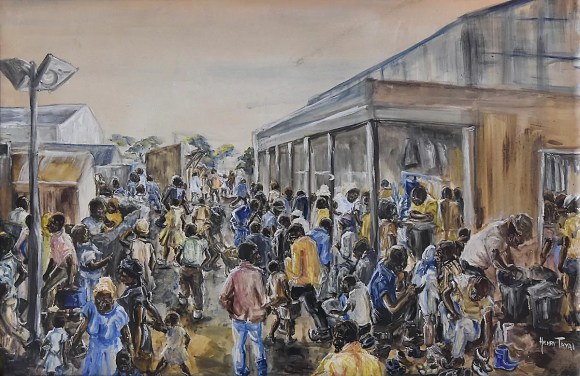
Art by Henry Tayali(1943-1987). From Public Domain

Let us imagine a world where wars have been outlawed and there is only peace. Is that even possible outside of John Lennon’s song? While John Gray, a modern-day thinker, propounds human nature cannot change despite technological advancements, one has to only imagine how a cave dweller would have told his family flying to the moon was an impossibility. And yet, it has been proven a reality and now, we are thinking living in outer space, though currently it is only the forte of a few elitists and astronomers. Maybe, it will become an accessible reality as shown in books by Isaac Asimov, Arthur C Clarke or shows like Star Trek and Star Wars. Perhaps, it’s only dreamers or ideators pursuing unreal hopes and urges who often become the change makers, the people that make humanity move forward. In Borderless, we merely gather your dreams and present them to the world. That is why we love to celebrate writers from across all languages and cultures with translations and writings that turn current norms topsy turvy. We feature a number of such ideators in this issue.

Nazrul in his times, would have been one such ideator, which is why we carry a song by him translated by Professor Fakrul Alam. And yet before him was Tagore — this time we carry a translation of an unusual poem about happiness. From current times, we present to you a poet — perhaps the greatest Malay writer in Singapore — Isa Kamari. He has translated his longing for changes into his poems. His novels and stories express the same longing as he shares in The Lost Mantras, his self-translated poems that explore adapting old to new. We will be bringing these out over a period of time. We also have poems by Hrushikesh Mallick translated from Odia by Snehprava Das and a poignant story by Sharaf Shad translated from Balochi by Fazal Baloch.

We have an evocative short play by Rhys Hughes, where gender roles are inverted in a most humorous way. It almost brings to mind Begum Rokeya’s Sultana’s Dream. Tongue-in-cheek humour in non-fiction is brought in by Devraj Singh Kalsi and Chetan Dutta Poduri. Farouk Gulsara and Meredith Stephens write in a light-hearted vein about their interactions with animal friends. G. Venkatesh brings in serious strains with his musings on sustainability. Jun A. Alindogan slips into profundities while talking of “progress” in Philippines. Young Randriamamonjisoa Sylvie Valencia gives a heartfelt account of her journey from Madagascar to Japan. Ratnottama Sengupta travels across space and time to recount her experiences in a festival recognised by UNESCO as an Intangible Cultural Heritage of Humanity. Suzanne Kamata brings a light touch again when she writes about robots serving in restaurants in Japan, a change that would be only fiction even in Asimov’s times, less than a hundred years ago!

Pijus Ash — are we to believe or not believe his strange, spooky encounter in Holland? And we definitely don’t have to believe what skeletons do in Hughes’ limericks, even if their antics make us laugh! Poetry brings on more spooks from Saranyan BV and frightening environmental focus on the aftermath of flooding by Snehaprava Das. We have colours of poetry from all over the world with John Valentine, John Swain, Ahmad Al-Khatat, Stephen Druce, Jyotish Chalil Gopinath, Jenny Middleton, Maria Alam, Ron Pickett, Tanjila Ontu, Jim Bellamy, Pramod Rastogi, John Grey, Laila Brahmbhatt, John Zedolik and Joseph K.Wells.

Fiction yields a fable from Naramsetti Umamaheswararao. Devraj Singh Kalsi takes us into the world of advertising and glamour and Paul Mirabile writes of a sleeper who likes to sleep on benches in parks out of choice! We also have an excerpt from Mohammed Khadeer Babu’s stories, That’s A Fire Ant Right There! Tales from Kavali , translated from Telugu by D.V. Subhashri. The other excerpt is from Swati Pal’s poetry collection, Forever Yours. Pal has in an online interview discussed bereavement and healing through poetry for her stunning poems pretty much do that.

Book reviews homes an indepth introduction by Somdatta Mandal to Banu Mushtaq’s Heart Lamp: Selected Stories, translated from Kannada by Deepa Bhasthi. We have a discussion by Meenakshi Malhotra on Contours of Him: Poems, edited and introduced by Malaysian academic, Malachi Edwin Vethamani, in which she concludes, “that if femininity is a construct, so is masculinity.” Overriding human constructs are journeys made by migrants. Rupak Shreshta has introduced us to immigrant Sangita Swechcha’s Rose’s Odyssey: Tales of Love and Loss, translated from Nepali by Jayant Sharma. Bhaskar Parichha winds up this section with his exploration of Kalpana Karunakaran’s A Woman of No Consequence: Memory, Letters and Resistance in Madras. He tells us: “A Woman of No Consequence restores dignity to what is often dismissed as ordinary. It chronicles the spiritual and intellectual evolution of a woman who sought transcendence within the rhythms of domestic life, turning the everyday into a site of resistance and renewal.” Again, by the sound of it a book that redefines the idea that housework is mundane and gives dignity to women and the task at hand.

We wind up the October issue hoping for changes that will lead to a happier existence, helping us all connect with the commonality of emotions, overriding borders that hurt humanity, other species and the Earth.

Huge thanks to our fabulous team, especially Sohana Manzoor for her inimitable artwork. We would all love to congratulate Hughes for his plays that ran houseful in Swansea. And heartfelt thanks to all our wonderful contributors, without who this issue would not have been possible, and to our readers, who make it worth our while, to write and publish.

Have a wonderful month!

Mitali Chakravarty

borderlessjournal.com

CLICK HERE TO ACCESS THE CONTENTS FOR THE OCTOBER 2025 ISSUE

.

READ THE LATEST UPDATES ON THE FIRST BORDERLESS ANTHOLOGY, MONALISA NO LONGER SMILES, BY CLICKING ON THIS LINK.

Categories
Essay

From Madagascar to Japan: An Adventure or a Dream?

By Randriamamonjisoa Sylvie Valencia

For as long as I can remember, I have been an introvert — this is who I am and will always be. Yet, few believe it. I come from Madagascar, a distant island where the people are called the Malagasy — a community bound by culture, tradition, and a shared sense of identity. Malagasy people are known for their warmth and generosity, often revealing a talkative side as they delight in conversation, and playful exchanges.  In contrast, I am reserved — a shy person who expresses myself freely only when comfortable and among those I trust.

As a child, I was the most talkative among my siblings, recounting every detail of my school day to my parents. I delighted in describing the funny expressions my primary school teacher made while explaining lessons, or the mischievous boys who always stuck their chewing gum on the pupils’ desks and all the tasks I had accomplished. I wanted my parents to know I was doing well, that the teacher praised me, and that I helped classmates who struggled.

Both my parents are very talkative, especially my father, from whom I inherited the gift of words. Speaking in front of my family comes naturally, yet in front of others, my words often falter — a fear that has always troubled me. I speak freely only with those I know well— my family and a few close friends.

Facing a large audience has always been daunting. My father encouraged me to confront this fear, to be confident, and to meet the audience’s gaze. I tried many times: presenting in group projects, speaking as a class representative, even addressing an audience at a classmate’s parent’s funeral.

As I grew older, my determination to overcome this fear grew. I devoured books and videos on public speaking, eager to communicate with confidence. My first real test came in 2018, when I delivered a speech in a Japanese language contest. I had loved Japanese language since childhood, captivated by its culture, and dreamed of becoming fluent. Entering the contest was a dream — an opportunity to speak publicly and a chance to win a trip to Japan.

I was guided by two close friends who practiced with me daily. They corrected my mistakes, offered feedback, and most importantly, encouraged me. Having known me for years, they understood how terrifying standing on stage could be, yet they supported me out of love, friendship, and belief in my potential.

During rehearsals, I gave my utmost effort, memorising the script when necessary. Still, doubts lingered about meeting expectations, conquering fears, and not disappointing those who believed in me. The days of practice passed quickly, and soon, the big day arrived. Nervous at first, I gradually became more at ease while speaking. I managed to control my anxiety but knew my performance was imperfect. I focused on each word, yet my mind occasionally went blank, struggling with the judges’ questions. Embarrassment washed over me; I feared I had let my friends and family down.

In the end, I did not win the first prize, but my closest friends congratulated me. They reminded me that the true milestone was stepping onto the stage, speaking in front of an audience, and maintaining composure. Their encouragement helped me realise that courage and effort mattered more than the outcome itself.

As an introvert, talking to strangers is challenging, let alone addressing a crowd. Hearing the words “public speaking” makes my stomach tighten, palms sweat, and heart race. Stage fright, fear of facing many people and sharing my thoughts has always been real. Each time my name is called, I shake, my mind blanks, heart pounds, mouth dries, and confidence seems to vanish before I start. Yet, I have never lost hope. Deep down, I knew a strength within me would help rise above fear and grow into a better version of myself.

One year later, I stood again in the same contest. This annual competition was a goal I refused to let go of. As before, my friends encouraged, pushed, and trained with me every day until the D-day. Their support gave me the strength to continue. I prepared even more fiercely — joining language clubs and volunteering in storytelling activities. But it was not easy. I never felt comfortable speaking or working with strangers. I was told teamwork required discussion, sharing, and collaboration — a nightmare for an introvert.

Solitude had been my ally, yet suddenly, I was surrounded by people of all ages and personalities. Cooperation was no longer optional. However, through this challenge, I discovered an important truth: whether introverted or extroverted, whether silent or talkative, we must learn to connect with others. Survival and growth depend on collaboration and support.

The big day of the speech contest arrived in May, a season of transition between summer and winter. I arrived at the hall just in time, accompanied by a close friend. A staff member guided me to my seat, only a few meters from the judges. I felt cheerful, and calm, even giving a fist bump to nearby contestants. For the first time, I felt truly ready to give a speech — optimistic, and at peace. Perhaps it was the preparation or my friends’ wholehearted support, or maybe I had begun to trust myself.

There were four contestants in the advanced level, and I was the last to speak. Each of us hoped to win the grand prize — a trip to Japan. I did not worry about the others. I believed in my success and was determined to win first place. Just days before, I even dreamed of visiting Japan, so nothing could stand in my way.

Finally, it was my turn. I adjusted the microphone, greeted in Japanese, and bowed to the judges and audience. I spoke for about five minutes on how Malagasy parents raise children. Three judges asked each two questions. Thanks to countless practice hours and mock questions and answers sessions with my best friends, I answered every tricky question. For the first time, right after my speech, I felt like a winner.

The event lasted about three hours, and the final verdict came. The Master of Ceremonies announced winners, starting with the beginner level, then the advanced. Among the four in my category, only two remained. The Master of Ceremonies paused dramatically before announcing the first-place winner… and pronounced my name. I whispered a silent thanks to God. This result — the goal I had worked so hard for — had become reality. The trip to Japan was the reward, and even more importantly, I had overcome stage fright. I spoke naturally and confidently in front of the audience — another milestone achieved.

Later that year, in 2019, I visited Japan for the first time. The experience was magical. I met wonderful people, explored my favorite country, and fulfilled a long-cherished dream.

Six years later, I returned to the Land of the Rising Sun—this time as an international student. I now live in Tokushima prefecture, which is in southeastern Japan, far from the bustling cities, in a quiet countryside where few tourists venture. Yet, the city and its neighbourhoods are simply wonderful. It is peaceful, surrounded by greenery, and while the locals may seem reserved, they are incredibly welcoming. Even with some grasp of the local language, adapting to a new country as a foreigner is challenging. Still, thanks to the support of my seniors and friends who have lived here for years, I managed to navigate my first six months successfully.

The city where I live hosts an annual Japanese speech contest open to foreigners who have been residing here for some time. I was encouraged to participate, partly because I could speak some Japanese, and partly because it was a great chance to gain experience. I thought, why not? After all, I gradually grew more comfortable speaking in front of others.

This time, participants could choose their own topics, though it was suggested to focus on their experience in Japan or explore cultural connections between their home country and Japan. I was eager to participate, but selecting a topic was harder than I expected. Inspiration felt scarce, and I had no clear direction. Still, I knew that finding my own perspective was key to making the speech meaningful.

Overwhelmed by my studies, I barely noticed the passage of time. Before I knew it, the deadline had arrived. I had not written a single word, though ideas swirled in my mind. I opened my laptop, took a deep breath, and began writing everything that came to my mind. Reflecting on my experiences in Japan, I realised that people often struggled to pronounce my name correctly. That inspired me to talk about the hidden culture behind Japanese and Malagasy names.

With my theme set, I focused on making my speech coherent and captivating. I tend to draw inspiration at the last minute. I wrote, rewrote, and proofread repeatedly, staying up all night without noticing morning approaching.

Finally, I finished my manuscript and emailed it to one of my Japanese teachers to check for grammatical errors. She responded immediately, and her quick proofreading allowed me to submit my speech on the deadline. I felt relieved, yet strangely nervous, a sensation I could not quite describe.

Six years have passed since I last spoke in front of an audience. Preparing another speech made me feel nostalgic, bringing back memories of long rehearsals, the advice of my best friends, and countless sleepless nights.

A month after submitting my manuscript, I received an email from the event organizer announcing my selection. I was among the fourteen candidates chosen to compete. I whispered a quiet “wow,” but doubts immediately surfaced. I had two months to prepare. To understand what awaited me, I watched recordings of previous competitions, while my seniors and Japanese teacher helped me refine my speech.

Four students were selected from my university. The other three were Asian students with extensive experience in Japanese language and culture. They read Kanji (Japanese characters)effortlessly and conversed naturally. And then, there was me. Though I had been exposed to Japanese language and culture since childhood, memorising every character reading and grasping dialects was never easy. Back in my country, despite growing interest in Japanese language and culture, opportunities to use it in daily life remain limited. Once again, I faced a new challenge—this time in the Land of the Rising Sun.

Time flew, and soon the two months of preparation had passed. Finally, the big day arrived. Early that morning, a kind university staff member greeted us with a bright smile. As I descended from my dormitory, I saw her waiting by her car near the main gate, bowing politely. Her excitement was palpable. Three of us rode in her car; she asked about our preparations and told jokes, perhaps to ease our nerves, which were all visible.

After twenty minutes, we arrived at a large building and walked up to the fifth floor through corridors decorated in traditional style. Japanese architecture and design have always fascinated me, and I was struck by their beauty once again. The event hall was medium-sized, with a small table at the entrance holding our name tags.

One by one, the other candidates arrived. We were then led to a smaller room for a preparatory meeting. While waiting, we chatted briefly to get to know one another. The competition began in the early afternoon. We were instructed to enter the hall one by one, greeted with warm applause. Observing the other candidates, I could tell they were ready. Fourteen contestants competed in total. Thirteen were Asians from countries including China, Vietnam, India, Indonesia, the Philippines, Taiwan, Sri Lanka, and Thailand. I was the only African, from a distant country few people knew. Before each speech, the Master of Ceremonies shared a brief anecdote about the candidate’s country, offering the audience a glimpse into its culture. Each contestant then delivered a five-minute speech.

There were two types of awards: the Golden Prize for first and second place, followed by four Silver Prizes. I had hoped to place among the top five while preparing my speech.

As I listened to the first three candidates, I was deeply impressed. Their speeches were powerful, emotional, and delivered with near-native fluency. I was surprised by how advanced and impressive their speaking skills were. I was the sixth speaker. Perhaps it had been so long since I last addressed an audience, or perhaps it was the absence of my closest friends but standing alone in a foreign country in front of strangers was overwhelming. My hands trembled. When my name was announced, I feared I might not endure those five minutes on stage.

Still, I stood before hundreds of people. I bowed, held the microphone firmly, and began. My heart raced and sweat ran down my face and back. Gradually, the pressure eased. When I shared the example of the longest name in the world—from my country, the audience reacted with surprise and amusement. I realised how attentive they were and regained inner calm. Although I forgot one line, I finished my speech smoothly and expressively.

The remaining eight candidates were equally impressive. Their eloquence was such that, with eyes closed, one might mistake them for native speakers. It was the highest-level contest I had ever participated in. Each theme and presentation were unique, and every contestant spoke with confidence. I doubted whether I would receive a prize, but reassured myself that even without one, the experience was worthwhile. Most participants had lived in Japan for over three years, and the Chinese and Taiwanese contestants were especially strong in oral expression. Yet, standing among such talented competitors was an honor.

After a break that was supposed to last twenty minutes but stretched to fifty, results were announced. They began with six Encouragement Prizes. I thought I might be among them, but my name was not called. Two more awards followed, still not mine. A friend nudged me, whispering, “Congratulations!” I replied, “Stop joking. Congratulations to you instead!”

Finally, the Silver Prizes were announced. They first called my country, then my name. The applause and cheers overwhelmed me, and tears welled in my eyes. I had not expected to win a Silver Prize, given the competition’s level. One friend from my university won the Golden Prize, and the second Golden Prize went to a Vietnamese contestant.

Participating in such a high-level competition was a tremendous challenge. Every step—from manuscript preparation to standing on stage—pushed me beyond my comfort zone. Yet, when it was over, I felt immense pride. I had once again delivered a speech before a large audience, this time in the country whose language I had cherished for years.

Though I had been nervous, the audience remained unaware. Their attentive expressions and warm applause carried me through. Afterwards, my Japanese teachers praised my performance, saying I had done exceptionally well. In that moment, I realised every hour of preparation, every doubt, and every fear had been worthwhile. I had faced a formidable challenge, stood my ground, and expressed myself fully, a reminder that courage, practice, and determination can transform daunting experiences into triumphs. It is a memory I will treasure forever.

.

Randriamamonjisoa Sylvie Valencia is from Madagascar and is currently studying in Japan as a trainee student. She enjoys reading, writing, listening to music, and traveling to explore new cultures.

PLEASE NOTE: ARTICLES CAN ONLY BE REPRODUCED IN OTHER SITES WITH DUE ACKNOWLEDGEMENT TO BORDERLESS JOURNAL

Click here to access the Borderless anthology, Monalisa No Longer Smiles

Click here to access Monalisa No Longer Smiles on Kindle Amazon International

Categories
Poets, Poetry & Rhys Hughes

His Unstable Shape

Most of us know that Humpty Dumpty was a large sentient egg who liked to sit on walls despite his unstable shape. He fell off and was broken and that is all that is certain about his life. Various apocryphal stories have become associated with him since his accident. Some people insist he was a philosopher as well as an egg. Others claim he invented a new emotion quite unlike any other emotion in the history of the world, but they are unable to describe what it might feel like. One professor has insisted that he was not an egg but the hull of an alien spacecraft from a distant star or a time machine from the future.

My aim today is not to add to this unhappy catalogue of fictions. I have no tales to tell about the kinds of antics he performed, nor can I offer insights into his character, beliefs or aspirations. Instead, I wish to ponder something that is talked about too seldom. If Humpty Dumpty was an egg, what thing would have hatched out of him? Had his shell not been shattered by an external force, we may assume it would have been broken by an inner one, for the ovoid stage of his existence could only be brief and something within must have emerged to escort his identity further along the path of natural development.

No forensic evidence was collected in the wake of his death and our speculations remain purely notional. Yet I think it is possible to construct a plausible scenario using inductive logic alone. First, we must attempt to establish what kind of egg he was, reptilian, amphibian or avian. One clue is his propensity for sitting on the tops of walls. It is true that lizards are accomplished wall climbers but they tend to cling to the sides rather than dominate the summits. Amphibians have no interest in walls that are not made of water and while they might congregate at waterfall tops they are disinclined to balance on narrow brick ledges.

There is always the possibility that he was the egg of some organism hitherto unknown on the surface of our world, that he might have come from outer space, from subterranean realms or an alternative dimension. But there is no need to multiply entities beyond necessity and without evidence to point us in that direction, it is safer to continue to assume that he was the egg of a phylum familiar to our zoologists. Personally, I favour the avian origin as the most realistic. Birds are constantly perching on our walls and sometimes they fall off too, when icy winds howl or rascals in the neighbourhood acquire new catapults.

Most of us are familiar with impetuosity and impatience. We might be reckless individuals ourselves or have friends and relations who embody the blurred spirits of haste and risk. Humpty was eager to become the bird he was destined to be, whatever kind it was, so keen in fact that he acted prematurely. Instead of remaining in the nest, wherever that was located, he left it and engaged in activities that were too old for him. He perched on walls, yes indeed, but perching high safely is the prerogative of those with wings. He was an egg and probably ignorant of the laws of physics. His fall was almost a foregone conclusion.

Now it is appropriate to turn our attention to the kind of bird he would have become if circumstances had been different. He was a large egg, one sizeable enough to hold audible conversations with human interlocutors[1], so we may immediately dismiss the vast majority of our feathered friends as candidates. This leaves us with the ostrich, the rhea, the moa, and that extraordinary bird from the island of Madagascar, Aepyornis maximus, so enormous that it inspired the fable of the roc, the bird that swooped down to seize elephants in its talons. No sentient examples of these birds’ eggs have been found, however, which is a pity.

All those birds are based in remote countries, and we are compelled to wonder how an individual egg might cross the oceans that separate these species’ homelands from our own, for it was in England that Humpty had his crisis and those birds are flightless. The ostrich and rhea are too small anyway, and the others went extinct before Humpty existed. The more we consider the matter, the less likely it appears that he was the egg of a bird known to science. Thus, we draw the conclusion that he was the egg of an undiscovered bird. What might the bird have been like? Because there are no clues there is no reliable answer to this.

But there is one solution that has an elegant absurdity about it and for that reason alone I am inclined to favour it. Some years ago, I happened to be strolling through the city of Cologne. I stopped in order to check the time on my wristwatch, for I am one of those unfortunate fellows who are unable to read numbers and dials while on the move. As I lifted my wrist to my face, a dull but loud creaking above my head made me fear that an object was about to fall on me. I looked up. It was a cuckoo clock fixed to the exterior wall of an old clock shop, one of the largest cuckoo clocks in the world. And it was striking the hour.

The hatch doors were opening, ponderously and painfully, and when they were fully agape the monstrous cuckoo came out. It emerged with a great deal of mechanical effort on an extendable trellis that sagged at its furthest reach. Then the cuckoo widened its beak and after an unsettling pause gave forth a cry of astonishingly dismal cadence. It repeated this sound three times to indicate that the local time was three o’clock in the afternoon and then, as exhausted as a senescent gran, it withdrew into its sanctuary, the hatch doors slamming behind it and the whirring of internal cogs ceasing as abruptly as they had begun.

I was astonished and affronted. I felt an outrage had been committed against my consciousness, that this clock was an insult to public decency, and I found myself wishing some other bird occupied the clock instead of an unmusical cuckoo. And it occurred to me that a different bird had once done so. Certainly, it must. We all know the cuckoo’s life cycle. It hatches in a nest not its own and destroys the other eggs in order to be the solitary recipient of all the attention from the bereaved parents. If cuckoos occupy clocks, then it logically follows that some other bird once lived in them. A bird of magic. But probably not a phoenix.

What bird lived in the clock before the cuckoo? This question is the key to understanding Humpty Dumpty’s true identity. That is what I now believe, at any rate. Somewhere in this peculiar world of ours the decayed remains of a cuckoo clock may be found, a cuckoo clock vaster by many orders of magnitude than the one I saw in Cologne. The bird that was its original occupant was the one who laid Humpty Dumpty and eggs similar to him. A cuckoo invaded the nest and left an egg that hatched first and rolled out the others. Humpty Dumpty did not break on that occasion. The start of his life was a rehearsal for his death.

[1] See Alice Through the Looking Glass for more details.

Rhys Hughes has lived in many countries. He graduated as an engineer but currently works as a tutor of mathematics. Since his first book was published in 1995 he has had fifty other books published and his work has been translated into ten languages.

.

PLEASE NOTE: ARTICLES CAN ONLY BE REPRODUCED IN OTHER SITES WITH DUE ACKNOWLEDGEMENT TO BORDERLESS JOURNAL

Click here to access the Borderless anthology, Monalisa No Longer Smiles

Click here to access Monalisa No Longer Smiles on Kindle Amazon International

Categories
Excerpt

Poetry of Love & Longing by Abhay K

Title: Monsoon: A Poem of Love and Longing

Author: Abhay K

Publisher: Sahitya Akademi

1

I wake up with your thoughts

your fragrance reaching me                           1

all the way from the Himalayas

to the island of Madagascar

.

brought by monsoon

from the blessed Himalayan valley                 2

to the hills of Antananarivo[1]

on its return journey

.

I dream of you every night, the shimmering dawn

snatches my dreams but the morning breeze comes  3

whispering your name, permeating my being

with your thoughts, only your thoughts, my love

.

I’m far away in this Indian Ocean island

yearning for your touch, gazing at the Moon,         4

Venus and myriad star constellations,

hoping you’re gazing at them too

.

I wait for the monsoon to be born[2]

to send you sights, sounds and aroma                   5

of this island, redolent of vanilla, cloves,     

Ylang-ylang[3] and herbs of various kinds

.

O’ Monsoon, wave-like mass of air,

the primeval traveller from the sea                    6

to the land in summer, go to my love

in the paradisiacal Himalayan valley

.

for eons you’ve ferried traders across the Indian Ocean,

guided the legendary Sinbad and Vasco da Gama    7

and brought wealth and joy to millions,

your absence, alas, brings famine and death

.

the bounty of Indra[4] offered through rains

at times just a spell of scattered showers,       8

at times unceasing torrents for days at a stretch

whetting passion of lovers with your thunder-drums

.

lovesick and far away from my beloved,

I beseech you to take my message to her                9

along with amorous squeals of Vasa parrots[5],

reverberating songs of Indri Indri[6]

.

the sound of sea waves crashing on coral beaches

mating calls of the Golden Mantellas[7]              10

mellifluous chirps of the Red fody

sonorous songs of the Malagasy Coucal

.

the sight of ayes-ayes[8] conjoined blissfully

at midnight in Masoala rainforests             11

fierce fossas[9] mating boisterously at Kirindy

colourful turtles frolicking in the Emerald Sea

.

yellow comet moths swarming Ranomafana[10]

Radiated tortoises carrying galactic maps        12

Soumanga sunbirds sipping nectar

white Sifakas[11] dancing in herd

.

ring-tailed lemurs feasting on Baobab[12] flowers

Vasa parrots courting their mates                  13

painted butterflies fluttering over fresh blossoms

blooming jacarandas painting the sky purple

.

Traveller’s palms[13] stretching their arms in prayer

Baobabs meditating like ascetics turned upside down  14

Giraffe-necked red weevils[14]  necking their mates

fragrant Champa flowers—galaxies on the earth

.

colourful Mahafaly tombs[15] dotting the countryside

erotic Sakalava sculptures[16] arousing longings in mind,   15

innumerable sculpted rock-temples at Isalo[17]

each one a homage to Lord Pashupatinath[18]

.

the rich dialect of the old Gujarati

still spoken here with great zeal,             16

O’ Monsoon, I urge you to carry these

to my love in the pristine Himalayan valley

.

as you glide over the Indian Ocean gently

caressing her curvaceous body,              17

the humpback whales will amuse you

with their mating songs

About the Book

Monsoon is a poem of love and longing that follows the path of monsoon which originates near Madagascar and traverses the Indian Ocean to reach the Himalavas and back to Madagascar. As monsoon travels, the rich sights and sounds, languages and traditions, costumes and cuisine, flora and fauna, festivals and monuments, and the beauty and splendour of the Indian Ocean islands and the Western Ghats, East and North India, Bhutan, Nepal and Tibet are invoked. The poem weaves the Indian Ocean Islands and the Indian Subcontinent into one poetic thread connected by monsoon, offering an umparalleled sensuous experience through strikingly fresh verses which have the immense power to transport the readers to a magical world.

About the Author

Abhay K is the author of nine postry colfections including The Magic of Madagascar (1’Harmattan Paris, 202 I), The Alphabets of Latin America (Bloomsbury India, 2020), and the editor of The Book of Bihari Literature (Harper Collins, 2022), The Bloomsbury Anthology of Great Indian Poems, CAPITALS, New Brazilian Rems and The Bloomsbury Book of Great Indian Love Poems. His poems have appeared in over 100 literary journals. His “Earth Anthem” has been translated into over 150 languages. He received SAARC Literary Award 2013 and was invited to record his poems at the Library of Congress, Washington, D.C. in 2018. His translations of Kalidasa’s Meghaduta (Bloomsbury India, 2021) and Ritusamhara (Bloomsbury India, 2021) from Sanskrit have won KLF Poetry Book of the Year Award 2020-21.


[1] Antananarivo is the capital of Madagascar

[2] Monsoon is born in the Mascarene High near Madagascar.

[3] Ylang-ylang is a tropical tree valued for perfume extracted from its

flowers

[4] Indra is the rain god in Hindu mythology.

[5] Vasa parrots are grey-black parrots endemic to Madagascar notable for

their peculiar appearance and highly evolved mating life.

[6] Indri Indri is the largest species of surviving lemur. It is critically

endangered.

[7] Mantellas are Madagascar’s golden or multi-coloured poison frogs.

[8] Aye-aye is a long-fingered species of lemur active at night.

[9] Fossas are the largest predators endemic to Madagascar.

[10] Ranomafana is a rainforest located to the southeast of Antananarivo in

Madagascar.

[11] Sifaka is a critically endangered species of lemurs also known as the

dancing lemurs.

[12] Baobab is a deciduous tree that grows in the arid regions of Madagascar.

Out of eight species of Baobab, six are endemic to Madagascar. They live

for thousands of years and are also known as the tree of life.

[13] Native to Madagascar, the Traveller’s Palm has enormous leaves which are

fan shaped.

[14] Giraffe-necked red weevil is a bright-red-winged, long-necked rainforest

beetle that uses its extended neck to battle for a mate.

[15] The Mahafaly people of Madagascar honour their dead by creating

imposing tombs.

[16] Sakalava sculptures, usually wooden nude female and male figures, adorn

the tombs of Sakalava Chiefs.

[17] Isalo is a national park in south Madagascar known for its natural rock

massif.

[18] Pashupatinath is another name of Lord Shiva.

Click here to read Abhay K’s interview

PLEASE NOTE: ARTICLES CAN ONLY BE REPRODUCED IN OTHER SITES WITH DUE ACKNOWLEDGEMENT TO BORDERLESS JOURNAL. 

Click here to access the Borderless anthology, Monalisa No Longer Smiles