Ghosts have been interpreted as frightening, funny, gory or weird. In this collection, we bring to you some ghostly meanderings from our pages, not written by ghosts but written about ghosts or spooky encounters that are philosophical (occasionally), funny and weird.
With enough horrors in the real world around us, we decided to focus more (not fully) on the comedic and explore horror from the perspective of fun with hopefully a cathartic impact, which will deviate our minds from realities like war, hunger and climate change. Some of the tellings may be just spooky… some claim to be real encounters… are they scary or funny? Read and find out…
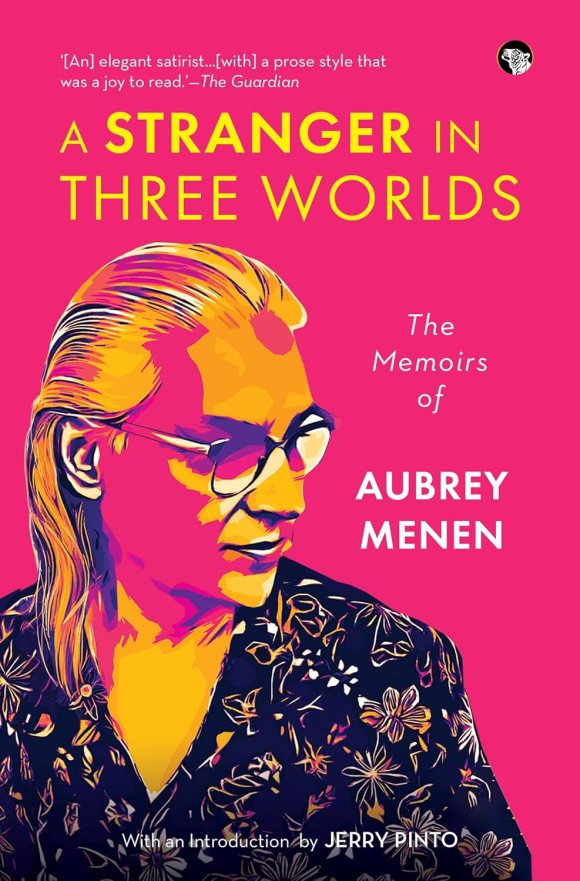
Title: A Stranger in Three Worlds: The Memoirs of Aubrey Menen
Author: Salvator Aubrey Clarence Menen
Publisher: Speaking Tiger Books
Salvator Aubrey Clarence Menen (April 22, 1912 – February 13, 1989) was a British author, novelist, satirist, and theatre critic. Born in London to Irish and Indian parents, he studied at University College, London, before becoming a drama critic and stage director. During World War II, he was in India, organising pro-Allied radio broadcasts and editing film scripts for the Indian government.
After the war, he returned to London and worked in an advertising agency’s film department, but the success of his debut novel, The Prevalence of Witches (1947), led him to write full-time. Menen’s satirical works explore themes of nationalism and the cultural contrast between his Irish-Indian heritage and his British upbringing.
Menen, a remarkably gifted author who frequently goes unnoticed, adeptly delves into the intricate themes of identity, nationality, and the sense of belonging. He does so with his signature blend of irony and profound insight in his two acclaimed autobiographical pieces. A Stranger in Three Worlds: The Memoirs of Aubrey Menenis an exceptional autobiographical account that spans multiple continents. Menen’s writing is noted for its irony, insight, and a nuanced exploration of themes such as belonging and the quest for the self in a multicultural context.
Menen’s life narrative is defined by his experience as an outsider, or a ‘stranger,’ within the three distinct cultures of England, Ireland, and India. This position of being an outsider enables him to keenly observe and critique the social and cultural norms prevalent in each society with remarkable clarity and humor.
The memoir explores the inherent tensions and contradictions that arise from possessing multiple, often conflicting, identities, as well as the difficulties of establishing a coherent sense of self when one does not entirely belong to any particular group.
The book’s narrative style is marked by irony and a keenly humorous outlook on the absurdities of the social conventions and biases he encounters across these cultures. His insights are both deeply personal and widely relatable, resonating with anyone who has navigated the complexities of multicultural or diasporic identity.
The essays featured in Dead Man in the Silver Market, originally published in 1953, analyse themes of jingoism, social class, and the absurdities associated with national pride, intertwining personal stories with sharp social critique.
Written shortly after World War II, his irreverent insights into English society, colonial history, and human nature continue to resonate powerfully in contemporary discourse. ‘The Space within the Heart’, authored in 1970, presents a more personal and philosophical exploration of existence, love, and self-awareness.
Infused with humour and gentle satire, it contemplates the essence of the soul, drawing from the Upanishads and European literary traditions. Menen’s seemingly straightforward yet deeply impactful writing encourages readers to transcend rigid identities and appreciate the fluidity inherent in the human experience.
With an introduction by Jerry Pinto, this omnibus edition functions as a memoir, offering personal reflections and experiences, while simultaneously serving as a critique of imperialism, examining its impacts and consequences.
Furthermore, it thoroughly explores the intricacies of identity, rendering it an exceptional piece of literature that is both informative and captivating, prompting readers to engage in deep reflection on its themes.
.
Bhaskar Parichha is a journalist and author of Cyclones in Odisha: Landfall, Wreckage and Resilience, Unbiased, No Strings Attached: Writings on Odisha and Biju Patnaik – A Political Biography. He lives in Bhubaneswar and writes bilingually. Besides writing for newspapers, he also reviews books on various media platforms.
.
PLEASE NOTE: ARTICLES CAN ONLY BE REPRODUCED IN OTHER SITES WITH DUE ACKNOWLEDGEMENT TO BORDERLESS JOURNAL
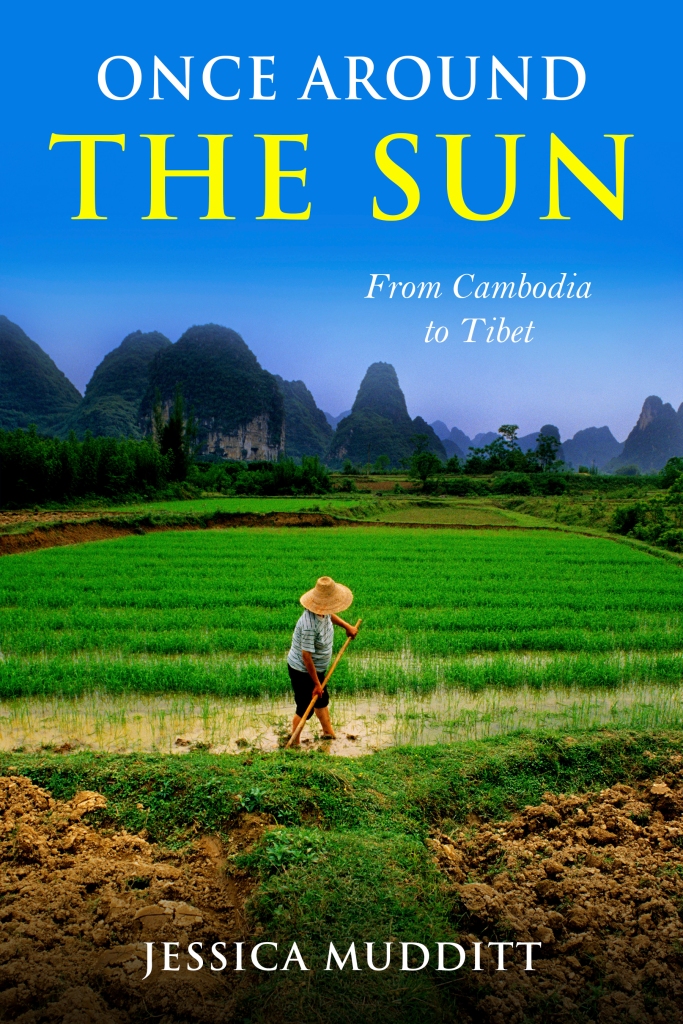
A brief overview of Once Around the Sun : From Cambodia to Tibet (Hembury Books) by Jessica Mudditt and a conversation with the author
Jessica Mudditt
Jessica Mudditt’s Once Around the Sun: From Cambodia to Tibet is not just a backpacker’s diary but also her need to relate to humanity, to find friendships and even love, as she does with Kris, a photographer named after Krishna, the Hindu god, because his parents while visiting India fell in love with the divinity!
The Burmese translation of Our Home in Myanmar was published recently.
Hurtling through Cambodia, Vietnam, China, Tibet, young Mudditt concludes her narrative just at the brink of exploring Nepal, India and Pakistan in her next book… leaving the reader looking forward to her next adventure. For this memoir is an adventure that explores humanity at different levels. Before this, Mudditt had authored Our Home in Myanmar – Four years in Yangon, a narrative that led up to the Myanmar attack on Rohingyas and takeover by the military junta. Once Around the Sun: From Cambodia to Tibet is the first part of a prequel to her earlier book, Our Home in Myanmar, both published by her own publishing firm, Hembury Books.
What makes her narrative unique is her candid descriptions of life on a daily basis — that could include drunken revelry or bouts of diarrhoea — while weaving in bits of history and her very humane responses. Her trip to Angkor Wat yields observations which brings into perspective the disparities that exist in our world:
“I was gazing out at an empire that was once the most powerful and sophisticated in the world. In 1400, when London had a middling population of 50,000, the kingdom of Angkor had more than a million inhabitants and a territory that stretched from Vietnam to Brunei. It had flourished for six hundred years, from the ninth to the fifteenth centuries.
“But somehow Cambodia had become one of the world’s poorest countries, and surely the most traumatised too, following a recent war and genocide. I knew that when we came back down to the ground, there would be a collection of ragtag street kids and downtrodden beggars desperately hoping for our spare change. It was difficult to reconcile the grandeur of Cambodia’s past with its heart-breaking present in the twenty-first century. How did a country’s fortunes change so dramatically? Could the situation ever be turned around?”
How indeed?
Then, she writes of Vientaine in Vietnam:
“I was struck by the fact that sex work seemed to be the consequence for countless young women living in poverty. It made me angry, but mostly sad.”
In these countries broken into fragments by intrusions from superpowers in the last century, judged by the standards of the “developed countries” and declared “underdeveloped”, an iron rice bowl becomes more important to survive than adventure, discovering other parts of the world or backpacking to self-discovery. Travel really is the privilege of that part of the world which draws sustenance from those who cannot afford to travel.
Jessica showcases mindsets from that part of the Western world and from the mini-expat world in Hong Kong, which continue alienated from the local cultures that they profess to have set out to explore or help develop. One of the things that never ceases to surprise is that while the ‘developed’ continue to judge the ‘third world’, these countries destroyed by imposed boundaries, foreign values, continue to justify themselves to those who oppress them and also judge themselves by the standards of the oppressors.
Some of these ‘developing’ countries continue to pander to needs of tourism and tourists for the wealth they bring in, as Jessica shows in her narrative. She brings out the sharp differences between the locals from Asia and the budgeted backpackers, who look for cheap alternatives to experience more of the cultures they don’t understand by indulging in explorations that can involve intoxicants and sex, their confidence backed by the assurance that they can return to an abled world.
Backpackers from affluent countries always have their families to fall back on — opulent, abled and reliable. Mudditt with her candid narrative explores that aspect too as she talks of her mother’s response to her being sick and budgeting herself. Her mother urges her to cut short her trip. But she continues, despite the ‘adversities’, with an open mind. That she has a home where she can return if she is in any kind of trouble begs a question — what kind of ‘civilisation’ do we as humans have that she from an abled background has a safe retreat where there are those for whom the reality of their existence is pegged to what she is urged to leave behind for her own well-being? And why — as part of the same species — do we accept this divide that creates ravines and borders too deep to fathom?
Mudditt with her narrative does create a bridge between those who have plenty and those who still look for and need an iron rice bowl. She mingles with people from all walks and writes about her experiences. Hers is a narrative about all of us –- common humanity. Her style is free flowing and easy to read — quite journalistic for she spent ten years working as one in London, Bangladesh and Myanmar, before returning to her home in Australia in 2016. Her articles have been published by Forbes, BBC, GQ and Marie Claire, among others. This conversation takes us to the stories around and beyond her book.
What led you to embark on your backpacking adventure? Was it just wanderlust or were you running away from something?
It was primarily from wanderlust, but I also didn’t know what I was going to do with the rest of my life. After six years at university, I was still yet to have any particular calling. However, I was also glad I didn’t know. It meant that I was free to go and explore the world, because I wasn’t putting my career on hold. I had no career.
I also had a broken heart when I set off for Cambodia – but the trip was planned before that relationship had even begun. But again, part of me was glad that my boyfriend had called it quits, because my plan was to be away for a very long time (and it ended being a decade away).
What made you think of putting down your adventures in writing? As you say, this is a prequel to your first book.
It was the pandemic that made me realise that backpacking was really special. There was a period in 2020 when it looked like travel may never be so unrestricted again, so it motivated me to document my year of complete freedom. It was also before social media was even a thing. When I was lost, I was really lost, and I had to use my problem-solving skills.
Prior to the pandemic, I sort of thought that backpacking itself was too fun to write about. I hadn’t actually lived in any of the countries I visited – I was just passing through. But that is also a valid experience, and one that many people can fondly relate to. There were also some really confronting and difficult moments.
You have written of people you met. How have they responded to your candid portrayals? Or did you change their names and descriptions to convey the essence but kept your characters incognito?
While I was writing the book, I got back in touch with the people I travelled with – I can thank Facebook for still being in touch with most people mentioned. They helped me to remember past anecdotes and I got some of the back story of their own trips. I have only used first names to protect their privacy, although there are some photos in the book too. Thankfully the world is so big that the odds are small that anyone would recognise, say, an Irish guy from Adam in Vietnam in 2006! Clem from Shanghai has just sent me a photo of her with my book, and Romi from Vietnam actually came to my book launch, which was awesome.
What was your favourite episode in this book — as a backpacker and as a writer? Tell us about it.
I think it was crossing into China and meeting ‘the man.’ I felt so alive with every step I took into China after crossing over on foot from Vietnam. To be chaperoned in the way I was – without being able to communicate a single word – was unusual. His kindness left me speechless, so the anecdote has a nice story arc.
In your travels through China, you faced a language handicap and yet found people kind and helpful. Can you tell us a bit about it?
I foolishly underestimated the language barrier. It was profound. In Southeast Asia, there was always at least a sprinkling of English, and I sort of just assumed that I’d be fine. I entered China from Vietnam, so my first port of call was Nanning, where there is not even really an expat population. I couldn’t do the most basic things, from finding the toilet or an internet cafe or something to eat! I used sign language and memorised the Chinese character for ‘female’ to make sure I went into the right toilet! In a restaurant, I just pointed at whatever someone else was eating in the hope that they would bring me a bowl of whatever it was. There were times when I was seriously lost and lonely, but I ended up staying in China for two months and saw the comedic side. I was bumbling around like Mr Bean (who is hugely popular in China).
I met a lot of people who were really kind to me, and I was just so grateful to them. I didn’t have Wi-Fi on my phone back then, so getting lost in a massive city in China was a bit scary. I met a student called Mei-Xing who ‘adopted’ me for a few days in Guilin. We had a really nice time together and it was so great to hang out with a local.
What is/are the biggest takeaway/s you had from your backpacking in this part of the world? Tell us about it.
I think it’s something quite simple: the world can be a very beautiful place, and a very polluted place. Tourism can do a great deal of damage when there are too many people clambering over one area. There is also an incredible level of disparity in a material sense on our planet. Some humans are travelling into space on rockets. Others are pulling rickshaws, as though they are draught horses. It is profoundly inequitable.
Having travelled to large tracts of Asia, what would you think would be the biggest challenge to creating a more equitable world, a more accepting world? Do you think an exposure to culture and history could resolve some of the issues?
I think that democracy is key. It slows us down and forces us to act in the interest of the majority, not the top-level cronies. That is definitely also something I witnessed in Myanmar. When a few people hold all the power, the population is deprived of things that ought to be a human right.
I think that travel definitely alters your perspective and broadens your mind, and it is something I’d recommend to anyone. Realising that the way that things are done in your home country is not the only way of doing things is a valuable thing to learn.
Mostly, you met people off the street. In which country did you find the warmest reception? Why and how?
In Pakistan. The hospitality and friendliness was unparalleled. I think it was in part due to not having many tourists there. Nothing felt transactional. I met some fascinating people in Pakistan who would have a profound impact on my own life. I am still in touch with several people I met there.
At a point you wondered if the poverty you saw could be reversed back to affluence in the context of the Angkor kingdom. Do you have any suggestions on actually restoring the lost glory?
I believe that it is beginning to be restored. Pundits have called this the “Asian Century.” I am convinced that the United States and the UK are in decline, and this process will only speed up. India, to me, holds the most promise as the next superpower, because it is a democracy (albeit flawed – like all of them), English- speaking, enormous, beautiful, fascinating and its soft power is unmatched. China is facing headwinds. I blame that on making people sad by removing their agency.
How long were you backpacking in this part of the world? Was it longer than you had intended? What made you extend your stay and why?
My trip was exactly 365 days long. I planned it that way from the beginning. I wanted to travel for no less than a year (more than a year and I might stay feeling guilty for being so indulgent!). That is also why the book is called Once Around the Sun – my time backpacking was the equivalent of one rotation of the Earth. I set off on 1 June 2006 – the first day of winter in Australia – and I arrived on 1 June 2007 in London, on the first day of the British summer. I love the sunshine.
After having travelled around the large tracts of Asia and in more parts of the world, could you call the whole world your home or is it still Australia? Is your sense of wellbeing defined by political boundaries or by something else?
Home for me is Sydney. I absolutely love it. I get to feel as though I am still travelling, because my home city is Melbourne. I go down a new road every other day and I love that feeling. The harbour is beautiful, and the sun is shining most days. It’s very multicultural too.
My kids are three and five, so I haven’t travelled overseas for years. My plan is to travel with them as much as possible when they are a bit older. I hope they love it as much as me. I cannot wait to return to Asia one day. I am also desperate to visit New York City.
What are your future plans for both your books and your publishing venture?
The second part of Once Around the Sun will come out in 2025. It’s called Kathmandu to the Khyber Pass, and it covers the seven months I spent Nepal, India and Pakistan.
My goal is to complete my fourth memoir by 2027. It will be called My Home in Bangladesh (it will be the prequel to Our Home in Myanmar!).
My fifth book will be about how to write a book. I am a book coach and in a few years I will have identified the most common challenges people face when writing a book, and finding their voice.
In the next twelve months, there will be at least 12 books coming out with Hembury Books, which is my hybrid publishing company. I love being a book coach and publisher and I hope to help as many people as possible to become authors.
Please visit the website and set up a discovery call with me if you plan on writing a nonfiction book, or have gotten stuck midway: https://hemburybooks.com.au/.
Photographs from Once Round the Sun, provided by Jessica Mudditt
(The online interview has been conducted through emails and the review written by Mitali Chakravarty.)
I had gone on a five-week walking tour of western Ireland when a very perplexing and unsettling event took place. I am not one to believe in the supernatural or in anything more ‘alien’ than, let us say, a snowstorm in May. Nevertheless, what I experienced at Hog’s Head[1] in 1973 shattered all those former positivistic convictions …
My Irish jaunts led me through the Ghaeltacht areas of western Ireland where the majority of the Irish population speak Gaelic. Armed with my trusty walking stick, I tramped over sheep-and horse-dotted meadows, espying every now and then a fleeing fox; trekked near the massive cliffs that plunged into the Atlantic, alive to the thunderous roar of the puffing holes[2]. I pointed my stick at the numerous sea-caves — home to the black-headed gull and the common tern, and above these arched bulky flying buttresses with brilliant sheen.
One particular morning while lodging at a farm near Hog’s Head, I set out very early on the famed loop road all around which spread a series of blanket bogs[3]. The excellent hostess of the farm, a spirited gaunt-faced middle-aged widow with a florid complexion, advised me to stay on the road, the bogs reputed to be dangerous, especially when the fog lay low and thick upon them. As the sun rose, and the fog with it, I pressed forward breathing the clean air of Ghaeltacht Ireland, lands so enchanting both to the eye and the ear. At times my ears caught the echoes of ancient harps, strumming bardic ranns[4] of dead warriors and poets. My Irish was getting better thanks to the communicative people and my constant reading of Irish poetry and children’s stories written in simplified Irish. So delighted was I that particular morning that I broke into an impromptu tune!
I reached a sharp bend in the road which led me around to the other side of a long, grassy hillock. There, at the foot of the hillock, through the recalcitrant wisps of mist, my eyes fell upon the ruins of a homestead. The stone walls remained more or less intact, but its roof had caved in. What astonished me most were the layers of lime that covered the ruins, mantled them like a blanket of soft snow. The lime aroused my curiosity more than the remoteness of the ruins themselves, so far from hamlet or village. I thought of inspecting them but the advisory from the hostess of the house caused me to baulk … I carried on round the bend reaching the farm towards late afternoon.
That night after supper, the hostess, my co-lodger– a young, taciturn man from Devonshire — and I sat comfortably near the sizzling, glowing fire of the hearth in the sitting-room. Aligned like a row of sentinels on guard duty stood a dozen alcohol bottles on the chimney-piece, in between which were snugged two framed photographs of her late husband, a good-looking man with steel-blue eyes. For five evenings now it had been our wont to take our after-supper brandy near the welcoming hearth, listening to the crackling of the logs, inhaling the perfumed scent of resin mixed with the hostess’s excellent brandy.
No longer able to contain my curiosity, I asked the good woman about those ruins and the layers of lime. She turned her eyes from the fire and gave a piercing glance in my direction! I involuntarily fell back into my armchair. She placed her glass on the three-legged table adjacent to her armchair stared at me.
“Did you go into them, lad?” she asked sternly.
“No … no … the bogs.” I stammered.
“Don’t you be going into them,” she followed up, lowering he voice. “Don’t you ever be going into them.” She pulled up her wicket chair closer to us, eyes aflame, face wan.
“Why not?” enquired the other lodger. The young man appeared a bit put out by the change of atmosphere from the usual casual and flippant ambiance. She answered him in a sort of fey chant: “Ruined stone walls, roofless. Former homestead of the famine-stricken. Mournful black tombs never to be laid low.” An eerie silence followed. She took a quick glance out the big bay window as if expecting someone … or something! The logs crackled. The fire glowed. I felt the hour was ripe for story-telling. Had she captured my thoughts? A broad smile spread across her taunt face, one that invited listeners to ready themselves as the curtain slowly rises on a stage already set.
“So I see that both of you would like to know why …”
“Yes. Why?” the other lodger sputtered, taking up his brandy glass.
“Yes, why. Why the lime? Why do those ruins need to be left intact?” I added.
The setting had now been perfectly set; I imagined a reincarnated Mary Wollstonecraft Shelley[5] about to embark on a most disquieting tale. And so she did …
“I need not comment on the terrible Potato Famine that swept over Ireland in the 18th century[6], which caused a million deaths mostly because Irish farmers were forced to produce wheat and corn for export instead of potatoes to feed their families.” The hostess of the house looked sharply at the young man. He, slowly sank into his seat.
The Potato Blight (1847), painting by Daniel Macdonald (1821-1853)
“Do you lads know that one acre of potatoes can feed a family of four for a year?” We shook our ignorant heads. “Anyway, during that famine the Brits ladled out free soup only to those of us who agreed to Anglicise their Irish family names. No change, no soup! Many who refused, emigrated. The others died of starvation. Well, the parents of that poor family refused to Anglicise their names or emigrate. A family of six, three boys and one girl, all under ten years’ old, managed to scrape up some potatoes, but soon were eating the peels of them before they gave up their souls. First their dog, then the children, finally the parents (Here she made the sign of the cross). No one dared offer them food lest the Brits punish them either by a whipping or stopping their soup rations.
“My great grandfather wasn’t afraid of the Brits. One day he went by to help the family with his horse-drawn cart full of flour, corn and some vegetables. He thought to feed them, then ride them from their out-of-the-way homestead over to his farm near Waterville. He found the whole family lying on the only bed of the house, on their backs, the whole lot of them holding each other’s hands, eyes bulging out of their sockets staring into the void of death. Then it happened …”
“Happened?” I spurted out in spite of myself, taking a gulp of brandy.
“IT happened,” she repeated frigidly. “First he heard the horrible yowling of their dog, yet couldn’t really see the animal. The poor beast yowled and whined so much that he covered his ears. Then before his eyes they all rose from their death bed, all of them I say. They rose and floated up, and down on to the bare floor with outstretched hands and open, toothless mouths. They shuffled towards him, all of them huddled together, whining and crying, their cries rising above those of the dog’s! My great grandpa screamed and ran to the bedroom door, then ran for his life across the bogs to the cart. He jumped up to the seat, took up the reins but when he looked back at the homestead there was no one … No one!”
“No one?” squeaked the young man who had been swallowing liberal amounts of the hostess’s brandy.
“No one. It was their ghosts that rose up before my great grandpa’s eyes…what we call in western Ireland appearances or the unquiet dead. You know, they dwell in the invisible world and will emerge at the presence of the living. The living must never disturb the sorrowful slumber of the unquiet dead. They gave up their ghost, their spirit, and if the intruder to their slumber looks upon them, it is their mortal coil that we see (and again the hostess made the sign of the cross), although they be only spirits or ghosts of themselves. That’s why we say they are no longer ‘living’, but do retain ‘life’ in them.”
“Life?” I echoed.
“Yes, life. Because those poor souls have to be saved and not lose themselves in the throes of limbo or Hell … “ And her eyes were ablaze like the blazing flames of the hearth. She went on in fiery tones: “They have been freed from the misery of the living; and because their souls have so suffered we spread lime over their famine-stricken corpses and doomed home so that nothing would trouble their soundless sleep. Nothing! So that no one dares trespass on their earthly hardship and misfortune. Their home has been preserved like a memorial for everyone to see and feel the tragedy of that period. So I’m telling you lads, let them rest wherever they be. You can see it from the roadside but don’t you be going in there.” She paused, lowering her head. “My poor great grandfather; I’m sure those hapless souls were pleading for salvation or heavenly mercy from the only person who dared venture into their damned dwelling.”
By that time I was sitting on the edge of my chair. I managed to state emphatically: “But ghosts don’t exist.”
Her eyes grew fiery: “No ghosts, my lad ? No ghosts you say ? Let me warn you never to set a foot in those ruins; that homestead has been doomed. Don’t go in I say. The shock may turn your wavy blond hair grey in an instant.” She made the sign of the cross, threw a cursory glance out of the bay window then stared at me as if lost in thought. “You know lads I’ve seen them meself.”
Her story was growing thicker like the dense flames rising in the hearth …We sat still in anticipation.
“Yes, meself. I was too stupid or curious after listening to all the tales told about that wretched family. Told again and again by my family and neighbours …”
The young man asked abruptly: “You haven’t told us their name.”
Why he wished to know the name of that family was beyond me. The woman sighed, clearly annoyed at this interruption, and answered with overt irritation: “The Donnellans if that is so important to you, lad. A good Irish name if there ever was one.”
“And what is your good name?” I ventured with a faint smile, attempting to quell the compressed atmosphere of the sitting-room.
“O’Casey, if that makes you happy to know,” she responded, now quite ruffled by our ‘irrelevant’ questions. “Now lads, may I proceed or is there something else that you both would like to know ?” There was not.
“Good! Now, I must have been about twelve or thirteen at the time when one day I gathered courage enough to enter the house of the dead. The smell of lime almost put me off, but I wanted to see for meself ! And see I did: There they lay on the death bed, covered in a smooth blanket of lime, holding hands. I imagine that the lime conserved their bodies. As I stared down at them, little by little my head throbbed and my ears went mute. Everything became so estranged in the world that surrounded me, so blurry, as if I were caught up in a morning mist. Then as God be my witness, voices rose from the death-bed like soft flakes of falling snow. Then they slowly rose from the bed and floated upwards, then downwards to the broken limed boards of the room, slipping out of their bleached mortal coils. The soft voices and the shrivelled bodies all drifted in the air huddled up to one another, drifting closer to me, those skeleton-like hands outstretched, tiny, toothless mouths wide open, chests sunken. Closer and closer they approached in mid-air. I cried out backing away to the doorless bedroom then ran out across the bogs to the road crying sidhes[7], banshees[8]until I got home, my clothes covered with mud. When my father found out about my whereabouts he gave me a proper whipping.”
The hostess collected her thoughts. “Don’t do anything foolish. Stay away from the dead. The dead are the dead, the living, the living.” She stood up and bid us a good night.
Was she being ironic? A good night after that tale? I glanced at my fellow lodger. His face was as white as a ghost’s, if I may say so. We both sat in silence, listening to the crackling of the fire slowly dying into soft glowing embers.
As I trudged up the creaking wooden steps to my room, I will say that her story really spooked me. My pragmatic education had taken quite a few blows, knocked off its pedestal of pedantry. Needless to say my sleep was hounded by queer, saturnine scenes difficult to decipher much less interpret.
It goes without saying that the next morning I felt as if I were in some sort of trance. Ambiguous thoughts wrestled within my confused mind. Our hostess had left for the day to Waterville, and the other lodger had not as yet been down for breakfast.
I remember that it was a rather chilly morning. The fog undulated in rhythmic wavelets over the bogs. I bent my direction towards the homestead walking briskly. As the mist gradually lifted, the ruins rose to my left. The mist, for some odd reason, lay stationary upon the forsaken stones like a shroud upon its corpse. Suddenly I heard the barking and whining of a dog whose echoes filled the misty bogs with rueful omens. I had never heard them on my previous promenades along the loop road. I stole a glance behind me: no one …
Whatever impelled me to cross those bogs to the ruins God only knows! But there I found myself at the threshold of the baneful interdiction. I stepped in, tip-toed towards the bedroom, the thick lime sticking to my walking boots. I tried to chip it off with my stick. Shards of roof tiles and chimney bricks lay scattered under a layer of foul-smelling lime. At that instant the wailings of the dog grew closer. They almost brought tears to my eyes. I felt a sudden helplessness due to this odious intrusion into their mirthless home.
My ears began to drum, pulsating and pulsating an uneven tempo, benumbing my senses, deadening my limbs. A terrible fatigue overwhelmed me. The whining and barking of the dog somewhere out over the bogs aroused such a sadness in me, an uncontrollable desire to cry. The poor beast whimpered and wailed like a baby. I eventually reached the master bedroom: there they lay, the six of them, hands locked together. Sound asleep ? No, their eyes stared up into the now descending mist; eyes without pupils, only the rims of the orbits, blackened by starvation. And as the mist descended soundlessly like falling snow upon the prostrate corpses, the little girl turned her head towards me, lethargically, mechanically like a toy doll, an arched smile spread across her bleached face, widening her bloodless lips. Patches of caked lime clung limply to her tattered clothes as she rose out of the bed like a feather, stood up and began to limp towards me, her tiny, dirty hands outstretched, her eyes … no … no eyes, only empty sockets peered steadily at me, approaching … approaching. I couldn’t move. I screamed but heard nothing. Screaming … screaming my voice summoned no echo, no one flew to my aid. She approached, that horrible smile now an ugly sneer deforming a fleshless face.
How I reached the bogs and over them I’ve never been able to recall. I saw myself running and running, my screams now pounding the misty morning. I splashed through the bogs like a maniac, wallowing in the low, dirty waters, my clothes and long, blond hair mud-splattered. My only salvation was the loop road, which I finally gained, panting like a tracked animal. I remember hearing the voice of the young man calling out to me, his long, lanky figure looming out of the mist like a phantom’s! He caught me in his arms as I screamed a terrible scream. He struggled to get me to my feet and whisked me away as best he could. I looked behind. There was no one.
And still, as the courageous fellow dragged me over the salutary road, I carried on screaming much to his dismay. He tried to calm me down as I tried to explain … No explanation was needed: He understood, frowned, and soon had me hustled off to the farm. It was only late in the evening that I began to regain my senses thanks to the steadfast care of my fellow lodger who plied me successively with tea, brandy and spurts of lively conversation whilst I lay prostrate on my bed.
Luckily the hostess had not as yet returned; she surely would have sensed something amiss and if she did find out about my misadventure would have certainly broken out into a storm of abuse. Contrary to what I expected, however, I slept like a top, waking quite fresh at six in the morning, although I had sensed someone slipping into my room twice or trice that night, most probably my fellow lodger checking on me.
The next morning at breakfast, I said nothing. Our hostess was much too busy to ply me with questions of my whereabouts yesterday, and the Englishman, sipping his tea gloomily, uttered not a word. He departed an hour after breakfast, peering at me from under a pair of reproachful brows which, I suppose, meant to upbraid me for my irresponsible actions in the realms of the supernatural. Before closing the door, though, he gave me a conspiratorial wink and an uneasy smile. I myself took leave of the good woman and her wonderful hospitality en route for Sligo, thanking her warmly for such insights into Irish lore. She looked at me funnily and wished me all the best of Irish luck.
Sauntering towards Waterville, my stick beating out a well-paced rhythm, I suddenly stopped dead in my tracks realising that I never found out the names of my fellow lodger or the hostess. Ah well, no one would hold it against me. Off I went on my wary way in the opposite direction of the accursed homestead not quite avid as last week for any new ‘adventure’ …
Here I now write, back in my cozy house-boat in Amsterdam, somewhat recoverred from that shocking encounter. Although my hair has not turned grey and the ghostly vision of that little girl from the homestead still haunts my sleep every now and then, a gruesome vision that I find impossible to come to grips with. Was it real or a figment of my imagination ? Dangling, wispy threads of the Irish hostess’s eerie yarn ? I’ll probably never seize the reality of that horrible moment
One day as I strolled along the canals on my way to the Stedelijk Museum and the Rembrandt House Museum, my usual haunts, and recently, havens to calm my overtaxed nerves, a book caught my interest in the window of the Scheltema book shop: Visions and Beliefs[9] in the West of Ireland by Lady Gregory[10]. I bought the 1970 Coole edition. Since that purchase, I have read five to ten pages every night, rereading them until the effects of those gleaned encounters with the supernatural banalise mine! A curious woman this Lady Gregory — she learnt Irish and orally collected the stories of banshees, sidhes and ghosts from the inhabitants of the Gaeltacht regions before writing them down and publishing them. She might be acclaimed the Jacob Grimm[11] of Ireland ! So inspiring are her accounts that I am also reading her Poets and Dreams and A Book of Saints andWonders[12].
This being said, in spite of the many months that have passed since my encounter with the unquiet dead, and my readings of Lady Gregory, the image of that little girl has for ever left its indelible imprint on my mind and heart. Mind you, it no longer terrifies me, but I remain wary, none the less.
.
[1] A hamlet located in Kerry County of western Ireland.
[2] Large circular holes located above sea-caves out of which water ‘puffs up’ when the ocean waters rush into the caves.
[3] Wild areas that cover the lowlands of western Ireland made up of decomposed plants.
[4] A stanza of Celtic poetry. It is of Irish origin.
[5] Mary Wollstonecraft (1797-1851) author of the Frankenstein story told before the hearth to her husband, Percy Byshe Shelley and to Lord Byron one stormy night.
[10] Lady Gregory (1852-1932). A remarkable woman who was one of the foremost literary founders of the Irish Republic by her stage works and translations.
[11] Jacob Grimm (1785-1863) A German philologist who collected folk tales from German peasants orally, then had them published, retaining their orthographic and dialectal traits.
Paul Mirabile is a retired professor of philology now living in France. He has published mostly academic works centred on philology, history, pedagogy and religion. He has also published stories of his travels throughout Asia, where he spent thirty years.
.
PLEASE NOTE: ARTICLES CAN ONLY BE REPRODUCED IN OTHER SITES WITH DUE ACKNOWLEDGEMENT TO BORDERLESS JOURNAL
Islands belong to oceans and seas and lakes. They are born within the deepest depths of the marine underworld like infants in the depths of their mothers’ wombs. Born often from surging volcanic eruptions, the molten lava hardens into rock. The rock is smoothed by ocean-swept sands that turn fecund over time. They are gradually populated by migrating birds who rest their weary wings and deposit seeds from which sprout rich and luxuriant vegetation. To these shingled or sandy shores, little by little, pirates, buccaneers, conquistadors, renegades, the exiled or self-exiled, slaves, missionaries and migrant workers come to explore and eventually settle.
They all come flocking to this primordial land floating in the waters of the world, birds and humans, animals too follow. Bees buzz their contentment, donkeys hee-haw, goats baa and mosquitoes whine. And yet the islands do not belong to any one of these creatures. They belong to the oceans and seas and lakes — their creators and benefactors.
Ah! The birth of an island! The centre of which rises high above those shingled or sandy shores, the dense jungles or arid scrub, where Vulcan in rampant rage had spat out smouldering rock and tongues of lava. There they now waft as if levitating from their aqueous-bed, home to a new Humanity …
Since my childhood, whenever I poured over maps my eyes would invariably fall on the islands that dotted the oceans or seas or lakes of our world. They held a more significant, a more imaginative, a stronger attraction for me, ones with which I could empathise. For Sicily was my genealogical point of attachment on those maps, a legacy of thirteen civilisations or so which had landed, settled or departed, leaving their immemorial traces both on the land, in the architecture, in our very mixed genes. Sicily is a perfect ‘officina‘[1] which I translate as the ‘melding of Humanity’ !
I day-dreamed while pouring over those frazzled maps and islands, whilst reading Jules Vernes’ MysteriousIsland and Daniel Defoe’s Robinson Crusoe. Actually, I don’t believe that I love islands because of those novels (or any other), but they did arouse in me a sense of friendship, affection and human compassion towards islands because of the extraordinary diversity of their errant or settled communities, their many languages and customs, their manifold landscapes. Languages that have forged the hybrid compositions of Creole, forged inter-marriages, forged populations whose quotidian merges into the hybrid species of fauna and flora.
I read and read again and again the fabulous tale of Hayy Ibn Yaqzān[2] who lived on his uninhabited island amongst the plants, trees and animals, all alone in wondrous solitude, learning from them: his human qualities, his religion, his love of humanity and sympathy for every quintessential being or object that came into contact with him — be it mineral, vegetal, animal or eventually human …
Islands are bursting with nature and nature is a friend of humanity, thus islands are bursting with friendship — bursting with hybrid species … like their ethnicities and their languages. Even when Nature can become an enemy, this enmity offers islanders the possibility of strength and force through trial and error. When storms arise, they build sturdier homes. When dangerous interlopers reach their shores, they offer hospitality and eventual integration. Perilous sea creatures and beating waves against boulders demand of islanders to muster their ingenuity and imagination. To cultivate friendship, virtue ; to draw closer to one another ; to be able to live only in a way that conforms to Nature … to an island’s generous and bountiful treasures ; to befriend Nature and Humanity, for they are equal in diversity and disinterestedness.
I suddenly stopped dreaming of islands as they pinched with patriotism, narrow nationalism, circumscribed communitarianism. I stopped dreaming of islands and with my fingers touched Sicily, Cuba, Cyprus, Malta, Madeira, and the Princess Islands stringing out in the Marmara Sea. I slid them upon the island of Olkhon on Lake Baikal in Russia, the oldest and deepest in the world; an island where Shamanism, the oldest religion of the world, and Orthodox Christianity vie in relative peacefulness. There my fingers brushed against layers of civilisation, of ethnic blending, of howling winds and raging white-crested waves off boulders and high cliffs and laughing seagulls on the wing. There I heard a myriad of languages spoken by the communities of Humanity both in the public and the private domains: Greek, Turkish, Sicilian, Spanish, Italian, Maltese, Russian, Arabic, Jewish-Spanish, Norman, Armenian and so on. There swelled dark secrets of mythical creatures, of legendary figures whose wild wisdom infused a shroud of enigma that piqued my curiosity towards the universal sympathy that exudes from those aforesaid islands: the fragrance of bougainvillaea, wisteria, honeysuckle and jasmine, of ossified forests laden with the ice of deep winter, of the briny sea spray of stoic rocks, of cries of fishermen at the docks and those of traders at the markets. When I lift my finger that sacred moment, that spell which has been cast upon me vanishes from my waking state …
To Sicily, Cuba, Malta, Madeira Cyprus, Olkhon and to the Princess Islands I weighed anchor and set sail on various shaped vessels — ships that cleaved the high seas or navigated the coasts. At dawn upon disembarking, the colours of the skies drip from violet to orange to red to blue. The fishermen at the harbours or docks always asked me: “How do you like it ?”
“What, the island ?”
“Yes.”
“There is no point on Earth that rivals an island,” I would always repeat in sympathetic earnest.
On shore, wherever that shore be, we would drink coffee or tea in one of the wooden cooperatives for fishermen, traders and sailors. Chickens cackled, dogs barked, seagulls laughed whilst glasses and conversation chimed out the tunes of the islanders’ community spirit: tunes chanted in many tongues, gesticulated in many forms. I broke bread and filled my glass, observing the leathern faces of these hard-working tradesmen mending their nets, fitting their poles, scraping or painting their sea vessels … accomplishing their livelihood together as a whole.
“The wind is blowing from the southeast,” a rough-looking chap declared for all to ponder upon.
“That’s rain !” shouted another with a slight nod of his head.
And then I fell asleep in my bungalow and dreamt of dancing boats and throngs of fishermen talking about their fortunes or misfortunes. Villagers living near the rising waves filled my sleep with their colourful robes or coiffeurs, their daily gestures of sympathy to both nature and humanity.
Pouring over maps filled my childhood. Fingering the points that we call islands submerged me in oceanic rhapsody. Entire archipelagos coiling from North to South and West to East pervaded my soul with the rhythmic cadence of their tides. And as the tides beat out cosmological tunes, my dreams ended. I woke and embarked on many an island adventure in Sicily, Madeira, Cuba, Cyprus, Olkhon, Malta and on the Princess Islands. Points on the map became the unchartered lands of my great middle age sympathetic adventure. I had returned to the lands of my ancestors ! Ships had bore me to those points of human sympathy, exploring fantastic landscapes, communicating in innumerable tongues. There I breathed the air of island sovereignty, simplicity, silence and solitude.
I lived happily on all those islands. And in spite of certain prejudices and intolerances, I rejoiced living with the islanders who are good, heroic, honest and fair in their daily commerce. Who earn their daily living by the sweat of their brow and by the devotion to one another, whoever be that one or other. Inside the cafés faces furrowed by wind and sun concentrated on their drink or their cards or dominoes, whilst outside, hands hardened by generations of toil and moil, mended nets, built boats, cut fish, rowed boats. I rejoiced at all those acts of universal friendship.
I lived happily, intermingling with the melded species of plants, birds and humanity — not only as a spectator, but as an actor: the spectator who observes himself acting, and the actor who perceives his observations. Like in a dream … day and night !
It seemed to me like paradise. Paradise, a word derived from the Old Persian ‘pairidaëza‘ which meant ‘enclosure, a place walled in’: walled in or enclosed by its creator — the water ! But its meaning shifted when read by the Hebrews and became ‘pardēs‘ ‘a garden’. The Garden of Eden ? Yes, a garden so pristine and divine, yet possessing that infamous apple tree of the forbidden fruit. All paradises can descend into the bowels of Hell if tempted by a slithering, sly, snaky and insidious interloper … As we shall soon see !
At present the tides of time have consumed my youth, so I have decided to write a humble meditation about my mingling amongst the islanders of so many islands, of so many archipelagoes. I see them all from the porch of my bungalow, stretching out like a necklace of pearls. A pearly necklace cast in its oceanic casket. So I write and wander upon the silent, deserted roads of the many islands that I have treaded; that I have seen, touched, smelt and tasted. The time has hence come to render homage to those islands, to the nature of those islands, to the nature of those populations.
At this point, I expect readers will retort and point out that not all islands should benefit from such a distinguished homage: How about Cyprus, and the Turkish-Greek conflict ? And Sri Lanka and the terrible war that raged between 1983 and 2010 ? Japan and England, too, big islands indeed but islands, nevertheless. Was the subjugation of Welsh, Scot and Irish not enough? No, those English islanders set out on the high seas to subjugate other ethnic communities … other islands! The first being Ireland, invaded in the XIVth century and conquered uninterruptedly by Henry the Eighth and Oliver Cromwell. The ‘de-Irelandising’ of the island, or more appropriately formulated, the genocidal ‘civilising mission’ produced exile, persecution, misery and death until the founding of the Irish Free State in 1921 and finally the Republic of Ireland in 1949![3]
Were the Japanese not content to eliminate any foreign intrusion on their precious island ? No, they set out to decimate and enslave the ethnic communities that thrived on the islands of the Pacific: Guam, Wake Island, the Philippines, the Solomon Islands, the Aleutian Islands, etc. Japan’s violent and bloody imperialism during WW II, and England’s century’s long brutal colonisation have marked all our History books and memories of their so called ‘civilising missions’. Be it the imperialistic brutality in the lands of the rising sun or that of the setting, as the French say: c’est bonnet blanc et blanc bonnet ![4]
Yes, these counter examples are, alas, historically documented. Are they then accidents of history or sorrowful exceptions? I will answer that in the case of Cyprus, the Cypriots, a fine blend of Greek and Turkish ethnic commingling since the Middle Ages, with a sprinkling of English since King Richard the Lion Heart (1191), became the unfortunate victim of Britain’s ‘civilising mission’. One needs only to read Lawrence Durrell’s Bitter Lemons of Cyprus[5]to understand the sad and tragic events that erupted in the 1950s and their never-ending aftermath and continuity. Cyprus belongs neither to Greece nor to Turkey (and certainly not to Great Britain), but to the Cypriot Greek and Turk, who in turn know perfectly well that their grand island for centuries has always belonged and will always belong to the brilliant whiteness of the Mediterranean Sea! The tragedy that befell this island sprang from the combined effort of British cynicism, Greek nationalism and Turkish overweening military reaction.
As to Sri Lanka, Sinhalese and Tamils had been living together since the twelfth century, assuredly not under the most perfect idyllic neighbourly conduct, yet the intermingling populations, be they Hindu, Christian or Budddhist, carried out their daily lives without too many eruptive disturbances. It was only with the full British conquest in 1815, and their fancied game of pitting one community against another, there, favouring the Tamil populations of the island, that a slow but steady bitterness, rancour and animosity grew within the Sinhalese population. The pent-up enmity exploded as soon as the British abandoned their ‘mission’, leaving both communities in a sort of political vacuum: Who was to govern? Who was to replace the ‘civilisers’ once they decamped without preparing Sinhalese and Tamil for self-rule, as the British had always done in the benignity and magnanimity of their decolonisation? The vacant legacy they left behind was rapidly filled with ethnic rivalry, exposed to Sinhalese vindictiveness and Tamil claims to share power and land in spite of their minority status. Each community claimed their rights as the deprived community at the expense of one another, a situation so similar to the void left behind by the British in Cyprus. The dramatic events that followed became the final act in the history of Britain’s ‘civilising mission’ performance …
In these two cases, the two communities, forsaken victims of the British colonial mindset, instead of achieving ethnic unity, wallowed in the abysmal chasm of oblivion. Islands that could be paradises plunged into the throes of Hell !
To conclude, an island belongs to the vast waters that enshrine it, as its etymology translates: a ‘land’ in ‘water’. Islands do not belong to imperialists or colonialist powers ; they belong to the oceans or seas or lakes that give birth to them, to the nature that stretches its silken carpet over them, to the ethnic groups or communities that gradually settle upon them, intermingling, trading, marrying, creating together a hybrid or Creole culture worthy of any ‘continental’ civilisation. For this very reason, there should not be any dominate power on an island, or official boundaries which sever communities from one another save the natural one that has nurtured and provided for its very existence: the surging billows and silent tides of their eternal creator …
.
[1]‘Factory’ or ‘workshop’ of production. It is of Latin origin
[2] An allegory written by Alī Ibn Sinā or Avicenna (950-1037) Hayy Iby Yazqān, the Bird Salāmān and Absāl interpreted and adapted by Ibn Tufayl with the same title, born in Muslim Spain in the XIIth century. See Lenn Evan Goodman, Ibn Tufayl’s Hayy Ibn Yaqzān, gee tee bee, Los Angelos, CA, 2003.
[3]The slaughter of all Irish aristocrats, the prohibition of inter-marriage between Anglo-Normand and Irish and the prohibition of the Gaelic written language in 1592 were part of the English ‘civilising mission’ in Ireland.
[4]‘It all amounts to the same thing’ or ‘It’s six of one and half a dozen of the other’.
[5] Lawrence Durrell, Bitter Lemons of Cyprus, 1957.
Paul Mirabile is a retired professor of philology now living in France. He has published mostly academic works centred on philology, history, pedagogy and religion. He has also published stories of his travels throughout Asia, where he spent thirty years.
.
PLEASE NOTE: ARTICLES CAN ONLY BE REPRODUCED IN OTHER SITES WITH DUE ACKNOWLEDGEMENT TO BORDERLESS JOURNAL
If nations are imagined (but not therefore imaginary) communities, Bengal is a nation. The reality of nationhood rests on the quality of the imagination that goes into it.
Calcutta, where I was born in 1957, provided me with a cartographic point of entry into the imagined geography of Bengal. My Bengal began with West Bengal, within which lay a rough face-to-face society rich in visual and oral provenance. The everyday homeliness of rural thatched mud huts were reflected in the high gabled roofs which contoured the spiritual skyline of Dakshineswar. Minstrel bauls walked through the soul, half-starved on their way to seeking salvation for everyone. The very soil of Bengal broke out in bhatiali song. The chau dancers of Purulia dramatised Hindu epics in a language emotively accessible to all. The energy of santhali dances invoked the performative agency of a tribal culture that refused to let pre-industrial and pre-state time lapse into contemporary irrelevance.
Agricultural West Bengal encompassed the legacy of a land whose grasp was much longer and larger than the social circumference of middle-class life in Calcutta. In my own ancestral village in Hooghly district, a short train journey from Howrah station, boys my age could climb trees and run barefoot and naked across scorching soil, outpacing the shy urbanite in me. Young women, taught to avoid the roving gaze of male strangers, lowered their eyes to the ground in modest contemplation when men passed by. Farmers could bend unbearingly long to till the land, standing upright for only a few minutes before they resumed their toil. No one spoke English. No one needed to. No one needed me. I needed them.
To the west of West Bengal lay the rest of India. The “rest of the Indians” were decipherable. In Bihar and Odisha, once a part of Bengal Presidency, rump Bengal lived on in the linguistic and cultural traces of the colonial past. Farther west, West Bengal vanished into an eclectic Indian nationalism. I must say, though, that on a long train journey from Calcutta to Cochin in Kerala as a teenager, I thought (rightly or wrongly) that the particular shade of green found in the vegetation of West Bengal was lost till it was found in Kerala again. The renewed connection between Calcutta and Cochin made it possible for me to extend my Bengali-ness vicariously all the way to Kerala, making me quite a pan-Indian Bengali, I suppose. The connective nationalism of Indian Railways (like that of the State Bank of India) plays no small part in protecting the unitary reality of contemporary India.
Farther to the west of the rest of India lay the lands of Islam. They began with forbidden territory: Pakistan. Pakistan embodied the Partition of India, the departure of space from Indian time. For me, West Pakistan was unknown terrain: No one I loved or hated lived there. But if, indeed, there was an “Islamic world”, then I certainly inhabited it subliminally. I was (and am) a Muslim. I belonged to the global efflorescence of a great faith that had spread into my birth and self-recognition. West Pakistan had nothing to do with it. My mother was a practising Muslim (after a fashion), my father was a practising atheist. As a five-day-old, I had been “adopted” by a childless Hindu couple who lived in the same block of flats as my parents. Nilima Kurup (née Bose) took me to temples, and Parameshwara Raghava Kurup, well-versed in the Vedas, stayed away from the Puranas. But no one made me anything but a Bengali indebted forever to the Islamic religiosity of South Asia, Central Asia, the Middle East, and beyond. Certainly, I belonged to the lands of Islam. There was nothing vicarious about this. It is just that West Pakistan had nothing to do with my identity. I respected its existence even as it stayed indifferent to mine (since it had no idea that I existed). That was all.
East Pakistan was different. I had relatives there on both my mother’s side and my father’s. I remember a childhood visit to my paternal uncle’s home in Narayanganj. It was raining. Unlike West Bengal (where rain falls on people), the people of East Bengal fall on the rain. A female cousin, all of six years old, made an excuse of going to the bathroom: instead, she took a bath in a roomful of rain as wide as the skies outside, within sight of the elders, dancing with the abandon of the water that flowed through her tresses, kissed her eyes, drenched her frock, and caused an uproar that led her to be dragged back to lunch, laughing unrepentantly. Meanwhile, her elder brother wanted to go to the “bathroom” as well. He was held back by his hair and resisted violently, raining cries of recrimination on everyone. Watching my wild bangal (native East Bengali) cousins in righteous ghoti (native West Bengali) awe, I decided that East Pakistan was too Bengali for me.
But it was not to be.
Bangladesh
Baker-ul Haque came to live next door to our flat in Nasiruddin Road, Park Circus, Calcutta, in 1971. A year younger, he caught up with me in historical time with vivid stories of how he and his family had escaped Bogra, trudging through forests as the Pakistani air force strafed fleeing civilians, people fell dead on the left and the right, his mother held on his elder sister’s hand, he grasped his younger siblings firmly, his father led on, and all of them made their way — to me. I doubted specific details of his heroic journey, but not his visceral courage. I witnessed it when my pet dog chased him to the fourth-storey terrace, he climbed on to the parapet and kept walking on it calmly, I held the dog back, and I implored Baker to climb down. He smiled at me insouciantly. It was only when he saw tears in my eyes that he relented. Once he was safely down, I wanted to give him a hearty kick, but settled for a rib-shattering hug instead. Epaar Bangla[1]wins when Opaar Bangla[2]is safe.
Baker and his family lived next door, in the third-storey flat which the writer Syed Mujtaba Ali had occupied briefly earlier. Given his literary reputation, I stayed away from him, but he was rather fond of me, and I invaded his rooms whenever I found the door ajar. The family which stayed with my own family was that of Lutfar Rahman, an Awami League Member of the National Assembly from Khulna. Chachaji[3] smiled a lot but was fierce, chachiamma[4] was benign to a fault, their elder son Ornob took after his mother and their younger son Tulu (his pet-name) took after his father. Both brothers, who were much younger than I was, became mini companions on laughing excursions to the same terrace on which Baker had reduced me to tears.
The liberation of Bangladesh on December 16, 1971 (which happily and sadly soon saw Baker’s and Lutfar Chacha’s families returning to Bogra and Khulna) was my rebirth as a Bengali. I had been born into the bifurcated mythos of Bengal, which was first partitioned administratively in 1905 in an act rescinded in 1911, and then partitioned along national lines in 1947 to produce Pakistan. The partition of that Pakistan in 1971 produced an independent Bengali nation called Bangladesh. It is only in the years to come that I would understand the reasons for the ontological security of Bangladesh: it is a sated or satisfied nation because its borders guarantee the two conditions of its existence — that it be Bengali and Muslim in co-determinate measure — with provision being made for the rights of non-Bengalis and non-Muslims within its borders. Indeed, so successful has Bangladeshi nationalism been that its majority population finds it unnecessary to seek links with West Bengal to achieve cultural completion. That attitude is reciprocated in West Bengal, whose incorporation into the Indian ethos makes Bangladesh its closest neighbour, but a neighbour nevertheless.
Yet, to look across the border within Bengal, to see its integrity, is to un-see its divisions. Bengal is named ground: To walk on it, even vicariously, is to recover the insights of Walter Benjamin [5]on his visit to Moscow. Benjamin’s delineation of Russia as named ground (in his Reflections) leads him to proclaim that “you can only see if you have already decided… Only he who, by decision, has made his dialectical peace with the world can grasp the concrete. But someone who wishes to decide ‘on the basis of facts’ will find no basis in the facts”. The facts are always too many. The facts are contested. The facts might not even be facts. But Bengal is decidedly one — not because of its successes but because of its vulnerabilities.
The Refugee Within
The fragile figure of the refugee straddles the two Bengals. Achintya Kumar Sengupta’s[6] poem,Udvastu[7], rendered unforgettably in the recitation by Kazi Sabyasachi[8], is a part of an aural tradition without which it is impossible to re-imagine the Bengal that existed once. What makes the refugee central to the idea of Bengal as a state of mind is that she embodies the land’s biological unity and integrity in the very act of losing her place in its stolen geography. Bearing the scars of uprooting, dispossession and exile, the refugee socialises the pain which lasts long after the immediate displacement of enforced migration has passed. To seek refuge is to pass from basha to bari. Basha is a temporary place of residence, no matter how long that temporarity lasts. Bari is an inherited abode which is both ancestrally personal and nationally interchangeable with desh, the native land. The udvastu or vastuhara[9] from East Bengal seeking refuge in West Bengal since 1947 had to contend with what Nilanjana Chatterjee calls “epistemological denial in India”, wherein those who had crossed the border were treated as an economic burden.
The epilogue to the story of the refugees of 1947 was written in 1971, when it was the turn of Bengali Muslims from East Pakistan to join Bengali Hindus in seeking refuge in West Bengal. While the vast majority of refugees spent months in harrowing conditions, professional and other middle-class families were often hosted by middle-class families in West Bengal who could afford to do so. It was not unknown for the family of a Bengali Hindu, who himself had come from East Bengal in 1947, to share its basha with a Bengali Muslim family. The Bengali Muslim knew that he would return home if Bangladesh won the war. His Hindu host kept dreaming of a bari relegated forever to the nostalgic lay of a lost land.
My family was more lucky. Our first trip to Bangladesh was to Lutfar Chacha‘s home in Khulna across the land crossing in Benapole. Of course, I enjoyed the royal spreads at breakfast, lunch, tea and dinner. But what filled my eyes was the sight of Ornob, Tulu and their little sister (by then), strutting about their home as if it was theirs. It was theirs. Bangladesh restored in me my extended sense of myself, my identity as a resident of Epaar Bangla who sought completion in the autonomy of Opaar Bangla. Soon after, I visited Baker in Bogra. At one dinner, his mother sat down just the two of us together. Naturally, I got the larger piece of fish in a bowl. I cooked up an excuse for Baker to go and look for something. I exchanged the bowls. He returned to eat. When we began with the vegetables, he exchanged the bowls. That insouciant smile again. I hate him. He has outwitted me always inspite of being a year younger.
The refugee is the first citizen of imagined Bengal. She will also be the last. That is, without Bangladesh and West Bengal being the ultimate refuge of the transitional Bengali self, there will be no Bengal.
There will be no me.
Birth matters. No one can be born in two places.
In his essay, “Englands of the Mind”, Seamus Heaney[10] registers the birthing role of place in the “interlacing and trellising of natural life and mythical life”; what a land does is to afford a man “nurture that he receives by living among his own”. Bengal forms a similar geography of the mind. It received me among my own. Life was material, which is to say that it veered from the banal to the brutal, but it was redeemed by the furtive companionship of the imagination. The trellising which Heaney notes does not have to be idyllic. It rarely is. Australian writer Dorothea Mackellar’s[11] poem, “My Country“, written while she was homesick in Britain, captures the native lore of a land that her ancestors supposedly discovered for her. She writes: “I love a sunburnt country,/ A land of sweeping plains,/ Of ragged mountain ranges,/Of drought and flooding rains.” Australia is nothing without its enervating drought and its equally uncaring rain. Mackellar dismisses the pastoral epiphanies of a promised expatriate land, particularly “When sick at heart, around us/ We see the cattle die”. Natural disasters provoke her to reclaim art from nature. She redeems a wayward landscape by offering it refuge in her lines.
I am no Heaney or Mackellar. Bengal has no need to find refuge in my words. May these English words of mine find refuge in the lap of Bengal from which I sprung into life.
[1] Epaar Bangla: This side of Bengal (West Bengal)
[2] Opaar Bangla: That side of Bengal (East Bengal or Bangladesh)
[3] Father’s younger brother is chacha and ji is an honorific in chachaji
Strider Marcus Jones wrote these lines about an idyllic utopia that was named Lothlorien by JRR Tolkien in Lord of the Rings. Jones writes beautiful poetry that touches the heart with its music and lyricality and recreates a world that hums with peace, beauty, acceptance and tolerance – values that have become more precious than gems in the current world of war, strife and distress. He has created his own Lothlorien in the form of a journal which he has named after the elfin utopia of Tolkien. An avid reader and connoisseur of arts, for him all his appreciation congeals in the form of poetry which draws from music, art and he says, perhaps even his legal training! Let us stride into his poetic universe to uncover more about a man who seems to be reclusive and shy about facing fame and says he learns from not just greats but every poet he publishes.
What started you out as a writer? What got your muse going and when?
In my childhood, I sought ways to escape the poverty of the slums in Salford. My escape, while gathering floorboards from condemned houses every winter and carrying them through back entries in crunching snow to our flat, above two shops for my dad to chop up and burn on the fire was to live in my imagination. I was an explorer and archaeologist discovering lost civilisations and portals to new dimensions our mind’s had lost the ability to see and travel between since the time of the druids. Indoors I devoured books on ancient history, artists, and poetry from the library. I was fascinated by the works of Picasso, Gauguin, Bruegel and many others and sketched some of their paintings. Then one day, my pencil stopped sketching and started to compose words into lines that became “raw” poems. My first mentor was Anne Ryan, who taught me English Literature at High School when I was fourteen. Before this, I had never told anyone I was writing poetry. My parents, siblings and friends only found out when I was in my twenties and comfortable in myself with being a ranger, a maverick in reality and imagination.
When I read your poetry, I am left wondering… Do you see yourself in the tradition of a gypsy/mendicant singing verses or more as a courtly troubadour or something else?
I don’t have the legs to be a courtly troubadour in tights and my voice sounds like a blacksmith pounding a lump of metal on his anvil.
I feel and relate to being gypsy and am proud of my Celtic roots passed down to me from my Irish Gypsy grandmother on my Father’s side who read the tea leaves, keys, rings, and other items telling people’s fortunes for years with scary accuracy. I seem to have inherited some of her seer abilities for premonition.
Like my evening single malt whiskey, age has matured the idealism of my youth and hardened my resolve to give something back to the world and society for giving me this longevity in it. The knocks from the rough and tumble of life have hardened my edges, but my inner core still glows like Aragorn’s calm courage and determination in the quest to bring about a more just and fairer world that protects its innocent people and polluted environment. Since Woody Guthrie, Tom Waits and Bukowski are influences I identify with deeply, I suppose I am a mendicant in some of my poetry but a romantic and revolutionary too, influenced by Neruda, Rumi, Byron, and Shelley shielded by The Tree of Life in Tolkien’s Lothlorien:
THE HEAD IN HIS FEDORA HAT
a lonely man,
cigarette,
rain
and music
in a strange wind blowing
moving,
not knowing,
a gypsy caravan
whose journey doesn't expect
to go back
and explain
why everyone's ruts have the same
blood and vein.
the head in his fedora hat
bows to no one's grip
brim tilted inwards
concealing his vineyards
of lyrical prose
in a chaos composed
to be exposed,
go, git
awed
and jawed
perfect and flawed,
songs from the borderless
plain
where no one has domain
and his outlaw wit
must confess
to remain
a storyteller
that hobo fella
a listening barfly
for a while,
the word-winged butterfly
whose style
they can't close the shutters on
or stop talking about
when he walks out
and is gone.
whiskey and tequila
with a woman who can feel ya
inside her, and know she's not Ophelia
as ya move as one,
to a closer and simplistic,
unmaterialistic
tribal Babylon,
becomes so,
when she stands, spread
all arms and legs
in her Eskimo
Galadriel glow,
sharing mithril breath,
no more suburban settlements
and tortured tenements
of death,
just a fenceless forest
and mountain quests
with a place to rest
on her suckled breasts,
hanging high, swinging slow.
war clouds HARP
through stripped leaves and bark,
where bodies sleeping in houseboat bones
reflect and creak in cobbled stones:
smokey sparks from smoked cigars
drop like meteorites from streetlight stars,
as cordons crush civil rights
under Faust's fascist Fahrenheit’s.
one more whiskey for the road.
another story lived and told
under that
fedora hat
inhaling smoke
as he sang and spoke
stranger fella
storyteller.
You seem to have a fascination for JRR Tolkien. You have a poem and a journal by the name of Lothlorien. Why this fascination? Do you think that JRR Tolkien is relevant in the current context? We are after all, reverting to a situation similar to a hundred years ago.
Yes, on all counts. Tolkien and his Lord of The Rings trilogy have been part of my life since I first read one summer when I was twelve years old. My young mind, starved of adventure and elevenses in Salford’s slums, willingly absorbed the myths and magic, lore’s and legends beguiling me to enter the ‘Age of Man’. This living in a time of relative peace alongside other, more ancient races with musical-poetic languages reflected part of my own reality in living through the Cold War decades under the impending doom of nuclear annihilation where daily life often felt the shadows cast by the Cuban Missile Crisis, war in Vietnam, Pol Pot’s Cambodia, and famine in Biafra.
Sauron’s evil eye and invading armies echo an outgoing President Eisenhower’s ominous warning to curtail the influence and corruption of the banking-military-industrial-complex. Instead, Martin Luther King and President John F Kennedy were assassinated and a surveillance state and gilded slavery ideology is being imposed globally using artificial intelligence. Ancient civilisations in Iraq and Libya have been destroyed for control of oil and to maintain global Petro dollar power. Tolkien and The Lord of the Rings is just as relevant today in Ukraine, Yemen, and Syria and as it was through the slaughters of Verdun, the Somme and Flanders Fields. It is a warning that good must prevail over evil and this burden is borne by those with courage and conviction who cannot be corrupted.
What is your Lothlorien? What does poetry mean to you and your existence?
My Lothlorien is a more peaceful world, with more tolerance of other individuals and cultures. Not perfect by any stretch but a place where people laugh, have their neighbours back and work with each other. A place of social justice and equality, music, poetry and art. It is no place for racism, sexism, ageism, corruption, or war. A kind of homestead with birdsong, forest, mountains and rivers, preferably in the French Pyrenees or Alaskan Bush. A place of words composed into poems and stories read and spoken, passed down and added to by each inspired generation in the Native American tradition. Poetry is all about communication and community in my existence. We are caretakers of our words and the world.
You have used Orwell, Gaugin and many more references in your poetry. Which are the writers and artists that influence you the most? What do you find fascinating about them?
Individuality of expression through fiction, poetry, art and music fascinates me. Now, at 62 years of age so many have influenced my poetry with or without me knowing or realising it. These include:
From the past – Chaucer, Tennyson, Shelley, Keats, Blake, W.B. Yeats, Auden, Langston Hughes, Hart Crane, Sexton, Plath, Kerouac, Heaney, Lorca, Orwell, Dickens, Dylan Thomas, Tolkien, Steinbeck, Heller, Donaldson, P.D. James, Ian Rankin, Vonnegut, Dostoyevsky, Rilke, Rumi, E.E.Cummings, Neruda, Leadbelly, Robert Johnson, Miles Davis, Thelonious Monk, John Coltrane, Dylan, Tom Waits. So many.
From now – They know who they are. I have published their work in Lothlorien Poetry Journal.
You play instruments — saxophone and clarinet? Does that impact your poetry?
Saying I play instruments is a huge stretch of the imagination. I get strange notes out of my saxophone and clarinet that must sound like a hurricane blowing in anyone’s ears. My black Labrador, Mysty, covers her ears with her paws but I enjoy trying to play. I love jazz music, anything from the 1920s to early 70s, but Miles Davis, Monk, Coltrane, Mingus, and Ornette Coleman took jazz music to a level that transcends mortality.
Jazz music continues to be a profound influence in my poetry. I will explain how.
Does any kind of music impact your writing?
In some way, unbeknown to me, jazz music, particularly that of Davis, Monk and Coltrane runs parallel to and interweaves with the rhythms of how I think when I write poetry. It closes my mind to the distractions of the outside world. The sound of those perfect and imperfect notes opens a door in my mind, I close my eyes, float into this dark room and my senses fill with images and words, which hover in the air like musical notes where I conduct them into rhythms and phrases bonded to a theme. Some become poems, others disintegrate into specks of dust, the moment gone. Sometimes, the idea and train of thought sleeps in my subconscious for years. This happened with my poems “Visigoth Rover” and “Life is Flamenco” which come from my sojourns randomly wandering through Spain but were born years later listening to Paco playing Spanish guitar and Flamenco music which is another key influence in my poetry.
VISIGOTH ROVER
i went on the bus to Cordoba,
and tried to find the Moor's
left over
in their excavated floors
and mosaic courtyards,
with hanging flowers brightly chameleon
against whitewashed walls
carrying calls
behind gated iron bars-
but they were gone
leaving mosque arches
and carved stories
to God's doors.
in those ancient streets
where everybody meets-
i saw the old successful men
with their younger women again,
sat in chrome slat chairs,
drinking coffee to cover
their vain love affairs-
and every breast,
was like the crest
of a soft ridge
as i peeped over
the castle wall and Roman bridge
like a Visigoth rover.
soft hand tapping on shoulder,
heavy hair
and beauty older,
the gypsy lady gave her clover
to borrowed breath,
embroidering it for death,
adding more to less
like the colours fading in her dress.
time and tune are too planned
to understand
her Trevi fountain of prediction,
or the dirty Bernini hand
shaping its description.
LIFE IS FLAMENCO
why can't i walk as far
and smoke more tobacco,
or play my Spanish guitar
like Paco,
putting rhythms and feelings
without old ceilings
you've never heard
before in a word.
life is flamenco,
to come and go
high and low
fast and slow-
she loves him,
he loves her
and their shades within
caress and spur
in a ride and dance
of tempestuous romance.
outback, in Andalucian ease,
i embrace you, like melted breeze
amongst ripe olive trees-
dark and different,
all manly scent
and mind unkempt.
like i do,
Picasso knew
everything about you
when he drew
your elongated arms and legs
around me, in this perpetual bed
of emotion
and motion
for these soft geometric angles
in my finger strokes
and exhaled smokes
of rhythmic bangles
to circle colour your Celtic skin
with primitive phthalo blue
pigment in wiccan tattoo
before entering
vibrating wings
through thrumming strings
of wild lucid moments
in eternal components.
i can walk as far
and smoke more tobacco,
and play my Spanish guitar
like Paco.
Tell us about how music and language weaves into your poetry — “i’m come home again” — there is no effort at punctuation — and yet the poem is clear and lyrical. I really love this poem – Lothlorien. Can you tell me how you handle the basic tool of words and grammar in your poetry?
In my mind, music is poetry through sound instead of words. Like words, the combinations of notes and pauses have intricate rhythms and phrases. In many of my poems like “Lothlorien” and those above, I weave the rhythms and phrases of jazz music or Spanish guitar and words together with run on lines so there is no need for punctuation. This gives these poems, and many others a spontaneity and energy which feels more natural and real and has a potent, more immediate impact on the senses and emotions when combined with images and happenings. This whole process feels natural to me. It began in my early twenties, when I was listening to old Blues and the likes of Leadbelly and Robert Johnson alongside Dylan, Led Zeppelin, Tom Waits and Neil Young. These are the raw underbelly notes of my pain and anger at the world. Jazz is the mellow top notes. I hope this makes sense. It is hard to explain something that is natural to and part of who I am, so forgive any lack of clarity.
Sometimes, I just like to add a moment of mischievous fun to a serious poem as in these two:
REJECTING OVID
the fabulous beauty of your face-
so esoteric,
not always in this place-
beguiles me.
it's late, mesmeric
smile is but a base,
a film to interface
with the movements of the mind behind it.
my smile, me-
like Thomas O'Malley
the alley
cat reclining on a tin bin lid
with fishy whiskers-
turns the ink in the valley
of your quills
into script,
while i sit
and sip
your syllables
with fresh red sepals of hibiscus,
rejecting Ovid
and his Amores
for your stories.
OLD CAFE
a rest, from swinging bar
and animals in the abattoir-
to smoke in mental thinks
spoken holding cooling drinks.
counting out old coppers to be fed
in the set squares of blue and red
plastic tablecloth-
just enough to break up bread in thick barley broth.
Jesus is late
after saying he was coming
back to share the wealth and real estate
of capitalist cunning.
maybe. just maybe.
put another song on the jukebox baby:
no more heroes anymore.
what are we fighting for --
he's hiding in hymns and chants,
in those Monty Python underpants,
from this coalition of new McCarthy's
and it's institutions of Moriarty's.
some shepherds’ sheep will do this dance
in hypothermic trance,
for one pound an hour
like a shamed flower,
watched by sinister sentinels-
while scratched tubular bells,
summon all to Sunday service
where invisible myths exist-
to a shamed flower
with supernatural power
come the hour.
How do you compose a poem? Is it spontaneous or is it something you do? Do you hear the lines or voices or is it in some other way?
Most poems come from life’s experiences and observations of people, places, nature, and events. These can be from the past, or present and sometimes premonitions of the future which often overlap depending on the theme/s and where I want it to go.
When it comes to composing a poem, I am not robotic, and neither is my Muse. I have no set time and never write for the sake of writing something each day which I find disrupts my subconscious process. A poem can begin at any time of day or night, but my preferred time to think and write is mid-evening going through to witching hour and beyond. I put some music on low, pour myself a slow whiskey and sit down in my favourite chair with pen and folded paper. I never try to force a poem. The urge to write just occurs. I don’t know how, or why. It just happens. My subconscious finds the thread, thinks it through and the poem begins to unravel on the page. I care about the poems since they care about the world and the people in it. So, I often agonise for days and in some cases years, over lines and words and structure, crossing out words and whole lines until they feel right. Editing, and redrafting is a crucial part of the writing process and requires courage and discipline. Butchering your own work feels barbaric in the moment but enhances your poetic voice and strengthens the impact of a poem on the reader.
You are a lawyer and in the Civil Service in UK. How does law blend with poetry?
I am a law graduate and retired legal adviser to the magistrates’ courts/civil servant who retired early. I have never practiced as a lawyer.
I never think about law when I write, but I am sure the discipline brings organisation to the orderly chaos of Spinoza’s universe that resembles the space inside my head.
Tell us about your journal. When and how did you start it?
I started Lothlorien Poetry Journal in January 2021. I publish the online rolling blog of poetry and fiction and printed book volumes — currently standing at eight issues featuring established and emerging poets and fiction writers published on the LPJ blog.
We are a friendly literary journal featuring free verse/rhyming/experimental poetry, short stories, flash fiction, and occasional interviews with poets.
We love poems about enchantment, fantasy, fairy tale, folklore, dreams, dystopian, flora and fauna, magical realism, romance, and anything hiding deep in-between the cracks.
I publish Lothlorien Poetry Journal periodically, 4-6 issues every year. Contributors to each issue (selected from the best work published on the Journal’s Blog) are notified prior to publication and receive a free PDF copy of the issue that features their work.
We nominate for the Pushcart Prize and Best of the Net.
What do you look for in a poet as a publisher?
I look for a poet or writer’s distinct voice, that spark of originality in their theme/s, the rhythm and musicality in their language and phrasing. I have no boundaries as to style, form, or subject – prose, rhyming, free verse, sonnets, haiku, experimental or mavericks who break the rules and write about the darker underbelly of society – if it is good and not offensive, racist or sexist Lothlorien Poetry Journal could be the natural home for your work. The best way to find out is to come to Lothlorien, have a read, and decide to submit.
LOTHLORIEN
i'm come home again
in your Lothlorien
to marinate my mind
in your words,
and stand behind
good tribes grown blind,
trapped in old absurd
regressive reasons
and selfish treasons.
in this cast of strife
the Tree of Life
embraces innocent ghosts,
slain by Sauron's hosts-
and their falling cries
make us wise
enough to rise
up in a fellowship of friends
to oppose Mordor's ends
and smote this evil stronger
and longer
for each one of us that dies.
i'm come home again
in your Lothlorien,
persuading
yellow snapdragons
to take wing
and un-fang serpent krakens-
while i bring
all the races
to resume
their bloom
as equals in equal spaces
by removing
and muting
the chorus of crickets
who cheat them from chambered thickets,
hiding corruptions older than long grass
that still fag for favours asked.
i'm come home again
in your Lothlorien
where corporate warfare
and workfare
on health
and welfare
infests our tribal bodies
and separate self
in political lobbies
so conscience can't care
or share
worth and wealth-
to rally drones
of walking bones,
too tired
and uninspired
to think things through
and the powerless who see it true.
red unites, blue divides,
which one are you
and what will you do
when reason decides.
IN THE TALK OF MY TOBACCO SMOKE
i have disconnected self
from the wire of the world
retreated to this unmade croft
of wild grass and savage stone
moored mountains
set in sea
blue black green grey
dyed all the colours of my mood
and liquid language-
to climb rocks
instead of rungs
living with them
moving around their settlements
of revolutionary random place
for simple solitary glory.
i am reduced again
to elements and matter
that barter her body for food
teasing and turning
her flesh to take words and plough.
rapid rain
slaps the skin
on honest hands
strongly gentle
while sowing seeds
the way i touch my lover
in the talk of my tobacco smoke:
now she knows
she tastes
like all the drops
of my dreams
falling on the forest
of our Lothlorien.
Thanks for your lovely poetry and time.
(This is an online interview conducted by Mitali Chakravarty.)
PLEASE NOTE: ARTICLES CAN ONLY BE REPRODUCED IN OTHER SITES WITH DUE ACKNOWLEDGEMENT TO BORDERLESS JOURNAL
Pete Seeger (1919-2014) lamented about the futility of war, but he also imparted hope, says Ratnottama Sengupta, as she recalls her memorable meeting with folk legend Seeger, in a tete-a-tete with friends
Last week, as people crowded the Kiev railway station to flee the Ukrainian capital, visuals started trending of the giant staircase inside the pedestrian bridge over the Yauza River to the Kiev Railway Station, the deepest station in the world. It reminded Sonia, my batchmate from Elphinstone College, of the hours she’d spent on the fabulous stairs that take you all the way down with her father who had an attack of trachycardia as they arrived in Kiev by a train from Moscow. “With great difficulty we made our way to the waiting hall from which you have to descend by this enormous staircase. I remember all the Ukrainians helped us, just as all the Russians would help us. And father kept taking Calmposes until I supported him down the stairs into a cab that took us from the station to the hotel.”
Only after that Sonia had called for an ambulance. But why not do that two hours ago? “Because father did not want me to engage with the local health authorities as we didn’t know whether they would have the drugs he used and had forgotten in India,” she explained. “And as soon as I made that call, within five minutes the ambulance was there – with that drug.” Only after that Sonia found out that Kiev has the fastest ambulance service in the world – “and the finest,” she added – “because of what they faced in WWII…”
All through those few hours Sonia felt so supported by the local people. “I didn’t have to explain anything to the cab driver or the hotel staff – we were whisked into our room and then I went back to check in!” So today Sonia wonders how people in the bunkers are coping with small necessities such as brushing their teeth. Even as she sends Kiev her love and prayers, she feels that “peace keeping forces have to go in rather than arming Ukraine.”
“But who will stand in the line of fire?” quips Liz George, another college mate. “So, may God help the people who are facing such terrible times!” she echoes Sonia. “May god protect everyone in Kiev,” Bhamini Subramanian’s heart goes out to the innocent civilians who lost their lives and the countless families displaced, fleeing and seeking shelter to save their lives…
Watching images of the bizarre war at Kiev opens a floodgate of memories amongst us. “Yet, put aside politics and people anywhere in the world are ready to go out of their way to help people in dire situations,” Sonia sums up. And, like her, I have seen from my travels around the world that people are the same everywhere – they just want the humdrum of a normal, peaceful day to day life. But circumstances – “and policies,” Sonia adds deny a whole lot of them that. “Wish we could find a less harmful way to settle disputes,” we sigh.
*
The mention of the staircase made me think of the Potemkin Steps – the giant stairway in Odessa, another landmark habitation in Ukraine. Originally known as the Boulevard Steps, or the Giant Steps, these are considered the formal entrance into the city from the sea. Odessa, perched on a high steppe plateau, needed direct access to the harbour below which was, in days of yore, connected only by winding path and crude wooden stairs. A hundred years eroded ‘the monstrous stairs’ built with greenish grey sandstone shipped from Italy – and so in 1933, the sandstone was replaced by granite and the landings by asphalt. And in 1955, the Soviet government renamed it as the Potemkin Stairs to honour the 50th anniversary of the mutiny on the battleship Potemkin. After Ukraine gained independence it restored – as it did with many other streets and landmarks — the previous name of Primorsky Stairs.
But why did I recall this bit of history? Because of Sergei Eisenstein’s Battleship Potemkin. “That silent 1925 film is a handbook for every editor!” – Hrishikesh Mukherjee had said to me as he must have to hundreds of other students of cinema in India. And just seven years ago, in 2015, the European Film Academy put a commemorative plate on the stairs to indicate that the Potemkin staircase is a memorable place for European cinema.
*
Watching the news unfolding tirelessly on the idiot box my friend Shireen Elavia is reminded of the Hindi film Airlift(2016), which had dealt with the evacuation of the Indian expatriates stranded in that state bordering Iraq and Saudi Arabia, at the outbreak of the Gulf War in 1990, when the soldiers of Saddam Hussain’s Iraq had walked into Kuwait and run over it… “In a massive rescue operation in which our friend Raji had also participated, Air India under its regional director Mascarenhas had airlifted 170000 people…” Sonia pitched in. “I was at that time posted in Moscow.”
“It is not a question of the negativity of war,” again Sonia recounted what a dear friend of hers – Polish by birth and Indian by marriage – has said. “Ukraine suffers because of its geopolitical position.” History repeatedly shows that “Countries suffer either because they have a certain geopolitical position or because they sit on earth filled with riches.” How very tragic! For, if they now forget they are all still in East Europe, we all forget that we are inmates of the same home – this planet.
A profound truth that we often overlook – or render to oblivion. A truth that Pete Seeger (1919-2014) had driven home to me in Delhi sometime in 1996. “The point is not to ask for yourself alone — one has to ask for everybody: Either we all are going to make it over the rainbow or nobody is going to make it. And that is how suddenly a song about the greens becomes a song that takes a step forward. This is what I call the folk process.”
*
The human drama unfolding between Russia and Ukraine, the two countries that have been described by a cartoonist as ‘divorced spouses,’ led yet another of my university friends, Usha Kelkar Srivastava, to re-play Where have all the flowers gone (1955), that old Pete Seeger favourite “which turns out to be a Ukrainian folk song”. The poignant melody was a favourite of ours when we went to university – much like Bob Dylan’s Blowin’ in the Wind (1962) and John Lenon’s Imagine (1964) – and for decades after he’d penned it, regardless of which country he was in, the guru of country singing would sing the peace songs and the audience would sing with him. “They would sing the songs in schools and in summer camps. Some of us sang in churches and unions, some sang in coffee houses and people would gather around us and sing with us old songs and new…” Pete had recounted in the course of the four days I was really fortunate to have spent in his company. The legend who sang in defence of humanity, had come to Delhi at the invitation of the Indian Council of Cultural Relations (ICCR) — and when he returned to America, he gifted me a set of CDs signed to me which are among my prized possessions.
“Just as a river takes the shape of the land it flows through, a song can echo the raw emotions of a land and people,” said Usha culling from her background in Music History. “Rarely has any song touched the world like the simple Where have all the flowers gone…” It has the cyclic structure of another Hebrew folk song about violence that I’d heard in an Amos Gitai film. Pete, while travelling in air, had come across a few lines in Sholokov’s And Quiet Flows the Don: “Where are the flowers, the girls have plucked them. Where are the girls, they’ve all taken husbands. Where are the men, they’re all in the army.”
The lines from a Caucasian folk song “are sung in the Ukrainian countryside as Tovchu tovchu makand Koloda Duda,” Usha added. Pete had adapted these words, adding the refrain of ‘Long time passing and Long time ago’ almost as a chorus. At some point in time he combined it with the tune of a traditional Irish lumberjack song – “only, I slowed down the energetic and full of vigour rendition,” and thus was born the haunting song. The three verses were later expanded by other country singers who added two more verses that underscore the tragedy thus: ‘Where have all the soldiers gone? They’re in the graves, everyone of them…and Now the flowers have come back, on the graves…’
“My only complaint is that this song is not specific enough,” Pete once said at a live concert in Sweden. “It’s too easy just to say, ‘When will we ever learn? Oh when will we ever learn?’ without saying what you want people to learn.” Yet, how potent this critique of war is can be gauged by the number of recordings, and the spread of languages in which it has been rewritten.
The Kingston Trio first recorded it in 1961 not knowing it to be authored by Pete Seeger. In 1962 Marlene Dietrich performed it in English, French and German at a UNICEF concert – “and she sings it even better,” Seeger had said. On a tour of Israel, she rendered it in German, breaking the taboo of using that language publicly in that country. The song has versions in Dutch, Polish, Czech, Croatian, Hungarian, Irish. It has been adapted to the piano, it exists in an instrumental version, and also as a parody! In 1964, Columbia Records released it in the Hall of Fame series and in 2002 Seeger was inducted into the Grammy Hall of Fame in the Folk category. In 2010 New Statesman listed it among the Top 20 Political Songs worldwide.
I had the opportunity to hear the other American icon, Joan Baez, sing the contemporary folk song with operatic flourishes, in Manchester sometime in 1977. The activist songwriter had included the German version in her 1965 album, Farewell, Angelina. The very next year the much-loved voice of Harry Belafonte had recorded it in a Benefit concert in Stockholm. A Russian version was recorded in 1998 by Oleg Nesterov, who founded the Moscow based rock band Megapolis just before Perestroika. In the present century Olivia Newton-John recorded it in her 2004 album Indigo: Women of Song while Dolly Parton recorded it in 2005 for her album Those Were the Days. On August 9, 2009, it was sung at the funeral of Harry Patch, the last surviving British soldier of WW1.
In Kolkata, where I now live, Anjan Dutt had covered “the old but always relevant song” inRawng (Colour) Pencil, going on to remind us at the outset of the Gulf War, “Ekii chinta Bangla tey korechhe Lalon, Notun korey eki gaan geyechhe Lenon, Shei eki katha aaj gaichhe Suman, gaichhi aami shei eki gaan (The same thought had inspired the Baul Lalon Fakir; the American John Lenon, and Kolkata’s own Suman and me, to ask — When will they ever learn?)” As for Kabir Suman, who penned the Bengali version, Kothay gelo tara: he had himself rendered it on stage with Pete during that India tour of 1996.
Back then Pete was “very happy that the Berlin Wall came down so peacefully”. I distinctly recall asking the self-effacing giant if the wide reach of Where have all the flowers gone indicates that the world is finally learning about not going to war. The Times of India had carried his answer: “I don’t know whether songs really change things. All I do know is that throughout history, leaders have been particular about which songs they want sung!” And then the balladeer sang of a youth who was asked the same question, to say, ‘I don’t know if I can change the world… But I will make sure the world doesn’t change me…’
“That was a good song,” Pete had concluded. “When people around the world say that — that’s when the world will be changed.”
Notes: Shlokov received the Nobel prize for And Quiet Flows the Don in 1965. The book came out in four parts from 1928 to 1940.
Ratnottama Sengupta thanks the people mentioned here: Both Sonia Singh and Raji Sekhar are her batchmates from Elphinstone College, Bombay (now Mumbai). They worked in Air India. Usha Srivastava and Elizabeth George (then Vergese) were singers in Pranjyoti Choir. Usha Kelkar Srivastava, trained in Western classical music, later went on to give lessons in Music History at the American Embassy School, New Delhi. Bhamini Subramaniam is a designer while Shireen Elavia. Havewala, is a retired banker.
.
Ratnottama Sengupta, formerly Arts Editor of The Times of India, teaches mass communication and film appreciation, curates film festivals and art exhibitions, and translates and writes books. She has been a member of CBFC, served on the National Film Awards jury and has herself won a National Award.
.
PLEASE NOTE: ARTICLES CAN ONLY BE REPRODUCED IN OTHER SITES WITH DUE ACKNOWLEDGEMENT TO BORDERLESS JOURNAL