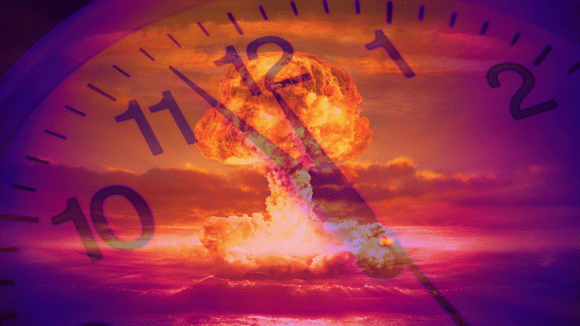
Last month the Doomsday Clock had moved closer to midnight than at any point since it was created in 1947. Maintained by the Bulletin of the Atomic Scientists, the clock is meant to signal how close humanity stands to destroying itself, whether through nuclear conflict, climate breakdown or new technologies. Its latest shift suggests that we are living through a particularly dangerous moment.
That is one way to look at the year ahead.
Another comes from a friend of mine who follows astrology. “2026 will be intense,” she told me after we had worked out the time difference to talk. “There are major planetary shifts happening. But that also means there is potential for growth.”
Between scientific warning and planetary symbolism sits a familiar question. Are we heading towards catastrophe, or simply moving through another period of change?
It is difficult to judge the scale of events while we are inside them. Perspective usually comes later. At the time, everything feels amplified. The media leans towards urgency. Our own thoughts do the same. The expectation of upheaval can sometimes be more overwhelming than the experience itself.
In recent weeks there have been many reminders of transition: the turning of the calendar year; the Lunar New Year observed across China, parts of Southeast Asia, Korea and the Himalayan region; the beginning of Ramadan for Muslims around the world. These moments draw people together in ritual and reflection. They offer continuity, even when the wider world feels unstable.
At the same time, global leaders speak in stark terms. The Secretary-General of the United Nations recently described a world marked by conflict, inequality and unpredictability. Climate scientists warn that we have entered uncharted territory. Heat records continue to fall. Rain arrives in sudden deluges. Winters in some places are no longer as cold as they once were.
For centuries, seasonal rhythms have provided reassurance. Spring follows winter. Festivals return at roughly the same time each year. Even the Gregorian calendar, introduced in 1582, was an attempt to bring order to time.
The Greek philosopher, Heraclitus, wrote that no person steps into the same river twice. The water flows on, and so do we. It is a simple image, but it captures something steady and true about human life.
What feels different now is the speed. Changes that once unfolded across generations now seem compressed into years. Climate patterns shift within decades. Technology reshapes industries almost overnight. Artificial intelligence systems are altering the nature of work, leaving some people optimistic and others uncertain. I know people who are struggling to find employment, both those nearing the end of long careers and those only just starting out.
My friend attributes the turbulence to a conjunction of Saturn and Neptune. She links economic instability and political upheaval to movements in the sky. When she mentioned the recent increase in visible auroras, I thought of astronomers pointing out that the Sun is nearing the peak of its eleven-year solar cycle. Different explanations, same phenomena.
Whether we turn to science, philosophy or astrology, the underlying experience is similar. Things feel unsettled. Time feels faster. The future feels closer than it used to.
It is tempting either to tune out the warnings or to become consumed by them. Neither response changes what is happening. Ignoring risk does not reduce it. Constant alarm does not resolve it either.
We cannot return to a previous version of stability. The seasons will continue to shift, though perhaps less predictably. Technologies will continue to develop. Political arrangements will evolve. Some changes are small and gradual. Others are abrupt and disorienting.
The real question is how we live through them.
After our conversation, my friend sent a message: “Changes aren’t endings, but thresholds.” It is a hopeful way to think about uncertainty. Crossing a threshold suggests movement rather than collapse.
Perhaps this year calls for small, steady practices. Paying attention to what we consume, digitally and otherwise. Slowing down our thinking when everything pushes us to react. Staying connected to the people around us. These are modest responses, but they are within reach.
We step into the river again. The water is different. So are we.
.
Keith Lyons (keithlyons.net) is an award-winning writer and creative writing mentor originally from New Zealand who has spent a quarter of his existence living and working in Asia including southwest China, Myanmar and Bali. His Venn diagram of happiness features the aroma of freshly-roasted coffee, the negative ions of the natural world including moving water, and connecting with others in meaningful ways. A Contributing Editor on Borderless journal’sEditorial Board, his work has appeared in Borderless since its early days, and his writing featured in the anthology Monalisa No Longer Smiles.
.
PLEASE NOTE: ARTICLES CAN ONLY BE REPRODUCED IN OTHER SITES WITH DUE ACKNOWLEDGEMENT TO BORDERLESS JOURNAL.
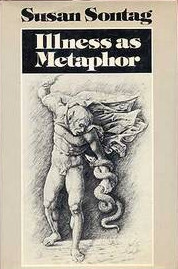
In her seminal work, Illness as Metaphor, Susan Sontag delves into the intricate realm of disease metaphors and presents evidence from the literary field that has employed metaphors for human illness, especially tuberculosis and cancer. Sontag draws on a rich literary history, referencing the works of Stendhal, Karl Menninger, Thomas Mann, Charles Dickens, Thomas Wolfe, Franz Kafka and others, to illustrate how metaphors for diseases have been ingrained in our cultural psyche. The two diseases, TB and cancer, discussed at length in the essay, are viewed from innumerable literary points of view. Fictional and real-life views of people surrounding these diseases have been put forward, which betray a cacophony of contrasting and similar ideas.
Sontag astutely dissects the contrasting metaphors associated with tuberculosis and cancer. Tuberculosis, she argues, has been romanticised and considered more socially acceptable and often viewed as a glamorous affliction. “Having TB was imagined to be an aphrodisiac and to confer extraordinary power of seduction. Cancer is considered to be de-sexualizing.” Sontag describes the tumour as “a foetus with its own will”. She further states that TB is a disease of poverty and deprivation, whereas cancer is a disease of middle-class life. She adds that cancer is associated with affluence, with excess. The metaphors associated with the diseases, she contends, not only affect the body but also shape societal perceptions and cultural narratives. The metaphorical attributions of TB and cancer in literature and society echo broader societal perceptions of class and status.
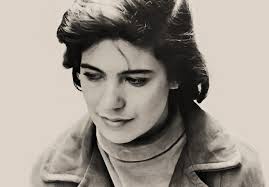
Published in 1978Susan Sontag (1933-2004)
There is an aphorism by Heraclitus that men have devised gods in their own images, and as Sontag states, the nomenclature of ‘cancer’ is derived from the Greek- karkinos and the Latin- cancer, both of which mean crab. She clarifies by quoting Galen that since the external tumour’s swollen veins resembled a crab’s legs, that is how it got its name. This tendency to associate unfamiliar things with familiar ones is common; people often perceive shapes in clouds, drawing comparisons to known objects. Similarly, diseases are often viewed through familiar frameworks. Since diseases afflict and weaken us, they are often seen as adversaries. Thus, labelling the experience of battling cancer as a fight imbues individuals with a sense of hope, suggesting the possibility of victory amidst adversity.
Sontag, betraying the nature of cancer as a slowly progressing disease that suddenly manifests without any warning, presents the earliest evidence where it was first used metaphorically by Wyclif in 1382. “The word of hem crepith as a kankir”.She assembles the different metaphors associated with Cancer, which are as diverse as the number of human illnesses. For her, Cancer is a source for topological metaphors: “spreads”, “proliferates”, “diffused”, and “excised”.
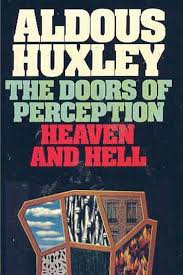
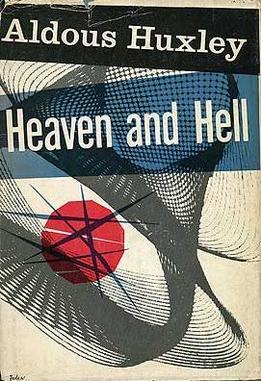
The essay examines the mythologies and superstitions associated with these diseases and how metaphors sometimes wear the cloak of superstition, too. But metaphors make the understanding of the disease more manageable. Metaphors are a means of understanding the meaning of things. That which cannot be explained as such can be explained by metaphors. In his books, The Doors of Perception and Heaven and Hell, Aldous Huxley states: “It is difficult, it is all but impossible, to speak of mental events except in similes drawn from the more familiar universe of material things. If I have made use of geographical and zoological metaphors, it is not wantonly out of a mere addiction to picturesque language. It is because such metaphors express very forcibly the essential otherness of the mind’s far continents, the complete autonomy and self-sufficiency of their inhabitants.” The metaphors will exist, and educating the masses is the only way to stop them from becoming a stigma or superstition against that disease.
Published in 1954Published in 1956
Quite possibly, the doctors refraining from revealing the true nature of disease inherently to the patient might reflect the notion of fear of death. The diseased person might perhaps think that death will come to everyone but him. Revealing his cancer to him might imply the idea of the inevitable approaching death. Thus, employing the metaphor of ‘battling’ with cancer provides a sense of relief to the patient of emerging victorious in the battle. A diseased man on the bed is akin to a newborn baby, with the only difference being that in one, the river of life has begun to flow, whereas, in the other, it is on the verge of drying. An afflicted man is as helpless as a baby. He craves for care. In this vulnerable state, directly discussing the illness may be too distressing, necessitating the use of metaphors to convey the situation. The patient’s understanding is limited. The only truth he has made a pact with is the slipping of time and the approach of death.
Regardless of how one has lived, everyone desires a death with dignity. Yet, why is it that some illnesses seem to afford this dignity while others do not? What criteria determine whether an illness is seen as favourable? Is it pain or time? The dilemma is akin to choosing between jumping into a well or off a cliff―Death awaits at both ends. As Susan Sontag herself ‘battled’ breast cancer, one cannot help but wonder whether the book would have been different had her affliction been tuberculosis instead. The essay appears biased, elevating tuberculosis and its sufferers while diminishing the dignity of cancer patients. It only examines these diseases from a personal perspective. TB has been presented as a glorified disease, whereas cancer is something that rots the body. Only briefly does the essay touch on the societal perceptions that label tuberculosis as a disease of poverty and cancer as a disease of affluence.
It is not only cancer and TB that have attracted metaphors or have been known to be identified with them. In fact, every other disease and illness is accompanied by metaphors, like an object and its shadow. And it must be noted that some diseases, apart from being associated with metaphors, are linked with gods and deities.
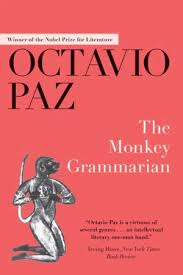
I recall a passage from the book The Monkey Grammarian in which the author, Octavio Paz, describes a scene inside the ‘Temple of Galta’ which is also known as ‘The Monkey Temple’ in Rajasthan: “The children leap about and point to the stone, shouting ‘Hanuman, Hanuman!’ On hearing them shouting, a beggar suddenly emerges from the rocks to show me his hands eaten away by leprosy. The next moment, another mendicant appears, and then another and another.”
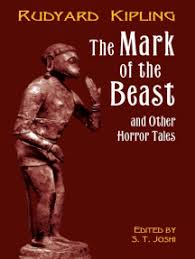
When I first read this passage, I was immediately reminded of the story ‘The Mark of The Beast’ by Rudyard Kipling and a paper that I had read related to the story titled ‘Recognizing the Leper: Hindu Myth, British Medicine, and the Crisis of Realism in Rudyard Kipling’s The Mark of the Beast’. The author of the paper had woven the interconnectedness and drawn parallels between the story, the leprosy affected character and Hanuman-lila. In ‘The Mark of The Beast’, an Englishman named Fleete, in the company of his two friends, desecrates a statue of Hanuman inside a temple with his cigar and declares it as ‘the mark of the beast’ but is soon embraced by a “mewing” leper who emerges from behind the statue following which, Fleete begins to develop skin discolourations and starts exhibiting animal-like behaviour. In the paper, the author establishes a connection between Hanuman and leprosy to justify why the Hindu monkey god is often called ‘sankat-mochan’ or ‘liberator from distress’. Drawing reference from the study of Hanuman lore by Philip Lutgendorf, the author argues how Kipling’s story resonates with a specific Hanuman-lila that relates his manifestation as a leper before the 16th-century saint Tulsidas.
“Instead, he [the tree ghost] told Tulsidas to seek the grace of Hanuman and revealed that the latter came every evening to a certain ghat in the form of an old leper to listen to the narration of Rama's story; he sat at the back of the crowd and was always the last to leave. That night, Tulsidas surreptitiously followed the leper, who led him deep into the forest before the poet finally fell at his feet, hailing him as the Son of the Wind. As the ghost had predicted, the leper "denied a thousand times" that he was anything other than a sick old man, but Tulsidas persisted in his entreaties. Eventually, Hanuman manifested his glorious form. Raising one hand over his shoulder to point southwest, he said, "Go to Chitrakut," and placing the other hand over his heart, added, "I promise you will see Rama.”
Illness as Metaphor should not be considered a caution about metaphors in their relation to illness but rather a critique of their misapplication, where these metaphors can morph into stigmas that persist in people’s consciousness. “Illness is the night-side of life, a more onerous citizenship. Everyone who is born holds dual citizenship in the kingdom of the well and in the kingdom of the sick. Although we all prefer to use only the good passport, sooner or later, each of us is obliged, at least for a spell, to identify ourselves as citizens of that other place,” Sontag states in the opening lines of her book-length essay. But, unless one is born in the mythical Shangri-La, and as long as humanity exists, illnesses and their accompanying metaphors will persist, evolving with each new malady that emerges. Today, it is cancer, just as yesterday, it was tuberculosis and COVID-19. Tomorrow will inevitably bring new illnesses, accompanied by a fresh set of metaphors that shape our collective understanding of the ever-present shadow of illness in the human experience.
Satyarth Pandita is a Junior Research Fellow at the National Institute of Mental Health and Neurosciences, Bengaluru. He completed his dual degree of Bachelor of Science and Master of Science in Biological Sciences (major) and Humanities and Social Sciences (minor) from the Indian Institute of Science Education and Research Bhopal (IISERB).
Links to Satyarth’s published works, email address and social media handles can be found here.
.
PLEASE NOTE: ARTICLES CAN ONLY BE REPRODUCED IN OTHER SITES WITH DUE ACKNOWLEDGEMENT TO BORDERLESS JOURNAL
And as imagination bodies forth
The forms of things unknown, the poet's pen
Turns them to shapes and gives to airy nothing
A local habitation and a name

 A Midsummer Night's Dream (1595) by William Shakespeare
Famous lines by Shakespeare that reflect on one of the most unique qualities in not only poets — as he states — but also in all humans, imagination, which helps us create our own constructs, build walls, draw boundaries as well as create wonderful paintings, invent planes, fly to the moon and write beautiful poetry. I wonder if animals or plants have the same ability? Then, there are some who, react to the impact of imagined constructs that hurt humanity. They write fabulous poetry or lyrics protesting war as well as dream of a world without war. Could we in times such as these imagine a world at peace, and — even more unusually — filled with consideration, kindness, love and brotherhood as suggested by Lennon’s lyrics in ‘Imagine’ – “Imagine all the people/ Livin’ life in peace…”. These are ideas that have been wafting in the world since times immemorial. And yet, they seem to be drifting in a breeze that caresses but continues to elude our grasp.
Under such circumstances, what can be more alluring than reflective Sufi poetry by an empathetic soul. Featuring an interview and poetry by such a poet, Afsar Mohammad, we bring to you his journey from a “small rural setting” in Telangana to University of Pennsylvania, where he teaches South Asian Studies. He is bilingual and has brought out many books, including one with his translated poetry. Translations this time start with Bankim Chandra Chattopadhyay’s advice to new writers in Bengali, introduced and brought to us by Abdullah-Al-Musayeb. Tagore’s seasonal poem, ‘Megh or Cloud’, has been transcreated to harmonise with the onset of monsoons. However, this year with the El Nino and as the impact of climate change sets in, the monsoons have turned awry and are flooding the world. At a spiritual plane, the maestro’s lines in this poem do reflect on the transience of nature (and life). Professor Fakrul Alam’s translation of Masud Khan’s heartfelt poetry on rain brings to the fore the discontent of the age while conveying the migrant’s dilemma of being divided between two lands. Fazal Baloch has brought us a powerful Balochi poet from the 1960s in translation, Bashir Baidar. His poetry cries out with compassion yet overpowers with its brutality. Sangita Swechcha’s Nepali poem celebrating a girl child has been translated by Hem Bishwakarma while Ihlwha Choi has brought his own Korean poem to readers in English.
An imagined but divided world has been explored by Michael Burch with his powerful poetry. Heath Brougher has shared with us lines that discomfit, convey with vehemence and is deeply reflective of the world we live in. Masha Hassan is a voice that dwells on such an imagined divide that ripped many parts of the world — division that history dubs as the Partition. Don Webb upends Heraclitus’s wisdom: “War is the Father of All, / War is the King of All.” War, as we all know, is entirely a human-made construct and destroys humanity and one cannot but agree with Webb’s conclusion. We have more from Kirpal Singh, Ryan Quinn Flanagan, Nivedita N, John Grey, Carol D’Souza, Vernon Daim, George Freek, Saranyan BV, Samantha Underhill and among the many others, of course Rhys Hughes, who has given us poetry with a unique alphabetical rhyme scheme invented by him and it’s funny too… much like his perceptions on ‘Productivity’, where laziness accounts for an increase in output!
Ratnottama Sengupta takes us back to how imagined differences can rip humanity by sharing a letter from her brother stationed in Bosnia during the war that broke Yugoslavia (1992-1995). He writes: “It is hard to be surrounded by so much tragedy and not be repulsed by war and the people who lead nations into them.” This tone flows into our book excerpts section with Red Sky Over Kabul: A Memoir of a Father and Son in Afghanistanby Baryalai Popalzai and Kevin McLean. Popalzai was affected by the Russian invasion of Afghanistan in 1980 and had to flee. A different kind of battle can be found in the other excerpt from The Blue Dragonfly – healing through poetry by Veronica Eley – a spiritual battle to heal from experiences that break.
In our reviews section, KPP Nambiar reviews The Stolen Necklace: A Small Crime in a Small Town by Shevlin Sebastian and VK Thajudheen, a book that retells a true story. Sangeetha G’s novel, Drop of the Last Cloud, we are told by Rakhi Dalal, explores the matrilineal heritage of Kerala, that changed to patriarchal over time. Bhaskar Parichha reviews Burning Pyres, Mass Graves and A State That Failed Its People: India’s Covid Tragedy by Harsh Mander. Parichha emphasises the need never to forget the past: “It is a powerful book and sometimes it is even shattering. The narrative is a live remembrance of a national tragedy that too many of us wish to forget when we should, instead, etch it in our minds so that we can prevent another national tragedy like this one from recurring in the future.” While we need to learn from the past as Parichha suggests, Somdatta Mandal has given a review that makes us want to read Ujjal Dosanjh’s book, The Past is Never Dead: A Novel. She concludes that it “pays tribute to the courage and tenacity of the human spirit and its capacity for hope despite all odds.”
We have more content than mentioned here… all of it enhances the texture of our journal. Do pause by our July issue to savour all the writings. Huge thanks to all our contributors, artists, all our readers and our wonderful team. Without each one of you, this edition would not have been what it is.
Heraclitus wrote one long book on papyrus.
It is believed to be called On Nature.
The title page was destroyed, and much of the content during the burning of the library at Alexandria.
Recent efforts have restored some of the charred fragments.
For example, the famous couplet --
“War is the Father of All,
War is the King of All.”
Actually reads,
“War is the Father of All,
War is the King of All.
Just kidding!
War is Stupid.”
Don Webb teaches Special Education (High School English) by day and horror writing by night. He has 25 published books, and around 100 published poems. He likes cats, fireworks and Egyptian history.
PLEASE NOTE: ARTICLES CAN ONLY BE REPRODUCED IN OTHER SITES WITH DUE ACKNOWLEDGEMENT TO BORDERLESS JOURNAL.
“Who are you?” Rarely do people vocalize this question, but you know they’re thinking it — from the very moment you meet them. To answer that question, you have to deal with another, internal one first. Who amI?
For a long time, I believed in a rigid identity, a fixed innate truth. Identity was a monolith, immutable and inherited. Down the river of years and landscapes, I have docked at numerous destinations, calling at each port with a distinct call. Heraclitus said you cannot step into the same river twice: the river moves on and so do you. If everything is in flux, how could I be, forever and everywhere I went, only one of the many things I could be?
In an interview, author Jhumpa Lahiri contended a singular, unchanging identity no longer interested her. Instead, she was seeking out different facets of her being and pushing the limits of how she defines herself. Lahiri grew up in an immigrant Indian family in the US but now lives in Rome, having learned and published in her adoptive language. She wonders if she is a Bengali, an American, an Italian, a woman, a writer, a wife or all of the above? Reading Lahiri’s words was liberating. Here was someone who had immersed herself into the Heracletian river, instead of skimming its superficial curves and bends.
I find this detachment from an unchanging, stereotypical identity appealing as I grow older. The more I turn around the sun, the more I want to shed cloaks of nationality, race, religion, sexuality and career. I want to be who I am, only I get to decide which emotional, political and social avatar I wish to place uppermost given the context. The richness of a pluralistic life means different hues take precedence depending on space and time. Back in the Renaissance period, polymaths were celebrated for being cultural chameleons and intellectual infidels. Utilitarianism has turned us into reductionists and prejudice into bigots. We want quick, short, predictable, comfortable answers to “Who are you?”. “Save the transgressive, subversive ambiguity of your Being,” they seem to say. “We need a label to comprehend your humanity. So, hurry up, what’s yours?”
Like Gandhi who wrote My Experiments with Truth, I too am Indian but unlike him, I am also the person who has lived most of his adult life away from India. I am gay, part of the identity politics of the LGBTQ+ minority and in the same breath I am also a cisgender able-bodied male with unspoken privileges. I am a scientist, but I am also a writer, poet. Sometimes I am a ‘person of colour’ and sometimes my emotional reactions against the racial battle fatigue, make me wish I could simply blend into the seawater of majority White.
Today, I have a paid job, but I am also someone who carries inside the memory of being unemployed. At times the immigrant in me surges to the forefront, on other occasions the anti-capitalist. I can be lucid and peaceful, but I know too the chasms between depression and vitality, the ones that are never fully bridged. Although this schizoid state recalls split personalities, a multi-layered identity is far from an incoherent, fragmented sense of self. All of these planes of existence make me who I am and, nevertheless, none of them are sufficient to define me. Only a paradox remains when I think of the whole of me. Identity then is an oxymoron, in evolution.
Undeniably, in a world that likes stock labels and neat boundaries it can feel chaotic to juggle different identities. Heterogeneity strikes many as a threat. Dissonance, variance, deviance constitute a trident charged against the constant, the power-wielding majority. The allure of sameness is strong in mobs, groups, entitled circles. They proclaim cohesiveness is the same as compassion. All outliers are dangerous. This primitive insularity reeks of exclusivity, of othering.
Invariability strikes those with unquestioned identities as the paragon of assimilation. But assimilation asks a great deal out of me and nothing out of you. How is that fair? Perhaps it is fair in the same way that ignorance and intolerance prosper while justice langours in the darkness. Assimilation has one objective: constancy. I’ve lived in four countries, speak five languages, straddle Science and Art. I stand at the crossroads of the developing East and developed West. I know the taste of racism deep in my skin (like spit full of hateful fear), I’ve walked down shiny corridors of privilege (Oxford, New York, Paris). I know the eyes that ask “Who are you?” and answer before I can, denying me the dignity of equality. In their gaze, my identity is a foregone, implicit bias. To them I say, constant is a dead word to me.
I live in the rough, mean, fleeting edges, the boundaries that no one sees because intersections are tough places. They are also thriving, lush, transcendent niches for the invisible and ignored. At intersections, we become so much greater than the sum total of our experiences. The goal of self-determination is not to figure out the right identity label and hold on to it dearly and protect it vehemently when attacked. Instead, fluidity serves natural order better. Amorphous like the primordial sizzling soup we come from, full of protean charm. Complex and dazzling like precious stones under a stolid terra firma. I wish to carry myself with my multitudinous, contradictory truths. If someone is not prepared to engage in meaningful exchange with my nebulous vibrant ‘otherness’, they will receive a unidimensional, disengaged version of me. Or better, none at all.
Rumi allegedly said “You are the universe in ecstatic motion.” As I write these words, I’m starting to see what he meant. My experiments with difference continue, ironically because the word identitycomes from the Latin one, idem, which means the same. How much of me is lost if the river stops flowing? Congruity always tries to boss over irregularity. In the end, the truth of one’s identity stems from uniqueness, not uniformity. Manifold and bewildering is the flow of an ecstatic river that refuses to be forded by narrow constraints imposed by mankind.
Tejas Yadav is an Indian scientist and writer. Currently, he lives in Paris. Themes of immigration, race and mental health inspire him. You can read more of his published work here:https://ytejas.medium.com/my-published-work-7cc06b99a443
.
PLEASE NOTE: ARTICLES CAN ONLY BE REPRODUCED IN OTHER SITES WITH DUE ACKNOWLEDGEMENT TO BORDERLESS JOURNAL.
The word “prophet” is rooted in the Greek word prophetes, a word that breaks down etymologically into “to speak before or foretell”. A soothsayer is considered a prophet in the sense that he foretells events. Such is the soothsayer in Julius Caesar who tells Caesar to “beware of the ides of March” when he was doomed to assassination. The Prophetic books of the Old Testament inform the people of Israel what God desires of them and what will happen if they disobey His commands. In Amos 3:7, it is written: “Surely the Lord GOD will do nothing, but he revealeth his secret unto his servants the prophets.” This designates the place of the prophet as one who knows God’s secrets. Amos reveals that the prophets had been instructed to remain silent until the burden became too great. Throughout Scripture, there is a love for justice which maintains the distinct definition of sympathy for the disadvantaged, and upholding God’s Word. A prophet is thus one who speaks on behalf of God Himself. The prophet Amos indicates throughout that the Lord will speak when He is out of patience. God is a God of all nations and will not tolerate disobedience even from Israel.
The Arab poet, Adonis, said, “It is an awful idea that after this one prophet, after this one book, everything would be said and written, isn’t it? If Mohammed would really be the last of the prophets, then no human word can be uttered anymore, and even much more frightening, no divine word either. The holy book is a trap closing in on us. Every monotheistic religion has the same problem. Christianity had the chance to avoid the trap but it didn’t. It identified itself with power and it embraced dogmatics.” Here we have a radical view that prophecy continues in the modern world. Richard Wilbur in “Advice to a Prophet” writes:
“Nor shall you scare us with talk of the death of the race.
How should we dream of this place without us?—
The sun mere fire, the leaves untroubled about us,
A stone look on the stone’s face?”
Here the poet is a prophet of a particular kind. Bringing God’s message to the people becomes something peculiar— in this, the prophet defines the meaning of humanity. The role of prophet in Wilbur’s poem is one who does not warn of the imminent threats to human life, but rather defines the human role within Nature and Being itself. The modern reflection of God is much more personal and forgiving. As stated by Adonis, Christianity could have unleashed the powers of human language but, instead, gave way to power structures. Language carries the unique gift of uniting disparate things. The power of analogy is that of reconciliation. The poet, with his or her unique gift, invites comparisons between things that have little in common as if to agree with Heraclitus who wrote, “All things contain their opposites.” Perhaps not their opposites, but definitely things of dissimilar nature. The dark contains the light, and the light is contained by the dark. One interiorises the other. This strange capacity of language to reveal what is concealed in the dark is a magic of its own. A word is a form of conjuration, something brought into being by shining a light on it. That light itself is the poem—a unified body of language that conditions the reader to a certain subjectivity, thus causing the reader to recognise some hidden aspect of him or herself.
What is this thing of revelation? “Apocalypse” is from the Greek apokalupsis which means to unveil, uncover. The nightmarish visions portrayed in Revelations are considered to be end of the world prophecies. The opening of the scrolls, the rivers of blood, the hellfire and dragon tossed into the pit: these things are seen as happening at the endtimes. This branch of Biblical study is called eschatology. What is it that eschatology uncovers? What is God unveiling to us in His prophetic writings?
Is it that true theology, the branch of learning concerned with the study of God, includes a side of God we are less acquainted to receive and understand? In Answer to Job, Carl Jung proposes what he called the Quaternity. According to Frith Luton, “The quaternity is one of the most widespread archetypes and has also proved to be one of the most useful schemata for representing the arrangement of the functions by which the conscious mind takes its bearings.” In Answer to Job, Jung writes of Job himself, “Because of his littleness, puniness, and defencelessness against the Almighty, he possesses, as we have already suggested, a somewhat keener consciousness based on self-reflection: he must, in order to survive, always be mindful of his impotence. God has no need of this circumspection, for nowhere does he come up against an insuperable obstacle that would force him to hesitate and hence make him reflect on himself.” The Quarternity is an extension of the Trinity. Jung believed the traditional conception of God was lacking. He invented the Quarternity to define the evil face of God. Thus, God becomes a holistic vision of the cosmos.
In Answer to Job, Jung portrays a human god who is capable of feeling guilty. In the end, Jesus is sacrificed not to cleanse humankind of sin but to rid God himself of guilt. Why wouldn’t God share the being of that created in His image? However, traditional theology includes a study of theodicy or reconciling divine goodness with the existence of evil. The ultimate question is why God might permit evil. We might even ask what constitutes a definition of evil. C. S. Lewis writes in Defense of Christianity, “God created things which had free will. That means creatures which can go wrong or right. Some people think they can imagine a creature which was free but had no possibility of going wrong, but I can’t. If a thing is free to be good it’s also free to be bad. And free will is what has made evil possible.” However, the definition here has an inevitable fallacy. In using free will to excuse God of wrongdoing, Lewis tells us he cannot imagine a free creature that has no capacity to do wrong. In applying this logic to God Himself, we are left with two possibilities. Either God isn’t a free creature, or God is also capable of wrong. In what capacity could God not be free? God is seen as “omniscient, omnipresent, omnipotent.” He is defined as sui generis, a being that causes itself. How could a self-caused being not maintain perfect autonomy? If God has will, He must have the ability to err if we take Lewis’s definition at face value.
Continuing along my original line of inquiry concerning the Apocalypse. What does it say about God’s nature? One, it demonstrates that we as fallible creatures are capable of causing great destruction. Why is that quality inherent in us? The Apocalypse, or “unveiling”, is shown to be final — creation is revealed for its full promise. The conclusion of time is the extinction of choice — it is ultimate revelation of true being. All secrets come undone. The lid to Pandora’s box is unclasped and all evil is unleashed. This tells us that something is hidden within Creation itself. Our awareness is incomplete. The Apocalypse completes that awareness and shows us the purpose we missed—complete annihilation. Why should God desire the annihilation of His creation? Why did He command the death of His Son as a sacrifice to the world?
Humankind is bent on forging a utopia, a paradise that lasts eternally. Behaviorist B. F. Skinner invented a utopia based on his model of psychological conditioning where people are entirely robbed of choice. Instead they are conditioned by authorities to fit their chosen roles. This theory is presented in Walden Two. In this novel, Skinner applies his understanding of behaviorist psychology to the creation of a perfect society. Children are conditioned to perform certain roles from the onset. Each person has a role chosen for them. What we don’t consider is who is making the decisions for the roles given to each person. By nature, this model eliminates choice by individuals—yet how is there any order without choice? The authorities are making the ultimate decisions but who chooses that role for them? In this utopian vision, we see a flaw inherent in the system itself. Humankind is robbed of “freedom and dignity” for the sake of a perfect community conditioned to serve the aims of the community as a whole. Yet what criteria is used to sponsor this concept of communal well-being? Again, who decides?
Aldous Huxley presents us with a similar enigma in Brave New World. This is a utopia that is so oblivious to its flaws that it is dystopian to the onlooker. People are robbed of dignity again, but in the process, they become childlike in their understanding. Human misery is alien to them because they take measures to eliminate it and inoculate themselves from it. The results are the same. We are left with a set of social engineers who demonstrate scientific objectivity in their observations. They comment on the community, applying their superior awareness of things. Knowledge is too specialised in such a community. It becomes the risk of those designated to “know” rather than the shared offerings of the community. So much for community.
Lois Lowry’s The Giver is another dystopian vision where knowledge becomes specialized for a few. The Giver is a person who is entrusted with the collective history of humankind, and this person imparts it to another person as the role is relinquished. This arrangement resembles the pagan priesthoods where the Eleusinian mysteries were kept secret exempting those initiated into the sacred cult. What did these secret rites entail? No one knows because they are extinct. However, the parables of Jesus Christ contain a certain mystery to them. They are the prophecy of God in themselves. Jesus was known for his unique gifts of teaching and language. The ancient prophecies concerning him told us that he would not be physically attractive so that his message would be the accent of his coming to the earth. In Matthew 13:11, Jesus answers his disciples who ask why he taught in parables. “He answered and said unto them, Because it is given unto you to know the mysteries of the kingdom of heaven, but to them it is not given.” So, what are the rites of the initiated?
Paul the Apostle writes in 2 Corinthians 4:4, “In their case the god of this world has blinded the minds of the unbelievers, to keep them from seeing the light of the gospel of the glory of Christ, who is the image of God.” Jesus is also described as the unveiling in various verses—thus the Apocalypse is understood as the wedding of the Paschal Lamb. In Exodus 12, the Paschal Lamb is the sacrifice whose blood is put on the doors of the firstborn of Israel so the avenging angel would spare them. Jesus Christ is seen as the Paschal Lamb in the New Testament whose blood protects believers from the avenging angel, or Satan. In Revelations 19:7 it is written, “Let us be glad and rejoice, and give honour to him: for the marriage of the Lamb is come, and his wife hath made herself ready.”
It seems God spares those He decides to spare. The firstborn of Israel were spared by Moses’ prayer and desire for their freedom from Egypt. One man’s strong desire for the justice of his people pleases God. As we know, Israel would later also sin and be condemned. However, the revelations of Israel became the truth of all of the nations and God’s people span the entire world.
The relationship of utopia and apocalypse is nowhere more apparent than in the Holy Bible. God defines Israel’s purpose. History shows they failed in acknowledging God after His power rescued them from Pharaoh. Even Moses came up short of God’s will and was not permitted to see the Kingdom of God. One universal truth of Scripture is that all of us, no matter how holy or chosen, fall short of God’s grace. It is thus we see the emergence of Original Sin. Original Sin is itself a revelation of St. Augustine, early Church father and Christian apologist. He began his journey in truth as a Manichean. In Confessions, he tells us that God showed him the error of his ways. It was then he discovered the power of Original Sin—that darkness cast on the world by Adam’s first disobedience. We are created in God’s image but are not God Himself; Jesus Christ alone is seen as the true image and equal of God in his Passion and innocence.
In short, utopia is the promise we can redeem ourselves with radical changes to our world or relations. Utopians tell us that their vision is superior and if we conform to it, we will all be better off. Politicians are often utopians with realist proclamations. They desire to shape the world in their own image, as God did with us, and grant us our salvation. The poets use utopia as a vision—it becomes a kind of mnemonic device in understanding the nature of the world. Prophecy is a revelation of utopia—which is modeled after God’s being. Our concepts of goodness are even deficient, but we all desire to live in a world of productivity and happiness for all. A poet casts his or her eyes forward to a world known in the imagination. Such visions shape the world as ideas and influence our thinking. The Romantics, for instance, were conservative republicans. They desired freedom from authoritarian righteousness—both political and religious autonomy. William Blake, an Anabaptist, voiced these visions the best in All Religions Are One. He writes, “That the Poetic Genius is the true Man, and that the body or outward form of Man is derived from the Poetic Genius.” He further explains that all nations experience this poetic genius differently. He defines this capacity as prophecy. Our true state of Being is poetic. Our form is a distinct relationship to that poetic being. Poetry, then, is being itself expressed in variety.
I remind the reader again of Heraclitus: “All things contain their opposites.” Therefore, what we see conceals a deeper mystery and faith. Even consciousness withholds certain fundamental values and truths from us. The unveiling of those values and truths has great destructive and restorative power. The Apocalypse is a lifting of the veil of consciousness to bring the powers of wholeness to Being. It is ultimate light and extinction—and therefore it is a vital annihilation. The power of chaos is spoken of in Genesis where we see God wrestling with the deep to create a new world. The creation of a new world from rough matter is the very act from the spirit of utopia. Utopians desire to restructure existence to perfect it. God summons His powers of light to unveil the cloud of unknowing.
Poetry as Being and Knowledge is the truth of God. It declares itself to the world and seeks to order it and restore its original purpose. However, the poet is largely unconscious of this power when he or she writes. Language is the poet’s tool. The poet casts language like a net to gather truth and display it to the world. The poet is a maker, a prophet, a seer, a utopian radical.
The Poet is the sheer image of God and the shadow of Christ’s spirit.
Dustin Pickering is the founder of Transcendent Zero Press and editor-in-chief of Harbinger Asylum. He has authored several poetry collections, a short story collection, and a novella. He is a Pushcart nominee and was a finalist in Adelaide Literary Journal’s short story contest in 2018. He is a former contributor to Huffington Post.
Disclaimer: The opinions expressed are solely that of the author and not of Borderless Journal.



 Borderless