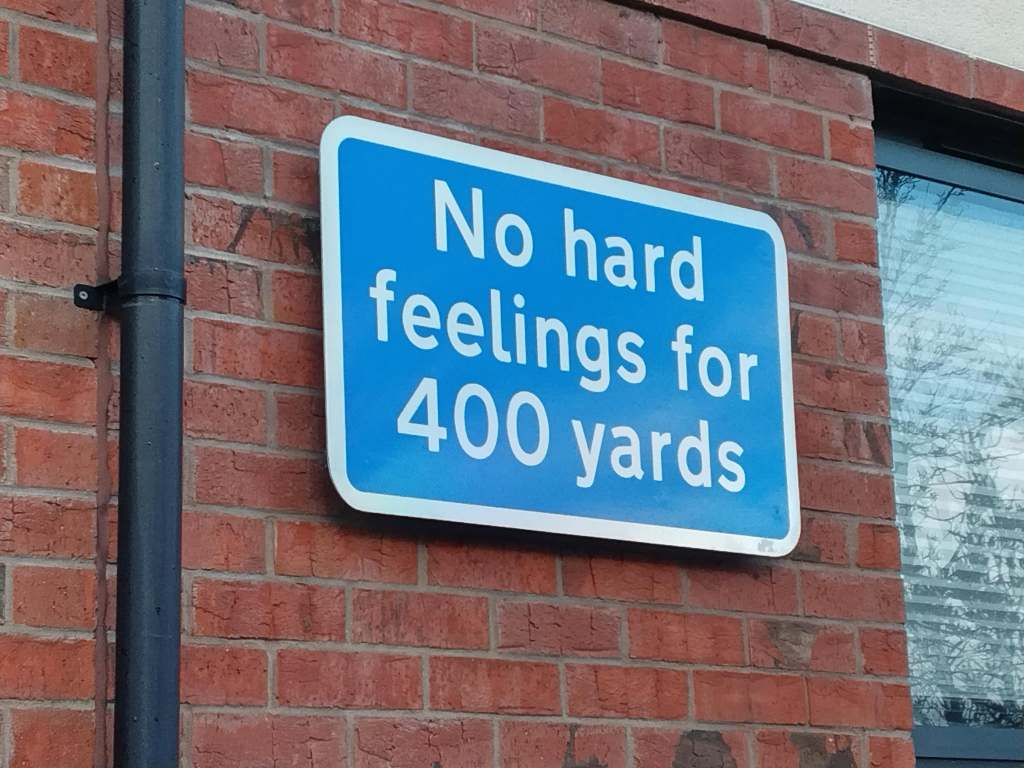
No hard feelings
for 400 yards
but beyond that distance
you can unleash
all the fury in existence
and even turn
like a firm worm
into an arrow of disaster
shot from a bow
by a vengeful archer.

Or if you prefer
you can transform yourself
into a doom-laden monster
running faster
than any athlete could
and sniffing prey out when
it hides in a wood
with the assistance of a nose
so persistent
that nothing in existence
can resist it.

No hard feelings
means only soft thoughts
are permissible
in the same way that only
easy tunes are
whistleable to lips
more familiar with quoting
comfy quips
than rugged ruminations.

Yes, whistleable
is a real word, I checked it
in a dictionary
while I was cartwheeling
up a garden path,
something I tend to do just
for the laugh
it generally affords me later.

I once knew a waiter
who jumped in alarm
when I somersaulted across
his restaurant floor
after entering the front door
on my way to my favourite
table: he wasn’t able
to control his nerves
and the meal he was bearing
ended up on the ceiling
with people staring
as it started to drip down.

No hard feelings!
That’s the issue, the nose in
the tissue, the reeling
peeling squealing teasing of
the kneeling devotee
of long-gone Don Quixote,
concealing his mirth
to prove his ultimate worth
while remaining
appealing, freewheeling,
even self-healing,
and mercifully large of girth.

Now come and join me
in the hard dance of softness
and we will prance
and caper like two wafers
stuck in an ice-cream cone
during a hurricane.
At least we won’t be alone!

My acrobatic days
are mostly over but every
400 yards or so
I twist and turn as the hard
feelings, hot from friction,
burn my soul.

Meanwhile, Don Quixote’s
dreamy head is
spinning slowly
like those festive windmill
sails on sale
at the end of
the short Cervantes season.
Rhys Hughes has lived in many countries. He graduated as an engineer but currently works as a tutor of mathematics. Since his first book was published in 1995 he has had fifty other books published and his work has been translated into ten languages.
.
PLEASE NOTE: ARTICLES CAN ONLY BE REPRODUCED IN OTHER SITES WITH DUE ACKNOWLEDGEMENT TO BORDERLESS JOURNAL
In Dylan on Worm’s Head, Rhys Hughes describes a misadventure that the Welsh poet had while hiking as a tribute to him on Dylan Thomas Day. Clickhereto read.
Munaj Gul gives an in memoriam for a photographer from Balochistan. Clickhere to read.
Musings of a Copywriter
In ‘Is this a Dagger I See…?‘, Devraj Singh Kalsi gives a tongue-in-cheek account of a writer’s dilemma. Click here to read.
Notes from Japan
In A Golden Memory of Green Day in Japan, Suzanne Kamata tells us of a festival where she planted a tree in the presence of the Japanese royalty. Click here to read.
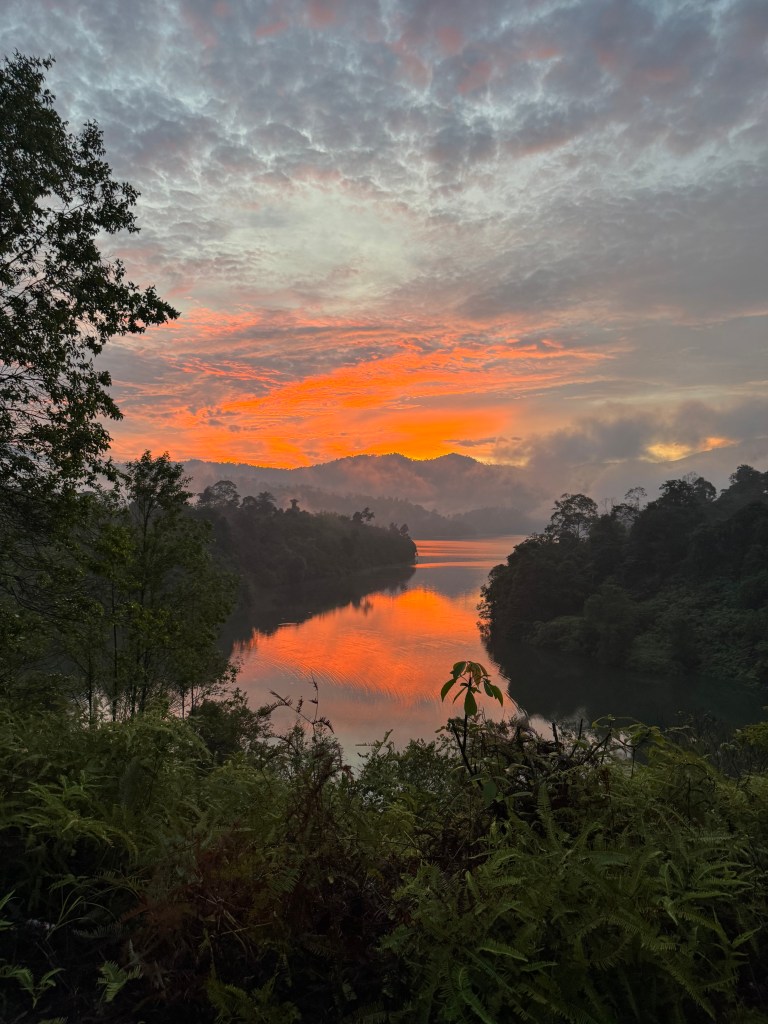
A new dawn or the sunset of better times? Photo Courtesy: Farouk Gulsara
It is the year 2074. Yes, the world is still around, and so is the human race. It has been over a century since Malaysia received its mandate to self-rule. Technically, we should be in a utopia with so much sunlight throughout the year and a chirpy tropical climate devoid of depressing, chilling winters or debilitating natural calamities. A potpourri of food options is available 24/7 at our fingertips and delivered to our doorsteps with easy-access drone servers. We should be the happiest people in the world. In reality, however…
Teenagers growing up in the formative years of Malaysia in the 1980s, not too long after the 1969 racial riots, were given a promissory note. They were told that if they followed the dotted line, they were assured of a utopia. They would be ushered into a land of milk and honey, oozing with order and tranquility. A land where brothers and sisters of all strata would be walking, holding hands, and singing one song of camaraderie and unity. Peace would be seen seeping from every pore. Smiles and cheery images of bright yellow sunflowers were immortalised in their vision of the future.
Coincidentally, massive oil reserves were discovered off their shores around that time, multiplying their euphoria. Money started flowing freely. The government made it their God-given duty to make millionaires out of their sycophants and display them as the nation’s success story.
They were so confident that the good times would roll forever that they felt a pressing need to increase the population and strengthen their vote bank. They wanted their 17 million population in 1990 to snowball to 70 million by 2020!
Maybe it was their subconscious intention to exhibit their patriarchal prowess. Soon, the urban skyline was brimming with phallic-like skyscrapers. The Petronas Twin Tower became the pride of the nation. Detractors said it was a waste of taxpayers’ money, but the Government insisted it was a private venture of Petronas, the private-public partnership that struck black gold.
Like the Tower of Babel, grand towers sprouted here and there, giving the illusion of wealth and prosperity. The government asserted that the promised ‘Vision 2020’ would have citizens speak one language of love for each other and would be knowledgeable and mindful.
To facilitate foreign investors’ seamless flying in and out of the country, a world-class airport sprung out of the lush greenery at the expense of its natural fauna and flora.
Like the fate of the Tower of Babel, with the sky being the limit but short on foundation, the idea of uninterrupted progress came tumbling down. The thought of people speaking one language was only on paper. Doublespeak was not only the domain of the leaders. The average citizen gave little back to Malaysia. Many saw little hope in their motherland. They grew wings to fly away to faraway shores.
Trying times came in droves—first, repeated economic downturns and other black swan events that only the anti-fragile could weather. Then, a global pandemic hit the world. Rather than scrambling to save the economy, leaders were content undercutting and downplaying opponents to grasp the helm of administration. Instead of utilising science to fight rumours, they looked at religious texts for answers. That is when the penny dropped. Citizens realised the country had reached the point of no return.
Now, in 2074, what we have is a country of economic migrants who sponge on the nation and use Malaysia as a transit point to hopscotch to greener pastures. The descendants of the first wave of workers whom the colonial masters brought in to build the nation are all but long gone. Draconian laws that rewarded mediocrity and championed race and religion successfully converted its subjects to a bunch of zombies, unflinching to the changes to the environment, but one with a one-track mind to satisfy the voices of his master. Religious bigotry ruled the land. Rather than speeding forward to the 22nd century, citizens were hellbent on returning to the 7th, their perceived golden era.
The latest election, the 25th election, went on without a glitch. Of course, there were no untoward incidences. All the opposition leaders have either been forced to retire or behind bars. Voters have been cowed to submission. Years of indoctrination have made the youths of today a bunch of unthinking yeomen. As they have been doing in the past ten elections, the ruling party won more than half of the election seats, uncontested.
The propaganda machine ensures that people only receive pleasant news. In its infancy, the Internet promised the democratisation of information. Soon, everyone realised that people were not competent enough to filter news. The herd is easily swayed and falls prey to popular clickbait. Hence, the government had to play nanny to alleviate undue anxiety among its citizens.
Our education system, which used to be at par with any other country, took a slow plunge. One by one, politicians scrapped examinations to garner popularity. Automatic promotions finally produced young adults who left high school without essential reading, writing, or arithmetic skills. People are inebriated by regular freebies and the periodic intoxicating religious cocktails churned out by government-appointed holy men. When they mentioned everyone using the same language and way of thinking, they meant mass conversion. Plurality and multiculturalism had gone out of the proverbial window long ago.
Under the guise of national security, press freedom is a legacy of the past. Policing the public meant monitoring what netizens uttered online and even the thoughts they shared on their social media posts. The lush tropical forests have mysteriously been denuded over the years. All the public protests fell to the deaf ears of the forest department. Files were closed when no one could be zeroed in to be responsible for the crime to nature. Everyone knows whose hand is in the cookie jar, but the leaders conveniently condemn it to global warming. The blame goes back to the public for being irresponsible in disposing of their garbage!
Outside the country, the three world wars that rocked the world to the brink of extinction never woke humans from their slumber. The Nuremberg trials failed to impress us that no one race is superior to the other and that in wars, nobody wins except arms dealers.
The imagined world free from wars and climate crises remains an unfulfilled dream. Whether 2074 or 2704, the world is fated not to learn from its past and is cursed to repeat the same mistake that it never learnt from its history. Humanity can only appreciate the beautiful world it once was on augmented reality screens. A once-promising roaring Asian tiger called Malaysia has now morphed into a toothless and tattered paper tiger. The best it can do is be a cautionary tale for other nations about what not to do in nation-building.
.
Farouk Gulsara is a daytime healer and a writer by night. After developing his left side of his brain almost half his lifetime, this johnny-come-lately decided to stimulate the non-dominant part of his remaining half. An author of two non-fiction books, Inside the twisted mind of Rifle Range Boy and Real Lessons from Reel Life, he writes regularly in his blog, Rifle Range Boy.
.
PLEASE NOTE: ARTICLES CAN ONLY BE REPRODUCED IN OTHER SITES WITH DUE ACKNOWLEDGEMENT TO BORDERLESS JOURNAL
In Cherry Blossom Forecast, Suzanne Kamata brings the Japanese ritual of cherry blossom viewing to our pages with her camera and words. Clickhere to read.
G Venkatesh writes about a book from 1946. What is interesting is no women writers are featured in it despite their being a phrase which he quotes in his essay, ‘a stepdaughter of the Muses’…
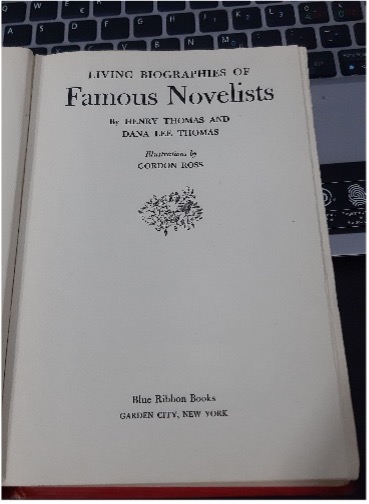
Photo graph by G Venkatesh
There is this book published in 1946 in New York, that I picked up at a Red Cross charity shop in Karlstad (Sweden) of late. A compilation of micro-biographies (make that ‘nano’ if you will) of 20 novelists (fiction-writers in other words) from Italy, Spain, France, England, Scotland, the USA, Russia and Ireland, who graced the world of literature in flesh between the mid-14th and the mid-20th centuries, and will continue to do so, in spirit, forever.
Pillars of fertile imagination, seeded from the idea-realm Visual by G Venkatesh
I venture in this article to present some gleanings from this little gem of a book, to enlighten, motivate, inspire, educate and rekindle interest in the classics of yore. Ralph Waldo Emerson wrote that all writing happens by the grace of God. We witness that in the lives of the twenty writers profiled in the book. Some had an inborn urge to write, some developed the penchant to do so as if the idea floated in from the idea-realm beyond the astral, and some others were blessed by the Divine to transmute their pain and suffering to the written word that has stood the test of time, and will continue to do so, into the distant future. Condemnation paved the way to commendation for some, while rejections emboldened others to transcend the limits of human judgement and rejoice in the sunshine of hard-earned glory.
At its perigee, the ‘novel’, as observed by Henry and Dana Lee Thomas, is an epitome of philosophy as applied to life. The Thomases ask readers to consider the life of every novelist profiled to be a magnum opus in itself – each adorned with facts stranger than fiction.
Boccaccio, Rabelais, Cervantes
This is an Italian-French-Spanish trio (encompassing the 14th to the early 17th century), and perhaps most of the readers may be familiar only with the third-named. Giovanni Boccaccio was a contemporary of Alighieri Dante (whose biography he wrote). A ‘friendly sinner’, he was a devotee of the here and now, while also being profoundly interested in the hereafter.’ Novelists, well and truly, leave behind accounts of their times, couched in fiction (and that, read alongwith factual history, helps us readers to visualise and understand better how things were in the past). The ‘poets’ in them, simultaneously dwell on and dream about how things can, must and will be in the future. Many of them refrain from including a semi-autobiographical element to their novels, and the Thomases have identified Francois Rabelais as being one such. To the Frenchman, all life was an anecdote with a bitter ending, a truth he based his limited fictional creations on.
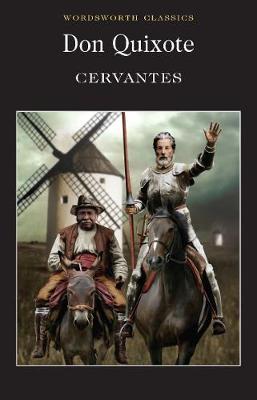
Miguel de Cervantes, the Spaniard, is presented as a disappointed, shattered and disgusted man, who was chiefly motivated by his own trials, travails and tribulations to pen the famous Don Quixote. This knight who fought windmills, was perhaps what Cervantes thought himself to be – blessed with the good fortune to live in folly and die in wisdom.
Defoe, Swift, Sterne
From the simple Quixote and the clumsy Sancho Panza to the resourceful Robinson Crusoe and his helpful Man Friday, characters created by Daniel Defoe in a novel eponymous with the protagonist. Defoe was a paradox of moral integrity and material ambition (if you can visualise one such blend), who by virtue of the fact that he donned the mantles of businessman, pedlar, politician, pamphleteer and spy (not necessarily in that order) in his life, could interpret mankind expertly in his fiction. A kind of ‘been-there, seen-that, done-that, can-write-about-all-with-authority’. Jonathan Swift, of Gulliver’s Travels fame, was gifted with a supreme intellect and a spiritual-religious leaning, but encumbered by physical weakness. God gives but also deprives at the same time, a mystery which humankind has not been able to solve. Fatherless when barely half-a-year old, he was verily a titan (like the character Gulliver he created) among pygmies (like the Lilliputians). He abhorred injustice and thought and prayed forever for the felicity of humankind. He lived to be 78, but contended on the basis of his experiences that the gift of a long life is bought at a very high price.
Laurence Sterne, the preacher-poet Yorkshireman, left behind several nuggets of wisdom in his novels and a couple of them can be cited hereunder:
“I laugh till I cry, and I cry till I laugh” (reminding one of the Yin and the Yang which feed into each other)
“Give me all the blessings of wisdom and religion if you will, but above all, let me be a man.”
Scott, Balzac, Dumas
Sir Walter Scott, while being a prodigy like Swift, also had to contend with physical disabilities like him. He tided over them marvellously, prudently, gallantly and tirelessly, en route to a knighthood and immortality in the realm of English literature. Dreamy Honoré de Balzac, obdurate and uncompromising, believed that man’s destiny and purpose in life was to “rise from action through abstraction to sight” – a deed-word-thought ascent in other words. “Life lies within us (spiritual), and not without us (material)”, he averred. He never got the glory he deserved when he was alive, and his soul perhaps got the peace it richly merited when fame showed up posthumously.
Athos, Porthos, Aramis and D’Artagnan – characters from The Three Musketeers, a novel by Alexandre Dumas which presents the facts of 19th century France through the medium of fiction – were known to school-goers in the 1970s and 1980s, like yours sincerely. Dumas, as the Thomases have noted, met praise with a shrug and insults with a smile – stoically in other words. However, he had a penchant for sarcasm and trenchant wit which were unleashed whenever required. “I do not know how I produce my poems. Ask a plum tree how it produces plums,” is verily a testimony to his transatlantic contemporary Ralph Waldo Emerson’s “All writing happens by the grace of God.”
Hugo, Flaubert, Hawthorne
Two Frenchman and a New-Englander American comprise this trio. Viktor Marie Hugo, of Les Misérables fame, was born in the same year as Dumas, and was regarded widely as the ‘Head’ of the 19th century to Abraham Lincoln’s ‘Heart’. His crests of hard-won success coincided with the troughs of ill-deserved sorrow (he had to contend with the deaths of his wife and children). The Divine Will strengthened his mind, soul and fingers to move quill on paper, enabling the much-bereaved Frenchman to cope and conquer. “Sorrow,” he wrote, “is but a prelude to joy.” A stoic would however add, “and vice versa”. Quite like Sterne’s “I laugh till I cry, and I cry till I laugh”. Despite all that he had to endure; Hugo always believed in God and the purposes he lays out for human beings in their lives.
Hugo’s friend Gustave Flaubert considered the written word to be a living entity, with a voice, perfume, personality and soul. A concoction of realism and romanticism, if ever there was one, Flaubert was also a peculiar amalgamation of poet-cynic, artist-scientist and humankind’s comforter-despiser. He ardently believed that though the soul is trapped within a mortal corpus on the terrestrial realm, it (which is the actual identity of a human being) lives in the idea-realm, and finds its rewards therein.
Hawthorne, on the other side of the ocean, was charmed by the sea and surf and sand in his childhood and youth, having spent a lot of time along the New England coast in north-western America. That led him to dwell on the mysteries of the human soul (which continue to be mysteries at the time of writing), while rebelling against the Puritanic influences that had engulfed the region. He was on an eternal quest, an intellectual and moral pathfinder in his own right, and a pioneering rebel with the pen and quill in his arsenal.
Thackeray, Dickens, Dostoyevsky
William Makepeace Thackeray, readers will be interested to know, was born in Calcutta (now, Kolkata). A sentimental cynic who glimpsed the stupidity of life through the fog of sorrow, he believed that foolishness of the past is a pre-requisite to wisdom in the present and the future – in other words, simply put, we learn from our errors as we move on. ‘Gifted with a bright wit and an attractive humour’, in the words of Charlotte Bronte, he contended that literature was more a misfortune and less a profession. His cynicism helped him to grasp reality, and feel empowered in the process –“How very weak the very wise; how very small the truly great are.” Kind and wise humans often lack the power to change things for the better, while the powerful ones lack the conscience, will and goodness to want to do so.
Thackeray rivalled with Charles Dickens for fame and glory. Dickens, similar to Scott and Swift, had to contend with physical discomfort in his childhood and adolescence, in addition to a father who was not responsible with the money he earned. These experiences would later feed into the stories he churned out prolifically; semi-autobiographical some of them, while informing readers at the same time about the times that prevailed – “the best of times and the worst of times” (A Tale of Two Cities). His humble beginnings made him burn the midnight oil later in life, fuelled by the ambition to succeed, which he sustained all along. Quite like it was Hugo across the Channel, the troughs of torment annulled the acmes of accomplishment. Yet, he remained grateful to God and fellow-humans for the life he lived, and bade one and all a ‘respectful and affectionate farewell’, before ascending to the astral realm.
Reclusive Feodor Dostoyevsky, like Hawthorne in America, struggled to shake off a Puritan upbringing and sought fodder for his literature among the common man – the suffering proletariat who visited liquor shops to drown their sorrows in alcohol. Man, he believed, was responsible for his own salvation…and not God. He however did believe at times that God saved those whom men punished. But then, he also contradicted himself or seemed to do so, when he said that man is saved only because the Devil exists. But perhaps that was not a contradiction after all – God saves man from what he has to be saved from! The meaning of life, according to Dostoyevsky, was the brute-to-angel and the sinner-to-saint transformation of man; quite on the lines of Balzac’s action-abstraction-sight prescription.
Novelist
Lifespan
Selected works
Giovanni Boccaccio
1313-1375
Filocolo, Filostrato, Teseide, Fiammetta, Amorosa Visione, Ameto, Decameron, Life of Dante
Francois Rabelais
1495 – 1553
Pantagruel, Gargantua
Miguel de Cervantes
1547 – 1616
Galatea, Don Quixote, Novelas Exemplares, Persiles y Sigismunda
Daniel Defoe
1661-1731
The True-Born Englishman, The Apparition of Mrs Veal, Robinson Crusoe, The Dumb Philosopher, Serious Reflections, Moll Flanders
Jonathan Swift
1667 – 1745
The Battle of the Books, The Tale of a Tub, Gulliver’s Travels Children of the Poor, Directions to Servants, Polite Conversation
Laurence Sterne
1713-1768
A political romance, Tristram Shandy, Sermons by Yorick, The Sentimental Journey
Sir Walter Scott
1771 – 1832
The Lady of the Last Minstrel, Ivanhoe, Kenilworth, The Lady of the Lake, Waverley, The Monastery
Honoré de Balzac
1799 – 1850
The Country Doctor, Eugenie Grandet, Jesus in Flanders, Droll Stories, Louis Lambert, Seraphita, A Daughter of Eve, The Peasants
Alexandre Dumas
1802 – 1870
The Three Musketeers, The Count of Monte Cristo, The Black Tulip, The Prussian Terror, The Forty-Five, Chicot the Jester, The Queen Margot
Victor Hugo
1802 – 1885
Les Misérables, The Toilers of the Sea, The History of a Crime, Legend of the Centuries, The Hunchback of Notre Dame, The Supreme Pity
Gustave Flaubert
1821 – 1880
Madame Bovary, The Sentimental Education, The Temptation of St Anthony, Bouvard and Pécuchet, Salambbô
Nathaniel Hawthorne
1804 – 1864
Twice Told Tales, The Blithedale Romance, The Scarlet Letter, Mosses from an Old Manse, The Marble Faun, Tanglewood Tales, The Snow Image
William Thackeray
1811 – 1863
The Great Hoggarty Diamond, Vanity Fair, The Book of Snobs, Henry Esmond, The Virginian, Lovel the Widower, The Newcomes
Charles Dickens
1812 – 1870
Pickwick Papers, Oliver Twist, Nicholas Nickleby, Barnaby Rudge, David Copperfield, A Tale of Two Cities, Great Expectations
Feodor Dostoyevsky
1821 – 1881
Crime and Punishment, Poor Folk, The Double, The Landlady, The Family Friend, The House of Death, The Gambler, The Idiot,
Leo Tolstoy
1828 – 1910
War and Peace, Anna Karenina, Childhood, The Cossacks, Two Hussars, Three Deaths, A Confession, Master and Man, Resurrection, What is Art
Guy de Maupassant
1850 – 1893
Une Vie, The Ball of Fat, Mademoiselle Fifi, The Necklace, Yvette, Our Heart, Bel-Ami, Pierre and Jean, A Piece of String
Emile Zola
1840 – 1902
Doctor Pascal, Therese Raquin, The Dram Shop, Nana, Germinal, The Earth. The Dream, Rome, Paris, Fertility, Work, Truth, Justice
Mark Twain
1835 – 1910
Huckleberry Finn, The Adventures of Tom Sawyer, Joan of Arc, A Connecticut Yankee, What is Man, The Prince and the Pauper
Thomas Hardy
1840 – 1928
A Pair of Blue Eyes, Under the Greenwood Tree, Far from the Madding Crowd, The Trumpet-Major, The Mayor of Casterbridge, Jude the Obscure, Tess of the D’Urbervilles
Table: The novelists profiled, and a list of their selected works
Tolstoy, Maupassant, Zola
Leo Tolstoy, also a Russian like Dostoyevsky, unlike Dickens, was not guided onward and forward by ambition. He believed in stooping to conquer and was motivated in his life’s journey by compassion. Orphaned when not yet a teenager, haunted by an inferiority complex pertaining to his ‘unprepossessing appearance’, and disgusted with organised religion (the Orthodoxy which prevailed in Russia), he discovered his purpose in Rousseau’s philosophy and in ridding the human heart of evil and helping it to live in peace, in communion with Nature. His dissent, rebellion and dissatisfaction with extravagance (of the nobility), bigotry (of the clergy) and tyranny (of the royalty), were the seeds, water and fertiliser for his contributions to Russian literature. Readers know that Mahatma Gandhi was inspired by the philosopher-prophet-penman Leo Tolstoy to set up the Tolstoy Farm in South Africa. Some nuggets which will serve as parts of vade mecums for readers:
“Death, blessed brother death, you are the final deliverance.”
“There are millions of human beings on earth who are suffering. Why do you think only of me?”
Guy de Maupassant was one of those millions who suffered a lot. Reading about the tragic short life led by him, with constant physical and psychological afflictions which led to autoscopy in his 42nd year, and death in the 43rd, makes one sad. It also makes readers turn to his short stories – of which he is known to be a master – more eagerly. Flaubert and de Maupassant knew each other well, the former being a ‘guru’ guiding the latter on from time to time, along his literary journey.
Another Frenchman – Emile Zola – a contemporary of de Maupassant and Flaubert and a good friend of the painter Paul Cezanne, progressed through pitfalls and serendipitous godsends to profile the poor people of France, and ironically rise to richness thereby. A man who defended justice and spoke up against all forms of unfairness, Zola is known for standing up for the French army captain Alfred Dreyfus, a Jew who was wrongly (and knowingly so) accused of treason in 1894, and playing a key role in clearing the Jew’s name in 1906 (four years after Zola passed away). His last written words –“…to remake through truth a higher and happier humanity.”
Twain and Hardy
The man most readers know as Mark Twain, was born Samuel Clemens in America. Though it would not be right to compare and contrast the travails endured by the novelists profiled by Henry and Dana in this book, it can at least be said that a peep into Twain’s life tugs at your heartstrings and the vibrations linger on for a long time. Indeed, as a natural consequence, respect and admiration well up in the heart, for this novelist. He suffered an awful lot, but also learnt to laugh at his own agony as an ‘onlooker’ – the soul observing the pain of the body and the trauma of the mind it enlivens, from a distance, without being affected in any way. Like Hugo on the other side of the ocean, he endured what can be considered as possibly the greatest sorrow a man can face – burying/cremating his own children, one after another. Twain always supported the underdogs while voicing his disgust at the pompousness of the rich and powerful, in his own unique brand of sarcasm. The following words of his may sound cynical, but they are open to interpretation:
“Nothing exists but you. And you are but a homeless, vagrant, useless thought, wandering forlorn among the empty centuries.”
Without letting these words deter you, link them with the other sufferer Viktor Hugo’s “Nothing is as powerful as an idea whose time has come”, and soldier on.
The last of the twenty, Thomas Hardy, is yours sincerely’s favourite (I happen to read all his important works in my twenties, if I remember right). Hardy like his fellow-Britons Swift and Scott was born with a “frail body, strong mind and compassionate soul”. He was compassionate towards and appreciative of the forces and elements of Mother Nature – winds, clouds, bees, butterflies, squirrels, sheep etc., as pointed out by the Thomases. The manner in which he moulded his protagonists in his novels was catalysed by this compassion. Most of them are compassionate themselves, and evoke compassion in the hearts of readers, quite easily. Hardy wanted to teach his fellow-humans how to “breast the misery they were born to”, by using his fictional protagonists as instruments. His life was an exercise in “subduing the hardest fate” and “persistence through repeated discomfitures”. As it often happens with true geniuses, he was much ahead of his times, and the glory that illumined his soul in heaven posthumously, more than compensated for the disappointments which had to be endured when it was encased in his mortal corpus.
Not the last word by any means
Serendipity, it must have been, which made me stride into the Red Cross charity shop in Karlstad in June, wherefrom I purchased this 280-page treasure. To quote Longfellow (who incidentally was a college-mate of Hawthorne’s),
“Lives of great men all remind us/We can make our lives sublime/And departing leave behind us/Footprints on the sands of time.”
The 20 authors profiled in this book represent a huge family of writers who converted fiction from ‘a stepdaughter of the Muses’ to an ‘epitome of the philosophy of life’, except that there were no ‘daughters or stepdaughters of men’ listed among the novelists in this volume.
.
G Venkatesh (50) is a Chennai-born, Mumbai-bred ‘global citizen’ who currently serves as Associate Professor at Karlstad University in Sweden. He has published 4 volumes of poetry and 4 e-textbooks, inter alia.
.
PLEASE NOTE: ARTICLES CAN ONLY BE REPRODUCED IN OTHER SITES WITH DUE ACKNOWLEDGEMENT TO BORDERLESS JOURNAL
Title: The Wistful Wanderings of Perceval Pitthelm
Author: Rhys Hughes
Publisher: Telos Publishing
The cover image of this book, depicting kangaroo like feet fitted to a patch of land and carrying homes, hopping through what it seems like a desert is as incredible an image as the story that the book proceeds to tell. At first glance one wonders what kind of imaginative world the author has invented and given life to in these pages and where is this thing hopping to and why.
It doesn’t help that the subtitle line reads “The Absurdity of Existence and The Futility of Human Desire”. For as the book begins, we are flung into the realms of a fantastical world swathed up in saudade and encountering bizarre events. Incidents triggered by the bittersweet longings of human heart, which makes the absurdity seem plausible amidst the ludicrous.
Such is the allure of the words crafted by Rhys Hughes. Nimbly, he makes use of the elements of the fantastic, comic and absurd in a highly imaginative setting while focusing on the human condition brought about by an intense yearning for something unattainable or saudade. An English writer of speculative fiction, much like the narrator of this book is, Hughes employs inconceivable ingredients, making this book a fun riot in every sense. Having written nearly fifty books, more than nine hundred short stories and innumerable articles, his style assumes certain effortlessness, turning the reading experience of this book into a marvellous excursion.
The book begins with Perceval Pitthelm, the narrator, arriving in Portugal in the quest of finding a quiet place to live and write. He rents a most peculiar house which arouses his curiosity to know about its history. His search leads him to the former owner old Rogerio, a seller of saudade, who goes on to tell him the tale of the house, originally situated in the town of Kionga in Africa and transported along with the town to Portugal on big hopping legs coursing a journey through the deserts. And thus begins the fantastical tale which not only captivates the narrator but also suffuses his heart with a passionate desire to taste saudade.
The events that succeed set in motion an adventure, taking us onto a journey through sea and desert, by boat employing huge hands, submarines battling giant squidmills and rafters sliding across desert. We witness cheek trees whose petals flush furiously and are accompanied by sweet and painful strains of Fado singing. We behold the play of a cheek tree guitar by giant Django hands and ripping open of Fado singer Cristina into a mist. We bump into a Don Quixote like Captain of the submarine followed by his own Pancho Sanza, on their mission to free the human existence from giant squidmills. We meet Mustapha, the inventor of hopping legs; a cast away on the desert who wishes to have a revenge on the world but instead finds love and goes onto find a quiet place to settle. Towards the end, our narrator, now free from saudade, is left with a bottle of song and the tale he is left with to recount.
The roller coaster of the ride that this book turns out to be is every bit delightful. In a subtle way, it does lead to contemplation upon the absurdity of human struggle to achieve the impossible whilst all that is needed is a little love and peace.
The book wraps up with a review of the works of Perceval Pitthelm by a reviewer who turns in a ruthless critique, a reviewer who is a large orange gargoyle with three eyes (invented of course by old Mustapha) and who has to write reviews for a living. This critique appears to be echoing Hughes’ own oeuvre of work and a quip on reviewers who put an eternal curse on the readers! A curse, if I may add, from which there is no respite for the readers who stand on the shore of his writing, intoxicated by the desire to delve into the unbelievable world conjured by him.
Rakhi Dalal is an educator by profession. When not working, she can usually be found reading books or writing about reading them. She writes at https://rakhidalal.blogspot.com/ .
.
PLEASE NOTE: ARTICLES CAN ONLY BE REPRODUCED IN OTHER SITES WITH DUE ACKNOWLEDGEMENT TO BORDERLESS JOURNAL
WILLIAM TELL

It’s hell
to be a fussy
William Tell.
He refuses to aim
his crossbow
at the apple
unless it’s peeled.
   But how does one
       peel a crossbow?


ROBIN HOOD

Robin Hood
has a slightly strange quirk.
He could rob a bank
instead of travellers
if he chose to
and many would thank
him for that.
Yet banks didn’t exist
back then:
he would have to
establish one himself
in order to raid it
but he’s afraid of paperwork.


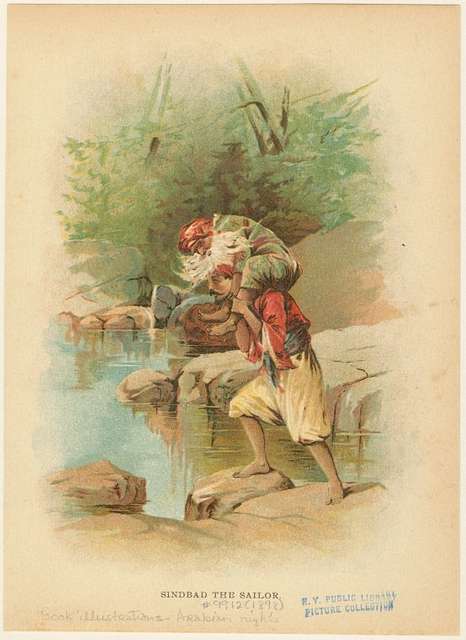
SINDABAD THE SAILOR

His tailor was a failure
and it drove Sinbad mad
that the colourful robes
he ordered to be made
tended to fade when exposed
to just a little salt spray.
“How can I have adventures
in pastel clothes? I want
to wear bolder shades
when I go looking for gold
and gems!” he muttered.
His tailor only smiled in reply
but when Sinbad’s back
was turned, he returned to his
original shape. He was a
gigantic genial green genie.


NED KELLY

Suits of armour
rather do chafe
but they keep you safe
from the bullets
of the Law. If you are poor
and truly believe you need
to rob banks to feed
yourself then taking precautions
is a lot less awful than
being shot into small portions.


DANIEL BOONE

Daniel Boone needed more room
so he went westward
until he came to Kentucky
where he was lucky
to survive all the various dangers.
Easily bored and
a man of few words
he rarely spoke to his friends
but often said howdy to strangers.


HONG GILDONG

He had magic powers
but no pockets on his trousers
So he kept his keys
strapped to his knees with a bowstring.
That was a clever thing
to do because if he was attacked
he simply bent a leg
and shot one of those iron objects
with serrated teeth
into the locks of their shocked looks.
Sometimes a key
ended up in an assassin’s mouth
and unfastened his tongue
and it wasn’t much fun
for that very bad man.

MARTÍN FIERRO

On the pampas
he was hampered
by fate when
he filled a hamper
with picnic foods
but forgot to bring a knife
to cut the bread
and cheese. Sitting
down with a deep frown
and trying to tease
meaning from political
debates while chewing
vast sandwiches
with the local cowboys.
   Gaucho Marx!


JESSE JAMES

He was a bushwhacker
in his youth and the bushes
plotted to whack him back
eventually. And they did
but not with a literal club
when he hid in thorny scrub
one prickly dangerous day.


DON QUIXOTE

His beard is a goatee.
His horse is a bag of bones.
He has no home.
His servant, Sancho Panza,
acts like a panda,
slow and plodding, chewing
often. While he,
chivalrous in a haphazard
frivolous manner,
never clamours for dinner
but only demands
noble and gallant repartee.


TWM SIÔN CATI

A cunning thief and trickster
he once took a leaf
out of his own book and refused
to give it back. Into a sack
of looted treasure it went
while he went into hiding
in the hills near Rhandirmwyn.
Those cursed heights!
Whether or not he read
the words on that stolen page
or not matters not a jot.
Our concise advice is the worst.


HENRY MORGAN

Why is that pirate yawning?
Doesn’t he know
that the golden age
of salty rogues is dawning?
He will do well
come hell or high water
and never give quarter
if he wakes up
in parallel with the zeitgeist,
ropes all spliced
so his sails won’t fail
but billow large and not nice
like a poltergeist
wrapped in the sheets
of a foamy sea. Wait and see!


RASPUTIN

I don’t want these cakes!
I don’t want this wine!
You might say I’m fussy
but I know my own mind.
I won’t dispute in this room
that Rasputin is doomed
but right now I feel fine.
It’s not time to become
just a footnote of mystery
in the annals of history.
No cakes, no wine for me!

DICK TURPIN

The highwayman is hurting
because of a pin
that was concealed within
the bag of coins
offered to him by the hand
of his victim
through the curtain
of a stagecoach window. His
thumb is bleeding
and the carriage is receding
down the rutted road.
He is annoyed
and will take no joy
from the successful robbery
because he is fussy
about injuries at work
and only respects big ones.
That’s his rule
        of ruddy thumb.


PANCHO VILLA

It’s time to retire
from revolutionary thrills
and live in the hills
in a cottage or bungalow.
But just in case
you don’t know
fussy Pancho declines
to dwell in any abode
less swell than a villa
in classical mode
well-stocked with wines.


GERONIMO

Geronimo is learning
to parachute
from one of the newly
invented aircraft
on the off chance
it will help his cause.
Paratroopers
will surely be effective
in future wars.
That’s what he thinks.
But he refuses to jump
out of the plane
unless he is given
a memorable name
to shout as he does so.
Rhys Hughes has lived in many countries. He graduated as an engineer but currently works as a tutor of mathematics. Since his first book was published in 1995 he has had fifty other books published and his work has been translated into ten languages.
.
PLEASE NOTE: ARTICLES CAN ONLY BE REPRODUCED IN OTHER SITES WITH DUE ACKNOWLEDGEMENT TO BORDERLESS JOURNAL
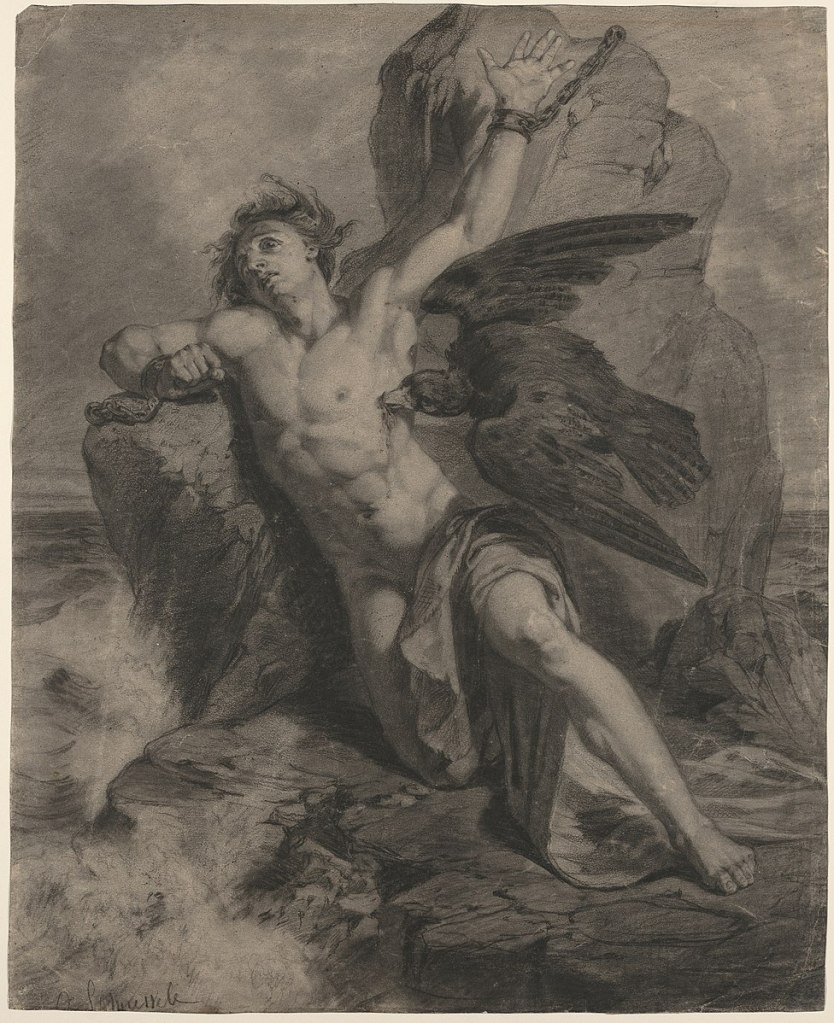
Prometheus Bound, charcoal by Christian Schussele. Courtesy: Creative Commons
When life itself seems lunatic, who knows where madness lies? Perhaps to be too practical is madness. To surrender dreams — this may be madness. Too much sanity may be madness — and maddest of all: to see life as it is, and not as it should be!
“No. I am not.” Surendra replied. “You are mistaken.”
“You are free! Free to move around and visit any place of your choice. Nobody can stop you. Nobody is stopping you. Inside or outside. Doors are open. Go for a stroll. You will realise this freedom. Why do you keep on saying this, father,” said the eldest son, while others listened and nodded.
“No, I am not free here—elsewhere. This is the truth. I am in chains. I carry them as a heavy burden, everywhere.” “Why do you say that dear brother?” asked Mukesh. “Your son is trying to make you understand that there are no chains around you. But you are adamant…and wrong.”
“Where am I wrong, Mukesh? You know me better.”
“Sorry, bro! But you are wrong.”
“How?”
“You say you are chained.” Mukesh replied patiently. “There are no chains. Look around — no chains. It is your illusion only.”
“It is a fact, Mukesh. I am in chains. Trust me, please,” said Surendra calmly. “I mean it. Every word. You know I never tell lies.”
A collective sigh!
Surendra was his usual composed self. Tall and dignified, he sat on the edge of the bed, in a meditating pose. A subtle aura made him appear otherworldly, a sage, among the philistines.
They sat for long. The distant forest could be glimpsed from an open window, a mass of soft shadows.
Raghu bent a look at his uncle.
“What nonsense, bro! You are totally free. I assure you. Absolutely free.” Mukesh broke the stalemate. “You are a well-read man. Why are you tormenting yourself and the rest of us? Please stop believing this wrong notion. You have always been logical. Now, come on. Walk with me to the nearest hotel on the highway. Nobody will stop you from moving around. I repeat, it is a free country!”
“Uncle is right. For the last three hours, we have been trying to prove the simple fact that you are not in chains. It is only a delusion! Come out of that, please, father and spare us this stressful drama.” Raghu pleaded with folded hands.
Surendra was unmoved: “That is the sad part!”
“What?”
“That my chains cannot be seen by my own son!”
“Please! Do not start again this argument now. It is a democracy in which all of us are free. That is it. Final! I do not want to argue on a given. Period.” “You are a fool. You are in chains, too, invisible chains but you don’t realize that, right now, like the silent majority. Living under the greatest illusion. That is it.”
Raghu gave his father a resigned look, “No point in talking further about this. Nobody can convince you. I am done.”
Raghu got up to leave.
“Fool! You will realize this fact soon.” Surendra said quietly. “It took me all these years to understand this simple and fundamental truth! We are all in chains in a free country! That is the biggest irony of human condition globally!”
Raghu did not engage with him. He exited, along with others, into the courtyard.
Ma waited there.
“Wastage of time and energy. Refuses to listen to reason. Stubborn as usual. He has never listened to me anyway. The fact is that he does not want to see reason. If not insane, he is not sane, either!”
Ma nodded. “I knew it from the beginning. Married to a top-class nut. Told you also many times. You never believed. Now face it.”
“He was a graduate, first in the community. Mad guys do not finish a B.Com with a first class,” replied Mukesh agitatedly. “Our mother said you drove him crazy. He was an intelligent man who did a lot to the extended family but you and your constant nagging made him mad.”
Ma retorted, “Defending the elder brother, as usual. You all gang up on me — mother-in-law, five brothers-in-law and two nasty sisters-in-law, all these years.”
The brother glowered. Ma glowered back. Mukesh muttered something and left in a huff.
Raghu and others met again, late night, to discuss ways of avoiding a possible public embarrassment of a rational, law-abiding, articulate man going mad in the autumn of his life, for no apparent reason.
It was a big mystery — his absurd claim of being in chains.
They discussed, debated but were unable to figure out the apparent trigger for such an odd behavior of the patriarch.
“We must act fast. The village should not learn that he has lost his mind,” Raghu said. “It will be great shame!”
They agreed to take him to the mental hospital the next afternoon on some ruse.
The gods willed it otherwise.
The village learnt about Surendra’s madness, very next morning, in a most dramatic manner. The author of this revelation was none other than a composed Surendra announcing it in the morning in the public square.
.
“You all are chained! Listen to me. Break your chains, you fools!”
Surendra shouted at the top of his voice.
People came out and watched, curious by the sudden transformation of a much-lauded supervisor in a textile factory in Kolkata, who had moved to Delhi, after the textile mills had closed down and driven taxi and finally owned three, in the Capital for two decades—saved money in the process, raised a large family and returned home in the village in Bihar to spend remaining years in the shadow of his ancestors. Surendra had renovated his old property in the village still mired in poverty. He taught children from the low-income families English and Math. A well-respected son of the soil who was not claimed by the city, like many others, and had returned to his roots.
At the moment, he appeared the usual self– calm, composed, dressed in simple cotton shirt and trousers, all white, and a pair of sandals. He wore a white Gandhi cap and spoke in measured tones.
As more crowd gathered near him, with children jostling for space and better view, he climbed a pile of crates, outside a grocer’s shop and addressed the audience in his familiar baritone: “Hear the truth! Be liberated!”
An old man asked lightly, “Okay. Give us the truth.”
Surendra smiled and said, “You ready for the shock?”
“Yes. We are.” The old man said. “Nothing surprises us anymore.”
Others chorused a big yes.
“Listen then, old man. This will surprise you a lot…” here he trailed off, building up suspense. Surendra surveyed the crowd and exhaled.
They waited for the fun.
Surendra looked again at the assembly of friends and neighbours and declared loudly: “Listen! The Truth. You are all shackled. All in chains!”
The old man was taken aback. “What? Are you drunk?”
Surendra laughed. “The drunk do not tell the truth. They spill secrets, after a peg too many.”
“That is also the truth,” countered the old farmer who had once stood for local elections. “The drunken truth. It also reveals things.”
“Truth is much higher than the alcohol-induced revelation.”
A murmur went around. Some youngsters jeered at the pompous man standing atop his perch, like a self-appointed guru.
“Fools! I give you the truth and you laugh at me!”
They laughed more.
“There is more.”
“What is that?” the old farmer demanded. “More truths!”
“I am the republic!” declared Surendra. “I am the democracy.”
This made the crowd laugh uproariously.
“He is out of mind,” said a neighbor. “How can a common citizen be the republic and democracy?”
“He always thought in grand terms,” said a school chum. “Treated himself as superior to rest of us!”
They laughed and some repeated derisively, “Hey, Republic! Hey, Democracy!”
“Tomorrow he will say he is the President of the Great Banana Republic!” said the chum.
“And day after, he will be the God!” observed the old farmer.
Surendra did not flinch. “Fools! You do not understand. You, too, are the republic and the democracy.”
They jeered again. “He is the Government.”
“Yes. I am the government.” Surendra shouted at the top of his voice. “I am a citizen — and everything. The basic unit. The fuel that keeps the system going.”
The crowd began enjoying the show.
“You are the government?” They asked.
“Yes, I am.”
“Then solve the problem of poverty, my government.” The farmer mocked.
“Who is the government?” A burly inspector asked in a husky voice. He had joined the crowd few seconds earlier. The crowd made way for the new arrival, haughty and walking with a swagger.
“This old villager says he is the new government,” said the school chum sarcastically.
“And the republic and democracy.” Added the old farmer with glee. “See his arrogance, audacity, a common man claiming to be the government!”
The inspector was amused. “Did you say that, old man?”
Surendra showed no fear. “Yes, I did.”
“What did you say?” the inspector asked. “Say it again.”
“I am a citizen.”
“Right.”
“I am the republic.”
“Wrong.”
“Why?”
“Because I am saying that — the police officer who is the real government. My word is last.”
“You are a mere pawn in the power game.”
“Let it be but I am the real government of this area.”
Surendra was patient and then said quietly, “Let it be. Anyway, I repeat, I am a citizen, the republic, the democracy and the government.”
The crowd laughed. They were enjoying the show now.
The inspector was amazed by the bold assertion. “How dare you?’
“Dare what?”
“How dare you call yourself the democracy, the republic and the government?” blazed the inspector.
“And why not? Why cannot I claim that?” persisted Surendra.
“A puny citizen! A low-life — that is what you are — nothing else.”
“Why low-life, inspector? I am the basic unit, like you, of the democracy.”
“So you say you are the government?” the cop jeered.
“Yes. I am. Part of the elected government.”
The crowd clapped for the puny man facing the cop.
The inspector replied, “That is going too far. I have to arrest you…”
“For what crime?”
“For anti-government stand. Being a grave threat.”
Surendra laughed. “Do I look like a threat? An old man standing in the square? How do I constitute a threat to the mighty state?”
The inspector scratched his bald head, pondered and then said, “I say so. I am the authority to decide that.”
“Then you are abusing your office,” replied Surendra.
Surendra’s statement surprised the fat officer. He thought and then said, “Enough! You are proving to be a danger to the security of the country. You are a public enemy number one. I arrest you for inciting people.”
He clapped the handcuffs on Surendra who said nothing.
People mocked him: “The new government goes in handcuffs!”
Surendra smiled and declared, “Fools! If truth leads to arbitrary arrest, you too, are under threat. I am ready to die for my convictions, my truth, which is the universal truth. The real government is always the public!”
Now few youngsters began shouting, “He is right. We are the real power, the voters. He is right!”
A carload of tourist was passing by. They stopped and filmed the scene. There was a local journalist and a lawyer who demanded an explanation from the cop: “How can you arrest a citizen for claiming that he is the legit democracy?”
The crowd was split into two camps: pro- and anti-police.
The seasoned cop understood the gravity of the situation and the volatile mood of the frustrated masses. He was one pitted again a crowd that might question his ways.
The man in khaki dialed a number desperately. Soon two jeeps arrived and took the disruptor to the police station, 10 miles away, followed by a large crowd and the carload of tourists. Within hours, the video began circulating and became viral. Foreign press caught on. Then the national press arrived and parked itself outside the police station.
The inspector refused to budge. “He is a public enemy number one, out to destroy the general peace and to incite people against the state by his bizarre claims of being the State, Democracy and Republic. A real danger to the legitimacy of an elected government. He needs to be kept behind the bars for the sake of peace and order.”
As the “Free Surendra, the Citizen” drive spread within 24 hours, the cops secreted him away to some other place, and, he was never seen again.
Some said he died due to torture. Others said Surendra was put in a maximum security jail in an island. Others claimed he was offered money and land by an opposition party to run on a ticket against the ruling party member.
The opinion was divided: Surendra, the Mad vs. Surendra, the Prophet: The former challenged the status quo and the latter revealed the plain truth to an unbelieving public!
Meanwhile, Surendra’s joint family had gone underground.
As happens in such viral cases, public memory being short, the world soon forgot Surendra and moved on with other viral videos about crazy dancers, weddings and stars spotted in the public.
Videos that excited the popular imagination.
Surendra and his disappearance no longer mattered.
After all, he was nothing — a zero.
Add zeros — and you become millions! He had once declared.
Sadly, he was ignored.
The thing did not end so tragically, however.
…on moonless cold nights, the ghost of Surendra could be seen in many locations, breaking his big chains and occasionally heard muttering — some said — two Russian names: Akaky Akakiyevich Bashmachkin and Gogol. After such sightings, the witnesses too, began mimicking his action and wanted to break out of their chains.
But who knows? These can be urban legends.
Fiction.
Or truth. In these days of doctored versions, it is difficult to decide on such matters…
.
Sunil Sharma is an Indian academic and writer with 22 books published—some solo and joint. Edits the online monthly journal Setu. Currently based in MMR (Mumbai Metropolitan Region).
.
PLEASE NOTE: ARTICLES CAN ONLY BE REPRODUCED IN OTHER SITES WITH DUE ACKNOWLEDGEMENT TO BORDERLESS JOURNAL.
Sunil Sharma unravels the mystique of the Spanish ingénue, the man who fights windmills and has claimed much much literary attention post Quichotte
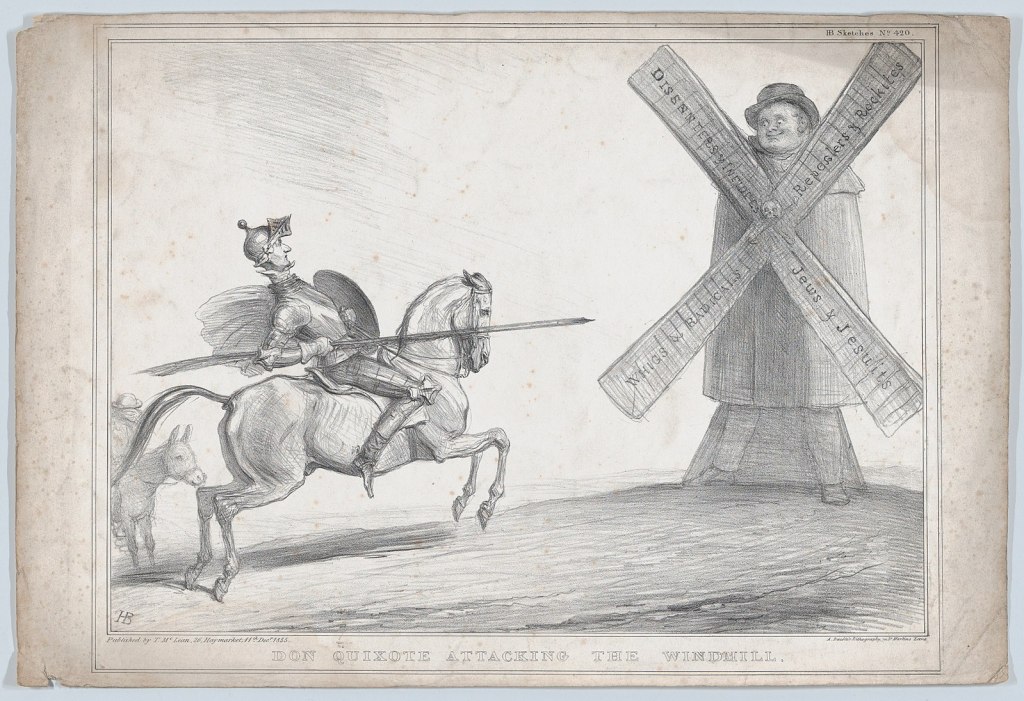
Don Quixote attacking the Windmill by John Doyle. Courtesy: Wiki
While learning Spanish in Mumbai recently, I came to enjoy Don Quixote immensely. And I also came to discover a unique tutor who came from the same enchanting land once traversed by the great philosophical Don on his poor steed Rocinante and in the company of his trusted fellow-adventurer, Sancho Panza. The shared links to Spain and her present and past culture made my wiry tall tutor a valuable guide. His observations vastly added to the pleasure of understanding the more than four-hundred-year-old sacrosanct text. He proved to be a skillful navigator, guiding me through the thick maze of the interesting book, generally considered to be the first modern novel of the West.
Spanish language is called the language of Cervantes — so rich is the effect and contribution of this artist on the overall national language and culture of Spain, and, on Western cultural life, by extension. The bulky rambling novel has inspired a host of great writers like Flaubert and Dostoevsky, among others. Picasso was said to be inspired by the adventures of this loveable simple man seeking beauty and romance in the most prosaic age of commerce and overseas conquest for colonies.
The Don’s creator can be called the precursor of magical Marquez and Isabel Allende and other experimental fictionists of the last century. The way even the mundane in Spain is fantastically transformed in the pages of this novel is an astonishing feat of unmatched artistic skill. It is a charming but lost place you come to see; a strange country that is conjured up for you. It is like catching a fleeting historical moment and preserving that elusive moment forever, for the succeeding generations of mind-travelers who want to revisit a famous literary site and be a participant in the unfolding seductive landscape marked by the surprising visual contraries.
The sheer magnitude, the solidity, the hugeness of the windmills can be experienced afresh by the reader through the eyes of the Don questing for the extraordinary in an ordinary age. The banal becomes the marvelous.
Don Quixote celebrates the creative difference in human perceptions — very much like the artistic genius of a Picasso or Dali who see things differently from the rest. This can disorient and yield a new insight. The windmills are not the ordinary windmills but are perceived to be giants. With the Don, the conventional view is drastically changed, and you get radicalised by a totally alien view. The usual appears unusual.
The artistic inversion and the radical reversal produce a startling breakthrough — the kind experienced in Kafka or Grass. There are other dramatic modifications. Deep transformations occurring in the text and within the reader. The world gets topsy-turvy. Don destabilizes stale perspectives and blasé viewpoints and manufactures refreshing realities, far removed from his current context and location.
The gentle sheep become an army of marauding mercenaries, a shocking opposite: the commonplace taverns and non-descript inns shed their dull features and turn into mysterious dark castles housing the secrets and weaponry of the ideal knights; the scheming magicians, it is claimed, make the precious libraries vanish. It is a continual collision of the real and the unreal, fact and fiction, heroic past and pedestrian present. In short, lands miraculous where things appear to be their reverse: everything appears to be whatit is not.
For example, Dulcinea is a fair princess for the smitten fifty-year-something Don; in reality, she is an ordinary farm girl. Cervantes has upturned the existing conventions of romance by describing ordinary real people of his country in a most favourable light and this bold gesture inaugurates the process of democratisation of literature that deepens further in succeeding centuries. A working farm girl serving as the original for an ideal princess itself is a remarkable advance, a literary breakthrough, a literary coup.
These ideas did not come naturally to me in my readings of Don Quixote but were a result of my constant interaction with my tutor. He was, incidentally, from Madrid and had a strong resemblance to Don. He went by a long name of Juan Rodriguez de Silva but preferred to be called Amando. Once, during a break in the long afternoon lessons, the 45-year-old Mumbai-based freelance writer and part-time Spanish tutor — in the country for a year for some research on the early proselytizing of the Spanish Catholic priests in Goa, Mumbai, Cochin and Chennai, among other coastal cities of the South India — told me that the father of my favourite author, Don Rodrigo de Cervantes, was a very interesting figure, largely ignored by the later scholarship.
He said: “I found him, Cervantes senior, quite fascinating. He was a surgeon who wandered from one place to another in search of work. The family led a difficult and unsettled life due to this reason. In those days, in sixteenth-century Spain, the job of a surgeon was not high-paying and considered lowly. It did not enjoy any social prestige. The poor family suffered many financial problems on account of this vagrant lifestyle.”
I listened attentively to this family history that was like opening a window on the hoary past of a different era and nation. “Spain was feudal. Aristocracy prevailed. Finding acceptability, honour and respect was difficult for the disinherited and dispossessed. The senior Cervantes was a man of ingenuity, very much like Don Quixote of La Mancha. I have this feeling that the immortal Don Quixote was modeled to some extent on Rodrigo. A few parallels can be seen,” said Amando.
“How?” I asked.
“Well, the guy was like to-day’s harmless imposter, not willing to violate the law or break rules but willing to twist facts and invent a bit of illustrious history or lineage to make him look grand. You can call such desperate persons as simple pretenders who mean no harm. Cervantes’ father thought what he was actually not. He was very inventive. The wandering barber-surgeon claimed he was descended from a noble family. An aristocratic past, I would say, for his impoverished family. But, in the long run, this fiction did not help, and he landed up in the debtors’ prison for unpaid arrears, very much like John, the unfortunate overspending dad of Dickens, who served as a model for Mr. Micawber. In fact, both the writers were much haunted by the imprisonment of their failed fathers and the misfortunes that attend such a situation. Poverty and inequalities of an unjust system are sympathetically described by both chroniclers of two great societies, most poignantly by Dickens and satirically, by Cervantes.”
This sounded exciting.
Amando continued, “You can call them forgeries. Innocent ones, of course. Who does not want to have a duke or duchess in their blood? People invent an interesting past for themselves for different reasons.”
I agreed. I know of a young man who had created a Christian past to woo a European woman in a multinational corporation in Mumbai and was successful in this deception. In America, many Indians have adopted Anglican names to blend well in their society and avoid hostility.
“You see, we all are like that. We all fictionalise, invent and re-create things for ourselves, at one point or other, in our unremarkable lives. Don is an avid reader of books that talk of romance and chivalry and wants to re-create that lapsed order of things in an age hostile to such revival and the entire project is doomed from the beginning.” I nodded.
Amando went on: “I know many poor young men who say they are from wealthy families, but the lies get exposed. The truth is to be confronted. Rodrigo lived in a dual world of lies and bitter truths. He was escaping from bitter facts into the comforts of fiction. Don was also like him. The imaginative man wanted to revive an entire age that was gone forever. Naturally, such an attempt was going to be farcical and ultimately tragic, simply because history can never be reversed. You cannot run away from your present and reality catches up—finally.”
He was right. Fiction does not last forever. They do not help, either. One has to return — to a normal sane world or die dubbed insane. This dramatic tension between the past and the present, between romance and grim reality, between an imagined past and an impoverished stark present, continually informs the life and the optimistic but hopeless quest of the man from La Mancha.
“Rodrigo was using a language no longer understood in a cynical age of greed. Like Don Quixote, he was caught up in a cusp of crucial change. A new world order was starting and the older solid one was dying. Folks like Don could see things others could not. Don is a visionary or a mad prophet—take your pick. A genius or a phony. In fact, forgeries, deceptions, self-deceptions, thefts are all common in art world. All art, if you permit, is itself, a great forgery. It may scandalize the establishment, but it is a truth that cannot be denied. The Bard is a known literary thief. Many painters did forgeries and were never caught. Forgery proves one point: No art can claim to be original except the precocious Greeks. Everything else is a mere re-telling or mere re-working of the original. That is why geniuses like Shakespeare or Picasso never bothered about originality but, ironically, could produce some of the most original works that were commentaries on the preceding ones, kind of meta-fiction or meta-work or meta-criticism. Borges did that through his short fiction called ‘Pierre Menard, the Author of the Quixote’ raises the question of continued relevance of an artwork for the coming generations. It tells us how we re-create the classics and fashion them in our own image. A text is never static but an open and dynamic series. Borges himself did successful literary forgeries to prove the point that search for originality of vision is futile exercise and need not be undertaken by the modern artists. It also undermined the seriousness of art.”
Talking of Cervantes, the insightful Spanish tutor said somberly, “Even Miguel Cervantes did forgery of a different sort by inventing an exotic authorship for the fictional Don Quixote and his adventures that defy common sense. He attributed authorship of this long text to one Arab Benegeli. He said it was originally written by the Moor, translated by another and edited by him. But then, it was a common practice for many writers to do like that only. Stevenson did that. Authorship, originality and artistic vision were not exclusive preserves of the narrating voice but were diffused in the wider culture of the day.”
I nodded.
He was quiet for long and then said, “In fact, this desire to recreate and represent the given facts is an act of forgery but since we are aesthetically conditioned or trained to view these as art objects, we miss the obvious and call it as a creation.” Now, this was revelation. “Don Quixote is an exquisite example of this human creative desire to recreate older realities or traditions in newer ways that can be shockingly, startlingly, daringly different from the older ones. They call them these days as revisions. In fact, every new voice is a renewed older voice. If you acknowledge the source, it becomes a tribute. Otherwise, it is plagiarism. Then there are other issues as well.”
I looked at him. A fine but unknown reader and critic, Amando said after a long pause, “The value of popular traditions, the value of books and the fictional truth and the outcome of a desire to implement these literary truths in the altered context of the contemporary reader of that text or tradition are all discussed by the writer. Rodrigo changes his pedigree, Don Quixote wants to re-create an imagined past in the romantic tradition of an era yet to come. Cervantes creates an Arab author for this history of an individual that reflects the seventeenth-century Spain and in the process, mocks that tradition and anticipates the emergence of another world that is no longer feudal. All these acts are forgeries of the prevalent facts. They challenge and change the facts and are changed by the subsequent facts of the succeeding generations.”
Yes, he was right.
He continued: “It is — great art — both local and universal. It is both temporal and eternal. It is both present and future. Now, the question is, can the great art of last century or much earlier, speak to us directly? Borges raises the same query in the Pierre Menard fiction and says a creative engagement with great texts like Don can be historically productive as we try to interpret these texts in the light of our own times. We try to refashion these multi-layered rich texts pregnant with multiple meanings and try to extricate valuable insights into the nature of time, humanity, life and society. Both creation and critical reading is a continual process of re-inventing, recreating, altering historical facts with imagination and then trying to make it give some historically true conclusions that can be called progressive at a later stage of its evolution. In a way, a great artist is able to transcend the limits of his social condition and rise above his historical moment and see the dawn of another moment. The past, present and future are all sedimented in great art that belongs to all the centuries and not to its century of creation. It is the great paradox of art. You commit artistic forgeries and produce genuine serious art out of this act of self-conscious tampering. Old knowledge being made contemporary and relevant by reading the present into the text of the old and making it yield new truths whose echoes can be found distinctly in that of the old text. Postmodern fiction does perform only this task for us. The only difference is they call it parody and avoid the term forgery.” That was brilliant.
“In our life ordinary, we all tend to fictionalise to some extent but have to return to bitter realities of the human existence. Fictionalised worlds are delightful ad hoc realms but fail to provide permanent sanctuaries. The real for a previous era or eras is unreal for us; the unreal for us was the real for our ancestors and out of the dramatic tension of the two, emerges newer dimensions and newer texts in a ceaseless manner. As the wise, not mad, Don says to Sancho, in chapter sixty-six, that each person is a forger of his own destiny and he, of his own but without necessary prudence. This results in one disaster after another. This view marks a radical juncture between the ideologies of the feudal and the emerging world and shows the inevitability of the decay and death of the former and the birth of the latter.”
After another long pause, he said, this somber Spaniard, a look-alike of Miguel Cervantes, “Last consideration on Don. Last three centuries, the imaginary Don has shed his fictional character and become real — like Mephistopheles, Hamlet, Wilhelm Meister or Young Werther, Raskolnikov and Madame Bovary. These characters have become super real and cultural figures of eminence and reached cult status. It is amazing transformation within art. They speak to the curious and the willing. The Don could see backwards and forwards, Janus-like. The historically well-located Cervantes could witness the dialectics of change vividly. He announced the total eclipse of a dominant world order and the arrival of another world order. In painting, the same was achieved by another brilliant Spanish genius. Velazquez achieves the same prophecy in his painting, Las Meninas, whereby he foresees the fading of monarchy and signals the end of the monolithic worldview of feudalism by splintering the single unified view into multiple perspectives. By rupturing the old and inaugurating the novel, serious art becomes prophetic and consecrates the new point of view that may look scandalous to many but gradually becomes accepted as the official version — till a new voice terminates the outdated and heralds the new beginnings for a changed age. Don does all this for us and by the inherent dualism of artistic projection and artistic cognition, renews and revitalizes the narrative traditions and their continuities. By constant re-engagement with the classics, we fulfill deeper needs for epistemologies and gain bold insights into the past, our present and dim future based on this temporal cycle. Great artists explain the world present past and future and tell us that nothing is eternal but subject to historical change. As long as they perform this task, they will never be irrelevant to us or others after us.”
Amando had just unfolded so many dimensions that others could not perceive in Don. But then, that is the art of reading and critically explaining to us through a consecrated cultural text of the yore. Is it not? All of us write our own Don Quixotes in our own way as close collaborators and gain rare insights, epistemes by this joint process. And feel educated or enlightened. ‘Epiphanies’ is what Joyce called these lucid moments.
Reading Don was such a moment for me in the company of my imagined Spanish tutor…
Sunil Sharma is the editor of SETU. He is a senior academic, critic, literary editor and author with 21 published books, seven collections of poetry, three of short fiction, one novel, a critical study of the novel, and, eight joint anthologies on prose, poetry and criticism, and, one joint poetry collection.
.
PLEASE NOTE: ARTICLES CAN ONLY BE REPRODUCED IN OTHER SITES WITH DUE ACKNOWLEDGEMENT TO BORDERLESS JOURNAL




 Borderless
