Categories
Review

This Could be A Love Poem for You

Book Review by Gazala Khan

Title: This Could Be a Love Poem for You

Author: Ranu Uniyal

Publisher: Red River

This Could Be a Love Poem for You by Ranu Uniyal, is her fifth collection of poems. Uniyal is a passionate bilingual poet at heart, a retired professor of English literature by profession and an inspiration to many budding poets. Across the Divide (2006), The Day We Went Strawberry Picking in Scarborough (2018), December Poems (2012) and Saeeda Ke Ghar (In Saeeda’s home, Hindi, 2021) are some other significant contributions made by the poet.

“Poetry and beauty are always making peace. When you read something beautiful, you find co-existence; it breaks walls down.” A quote by Mahmoud Darwish is reflective of Dr Uniyal’s poignant portrayal of human existence layered with love, grief, crises and relationships with the One (Self) and the World.

The collection is an aesthetic delight that traverses the heart of the readers with astute directness and a distinct confessional tone. It has three segments: ‘Dust My Regrets’, ‘Be a Good Girl’ and ‘Thy Eternal Grace’. Collectively, there are 62 poems in all.

The poems start from the personal and move to the universal  with their intricate details. The poetic sensibilities take us to the female imaginary of the physical, psychological and spiritual domains. If Kamala Das in the 20th century introduced the readers to her brazenness in poetry, then Ranu Uniyal in the 21st century coerces her readers to travel from the common routine to the coveted spiritual abode found in the creative doctrine of poetry. The poetic depth can also be inferred through the rhythmic structure, the play with the words through alliteration and rhymes introduce jibes in poems such as ‘The Shop and the Shutter’.

The themes of love, identity, self-expression, language and power, old age, body’s fragility, vulnerability, precarity, loss, women and domesticity, motherhood, death and memory are persistent throughout the anthology. She poetically contours the theme of human existence and its distinct flavours like WB Yeats in Sailing to Byzantium with — “That is no country for old men.”

The poetic pondering over the question of ‘Self’ or recurrent declaration of ‘I’ is developed through linguistic, racial, and geographical temporal identities. For example, the poet’s ‘Garhwali’ identity is camouflaged with the the more modern Anglophone identity. The declaration of the personal “self” and dedication to some personalities like Mohini Mangalik, S. A. Hamid and Amma takes us to the glints of the poet’s biography in the most poetic manner. Gulzar once uttered that, “we poets are errant grains of dust… life takes us and tosses us, we do not know where it will end.” The poems hail the essence of life’s evolutionary journey, especially the one of experience and the mature years of life.

Her poems present multiple binaries: of love and grief, seller and buyer, life and death, through picturesque imagery. Additionally, the poet familiarises the readers with the references to the pagan myths from diverse cultures, Christ, Nachiketa, Yama, Isis, which also introduce us to the eco-folklorists’ traditions which is a delight to explore.

She writes in aphorisms at times and critiques the personal and public crises. The poem, ‘Only Grief’, provocatively emotes the climate crisis as an apocalyptic warning through a distant voice from the future, wherein, critiquing the war-torn present world and the catastrophic space left for the progeny of the future.

We sang dangerously of the failure.
Of our prodigal ancestors.

Another poem, ‘From One Life to Another’, reflects a similar concern about the cataclysmic/tragic climate situations left for the future:

Sparrows and crows have 
been hushed to silence.
The once-green acacia shrieked
as they chopped her limbs.

Nature and motherhood hold each other’s hands in sharing the identity of exploration and exploitation. Furthermore, the intricate details through the lens of the ecofeminist poetic sensibilities highlight the diversified literary corpus in the anthology. The same poem states further:

I was once a tree- all green.
Very tall, bobbing in the wind.
I had leaves, branches.
And occasional flowers.
I, too, had a name.
A woman. A mother.
Once a tree.
I brush them aside,
My tears, an upright foliage
Lying heavy on my chest.

Dr Uniyal can be set alongside the “literary greats” like Kamla Das and Sujata Bhatt.

The usage of the colloquial vernacular Hindi words and phrases makes it more personal, tinctured with cultural aesthetics.

The eponymous poem in the anthology, ‘This Could Be a Love Poem for You’ is raw and personal between the one waiting for the other partner far away from a distance is the talisman of the relationship, the theme that finds its way again and again in the poet’s poetic oeuvre. This colourful and mature anthology glossed with distinct sonorous imagery could indeed be a reflective love poem for the present and for our progeny, the rightful claimants, who would reminisce over the past.  It’s a love poem about resilience and human existence that shall follow the hearts of the readers for a long, dialogic course of expressions and insights.

Gazala Khan teaches in the Department of English at Doon University, Dehradun, India. She has published poetry in magazines such as Setu, Borderless, and The Fictional Café and has been consistently working on creative and literary projects.

.

PLEASE NOTE: ARTICLES CAN ONLY BE REPRODUCED IN OTHER SITES WITH DUE ACKNOWLEDGEMENT TO BORDERLESS JOURNAL
Click here to access the Borderless anthology, Monalisa No Longer Smiles

Click here to access Monalisa No Longer Smiles on Kindle Amazon International

Categories
Festive Special

Goodwill and Peace on Christmas

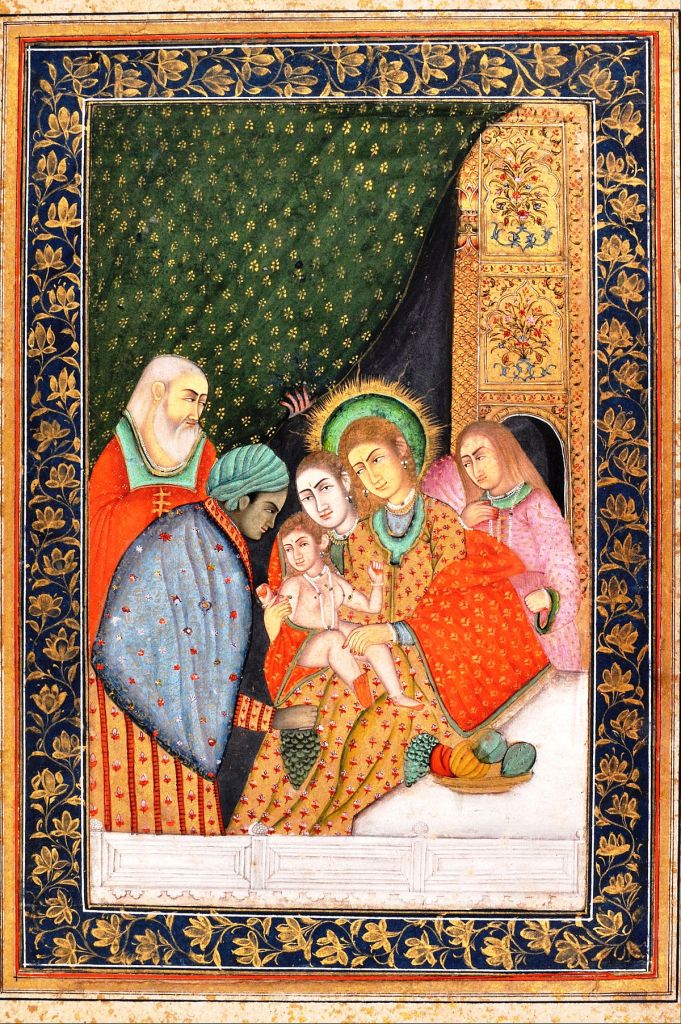
Nativity of Christ, painted in the Mughal empire, around 1800 AD

“The central celebration is the birth of a child. There is no culture that does not celebrate this event, because all of us who belong to the human race can see our collective future in the pudgy little face. We marvel at this conjuring act, the miniature miracle, at its tiny fingernails and budlike nose.” — Jerry Pinto, Indian Christmas: Essays, MemoirsHymns, an anthology edited by Jerry Pinto and Madhulika Liddle

Christmas centres around the birth of a child who impacted a large part of the world and urged us to love others despite differences, to be kind, to embrace those who suffered… and that is the spirit that continues to unite humankind to move towards a future where people thrive in harmony, with love in their hearts. Despite all the darkness that broods over the world, Christmas has come around. The sun still moves forward in time and at some point, the darkness will give way to light. Perhaps, Christmas will remind people of the values they need to uphold to live in a world that is not filled with fear, greed or the lust for power and they will stop killing ruthlessly and without any sense of coherence. With that in mind, we have tried to evoke the spirit of Christmas cheer by presenting writings that talk of celebrations.

This is a season that should be filled with hope, goodwill, peace and love. The celebrations — depicting variety, a departure from conventional norms — by writers who reach across borders and time, rekindle our belief in the wonder created by these values, which is what Christmas is all about. We start with Tagore, a Brahmo by religion but his poem in English dwells on the wonder he feels at the idea of this unique birth of Christ. Our other writers from across the world pitch in with what Christmas means to all of them, whether it creates a sense of goodwill, nostalgia, invokes curiosity or just evokes plain laughter. Hopefully, we can all join together to ring the bells of kindness, love, humanitarian help and peace this year!

Poetry

An excerpt from Rabindranath Tagore’s ‘The Child‘ a poem originally written in English by the poet to celebrate Christmas. Click here to read.

One Star by Ihlawha Choi. Click here to read.

Christmas Cheer by Malachi Edwin Vethamani. Click here to read.

Prose

Indian Christmas: Essays, MemoirsHymns, an anthology edited by Jerry Pinto and Madhulika Liddle has been discussed by Somdatta Mandal. Click here to read.

In I Went to Kerala, Rhys Hughes treads a humorous path while exploring Christmas in Kerala. Click here to read.

In Hold the Roast Turkey Please Santa , Keith Lyons writes from New Zealand, where summer solstice and Christmas fall around the same time. Click here to read.

In My Christmas Eve “Alone”, Erwin Coomb has a strange encounter on Christmas eve… Is it real? Click here to read. 

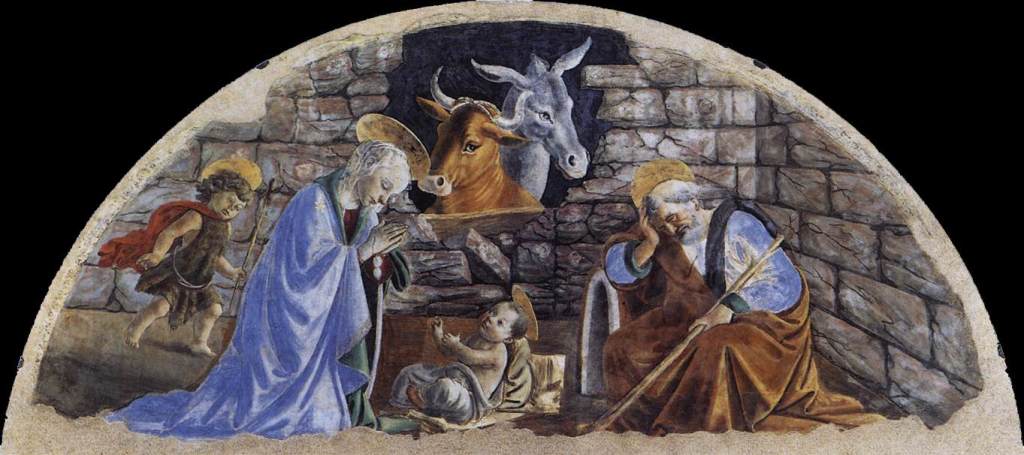
Nativity, a fresco by Italian artist Boticelli, created around 1467
Categories
Editorial

Celebrating the Child & Childhood…

‘Victory to Man, the newborn, the ever-living.’
They kneel down, the king and the beggar, the saint and
the sinner,
the wise and the fool, and cry:
‘Victory to Man, the newborn, the ever-living.’

The Child’ by Rabindranath Tagore1, written in English in 1930

This is the month— the last of a conflict-ridden year— when we celebrate the birth of a messiah who spoke of divine love, kindness, forgiveness and values that make for a better world. The child, Jesus, has even been celebrated by Tagore in one of his rarer poems in English. While we all gather amidst our loved ones to celebrate the joy generated by the divine birth, perhaps, we will pause to shed a tear over the children who lost their lives in wars this year. Reportedly, it’s a larger number than ever before. And the wars don’t end. Nor the killing. Children who survive in war-torn zones lose their homes or families or both. For all the countries at war, refugees escape to look for refuge in lands that are often hostile to foreigners. And yet, this is the season of loving and giving, of helping one’s neighbours, of sharing goodwill, love and peace. On Christmas this year, will the wars cease? Will there be a respite from bombardments and annihilation?

We dedicate this bumper year-end issue to children around the world. We start with special tributes to love and peace with an excerpt from Tagore’s long poem, ‘The Child‘, written originally in English in 1930 and a rendition of the life of the philosopher and change-maker, Vivekananda, by none other than well-known historical fiction writer, Aruna Chakravarti. The poem has been excerpted from Indian Christmas: Essays, MemoirsHymns, an anthology edited by Jerry Pinto and Madhulika Liddle, a book that has been reviewed by Somdatta Mandal and praised for its portrayal of the myriad colours and flavours of Christmas in India. Christ suffered for the sins of humankind and then was resurrected, goes the legend. Healing is a part of our humanness. Suffering and healing from trauma has been brought to the fore by Christopher Marks’ perspective on Veronica Eley’s The Blue Dragonfly: healing through poetry. Basudhara Roy has also written about healing in her take of Kuhu Joshi’s My Body Didn’t Come Before Me. Bhaskar Parichha has reviewed a book that talks of healing a larger issue — the crises that humanity is facing now, Permacrisis: A Plan to Fix a Fractured World, by ex-British Prime Minister Gordon Brown, Nobel Laureate Michael Spence, Mohamed El-Erian and Reid Lidow. Parichha tells us that it suggests solutions to resolve the chaos the world is facing — perhaps a book that the world leadership would do well to read. After all, the authors are of their ilk! Our book excerpts from Dr Ratna Magotra’s Whispers of the Heart – Not Just A Surgeon: An Autobiography and Manjima Misra’s The Ocean is Her Title are tinged with healing and growth too, though in a different sense.

The theme of the need for acceptance, love and synchronicity flows into our conversations with Afsar Mohammad, who has recently authored Remaking History: 1948 Police Action and the Muslims of Hyderabad. He shows us that Hyderabadi tehzeeb or culture ascends the narrow bounds set by caged concepts of faith and nationalism, reaffirming his premise with voices of common people through extensive interviews. In search of a better world, Meenakshi Malhotra talks to us about how feminism in its recent manifestation includes masculinities and gender studies while discussing The Gendered Body: Negotiation, Resistance, Struggle, edited by her, Krishna Menon and Rachana Johri. Here too, one sees a trend to blend academia with non-academic writers to bring focus on the commonalities of suffering and healing while transcending national boundaries to cover more of South Asia.

That like Hyderabadi tehzeeb, Bengali culture in the times of Tagore and Nazrul dwelled in commonality of lore is brought to the fore when in response to the Nobel laureate’s futuristic ‘1400 Saal’ (‘The year 1993’), his younger friend responds with a poem that bears not only the same title but acknowledges the older man as an “emperor” among versifiers. Professor Fakrul Alam has not only translated Nazrul’s response, named ‘1400 Saal’ aswell, but also brought to us the voice of another modern poet, Quazi Johirul Islam. We have a self-translation of a poem by Ihlwha Choi from Korean and a short story by S Ramakrishnan in Tamil translated by T Santhanam.

Our short stories travel with migrant lore by Farouk Gulsara to Malaysia, from UK to Thailand with Paul Mirabile while chasing an errant son into the mysterious reaches of wilderness, with Neeman Sobhan to Rome, UK and Bangladesh, reflecting on the Birangonas (rape victims) of the 1971 Bangladesh Liberation war, an issue that has been taken up in Malhotra’s book too. Sobhan’s story is set against the backdrop of a war which was fought against linguistic hegemony and from which we see victims heal. Sohana Manzoor this time has not only given us fabulous artwork but also a fantasy hovering between light and dark, life and death — an imaginative fiction that makes a compelling read and questions the concept of paradise, a construct that perhaps needs to be found on Earth, rather than after death.

The unusual paradigms of life and choices made by all of us is brought into play in an interesting non-fiction by Nitya Amlean, a young Sri Lankan who lives in UK. We travel to Kyoto with Suzanne Kamata, to Beijing with Keith Lyons, to Wayanad with Mohul Bhowmick and to Langkawi with Ravi Shankar. Wendy Jones Nakanishi argues in favour of borders with benevolent leadership. Tongue-in-cheek humour is exuded by Devraj Singh Kalsi as he writes of his attempts at using visiting cards as it is by Rhys Hughes in his exploration of the truth about the origins of the creature called Humpty Dumpty of nursery rhyme fame.

Poetry again has humour from Hughes. A migrant himself, Jee Leong Koh, brings in migrant stories from Singaporeans in US. We have poems of myriad colours from Ryan Quinn Flanagan, Patricia Walsh, John Grey, Kumar Bhatt, Ron Pickett, Prithvijeet Sinha, Sutputra Radheye, George Freek and many more. Papia Sengupta ends her poem with lines that look for laughter among children and a ‘life without borders’ drawn by human constructs in contrast to Jones Nakanishi’s need for walls with sound leadership. The conversation and dialogues continue as we look for a way forward, perhaps with Gordon Brown’s visionary book or with Tagore’s world view of lighting the inner flame in each human. We can hope that a way will be found. Is it that tough to influence the world using words? We can wish — may there be no need for any more Greta Thunbergs to rise in protest for a world fragmented and destroyed by greed and lack of vision. We hope for peace and love that will create a better world for our children.

As usual, we have more content than mentioned here. All our pieces can be accessed on the contents’ page. Do pause by and take a look. This bumper issue would not have been possible without the contribution of all the writers and our fabulous team from Borderless. Huge thanks to them all and to our wonderful readers who continue to encourage us with their comments and input.

Here’s wishing you all wonderful new adventures in the New Year that will be born as this month ends!

Mitali Chakravarty

borderlessjournal.com

  1. Indian Christmas: Essays, MemoirsHymns edited by Jerry Pinto & Madhulika Liddle ↩︎

Click here to access the content’s page for the December 2023 issue

.

READ THE LATEST UPDATES ON THE FIRST BORDERLESS ANTHOLOGY, MONALISA NO LONGER SMILES, BY CLICKING ON THIS LINK.

Categories
Poetry

Poetry by John Grey

Groundhog. Groundhog Day is celebrated on February 2nd. If the groundhogs leave the den where they hibernated, the weather is supposed to move towards spring. This observance has its roots in ancient Celtic culture.
GROUNDHOG DAY

It’s Groundhog Day.
The groundhog is somewhere
burrowed deep in the ground.
Either the groundhog 
doesn’t know what day it is
or he doesn’t care.
But, then again, 
Christ doesn’t show up
on Christmas either.
Just your father
and his new wife
with some toys.
It’s the one time of the year,
you see his shadow.


TWILIGHT

day flies off
like cardinals
and gold-finches

night
settles
on the branches
like crows

mice
scamper nervously
across the forest floor

all the birds
are owls


WORKING MY WAY THROUGH THE DICTIONARY, 
	I AM NOW AT Q

Some words 
have tens, 
if not hundreds, 
of synonyms.
Others,
hardly any at all.
That is why I’ve never 
written a poem about a quark.
That word, 
for want of an alternative,
would appear on every second line.
Even this poem 
has to repeat the word quark
just to get its point across.
So let this be my quark poem
and leave it at that.

John Grey is an Australian poet, US resident, recently published in New World Writing, Santa Fe Literary Review, and Lost Pilots. His latest books, Between Two Fires, Covert and Memory Outside The Head are available through Amazon. He has upcoming poetry in the Seventh Quarry, La Presa and California Quarterly.

.

.

PLEASE NOTE: ARTICLES CAN ONLY BE REPRODUCED IN OTHER SITES WITH DUE ACKNOWLEDGEMENT TO BORDERLESS JOURNAL
Click here to access the Borderless anthology, Monalisa No Longer Smiles

Click here to access Monalisa No Longer Smiles on Amazon International

Categories
Poetry

The Grave is Wide…

Poetry by Michael R. Burch

Courtesy: Creative Commons
Epitaph for a Refugee Child
		
I lived as best I could, and then I died.
Be careful where you step: the grave is wide.

Epitaph for a Refugee Mother

Find in her pallid, dread repose,
no hope, alas!, for a human Rose.

who, US?

jesus was born 
a palestinian child
where there’s no Room 
for the meek and the mild

... and in bethlehem still 
to this day, lambs are born
to cries of “no Room!” 
and Puritanical scorn ...

under Herod, Trump, Bibi
their fates are the same— 
the slouching Beast mauls them
and WE have no shame:

“who’s to blame?”

(First published in Setu)


Excerpts from “Travels with Einstein”


I went to Berlin to learn wisdom
from Adolph. The wild spittle flew
as he screamed at me, with great conviction:
“Please despise me! I look like a Jew!”

So I flew off to ’Nam to learn wisdom
from tall Yankees who cursed “yellow” foes.
“If we lose this small square,” they informed me,
earth’s nations will fall, dominoes!”

I then sat at Christ’s feet to learn wisdom,
but his Book, from its genesis to close,
said: “Men can enslave their own brothers!”
(I soon noticed he lacked any clothes.)

So I travelled to bright Tel Aviv
where great scholars with lofty IQs
informed me that (since I’m an Arab)
I’m unfit to lick dirt from their shoes.

At last, done with learning, I stumbled
to a well where the waters seemed sweet:
the mirage of American “justice.”
There I wept a real sea, in defeat.

(First published in Café Dissensus)

Michael R. Burch’s poems have been published by hundreds of literary journals, taught in high schools and colleges, translated into fourteen languages, incorporated into three plays and two operas, and set to music by seventeen composers.

PLEASE NOTE: ARTICLES CAN ONLY BE REPRODUCED IN OTHER SITES WITH DUE ACKNOWLEDGEMENT TO BORDERLESS JOURNAL

Click here to access the Borderless anthology, Monalisa No Longer Smiles

Click here to access Monalisa No Longer Smiles on Kindle Amazon International

Categories
Review

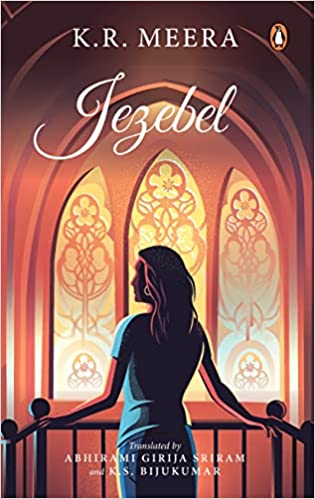
Jezebel

Book Review by Somdatta Mandal

Title:     Jezebel

Author: K.R. Meera, translated from Malayalam by Abhirami Girija Sriram and K. S. Bijukumar)

Publisher: Penguin Random House India

In a multicultural and multilingual country like India, it is very difficult to ascertain the progress of literary creativity in all the regions because of language barriers. Translation is one of the means through which this deficiency can be met. Recently even big publishing houses are paying a lot of attention to translate texts from different bhasha[1] literatures into English so that they can cater to a pan-Indian readership. K.R. Meera’s original Malayalam novel Jezebel is one such recent addition. It has the eponymous protagonist Jezebel, a young doctor in Kerala, struggling against the cruel realities of a patriarchal world –realities that not even her education, resolve or professional brilliance can shield her from. Trapped in an abusive and claustrophobic marriage that had been arranged by one of her relatives for some ulterior motive, the novel begins with a powerful metaphor of suffering and endurance:

“As she stood in the family court, pelted with the blame of having paid a contract killer to murder her husband, Jezebel had this revelation: To endure extreme torture, imagine yourself as Christ on the cross.”

In this novel, which takes the form of a courtroom drama to show us the rich inner worlds of its characters, we see Jezebel reflect on her life and its pivotal points as she takes the stand. Through her memories, we see her grow from a reticent, serious young woman to a rebel who refuses to bend to the conventions of society. In the Old Testament of the Bible, Jezebel was a prophet and she was the only one to challenge prophet Elijah. She was at the same time a strong woman and an accursed one. Like the Biblical story of Queen Jezebel, who was much maligned as a scheming harlot and infamously thrown to her death from her palace window, Jezebel is a novel that asks if independent women can ever live lives that are free of judgement. The marriage between Jezebel and Ahab was an agreement between two communities that worshipped two different gods. Poor King Ahab was a good king who ruled for twenty-two years. His only mistake was to marry the Sidonian princess Jezebel. And that too to improve relations between the two kingdoms and to trade with them. When they got married, Queen Jezebel brought her gods along with her to Samaria. In our protagonist’s case, her already contentious divorce proceedings go suddenly awry, and her unhappy marriage holds complex secrets. Throughout the novel, K.R. Meera’s powerful prose makes resonant allusions to the Bible in different ways that elucidate the correlations between legend and the protagonist’s life while also exploring how sexuality and gender roles are manipulated by the dictates of society.

In the novel we are shown how Jezebel’s arranged marriage with Doctor Jerome George Marakkaran ended in disaster from day one, and in the two and a half years they lived together as husband and wife, their marriage was never consummated. Her father-in-law, George Jerome Marakkaran is a brute straight from TV serials, and starts cursing Jezebel right from the first day believing in his god-ordained mission to punish her in any form whatsoever. The court hearings frame the narrative, with the (very filmy) lawyer’s dramatic queries triggering flashbacks, each a tale of tremendous misery, shocking injustice or unbearable trauma – a veritable catalogue of the woes of a half of the world even in this day and age. The mother-in-law, Lilly George Marakkaran, however, is kind-hearted even if meek, and she too secretly supports her daughter-in-law to break the shackles of patriarchy and go out into the world – something she was unable to do. This inability leads to her suicide in the end. Jezebel’s parents, too, are characters who refuse to come out of clichés. The result is a series of unfortunate events, and they all end up in a family court for divorce. In order to narrate the plight of her protagonist from the very beginning, Meera creates the canvas with plenty of characters, who like Chaucer’s ‘God’s plenty’ fill the pages of the novel from the beginning to the end. Most of these characters are stereotypes and yet they manage to make the story convincing, though melodramatic at times. Jezebel has a difficult childhood growing up with her mother Ammachi who explains every move in Biblical terms and who argues that “a good woman will not ever speak a word” against her husband, however worthless he is; her maternal grandmother Valiyammachi is the one who understands her and asks her to discontinue her marriage immediately and live life on her own terms. Throughout the novel she offers her shoulders for Jezebel to weep upon.

In between, a lot of melodrama is thrown in. The novel itself confesses the soap opera part:

“John’s wedding was a frugal affair. George Jerome Marakkaran stood ramrod stiff, hands clasped behind his back, chin tilted up at a hundred-and-twenty degrees. In his sandalwood-coloured silk jibba and gold-bordered mundu, he looked every bit the father in television serials.”

The rigid patriarch that he is, George Jerome Marakkaran is no exception; almost all characters and situations befit TV serials. There are no surprises, no nuances, no gray between black and white. To give an entire cross-section of society, we have sympathetic characters like Father Ilanjikkal from the nearby church, Jezebel’s uncle Abraham Chammanatt, who was a party to the injustice inflicted upon her and to whom she begs, “Please give me back my life. That’s all. My happiness …my ability to laugh.” We also have sexually abused children, references to other broken marriages, gay relationships, the story of Advait, who had undergone a sex-change surgery to become a man, and who tells Jezebel, “To prove that a man is a man and a woman is a woman, you need a certificate.” On another occasion explains it thus:

“‘Society is a great playwright, Jezebel. Our job is to act out our cliched roles again and again in the ancient play that it has scripted. Every role has its prescribed dress code, make-up, hairstyle, and dialogue. Our job is to play those roles, no matter how ill-fitting the costume, without changing the course of the script. If I decide to change my costume midway through the play, then what will happen to the play? What will the audience, eager to hear a story that they like, do?’ he sighed.”

 Amidst the struggle of Jezebel to come to terms with society, Meera also mentions the flitting relationships that Jezebel undergoes with different men and all of which fizzle out due to different reasons. When her lawyer informs her that the verdict for her divorce suit would come out soon, this is how Jezebel reacts:

“Verdict? What verdict? Verdict against whom? In an instant, Jezebel was flung from heaven to the netherworld. She despaired about the she-who-was, and the she-who-had-been. She felt emboldened thinking about the she-who-would-be, though. Just then, she saw four creatures in the centre of and around the throne under the sea. They had many eyes in the front and the back. The first creature looked like Ranjith, the second had Jerome’s face, the third resembled Nandagopan, the fourth had Kabir’s looks. The four creatures had six wings each, many eyes all around and within. They proclaimed day and night. In their midst, she saw a lamb that looked like it had been slain.”

Each ordeal leads the reader to the next in a highly skilfully woven narrative that becomes unputdownable after the opening. That, arguably, is what Meera is aiming for, getting every reader to care for the fate of the characters no matter how stereotypical they might be. Indeed, their being stereotypes helps in making the story universal, whereas nuances and specifics might have made it different. While Meera’s story-telling abilities are way above average, the simplistic treatment of many subplots may mar the reading experience for a few readers. Paradoxically, that is what at the same time may compel the kind of readers who don’t bother about ‘feminism’ and ‘patriarchy’ to keep reading this novel till the end, and even think through it.


 Jezebel reflects on her life and its pivotal points as she takes the stand. Through her memories, we see her grow from a reticent, serious young woman to a rebel who refuses to bend to the conventions of society. Jezebel is a novel that asks if independent women can ever live lives that are free of judgement. K.R. Meera’s prose, in this elegant translation from the Malayalam by Abhirami Girija Sriram and K.S. Bijukumar, makes resonant allusions to the Bible in powerful ways that elucidate the correlations between legend and the protagonist’s life while also exploring how sexuality and gender roles are manipulated by the dictates of society.

The beginning of the novel is set seven years after that day the Marakkaran family arrives at Jerusalem, Jezebel’s home, to “appraise” her. A broken Jezebel is facing a barrage of questions from Jerome’s lawyer in a family court which is hearing her divorce petition. She feels like Jesus Christ on the cross, enduring extreme torture. There is yet another round of accusations, all built around an alleged attempt to murder her husband. A courtroom saga begins as Jezebel looks back and remembers scenes from her marriage that brought her exciting life and career to a screeching halt.

Jezebel’s is not the only story of suffering in the novel. There is Sneha, a schoolgirl traumatised by the sexual abuse at the hands of her math teacher, and Angel, a four-year-old girl, who survived a mass suicide by her family because of debts, only to be sexually assaulted by her sixty-year-old neighbour. Jezebel is also a story of the will to survive physical and mental wounds and standing up to force the change of a medieval mindset. Anitha, one of the novel’s characters, picks up the brushes to become an artist after both her husband and lover abandon her. And Jezebel stands tall above everybody else while she fights a system rigged in favour of men. The novel is a serious attempt to end the silent suffering of gender injustices in homes and outside, especially when women find themselves always constrained by the limits that patriarchy imposed upon them. Indeed, the work is a testament to the fact that even in this modern age, in India at least, patriarchal social norms wield an inordinate power over women and restrict their ability to exercise their agency and achieve self-determination.

Reading through the 390 pages of a novel is not an easy task but the way K.R. Meera manages to retain the reader’s interest is praiseworthy. Despite having so many stereotypical characters strewn throughout the narrative, Meera’s manner of storytelling is unique and like a detective novel one often goes on guessing what happened next.

The book drags a little towards the end and would have read much better if some sort of precision was adopted in the narrative technique. To remain politically correct and elaborate on the reasons and ramifications of the story line sometimes, such details may have been unnecessary.  

In the author’s acknowledgements section Meera states that she shadowed Dr. Dhanya Lakshmi in her professional life and for verifying the medical facts and interpretations in the novel. In some places these details seem superfluous and could have been avoided. The author also thanks the advocates who accompanied her to Kottayam’s family courts and observed the court proceedings. The way the interjections of the lawyer and the judge are narrated in the novel sometimes seems rather contrived as the author seems to rely on sensationalism as found in films. The translators use informal expressions in Malayalam for the retention of the local idiom and unlike several other translated texts where the reader is often confused because different relationships are addressed in the local lingo, in this novel it does not seem so. Finally, the way issues of ‘feminism’ and ‘patriarchy’ – the two main thrust areas of the novel – that plague contemporary society in Kerala even today, are wonderfully resolved by the author must be mentioned. K.R. Meera tried to break free from Malayalam literary traditions. Jezebel’s reluctance to take a stand for herself in the novel and the consequent adversities in her life tell a tale of epistemic marginalization. According to the author, “I have seen bold, patient women take their time to stand up for themselves. What we often forget is that to sprout wings, one must go through the stages of being a cocoon and a pupa.” The last sentence of the novel therefore speaks of the resilience of Jezebel when she turned her face up to the sun. The old Jezebel was no more. The new Jezebel is one who received the revelation — “And so, the woman adorned with the sun will weep and wail no more.” The novel is recommended to all readers who will find interest in reading about contemporary Christian society in Kerala and realise that societies in other parts of India are also not free from accepting a powerful educated woman who wants to live her life without paying heed to the shackles imposed at every step through patriarchal domination.

[1] Language

Somdatta Mandal, academic, critic and translator, is a former Professor of English at Visva-Bharati University, Santiniketan, India.

.

PLEASE NOTE: ARTICLES CAN ONLY BE REPRODUCED IN OTHER SITES WITH DUE ACKNOWLEDGEMENT TO BORDERLESS JOURNAL
Click here to access the Borderless anthology, Monalisa No Longer Smiles

Click here to access Monalisa No Longer Smiles on Kindle Amazon International

Categories
Stories

Does this Make Me a Psychic?

By Erwin Coombs

Shark’s Teeth. Courtesy: Creative Commons

The credibility of a writer is important. Of course, anyone’s credibility is important because without it, you are keeping time with someone who is a phantom of a personality if they can’t be believed for one reason or another. One must trust that the person telling a story is not sitting in a Starbucks for hours at a time nursing a small coffee and babbling away about things that never happened or didn’t happen that way. Just to put your mind at rest, I’m not currently in a coffee shop, I never linger over coffee and everything I say happened, more or less as I describe.

Here’s where my credibility might be called into question: I am psychic. There, I said it, it’s on the page, a frank admission that makes most people start to wonder where the nearest exit is, or perhaps you are now looking for the nearest recycling bin for this peice. I remember saying this to a fellow at a party once and his expression froze. Not being the most socially adept creature, he was looking for a way to get away from me before I put a hex or curse or whatever it is psychic people do.

He grabbed his cell phone and said, “Sorry, I better take this.”

And as he backed away his phone began to ring. So, either he was pretending to have a call, or he was the psychic — one who knew it was coming. But he found an almost smooth way out of a conversation with someone who might just be an oddball. You do not have to fake a call and presumably you’re reading this with open eyes and an open mind, so let me tell you a bit about this nether, dark world that both fascinates us and repels us like standing naked before a mirror once you’re well into middle age. Here is a story that might not be spooky in the other world sense, but it certainly gave me pause.

It was an overcast fall day in an old room in an old school. How’s that for a spooky, atmospheric set up?  I was teaching another class of basic level grade 10 boys. These poor devils have been committed opponents to English classes likely since their first day in kindergarten. Again, it’s not that they’re dumb, at all. But they sure didn’t like English class.

I came up with a brainchild of an idea to get them to work. I could always keep them quiet and seated, which is a feat in itself. But to get them to work I thought I would go right back to a depression era technique and told them I would give the best student of the day a prize. Now these poor working-class sods were not used to prizes. Mostly at home they got slaps across the head for transgression both real and imagined on the part of parent(s) whose only embrace of parenthood involved forgetting to bring a condom. Their faces lit up at the prospect of a prize. An award! They had spent their school years running into punishments, but a prize!

I felt a little bad when they immediately grabbed their pencils (this time not as a weapon), opened their books (this time not for a pillow), and began to read and write. There is no more stirring or heartbreaking sight for a teacher who cares than watching students try so hard to do something well for which they have no confidence. I sat at my desk and began to wonder.

The first thing I wondered was what could I give for a prize. I assumed they would scoff and make some kind of a sucking noise with their teeth. In 1991, this was a favourite of rappers to display dismissiveness. I had encountered it many times as a teacher. My defense was to ask, in a sincere voice, if they wanted some floss.

“Floss? For what, man?

“Sorry, I thought you had something stuck in your teeth from lunch. I do have some floss in my desk. It’s been there for a while, but it might just do the trick of dislodging that bit of food you feel the need to suck out.”

With a lot of teachers this might well have resulted in a small-scale riot. But my kids knew I liked them, and I tease and, as I said, they might not be bookish smart, but they knew sarcasm when they heard it and they usually just laughed.

But back to the problem of offering a prize that I didn’t even have. I cast a quick look around the room for possibilities. There were some posters on the wall of an educational bent that I could use. There was a lovely one of a parachutist drifting down to earth with the caption below saying: “The mind is like a parachute. It only operates when open.”

I could imagine telling some poor slob that they could take that home for a hard day’s work. I imagine I would eventually make it out of the class, but not in one piece. The pounding I would take would put me on long term disability. Not a terrible idea but the journey to get there would be hard.

I thought about the money in my pocket, full five dollars and some change. But wouldn’t that be a bribe or some form of prostitution? And the next class all behavior and production would come with a price tag. And when the principal got word that I was paying my students, it would mean a different route to long term disability.

I rummaged through my desk drawer when I saw it. My salvation! It was a glass jar of shark’s teeth. Now why in God’s name would a teacher have such a thing on his desk. Simple. It cost me nothing and was a gift. My wife’s uncle was this eccentric but genuinely nice man who collected things. It didn’t matter what, he would collect them. He had scoured the countryside looking for Indigenous arrowheads and tools and guess what? He found them by the hundreds. His collection was so impressive that the Royal Ontario Museum gladly took them when he offered them up out of the goodness of his heart. So, one day we were in his cavernous basement, strewn with rocks and fossils and bits of metal and God knows what else. It was a summer day, and his hay fever had the better of him. He let out a sneeze that no doubt shattered an arrowhead or two.

He blew his nose into a handkerchief that would likely never be used again for any human purpose. He looked down at the contents and said,

“Oh, I thought my nose was bleeding, but it’s snot (instead of it’s not, you see).”

That was exactly the kind of joke this guy made and one of the reasons I found him so much fun to be with. The odd thing was he had survived a German work camp as a teenager during World War II, one in which his brother had died. Yet here he was, in his seventies, bent and old and so full of life and always finding a reason to laugh. How could I not like him?  And now was he related to some of Tina’s family? They were people who could find a dark cloud in the second coming of Christ.

“You know he really should have called first. This is really not convenient.”

Anyway, this jolly old fellow saw me admiring his countless bottles of shark’s teeth lined up on a shelf.

“Geez, just take one. I got plenty.”

“That’s awfully good of you, Bill. But all the work you took yanking them out of their mouths. It just doesn’t seem right.”

He would never laugh at my jokes, but I know he liked them.

“Here, you keep ‘em. Mostly they were lost in bar fights anyway.”

So, thank you very much, Bill. Now I could give my winner a reason to not add my teeth to the collection.

The class came to an end, and I knew I had my top student. I would have liked to have given them all something because they had all tried, and I was very proud of them. But if you give a prize to everybody then it takes away from the very idea of a prize which is a celebration of accomplishment in a field of others. It reminded me of the increasingly bizarre notion that had come up in education in the last few years, namely that everyone is special and stands apart and should be recognised as such. I am all for increasing students’ sense of self-worth but here’s the trick: if everyone is special, then nobody is special. If every child is recognised and labelled as having poor behaviour or attitude because of their genetics or how they were raised or because they weren’t tucked in at night in order to maximise their potential, then they all have an out.

Unfortunately, it gives every kid a playing card that they can pull in any situation. I remember breaking up a fight and as I guided the hulk along to the office, he looked at me wide eyed and said, “It’s not my fault…I have anger issues.”

This was a kid that was not exactly a future student of psychology. A future as a study model of aberrant psychology possibly. But he had been told by teachers and counsellors and no doubt his parents that his ‘acting out’, to put it mildly, was the result of this syndrome. It is to laugh for.

Though I wanted to reward them all, I knew that I had to choose just one. Bobby Mack (yes, it did sound vaguely like a cosmetic line) was the one. I don’t think anyone ever made fun of his name to his face. He was very tall and naturally very strong. His strength wasn’t achieved from holding big books in the library. His love of academics was an empty love. He was, however, a very good future plumber. That’s why he was at school. He was a likeable fellow with a good sense of humour, I knew this because he laughed at my jokes. 16 years old in grade 10, turning his life around to pursue his love of plumbing. It would also help him support the two children he had with two different girls similarly young. Ah, well, he had a goal and I felt he could do it.

With a few minutes to go before the end of class I stood before their expectant faces and said my piece.

“Well, after careful consideration, and after having fed data into the computer, it has been calculated who is student of the day and thereby the winner of a prize that will change their lives.”

I love a big build up, but the faces in front of me told this young teacher that they didn’t use computers, only had calculators for projectiles and didn’t think lives could change. I cut to the chase and told Bobby to come on up and get his prize. He lumbered to the front of the room with a shy smile as the class applauded.  I’m sure the guy never won a prize in an English classroom in his life. When I say applauded, I mean a few did, several whined that they should have won. One fellow called out,

“Oh, sir, that’s not fair. You’re a racist.”

I looked down at this white face, back to Bobby’s white face and wondered where he got that complaint from.

“No, it’s not racist. For one thing I didn’t even know you were Chinese.”

“I’m not Chi…!”

He cut himself off realising that there was both a joke as well as a jab in there for him. Bobby stood in front of me and I slowly, for even more dramatic effect, took out my little bottle of shark’s teeth, took one out and put it in his outstretched hand. The smile didn’t run from his face, it sprinted. He looked hard at the tooth and held it as though he were holding a turd.

“What the hell is this?”

As he was genuinely angry and outraged, I let the swear word go. It floated up into the air not to be addressed by the tough teacher I usually was. It fled the room along with his smile and his joy at having won. He was angry. He was big. I was scared.

“That, my friend, is a shark’s tooth from Florida!” I said, pumping up the item like a door-to-door salesman.”

“I thought I was getting chocolate, or money or something not weird.”

“I want you to know why that is such a prize, far more valuable and lasting than chocolate.”

He still looked angry, but I sensed he would listen. I figured I better talk fast and good or start running. At the Faculty of Education, they taught us that running away from threatening students can chip away at one’s credibility in the classroom. I addressed the whole class as well.

“A hundred years ago there was a shark swimming in the warm waters of the Atlantic Ocean. It didn’t know about death; it didn’t know about anything. It simply existed. That’s all it wanted, to eat and swim and make little sharks, not because he thought those were good things to do. He just did what came naturally to him…stay alive and make more life. But he died, in some way we will never know. And now Bobby here is holding one of his teeth in his hand.

This is a reminder to all of us that life is beautiful, but it doesn’t last. That shark had a last day on this earth and so will we. We don’t know how or when. But one thing we do know is that we should treasure every day we have, and remember, always remember, this is the only life we have and today is the only day we get, so make the most of it. Value it. That shark, though he didn’t know it, has taught us that lesson.”

Bobby now had the tooth between his fingers and smiled.

“Yeah, that’s kind of cool sir…thanks.”

He tucked the tooth into his pocket and took his seat. The bell went a minute later, and I was pleased to see several kinds around Bobby as he showed off the prize that had meant less than nothing to him moments before. I was proud of myself for having taught a lesson, a life lesson that would hopefully stick with those kids for their whole lives.

I know it stuck with Bobby for the rest of his life. For his life ended that night. He was at a party, a drunken argument and another kid came back with a gun and shot Bobby in the head. I like to think he had the tooth in his pocket and that maybe his last day on earth, he might have valued the little things a bit more, his child’s smile, his mother’s farewell hug. I even fool myself into thinking he looked up at the sky for once, not to check the weather, but just to be happy.

.

Erwin Coombs is a retired teacher of philosophy, history and literature who has rejected all forms of retirement. He is an avid writer, reader, and observer of life. When not observing and reading and living, he is writing. Erwin has lived in Egypt, Jamaica, England and travelled a great deal but, in his mind, not enough. His writing is a celebration of people and opportunity, both of which life gives in abundance. These stories are from his, as yet unpublished book, Dusty the Cat: Her Part in My Downfall.

.

PLEASE NOTE: ARTICLES CAN ONLY BE REPRODUCED IN OTHER SITES WITH DUE ACKNOWLEDGEMENT TO BORDERLESS JOURNAL
Categories
Musings

A Writer’s Pickle

By Adnan Zaidi

I don’t remember when I started writing, or why I started writing. I don’t even remember my first poetry, or article, or any write up for that matter. It’s been an eternity. I just know I have been writing from the time when the children of my age were out in the garden playing games.

Writing runs in my blood. No, actually writing is my blood. It is my only escape from whatever exists outside into a magical world of inside. A world where I recline over ostrich cushions, cladded in a robe finely woven by the angels of beauty, wearing a bracelet made of stars, enjoying songs of cuckoo birds who gather to celebrate the baptism of newly born fairy.

Sorry.

I got lost. Now coming to the point.

I am a poet, or at least I think I am. And not a very good one, trust me. I mean no one has ever come to tell me that they enjoyed any specific piece of my poetry that I recited or shared on social media. No one reads my couplets to their lovers. No one texts me to tell me that they were touched by my recent ghazal or nazm.

None of those things happen you see.

But hey, hey, hey, no judging! I totally get it. I do understand. Even sometimes I too get this strong feeling that one of these days I am going to stop writing this stuff that I consider poetry. And I am not even lying.

But then there are two questions — could I really stop? And do I really have to?

And the answer to both of these questions is negative.

I mean whenever I pick up my pen to write, never ever I bother about what people want to read. I just write what my heart dictates ( like 90% of writers out there). It’s more like a revelation of my soul. And I can never stop listening to these revelations. Because I don’t know how to.

I mean, I wonder, if I stop writing then who will tell people about the old Neem tree which was there in my house, and which used to smell like heaven when the spring blooms came? Or those beautiful roses as red as the blood of Christ? Who will write about the lessons my grandmother taught me as a kid, or the lullabies that my mother sang to me?  Who is going to narrate to them my perspective of the Romeo and Juliet? Who is going to write the last verse of that incomplete poem on my desk?

I need to understand the fact that when a poet writes a poem — no matter what — it is something that he has created, and he celebrates it. He should celebrate it! Irrespective of that fact the no one joins him in this celebration.

Because no matter what people say, every story is worth telling.

As I do not remember my first write up, I so don’t want to know my last. I want to die writing it. Leaving a door to my story open for others to enter.

.

Adnan Zaidi is pursuing his masters in law from Aligarh Muslim University, India. He has recited his poetry on various platforms and has also been published a couple of times by different magazines. He also writes his own blog, raising social and political issues.

.

PLEASE NOTE: ARTICLES CAN ONLY BE REPRODUCED IN OTHER SITES WITH DUE ACKNOWLEDGEMENT TO BORDERLESS JOURNAL
Categories
Review

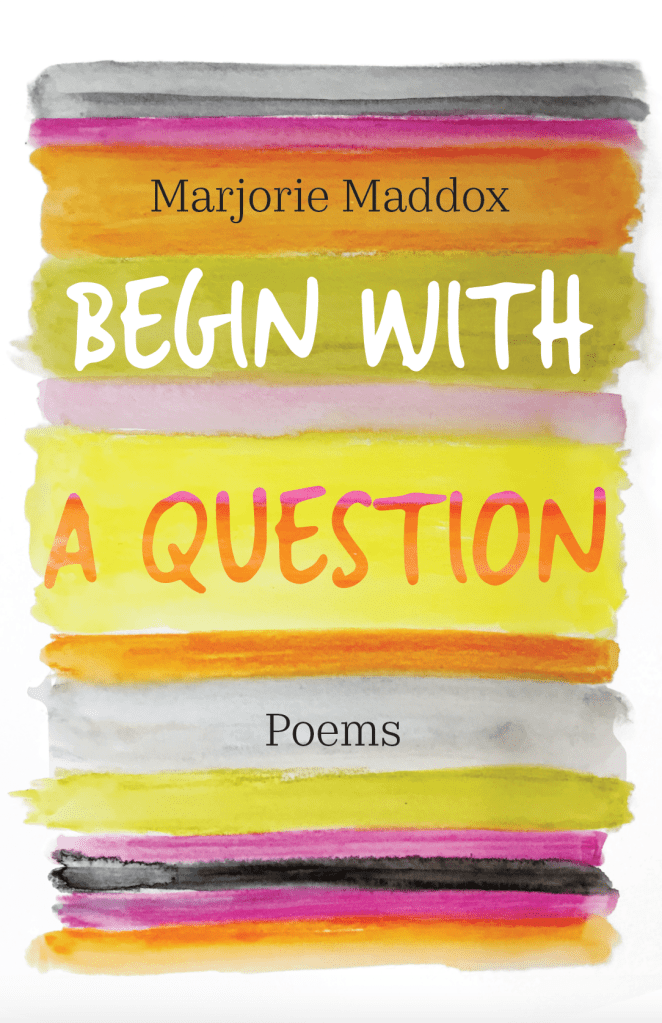
Begin with a Question

Book review by Candice Louisa Daquin

Title: Begin with a Question

Author: Marjorie Maddox

Publisher: Paraclete Press

There are people who write poetry, and there are great poets. By great, we speak of those few capable of transcending above the multitudes with their mastery of the word, imagination and homage to the interior and exterior worlds. An academic and writer, Marjorie Maddox, is such a poet. When you read her, you feel almost angry at her unbridled ability to speak to things you couldn’t begin to evoke yourself. She’s fleet of tongue in her assessment of the world, and does so without a shred of arrogance.

Begin with a Question is a clever collection of spiritual, religious and lived in moments. Whether you believe in a higher power or not, you may find yourself falling for Maddox’s quick wit, keen eye and erasable wordplay. Maddox explores existence from a multitude of directions. These are real moments, most of us have lived in some form. Who hasn’t sunk to their knees and asked;

“affirmation its own negation of belief— ‘no,
I do believe your unbelief’ —the tangles already
tugged and tied into a complicated Yes.” 
-- Begin with a Question

It’s such an honest reflection, painfully so — querying the very reasons we could wish to believe in a God juxtaposed against the real reasons we may not — ending in the all-abiding faith we want to, even if to do so is searingly hard at times. As much here is unsaid as said. There is a sensibility to the journey from first line to last that echoes a refrain, a favourite choral song, something holy and human being implored from a deep place.

This first poem sets the compass for the rest of the journey, this books intention is attuned to the whole with each poem. Structured collections don’t lose something by their intentionality, they often hone the message to greater clarity and this is the case with the poem ‘Begin with a Question’.

“by your own single note of joy: 
You stop moving. And that is when you begin.”  

This deliberation comes from experience, knowledge and the craft of writing. Maddox’s years spent teaching and writing are evidenced in the flow of her message. That said, she’s not sterile in her precision, there is an abundance of passion, intensity and emotion throughout, it’s just placed rather than flung. For some, the adherence to a spiritual theme, may be off-putting, though this would be a mistake, given one’s personal faith doesn’t have to alienate the worth of a story. We can all read about someone who has a different life and gain from it. Whether atheist, agnostic or spiritual, Maddox asks you to consider the story within the story, a story we all share. A search for the meaning of our existence and what matters along the way as found in the poem ‘Your Godmother, almost blind’:

“no promises, 
but it gets easier.
If you are left-
handed, reverse
everything.”

This poem has many layers. The same is true of the poem ‘During My Daily Phone Call to Her Assisted Living Facility, My Mother Explains That She Is Slowing Fading Away …’. The title itself is searing, liminal and the subsequent poem equal in measure. Maddox knows how to open a poem like nobody else with unforgettable lines like:

“And it is not the light but the dust in the light
that rises, plunges, plateaus on the short hhhhh
of my exhale, less final than a sigh that dies
from hopelessness but, still there…”

It’s devastating in its rendering, there are no unnecessary words. This poem is emotions in a capsule that reaches inside and rips out stifled feelings. The power it possesses is otherworldly, magnificent, terrifying:

“And it is not
the distance between words,
between parent/child, not the desert under the plane,
or the plane cursing above and past the jagged mountains,
the wholesome prairies, the vast expanse of flat nothing
I’ve come to expect from questions…”

This poem cuts in half any pretence. You just hang your jaw and drink it in. It’s only once in a lifetime someone can write a poem with this kind of truth.

Maddox knows her history of literature and many will feature in this collection, with the ease of a well-versed lover of stories. Few read like this anymore and even if you are not familiar with all the characters, you may appreciate this nod to them. She does this without a hint of pretension, naturally as if they represent in metaphor, our own lives. From her poem ‘Gardens and Farms’:

“Which we, weary Anno Domini gardeners,
expatriates of Eden” 

Whether you believe Eden on a metaphysical plane, you can appreciate the idea of having fallen to Earth and the subsequent toil, versus the dream of an ideal. Each observation is achieved with the fluidity of a natural observer. Maddox reminds of the pastoral poets of the 18th century who transcended their descriptions with the heraldry of their spiritual quest. When Maddox writes:

“Fear tangles every root of prayer;
all I can mutter is Why? How?”
 -- Without Ceasing

I heard the universal howl into the abyss, the raw cry of pain, unassuaged, lost and wandering. It felt both Biblical, as in Christ in the Wilderness, and also deeply human, the purpose of Christ being among humanity. Without obviating the religious undertones, Maddox piques the question we all have, when suffering, ‘Why? How?’ – echoing the universal refrain when faced with terror, pain, suffering. Paraclete Press who published this collection, is the publishing arm of the Cape Cod Benedictine community. Given that much published poetry today is based upon ‘trending’ themes, I am glad such publishers exist to ensure we are not blinkered in whom we publish:

“No longer partitioned off
by sin, by regret, by self-righteousness...” 
 -- Voices Raised

It could be argued, Maddox achieves the impossible, a meshing of past and present, in appreciating both. Paring a Leonard Cohen song with the story of Joseph and Mary. The poignant story of Mary finding ‘no room at the inn,’ is one that struck me as a small child (even as I was Jewish) because it spoke to me of human cruelty. It is that great story of overcoming, endurance, love, and something more than humanity. When Maddox writes:

“and still
convinced of the predestined
roll of dice chrismated with Miracle—
keeps walking with his-not-his woman
forever strangers in this hometown
that will not welcome them, will 
not lay them down to sleep.” 
-- Traveling Man

It’s truly clever to juxtapose Leonard Cohen’s prescient lyrics against a story we know relatively well. The bittersweet, the ideas of not being welcomed, nowhere to sleep. A powerful parallel between that and other acts of selfishness committed by humanity, how often we close doors and bar entry can be seen. There are universal themes here that haunt and force thought beyond comfort zone, which is exactly what poetry at its most powerful, can do. Saying so much in so little, is both reflective, achingly transposing and deft in its precision. Often, I am struck by how closely Maddox’s work feels like a prayer, incantation, yearning for … betterment. And I take solace in this because I share its intention.

“What does the world weight
slit this way; infused with sorrow?
The bones of betrayal are wood
nailed with pain.” 
-- The Five Sorrowful Mysteries 

Maddox ends with her poem And All Shall Be well. The title alone moved me. It soothes that entombment that haunts our peace, when we have been hurting and believe it will never end. We seek the solace of hope, and kindness. In many ways, whether we acknowledge it or not, this is a step Jesus would have taken, because all who live in the West are influenced by the teachings of Christianity even if we’re unawares. The infiltration of those simple morals and codes to live by, are often a solace without our knowing.

“Begin
where there is no beginning, where refrain neither breaks nor mends
what you once knew as discipline. The middle is where we start from—” 
-- And All Shall Be Well 

.

Candice Louisa Daquin is a Psychotherapist and Editor, having worked in Europe, Canada and the USA. Daquins own work is also published widely, she has written five books of poetry, the last published by Finishing Line Press called Pinch the Lock. Her website is www thefeatheredsleep.com

.

PLEASE NOTE: ARTICLES CAN ONLY BE REPRODUCED IN OTHER SITES WITH DUE ACKNOWLEDGEMENT TO BORDERLESS JOURNAL.

Categories
Essay

A Tale of Devotion and Sacrifice as Opposed to Jealousy and Tyranny

Sohana Manzoor explores the social relevance of a dance drama by Tagore, Natir puja

Quite a few of Rabindranath Tagore’s dance dramas and poems develop around the idea of Buddhist philosophy that induces people to lead a simple life, to gain an understanding of the injustice and inequality prevailing in society, and to acquire knowledge and develop a deeper insight into the universe. Such a major problem reflected in Tagore’s work is the class and caste system of the Indian society.

It would be relevant to recall that one reason that Gautama or Buddha left home is because he recognised that the traditional religions practiced during his time were unable to absolve the dissatisfaction and frustration that abound in life. The class and caste system that divided and segregated people troubled him deeply. Little wonder that all the principal religions of the world rose for emancipation of people from such bondages.

Unfortunately, the corrupt human heart does not allow such practices to go unhindered. Even though at the root of any religious faith there is a high ideal to free people from evil practices and oppression, they also are used as ideological weapons to control mankind. In every age, therefore, figures like Christ and Buddha rise to remind humanity that there is a law beyond the one practiced through selfishness and pettiness of everyday life. Hence, peace and faith are required to be restored at the price of a sacrifice that shows the significance of selfless love, the futility of social class and caste. Actually, the truth is ever present, but sometimes it just takes one act to see that there is a truth higher than all the material wealth one can ever accumulate.

Tagore explored various perspectives of Buddhism in many of his works. Malini, Chandalika and Natir Puja are three dance dramas that deal with this theme. Natir Puja (Devotion of the Court-Dancer) has at its centre the pure soul of a mere dance-girl who is jeered at as a fallen woman, and who considers herself unworthy of even attending to the words of Buddha. But her humility reflects one of the core ideals of Buddhism and she is called upon by the devout followers of Buddha to perform the rituals of a priestess before the altar of Buddha. In the process, her devotion is preferred over the offerings of the royal princesses some of whom feel insulted.

One of them, the princess Ratnavali, takes measures to punish the court-dancer by throwing a choice before her — either to dance in front of the altar as an affront to Buddha, or to face death. The dance-girl Srimati accepts the royal order of dancing before the altar, but she succeeds in revealing herself as a devout follower of Buddha and embraces death. The storyline also focuses on the nature of the faith of Buddhism through the figure of Lokeswari, the wife of the former King, Bimbisar. Lokeswari’s only son Chitro had left home to follow the path of Buddha, and his mother, who used to be a follower of Buddha, emerges as a frenzied woman. She cannot accept that her only son had left home, and her husband renounced the throne when another son Ajatsatru wanted to be the King. For the first time in her life, she questions the validity of a belief that might want human beings to renounce all their precious possessions.

Through an intricate series of events Natir Puja unfolds and delves into several significant aspects of human dilemma. First, through the figure of Srimati and Lokeswari, the nature of devotion is explored. Second, the problem of caste system is brought out through characters such as Ratnavali who cannot accept that a lower caste man or woman could be considered more pious than the royal followers in the eyes of God. Third, that the gravest sinner could seek forgiveness and repentance is always a possibility.

Natir Puja is a tale elaborated from another longer poem by Tagore titled, “Pujarini” (The Worshipper). At the centre of both tales stands Srimoti, who claims to be “Buddher dashi,” or a handmaiden of Buddha. The term “dashi” should not be considered derogatory here but one that focuses on the nature of humility in Buddhism. The meaning of “Buddha” is teacher and in the traditional Vedic ideology, a teacher claims the highest status in society. Therefore, the chance of serving the teacher is indeed a privilege. And as Srimoti says, “My days of false modesty are over. I would not sing falsely, but you did not grasp what your eyes witnessed.” She points out how the faithful see and hear with their heart. The eyes might see, but they would not always recognise what they perceive.

Lokeswari, on the other hand, reminisces how once she was an ardent follower of Buddha, but it becomes clear from her words that she had thought more of distinction than salvation. And yet, Buddha preached freedom from avidya (darkness of ignorance and limiting of consciousness). A man living the life of avidya, spends his life in a spiritual slumber. Therefore, devotion to Buddha requires spiritual awakening, which Lokeswari fails to comprehend. Her very name, Lokeswari, actually suggests her dilemma — the Queen of the World — and naturally, she could not give up the ownership of the materialistic world. In the end, however, Lokeswari realises her error of judgment, and honours Srimoti’s sacrifice. After all, Srimoti is able to show that for faith and truth one should be ready to offer the highest price, one’s own life if necessary.

As a court-dancer, Srimoti might have received a lot of attention, but her position is still that of a high-class courtesan. There are quite a few references where the royal family members make fun of her. Even the elderly Queen Lokeswari scoffs at the idea that Srimoti might turn out to be a priestess of Buddha and the princesses will be her attendants: “Disciple of this dancing girl! That’s what will happen indeed! Now it’s up to the fallen woman to arise with words of salvation.”

From the onset, the Princess Ratnavali, too, makes fun of the calm and quiet nature of Srimoti who is frequently affronted by the princesses but rarely replies. It is almost as if Ratnavali senses her superior nature and takes her to task by insulting her in whatever way possible. The situation escalates when Srimoti is honoured by the Buddhist monks. At that point, Ratnavali makes snide remarks about the Bhikkhu Upali born of a barber family, or Sunado, the son of a milkman, or Sunit, an untouchable. She forgets that Buddhism is a faith that nullifies class and caste system. Her words also reveal that human psychology is deeply steeped in pettiness, jealousy and arrogance, and it takes sufferings and remorse to do away with them.

So, we come to the last point—the theme of repentance and forgiveness. The figure of Lokeswari is an everyman or woman. She is not an evil person, but nor is she convinced by the words of the bhikkhuni who attempts to make her see that there is a difference between the value of gold and that of the light. In today’s world this is where most of us stand. The materialistic ideology has taken over the ethical and philosophical aspects of life. As a result, we keep on asking for more and there is no end to our craving. In the process of worshipping Mammon, we overlook humanity and humility. We not only forget to look at the sufferings of other, but we choose to ignore them. Lokeswari’s humanity returns to her when Srimoti prepares to dance in front of Buddha’s altar. She offers her poison so that she dies before committing a sin. And when, Srimoti unfolds through her dancing that she never meant to insult Buddha but to honour him, once again Lokeswari joins her in reciting,

Buddham saranam gacchami
(I submit to the Buddha for refuge)

Dhammam saranam gacchami
(I submit to the Dhamma for refuge)

Sangham saranam gacchami
(I submit to the Sangha for refuge.)

Even the Princess Ratnavali, who had insulted Srimoti earlier and is responsible for bringing out the royal order, finally kneels down before the dead body of the dance-girl to pay respect. The play ends with Ratnavali chanting the words of Buddha. 

Tagore’s dance drama has played out beautifully to bring out a historical aspect of the Indian culture. The story of Bimbisar and his son Ajatsatru may not have been represented the way history records it, but the tale certainly brings out the tension and the hostility that poison the world at every age. The corrupt and selfish human heart tends to assume that property and wealth hold the key to success and happiness, but ends up in welcoming segregation, arrogance and jealousy. So, should we consider love, affection and sacrifice as mere human follies, or should we abandon the idealistic notions and consider wealth and control as our ultimate gain? Perhaps, the answer lies in the wasteland of our postmodern civilization, which has already sacrificed or butchered its saviours and is still waiting to be atoned.

Sohana Manzoor is Associate Professor, Department of English & Humanities, ULAB. She is also the literary Editor of The Daily Star, Bangladesh. This essay was first published in The Daily Star.

.

PLEASE NOTE: ARTICLES CAN ONLY BE REPRODUCED IN OTHER SITES WITH DUE ACKNOWLEDGEMENT TO BORDERLESS JOURNAL