Narrative by Meredith Stephens: Photographs by Alan Noble
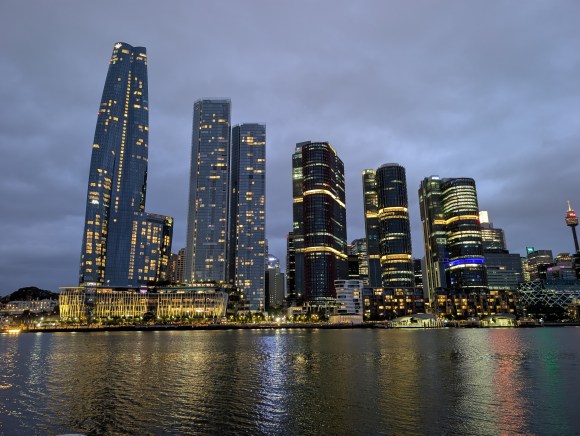
Sydney Skyline
We are not champagne sailors. The only time Alex and I drink champagne aboard a boat is to celebrate the end of a voyage of hundreds of nautical miles. Our sailing expeditions are characterised by breakages, deprivations and isolation. Sometimes the seas are so rough that I cannot move around the boat, let alone change clothes. I can only bathe once a week, and that consists of a dip in the ocean at anchor.
Our meals often consist of fish we have caught and cooked, unless we consume them immediately as sashimi. A single fish might last us days, served in various guises. Other meals are prepared from lentils or canned foods. In contrast to land trips, I usually lose a kilogram or two when at sea. I prefer not to use the term ‘yacht’, because people imagine us sunning ourselves on the deck while sipping champagne. Instead, I use the term ‘sailboat’. I do confess to a tad of reverse snobbery in the deprivations I endure and look down on those I describe as ‘champagne sailors’. But was that about to change?
We had been invited aboard the luxury observer vessel known as The Jackson to watch the start of the annual Sydney to Hobart Yacht Race on Boxing Day. After Christmas lunch, we headed to Adelaide Airport to catch our ninety-minute flight to Sydney. Upon arrival at our hotel, we caught the lift to our room. The lift doors opened on the third floor to let two brothers in, aged around 10 and 12. They met our gaze.
“Would you like us to sing you a Christmas carol?” the younger one asked.
The older one looked a bit embarrassed, but I thought asking strangers to join in singing a carol in a lift on Christmas Day was a nice, if not brave gesture, so I nodded enthusiastically. The younger one started singing ‘We wish you a merry Christmas’, and facing us, moved his hands in the manner of a choir conductor. I joined in. Then the boys noticed that they had arrived at their floor and stopped singing.
“See ya!” said the older one, as they exited.
We continued to the seventh floor and deposited our bags. The light was fading, so we decided to head back outside to take a stroll around the harbour. We returned to the lift. Once we reached the fifth floor the doors opened and the two boys entered again. Three other guests were standing behind us.
“More carols?” asked Alex.
They nodded and smiled. “Yes!”
They launched into another familiar carol, and again I joined in. The tall guest behind me gave a kindly chuckle. Then they reached the third floor, bade us farewell, and exited. We continued to the ground floor and made a tour of Darling Harbour in the remaining light. It had been a wonderful Christmas Day, and what better way to end it than the act of goodwill in being serenaded by children in a hotel lift.
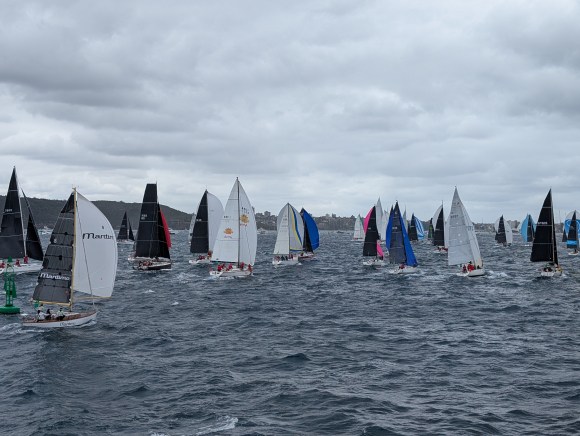
The next day was the yacht race, which has been held annually since 1945 and is one of the world’s great ocean races. The sailors would be competing in a gruelling and treacherous race of 128 boats covering 628 nautical miles (1,200 km), south down the Tasman Sea, across Bass Strait, to Hobart in the south of Tasmania. This race is one of the highlights of Boxing Day and a television staple.
Start of Sydney to Hobart race
We walked to the appointed wharf and noticed a long queue waiting to board. Upon being noticed by our hosts, we were directed to a shorter queue and were ushered up the stairs to the top deck, limited to fewer than sixty people. A ribbon with ‘The Jackson’ written on it was affixed to our wrists. We were greeted by a waiter holding a tray proffering a range of drinks. Alex picked up two glasses of champagne and handed one to me. Was this the beginning of my new career as a champagne sailor?
The Jackson soon departed and we headed out to the deck to view the boats lining up for the race. Even though it was summer the cold penetrated my body and my hands shook. I was determined to brave the cold in order to hold my place to view the start of the race. The lady next to me made some commentary.
“That’s the start line,” she said, pointing to two yellow buoys. The start lines are staggered depending on the the size of the boats to help prevent collisions. It’s a southerly, so that should help.”
I nodded, feigning comprehension. I was not yet a competent enough sailor to pick up the wind direction so quickly. The cannon sounded on the deck below, and a plume of smoke rose. The yachts set off. Soon they had overtaken our observation vessel and most of the guests moved back inside the boat to watch the race on a large screen. Alex and I and a few other hardy souls remained on the outside deck to savour the unique setting of Sydney Harbour. Waiters braved the cold regularly to top up our champagne and offer us canapes. We accepted each time, although I eventually slowed down and shared a glass of champagne with Alex. Had we become the dreaded champagne sailors?
The yachts sailed through the heads until most of them disappeared from view. The Jackson turned around and headed back to King Street Wharf. We remained outside on the deck in the cold, making the most of every minute because Sydney Harbour is so far from home, and we may never have this opportunity again.
I stubbornly refuse to accept the title of champagne sailor though. We are temporarily boatless (which is another story) but once we resume sailing again later this year, we hope to return to the days of self-reliance on the boat and sourcing our meals from the ocean. Maybe not too much deprivation though, because we will continue to uncork a bottle of champagne, as is our tradition, after completing a major ocean passage of several hundred nautical miles.
Sydney to Hobart race
.
Meredith Stephens is an applied linguist from South Australia. Her recent work has appeared in Syncopation Literary Journal, Continue the Voice, Micking Owl Roost blog, The Font – A Literary Journal for Language Teachers, and Mind, Brain & Education Think Tank. In 2024, her story Safari was chosen as the Editor’s Choice for the June edition of All Your Stories.
PLEASE NOTE: ARTICLES CAN ONLY BE REPRODUCED IN OTHER SITES WITH DUE ACKNOWLEDGEMENT TO BORDERLESS JOURNAL
I stretched the boat hook as far as I could towards the mooring buoy, but it slid beneath the bow.
“Go back!” I shouted to Alex back at the helm, but my voice was carried away in the wind.
I pointed at the buoy under the net, and Alex reversed. The waves were dancing in front of me and the buoy would not stay in place long enough for me to reach it. On the second attempt, I forced all of my attention on the rope attached to the buoy, and tried to pull it aboard. It was much too heavy so I screamed for Alex to come, and he raced from behind, pulled the buoy up and secured it to the bow.
How would I alight into the dinghy in these waves? Alex lowered it into the water and it lunged towards the stern and back in succession. I doubted I would be able to board in these conditions.
“How about if I move the dinghy to the side of the boat and you enter via a ladder?”
“Worth a try!” I answered.
Alex brought the dinghy to the side of the boat and slung a ladder made of strong fabric overboard. I gingerly stepped down but once I glanced at the water raging beneath me, I lost confidence and gave up.
“I think I had better hop in from the stern after all,” I told Alex.
He moved the dinghy back to the stern. As I walked towards it, I slipped and fell on my thigh. There was no time to feel sorry for myself, so I picked myself up and continued heading for the dinghy. It lunged back and forth in the waves.
“Now!” commanded Alex.
I placed one foot in the centre of the dinghy to centre myself and then sat down on the bench. As hard as it was for me it was not hard for Haru, my border collie. I called her in and tapped the dinghy behind me because I knew she was hard of hearing. She leapt behind me with alacrity. It was so much easier for her to board the dinghy, not least because of her four legs.
Alex was locking the door back on the boat. The dinghy kept lunging toward the stern, and I was scared of getting knocked off when it hit the stern. I screamed as hard as I could.
“Okay!” replied Alex and hopped in behind me. Then he turned on the engine and headed for the shore, except that the shore was unrecognisable. Instead of a sandy beach, there were rocks.
Alex headed for the most promising spot. “Hop out!” commanded Alex, and I disembarked one leg after the other and headed to climb over the rocks. As usual, Haru leapt out and ran ashore.
I thought I was clear of the rocks and the menacing water, when Alex called out to me.
“Take my backpack! The laptops are in here. They can’t get wet. I realised then that we should have put them into the dry bag.”
I walked over the slippery rocks and strained to grasp the shoulder straps of the backpack. Once they were in my hands I returned to shore over the rocks, ready for the trek up to the holiday house.
I was so longing for the warmth of the fireplace and the view of the setting sun over the bay. I walked effortlessly up the hill, with Haru trotting happily beside me. The shelter and glow of the house was just as I had imagined. It was worth the hardship of getting there.
That night the winds continued to build, but it was pleasurable to hear them passing over the house as we enjoyed the safety and warmth of being inside.
Around one in the morning, the whole house shuddered when hit by a particularly strong gust, which was violent enough to briefly wake Alex.
No sooner was it light that I heard Alex enter the room. He must have been out before the wee hours.
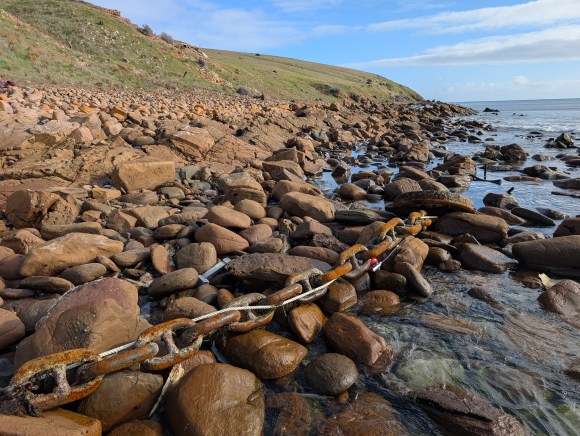
“The boat has drifted to shore. I had a bad feeling and got up early to check the position of the boat. From the cliffs I could see that the mast was too close to the shore. Then my fears were confirmed when I saw that it had been blown ashore.”
Dragged moorings. Photo Courtesy: Alan Noble
“Didn’t the mooring hold?” I asked.
“Evidently not. I’m going to check it out now. Want to come?”
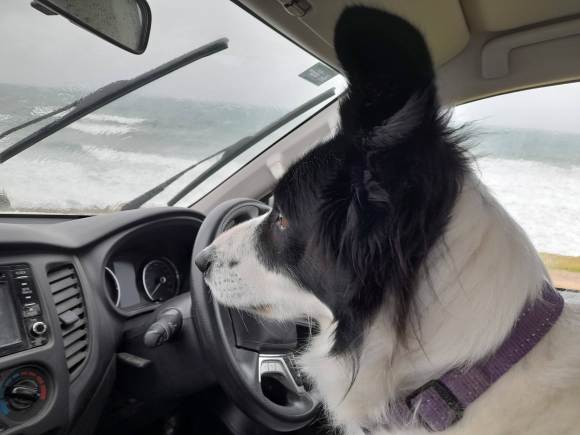
I agreed, and we drove out to the cliff with Haru in the back seat. Once at the cliff, I remained in the car because I couldn’t face the gale-force winds that were now gusting to forty knots. Meanwhile, Alex, in his wetsuit, walked down the dirt road towards the beach, entered the water, and pulled himself aboard. I kept my eyes focused on him until I saw his figure exit the boat, swim ashore, and walk up the track back toward me.
“It’s finished. There’s nothing we can do, beyond salvage.”
Alex’s boat of sixteen years and our home away from home for the last five years was no more. In years past, we had circumnavigated Tasmania, sailed to New Caledonia and back, and across the Great Australian Bight to sail north on the Indian Ocean. Exiting a marina and heading towards the waves was a symbol of leaving our troubles behind and anticipation of adventure. I could no longer take this adventure for granted.
Alex reached out to Thompson’s Marine Salvage, and they arrived at the bay within two hours. The plan was to attach one end of a heavy rope to a tractor at the top of the cliff, and the other end to the boat, and drag it onto the sand to save it from smashing on the rocks.
Alex again donned his wetsuit, descended the cliffs, and swam to the boat. I sheltered from the wind in the car at the top of the cliffs with Haru. Then I thought that I should walk towards the boat in case there was anything I could do. Just as I reached the shore, a young man in a wetsuit approached me.
Haru observing from inside the car. Photo Courtesy: Meredith Stephens
“Watch out for the rope. We’re ready to begin!”
It was too late. The operation had started, and the rope was heading towards me, as the tractor started to try and haul the boat to the shore.
“Jump!” the young man urged.
I’m glad the young man thought this was a possibility, but I haven’t jumped for years. My days of jumping are decades behind me. Unable to jump, I met the full force of the rope and was knocked on my back. My head hit some rocks. I uttered an expletive “sh..!” which I reserve for extreme situations. I lay there for seconds before slowly getting back to my feet. My head was aching from the blow and my whole being was in shock. I gave up on rendering assistance and walked slowly back to the car. There I sheltered from the wind until Alex eventually returned to the boat.
“The operation has failed. The boat is still stuck on the rocks,” he explained.
Late in the day, a twenty-ton excavator arrived on the scene. I spent the day bent over holding a rubbish bag, picking up rubble from the boat. Haru trotted around me enjoying being freed from the confines of the house. The excavator approached the boat like a giant menacing dinosaur. I grabbed Haru by the collar and removed myself to a distant spot on the other side of the boat. I could not face another industrial accident. The hand of the excavator grappled the mast and moved it to a safe spot on the rocks. I watched the dinosaur make its retreat back to the road while I maintained a hold on Haru’s collar.
The following day a second twenty-ton excavator descended onto the beach. The first excavator lifted the stern while the second lifted the bow. Slowly, the airborne boat was moved off the rocks and onto land. I was invited to view it, but I couldn’t face seeing the destruction of our home. That evening, I ventured out to the paddock where the boat now rested high and dry, like a beached whale. Amongst the devastation, I retrieved the remains of my dressing gown, which had somehow become entangled in the bow.
Over the next few days, I continued to return to the beach to extract boat rubble from the shore and pull up items of clothing and bedding from the sand. Alex drove down to the beach in his off-road vehicle, and we loaded up the tray with bags of rubble. Different items washed ashore each day.
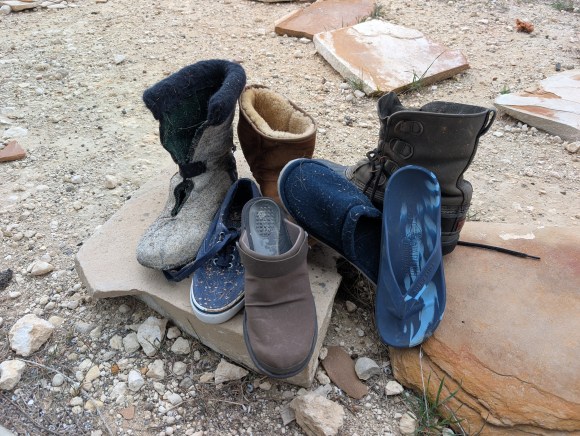
Salvaged shoes. Photo Courtesy: Alan Nobel
The bump on my head continued to heal, only feeling pain when touched. The bruises on my legs changed colour as they too healed. And eventually the bay would heal too. We continued daily beach clean-ups. Seven odd shoes were salvaged, an odd snorkel fin, and odd gloves. Two months later the other fin washed up, but none of the missing shoes ever made an appearance. We continued to fill our off-road vehicle, and rubbish bags, with debris. Our beloved nautical home sat out of place in a paddock awaiting salvage. We came away with a renewed appreciation and respect for the destructive power of the ever-changing sea, but it would take more than a broken boat to diminish our desire to sail again. For now, our sailing adventures were on hold, but once we had the opportunity, we would again return to the sea. This would not be our final voyage.
.
Meredith Stephens is an applied linguist from South Australia. Her recent work has appeared in Syncopation Literary Journal, Continue the Voice, Micking Owl Roost blog, The Font – A Literary Journal for Language Teachers, and Mind, Brain & Education Think Tank. In 2024, her story Safari was chosen as the Editor’s Choice for the June edition of All Your Stories.
PLEASE NOTE: ARTICLES CAN ONLY BE REPRODUCED IN OTHER SITES WITH DUE ACKNOWLEDGEMENT TO BORDERLESS JOURNAL
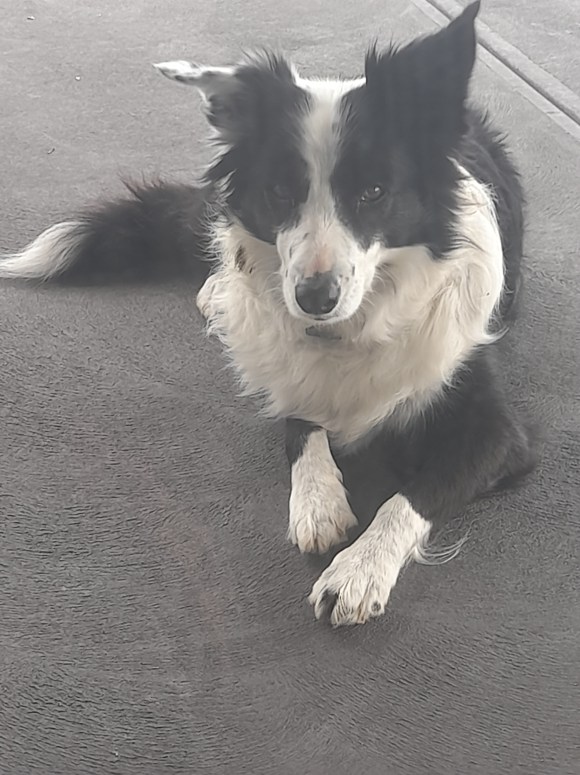
In an ideal world I would sleep in every morning and enjoy a leisurely breakfast, but I can indulge in no such luxury because I have a border collie. Her name is Haru. She has an elongated body, a pointy white snout scattered with black dots, one black ear and one black and white spotted ear, all-knowing brown eyes, feathered forelegs, and a bushy tail with a white tip. She looks more like a cross between a fox and a border collie than a pure border collie. As soon as she hears my voice when I wake up, she starts whining from the courtyard below, nagging me to take her for a walk. I much more looking forward to my breakfast than the walk, but Haru is the opposite.
Haru. Photograph by Meredith Stephens
One Tuesday, as usual, I affixed her leash and walked her towards the esplanade. Haru has memorised the route. She strained in front of me to the point where we crossed the road and then continued to drag me towards the pedestrian crossing. Then she made a beeline for the stairs leading down to the beach. I released the leash and threw the ball down to the sand. She raced down the stairway ahead of me and ran to catch the ball. In the winter months along this coastline, dogs are allowed to run off the leash as long as they are under the owner’s control. I was joined by a throng of other dog lovers and their canines, running to catch balls. Haru is interested neither in other dogs nor other people. All she cares about is the ball. Other dogs approached her and chased her, but she’s indifferent, solely focused on the ball in my hand.
This is good for me because I get exercise when I otherwise would not, and experience vicarious pleasure in her excitement at retrieving the ball. Maybe this is more fun than breakfast after all. However, my walk last Tuesday was unlike those of previous weeks. I spotted an entire fish washed up on the shore amongst the seaweed. I had never seen this before on my daily beach walks over the last five years. Then I looked up and saw a rounded shape of a mammal a few hundred metres in the distance. I walked towards it, and once up close I realised that it was the head of a dolphin. “Sorry,” I said, feeling complicit in the damage wreaked by climate change. Haru was normally quick to sniff out a carcass and chew it, but she showed no interest.
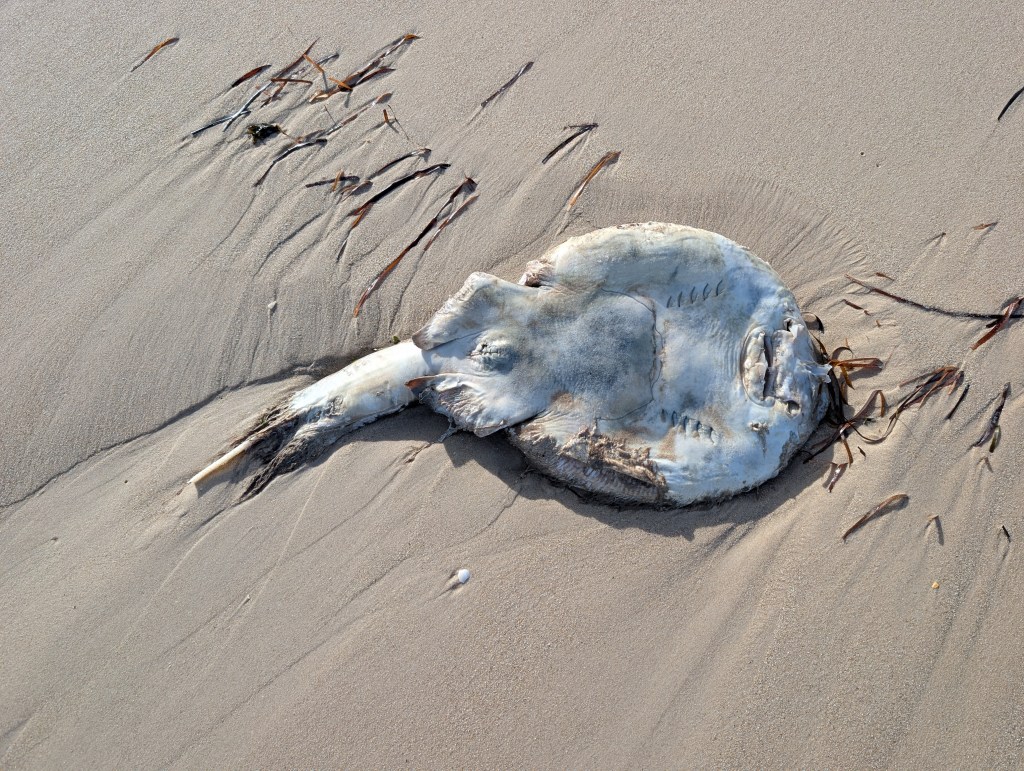
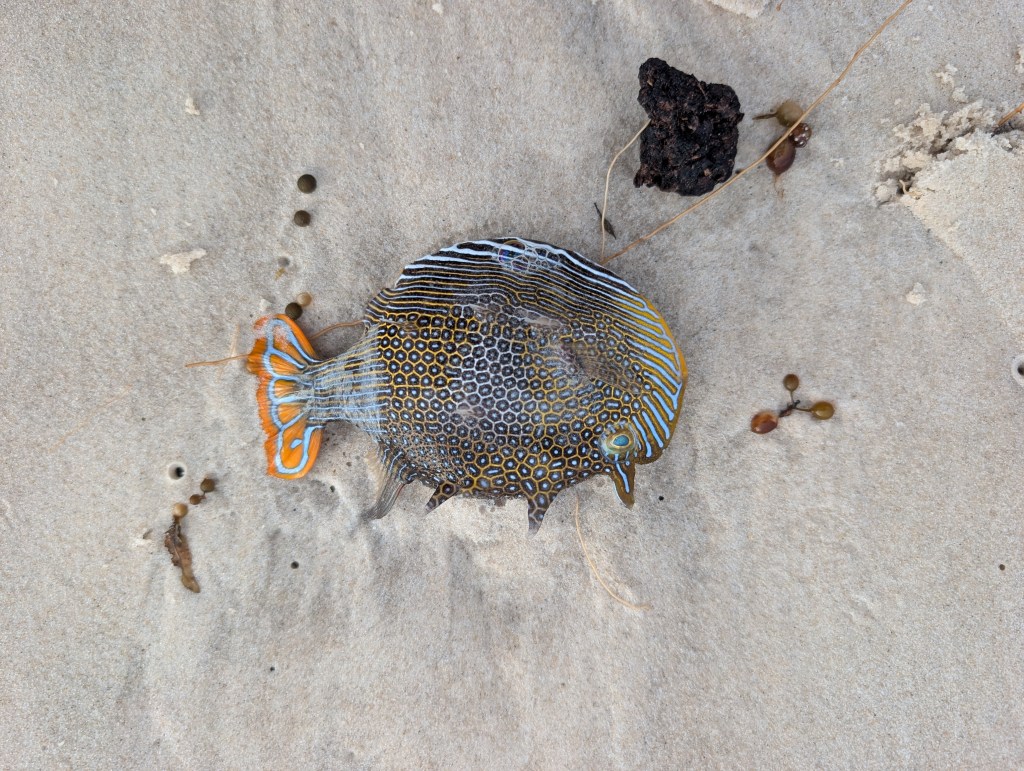
The next day I chatted to a neighbour who told me that on her beach walk she had seen a range of species washed up on the beach that she didn’t know existed. We were witnessing the aftermath of an algae bloom, known as Karenia Mikomotoi, from September 2024. This had arisen in response to a rise in the sea surface temperatures of 2.5 degrees. The recent storms in June 2025 had washed the bodies of these sea creatures ashore. On my next beach walk I came across a small stingray, completely intact, directly in my path. I had seen stingrays before swimming in the shallows but never washed up on the beach. It was so beautifully formed that I could tell it had met an untimely death. Something untoward and unusual had happened. Again, Haru showed no interest in the stingray, despite usually being interested in decaying fish or animals.
Dead StingrayFish washed up on the beachPhotographs by Alan Noble
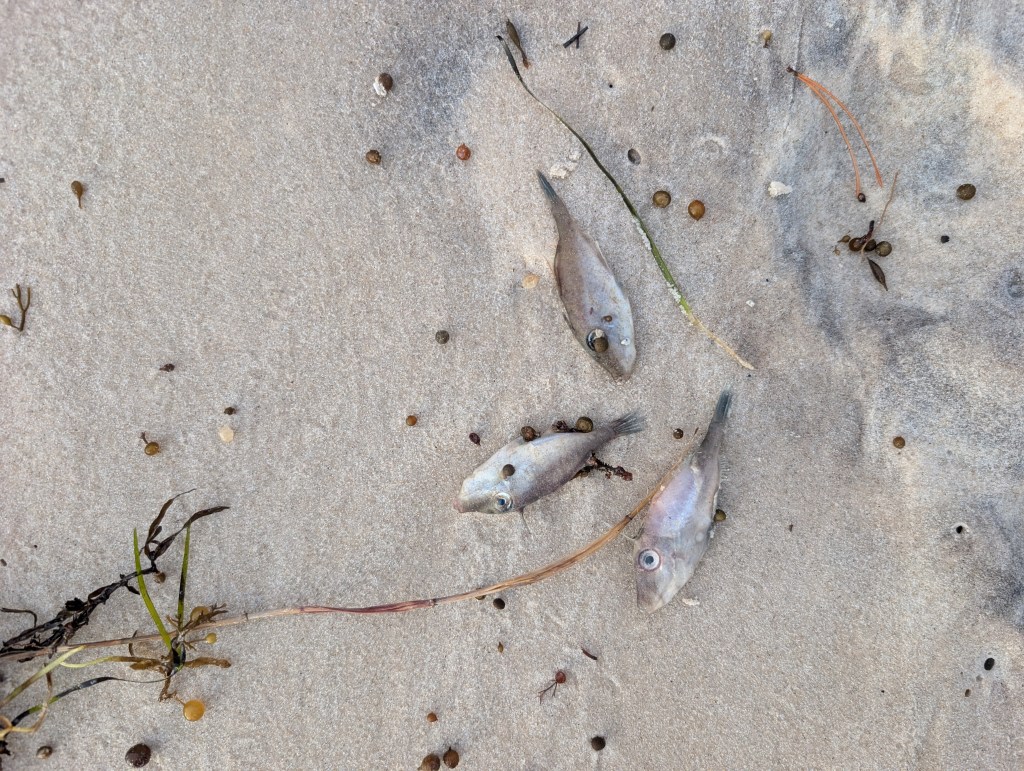
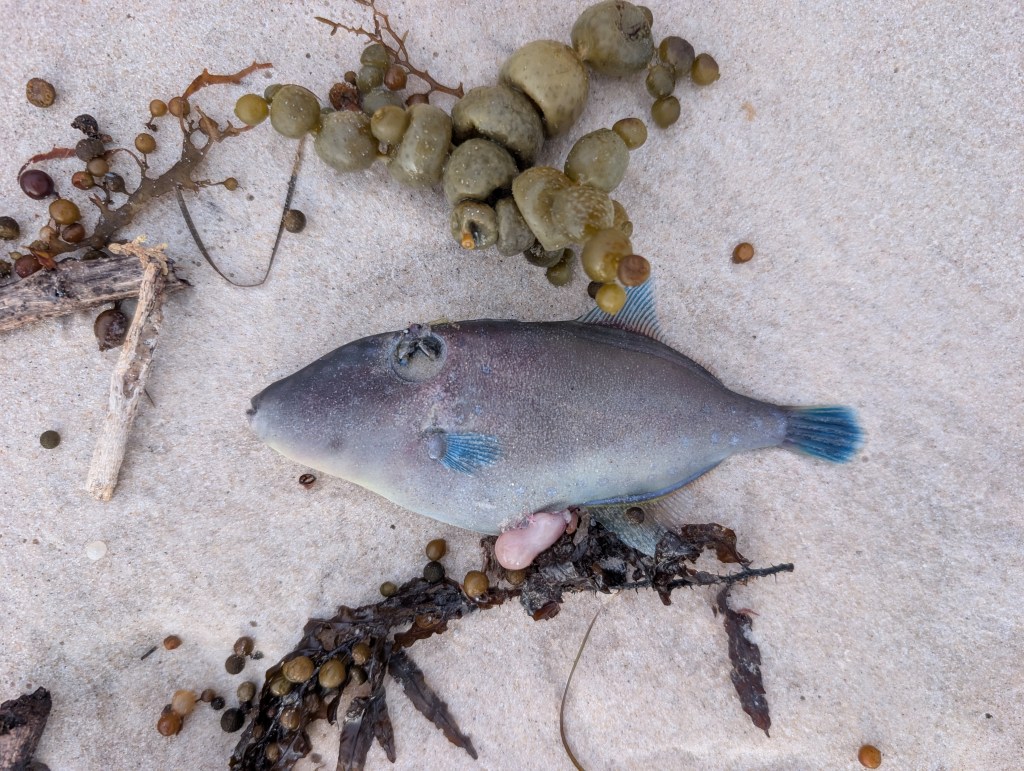
Weeks later I continued to spot fish washed up on the shore that I have never seen before. I came across much smaller fish a couple of centimetres long, some slightly larger fish, and another small stingray. These were the kind of colourful fish that I would see when snorkelling in pristine waters, not washed up on a suburban beach. Haru continued to ignore these dead creatures and skipped along the beach anticipating my ball-throwing. Or perhaps she somehow sensed they contained toxins. At least she was unlikely to be poisoned by eating them.
Small fish washed upon the beachBlue fish dead on the beachPhotographs by Alan Noble
She delights in catching not only one ball that I throw her, but sometimes two. She doesn’t like to relinquish a ball, so I have another one on hand to throw her so that she can chase all the while holding the first one in her mouth. After chewing the ball down to a smaller size and squashing it, she can sometimes fit two into her mouth. Once she has managed this, she runs away from me into the wintry waters, oblivious to the cold, triumphant that she has two balls and trying to get as far away from me as she can in case, I try to take one away from her. Sometimes she skips through patches of the dirty foam left by the algal bloom.
I wish I could provide a happy ending to this story, but the algal bloom is not predicted to end soon, so my idyllic morning and evening beach walks with the oblivious Haru are likely to be punctuated with sightings of innocent marine creatures being washed ashore, victims of climate change and warming temperatures.
One consolation occurred the day my fiancé, Alex, and I left the mainland to sail across Investigator Strait to Kangaroo Island. Over the years there has never been a crossing during which we have not seen dolphins. In the back of my mind, I feared that this would be the first time. An hour into our crossing, Alex heard the familiar splash of breaking water and sighted a pod of dolphins. Not only that, once in the bay at Kangaroo Island, we spotted a sea lion. Thankfully, the marine life that can escape the algae is still undisturbed. I hope the scientists will find a way to address the marine heatwave so that life in our oceans can again thrive, and beachgoers can be spared the sight of these innocent creatures being washed up on local beaches. We can’t simply delegate to the scientists, though. Witnessing this marine carnage is a strong impetus for ordinary citizens to live more sustainably.
Meredith Stephens is an applied linguist from South Australia. Her recent work has appeared in Syncopation Literary Journal, Continue the Voice, Micking Owl Roost blog, The Font – A Literary Journal for Language Teachers, and Mind, Brain & Education Think Tank. In 2024, her story Safari was chosen as the Editor’s Choice for the June edition of All Your Stories.
PLEASE NOTE: ARTICLES CAN ONLY BE REPRODUCED IN OTHER SITES WITH DUE ACKNOWLEDGEMENT TO BORDERLESS JOURNAL
Ratnottama Sengupta muses on her encounter with the writings of eminent artist and writer, Dhruba Esh, and translates one his many stories, Amiyashankar Go Back Home from Bengali. Click here to read.
The story of Hawakal Publishers, based on a face-to-face tête-à-tête, and an online conversation with founder Bitan Chakrabortywith his responses in Bengali translated by Kiriti Sengupta. Clickhere to read.
Narrative by Meredith Stephens & Photographs by Alan Noble
I have read about overtourism in Spain and Greece. Locals have been overwhelmed with the visitors, and some even displayed signs for tourists to go home. According to Fortune magazine (17 July 2024), some locals in Barcelona turned on tourists with water pistols, and others in the Canary Islands embarked on a hunger strike in response to the numbers of tourists. Images of overtourism in Santorini, Greece prompted me to search for an unpopulated area, and I didn’t have to look much further than our own state of South Australia. We hoped to visit deserted towns, dotted with ruins, where there are more sheep than people.
Alex, Verity and I headed out of Adelaide on a bleak wintery day, caravan in tow, to the outback. First stop was Burra, a former mining town where copper was mined from 1845 until 1877. Copper brought prosperity to the state of South Australia saving it from bankruptcy. The small town centre featured a proudly-standing rotunda. Businesses were open, and there were grand buildings and churches which overwhelmed this small town, standing testament to a thriving past.
The caravan was too big for a parking spot, so we parked it parallel to the kerb straddling several spots. We entered the tourist bureau, and as there was no-one in line, headed straight to the desk. We were greeted warmly by the assistant, who handed us a map and explained the various places where we could stay overnight in a caravan. There were free sites, a caravan park, and if you bought a meal at the pub you could camp in their grounds.
Then she pointed out the many historic sites on the map, fixing her eyes on me with a wide smile. I could sense Alex pulling away ever so slightly, as he was anxious to secure a caravan site and do some sightseeing before nightfall, but I was captivated by the enthusiasm of the guide and tried to remember as much as I could of what she was telling us. We headed to one of the recommended sites for the night and investigated the former mining sites with original equipment that had been shipped out from Cornwall, England, in the1800s. We were the only tourists at the site.
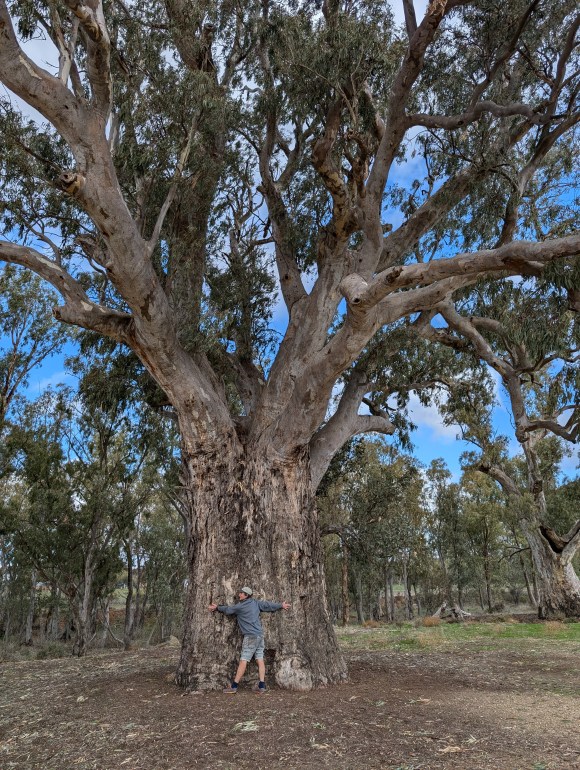
The next day we drove through Peterborough and Orroroo. We entered the cafe in Orroroo for lunch and asked the assistant what there was to see there. She gave us a map and explained that we absolutely had to see a spectacularly large 500-year-old tree on the outskirts of town.
Tree outside Orroroo
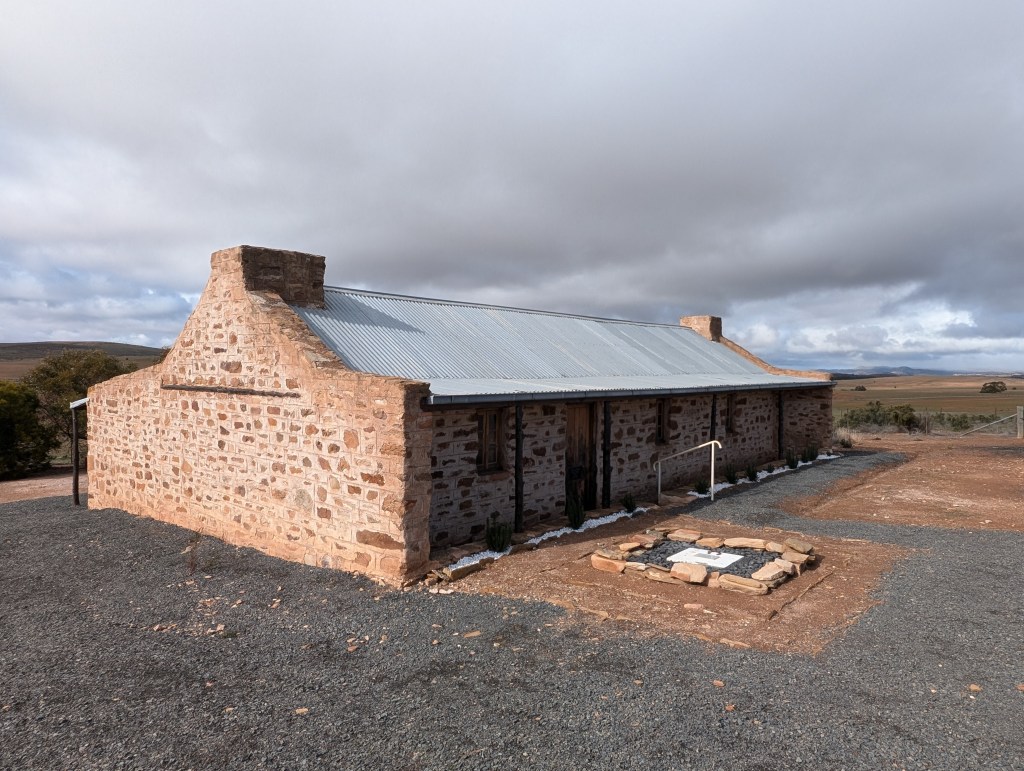
Next, we headed to the very small town of Hallet. There at the general store we asked for a key which would open the door to the now deserted birthplace of the polar explorer and aviator, Sir Hubert Wilkins. It was the first time we had been given a key to let ourselves into a tourist attraction, and we felt very privileged. We drove twenty kilometres to the home along dirt roads. Again, we were the only visitors. We made our way to the front door and unlocked it. This home, formerly rubble, had been lovingly restored by the Australian Geographic Society as a tribute to the explorer.
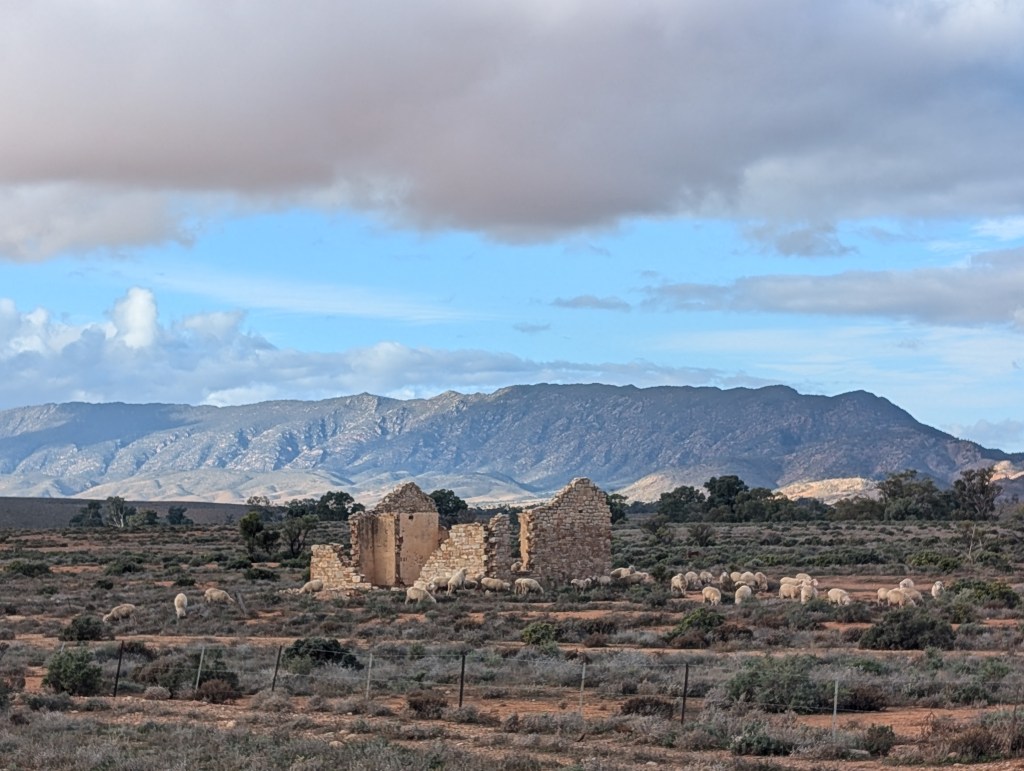
Ruins in the OutbackRestored home
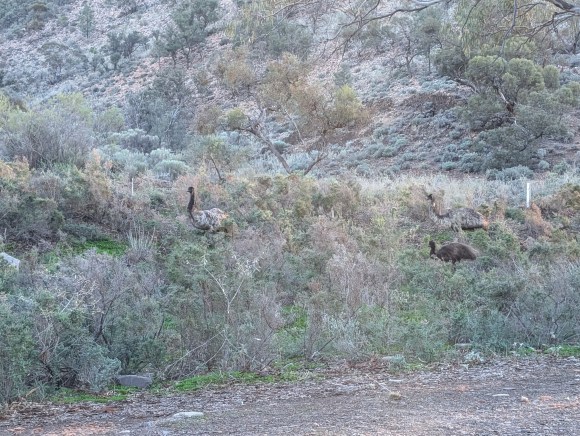
We continued to the Parachilna Gorge in the Flinders Ranges where we spent the night. Alex made a campfire, and we dined outside. Again, we were surrounded by ancient trees with generous girths in a dry riverbed. In the morning Alex woke to spot families of emus passing by, camouflaged by the foliage.
Emu family in Parchina Gorge
We continued onto the deserted nineteenth-century town of Farina that day. People started to abandon the town in the late 1800s, and the last of the inhabitants had left by the 1960s. Fortunately volunteers are keen to preserve the history and the ruins and manage the town during the school holidays. We were given a hearty welcome by a volunteer at the entrance to the bakery and received a map of the town.
Finally, on the 700kilometre drive back to Adelaide, we were low on diesel and made a brief detour to a small town off the highway. After putting the diesel in the car, I went inside to pay.
“Thanks, darling!” the cashier gushed.
“I like your dog! Is he a kelpie?” I asked.
Then I was given an enthusiastic account of how the kelpie had been rescued from a shelter. I think the owners may have been deprived of human company and were glad to see a new face. Alex came in because he was wondering what had become of me, engrossed in conversation. We had the impression that we were their only clients for the day. Eventually, I managed to extricate myself.
On this trip we had no experience of overtourism. Rather we visited sites where few tourists could be seen. Guides were so enthusiastic that they fawned over us. One reason that there were so few tourists is that it was the middle of winter and there was intermittent rain. Another was the geographical isolation of the outback. Australia is distant from countries with large populations. South Australia is distant from the large Australian cities on the east and west coasts and the outback further still—although closer to Adelaide than any other Australian capital city.
The landscape of the outback feels as different as another country. Our city, Adelaide, has a multitude of houses and new freeways, but the outback has few houses and many ruins. These ruins attest to a time of optimism when settlers believed the rains would be consistent. We enjoy hitching up the caravan and driving to the outback, where there are so few tourists that the sight of another human being results in an effusive welcome.
.
Meredith Stephens is an applied linguist from South Australia. Her recent work has appeared in Syncopation Literary Journal, Continue the Voice, Micking Owl Roost blog, The Font – A Literary Journal for Language Teachers, and Mind, Brain & Education Think Tank. In 2024, her story Safari was chosen as the Editor’s Choice for the June edition of All Your Stories.
PLEASE NOTE: ARTICLES CAN ONLY BE REPRODUCED IN OTHER SITES WITH DUE ACKNOWLEDGEMENT TO BORDERLESS JOURNAL

 Borderless