Rain brocades the canopy palm, glass lions silver the cornerpost of a marble dome. We read a tablet of leaves on the ceiling, you step over a crescent of roses, the candle stars swim in the black trees. Fountain waters branch lavender between helical pillars, we awaken cords and strings, we turn our amber mirrors upward, the sky fallows mosaic pastures at the height of the ciphering earth.
A Roman floor mosaic from Ostia Antica from the Immaculate Conception Room, Vatican Museum. Photo Courtesy: John Swain.
John Swain lives in Le Perreux-sur-Marne, France. His most recent chapbook, The Daymark, was published by the Origami Poems Project. Additional information may be found at http://www.john-swain.com.
PLEASE NOTE: ARTICLES CAN ONLY BE REPRODUCED IN OTHER SITES WITH DUE ACKNOWLEDGEMENT TO BORDERLESS JOURNAL
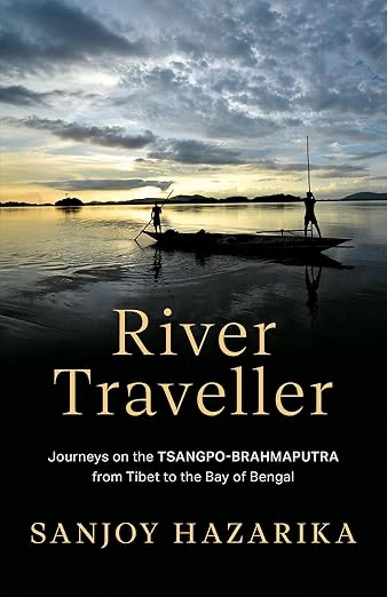
Title: River Traveller: Journeys on the TSANPO-BRAHMAPUTRA from Tibet to the Bay of Bengal
Author: Sanjoy Hazarika
Publisher: Speaking Tiger Books
Sanjoy Hazarika, a former reporter for the New York Times, dons many hats, combining roles as researcher, columnist, mentor and practitioner. Over decades this veteran journalist has travelled extensively across the Northeast and its neighbourhood. His interests include developments in Myanmar, Bhutan, Tibet (PRC), Bangladesh and Nepal and he has produced over a dozen documentaries including on the Brahmaputra, dolphins, governance, conflict, and rights.
River Traveller tells the story of a great river, as powerful as it is mysterious. The Brahmaputra rises in Tibet, travels through three countries and, after travelling over 2,900 kms, flows into the Bay of Bengal. But the most interesting part is that this river is known by many names: Yarlung Tsangpo and Po Tsangpo in Tibet, Siang in Arunachal Pradesh, Brahmaputra in Assam, the Jamuna in Bangladesh, merging with the Ganga at Arichar Ghat, to form the vast Padma on its unending flow to the Bay of Bengal and its quest for union with the sea.
This book has come together over decades of travels on this braided river (including on the boat clinics that he launched in 2005 in Assam) where Hazarika had seen its beauty and faced its wrath, been stuck on sandbanks and swept out to sea. He listened to those who plied the boats, the pilots, drivers, fishermen and their families, the sick and the ailing, women and children, Buddhist and Hindu monks, Sikh and Muslim priests, officials, politicians, students and scientists. He has listened to poets, singers, writers and artists, and to businessfolk and daily wage earners, boat builders, contractors, tea planters and workers. The writer amalgamated all their stories which were a mix of sadness, a determination to survive, an acceptance of fate and joy. Therefore, his traveller’s tales span not just his own journeys but the stories of those who had gone before him. Like the river, the region and its neighbourhood “never cease to delight, surprise, inspire, sadden and confound.”
Of course, the most ostentatious reason for Hazarika’s travels is the filming of documentaries on the river at different points of time. His first travel was for the film A River’s Story, the Quest for the Brahmaputra that he scripted and produced with Jahnu Barua as the director, Sudheer Palsane as cinematographer, Sanjoy Roy and Jugal Debta as audiographers as well as many others. The thrust area was to study the stories of the river and its people, from its beginnings in the Tibetan Plateau to the end in the Bay of Bengal. It wasn’t about science and theory, or politics and the environment, or climate change, but about the river and its moods, and especially its people and their relationship with each other, through history and changing geography, culture, faith, peace and poverty.
In the second venture, Gautam Bora was director and cinematographer of Brahmaputra, a six-part series for Doordarshan, shot in Arunachal Pradesh and Assam. In his third venture, he was involved in the making of Children of the River, the Xihus of Assam, which was directed and filmed by Maulee Senapati and where he learned much about dolphins.
Divided into three parts, the book is as exhaustive a study on the river as can be imagined. The Brahmaputra is one of the world’s longest and widest rivers—sustaining entire civilizations and agrarian systems. It has fascinated cartographers, lured adventurers, attracted kings and dynasts, and has supported life and ways of living by its banks. Before beginning with the actual travel in Part One that includes his sojourns in Tibet and Arunachal Pradesh, Hazarika goes back to history of the thirteenth century when in about 1215 AD, the Tai-Ahom prince Siu-ka-pha left his native land now on the China-Myanmar border and undertook a long march before settling down in Charaideo, his capital, with its surrounding flat plains, rich red soil, streams and the vast Brahmaputra nearby. After that for centuries, traders, smugglers, fighters, fugitives, goods, cuisines, languages and ideas as well as religions and religious people have travelled in either direction on the Siu-ka-pha trail.
Hazarika begins his yatra in Tibet and narrates how the challenges relating to it were not new. He describes a Tibet that was trying to hold on to its cultural legacy in the face of Chinese rule and the land’s exploitation for its resources. He recounts stories of explorers, spymasters and mapmakers, especially a motley crowd of intrepid men in the service of the East India Company and the Survey of India, who discovered the route of the river especially when it’s source was hidden in the most inhospitable terrain on earth. They finally solved the puzzle of the vanishing river and established that the Brahmaputra and the Tsangpo were the same river.
In Arunachal Pradesh, Hazarika views the river from a helicopter and to him it resembled a great, brown meandering serpent, moving in huge loops, with many channels; at times, a stream or two which joined the flow backed down on themselves, creating elegant oxbow lakes. At Gelling, the first village on the Indian side, the turbulent Tsangpo churns its way through a narrow valley after a cascading drop from Tibet. Here for the first time the Tsangpo changes its name and is known as the Siang or Dibang for the next 200 kilometers before it enters Assam. At a place called Kobo, the Lohit meets the Dibang, Noa Dihing, Tengapani and Siang and develops the immense power that is mirrored in the Brahmaputra in full flow.
Part Two comprising of nine chapters focuses on Assam. After the earthquake of 1950, water ‘blockades’ happened not just on the Siang but also on several other rivers flowing into the Assam Valley and as a result the river changed its course, lifted the riverbed, flattened the banks and land, and braided it in many places far more than ever before. As a result, many towns like Rohmoria, Sadiya simply vanished after being embraced by flood waters, and places like Barpeta, Goalpara and Dhubri underwent demographic changes.
In separate chapters we learn about the tea gardens of Assam, the influence of Srimanta Sankaradeva and his satras[1], about the great river island Majuli, the singer Bhupen Hazarika, the presence of dolphins in the Brahmaputra, the thousands of islands known as the chars and saporis, which are permanent in their impermanence, where the Muslim residents are known as Miyas, the large number of migrants that inhabit the place, the sand bars and sandbanks that dot the riverscape from Upper Assam and how the collection of sand and its sale and distribution has changed the lives of many along the river to the point where it enters Bangladesh. He also gives us details about the ferry system, the boat clinics on the river that represent both a dream and a reality, as annually, nearly three lakh people are treated in these mobile structures.
The third part of the narrative obviously ends with four chapters on Bangladesh. We are told how to move from a slow riverine economy to a bustling one is quite challenging. This section includes fear of being hunted by pirates on an open sea, the faith in the navigators, ‘drivers’, pilots and other crew members who can read the mind of the river, the trip to the confluence of the Ganga and the Brahmaputra along with a Bangladeshi singer called Maqsoodul Haque or Mac. Both these rivers have different names in Bangladesh. The Ganga is the Padma while the Brahmaputra is the Jamuna. We are told about the story of the island known to Indians as New Moore Island and to the Bangladeshis as Sandwip island that appeared and disappeared, causing a diplomatic furore. The Brahmaputra’s role in shaping the destiny of low-lying Bangladesh is well-established and we are told of the connectedness of the people to the river, on either side of the human-made border. There are many places where the turbulent river refuses to accept human markers and controls and the border just remains an imaginary line snaking across shifting sands.
After reading about the multifarious experiences of Hazarika, it is needless to state that this book of non-fiction mesmerizes the readers to such a great extent that one hankers for more information. It is best to conclude the review by quoting from the poetic way Hazarika himself speaks at the end of the book about the interconnectedness that lies even in a grain of sand:
“I have traversed the river, shared my secrets with it and laid my fears and troubles to rest there. It too has spoken to me and has been kind and generous, in the midst of its vastness and power, to someone who could not swim.
“River Traveller is deeply personal and piloted by my life and learnings on the river, failings, shortcomings, understanding. It’s about shared stories, loves gained and lost, inspiration and sadness. Autobiographical in parts, it navigates history and crosses borders.
“Many travels beckon, for the river still calls.“
From extremism to environmental responsibility, politics to ethnography, River Traveller touches on a multitude of subjects, and is an enduring study of human life and natural history. It is a rich and memorable portrait of one of the mightiest rivers on our planet. The colour photographs that are included in the middle of the narrative add extra charm to the narration. A volume worth possessing and reading and rereading repeatedly.
[1] Specialised Vaishnavi monasteries in Assam serving as socio-religious, cultural and educational centres since the fifteenth century.
.
Somdatta Mandal, critic and translator, is a former Professor of English at Visva-Bharati University, Santiniketan, India.
.
PLEASE NOTE: ARTICLES CAN ONLY BE REPRODUCED IN OTHER SITES WITH DUE ACKNOWLEDGEMENT TO BORDERLESS JOURNAL
Time has erased the road where I walked as a child. The last time I walked through here there were trees and grass.
Time has eroded everything. There is no shade, no flowers blooming, and no fruit on the vines. It is all rubble.
How sad it makes feel to see this road go away like if it never existed. I have only returned to say goodbye.
THE END OF SILENCE
I am almost at the end of silence. I am way past the end of love. Everything is almost over.
Where could I go now? And does it really matter? I feel the wind in my eyes. In a matter of time, I will be blind.
Summer is long gone. The glass is neither half empty nor half full. The leaves that fall at my feet will be followed by their mother trees.
I will spread out like a tortilla The sea will carry my remains away toward sunset like my will says. The sky will fill with clouds and birds will sing my goodbye song.
My time will soon run out. I could still hold out for a moment. I am as impassive as solitude. My eyes are fixed upon the sun.
Lay my soul to rest. Let me pass like all things.
THE FOG BELOW MY FEET
The ceiling has dropped. There is fog below my feet. The ceiling has dropped. I can barely see the street.
I can imagine this a meeting of ghosts gathering all around us. It must be their mouths blowing smoke out of a ghost cigarette.
I grounded my car. I left the keys on the nail. I grounded my car. If I drive, I am sure to fail.
I can imagine I am walking on clouds rising from the ground. It is nature, the fog-maker, reminding us to look out and slow down.
Art by John Constable ( 1776-1837). From Public Domain
Born in Mexico, Luis Cuauhtémoc Berriozábal lives in California and works in the mental health field in Los Angeles. His poetry has appeared in Abramelin, Barbaric Yawp, Blue Collar Review, Borderless Journal, Fixator Press, Kendra Steiner Editions, Mad Swirl, The Literary Undeground, and Unlikely Stories.
.
PLEASE NOTE: ARTICLES CAN ONLY BE REPRODUCED IN OTHER SITES WITH DUE ACKNOWLEDGEMENT TO BORDERLESS JOURNAL
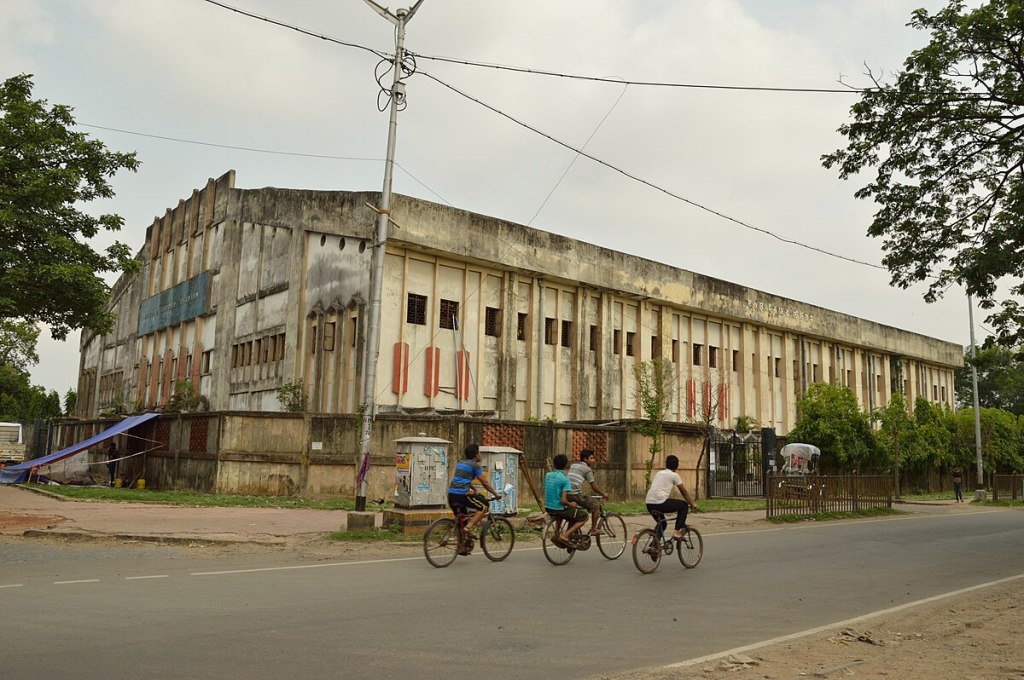
The singsong voice of the conductor filled the air in the busy intersection of Rabindra Sadan.
Sanjib crossed the road hurriedly, raising his hand to attract the conductor’s attention lest the bus left the stand before he reached it. The conductor nodded assuredly, indicating they had no intention of leaving so soon.
Sanjib boarded the bus and occupied a window seat near the front. Flicking his wrist, he looked at his watch — 4:15pm. He had ample time to make the trip to Belepole and return by 9pm
After a couple more minutes of waiting at the stand, the engine revved and the bus slowly made its way towards the Second Hooghly Bridge. As the conductor made his customary gesture for the ticket, Sanjib handed him a 50 rupee note.
“Belepole,” he added with excitement.
Sanjib’s heart was fluttering in his chest. He was going to visit Belepole, the place where he was born, after almost two decades. He had spent fourteen years of his life in that place — almost his entire childhood. But when he was in grade 9, his father — a central government officer —got a posting in Delhi, and they moved there permanently after selling their house to a promoter. Things became very hectic after that. There was school, then college, then masters, then PhD, then a post-doc in Europe, and finally a teaching position in a reputed central government institute in the capital city. The years passed by like a whirlwind, starting and ending within the blink of an eye. Sanjib had come to Kolkata only a handful of times within that period but never found the time or opportunity of visiting his birthplace.
This time, however, was different.
This time, he had come to Rabindra Sadan to attend the inauguration of an art exhibition hosted by his school friend and renowned artist Pulak Banerjee. The interactions with his old friend brought back memories of his birthplace — which was only half an hour from the gallery on the other side of the Hooghly River — to his mind, and he was filled with an intense desire to pay a visit to the locality where his journey had started. Pulak supported this idea wholeheartedly, but he let Sanjib go on the sole condition that he be back for dinner at Peter Cat around 9 pm.
As the bus raced past the innumerable cables of the Second Hooghly bridge, countless fond memories of his youth flooded Sanjib’s mind. Memories of their three-storied house — which was almost a hundred years old, memories of the pond where he used to swim summer and winter, memories of his neighbors and their smiling faces, memories of all the childhood mischief and scoldings. They started appearing one after another, like hours-long video fast-forwarded to finish within only a few seconds.
But even amid this deluge, the memory of a single person stood out sharply against the rest. The memory of his childhood friend — Anil.
Anil, who was only one year his senior, had been his next-door neighbor. The two friends had grown up together and were almost inseparable. Not a single day had passed in those fourteen years that the two friends hadn’t played or spent some time together. Wherever one went, the other followed. Whatever one did, the other copied. They were up to all sorts of mischief together, and had become the terror of the locality for an extended period of time. Anil belonged to a relatively poor family, and could only afford education in a Bengali medium school. Sanjib, and his parents always welcomed him into their household with open arms, and he went on multiple trips with Sanjib and his family.
Anil wasn’t very good in studies, and barely passed his examinations is school. But what he lacked in intelligence, he more than made up for in athleticism. He was a great cricketer and an expert swimmer. He participated in many state level competitions and even won a few medals over the years. The two friends had a pact — Sanjib would help Anil with his studies, and Anil would help Sanjib improve his batting and swimming forms.
For fourteen long years, they had laughed and cried and fought and grown up together, until one day, Sanjib had to move away. It was the most difficult moment of their young lives, and a lot of tears were shed and promises were made. Anil didn’t have a landline at home at that time, so it was decided that he would visit a nearby shop every other day at a pre-determined time and Sanjib would call him there.
This ritual was followed religiously for nearly two years before Sanjib’s tuition timings and the pressure of his impending board and competitive examinations finally caught up with him. Slowly but surely, the two friends drifted apart. Pretty soon, Anil was relegated to Sanjib’s subconscious mind, waiting to be liberated again by some external stimulus.
That stimulus finally arrived nearly two decades later, and Sanjib’s mind was once again filled with the memories of his dear old friend and companion.
“Belepole is coming. Belepole is coming,” the conductor announced in his characteristic voice.
Sanjib got up from his seat.
Alighting from the bus, he slowly made his way towards the familiar by lane that led to his neighborhood — his para. As he walked along the alley, his mind was once again crowded with incidents from his childhood. These streets were once his playground, and there was a time when he knew every square inch of this locality like the back of his hand. Every nook and cranny of this place was filled with memories. Some of the old buildings he could still recognise, but many of the old ones had given way to more modern apartments. His para had undergone a transformation with time, confirming the old saying that change is the only constant in the universe.
Sanjib soon reached the location of his old house and found a modern four-storied apartment standing tall in its stead. He had seen pictures of this apartment in his father’s phone, but this was the first time he saw it with his own eyes. He stood rooted to the spot, mentally drawing the outline of his old house and comparing it with the present architecture.
He could still visualise every detail clearly against the modified backdrop — his bedroom, the living room, the kitchen, the dining room. It was as if he was seeing through the new apartment and staring into his long-lost past.
“Heyyy maaan. What’s your problem?”
A hoarse voice suddenly interrupted Sanjib’s reverie.
He turned around in surprise — a bit ashamed that he had been caught staring at a building for so long — and found a tramp sitting a little way off along the edge of the street. His clothes were in tatters, and it seemed like he hadn’t taken a bath in years. His long hair and beard had become matted with oil, dirt, and dead skin cells. His frail frame shook with every word he said. Even from afar, Sanjib could realise that he was inebriated by the intonations of his voice.
“Get outta hereee!” He shouted again. “What’re you doing standing and staring in the middle of the streeeetttt!”
Sanjib’s face filled with disgust. He felt an overwhelming sense of aversion towards the tramp. He quickly turned away from him and walked towards the new apartment.
Beyond the apartment was Anil’s house, and Sanjib had half expected to find his friend at home. It was, after all, a Sunday evening. So, chances were higher than usual.
But he was taken by surprise when he found Anil’s house barely standing at all. One of the walls had completely crumbled, and the rest were ready to follow suite. The entire plot had become a garbage heap with dogs and crows roamed around ravenously in search of leftovers. Nature had already started reclaiming the land and the dilapidated building was covered with creepers and crawlers.
The juxtaposition of the dazzling new apartment and the crumbling old house in such close proximity had a great effect on Sanjib’s mind and he stood dumbfounded in front of his friend’s former residence.
“Sanjib?” A second voice broke out in the background. “Is that you?”
There was uncertainty in the voice, but it sounded very familiar.
Sanjib’s brain had already started connecting the dots, and by the time he turned around, he had matched the voice with a face from his past.
“Bimal kaku[1]!” He nearly shouted with delight. “How are you?”
The warm and welcoming smile of Bimal Das felt very soothing to Sanjib’s eyes.
“I am fine, Sanjib.” The man replied with a touch of warmth and emotion. “How big you’ve grown! It’s been such a long time since I last saw you!”
Sanjib embraced his Bimal kaku lovingly.
Bimal Das used to own a grocery shop in the neighbourhood, and he had always been very fond of all the kids in the locality. He often used to give them free snacks below the counter, and invited them to his house whenever there was an occasion.
“Come,” Bimal led Sanjib by his arm. “We’ll sit and talk in my house.”
The next half an hour was spent in fond recollection.
Sanjib leant that Bimal’s shop was not running very smoothly ever since the advent of online shopping. His sons, however, had all gotten jobs outside the state, and they regularly sent him money to ensure he never lacked the basic amenities required to live a modest life. They had also suggested that he close the shop and stay with them, but Bimal had always felt a strong affection towards his shop and refused to shut it down.
He opened his shop regularly, sat behind the counter like old times, and spent most of the time chatting with the retired people of the locality.
“You see Sanjib, I will continue running the shop as long as my body permits,” he concluded with a defiant tone.
Sanjib looked admiringly at his Bimal kaku. He had aged significantly, but his vigour and liveliness were worthy of praise.
“Bimal kaku,” Sanjib spoke apprehensively. “What happened to Anil? His house is in ruins.”
A pall of gloom suddenly descended on Bimal’s smiling face. He looked down towards the floor and sat silently.
Sanjib’s heart sank. With each passing moment, his mind grew heavier with anxiety.
When Bimal started speaking again, Sanjib braced himself for the worst.
“Around five years after you left,” Bimal spoke softly. “Anil lost his mother — who was his biggest well-wisher and who loved him the most in the world.”
“Anil was heartbroken,” he continued.
“Still, he had his father to look after him, guide him, and reign in his emotions. The father-son duo clung onto each other and battled the storms of adversity. Anil gradually recovered from the shock and tried his best to live his life to the fullest.
“But alas. The fates had marked him as a child of misfortune. Five years later, his father passed away as well. Anil was all alone.
“Although all of us, his neighbours, tried our best to console him and help him in his time of need, he never recovered from this second shock. He left his house, started roaming about the streets aimlessly, got drunk, and all but lost his mind. We tried numerous times to bring him back to his senses, but it was not to be. Anil would be absent for weeks at an end, and then suddenly, one morning, we would find him sleeping unceremoniously near the edge of the main road.
“Those of us who felt sorry for him gave him food and clothes from time to time. While he ate and drank to sustain himself, he rarely touched the clothes. After a few years, he stopped recognising us completely. He just came and went as he pleased.”
Sanjib couldn’t believe his ears. Every word that Bimal spoke appeared to drive a nail through his heart. He felt an indescribable pain and sadness for his friend.
“Coincidentally,” Bimal continued morosely. “Anil is here now.”
“He came a couple of days ago. Just this afternoon, I found him sitting and blabbering at the intersection. I gave him some food and water. He was quite drunk. His clothes were in tatters, and he looked more dead than alive. Oh, how it pained me to see him in such a condition.”
Bimal covered his face to hide the tears that flooded his eyes.
Sanjib jolted upright, as if struck by lightning. His mind had already raced half an hour back into the past.
He recalled the hoarse voice that had interrupted his day dream.
He recalled the countenance of the tramp that had disgusted him so much.
He brought forth every feature of that haggard body in front of his mind’s eye. The unkempt hair and beard, the tattered clothes, the frail frame.
His friend had spoken to him after twenty years. And he had turned and walked away disgusted. His friend, who probably had a bright future as a cricketer or a swimmer, but was reduced to nothingness. His friend, who had lost his sanity thanks to the cruel workings of fate.
The image of the modern apartment and the crumbling house flashed in front of Sanjib’s eyes. He was the modern apartment, shining and well established in life. Anil was the crumbing house, battling against insanity and counting his days.
In the face of this incomprehensible truth, the contrast seemed even more cruel.
Sanjib sat still. His vision had become blurry and his cheeks were hot with the stream of tears that flowed down like water from a dam.
At the intersection, Anil was still sitting on the road, speaking gibberish, and cursing anyone who passed the street.
Sayan Sarkar was born and raised in Kolkata. He is a passionate reader and lifelong learner who spends his leisure time immersed in books and new ideas.
.
PLEASE NOTE: ARTICLES CAN ONLY BE REPRODUCED IN OTHER SITES WITH DUE ACKNOWLEDGEMENT TO BORDERLESS JOURNAL.
Nazrul’s Ashlo Jokhon Phuler Phalgun(When Flowers Bloom Spring) has been translated from Bengali to English by Professor Fakrul Alam
From Public Domain
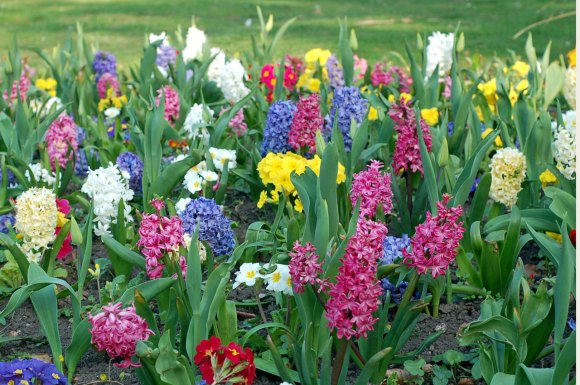
When flowers bloom spring, Gulbagh’s roses would rather leave.
On such a day though, why would one want to leave a friend behind?
Even before daybreak, a forlorn bulbul bird cried out in the flower garden,
Before their buds could bloom, flowers shed in the chilly breeze.
This is how it always was in old flower gardens! Men want fresh flowers,
But the cruel gardener keeps plucking away from the garden that is life!
The soil is where all golden body parts lie hidden, covered by dust,
Emperors and newly married brides too—everyone in the prime of life.
The world’s colourful blossoms may shed well before dusk descends
So sorry a sight it is to see souls leaving still young bodies to survive!
Tread thoughtfully dear wayfarer, for you’ll be treading on dead flowers
As the earth’s pathways are always strewn with dust blowing from graveyards.
It’s time for you, Hafiz, to give up all worldly desire and attractions,
Time to leave home for a spouse in a faraway world calling out to you!
Born in united Bengal, long before the Partition, Kazi Nazrul Islam(1899-1976) was known as the Bidrohi Kobi, or “rebel poet”. Nazrul is now regarded as the national poet of Bangladesh though he continues a revered name in the Indian subcontinent. In addition to his prose and poetry, Nazrul wrote about 4000 songs.
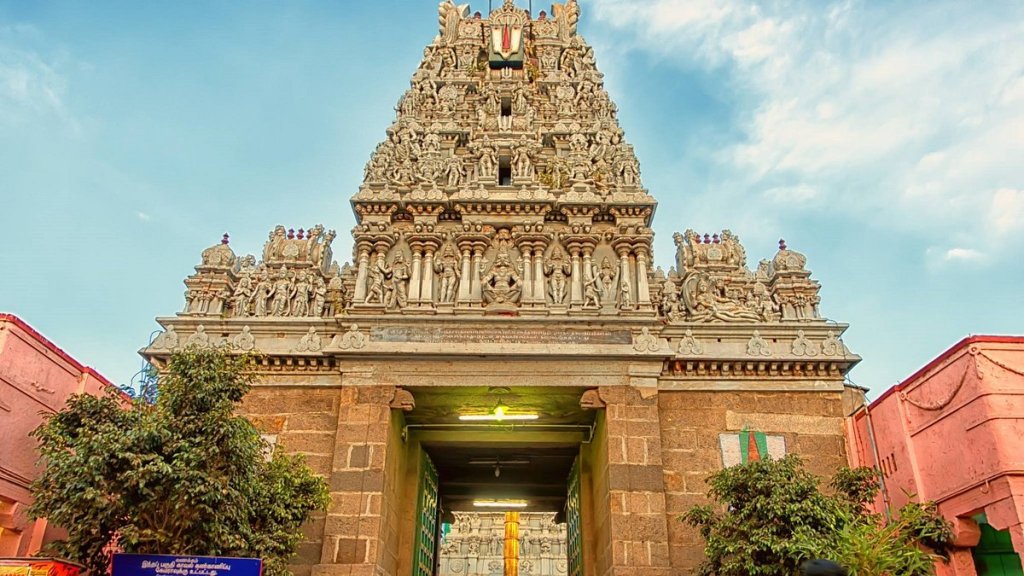
“Which part of India did your people come from?” asked the Tamil tour guide during our last trip to Chennai.
“I know my forefathers came from Tamil Nadu, but, sorry can’t tell you which part of Tamil Nadu or village they came from,” I told him in Tamil. “I am a third generation Malaysian Indian. We lost touch with all the relatives back home.”
“Your Tamil is very good for someone out of this country. Judging from way you speak, you could pass off for someone from Thanjavur!” he went on.
“People from Malaysia have mostly left their original accent and have developed new ones with Malay and Chinese words in theirs, so you cannot pigeonhole them to any region in India anymore.” I replied.
In a philosophical tone, he paused, then said, “I am here in Chennai, and you are there in Malaysia, and the only thing that connects us is the Tamil language.”
Of course, there is the DNA that unites us, but the bond that draws us to India is independent of the language spoken or written.
Our little conversation reminded me of the 1980s music video ‘Down Under’ by the Australian rock band, Men at Work. In that scene, the singer goes around the world, and everyone recognises him with his characteristic Aussie mannerisms. “Do you come from a land Down Under?” is their first response.
My grandparents and parents believed that, despite moving away from their homeland due to increasingly hostile living conditions, it was necessary to pass down their culture and language. Perhaps it was the only language they knew. They did not turn their backs on Tamil Nadu, nor let their offspring immerse themselves solely in the local culture. They had no anger towards their country. They did not turn their backs on her. They understood their motherland was going through difficult times and that tides would eventually change. Maybe they thought that one day their descendants would return and boast about how their princes of the soil had succeeded in a distant land, even while still holding onto their ancestral roots – the mother tongue.
It looks like the sun has risen, and the country has awakened from her long slumber, continuing to pursue what she stopped in her glorious past. Even her children, who have spread across all corners of the Earth, have made her proud.
For the rest of my trip, I conversed in Tamil, checked into a four-star hotel, and even conducted transactions at a bank counter. At first glance, I am sure they could tell I was not local, with liberal use of the word ‘lah’[1] in my sentences and the distinctive sing-song manner Malaysians use when speaking Tamil, it seems. The Malaysians are also described as extremely courteous, unlike the locals there.
[1]Lah is a phrase used by Malaysians and Singaporeans in local parlance
.
Farouk Gulsara is a daytime healer and a writer by night. After developing his left side of his brain almost half his lifetime, this johnny-come-lately decided to stimulate the non-dominant part of his remaining half. An author of two non-fiction books, Inside the twisted mind of Rifle Range Boy and Real Lessons from Reel Life, he writes regularly in his blog, Rifle Range Boy.
PLEASE NOTE: ARTICLES CAN ONLY BE REPRODUCED IN OTHER SITES WITH DUE ACKNOWLEDGEMENT TO BORDERLESS JOURNAL
Late, late August; the ample rains muddy The floor of the forest in dear desolation. The berries lie pristine dampened By the final drips of last night's drizzle. The forsythia blooms unhindered outside The window as my mind turns to America. Each year, as fall approaches, I think of you. Yet all I do now is turn, turn, turn to the rain. The leaves moisten in indefinite wait for the Sun that leaves no room for conjecture. The shadows tell diverse tales at different Hours of the day; my watch dissents sometimes. The infidelities of the clouds run amok in terse Acceptance of their inabilities to shimmer. Prodded by the indecisive nature that life Bestows upon my very being, I remain rooted To the oranges that fill my basket with yearning. The grass would leave no imprint of our touch, Nor the daisies without whom monsoon had Little meaning. The jasmines would be seen Flitting about with a sense of purpose As we chased them without pity or faith. With a deep lust for expectation, I remind myself Of the days when we would crowd these streets Littered with the shrubbery of touch-me-nots. Every year, I would hope against hope.
(First published in The Past Is Another Country, poems by Mohul Bhowmick)
Mohul Bhowmick is a national-level cricketer, sports journalist, poet, essayist and travel writer from Hyderabad, India. He has published five collections of poems and one travelogue so far. His latest book, The Past Is Another Country, came out in 2025. More of his work can be discovered on his website: www.mohulbhowmick.com.
PLEASE NOTE: ARTICLES CAN ONLY BE REPRODUCED IN OTHER SITES WITH DUE ACKNOWLEDGEMENT TO BORDERLESS JOURNAL
The scent of ozone and damp earth, the particular weight of afternoon light filtering through old venetian blinds—these small phenomena often announce memory long before language does. A man sits in a borrowed room, tracing with his thumb the grain of a worn wooden desk. He is not summoning a triumphant episode from his past; he is grasping at a faint, persistent echo: his grandfather’s rough hands, smelling of linseed oil, guiding him to adjust the focus on a heavy, obsolete microscope. This tactile ghost, a pressure without a narrative, is memory in its most primordial register—somatic, unspoken, resistant to articulation. Yet across the same room sits a framed, slightly faded photograph of a military regiment from a war the man never witnessed. If the desk grain belongs to the biology of remembrance, the photograph belongs to its cultural architecture. The former is of the body; the latter is of the nation.
Between these two points—molecular trace and cultural inscription—memory unfolds as a dual phenomenon. One register writes itself into the nervous system or even into the regulatory architecture of DNA; the other composes itself through stories, monuments, rituals, and shared forms of collective identity. Human remembering, therefore, is never a single mechanism. It is a negotiation between biological predisposition and symbolic world‑making. While Maurice Halbwachs argued that memory exists only within social frameworks—familial, religious, national—the new sciences of epigenetics complicate this picture by suggesting that experience may inscribe itself directly onto the genome, altering stress responses and emotional baselines (Halbwachs 1994). Jan Assmann placed cultural memory within the realm of external media—texts, rituals, archives—through which civilizations secure continuity. But what if continuity also occurs beneath culture, silently, in the biological preconditions of feeling, reactivity, and vulnerability?
The humanities have traditionally claimed memory as their domain. For scholars of culture, memory is built, curated, stabilized, even dramatised. The frameworks of collective identity depend on ritual performances, anniversaries, museums, and the symbolic politics of commemoration. Pierre Nora’s notion of lieux de mémoire—sites of memory—emphasises the necessity of external anchors when living memory fades (Nora 1989, 18). Paul Connerton underscores how societies remember through bodily habits: the manner of sitting, mourning, greeting, celebrating (Connerton 1989). Paul Ricoeur goes even further, proposing that identity itself is narrative; one becomes a self through the stories one tells and those narrated about the person (Ricoeur 2004). In this tradition, memory is a fundamentally symbolic undertaking. It requires a community, a language, a form.
Yet parallel to this symbolic tradition runs a different kind of memory science—one that refuses narrative and instead concerns itself with molecular inscription. Michael Meaney’s research on maternal care in rats revolutionised the field by showing how early‑life nurturing modulates the expression of genes associated with stress regulation (Meaney 2001). In Meaney’s experiments, pups that received high levels of licking and grooming developed healthier stress responses as adults due to reduced DNA methylation at specific sites in the hippocampus. This was not metaphorical memory but biological history. Szyf (2007) argues that the epigenome serves as an interface between the dynamic environment and the inherited static genome, responsive to chemicals and social behaviors like maternal care, shaping phenotypic diversity and disease susceptibility. Under certain extreme conditions—famine, war, prolonged deprivation—some studies even suggest intergenerational effects, whereby descendants inherit altered physiological responses shaped by ancestral trauma (Zhang and Meaney 2010).
Here arises a philosophical friction: cultural memory is fluid, socially negotiated, and open to reinterpretation; biological memory is involuntary, material, and often silent. If one is authored by discourse, the other is authored by experience itself. If one requires narration, the other bypasses language entirely. And yet, human memory—actual lived memory—always seems to emerge in the space between these two registers.
Bruno Latour would likely say this duality is not a conflict but an illusion. Modernity, he argues, falsely separated nature and culture into distinct domains (Latour 1993). Epigenetic memory and cultural memory demonstrate that the separation was never real to begin with. Biological predispositions shape how cultural narratives are received, processed, and embodied. Cultural narratives, in turn, modulate biological baselines—stress responses, temperament, even the perceived meaning of vulnerability. The subject is always hybrid: part symbolic construct, part molecular history.
Tim Ingold’s idea that human beings do not “store” memory but rather live along unfolding lines—lines of descent, perception, and movement—allows a different perspective (Ingold 2007). In this view, memory is neither an archive nor a code but an ongoing negotiation between the environment and the self. Early experiences lay down tendencies, grooves, or vulnerabilities, while cultural forms offer scripts, languages, and interpretive structures. The resulting life is neither determined biologically nor invented culturally; it is braided, entwined, perpetually unfolding.
Consider inherited trauma—a conceptual laboratory for observing this entanglement. A child of survivors may inherit an altered cortisol response, a nervous system calibrated toward vigilance. That same child is simultaneously raised within a narrative tradition of survival, persecution, resilience, or victimhood. The cultural story does not cause the biological predisposition, and the biological predisposition does not dictate the cultural story. Rather, each shapes how the other is lived. The narrative frames the physiological feeling; the physiology lends weight and urgency to the narrative. Memory occurs where the body trembles at the threshold of meaning.
Even the politics of memory shifts when viewed through this dual lens. Nikolas Rose’s “politics of life itself” points to how biological knowledge—molecular, epigenetic, neurochemical—reshapes governance and identity (Rose 2007). Cultural memory stabilises collective meaning, while biological memory renders life legible in new ways: as risk profiles, predispositions, susceptibilities. One is mobilised for identity, the other for prediction.
What emerges from these entanglements is a model of memory as dual‑register: one symbolic, one material. The symbolic register is flexible, contextual, and discursive. It legitimises, interprets, and projects meaning. The material register affects moods, is pre-linguistic, and enduring. It inscribes, tunes, and predisposes. The two registers do not mirror each other; they modulate each other. Without the symbolic, the material remains mute. Without the material, the symbolic remains disembodied.
Human memory exists in the shimmer between the registers. It is neither pure biology nor pure discourse; it is the embodied narrative of a life being lived in time. The man at the desk, staring at the old regiment photograph, is not merely recalling. His body, shaped by ancestral stress and nurtured by familial narratives, meets an artifact shaped by national history. His interpretation of the photograph is guided by cultural frameworks, but the emotional charge with which he confronts it may come from deeper, older inscriptions—those written, silently, in the folds of his biology.
To remember, then, is to stand at the crossroads of matter and meaning. It is to inherit stories and methylation patterns, monuments and cortisol rhythms, photographs and tremors. It is to live as a site where culture meets biology, where the past becomes present through both symbol and cell. Memory is not a story we tell, nor a gene we carry, but the meeting point where the body’s predispositions encounter the world’s demands for meaning. In that meeting—fleeting, trembling, always becoming—the human appears.
Amir Zadnemat is an Iranian writer and essayist with a master’s degree in literature from the University of Guilan. His work focuses on modern literature, cinema, and cultural criticism.
PLEASE NOTE: ARTICLES CAN ONLY BE REPRODUCED IN OTHER SITES WITH DUE ACKNOWLEDGEMENT TO BORDERLESS JOURNAL
Bibliography
Assmann, Jan. 2011. Cultural Memory and Early Civilization: Writing, Remembrance, and Political Imagination. Cambridge: Cambridge University Press.
Connerton, Paul. 1989. How Societies Remember. Cambridge: Cambridge University Press.
Halbwachs, Maurice. 1994. On Collective Memory. Edited and translated by Lewis A. Coser. Chicago: University of Chicago Press.
Ingold, Tim. 2007. Lines: A Brief History. London: Routledge.
Latour, Bruno. 1993. We Have Never Been Modern. Cambridge, MA: Harvard University Press.
Meaney, Michael J. 2001. “Maternal Care, Gene Expression, and the Transmission of Individual Differences in Stress Reactivity across Generations.” Annual Review of Neuroscience 24 (1): 1161–92.
Nora, Pierre. 1989. “Between Memory and History: Les Lieux de Mémoire.” Representations 26 (Spring): 7–24.
Ricoeur, Paul. 2004. Memory, History, Forgetting. Translated by Kathleen Blamey and David Pellauer. Chicago: University of Chicago Press.
Rose, Nikolas. 2007. The Politics of Life Itself: Biomedicine, Power, and Subjectivity in the Twenty‑First Century. Princeton, NJ: Princeton University Press.
Szyf, Moshe. 2007. The dynamic epigenome and its implications in toxicology. Toxicological Sciences 100, 7–23.
Zhang, Tie-Yuan, and Michael J. Meaney. 2010. “Epigenetics and the Environmental Regulation of the Genome and Its Function.” Annual Review of Psychology 61: 439–66.
It’s those words in the smaller pairings that offer imagined depth but inexact dimension with eyes that cannot see newness in weakened light absent colour words that can be read from the ashes of what never was in a time escaping into the dimming sunset: if only I could see my choices replayed if only I could hold them when the air was younger when they floated on a gentle breeze and were touched by an earlier sunlight when I knew what it was to be in the moment and I was captured by words still to come. If only they were here if only the words I heard then continued to speak now.
SR (Salvatore Richard) Inciardi was born in New York City and attended Brooklyn College and New York University. SR Inciardi’s poetry has appeared in the USA and in Europe in various online and print magazines including Green Ink Poetry, Harrow House Journal, Grey-Sparrow Journal, Borderless Journal, Written Tales,among others. He was a contributor to Green Ink Poetry for their publication on Kennings: Equinox Collections: Autumn released on Amazon in October, 2024.
.
PLEASE NOTE: ARTICLES CAN ONLY BE REPRODUCED IN OTHER SITES WITH DUE ACKNOWLEDGEMENT TO BORDERLESS JOURNAL
Every Room Has a View— A Novel by Sujit Saraf is a narrative of exceptional dignity and subtle audacity. A dark comedy, a rumination on loss, and an evocative picture of a diasporic life – this book manages to turn what could have been a simple account of bereavement and rites into something much richer – into a luminous examination of identity, remembrance, and ever shifting territory between tradition and revivification.
The author is an engineer by training. His novel, The Peacock Throne, has been was shortlisted for the Encore Prize in London. His third novel, The Confession of Sultana Daku, is being made into a motion picture. He also runs Naatak, an Indian theatre company in America for which he writes and directs plays and films.
In this novel, Naveen Gupta, an Indian engineer who made a life in Silicon Valley over three decades, is dead. His Bay Area home boasts of panoramic vistas of the Golden Gate Bridge, portraying the American dream he managed to make into a reality for himself and his family. Naveen’s final wish is, however, strikingly paradoxical. He wishes to be cremated on seashore in San Francisco with the same rites that his father was cremated in India with. This odd wish becomes the pivot around which the story revolves—divulging not only operational absurdities but innate questions about what it means to belong, or to crave for belonging, in a place that would hardly understand those traditions.
Narrated through the voice of Usha, Naveen’s widow, the novel gives a glimpse into the quiet perplexities of those living between cultures. We witness at once the chaos and comedy that ensues when a circle of well-meaning friends and relatives make attempts to honour Naveen’s wishes in a land where neither permits nor precedent exist for such rites. The absurd painted through images — a pandit in jeans and a backpack, a rented cow brought up through an apartment elevator, and confusions with local authorities who mistake a funeral pyre for a beach campfire — play like a comedy. These images are, however, never frivolous. They reveal how sometimes diaspora may cling to rituals in unsettling times.
The story’s procession brings in focus characters whose dilemmas and idiosyncrasies deepen the central themes. Maaji, Naveen’s mother, at first unsure about how to navigate life in a foreign land, eventually finds solace and community among other seniors in Sausalito. Her ache of displacement replaced by a sense of belongingness in a society. Ajay, the teenage son, is silent and observant. Standing on the edge of two cultures, he carries his father’s legacy in his reticent response to loss and his passionate retreat into music. Through these figures, the author explores different ways in which immigrants may carry and reconcile their heritage while forging new selves on unfamiliar ground.
The most compelling journey, though, is Usha’s own. What begins as confusion over her husband’s last wish slowly progresses into a thoughtful inner quest for meaning and autonomy. She moves through grief not as a passive mourner but as a pilgrim of her own consciousness.
Saraf’s narrative invites us to laugh at the ludicrousness of circumstance, to pause in instants of quiet contemplation, and to wonder at the fault lines between what is reminisced and what is lived. He shows that the immigrant experience is not uniform but a constellation of small, vivid moments — a recollection of a far-off village or city street, a misplaced ritual, a cautious chat in a new language or a yearning for ancestral soil that may never be touched again.
In Every Room Has a View, the titular phrase itself becomes a brilliant metaphor. The rooms in Naveen’s house may offer views of an iconic bridge and sweeping bay—a testament to success and achievement—but the novel invites us to look beyond the literal. Every room in Usha’s life, every memory and every ritual, holds its own view: of history, of loss, of transformation. It prompts the reader to ask: What do our “views” reveal? What do they conceal? And what remains when all the windows have been opened, and all the rituals performed – especially towards the end when Usha comes to know of the reason of Naveen’s reluctance to make a journey back home.
This novel is not a simple commentary on cultural collision nor a mere satire on complications of creed and law. It is a humane narrative of the perennial human quest for meaning. In seeking to honour his father’s rites, Naveen’s family—and through them, the reader—discovers that identity is not something anchored in a fixed geography or grammar of practice, but something that must be negotiated with love, imagination, and an openness to the unpredictable vistas of the heart.
Rakhi Dalal is an educator by profession. When not working, she can usually be found reading books or writing about reading them. She writes at https://rakhidalal.blogspot.com/ .
.
PLEASE NOTE: ARTICLES CAN ONLY BE REPRODUCED IN OTHER SITES WITH DUE ACKNOWLEDGEMENT TO BORDERLESS JOURNAL




 Borderless