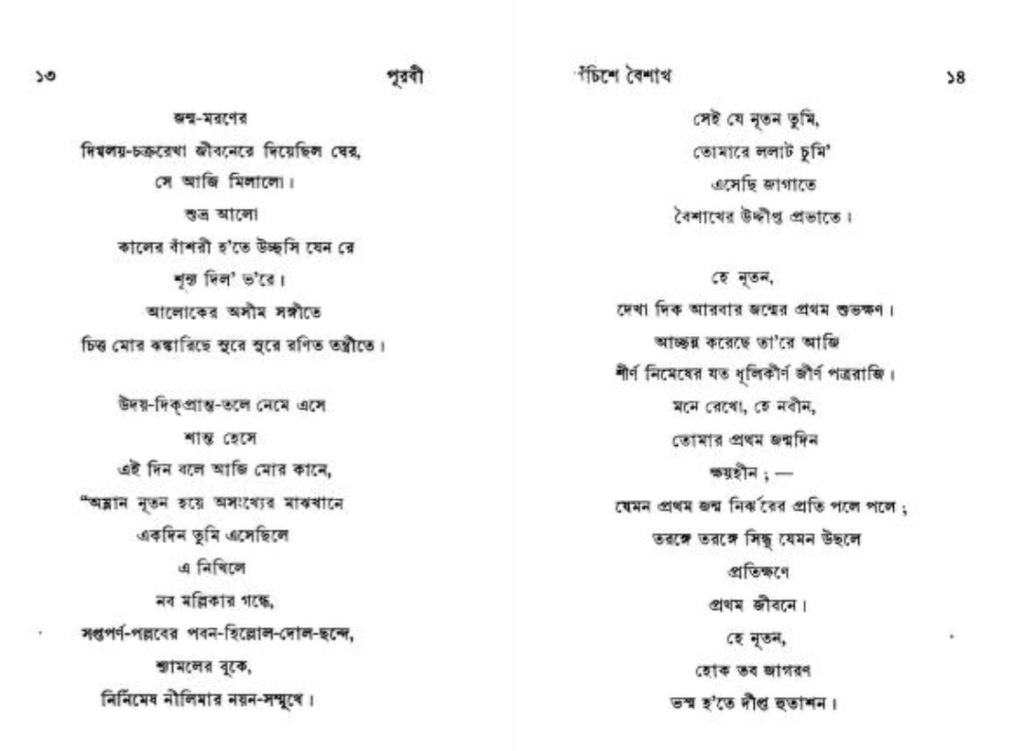
Pochishe Boisakh[1]was written by Tagore on 8th May 1922, and published in a collection called, Purabi [name of a raga] by the poet himself under the aegis of Vishwa Bharati.
Purabi by Rabindranath TagoreRabindranath Tagore(1861-1941)
Night gives way to dawn. I bring to you By hand, The full saga of My birth written By the rays of The morning sun.
A blood smeared sun rises out of the horizon. Faint shadows of the woods play lonely notes of the Bhairavi. Saal, palm and sisir trees murmur to Break the silence of the outskirts. On the dry fields, a blood-red path resembles The forehead of a sanyasi* smeared with holy paste.
This day returns every year In different guises on this earth — Sometimes, filled with copper-coloured mangoes, Or rustling with young palms, Or, crackling with dry leaves in the mid-day sun, Sometimes rushing to free itself Like the clouds of the Unshackled kalbaisakhi*. And it comes to me When I am alone, Drunk with the northern breeze, Hands me a gift — A plate made of the blue sky And then a zephyr filled cup of nectar.
This day has dawned today. My heart beats rapidly As if someone is blowing a conch resonating With the susurration of infinite oceans. Birth and death like The skyline meet in the circle of life. Today they come together. A white radiance seems To overflow with music from The flute of Time, filling the emptiness. Endless music irradiates My soul singing from within.
Morning descends with a Calm smile and Whispers into my ears: “I have come anew amidst many. One day, you arrived In this universe Redolent with the perfume of fresh mallika blooms, Amidst the breezy caresses of the chattim tree, In the heart of darkness, Under a steadfast, azure gaze. I kiss the forehead Of the new you. I have come to awaken you On this exciting day.
“Oh, newly fledged, Let’s revisit the start of your life. Today your existence is overwhelmed With transient dusty correspondence. Remember, O youth, Your first birthday… Unblemished — Pure, like the first moments of your life; Like the waves of the ocean, revive Every second of Your first day.
“Oh, newly fledged, Arise, illumined Out of the ashes of past. Anew, May you shine out of the mists like a rising sun. Holding the vernal flag, Fill youthful moments with lush foliage — In this way, newly fledged, Pierce the emptiness, reveal yourself. Revel in the exuberance of life, Reveal the eternal wonders of the universe within your being. The horizon reverberates with notes from the auspicious conch.”
In my heart, Eternal new notes peal On pochishe boisakh!
In 1941, Tagore adapted the last part of the poem, changed a few words and made it into a song for his last birthday, acceding to the request of a birthday song to his family and friends. The song, ‘Hey Nutan’[2], has been translated by Aruna Chakravarti in her historical novel, Daughters of Jorasanko, as the last birthday song by Tagore. You can access the translation of the song and his last birthday celebrations depicted by Aruna Chakravarti by clicking here.
ScreenshotScreenshotThe poem written in 1922 from Purabi, Vishwa Bharati The last part of the poem from PurabiThe last birthday song (1941)The last part of the longer poem written in 1922 was adapted into a song by Tagore, his last paean to his own birthday, few months before his death in 1941. The changes made to the words and phrases can be seen in the screenshots pasted above.
[1] Pochishe Boisakh is the 25th of Boisakh. Boisakh is the first month of the Bengali calendar coinciding with mid-April to mid-May. Tagore was born on 25th Boisakh, which is a date that shuttles between 7th to 9th May every year on the Gregorian calendar.
[2] Aruna Chakravarti translates this as ‘Oh ever new’. In the poem, it has been translated as ‘Oh newly fledged’. It is from that point that Tagore made the changes and converted the poem into a song. He changed a few words, a few lines, giving it a new life as a song.
(This poem has been translated by Mitali Chakravarty with editorial input by Sohana Manzoor)
.
PLEASE NOTE: ARTICLES CAN ONLY BE REPRODUCED IN OTHER SITES WITH DUE ACKNOWLEDGEMENT TO BORDERLESS JOURNAL
Travel writing by Tagore: Translation by Somdatta Mandal
In 1885, under Jnanadanandini’s1 editorial venture, a children’s magazine called Balak was published from the Tagore household in Calcutta. It contained different writings of the young Rabindranath, who would handle a lot of things for the publication. This magazine was later merged with Bharati and edited by his elder sister, Swarnakumari Devi. Among the different entries that Rabindranath contributed for Balak are two interesting travel pieces. One travelogue published in Vol. 3, Ashar 1292 B.S. (July-August 1885) called “Das Diner Chhuti” (Ten Days’ Holiday) narrates his trip to Hazaribagh that year along with his nephew and niece during their school holidays. The second one called “Baraf Pora” (Snowfall) describes his first experience of snowfall in England in the winter of 1878 when he was living in Brighton along with his brother Satyendranath’s family2.
Rabindranth Tagore (1861-1941) in England
Baraf Pora (Snowfall)
The outlines of pictures gradually blur out of the mind; the shadows of all that we see every day come ahead and crowd it, replacing the things we had seen a few days earlier. We cannot clearly understand where the earlier images get lost in the melee.
I went to England in the year 1878 A.D. That was about seven years ago. At that time, I was young too. I can remember overall what I had seen in England, but all her pictures are no longer clear in my mind. I cannot match one line with another. A kind of mist has already descended on my memories of England. The pictures must be brought out occasionally and aired in the sun. That is why I have brought out my memories in the sunlight today.
It was the middle of October when I reached England. I didn’t feel it to be too cold then. We stayed in Brighton. It was sunny in Brighton then. Happy with the sunshine, all men, both young and old, had come in hordes to the seashore. The sick and the elderly people moved in pushcarts with one or two young girls or any other member of the family accompanying them. The ladies were dressed up in different kinds of clothing with umbrellas over their heads. Small boys dragged iron wheels and ran along with them. Some ladies sat on the seashore with open umbrellas over their heads. Some were busy following the movement of the waves and collecting different kinds of seashells. An Italian beggar was moving around playing an organ. Vegetable and milk vendors were returning after supplying their products in different houses. A man and a woman were riding their own horses on the pathway and the dressed up stable boys were following them. Some schoolmasters were walking with a big group of boys following them; on the other hand, each schoolmistress had a whole trail of schoolgirls following her. They had come to enjoy the sea breeze, or if not, at least the sunshine. Quite often we would run around the grassy fields near the seashore. Though the age was not conducive for running around, we didn’t mind because no one suitable was present there to criticise us for our out-of-the-way behaviour. The best time for our outing was ten or eleven o’clock in the morning. Whatever it might be, the seaside was celebrating the festival of sunshine when we reached Brighton.
As the days went by, the cold started increasing. The mud on the streets froze in the cold weather. The dew on the grass would freeze too and it seemed as if someone had scattered lime powder everywhere. On waking up in the morning I found that ice crystals had formed different designs on the windowpane. Sometimes I also found one or two sparrows that had died in the cold lying on the road. The few yellow leaves remaining on the trees also fell down, leaving the lean bare branches behind. The small little robin birds came to the glass windows with reliable hearts begging for bits of bread. Everyone assured us that we would soon witness snowfall.
Christmas was almost approaching. It was biting cold on a moonlit night. The doors and the windows of the room were all shut tight with the curtains drawn over them. The gas was burning. A fire was lit to warm up the place. After dinner we were all around the fireplace busy chatting. The two young boys attacked me. Despite having plenty of proof, I do not want to mention here that they never behaved politely with me. They have grown up now, they even read Balak; so, I do not want to write about them and then make my life more miserable answering their questions. A few days later they will also learn to protest. Because I would not be able to counter them, I remained quiet. You readers can guess whatever you like about their behaviour – I will not volunteer to take any responsibility on my shoulders.
Everyone was sitting warm enough when suddenly we got the news of the snowfall. As all our doors were shut, we did not know when it began. All of us including the children ran outside to see the beautiful sight. The cold seemed to have frozen the moonlight in layers and stuck on the streets, on the grass, the bare branches, the sloped slate roofs. There was no one on the street. All the houses in front of us had their doors and windows shut. The night and quietness, the moonlight and the snow all blended to create a wonderful scene! The children (and I too) picked up the snow on the grass and turned it into little balls. As soon as we brought them in, they melted into water.
For me this was the first night of snowfall. After this I have seen snowfall several times. But describing it is not easy, especially after so many years. I was walking on the street covering myself entirely in black woolen clothes. The sky was grey. Little flakes of snow were falling all around like quinine powder. It did not fall like raindrops – it came in lightly as if flying or dancing. It came and touched your clothes lightly; you could dust and collect them. The wheels of cars left their marks on the soft white layers of snow. One also felt sad to leave dirty and muddied shoe imprints on the white layer of snow. It seemed as if the petals of the parijat flower were falling from the sky. Snow also got stuck on the black dresses and black umbrellas of the pedestrians.
Parijat flowers fallingSnowflakes falling
It was wonderful to watch how everything got covered with snow gradually. At first, it fell merely like some white streaks on the streets. There was a small plot of land in front of our house. It had a few saplings and creepers – no leaves on the shrubs but just bare branches. Those branches were still not covered with snow, so it was a mixture of green and white. The saplings seemed to be freezing in the cold. Their clothes were gone; wearing white funeral clothes of snow, the sap in their veins also seemed to be freezing. The black slate roof of the house was gradually turning grey and then white. Soon the streets were also covered with snow – the small saplings got buried in it. The snow also piled up on the narrow windowsill. The noses of the few pedestrians on the street turned blue, their faces shriveled in the cold. Far off at a distance, the church steeple was faintly visible like a white ghost in the sky.
It is very difficult now in this hot and humid summer month to even imagine how cold it was. I remember how after taking a cold-water bath in the morning my hands would become so numb that I could not find the handkerchief in my pocket. There was no limit to the amount of warm clothes on my body. Despite the thick shoes and socks, the soles of my feet would become cold in no time. Even after getting inside a bundle of blankets at night, I would be worried how I would turn on the other side because whenever I turned, I would get a shock. We heard the story about four fishermen who had gone out to fish in the sea. When a ship came near their boat, they saw that the four of them had already frozen to death. The coachman who was sleeping on his carriage at night had also died. The water in the pipes often froze and caused the pipes to burst. Snow had covered up the River Thames. The lake inside Hyde Park was also frozen. Hundreds of people wore a kind of iron shoes and skated over that lake every day.
This skating was a wonderful affair. Hundreds of people wearing skating shoes turned and bent and twisted and glided over that hard lake. The way people skated was like the way a boat moved with its sail. With the body slightly tilted on one side, one could float easily on the ground. No effort was needed to step forward – one did not have to quarrel with the ground or defeat it with each footstep.
Trying to bring back the winter of England to our country even through our imagination is futile. The heat here rises very quickly, melts like the snow and cannot be grasped. It is not sufficiently welcomed within the blankets and quilts here.
Rabindranath Tagore (1861 to 1941) was a brilliant poet, writer, musician, artist, educator – a polymath. He was the first Nobel Laureate from Asia. His writing spanned across genres, across global issues and across the world. His works remains relevant to this day.
Somdatta Mandal is a critic and translator and a former Professor of English at Visva-Bharati, Santiniketan, India.
.
PLEASE NOTE: ARTICLES CAN ONLY BE REPRODUCED IN OTHER SITES WITH DUE ACKNOWLEDGEMENT TO BORDERLESS JOURNAL
Apnake jana amar phurabe na/Ei Janare shongo tomai chena/

There will be no end to my discovery of myself/And this discovery keeps coming with my discovery of you
On the one hand, Rabindranath Tagore [1861-1941] has been with me almost all my life. On the other, I only began to discover that I had Rabindranath so centrally in me relatively late in my life. In fact, I have now realised that the process of discovering the way he has been embedded in me is part of the process of discovering my own self in the course of the life that I have been leading till now. Indeed, at this stage of my life, it seems to me that there will be no end to my discovery of the way Rabindranath has become part of my consciousness since I feel that there will be no end to discovering myself till I lose consciousness once and for all. The one thing I can say with certainty, using his words but in my translation is “There will be no end to my discovery of myself.” For sure, this process of discovering myself endlessly keeps happening with my continuing discovery of Rabindranath.
Surely, the process through which Rabindranath had become embedded in me began in childhood. However, I did not encounter his work in my (English medium) textbooks since I did not learn Bengali in school for a while. How then did I come to remember poems such as “Tal gach ek paye dariye/shob gach chareea/ Uki mare akaashe” (Palmrya tree, Standing on one foot/Exceeding all other trees/Winking at the sky”) or “Amader Choto Nadi chole bnake bnake” (“Our little river keeps winding its way”). How do I remember these opening lines even now? And why do I still associate such palm trees and winding little rivers with these lines even now whenever I am in the Bangladeshi countryside? Surely, it must have been my mother who planted Rabindranath in me in my seed time so that he would become embedded in my unconscious, only to surface in my consciousness decades later. It is surely no coincidence that she taught me Bengali and made me learn Rabindranath’s poems indirectly.
As a boy growing up at a time when the radio was the main source of entertainment in middle-class Bengali houses, my siblings and I were made to listen to Rabindra Sangeet in our house by my father, who felt that he had to share his favourite songs and singers in the musical genre with us, whether we wanted to listen to them or not. Of course, at that age I would have much rather not listen to those solemn-sounding, soulful songs, and whenever I could put my hands on the radio dials, I would listen to English popular music on Radio Ceylon. My favourite singers were Pat Boone, Elvis Presley, Cliff Richards and—a little later—the Beatles. In school, when we were not playing or talking about sports or girls, we boys would be discussing the pop music we heard on Radio Ceylon. By the end of the 60s, we would be talking about the English thrillers and comedies we saw on Dhaka television. What place could Rabindranath have in one’s life then? If Rabindranath had been placed in my innermost self by my mother through her reading of his poems to us children or my father through his addiction to Rabindra Sangeet, for the moment he was getting occluded deep inside me and, it would now seem, all but forgotten!
But from the middle of the 1960s, our lives in Dhaka began to change as the claims of Pakistan on us East Pakistanis started to loosen, little by little. It was a time when in neighbourhoods and on streets, processions would come out singing gonosangeet—literally songs of the people, but in effect music of protest and patriotism. First, the Six Points Movement and then the Agartala Conspriacy case were on everyone’s lips and East Pakistanis everywhere were becoming activists in one way or the other. There was no escaping songs like “Shonar Bangla” (“Golden Bengal”) or “Banglar mati, banglar jol, banglar baiuo, banglar phol/Punno houk”” ( “Let the land, the waters, the air and fruits of Bengal be blessed…) and “Bartho Praner Aborjona Purea Phele Agun Jalo” (“Burn the frustrated soul’s detritus and light up a flame”). In my school where we boys now studied “Advanced English” and “Easy Bengali”. There was no way we could have learned enough Bengali to read Rabindranath or Nazrul in the original in any sustained attempt, but how could we escape the call from such songs and poems like Nazrul’s “Bidrohi” (“The Rebel”) or the call from the streets to protest and even burn for our emancipation? At home, three of my four sisters would be practicing Rabindra Sangeet regularly, since this was what my parents wanted them to do, and so there would be no evading Rabindranath’s songs at home for this reason as well, but I was more interested in friends and sports than staying home and so I would hear the songs only in snatches at this time.
By the end of the decade though, Rabindranath was everywhere in our lives since becoming Bengali became first and being a Pakistani only came later. Even on Dhaka Television, Rabindranath’s songs and dance numbers were being aired fairly regularly then. Outside, one could get to see his plays and dance dramas being performed every now and then in functions and cultural events all over the city. He would soon become an important part of Pohela Boisakh, which itself would become instantly popular amongst us all almost as soon as Chhayanaut[1] organised the first event in Balda Garden as the decade came to a close. But while Rabindranath was everywhere around me all of a sudden, I was still not reading him at all, preferring English thrillers and westerns initially, and later, when I became a “serious” reader from college onwards, contemporary classics of English and European literature available in English editions.
In the early seventies, however, you could not be in Bangladesh without imbibing Rabindranath at least a little, for there was a process of osmosis at work at this time. Glued as we were to Swadhin Bangla Betar Kendro[2] during our Liberation War[3], we kept listening to his patriotic songs on our radios; the promise of Shonar Bangla seemed alive and possible then. The years after liberation, my generation was exposed to Rabindranath in new ways; we would get to hear and view singers like Kanika, Debobroto and Suchitra Mitra on stage in Dhaka; their songs became freely available in tapes in our shops; and Satyajit Ray’s film version of Rabindranath’s fiction and Ray’s documentary on him became staples of Dhaka’s film societies. I was finally growing up intellectually and was hungry for culture, and so how could I have escaped the poet’s works totally at this time?
But the Rabindranath that I was imbibing thus was almost entirely coming to me aurally and visually. Because he was becoming embedded in my consciousness through songs and the silver screen as well as television, he still inhabited the surface of my consciousness. And I was certainly not making any conscious bid to savor him. The seventies and the eighties were, in fact, decades when I was becoming an even more “serious” student of English literature than before and getting “advanced” degrees in my subject and acquiring expertise for my teaching career; where would I get the time to read Rabindranath then? As an expatriate student for six years in Canada and as a visiting faculty member for two years in the USA, I would be getting small doses of Rabindranath in those countries through the songs I kept hearing in the cassettes I had brought along of my favorite singers and in the occasional film versions of his work that I would get to see because of campus film societies, and I suppose nostalgia played a part in my yearning for him then, but I had no time to spare for him and not enough exposure to his works to let his ideas and his achievement resonate in me in any way.
To sum up my encounters with Rabindranath till then, I was discovering Rabindranath in small doses all the time and experiencing him directly here and there, but my knowledge was all very superficial and my understanding of him too limited. And nothing much had happened that would allow me to tap into the unconscious where all the memories of poems and songs by him I had first come across through my parents’ enthusiasm for his works were hidden.
“Dekha hoi nai chokkhu melia/Ghor hoite shudhu dui pa felia”/

“I haven’t seen with my eyes wide open/what was there only a stride or two away from my house”
In the 1980s, I became smitten by theory, especially the works of Edward Said, and suddenly questions of postcoloniality, ideology, power and location became all-important for my understanding of literature. I was coming around to the belief that I could not be a good and truly advanced student of English literature in Bangladesh, let alone a good teacher of the subject here, unless I sensitised myself to my roots and look at the world around me. And now I remembered some lines I had been hearing since childhood without realising their relevance for me and everyone else around us then: “Dekha hoi nai chokkhu melia/Ghor hoite shudhu dui pa felia” (“I haven’t seen with my eyes wide open/What was there only a stride or two away from my house”). Rabindranath had been all around me and yet I had not opened my eyes wide enough to learn from him. I had not read his works with any kind of sensitised attention at all and I had not been able to arrive at any kind of appreciation of his achievements except the smug sense of self-satisfaction at the thought that this Bengali had once won the Nobel Prize.
Towards the end of the 1990s, for the first time really, I plunged into Rabindranath and found—to quote Dryden on Chaucer— “here was God’s plenty”. Having opened my eyes to him I realized that there was so much to him than one could take in at any one time. He had once said in a song about the infinite contained in the finite and I now thought, “How appropriate of him!” He had said in one of his most famous poems, “Balaka[4]” about how one must not succumb to stasis and how the essence of life is motion and I thought, “how inspirational!” He had written in a song about viewing the Ultimate Truth through music and I thought “Exactly!” He had looked on in amazement in a starry night at how humans have a place in the cosmos (Akaash Bhora Surjo Tara[5]) and I thrilled at the idea now. He made me see the monsoonal kadam flower that I had passed every year without blinking an eye as immensely lovely. Every poem that I read enlightened me, every song lent my soul harmony, every short story or novel took me to eternal truths about human relationships. Who would not learn from a man who had been given some of the highest honors the world has offered any human being, when he says with such unambiguous humility, “Mornam ei bole khati houk/Aami tomaderi lok…” Let this be my claim to fame/I am all yours/This is how I would like to be introduced.” And so I kept reading him in between teaching and writing, finding him an endless source of inspiration, creativity and wisdom. I strove to learn about nature, the universe, people, relationships, beauty and the dark side of humans through his works. And soon I felt compelled to translate some of them.
Rabindranath, then, opened my eyes not only to the world I lived in but also helped me discover my own self as a product of forces that had taken our nation past 1947 to true liberation. He helped root me in Bengali and Bangladesh as never before, making me discover myself not merely as a Bengali but as a citizen of the world, a product of a certain history but also of the history of mankind. My discovery of him and my place in the world was furthered by the work I did in co-authoring The Essential Tagore and authoring a collection of essays on diverse aspects of his work.
But Rabindranath truly contains multitudes. What I now realise is that it is impossible to discover him fully in one life, especially when one embarks on the process of discovery so late in life. By now, therefore, I have despaired of knowing the whole man and feel I will get to know only parts of him. But I also know whatever I read of him will enlighten me and make me know myself better in every way than before. And so I’ll keep reading him and translating him, if only to know him and myself better in the days left for me!
[1] Centre for promotion of Bengali Culture established in 1961
The soughing of the waters of the river is like the keening of a mother for her child. It will never end until time itself is no more, and the light disappears from some distant shore. Until then, Marianne wields her garden rake with something like fury, as if that will happen tomorrow. No crowd gathers to watch, and no man offers assistance, or can take a moment from the course of his day, to marvel at her persistence, or to wonder, as at a body risen from its grave, or as a rake digs its furrow, or the earth bears no seed, at the cause of this unspoken sorrow.
George Freek’s poetry has recently appeared in The Ottawa Arts Review, Acumen, The Lake, The Whimsical Poet, Triggerfish and Torrid Literature.
PLEASE NOTE: ARTICLES CAN ONLY BE REPRODUCED IN OTHER SITES WITH DUE ACKNOWLEDGEMENT TO BORDERLESS JOURNAL
Mahashweta Devi (1916-2016) was a renowned and much awarded writer-activist-translator who was reputed for her close observation and documentation of tribal life and its marginalisation and willed forgetting by dominant power systems. Among the many awards received by her were the Padma Vibhushan, the Ramon Magsaysay, the Jnanpith and the Sahitya Akademi Award. The stated aim of the present volume — in keeping with the overall objectives of the Writer in Context Series — is to present a more rounded, multidimensional image of Mahasweta Devi. This has been admirably accomplished by Prof Radha Chakravarty who is an eminent translator and academic herself.
In the ‘Introduction’, she unpacks the partial truths that underlie the stereotypical image of Mahasweta Devi as an activist. Highlighting the fact that Mahashweta’s representations of different forms of marginality bring together “the aesthetic and the political in ways that demand a more nuanced reading”, she reinforces the need to read Devi’s oeuvre as literature, and not only as “forms of social documentation or ‘witnessing’”. She interrogates the stereotype of the activist-writer and opens up the possibility of re-reading Mahasweta Devi’s life and work in “newer, more unsettling ways”. Further, Chakravarty highlights how her (Devi’s) creative writings in particular emerge as “ambivalent texts, simultaneously imbued with radical potential and a continued reliance on traditional forms of signification”.
Mahasweta Devi’s writings often demonstrate a tenuous divide between fiction and non-fiction. As a matter of fact, she emphasises on “the historical basis for her creative writings”, which is evident in many of her novels like Mother of 1084 (Hazaar Churashir Maa, 1974), and stories like ‘Draupadi’ and many others, which are based on the Naxalite movement. Simultaneously however, her literary works display a measure of social realism which, Chakravarty contends, is “offset by a visionary quality that enables the imagining of transformative possibilities.” The contents of this volume testify to the varied, diverse and sometimes “contradictory dimensions of her multifaceted genius”.
The book under consideration aims to set the record straight for readers outside Bengal whose views are based on the “tiny fraction of her Mahashweta Devi’s work available in English translation”. She was an extraordinarily prolific and versatile writer who wrote in multiple genres, including fiction, biography, drama, children’s literature, memoirs, travel writing, and literary criticism. She also occasionally translated her own work into English.
Chakravarty’s introduction and compilations in this volume foregrounds the aspect of Mahashweta’s political activism and how her writing itself becomes a form of resistance. Her early induction into Marxism was also partially attributable to her family background. Her family included Ritwik Ghatak (her father’s brother was a famed film maker) on her father’s side and on her mother’s, Sankha Choudhuri and Sachin Choudhuri, one a well-known sculptor and the other, the founder/editor of India’s foremost social science journal, Economic and Political Weekly, respectively.
Her early contact with Tagore and education at Santiniketan sensitised her to values of “inclusiveness, self-reliance, freedom of thought and expression, social responsibility, and environmental issues”. There, she also imbibed some of the spirit of the freedom struggle. Through her marriage to Bijon Bhattacharya, she grew familiar with IPTA[1] and the left ideologies. Later, she was associated with different radical movements in Bengal, Manipur, Jharkhand, Bihar, and Rajasthan, which find expression in many of her writings (Mother of 1084, ‘Draupadi’).
Her political commitment to these movements is evident in her use of language. Local vocabularies become central to the style and subject of Mahasweta’s writings. She wrote in 1983: “Since I remain immersed in indigenous myths, oral legends, local beliefs and religious convictions, I find purely indigenous words very potent and expressive.”
She was critical of writers in the Bangla literary establishment whose experiments with modernist aesthetics led to disengagement with the socio-political context. All the same, her writings evince special “linguistic, textual, and aesthetic strategies that can be compared to the practices of other writers who were experimenting with new approaches”, using non-linear time. Oral traditions fascinated her and she worked closely with Prof G.N.Devy in her later years, to campaign for the recognition of tribal languages.
She also translated and edited volumes on Indian folklore. In her own writings, she includes elements from the oral traditions, as in the snatches of local lore in Jhansir Rani (The Queen of Jhansi) or the lines from an untranslated Santhal song in ‘Draupadi’. As Chakravarty points out, “Heteroglossia, the use of language as an indicator of social hierarchies in multivocal, polyphonic texts, functions as a potent literary feature in her writings.” Alongside, many of her texts incorporate multilingual elements, as if to indicate the heterogeneities in South Asian societies and cultures.
The book is an comprehensive introduction to and reappraisal of Mahasweta Devi’s life and work. It is imaginatively conceptualised and organised into different sections, each highlighting diverse aspects of her work and the criticism thereon. Section 1 of the book called ‘Spectrum: The Writer’s Oeuvre’, offers the reader in English an overview of the full range of her oeuvre through brief samples of her literary writings across diverse genres to highlight her versatility. These include Jhansir Rani (1956), a fictionalised biography of Rani Lakshmibai, Queen of Jhansi, which amalgamates historical sources, folklore, and creative characterisation, to show up the contradictions in different versions of the Rani’s life and Hajar Churashir Ma (The Mother of 1084), her powerful novel about the political awakening of a mother after her son is killed by the police during the Naxalite movement of the 1970s, altered the trajectory of the Bengali novel. The extract from the final pages captures, in a style resembling stream-of-consciousness, the dramatic political power struggles in the outer world and the inner drama of the mother’s psyche.
The short story ‘Giribala’ narrates the plight of a girl married off at 14 to a man who sells their own daughters into the flesh trade to pay for the construction of his dream house. The play Bayen uses modern experimental techniques to present the story of a woman from the caste of Doms (cremation attendants), who becomes the victim of collective superstition and scapegoating and yet, in a final act of heroic self-sacrifice, saves the very community that has ostracised her. In a complete change of tone and style,’Nyadosh the Incredible Cow’, a delightful piece of writing for children, offers a witty anecdotal account of the devastating exploits of a cow in the author’s home. The extract from Tarasankar Bandyopadhyay, Mahasweta Devi’s English monograph on the iconic Bengali writer, reveals her incisiveness as a literary historian and critic and also provides a window to her own literary values.
As Chakravarty clarifies, given the vast body of critical readings on Mahasweta’s writings, a comprehensive compilation is beyond the scope of this book. Instead, the selected essays in Section 2 (‘Kaleidoscope: Critical Reception’) offer the reader (in translation) a sense of the paradigm shifts that mark Devi’s critical reception in Bengal, the rest of India, and in the international domain. Tensions, debates, and contradictions are highlighted, and overview of her critical reception over four decades –1957 to 1997 in Bengal is discussed by Arup Kumar Das. An essay by Dipendu Chakrabarti analyses the debates and controversies around her work. Dilip K. Basu’s account of Hajar Churashir Ma views itas a pathbreaking text that transformed the course of the Bengali novel in the 1970s.
The essays in English by other Indian critics include Sujit Mukherjee’s classic piece on Mahasweta and Spivak, Jaidev’s account of national allegory in Douloti, Arunabh Konwar’s comparative analysis of the creative use of fictionalised biography by Mahasweta and Indira Goswami, Shreya Chakravorty’s study of the politics of translation in the work of Spivak and Samik Bandyopadhyay, Anjum Katyal’s account of Mahasweta as a dramatist, and Benil Biswas’ reading of the transmutations of Mahasweta’s texts via stage and screen adaptations.
International contributions include an important new essay on Pterodactyl by Gayatri Chakravorty Spivak, who interprets the rhetorical pointers in the text to speak of it as an activist mediation for the reader to learn about earning the right to intervene. Shreerekha Subramanian’s essay offers a comparative study of the discourse on motherhood in novels by three women writers across different languages, locations, and literary traditions: Mahasweta Devi, Toni Morrison, and Amrita Pritam.
Section 3 (‘Ablaze With Rage: The Writer as Activist’) includes some of Mahasweta’s activist writings, such as ‘Tribal Language and Literature: The Need for Recognition’, a passionate demand for the inclusion of tribal languages in official discourse; ‘Palamau is a Mirror of India’, where she critiques what she perceives the failures of the state to address the plight of the oppressed people in post-Independence India; and ‘Eucalyptus: Why?’, a scathing critique of the nexus between local powers and global market forces that have led to the replacement of natural forests in Bengal with eucalyptus plantations that have destroyed the local ecology that sustained human and animal life there. Alongside, in ‘The Adivasi Mahasweta’, Ganesh N. Devy reminiscences about his first encounter with Mahasweta Devi and their subsequent collaborations in activist campaigns and projects. ‘Haunted Landscapes: Mahasweta Devi and the Anthropocene’, by Mary Louisa Cappelli, connects Mahasweta’s activist writings and fiction on the subject of the Anthropocene to indicate the need to take a composite view of her writing and activism as twin manifestations of the same vision.
Section 4, ‘Personal Glimpses: A Life in Words’, includes extracts from Mahasweta’s memoir Our Santiniketan (2022), along with interviews (with Naveen Kishore and Radha Chakravarty) and reminiscences by her family members (Nabarun Bhattacharya, Soma Mukhopadhyay, Sari Lahiri, Ina Puri), friends (writers ‘Anand’ and Anita Agnihotri), and associates (Ranjit Kumar Das ‘Lodha’, Dakxin Bajrange), which highlight different facets of Mahasweta’s life and personality, bringing to life the woman behind the public image.
The book offers a comprehensive overview of Mahashweta Devi’s writing and will be of immense use to students, researchers and to general readers. As Chakravarty reiterates , “New trends in Mahasweta studies continue to evolve, including emphasis on her environmental concerns, ethics, planetarity and the Anthropocene, intersectionality, the use of incommensurate realities and registers of writing, comparative readings, and an emerging focus on her life”.
This is an ambitious attempt to give us an idea of the immense range of her work. While a full biography and a full bibliography of Mahasweta’s oeuvre is yet to be published, (encompassing the entire corpus of her work, including letters and other unpublished material) this volume is a vital step in that direction. In her excellent Introduction, Chakravarty charts the long-term impact of Devi’s work which continues to resonate in contemporary forms of activism and theatre. Through the actions of the many groups of people she inspired – the women of Manipur whose public protest imitated her fiction, to the performances of the Budhan theatre, and the rise to fame of the Dalit Bengali writer, Manoranjan Byapari— “Mahasweta’s impact and influence can be felt in many ways. She survives through the people she struggled to support all her life,”
It is an ironical reflection on our times that a prolific and much awarded Indian writer-perhaps deserving of the Nobel prize, should be excised from the university syllabus of a central university. This move has, perhaps paradoxically, elicited even more interest in Mahasweta Devi’s work and has also consolidated her reputation as a mascot, a symbol of resistance to state violence. A timely intervention, this volume proves yet again that a great writer, in responding to local , regional, environmental ethical concerns sensitively, transcends his/her immediate context to acquire global and universal significance.
[1] Indian People’s Theatre Association founded in 1943
.
Dr Meenakshi Malhotra is Associate Professor of English Literature at Hansraj College, University of Delhi, and has been involved in teaching and curriculum development in several universities. She has edited books on Women and Lifewriting, Representing the Self and Claiming the I, in addition to numerous published articles on gender, literature and feminist theory. Recently, she co-edited The Gendered Body: Negotiation, Resistance, Struggle.
.
PLEASE NOTE: ARTICLES CAN ONLY BE REPRODUCED IN OTHER SITES WITH DUE ACKNOWLEDGEMENT TO BORDERLESS JOURNAL
I am currently staying with friends in the city of Exeter and they have given me a room, a room that contains a desk and a chair. This is a huge relief. One thing I have discovered since returning from India three months ago is that a desk is a valuable and uncommon item. I had always taken them for granted before. They never impinged on my consciousness.
My consciousness was rather neglectful in that regard, it seems. I assumed that everybody in the world regarded desks (and chairs) as fundamental aspects of existence. It simply never occurred to me that people might not require desks because they didn’t need to write books. I had forgotten that not everyone writes books all the time. What an oversight!
Since arriving in Britain, I have stayed with friends in a variety of locations but, only in Exeter, have I had a desk and chair. Only here, have I been able to sit and work on my next book. Or rather, only here have I been able to do so with relative ease, sitting perched on an adjustable chair, slightly hunched over, three fingers on each hand tapping away at the keyboard (I was once a two fingered typist but I have since improved), a desk lamp providing illumination and a mug of coffee not far away, and even disordered pages of written notes sharing desk space, because it happens to be a big desk.
Yes! A desk large enough to include not only my computer but books and messy piles of paper with garbled messages on them (messages that made total sense when I wrote them but now seem baffling and cryptic). There is plenty of spare space for me to move my mouse with grand sweeping gestures (instead of trying to restrict it to an area no larger than a beer mat). I have found a paradise of sorts. It is a desk that fulfils its promise, a desk that has no wobbly leg, that is high enough to prevent my legs bashing against the edge (and it is a blunt edge, thank goodness) but not so high that I have to crane up. It is a good desk, noble and honest. It is a friend and facilitator.
I don’t mean to sound ungrateful but friends who have accommodated my presence in their houses (while I seek a permanent place of my own) have been unable to cogitate the importance of a desk because the act of writing seems of no great importance to them. Can’t you balance your laptop on your lap? That is a question that seems perfectly logical to them. But no, I can’t. It slides off, just like cats often do when they fall into a deeper sleep and their muscles relax. My computer might call itself a ‘laptop’ but that seems to be a nickname rather than an accurate description of what it can do.
Well, if you can’t balance it on your lap, just don’t write anything. That is their solution to my dilemma. And I have written less, yes, and I do miss the big desk I had in India with the power socket right next to me and enough space on a generous surface for two or more mugs of coffee at once. Indeed, the desk was large enough so that my wife was able to do her writing on her own computer at the same time without either of us interfering with the other! Can you imagine a desk like that? That was a palatial desk.
Of course, I have done my best to improvise. I have used a cardboard box as a desk and sat on the edge of the bed. I have used the edge of the bed as the desk and sat on the cardboard box. I have tried to use a narrow bookshelf as a desk, standing up to type while striking my head on the shelf above it. I sat on the stairs and used the higher step as a desk. None of this has been practical or comfortable. Desks are hugely underrated.
One of my friends kindly gave me a bedroom into which she thoughtfully placed an inflatable bed and then she inflated it for me with an electric pump. It was a small room and the bed, fully inflated, was very large, so large that it took up all the space in the room, every cubic centimetre. Opening the bedroom door, I was immediately confronted with the bulging bed, which I had to climb onto. I tried writing on this bed but there was a leak. It slowly deflated and before long I was in the middle of a choppy pseudo-sea, feeling nauseous, while my fingers kept missing the keyboard of the undulating computer. No wonder sailors lost on the ocean have written so few books!
It is a different situation when I am looking after cats or dogs or other pets for friends who are away on holiday. Then I am able to employ kitchen tables as desks (although cats seem to want to take up most of the space on these surfaces too) and my computer and notes don’t even have to be cleared aside for dinner. I can eat dinner on my lap somewhere else.
That’s right, laps are for dinners and pets, not for laptops. I know there are writers who can write without desks and chairs. People who can sit cross-legged on a carpet on the floor or even while in the lotus position, serenely balancing the computer on their kneecaps as if it is a bridge anchored to two boulders and spanning the abyss between them. I admire such individuals, I guess, but I am not flexible enough to do likewise. I mean, I have a flexible mind, but my body doesn’t follow the example my mind sets.
Some ingenious inventor ought to invent a portable desk that folds up and can be carried in a pocket. Also, a chair that can be carried in the other pocket. It would reduce the frustration and sadness of desk-bound scribblers like myself. It would be an act of mercy. An alternative solution is for everyone in the world to start writing books, so they appreciate the necessity of a desk. In the meantime, I am making good use of the desk I have been loaned and I will miss it when I am gone from my current temporary residence.
Rhys Hughes has lived in many countries. He graduated as an engineer but currently works as a tutor of mathematics. Since his first book was published in 1995 he has had fifty other books published and his work has been translated into ten languages.
.
PLEASE NOTE: ARTICLES CAN ONLY BE REPRODUCED IN OTHER SITES WITH DUE ACKNOWLEDGEMENT TO BORDERLESS JOURNAL
I want to reach the state where angels dance across my neurons from tiptoe-crossed ethereal realms while humming my spirit in the direction of higher consciousness with spells that guide me close enough to smell the throne of God
I want to close my eyes and instantaneously shift perception to the precision point of total awareness where what once was believed to be normal reality begins to seem as if it was just a childlike illusion as the true data pulses and throbs in colours, shapes, signs, and visions from dimensions that cannot be counted on fingers
I want to expand the inward horizon with lucid dreams of precognition that foretell what is still set to manifest through glimpses that melt away my conditioning and open the doorways to enlightenment
SIDEREAL NECTAR
Yellow neon fluorescence escaping behind the cover of pines
full moon bows a graceful retreat replaced by live wires and humming generators
I will write a poem on tea leaves about ripened figs and the prince of parables
crown the skyline at five a.m. while Venus dances to her own blinking pulse
electricity spells half of the story a magnet clenched between teeth to attract the pull
cross-tide and chemical trails hung from the wings of gods and ghosts
breathe deeply of the moment while it lasts then beg for mercy that another arrives
ALL THE WORLD IS A STAGE
And the horses will gallop and the cows will chew the cud and the sheep will graze (while being led astray) and the vultures will perch and the rats will scurry and the turtles will shrink their heads and the swine will bathe in their troughs and the skunks will spray their scent and the goats will gnaw on bones and the wolves will hunt and the foxes will manoeuvre with stealth and the serpents will slither and the salmon will swim and the bulls will charge and the frogs will hop and the ravens will sing their refrains and the owls will judge by night and the ants will march after sugar and the bees will buzz near the flowers and the butterflies will flutter
and all the farm will play its part in kind as both the shepherds and the butchers watch over
Scott Thomas Outlar survived both the fire and the flood. He now spends his hours flowing and fluxing with the ever-changing currents of the Tao River.
.
PLEASE NOTE: ARTICLES CAN ONLY BE REPRODUCED IN OTHER SITES WITH DUE ACKNOWLEDGEMENT TO BORDERLESS JOURNAL
The fudge boat
stays afloat
thanks
to the towering
willpower
of sailors
who love fudge.

The anchor is weighed
every day
and brings up sludge
on its flukes
that looks disgusting
but tastes
robustly nourishing.

This is the fudge
in question.

And the fudge in answer?

Well, that’s as
smooth as an exotic dancer
who undulates
her degenerate limbs
for the benefit
of the salty whims
of the shore leave crew,
captain, navigator and mate,
all of whom
love to chew
the hardest fudge that you
might ever imagine:
it sticks their
jaws together
as if their gums are tethered
to each other
by mooring ropes.

But the fudge boat remains.

Once I took a trip
as a passenger on that vessel.
I nestled in the hold
among the tubs of fudge
and I refused to budge
when we finally
reached our destination.
I loved that fudge too much!

The captain kicked me off
his ship
and I was reduced
to begging in the port city
for cheap toffee
because of fudge withdrawal.

It’s a terrible curse
to love fudge that much
and even worse
to be forced to give it up
but I was a poor man,
not a toff,
and couldn’t afford
to overindulge until I bulged.
Woe is me!

But I am resourceful
and never abandon hope
and now
I'm designing
my own strange boat:
a tiramisu submarine.

If it works, it’ll be a dream,
and if it doesn’t
I will drift with the currents
under the waves
towards those flooded caves
where mermaids
act as envoys for
the rulers of fudge enclaves.

I’ll be brave
and attempt to claim asylum
by denying my
species, class and phylum
and fudging
the figures to the best of my
affable ability.

Fudge paradise, here I come!
Rhys Hughes has lived in many countries. He graduated as an engineer but currently works as a tutor of mathematics. Since his first book was published in 1995 he has had fifty other books published and his work has been translated into ten languages.
.
PLEASE NOTE: ARTICLES CAN ONLY BE REPRODUCED IN OTHER SITES WITH DUE ACKNOWLEDGEMENT TO BORDERLESS JOURNAL
Tommy sat down to dinner with his parents. Roast beef and mash again. He grimaced. His mother, a cashier at Lidl[1], and his father, a travelling salesman, threw him cursory looks: “Tommy, you should eat, meat is so dear,” his mother lamented.
“Eat up boy, money doesn’t grow on trees you know,” barked his father, wheezing irritably, followed by a huff that brooked no further comment on the subject.
Tommy slouched over his plate and wolfed down the food without a word. He left the table, as always, casting a contrary glance at his father, who ate his meal in silence, a ritual to which he demanded both his wife and his son to observe scrupulously.
Tommy slipped outside into the warm breeze of late summer, sitting down on the steps of his parents’ (the bank’s!) town council flat. How his father unnerved him with his tyrannical rules and stentorian ditties. “He’s gone almost half the year selling his cheap, nasty wares, and here he is laying down the law like a bloody dictator. Poor mommy does all she can to meet his inept demands, but when she can’t she cries her eyes out,” he fumed inwardly, clenching his fists.
Tommy took out a box of matches, lighting each one, then flicking them into the yellowing grass of their front garden. He enjoyed watching the little sticks sail into the night air all alit, only to fall extinguished on the stone walk-way or grass. He loved the sulphurous smell of the sparks, the vision of the orange flame. They aroused a shiver of excitement in his belly and spine. The door opened. His father snorted: “Whatever are you doing with all those matches ? Matches don’t grow on trees.” And in a heightened voice, “Stop wasting them …” He slammed the door shut. Tommy clenched his fists, his lips whitening in constrained animosity …
Tommy began his incendiary career at school. Armed with a box of matches that he had pinched from the local grocers, he set fire to the large rubbish bin in one of the maintenance rooms on the first floor of the building, causing billows of smoke to fill corridors and lungs of children and teachers as they rushed about either to escape or extinguish it. The fire was not serious in itself. However, the bin contained plastic substances whose horrible odours and ochre-yellow fumes made everyone retch or choke. Several children collapsed from smoke inhalation. Since no one had suspected Tommy, or any other child for that matter, the school board of directors concluded that it was due to an act of negligence. Hence, the elderly maintenance man was promptly sacked!
The thirteen-year old Tommy’s maiden exploit filled his lungs with pride, and would incite him to bigger deeds of daring …
And bigger deeds they indeed were: Southwold’s supermarket fell prey to Tommy’s insatiable fiery appetite. He had spotted an area outside the supermarket where hundreds and hundreds of wooden boxes, crates and cartons had been stacked all along the wall. This storage area was fenced off from a vacant lot which ran the whole length of it. In full daylight, the defiant Tommy sprinkled gasoline all along the mass spread of boxes, crates and cartons, then tossed matches into them. He ran and lay low under the scant bushes of the lot as the fire took hold and spread. Soon the flames were licking the wall, arching high over the roof of the supermarket (it wasn’t Lidl where his mother worked!), casting sparks into the hot, August air.
Tommy crawled away to safety into a nearby woods where he observed the now roaring flames with gratifying glee. Sirens drowned out the shrills of clients and supermarket personnel. The young arsonist dusted himself off, pushed back his tousled hair, and like all seasoned arsonists have done (and will always do), stepped gingerly into the gathering crowd that watched the fiery spectacle, listening to them conjecture unintelligently on the origins of the fire. He covered his mouth, concealing a victorious smile, mesmerised by the grandeur of the blaze. The thirteen-year-old Tommy eyed the spectators with disdain, his shrewd mind already kindling his next performance for all to see — one that would ‘bring down the house’, as his father would always jeer with that gross guffawing of his.
In that nearby woods which separated the shopping mall and the school from Tommy’s neighbourhood, a gang of ruffians had built a huge tree-fort in an aged oak, whose horizontal growth provided an excellent setting for their fort. It was very long, sloping upwards into the large leafy branches, built with brand new wood stolen from the construction sites and roofed with a huge metal sign that the rowdies, no doubt, had pilfered from some warehouse. The fort was furnished with stolen furniture, pieces of carpet, framed pictures, curtains and all sorts of knick-knacks. Tommy despised this gang of thugs who constantly stopped him on his way to school on the wide path that divided the woods in two, either to filch his lunch money, which they deemed ‘toll fee’ for passage through ‘their territory’, or simply to slap him about a bit ‘just for fun’. Tommy could have gone around the woods, but that would have implied a forty-five minute trek. Class began at eight.
Tommy’s heart, aflame by these extorting blighters, especially by their crass, vulgar laughter, carried out his revenge with ardent savagery and meticulous precision …
Four days later, at five o’clock in the afternoon, gigantic flames spearing upwards from the clearing of the woods were seen miles away. Even the heat was felt in the nearby neighbourhoods. Indeed, Tommy had thought out his plan of action with methodical mania. He knew when the wretched hooligans would be out of their lair of lechery, all eleven of them, out on ‘errands’ as they snickered; that is, stealing, extorting, fighting. He spread two small jerrycans of gasoline, siphoned from his father’s car, thick over the tree-fort, trunk and branches of the oak. He felt a pang of sorrow for the aged oak … but what must be done must be done, right ? When these preliminaries had been accomplished the rest was child’s play. The dryness of the tree and the wood of the fort produced a conflagration that even took Tommy by surprise, all the more as it spread at an incredible speed out of the clearing into the surrounding wooded areas. Alarmed but fascinated by the raging, arching, yellowish-orange flames, he threw more and more brushwood into the sweeping blaze, screaming at the top of his lungs – “Feed the fire! Feed the fire! Feed the fire!” But this unexpected madness nearly cost him dearly, for at that very hysterical moment, one of the ruffians who had probably seen the flames from afar on his way back to the tree-fort, overheard Tommy’s uncontrollable cries and spotted the arsonist on the edge of the clearing, flinging dead wood into the flying sparks that shot out from all quarters of the main blaze.
“Hey you!” the lad shouted. Tommy didn’t need to turn around. He recognised the voice. He took to his heels through the twisting paths of the woods which had not as yet been touched by the lapping flames, running as fast as he could. He heard the other pacing after him, yelling at the top of his voice words that struck fear in Tommy’s little heart. But Tommy knew the woods like his hand. He veered off the path and darted into a pocket of thick thorny undergrowth, his face and hands pricked and slashed. The pursuing lad stopped, out of breath, hesitant to follow, for now the unfurling blazes were curling up in front him! Knowing that the criminal had escaped, he back-tracked, hoping to escape. He did, for the morning newspapers reported no deaths from the tragic incident. As to the arsonist, he battled through thorn and thicket, managing to flee by way of a tiny footway which led him behind his neighbourhood. He waited in a copse of willows and, under the cover of darkness, made for his parents’ flat, looking furtively at the rising flames, which by then had all but devoured the woodlands. At ten o’clock he reached his doorstep, seen by no one …
Sirens screamed well into the night, accompanied by the coarse calls of clusters of men, apparently out in search for the culprit.
Tommy, exhausted by the fire and his flight, silently opened the front door, slid in and tip-toed upstairs to wash his face and hands, smelling of smoke and streaked with dried blood from the thorns. Once this operation completed, he stepped outside, then stood on the steps of the flat, watching the crimson glow of the conflagration light up the sky. Many neighbours were doing the same, some standing and talking in the middle of the high street. His father and mother stepped outside to watch the spectacle.
“How awful! How terribly awful!” wailed his mother, hands cupped over her mouth.
“I hope they catch the animal and skin him alive!” his father yelped in a burst of his usual condemnatory judgement. “I’ll be the first to lend a helping hand,” he added in a angry voice, spitting out a cigarette stub into the garden flower-bed. Tommy listened, a slight grin spreading over his aching face.
“Tommy, what are you doing here on the steps at this hour?” his mother suddenly enquired rather nervously, as if she had just emerged from some trance.
“I’m doing what you and everyone else in the neighbourhood are doing, mommy, watching the fire.” This pertinent answer prompted no reply.
The next morning at breakfast, Tommy explained away the scratches on his face and hands because of their cat, whose viciousness was quite known to them all if caressed the wrong way.
“Please don’t muck about with the cat, dear,” his mother lovingly reprimanded. “Look at your face and hands.” Tommy shrugged his shoulders at this show of motherly concern, thanking his stars that his father was out early that morning at some sales show in connivance with his associates to fleece their clients. His mother harped on about the woodland fire and all the rumours and gossip that conflated it. Tommy hardly listened.
The three devastating fires that broke out in the wheat and rye fields and in the orchards of the neighbouring villages and hamlets west of Southwold during September convinced the police that they were not dealing with some feckless firebug, but a shrewd and odious serial compulsive pyromaniac. And since there had been no rain for months, the fields and orchards went up like ‘a box of matches’ as the expression goes. And yet, not one single shred of evidence could be brought against him (or her?). No one had seen anyone near the fires, nor had that ‘anyone’ left a clue of his or her identity by inadvertence. The adolescent who had pursued Tommy in the woods, when interrogated by the police, admitted that because of the smoke and the hood over the fugitive’s head he could not give any clear portrait of the heathen.
Meanwhile, vigilante squads had been formed to track down and ferret out the beast, corner him (or her?) in his or her lair or den …
Tommy read or heard all these trumpetings with considerable apathy, working hard at school, keeping to himself, playing the shy, reserved boy during recreation or when out with a friend or two. His conscious was clear … his keen sense of survival, too. How he jeered inwardly at all this fuss over him: Little Tommy Harper, the pyromaniac! It did indeed hoist his pride. His mother and father talked unceasingly about the misbegotten pyromaniac at dinner night after night, his father booming out his usual commonplace clichés, his mother, those exasperating soughs and sighs. As to Tommy, he remained silent, meditating on the fact that his father had suspended his sacred ritual of silence at the table — at least for this major event– but more importantly, mulled over his next exploit, one that would go down in the chronicles of their precious sea-side town. What Tommy did not know, and this goes without saying, that this chronicled exploit –for indeed it was chronicled– would be his last …
The origin of the daring deed lay in an ugly tussle between Tommy and one of his classmates over a boat-outing at the boy’s father’s boat some five miles or so from Southwold on the River Blyth. It seems that the boy’s father, for some unknown reason, had taken a disliking to Tommy’s father, a dislike which then tainted Tommy. When the classmate invited several mates on his father’s catamaran one Saturday morning, Tommy was overtly excluded. He demanded an explanation for this unfair ostracism. He was given none! The boy merely smiled in unconcealed contempt. Tommy, fists clenched, knocked him down and began pummelling him with vicious blows until two or three teachers came to the battered boy’s rescue. The incident occurred during recreation and created quite a stir at school.
Tommy was, henceforth, not only shunned by his fellow mates, but was suspended from school for three days. His father in a spurt of terrible wrath, took the belt to him, beating him so hard that the boy’s mother had to intervene to avoid her son from fainting: “I’ll have no blood in this house ! No blood!” she raged and ranted, putting an end to the thrashing. The red-faced father pushed his son to the floor and marched out of the house …
A week later Tommy had thoroughly refined his plan. Nothing would curb his revenge. How sweet it would be… He would reduce that boat to cinders! Everything up in crisp, crimson flames! Everything: yachts, catamarans, the boat-house and club. Everything! That’ll teach them all what it means to be humiliated, banned like an outlaw. “Fire for fire! Feed the fire! Feed the fire! Feed the fire!” he repeated to himself raving.
On one very warm night, at the beginning of October, Tommy slipped out of the flat at midnight. His father had gone off on one of his ‘travelling tours’ and his mother was fast asleep. He dressed all in black, a hood hid his blond hair. As always, he had three jerrycans of gasoline stuffed in a backpack, siphoned from a neighbour’s car, along with two or three large boxes of matches and his father’s pruning shears.
The walk to the waterfront took him over three hours, but the effort would be worth its weight in gold. He had studied the area inside and out, had even drawn a map of it. The pruning shears got him into the enclosure. From there, the rest would be easy. First targets: the boat-house and club. He saturated their walls with enough siphoned gasoline to ignite the Tower of London. Then to the yachts and catamarans he skipped gayly, the berthed vessels dancing lightly in their slips[2]. Yachts, motor boats and catamarans were soaked with what was left of the gasoline, Tommy jumping from one to the other in a state of uncontrolled dementia. Above him, a full moon girt with a golden halo seemed to fuel fire to the leaping lunatic, giggling and choking with laughter at each wild hurl of gasoline: “Feed the fire! Feed the fire! Feed the fire!” he howled into the darkened air …
Suddenly hurried footsteps! A torch carved out a hollow tunnel of hazy light in his direction. No time to lose; it was the watchman on to him. He had not counted on that. He lit several matches, igniting boat after boat. The torchlight swung from left to right, the footsteps hurried here and there as flames burst into the blackness. From the boats Tommy then jumped onto the floating dock, hurrying to the boat-house and once there threw matches randomly at the saturated walls. A curtain of flames shot up, spiralling speedily towards the rooftop. The whole house went up like a rocket ship out of its launch. Two small explosions followed.
“There must have been demijohns of gas inside,” Tommy thought. As he raced to the marina club-house to complete his crazed ravaging two or three gunshots rang out, one of which ricocheted metallically off a crane just to the left of him next to a boat ramp. “He’s shooting at me the bloody git!” Tommy lashed out, scowling. He ran and cringed for cover behind stacks of buoys and coils of rope. The marina club-house still lay several feet to his right, but here the desperate arsonist hesitated. He had no cover to reach it, and worse still, because of the dark and the spiralling smoke he couldn’t see the watchman. Could the bugger see him? Tommy had never been confronted by such a perilous predicament. Escaping from pursuing ruffians was one thing but dodging bullets was another. This was no police or action picture. Tommy realised that one bullet could put an end to his life in a split second.
Tommy baulked at the idea of running to that awaiting target, but completely obsessed with it, he was about to take the risk. However, something unexpected happened. Unknowingly he had hid behind the buoys and coils of rope that had been piled up on a pontoon moored to one of the many floating docks on the river waters. The ropes that moored the pontoon to the dock had been burnt away by the flames racing out of the marina boat-house, flames that had all of a sudden surrounded Tommy. About to dash towards the boat-club to escape the approaching flames, he realised that the pontoon was moving out into the river, slowly. The River Blyth that led out to the Broads … then to the ocean! A few more shots rang out in his direction. He caught sight of the watchman, it was good Mister Knowles, the father of one of his classmates. The man, well over his fifties stumbled then fell, lying still as the flames seemed to engulf his body. Tommy screamed in despair. An arsonist he indeed was… but a murderer ?
Sirens rang out in the heat of this dreadful night. Firemen and police had since entered the marina battling through the blazes and stifling smoke with tons of water sprayed at random. Had they seen Mister Knowles body? Would they be able to save him?
Torchlights swept the marina then swerved into the river. Hidden securely behind the buoys and rope the cringing boy could not be seen, yet the police were training their torches on it as if suspecting something. “They’ll get the rubber boats out after me,” Tommy fretted. “I’m done for !” As his father had said, they would skin him alive! Already the lynching squads were out in the nearby streets, tracking the heathen who had struck again. And those blokes were no choir boys.
The pontoon moved quicker and quicker towards the Broads where the fierce swells tossed and rocked the fragile vessel. Tommy thought of putting on a buoy but he couldn’t swim, and anyway the vigilantes would be scouring the marshes along the river in search of the fugitive; he could hardly stay in the water, floating about like a cork in a pond or an apple bobbing up and down in a barrel. Thick grey, fleecy clouds slid athwart the halo of the moon. Tommy was suddenly swallowed up in a shroud of gloom as the pontoon bounded out beyond the Broads into the rising rolls and swells. The thirteen-year old Tommy Harper screamed for his mommy. A scream that no ear heard!
Further and further out the doomed passenger, stranded on the pontoon, was borne into the darkness and distance …
*
After months and months of searching for the pontoon, the naval patrols and the local police abandoned their hunt. All that they were able to find were two or three floating buoys. As to the sudden disappearance of thirteen-year old Tommy Harper, it was said that he had absconded from home. Oddly enough, the police never suspected the boy of the fires, believing his disappearance, and the end of the series of tragic conflagrations, a mere coincidence. Furthermore, the only person to have had a clear view of the criminal, Mr Knowles, had unfortunately died of smoke inhalation, the firemen arriving too late to resuscitate him. When neighbours of dubious doubts questioned Mrs Harper about this ‘coincidence’ over a cup of tea at bridge she would reply in lachrymose accents, wringing her knotty hands: “Why would my Tommy ever do that ?”
One or two neighbours of the Harpers believed that they had caught sight of a boy who bore a remarkable resemblance to their son in Amsterdam, walking up and down the streets, handing out leaflets. This information, however, was never investigated. Besides, Mr Harper, ravaged by all this gossip and hearsay about his son threw up his hands and declared :
“I’ve washed my hands of that boy. Let him go to the devil!”{ His poor mother on the other hand, cried and cried every day and night, praying that her only son, her little Tommy, would cheerfully come walking through their front door …
He never did.
.
[1] A German founded discount supermarket chain located in many European countries
Paul Mirabile is a retired professor of philology now living in France. He has published mostly academic works centred on philology, history, pedagogy and religion. He has also published stories of his travels throughout Asia, where he spent thirty years.
.
PLEASE NOTE: ARTICLES CAN ONLY BE REPRODUCED IN OTHER SITES WITH DUE ACKNOWLEDGEMENT TO BORDERLESS JOURNAL
Musical resonance, the skeletal grind, wheel well tumblings on a red vineyard clime – Sardinian giant wormholes, shivering, stuck on a what in the world island, heaving cardamom can’t work corners, the formation of sand and mixtape spools, a cursory lust over the wanting membrane: frothing, feasting, ruthlessly ensnared And Jericho was no one’s lover, scorned his heart for an apple-bride’s cleaver, drove scurvy from the harbours, devoured the worm from the bottom of the bottle, held Man high as the oldest scar, taunting the land with boundless shadows: inventor of the first way to die.
Ryan Quinn Flanagan is a Canadian-born author residing in Elliot Lake, Ontario, Canada with his wife and many bears that rifle through his garbage. His work can be found both in print and online in such places as: Evergreen Review, The New York Quarterly, Borderless Journal, GloMag, Red Fez, and Lothlorien Poetry Journal.
.
PLEASE NOTE: ARTICLES CAN ONLY BE REPRODUCED IN OTHER SITES WITH DUE ACKNOWLEDGEMENT TO BORDERLESS JOURNAL












 Borderless