Categories
Review

Maya Nagari: Stories of Bombay-Mumbai

Book Review by Somdatta Mandal
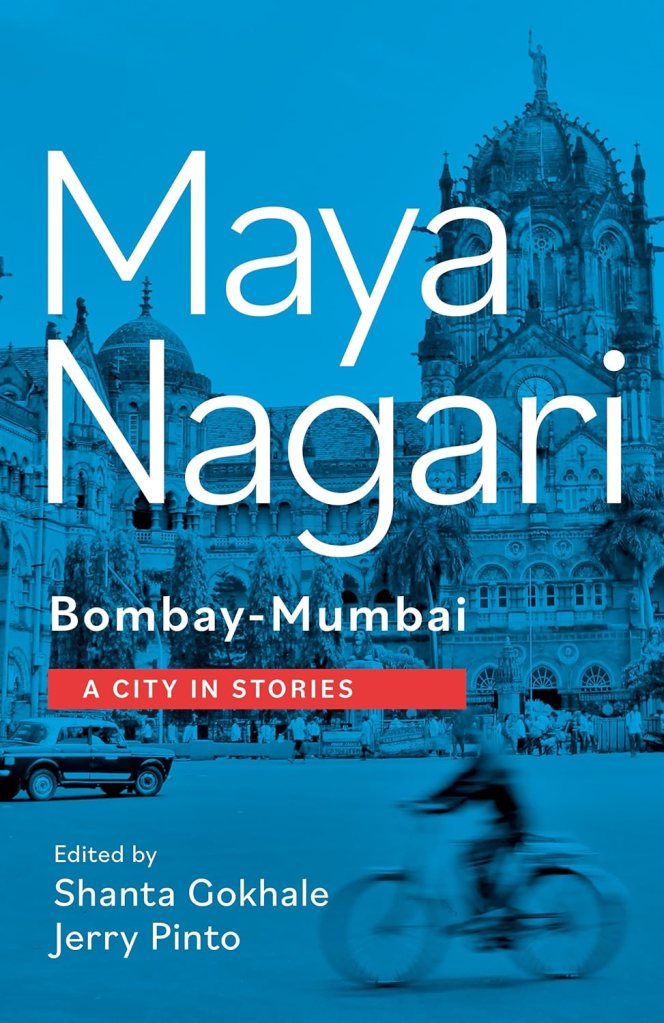
 Title: Maya Nagari: Bombay-Mumbai A City in Stories

Editors: Shanta Gokhale, Jerry Pinto

Publisher: Speaking Tiger Books

The very mention of the name Mumbai (or Bombay) brings to our minds a great city in India where the thriving metropolis grows at a rapid speed because people not only flock here from different parts of the country to make quick bucks and survive against all odds, but also because the film industry of Bollywood has also established it as a city of dreams, one that never sleeps and instead creates a mirage-of-sorts — an illusion, rightly labelled by the editors of this anthology as ‘Maya Nagari’. Edited by Shanta Gokhale and Jerry Pinto, this book, comprising twenty-one short stories about Mumbai takes the road less taken to create a non-uniform image of the metropolis. In tune with its multicultural and multilingual nature, we have stories about the city that is a sea of people and speaks at least a dozen languages. There are stories translated from Marathi, Urdu, Gujarati, Tamil, Hindi, Kannada, Malayalam, and stories written originally in English. Among the writers are legends and new voices—Baburao Bagul, Ismat Chughtai, Pu La Deshpande, Ambai,Urmila Pawar, Mohan Rakesh, Saadat Hasan Manto, Ambai, Jayant Kaikini, Bhupen Khakhar, Shripad Narayan Pendse, Manasi, Krishan Chander, Udayan Thakker, Cyrus Mistry, Vilas Sarang, Jayant Pawar, Tejaswini Apte-Rahm and Anuradha Kumar.

As Jerry Pinto clearly states in the introduction, the stories can be read as we like, we can begin with the first story or the last, or any story in between. The observant reader might notice that he and the other editor Shanta Gokhale have deliberately chosen not to organise the material according to chronology, or geography. This is partly because they believe that the city lives in several time zones and spaces at once, as does India, but also because there is something essentially chaotic about its nature. So, he says, “the stories echo and bounce off each other, they do not collide, but there is a Brownian motion to these patterns” and he hopes to let the readers find it. Here, Mumbai is stripped of its twinkle; it is deglamourised to reveal how it’s the quotidian that lends the city its character—warmth and hostility alike and as inhabitants of the city the editors call ‘home,’ they hope a narrative will emerge.

In the twenty-one stories of this collection, there is the city that labours in the mills and streets, and the city that sips and nibbles in five-star lounges, the city of Ganapati, Haji Malang and the Virgin Mary. What binds the stories together is ‘human muscle’ – the desperate attempts of men and women of all classes and castes to survive in this heartless city amid all odds.

The stories are of different lengths and written in different narrative styles. Of the five or six stories translated by Shanta Gokhale herself from Marathi, one is struck by the excessive length of the so called ‘short’ stories. The very first one “Oh! The Joy of Devotion” by Jayant Pawar, forty-five pages in length, narrates in detail about the Ganapati festival and how it is related to the fate of the local people. Pu La Deshpande’s story “A Cultural Moment is Born”, set in the 1940s, tells stories of people living in chawls [slums] and how they spend their cultural days. Another very long story translated by Gokhale called “The Ramsharan Story” tells us about the rise and fall of a bus conductor by the name of Ramsharan who turns out to become a union leader. Baburao Bagul’s “Woman of the Street”, written originally in Marathi and translated by Gokhale again, tells the story of Girija, a sex-worker trying to collect money to cure her son in the village. The story ends on a disturbing note, as it reaffirms the relativity of success.

Once again, Krishan Chander’s story “The Children of Dadar Bridge” translated from Hindustani by Jerry Pinto is so long that it qualifies to be called a sort of novella. In this powerful story God comes to earth to a chawl and offers food to the first-person narrator. Then, impersonating as a small and innocent child, and along with the child narrator, he moves around different places in the city to witness its activities firsthand — we get to know about behind the scene affairs that take place in the film studios, about satta[1] dens, about bribery, local dons who arm-twist every new hawker to carry on their business after receiving their weekly cut money and more. In “Civic Duty and Physics Practicals”, Malayalam writer Manasi reveals the different experiences one comes across living in a society defined by power equations. Issues of hooliganism, superstition, illegal colonies, corruption, intimidation and violence are explored in a single story where the narrator is struggling, for days, with blaring speakers at a wedding nearby, even as her son tries hard to prepare for his upcoming exams. The story soon takes a dark turn where power trumps over consideration for fellow human beings.

A very powerful story written by Ambai in Tamil called “Kala Ghora Chowk” deals with issues of Marxist ideology, trade unions and the fate of a raped woman called Rosa. Anuradha Kumar’s “Neera Joshi’s Unfinished Book” tells us the life story of one woman who “made the city” and the perennial problems of displaced mill workers when the closed mills give way to high-rise buildings. Some of the stories are of course written in a lighter vein, though they also depict different problems related to city life. As the title of Vilas Sarang’s story “An Afternoon Among the Rocks” suggests, it narrates the plight of a couple trying to make love in the deserted seashore and how they get hijacked by a smuggler! In “The Flat on the Fifth Floor”, Mohan Rakesh writes about two sisters who meet the narrator after one failed love affair. A moving picture of the closing down of cinema halls in Mumbai comes out very beautifully in the Kannada story “Opera House” by Jayant Kaikini, especially narrating the plight of one of the sweepers working there when the declaration of permanent closure is pasted everywhere. Tejaswini Apte-Rahm’s “Mili” tells the story of a man who meets his ex-girlfriend after five years.

Though it is not possible to give the details of each and every story included in this anthology in this review, one must mention some of the stories that were originally written in English. Cyrus Mistry’s “Percy” about a young and lonely Parsi boy is so compelling that it was even made into a Gujarati motion-picture. “House Cleaning” by Jerry Pinto tells the story of a woman cleaner and his son, who talks about the reality of street dwellers. Eunice de Souza’s “Rina of Queen’s Diamonds” is not a straightforward narration at all but offers a collage of different vignettes of life in Bombay.

Though most of the stories portray the seamier side of life and in some ways de-glamourise Mumbai, at the same time they also portray how human resilience can combat all sorts of odds, and the city can be revealed only through shared experiences. Thus, each of the twenty-one stories in this collection tells a different tale of Mumbai, Bombay, Momoi, Bambai, Manbai and many others. As the editors have rightly pointed out at the beginning of their introduction, “You cannot catch a city in words. You cannot catch a city at all.”  They felt that “it is not meant to be caught…this city resists even more because it was not designed at all; it just happened and it keeps on happening.” Thus, the four-hundred plus pages of this anthology Maya-Nagari remains a book to be treasured and read now at leisure and also at any time in the future.

.

[1] Betting or gambling dens

Somdatta Mandal, critic and translator, is a former Professor of English at Visva-Bharati, Santiniketan, India.

.

PLEASE NOTE: ARTICLES CAN ONLY BE REPRODUCED IN OTHER SITES WITH DUE ACKNOWLEDGEMENT TO BORDERLESS JOURNAL

Click here to access the Borderless anthology, Monalisa No Longer Smiles

Click here to access Monalisa No Longer Smiles on Kindle Amazon International
Categories
Review

Bhang Journeys: Stories, Histories, Trips and Travels

Book Review by Bhaskar Parichha

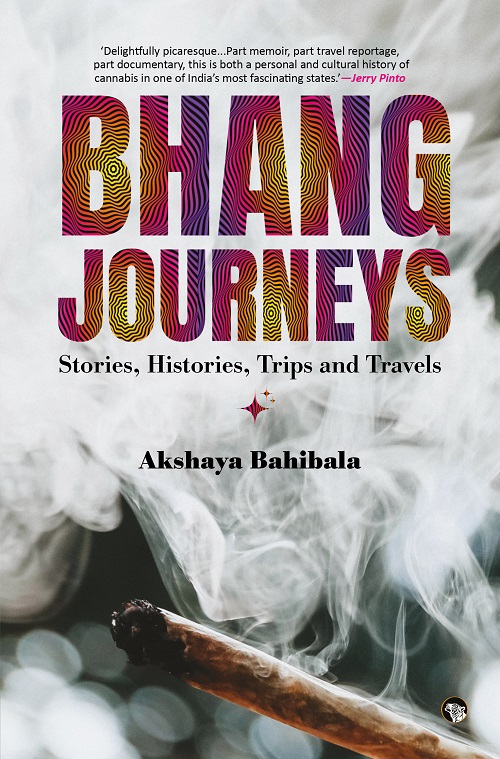
Title: Bhang Journeys: Stories, Histories, Trips and Travels

Author: Akshaya Bahibala

Publisher: Speaking Tiger Books

Akshaya Bahibala is a poet, bookseller, publisher, and library advocate. He is the co-founder of Walking Book Fairs, an independent bookstore and publishing company, as well as one of the most beloved bookmobiles in India, having journeyed over 35,000 kilometres through 20 states to promote a love of literature. Bahibala has authored four books in Odia. This book marks his debut in English. This captivating book is full of unexpected twists and turns, offering a unique blend of memories, adventures, and intriguing facts about a well-known substance. It serves both as an exploration and a cautionary tale.

Bhang Journeys: Stories, Histories, Trips and Travels by Akshaya Bahibala is an eye-witness account of the cannabis in one part of India – Odisha. Quite a bit of research and ideation seems to have gone into the book. This book is truly captivating due to its exploration of a controversial subject — bhang or cannabis..

Reads the blurb: “For ten years, from 1998 to 2008, Akshaya Bahibala was in the grip of bhang, of ganja—drinking it, smoking it, experiencing the highs and lows of an addict on Puri’s beaches with hippies, backpackers and drop-outs from France and Japan, Italy and Norway. Then he drew back from the edge and tried to make a life, working as a waiter, a salesman, a bookseller. He starts this journal-cum-travel book with startling, fragmented memories of his lost decade. From these, he moves to stories about people across Odisha whose lives revolve around ganja-bhang-opium.”

Bahibala commences the book by recounting his experiences of indulging in bhang and ganja on the shores of Puri. He also spends time with a considerable number of foreigners — Caucasian men and women who appear to visit Puri for the purpose of getting high. The author mingles with Japanese, German, French, Italian, and Israeli tourists, sharing meals, borrowing money, exchanging bhang-infused biscuits, occasionally engaging in fights, all while listening to Bob Marley’s soulful rendition of “No Woman, No Cry” in a state of intoxication.

The book has some interesting details like how the owner of a government-approved bhang shop prides himself on selling the purest bhang available, claiming it can make people as forgiving and non-violent as Jesus. Another story is about how an opium cutter, learnt how to massage a lump of opium with mustard oil and carve it into tablets as a boy. There is a heart wrenching narrative of a girl who survived cholera by licking opium and became a lifelong addict. Yet another, is about the yearnings of a goldsmith with an opium de-addiction card for 20 grams a month, but he longs for more — atleast 25 grams. There is also the story of the ganja farmer who flies to Puri from Punjab in a helicopter.

The hallucinations induced by the drug are reflected in the case study of a young man, suffering from ganja-and-bhang-fuelled paranoia, convinced that Indian and American spies are after him makes for an interesting yet concerning read. Descriptions are given of angry villagers indulging in violence against excise department officials who try to destroy ganja plantations.

Alongside these narratives, are official data on opium production, seizures, and destruction; UN reports on the medicinal benefits of cannabis and a veteran’s recipes for bhang laddoos and sherbets. The author delves into the process of creating bhang, highlighting its complete legality in India (unlike charas and ganja, which are prohibited under the country’s 1985 Narcotic Drugs and Psychotropic Substances Act). Additionally, there is a subtly humorous account of a Brahmin bhang shop owner who offers intriguing insights into the procurement and sale of bhang. Bahibala also discusses opium (referred to as afeem locally) cutters and government-operated facilities where opium is manufactured. He sheds light on opium addicts, for whom the government provides a de-addiction program.

The author concludes the book on a rather melancholic tone, discussing the current state of affairs in Puri and the significant changes that have occurred over the past two decades. The absence of foreign tourists on Beach Road, the police cracking down on public marijuana use, the proliferation of hotels and restaurants, and the eagerness of owners to expand and construct more establishments are all highlighted. Additionally, the author reflects on the individuals he once knew during his youth, noting that some have relocated to other countries while others remain in the area.

This book offers a comprehensive perspective on the bhang/charas/ganja culture in India, covering aspects such as production, sale, purchase, and consumption under peer pressure. The author’s personal experiences and lessons learnt add depth to the narrative, making it a captivating read. It is a liberating and unfiltered account, unconcerned with conforming to political correctness and yet, there is his own story, where he feels he ‘lost’ a decade of his life to addiction.

Bhaskar Parichha is a journalist and author of UnbiasedNo Strings Attached: Writings on Odisha and Biju Patnaik – A Political Biography. He lives in Bhubaneswar and writes bilingually. Besides writing for newspapers, he also reviews books on various media platforms.

.

PLEASE NOTE: ARTICLES CAN ONLY BE REPRODUCED IN OTHER SITES WITH DUE ACKNOWLEDGEMENT TO BORDERLESS JOURNAL

Click here to access the Borderless anthology, Monalisa No Longer Smiles

Click here to access Monalisa No Longer Smiles on Amazon International

Categories
Review

A Tale as Good as an Agatha Christie Mystery?

Book Review by Rakhi Dalal

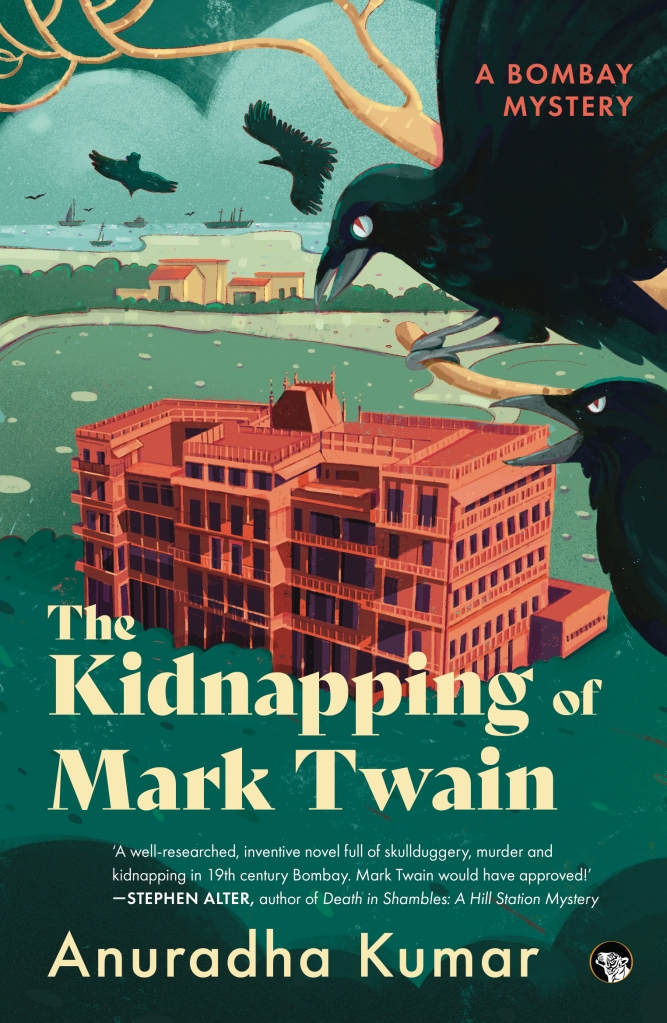
Title: The Kidnapping of Mark Twain: A Bombay Mystery

Author: Anuradha Kumar

Publisher: Speaking Tiger Books

At the turn of the nineteenth century, Bombay was a city bustling with economic activity. A city that stood on the verge of modernisation and rivalled cities like Paris, London and New York. A city that had much to offer to those coming in to make a living or to simply visit it for sightseeing. A city that offered home and work opportunities to people from different countries across the world. It was also during the years 1896-97 that Samuel L. Clemens, or Mark Twain as he was better known as, travelled to Bombay with his family and wrote about his experience in his travelogue, Following the Equator.

In The Kidnapping of Mark Twain, Anuradha Kumar weaves the historic facts from Twain’s book with some intriguing and riveting detective fiction and makes it a fascinating read, especially for the mystery readers.  Anuradha Kumar has published more than thirty books, has won the Commonwealth awards for short stories a couple of times, written under the pseudonym of Aditi Kay, worked in the Economic and Political Weekly for almost 9 years and writes from USA now.

The book starts with Henry Baker, an American trade consul, waiting impatiently for the arrival of Mark Twain and his family to Bombay. His arrival is shadowed by the news of murder of a young girl named Casi which has also left Henry’s friend Maya Barton disturbed. Within a day of his reaching Bombay, Mark Twain suddenly vanishes from his hotel room. What follows then is a series of trailing and mystery solving that keeps the reader in thrall.

Henry, with the help of Maya and his loyal aide Abdul, takes upon himself to find the writer. With much that is happening in the city, including murder, a labour unrest, a threat of strike, Henry finds the authorities a little too preoccupied or uninterested to follow Mark’s case. Since he cannot further risk any diplomatic disagreement between the United States and Britain, he follows through even though his position offers no legal authority. What he encounters at each step leads him to more confusing scenarios but he manages to pull through despite the shocking and bizarre revelations coming in.

Kumar skilfully crafts characters who carry the most unusual of acts which keep the readers on an edge – a ‘Waghare’ thief, a stilt walking magician, a fanatic preacher and a sad Serbian musician. Along with Maya Barton who excels in impersonating appearances. All this and much more. With the help of Maya and Abdul, Henry succeeds in unravelling the mystery of Mark Twain’s disappearance. The mystery that is solved, however, is just not of Mark’s disappearance but also of Casi’s murder and truth behind fanatic Arthur Pease’s de-addiction centre.

Anuradha Kumar’s research that has gone in writing this novel shines through her depiction of the city of erstwhile Bombay – its sights and sounds as well as all the places which stand out in the making of this city. The novel hustles with everything quintessentially Victorian Bombay. Action happens in places like the Victoria Terminus, the Bombay Police Headquarters, Colaba Causeway, Elephanta Caves and the Bombay Cotton Mills. Mark Twain takes rooms at the famous Watson’s Hotel where he finds it difficult to sleep because of all the noise made by crows. Henry Baker lives at Byculla club and Maya Barton at a Colaba bungalow. Tukaram, Casi’s husband and a suspect, is the labour supervisor at the Bombay Cotton Mills. The day Mark Twain lands, he attends a party hosted by a rich Parsi businessmen where the famous nautch girls present a dance. The reader gets a grasp on the city that once was. On the other hand, the novel also stirs with the city’s underbelly where crime, opium addiction, poverty and class dynamics are at play.

It is fascinating to note that the author would make use of Mark Twain’s disappearance as mentioned in his travelogue and spin it to make a thrilling mystery. The portrayal of events is so vivid that sometimes the reading seems akin to watching an Agatha Christie in a TV series. Then there are historic events mentioned in the backdrop which gives an idea about the world politics at large. The narrative refers to Oscar Wilde’s trial and his subsequent imprisonment in England and the first protest of women’s right to vote. It brings forth the discriminatory policies that British persisted in India like labelling certain ethnic groups as criminals and makes use of the social reforms like women education underway in the Indian society. All of these, combined with the adventure that the book offers, make for a gripping tale that could have been only set in the Bombay of 1896.

Rakhi Dalal is an educator by profession. When not working, she can usually be found reading books or writing about reading them. She writes at https://rakhidalal.blogspot.com/ .

.

PLEASE NOTE: ARTICLES CAN ONLY BE REPRODUCED IN OTHER SITES WITH DUE ACKNOWLEDGEMENT TO BORDERLESS JOURNAL

Click here to access the Borderless anthology, Monalisa No Longer Smiles

Click here to access Monalisa No Longer Smiles on Kindle Amazon International
Categories
Review

Mafia Raj: The Rule of Bosses

Book Review by Bhaksar Parichha

Title: Mafia Raj: The Rule of Bosses in South Asia 

Authors:  Lucia Michelutti , Ashraf Hoque , Nicolas Martin, David Picherit, Paul Rollier, Clarinda Still

Publisher: Speaking Tiger Books

In criminal law, mafia raj refers to an organised crime regime enforced by criminal elements. Throughout history, such syndicates have had significant influence over various aspects of society, including politics, business, and even law enforcement.

Mafia Raj: The Rule of Bosses in South Asia is authored by multiple academics. It is a fascinating book as it delves deep into the subject. Among the writers, Lucia Michelutti is a Professor of Anthropology at University College London. Ashraf Hoque is an Associate Professor in the Department of Anthropology there. Nicolas Martin is an Assistant Professor in Indian/South Asian Studies at the AsienOrientInstitut of the University of Zurich. David Picherit is Research Fellow at the French National Centre for Scientific Research. Paul Rollier is Assistant Professor in South Asian Studies at the University of St. Gallen. Arild E. Ruud is Professor of South Asia Studies at the University of Oslo. Clarinda Still is Research Associate at the University College London.

The book tells us number of criminal organisations emerged within the country during the British rule, primarily in urban areas. Drug trafficking, extortion, and murder are some of the ways in which these concerns gained power and influence. These developed into the mafia in post-colonial times.

The presence of mafia raj has within any society has far-reaching consequences. It undermines the rule of law and democratic institutions, creating a climate of fear, intimidation, and corruption. The activities of mafia raj often involve violence, extortion, and illegal activities that threaten the stability and security of communities. Addressing the issue of mafia raj requires a multi-faceted approach. One of the key challenges is to combat the vast network of criminal organisations that operate with impunity. This requires strengthening law enforcement agencies, conducting targeted investigations, and implementing effective anti-crime strategies.

The book expounds it is important to improve the socioeconomic conditions that contribute to organised crime in addition to law enforcement efforts. There is a need to bolster economic development, reduce poverty, and provide opportunities for marginalised communities. Mafia raj is a significant threat to society, undermining the rule of law and democratic institutions. A comprehensive approach that combines law enforcement efforts with socioeconomic development initiatives is required to combat it. Only through collective action and international cooperation can we hope to put an end to this dark chapter in history.

Says the blurb: “‘Mafia’ has become an indigenous term on the Indian subcontinent. Like Italian mobsters, South Asian ‘gangster politicians’ and violent entrepreneurs are known for inflicting brutal violence while simultaneously upholding vigilante justice-inspired fear and fantasy. But the term also refers to the diffuse spheres of crime, business and politics operating within a shadow world that is popularly referred to as the rule of the mafia, or ‘Mafia Raj’.”

Through intimate stories of the lives of powerful and aspiring bosses in India, Pakistan and Bangladesh—a rookie neta from Dhaka, a self-styled leader of the poor in Punjab, a henchman from Chittoor, small-time brokers in Lahore, a female don in western UP, a political bigshot in Nawabganj, and a legendary figure in the blood-ridden politics of South India—this book illustrates their personal struggles for sovereignty during their climb up the ladder of success.

A rich ethnographic study of the distinctive cultural milieu within the sub-continent from which such stories emerge, the authors offer a global perspective on crimes, corruption, and the lure of the strongman that flourish within the geographical constraint of South Asia.

Bhaskar Parichha is a journalist and author of UnbiasedNo Strings Attached: Writings on Odisha and Biju Patnaik – A Political Biography. He lives in Bhubaneswar and writes bilingually. Besides writing for newspapers, he also reviews books on various media platforms.

.

PLEASE NOTE: ARTICLES CAN ONLY BE REPRODUCED IN OTHER SITES WITH DUE ACKNOWLEDGEMENT TO BORDERLESS JOURNAL

Click here to access the Borderless anthology, Monalisa No Longer Smiles

Click here to access Monalisa No Longer Smiles on Amazon International

Categories
Review

Camel Karma

Book Review by Somdatta Mandal

Title: Camel Karma: Twenty Years Among India’s Camel Nomads

Author: Ilse Kohler-Rollefson

Publisher: Speaking Tiger Books

Whenever we read about travel narratives by foreigners in India, especially Westerners, we assume it to be primarily superficial, skin-deep, and without much contact with ground reality. This non-fiction book, that can also be read as a sort of travelogue, busts that myth. It begins with a German veterinarian, Ilse Kohler-Rollefson’s arrival in Rajasthan in 1991 and almost twenty-five years of association with the same. On a field trip to Jordan in 1979, she first became fascinated by the relationship between pastoral peoples and the camels they shared their lives with. After a brief stint of camel field research in Sudan’s eastern desert, her choice to continue her research on camel husbandry led her naturally to India, the country with the third-largest camel population in the world, and she arrived at the National Research Centre on Camel (NRCC) in Bikaner, Rajasthan. Wanting to know more about the practical aspects of camel-keeping or its cultural foundation, she encountered the Rebaris, also called Raikas in Marwar, who are proper breeders of camels and whose whole lifestyle centred around it. She writes, “To me it seemed that the Raikas’ relationship with their animals was equally worthy of conservation as a uniquely human heritage.”

Historically, the Raika of Rajasthan have had a unique and enduring relationship with camels. They offer a compassionate alternative by keeping farm animals as part of nature, allowing them to move and do so in herds. Farm animals can thus extend their potential as humanity’s greatest asset. Their entire existence revolves around looking after the needs of these animals which, in turn, provide them with sustenance, wealth and companionship. Ilse is immediately enthralled by Raika’s intimate relationship with their animals, but she is also confronted with their existential problems.

For her, her research among them gave her not just a glimpse of the history and culture of Rajasthan, but also a way forward in her personal journey. Denying all kinds of creature comforts, the hope of saving both the camel and the Raika way of life took her and her spirited ally, Hanwant Singh Rathore, from vet labs in the city, to Raika settlements in the remotest corners of the Thar Desert, and everywhere in between. The intractable dilemmas— both bureaucratic and cultural—they were often confronted with required creative solutions. As they adapted to their circumstances, they found their orthodox Raika friends adapting with them. Kohler-Rollefson’s is a journey that is often exasperating, sometimes funny, but keeps revealing unexpected layers of rural Rajasthani mores and diverse cultures that make it such a fascinating place.

Spending her own research grants on a shoe-string budget, Kohler-Rollefson set up a base office in Sadri, close to the Kumbhalgarh Wildlife Sanctuary at the foothills of the Aravalli mountains, where she employs several Indians as research assistants (none of whom stay for long), veterinarians who help in administering the teeka, the vaccines to eradicate common camel diseases. With her trusted driver cum translator, her ally, she interacts with several nomadic tribes who rear camels, but whose caste and culture are radically different from one another as chalk and cheese. The narrative also gives details about her interactions with the local people — some of whom had earlier eyed her with suspicion of being an outsider, but later accepted her whole-heartedly.

She describes the sign-language with which she interacts with the womenfolk in the Raika households, her regular visits to the annual animal fair at Puskar, where she even bought a young female camel and named her Mira, leaving her to grow up and breed with the other camels of the Raika. Kohler-Rollefson learned that the Raika did not sell camel milk or eat camel meat. They used other camel by-products, but clearly the economic returns from a camel did not seem optimal. Mostly, they bred female camels to give birth to male camels that could be sold to other caste for work. She was surprised to find that “these camels resembled family members and were treated almost as intimately; nobody was afraid of them.”

Despite repeated setbacks, both from government apathy as well as social taboos, Kohler-Rollefson’s dedication to the cause was so sincere that she was able to found many organisations like the Lokhit Pashu-Palak Sansthan (LPPS), including the Camel Husbandry Improvement Project (CHIP), promote the study and documentation of ethno-veterinarian practices (the melding of traditional and modern approaches to treating camel diseases), highlighting the Raika’s grazing needs at the World Parks Conference (2003), and along with Rathore and a Raika team, even embarking on an arduous 800 km long yatra  on camelback throughout Rajasthan to raise awareness and draw attention to the dwindling camel numbers.

She successfully organised a meeting where apart from the traditional Raika constituency, she could include members from a range of castes spanning the whole social spectrum of Rajasthan – Rajputs from Jaisalmer, Bishnois from Barmer, Jats from Bikaner, Gujjars from Nagaur and Sindhi Muslims from deep in the Thar. She even escorted a group of Raika, including a colourful Bhopa (a wandering minstrel who sings and narrates the story of various episodes of the mythical Pabuji’s life through unfolding of cloth scrolls) to Germany and then to Interlaken, Switzerland for an FAO (Food and Agriculture Organisation of the United Nations) conference. She set up the League for Pastoral Peoples and Endogeneous Livestock Development (LPP) in Germany. In other words, Kohler-Rollefson has been successful in drawing attention to the problems of camels rearing at an international level.

The first edition of this book came out in 2014. Since then, they have had a daunting roller-coaster ride, shuttling back and forth between the depths of despair where they thought all was lost to exhilarating heights from which they fleetingly espied camel nirvana: a scenario where camels, people, and the environment live together in harmony and mutually support each other. Interestingly, the second revised edition of Camel Karma was published in 2023 and the other good news is that 2024 has been declared the International Year of Camelids by the United Nations General Assembly, with the stated goal of raising awareness of the contribution of camelids to livelihoods, food security and nutrition. It also aims at encouraging all stakeholders, including national governments, to work towards recognising and valuing the economic, social, and cultural importance of camelids in the lives of communities, especially those that are highly vulnerable to extreme poverty.

In combination with the India government’s recent discovery and appreciation of the country’s pastoralist cultures, this may be just the constellation that successfully revives India’s camel sector. In a scenario where companies and countries are competing for shares in the globalised market, the unique selling point of Rajasthan’s camel milk is the Raika’s heritage of producing milk humanely and with compassion. The biodiverse diet of the state’s camels is composed of ayurvedic plants that add another unique quality.

Thus, it seems appropriate that we all read Camel Karma now and let the world know about the unique Raika heritage and to serve as a baseline to look back on ten or twenty years from now. Despite the rapid technological development in all spheres of life, the author sees a future, and even an urgent need, for both the camel and for the Raika and other nomadic livestock keepers. She is optimistic for several reasons as everything in India is cyclical. The camel is a versatile and multipurpose animal that can fulfil many basic needs of humans. Its role as transport and farm animal is certainly on the retreat, so long as oil is available and affordable. Yet its potential as a dairy animal remains huge. Apart from that, there is a range of other eco-friendly products that can be made from happy living camels and that may just satisfy that budding urge of urbanites – in India and abroad – to re-connect with nature.

Apart from wholeheartedly praising the endeavour of Kohler-Rollefson in spending twenty years of her life among India’s camel nomads, in sacrificing her personal and family life for the welfare of the camels, and in drawing the attention to their problems in various fora in the international context, Camel Karma is a must read for everyone who is interested in learning about the socio-economic lifestyle of several castes and tribes of rural people in Rajasthan. We are looking forward to reading the sequel to this book which the author is planning to write, and which she tentatively calls “Camel Dharma” – a book about finding the right way of living with camels!

.

Somdatta Mandal, critic, and translator, is former Professor of English at Visva-Bharati, Santiniketan, India

.

PLEASE NOTE: ARTICLES CAN ONLY BE REPRODUCED IN OTHER SITES WITH DUE ACKNOWLEDGEMENT TO BORDERLESS JOURNAL

Click here to access the Borderless anthology, Monalisa No Longer Smiles

Click here to access Monalisa No Longer Smiles on Kindle Amazon International

Categories
Review

The History Teacher of Lahore by Tahira Naqvi

Book Review by Somdatta Mandal

Title: The History Teacher of Lahore: A Novel

Author: Tahira Naqvi

Publisher: Speaking Tiger Books

Tahira Naqvi, the Pakistani American writer, has extensively translated the works of Saadat Hasan Manto, Khadija Mastur, Hajra Masroor, and the majority of works by Ismat Chughtai from Urdu into English. As a teacher/professor of Urdu language and literature at New York University, she has regaled us with several short stories that speak of cross-cultural encounters of immigrant Pakistanis in America, especially about how women experience acculturation in the New World. The History Teacher of Lahore is her first novel where she recollects the sights, sounds, and ambience of growing up in Lahore in intimate details. The setting of this novel is the nineteen eighties, which was particularly a time of unrest in Lahore. In this debut political novel, Naqvi eloquently portrays the struggle between a besieged democracy and the rise of Islamic fundamentalism on the one hand, and the thriving cultural traditions of Urdu poetry on the other.

The story begins with the young protagonist Arif Ali who moves from his hometown of Sialkot to Lahore with a dream of being a history teacher and a poet. A ‘tall, slight man in his late twenties,’ we find him relaxing on a bench in Jinnah Park — a place that has become haven for him to spend his time reading, far away from the ferocity of traffic and street crowds. In the days that followed, Arif realised that in the Government Model School for Boys where he taught, he was forced to teach the boys another kind of history for his sake as much as theirs. But that required deep thought, time, and enthusiasm. He befriended Salman Shah, another teacher in his school, and his rapport with him grew stronger by the day. But once again, Arif found the atmosphere in the school was becoming increasingly confining. He would often engage in animated chatter with the high school Islamiyat teacher Samiullah Sheikh, whom he found disagreeable. Not only dressed in Shariyah compliant clothes, but this man was also waiting for his opportunity to teach at a madrassah[1]. This was the period when bans were being imposed on popular music of the kind Nazia Hasan and her brother sang for the younger generation, and even though ‘Disco Deewane’ and ‘Dreamer Deewane’ were sung loud, fear had become an elixir for rebellion. Arif was forced to resign from the school and along with his friend Salman. he ultimately got another position as a history teacher in another private school, Lahore Grammar Institute, where there was more freedom to teach than in the earlier one. The free socializing among the sexes here was new and noteworthy for Arif.

As Arif’s impotent rage towards the increasing religious intolerance grew, he joined his friend’s uncle Kamal and his partner Nadira to secretly help them rescue underprivileged children in clandestine ways. In the meantime, his poetic creations found great impetus when he found a secret admirer in Roohi, Salman’s sister, and started sending her his poems regularly. Though they never met, Roohi would write letters to him every week, and gradually, the more letters Arif received from her, the more his feelings for her grew. The secrecy of their epistolary courtship continued for quite some time till things were disclosed and after a lot of twists and turns in the story, they were finally engaged to get married.

In the meantime, his friend Salman got engaged to a colleague Zehra Raza, and despite the Shia-Sunni clashes that prevailed in society all around, they were unaffected by such ideology. The three of them developed a close camaraderie among themselves, but soon after, the General’s death brought in a lot of political turmoil in the city. The mentality of the public also changed, people went en-masse to watch public flogging, and trouble loomed ahead when Sunni Shia, Ahmadi non-Ahmadi, Punjabi Urdu-speaking, Protestant-Catholic, divisions and sub-divisions, inter-faith, inter-class and inter-religion issues became more and more marked in all spheres of society. The warp and weft of faith produced such tangled intricacies as could only be imagined in nightmares.

As the nation was caught in the vortex of religious extremism, Arif’s position also underwent a great change in the school when he wanted to teach ‘true’ history to his students. He was caught in a dilemma when he found he was forced to teach false historical information in the doctored textbook that Aurangzeb with his hatred of other religions was adored whereas Akbar with more religious tolerance was totally sidelined. He tried to rectify the errors by providing supplementary notes to his students, but that landed him in more trouble. Apart from differences of opinion with the other teachers in school, Arif’s was gripped with a kind of fear and frustration when some unidentified goons threatened him to stay away from issues that did not concern him. Things got worse when a Christian student in his class was falsely accused of blasphemy and Arif decided to save him from being arrested. He embarked on a dangerous mission to resolve this Christian-Muslim conflict that landed him in the middle of sectarian clashes and without giving out all the details, one just mentions that the novel ends at a tragic moment.

In the acknowledgement section Naqvi states that she is grateful to her father for many things but especially for his Urdu poetry which she has used freely in translation. These poems, ghazals and nazms, help to explain the different moods of the protagonist and his mental situation very clearly. One interesting aspect of the novel is that each of the twenty-two chapters is prefaced by a small quote that in a way summarizes the mood and content of that chapter. Most of these quotes are from Jean-Paul Sartre, while others are from Spinoza, Ghalib, Shakespeare’s Sonnet 116, H.W. Longfellow, Jacques Derrida, Tertullian, Thomas Mann, and four entries particularly from The Lahore Observer dated 15 September 1990, December 1990, January 1997, and January 1998 respectively. These wide-ranging quotes not only increase the story-telling impact, but also endorse the erudition of the novelist herself.

To conclude we can say that Bapsi Sidhwa’s The Ice-Candy Man gave us the sights, sounds and details of Lahore during the Partition in 1947, and the same city becomes wonderfully alive again through the pen of another woman writer from Pakistan who had spent her growing years there, and who gives us details about it from the 1980’s onwards when  the political situation of the country was once again very murky. The novel wonderfully portrays the radical Islamisation of the country that included murder, mayhem, and public flogging and more that was visible in Lahore, as this process resulted in terrible uncertainty in the lives of the city’s residents from all walks of life. Strongly recommended for all readers, we eagerly wait for more novels by Tahira Naqvi in the future. The insider-outsider’s point of view offered by her is remarkable and this debut novel can be counted as a collector’s item.

[1] Muslim religious school

Somdatta Mandal, critic and translator, is a former Professor of English from Visva-Bharati University, Santiniketan, India.

.

PLEASE NOTE: ARTICLES CAN ONLY BE REPRODUCED IN OTHER SITES WITH DUE ACKNOWLEDGEMENT TO BORDERLESS JOURNAL

Click here to access the Borderless anthology, Monalisa No Longer Smiles

Click here to access Monalisa No Longer Smiles on Kindle Amazon International

Categories
Excerpt

New Novel by Upamanyu Chatterjee

Title: Lorenzo Searches for the Meaning of Life

Author: Upamanyu Chatterjee

Publisher: Speaking Tiger Books

It is the 20th of December 1980, a Saturday, and at dinner, Lorenzo Senesi, who will turn twenty-two in a little over a month, tells his mother, ‘Mamma, I think I just might go down to Padua with Roberto and Francesca for Christmas and the New Year. Should be back by the 3rd or 4th of January.’

Elda glances at her son but says nothing. Amedeo the father grunts once to acknowledge that the information has reached his ears. Paola, Lorenzo’s sister, older by fourteen months, asks in a tone that suggests that it wouldn’t matter if he doesn’t respond, ‘With those two? But I thought you were bored to death of them.’

The next morning, Lorenzo packs some essential things, including his copy of Carlo Carretto’s The Desert in the City, in an overnight bag, places the bag on the rear seat of his Renault 5, goes to the kennel in the corner of the garden to hug and nuzzle Vega the dog (a handsome golden-brown beast, half German Shepherd, a quarter Retriever, and in her reflective moments, there is something about her eyes that recalls the young Sylvester Stallone) and is off. Francesca and Roberto are nowhere to be seen. From Aquilinia, the dot on the outskirts of Trieste where they stay (a workers’ village, really, an adjunct to the Aquila oil refinery is how it was conceived and inaugurated in 1938, with habitual pomp, by Mussolini), he takes La Strada Costiera, the scenic coast road, down to the plains.

It is late in the morning, and bright and sunny. On his right lie the hummocks, ridges and undulations of karst, their eroded limestone continually sneaking a peek between the trees of lime and pine at the brilliant blue, on his left, of the bay of Trieste. The landscape tumbles down in leaps and bounds to the radiant sea that stretches like blue polythene till the haze of the horizon. On some curves, he can spot the white sails of boats, as still as life, on the aquamarine lapping at the feet of Miramare Castle.

The Renault, three years old, is an acquisition that dates from his road accident and the insurance money that he reaped as one of its consequences. It moves well; he makes good time to Sistiana and thence to Monfalcone where, having left the Adriatic and reached the bland plains, he takes the A 4 west-south-west towards Milan. He is undecided—but only for a moment—between the radio and the cassette player. Radio Punto Zero on FM wins; with his arms fully stretched to grip the steering wheel, he leans back in the seat to enjoy Adriano Celentano crooning ‘Il Tempo Se Ne Va.

A hundred and fifty kilometres, more or less, to Padua, an uncluttered highway through the ploughed cornfields and plantations of poplar of the region of Gorizia; Celentano on the radio is succeeded by Franco Battiato, Giuni Russo, Antonello Venditti and Claudio Baglioni. Friuli-Venezia-Giulia gives way to the Veneto a while before Lorenzo switches off the radio to enjoy, in peace, the noon silence. At Padua, though, it not being his final destination, he still has a further fifteen kilometres to go to reach Praglia at the foot of the Euganean Hills.

He parks the Renault as far as he can from a bus disgorging a contingent of British tourists alongside the church wall of the Chiesa Abbaziale di Santa Maria Assunta and carrying his overnight bag, walks across to the arched recess in which is inset an iron door. It is the principal entrance to Praglia Abbey of which the church forms an integral part. He rings the bell and waits.

He glances back at his car. Behind the wall, the church rises solid and grey, monolithic like a fortress, almost forbidding. Hearing the clang and whine of the iron door being opened, he turns back.

The monk whom he sees, Father Anselmo, sombre in his black robe, is tiny. He smiles and nods at Lorenzo and ushers him in. ‘Oh, have you come by car? Then I’ll open the main gates for you so that you can park inside.’ Without ceasing to nod and smile, he ushers him out.

Father Anselmo, being the porter of the abbey, is a statutory requirement of the institution. Let there be stationed at the monastery gate, says Chapter 66 of the Rule of Saint Benedict, a wise and elderly monk who knows how to receive an answer and to give one and whose ripeness of years does not suffer him to wander about. This porter ought to have his cell close to the gate so that those who come may always find someone there from whom they can get an answer. So when the Father does not reply, it may be presumed that the question was not worth a response. For they do not speak much, the Benedictines.

The Renault having found its parking berth in a spacious, paved, open corridor that runs right around a large, rectangular garden, Lorenzo returns to the reception room where Father Anselmo, at his place behind a plain, unadorned desk, waits for him.

‘Good afternoon,’ he starts again formally. ‘I would like to meet the maestro dei novizi. I have an appointment. My name is Lorenzo Bonifacio.’

A cue, as it were, for Father Anselmo to nod and smile again, and without getting up, lean sideways in his chair and press, six times in a measured, definite code, a red plastic button affixed to the wall. One push of the bell, a long pause, two pushes, a short pause, two more pushes, a long pause, one last push. Immediately, from the great bell tower of the church, clearly audible in each nook and cranny of the abbey, begins to ring, in the same code and with the same pauses, one of the lesser bells. Father Anselmo then gestures to Lorenzo to sit down in one of the chairs ranged along the wall. No conversation ensues.

(Extracted from Lorenzo Searches for the Meaning of Life by Upamanyu Chatterjee. Published by Speaking Tiger Books, 2024)

About the Book

One summer morning in 1977, nineteen-year-old Lorenzo Senesi of Aquilina, Italy, drives his Vespa motor-scooter into a speeding Fiat and breaks his forearm. It keeps him in bed for a month, and his boggled mind thinks of unfamiliar things: Where has he come from? Where is he going? And how to find out more about where he ought to go?
When he recovers, he enrols for a course in physiotherapy. He also joins a prayer group, and visits Praglia Abbey, a Benedictine monastery in the foothills outside Padua.

The monastery will become his home for ten years, its isolation and discipline the anchors of his life, and then send him to a Benedictine ashram in faraway Bangladesh—a village in Khulna district, where monsoon clouds as black as night descend right down to river and earth. He will spend many years here. He will pray seven times a day, learn to speak Bengali and wash his clothes in the river, paint a small chapel, start a physiotherapy clinic to ease bodies out of pain, and fall, unexpectedly, in love. And he will find that a life of service to God is enough, but that it is also not enough.

A study of the extraordinary experiences of an ordinary man, a study of both the majesty and the banality of the spiritual path, Upamanyu Chatterjee’s new novel is a quiet triumph. It marks a new phase in the literary journey of one of India’s finest and most consistently original writers.

About the Author

Upamanyu Chatterjee is the author of English August: An Indian Story (1988), The Last Burden (1993), The Mammaries of the Welfare State (2000), Weight Loss (2006), Way to Go (2011), Fairy Tales at Fifty (2014), and Villainy (2022)—all novels; The Revenge of the Non-vegetarian (2018), a novella; and The Assassination of Indira Gandhi (2019), a collection of long stories. 

In 2000, he won the Sahitya Akademi Award, and in 2008, he was awarded the Order of Officier des Arts et des Lettres by the French Government for his contribution to literature.

.

PLEASE NOTE: ARTICLES CAN ONLY BE REPRODUCED IN OTHER SITES WITH DUE ACKNOWLEDGEMENT TO BORDERLESS JOURNAL

Categories
Review

Artificial Intelligence in a Human World 

Book review by Bhaskar Parichha

Title: Faking It : Artificial Intelligence In a Human World 

Author: Toby Walsh

Publisher: Speaking Tiger Books

AI, or Artificial Intelligence, has become an integral part of our daily lives. It has revolutionised industries, from healthcare to transportation and manufacturing. However, some people may seek to artificially enhance AI to deceive others. This is called “faking AI”. There are several reasons why someone might fake AI.

Faking AI can enable individuals to impersonate someone else or appear as experts in a particular field. This can have negative consequences, such as fraud or phishing scams. Creating AI from scratch can be complex and time-consuming. By pretending to have AI, individuals can save time and effort while still achieving their desired results. In some cases, individuals may prefer to keep certain aspects of their AI-driven projects confidential. Faking AI can provide privacy and discourage further investigation.

One of the most common methods of fake AI is to manipulate data. By selectively choosing or modifying data, individuals can create artificial patterns or results that seem AI-generated. Another approach is to use pre-trained models, which are AI systems based on large datasets. These models can be repurposed and fine-tuned to deliver specific results without significant effort.

Machine Learning as a Service (MLaaS) platforms enable individuals to create AI models without technical expertise. These platforms often offer pre-trained models to generate fake AI results. Fake AI APIs, or Application Programming Interfaces, can simulate AI functionality. These APIs provide AI-driven responses or data but rely on predetermined algorithms or scripts.

While pretending to have AI may have certain advantages, it also has several disadvantages. Faking AI can mislead consumers about AI quality and authenticity. This can erode trust in AI technology and hinder its widespread adoption.

Faking AI may violate ethical guidelines and legal requirements. The use of AI without disclosing its true origins or limitations can contribute to legal consequences, including breach of contract or fraud. Faking AI can result in inaccurate predictions and decisions. This can lead to serious consequences in industries where AI plays a significant role, such as healthcare or finance.

Faking It: Artificial Intelligence In a Human World by Toby Walsh goes into the subject. A world leader in artificial intelligence, Walsh has spent his life dreaming about and researching how machines think. Scientia Professor of AI at the University of New South Wales and Fellow of the Australian Academy of Science. Toby is passionate about ensuring AI improves, not harms, our lives. He authored It’s Alive! From the Logic Piano to Killer Robots, which was named one of the year’s best books by the New Statesman. Toby contributes to American Scientist, New Scientist and The Guardian.

The blurb says:Faking AI has become an increasingly prevalent concern in today’s digital age. It is crucial for individuals and organizations to be aware of the methods and motivations behind faking AI and take appropriate measures to detect and protect against it. By implementing best practices and promoting transparency, we can build trust and preserve the integrity of the AI-driven world. Artificial intelligence is, as the name suggests, artificial and fundamentally different to human intelligence. Yet often the goal of AI is to fake human intelligence. This deceit has been there from the very beginning. We’ve been trying to fake it since Alan Turing answered the question ‘Can machines think?’ by proposing that machines pretend to be humans.

As Walsh argues in his book, we are on the verge of developing artificial intelligence that can be used to deceive us. ChatGPT is an example of an artificial intelligence that is capable of fooling us into believing that it is intelligent and blurring the line between what is real and what is not. The truth is that they are devoid of true understanding, sentience, and common sense.

In spite of this, they are still capable of making a difference in the world. He raises fundamental questions in the book, including: Can artificial intelligence be creative? Can they be moral? What can we do to ensure they are not harmful?

Toby Walsh takes us through all the ways artificial intelligence mockups human emotion in this exciting and fascinating book. Also, he examines the implications of this for humanity in the present and the future of our planet.

.

Bhaskar Parichha is a journalist and author of UnbiasedNo Strings Attached: Writings on Odisha and Biju Patnaik – A Political Biography. He lives in Bhubaneswar and writes bilingually. Besides writing for newspapers, he also reviews books on various media platforms.

.

PLEASE NOTE: ARTICLES CAN ONLY BE REPRODUCED IN OTHER SITES WITH DUE ACKNOWLEDGEMENT TO BORDERLESS JOURNAL

Click here to access the Borderless anthology, Monalisa No Longer Smiles

Click here to access Monalisa No Longer Smiles on Amazon International

Categories
Review

Along the Tibetan Edge in China

Book Review by Bhaskar Parichha

Title: Journey to the End of the Empire: In China Along the Edge of Tibet

Author: Scott Ezell 

Publisher: Speaking Tiger Books

This is one of the rare travelogues written by a gifted writer. The topic Scott Ezell covers is equally intriguing- China and Tibet. In about two hundred eighty pages, he takes readers on a tour of the most contentious part of China. Journey to the End of the Empire: In China Along the Edge of Tibet is an essential read.

American musician and poet Scott Ezell has a background in Asia and indigenous cultures. Between 1992 and 2004, he lived in Taiwan and traveled extensively in China, India, and Japan. He has been working on a project since 2009 that documents the impacts of centralised state power, civil conflict, and destructive resource extraction in the China-Southeast Asia border region. A Far Corner is an account of his experiences living and working with an indigenous artist community in Taiwan over a period of three years.

Says the blurb: “On foot, by rattling truck and local bus, by jeep and motorcycle, American poet and musician Scott Ezell explores the Tibetan borderlands in the twenty-first century Chinese empire. The journey starts in Dali, in the foothills of the Himalaya in southwestern China, and extends north a thousand miles through towns and villages along the edge of Tibet, finally arriving at Kekexili, the highest plateau in the world, and crossing the Kunlun Mountains. Ezell takes us through landscapes of blond and gold barley fields, alpine meadows ablaze with wildflowers, silver-blue rivers beneath ‘clouds like burning aluminium’, and snow peaks ‘cracking and shattering into jagged resplendence against the sky’.”

Along the way, Ezell speaks Mandarin with farmers, shopkeepers, lamas, nomads, and police officers. Throughout Ezell’s account, there is also outrage, as he observes the rise of militarization, surveillance, destructive resource extraction, and the destruction of entire river ecosystems by massive dams over the course of many years and numerous trips.

Writes Ezell in the introduction: “In September 2004 I set out on a journey along the edge of Tibet. Starting from the foothills of the Himalayas in southwest China, I traveled north into further, higher landscapes by local bus, hitchhiking, and a motorcycle I bought along the way. I speak Mandarin, which allowed me to communicate all down the road with villagers, Buddhist lamas, nomads with chunks of bone braided in their hair, and police at security checkpoints. After six weeks and 1,200 miles, I reached Kekexili, a wilderness reserve 17,000 feet above sea level. From there I crossed the Kunlun Mountains and descended to Golmud, a city at the crossroads of Tibet, China proper, and Xinjiang. That journey is the basis for the narrative.

“Over the next fifteen years I returned a dozen times to Tibet and southwest China. I witnessed transformations so shocking that I felt I was taking blows to my own bones. Massive dam systems killed rivers and displaced communities, mountains were raked apart to provide gravel for construction projects, and the region was increasingly militarized and surveilled as China tilted toward its grim police state superpower status.”

Ezell strikes a sympathetic note when he says : “Today China holds one million Uyghurs in concentration camps in Xinjiang, democratic freedoms have been smashed in  Hong Kong, human rights lawyers are held in black jails, and the government openly surveils its population. But the systematic oppressions of ‘empire’ are not unique to China. The seizure of land and genocide against indigenous peoples in the United States and elsewhere, the legacy of slavery and the present-day wage-slavery of the global economy, and the colonization of Tibet as a means of territorial expansion and resource extraction these are all variations of centralized authority exerting power over minority, marginalized, and disenfranchised peoples.”

The book evokes the majesty of Tibetan landscapes, the unique dignity of the Tibetan people, and the sensory extremity of navigating nearly pre-industrial communities at the edge of the map, while also encompassing the erosion of cultures and ecosystems. Journey to the End of the Empire is both a love song and a protest against environmental destruction, centralised national narratives and marginalised minorities.

.

Bhaskar Parichha is a journalist and author of UnbiasedNo Strings Attached: Writings on Odisha and Biju Patnaik – A Political Biography. He lives in Bhubaneswar and writes bilingually. Besides writing for newspapers, he also reviews books on various media platforms.

.

PLEASE NOTE: ARTICLES CAN ONLY BE REPRODUCED IN OTHER SITES WITH DUE ACKNOWLEDGEMENT TO BORDERLESS JOURNAL

Click here to access the Borderless anthology, Monalisa No Longer Smiles

Click here to access Monalisa No Longer Smiles on Kindle Amazon International

Categories
Excerpt

The Kidnapping of Mark Twain

Title: The Kidnapping of Mark Twain: A Bombay Mystery

Author: Anuradha Kumar

Publisher: Speaking Tiger Books

An hour passed as Henry, back in his rooms at the Byculla Club, waited for Abdul to return from the doctors’ bungalow. He had taken a message from Henry to Maya. He would not be back to have dinner with the Clemenses that evening. ‘Don’t give Maya memsahib the message in front of them,’ Henry warned, and Abdul gave him his usual long-suffering look. He really wasn’t an idiot, Henry thought to himself ruefully. ‘And if she asks more, tell her some urgent business came up.’ Henry’s face darkened, for he wouldn’t tell her about his intentions of tailing Bancroft, even accosting him. ‘And come back fast, we need to…’

Abdul looked at him expectantly, but Henry paused, pursed his lips. ‘I will tell you when you are back.’

He looked toward his desk, where his prized Colt Bisley lay in the locked second drawer. A brand-new model, with its five-inch barrel, that he had bought in London. Henry didn’t want to use it, especially on Bancroft and he hoped the other man wouldn’t make it difficult for him. Freddie Bancroft had quite a reputation, one that preceded him. He had first trained as a dentist and then worked as an insurance agent in Philadelphia before he had set out to make a magician of himself. It was an ambitious hope, and Bancroft could be impatient. The time when the

New York papers had reported unfavourably about his show, when his illusions had not worked, and his card tricks had bored much of the audience, Bancroft had thrown a tantrum, throwing his magician’s props on the seated audience. He had then burst into the offices of the New York Journal. He had accosted the editor on the late evening shift, accusing him, and the paper, of favouring the other magician Alexander Hermann, and insisted that the next day the office itself would vanish into thin air.

A portion of the office was indeed found ablaze early the next morning, but Bancroft had an alibi. There were many people who had seen him on the return train to Philadelphia. And the culprits were found to be two workers who were part of the union of newspaper workers. But Bancroft later bragged about it, that he could indeed hypnotize people to do his bidding.

He had made sure people in Bombay knew about this too, and he was determined to stage his own show at the Rippon Theatre on Grant Road. Bancroft had dropped flyers all over, had demanded advertising space for himself in the Gazette, and was also soliciting funds from the likes of Albert Sassoon, Shapoorji Bengalee, and the others, to build those elaborate sets he so wanted. But, of course, Henry, his fellow countryman, hadn’t been of much help, nor had he pulled his weight with the customs people.

Henry sighed. He was letting his jealousy get to his head. Bancroft must have added to his skills in the months he was in Bombay. For he had impressed Maya, and in a far shorter period of time, Mark Twain too, it would appear. And perhaps, Henry thought, Bancroft wanted Twain to write about him, an entire piece in the American papers about the magician’s immense popularity in the East. And now, it would appear that Bancroft may have been the last person to actually see Mark Twain, for he must have peered into his room, as he had Boehme’s, and it was likely, he did know a thing or two.

Henry looked at his notes on the table, and realized with some consternation that he had forgotten a meeting. With a man he disliked as much as he did Bancroft, but when business mattered, Henry knew he had to be quite the professional. Arthur Pease, the tireless campaigner against opium, the vices of drinking, and prostitution, had expressed an interest in the electric fans. They were needed, Pease had said, for the big meetings and assemblies he called every once in a while, in the Parsi meeting halls, and the town hall, and especially at the Reformatory Institute that was a particular favourite of his, for he always found a willing and suppliant audience here.

An hour later, Henry felt there was little point waiting for Abdul in his study. The longer he was on his own, the more he would fret over Twain and think sullenly about Bancroft. So Henry resolutely set off first for the police headquarters, and then to meet with Arthur Pease in Khetwadi, that lay a bit after Crawford Market. This was where Pease lived in a small bungalow, part of which doubled up as a healing centre for addicts.

Henry left a note for Abdul by the table near the hat stand, next to the silver embossed tray that usually held the keys, messages, and letters. Come to…, and he wrote the address. House next to Daji clinic. Crawford Market. Come as soon as you see this.

He called for a carriage, from the many standing aimlessly by the club. The coachman, a Pathan judging from his build and turban, saluted smartly as he jumped down from his seat to hold the door open. ‘The police station first,’ Henry said in a low voice, ‘and then someplace else. I will tell you later. You do have the time, I hope?’

‘Good, sahib, very good,’ the coachman said, nodding to his helper who would ride with him. The boy resting at the foot of the statue that everyone called the Standing Parsi, came running up, and the carriage shook momentarily as he jumped up behind. ‘Go fast, all right?’ Henry said, looking through the window.

The man nodded, gently tapping the pony, a young, spirited brown animal, with his whip, and then, looking over his shoulder said, ‘They are sending a lot of the police toward Sewree and Parel, the workers are angry. They really anticipate trouble, and they are stopping us from going there.’

(Extracted from The Kidnapping of Mark Twain: A Bombay Mystery by Anuradha Kumar. Published by Speaking Tiger Books, 2023)

About the Book: In 1896, Mark Twain arrives at the docks of Bombay, wife and daughter in tow, and, after attending a party in his honour, vanishes from his room at the iconic Watson’s Hotel in the dead of night.

Desperate to find the legendary writer and avoid an international incident between his country and Britain, the American Trade Consul, Henry Baker, teams up with Abdul, his trusted aide, and Maya Barton, a free-spirited Anglo- Indian with surprisingly intuitive detective skills. But they have their task cut out for them: Mark Twain’s disappearance appears to be entangled with a thriving opium trade; an intimidating, self-righteous preacher; an anxious magician who walks on stilts; a professional thief on the run; and a powerful labour leader, Tuka, whose young wife is found strangled in her bed.

Full of fascinating period detail and delightful cameos—and awash with suspense—The Kidnapping of Mark Twain is a thrilling page-turner.

About the Author: Anuradha Kumar was born in Odisha. She studied history at Delhi University and management (specializing in human resource management) at the XLRI School of Business, Jamshedpur. She has worked for the Economic and Political Weekly. She has an MFA in Writing from the Vermont College of Fine Arts (VCFA). Her stories have won awards from the Commonwealth Foundation, UK, and The Little Magazine, India. She writes regularly for Scroll.in. Her stories and essays have appeared in publications like Fiftytwo.in, The India Forum, The Missouri Review, among others. She has written for younger readers as well. This present work is her 11th novel.

PLEASE NOTE: ARTICLES CAN ONLY BE REPRODUCED IN OTHER SITES WITH DUE ACKNOWLEDGEMENT TO BORDERLESS JOURNAL