Categories
Essay

From Srinagar to Ladakh: A Cyclist’s Diary

Farouk Gulsara on a cycling adventure through battleworn Kashmir

They say to go forth and explore, to go to the planet’s edge to increase the depth of your knowledge. Learning about a country is best done doing the things the local populace does, travelling with them, amongst them, not in a touristy way, in a manicured fashion in a tourist’s van but on leg-powered machines called bicycles. Itching to go somewhere after our memorable escapade in South Korea, cycling from Seoul to Busan, as the borders opened up after the pandemic, somebody threw in the idea of cycling from Kashmir to Ladakh. Long story short, there we were, living our dream. The plan was to cycle the 473km journey, climbing 7378m ascent in 8 days, between 6th July 2024 and 12th July 2024. 

Our expedition started with us landing in Amritsar after a 5.5-hour flight from Kuala Lumpur. From there, it was another flight to Srinagar, where the crunch began.

Day 1. Amritsar
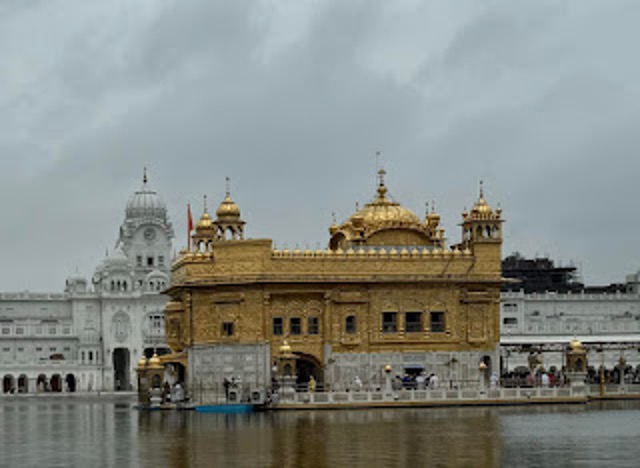
Amritsar Golden Temple. Photo Courtesy: Farouk Gulsara

After a good night’s sleep, everyone was game for a quick, well-spread breakfast and a leisurely stroll to the Harmandir, the Sikh Golden Temple. Much later, I realised the offering was 100% vegetarian and did not miss any non-vegetarian food. As a mark of respect, the vicinity around the temple complex served only vegetarian food, including a McDonald’s there. Imagine a McDonald’s without the good old quarter pounder! Hey, image is essential.

The usual showing of gratitude to the Almighty was marred by the unruly behaviour of the Little Napoleons, the Royal Guards. New orders were out, it seems, according to one guard with a chrome-plated spear and a steely sheathed dagger at his hip—no photography allowed. Then, on the other end of the Golden Pool, it was okay to photograph but only with a salutary (namaste) posture, with hands clasped on the chest. On the other side, it was alright. One can pose as he pleases. The guards were more relaxed there. 

That is the problem when rules are intertwined with religion. People make their own goal post and shift it as they please. When little men are given power to enforce God’s decree on Earth, they go overboard. They feel it is their God-given raison d’etre and the purpose of existence. Since nothing is cast in stone and everyone in mankind is on a learning curve, what is appropriate today may be blasphemous tomorrow and vice versa. We distinctly remember snapping loads of pictures of the full glory of Harmandir day and night during our last visit, preCovid. 

We all know what happened in the Stanford experiment when students were given powers to enforce order. It becomes ugly very quickly. Next, the flight to Srinagar. 

Boat House Dal Lake, Srinagar
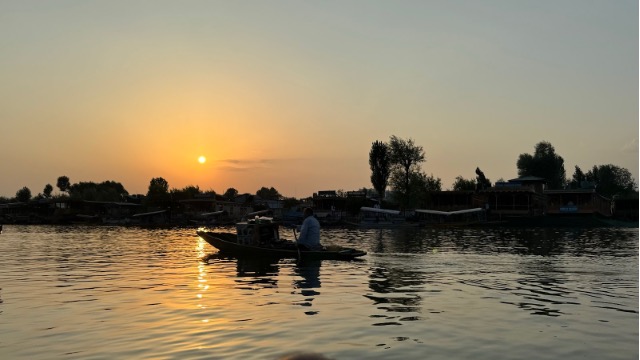
Srinagar. Photo Courtesy: Farouk Gulsara

My impression differed from when Raj Kapoor and Vyajanthimala were seen spending their honeymoon boating around the lake in the 1964 mega-blockbuster Hindi movie Sangam. Then, it had appeared insanely cold, with mists enveloping the lake’s surface. Serenity was the order of the day. What I saw in the height of summer with a temperature hovering around 30C, was anything but peaceful. Even across the lake, the constant blaring of car horns was enough to make anyone go slightly mad. 

The lake is a godsend for dwellers around it. Many depend on the lake to transport tourists and sell memorabilia and other merchandise on their boats. The rows of boat houses are also popular sites for honeymooners and tourists to hire. Privacy may be an issue here. Imagine small-time Kashmiri silk vendors just landing at the boat house and showing produce to the occupants. They may want you to sample their kahwa, a traditional spiced-up, invigorating, aromatic, exotic green tea.

Day 2. Boat House, Dal Lake, Srinagar
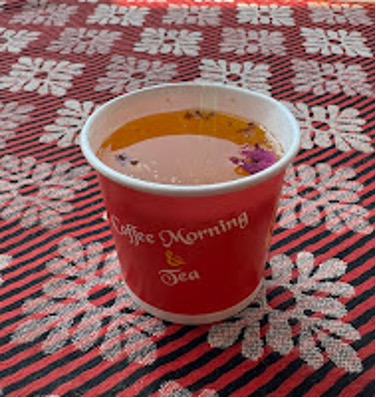
Kashmiri Kahwa, a spiced tea. Photo Courtesy: Farouk Gulsara

Early morning starts with peaceful silence until the honking and murmur of the crowd start slowly creeping in. It was a leisurely morning meant to acclimatise ourselves to the high altitude (~1500m) before we began to climb daily till we hit the highest point of ~5400m. This would — aided by prophylactic acetazolamide –hopefully do the trick to keep altitude sickness at bay. 

The morning tête á tête amongst the generally older crowd was basically about justifying our trip ahead. The frequent question encountered by these older cyclists was, ‘Why were they doing it?’ The standard answer was similar to what George Mallory told his detractors when he expressed his desire to climb the peak that became Everest.

“Why? Because it is there!” Mallory had said. 

The cyclists told their concerned naysayers, “Because we can!”

Yeah, the general consensus was sobering. Time was running out, and so many things needed to be done before the big eye shut. There were so many places and so little time!
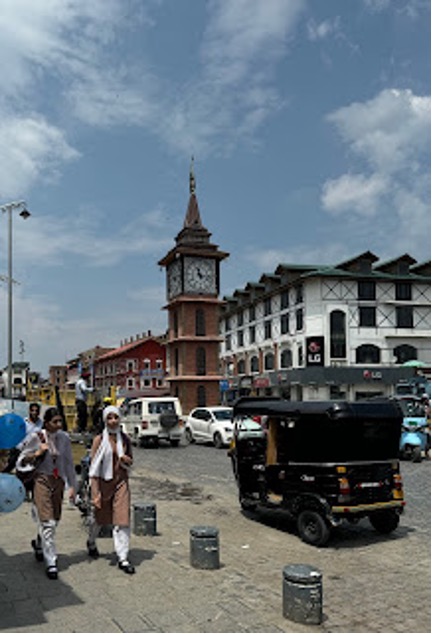
Lal Chowk. Photo Courtesy: Farouk Gulsara

Continuing the easy-peasy stance before the crunch, a trip to town was due. Backed with the symphony of the blaring of honks, we made a trip to the town square, Lal Chawk. After checking out how regular people got along with life, we realised the heavy presence of armed army personnel at almost every nook and corner of the town. Perhaps it was because it was Friday and prayers were in progress.

The return trip to our boat house was a trip down memory lane. After spending most of our adult lives in air-conditioned cars, the trip back on a cramped Srinagar town bus brought us back to our childhood, when rushing to get a place in the bus and squeezing through shoulder to shoulder in a sardine-packed bus was a daily challenge. That, too, was in the tropical heat minus the air conditioning. 

By noon, temperatures had soared to a roasting 30C. So much for cool Kashmir!

Our trip coincided with the Amarnath Yatra, an annual pilgrimage for Shiva worshippers who pay obeisance to Holy Ice Lingam. 
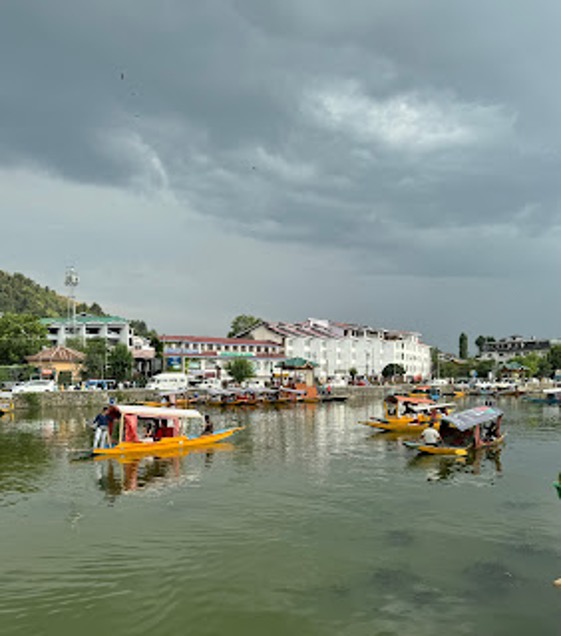
Dal Lake. Photo Courtesy: Farouk Gulsara

The evening was the time to familiarise ourselves with our machines, which involved a ride around the city. It was a nightmare of an experience where we had to simultaneously see our fronts, back, and sides. It was jungle fare. Nobody knew from which direction vehicles were going to barge at us. We survived somehow, if ever we were born in India, our most probable cause of death would be death by road traffic accident. 

The ride brought us to the affluent part of Srinagar, which changed our perception of Kashmir as a war-torn zone. What we saw were nicely manicured lawns and neatly painted buildings. The only hint of disturbances is the apparent presence of armed army personnel nearby. It is said that the one single sign of peace is to see people hanging around lakes and esplanades. We did see this on this ride. Young families were strolling along the promenade to a string of shops selling potpourri of delicacies. Kashmir appeared peaceful. 


Day 3. Srinagar…move it, move it…
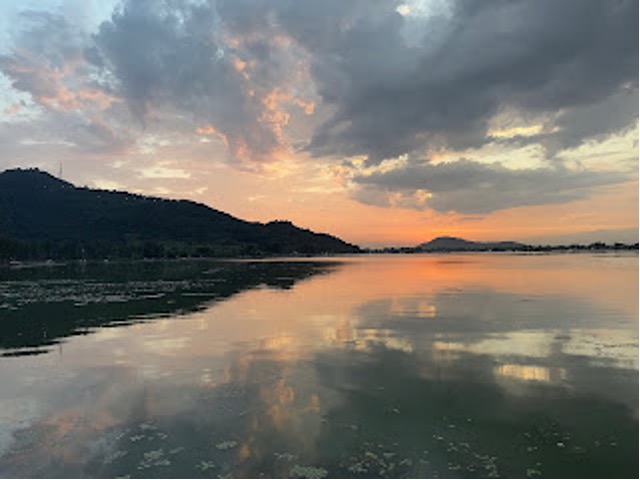
Sunset at Dal Lake. Photo Courtesy: Farouk Gulsara

It was 4am in Kashmir, and all through the night, it had been raining with occasional threats of thunder in the distance. The plan was to start riding as soon as the day broke with the first ray of the sun. That could be 5am or later. And it has probably nothing to do with Indian timing. Today’s ride would be a 90km challenging ride with an ascent of 4.5%. 

All the cyclists survived the ordeal. Starting around 6am, after checking the machines and last-minute briefings, we were good to go.

We did not know that Lake Dal was so huge. The first 20km was all about going around the lake. The first stop was at Mani Gam, a picturesque countryside with a massive tributary of the Sindh River, for an early breakfast of hot milk coffee. 

As expected, the traffic was heavy because of the Amarnath Yatra. But one would expect attendees of a divine voyage like this to want to exhibit tolerance, patience, and softness. Unfortunately, the ugly side of drivers was in full glory. If the rest of the world would blare their honk with all their might just before a head-on collision, here, the same action is synonymous with informing another fellow road user that he is around. 

To be fair, many pilgrims were in chartered vans, and the drivers were quite aggressive, overtaking in blind corners and swerving to the edge of the roads. All in the name of making more trips and making money for the family. 
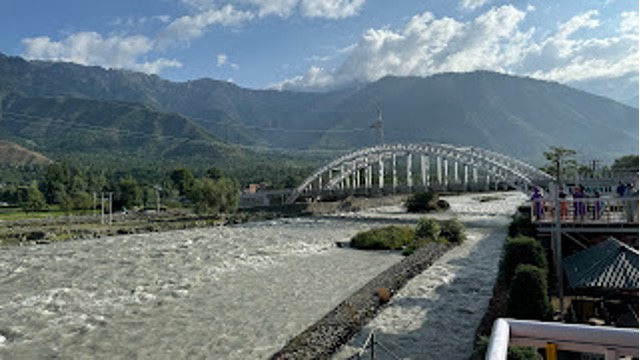
Sind River at Ganderbal. Photo Courtesy: Farouk Gulsara

They say with greater powers comes great responsibility. Apparently, the lorry drivers here missed the memo. Locally, they are known as the King of the Road, with multi-octaved ear drums rupturing high-decibel honks, sometimes to the tune of Bollywood numbers. 

The cyclists continued grinding despite side disturbances that can push any person raving mad; the steady climb was unforgiving. Just when they thought that was the end of the climb, they were fooled for another just after the bend. The most gruelling part was the end of the day’s trip. We rode more than 85 km, climbed a total elevation of 2692 m, and still lived to tell. 

Hotel Thajwass Glacier, Sonamarg 
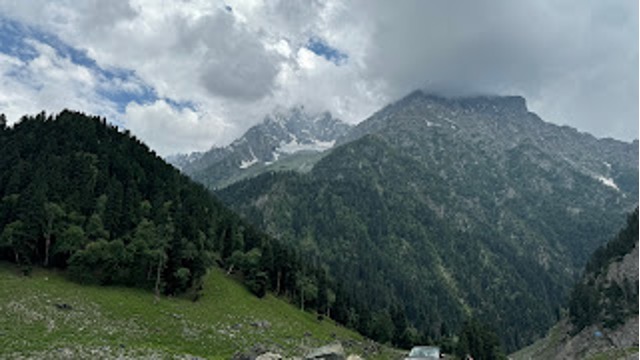
Along Srinagar…Ladakh Highway. Photo Courtesy: Farouk Gulsara

Dinner was entirely vegetarian as a mark of respect to the hotel’s occupants who were there to fulfil their pilgrimage at Amarnath temple. The brouhaha that struck a chord amongst many occupants was the cancellation of helicopter services to the pilgrimage site. The pilgrims were given the choice of either walking a 15 or 22-km track to fulfil their vows or they could pre-book a helicopter ticket to go there. The trouble with the helicopter services is that their feasibility depended on the weather. Weather is controlled by God, the logical explanation would be that God was not too keen to give audience to the so-and-so who were scheduled on flight.

After the light chat with fellow hotel dwellers and answering their curious questions about why able bodies would want to torture themselves, it was time to hit the sack. We could have asked them why fly when they could walk, but we did not.

Day 4. Sonamarg
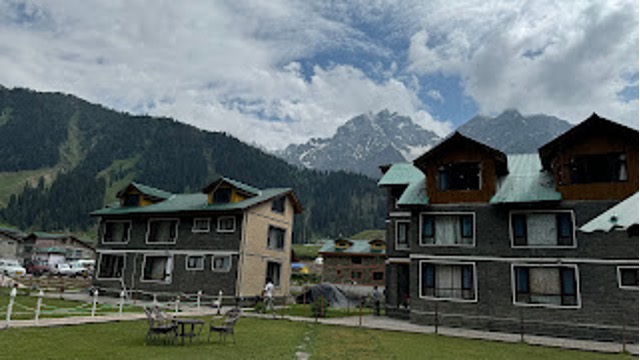
Sonamarg. Photo Courtesy: Farouk Gulsara

We decided to make it a day of light and easy. Everyone was left to their own devices after the spirit-sapping grind the day before. Most took a rain check on the initial hike but went for a long walk instead. 

So, we took a stroll in the Kashmiri Valley, admiring the result of Nature’s choice of colours in His palette: the symphony of rushing cool mountain water and the refreshing cool breeze. 

We met a couple from Chennai at the breakfast table with a sad tale. They had recently lost their only child who was born with cerebral palsy. They had to part from her after caring for their child for many years. They suddenly found plenty of free time on their hands. They decided to spend the rest of their remaining post-retirement lives doing short gigs, earning enough money to tour around and help out other families undergoing the same predicament as they did with their special child. 

When we think we do not have nice shoes, we should not forget about those with no feet. No matter how big our problems seemed, others could have had it worse. 

Sonamarg can be classified as a tourist town with rows of hotels on either side of the road, occasionally laced with souvenir shops and restaurants. The township appears to have been newly built, with freshly tarred roads, loose pebbles on the road shoulder, and unfinished touch-ups. 

Day 5. Off to Drass
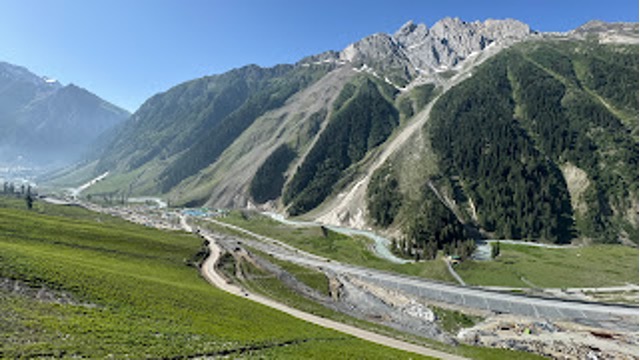
On the way… Photo Courtesy: Farouk Gulsara

We were off to Drass, the coldest inhabited place in India in winter. A quick read and one might read it as Dr-Ass, rather fitting of a name as one could use an examination of one’s derrière after a climb that was upon us. We will see you in hell. But wait, hell is supposed to be hot, is it not? Or hath hell frozen over?

At one point in the 1947-48, Drass was invaded and captured by Pakistan. Soon later, India recaptured Drass. We were only 12km from the line of control (LOC).

Hotel D’Meadow Drass

As expected, it was a gruelling ride. The first 21km were excruciatingly torturous, with narrow roads that had to be shared with the notorious motorists who thought that without the honk, one could not drive. We had to test our trail biking skills later as quite a bit of the stretch was undone or probably collapsed as a result of downpours. We were left with a sand tract and later fabricated stone tracks, which gave good knocking on our posterior ends. Remember our appointment with Dr Ass?
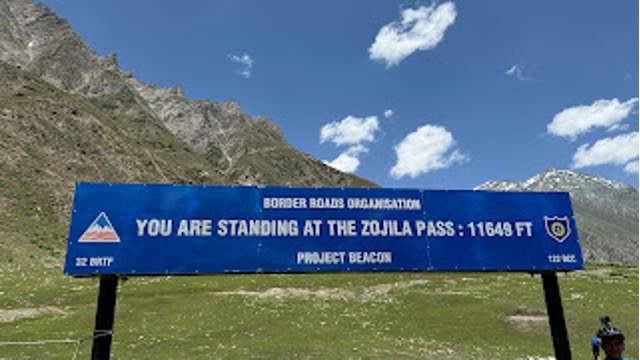
Zojila Pass. Photo Courtesy: Farouk Gulsara

After the 21 km mark, it was generally downhill, but our guide told us to unlock the mountain bike suspension for more comfort due to the violent bumping. The road improved as we entered Ladakh but was interspersed with occasional potholes that shook the machine.

After a short lunch break at a remote restaurant (referred to as a hotel), we were good to go and finally reached Drass at about 3 pm.


We had gone through the gruelling Zojila Pass. A tunnel is currently being built to connect Sonamarg and Drass. It would cut down travel from 4h to 1.5h. 

Point to note: this Pass lives up to its name. When Japan was attacked by many post-nuclear attack monsters, the biggest one was referred to as Gojira. Hollywood decided to christian Gojira as Godzilla, giving rise to the meaning of gigantic as in Mozilla and Godzilla’s appetite. Zojila Gojira, what’s the difference? Both were scary.

Day 6. Drass to Kargil 

Leaving the ‘Gateway to Ladakh’ and the ‘Coldest place in India’, we headed toward Kargil, which had been immortalised in annal of history when Pakistan and India fought a war in 1999. 

Today’s cycling routine was less enduring compared to our previous rides. Most of the route was a downhill trend lined by dry, stony mountains on one side and the gushing blue waters of a tributary of the Indus on the other. The road condition was pretty good, with recently tarred roads, barring some stretches being tarred and resurfaced in various states. 

After completing the close 60km trip to Kargil, we were told we were the fastest group the organiser had ridden with. Eh, not bad for a bunch of sixty-something madmen! Maybe they were just words of encouragement.

I was surprised to see Kargil as a bustling town with many business activities. Construction is happening here and there. Vendors were spreading their produce. Touters were busy looking for clientele. Hyundais, Marutis, and motorcycles thronged the streets, which were obviously not built to handle such tremendous volumes. Everyone was in a hurry. That is a sign of development. 

We were housed in the tallest building around here. It was a four-story, four-star hotel with a restaurant and 24-hour hot water services. In most places we stayed, hot water was only supplied at short, predetermined intervals. 

Day 7. Kargil to Budkharbu

The day started at about 6:45 am, with temperatures around 9C. This leg was expected to be tough. Two-thirds of our journey would be climbs, and there’d be more. It is expected to be sunny throughout, so we could expect a lot of huffing and puffing. 

Today’s ride was easily the toughest one. Straddling on our saddles for 7.5 hours was no easy feat by any means. The climbs went on and on. The steepest and most prolonged ascent came after 39 km. It was a sustained climb for the next 10 km, hovering between 4% and 12% ascent. 
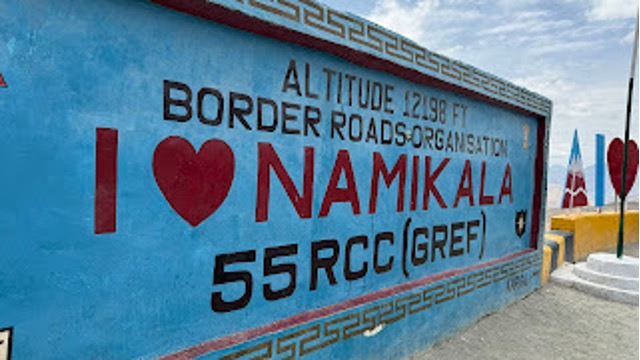
Photo Courtesy: Farouk Gulsara

Nevertheless, we were feasted with some of the most mesmerising views of barren, arid landscapes, as though someone had painted them with hues in the brown range, occasionally speckled with malachite green and a top of sky blue. It was a feeling as if we were at the edge of heaven. 

We pass through a small town called Malbech, which appears to be a Buddhist town with many temples and chanting over its public address system. I guess no one wants to keep their sacred words of God to themselves. They had a compelling desire to broadcast it to the world. 

Many Shiva temples and mosques lined the road of our ride, all showing their presence with specific flags, colours and banners claiming those areas. 

We finally reached Budhkharbu at 2 pm in the heat of summer Ladakh. The temperature was about 22C. The total biking time was 5h 43m. Everyone was shrivelled, depleted of glycogen and energy.  

Budhkharbu is so far from civilisation that the occupants do not feel the need for digital connectivity. Only we, the town folks, were having withdrawal symptoms for not being able to upload our Strava data to earn instant gratification. Foreigners were not allowed to purchase SIM cards, so we were essentially crippled for a day.

Day 8. Padma Numbu Guest House, Budhkhorbu to Nurla
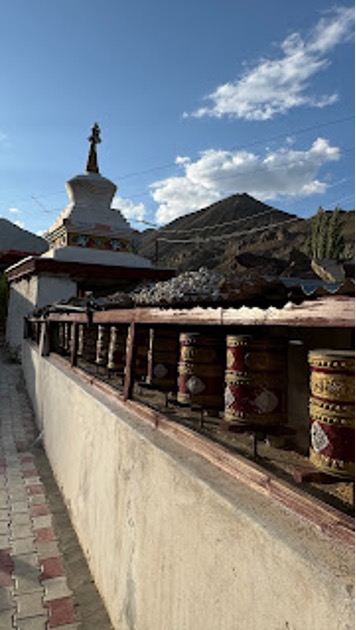
Photo Courtesy: Farouk Gulsara

Rise and shine. Rinse and repeat. Breakfast at the Guest House to a vegetarian, sorry, no eggs too, accompanied by the aroma of incense and the tune of ‘Om Jaya Jagatheeswara Hare1‘, we were good to go. I suspect the owners of this guest house were ardent BJP supporters. The keyholder to our rooms carried a lotus symbol. And the BJP mission office was their neighbour. 

We were up on the saddle and ready to move by 7:15 am. The sun was already bright and shiny by then, and we were all enticed by the 26kms steep decline.

After 9 kms, we did not mind the initial steep climb traversing the unforgiving Fotula Pass. At one point, we almost reached 4,200m above sea level. Other than the occasional passerby and military barracks, there wasn’t a single inkling of life there. It was just barren, arid land for miles and miles. 

64 km later, we arrived at our destination, Nurla. Nurla is a no man’s land and is not featured for first-time visitors to Ladakh. Nearby is a self-forming statue of the Sleeping Buddha and a giant statue of Maitreya Buddha. Here, the seed of the Namgyal Dynasty started. It is famous for Tibetan paintings. As temporary sojourners, we just learned and moved along. 

By now, we had learnt how the honking system worked. Even the brotherly advice from BRO (Border Road Organisation) advises using vehicle horns, especially at blind corners and overtaking another vehicle. At a telepathic level, the driver seems to converse with the other, ‘I can take charge of my vehicle as I overtake you. Now, don’t you make any sudden moves, can you?’ The melodious tone of honks, especially of lorries and buses, is just to liven up the monotonous journey, as do music (and movies).

Day 9. Travellers Lodge, Nurla to Leh

We were told today’s leg would be challenging, with 85 km to cover and a steep one. Hence, we had to be up on our saddles by 5 am. 

In essence, today’s outing was the toughest by far. We climbed two hills, and just when we thought everything was done and dusted, another climb to our hotel came. Overall, we covered 85km and 1672m elevation in 7h 2m. 

We saw two essential tourist attractions as we approached Leh: Magnetic Hill and gurudwara. Magnetic Hill is believed to create an optical illusion of a hill in the area and surrounding slopes. The cars may be going uphill when they are, in fact, going downhill. 
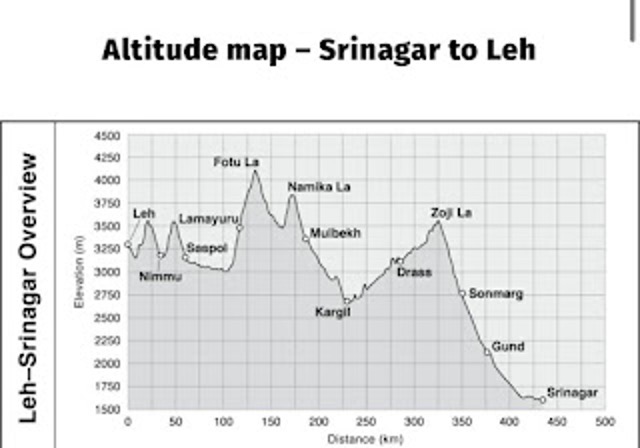
Sourced by Farouk Gulsara

The Guru Pathan Gurudwara is another curious worship site in the middle of nowhere. Legend has it that Guru Nanak stopped at this place, coming from Tibet and towards Kashmir. It was a Buddhist enclave. While meditating, an evil demon tried to crush him by rolling down a boulder. Hold behold, the stone turned waxy soft and did not injure the Guru. 

An indestructible piece of rock was encountered while constructing this stretch of the highway. The Buddhist monks told the authorities of the legend, and the Gurudwara was erected. The Buddhists revered Guru Nanak and treated him as a great teacher. 

The journey ended with a brutal, unrelenting climb to our final destination, Hotel Panorama in Leh. 

The next journey the following day to Khardungla was optional. Only the young at heart opted for it. A 37 km journey with an inclination of 8% constantly with possible extreme subzero temperatures was too much to ask from my gentle heart. I opted out.  

Thus ended our little cycling escapade from Srinagar to Leh, Ladakh. Few will attempt this journey with SUVs or superbikes; only madmen will do it with mountain bikes. 

P.S. I want to thank Sheen, Adnan, Basil, and Samir of MTB Kashmir for their immaculate planning and supervision of the rides. 

  1. A holy chant extolling the lord of the Universe ↩︎

Farouk Gulsara is a daytime healer and a writer by night. After developing his left side of his brain almost half his lifetime, this johnny-come-lately decided to stimulate the non-dominant part of his remaining half. An author of two non-fiction books, Inside the twisted mind of Rifle Range Boy and Real Lessons from Reel Life, he writes regularly in his blogRifle Range Boy.

.

PLEASE NOTE: ARTICLES CAN ONLY BE REPRODUCED IN OTHER SITES WITH DUE ACKNOWLEDGEMENT TO BORDERLESS JOURNAL

Click here to access the Borderless anthology, Monalisa No Longer Smiles

Click here to access Monalisa No Longer Smiles on Kindle Amazon International

Categories
Travel

The Storied Past of Khiva

Narratives and photography by Gita Viswanath

Entrance to Khiva

If you thought time travel was only a captivating concept in science fiction or theoretical physics, try experiencing it in Khiva! Located in the heart of the Kyzylkum Desert in Uzbekistan is the ancient city of Khiva, declared a UNESCO World Heritage Site in 1990.  With its immaculately preserved city walls and stunning monuments, Khiva transports visitors back in time to the days of the Silk Route and the prosperous empires of Central Asia. When five of us planned a trip to Uzbekistan, we knew we would encounter history in every nook and corner of this utterly enchanting country. However, to see it all preserved with so much care and thought was another experience all together. The credit for this goes to Uzbekistan’s first President, Islam Karimov, who took up the task of restoring monuments and returning to the Uzbeki people, their rich and layered history and multiculturalism after years of Soviet rule.

Our guide, Murat led us through this treasure trove of history and architectural marvels with a quiet, thoroughly knowledgeable air. We set out after a hearty breakfast at Zarafshon Boutique Hotel, conveniently located within the walls of the Itchan Kala (Inner City), to walk for the next four hours through its mesmerizing, labyrinthine streets that reverberate with the sounds of a folklore ensemble’s traditional music, tourists’ chatter, guides’ narrations, and shopkeepers’ entreaties to buy their wares.

A city that goes back over two millennia, Khiva was one of the oases along the Silk Route. The Silk Route, an ancient network of trade routes connecting the East and West, spanning thousands of miles across Asia, resulted in the exchange of goods, ideas, faiths and convictions that ultimately transformed and defined history in a way that has an impact to this day. Ever since, Khiva thrived as a centre of trade, commerce, and cultural exchange. It became an important city in the region, famous for its wealth, power, and architectural splendor.

The skyline of Khiva is defined by its walls, reminiscent of Jaisalmer in Rajasthan. Itchan Kala, enclosed inside magnificent mud-brick walls, packed with straw, dates back to the 10th century. Within these walls lie architectural marvels, including the Kalta Minor Minaret, Toshhovli Palace, the Muhammad Amin Khan Madrassah, and the Juma Mosque.

Kalta Minor minaret

The incomplete Kalta Minor, with its arresting turquoise minaret towers over us at 45 meters. Soon, the colour turquoise became so omnipresent in our photo gallery that we needed to use Google Lens to distinguish one from another! Muhammad Amin Bahadur Khan, the Khan of the Khiva Khanate intended the minaret to be the largest and tallest in the Muslim world at 80 meters, exceeding the height of the 73-meter Qutb Minar in Delhi. According to the historian, Mulla Olim Maxdum Hoji, the Khan could not have his way due to his untimely death in a battle near Sarakhs in 1855. Twelve of the sixteen verses inscribed on the minaret are those of Muhammad Riza Ogahi, a poet from Khiva, who was witness to its construction. The writings were pulled down during the Soviet regime, only to be restored after Uzbekistan’s independence. There is a belief that criminals were dragged up to the top of the minaret and thrown down, although there is no historical evidence to support this. It remains a tale told by the guides to tourists who go, “Oh nooooo!”

Tosholvi Palace

Moving on to the Toshhovli Palace, which means ‘Stone House’, we were captivated by the decoration comprising ceramic tiles, carved stone and wood. Built by Alla Khuli Bahadur Khan between 1832 and 1841, it has more than 150 rooms with nine courtyards. The high ceilings of the rooms are designed to keep the place cool in the summer months of this desert region.

Known for his impatience, Allah Khuli insisted that the royal architect, Usto Nur Mohammed Tajikhan, build the palace in three years. When the architect nervously said that it would not be possible, he was impaled and Kalender Khivaki took over along with the famous tile decorator, Abdullah Jin. It took eight years and the labour of nearly a thousand slaves to complete this structure that we, today as tourists, gape at in complete awe. The unfading colours of the glazed tiles owe their lasting quality to a technique called “ishkor,” mastered by the craftsmen of another era.

Embedded within the intricate tile work of the Toshhovli Palace is the hilarious story of how Allah Khuli picked a woman from his harem for each night. The region is known for its large pomegranates, with juicy seeds as red as rubies and Khuli is supposed to have flung one fruit into the quarters of the woman he desired. The fall of a pomegranate through the window, then, alerted the woman! Murat and the five of us had a hearty laugh and one of us even wondered aloud, ‘what if he didn’t have good aim,’ or ‘what if the window was closed!’ Murat shrugged his shoulders, a tad embarrassed.

The austere and monastic, yet splendid wood carved pillars and roof of the Juma Mosque stands as a contrast to the rich colour palettes of the other monuments. According to the Arabian geographer Al-Mukaddasy, the Juma Mosque was constructed in the tenth century. This one-storey brick building with a flat roof was rebuilt over the ruins in 1788 with 25 of its 212 pillars, made of black elm wood, recovered from the original structure. The roof has small openings to let in the light.

Beyond its architectural majesty, Khiva resounds as a living testament to the cultural heritage and traditions of Uzbekistan. In its stark brown desert landscape, the colours of Khiva’s monuments, ceramics and hats stand out in a sharp and endearing contrast. To this day, the bazaars of Khiva are filled with artisans who continue to practice traditional crafts such as carpet weaving, pottery, and silk embroidery, preserving age-old techniques and skills passed down through generations. The great artistic legacy lives on in the silent monuments staring down at you as well as in the bustling bazaars with warm, hospitable people who are especially partial to Indian tourists given their adoration of Bollywood films. In fact, fans of Hindi films, of which there are aplenty in Uzbekistan, rattle off names of stars ranging from Raj Kapoor to Shah Rukh Khan! Parts of the Hindi action film, Yeh Mohabbat Hai (This is love, 2002), directed by Umesh Mehra were shot in Khiva!

The rumble in the belly with all the walking we did brought us back rudely into the moment and we headed straight to a restaurant recommended by Murat.  Food is such an integral part of travel and we did full justice to the spread that consisted of fresh salads, bread called non, straight out of the wood-fired ovens, and the ubiquitous lamb. As Khiva continues to enthrall travellers, it remains a guiding light of history, culture, and heritage in the heart of the Uzbekistan desert. It remains a mute witness to a borderless world of yore.

Gita Viswanath is the author of two novels – Twice it Happened (2019) and A Journey Gone Wrong (2022), , a non-fiction book, The‘Nation’ in War: A Study of Military Literature and Hindi War Cinema (2014), and a children’s book, Chidiya (Bird, 2018). Her short films: “Family Across the Atlantic” and “Safezonerz” are available on YouTube.

PLEASE NOTE: ARTICLES CAN ONLY BE REPRODUCED IN OTHER SITES WITH DUE ACKNOWLEDGEMENT TO BORDERLESS JOURNAL

Click here to access the Borderless anthology, Monalisa No Longer Smiles

Click here to access Monalisa No Longer Smiles on Kindle Amazon International

Categories
Conversation

Rings on Her Fingers and Bells on Her Toes…

Ratnottama Sengupta in conversation with Sohini Roychowdhury, who uses dancing to build bridges across cultures

“Meet my daughter Sohini,” Uma Di was introducing the dancer who then lived in Madrid. And my first response was, “Why isn’t she in the movies?!”

Sohini Roy Chowdhury. Courtesy: Sohini Roy Chowdhury

Tall, fair, lissome, agile, Sohini Roychowdhury is the stuff beauty queens and show stoppers are made of. That wasn’t surprising: after all, Uma Roychowdhury herself is the picture of perfection in aesthetics.

It didn’t take me long to realise that, much like the well regarded sculptor’s bronzes, her daughter too was made of enduring stuff. One day she was teaching Bharatanatyam to French, Spanish, and Italian enthusiasts. The next day she was lecturing on mythology in New York. One day she was dancing to ‘Jai Ho![1]’ for the director of the Oscar winning Hollywood movie[2]. Another day she was delineating Durga in an Anthropology Museum…

None of these saw her run out of breath. Nor does she, ever, run out of time. When she’s not holding her fingers in a dance mudra, she is holding a metaphoric pen. This month she unveiled her second book, Dance of Goddess Kali. Yes, she has rings on her fingers and bells on her toes — and wherever she goes, there’s dance on the cards!

Here is what she had to say when I spoke to her:

The Dance of Kali follows Dancing with the Gods. How are the two books different?

Dancing With the Gods and The Dance of Kali are two distinct works, each focusing on different aspects of my artistic and spiritual journey. 

Dancing With the Gods is a pictorial, coffee-table book stemming from my journey as a classical Indian dancer with a multinational dance troupe. Its vivid visuals showcase my onstage performances and behind-the-scenes moments. These are highlights of my career as a dancer, both solo and with Sohinimoksha World Dance and Communications[3]

This visually captivating book focuses on imagery and aesthetics. It offers glimpses into my artistic expression through dance, celebrates my journey around the world, and highlights my life-mantra of connecting civilisations through my craft. This tracing of Sohinimoksha’s journey is for a broader audience: Indian dance enthusiasts, art lovers, and individuals interested in my achievements. The aim is to inspire through visually compelling storytelling.

In contrast, The Dance of Kali is a treatise on the ethos of Goddess Kali and Shaktism. It delves into the deeper spiritual and philosophical aspects associated with the goddess, exploring Kali’s symbolism, mythology, and significance within the context of Shaktism, a Hindu tradition of worshiping the divine feminine energy. The tone of this work is contemplative, as it delves into the profound symbolism and the spiritual aspects associated with the Goddess. It incorporates scholarly research, analysis, and interpretations from various perspectives. Hopefully it offers readers a deeper understanding of Kali’s significance in Hindu spirituality.

May I point out here that The Dance of Kali is not a religious book. It is for readers with a specific interest in Hindu mythology, spirituality, or the myths and legends around the resident Goddess of Kolkata. Those seeking a deeper understanding of Kali’s symbolism and philosophical underpinnings within the context of Shaktism, will find this book dispels disrespectful misrepresentations and unfounded Western misconceptions  surrounding the images of Kali as a demonic goddess. 

To sum up: both the books reflect different facets of my artistic and spiritual journey. However, they differ significantly in their subject matter, focus, tone, and intended audience. One celebrates my achievements as a dancer through captivating visuals. The other is an academic tome exploring the profound symbolism and spirituality associated with Goddess Kali.

What prompted you, an international dancer, to pick such a rooted in mythology subject?

I have always had a personal affinity with or inclination towards Goddess Kali. Many artistes draw inspiration from their own beliefs, experiences, and cultural backgrounds when choosing subjects for their work. I am no different. For me the depiction of the Goddess is an opportunity for artistic exploration. Kali, with her complex symbolism and multifaceted persona, offers rich material for creative interpretation through the arts, be it dance, literature or visual arts. 

This book also celebrates India’s rich mythological heritage and the way it connects to other ancient cultures, in Mesopotamia, Egypt, Spain and France. Kali, with her global soul sisters Ishtar or Sara La Kali, holds significant cultural and religious importance, not just in Hinduism, but other cultures as well, particularly within the contexts of worshipping Mother Goddesses. I delve into Kali’s mythology and symbolism to honour this aspect of Indian life, and its universal resonance. 

Yes, Goddess Kali is rooted in Indian mythology. But the themes she embodies — feminine power, transformation, and liberation —transcend cultural boundaries. I hope this book will serve to explore universal themes of empowerment and spirituality. It also aims to provide a deeper understanding of Hindu mythology, and the symbolism associated with the Dark Goddess. Effectively I seek to promote intercultural dialogue and foster greater appreciation for diverse religious traditions. Most significantly, I hope to dispel the uneducated interpretations of Kali as a horrific, savage, demonic goddess. How often she is typecast as a symbol of evil — in popular Western films, books and even as Halloween costumes for disrespectful celebrities like Heidi Klum

I have witnessed your performance as Durga in an anthropology museum in Madrid. I have noted your commitment to meaningful, even profound themes in your endeavours. What has been your grooming in dance?

I started dancing at a young age under  renowned Bharatanatyam Guru, Thankamany Kutty. Later I learnt from Kalamandalam Venkitt in Kolkata. I received rigorous training in Bharatanatyam, the dance  that originated in the temples of Tamil Nadu. My dedication to classical art led me to delve deep into its nuances. I mastered intricate footwork, expressions, and storytelling techniques. Over the years, I refined my technique and expression through consistent practice and performance and came to embody the essence of Bharatanatyam.

Your father was a renowned sitarist living in Germany. Your mother is a reputed sculptor of Kolkata. Why did you, an only child, not take to any of these streams of creative expression?

Indeed I was born into a family of accomplished artists. My father, Pandit Subroto Roychowdhury was a renowned sitarist, and my mother, Uma Roychowdhury, is a reputed sculptor. But I chose a different path for myself. 

As an only child, I was exposed to various forms of creative expression. But my passion for dance was ignited after watching a riveting performance by Yamini Krishnamurthy when I was about four years old. While I deeply respect my family’s artistic legacy, I followed my own calling and embarked on a journey to carve my niche in the world of dance.

What are the values you have imbibed from them individually?

My father’s sitar schools in Germany have produced hundreds of students — including distinguished sitar players. From him I imbibed a profound appreciation for music and rhythm. I learned discipline, dedication, and the importance of perseverance in mastering an art form. From my sculptor mother I inherited a keen love for aesthetics and eye for details. I learned the importance of expressing emotions and stories through visual and performing arts. 

Together these values have steered me towards excellence and innovation in my journey as a dancer and communicator.

Mixed genre performance by Sohini Roychowdhury. Courtesy: Sohini Roy Chowdhury

You have lived in Moscow and Madrid. You are guest professor in far-flung Universities, in America and Columbia. You have danced Bharatanatyam and you have danced to Jai ho! at the premiere of Slumdog Millionaire. What have you gained through your international exposure?

My international exposure has enriched me both personally and professionally. Living in cultural environments as diverse as Moscow and Madrid have broadened my perspectives and deepened my understanding of global arts and communication. 

More than 2000 students have ‘graduated’ through my two dance schools in Spain — Casa Asia and Sohinimoksha Artes de la India. In Moscow, more than 80 Russian students performed with me on stage at the Embassy of India and Nehru Centre at the end of their course. As a guest professor in universities across Europe, USA and Latin America, teaching dance, Natyashastra [theory of dance] and Indology, I have not only shared my expertise — I have learnt from students, artistes and scholars from different backgrounds. 

Through my performances of Bharatanatyam, and collaborations with international artists, have bridged cultural divides. My dancing to Jai Ho! at the European premiere of Slumdog Millionaire showcased the universal appeal of Indian dance and music. It  highlighted its ability to connect with people across borders. Today I can confidently claim to have promoted cross-cultural exchange globally.

Coming from an aristocratic, old Calcutta background, what merit do you see in Bollywood dancing?

Despite coming from an aristocratic background rooted in old Calcutta, I recognise the merit in Bollywood dancing which has become a global phenomenon. Not surprising. For, characterised by vibrant energy, expressive movements, and fusion of multiple dance styles — from Salsa to Tango, Twist to ChaChaCha – Bollywood dancing holds mass appeal. It serves as a platform for artists to showcase their talents to diverse audiences and has contributed to the popularization of Indian culture worldwide. It is rooted in traditional Indian dance forms, yet embraces modern influences. And it reflects the evolving tastes of contemporary audiences. 

Since the 1960s, Bollywood has drawn inspiration from various musical traditions across the world. This imparted its films a rich tapestry of global influences. This fusion of world music and dance enriched the aesthetic of Bollywood — and in turn contributed to its cultural significance and global appeal.

In the 1960s, Indian cinema underwent a transformation with the emergence of filmmakers like Guru Dutt and Raj Kapoor, who infused their films with elements of Western music and dance. The most iconic example of this is seen in the song Mera joota hai Japani [my shoes are Japanese] from Shree 420 (1955): here Raj Kapoor’s character sings about wearing Japanese shoes, English pantaloons, and Russian caps — all of which symbolised the growing influence of the West in post-colonial India. And yet, as the song stresses, at core these films are Hindustani — Indian.

Throughout the ’60s, ’70s and ’80s, the industry witnessed the rise of dance and music directors who played a pivotal role in incorporating world music and dance forms into Hindi cinema. Composers like OP Nayyar, Shankar Jaikishan, SD Burman, C Ramachandran, Kalyanji Anandji, RD Burman, Laxmikant-Pyarelal, and Bappi Lahiri experimented with disparate musical styles. These ranged from rock-n-roll, rumba, flamenco to disco, reggae and jazz. This infused their compositions with international flavours. 

Similarly, choreographers Sohanlal,  PL Raj, Herman Benjamin, Suresh Bhatt, Saroj Khan, Chinni and Rekha Prakash, Shiamak Davar, Farah Khan, Remo D’Souza, Terence Lewis, Vaibhavi Merchant, and Prabhu Deva have blended Indian classical dance with Western styles. This has created the unique dance style that is now identified as Bollywood dancing. It has homogenised movements from hip-hop to salsa and contemporary dance.

Soon stars like Shammi Kapoor, Helen, Asha Parekh, Hema Malini, Rishi Kapoor, Mithun Chakraborty, Jeetendra, Govinda, Hrithik Roshan, Madhuri Dixit, and Sridevi became synonymous with Bollywood’s larger-than-life dance numbers. For, it showcased their versatility and flair for different dance steps. Embracing the twist and turn era of the ’60s to the disco craze of ’70s and the hip-hop-inspired moves of the 2000s, Bollywood stars captivated audiences with their energy and charisma.

Along with Western influences, Bollywood also drew from traditional Indian dances. Its choreography incorporated elements of Bharatanatyam, Kathak, and Odissi. Dance sequences like Dola Re Dola from Devdas (2002) and Pinga from Bajirao Mastani (2015) exemplify the fusion of classical and contemporary dances, blending intricate footwork with dynamic movements and expressions.

In recent years, Bollywood has continued to evolve, reflecting the changing tastes and preferences of global audiences. Directors, like Sanjay Leela Bhansali and Farah Khan, have pushed the boundaries of traditional filmmaking, creating visually stunning spectacles that showcase the diversity of world music and dance. Stars like Priyanka Chopra, Deepika Padukone, and Ranveer Singh have embraced this eclectic mix of styles, bringing their own unique interpretations to the screen.

Spanish, Bulgarian and other European dancers from my own troupe, Sohinimoksha World Dance, have performed specially choreographed fusion dance items set to popular Bollywood tracks. Kristina Veselinova danced to Mere Dholna from Bhool Bhulaiya; Violeta Perez and Lola Martin to Senorita! from Zindagi Na Milegi Dobara and Maria Sanz on Padmavat’s Ghoomer on stages across India and the world. So I readily acknowledge the significance of Bollywood dance in preserving India’s cultural heritage while adapting to changing times.

Would you say our films are taking our dance traditions to votaries abroad? Just as Indian musicians of the 1960s had taken our ragas to the West?

In the 1960s, Ravi Shankar, Ali Akbar Khan and other maestros played a crucial role in initiating the West in the rich notes of Indian classical music — and that had enriched the global cultural landscape. My own father, Pandit Subroto Roychowdhury, spent more than 40 years in Germany and other European countries, spreading and popularising Indian classical music through concerts and classes. Today Indian films, particularly Bollywood, are carrying forward this legacy. They are showcasing the wealth that is Indian dance — often fused with world dance influences. Just as our musicians shared the wealth of ragas with the West, Bollywood films are spreading the infectious exuberance of Indian dance to enthusiasts around the globe. This is fostering cultural exchange on an international scale. Small wonder that Bollywood is now acknowledged as India’s most potent soft power. 

What, in your opinion, is needed to make GenNext learn from our past traditions?

If we want GenNext to learn from our past traditions, we must provide them with comprehensive exposure to our rich cultural heritage. For this, we must integrate our arts and cultural practices into educational curricula. We must foster appreciation through interactive experiences — workshops, performances, cultural events. Additionally we must leverage modern technologies and platforms to disseminate information. Let’s make traditional arts more accessible and engaging for the young. Let’s cultivate mentorship programs and intergenerational exchanges. For, we must bridge the gap between past traditions and contemporary lifestyles, to ensure their relevance and continuity for the generations to come.

Sohini I have seen you at close quarters, as a mother, wife, daughter, and daughter-in-law even as you criss-cross the world for your dance. How do you still find time to write, which is such a demanding, reflective expression?

I am fortunate to be able to balance my roles as a mother, wife, daughter, daughter-in-law, and a performing artiste. My experience as much as my dedication to my craft honed my time-management skills. Despite crisscrossing the world for performances, lecture tours, and other professional commitments, I carve out time to write, for I recognise its significance as a reflective form of expression. 

To effectively manage my time, I set priorities, create schedules, and maximize productivity during the available windows of time. I designate specific periods for writing, be it early mornings, late evenings, or during travel downtime. I try to integrate writing into my daily routine, seizing moments of inspiration and reflection to jot down ideas or draft passages.

My passion for writing is a driving force — it motivates me to make time for it amidst my busy schedule. Writing provides a creative outlet for introspection, and intellectual exploration. It complements my artistic endeavours and enriches my personal and professional growth.

I am grateful for the support I receive from the network of my family, friends, and collaborators. They play a crucial role in facilitating my writing pursuits. My latest book, The Dance of Kali, was co-written with my son Rishi Dasgupta, an Economics MSc from the University of St Andrews, UK. 

However, at the end of the day, that I find time to write amidst my multifaceted life, reflects my passion for engaging in reflective expression. Because? It contributes to my holistic development as an artist and an individual.

[1] A song from the 2008 Bollywood movie, Slumdog Millionaire

[2] Danny Boyle

[3] A dance troop started by Sohini Roychowdhury with presence in Madrid, Berlin and Kolkata

.

Ratnottama Sengupta, formerly Arts Editor of The Times of India, teaches mass communication and film appreciation, curates film festivals and art exhibitions, and translates and write books. She has been a member of CBFC, served on the National Film Awards jury and has herself won a National Award. 

.

PLEASE NOTE: ARTICLES CAN ONLY BE REPRODUCED IN OTHER SITES WITH DUE ACKNOWLEDGEMENT TO BORDERLESS JOURNAL

Click here to access the Borderless anthology, Monalisa No Longer Smiles

Click here to access Monalisa No Longer Smiles on Amazon International

Categories
Essay

Charlie and I: My Visit to Corsier-sur-Vevey

Nirupama Kotru, a film buff renews her acquaintance with Chaplin and, in the process, learns a life lesson.

“In that dark room in the basement of Oakley Street, Mother illuminated to me the kindliest light this world has ever known, which has endowed literature and the theatre with their greatest themes: love, pity and humanity.”

— Charles Chaplin, My Autobiography

He has been called a genius by scientists, philosophers, writers, humanists, film-makers and actors. His films continue to fascinate generations. They are timeless in the true sense of the word. As children, we laughed at the slapstick and the physical humour in his films. As adults, we have learnt to appreciate the world-view that lies behind some of his funniest films. Charlie being sucked into the giant machine in Modern Times (1936) remains one of the indelible memories of childhood. Later in life, one came to appreciate the thought – the causes and consequences of the Great Depression (1929–39) – that went into the writing of the film.

Charlie Chaplin has been an important influence in Indian films. Take celebrated actor-director Raj Kapoor, for instance. Raj Kapoor absorbed the mannerisms associated with Chaplin’s Little Tramp, including the waddle. It is a tribute to Chaplin’s genius that this Indian actor came to be universally recognised as the tramp, with his film Awara (the title of the film means a vagabond or a tramp) becoming a huge hit at home and abroad. Many actors after Kapoor, among them Sridevi (Mr India,1987), Mehmood (Aulad,1968), Kamal Haasan (Punnaigai Mannan,1986), and Chiranjeevi (Chantabbai,1986), channelised their inner Charlie into their performances. But it was Noor Mohammed who first adopted the Chaplin persona, and even used the screen name “Charlie” in films like The Indian Charlie (1933), Toofan Mail (1934) and Musafir (1940).

In November 2022, when I was informed that I would have to travel to Geneva for work, my first reaction was far from enthusiastic. I thought Geneva would be bitterly cold; also I needed to start planning my forthcoming family vacation to the United States. The United Nations Conference on Trade and Development (UNCTAD), under whose aegis this program of the Intergovernmental Forum on Mining was taking place in Geneva, had asked India to send a women leader in mining.

Over the next four working days, I came to love Geneva Lake Geneve, the beautiful weather, the lovely architecture and the people. But the highlight of my trip was the last day, which I had taken off. The surprising part was that none of my colleagues, including those posted in the three Indian Missions/Consulates in Geneva, had visited the Chaplin Estate (The Manor de Bain). It was sheer luck that I remembered reading about Chaplin spending the last twenty-five years of his life in Switzerland, until his death in 1977. I discovered in the nick of time that Corsier-sur-Vevey was less than a two-hour drive from Geneva. I realised that this was a once-in-a-lifetime opportunity. A quick booking of tickets on the Chaplin World website and I was off to the Manor de Bain! I decided to combine my Vevey trip with one to Gruyere, the beautiful town which lends its name to a popular kind of cheese.

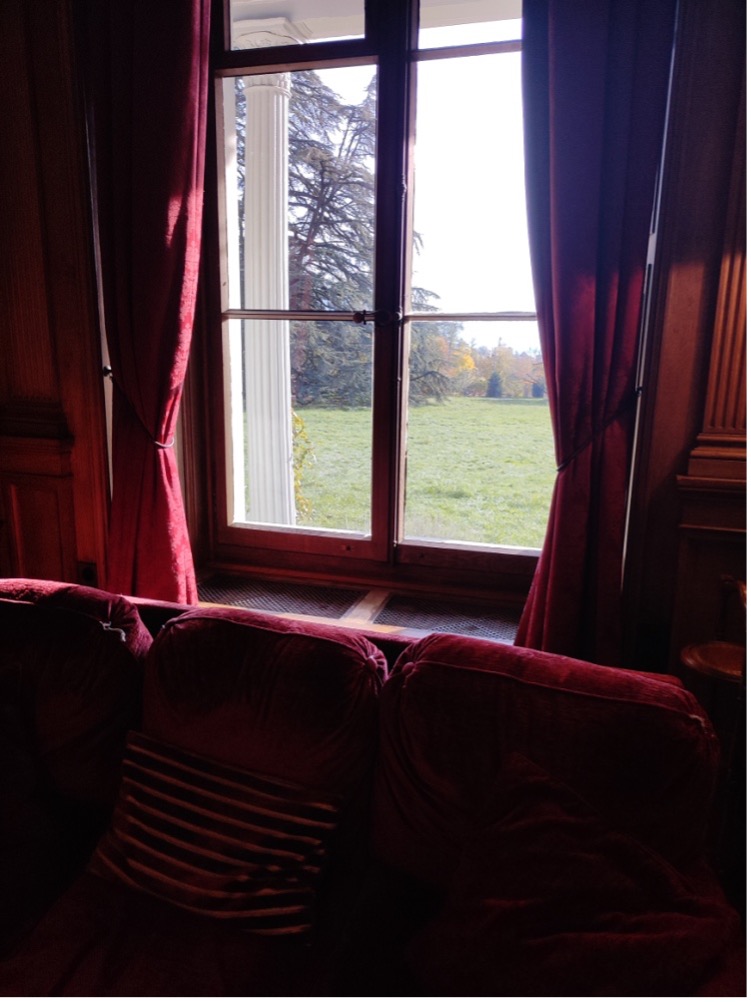
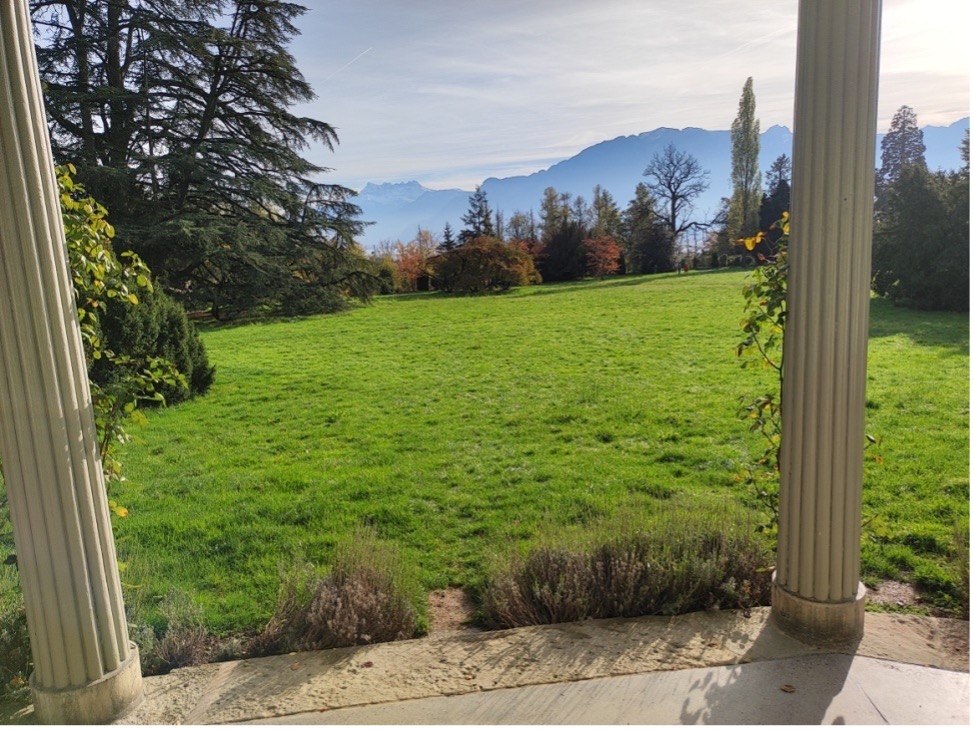
After a quick trip to Gruyere, I set off for Vevey. My heart started racing as I passed the town square in Vevey which had huge murals of Chaplin on some buildings. Finally, I entered the hallowed portals of the estate where Chaplin spent twenty-five years with his wife, Oona, and his children. Passing through his study in the main living quarters, as I entered the drawing room with its cosy sofas, I came across French windows which overlooked the massive grounds of the estate. I stopped to take a picture. Suddenly, my phone camera froze. I panicked. I tried to close the camera app and switch off my phone, but nothing worked. I thought, this was it, I won’t be able to take any more pictures to remind me of this special day. Dejected, I moved into the dining room. A lady guard came to me and asked me if I would like to write something in the visitor’s book, which I did, sitting down on a chair in the corner.

All this while I was feeling disappointed. Suddenly, I looked up to see a home video playing in a loop, of Chaplin enjoying a meal on a sunny day with family and friends. I thought to myself: Was this a sign? Was Chaplin saying, “Why are you obsessed with taking pictures? You have come so far to see my home; I want you to enjoy my estate, look at my work. Don’t let these modern gadgets rule your life. Slow down.Take it all in.”

I calmed down and went back to those French windows in the drawing room to take in the magnificent view of the estate grounds. A man walked towards me. I asked him if he could help unfreeze my phone. He suggested I switch it off and then on again. I did that, and voila! It worked. Though I was relieved when my phone came back to life, I realised that in those intervening ten-fifteen minutes when my phone was frozen, I was forced to take a breather, to reflect upon the beauty I was surrounded by, and all the blessings which make life worth living. And I went back to the study and foyer of the house to spend some more time reading more about the struggles, trials and triumphs of this great artist.

As I emerged from the main building, I thought of rounding off the visit with a leisurely walk around the grounds. Suddenly I noticed a sign which said “The Studio”. I had deliberately avoided researching on what the visit had to offer, so I decided to just go with the flow and enjoy whatever was on offer. There was a screen outside “The Studio” which said that a film screening was to start in nine minutes. I waited, and finally watched the film, a moving take on Chaplin’s life and work, with ten other viewers.

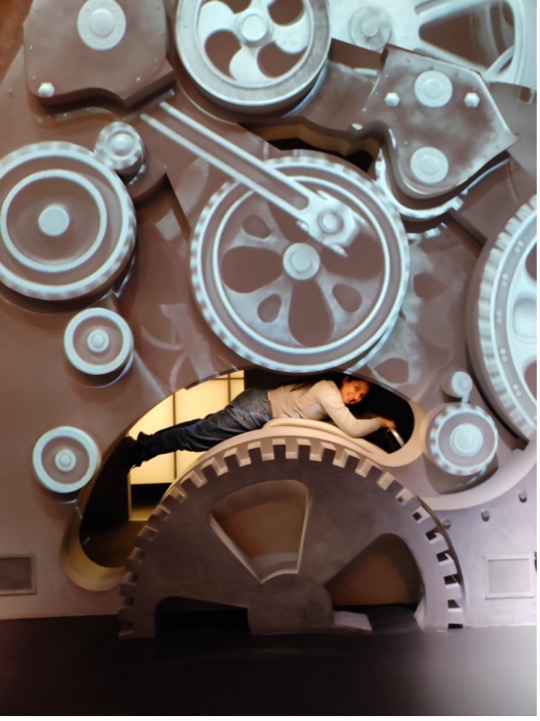
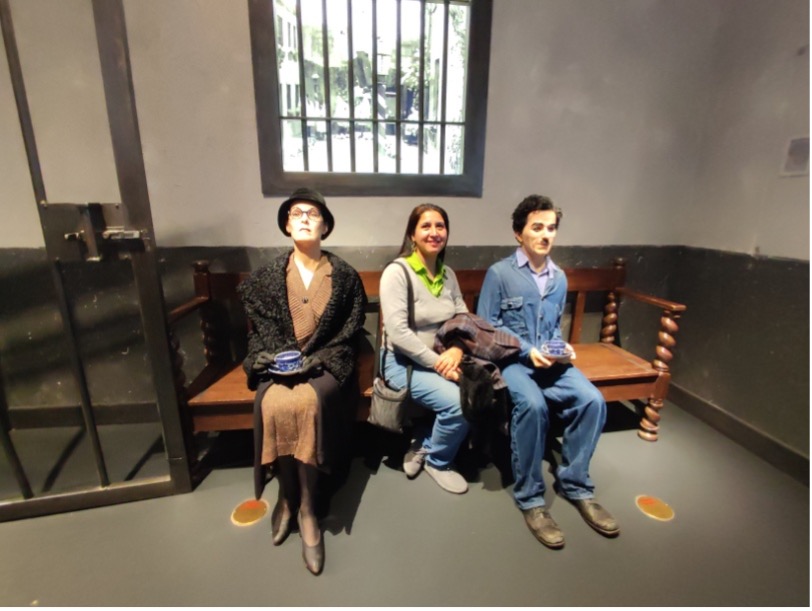
After the film ended, we were asked to move towards the screen. Suddenly, the screen disappeared and lo and behold, I found myself on a beautifully recreated set from The Kid. We were prompted to go behind the set, and to my bewilderment, what followed was one set after another – The Great Dictator, City Lights, Gold Rush, Limelight, A King in New York, whew! It was such a delight to go through those sets, to see the wax figurines, to sit on the chair from The Gold Rush with Charlie peeping from under a table, to pose next to Charlie in my own bowler’s hat, to sit on the jail bench next to him, to be swallowed by the giant machine from Modern Times. Mercifully, my camera behaved throughout the studio visit and I took many keepsake pictures. After a stroll through the beautiful grounds, I picked up some books, including Chaplin’s autobiography, and other memorabilia. I started reading the autobiography shortly after my visit and it reaffirmed my views about Charlie.

During my visit and afterwards, I got a lot of time to reflect upon how Chaplin’s films were deeply concerned with the human condition, with all the miseries and challenges brought upon it by events that the common man has no control over. Chaplin’s work includes The Gold Rush (1925), which drew from real-life events such as the Klondike Gold Rush and the Donner Party, and The Great Dictator(1940), a satire on Adolf Hitler. Limelight (1952), which depicted the frustration of a has-been comedian, can be classified as auto-fiction, as can The Kid (1921), while Modern Times has been hailed as an astute commentary on industrialisation. Levity was Chaplin’s forte, but all his films were deeply rooted in his political and social consciousness. More often than not, he had to pay a heavy price for sticking to his beliefs.

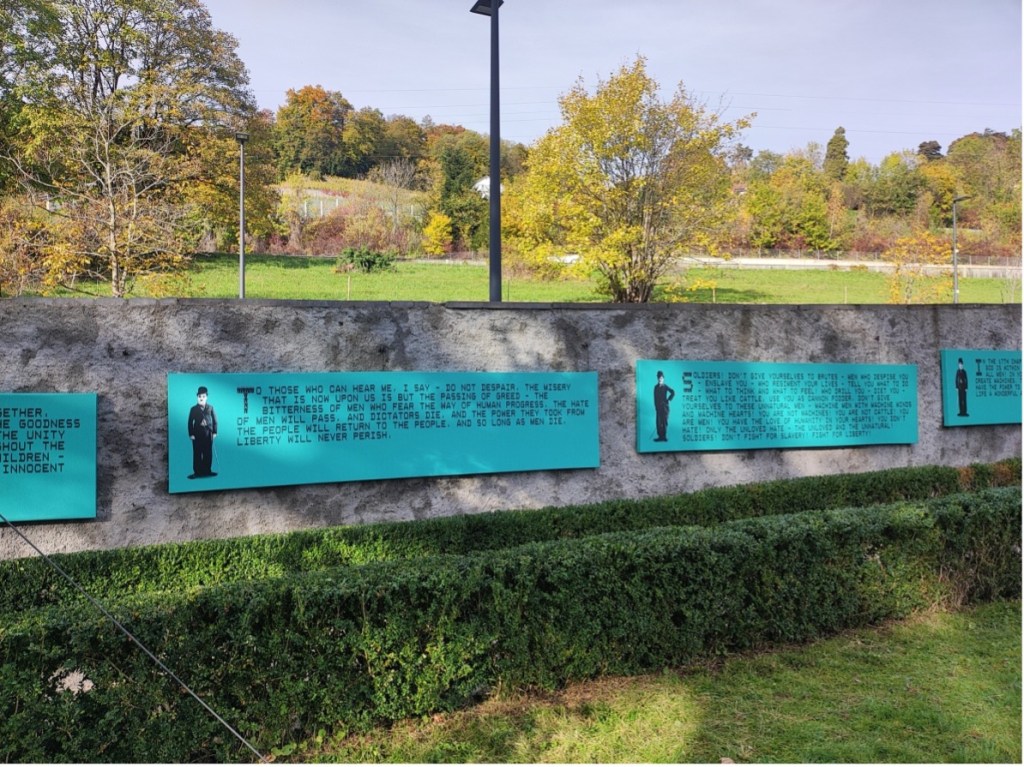
Recollecting the making of The Great Dictator, Charles says in his autobiography, “Halfway through, I began receiving alarming messages from United Artists … But I was determined to go ahead, for Hitler must be laughed at. Had I known of the actual horrors of the German concentration camps, I could not have made The Great Dictator; I could not have made fun of the homicidal insanity of the Nazis.”

The boundary wall of the Manor de Bain. The sounds of cow bells from across the road drifted towards the estate, making for a mesmerising setting.

Chaplin was a genius who understood the power of the audio-visual medium. Since pantomime was his greatest strength, having performed bit roles in theatres during his childhood days of great hardship and penury, he used this technique to convey pathos through humour. Although he was earning quite well as a comedian-writer-director in Hollywood, by 1919, he was so frustrated with the studio system, which did not give him a free hand to write his own scripts, that he co-founded United Artists along with Douglas Fairbanks, Mary Pickford and D.W. Griffith.

His first major hit under his own banner was The Kid, which drew from his childhood experiences. So strong were his convictions about the silent film that he swam against the tide and released City Lights in 1931, well after talkies had completely taken over Hollywood. Slowly, he started warming up to the possibilities of sound in film. He used sound effects in Modern Times but no spoken dialogue. He composed and sang a charming ditty in gibberish, ‘Titine’,with some random words in French, Italian and English thrown in, for Modern Times which never fails to bring a smile to the face, even eighty-seven years after its release

Whether it was silent films or talkies, Chaplin continued to tell his stories of universal values, of hope amidst great suffering. As an artist, he never shied away from speaking truth to power. Like most great artists, he did not accept manmade boundaries. Although he was English by birth, he was criticised for not fighting in World War I. He had long arguments with Winston Churchill about Mahatma Gandhi and the struggle of the Indian people for freedom. In fact, he met Gandhi-ji shortly after meeting Churchill, during a trip to London, and questioned him at length about his abhorrence for machinery. He returned from the meeting with great admiration for Gandhi-ji’s strategies for achieving independence and his principles of non-violence and truth. His conversation with Gandhi-ji influenced his writing of Modern Times, especially the Gandhian theory about modernisation and rapid industrialisation being the cause of unemployment and rising inequality. The fearless artist once made an uncharitable remark about the English royalty, telling Churchill, “I thought socialists were opposed to a monarchy”, to which Winston Churchill replied, with a laugh, “If you were in England, we’d cut your head off for that remark.”

Being wary of the ways of Hollywood where an artist was judged by his or her success at the box office, he made few friends in the film industry. Chaplin was happy spending time visiting his childhood haunts on his trips to London, and also enjoyed wining and dining with film stars, princes and princesses, prime ministers and presidents, scientists, philosophers, poets and writers. He was friends with Mary and Douglas Fairbanks, Albert Einstein, George Bernard Shaw, H.G.Wells, Harold Laski, Aldous Huxley, Theodore Dreiser, et al. He went to Lucerne in Switzerland to meet India’s first prime minister, Jawaharlal Nehru, expressing his surprise at finding him “a small man like myself”. Chaplin invited Pt Nehru to his estate in Vevey for a meal. They had a long chat on the way, which left Chaplin impressed with the “…man of moods, austere and sensitive, with an exceedingly alert and appraising mind”.

Chaplin was a pacifist and a philosopher, and was derided for his views in America – not just mocked, but harassed by the FBI under its founding director, J. Edgar Hoover. In 1952, the country which has historically been considered the land of free speech hounded Charlie out of its borders under the mistaken impression that he was an avowed communist, and told him to never come back. Chaplin even narrowly escaped an assassination attempt in Japan.

Chaplin’s autobiography ends in 1964, on a poignant yet hopeful note, just like Charlie’s films, with Chaplin expressing his sadness at having to leave America, but also describing his happy days in Switzerland, where he befriended several artists who lived in the area. Eight years later, in 1972, Charles Spencer Chaplin was called back to America by the Academy of Motion Picture Arts & Sciences to receive an Honorary Oscar. After initial hesitation, Chaplin decided to attend the ceremony, which would end his twenty-year exile from America. He went on to receive an unprecedented standing ovation lasting twelve minutes. Cries of “Bravo!” filled the auditorium and Chaplin was clearly overwhelmed. It was an emotional homecoming for the man who had left Los Angeles in extremely unpleasant circumstances in 1952.

Chaplin was knighted by Queen Elizabeth II in 1975, but by then he was frail and had to accept the honour in a wheelchair. He passed away in 1977, but his legacy lives on. I hope cine buffs like me keep rediscovering him, for The Tramp is timeless.

(The photographs have been provided by the author, except for the book cover)

Nirupama Kotru is an officer of the Indian Revenue Service,1992 batch. Ms.Kotru has served in the Income Tax Department at Mumbai, Chennai, Delhi and Pune. On deputation, she served as Director (e Governance) in Ministry of Corporate Affairs and as Director (Films) in M/o Information & Broadcasting, where she looked after policy issues such as censorship, India’s participation in film festivals abroad, archiving, film schools and production of films.

As Joint Secretary in Ministry of Culture she has looked after prestigious national akademis such as Sahitya Akademi and National School of Drama, and national museums such as Indian Museum and Victoria Memorial Hall &Museum. She is presently posted as Joint Secretary& Financial Advisor, Ministries of Coal, Mines & Minority Affairs. She has released an album of bhajans called Upasana. She has also written around thirty articles on cinema and other topics such as parenting. She is currently co-authoring an anthology on Hindi cinema of the 1970s.

.

PLEASE NOTE: ARTICLES CAN ONLY BE REPRODUCED IN OTHER SITES WITH DUE ACKNOWLEDGEMENT TO BORDERLESS JOURNAL. 

Click here to access the Borderless anthology, Monalisa No Longer Smiles

Click here to access Monalisa No Longer Smiles on Kindle Amazon International

Categories
Review

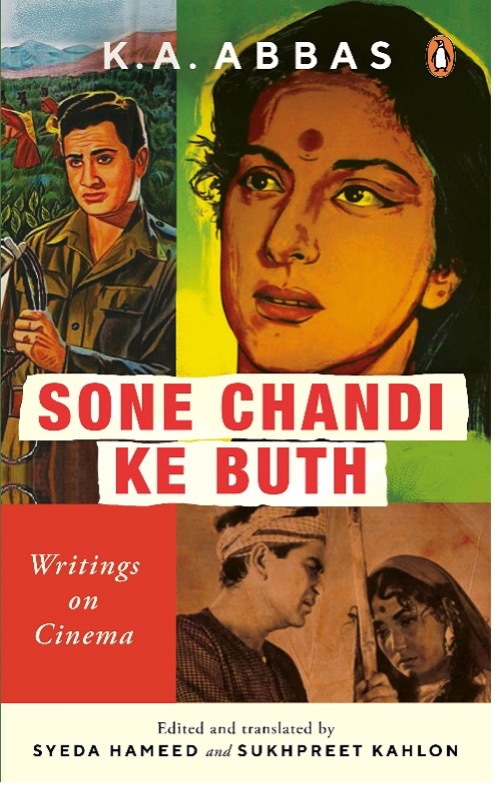
Writings on Cinema by KA Abbas

Book review by Gracy Samjetsabam

Title: Sone Chandi Ke Buth: Writings on Cinema

Author: K. A. Abbas

Editors and Translators: Syeda Hameed and Sukhpreet Kahlon

Publisher: Penguin Vintage

Khwaja Ahmed Abbas’s[1] Sone Chandi Ke Buth:[2]Writings on Cinema (2022), edited and translated by Syed Hameed and Sukhpreet Kahlon is truly, “an insider’s view of the ‘Sitaron Ki Duniya’[3]”.

The book is a constellation of Bollywood stories about moviemaking, film personalities, incidents, and fateful moments straight from the horse’s mouth. The book is divided into four sections – Funn Aur Funkaar[4], Kahaaniyaan[5], Articles, and Bombay Chronicle Articles. Abbas was often addressed as the “Human Dynamo” by his closest friends for his spontaneity and dexterity in churning out forms of expression such as short stories, novels, dramas, and films, which manifested whenever he pronounced, “Mujhe Kuch Kehna Hai[6]. He embodies a different time and sensibility, making the man and his work a treasure from the bygone days. Professor and scholar Ira Bhaskar aptly describes, “K. A. Abbas represents a crucial figure of the Indian modern who believed that critics and artists had a responsibility towards society.”      

K.A. Abbas, who was adept in Urdu, Hindi and English made the most of his multilingual skills to contribute thousands of articles on popular media including the longest-running weekly column, 46 years as a contributor in Blitz, writing for the Bombay Chronicle, 40 movies, short stories, and 74 books in 73 years. Sone Chandi ke Buth (2022) is Abbas’s last book on filmi duniya, the world of movies. The book throws a glimpse into Abbas’s journey from the young and aspiring journalist who wrote paltry salaried publicity blurbs to a scriptwriter, filmmaker and film critic of great repute  who made a tradition of his own offering “love” for the art and to everyone who lovingly called him “KAA”. Bollywood’s Big B, the Mahanayak[7], the megastar fondly admires Abbas’s “unrelenting spirit” and recalls, “K. A. Abbas gave me my first film, Saat Hindustani. I call him Mamujan.”

Syeda Hameed and Sukhpreet Kahlon labelled Sone Chandi ke Buth (2022) as “adhbudh[8]”, for the book is a testimony of the contribution of the man and his craftmanship. Coming from a family of poets and writers, Abbas walked along with the stars of the industries in its golden and the silver eras and yet was a man who could make jokes of himself, give sincere criticism on the quality of an artist’s work or the movie, speak of Bollywood as a unifying factor of pluralism in India, and suggest the importance of understanding truth for a greater cause. Intelligently and humorously, the book opens a window to fascinating instances and anecdotes of his life experiences and his encounters with the people who made history in the world of movies in India via Bollywood that were crucial to the industry or the personalities. With each turn of the pages, the narrative unravels interesting stories and junctures like how in writing about V Shantaram, whom he calls “Sadabahar” or evergreen, he goes on to describe his “crashing” into the world of film and becoming a film critic through film publicity, how his editor’s advice at the Bombay Chronicle opened his wings of  liberty to be critical but to do it prudently.

Drawing a fine veil between the reel life and the real life of the people with whom he manoeuvred in the film industry, the book “revealed more than concealed” the human aspects of greatness and flaws of each amidst their roles as heroes, villains or side characters in the movies. The book is filled with incredible stories of towering Bollywood personalities through Abbas’s eyes. Revelations in the section “Funn and Funkaar” captivatingly describe why he referred to V Shantaram as “The Evergreen Filmmaker”, Prithviraj Kapoor as “The Shahenshah[9]”, Raj Kapoor as “An extraordinary Karmayogi[10]”, Dilip Kumar as “Loss of a national treasure”, Meena Kumari as “The Muse of Ghazals”, Balraj Shani as “The People’s Artist”, Amitabh Bachchan as “Himmatwala[11]”, Sahir Ludhianvi as “The Lover and the Beloved”, Rajinder Singh Bedi as “The Guru”, and Satyajit Ray as “Mahapurush[12]”. The section “Kahaaniyan” sheds light on the ironies of the glamour and glitz in the film industry and on special days on the movie sets.

The section on “Articles” presents his thoughts on the relationship of filmmaking with business and its impact on society. Each article is a critical discussion of aspects of a good film, and he strongly opposes scripts that succumb to commercial sensibilities and powerfully voices the need for for “a good story” that “lies at the heart of a good film”. The section “Bombay Chronicles articles” compiles some of the finest articles of his passionate and flourishing days at the Bombay Chronicle in the 1930s as a film journalist. The articles in the concluding section continue to bring forth memorable facets of the world of films in India of the man and his times, and at the same time keep the spirit of enquiry burning in all movie enthusiasts and scholars to reflect on how much has changed over the years. Sone Chandi ke Buth brings into play Abbas, the man, the artiste and his style to showcase what a perfect blend of the head and the heart can do in film making.

If you are looking for a must-have book on Bollywood, filmmaking and movie criticism, then Sone Chandi ke Buth offers you an ample amount of it and more. Timeless memories of photos of the movies: Awara[13] (1951), written by him; Anhonee[14] (1952), a film he made on Nargis’s request; Rahi[15] (1953), a movie based on Mulk Raj Anand’s Two Leaves and a Bud starring Dev Anand and Nalini and Jaywant; Munna (1954), the first songless film of Indian cinema under the Naya Sansar banner; Pardesi [16](1957), the first Indo-Soviet production in a collaborative work of the Naya Sansar banner and Mosfilm Studio; Char Dil Char Rahein [17](1959), Abbas’s first multi-starrer movie; Chaar Shehar Ek Kahani[18] (1968), Abbas’s best-known political documentary; Saat Hindustani [19](1969), a movie on comradeship; and also, personal photos of Abbas’s self,  with his family and on film sets, enhances the aesthetic of the book.

The book has a phenomenally exciting set of stories about the famous and the lesser known faces of the movie industry in India, as people with ordinary life and circumstances amid their successes and failures. The translators and editors — his niece, Padmashri Syeda Hameed, an activist, educationist, writer and a former member of the Planning Commission of India, and Sukhpreet Kahlon, a researcher on cinema studies at the School of Arts and Aesthetics, Jawaharlal Nehru University — need to be thanked for collating these wonderful writings that touch our hearts while forging new bonds and links through the medium of films.

[1] Indian Film Director, 1914-1987

[2] Translates to: Statues of Gold and Silver

[3] World of stars

[4] Fun and Fun makers

[5] Stories

[6] I have to say something

[7] The great actor, refers to Amitabh Bachchan

[8] Amazing

[9] The Emperor

[10] A person who believes the ultimate panacea lies in devotion to work

[11] Courageous

[12] Superman

[13] The Vagabond

[14] The Untoward

[15] Traveler

[16] Foreigner

[17] Four Hearts, Four Paths

[18] Four towns, One story

[19] Seven Hindustanis

.

Gracy Samjetsabam  is a freelance writer and copy editor. Her interest is in Indian English Writings, Comparative Literature, Gender Studies, Culture Studies, and World Literature. 

.

PLEASE NOTE: ARTICLES CAN ONLY BE REPRODUCED IN OTHER SITES WITH DUE ACKNOWLEDGEMENT TO BORDERLESS JOURNAL

Click here to access the Borderless anthology, Monalisa No Longer Smiles

Categories
Review

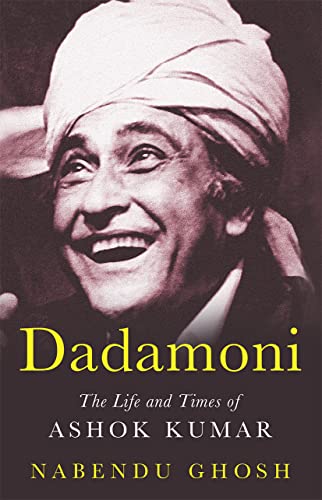
The Life and Times of Ashok Kumar by Nabendu Ghosh

Reviewed by Indrasish Banerjee

Title: Dadamoni: The Life and Times of Ashok Kumar

Author: Nabendu Ghosh

Publisher: Speaking Tiger Books

Dadamoni: The Life and Times of Ashok Kumar by Nabendu Ghosh (1917-2007) is a reflection on the Hindi film industry as much as it’s a biography of the legendary actor.  An eminent scriptwriter in Bollywood and director, Ghosh was an award-winning Bengali writer whose oeuvre of work includes thirty novels and fifteen collections of short stories. As a script writer, he wrote the scripts in Hindi for iconic films like Devdas, Bandini, Sujata, Parineeta and many more.

Ashok Kumar (1911-2001) was a part of both the small and the big screen in India while he lived. Was Ashok Kumar a star? What was his position in the Hindi film industry? When did he become a character actor? Was he a good actor? These questions are very easy to answer about others but when it comes to ‘Dadamoni’, as he was fondly called, the answers become nebulous.

Ashok Kumar started his career in the early 1930s which makes him senior to stars like Raj Kapoor, Dilip Kumar and Dev Anand who made their debuts and attained stardom when Ashok Kumar was already a reigning star. Ghosh knew Ashok Kumar personally for many years. And the personal touch comes through in many places – through anecdotes and because of the regard that shines through the narrative. The jokes that Ashok Kumar cracked from time to time, the things the thespian told the author, all find place in the book. There is also a visible attempt to protect Dadamoni’s reputation against any allegation of vices generally attributed to stars. Ghosh, who had gone to Bombay as part of Bimal Roy’s team, constantly tries to establish Dadamoni as a gentle, thoughtful and educated person.

But this gentle, thoughtful and educated person didn’t have it easy in the world of films. Ashok Kumar had a shaky start. A shy and retiring person, he had gone to Bombay while studying to become a lawyer in Calcutta — to become a director. The ambition was idealistically driven – films, a new medium then, could be a means of educating people. But fate intervened. The person supposed to play the hero’s role in Achhut Kanya (Untouchable Maiden, 1936) had gone missing and the search for a replacement was on.

One day, Ashok Kumar, an employee of Bombay Talkies then, discovered the owner of the studio, Himanshu Rai, quizzically looking at him. Rai had found the replacement for the hero of Achhut Kanya. But for the hero, it was beyond belief that he could act in a movie. The most endearing part of the book is how this diffident hero finds his footing in the industry becoming its earliest and biggest star. And the most poignant part is the gradual decline and death of the studio system even as its product – Ashok Kumar – rose to new heights.

As the narrative draws to a close, one is left wondering what is Ashok Kumar’s position in the legion of Bollywood stars? This has been answered exhaustively in the ‘Afterword’ by Ratnottama Sengupta, eminent film critic and Ghosh’s daughter, who brings in not only personal lore but also her own experience. She tells us Ashok Kumar served “as a textbook for actors wanting to perfect characterisations, voice control, timing, gestures postures” and that he transformed “the acting style in Indian cinema from theatrical to naturalistic – which is still the cinema language worldwide.”

Naming him the “Elder brother of the industry”, Sengupta asserts, “I’d say he is the one personality who symbolises Indian cinema’s journey from Bombay Talkies to Bollywood.” She brings in his stories of interactions with film stars, his hits and directorial ventures, his launching of major actors and his deep links with them, including his acclaimed brother, Kishore Kumar, with more anecdotes from multiple eminent actors like Shammi Kapoor, Moushumi Chatterjee, David Lean and his associates and family ties that stretch to embrace actors from different religion and race. Bharti Jaffrey, Ashok Kumar’s daughter, who has written a heartfelt forward for this edition, is married to actor Saeed Jaffrey’s elder brother.

What makes this book unique is that Ghosh wrote this book in English himself and it has been republished posthumously[1] with the addition of a forward and an exhaustive afterword by the well-known daughters of the two film icons. It also has classic photographs of Ashok Kumar. Both the emotionally charged forward by award-winning actress Bharti Jaffrey, and the afterword by Sengupta, a national film award-winning journalist, explore further the enigma that was Ashok Kumar. By the end of the ‘Afterword’, one realises how deeply tied and organic are the Bollywood families and how much they do to try and create bridges and close gaps – the Ashok Kumar Foundation being one such effort. The whole package – the forward, the narrative, the photographs and the afterword — leaves one spellbound.  

CLICK HERE TO READ THE BOOK EXCERPT


[1] First published in 1995 by Harper Collins – mentioned in the ‘Preface’ written by Ghosh in 1995 and reproduced in this edition published by Speaking Tiger Books.

.

Indrasish Banerjee has been writing and publishing his works for quite some time. He has published in Indian dailies like Hindustan Times and Pioneer, and Café Dissensus, a literary magazine. Indrasish is also a book reviewer with Readsy Discovery. Indrasish stays and works in Bangalore, India. 

.

PLEASE NOTE: ARTICLES CAN ONLY BE REPRODUCED IN OTHER SITES WITH DUE ACKNOWLEDGEMENT TO BORDERLESS JOURNAL

Categories
Interview

Shantanu Ray Chaudhuri: A Seeker of Serendipity

In conversation with Shantanu Ray Chaudhuri

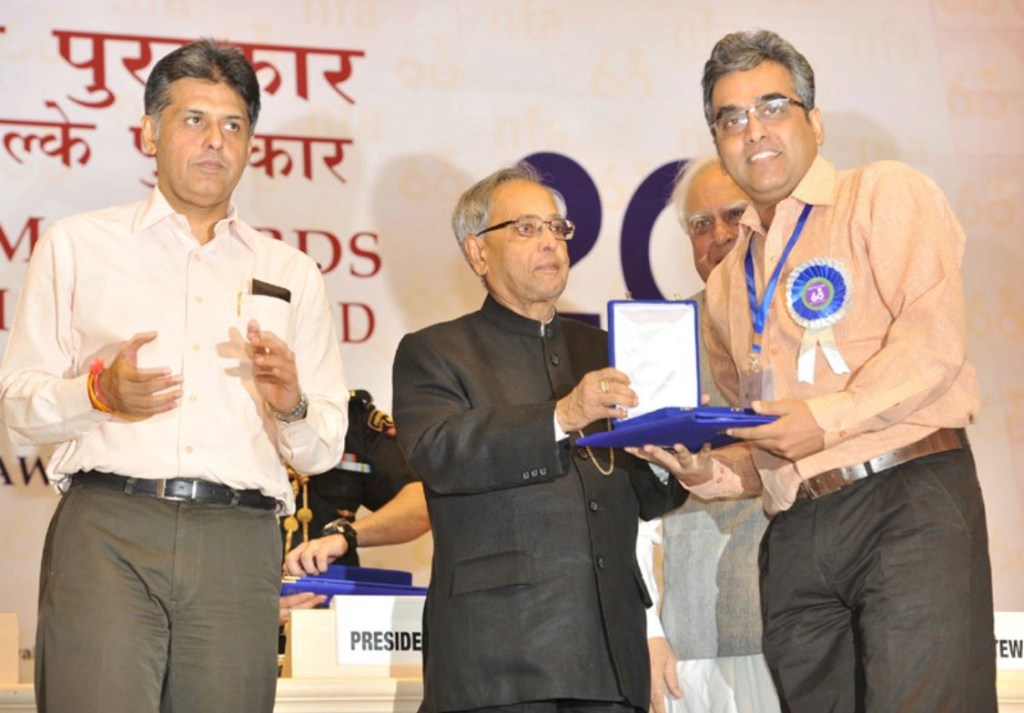
Indian President Pranab Mukherjee presents the Swarna Kamal Award to Shantanu Ray Chaudhuri at the 60th National Film Awards ceremony in New Delhi in 2013. Photo provided by Shantanu Ray Chaudhuri

Sandman, the mythical dream maker from Scandinavia, is said to sprinkle magical sand on sleeping children’s eyes to inspire beautiful dreams. What could Sandman have in common with a much-fêted editor who has worked with many celluloid stars and writers?

They both vend dreams – one makes dreams for children and the other is tries to fulfil dreams of writers attempting to create a beautiful book. Meet one such seeker of serendipity Shantanu Ray Chaudhuri, an eminent award-winning editor, who has brought out books on and by film personalities of India as well as assisted less-known writers find a footing in the tough world of traditional publishing. His magical sand is impeccable editing and an open outlook that stretches beyond the superficial glitter of fame and delves deep to look for that hidden well from which he draws out the best in a writer.

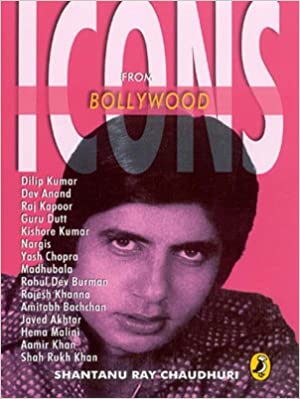
Books commissioned and edited by him have won the National Award for Best Book on Cinema twice and the inaugural MAMI (Mumbai Academy of Moving Images) Award for Best Writing on Cinema. In 2017, he was named Editor of the Year by the apex publishing body, Publishing Next. He has worked with famed writers like Gulzar and Arun Shourie as well as Bollywood stars like Rishi Kapoor and with the prestigious Satyajit Ray Archives. He has a book called Icons from Bollywood (2005) with Penguin on films, a set of fifteen essays. And he writes wonderful pieces on films for various sites like Cinemaazi, an archival film website,  and Free Press Journal regularly.

But, Ray Chaudhuri is not just a film buff as he tells the world. He has a well-kept secret like ABBA’s ‘Nina Pretty Ballerina’, who would wear dancing shoes after work and turn into a phenomenon. He emotes beautiful poetry but hesitates to publish…He does have a book of verses though called Whims brought out by the Writers’ Workshop. In this exclusive, Ray Chaudhuri, who has worked in Penguin and Harper Collins and now is the Editor-in-Chief of Om Books International, tells us how he turned from a dry accountant to a seeker of serendipity and what it takes to publish with traditional publishers.

Please tell us what started you out on your journey as an editor and writer.

I have always loved the word serendipity. It accounts for whatever good I have experienced. I loved reading of course but went on to become an accidental editor. I started very early – loved books. Went through the age-specific lists – Hardy Boys, Alfred Hitchcock and The Three Investigators, and Tintin (which I love still), then slowly to Conan Doyle and Agatha Christie and P.G. Wodehouse, Satyajit Ray, Feluda and Shonku, Somerset Maugham, Camus and others.

In fact, I remember, during summer vacations, my mashis [aunts] would often ask to pluck grey hair from their heads and would pay me at Re 1 per hair. So, if I managed 25, I would have money to buy a Tintin. Or novels that were sold in second-hand shops at Rs 10-15. I wanted to study literature and humanities but at the time the stream was looked down upon. People whose opinions we respected kept saying, ‘Will you be a schoolteacher after studying humanities?’ I wish I had said yes at the time.

Anyway… Science I was sure I wouldn’t take. And humanities I wasn’t allowed to. So, I took up commerce, graduated, did my M.Com, studied for chartered accountancy and cost accountancy. Then for years worked in accounts and finance. And hated it. I would leave jobs and go off quite regularly.

Meanwhile, I had started writing poems and on films (as a means of escaping the drudgery of accounts and finance). These were published in magazines regularly. In fact, I won the Filmfare Best Review Award that they had every month a few times. Then, Writers Workshop published my first book of poems. And by this time, nearing thirty, I had had enough of accounts. I realised that any creativity in accounts would lead to jail! And I was damned if I could put up with another day of matching debits and credits. I enrolled for a mass communication course at XIC Mumbai, then started a magazine on cinema on my own, and subsequently moved to publishing and editorial.

What pushed you into publishing others over writing yourself for we can see you are an excellent writer too?

I have often asked myself: do I have anything to say that will make a difference to someone reading? Can I ever write an opening sentence as eloquent as Camus’s The Outsider? Or create a character like Larry Darrel in Maugham’s Razor’s Edge? Or one line like Rilke’s ‘For the Sake of a Single Poem’. Or, in fact, a draft of an unpublished novel a young friend of mine, Ramona Sen, asked me to read recently to comment on editorially – it is so good … could well be the next big thing in publishing. And the answer has always been ‘no’.

I look at what goes for writing today. It dismays me that books have become all about posting your picture with the cover and getting likes – it has to be more than getting FB likes, more than announcing your book as bestseller on social media. I would be mortified about unleashing anything as mediocre as these on anyone.

And then there’s also the question of what being a ‘writer’ means for you as an individual. Some of these authors and poets I meet are so conceited … I have doubts about myself as a person … you know, as Matthew 16:26 says: For what will it profit a man if he gains the whole world and forfeits his soul? These doubts about whether my writing amounts to anything, whether it says anything about me as a person have kept me from writing and more importantly publishing my writing – barring of course my columns and features on cinema.

Editing and publishing other people’s work is more impersonal – I can keep myself out of the equation. Though when you really like a book, you do tend to get emotionally involved.

You have authored a book of poems, Whims, and Icons from Bollywood. Tell us about these.

I guess both came off just like that – I wonder if there was a case of wanting to show off at the time I had published them. Today, I would think twice. The book of poems, Whims, was published by Writers Workshop, and I was rather proud at one time that Professor Lal deemed it worthy of being published. I often told myself that some of the best Indian poets began with Writers Workshop. I just sent it off to him on a whim.

Icons from Bollywood was a more organised affair. I was working at Penguin at the time. Its children division was doing a series of books on icons – the arts, science, music, etc. Since everyone knew my interest in cinema, I had even met a few of the icons, the publisher, Sayoni Basu, asked me and I agreed. Eventually as no two people could agree on the ten names for the book – all the books in the series had ten icons – this ended up having fifteen names, the only book in the series with fifteen essays. It did rather well, got some good reviews in Dawn and Guardian and a few others.

Is authoring a book more challenging than editing and publishing for another? Or is it the other way? Please elucidate.

Of course, writing a book is more challenging. When you edit, you are working on adding some value to what a writer has already put down. You are not creating the world. At best, you help the author develop his work. It is challenging because often you are the first reader outside the author’s circle and your opinion also shapes the book. But writing is way more difficult. You are literally creating something out of nothing. Even writing a single line of good poetry is tougher than editing.

Tell us what moves your muse for poetry and prose?

That’s tough. It could be anything. For instance, in my college days DTC buses used to have a single passenger seat right at the front. I would often look at it and imagine how lonely it might feel. I eventually wrote a poem on that. Or when my folks narrated the story of Gulzar’s film Lekin to me, I was moved enough to write a poem. The sight of a battered old man, dead-drunk, lying by the roadside led to a story – what if that man had a past when there was hope and love in his life. Being in love has been a muse: I once wrote 21 poems for a beloved friend’s twenty-first birthday. The sight of my son’s sleeping face, his soft breathing, when I wake up at night and look at him. Even hate inspires you. The sense of disillusionment I felt about a ‘great’ poet’s pettiness and hypocrisy led to one of my best poems. My own frailties. The light at dusk, a tired day going to sleep. Lost friends … lost ideals. A good film. A bad film. Anything really.

We have read a lot of film pieces by you. When did your interest in writing for cinema start and how did it take off? Did it ever stray to film industries in other countries?

I think the love for cinema developed once I started studying commerce. The subjects bored me. Films offered me an escape. It helped that there were 4-5 cinema halls within walking distance of both my home and my college. I would often get away from college and make my way to a theatre. In the three years of graduation, I watched 169 films in halls. I watched the first-day-first-show, 12-3, and then would make my way to the evening one 6-9. I used to make a list and write down synopsis of what I felt. This was the 1980s, theatres were in awful shape, a really bad time for films and so most of what I watched were utter crap. But that was a lesson in itself. And I really enjoyed the escape to another world, even if a trashy one.

Slowly, with the coming of cable TV, there were more options. The VCR had come in and with that a few more options. Pirated prints from Palika Bazar. I had meanwhile written a few reviews for Filmfare and won a series of best review awards. That boosted my confidence in both my writing and my understanding of cinema. I also did a course in film and TV from the XIC, Mumbai. I started contributing to journals. I ran and wrote for the journal I started in Bombay, Lights Camera Action. But things took off after I started writing on Bengali cinema for Film Companion. And then with my association with Cinemaazi. I must thank Anupama Chopra and Sumant Batra for this. Couldn’t have happened without them.

I publish primarily on Bengali and Hindi cinema but write on a lot of international films for my own self. It’s tough finding time to watch, write, while keeping to the demands of a regular job and other freelancing assignments that one needs to do to keep the home fires burning. I envy the people who have money to spare, don’t have to worry about a job, and can keep churning out books.

Please tell us a bit about Cinemaazi – is it a website founded by you? It seems to be an archive, there is mention of an encyclopaedia?

Cinemaazi is the kind of serendipity I have been looking for as editor and film lover. It’s an initiative to document the history of Indian cinema across languages under the umbrella project Indian Cinema Heritage Foundation, a public charitable trust. The Foundation is also creating a freely accessible digital archive and encyclopaedia of Indian cinema and its people. No, I am not the founder. It’s entirely the brainchild and vision of Sumant and Asha Batra. Sumant is the kind of collector you can only be in awe of. I met him first at the Kumaon Lit Fest that he runs. And we shared a common love of cinema. In 2019, he started talking of a site to document the history of Hindi films, using his huge collection of film memorabilia. My only contribution, if you could call it that, was suggesting we make it a site on pan-Indian cinema, not just Hindi. He agreed and I worked on getting some material on Bengali and some other languages. Also kept contributing to it with articles and some video essays – we did a six-hour-long oral history project with Dhritiman Chatterjee. Cinemaazi got off to a very good start in January 2020. But by March 2020 we were all locking down. And it affected an endeavour taking its first steps. But it kept on working thanks to a small dedicated team. And now it’s poised to take off in a big way. I would have been very happy to engage in a bigger way with Cinemaazi, but as Sumant says, ‘he can’t afford me’, whatever that might mean. Sigh! I guess one ceases to be useful after a time. I am happy to have been a part of it in a small way in its first years.

You have worked with many icons of the Indian film industry like Rishi Kapoor, Satyajit Ray, Gulzar. Please share with us a few of your more interesting experiences.

The big names I worked with like Gulzar and Rishi Kapoor and Arun Shourie were like perks of the job. Yes, they were FB like/share moments except that I seldom shared those days. I miss Rishi-ji a lot … and often go through the WhatsApp messages he sent me… With Gulzar-ji, it was all about poetry and translations. Never worked on a book of films with him, though I did commission a series of monographs on three of his films that came out after I had left the publishing house.

Shantanu Ray Chaudhuri in conversation with Gulzar and Meghna (Gulzar’s daughter) in Jaipur Literary Festival

The Satyajit Ray association was immensely satisfying. We ended up publishing five very rare books that I think not many editors would have dared to – imagine doing a book on Satyajit Ray’s unmade film on Ravi Shankar! The ones I really enjoyed were the first-time authors I was privileged to publish, people like Balaji Vittal, Anirudh Bhattacharya, Akshay Manwani, Rakesh Bakshi, Parthajit Baruah … and so many. They had no reason to trust me as editor and publisher. I have never been a big-name editor. But to have had them trust me with their books, books that did well, was quite humbling.

I was privileged to have someone like Vishal Bhardwaj trust me with his first book of poems in English. And through Vishal, I came to know Rekha and worked on a series of festival appearances with her – she has so many stories that she should do a book. With Sharmila Tagore, I worked on a book on Mansur Pataudi that did very well. Authors like Krishna Shastri, Sathya Saran and Gajra Kottary became close friends. Rakhshanda Jalil … whom I love and admire – she did a wonderful book on Shahryar with me and a couple of other translations of Gulzar and Kaifi Azmi. There was Nasreen Munni Kabir and her book on Zakir Hussain…

The more interesting encounters are the ones that ended badly. An author, who again published first with me and went on to publish 4 more, turned on me because I took on his rabid right-wing wife on the CAA and their obnoxious reference to ‘urban naxals’ … I was abused and received a lot of threatening messages and calls … I lost a friend and an author, but I am glad I could take a stand on a matter on which many of our ‘liberal’ friends and authors remain silent. Another ‘great’ poet, someone I considered God, turned out to have feet of clay and whose behaviour I find traumatic even today. But those are for my memoir! They taught me a better lesson than anything else could.

You have worked with big multinational names like Penguin and HarperCollins and even brought out collection of books on films. And now you have moved to working with one of the oldest and most iconic publishers from India. Is the experience any different?

Well, the best thing about not being with an MNC is that one is not part of the toxic environment they breed. It was killing after a point. And often they wouldn’t take on an idea just to spite you, even though some of the books that got commissioned were unbelievably bad, had me scratching my head, wondering what I had missed. And they can be very demeaning to authors. And short-sighted too. I remember signing up Rahul Rawail’s memoir of Raj Kapoor. And the publishing house actually reneged on its commitment after sending him an offer. It put me in such a bad place with him. Thankfully, I could get him another MNC publisher. And the book is now getting such rave reviews.

Yes, it’s challenging working in a smaller space. You have nothing going for marketing –  not that the biggies do anything much on this either, unless you are already a big name which makes it easy to market. Then you don’t have budgets for advances and for marketing. So, immediately your commissioning acquires a different take. But that also makes you look for good young talent. I am glad I have found quite a few, thanks to agents like Suhail Mathur and some goodwill I might have built up in the last few years. Authors I am sure I wouldn’t have been allowed to publish in the MNCs. Now, whether they sell and work in the market is a gamble.

Writers find it challenging to use traditional publishing. In an attempt to make their writing visible, many are turning to self-publishing and publishing with independent small publishers. What do you think of this trend?

I think it does take a little more time in going the traditional publishing route. Self-publishing is quicker. But then authors also need to be patient. Traditional publishing can give them benefits of a good editor. Give them more time to polish their text. However, it seems more and more authors are in too much of a rush to publish. Getting FB likes and shares is more important than working on your text. Authors don’t feel like they need good editorial intervention. Publishing is all that matters, whatever be the quality of writing.

Unfortunately, traditional publishing too has failed to give good editorial inputs. Some of the stuff I read by the MNC publishers are atrocious. I think everyone wants a book out too quick. When I started out as an editor, we had months to work on a book. These days, authors tend to ask for a marketing plan even before they have completed the first draft of the text. And publishers are only too willing to get on the treadmill. And the post-publication efforts of MNCs also operate on the 90-10 principle: 90 per cent of marketing budget is spent on 10 per cent of the biggies. So, I guess self-publishing works. Some of the most successful mass-market writers we have today started with vanity or self-publishing, then were picked up by the traditional publishers. And the writing continues to be as bad.

Can you tell us as a publisher, what do you look for when you accept or reject a piece of writing?

I don’t think any publisher has figured out what makes a book work. Most of them go by herd mentality: mythologicals are selling, let’s do them, in trilogies, since it’s fashionable these days. Short stories don’t work. Fitness/self-help, yes, let’s do. 

Basically, one looks for (i) is the content engaging (ii) is the writing interesting. Take, Akshay’s book on Sahir … I found the content wonderful. And so well done. Or Balaji-Anirudh’s book on RD Burman … the research was impeccable. And though people were sceptical, saying these people had been dead for decades, one felt that these books had that special something. Or more recently, the anthology on motherhood that Om is publishing. I was immediately interested in the theme and the variety of essays on offer – to have Kamala Das and Mannu Bhandari, Shashi Deshpande and Shabana Azmi between the same covers is…. There’s a collection of essays on the pandemic that I have commissioned, coming out soon – again, from Shashi Tharoor and Vidya Balan to an anonymous gravedigger and migrant worker – the range is incredible. The book that we are doing with Borderless Journal, for example. What a wide variety of international writing! Or the book on cybersecurity. Or for that matter, Suman Ghosh’s Soumitra Chatterjee book, which gave some fascinating insights to the director-actor relationship. I knew people would think it niche, but what if we could make it big? It has the potential.

Thank you for that. What is your vision as a publisher and writer of the future of publishing and writing?

I am too small fry to talk of the future of publishing. It’s a tough time for publishers. At the end of the day, all those 500 likes on FB won’t help if those liking don’t buy books. Social media reach is no guarantee of either good writing or good sales.

The way Westland folded says a lot about how untenable big advances are. Authors must realise that. While publishers must make efforts to sell more of the books they publish so that even if advances are small, the royalty on sales works out.

I think there’s also a lot of snobbery around English-language publishing in India. On the part of publishers, authors, translators, agents, literary festivals. I know an agent, one of India’s most successful, who doesn’t deign to pitch books to me because I am not with the top MNC publishers. Though apart from a hefty advance, there is nothing I cannot deliver that the biggies can. One of the most popular cover designers, who worked closely with me when I was at Penguin and Harper, just put me out to dry when I approached him for a cover on the Soumitra Chatterjee book. He couldn’t be bothered even to respond given that I was with a smaller publisher now. The most popular translator won’t give me time of day, though I edited his/her first book. There’s this author couple I published after both their individual books had been rejected at other publishers. But once they realised that prosperity lay in ingratiating themselves with what they perceived were other more popular and powerful editors … though none of their books have worked in terms of sales so far in the last ten years.

Most editors I have come across give off vibes like they are god’s gift to the language. I mean, not even two per cent of the population engages with the work you do. What are we so uppity about? The local cobbler attends to more people than what your average book gets as readers.

And this snobbery impacts the kind of publishing we do. We are suckers for big names, big advances. We have to move out of that. And out of this herd mentality of publishing. Give new writers, new themes a chance. At the same time, new young authors need to reflect on their work and not rush into becoming a ‘published’ author. It’s not instant noodles or coffee. Books and authors take time to develop. We need to give books that time.

Thank you for giving us your time and also taking on our anthology.

Click here to read poems by Shantanu Ray Chaudhuri

(This is an online interview conducted by Mitali Chakravarty.)

PLEASE NOTE: ARTICLES CAN ONLY BE REPRODUCED IN OTHER SITES WITH DUE ACKNOWLEDGEMENT TO BORDERLESS JOURNAL

Categories
A Special Tribute

Dilip Kumar: Kohinoor-e-Hind

In a tribute to Bollywood legend Dileep Kumar or Yusuf Khan in real life, Ratnottama Sengupta, one of India’s most iconic arts journalist, time-travels to the days when the ‘Fankar-e-Azam’ – the great actor – sprinted about on the sets of Bombay’s studios …spiced up with fragments from the autobiography of Sengupta’s father, famed screenwriter and litterateur, Nabendu Ghosh

“Actually the quality of a performer is also measured by the contrast that he can handle. To do something different, to be humorous, and intimidating, and also to make them feel sorry for you… that is the way people like you.” – Dilip Kumar

On 7thJuly, 2021, I was at a loss — in trying to think of an epithet for the thespian who had just passed away.  So am I now, in deciding where I should start my recollections of the deathless legend. For, Dilip Kumar was already B-I-G when I started understanding the word ‘Cinema’.

I was born in 1955 — the year of Satyajit Ray’s Pather Panchali in Bengal, Bimal Roy’s Devdas in Hindi films, and also of Azad. Years would go before I learnt that Apu-Durga’s Song of the Road had placed India on the celluloid map of the world. Before I understood that my father, Nabendu Ghosh, had a hand in immortalizing Devdas by writing its screenplay – often dubbed ‘direction on paper.’ And before I observed this curious coincidence: Azad had released the same year as Devdas, the ode to undying, self-destructive love. Curious, because it brought the Monarch of Tragedy with Tragedienne, Meena Kumari, in order to create a comedy! A fun outing where a rich man, Azad, rescues Shobha from bandits; and when she decides to marry him, her family discovers Azad is the bandit.

1955 First release of Devdas . Photo provided by Ratnottama Sengupta

I became aware of this film only recently, while working on the song Apalam Chapalam – danced by Sayee and Subbulaxmi – for my underproduction documentary on Dance in Hindi Films. That number is a lesson for anyone studying dance. But aeon before I came to it, I would start dancing every time the Murphy radio in our Malad bungalow played Radha na boley na boley na boley re (Radha shan’t speak to Krishna).  I would pick up the hairband lying in front of our mirror, put it on and start swaying in a circular motion. I must have been about two-and-half. There was no television, no silver screen, no Meena Kumari in my life, only a radio. And it cast a spell with this song from Azad, one of the few comedies of Dilip Kumar, with Kohinoor and Ram Aur Shyam.

Years down the star actor had talked about distributors objecting to his playing a comic role. “’But people are used to seeing you in tragic roles… so you will die in the end, right?’ they would insist. ‘But I wanted to alter the image. I did not want to be stuck in one groove. There is a risk in breaking a familiar mould, but if people can anticipate you, that is the end of your mystery! So you must do something different each time, a departure from your familiar personality. You must work a little harder and change the chemistry of the personality’.” This could be the Bible for any actor if he plans to defy time.

Dilip Kumar captivated me with a dance which – like Meena Kumari’s in Azad – was no classical number, only robust, folksy Nain lar jai hey toh manwa ma kasak hoibey kari (When our eyes meet, I feel a pang in my heart). This was in Gunga Jumna (1960), produced by Dilip Kumar and directed by his mentor Nitin Bose. The star gustily dancing with a bunch of guys in dhoti – he was so spontaneous, so natural! This at a time when women danced but men dancing was seen as effeminate. Yes, the traditional dance gurus were male, but the movie idol had to be macho, so no dancing! Dance gurus were revered in life but on screen they were lampooned as in Padosan (The Next-door Neighbour, 1968). But he was so confident, suave you cannot but be infected by his joi de vivre.

The other thing about Gunga Jumna was its dialect.  The tongue he speaks — an admixture of Brajbhasha, Khaiboli, Awadhi, Bhojpuri — connects all our people in northern India. That may be why, when Amjad Khan was preparing to play Gabbar Singh, his lines garnished his dhobi’s (washerman’s) dialect with Gunga’s. Again, Lagaan (2001) returns to this tongue which Aamir Khan once more picks up as PK (2014), the alien who knows no earthly language of communication, from a street walker in a psychic manner, by simply holding her hand.

Dilip Kumar’s dialogue delivery was distinctly different from his other contemporaries, Raj Kapoor or Dev Anand. One had cultivated a generous dose of Charlie Chaplin in his mannerism; the other had to thank Gregory Peck for his angular tilt of head. Dilip Kumar’s controlled delivery, low and clear, probably stemmed from his admiration for Paul Muni. He whispered for the benefit of his lady love alone – how romantic! A person standing at an arm’s distance, and being addressed almost with reverence, at a time when so many of contemporaries had yet to cast off the theatrical manner of vociferous enunciation: this intensity charmed my mother’s generation of men and women and spilled over to actors of my preteen years – unabashedly they subscribed to the adage, ‘Imitation is the foremost form of adulation’.

When Joy, the worthy son of Bimal Roy, made his centenary tribute to his father, he had started by interviewing Nabendu Ghosh. In it, while talking about Devdas, the screenwriter says: “On the first day of shooting I saw Dilip Kumar loitering by himself, aloof, remote. So I asked him, ‘What’s the matter Yusuf Bhai? Every day you sit with us, talk to us, join us in our banter. Why are you so preoccupied today?’ He replied, ‘Woh teenon mere kandhe par baithey hain Nabendu Babu (those three are weighing me down like a burden on my shoulder).’ ‘Kaun teen (which three)?’ – I asked him. He replied, ‘Barua Saab, Saigal Saab, and Sarat Chandra.’” The first two legends had played Devdas (1935), Pramathesh Barua in Bengali and K L Saigal in Hindi, in New Theatre’s bilingual production, and Sarat Chandra Chatterjee (the author of Devdas) of course is the most translated author in India: Devdas alone has seen a dozen versions in as many languages if not more. Nabendu continued: “So I asked him, ‘What do you think of Sarat Chandra as a writer?’ And he replied, ‘He had divinity in his pen.’”

What a pithy appreciation of a literary master. Hardly surprising that Dilip Kumar was a major presence on the stage when the Sarat Centenary Celebrations were held in Bombay. Others present included Nitin Bose and Biraj Bahu Kamini Kaushal along with Sunil Gangopadhyay, then a young Turk who pooh-poohed the literary giant. Baba, having scripted Parineeta(1953), Devdas, Biraj Bahu(1954), Majhli Didi(Middle Sister, 1968) and Swami (later filmed by Basu Chatterjee), as much as due to his standing in Bengali literature, had chaired the unforgettable celebration.

 When Nabendu Ghosh was wondering about Yusuf Saab’s eloquent reticence, clearly the actor was in the process of pouring himself into the soul of the persona — or was he giving Devdas the stamp of Dilip Kumar? It was this total absorption that saw him transcend every known interpretation of the character and make his Devdas the abiding face of an indecisive, love-torn soul.  In an interview Dilip Kumar had said, “If I have to be convincing as a 30-year-old, I must familiarize myself with what he has gone through in the preceding 29 years.”

 However in another interview — this one, to renowned film critic, screenwriter and director, Khalid Mohamed — he had debunked method acting saying, “Yeh kis chidiya ka naam hai? What is this thing you call Method Acting?” Okay, so he did not learn – or unlearn – the acting technique of the Russian master Stanislavsky but he certainly believed in the ‘art of experiencing.’ He must have drawn on personal experiences or their memories to inform his characterization, the truth behind the persona who lived and loved in another space and time.  This I can say from my visit to the sets of Sungharsh (Clash,1968) directed by H S Rawail.            

 I can’t remember why I had gone there but I remember visiting with my father. The crew was busy preparing lights for the shot. This was the last film where Dilip Kumar was seen with Vyjayantimala: their first was Devdas, and included Gunga Jumna, Madhumati, Naya Daur, Paigham. I noticed him running round the sets, dressed in a dhoti with a gamchha tied round his waist. “Why is the hero working himself out of breath?” I’d wondered to myself.  I got the answer when they started the takes: the scene required him to run up, axe in hand, and breathlessly deliver a message.  The film based on Mahasweta Devi’s novel, Layli Aasmaner Aina (The Mirror of Layli Aasman), revolved around a courtesan and a thugee, and almost half a century later Baba wrote Sei Sab Kritantera (Those Gods of Death) which won him the Bankim Puraskar, about the cult of bandits. But circling back to Dilip Kumar, I find it astounding that a quarter century after his screen debut, the legend was preparing for the shot by physically running around!                 

No wonder he was so natural. Yet this perceptive actor did not skyrocket into fame with Jwar Bhata (Ebb and Flow, 1944), directed by Amiya Chakravarty, nor did Pratima, directed by Jairaj with music by Arun Mukherjee, do any good to his career. It was with Nitin Bose’s Milan (The Union), based on Tagore’s Naukadubi (The Wreck) and released on a Friday preceding 15tH August 1947, that his listless performance gained sparkle. Along with Jugnu (Fireflies), which was the highest grosser of the year, Milan laid the ground for the long innings of the resolved player. Small wonder, when he produced Gunga Jumna, he singled out his mentor to be the director.

All the three films, Jwar Bhata. Pratima and Milan were produced by Bombay Talkies, then being run by Devika Rani and Ashok Kumar. The popular pair of Achhut Kanya (The Untouchable Girl, 1936) was responsible for most decisions in the milestone production company that gave breaks to other majors of Indian cinema like Dev Anand, Gyan Mukherjee, B R Chopra, Sadat Hasan Manto. Ashok Kumar and Devika Rani had given Mohamed Yusuf Khan, the son of a Pathan dry fruits trader from Peshawar, his screen name. “Why did Yusuf Khan become Dilip Kumar?”  is a much asked question. To Khalid Mohamed the thespian had revealed, “The choice was between Jehangir and Dilip Kumar. The second seemed a better option because it sits easy on every tongue.” Many others have seen a different reason behind the change.

Ashok Kumar Ganguly was directed to lop off his family name at the instance of Franz Osten, the Bavarian director who partnered Himanshu Rai in the early years of Bombay Talkies, to make him more ‘Indian’ rather than a Bengali or a Brahmin. ‘Kumar’ – meaning, young prince – was, since then, included in their name by most actors — Uttam Kumar too. When Dilip Kumar debuted in mid-1940s, the national movement to free India from colonial harness was coming to a head — as was the crescendo for a separate political identity for the Muslim populace. In this scenario, many in the profession that depended on the support of maximum number of viewers, were opting for names that did not underscore their Islamic roots. Thus Mahjabeen Bano became Meena Kumari, Mumtaz Jehan Dehlavi became Madhubala, Nawab Bano was renamed Nimmi by Raj Kapoor, Nargis had started as Baby Rani, Hamid Ali Khan had assumed the name of Ajit. However, Dilip Kumar spawned many other clones. Thus, commenced the age of Pradeep Kumar, Rajendra Kumar, Manoj Kumar, Sanjeev Kumar, Akshay Kumar. And many tried to clone his histrionic abilities too!
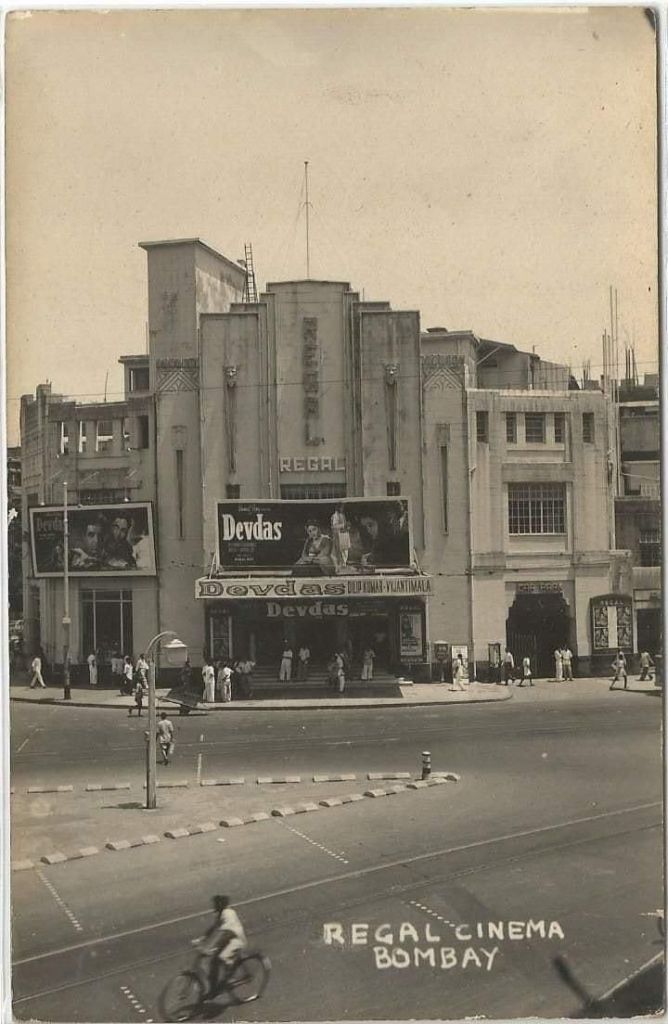
*

The year 1947 proved a turning point in the life of Dilip Kumar in so many ways. Mehboob Khan’s Andaz (Gesture,1949), his Aan (Pride) and Nitin Bose’s Deedar (A Glance), both released in1951, Amiya Chakravarty’s Daag (The Stain,1952), Bimal Roy’s Devdas, Yahudi (Jew), Madhumati,  K.Asif’s Mughal-e-Azam (1960) — all the films thereafter proved super hits. They also carried a message for the masses, be it against alcoholism, or war; in favour of fidelity in marriage, or unadulterated friendship. They turned the brooding hero into a popular idol. At a time, the country was rapidly industrializing, Naya Daur (New Age) focused on the conflict between modernity and tradition through a race between a tonga and a bus. Yahudi, through the love between the Jewess and the Roman prince, sent out a message of communal bonding.

Dilip Kumar, it is evident, kept pace with the transformation coming in the nation’s life. His own performance, his selection of roles all reflected this. That could be why Gunga Jumna by the family production house of Citizen Films, became a precursor in so many ways. I have already spoken about its dialect. Projecting dacoits in the central roles was another. Later decades saw dacoits being replaced by smugglers as villain, drag racketeers as the evil guys, terrorists as the despicable ones.  But the dacoit theme kept recurring through Mujhe Jeene Do (Let Me Live, 1963), Mera Gaon Mera Desh (My Village My Land, 1971), Sholay (Flames, 1975), Pratiggya(The Oath, 1975(, Ganga Ki Saugandh ( Swear by the Ganga, 1978), Bandit Queen (1994), Pan Singh Tomar (2010). More so, the keynote of two brothers on either side of law was to see many reincarnations – most remarkably in Deewar (The Wall), which turned Amitabh Bachchan into the legend he is. Years later Dilip Kumar teamed with Amitabh Bachchan to play father and son aligned on opposing sides of law – again, with amazing success.

The legend teaming with a younger icon was not something new for Dilip Kumar, nor would it be the last. Keeping pace with his growing years he had shared screen space with Anil Kapoor in Mashal (The Torch, 1980s), and with Naseeruddin Shah in Karma. Prior to Deewar he had appeared in Paari (1970s), a Bengali film, where the then rising star Dharmendra played the lead. This film was remade as Anokha Milan with the same cast. Likewise, Tapan Sinha’s Sagina Mahato (Bengali) was remade as Sagina (Hindi) with his wife Saira Banu opposite him.  This remains one of Dilip Kumar’s most significant performances — perhaps also his most ‘political’ incarnation on screen. Here he is a factory worker who becomes the first to stand up to the tyranny of the British bosses in the tea gardens on the Himalayan reaches of North Bengal. Once more he surprised us, his younger viewers, to whom he was nothing but a man named Sagina Mahato whose naivety was being cleverly exploited. I had seen both the Bengali and Hindi versions but I have no answer as to why the remake did not work a magic nationally. Dilip Kumar was, after all, a master of delivery in Hindi and Urdu, although his English too was flawless.

Dilip Kumar seems to have had a special equation with Bengal, which could have grown out of the fact that so many directors from Bengal dominated the Indian screen through 1940s, 1950s, 1960s, 1970s… in other words, the screen idol’s active years. I was won over by the charisma of the star in Madhumati, incarnated from a story by Ritwik Ghatak. He had penned the first draft of the immortal classic that continues to mesmerise viewers to this day, then he was summoned back to Kolkata to direct two of his own films, Bari Theke Paaliye (The Runaway) and Ajantrik( 1957). The final script was prepared by Bimal Roy, as was his practice, in conference with his team. As a part of this Nabendu Ghosh had worked on detailing the reincarnation film as Dilip Kumar himself revealed in the interview to Khalid Mohamed. I was simply enchanted by the actor’s screen presence. Here I was, growing up in the age of Rajesh Khanna and Amitabh Bachchan, remember? Yet I was compelled to surrender to the charm of this actor! The only other ‘Kumar’ who superseded his charm for me was Uttam Kumar – and both had started their screen journeys in 1940s – long before I was born! Madhumati itself was ‘born again’ – most successfully as Farah Khan’s Om Shanti Om (2007) but the enduring charm of Dilip Kumar as an engineer arriving the upper reaches of Kumaon Hills and losing himself amidst tribals remains matchless.

Baba (Nabendu Ghosh) also scripted Yahudi where Bimal Roy directed Dilip Kumar and Meena Kumari as the Roman prince and the Jewess who fall in love – endangering lives. In the Nehruvian era, it resonated with the values of secularism that the super actor himself enshrined. In his personal life, this saw Dilip Kumar align with the Congress. He donned the hat of the Sherif of Bombay (1980) and raised funds for causes, including for the physically challenged, through exhibition cricket matches. His commitment to the country’s constitutional framework saw him campaign in support of V P Singh — and later Manmohan Singh — as Prime Minister. Nominated to Rajya Sabha — the Upper House of Parliament — from 2000 to 2006, he served in Standing Committees that brought in amendments to Indian Medical Council Act 2006. He used his MP funds to restore Bandra Fort and improve the Bandra Promenade. These kept earning him laurels in India and beyond. The Dadasaheb Phalke Award winner was decorated as Padma Bhushan in (1991), Padma Vibhushan by the present Modi government in 2015, and — befittingly — accorded state honour at his funeral.

My most significant interaction with Dilip Kumar happened four decades after Yahudi – in 1999. Atal Behari Vajpayee was then the Prime Minister, and the Pakistan government was to confer their highest civilian award – Nishan-e-Imtiaz on the actor. In the wake of the Kargill infiltration and the ensuing war this was red rag to the right wingers. Shiv Sena had laid siege outside the thespian’s Pali Hill mansion, objecting to his receiving the award of merit as a betrayal of his own country. At that point Dilip Kumar, who continues to have a massive following across the subcontinent and beyond, had come to meet the Prime Minister. And I, then the Arts Editor of The Times of India, was given a special audience – perhaps also because I was the daughter of ‘Nobendu Babu’.

I clearly recall his words: “I was born in Peshawar, which by a twist of events is now in another land. A boundary line has turned it into a foreign country but I continue to be a produce of that land. I cannot deny that nor do I wish to. And I am not breaking any law of this land by accepting this Order of Excellence. If my country benefits in any way by my refusing this award, then I am willing to do so. If instead it strengthens bonding with a (warring) nation, why should I decline it?”

This is what he said to the Prime Minister too, resulting in Vajpayee ji issuing a statement to the effect that Dilip Kumar does not need to prove his patriotism to anybody. He will do just as his heart dictates. Whether he should accept the Nishan or decline it will be decided by his inner self. No one needs to tell him that.

In later years I have thought to myself: Suchitra Sen, another abiding icon who was paired with Dilip Kumar in Devdas, has been honoured by the Bangladesh government because she was born in Pabna, and we felt happy. Soumitra Chatterjee has been honoured by the French Legion de Honor – as was his mentor Satyajit Ray before him – and we felt honoured. The Government of India conferred the Padma on Sir Richard Attenborough for his directorial essay on Gandhi (1983) and we rejoiced. If all of these gladdened our hearts, why should we take exception to Nishan-e-Imtiaz? Why must we carry scars of the past in our mind and heart? Would it not be better to apply balm on wounds and reinforce peace? 

Before I wrap up, I must time-travel back to 1991. That was the year the Film and Television Institute of India (FTII) conferred an Honoris Causa on Nabendu Ghosh whose 25 year association (1966-1991) had seen the emergence of such famous alumni as Kumar Shahani, Jaya Bachchan, Subhash Ghai, Girish Kasaravalli, Aruna Raje, Syed Mirza, Ketan Mehta, Kundan Shah. “By honouring his association with FTII we are also honouring the milestones the screen writer has gifted to the world of cinephile,” Dilip Kumar had said as the Guest of Honour handing over the honorary doctorate.  And in his address to the students, who had caused waves of unrest in FTII, he had said: “You have come here to learn the art of filmmaking. Instead, do you wish to teach your teachers? In our times we did not have any institute, we learnt from our directors. Bimal Roy himself was an institution. Nitin Bose, Bimal Roy, Mehboob Khan – they have moulded masters who come to teach you here. You stand to gain if you learn from them. Never forget to benefit from those who have learnt by experience…”

The words stay with me, as do the performances of the timeless actor who stopped short of scoring a century.

.

Ratnottama Sengupta, formerly Arts Editor of The Times of India, teaches mass communication and film appreciation, curates film festivals and art exhibitions, and translates and write books. She has been a member of CBFC, served on the National Film Awards jury and has herself won a National Award. 

.

PLEASE NOTE: ARTICLES CAN ONLY BE REPRODUCED IN OTHER SITES WITH DUE ACKNOWLEDGEMENT TO BORDERLESS JOURNAL