Categories
Editorial

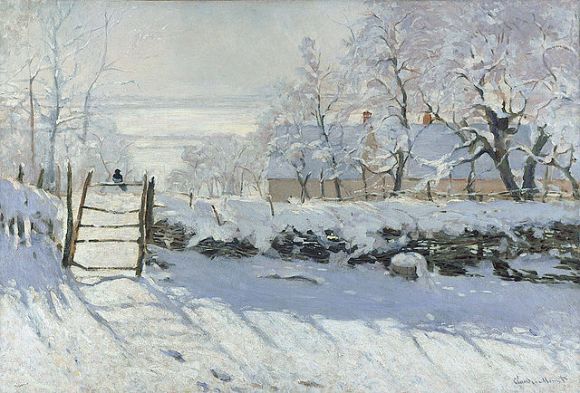
Spring in Winter?

Painting by Claude Monet (1840-1926)
If Winter comes, can Spring be far behind?

'Ode to the West Wind', Percy Bysshe Shelley (1792 -1822)

The idea of spring heralds hope even when it’s deep winter. The colours of spring bring variety along with an assurance of contentment and peace. While wars and climate disasters rage around the world, peace can be found in places like the cloistered walls of Sistine Chapel where conflicts exist only in art. Sometimes, we get a glimpse of peace within ourselves as we gaze at the snowy splendour of Himalayas and sometimes, in smaller things… like a vernal flower or the smile of a young child. Inner peace can at times lead to great art forms as can conflicts where people react with the power of words or visual art. But perhaps, what is most important is the moment of quietness that helps us get in touch with that inner voice giving out words that can change lives. Can written words inspire change?

Our featured bookstore’s owner from Bangladesh, Amina Rahman, thinks it can. Rahman of Bookworm, has a unique perspective for she claims, “A lot of people mistake success with earning huge profits… I get fulfilment out of other things –- community health and happiness and… just interaction.” She provides books from across the world and more while trying to create an oasis of quietude in the busy city of Dhaka. It was wonderful listening to her views — they sounded almost utopian… and perhaps, therefore, so much more in synch with the ideas we host in these pages.

Our content this month are like the colours of the rainbow — varied and from many countries. They ring out in different colours and tones, capturing the multiplicity of human existence. The translations start with Professor Fakrul Alam’s transcreation of Nazrul’s Bengali lyrics in quest of the intangible. Isa Kamari translates four of his own Malay poems on spiritual quest, while from Balochi, Fazal Baloch bring us Munir Momin’s esoteric verses in English. Snehprava Das’s translation of Rohini K.Mukherjee poetry from Odia and S.Ramakrishnan’s story translated from Tamil by B.Chandramouli also have the same transcendental notes. Tagore’s playful poem on winter (Sheeth) mingles a bit for spring, the season welcomed by all creatures great and small.

John Valentine brings us poetry that transcends to the realms of Buddha, while Ryan Quinn Flanagan, Ron Pickett and Saranyan BV use avians in varied ways… each associating the birds with their own lores. George Freek gives us poignant poetry using autumn while Luis Cuauhtémoc Berriozábal expresses different yearnings that beset him in the season. Snehaprava Das and Usha Kishore write to express a sense of identity, though the latter clearly identifies herself as a migrant. Young Debadrita Paul writes poignant lines embracing the darkness of human existence. Joseph C. Ogbonna and Raiyan Rashky write cheeky lines, they say, on love. Mohit Saini interestingly protests patriarchal expectations that rituals of life impose on men. We have more variety in poetry from William Doreski, Rex Tan, Shivani Shrivastav and John Grey. Rhys Hughes in his column shares with us what he calls “A Poem Of Unsuccessful Excess” which includes, Ogden Nash, okras, Atilla the Hun, Ulysees, turmeric and many more spices and names knitting them into a unique ‘Hughesque’ narrative.

Our fiction travels from Argentina with Fabiana Elisa Martínez to light pieces by Deborah Blenkhorn and Priyanjana Pramanik, who shares a fun sketch of a nonagenarian grandma. Sreenath Nagireddy addresses migrant lores while Naramsetti Umamaheswararao gives a story set in a village in Andhra Pradesh.

We have non-fiction from around the world. Farouk Gulsara brings us an unusual perspective on festive eating while Odbayar Dorj celebrates festivals of learning in Mongolia. Satyarth Pandita introduces us to Emil Cioran, a twentieth century philosopher and Bhaskar Parichha pays a tribute to Professor Sarbeswar Das.  Meredith Stephens talks of her first-hand experience of a boat wreck and Prithvijeet Sinha takes us to the tomb of Sadaat Ali Khan. Ahmad Rayees muses on the deaths and darkness in Kashmir that haunt him. Devraj Singh Kalsi brings in a sense of lightness with a soupçon of humour and dreams of being a fruit seller. Suzanne Kamata revisits a museum in Naoshima in Japan.

Our book excerpts are from Anuradha Kumar’s sequel to The Kidnapping of Mark Twain, Love and Crime in the Time of Plague: A Bombay Mystery and Wayne F Burke’s Theodore Dreiser – The Giant, a literary non-fiction. Our reviews homes Somdatta Mandal discussion on M.A.Aldrich’s Old Lhasa: A Biography while Satya Narayan Misra writes an in-depth piece on Amal Allana’s Ebrahim Alkazi: Holding Time Captive. Anita Balakrishnan weaves poetry into this section with her analysis of Silver Years: Senior Contemporary Indian Women’s Poetry edited by Sanjukta Dasgupta, Malashri Lal and Anita Nahal. And Parichha reviews Diya Gupta’s India in the Second World War: An Emotional History, a book that looks at the history of the life of common people during a war where soldiers were all paid to satiate political needs of powerbrokers — as is the case in any war. People who create the need for a war rarely fight in them while common people like us always hope for peace.

We have good news to share — Borderless Journal has had the privilege of being listed on Duotrope – which means more readers and writers for us. We are hugely grateful to all our readers and contributors without who we would not have a journal. Thanks to our wonderful team, especially Sohana Manzoor for her fabulous artwork.

Hope you have a wonderful month as we move towards the end of this year.

Looking forward to a new year and spring!

Mitali Chakravarty

borderlessjournal.com

CLICK HERE TO ACCESS THE CONTENTS FOR THE NOVMBER 2025 ISSUE.

.

READ THE LATEST UPDATES ON THE FIRST BORDERLESS ANTHOLOGY, MONALISA NO LONGER SMILES, BY CLICKING ON THIS LINK.

Categories
Bhaskar's Corner

‘Language… is a mirror of our moral imagination’

By Bhaskar Parichha

Prof. Sarbeswar Das (1925–2009): A scholar of depth, a teacher of light. Photo Provided by Bhaskar Parichha

In the intellectual history of modern Odisha, Professor Sarbeswar Das stands as one of those rare figures who seamlessly bridged scholarship, ethics, and social commitment. A luminous teacher, an erudite writer, and a quiet Gandhian, his life and work embodied the moral seriousness and intellectual curiosity that marked a generation shaped by the freedom struggle and the promise of a newly independent India.

Born in Sriramchandrapur village in the Puri district of Odisha in 1925, Sarbeswar Das grew up in a milieu where simplicity, discipline, and community values were deeply ingrained. His brilliance shone early—he topped the matriculation examination across Odisha and Bihar, a distinction that foreshadowed a lifetime of academic excellence.

His educational journey took him first to Ravenshaw College, Cuttack, the cradle of higher education in Odisha, where he absorbed the liberal spirit and rigorous intellectual training that the institution was known for. He later studied at Allahabad University, one of India’s foremost centers of learning, before proceeding to the University of Minnesota, for advanced studies in English literature.

His exposure to American academia at a time when few Indian scholars ventured abroad profoundly shaped his intellectual orientation. The years in Minnesota opened to him a new world of thought—modern literary criticism, American fiction, and the philosophy of democratic humanism—all of which left a deep imprint on his teaching and writing in later years.

On returning to India, Das joined the teaching profession, which he would pursue with remarkable dedication and grace for several decades. He served as a professor of English in some of Odisha’s most respected institutions—Christ College (Cuttack), SCS College (Puri), Khallikote College (Berhampur), and Ravenshaw College (Cuttack).

As a teacher, he was known not only for his formidable command of English but also for his clarity of expression, quiet humour, and empathetic engagement with students. He could bring Shakespeare and Emerson alive in the classroom, weaving them into the moral fabric of everyday Indian life. His pioneering initiative was the introduction of American Literature as a formal subject of study in Indian universities, long before it became fashionable to do so.

In an age when English studies in Odisha were largely confined to the British canon, he expanded its horizons by introducing writers like Walt Whitman, Emily Dickinson, William Faulkner, and Mark Twain to Indian classrooms.

Das believed that literature must connect with lived experience. He often told his students: “Language is not just a means of expression; it is a mirror of our moral imagination.” This conviction shaped generations of students who went on to become writers, teachers, and civil servants. Among them was the late Ramakanta Rath, later one of Odisha’s most celebrated poets, who fondly remembered Prof. Das as a teacher who inspired intellectual courage and aesthetic sensitivity.

Alongside his teaching, Prof. Das was a prolific writer and scholar. He authored around twenty-five books spanning essays, literary criticism, translations, and reflections on education and society. His writings in English and Odia reveal a mind steeped in both classical and modern traditions. Fluent in English, Odia, and Sanskrit, he was at ease quoting from the Bhagavad Gita and Hamlet in the same breath.

His essays in English reflected on the role of language in education, the cultural responsibility of intellectuals, and the need for moral clarity in modern life. He consistently argued for a vernacular humanism—a belief that English education must not estrange Indian students from their cultural roots but rather help them view their own traditions through a broader, universal lens.

As a principal, he brought administrative efficiency and human warmth to his role. His tenure is remembered for reforms that encouraged academic discipline, faculty collaboration, and student participation. He believed that education was not merely about acquiring degrees but about shaping ethical citizens.

Prof. Das’s intellectual life was inseparable from his moral and civic commitments. As a young man, he participated in the Quit India Movement, aligning himself with the Gandhian values of simplicity, non-violence, and service throughout his life.

Late in life, Prof. Das turned inward to recount his journey in his autobiography, Mo Kahani (My Story), which has since acquired the stature of a modern Odia classic. Spanning eight decades of personal and social history, it offers not only a memoir of a life well-lived but also a vivid ethnography of Odisha across the twentieth century.

In Mo Kahani, he paints rich, affectionate portraits of his family—his parents and sisters, Suruji and Hara Nani—and evokes the rhythms of village life, with its festivals, hierarchies, and hardships. His account of the great famine of 1919, passed down through family memory, is a haunting narrative of suffering and resilience.

The autobiography captures the moral universe of rural Odisha—its compassion, faith, and silent endurance—while chronicling the social changes wrought by modernity, education, and political awakening.

The book transcends personal recollection to become a social document of rare authenticity, preserving the voices and values of an era in transition. Scholars have hailed it as a valuable resource for understanding Odia social and cultural history, as well as a significant contribution to Indian autobiographical writing.

Prof. Sarbeswar Das passed away in 2009 at the age of 84, leaving behind a legacy of intellectual depth and human kindness. Those who knew him remember his calm demeanour, his Gandhian simplicity, and his unwavering belief in the power of education as a moral force. His students and colleagues regarded him not merely as a teacher but as a guide who exemplified integrity and humility in every aspect of life.

His contributions to English literary education in Odisha were transformative. By introducing American literature, promoting cross-cultural study, and insisting on a pedagogy grounded in ethical reflection, he helped modernise the study of English in the state and inspired a generation to approach literature as a bridge between worlds.

Even today, his writings—both critical and autobiographical—continue to speak to the challenges of our times: the search for meaning in education, the reconciliation of global and local cultures, and the enduring need for moral clarity in a rapidly changing world.

In the final measure, Prof. Sarbeswar Das remains not only a scholar and educator but also a moral historian of his age—one who chronicled the soul of Odisha with the sensitivity of a poet and the precision of a teacher. His Mo Kahani endures as his final lesson: that learning is not a mere accumulation of knowledge, but a lifelong practice of understanding, empathy, and truth.

.

Bhaskar Parichha is a journalist and author of Cyclones in Odisha: Landfall, Wreckage and ResilienceUnbiasedNo Strings Attached: Writings on Odisha and Biju Patnaik – A Political Biography. He lives in Bhubaneswar and writes bilingually. Besides writing for newspapers, he also reviews books on various media platforms.

PLEASE NOTE: ARTICLES CAN ONLY BE REPRODUCED IN OTHER SITES WITH DUE ACKNOWLEDGEMENT TO BORDERLESS JOURNAL

Click here to access the Borderless anthology, Monalisa No Longer Smiles

Click here to access Monalisa No Longer Smiles on Amazon International