In conversation with Isa Kamari, a celebrated writer from Singapore, with focus on his latest book, Maladies of the Soul. Click here to read.
Translations
A Hunger for Stories, a poem by Quazi Johirul Islam, has been translated by Professor Fakrul Alam. Click here to read.
A Hand Mill, a story by Ammina Srinivasaraju, has been translated from Telugu by Johny Takkedasila. Click here to read.
Kiyya and Sadu, a part of this long ballad on the legendary lovers from Balochistan, has been translated from Balochi by Fazal Baloch. Click hereto read.
In Tintin in India, Rhys Hughes traces the allusions to India in these iconic creations of Hergé while commenting on Tintin’s popularity in the subcontinent. Click hereto read.
Meredith Stephens shares the response of some of the Californian community to healing after the 2020 forest fires with a narrative and photographs. Click hereto read.
No, they whisper. You own nothing.
You were a visitor, time after time
climbing the hill, planting the flag, proclaiming.
We never belonged to you.
You never found us.
It was always the other way round.

‘Moment’ by Margaret Atwood
With an unmanned mission reaching the moon — that moon that was chipped off the Earth’s surface when Theia bashed into the newly evolving planet — many feel mankind is en route to finding alternate biomes and perhaps, a solution to its housing needs. Will we also call moon our ‘Homeland’ and plant flags on it as we do on Earth? Does the Earth — or the moon — really belong to our species. Do we have proprietary rights on these because of lines drawn by powerbrokers who say that the land belongs to them?
These are questions Margaret Atwood addresses in her writings which often fall into a genre called cli-fi. This is gaining in popularity as climate has become uncertain now with changes that are wringing fear in our hearts. Not all fear it. Some refuse to acknowledge it. While this is not a phenomenon that is fully understood by all of us, it’s impact is being experienced by majority of the world — harsh stormy weather, typhoons, warmer temperatures which scorch life and rising water levels that will eventually swallow lands that some regard as their homeland. Despite all these prognostications, wars continue to pollute the air as much as do human practices, including conflicts using weapons. Did ‘climbing a hill’ and ‘planting the flag’ as Atwood suggests, ever give us the rights over land, nature or climate? Do we have a right to pollute it with our lifestyle, trade or wars — all three being human constructs?
In a recent essay, Tom Engelhardt, a writer and an editor, contended, “Vladimir Putin’s greatest crime wasn’t simply against the Ukrainians, but against humanity. It was another way to ensure that the global war of terror would grow fiercer and that the Lahainas of the future would burn more intensely.” And that is true of any war… Chemical and biological weapons impacted the environment in Europe and parts of Afghanistan. Atom bombs polluted not only the cities they were dropped in, but they also wreaked such havoc so that the second generation’s well-being continues impacted by events that took place more than seven decades ago. Yet another nuclear war would destroy the Earth, our planet that is already reeling under the impact of human-induced climate change. Flooding, forest fires and global warming are just the first indications that tell us not only do we need to adapt to living in changed times but also, we need to change our lifestyles, perhaps even turn pacifist to survive in a world evolving into an altered one.
Critiquing the darker trends in our species which leads to disasters is a book by an eminent Singaporean writer, Isa Kamari, called Maladies of the Soul. He too looks for panacea in a world where the basic needs of humans have been satiated and they have moved on towards overindulgence that can lead to redundancy. In a conversation, he tells us how he hopes his writings can help towards making a more hopeful future.
This hope is echoed in the palliative poems of Sanket Mhatre from his book, A City full of Sirens, excerpted and reviewed by Basudhara Roy. Bhaskar Parichha’s review of Samragngi Roy’s The Wizard of Festival Lighting: The Incredible Story of Srid, is a tribute also from a granddaughter to her grandfather celebrating human achievements. Somdatta Mandal’s discussion of fiction based on history, Begum Hazrat Mahal: Warrior Queen of Awadhby Malathi Ramachandran not only reflects the tenacity of a woman’s courage but also explores the historicity of the events. Exploring bits of history and the past with a soupcon of humour is our book excerpt from Syed Mujtaba Ali’s Tales of a Voyager (Joley Dangay[1]), translated from Bengali by Nazes Afroz. Though the narrative of the translation is set about ninety years ago, a little after the times of Hazrat Mahal (1820 –1879), the excerpt is an brilliant introduction to the persona of Tagore’s student, Syed Mujtaba Ali (1904-1974), by a translator who describes him almost with the maestro’s unique style. Perhaps, Afroz’s writing bears these traces as he had earlier translated a legendary work by the same writer, In a Land Far from Home: A Bengali in Afghanistan. Afroz starts with a startling question: “What will you call someone who puts down his profession as ‘quitting job regularly’ while applying for his passport?”
In non-fiction, we have Devraj Singh Kalsi’s funny retelling of his adventures with a barber while Hughes‘ essay on the hugely popular Tintin makes us smile. The patriarchal past is reflected in an essay by G Venkatesh, whereas Suzanne Kamata from Japan talks of women attempting to move out of invisibility. Meredith Stephens and Candice Louisa Daquin both carry on the conversation on climate change. Stephens explores the impact of Californian forest fires with photographs and first-hand narrative. Vela Noble draws solace and strength from nature in Kangaroo Island and shares a beautiful painting with us. Madhulika Vajjhala and Saumya Dwivedi discuss concepts of home.
Two touching tributes along with a poem to recently deceased poet, Jayanta Mahapatra, add to the richness of our oeuvre. Dikshya Samantrai, a researcher on the poet, has bid a touching adieu to him stating, “his legacy will continue to inspire and resonate and Jayanta Mahapatra’s name will forever remain etched in the annals of literature, a testament to the enduring power of the poet’s voice.”
Our translations this time reflect a diverse collection of mainly poetry with one short story by Telugu writer, Ammina Srinivasaraju, translated by Johny Takkedasila. Professor Fakrul Alam has introduced us to an upcoming voice in Bengali poetry, Quazi Johirul Islam. Ihlwha Choi has translated his own poetry from Korean and brought to us a fragment of his own culture. Fazal Baloch has familiarised us with a Balochi ballad based on a love story that is well known in his region, Kiyya and Sadu. Our Tagore translation has attempted to bring to you the poet’s description of early autumn or Sharat in Bengal, a season that starts in September. Sohana Manzoor has painted the scene depicted by Tagore for all of us to visualise. Huge thanks to her for her wonderful artwork, which invariably livens our journal.
Profound thanks to the whole team at Borderless for their support and especially to Hughes and Parichha for helping us source wonderful writings… some of which have not been mentioned here. Pause by our content’s page to savour all of it. And we remain forever beholden to our wonderful contributors without who the journal would not exist and our loyal readers who make our existence relevant. Thank you all.
An introduction and a conversation with Isa Kamari, a celebrated Singaporean writer
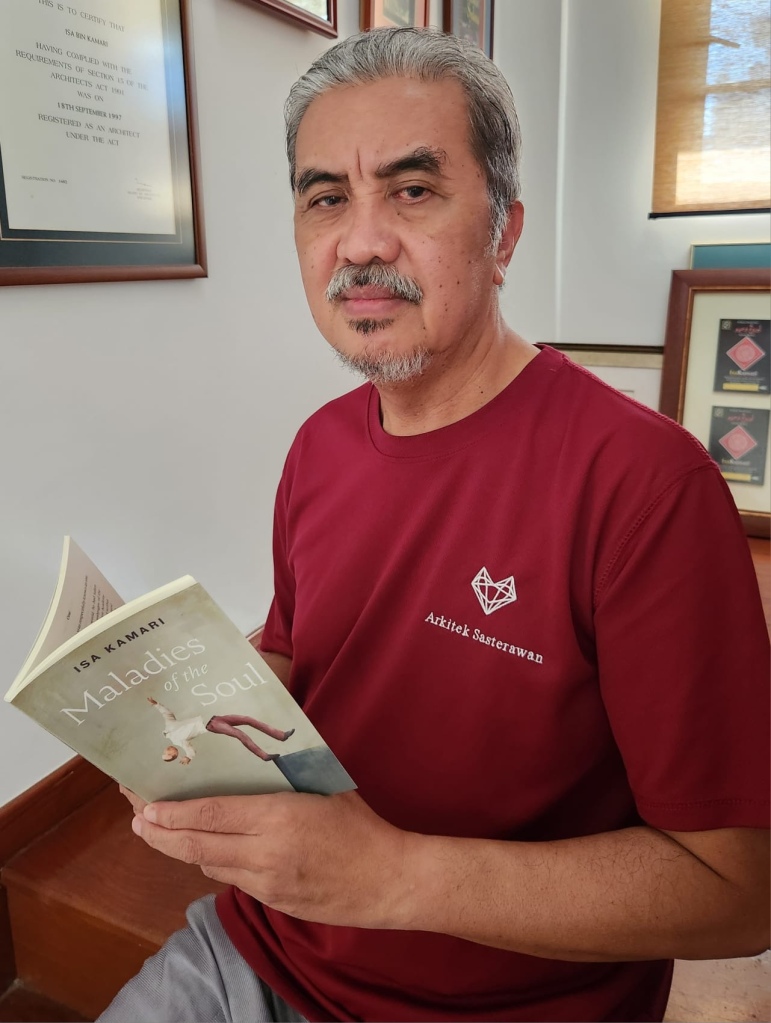
Isa Kamari
Isa Kamari is a well-known face in the Singapore literary community. He has won numerous awards — the Anugerah Sastera Mastera, the SEA Write Award and the Singapore Cultural Medallion, the Anugerah Tun Seri Lanang. He has been part of university curriculums and has written for the television. With 11 novels, nine of which have been translated from Malay to English — and some into more languages like Arabic, Mandarin, Urdu and Turkish, French, Russian Spanish — three poetry books, plays and one novella written in English by him, one can well see him as a leading voice in literature on this island that seems to have grown into a gateway for all Asia.
Kamari’s writings dip into his own culture to integrate with the larger world. The most remarkable thing about his works, for me has been the way in which he has brought the history of Singapore from the Malay perspective into novels and made it available for all readers. The most memorable of these actually gives the history of the time around which the Treaty of Singapore was signed between the British and the indigenous ruler in 1819, handing over the port to Raffles, the treaty that was crucial to the founding of modern Singapore. The novel is named after the year of the treaty.
Other novels like Song of the Wind , Rawa and Tweet — all bring into perspective how the local Orang Seletar integrated into the skyscrapers of Singapore. We can see in his writings how the indigenous moved to be integrated into a larger whole of a multi-racial, multi-religious accepting modern city. One of his novels, One Earth (1999), is like an interim almost, set during the Japanese occupation in Singapore. The narrative dwells on the intermingling of races in the island historically. Kiswah and Intercession are novels that cry out for reforms on the religious front.
He also has novels that delve into individual journeys to glance into the maladies of the modern-day world. Whether it is faith, or career, he brings into focus the need to heal. Recently, Kamari has brought out a book of short stories, Maladies of the Soul, to focus on just this. His fifteen short stories centre around the issue mentioned in the title. In the first ten stories, he writes of old age, of mental stress, of compromises made to achieve success, of anxieties just as the title suggests. These are internal conflicts of people in a country where most have enough to eat, a house to live in and access to education for their offsprings. Then in the last five stories, he moves towards not just showcasing such maladies but also resolving, using narratives that are almost surrealistic, or poetic. They are not happy but reflective with the ability to make one think, look for a resolution. They are discomfiting narratives.
One of the last stories is given from the perspective of a silkworm — a powerful comment on the need for freedom to survive. Another has the iconic Singapore Merlion emote to an extent. The writing escapes the flaw of being didactic by its sheer inventiveness. One is reminded that this is a book by an author from a city-state which has resolved problems like poverty to a large extent. That the journey was arduous and full of struggle can be seen in Kamari’s earlier novels. But now, that people have enough to eat and live by, he takes the next step that is necessary. His stories demand not just being familiar with the issues they faced in the past, but also suggest a movement towards resolving the social problems that in a developed country can warp individuals to make them non-functional and make the society lose its suppleness to adapt and progress.
One of the stories like his earlier novel, The Tower, reflects the climb of a careerist, an architect, up a tower he has built, while recalling the compromises made. The interesting thing is the conclusions have a similar impact. And then, there is yet another story that is almost Kafkaesque in its execution, where a man turns into a bull — a comment on stock trading or people’s obsession with money and to compete?
The book needs to be read sequentially to get the full impact of his message. For, he is a writer with a message, a message that hopes to heal the world by integrating the spiritual with modernisation. In this conversation, he discusses his new book and his journey as a writer.
What makes you write? What moves you to write? Why do you write?
I need to be disturbed by events, issues and thoughts before thinking of writing anything. I would then ponder and research on the topics at hand. Only when I have my own tentative resolution of the conflicting elements, I would begin to write. Most often, my views and positions will change as I write further. In that sense writing is a form of discovery and therapy for me.
Tweet in Spanish
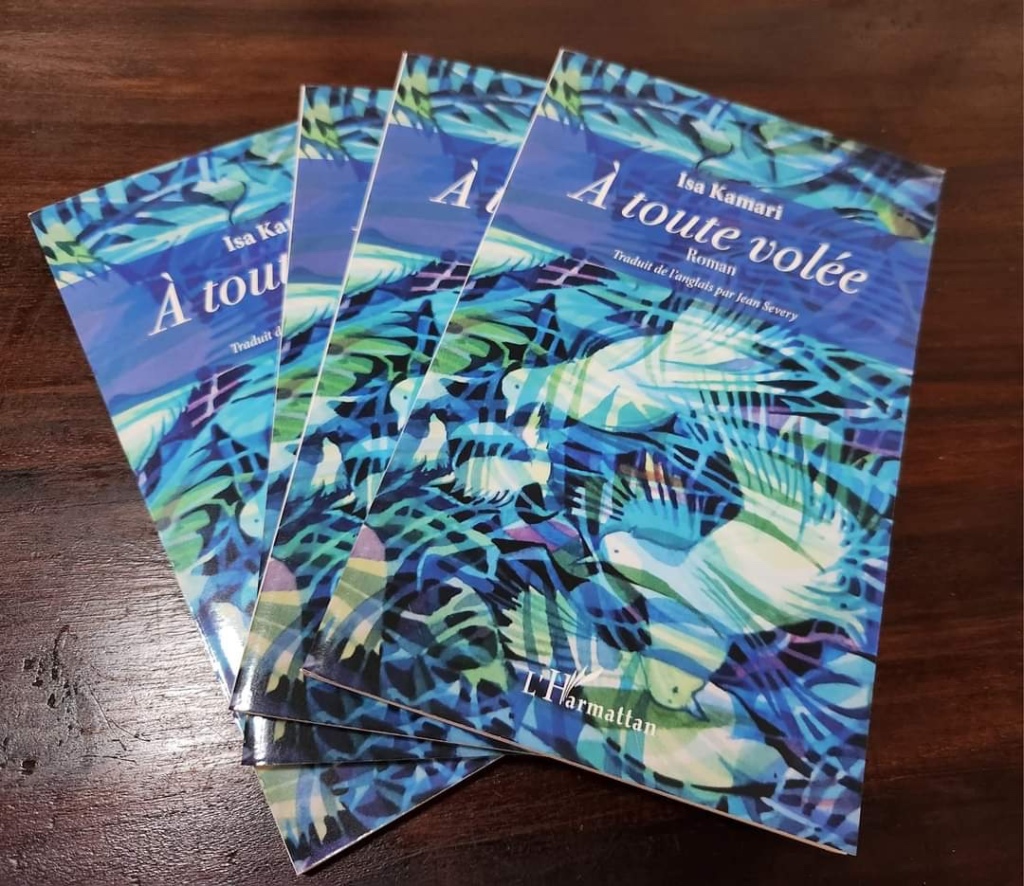
Do you see yourself as a bi-lingual writer or a Malay writer experimenting in English? You had written your novella, Tweet, in English. Later it was translated to more languages. How many languages have you been translated into? Do you feel the translations convey your text well into the other language?
Culturally, I think in Malay. English is a language of instruction for me. When I attempt to translate my Malay works into English, the writing sounds and feels Malay. Tweet is a result of a challenge I imposed upon myself to write creatively in English. The result is not bad. Tweet has been translated into Malay, Arabic, Russian, French, Spanish, Azerbaijan and Korean. I wouldn’t know how well the novella has been translated because I do not know those languages. I trust the translators whom I choose carefully.
Throne and Tweet in RussianTweet in French
The stories of Maladies of the Soul first appeared in Malay. Now in English. Did you translate them yourself, being a bi-lingual writer? Tell us your experience as a translator of the stories. Did you come across any hurdles while switching the language? What would you say is the difference in the Malay and English renditions?
Yes, I translated all the stories in the book. I had to overcome my own fear that the stories might end up too Malay in expression and feel. But I told myself to be true to my own voice and not be inhibited by language structure and convention. I would not know exactly the difference between the two renditions. I was just interested to tell the stories.
Is this your first venture into a full-length short story book? Tell us how novels and short stories vary as a genres in your work. How do you use the different genre to convey? Is there a difference in your premise while doing either?
I have produced just one collection of short stories. In each of the short stories, I had to be focussed on expressing concepts and philosophies on a single problem of the human condition. In my novels the concepts and philosophies are varied, expanded, more complex and layered but yet interrelated and weaved around dynamic human experiences facing common predicaments or challenges of an era.
One of the things I noticed about the book was that the stories would convey your premise better if read in order. Is that intentionally done or is it a random occurrence?
The short stories can be weaved into a novel. There is a central spine, which is my observation and philosophy of life which bind them all. The intrinsic sequence or order is not intentional, but perhaps it is the psychological thread and latent articulation of the storyteller.
Some of the stories seem to have echoes in your novels, like Kiswah and Intercession, both of which deal with crises in faith. Did your earlier novels have a direct bearing on your short stories?
I used to transform my poems into short stories, and from those write novels. The genres are just tools for me to express my thoughts and feelings. I use whatever works. I have even experimented on weaving short stories and poems in a novel. I wanted to create prose that are poetic, and poems that are capable of conveying a narrative. My latest novel, The Throne, is a result of this experiment.
Some of your stories touch on the metaphorical, especially the last five. Some of the earlier ones describe unusual or even the absurd situations we face in life. As a conglomerate, they explore darker areas of the human psyche, unlike your novels which were in certain senses more hopeful, especially Tweet. What has changed to bring the darker shades into your writing? Please elaborate.
The stories in Maladies of the Soul have a common theme of alienation in various facets and dimensions of life. As such the expected feeling after reading them is that of gloom and hopelessness. That is intentional as a revelation of the deeper and hidden fallacy of modern life that appears organised and bright on the surface. I wanted my readers to be shaken or at least moved to ponder and reflect on our current, shallow and fractured human condition. There is a better life if we were to look the other way and be more mindful and caring of each other and our environment.
I still recall a phrase from your novel, The Tower, “Festivities celebrating loneliness”. Would you say your short stories have moved towards that?
Exactly.
Why did you choose short stories over giving us a longer narrative like a novel?
It is like giving my readers bite sizes of my exploration and philosophy of life. I leave it to the readers to weave the stories into a whole, and reflect upon their own experiences, thoughts and feelings, perhaps in a more integrated and holistic manner.
What are the influences on your writing?
Life itself. Like I mentioned earlier I do not write in a vacuum. I engage life in my writing as a way of validating my ever-changing existence. I want my life and writing to be authentic and significant. Hopefully, meaningful to others too.
What can your readers look forward from you next?
I have just completed a draft of a novel in Malay, Firasat. As in all my novels, I offer a window towards healing by embracing a rejuvenated Malay philosophy called firasat which is an intuitive, integrated, balanced, lucid, harmonious and holistic way of life.
Thank youfor sharing your time and your writings with us.
(The online interview has been conducted by emails by Mitali Chakravarty)
PLEASE NOTE: ARTICLES CAN ONLY BE REPRODUCED IN OTHER SITES WITH DUE ACKNOWLEDGEMENT TO BORDERLESS JOURNAL.




 Borderless