Categories
Editorial

Other Echoes in the Garden…

“Other echoes
Inhabit the garden. Shall we follow?
Quick, said the bird, find them, find them…”

— TS Eliot, ‘Four Quartets: Burnt Norton’(1936)

Humans have always been dreamers, ideators and adventurers.

Otherwise, could we have come this far? From trees to caves to complex countries and now perhaps, an attempt to reach out towards outer space for an alternative biome as exploring water, in light of the recent disaster of the Titan, is likely to be tougher than we imagined. In our attempt to survive, to live well by creating imagined constructs, some fabrications backfired. Possibly because, as George Orwell observed with such precision in Animal Farm, some perceived themselves as “more equal”. Of course, his was an animal allegory and we are humans. How different are we from our brethren species on this beautiful planet, which can survive even without us? But can humanity survive without Earth? In science fiction, we have even explored that possibility and found home among stars with the Earth becoming uninhabitable for man. However, humanity as it stands of now, continues to need Earth. To live amicably on the planet in harmony with nature and all the species, including our own, we need to reimagine certain constructs which worked for us in the past but seem to have become divisive and destructive at this point.

Ujjal Dosanjh, former Minister in the Canadian cabinet and former Premier of British Columbia, in his autobiography, Journey After Midnight – A Punjabi Life: From India to Canada, talks of regionalism as an alternative to narrow divisive constructs that terrorise and hurt others. He writes in his book: “If humanity isn’t going to drown in the chaos of its own creation, the leading nations of the world will have to create a new world order, which may involve fewer international boundaries.” We have a candid conversation with him about his beliefs and also a powerful excerpt from his autobiography.

An interview with Professor Fakrul Alam takes us into Tagore’s imagined world. He discussed his new book of Tagore translations, Gitabitan: Selected Song-Lyrics of Rabindranath Tagore. He has brought out a collection of 300 songs translated to English. In a bid to emphasise an inclusive world, we also have a translation of Tagore’s ‘Musalmanir Galpa’ (A Muslim Woman’s Story) by Aruna Chakravarti. A transcreation of his poem, called ‘Proshno or Questions’ poses difficult challenges for humanity to move towards a more inclusive world. Our translation by Ihlwha Choi of his own Korean poem to English also touches on his visit to the polymath’s construct in the real world, Santiniketan. All of these centring around Tagore go to commemorate the month in which he breathed his last, August. Professor Alam has also translated a poem from Bengali by Masud Khan that has futuristic overtones and builds on our imagined constructs. From Fazal Baloch we have a Balochi translation of a beautiful, almost a surrealistic poem by Munir Momin.

The poetry selections start with a poem on ‘Wyvern’, an imagined dragon, by Jared Carter. And moves on to the plight of refugees by Michael Burch, A Jessie Michael, and on migrants by Malachi Edwin Vethamani. Ryan Quinn Flanagan has poetry that suggests the plight of refugees at a metaphorical level. Vibrant sprays of colours are brought into this section by Luis Cuauhtémoc Berriozábal, Saranyan BV, Jahnavi Gogoi, George Freek and many more. Rhys Hughes brings in a spot of humour with his mountainous poetry (literally) and a lot of laughter with his or rather Google’s attempt at automatic translation of a poem. Devraj Singh Kalsi has shared a tongue in cheek story about an ‘amateur professional’ — rather a dichotomy.

We travel to Andaman with Mohul Bhowmick and further into Sierra with Meredith Stephens. Ravi Shankar travels back in nostalgia to his hostel and Kathleen Burkinshaw dives into the past — discussing and responding to the media presentation of an event that left her family scarred for life, the atomic holocaust of 1945 in Japan. This was a global event more than seven decades ago that created refugees among the survivors whose homes had been permanently destroyed. Perhaps, their stories are horrific, and heart wrenching like the ones told by those who suffered from the Partition of India and Pakistan, a divide that is celebrated by Independence Days for the two nations based on a legacy of rifts created by the colonials and perpetrated to this day by powerbrokers. Aysha Baqir has written of the wounds suffered by the people with the governance gone awry. Some of the people she writes of would have been refugees and migrants too.

A poignant narrative about refugees who flock to the Greek island of Lesbos by Timothy Jay Smith with photographs by Michael Honegger, both of whom served at the shelters homing the displaced persons, cries out to halt wars and conflicts that displace them. We have multiple narratives of migrants in this issue, with powerful autobiographical stories told by Asad Latif and Suzanne Kamata. Paul Mirabile touches on how humans have adopted islands by borrowing them from seas… rather an unusual approach to migrations. We have an essay on Jane Austen by Deepa Onkar and a centenary tribute to Chittaranjan Das by Bhaskar Parichha.

The theme of migrants is echoed in stories by Farouk Gulsara and Shivani Shrivastav. Young Nandani has given an autobiographical story, translated from Hindustani to English by Janees, in which a migration out of various homes has shredded her family to bits — a narrative tucked in Pandies Corner.  Strange twists of the supernatural are woven into fiction by Khayma Balakrishnan and Reeti Jamil.

In reviews, Parichha has explored Arunava Sinha’s The Greatest Indian Stories Ever Told: Fifty Masterpieces from the Nineteenth Century to the Present. Somdatta Mandal’s review of Amitav Ghosh’s Smoke and Ashes: A Writer’s Journey Through Opium’s Hidden Histories seems to be an expose on how historical facts can be rewritten to suit different perceptions and Basudhara Roy has discussed the Greening the Earth: A Global Anthology of Poetry, edited by K. Satchidanandan and Nishi Chawla.

There is more wonderful content. Pop by our August’s bumper edition to take a look.

I would like to give my grateful thanks to our wonderful team at Borderless, especially to Sohana Manzoor for her fabulous artwork. Huge thanks to all our gifted contributors and our loyal readers. Borderless exists today because of all of you are making an attempt to bringing narratives that build bridges, bringing to mind Lennon’s visionary lyrics:

You may say I'm a dreamer
But I'm not the only one
I hope someday you'll join us
And the world will live as one

Thank you for joining us at Borderless Journal.

Have a wonderful month!

Mitali Chakravarty

borderlessjournal.com

.

Visit the August edition’s content page by clicking here

READ THE LATEST UPDATES ON THE FIRST BORDERLESS ANTHOLOGY, MONALISA NO LONGER SMILES, BY CLICKING ON THIS LINK.

Categories
Poets, Poetry & Rhys Hughes

An Experiment with Automatic Poetic Translation

Courtesy: Creative Commons

I am intrigued by the whole process of translation, a most remarkable alchemy of words and meanings, and when it comes to the translation of poetry, I find the operation especially bewildering and beguiling. But this is not the place for me to discuss my views on the mechanics of the subject, for in fact I have no such views. I am not a translator. I merely wish to explain that the following poem is the result of a minor experiment I have been planning for a long time, a variant of the ‘Chinese Whispers’ game, performed using an automatic translation program. A poem is written, a poem using fairly obvious imagery, and then the translation game begins. The poem is translated from English into another language, in this case Albanian, then from Albanian into another language, Arabic in fact, and from Arabic into Basque, and so on. Eventually the poem exists in Zulu, and from there it is translated back into English.

Possibly it will no longer sound like a real poem at this stage. But it can be easily adjusted, turned into something resembling a new poem, and presented as a continuation of the original poem. The final poetic work will consist of the original stanza followed by the manipulated stanza. If they enhance each other, so much the better, but if not, nothing much has been lost.

The Transformation

The transformation is lengthy
but painless,
it does not drain us. The way
ahead is clear
as far as the glowing horizon
where the moon
has promised to rise. The eyes
of the night
stare intensely in preparation
for blinking
thanks to the white eyelid of
a belated moon
and we grow wise when at last
it arrives, saying
that the stars belong in sleep
and so they do and so
do we and finally
the change
occurs
rest
ful
ly.

This poem was automatically translated between all the following languages:

English – Albanian – Arabic – Basque – Bengali – Czech – Dutch – French – German – Greek – Hindi -Indonesian – Korean – Latin – Macedonian – Maltese – Nepali – Persian – Portuguese – Romanian – Sanskrit – Slovak – Swahili – Thai – Turkish – Urdu – Vietnamese – Welsh – Zulu – English

And the result, after a very small manual adjustment, is:

After a long time
I’m still crying,
a street name outside of us.
This is obvious at first:
bright horizon.
Where is the moon?
And so ends the contract.
Dinner?
I can’t wait to get ready.
This is not a rumour
of white hair
or months.
Finally we bring you a sage.
They started talking,
you are sleeping,
and so
I continue to do so.
Be careful,
what’s up is silence,
targeted
from where?

Rhys Hughes has lived in many countries. He graduated as an engineer but currently works as a tutor of mathematics. Since his first book was published in 1995 he has had fifty other books published and his work has been translated into ten languages.

.

PLEASE NOTE: ARTICLES CAN ONLY BE REPRODUCED IN OTHER SITES WITH DUE ACKNOWLEDGEMENT TO BORDERLESS JOURNAL

Click here to access the Borderless anthology, Monalisa No Longer Smiles

Click here to access Monalisa No Longer Smiles on Kindle Amazon International

Categories
Notes from Japan

Olives and Art in the Inland Sea

Photographs and narrative by Suzanne Kamata

Sodoshima

My daughter Lilia, my friend Wendy, and I set out on a Saturday morning for Shodoshima. It’s the largest island in the Inland Sea, home to about thirty thousand people, many of them aging. My mother-in-law went there years before on a group tour. She brought back olive oil as a souvenir. I am intrigued by the idea of a Japanese island with a Greek flavour. Because of its relatively large size and population, and its popularity with tour groups, I figure it would be somewhat accessible for my daughter, who uses a wheelchair and is deaf.

On the island, we stop at a tourist center for maps. I drive through the town. Some of the streetlights are shaded by green or yellow globes. Maybe they are supposed to look like olives. The road follows the seashore. Off the coast we see fishing boats. Here and there are small clusters of olive trees, the branches beaded with black olives. We finally come across a sign advertising the Olive Garden. I pull over and park in a handicapped parking space. A restaurant is up the hill.

“Shall we go eat lunch?” I ask.

“Yes,” Lilia nods. The hill is steep, but there are no steps. Lilia gets into her wheelchair and I begin to push her up the slope. From the restaurant, the view of the sea is marvelous. I smell olive oil. Wendy and I order spaghetti, which comes with bread. Lilia orders Japanese noodles, which are served with tempura fried shrimp and vegetables. When the food arrives, the server tells us how to eat it. “You should drizzle olive oil on the tempura,” she says. “You should put some olive oil and herbed salt in a small dish and dip your bread in it.”

According to a brochure, locals make olive lip gloss, olive soap, olive wax, olive hand cream, and olive-oil smoothies. You can even take classes in using olives to dye fabric. Every October the island holds an Olive Harvest Festival. People come to pick olives. They enter the “Healthy Olive Cooking Recipe Contest.” I imagine that the people of Shodoshima spend a lot of time thinking about new ways to use the olive oil that they produce. The islanders have been growing olives since 1908, and from the taste of our lunch, it’s clear that they have gotten quite good at it.

“Shall we find the Greek windmill?” I ask after we’ve eaten. I had caught a glimpse of it on our way up the hill. It’s actually a replica of the white windmills often seen on postcards from Mykonos.

Olive Park is just down the road. According to the brochure, the chalk- white building is “an exact replica” of an ancient Greek building. The brochure continues, “You may feel as if you are standing on an island in the Aegean Sea.” I’m surrounded by people speaking Japanese. Somehow, I still feel as if I am on an island in the Inland Sea. I really want to see the Greek windmill, but it’s down another hill.

“I don’t care if I see it,” Wendy says. “I can stay here with Lilia while you go.”

I ask Lilia if she wants to see the windmill. “Yes!” she replies.

Wendy and I take turns backing the wheelchair down the hill. It’s laborious, and maybe dangerous. If we lose control, we could all be injured. At last, we enter an olive grove and get close to the white windmill, which was built to commemorate the friendship between Shodoshima and Milos Island in Greece. Emperor Hirohito planted an olive tree near the windmill. As we walk back to the main building, I pluck an olive from a branch. I pop it into my mouth. It’s bitter and tough-skinned. I spit out the black skin. So much for raw olives.

We enter the small museum. A large statue of Athena greets us. Some brooms are on sale. They’re imitations of brooms in a movie about Kiki, a young witch who runs a delivery service, which has recently been filmed on the island. Lilia wants to watch the film about olive cultivation on the island. While she watches, I look at the exhibits. There are photos of Japanese women in kimonos covered with aprons, pressing olives. “They don’t look happy,” Wendy says. “It looks like hard work,” I add. “And in those clothes!”

“Anger at the Bottom,” an art installation by Takeshi Kitano, is in another small port town called Sakate. In Japan, the artist is a famous comedian called Beat Takeshi who often appears on TV. In the West, he is considered a serious actor, writer, and artist. He created this work of art with another artist, Kenji Yanobe. At first glance, this installation is a well. On the hour, however, a monster rises out like a jack-in-the-box. Water spews from its mouth. I think that Lilia would enjoy seeing this. She loves stories about ghosts and monsters.

On the way, we pass a soy sauce factory, and a small gift shop advertising soy sauce–flavored ice cream. Yuck. But Lilia signs that she wants ice cream. “Later,” I sign back, determined to see the monster rise from the well. It’s almost three o’clock. If we’re late, we’ll have to wait another hour to see the beast rise up. We arrive at the port. Another sculpture, which resembles a silver star, faces the harbor. Some elderly men sit idly in front of a nearby building. I decide to ask one of them where the installation is located. I show him the photo I had printed from the Internet. “Where is this?” He points toward some houses. People probably ask him all the time.

“Is it within walking distance?”

“Yes, but there are few tourists now so you would be able to park closer.” He nods at the wheelchair. “It would be better to drive.”

Wendy has to go back to Takamatsu. We decide that I will drop her off at the nearest ferry terminal and then Lilia and I will come back to see the monster. After that, we’ll go farther north to our hotel. I notice that there are many signs in English directing visitors to “Anger at the Bottom.” I didn’t really need to ask how to get there. I follow the signs down a narrow road. We pass a persimmon tree heavy with fruit. There’s another slight incline. I find a parking area near the well. The monster is already out of the well, but it isn’t moving.

Lilia gets into her wheelchair and I begin pushing her up the hill. She could help me by gripping the wheels and moving them forward. She doesn’t. She sits with her hands on her lap on top of her sketchbook. “Go, Mama, go!” she says. I huff and puff. “What do you mean? Why aren’t you helping?” Surprised at my reaction, she grabs onto the wheels and pulls.

At the well, the monster is still. This is the off- season. As the man at the harbour said, there aren’t many tourists this time of year. Perhaps the monster doesn’t rise and spit out water on the hour in this season. Maybe it stays in place. The monster’s red eyes seem to stare at the sea. I detect a yearning in its expression. Its lips are pressed together. No teeth are visible. The neighbourhood is quiet. The only sounds are the flapping of a crow’s wings and the twitter of an invisible bird. A slight breeze stirs the goldenrods. I wait while Lilia sketches the monster. I’m disappointed that she couldn’t see it in motion. Since it isn’t moving, however, she takes her time drawing it. When she finishes, she shows me her work. “Good job,” I say. “Now how about some soy sauce–flavoured ice cream?”

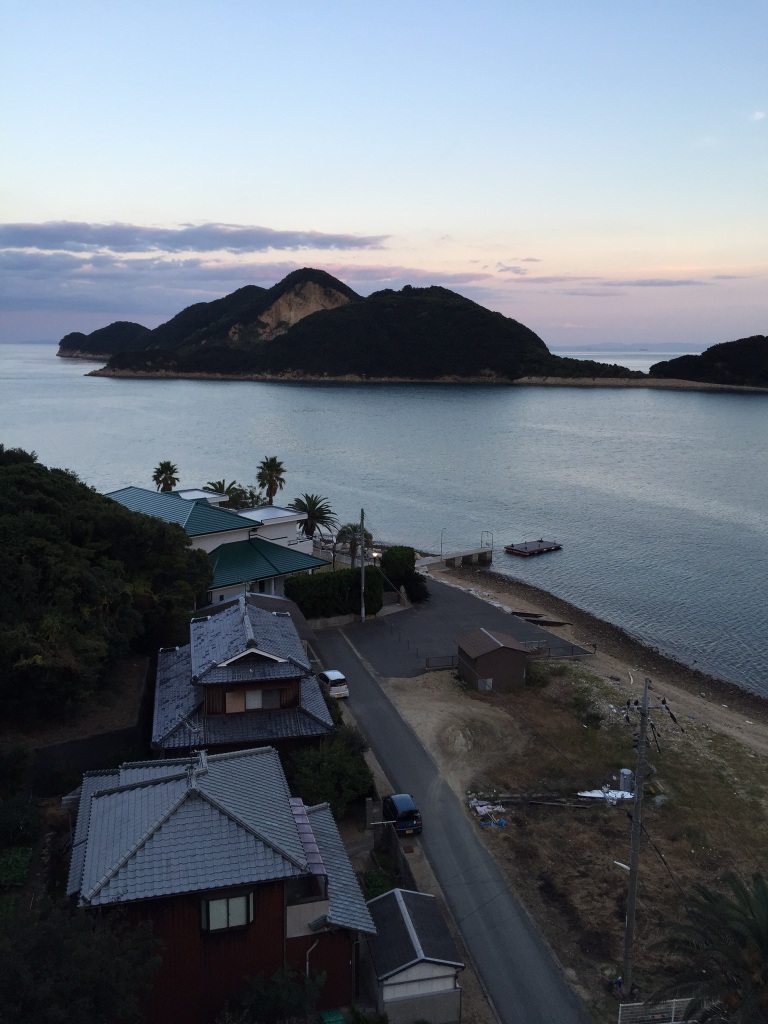
I read that the sunset somewhere on Shodoshima has been rated one of Japan’s hundred best sunsets. Since our hotel room has a view of the sea, I’m eager to check in before sundown so we can watch. I drive along twisty mountain roads, past a quarry, and past stone sculptures, down to another tiny port town in a secluded cove. I check us in to the hotel. “You can borrow DVDs,” the desk clerk says. “Or borrow books.” The lounge is filled with comfortable white leather armchairs. Some books in English are on a shelf, as well as many books in Japanese. I grab a DVD of a movie called 24 Eyes which is based on a novel written by Sakae Tsuboi, a famous Japanese writer who was born in Shodoshima. From our eighth-floor room, we can look out upon the sea from the bathtub. However, I discover that a mountain is blocking our view of the sunset.

We have dinner in the restaurant on the first floor. All the food is fresh and healthy – fish, followed by peeled grapes and slices of persimmon. After a while, we go back to our room and watch the movie. The plot of 24 Eyes is about a young teacher from the larger island of Shikoku who gets a job on Shodoshima in the 1920s. Most people on the island were poor. They wore kimonos. The teacher wore Western clothes and rode a bicycle, which shocked everyone on the island. Later, of course, everyone grew to love the teacher.

In the movie, there is a lot of singing. The children sing about dragonflies and crows. There is also a lot of crying. One girl has to give up her dream of going to music school because her parents are against it. Another gets sick and dies. Three boys go off to war. Many miserable things happen. Sometimes there is singing and crying at the same time. Lilia cries, too. I bring her tissues and give her a hug.

The next morning, we set out for The Movie Village on the southern coast of the island. Many of the tourists at the theme park are much older than us. I spot a group of senior citizens communicating in sign language. One of them notices that I am signing to Lilia and approaches us. “Where are you from?” she asks in sign language.

“Tokushima,” Lilia signs back.

The woman signs that she is from Osaka. “Is that your mother?” She gestures to me. I’m pleased. We look nothing alike. When we are in America, most people think she is adopted.

“Yes,” Lilia replies. She draws her hand down the middle of her face. “I am half.”

“It’s the first time I’ve met an American,” the woman signs.

We look at the old-fashioned wooden buildings. Kimonos are hung on bamboo poles, as if someone has just finished the laundry. Shops sell vintage toys and candies. Visitors try to walk on bamboo stilts or roll a hoop with a stick.

We come to a restaurant with painted pictures of Japanese movie stars propped in front. At the entrance is a photo of the food served. The restaurant’s theme is Shōwa- era school lunch. I ate Japanese school lunches when I first came to Japan. I taught English at junior high schools, and I ate with the students. I don’t feel nostalgic for those lunches, but Lilia wants to eat here. We go inside. Posters from different movies filmed on Shodoshima cover the walls. Some clothes worn in one movie are on display in a corner. We order school lunch. It’s served on a metal tray, just as I remember. There is a bowl of watery curry, a big white roll sprinkled with sugar, and a tangerine. Lilia gets milk in a bottle. I ask for the milk mixed with coffee, also served in a bottle. To tell the truth, it isn’t that great. I’m glad that the food in Japan has gotten better.

Lilia wants to visit the monkey park. She also wants to check out the ravine with a ropeway going across it. Sadly, we don’t have enough time. But now that she knows this island is here, she can return. We drive along the coast, back to the ferry port. The sea glistens in the late afternoon sun. Sometimes it seems as if all the beauty of the world is within our reach.

Lilia in Sodoshima

Suzanne Kamata was born and raised in Grand Haven, Michigan. She now lives in Japan with her husband and two children. Her short stories, essays, articles and book reviews have appeared in over 100 publications. Her work has been nominated for the Pushcart Prize five times, and received a Special Mention in 2006. She is also a two-time winner of the All Nippon Airways/Wingspan Fiction Contest, winner of the Paris Book Festival, and winner of a SCBWI Magazine Merit Award.

PLEASE NOTE: ARTICLES CAN ONLY BE REPRODUCED IN OTHER SITES WITH DUE ACKNOWLEDGEMENT TO BORDERLESS JOURNAL

Click here to access the Borderless anthology, Monalisa No Longer Smiles

Click here to access Monalisa No Longer Smiles on Kindle Amazon International

Categories
The Observant Immigrant

Can We Create a Better World by Just Wishing for it?

By Candice Louisa Daquin

The wish to laugh and shrug off differences that create unhappiness and wars is a universal one. The majority of us want to avoid unhappiness at any cost. There is however, a downside to trying to avoid unhappiness by being too open about unhappiness. When we begin to pathologize everything as a disorder, we may inadvertently neglect our ability to generate better mental health.

Before mental illness was discussed en mass, it was private and considered shameful. This had obvious detrimental effects on those suffering, but one could also argue there was a benefit to not making everything so extremely public. Like with any argument, there are pros and cons to how far we publicize mental health. The extreme of ignoring it, didn’t work. But does the extreme of talking about it to death, really help people as much as we think?

In the second half of the 20th century, owing in part to a neglect of, and a need for; improved mental health care, societies began to shift from encouraging suppression of emotion to a recognition of psychological distress and its impact. Institutes and then the de-institutionalisation movement, became ways of coping with people who struggled to function in society. But these people didn’t choose to be unhappy. Whilst it’s obvious this shift to publishing mental health instead of hiding it, has been highly beneficial in some regards; we should also consider its far reaching ramifications.

“(Historically) Many cultures have viewed mental illness as a form of religious punishment or demonic possession. In ancient Egyptian, Indian, Greek, and Roman writings, mental illness was categorised as a religious or personal problem. In the 5th century B.C., Hippocrates was a pioneer in treating mentally ill people with techniques not rooted in religion or superstition; instead, he focused on changing a mentally ill patient’s environment or occupation or administering certain substances as medications. During the Middle Ages, the mentally ill were believed to be possessed or in need of religion. Negative attitudes towards mental illness persisted into the 18th century in the United States, leading to stigmatisation of mental illness, and unhygienic (and often degrading) confinement of mentally ill individuals,” states an article on this issue.

By publicising everything, in reaction to the days when mental health was viewed with more stigma, we have not improved suicide statistics or mental illness numbers like we’d logically assume. When something is freed of stigma and shame, more people admit to suffering from mental illness than ever before, which will make it seem like more people have mental illness, when it could simply be that they are more willing to admit to having it. On the other hand, there is an observed phenomena of things becoming socially contagious.

How can we be sure we’re not increasing mental health numbers by making it so acceptable to be mentally ill? By over-emphasising it on social media? Publicising the struggle to avoid stigma, is positive, but the degree to which we discuss mental illness may be so open, as to increase numbers or over-diagnose people. For example, everyone gets sad sometimes, that doesn’t mean everyone suffers from clinical depression. Everyone gets anxious sometimes but that doesn’t mean everyone suffers from anxiety. The distinction is: Is it a disorder or a feeling? Do clinicians spend enough time considering this when they give patients a life-long diagnosis? And what is the effect of such a diagnosis?

When psychiatrists diagnose mass numbers of people, especially easily influenced teenagers, with serious life-changing mental illnesses, that immediately means the reported numbers swell. Who is to say they would be that large if diagnosis weren’t so open ended? Nebulous? Open to outside influence? Or even, the pressure of pharmaceutical companies and desperate doctors wanting quick fixes? What of parents who don’t know how to handle their rebellious teen? Is that mental illness or just life? If they demand treatment and the teen is labeled mentally ill, do they fulfil that prophecy? And if they hadn’t been diagnosed, would their reaction and outcome be different?

Our innate ability to laugh and shrug things off, comes from the challenges in life that were so terrible we had no choice if we wanted to go forward. If we remove those challenges, are we teaching our kids how to cope with hard things or wrapping them in cotton wool and medicating them? When a family of ten children ended up with eight routinely dying, how else could families cope with such tragedy but to have that coping mechanism of laughter and the ability to shrug off despair and horror? It did not mean anyone was less caring, or feeling, but that sensitivity had to be weighed against our ability to endure. We could argue we endure less pain now than ever before, as we are less likely to lose a great number of people we know, die due to disease and famine and other historical reasons for early death. Many will never even see the body of a dead relative, so how can they process that loss?

The modern world brings with it, its own attendant risks and stressors. People growing up in 1850 may not have had to worry in the same way, about looking young to keep a job, or trying to ‘do it all.’ On the other hand, they might have had to worry about not having a society that helped them if they lost a job, or how to stop their families from starving or their village from being raided. They had fewer social cushions in that sense and more of a risky day-to-day. This was starkly true when we compare the recent pandemic outbreak with say the plagues of earlier centuries. People died in the street and were left to rot, whereas now, even as we struggled and many died, we had a modicum of order. For all our terrors with Covid 19, it could have been far, far worse and has been. I say this from a position of privilege where I lived in a society that had access to medical care, and I’m fully aware many still do not, but nevertheless if we directly compare the experience of the Black Death with Covid-19, we can see tangible improvement in what those suffering, could access.

This means whether we believe it or not, appreciate it or not, we have over-all an improved quality of life than even 50 years ago. At the same time, we may have swapped some deficits for others. It may seem a minor consolation for the myriad of modern-day woes, but we are better off than our grandparents who were called ‘The Silent Generation’. They grew up learning to not speak of their struggles but cope with them silently. These days we have outlets. And in other ways, we are more alone, it is a strange mixture of progress and back-tracking. Some would argue our grandparents had a simpler, healthier life. But if average life expectancy is anything to go by, we are growing older because for the majority, our access to medical care and over-all nutrition, are improved. On the other hand, more grow old but sick-old, which is not perhaps, something to aspire to.

When we consider how badly many eat, and in truth, we do ourselves no favour when so many of us are obese and suffering from diseases of modern living such as lack of exercise, heavy drinking, lack of sleep and eating fast-food. It might be most accurate to say we have swapped some deficits such as dying due to curable diseases, and dying from malnutrition or lack of access to care and antibiotics, with modern deficits like increasing cancer rates and increasing auto immune disorders, all of which are increasing with the swell of the modern world and its life-style.

What it comes down to is this; through the wars of the past, people stood next to each other in trenches whilst their friends were blown to pieces or died in agony. They had PTSD[1] then, they suffered from depression and anxiety, but they also had no choice but to carry on. For some, the only way out was suicide or AWOL[2], while for many, they stuffed their feelings down and didn’t speak of it. Clinicians thought this way of coping caused illness and it led along with other reasons, to an improved mental health system.

But, now, in 2022, you might be forgiven for thinking EVERYTHING was a disease, and EVERYONE suffered from something, and you might find yourself wondering if some of this perceived increase was the direct result of going from one extreme to the other. Initially, nobody was mentally ill. Nowadays, who isn’t? Is this a better model?

Having worked with mentally ill people for years as a psychotherapist, I can attest that mental illness is a reality for many. I knew it was before I ever worked in the field, and it was one reason I chose that field. I wanted to help others because I saw viscerally what happened to those who did not receive help. Despite this I came to see the value of sometimes putting aside all the labels and diagnosis and medications and treatments and trying to just get on with the process of living. If we tell someone they are mentally ill and medicate them and coddle them and tell them they don’t need to try because they are so sick, then it doesn’t give them much motivation to see what else they can do.

True, for many, they are too sick to do anything but survive and that in of itself is a big achievement. So, when we talk about the need to motivate ourselves beyond labels, we’re talking about those who we’d call high functioning. People who may suffer from depression, or anxiety, but are very able to do a lot of things despite that. Does medication and therapy and labeling them, really help them make the most of their lives? Is putting them on disability for years without reviewing if things could or have changed, help? Can they learn something from our ancestors who had to just laugh and get on with it, no matter how tough things got?

It may seem a very old-fashioned approach to consider ‘toughing it out’ and having come to America and seen how much onus they put on toughing it out, I have mixed feelings about the value of doing so. The idea of being tough enough means there is always the reverse (not being tough enough) and that feels judgmental. Being judgmental, I think, has no place in recovery.

What does have a place in recovery, is doing the best you can and not letting labels define or defeat you. In this sense, I see a lot of commonalities with those struggling today and those who struggled 150 years ago. Maybe we can all learn from them and combine that with some modern prescriptivism that give us more chance to laugh and thrive, rather than fall under the yoke of a diagnosis and its self-fulfilling prophecy?

I have had many clients who felt their diagnosis disincentivized them from any other course of action than being a patient. The medication route alone is fraught with ignorance. For so long SSRIs[3] and other anti-depressants were heralded as lifesavers for depressed people, but what proof existed for this aside the hope a cure had been found? Years later studies showed only 30% of people seemed to respond to anti-depressants versus placebo.

Then second and third generation drugs were created, all the while charging exorbitant prices, and patients routinely took 2/3/4 medications for one ‘illness.’ Aside the expense and physical toll taking that much medication can do, there was a mental cost. Patients felt over-medicated, but not happier, not ‘better.’ By tputing their faith in drugs, they lost their faith in other ways of getting ‘better’ and some spiraled downward. The reality is we are all different and we process life differently. Some of us are more forward-focused, others, through imitation, genes or experience, may not be. It isn’t a deficit or illness, it’s a personality, that can change somewhat but should also be understood as the diversity of how humans cope.

Treatment Resistant Depression became the new diagnosis when modern medication failed, and new drugs were considered in tangent with current drugs, but this led to people taking more drugs, for longer periods of time, often with little improvement. How much of this is due to a negligent approach to treatment that only saw drugs as the answer? Meanwhile therapy was cut-back or became prohibitively expensive, cutting off other options for treatment. It’s logical that therapy can help avoid feeling isolated, but when the system prefers to medicate than provide therapy, there are so many taking medicines for years, that were only meant as stopgaps.

Should the media or your general physician, be the one telling you what drugs you should be taking, if at all? Preying on the desperation families  by the introduction of for-profit medication, muddies the waters further.  The disparity of information means no one source can be trusted, especially as information is ever-changing. More recently a study showed that anti-depressants may not work at all it was commonly held clinical depression was caused by a chemical imbalance and studies show correcting that imbalance does not improve depression as was once thought.

This shows us that psychiatry still has a long way to go, and when they claim things as facts, they rarely are. It contends we should not blindly trust what has become a profit led industry, where many of its practitioners see patients for a short time but somehow still diagnose them with serious mental disorders. Surely, we should consider equally, the importance of conservative diagnoses and recognise that normal variants are not necessarily disorders. In many cases, it may be that under diagnosing rather than over-diagnosing could work better.

For example, I know of many (too many) patients who told me they were diagnosed with bipolar disorder, before the age of 21 by a regular non-mental health doctor, or by a psychiatrist. Their subsequent mistrust of the system is understandable with that experience. How can someone tell you that you have bipolar disorder at 17 years of age, from a 20-minute conversation?

Even the diagnostic criteria for bipolar 1 or 2 in the DSM (Psychiatric Diagnostic and Statistical Manual), is flawed, because it’s too generalised and only highly trained professionals would be able to understand the nuance. Most are not that trained and therefore take at face value, when a diagnostic tool says someone has bipolar if they experience an episode of mania. But firstly, are they defining mania correctly? Is the patient describing mania correctly or being led? Were there mitigating factors?

If you diagnose a child with a serious mental disorder and medicate them, how can you be sure their brains aren’t affected by taking that strong medication before they have reached full development? How can you be sure they are not becoming what they are told they are? Too often, people spend years under the cloud of medication, only to emerge and realize that what was a discrete episode of depression, was medicated for decades, robbing them of the ability to recover? Doesn’t a label make it likely that some will feel helpless?

Moreover, how much power does a label have on our sub-conscious? If we are told, we are (will not be able to do something, why would we even try? If we believe we are depressed, are we less or more likely to fight against it? Isn’t some fighting a good thing? Likewise, diagnosing older people with a disease like Bipolar (a disease that occurs after puberty), shows the mistakes of the psychiatric world. How can a 70-year-old man ‘suddenly’ be Bipolar unless he has a brain-tumour or otherwise? Dementia is often misdiagnosed as Bipolar because badly trained doctors seek answers for aberrant behavior, without considering the whole story, such as how can someone of 70 develop a disease that affects those around the age of 18? Sure, some can slip through the gaps, but often, it’s the frustration of the family or doctor colouring the diagnosis. Such life-long labels should not be given lightly.

What if we treat mental illness depending upon its severity, in a different way? Consider the value of improving real-world ways of copying despite it, instead of relying on medications that were only ever meant as a stop gap and not developed to be taken for years on end? Nor over-medicating without due cause. Nor medicating young people based on very loose diagnostic expectations. Or assuming everyone who says they feel depressed or anxious, is clinically depressed or anxious, or that medication is their only solution?

Organisations that take vulnerable teens who often have co-morbid diagnosis of drug-or-alcohol abuse alongside mental illness, into the wilds, seem to be a real-world way of encouraging those young people to find coping mechanisms outside of addiction and reliance upon medication. Equally, when a young person (or anyone really) is productively employed in something they feel has meaning, this is one way anxiety and depression can improve.

We’ve seen this with Covid-19 and the necessary isolation of so many school children. Whilst it was unavoidable, the rates of depression spiked, in part because studies show people need interaction with each other. This is why online learning has a poorer outcome than classroom learning, this is why older people are less at risk of dementia if they socialise. We are social animals, we feed off each other and we empower each other. Finding your place in the world is always in relation to others to some extent.

We may never avoid war completely or our human tendency for strife, but we also have a powerful other side that urges people to do good, to help each other, to laugh and shrug off the differences that divide us. What good does’ division ever do? Unhappiness is unavoidable at times, but sometimes it’s a choice. We can choose to recognise something is hard and actively pursue ways of improving it. We can struggle through and feel good about the struggle and the effort we put in. if we take that all away and don’t encourage people to try, we give them no way out. Sometimes there is no way out of suffering or mental illness, but often we cannot know that unless we have tried.

Many years ago, people valued older people because they were considered wise and able to impart valuable life lessons to impetuous youth. Nowadays, the elderly are not respected and are often siphoned off into homes before their time, because people find them an inconvenience. There is a theory that humans became grandparents because grandparents were an intrinsic part of the family make-up. This explained why humans were among the only mammals to live long after menopause. Most animals die shortly after menopause, nature believing once your reproductive years are behind you, you have no value. But humans were distinct because they live long after menopause. The grandparent theory supports this by demonstrating the value of grandparents, and we can learn a lot from what nature already knows. It is never too late to have value, it is never too late to learn and grow, and it is never too late to laugh and come together, setting differences aside.

Those who achieve that, may well be happier and live healthier lives, as laughter is shown to be a great anti-ager as well as an improvement on our overall mental and physical health. Of course, what we can learn from the extremism found in the cult of positivity, illustrates there must be balance and we cannot expect to be happy all the time or unaffected by tragedy when it occurs. But staying there, and not attempting to move beyond it, to reclaim ourselves and our futures, seems to be a way to avoid going down that dark tunnel of no return.

Experience shows, we are what we think. We don’t have to be positive 24/7. To some extent any extreme sets us up for burnout and puts too much pressure on us to be ‘up’ all the time, when it’s natural to have down times. But striving for happiness, or contentment, or just finding ways to shrug off the smaller things and come together, those are things most of us wish for. So, it does no harm to direct our energies accordingly and prioritise our ability to cope. Perhaps our differences are less important sometimes, than what we have in common, and what we can do to make this world a more livable place.


[1] Post-traumatic Stress Disorder

[2] Absent without Official Leave

[3] Selective Serotonin Reuptake Inhibitors

Candice Louisa Daquin is a Psychotherapist and Editor, having worked in Europe, Canada and the USA. Daquins own work is also published widely, she has written five books of poetry, the last published by Finishing Line Press called Pinch the Lock. Her website is www thefeatheredsleep.com

.

PLEASE NOTE: ARTICLES CAN ONLY BE REPRODUCED IN OTHER SITES WITH DUE ACKNOWLEDGEMENT TO BORDERLESS JOURNAL.