Categories
Stories

Sparks

By Brindley Hallam Dennis

Courtesy: Creative Commons

It must be ten years ago now; thereabouts. It was the harshest winter we’d had for years, except for the one immediately before; or was it the one just after? There were two of them, one after the other, with snow that fell thick and lay for weeks; with frost that capped the pools and hung from the gutters and the eaves till the sparkling white had turned as rust brown as it was iron hard. Even the lake froze over, and in the mornings, just after I’d arrived at work, I’d watch the first boat of the day ice-break its way, sending from its bows slow motion waves that lifted and crackled in the sharp still air and crisped into perfect stillness, as if suddenly a film had been brought to a halt, though the boat would, almost literally, plough on. And circling cracks such as you might find on a window pane not quite broken, would spread out and set like sugar-work into the white-grey surface.

It was a part-time job on the minimum wage, two days a week, but I liked the work out there in the garden, looking down on the water. Besides, I needed the money and I got a good breakfast too for the house staff looked after me and were there even when no guests were staying.

We were two miles up the valley from the main hotel, but that was far enough to tell the difference where weather was concerned that winter, those winters. It got so bad that once or twice they ferried us up in the four by four and we left our vehicles on the main car-park. There was always something for the house staff to do, always something for me, if I played my cards right.

There was the garden furniture to sand down and re-stain for the wood, wire-brush and repaint for the metal. I’d eek out those jobs over the whole season, saving them for days when it was too bitterly cold or too rough to be outside. There were days when you could feel the air contract, feel it close in around you as the temperature dropped, and water droplets hanging from the little branches and the leaves would crystallize into globules of ice.

On bright days when the sun blazed and the sky was blue, the sheet-ice lake sparkled, and the mountains really did look like iced cakes. I’d work outside then. There was always the quarter mile drive up from the road to keep clear. Sometimes it could be knee deep in crunchy snow. And there would be a tight turning circle at the bottom, by the road, where the gates made their own angel-wings.

At six pound forty-nine an hour, or thereabouts, I still felt that it was mine. I knew that ground better than anyone else; knew where the fell wall was poised for a thaw that would bring twelve feet of it crashing down in the spring; knew where the crocuses and the primulas would appear. I knew where the insomniac red squirrel would run along the top of that dry-stone wall to get my feeders, and where the crows perched, waiting for the chance to break in and steal the nuts. I waited each Christmas for the snowdrops to show: a long procession of green robed acolytes, their white hoods not yet visible, winding along the hedgerow and spilling out onto the grass beneath the ornamental trees. There was a robin that fed from my hand until winter took him.

It was a fellside garden: steeply sloped, rhododendrons and laurel, ferns and bracken pushing their way in when my back was turned, old sycamore and pine marking its internal boundaries. Buzzards and kestrels would dog-fight the crows for mastery of the air above.

The owner visited several times a year. He had a couple of dozen similar assets, but said ours was his favourite. Celebrities came to stay: film stars, musicians, TV personalities, politicians not yet disgraced, has-beens and fat cats of one sort, or another. Some would chat, and perhaps bluff an offer to help out, trusting you to decline. Mostly, the owner would stay at the main building, but every now then he’d bring a little entourage for afternoon teas or private conferences in our big old dining room with its walk-in fireplace.

He paid such a visit during one of those winters. I can’t remember which, but it was a bright day and I was digging out the hard-packed snow half-way up the drive when the manager drove up. I walked down to where he waited at the gates. He looked up the drive and said, “Can I be a pain?”

“I have every faith,” I told him. When he’d recovered, he told me that the owner would be on his way in half an hour and expected to park up at the house. “Can you clear it in time?”

I could, but I made a point of taking a long panoramic look before I said, “I’ll do my best.”

The owner and his entourage ensconced themselves in the big room and I was called to bring in logs for that fire. He was on his knees in front of it. Twisted and scorched newspapers and broken sticks lay in the grate. Some of the sticks were charred. Spent matches littered the hearth. There was a smudge of soot on his cheek, and on that Armani cuff too I think.

“Do you know how to light a fire?”

I nearly laughed. He was a multi-millionaire.

“Yes,” I said. “I do.”

Shortly after that I moved on. My old boss sold the house to someone who quite literally had the slope on which I used to garden removed. Perhaps only I know what has gone.

Brindley Hallam Dennis lives on the edge of England where he writes occasional plays, poetry, and essays. His writing has been published and performed. He blogs at www.Bhdandme.wordpress.com 

.

PLEASE NOTE: ARTICLES CAN ONLY BE REPRODUCED IN OTHER SITES WITH DUE ACKNOWLEDGEMENT TO BORDERLESS JOURNAL

Click here to access the Borderless anthology, Monalisa No Longer Smiles

Click here to access Monalisa No Longer Smiles on Kindle Amazon International

Categories
Stories

Heafed* by Brindley Hallam Dennis

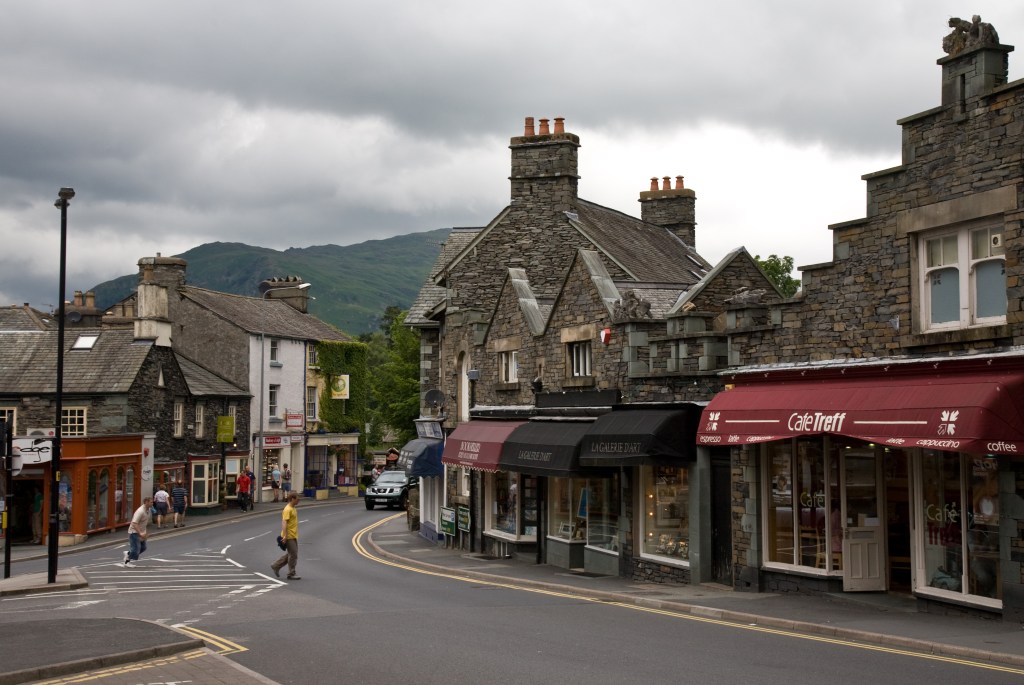
Cumbria, where the story is set. Courtesy: Creative Commons

The barman hadn’t warned me that I’d taken the old man’s regular place at the bar. Perhaps that’s why he was so edgy to begin with.

“So. Whur’s thee really frum?”

“The Midlands,” I said.

“Ah wusnae sae fur aff, then.” he observed, nodding slowly.

“I’ve been up here more than fifty years mind you,” I told him.

“Thee’s still an incomer,” he said. “Thee’s allus an incomer.”

I must have frowned or something because he smiled and spoke more softly.

“It’s nae a bad thing tae be.”

“No?”

The smile turned into a grin, and he leaned closer.

“Incomers is good fer’t stock,” he said. “Freshens it up somat. Besides,” he added, there’d be nae names if’n it weren’t fer’t incomers. Fer’t fells an’t becks, tha knows. It’s allus incomers that gies places theer names.”

“I guess so.”

“Sae next lot knaws whut tae call ‘em, he explained. The thing wi’ incomers,” he said, “is ef they gie ‘emselves tae place, or just tek frum it.”

We sat looking at each other after that for maybe a minute or more without saying anything. Then he nodded to my glass.

“Wilt tek another yan?”

“Aye, I thought, why not?”

“So,” he said while the barman was drawing two more pints, “You’ll not have been all that old, when you arrived?”

I noticed the change too. Maybe he’d relaxed a little, forgiven me for taking his place at the end of the bar.

“I was twenty-one,” I said.

“Why here?”

“School trip a few years before. Thought I’d come to heaven.” He nodded at that. “I took to driving up for weekends once I got a car; camped on a local farm. The farmer let me use his standpipe for water. We got to know each other, well, recognise each other. He was older than me. He’d be dead by now, I guess.”

“Aye. It’s a hard life on the fells.”

We sipped our beers.

“And what made you leave? Home.”

That one caught me out. I took a longer pull at the beer.

“Working for my dad for three years.”

“Ah,” he said, and I think he chuckled. “I know that one, lad,” he said.

I’m over seventy, but it’s always nice to be called lad.

“My heart wasn’t in it,” I told him, “The work.”

He gave me a keen look but said nothing.

“You’ll have been tied to the land, I imagine?”

“Tied?’

I wondered what he thought I meant.

“Has it worked, leaving?”

“Yes,” I said. “And staying? Has that?”

He took a long pull at his beer. The barman, who’d been listening intently, waited for his answer.

.

*Animals growing accustomed to and attached to an area of pasture that they seldom stray away from it.

.

Brindley Hallam Dennis lives on the edge of England where he writes occasional plays, poetry, and essays. His writing has been published and performed. He blogs at www.Bhdandme.wordpress.com 

.

PLEASE NOTE: ARTICLES CAN ONLY BE REPRODUCED IN OTHER SITES WITH DUE ACKNOWLEDGEMENT TO BORDERLESS JOURNAL
Click here to access the Borderless anthology, Monalisa No Longer Smiles

Categories
Essay

 Half A World Away from Home

By Mike Smith

Auckland downtown. Photo Courtesy: Mike Smith

I recently visited New Zealand, where I met up with writer Jenny Purchase, whose collection of short stories Transit Lounge  has just been published. I was fortunate enough to read an earlier version of this in manuscript form, and it was good to meet up face to face with her at last; and to get my own proof copy of the then not yet published volume!

Reading a book written in and about a foreign country (where, it has been famously asserted, ‘they do things differently’) is a bit like travel itself. We are hit simultaneously by not only what is dissimilar from our own patch and experience, but also what is, unexpectedly perhaps, amazingly similar. It’s not just Maori culture that Jenny’s stories jolt the outsider into, but the wider society of this modern democracy, which is said, at least here in my country, to be like stepping back in time into a version of our own past.

That’s true to a very shallow extent. Buildings are reminiscent of British structures: but who could tell skyscraper London, from skyscraper Hong Kong, or Dallas, or tower packed City Centre Auckland if they’d never been in any of them before? I used to think a good TV game might be to fly contestants into night clubs around the world and ask them to guess which country they were in. It crossed my mind more than once that you could do something similar with shopping centres, or malls if you prefer it. There would be clues, but often not in the appearance of the shoppers, nor in the brands they were carrying. But what we in the UK call charity shops are in NZ called opportunity stores, which implies differences that cut much deeper than mere labelling.

Yet those low-rise suburbs of New Zealand’s largest city, the wood-framed clapper boarded houses that I think of as ‘chalet chic’, and especially the oldest of them, and which look so alien to my eyes, were once common in the UK, and I could take you to a few still rotting gently in Lake District lanes under pine trees, oak and ash. One house we stayed in, at the resort town of Akoroa, settled by the French in 1840, is said to have been imported in kit form from Britain in the 1850s, and to be same kit as the more famous ‘Treaty House’ at Waitangi, except of course with an additional second storey.

The traffic, too, has that blend of the familiar and unfamiliar to European eyes, with the same private cars I would see on UK roads. But the lorries! Huge Mack trucks, often with trailers, that I’ve seen before only in the movies. There was the odd Chevy knocking about too. But they all drive on the left, just like in the UK.

When people get off the bus in Auckland, they thank the driver. Yet, I was told, the drive to get more people out of their cars and into public transport in the city was struggling against a deeply ingrained reluctance to take the bus. Snobbery was given as the explanation. And from the sound of engine noises in the night, and during the day, there are more drivers than I hear where I live who still think it’s clever to be audible three streets away. And don’t get me started on those who play their music louder than all the traffic noise within a hundred yards!

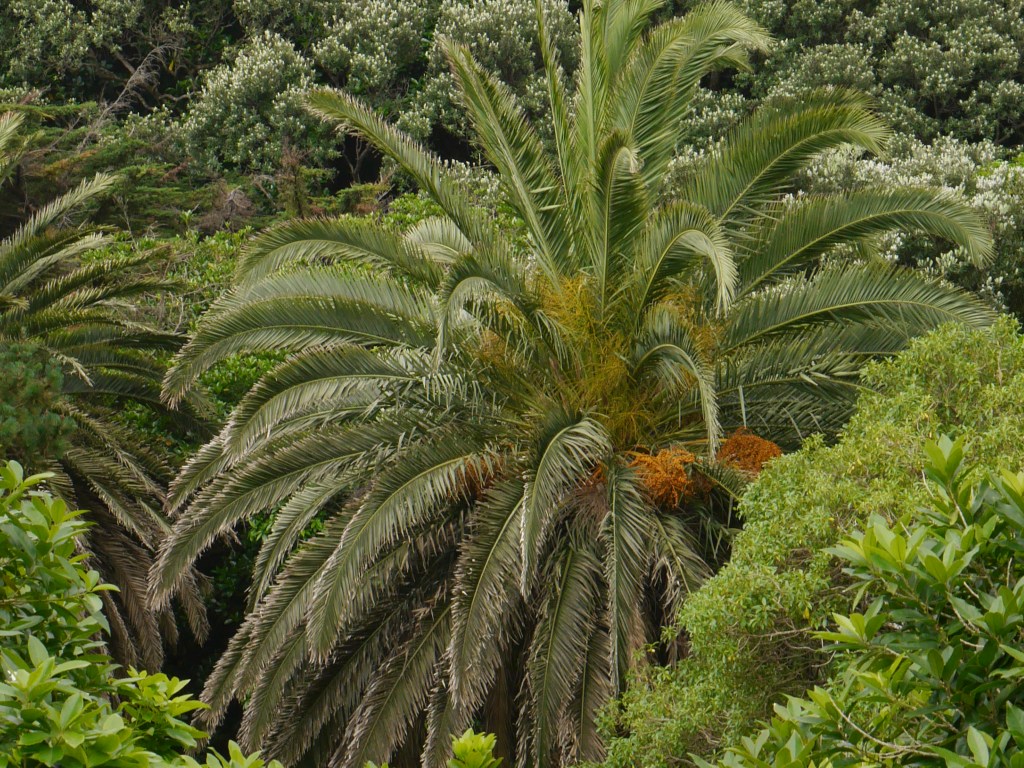
And what about the forests? Walking on the Queen Charlotte trail near Picton in South Island, it was the difference that struck me: the canopy of ferns and palms; leaf shapes that I couldn’t identify; the scars of recent landslips, which looked as if some giant had taken a massive ice-cream scoop to the hillside and peeled off a good helping, only to drop it a few hundred feet down the valley side, often into the sea where the path ran close above the shore. I got the feeling all along the coast that I was walking on sandcastles not yet reached by the rising tide. 

Yet, turn a corner and momentarily you could imagine yourself in an English glade or a Scottish glen, and in so many places the name given to it might well be of an English or Scottish general or politician, or any surname that you’re very familiar with. And, let’s be honest, in an English woodland I’m as likely to struggle with identifying those leaves except for a really obvious few! But the palm fronds and ferns exploding like huge green fireworks from an otherwise normal — to my eyes — New Zealand forest canopies always excite me!

Plants that at home are house plants on the windowsill, and never big enough to block the view are here growing outside, and above head height. Fruit that costs a fortune in English supermarkets falls here in back gardens like English apples and is left to rot.

The Fish and Chips are good, and celebrated both here and there, though it throws me for a second each time what we call crisps are referred to as ‘chips’. The coffee, ‘a long black a day keeps the senses in play’ is my take on the old saw, is the best I’ve ever had, though I’m doing my best to replicate it here in Cumbria!

Similarities and differences abound both in stories, and in the places they come from and reveal. They told me when I was young that travel broadens the mind, but I wonder if also, and perhaps more so, it sharpens our perception of where we’ve come from as well as that of where we’ve arrived, whether we travel by plane or on the page! 

Raising A Trowel

Seen from the Auckland waterfront, where the pedestrian swing bridge salutes the boats as they enter and exit the inner harbour, city centre offers an intense, almost intimidating backdrop of close-packed tower blocks of concrete and glass, overtopped by the sharp needle of the skytower a few blocks further up the hillside beyond the historical shoreline.

But turn around and follow the embedded railway tracks left over from the days of steam trains and sailing ships, all the way to where the old industrial silos have been decorated with lights and festooned with climbing plants and find the single track spur that slips away to the right, splitting almost immediately into two again before entering the double-track tram shed, and you will have arrived at what we were told is the last of the Auckland Community Gardens.

Lying alongside the long building are some forty raised beds, tended by volunteers, each bed that I saw, carrying the name of its gardener. Hard up to the tram shed wall (here decorated with images of old tickets), sits a row of composters for food waste and wormeries in plastic barrels. There’s a greenhouse and a traditional pallet-built compost heap. Water runs from the tap.

There were many such gardens in Auckland at one time. I recall encountering one unexpectedly on a small site on one of the steeper city centre streets during a previous visit. But I’m told that all save this one have gone now, the land taken for the far more valuable purpose, in monetary terms and for other reasons, of squeezing in another tower block. This last of them is fighting to keep its plot, and I hope it does. Buildings, from what I’ve seen, sit tight in their boundaries in Auckland. It’s a city that doesn’t seem to see the need for growing space. And perhaps, with a country more or less the size of the United Kingdom but with only about one fourteenth of its population, that shouldn’t surprise us.

Two tomato plants were pressed on us, for our daughter’s nascent garden out in the suburbs. My guess is that I will never eat tomatoes grown in such valuable land, on a dollar per acre basis. But the clue is in the name. This is a Community Garden, and the community, which it not only serves but also creates, is an inclusive one.

Community Gardens offer more than a source of ‘home grown’ food, paid for in care rather than cash. I would guess that even a city like this, which to the outsider’s eyes can seem remarkably relaxed and laid back at first glance, could use those benefits.

The names on those raised beds confirmed the story told by the volunteer who we chatted with on our stroll past. The garden brings together people whose languages and skin colour vary enormously, but they are united by their green fingers and that remarkable thing, the human smile, and much more.

Back on my own plot now, bound fast in winter frost, harsher and earlier this year than we have become used to over the last decade, I raise a trowel from the iron hard soil, in salute to fellow gardeners everywhere.

A Cacophony of Voices

The variations we hear around us, in accent and in language itself, I suspect, offer different perspectives of reality rather than merely alternative words for it. Perhaps that’s why I came home from my recent trip to New Zealand with a beginner’s guide to Maori!

‘Yis’ and ‘yes’ are both similar and different at the same time, and so are ‘iggs’, though the latter perhaps weighs more heavily on the difference side of the scale. But in the North of England, yes and aye carry a much older distinction, despite both being used without forethought locally. Though my skin is more or less the same colour as that of almost all my neighbours, and though I’ve lived in this part of the world for over half a century now, any school kid, and any old codger of my own age would know as soon as I opened my mouth that I’m ‘nut frum rahnd ‘ere’. Old codgers, fifty years ago, in a Cumbrian pub told me that during their childhood, people from villages only two miles apart could be distinguished by the way they spoke.

Only the outsider is fooled into thinking that rural England has a homogenous population, and perhaps that’s true elsewhere. But in the cities, it is cosmopolitan around the world, and visibly so. More interesting to me is the cacophony of voices, none of which I believe, have been genetically inherited. We speak as we have heard. We speak as we have listened, and in the accents of those we have listened to and consciously or unconsciously, copied.  Until a couple of generations ago that would have been limited almost completely to geographically close family and neighbours.

Several years after my visit to the Waitangi Treaty Grounds, it suddenly struck me what I had overlooked, though it was obvious from the beginning. The Treaty was signed by many Maori leaders in 1840, but on behalf of a single Monarch-Emperor. Our perceptions of others, and of ourselves, evolve over time. As part of that process we forget, deny, re-interpret and re-invent both our own narratives and those of people we have encountered. We redefine who ‘we’ are, and who ‘they’ are. ‘Us’ and ‘them’, are perhaps the two most unstable words in the English language.

Language itself is unstable. New languages are formed by the coalescence of older languages – English is a prime example of this, and not yet a thousand years old as a national, let alone an international tongue. They are formed too from the disintegration of an earlier single language – Scottish Gaelic, Irish, and Welsh among others, all derive from a single widespread early European language. Which process the language of any people is undergoing at any moment, that of coming together or that off moving apart, must be an indicator of wider social, political and religious evolutions.

The biblical story of Babel’s Tower, and its cataclysmic dividing of us, of being struck down as it were by the curse of having different languages rather than one, is a story that raises ideas we might do well to ponder and examine more than it seems to me that we have.  Harari’s book Sapiens makes the simple assertion that once upon a time a monkey had two offspring, with the astonishing addition that one was a human being. My question is did their offspring develop a single language from which all our languages grew? Or did they disperse into separate communities each of which developed their own languages?

A history of the North American Indian that I came across asserted that those first people had dispersed across the continent before the development of language, which implies that by the time we had spread that widely across the world we were still, apart from, perhaps, something like birdcalls, mute. Yet we all carried the genes that would predispose us to develop language, and that when the American Indians did so it was in quite as many unrelated languages. The Maori came to New Zealand less than a millennium ago and brought with them languages with shared roots despite their many tribes.

Of course, I have no answers, though it seems likely to me that communities and individuals who are open to strangers are more likely to see the amalgamation of languages, and that those who are not will encourage their disintegration. And I do have the suspicion that language, to use a modern analogy, is like a TV channel. Each one carries its own agenda and its own programmes. Each presents the world from its own perspective and its own focus. There may be overlap. There will be difference. But as language using beings we can, with varying degrees of competence and effort no doubt, tune in to any, and who knows, perhaps to all of them, if we wish to do so.

Mike Smith lives on the edge of England where he writes occasional plays, poetry, and essays, usually on the short story form in which he writes as Brindley Hallam Dennis. His writing has been published and performed. He blogs at www.Bhdandme.wordpress.com 

.

PLEASE NOTE: ARTICLES CAN ONLY BE REPRODUCED IN OTHER SITES WITH DUE ACKNOWLEDGEMENT TO BORDERLESS JOURNAL

Click here to access the Borderless anthology, Monalisa No Longer Smiles

Categories
The Observant Immigrant

The Immigrant’s Dilemma

By Candice L. Daquin

Courtesy: Creative Commons

I have been an immigrant to a new country three times: from France to England, England to Canada and then, Canada to America. Being an immigrant is often a highly positive experience. We may have greater opportunities, we seek our dreams, we grow them. On the other hand, immigration for those of us who have gone through the process, is not easy. It is expensive, time-consuming, nail-biting and often lonely. It is said that those who immigrate ‘successfully’ do so because of familial support and/or because their children reap the benefits of their sacrifice.

Whilst there are too many stories to condense any one feature of immigration, we can only talk of our own experiences and somehow in understanding that, perhaps stay open enough to understand others. We can come together through that collective understanding.

As a psychotherapist, I work with many immigrants. I see clients daily who were born elsewhere and sometimes struggle to acculturate in their new-found country. Where I live, near the border between Mexico and America, we have a multitude of immigrants from Mexico, central and south America as well as from around the world, coming through the borders, seeing asylum and a better life.

Consequently, there can be a high degree of racism in rebuke for the startling numbers of immigrants passing through our city. I can drive down a road and see people lined on the street much as you would see in other countries, begging and homeless. Our resources are stretched and one option chosen by the Governor of Texas was to bus immigrants and asylum seekers to other states in the US. Initially this was considered a racist, insensitive act that treated people like cattle. When you look at it closer, you can see it was perhaps these things but also a desperate plea for other states to understand the overwhelming nature of immigration for border states and share in the expense.

It is easy for a non-border state to believe the border should be effectively kept open and all immigrants allowed in. but when it’s on your door step it can be challenging. Most people in Texas care about immigrants but also experience some of the downsides of too many immigrants at once. In El Paso, people froze to death sleeping on the streets, houses were broken into, the situation was dire and extreme and locals didn’t have enough resources to manage. Shipping immigrants who wish to go to other states, to those states, might appear cruel, but also makes sense, if it’s consensual. Whilst many of the Texan Governors decisions have been quite possibly racist and prejudicial, this choice was in part to show other states how dire the situation is.

Why are there so many asylum seekers right now? As President Biden announced the lifting of closed borders to asylum seekers, the numbers attempting to come into America increased exponentially. Under the Trump administration, the Department of Homeland Security (DHS) called the “Remain in Mexico” policy (officially, the Migrant Protection Protocols) caused immigration to be somewhat halted. The original reason countries like America accepted asylum seekers goes back to WW II where the Jews who survived ethnic cleansing had nowhere to live and were essentially stateless. The right to seek asylum was incorporated into international law following the atrocities of World War II. Congress adopted key provisions of the Geneva Refugee Convention (including the international definition of a refugee) into U.S. immigration law when it passed the Refugee Act of 1980.

The laws that exist now were enacted to protect them and ensure stateless people were never again turned away in droves. The creation of Israel was in part the consequence of WW2 and the abuse against the Jews. It could be argued any issues with Israel are directly linked to the ethnic cleansing the Jews experienced and their subsequent statelessness. Laws endeavoring to protect future people from such experiences are what we now use in our handling of asylum seekers. “When Congress finally eliminated the racial provisions in U.S. immigration and nationality law in the 1940s and 1950s, generations of federal practice and procedure did not instantly disappear without a trace. Over the years, other government agencies had developed their own racial classification systems, often partially borrowed from INS experience, and such systems could take on lives of their own.”

The downside to this is, the world has dramatically changed since the 1940s (2,307M versus over 7 million today). the population is growing at a heady rate and thus, even if a small percent of people seek asylum from any one country, it is huge in comparison to previous numbers. Department of Homeland Security  statistics show that from Biden’s Inauguration Day through May 2022—just 16 months and change—about 1.05 million migrants were apprehended on the southwestern border and then released into the US. With every year, the worlds population swells and with it, a strain on resources. ‘Affluent’ countries such as America, may literally speaking have the resources to help asylum seekers but the reality for many asylum seekers is quite different once they are in-country. According to Census Bureau statistics, immigrants’ share of the U.S. population rose more from 1990 to 2010 than during any other 20-year period since these figures were first recorded in 1850—from 7.9 percent to 12.9 percent

What constituted poverty in their country of origin may be considerably lower than what money they can earn in America, if indeed such earnings can be made at all. The social welfare system protects asylum seekers by giving them somewhere to live and a stipend until they are able to find work but what of those who do not possess the necessary skills? Not to mention the dearth of certain jobs. Immigrants wishing to live in the cities, may find work is only available in the agricultural parts of America and not earn enough to live on without language and education in a city. Likewise, they must contend with crime, safety issues and making the meager money they receive, stretch to pay for themselves and their families. What might seem initially like a lot of money, in comparison to their home-countries, is quickly devoured by the more expensive living expenses of America.

Immigrants who move to America or other developed countries, on a visa rather than asylum, may fare better. But note how many PhD’s are driving cabs or serving in restaurants. Underemployment is a phenomenon whereby those who are educated, are working at a lower level than that education would typically warrant. For their children there may be greater opportunities but for many first-generation immigrants, the adjustment and opportunities are restricted. Doctors in their own countries, they find American prohibitions on accepting foreign transcripts and learning, despite the low quality of American education in comparison to many other countries. It’s almost if you were being subjective about it, like having to pay the price for immigration.

When I immigrated to Canada, I found many who possessed PhDs and advanced education were unable to find work. There was some push back from locals who resented skilled workers and felt all immigrants should ‘know their place’ and take the dregs work. This is something you really don’t believe will happen to you when you are very educated, and get a skilled worker visa, but it’s a reality, perhaps less spoken about because it makes the host country look unkind. But go beyond the shiny posters about immigration and speak to the people and you will find it’s not uncommon.

Immigration is necessary for many reasons, not least the Western world ageing and requiring new blood because of declining birth rates. But the Western world wants immigrants to do the work they don’t want to do just as much as they may appear to want immigrants to ‘succeed’ and for every Doctor and PhD who was an immigrant, there are plenty who find themselves no better off through immigration. That’s a sacrifice worth making when you have no other choices or you hope your children will inherit the American Dream but if you have no children and you’re sold a false dream, then it can be disheartening if not crushing. There are 11 million recent immigrants in transition, best estimates predict, who labour in American fields, construction and kitchens, as well as American classrooms, detention centers and immigration courts.

What we hear less about, is how many immigrants leave. And how many suffer silently, having fallen between the gaps, into anything but the American Dream. What can be done about this? Should we impose immigration restrictions not out of cruelty but an understanding that a host country is ill equipped to deal with mass influxes and that the original reasons for the laws have evolved/changed as our population has grown? Should we insist other states take some responsibility for asylum seekers? As well as demand other countries pitch in more? And understand that what may look racist, is in fact a more realistic approach than flinging open the border and allowing everyone to come in at once?

It is an interesting dilemma and one that won’t be decided any time soon. The racists and extreme economic conservatives will battle against the diametric opposite liberals who believe all should inherit the opportunity a country like America holds. Both sides are too extreme in that they don’t consider the reality. The reality is racism should not and cannot endure in a country like America where soon ‘brown skin’ will be the majority and old racist ways are being challenged. But equally, being so ‘woke’ that you don’t see the fall out of idealistic policies, isn’t the answer either. In tandem with an identity politics that emphasises the subnational, a too progressive project may place global concerns above national interests. Hence, the oft repeated slogan “global problems require global solutions.”

Speak to the people. Many times, people criticise me for living in Texas. They assume I’m one of the ‘bad guys’ without understanding Texas is made up of a huge diverse population. Within that diversity are many Latinos who don’t want mass unchecked immigration any more than the racists, but for radically different reasons. Things aren’t as simple as they seem in a Twitter comment. There are many complex considerations that must be taken into account to ensure the best outcome not only for asylum seekers but those who already live in-country. There are answers, but they won’t come from knee jerk reactions or entrenched thinking on either side.

What we do know today, is people are literally dying to come into America and with them, perhaps some unchecked terrorists sneak in, just as they did before 9/11. In order to protect everyone and ensure things are done legally and safely, immigration must have some controls and should be funded accordingly, without any one state taking the majority of the strain. Many Texans are quite the reverse from what you’d imagine, if you subscribe to stereotypes. Maybe the problem is we should really get rid of stereotypes and try knowing who people really are before we judge en mass. Houston has one of the highest Indian communities in the world. All cities within Texas have absorbed huge numbers of immigrants from around the world. Let’s think less of ‘them and us’ and more about truly doing what will be best for those seeking to come into a country and begin a new life. Immigration is a conundrum, but if we work together, instead of apart, we can find answers.

.

Candice Louisa Daquin is a Psychotherapist and Editor, having worked in Europe, Canada and the USA. Daquins own work is also published widely, she has written five books of poetry, the last published by Finishing Line Press called Pinch the Lock. Her website is www thefeatheredsleep.com

.

PLEASE NOTE: ARTICLES CAN ONLY BE REPRODUCED IN OTHER SITES WITH DUE ACKNOWLEDGEMENT TO BORDERLESS JOURNAL.

Click here to access the Borderless anthology, Monalisa No Longer Smiles

Categories
Contents

Borderless, December 2022

Art by Sohana Manzoor

Editorial

It’s Only Hope… Click here to read.

Conversations

Shantanu Ray Chaudhari converses with writer Gajra Kottary, a well-known writer of Indian TV series, novels and stories. Click here to read.

A discussion on Samaresh Bose’s In Search of the Pitcher of Nectar, a book that takes us to the heart of the Kumbh Mela, a festival recognised by the UNESCO as an Intangible Cultural Heritage, with the translator, Nirmal Kanti Bhattacharjee. Click here to read.

Translations

Nazrul’s Why Provide Thorns has been translated by Professor Fakrul Alam. Click here to read.

Mercy, a story be P. F. Mathews, has been translated from Malayalam by Ram Anantharaman. Click here to read.

Even A Simurgh Cannot Change Destiny, a Balochi folktale translated and retold by Fazal Baloch. Click here to read.

Confessions, a poem written by and translated from Korean by Ihlwha Choi. Click here to read.

The Sun on the First Day, a translation of Tagore’s Prothom Diner Shurjo by Mitali Chakravarty. Click here to read.

Pandies’ Corner

Songs of Freedom: Vikalangta or Disability is an autobiographical narrative by Kajal, translated from Hindustani by Janees. These narrations highlight the ongoing struggle against debilitating rigid boundaries drawn by societal norms, with the support from organisations like Shaktishalini and Pandies. Click here to read.

Poetry

Click on the names to read

Jared Carter, Sukrita Paul Kumar, Rhys Hughes, Asad Latif, Luis Cuauhtémoc Berriozábal, Santosh Bakaya, Phil Wood, Sharanya B, George Freek, Saibal Chatterjee, Jonathan Chan, Sutputra Radheye, Shambhu Nath Banerjee, Michael Burch

Poets, Poetry & Rhys Hughes

In Some Differences Between Wales and India, Rhys Hughes makes some hilarious comparisons. Click here to read.

Musings/ Slices from Life

Near-Life Experiences: Hiking in New Zealand

Keith Lyons escapes city life to find his happy place while hiking in New Zealand. Click here to read.

The Seven Grandfather Teachings

Saeed Ibrahim introduces us to Native Indian lore from Canada and shows its relevance in the current times. Click here to read.

Dismasted in Bass Strait

Meredith Stephens takes us for a sailing adventure with photographs in the Southern Hemisphere. Click here to read.

Musings of a Copywriter

In Of Mice & Men, Devraj Singh Kalsi talks of his encounters with rats. Click here to read.

Notes from Japan

In A Clean Start, Suzanne Kamata tells us how the Japanese usher in a new year. Click here to read.

Stories

Annapurna Bhavan

Lakshmi Kannan closes class divides in Chennai over a meal. Click here to read.

Two Faces of a Mirror

Tulip Chowdhury gives us a story set in a Bangladeshi village. Click here to read.

The Slip

Sushma R Doshi takes a look at the pandemic against an Indian middle-class set up. Click here to read.

Till Life Do Us Part

Devraj Singh Kalsi explores a strange new trend. Click here to read.

Essays

Orangutans & a School at Sarawak

Christina Yin, a conservationist, travels to Borneo in an attempt to create awareness for conserving the Orangutan. Click here to read.

Taiping of the Raj Era

Ravi Shankar explores Taiping in Malaysia with a camera and words. Click here to read.

Ivory Ivy & Stephen Dedalus

Paul Mirabile explores James Joyce’s Stephen Dedalus and his passion for words keeping in mind the hundred year old Ulysees & the even older, A Portrait of the Artists as a Young Man. Click here to read.

Book Excerpts

An excerpt from Radha Chakravarty’s translation of Tagore’s Farewell Song. Click here to read.

An excerpt or two short narratives from Rhys Hughes’ Yule Do Nicley. Click here to read.

Book Reviews

Somdatta Mandal reviews The Shaping of Modern Calcutta: The Lottery Committee Years, 1817 – 1830 by Ranabir Ray Chaudhury. Click here to read.

Rakhi Dalal reviews Freny Manecksha’s Flaming Forest, Wounded Valley: Stories from Bastar and Kashmir. Click here to read.

Basudhara Roy reviews Manoranjan Byapari’s How I Became a Writer: An Autobiography of a Dalit. Click here to read.

Bhaskar Parichha reviews In Search of the Divine: Living Histories of Sufism in India by Rana Safvi. Click here to read.

.

Click here to access the Borderless anthology, Monalisa No Longer Smiles

You are all welcome to the book talks of our first anthology

Categories
Musings

A Fine Sunset

By Mike Smith

Camusdarach Beach. Photo courtesy: Mike Smith

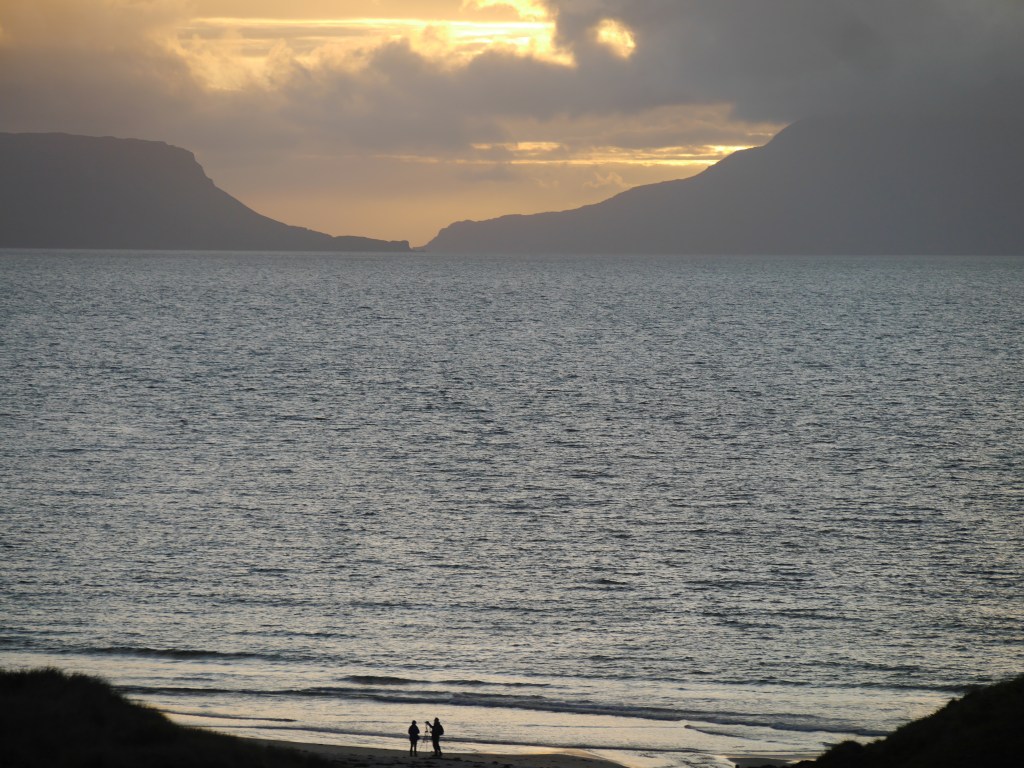
Traigh Beach lies on the west coast of the Scottish Highlands, and from it you look out towards the islands of Eigg, Rhum, and Skye; you look out towards sunset.

It’s a beach I know well, for an outsider. I’ve visited it, probably on average more than once a year for the past forty years, and once or twice in the decade before that. I have written poetry on it. But as often as not, I’ve passed it on my way to another beach a couple of miles up the coast, and that beach, forty years ago, was featured in a film that has become something of a cult movie.

I’m talking about Camusdarach beach, and about Bill Forsyth’s movie Local Hero[1], which starred among others, Camusdarach beach.

But there’s another tale, and in fact more than one, that has drawn attention to this little stretch of coastline. Published as a short story a further fifty years into the past, and by a writer who is now almost totally forgotten, L.A.G. Strong’s[2] tale ‘The Seal’ doesn’t name the beach, but one of its minor characters has a dog named Darach, with has no other reason to be there but to give us that clue.

And the beach is described — broom, dunes, the path along the burn leading in, never mind that view of Skye and the other islands – with picture postcard accuracy. It’s a simple but haunting tale of intimacy not quite achieved between the newly married George, clumsy, boisterous and totally obtuse and the contemplative, highly sensitive Rosamund. The first time I read it, I was thinking of Camusdarach long before the dog put in its brief appearance!

It’s a remarkable story, for its subtlety and its insights, but also for the fact that there is not a single word in it that would need to be excised for you to imagine it taking place, and having been written, in the last day or two. Equally, it could have been written, and again word for word, a hundred years before its publication over ninety years ago. That durability, of place as well as the story is astonishing, and both reassuring and daunting. If one of my stories managed such a feat of, well, transcendence, I would be very happy. It would also be possible to transfer Strong’s tale to just about any beach anywhere in the world over all that time by merely adjusting the names of people, places, and that dog, and the nature of the eponymous animal and the plants growing behind the beach. How’s that for universality? And curiously, the fact that you could do that makes it less worthwhile to do it! Strong’s story in its original setting could speak to us all from the day it was written and will continue to do so while people fail to connect.

Yet I’ve found remarkably little written about Strong. He was a prolific writer across several genres – plays, poetry, essays, novels, as well as the short story – but he’s one of those very good writers (based on the thirty-one short stories in this collection), that seems to have dropped out of our consciousness. How could I find out if this was indeed the beach he had in mind, and why did I want to?

I recently took a holiday cottage overlooking Camusdarach and spent most of a week staring at that view. It’s one of those special places that, in its continuous changes and in its unchanging certainties, holds the attention, day into night, night into day. I made sure to take my copy of Strong’s 1931 collection Travellers, in which ‘The Seal’ is included. I thought it would be good to read it, looking out to sea as Rosamund does in the story. And it was.

But I re-read the other stories too, and among them found the names of Arisaig, and Morar, villages a couple of miles to south and north of me respectively. I found also Glenan Cross farm – to which he pins a headless ghost, and which still sits a bare half mile away on the other side of the coast road — and the name of one the little islands lying just beyond the headland to my left as I read.

So, no biographical evidence, but there in the stories, the minutiae of place that tells me he knew it and implicitly, like me, loved it, though he would have been an incomer too.

And as I’m working on this piece, and dipping into the story, I notice with a frisson of recognition two more little details a few lines apart: ‘She crossed the road’, and ‘After the room at the farm’, which makes me think he pictured her walking the path from Glenan Cross, though he doesn’t name it here, and which I too walked only a few weeks ago.

I’m not a great fan of tagging an author’s biographical details to their writings. What a story means to them is their business, and what it means to me is mine, and the two need neither coincide nor influence one another, but to find myself in a place I know, reading a story set in that place and written by an author who knew it too, brought me a little closer, and not only to the story. Might I say that it heightened my sense of a common humanity and the shared experience of a story as timeless as a fine sunset?

.

[1] Local Hero, 1983, Scottish movie

[2] Leonard Alfred George Strong (1896 –1958), a popular English novelist, critic, historian, and poet, and published under the name L. A. G. Strong.

Mike Smith lives on the edge of England where he writes occasional plays, poetry, and essays, usually on the short story form in which he writes as Brindley Hallam Dennis. His writing has been published and performed. He blogs at www.Bhdandme.wordpress.com 

.

PLEASE NOTE: ARTICLES CAN ONLY BE REPRODUCED IN OTHER SITES WITH DUE ACKNOWLEDGEMENT TO BORDERLESS JOURNAL
Categories
Poetry

From Traigh Beach

By Mike Smith

Traigh Beach. Photo Courtesy: Mike Smith
Bone
sinew and hide
articulated 
on the beach at Traigh* 
where this otter
from the lie of it
crawled from the sea to die
sink now
into soft sand
such as we with our small talk
of futures and of pasts
walk.


(ripples waves tides sift the present
pools fill and dry 
winds drift the beach
 earth and sky move
storms pass)

Return one day
the bones will lie
disarticulated now
telling a different tale
of lives lived upon sand.

But however they fall 
those of us who walked and talked here will understand


*
Traigh'(pronounced to rhyme with 'try') is on the West Coast of the Scottish Highlands. It's a place, but also the Scottish Gaelic word for 'shore', though it might be translated to 'beach' too. Traigh Beaches lie on the old coast road from Arisaig to Morar, and face towards the island of Eigg. 

Mike Smith lives on the edge of England where he writes occasional plays, poetry, and essays, usually on the short story form in which he writes as Brindley Hallam Dennis. His writing has been published and performed. He blogs at www.Bhdandme.wordpress.com

.

PLEASE NOTE: ARTICLES CAN ONLY BE REPRODUCED IN OTHER SITES WITH DUE ACKNOWLEDGEMENT TO BORDERLESS JOURNAL

Categories
Musings

September Nights

By Mike Smith

How beautiful this darkness! The air is still and comfortably warm, which for people of that age is surprising at this time of night. Half an hour and today will be over and night will have tipped into tomorrow’s early morning. The darkness will remain for an hour or two, more in fact now the year is turning too, with another season slipping into place.

Houselights are already off, not that there are many to be seen in any case down here in the valley: only the glimmer of one or two through the trees at each end of the river’s wide curve, and of the farm of course, behind, upon the rising ground. The double pizza-slice of flat grass field is a flood plain for when the river rises after heavy rain miles away upstream on the high fells. It has gathered becks as it falls and flows, and under the strictures of Civil Servants who have environmental boxes to tick no-one now who lives alongside keeps the channel clean, but natural processes clog and choke it for years until some catastrophic surge scours it out, bringing down fallen trees to smash bridges and riverside buildings to smithereens, collapsing banks and gouging the channel clean to bedrock.

The river’s nobody’s friend now; nobody’s resource. But miles away suits in offices can put up on their screens all sorts of proofs that everything is as it should have been since the ice-sheet’s retreat, when no-one lived here.

But tonight, the darkness is so complete that even the black amphitheatre of trees beyond the river’s further edge has merged with the black cloud-lagged starless, moonless sky and all has fallen silent. And people of that certain age, surprised at how pleasant it is to be motionless and silent, as if in a void, and to smell the faint odour of the distant pines and to feel the air warm upon their still warm skin, and to catch the sharp tang of salt upon their lips from tears running down their cheeks, they wait.

Mike Smith lives on the edge of England where he writes occasional plays, poetry, and essays, usually on the short story form in which he writes as Brindley Hallam Dennis. His writing has been published and performed. He blogs at www.Bhdandme.wordpress.com

.

PLEASE NOTE: ARTICLES CAN ONLY BE REPRODUCED IN OTHER SITES WITH DUE ACKNOWLEDGEMENT TO BORDERLESS JOURNAL

Categories
Stories

Does this Make Me a Psychic?

By Erwin Coombs

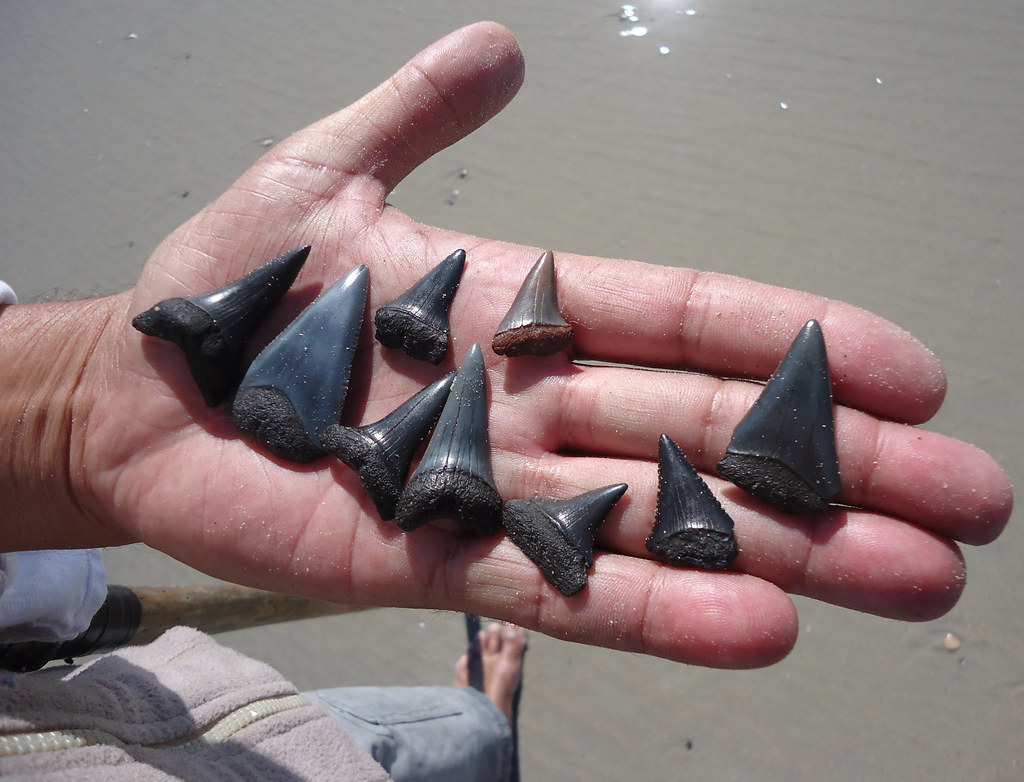
Shark’s Teeth. Courtesy: Creative Commons

The credibility of a writer is important. Of course, anyone’s credibility is important because without it, you are keeping time with someone who is a phantom of a personality if they can’t be believed for one reason or another. One must trust that the person telling a story is not sitting in a Starbucks for hours at a time nursing a small coffee and babbling away about things that never happened or didn’t happen that way. Just to put your mind at rest, I’m not currently in a coffee shop, I never linger over coffee and everything I say happened, more or less as I describe.

Here’s where my credibility might be called into question: I am psychic. There, I said it, it’s on the page, a frank admission that makes most people start to wonder where the nearest exit is, or perhaps you are now looking for the nearest recycling bin for this peice. I remember saying this to a fellow at a party once and his expression froze. Not being the most socially adept creature, he was looking for a way to get away from me before I put a hex or curse or whatever it is psychic people do.

He grabbed his cell phone and said, “Sorry, I better take this.”

And as he backed away his phone began to ring. So, either he was pretending to have a call, or he was the psychic — one who knew it was coming. But he found an almost smooth way out of a conversation with someone who might just be an oddball. You do not have to fake a call and presumably you’re reading this with open eyes and an open mind, so let me tell you a bit about this nether, dark world that both fascinates us and repels us like standing naked before a mirror once you’re well into middle age. Here is a story that might not be spooky in the other world sense, but it certainly gave me pause.

It was an overcast fall day in an old room in an old school. How’s that for a spooky, atmospheric set up?  I was teaching another class of basic level grade 10 boys. These poor devils have been committed opponents to English classes likely since their first day in kindergarten. Again, it’s not that they’re dumb, at all. But they sure didn’t like English class.

I came up with a brainchild of an idea to get them to work. I could always keep them quiet and seated, which is a feat in itself. But to get them to work I thought I would go right back to a depression era technique and told them I would give the best student of the day a prize. Now these poor working-class sods were not used to prizes. Mostly at home they got slaps across the head for transgression both real and imagined on the part of parent(s) whose only embrace of parenthood involved forgetting to bring a condom. Their faces lit up at the prospect of a prize. An award! They had spent their school years running into punishments, but a prize!

I felt a little bad when they immediately grabbed their pencils (this time not as a weapon), opened their books (this time not for a pillow), and began to read and write. There is no more stirring or heartbreaking sight for a teacher who cares than watching students try so hard to do something well for which they have no confidence. I sat at my desk and began to wonder.

The first thing I wondered was what could I give for a prize. I assumed they would scoff and make some kind of a sucking noise with their teeth. In 1991, this was a favourite of rappers to display dismissiveness. I had encountered it many times as a teacher. My defense was to ask, in a sincere voice, if they wanted some floss.

“Floss? For what, man?

“Sorry, I thought you had something stuck in your teeth from lunch. I do have some floss in my desk. It’s been there for a while, but it might just do the trick of dislodging that bit of food you feel the need to suck out.”

With a lot of teachers this might well have resulted in a small-scale riot. But my kids knew I liked them, and I tease and, as I said, they might not be bookish smart, but they knew sarcasm when they heard it and they usually just laughed.

But back to the problem of offering a prize that I didn’t even have. I cast a quick look around the room for possibilities. There were some posters on the wall of an educational bent that I could use. There was a lovely one of a parachutist drifting down to earth with the caption below saying: “The mind is like a parachute. It only operates when open.”

I could imagine telling some poor slob that they could take that home for a hard day’s work. I imagine I would eventually make it out of the class, but not in one piece. The pounding I would take would put me on long term disability. Not a terrible idea but the journey to get there would be hard.

I thought about the money in my pocket, full five dollars and some change. But wouldn’t that be a bribe or some form of prostitution? And the next class all behavior and production would come with a price tag. And when the principal got word that I was paying my students, it would mean a different route to long term disability.

I rummaged through my desk drawer when I saw it. My salvation! It was a glass jar of shark’s teeth. Now why in God’s name would a teacher have such a thing on his desk. Simple. It cost me nothing and was a gift. My wife’s uncle was this eccentric but genuinely nice man who collected things. It didn’t matter what, he would collect them. He had scoured the countryside looking for Indigenous arrowheads and tools and guess what? He found them by the hundreds. His collection was so impressive that the Royal Ontario Museum gladly took them when he offered them up out of the goodness of his heart. So, one day we were in his cavernous basement, strewn with rocks and fossils and bits of metal and God knows what else. It was a summer day, and his hay fever had the better of him. He let out a sneeze that no doubt shattered an arrowhead or two.

He blew his nose into a handkerchief that would likely never be used again for any human purpose. He looked down at the contents and said,

“Oh, I thought my nose was bleeding, but it’s snot (instead of it’s not, you see).”

That was exactly the kind of joke this guy made and one of the reasons I found him so much fun to be with. The odd thing was he had survived a German work camp as a teenager during World War II, one in which his brother had died. Yet here he was, in his seventies, bent and old and so full of life and always finding a reason to laugh. How could I not like him?  And now was he related to some of Tina’s family? They were people who could find a dark cloud in the second coming of Christ.

“You know he really should have called first. This is really not convenient.”

Anyway, this jolly old fellow saw me admiring his countless bottles of shark’s teeth lined up on a shelf.

“Geez, just take one. I got plenty.”

“That’s awfully good of you, Bill. But all the work you took yanking them out of their mouths. It just doesn’t seem right.”

He would never laugh at my jokes, but I know he liked them.

“Here, you keep ‘em. Mostly they were lost in bar fights anyway.”

So, thank you very much, Bill. Now I could give my winner a reason to not add my teeth to the collection.

The class came to an end, and I knew I had my top student. I would have liked to have given them all something because they had all tried, and I was very proud of them. But if you give a prize to everybody then it takes away from the very idea of a prize which is a celebration of accomplishment in a field of others. It reminded me of the increasingly bizarre notion that had come up in education in the last few years, namely that everyone is special and stands apart and should be recognised as such. I am all for increasing students’ sense of self-worth but here’s the trick: if everyone is special, then nobody is special. If every child is recognised and labelled as having poor behaviour or attitude because of their genetics or how they were raised or because they weren’t tucked in at night in order to maximise their potential, then they all have an out.

Unfortunately, it gives every kid a playing card that they can pull in any situation. I remember breaking up a fight and as I guided the hulk along to the office, he looked at me wide eyed and said, “It’s not my fault…I have anger issues.”

This was a kid that was not exactly a future student of psychology. A future as a study model of aberrant psychology possibly. But he had been told by teachers and counsellors and no doubt his parents that his ‘acting out’, to put it mildly, was the result of this syndrome. It is to laugh for.

Though I wanted to reward them all, I knew that I had to choose just one. Bobby Mack (yes, it did sound vaguely like a cosmetic line) was the one. I don’t think anyone ever made fun of his name to his face. He was very tall and naturally very strong. His strength wasn’t achieved from holding big books in the library. His love of academics was an empty love. He was, however, a very good future plumber. That’s why he was at school. He was a likeable fellow with a good sense of humour, I knew this because he laughed at my jokes. 16 years old in grade 10, turning his life around to pursue his love of plumbing. It would also help him support the two children he had with two different girls similarly young. Ah, well, he had a goal and I felt he could do it.

With a few minutes to go before the end of class I stood before their expectant faces and said my piece.

“Well, after careful consideration, and after having fed data into the computer, it has been calculated who is student of the day and thereby the winner of a prize that will change their lives.”

I love a big build up, but the faces in front of me told this young teacher that they didn’t use computers, only had calculators for projectiles and didn’t think lives could change. I cut to the chase and told Bobby to come on up and get his prize. He lumbered to the front of the room with a shy smile as the class applauded.  I’m sure the guy never won a prize in an English classroom in his life. When I say applauded, I mean a few did, several whined that they should have won. One fellow called out,

“Oh, sir, that’s not fair. You’re a racist.”

I looked down at this white face, back to Bobby’s white face and wondered where he got that complaint from.

“No, it’s not racist. For one thing I didn’t even know you were Chinese.”

“I’m not Chi…!”

He cut himself off realising that there was both a joke as well as a jab in there for him. Bobby stood in front of me and I slowly, for even more dramatic effect, took out my little bottle of shark’s teeth, took one out and put it in his outstretched hand. The smile didn’t run from his face, it sprinted. He looked hard at the tooth and held it as though he were holding a turd.

“What the hell is this?”

As he was genuinely angry and outraged, I let the swear word go. It floated up into the air not to be addressed by the tough teacher I usually was. It fled the room along with his smile and his joy at having won. He was angry. He was big. I was scared.

“That, my friend, is a shark’s tooth from Florida!” I said, pumping up the item like a door-to-door salesman.”

“I thought I was getting chocolate, or money or something not weird.”

“I want you to know why that is such a prize, far more valuable and lasting than chocolate.”

He still looked angry, but I sensed he would listen. I figured I better talk fast and good or start running. At the Faculty of Education, they taught us that running away from threatening students can chip away at one’s credibility in the classroom. I addressed the whole class as well.

“A hundred years ago there was a shark swimming in the warm waters of the Atlantic Ocean. It didn’t know about death; it didn’t know about anything. It simply existed. That’s all it wanted, to eat and swim and make little sharks, not because he thought those were good things to do. He just did what came naturally to him…stay alive and make more life. But he died, in some way we will never know. And now Bobby here is holding one of his teeth in his hand.

This is a reminder to all of us that life is beautiful, but it doesn’t last. That shark had a last day on this earth and so will we. We don’t know how or when. But one thing we do know is that we should treasure every day we have, and remember, always remember, this is the only life we have and today is the only day we get, so make the most of it. Value it. That shark, though he didn’t know it, has taught us that lesson.”

Bobby now had the tooth between his fingers and smiled.

“Yeah, that’s kind of cool sir…thanks.”

He tucked the tooth into his pocket and took his seat. The bell went a minute later, and I was pleased to see several kinds around Bobby as he showed off the prize that had meant less than nothing to him moments before. I was proud of myself for having taught a lesson, a life lesson that would hopefully stick with those kids for their whole lives.

I know it stuck with Bobby for the rest of his life. For his life ended that night. He was at a party, a drunken argument and another kid came back with a gun and shot Bobby in the head. I like to think he had the tooth in his pocket and that maybe his last day on earth, he might have valued the little things a bit more, his child’s smile, his mother’s farewell hug. I even fool myself into thinking he looked up at the sky for once, not to check the weather, but just to be happy.

.

Erwin Coombs is a retired teacher of philosophy, history and literature who has rejected all forms of retirement. He is an avid writer, reader, and observer of life. When not observing and reading and living, he is writing. Erwin has lived in Egypt, Jamaica, England and travelled a great deal but, in his mind, not enough. His writing is a celebration of people and opportunity, both of which life gives in abundance. These stories are from his, as yet unpublished book, Dusty the Cat: Her Part in My Downfall.

.

PLEASE NOTE: ARTICLES CAN ONLY BE REPRODUCED IN OTHER SITES WITH DUE ACKNOWLEDGEMENT TO BORDERLESS JOURNAL

Categories
Stories

My Christmas Eve “Alone”

 By Erwin Coombs

Courtesy: Creative Commons

Years before I became a teacher, I found myself in the sad position of having a four-year BA and being in the middle of a recession. The recession was the economy. On a personal level, I had a pretty good depression going. Not being able to get into a Faculty of Education and not being able to find a decent job, this newly married fellow was forced to take the only job he could find as a security guard.

Now I don’t mean to disparage security guards. They have a nasty job with a nastier pay. But you’ve seen these people. They are usually on the cusp of what we might term the unemployable. When I say cusp, I mean they are leading the parade of that group. And it’s not their fault. Many are new immigrants whose education credentials have not been recognised. Or they are retired men who cannot stand to watch their lives fritter away at home so come to malls and office lobbies to wear a uniform and do the same. And then there are young people, as I was, who are caught in hard times and have no other choice.

After a couple of humiliating jobs waiting tables in chain restaurants where I would remarkably come home with less money than what I would take to my shift, I jumped at the offering of a job as a security guard. The next time you’re in a chain restaurant, I want you to look kindly on those employees too. They are usually bright and assigned the all-important tasks of making sure the salad bar is inviting. And while you’re in there take a closer look at the salad bar. It is old and crusty and sprayed with oil to make it look shiny. But we had to make it look less toxic. Any idea how few employees eat that salad? Lots and lots.

Okay, when I say jumped at the job, that might be an overstatement. One doesn’t jump at that sort of employment. One stumbles, slithers or falls into it. But here I was offered a job at $5.75 an hour!! It was an olive branch. That very phrase has a biblical origin, apparently. But there was nothing biblical or God giving in a job like that for those wages. Don’t get me wrong. I was raised in a white trash upbringing where one didn’t expect anything necessarily good. Instead, one only hoped very hard that nothing too bad would happen that day that might lead to a poor night’s sleep — such as the arrest of a family member, an eviction from your apartment, or the like. As a survivor of this sort of upbringing, the prospect of a job didn’t seem that bad. What, after all, was I going to do with a specialization in English Lit. and a major in history? Apparently, I was going to guard office buildings in the wee small hours of the morning.

But while that might seem a sad conclusion to years of study, there were some perks. Imagine, for example, the sheer utility of having to wear a tie that clips on! Think of the minutes, and in the totality of a year, the hours saved not having to struggle with said tie. Pop it on and you’re ready to do whatever it is that fellows with clip on ties do. Oh yeah, that would be security work. The assumption being giving workers like me, those ties in the event of an altercation, you wouldn’t be choked with that tie.

When you are making $5.75 an hour, and you are brandishing what has appeared to be a useless university degree over your head, what’s going to happen if an altercation does occur? Let me tell you, you are going to, to put it politely, not intervene. There was no chance of my tie ever being touched by anyone except my sad, trembling hands before a sad, trembling shift at wherever they put me.

And for my second shift of what was to be my “permanent placement” I was assigned to a tall office tower in downtown Toronto. It was a plumb job, high end lawyers, businesses that made obscene amounts of money doing God knows what God knows where. And they had entrusted me to keep it safe throughout the long dark winter nights. Was I honoured? No, I wasn’t honoured. I only felt deflated. And to make matters worse, my first shift was on Christmas Eve, the graveyard shift, from nine p.m. to nine a.m. Christmas morning. Envisage if you will a bleaker prospect. Here I am, a young man, head full of ideas (granted, not his own) and lines of poetry and hope for the futures of his world and the world in general, newly married and, yes, making minimum wage, working on Christmas Eve. Gradually the poetry and the hope faded.

But to be fair it wasn’t entirely without a bright side. My wife had gone to visit her family outside of Toronto for Christmas. Had I not had a shift to cover, I would have gone with her. Her family were a small-scale variation of a war zone. Nobody got along and there was never a peaceful moment, instead there was only a lull between battles. There were tears and accusations and more tension than one might find in a tightly strung tennis racket. When I told her that I was expected to perform my duties as a poor imitation of a cop for this special night, and that she would have to go enjoy the majesty of her family without me, I was not as sad as one might think. In fact, I had a novel to read, a thermos of tea and the prospect of 12 hours of not watching a family engage in a bench clearing brawl over two days.

But fate had other plans for me. Other plans of a Christmas Carol variety.

I showed up early to get the very precise instructions of how to get through the night. My boss, a veteran of many years, who commanded all the respect one might command when sporting a polyester jacket uniform, was very specific.

“There’s no one in this building tonight. Except you. There is a fellow on the second level parking garage, but he never leaves his cubicle. And, uh, between me and you, that should make you feel safer.”

“Safer. Why?’

I started having visions of a madman on some kind of a parole programme given parking duty having committed the most heinous offences.

“Well,” my boss continued…” he’s one of them.”

He let that comment hang in the air for me to absorb and be shocked at. Of course, I knew what he meant. This was 1987, and the world was still in the throes of homophobia and misogyny and racism and all the other features of Neanderthal thinking that was, thankfully, about to be knocked on the head by people with fully developed brains. But I wanted to have a bit of fun with this monkey boss.

“You mean, he cheers for the Montreal Canadians?” I tried to sound both outraged and frightened that such a man would be my workmate through this long night.

Bob, the Neanderthal boss, was a little shocked that I hadn’t picked up on his primitive subtlety.

“NO… he’s a fag!”

I pretended that it would take me a while for that to sink in and put on a shocked face.

“You mean, he….?”

“That’s what I mean.” He said, almost in triumph of having gotten his point across. “But don’t worry, as I said, he never leaves his cubicle, thank God.”

Within ten minutes, Mr. Meathead had left the building and I was alone. Except, of course, for the serial homosexual rapist that I had been warned about. I went right down to see him two floors below to introduce myself. And there he was, sitting in a tiny cubicle with classical music playing and reading what looked to be a fairly serious book.

“Hi, I’m Erwin, tonight’s security guard. It’s my first shift so if there are any problems please don’t call, I’ll likely be napping on an office couch somewhere.”

He laughed and we joked about Bob the Ape man and how if were both in this job one year from now we would have a mutual murder/suicide pact. I left him alone and went upstairs to begin my action-packed shift of watching. And watching. And, if there was time later, watching.

Now as this was my first shift, I thought I should probably do some of what was expected of me. We were told to go on perimeter patrols. These were walks around the out and inside of the building looking for narcotics dealers and nuclear terrorists and generally the sort of high-end criminals who intrude into empty offices in the night. And we were to record in our little make belief police notebooks where we had patrolled and at what time and what we had discovered. After a couple of weeks, it dawned on me that the patrols were not necessary. But I was dedicated enough to still record the patrols in my book. Had I been a little more honest I would have recorded the following:

10:15 p.m. went to office lounge and took delicious 15-minute nap

11:00 p.m. found cookies in staff lounge… ate same

12:30 a.m. finished latest novel…surprise ending quite good

2:00 a.m. considered the merits of suicide as I peered over 15th floor balcony onto atrium…. otherwise, no unusual activity

4:00 a.m. wondered why my cat sleeps so damn much

But as I said, this was my first shift, so I dutifully walked about and scribbled down my report. All had been very quiet until I got to the first level of parking. There were literally no cars in either lot, everyone with lives being at home while I celebrated Christmas Eve in their empty building. But it was not as empty as I thought it was. There, across the lot, I spotted what was obviously a homeless old man who had broken in no doubt to escape the frigid outside. My several hours of rigorous training had taught me what to do in this situation, so I called out the lines I had learned that might save my life one day.

“Hey! You!! You shouldn’t be here!!” I yelled in my deepest, most authoritative voice. The old man, who was shuffling more than walking turned his head to look at me and gave the most peaceful smile. And then he hid behind a concrete column in the middle of the lot.

I have read enough detective novels to know what my next step should be. I must go to the other side of the column to find him. That’s the kind of skill set one acquires from reading. I did, but the shuffling old fellow was a bit faster than I imagined, for he had run around the column to avoid me. I followed. He ran, I followed. Before long I was running around the column chasing no one, and the image of the dog chasing its’ own tail came to my mind. There was no way he could have escaped my most professional pursuit, but he had. I stood there, out of breath and dumbfounded. There was an intruder in the building, and I had let him, somehow, get away. And now I had to report it.

I jogged down to the serial rapist one floor below. He was surprised to see me, perhaps because I was not the same calm looking fellow who couldn’t give a flying damn about this job. I looked worried. Mostly because I was.

“Listen, Mark, not to alarm you, but you should know, there’s an intruder in the building.”

“An intruder?” he looked concerned enough to put down his book.

“Yes, I think it’s a homeless fellow. I’ve got to call it in to headquarters and then notify the police.”

This all sounded very by the book and what ought to be done. Naturally, I was making it all up. I had no idea what procedure was, and I had never read “the book”. And as far as headquarters went, I knew it was staffed by the same South African lunatic who had trained me, if he was even awake. And as for the police, I supposed that made sense as this guy was, strictly speaking, a break in sort of fellow. I was hoping for some guidance from Mark who looked, sadly, like this wouldn’t be his last year at this cubicle. He must have had a lot of great books he wanted to read.

His attitude became casual.

“So, what did this guy look like?”

“Well, he was old, with a gray beard…”

Here is where he cut me off.

“Long gray coat, shuffled when he walked, pleasant smile, fairly short…?”

“Christ, you saw him too! Did he come up to you?’

“No, he never does. He just walks and smiles and disappears.”

Now at the idea that Mark allowed this guy to walk about at his leisure my security guard instincts (never very sharp) kicked in.

“Did you report it??” I asked accusingly.

“Oh, Erwin, you can’t report a ghost. Well, you can, but why bother?”

I looked at him in a predictably stunned way.

“A ghost?”

“Oh yeah…I see him every so often and he just comes and goes and just goes. He has disappeared before my eyes more often than first dates I’ve had. But unlike my first dates, he always comes back with a smile. Don’t worry, he’s harmless.”

Now here’s something else to imagine. You are alone in a big building, you’ve seen a ghost, you have the prospect of many more hours alone and you are told you’ve seen a ghost and that you might see him again but not to worry as he’s harmless. I don’t doubt that ghosts exist and never have. I also believe that they are harmless.

Does this mean that I want to be with one overnight in a building alone? Nope.

I can also tell you that security guards do several things most people aren’t aware of. They pilfer little things, like pens, staplers, cookies (as I hinted at earlier) and they sleep. Sitting alone for a long time and trying to stay awake, it’s tough. Sure, you can play a radio, you can read, you can make plans for an escape from this life that you couldn’t have had nightmares about when you were younger. But ultimately sleep stampedes towards you and you nestle your red eyes into your polyester shirt sleeve laid out on the desk and sleep. But not when you expect the old ghost of Parking Level Two to come by for a Christmas visit. That was the only night I stayed awake for a whole shift. And it was purely from fear, not dedication to my profession. The paltry pay was compensated for with this experience, so I have no regrets about having taken this job. Who knows what adventures lie in the most seemingly bland corridors we travel through!

Erwin Coombs is a retired teacher of philosophy, history and literature who has rejected all forms of retirement. He is an avid writer, reader, and observer of life. When not observing and reading and living, he is writing. Erwin has lived in Egypt, Jamaica, England and travelled a great deal but, in his mind, not enough. His writing is a celebration of people and opportunity, both of which life gives in abundance. These stories are from his, as yet unpublished book, Dusty the Cat: Her Part in My Downfall.

.

PLEASE NOTE: ARTICLES CAN ONLY BE REPRODUCED IN OTHER SITES WITH DUE ACKNOWLEDGEMENT TO BORDERLESS JOURNAL