Categories
A Special Tribute

Abol Tabol: No Nonsense Verses of Sukumar Ray

Ratnottama Sengupta relives the fascination of Sukumar Ray’s legendary Abol Tabol, which has  just completed its centenary

Sukumar Ray, the creator of Abol Tabol[1], came into my life long before Upendra Kishore Roy Chowdhury, the author of Goopy Gyne Bagha Byne. Pather Panchali, the timeless novel, cast its spell when I outgrew the ghost stories penned by the father for kishore-kishoris, the young adults of Bengal. And Satyajit Ray, Sukumar’s son, became an icon only after I got my primary lessons in film viewing. 

But, to go back to the beginning: I was a pravasi toddler growing up in Bombay when I would lisp, Baburam Sapure, kotha jaas bapu re/ Where are you off to, snake-charmer Baburam! And I’d recite, Ramgarurer chhana, haanste taader maana[2]! No no no no, we shall not laugh, I’d say, trying to choke my own laughter at the thought of forbidding laughter. For, by now, I would also fondly spout, Maasi go maasi, pachhe haansi – Neem gaache tey hocche seem… Aunt dear Aunt, I’m rolling in laughter that broad beans are growing on the neem tree! The mushroom wants to be an umbrella for the elephant, and a crow’s hatching the egg of a stork! Yes, I would laugh too as I recited these lines. For I had learnt that contradictions are funny.

There were other poems that I learnt by rote without knowing they were limericks, not mere rhymes. Some, I later realised, told stories; some were satires aimed at Sukumar’s own Banga samaj – the Bengali society – and some were oblique critiques of the Imperialists then Lording over his land. Hunko mukho hyangla, bari taar Bangla, do you know his dour-faced compatriot? And have you encountered the three pigs maathay jaader neiko tupi? The three pigs wearing no hat! 

But most of all, his critique of his compatriots comes through in Sat Patra, A Suitable Boy. I won prizes for reciting it, long before I understood the critique of a Bengali father’s keenness to marry off his daughter to a ‘suitable boy’ – even if the proposed groom is dark or deaf, drunkard or devil…

It took years of growing up, in the literary family of Nabendu and Kanak Ghosh, to realise that some of the lines I heard every day were not abol tabol katha, mumbo jumbo words spewed out perfunctorily. So, my mother never took ‘No’ for an answer: “Utsahey ki na hoy, ki na hoy chestaay?” She’d quote Haaturey to say, “what can not be achieved by enthusiasm and effort?” And if I screamed to protest, she’d simply smile and ‘admire’ like the he-owl, “Khasa tor chechani, how sensationally you scream!”  While Baba, come winter, would keep repeating, “Kintu sabar chaitey bhalo, powruti aar jhola gur[3]!” Who would have thought of clubbing the daily bread of the rulers with the winter delicacy of the ruled rustics!

When I visited Kolkata, I often heard the phrases “Narad! Narad! (let the fight begin)”, “Gechho Dada (here now, off again now)”, and “Nyara beltala jaay ka baar (how often does a bald-pated man walk under the wood-apple tree).” And I wondered, did Sukumar Ray weave poems around the phrases, or did they become part of our colloquialism, thanks to Abol Tabol?

It was Baba who brought me alive to the literary merits of the verses sans sense. And even as I studied Edward Lear as a student of literature, I recognised that Sukumar Ray pulled off the harnessing of contradictions with as much ease as he surprised us with his endings. Ei dekho notebook, pencil e haatey,/ Ei dekho bhara sab Kil bil lekhatey[4]. Yes, Ray’s Kheror Khaata – handmade rough red cotton cloth wrapped scroll book — was overflowing with thoughts, words and illustrations. If he was talking of the lack of coherence in God’s own country, Shib thakurer aapan deshe, he was also making fun of Ekushey Aiin, The Law of 21, whereby Karur jodi gof gajaay, a man would have to pay a hefty tax for even the natural occurrence of whiskers! And Abaak Kando! How strange that he ate with his hand, se naaki roj haat diye bhaat maakhey!

Like Satyajit Ray’s reading of his granddad’s Goopy Gyne Bagha Byne, Larai Khyapa has nuggets hidden in the lines to protest the war mongering of nations. So, Saat German, Jagai eka, tabuo Jagai larey! And Paanch byata ke khatam karey Jagai Dada molo! Jagai, a homegrown brawny, alone takes on seven strapping Germans! And breathes his last only when the last of them is dead!

To conclude, I will quote Bujhiye Bola [5]and say, Ki bolchhili, esab sudhu abol  tabol bakuni? Bujhtey holey magaj laagey, bolechhilam takhuni![6]

Didn’t I tell you, you need to read and re-read Sukumar Ray, to understand the truth lining his nonsense poems?

*

“Sukumar Ray’s drawings are a unique part of our art tradition. And Swapan Maity has dared to give sculptural forms to those two-dimensional line drawings.” It is tough to put in words the significance of these miniatures in terracotta, of those humour-induced fun-filled drawings of the quirky protagonists of Abol Tabol, said Partha Pratim Deb. The former Dean, Faculty of Visual Art at Rabindra Bharati University, Kolkata was speaking at the inauguration of ‘Ajab Kumar’, a weeklong exhibition of reliefs and miniatures in terracotta along with portraits of Sukumar, his father Upendra Kishore, his son Satyajit Ray, and grandson Sandip  – each of them a legend in their own right. What made the portraits so special was that they were all done in a single stroke of one unbroken line.

Sukumar Ray – born October 30, 1887; died September 10, 1923 — is easily identified as a pioneer in Bengal’s literary art. His father was not only a writer, he played the violin, he painted, he dabbled in composing music, he was an amateur astronomer, and he was an entrepreneur in printing technology. Upendra Kishore Ray studied block-making, conducted experiments and set up a business in making blocks. His sister, Mrinalini, was married to Hemen Bose, elder brother of pioneer scientist Jagadish Bose, who was an entrepreneur of renown.

Sukumar too grew up to be an expert in Printing Technology. To master that, he travelled to London on a scholarship to train in Photography and Printing Technology at the School of Photo Engraving and Lithography. On his return, he worked to further the family firm, M/s U Ray and Sons, where he was involved with his brothers, Subinay and Subimal. And his sisters, Sukhalata Rao and Punyalata, too were involved in the magazine published by Upendra Kishore Ray,  Sandesh[7], which carved a distinct place in the realm of children’s literature in Bengali.

Sandesh covers. The Journal was started in 1913

Born at the peak of the renaissance in Bengal when literature to art, religion to fashion, were all experiencing a regeneration after coming in contact with European lifestyle and industrial revolution, Sukumar had among his friends the literary genius Rabindranath Tagore, the scientists Jagadish Chandra Bose and Prafulla Chandra Ray, composer Atul Prasad Sen. Multitalented like his father, Sukumar was adept at photography and had joined the Royal Photographic Society. And apart from limericks, he wrote the stories of Pagla Dashu[8], technical essays on the new methods he had developed in halftone block-making in journals like the Penrose Annual, plays like Abaak Jalpan (The Curious Thirst), a wealth of literature for young readers in Khai Khai[9]. And within days of his passing was published Abol Tabol – mumbo jumbo that etched his name in the mind and heart of every child born to the language spoken by Tagore and Bankim, Nazrul and Sarat Chandra.

*

The year was 1993. Swapan Maity, thirty years ago, was a student in the Visual Art Department of Rabindra Bharati University on the campus housed in the ancestral residence of the Tagores at Jorasanko. When his other batchmates spent time singing, playing, painting or simply leg pulling their friends, Maity would tirelessly bury himself in crafting figurines in clay. Some of these figures had naturally different tint – pink or red earth – determined by their source, Ganga in Kolkata or the clay of Rangamati near his hometown Midnapore.

Once satisfied with the finish, the learner would lay them out in the long corridors of the heritage architecture to let them dry in the sun. Even his friends who teased him over his ceaseless devotion to sculpture were left speechless when they recognised the life-like recreation in lifeless mud of the snake charmer, Baburam Sapure; of Uncle’s Contraption, Khuror Kal; of Kumro Potash, the Pumpkin Prince; of the Theft of the Whiskers in Gonf Churi.

The expressive miniatures have added volume to the body of illustrations imaged by the genius of Sukumar Ray. The miniatures, unique then, are still a marvel. Reviewed in the popular magazine Desh [10]of April 9, 1994, they were exhibited in the closing month of 2023 – at Kolkata’s celebrated Academy of Fine Arts – to mark the completion of a hundred years of their creation in a Bengal – nay, an India that was ruled by the imperialist government in the name of King George V of Britain.

Along with the miniatures Maity – whose statue of Don Bosco is a landmark of Kolkata’s busy Park Circus area – had added a few relief sculptures to encapsulate the entire range of the satire robed in rhymes that amazingly continue to be repeated decade after decade by generation after generation, and still are so pertinent.

[1] Literal translation from Bengali: Mumbo Jumbo. First published on 19th September 1923

[2] Literal translation from Bengali: Ramgarur’s children, they are not allowed to laugh

[3] Bengali literal translation: But the most supreme food is bread with liquid molasses…

[4] Bengali literal translation: See the notebook, pencil in hand,/ See it filled with all squiggly writing

[5] Bengali literal translation: Explaining clearly

[6] Bengali literal translation: Were you saying this is all nonsensical talk? You need brains to understand what I was saying…

[7] A traditional Bengali desert

[8] Mad Dashu

[9] Literal Bengali Translation: Eat, Eat.

[10] Literal Bengali Translation: Country

Ratnottama Sengupta, formerly Arts Editor of  The Times of India, teaches mass communication and film appreciation, curates film festivals and art exhibitions, and translates and write books. She has been a member of CBFC, served on the National Film Awards jury and has herself won a National Award. 

.

PLEASE NOTE: ARTICLES CAN ONLY BE REPRODUCED IN OTHER SITES WITH DUE ACKNOWLEDGEMENT TO BORDERLESS JOURNAL

Click here to access the Borderless anthology, Monalisa No Longer Smiles

Click here to access Monalisa No Longer Smiles on Amazon International

Categories
Excerpt

The Wistful Wanderings of Perceval Pitthelm

Title: The Wistful Wanderings of Perceval Pitthelm

Author: Rhys Hughes

Publisher: Telos Publishing

There is a shop somewhere in this town that sells bittersweet longing and I decided to seek it out and buy enough for the afternoon and perhaps the evening too. I wandered the streets of Figueira da Foz and if I happened to meet a stranger I asked them for directions, but no one knew where it was, though most had heard of it.

My yearning to find and enter that shop grew steadily more intense, and it now occurred to me that I already had what I wanted, a bittersweet longing for the building and the product sold by its keeper to his clients. But this simply wasn’t sufficient.

Perceval Pitthelm is my name and I’m sure you already knew this and I am English and a writer of adventure novels. I came to Portugal because I had been told it was a more tranquil land than my own in which to write a new book. This turned out not to be quite true. Nonetheless I was fairly satisfied with my circumstances.

I was a little lonely, indeed, but my health had improved. Originally, I planned to stay three months, but I now felt I would be here until the day of my death. Of course, that day might come with any particular sunrise. It could even be today. Fate likes to take us by surprise and teach us useless lessons. Who can say why this is?

At last, purely by chance, I found the shop at the far end of a dark and narrow alley that went nowhere else. The low doorway was covered by a curtain that I realised was a ragged flag and it tickled the nape of my neck as I stooped to pass under. I emerged in shadows and it required a minute for my eyes to adjust to the gloom.

Then I saw I wasn’t alone and that a man was sitting on a chair behind a long counter on which stood rows of oddly shaped jars and bottles. His teeth shone faintly behind a wide but unjustified smile. Most illumination came from the vessels in front of him, an eerie phosphorescence of many shifting colours. I took a step closer.

‘There is bittersweet longing in the glass containers?’

He nodded slowly. ‘Correct.’

‘I didn’t realise it came in liquid form.’

‘You can freeze it if you wish, then it will turn solid. You may heat it over a flame and inhale the vapour. But at room temperature it is a liquid that emits the glow of its own sad craving.’

‘Shall I drink it neat?’

‘Not if you are unaccustomed to it.’

‘I am English, you see.’

‘Of course you are. Drink it mixed with tea. ‘Saudade’ in its raw form is too potent for you. The effects are dramatic. All day and night you will stand on the shore waiting for something you may not even recognise if it arrives. Your hair will grow long in hours and float in the wind, whipping your face and urging it to gallop off your head, even if there is no wind at the time. So many tears will stream from your eyes that your cheeks must go mad from the excess of salt.’

‘I’ve never had mad cheeks! My features are sane.’

‘Keep it that way, Senhor.’

‘Yet I wish to taste bittersweet longing …’

He sighed deeply and said:

‘I understand and I won’t try to discourage you, but imbibe it slowly, a few drops only. This stuff is lethal. Mad cheeks have been responsible for much mischief in the past.’

I was intrigued and asked him to cite examples.

‘Well,’ he continued, ‘there was once a man named Dom Daniel and he drank against my advice half a bottle of distilled saudade and went off to stand on the beach, to weep, wait and gaze at sea, and his cheeks went mad and began swelling with delusions of grandeur and they became too big for his face and gravity tore them off. The tide dragged them far out and he assumed they were lost forever. Back home he walked, ashamed to own a face without cheeks and dreading the anger of his wife when she found out, but those lost cheeks of his didn’t drown or sink to the bottom. They kept riding the currents.’

‘And were washed up on a remote island?’

‘Indeed, Senhor! How did you guess? On an island off the coast of far distant Brazil they reached a new shore and they took root in the sand and grew into cheek trees, extremely tall and festooned with cheeks for leaves and those cheeks blushed deeply like overripe fruits and they were visible to the crews of passing caravels.’

‘Do they still sail caravels in Brazil?’ I asked.

He shrugged. ‘Why not?’

‘We are living in the modern era, that’s why.’

‘Oh no, Senhor! Oh no!’

‘What did I say wrong? What is my blunder?’

‘Saudade doesn’t permit one to remain in the present. It takes us back, my friend, to a time that perhaps never was real but has been lodged in our hearts since we were children, to a time and to places from that time. The magical lands that filled our daydreams, those visions of wonder and marvels, those gentle golden easy places, when we knew that travel was a miracle that would take us there one day, always one day, one day, yes, but never now, never soon. We just had to wait to grow up and the power would be ours. But we did grow up and nothing was as simple or fine as it should have been. The lands were gone, we couldn’t locate them on any map, for we had forgotten to look into our hearts, where they really were, slumbering and fading all the while.’

‘But what happened to those giant cheek trees?’

‘Nothing at all, Senhor.’

‘Didn’t anyone climb them?’

‘To pluck unripe cheeks, you mean? No! The cheeks blushed and the blushes were visible for many leagues across the ocean. Burning blushes that pulsed in the night like lighthouse beams. How do you think it made sailors feel? Sure, they could navigate using the blushes, but cheeks will respond to other cheeks like brothers.’

‘And also like lovers?’

‘Exactly that way! You are no fool, my friend. I knew it before and I know it again. The cheeks of the cheek trees blushed and the cheeks of the sailors blushed in sympathy. How embarrassing for grown men! How humiliating that must be in front of their comrades, all together with their scarlet cheeks pulsing and burning!’

‘And they began to avoid that island, to sail far around it, to take long detours out on the open ocean?’

‘You are perceptive. And saudade was to blame.’

‘The tale is intriguing.’

‘This really happened,’ he told me, and he sighed again, ‘so take care if you sip saudade, even if you dilute it with tea. This isn’t fake stuff, the bittersweet longing of actors in films.’

‘I listen. I have no desire to lose my cheeks.’

‘Oh Senhor! This stuff is intoxicating and throbs your soul as well as your heart. It must be swallowed only in drops. As for cheeks, they are perilous and weird, but let me tell you something. Knees are worse, much worse. Knees! Bear this in mind.’

I said farewell to Old Rogerio, for I already knew his name and in fact had spoken to him at length before. But saudade cares not for precision. It prefers the vagueness that frames a longing. One must never be quite sure what exactly one is yearning for…

About the Book:

Writer, explorer, inventor, fantastist … join Perceval Pitthelm as he takes you on a journey in the township of Kionga, self-propelled on a pair of massive, mechanical kangaroo legs. His stories may be wild, but his adventures are even wilder. In a riot of imagination and literary sleight of hand, Rhys Hughes presents an old-style adventure set in East Africa, Brazil and the Sahara Desert in this novel. We’re talking Philip José Farmer crossed with H Bedford-Jones meeting James Hilton by way of Karel Čapek (in his War with the Newts phase). And with hefty chunks of Flann O’Brien and Boris Vian thrown in for good measure!

About the Author

Rhys Hughes has been writing fiction from an early age. His first book was published in 1995 and since that time he has published fifty other books, nine hundred short stories and many articles and poems, and his work has been translated into ten languages. He graduated as an engineer but currently works as a tutor of mathematics. Having lived in Britain, Spain and Kenya, he is now planning to move to India. His poetry tends to be humorous light verse and offbeat lyrical fantasy, influenced mainly by Don MarquisOgden NashEdward Lear, Richard Brautigan, Ivor Cutler and Spike Milligan.

PLEASE NOTE: ARTICLES CAN ONLY BE REPRODUCED IN OTHER SITES WITH DUE ACKNOWLEDGEMENT TO BORDERLESS JOURNAL

Click here to access the Borderless anthology, Monalisa No Longer Smiles

Click here to access Monalisa No Longer Smiles on Kindle Amazon International

Categories
A Wonderful World

Can Laughter be Weaponised?

"Against the assault of Laughter, nothing can stand." -- Mark Twain, The Mysterious Stranger 


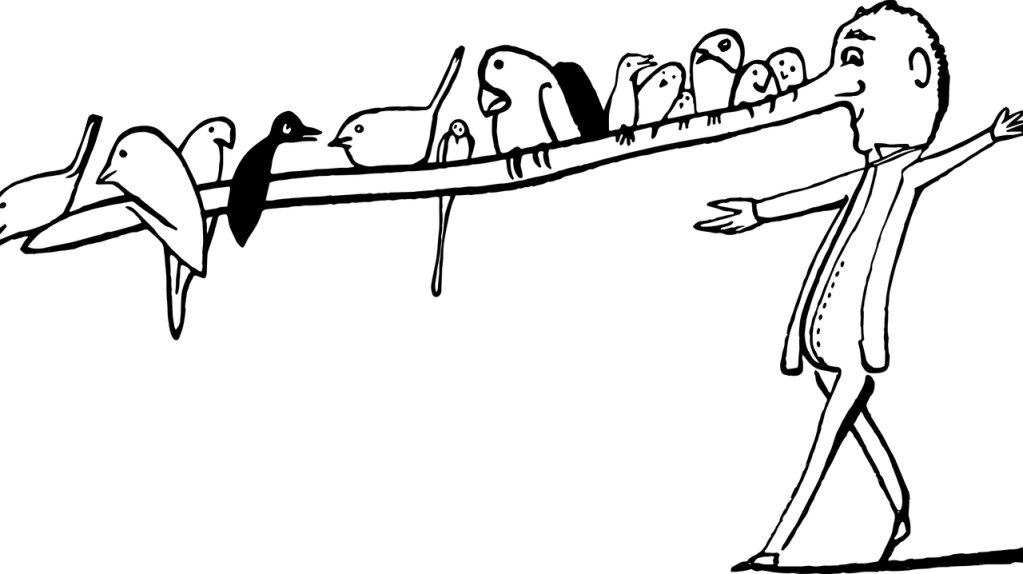
A sketch by Edward Lear: Courtesy: Creative Commons

Imagine… if there were a world where laughter could help collapse the human construct of war! If only leaders of opposing factions could meet in a match of laughter and resolve their differences with guffaws instead of weapons that kill, maim destroy… 

Imagine… if each cannon chortled with hilarity, shooting absurd images to evoke fun instead of destroying buildings, nature and fauna, the concept of war could be annihilated. To build a new world based on love and harmony, old harmful constructs need to be erased — and battles, weapons and war are exactly that. Hundred years ago, Nazrul wrote about destroying walls and differences in his famous poem ‘Rebel or Bidrohi’ to create new civilisation based on love and acceptance.

For a world we dream of building with love, peace and hope, here is a deluge of laughter from our treasure chests to help heal gloom, doom and hate, often the tools of warlords. Let us step into the realm of the fantastic where with a dash of humour the pen creates Pirate Blacktarn who sails the Lemon seas to meet strange creatures, mermaids and Gods and battles pollution with catfish! Let us laugh while we battle Gretchums, go on pony rides or drives and pay a tribute to the great Lear who created limericks. On April 1st, 2022, let us with a pinch of humour and lot of laughter thaw warmongers and wall builders by making them snigger away their grouches with the aid of the tickle imp so that battles collapse into peaceful resolutions. Let us cheer war victims and recreate a beautiful imaginary world. To that end, we have the humorous writing of Tagore to start us out on our cheerful voyage towards a beautiful world…

Prose

 Humour from Rabindranath: Translated from the original Bengali by Somdatta Mandal, these are Tagore’s essays and letters laced with humour. Click here to read.

Surviving to Tell a Pony-tale: Devraj Singh Kalsi journeys up a hill on a pony and gives a sedately hilarious account. Click here to read.

Driving with Murad: Sohana Manzoor unfolds her experiences while learning to drive with a dash of humour. Click here to read.

Lear And Far: Rhys Hughes on Edward Lear who wrote fabulous humorous verses to laugh away our fears and founded the popular genre of limericks. Click here to read.

Poetry

Pirate Blacktarn poems … Wander into the fantastical world of Pirate Blacktarn, terror of the Lemon seas with twelve story poems by Jay Nicholls. Click here to read.

Walking GretchumsSaptarshi Bhattacharya takes us into a land of the fantastical… Do such creatures exist and can we battle them? Click here to read.

Animal LimericksMichael Burch introduces the absurd in the format created by Lear. Click here to read.

The Tickle ImpRhys Hughes introduces us to an imp who tickles… a most powerful weapon. Click here to read.

A LAUGHING LIMERICK 
(With Due Apologies to the Maker of Prufock)

Let us go there you and I...
Where laughter etches out against the sky
To a fun-tastical world of the absurd —
Fun-loving creatures, animals and birds.
Let us replace gloom with laughter. Let us do, you and I...

-- Mitali Chakravarty
Categories
Essay

Here, There, Nowhere, Everywhere

Did life change or did I change from the events of the last year,’ ponders New Zealander Keith Lyons who was in the southern state of Kerala when the first cases of Covid-19 were detected in India last January.

Everything shifted last year. Priorities. Energies. Focus. 

Well, actually, there wasn’t much focus for me last year. For much of 2020, I felt unfocused, scattered, reactive. I was not achieving peak performance or being proactive going forward, if we were to use business language. I doubt if I was being the best version of myself either. I definitely needed to ‘pivot’, whatever that meant. 

What was initially a short holiday ‘back home’ to catch up with family and friends turned into something without a clear ending, as it dawned on me maybe I wouldn’t be travelling again for years perhaps, why, even ever. 

Usually, by May, I would be like the snowbird and migrate to warmer climes. I would head to my base in Bali’s Ubud, and then later in the year to southwest China and Myanmar, the three locations in Asia where I have caches of cotton shirts, swimming goggles, cycle shorts, hot water kettles, tea strainers and rice cookers. 

By November, I would surely be back in the country termed ‘the land of mystery, mysticism, mythology, miracles, multiculturalism and mightiness’ — India. 

When I left Kerala’s Varkala Beach near Thiruvananthapuram in February last year, after my last dip in the warm breaking waves, I always thought I would be back for chai at one of the cliff top cafes overlooking the gleaming ocean, the lunchtime Rs.90(US$1.25) thali at True Thomas and falling asleep to the whirl of the fan and the shushing of the Arabian Sea. 

But it didn’t happen last Indian winter, and I doubt if it will happen this year or even next. The seasons turn, the tides come and go, the waves roll onto the main Papanasham beach and the less-visited Black Sand beach. True Thomas is ‘temporarily closed’ according to Google. In fact, the Kerala beach destination was already impacted by Covid-19 in March 2020, when an Italian tourist visiting for a fortnight tested positive for the virus. The English boss of Coffee Temple Cafe had got in trouble with authorities for his blackboard offering of ‘Anti-Coronavirus juice’ (150 Rs) made from ginger, lemon, gooseberry. 

I wonder how the Tibetan and Nepalese who work in eateries during the season, November to May, are surviving. 

Mid-2020 I found myself unable to continue my digital semi-nomadic existence of following mild weather and hopping on AirAsia flights I’d booked up to a year earlier. Instead, because of travel restrictions during the pandemic, and my own wish to stay safe, I was lock-downed in my hometown in New Zealand, cohabiting with my parents in the house I’d lived in since aged eight years old.

A friend on Facebook sent me a message saying she couldn’t wait to walk down the aisle, with a photo of an aeroplane aisle. Another sent an image showing the perfect Covid-19 sport which requires masks, gloves and 2m distance: fencing. 

In the post from China, I received a couple of full-face snorkelling masks. In between the time of ordering and the arrival of the goods, on YouTube, there was a video on how to convert to meet the N95 respirator standards, or how to modify for use as an emergency interface with a ventilator. Researchers even had a paper in Nature about using Decathalon snorkelling masks. I wouldn’t believe much else on Youtube. What a shame that many do. 

From Bali last year, there were claims that it was one of the safest places in the world as the recovery rate was high, and mortality rate low, compared to other places. This was attributed to a mix of sunshine, high temperatures, and a better (superior) immune system. 

Sound familiar, my friends in India? Later someone posted a graph showing exponential growth, with the caption ‘Bali, what happened?’ 

New Zealand, as it turns out, has been largely protected from the ravages of Covid-19, thanks to closing the borders, a short lockdown, and citizens acting together as a ‘Team of 5 Million’.

This time last year I went on lots of walks, I gazed at cloud formations, and watched sunsets. I cut down scraggly trees, sorted through books, and gave away many of my parent’s possessions as part of downsizing. Of the bounty of childhood books I distributed, one was the beguiling ‘The Owl and the Pussycat’ by Edward Lear, penned 150 years ago, which my father would read to us when we were young:

The Owl and the Pussy-cat went to sea
In a beautiful pea-green boat,
They took some honey, and plenty of money,
Wrapped up in a five-pound note …

I even sold the family silver. 

My parents didn’t get Covid, and just last week, got the first of two Pfizer pricks in the upper arm (so far, only 10% of the population in New Zealand have received their first shot). 

What changed dramatically was their circumstances. An operation in hospital for my 85-year-old father to reverse a previous insertion of a stoma didn’t work out as expected, and in late June last year the one night back home after his surgery proved to be his last night in the house they bought in 1976. He left in the back of an ambulance. He is now in hospital-level care in a rest home, and his wife, my mother, lives nearby in a retirement village. 

Before his surgery, they considered selling the house and moving to the retirement village together, but undetected earthquake damage from 2010-2011 was discovered by the real estate agent, and I had to initiate a claim to have the damage repaired. 

Being back home, many things were familiar, some things had changed, a few things were strange. I had become the parent of my parents. My days revolved around sorting out their problems. Instead of my independent existence and free lifestyle, I found myself taking on family responsibilities. Yet I was glad that in a time of need, I had been there to do the things they couldn’t do easily. 

The year 2020 was unprecedented (and UnPresidented), with so many unknowns, so many surprises. Sharing a birth date with a friend from journalism school, we went for dinner with her family. Little did I anticipate it was the last time I saw her husband, a blood doctor, who died suddenly during a video consult with a patient. 

My side hustle — a small travel agency working with ethnic minorities in southwest China — got its first inquiries in June last year. Several guides urged me to keep it open, as it was their main source of income. Before that, I hadn’t received any inquiries for the first part of 2020.

Several of the publications I usually write for have gone into hibernation, and some projects are on hold indefinitely. Before a job interview last week, I had to reflect on what I have been doing with my life. Or at least, the last 15 years. 

But what do I do these days? I swim most days, some days join a friend at the gym who wants to improve his heart. I drink one cup of coffee a day, recently, made from green coffee beans I’ve roasted in a popcorn machine. At least once I week I go out to have an Indian meal. This week it was a Kerala thali of a dozen delicious parts. Last week my friends ordered a family dosa, which had to be carried to the table by two waiters. 

My parent’s house is now my house, and each day I attend to its restoration and renovation, learning new skills of skim-coating, tiling, and concreting. Each month I get an email reminder that most of my AirAsia BIG Loyalty points are expiring soon.

Spending time with those I love is more important for me these days. We speak more frankly about what really matters. I’ve even started attending Death Cafe events, where anyone can share about their fear of death. 

Through it all, I feel like I am becoming a better friend to myself. I am my own guru. I am my own Jedi Master — it was just that I didn’t realise it before. I’ve learned to better cope with the challenges of life. As Jedi Master Yoda once said: “Named must be your fear before banish it you can”.

All I have to do is breathe. Breathe in. Exhale. Repeat. 

Last year, just a week after traditionally the coldest day of the year (one month after the shortest day), I saw my first golden daffodils, the yellow trumpets signalling that the winter had been mild, and that the warmer days of spring were not far away. 

Today on my way to the swimming pool, weeks before the solstice, I spied a row of daffodils in a neighbour’s garden and had to smile. I don’t know what the future holds, and I acknowledge that things will not return to normal like before. Yet I walk on, carrying in my heart hope, not so much as wishful thinking or expecting a positive outcome, but knowing that whatever the rest of 2021 and beyond throw up, no matter how disruptive, that the only way out is through it. 

Keith Lyons (keithlyons.net) is an award-winning writer, author and creative writing mentor, with a background in psychology and social sciences. Keith was featured as one of the top 10 travel journalists in Roy Stevenson’s ‘Rock Star Travel Writers’ (2018). He has undertaken writer residencies in Antarctica and on an isolated Australian island, and in 2020 plans to finally work out how to add posts to his site Wandering in the World (http://wanderingintheworld.com).

.

PLEASE NOTE: ARTICLES CAN ONLY BE REPRODUCED IN OTHER SITES WITH DUE ACKNOWLEDGEMENT TO BORDERLESS JOURNAL.

Categories
Editorial

And This Too Shall Pass…

“April is the cruelest month, breeding
lilacs out of the dead land…”
-- TS Eliot, Wasteland

April and May have been strange months — celebrations withered to anxieties. As the pandemic took on demonic proportions in its second wave, devastating millions with death and darkness, paralysing with the fear of losing friends and relatives or ones’ own life, festivities gave way to mourning. April this time truly seemed like the cruellest month as expressed by TS Eliot in the start of the Wasteland, turning our joyous thoughts on healing to a devastating reality of swirling smoke of pyres and graves that continue to throng certain parts of the world. However, mankind needs hope like the Earth needs rain, hope to survive. Great literature and writing inspire to give just that.

This month is also the birth month of three greats who were able to generate that kind of hope with their work: Rabindranath Tagore, Edward Lear and Kazi Nazrul Islam. We launched our new Tagore section on May 7th with Aruna Chakravarti’s translations of the maestro, Songs of Tagore. Do visit us at Tagore & Us to read them and more. We plan to keep adding to this section on a regular basis. This time we have Bengal Academy Award winner Fakrul Alam’s translations of six seasonal songs of Tagore, a translation from Borderless of a poem by the maestro that is not quite accepted as Rabindra Sangeet as the tune was given by the eminent musician Pankaj Mullick. An essay by Dr Anasuya Bhar highlights different lives given to Tagore’s writing by his own rewrites, translations, and films – an interesting perspective. We also carry tributes to Tagore in verse from Ilwha Choi of Korea, Mike Smith of UK, Himadri Lahiri and Sunil Sharma from the poet’s own homeland.

We celebrated Edward Lear’s birthday with some limericks and Rhys Hughes essay placing the two century old writer’s poetry in the present context and a hilarious conclusion to the sequel of Lear’s famous ‘The Owl and the Pussycat’. Upcoming is the birth anniversary of the rebel poet from Bengal, Nazrul. Sohana Manzoor translated a powerful essay and Shahriyer Hossain Shetu, a poem by this legendary writer who believed in syncretic lore and married a Hindu woman. Now the national poet of Bangladesh, Nazrul even wrote of Hindu Gods in many of his songs and essays – a lore that yearns for revival in the current day where politicians have fragmented the world by building more walls, using the names of religion, race, economics, caste and culture.

We have a poem from Pakistan by eminent poet Akbar Barakzai translated by Fazal Baloch using the lore of Samuel Becket’s Godot and yet another translation from Malayalam by Aditya Shankar of Sujith Kumar’s poem. Our poetry section is exciting with an exquisite poem from Jared Carter on a yeti, resting on the ephemerality of its presence; a funny one from Rhys Hughes and a diversity of poets from many countries, including Bangladesh. We also started a new column called Nature’s Musings which will combine poetry or prose with photographs by award-winning photographer Michael Wilkes and Penny Wilkes, who joins us now as a writer-in-residence.

In stories, we carry a COVID narrative by a real doctor, Shobha Nandavar, based in Bangalore and interestingly another about a doctor, the first women to adopt the medical profession in Bengal. Sunil Sharma in his narrative has highlighted a crisis in humanism. There are many more stories which would make for an interesting read. In musings, other than Devraj Singh Kalsi’s witty take on countries without Nobel Laureates, we have a Canadian writer’s perception of death rituals in Japan. Sybil Pretious has shared with us her strange adventures within China this time. Don’t miss the backpacking granny!

The May issue has a wide range of essays and musings ranging from Candice Louisa Daquin’s write up on the need to trust instincts to Keith Lyon’s residency in the Antarctica with interesting photographs. He writes that you could wear shorts in summers! Bhaskar’s Corner pays a tribute to the Padmashree Odia writer who passed away last month of old age, Manoj Das.

Our book excerpt is from an unusual book by Nabanita Sengupta, A Bengali Lady in England (1885): Annotated Translation with Critical Introduction to Krishnabhabini Das’ Englandey Bangamahila. We also carry reviews by Rakhi Dalal of Feisal Alkazi’s memoir, Enter Stage Right: The Alkazi Padamsee Family Memoir and by Bhaskar Parichha of Raising a Humanist by Manisha Pathak-Shelat and Kiran Vinod Bhatia. Shakti Ghosal’s The Chronicler of the Hooghly and Other Stories has been reviewed by Gracy Samjetsabam.

Our interviews this time are more on practical issues than literary – with the two authors of Raising a Humanist and with someone who supported our Tagore section by inviting us to talk on it in an online festival called Anantha, Sonya Nair. A friend and an academic with decidedly avant garde outlook, she is part of the twenty-year-old peer-reviewed Samyukta Journal that homes many academics. Pause by and have a read to see how they serve.

I would want to give heartfelt thanks to Nidhi Mishra and Archana Mohan for hosting Ms Sara’s Selections from Bookosmia this time as they help many battle the pandemic with hope, especially young children growing up in a world inhibited with masks and social distancing. I would also like to thank all the writers and my whole team for rising above the darkness by helping us get together this issue for our readers who I hope do find solace in our pages. And thank you readers for being with us through our journey.

There is a lot more in our pages than I have written. Do take a peek at this month’s issue and enjoy.

Best wishes,

Mitali Chakravarty

Categories
Index

A Tribute to Edward Lear: Humour, Limericks & More…

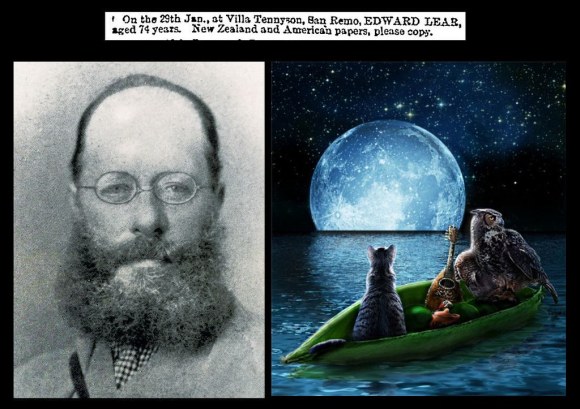
The Owl & the Pussycat. Courtesy: Creative Commons

Edward Lear, born 209 years ago on 12th May, not only popularised limericks, but wrote fabulous humorous verses to laugh away our fears. Rhys Hughes, on our editorial board, has written an essay to contextualise the poem to our modern day needs and even offered a hilarious conclusion to the poem. Click here to read his tribute to the great humorist, Edward Lear (1812-1888) in Poetry, Poets and Rhys Hughes.

As a tribute to the wonderful world created by Edward Lear, we are also publishing two limericks here, contextualising the humour to our needs and times.

1
Amidst the new wave of coronal graves, 
A secret  was withheld, even waived. 
People who vote 
Will turn into goats
And thus, be from the pandemic saved.

2
It came to pass in the distant land of Tierds, 
Wisdom was measured by the length of beards. 
They let it grow in undeterred ways
Till it became quite the craze
To participate tripping in a hirsute race unsteered.

Humour is the best weapon to battle fear. Click here to read some more limericks we brought out to battle our pandemic fears in Limericks: Of Donkeys & Corona.

.

PLEASE NOTE: ARTICLES CAN ONLY BE REPRODUCED IN OTHER SITES WITH DUE ACKNOWLEDGEMENT TO BORDERLESS JOURNAL

Categories
Poets, Poetry & Rhys Hughes

Lear and Far

The Owl and the Pussy-cat went to sea
In a beautiful pea-green boat,
They took some honey, and plenty of money,
Wrapped up in a five-pound note.
The Owl looked up to the stars above,
And sang to a small guitar,
“O lovely Pussy! O Pussy, my love,
What a beautiful Pussy you are,
         You are,
         You are!
What a beautiful Pussy you are!”

Pussy said to the Owl, “You elegant fowl!
How charmingly sweet you sing!
O let us be married! too long we have tarried:
But what shall we do for a ring?”
They sailed away, for a year and a day,
To the land where the Bong-Tree grows
And there in a wood a Piggy-wig stood
With a ring at the end of his nose,
          His nose,
          His nose,
With a ring at the end of his nose.

“Dear Pig, are you willing to sell for one shilling
Your ring?” Said the Piggy, “I will.”
So they took it away, and were married next day
By the Turkey who lives on the hill.
They dined on mince, and slices of quince,
Which they ate with a runcible spoon;
And hand in hand, on the edge of the sand,
They danced by the light of the moon,
          The moon,  
          The moon, 
They danced by the light of the moon.

Beyond the Owl and the Pussycat

Courtesy: Creative Commons

The most famous poem written by the grand nonsense versifier, Edward Lear, is the one about the owl and the pussycat eloping together, and with the possible exception of ‘The Jumblies’ it is his best too. One of the curious things about this marvellous flight of silly fantasy is how it seems to demand a sequel. And sequels have been provided, one by Lear himself. Why this should be the case remains a minor mystery. No one to my knowledge has ever tried to write a sequel to his other poems, not even he.

It is not enough to state that the original story of the owl and pussycat lacks a convincing resolution. So do most of his other poems. No, there is a special quality about this work, about the adventure of two animals, one feathery, the other furry, that encourages further speculation on what might happen to them next. We extrapolate the action in our minds and frequently we are tempted to write down what we think could be a suitable or surprising continuation. But none of the sequels have become well-known.

The owl and the pussycat went to sea, they were married and danced in the light of the moon. So far, so good. Lear originally wrote the poem for a three year old girl, Janet Symonds, who was the daughter of a close friend. Might a young child have understood words such as ‘runcible’? No, but that word is an invented one anyway, coined by Lear for this poem, and though it has entered the dictionary nobody is quite clear as to what it means. My own dictionary, a battered old dusty thing, claims that a ‘runcible spoon’ is a curved fork. I have the option to believe that definition and I decline.

Lear liked the word he had coined so much that he spent it freely in other poems, obscuring the meaning still further. The enthusiastic reader can find a ‘runcible hat’, ‘runcible wall’, ‘runcible cat’, ‘runcible goose’ and ‘runcible raven’ in his extensive works. It is a satisfying word and that is sufficient to justify its frequent use by him or anyone else. Lear was a primarily a visual artist and often illustrated his own poems and there exists his own drawing of the famous ‘runcible spoon’ in the beak of a bird known as the ‘dolomphious duck’ who employs it to scoop up frogs.

That should have settled the matter. The ‘runcible spoon’ is a type of ladle. But in fact nothing was settled. British national newspapers published letters from readers demanding to know what the thing was. Other readers answered with all the knowledge, or fancy, at their disposal. It became a spoon named after a butler who obsessively polished cutlery until it changed shape. Or it was a spoon with a sharp cutting edge that ought to remind the person who used it of the Roncevaux and the battle fought there with swords that feasted on the tasty morsels inside the tin can armour of the troops engaged in the fighting. And yet speculations like these are doomed to defeat. ‘Roncevaux’ sounds nothing like ‘runcible’ and the quince enjoyed by the owl and pussycat certainly has a taste different from that of fallen hacked knights.

To focus on one word in a marvellous verse narrative that includes perilous ocean crossings, forbidden romance, mercantile pigs and serenades seems petty in the extreme. Let us agree that ‘runcible’ is a fine word and leave the deeper question to future generations to solve. It will surely be more fruitful to consider the epic journey freed from the mooring ropes of semantics. The owl and the pussycat set out to sea in a ‘pea-green boat’. It is not revealed whether this boat belongs to them or whether they have requisitioned it. They carry supplies with them in the form of honey and plenty of money and it is stated plainly that this money is ‘wrapped in a five-pound note’. Now that is a peculiar assertion for Lear to make. Why wrap money inside more money? Five-pound notes back in his day were large, more like small towels than the kinds of banknotes we are familiar with. Have these two intrepid beasts turned the five-pound note into a parcel that contains gold coins? It is hardly a safe place to conceal valuables. A thief who steals the five-pound note will take the rest unintentionally. And they are at sea. Are there no pirates in these waters?

I will say nothing about the fact that owls and cats are not generally known for forming amorous relationships with each other. That would be crass. But it is true that the larger species of owl is a menace to the domestic cat and would rarely hesitate to swoop and grab one for lunch. Yet love flourishes in the most unlikely of settings and circumstances. Better to mind our own business and not pry into private matters. The owl and pussycat wish to elope and our duty is to stand aside and let them do so. The owl turns out to be a competent musician despite lacking fingers and plays the guitar for the pussycat while singing songs of charm and sweetness. Compliments are exchanged between the pair and the pussycat soon urges marriage as a most desirable development. Yes, the owl is willing but the couple have no ring. Impediment!

They sail away for a year and a day to a land ‘where the Bong-tree grows’. To spend so long at sea without making landfall in such a tiny vessel is really an achievement. How much honey did they take with them to last so long? It seems feasible that they supplemented their diet with fish caught fresh from the ocean or perhaps with migrating birds that the owl would be able to intercept. We who live on land have no right to criticise. On the island they discover a pig with a ring in his nose. Yet he is a free pig, owned by no one, and presumably the ring is decoration rather than a symbol of servitude. We see in our modern age how many people wear jewellery in their flesh that has no deeper meaning than style and fashion. Buccaneers originally wore gold earrings to pay for their funerals if they were killed in a skirmish. Contemporary men wear earrings perhaps to look like buccaneers. In the first case, the purpose is more important. In the second case, it is the appearance that matters. Who can say what reason the pig has for his ring? Lear tells us that this pig is actually a ‘Piggy-wig’ and there might be a clue to some esoteric status in that suffix.

The pig agrees to sell the ring for ‘one shilling’. It is doubtful whether the pig has any spare change in such a remote location. Therefore the shilling must be a coin, part of the money wrapped in the five-pound note. Why protect the token of lesser value with the token of greater? It makes no sense. The paper banknote is likely to have been splashed by water during the crossing. It would be very improbable for a sea voyage of 366 days to be entirely storm free. Paper turns soggy, metal does not. To cover the five-pound note with the shillings is the sensible thing to do, and store them in the driest part of the boat. But who am I to give advice to these characters? They have been successful in all they have so far attempted. The transaction is made and the ring is handed over. A turkey who lives on a hill agrees to marry them the next day. The ceremony is completed and the nuptial night is celebrated by a modest feast and a corybantic dance on the sand in the bright moonlight.

How marvellous! How wonderful! Why do we feel that more needs to be told? The narrative is incomplete, of course. Too many questions remain to be answered. But why do we insist on learning more about the owl, the pussycat, the world that is theirs? Once again, I maintain that this curiosity extends to no other of Lear’s poems. We read about the ‘Dong with the Luminous Nose’ and we are satisfied with what we are given. None of the limericks demand further action. Could it be simply that the poem is so nice we wish it to continue? That we are dissatisfied with its brevity? Lear must have felt the same way because he began writing a long sequel but it was never finished. What remains is truly a peculiar work. Although it is never stated explicitly that the owl is male and the pussycat female, it is certain that this is a heterosexual pairing because in Lear’s fragmentary sequel the couple have children. ‘The Children of the Owl and the Pussy-cat’ was published posthumously in 1938, long after Lear’s death. Let us now consider what happens in that narrative.

The children of the two voyagers are part fowl and part feline. They love to catch and eat mice. They take up the story and reveal that they live on the shore of Calabria. Does this mean that the land where the Bong-tree grows is part of Italy? Or did the couple move from the place where the pig married them? The cat climbs a tree one day and falls to her death. The owl is now a single parent but he rallies and does his best to look after the children. “Our owly father long was ill from sorrow and surprise / But with the feathers of his tail he wiped his weeping eyes. / And in the hollow of a tree in Sila’s inmost maze / We made a happy home and there we pass our obvious days.”

Other owls visit them and bring them news of the outside world, but this is regarded as nothing to be grateful for because the children “take no interest in poltix of the day”. The money has almost run out but the owl still plays on the guitar and sings songs to nobody in particular. The sequel breaks off abruptly. It is a rather sad set of rhymes but the tale it tells is no more implausible than the original elopement. The pig and the turkey play no part in the events. Nor is it revealed exactly how many children there are.

Beatrix Potter, however, did write more about the pig. ‘The Tale of Little Pig Robinson’ is a prequel that relates the background of the pig. No one has seen fit to write in greater depth about the turkey and that is a shame. But over the decades that followed, a few more details emerged about the owl and the cat. In the 1977 animated film, The Many Adventures of Winnie the Pooh, the character Owl mentions that it was a relative of his who went to sea in the pea-green boat. Eric Idle, former member of the Monty Python team, has penned an apocryphal work about what occurred between the owl and pussycat’s marriage and the fatal accident. ‘The Quite Remarkable Adventures of the Owl and the Pussycat’ features a tense episode in which the couple are attacked by a band of ravenous rats. A heretical text published in the Roald Dahl Treasury is set in an alternate world in which the owl offers gin to the pussycat and so she rejects him. The comedian Stewart Lee has also created an extended version of the story. None of these sequels dispel the feeling that there is a lot more to be told about the remarkable owl and pussycat.

I have made three or four attempts to write a sequel myself. I will leave you with arguably the most appropriate one.

“Mayday! Mayday!” hooted the Owl
as the pea-green boat began to sink.
“We’re low on honey and plenty of money
won’t serve for a life-raft, I think!
The Pussy-cat can’t swim and even I won’t
be able to flap as far as the shore.
We’re in the drink of an appalling bay
and drowning seems the only way
        that this unfunny day
         is going to finish at all.”

“Don’t panic,” said the confident voice
over the crackling radio static.
“The Royal National Lifeboat Institutional Society for the  
      Protection of Talking Fictional Animals is coming to you 
       without delay.”

            And so it was.

Rhys Hughes has lived in many countries. He graduated as an engineer but currently works as a tutor of mathematics. Since his first book was published in 1995 he has had fifty other books published and his work has been translated into ten languages.

.

PLEASE NOTE: ARTICLES CAN ONLY BE REPRODUCED IN OTHER SITES WITH DUE ACKNOWLEDGEMENT TO BORDERLESS JOURNAL

Categories
Humour

Limericks: Of Donkeys & Corona

This section is dedicated to the memory of the Edward Lear (I812-1888) who laughed away life’s trials with nonsense verse and limericks.

The great erstwhile litterateur Edward Lear,

Popularised laughter and not a single tear.

He wrote fun rhymes

And drew out his times.

His verses gave joy and brought good cheer.

— MC

There was a donkey who loved to bray. 

When they asked him why do you bray, pray ?

The mule obstinate 

His teeth did grate 

And with a vengeance started to bray.

—SB

This donkey one day fell in love.

He fell and he fell and how ! 

The besotted one 

Now wanted to run 

From this vicious virus of love.

—SB

I am Jennet said the dame.

My love for you I will loudly proclaim 

from the rooftops. 

To hell with the cops ! 

Said Jennet, eyes with love aflame !

—SB

There was a superstitious man from Surrey,

Who was extremely prone to worry.

When he heard a donkey bray,

It rather spoilt his day 

And made him quite swallow his fish curry.

— MM

There was a donkey who loved Ovid.

His songs warded off the Covid.

Each time he brayed,

The virus prayed —

Stop that noise or I’ll die atrophied. 

–MC

The donkeys danced on the road braying.

The cows sat chewing, meditating, praying.

The traffic jammed.

The horns rammed.

Corona from the confusion fled fraying.

—MC

Index of names:

SB: Santosh Bakaya

MM: Meenakshi Malhotra

MC: Mitali Chakravarty

.

PLEASE NOTE: ARTICLES CAN ONLY BE REPRODUCED IN OTHER SITES WITH DUE ACKNOWLEDGEMENT TO BORDERLESS JOURNAL.