Categories
Essay

Discovering Rabindranath and My Own Self

Musings by Professor Fakrul Alam
Apnake jana amar phurabe na/Ei Janare shongo tomai chena/

There will be no end to my discovery of myself/And this discovery keeps coming with my discovery of you

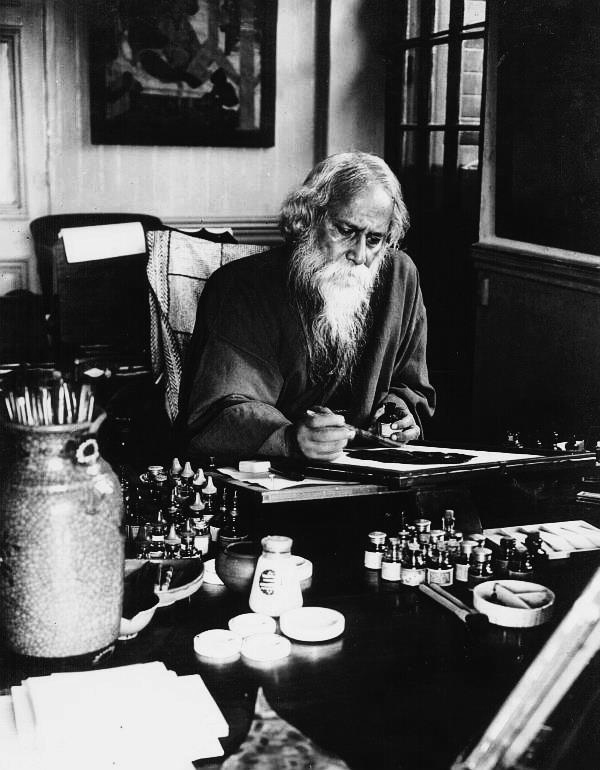
On the one hand, Rabindranath Tagore [1861-1941] has been with me almost all my life. On the other, I only began to discover that I had Rabindranath so centrally in me relatively late in my life. In fact, I have now realised that the process of discovering the way he has been embedded in me is part of the process of discovering my own self in the course of the life that I have been leading till now.  Indeed, at this stage of my life, it seems to me that there will be no end to my discovery of the way Rabindranath has become part of my consciousness since I feel that there will be no end to discovering myself till I lose consciousness once and for all. The one thing I can say with certainty, using his words but in my translation is “There will be no end to my discovery of myself.”  For sure, this process of discovering myself endlessly keeps happening with my continuing discovery of Rabindranath.

Surely, the process through which Rabindranath had become embedded in me began in childhood. However, I did not encounter his work in my (English medium) textbooks since I did not learn Bengali in school for a while. How then did I come to remember poems such as “Tal gach ek paye dariye/shob gach chareea/ Uki mare akaashe” (Palmrya tree, Standing on one foot/Exceeding all other trees/Winking at the sky”) or “Amader Choto Nadi chole bnake bnake” (“Our little river keeps winding its way”). How do I remember these opening lines even now? And why do I still associate such palm trees and winding little rivers with these lines even now whenever I am in the Bangladeshi countryside? Surely, it must have been my mother who planted Rabindranath in me in my seed time so that he would become embedded in my unconscious, only to surface in my consciousness decades later. It is surely no coincidence that she taught me Bengali and made me learn Rabindranath’s poems indirectly.

 As a boy growing up at a time when the radio was the main source of entertainment in middle-class Bengali houses, my siblings and I were made to listen to Rabindra Sangeet in our house by my father, who felt that he had to share his favourite songs and singers in the musical genre with us, whether we wanted to listen to them or not. Of course, at that age I would have much rather not listen to those solemn-sounding, soulful songs, and whenever I could put my hands on the radio dials, I would listen to English popular music on Radio Ceylon. My favourite singers were Pat Boone, Elvis Presley, Cliff Richards and—a little later—the Beatles. In school, when we were not playing or talking about sports or girls, we boys would be discussing the pop music we heard on Radio Ceylon. By the end of the 60s, we would be talking about the English thrillers and comedies we saw on Dhaka television. What place could Rabindranath have in one’s life then? If Rabindranath had been placed in my innermost self by my mother through her reading of his poems to us children or my father through his addiction to Rabindra Sangeet, for the moment he was getting occluded deep inside me and, it would now seem, all but forgotten!

But from the middle of the 1960s, our lives in Dhaka began to change as the claims of Pakistan on us East Pakistanis started to loosen, little by little. It was a time when in neighbourhoods and on streets, processions would come out singing gonosangeet—literally songs of the people, but in effect music of protest and patriotism.  First, the Six Points Movement and then the Agartala Conspriacy case were on everyone’s lips and East Pakistanis everywhere were becoming activists in one way or the other. There was no escaping songs like “Shonar Bangla” (“Golden Bengal”) or “Banglar mati, banglar jol, banglar baiuo, banglar phol/Punno houk”” ( “Let the land, the waters, the air and fruits of Bengal be blessed…) and “Bartho Praner Aborjona Purea Phele Agun Jalo” (“Burn the frustrated soul’s detritus and light up a flame”). In my school where we boys now studied “Advanced English” and “Easy Bengali”. There was no way we could have learned enough Bengali to read Rabindranath or Nazrul in the original in any sustained attempt, but how could we escape the call from such songs and poems like Nazrul’s “Bidrohi” (“The Rebel”) or the call from the streets to protest and even burn for our emancipation?  At home, three of my four sisters would be practicing Rabindra Sangeet regularly, since this was what my parents wanted them to do, and so there would be no evading Rabindranath’s songs at home for this reason as well, but I was more interested in friends and sports than staying home and so I would hear the songs only in snatches at this time.

By the end of the decade though, Rabindranath was everywhere in our lives since becoming Bengali became first and being a Pakistani only came later. Even on Dhaka Television, Rabindranath’s songs and dance numbers were being aired fairly regularly then. Outside, one could get to see his plays and dance dramas being performed every now and then in functions and cultural events all over the city. He would soon become an important part of Pohela Boisakh, which itself would become instantly popular amongst us all almost as soon as Chhayanaut[1] organised the first event in Balda Garden as the decade came to a close.  But while Rabindranath was everywhere around me all of a sudden, I was still not reading him at all, preferring English thrillers and westerns initially, and later, when I became a “serious” reader from college onwards, contemporary classics of English and European literature available in English editions.

In the early seventies, however, you could not be in Bangladesh without imbibing Rabindranath at least a little, for there was a process of osmosis at work at this time. Glued as we were to Swadhin Bangla Betar Kendro[2] during our Liberation War[3], we kept listening to his patriotic songs on our radios; the promise of Shonar Bangla seemed alive and possible then. The years after liberation, my generation was exposed to Rabindranath in new ways; we would get to hear and view singers like Kanika, Debobroto and Suchitra Mitra on stage in Dhaka; their songs became freely available in tapes in our shops; and Satyajit Ray’s film version of Rabindranath’s fiction and Ray’s documentary on him became staples of Dhaka’s film societies. I was finally growing up intellectually and was hungry for culture, and so how could I have escaped the poet’s works totally at this time?

But the Rabindranath that I was imbibing thus was almost entirely coming to me aurally and visually. Because he was becoming embedded in my consciousness through songs and the silver screen as well as television, he still inhabited the surface of my consciousness. And I was certainly not making any conscious bid to savor him. The seventies and the eighties were, in fact, decades when I was becoming an even more “serious” student of English literature than before and getting “advanced” degrees in my subject and acquiring expertise for my teaching career; where would I get the time to read Rabindranath then? As an expatriate student for six years in Canada and as a visiting faculty member for two years in the USA, I would be getting small doses of Rabindranath in those countries through the songs I kept hearing in the cassettes I had brought along of my favorite singers and in the occasional film versions of his work that I would get to see because of campus film societies, and I suppose nostalgia played a part in my yearning for him then, but I had no time to spare for him and not enough exposure to his works to let his ideas and his achievement resonate in me in any way.

To sum up my encounters with Rabindranath till then, I was discovering Rabindranath in small doses all the time and experiencing him directly here and there, but my knowledge was all very superficial and my understanding of him too limited. And nothing much had happened that would allow me to tap into the unconscious where all the memories of poems and songs by him I had first come across through my parents’ enthusiasm for his works were hidden.

“Dekha hoi nai chokkhu melia/Ghor hoite shudhu dui pa felia”/

“I haven’t seen with my eyes wide open/what was there only a stride or two away from my house”

In the 1980s, I became smitten by theory, especially the works of Edward Said, and suddenly questions of postcoloniality, ideology, power and location became all-important for my understanding of literature. I was coming around to the belief that I could not be a good and truly advanced student of English literature in Bangladesh, let alone a good teacher of the subject here, unless I sensitised myself to my roots and look at the world around me. And now I remembered some lines I had been hearing since childhood without realising their relevance for me and everyone else around us then: “Dekha hoi nai chokkhu melia/Ghor hoite shudhu dui pa felia” (“I haven’t seen with my eyes wide open/What was there only a stride or two away from my house”). Rabindranath had been all around me and yet I had not opened my eyes wide enough to learn from him. I had not read his works with any kind of sensitised attention at all and I had not been able to arrive at any kind of appreciation of his achievements except the smug sense of self-satisfaction at the thought that this Bengali had once won the Nobel Prize.

Towards the end of the 1990s, for the first time really, I plunged into Rabindranath and found—to quote Dryden on Chaucer— “here was God’s plenty”. Having opened my eyes to him I realized that there was so much to him than one could take in at any one time. He had once said in a song about the infinite contained in the finite and I now thought, “How appropriate of him!” He had said in one of his most famous poems, “Balaka[4]” about how one must not succumb to stasis and how the essence of life is motion and I thought, “how inspirational!” He had written in a song about viewing the Ultimate Truth through music and I thought “Exactly!” He had looked on in amazement in a starry night at how humans have a place in the cosmos (Akaash Bhora Surjo Tara[5]) and I thrilled at the idea now. He made me see the monsoonal kadam flower that I had passed every year without blinking an eye as immensely lovely. Every poem that I read enlightened me, every song lent my soul harmony, every short story or novel took me to eternal truths about human relationships. Who would not learn from a man who had been given some of the highest honors the world has offered any human being, when he says with such unambiguous humility, “Mor nam ei bole khati houk/Aami tomaderi lok…” Let this be my claim to fame/I am all yours/This is how I would like to be introduced.” And so I kept reading him in between teaching and writing, finding him an endless source of inspiration, creativity and wisdom. I strove to learn about nature, the universe, people, relationships, beauty and the dark side of humans through his works.  And soon I felt compelled to translate some of them.  

Rabindranath, then, opened my eyes not only to the world I lived in but also helped me discover my own self as a product of forces that had taken our nation past 1947 to true liberation. He helped root me in Bengali and Bangladesh as never before, making me discover myself not merely as a Bengali but as a citizen of the world, a product of a certain history but also of the history of mankind. My discovery of him and my place in the world was furthered by the work I did in co-authoring The Essential Tagore and authoring a collection of essays on diverse aspects of his work.

But Rabindranath truly contains multitudes. What I now realise is that it is impossible to discover him fully in one life, especially when one embarks on the process of discovery so late in life. By now, therefore, I have despaired of knowing the whole man and feel I will get to know only parts of him. But I also know whatever I read of him will enlighten me and make me know myself better in every way than before. And so I’ll keep reading him and translating him, if only to know him and myself better in the days left for me!  

[1] Centre for promotion of Bengali Culture established in 1961

[2] Free Bengal Radio Centre

[3] 1971 Bangladesh was liberated from Pakistan.

[4] Swans

[5] The Star-Studded Sky

.

Fakrul Alam is an academic, translator and writer from Bangladesh. He has translated works of Jibonananda Das and Rabindranath Tagore into English and is the recipient of Bangla Academy Literary Award (2012) for translation and SAARC Literary Award (2012).

PLEASE NOTE: ARTICLES CAN ONLY BE REPRODUCED IN OTHER SITES WITH DUE ACKNOWLEDGEMENT TO BORDERLESS JOURNAL

Click here to access the Borderless anthology, Monalisa No Longer Smiles

Click here to access Monalisa No Longer Smiles on Amazon International
Categories
Poetry

Jericho Was No One’s Lover

By Ryan Quinn Flanagan

JERICHO WAS NO ONE’S LOVER 

Musical resonance, the skeletal grind,
wheel well tumblings on a red vineyard clime –
Sardinian giant wormholes, shivering,
stuck on a what in the world island,
heaving cardamom can’t work corners,
the formation of sand and mixtape spools,
a cursory lust over the wanting membrane:
frothing, feasting, ruthlessly ensnared
And Jericho was no one’s lover,
scorned his heart for an apple-bride’s cleaver,
drove scurvy from the harbours,
devoured the worm from the bottom of the bottle,
held Man high as the oldest scar,
taunting the land with boundless shadows:
inventor of the first way
to die.

Ryan Quinn Flanagan is a Canadian-born author residing in Elliot Lake, Ontario, Canada with his wife and many bears that rifle through his garbage.  His work can be found both in print and online in such places as: Evergreen Review, The New York Quarterly, Borderless Journal, GloMag, Red Fez, and Lothlorien Poetry Journal

.

PLEASE NOTE: ARTICLES CAN ONLY BE REPRODUCED IN OTHER SITES WITH DUE ACKNOWLEDGEMENT TO BORDERLESS JOURNAL

Click here to access the Borderless anthology, Monalisa No Longer Smiles

Click here to access Monalisa No Longer Smiles on Kindle Amazon International

Categories
Excerpt

Out of Sri Lanka

Title: Out of Sri Lanka: Tamil, Sinhala and English Poetry from Sri Lanka and its Diasporas 

Editors: Vidyan Ravinthiran, Seni Seneviratne and Shash Trevett. 

Publisher: Penguin India (Vintage)

AAZHIYAAL
(b. 1968)

Aazhiyaal (the pen name of Mathubashini Ragupathy) was born in Trincomalee in Eastern Sri Lanka. She taught English at the Vavuniya Campus, Jaffna University, before moving to Australia in 1997 where she worked for two decades in the IT sector and commercial management in Canberra. Aazhiyaal has published four collections of poetry in Tamil: Uraththup Pesa (2000), Thuvitham (2006), Karunaavu (2013) and Nedumarangalaai Vazhthal (2020), the last honoured by Canada’s Tamil Literary Garden. Her poems have appeared in anthologies and have been translated into several languages. She in turn has translated Australian Aboriginal poetry into Tamil (Poovulagaik Kattralum Kettalum, 2017). Aazhiyaal writes about women’s place within patriarchy and uses her work to make sense of the war in Sri Lanka: ‘I believe that poetry is the antidote to the present rat-race. It is needed, it is necessary.’


Unheeded Sights

After the rains
the tiled roofs shone
sparklingly clean.
The sky was not yet minded
to become a deeper blue.
The tar roads reminded me
intermittently of rainbows.
From the entire surface of the earth
a fine smoke arose
like the smoke of frankincense, or akil wood,
the earth’s scent stroking the nostrils,
fragrant as a melody.

As the army truck coming towards me
drives away,
a little girl transfers her candy-floss
from one hand to the other
raises her right hand up high
and waves her tiny fingers.

And like the sweet surprise
of an answering air-letter
all the soldiers standing in the truck
wave their hands, exactly like her.

The blood that froze in my veins
for an instant, in amazement,
flows again rapidly, asking aloud,
‘War? In this land?
Who told you?’

[tr. from Tamil by Lakshmi Holmström]


BASHANA ABEYWARDANE
(b. 1972)

Rohitha Bāshana Abeywardane was a member of the founding editorial board and later editor in chief of the Sinhala alternative weekly newspaper Hiru. In 2003, he was one of the activists who organised the Sinhala-Tamil Art Festival. His journalistic commitments brought on threats to his life, and he had to leave Sri Lanka. He continues to publish and coordinates Journalists for Democracy in Sri Lanka, an organisation founded by journalists in exile. Following a stay in the Heinrich Böll House, Langenbroich, Abeywardane took part in the PEN Writers in Exile Program from September 2007 to August 2010. Today, he lives in Germany with his wife.


The Window of the Present

Nightmares, long dead,
peer through the shattered panes
of the window of the present.

The dead of the south, killed on the streets,
with bullet-riddled skulls,
walk once again, through an endless night,

and those of the north drowned in deluges of fire
when rains of steel drench their unforgiving earth,
gaze through the shards of glass empty eyed;

as slaughtering armies, prowl under starless skies,
upholding sovereignty
with blood-soaked hands.

PACKIYANATHAN AHILAN
(b. 1970)

Born in Jaffna in the north of Sri Lanka, Packiyanathan Ahilan has lived through the thirty-year civil war. An academic as well as a poet, he has published three collections of poetry and is Senior Lecturer in Art History at the University of Jaffna. As well as writing about the visual arts, poetry, theatre and heritage, he curates art exhibitions and is co-editor of Reading Sri Lankan Society and Culture (Volumes 1 & 2). Ahilan’s poetry is sparse and staccato, like a heartbeat: he is one of the most influential poets writing in Tamil in Sri Lanka today.


Days in the Bunker III

Good Friday.
The day they nailed you
to the cross.

A scorching wind
blew across the land and the sea.
One or two seagulls
sailed in an immaculate sky.
The wind
howling in the palm trees
spoke of unfathomable terror.
That was the last day of our village.

We fishermen came ashore,
only the waves
returned to the sea.
When the sun fell into the ocean,
we too fell
on our knees
and wept.

And our lament
turned slowly into night.

In the distance
our village was burning
like a body being cremated.

Good Friday.
The day they nailed you
to the cross.

[tr. from Tamil by Sascha Ebeling]


A Poem about Your Village and My Village

1
I do not know.
I do not know if your village
is near the ocean with its wailing waves
or near a forest.
I do not know your roads
made from red earth and
lined with tall jute palms.
I do not know
the birds of your village
that come and sing in springtime.
I do not know
the tiny flowers along the roadsides
that open their eyelids when the rains pour down.
I do not know the stories
you tell during long nights
to the sound of drumbeats
or the ponds in your village
where the moon goes to sleep.

2
Tonight,
when even the wind is full of grief,
you and I know one thing:
Our villages have become
small
or perhaps large
cemeteries.
The sea with its dancing waves
is covered with blood.
All forests with their
trees reaching up to the sky
are filled with scattered flesh
and with the voices of lost souls.
During nights of war
dogs howl, left to themselves,
and all roads and the thousands
of footprints our ancestors left behind
are grown over with grass.
We know all this,
you and I.
We now know about
the flowers that died,
the abandoned lines of poetry,
the moments no one wants to remember.


3
But
do you know
if the burnt grass
still has roots,
or if the abandoned poems
can still be rooted in words?
If, like them, you do not know
whether our ancient flames
are still silently smouldering
deep down in that ocean
covered with blood,
know this today:
They say that
after he had lain in hiding
for a thousand years
one day
the sun rose again.

[tr. from Tamil by Sascha Ebeling]

ABOUT THE BOOK:

Out of Sri Lanka shines light upon a long-neglected national literature by bringing together, for the first time, Sri Lankan and diasporic poetry written in and after Independence.  Featuring over a hundred poets writing in English, or translated from Tamil and Sinhala reshapes our understanding of migrational poetics and the poetics of atrocity. Poets long out of print appear beside exciting new talents; works written in the country converse with poetry from the UK, the US, Canada and Australia. Poems in traditional and in open forms, concrete poems, spoken word poems, and experimental post-lyric hybrids of poetry and prose, appear with an introduction explaining Sri Lanka’s history.

There are poems here about love, art, nature – and others exploring critical events: the Marxist JVP insurrections of the 1970s and 80s, the 2004 tsunami and its aftermath, recent bombings linked with the demonisation of Muslim communities. The civil war between the government and the separatist Tamil Tigers is a haunting and continual presence. A poetry of witness challenges those who would erase, rather than enquire into, the country’s troubled past. This anthology affirms the imperative to remember, whether this relates to folk practices suppressed by colonisers, or more recent events erased from the record by Sinhalese nationalists.

 ABOUT THE EDITORS:

Vidyan Ravinthiran was born in Leeds, to Sri Lankan Tamils. His first book of poems, Grun-tu-molani (Bloodaxe, 2014), was shortlisted for the Forward Prize for Best First Collection, the Seamus Heaney Centre Poetry Prize and the Michael Murphy Memorial Prize. His second, The Million-petalled Flower of Being Here (Bloodaxe, 2019) was shortlisted for the Forward Prize for Best Collection, the T.S. Eliot Prize and Ledbury Munthe Poetry Prize for Second Collections. After posts at Cambridge, Durham and Birmingham, he now teaches at Harvard.

Seni Seneviratne, a writer of English and Sri Lankan heritage published by Peepal Tree Press, with books including Wild Cinnamon and Winter Skin (2007)The Heart of It (2012), and Unknown Soldier (2019), which was a Poetry Book Society Recommendation, a National Poetry Day Choice and highly commended in the Forward Poetry Prizes 2020.

She is currently working on an LGBTQ project with Sheffield Museums entitled Queering the Archive and her latest collection, The Go-Away Bird, was released in October 2023. She lives in Derbyshire.

Shash Trevett is a Tamil from Sri Lanka who came to the UK to escape the civil war. She is a poet and a translator of Tamil poetry into English. Her pamphlet From a Borrowed Land was published in 2021 by Smith|Doorstop.

Shash has been on judging panels for the PEN Translates awards and the London Book Fair, and was a Visible Communities Translator in Residence at the National Centre for Writing. Shash is a Ledbury Critic, reviewing for PN Review and the Poetry Book Society and is a Board Member of Modern Poetry in Translation. She lives in York.

Categories
Poetry

Sparrows

Poetry and translation from Korean by Ihlwha Choi

The sparrow I saw under the roof of a border checkpoint

crossing from the USA to Canada,
heading to the Mahatma Gandhi Memorial in New Delhi,
coming out with a bottle of drink from an alleyway
encountered a sparrow in front of a small shop.

Both the sparrows – the one seen at the border checkpoint
and the other in front of the small shop,
belong to the same species as those
that live under the eaves of my hometown houses.
Next to the KBS* New York correspondent’s mike,
the sparrow hopping on the street, nibbling on crumbs,
and the sparrow living in a salt warehouse in Sorae*, Incheon,
are both sparrows from the same species.

Like a quiet Korean restaurant sign by the road on the way to Las Vegas,
or like the little six-year-old Korean-American kid I met
at a small snack bar in an LA alleyway,
lonely yet welcoming fellow countrymen sparrows from afar.

*KBS: Korea Broadcasting System
*Sorae: small creek in Incheon City, Korea

Ihlwha Choi is a South Korean poet. He has published multiple poetry collections, such as Until the Time When Our Love will Flourish, The Color of Time, His Song and The Last Rehearsal.

.

PLEASE NOTE: ARTICLES CAN ONLY BE REPRODUCED IN OTHER SITES WITH DUE ACKNOWLEDGEMENT TO BORDERLESS JOURNAL. 

Click here to access the Borderless anthology, Monalisa No Longer Smiles

Click here to access Monalisa No Longer Smiles on Kindle Amazon International

Categories
Poetry

Dusk Descends on the World

Poetry by Masud Khan, translation from Bengali by Professor Fakrul Alam

MOTHER


In the dust smeared evening
Far away, almost at the margins of the horizon,
The one who is resting all by herself

In a bed laid out under the open sky
Is my mother.
Her bed smells of grass and the antiseptic Dettol.
A tube in her nose supplies her with oxygen,
A saline bottle is attached to her arm,
And she is tied to a catheter too—
It is as if she is getting entangled inextricably
In a jungle of plastic and polythene reeds.

A smoky surreal unreal canopy encircles her bed.

Seemingly after ages, dusk descends on the world,
A few birds and insects form a chorus,
Wailing throatily obscure and dissonant tunes
In amateurish over-excited zeal,
Seeking refuge timorously in that plastic hedge,
At the margin of the horizon,
In the shadow of primeval motherhood.


A FRAGRANT TALE

The world is full of misleading, minus signs and foul smells.

At times, the world feels as heavy and unbearable
As the weight of a son’s dead body on his dad’s shoulder,
Or as stressful as playing the role of a dead soldier,
Or as formidable as a physically challenged person’s ascent up a mountain
Or as painful as caring for a precocious, traumatised child...

Nevertheless, occasionally such stress-laden memories will blur,
And suddenly, wafting on the wind’s sudden mood swing,
A fragrant moment comes one’s way!

Masud Khan (b. 1959) is a Bengali poet and writer. He has, authored nine volumes of poetry and three volumes of prose and fiction. His poems and fictions (in translation) have appeared in journals including Asiatic, Contemporary Literary Horizon, Six Seasons Review, Kaurab, 3c World Fiction, Ragazine.cc, Nebo: A literary Journal, Last Bench, Urhalpul, Tower Journal, Muse Poetry, Word Machine, and anthologies including Language for a New Century: Contemporary Poetry from the Middle East, Asia, and Beyond (W.W. Norton & Co., NY/London); Contemporary Literary Horizon Anthology,Bucharest; Intercontinental Anthology of Poetry on Universal Peace (Global Fraternity of Poets); and Padma Meghna Jamuna: Modern Poetry from Bangladesh(Foundation of SAARC Writers and Literature, New Delhi). Two volumes of his poems have been published as translations, Poems of Masud Khan (English), Antivirus Publications, UK, and Carnival Time and Other Poems (English and Spanish), Bibliotheca Universalis, Romania.  Born and brought up in Bangladesh, Masud Khan lives in Canada and teaches at a college in Toronto.

Fakrul Alam is an academic, translator and writer from Bangladesh. He has translated works of Jibonananda Das and Rabindranath Tagore into English and is the recipient of Bangla Academy Literary Award (2012) for translation and SAARC Literary Award (2012).

PLEASE NOTE: ARTICLES CAN ONLY BE REPRODUCED IN OTHER SITES WITH DUE ACKNOWLEDGEMENT TO BORDERLESS JOURNAL

Click here to access the Borderless anthology, Monalisa No Longer Smiles

Click here to access Monalisa No Longer Smiles on Amazon International

Categories
Poetry

Poems by Ahmad Al-Khatat

GATES OF GRIEF WARMED


At thirty-four years old, I'm still experiencing psychic illness.
Why are my grief warmed gates sealed, I wonder?
Who made me miserable because I missed you, brother?
I weep thirsty, but the clouds and the rain do not seem to be satisfied.

From my depressed expression, the candle learns to cry.
Your perfume teaches my depressed face to read poetry.  
Your fragrance learns to fade without getting in my way.
My habits of smoking and consuming alcohol have caused
damage to my throat.

Using brutal chains of no mercy, accept me for who I am.
I don't have the right to wish for dreams like the previous
children that passed away. They passed away without leaving a
name, having learned the meaning of both love and war.
As though angels of God.


GRADUATION PARTY

Moses, Jesus, and Muhammad
were three of my most powerful pals.
They each had a flower in the vase and
our enemy destroyed all the vases and
stole all their flowers.

I recall their parents having inscribed.
their names on their two arms and legs.
Just to be able to track them down after
graduation party. We often forget about
our assignments because of armed troops.

"Evacuate, damn it!" they yelled at our door.
Ignoring the agony of an empty stomach,
Ignoring the stillness, Ignoring the absence
of our grandfathers, who taught us to live
and die for the soil and air of free Palestine.

We buried our hopes behind the fig and olive.
trees because we wanted to live, to love,
and to be free of the vocabulary of callous
conflicts that neglected mankind.
Nonetheless, we are still magnificent bare trees.

Together in the moonless night,
we prayed then slept in peace until the graduation
began to draw closer and closer with
daggers in our hearts, bullets screeching towards
our chests, missiles burst at the conclusion
of the party.

We were picked up by one of our parents.
many hours later. Whether you believe it or not!
We're all in the same bloody coffin. We wonder.
whether when the people of the globe cease turning
our reality the other way, they want to deafen both ears
and blind both eyes.


UNTOLD HABITS

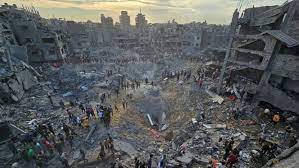
During the present genocide,
we learn of untold habits.
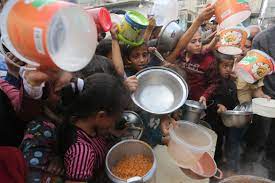
My father comes home sad with
an empty grocery bag,
which is more than a routine.

My mother often tells us to
wash our hands and occasionally our bodies.
She pretends to prepare,
places our empty and shattered dishes,
and then sobs alongside my father.

Then we all say bismillah
before we eat and Alhamdulillah's after
we’ve finished licking our empty fingers.
We then listen to my parents' prayers as
we elevate to the skies.

Ahmad Al-Khatat is an Iraqi Canadian poet and writer. His poetry has been translated into other languages and his work has been published in print and online magazines abroad. He resides in Montreal, Canada, now with his spouse. 

PLEASE NOTE: ARTICLES CAN ONLY BE REPRODUCED IN OTHER SITES WITH DUE ACKNOWLEDGEMENT TO BORDERLESS JOURNAL

Click here to access the Borderless anthology, Monalisa No Longer Smiles

Click here to access Monalisa No Longer Smiles on Kindle Amazon International

Categories
In Memoriam

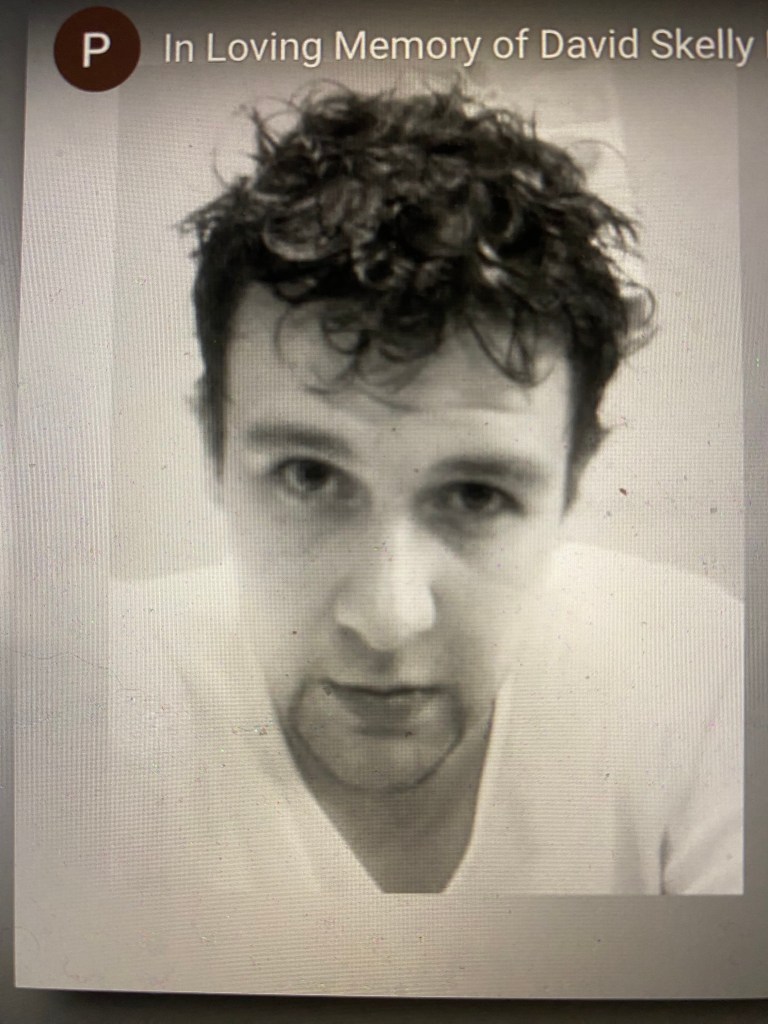
Posthumous Poetry by David Skelly Langen

David Skelly Langen (1986-2023)
METRO WEST 

the tall walls make me uncomfortable as I’m shot from every angle
it’s a kodak moment
an interpersonal feel without a signed consent
my privacy is strangled
I’m just another man sitting guilty until proven innocent
the cage is claustrophobic and my mind has no choice but to ride
along shotgun
he looks for smuggled tobacco to roll a cigarette and asks me “Yo, you got one?”
A simple reply will do as an elongated conversation
seems to always lead to confrontation between me and this man
or the officer manning his station
as I walk the green mile my oversized blue flaps stick to the floor, what
a sorry excuse for a shoe passed down from man to man
god only knows the stories that go with them, the sad stories
originating from prison to prison
I live in a prism, confused as I follow the lines, how did I get to this point,
locked away, throw away the key to my
lips, I don’t think I’ll talk today as I sit in this hole, this empty abyss
the punishment given because I spoke with my fists
born into the wild I once again need to fend for myself
as I did as a child, I’ve walked miles but ended up at the wrong place
angry men in blue feel the need to compensate for their stolen
lunch money, don’t laugh, they have the upper hand
you don’t even have soap for a bath, so you ask yourself
am I still a man?
has this west end place stolen my lunch money, I’m placed in front
of a mirror, faced off with
my masculinity, and fascinated with the man I’m facing
I try to reach through or at least lose my mind
I want to be changing places

(“Metro West” refers to the Metro West Detention Centre in Toronto)


PHYSICAL INTRUSION


my mind is stronger than your muscle
you flex to make your point clear
because your go system is pristine
but the frontal lobe screams stop, in front of the cracked mirror
where you find an empty glass, covered in residue. Things seem illusive
This intrusion knows no barrier, adjacent to muscle
so let’s not try to spread a subliminal message
I am a hypocrite, as I know nothing else but
the compelling thought of advancing my position in this broken mirror
life as I see it
you should expect the same from me, as I lack character
but the difference is, I am equipped, with the sword in the stone
because I am strong with characteristics that shine without tone
what need have we to speak, when a gesture
is often remanded for its curtain call, when the water’s too dark
and you think until your mind sinks too deep
your muscle makes you weak
mine makes me acknowledge your weaknesses –
words are seen by millions
muscle is for minions


THE ONE WHO LEFT HIS MIND AT THE STATION

20 packs of beer, get ‘em in I’m a crook
spicy cinnamon with an adrenaline strut
a minion in cuffs, shackled hack, I’m corrupt
back to bat with a black kinda rap, okay enough
it stink like the stuff that come up from yer bowels
I spit shit, drop exlax with the vowels
I’m foul, I speak faeces, I need a towel and shout
I rip through with weapons that repent from my mouth
philosophise preaching as knees weaken weekly
dream big, speak Nietzsche
proposing a toast and civil war with myself
ouch!
the mind’s amiss on arrival, it’s ritual
running circles, I’m tribal, habitual
aboriginal, simple-minded, cynical
freddy krueger slasher but I keep it at a minimal
i‘m Trivial, i‘m jeopardy, I got questions
but hold on, criminal record, oops! forgot to mention
I used to kick it old school, it’s david beckham
a little bit of English with a foot in yer rectum


OVERDOSE


Where are you?

Are you where I see you standing, or somewhere else?

Am I here standing next to you, or somewhere else with you?

Am I alone?

Where did you go? I don’t see you there.

Why is my prescription empty?


(The following poem was added to the poet’s obituary in order to allow him to speak “in his own words” at his funeral)

MY MIND BENDS

the license plate on the back of my head spells trouble
my mind bends
spells spoken to the caves
abducting word skills
from something the world kills
I believe in my own lies, a psychopath in paralysis
diseased with addiction
cavities dance to the pulsing sound of a root canal

Up is nothing more
than an animated feature presentation
Homer as a d-day rather than a replay rarity
hurricanes steep through my kettled mind
I exist in a reign of horror
I’ll make a place on the map just to attract the UN
scissors cut through the vein of ambition
thinking has lost the war
bite the nail I say
using my head to bang nail into coffin

Aerial-David Skelly Langen (1986-2023) was a poet, pugilist, and ongoing survivor of street-level, drug-and-violence mayhem in Toronto, Moncton, and Liverpool, England. He described himself as an “outgoing, self-admitted work in progress.” His poetry is published in a collection of “poems of resistance” in Resistance Poetry 2 (2012) and in the family-based anthology, They Have to Take You In (2014). A posthumous debut collection from his considerable output of rap-based poetry will appear in 2025 under the title, The Red Cardinal, in honour of his crimsoned life in spirit and song. The poems shared here were first published in Resistance Poetry 2 in 2012.

.

PLEASE NOTE: ARTICLES CAN ONLY BE REPRODUCED IN OTHER SITES WITH DUE ACKNOWLEDGEMENT TO BORDERLESS JOURNAL

Click here to access the Borderless anthology, Monalisa No Longer Smiles

Click here to access Monalisa No Longer Smiles on Kindle Amazon International

Categories
Essay

Peeking at Beijing: Fringe-dwellers and Getting Centred

How can anybody comprehend Beijing, one of the largest and most ancient cities on Earth? Its origins date back three millennia, but Keith Lyons tries to get a sense of the real Beijing in just full three days.

Day Three*

After a series of false starts on the previous day, when I’d thought I would be ticking off Beijing’s main iconic sights, for my third and final day in the city I took a different approach. Instead of heading into the heart of the capital, I sought out enclaves that were more on the periphery of the megacity, both literally and figuratively. 

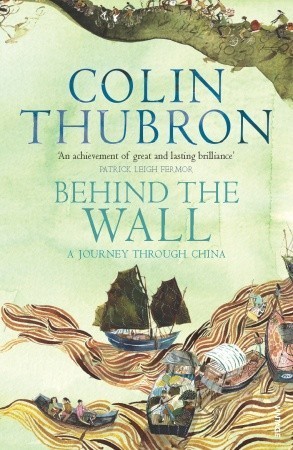
I’d been reading the accounts of Colin Thubron’s visits to China, including his 1987 book Behind the Wall which started in Beijing. Feeling displaced in the impersonal capital, his impression of Beijing was more of a building site than a city. “I tramped its streets in disorientation, looking for a core which was not there.” He found Tiananmen Square arid and couldn’t wait to get out of the city. “The fission of solitary travel — travel in a boyish euphoria of self-sufficiency — tingles in my stomach as I march across Beijing’s railway station,” he writes as he sets off on his travels around the Middle Kingdom as it emerged from decades of Mao and Cultural Revolution oppression.

Looking back on the previous day’s ‘failures’, I tried to reframe the disappointing experiences as learning, rather than ruminating on the rejection I felt after not getting inside the Forbidden City. 

One turning point in my journey was coming across a quote from Robin Sharma while thumbing through a bilingual personal growth book that sat among the artsy and anime library at my new accommodation, the hipster co-working space and ‘serviced apartment boutique hotel, ’ Stey 798. Initially when I saw the pull quote in English and Mandarin, I thought to myself, “What a douchebag; it’s fine for the business guru to say, having made millions spouting his stuff to the likes of Microsoft, IBM, General Motors and FedEx.” But then I reflected on the words and realised the truth in them: “There are no mistakes in life, only lessons. There is no such thing as a negative experience, only opportunities to grow, learn and advance along the road of self-mastery.”

I wasn’t exactly on the road to self-mastery when I found myself lost, tired, bothered and despondent on an unnamed minor road on the outskirts of Beijing. However, I realised that some of my preconceptions had been limiting. 

For example, the fixed idea that because Beijing was big and busy that it would be dangerous to hire a bike and cycle around. There were rows and rows of identical-looking bicycles for hire at every street corner, wide separate cycle lanes, and lots of visitors navigating successfully around Beijing by bike. If I’d been on a bike the previous day, I could have cycled right through Tiananmen Square rather than circle wide around the massive open space (though security personnel will still make sure you don’t stop to take photos at the best spots). 

So, note to self (and to others), try exploring Beijing on bike rather than just using the subway, taxis, or buses. To make bike hire possible, get a Chinese SIM card, install Mobike, and set up payments via WeChat and Alipay, so you can use the lockless sharing bikes provided by Meituan (yellow bikes), Didi Bike (green) and Hello Bike (blue) simply by scanning QR codes, or unlocking bikes with Bluetooth. 

I’ve since learnt some bike hire operators can loan high-quality bikes, with English-speaking staff who deliver bikes to your hotel. So even without a smartphone connected with a local SIM and data, you could arrange to discover the city formerly known as Peking by bike.

Beijing was once capital of the ‘kingdom of bicycles’, with the uptake of bikes trebling in the 1980s across China, as the rationing was cut for locally made bikes such as the prestigious Flying Pigeon brand. Cycle lanes were first incorporated into main roads throughout much of Beijing when car ownership was limited to government officials, with more than 3/4 of Beijing’s road space taken by cyclists in 1988. According to one study, some busy intersections saw 20,000 bicycles an hour, and 8 out of 10 Beijing’s used a bike as their primary transport. 

While China is the leading exporter of bicycles, bikes dropped from 62% of vehicles on the road in the late 1980s Beijing to just 16% by 2010. However, in the last decade, there has been a boom in bike use, not so much by the proletariat but by middle-class Chinese with an environmental and health consciousness embracing a post-materialist sharing society. Bike schemes featuring special locks, non-deflating tyres, rust-resistant bodies and GPS tracking have proliferated across Beijing and in most cities and towns, though following the boom there was also a bust for some players unable to cope with aggressive competition practices copied from the Uber monopoly playbook. 

In tandem with the return of the bike have been some other initiatives to address the problem Beijing was once synonymous with: air pollution. Much has been made of just how bad air pollution is in China, with 16 of the 20 worst air quality cities up to recently located in China. For the nation’s capital, vehicle emissions and burning coal to produce electricity have been the main causes of smog, but a wide range of measures have seen air pollution in Beijing decline by 50%. The air pollution in Beijing is still three times as bad as that in the US’s most polluted city Los Angeles, and some daily measures still exceed the World Health Organisation’s guidelines, but the initiatives which include better urban planning, switching away from coal, extensive public transport, and Low Emission Zones where only e-vehicles are allowed seem to be working. 

As an aside, a recent comparison of air pollution readings found Delhi was five times as polluted as Beijing, though the sources, composition and frequency of air pollutants are different for the two cities, with Delhi’s woes from biomass burning, road dust and the burning of agricultural waste. Delhi has been judged the world’s most polluted capital for four years in a row, according to IQAir. 

There’s another thing too. Much has been made about how polluted the air is in Beijing, but on the three full days I visited, only one day seemed to be overly hazy with smoggy, dirty air. Admittedly, particles in the air don’t have to be visible to be harmful, as the world is learning with more research into fine particles, but from a check of several air monitoring sites, including the US Embassy’s real-time monitoring which started in 2008, the readings were not too high. Probably no worse than smoking half a packet of cigarettes. Maybe that’s why many people in China wear face masks, not just because of illness or to stop the spread of germs. 

So next time — if there is one — I will definitely brave it on a bike. But that’s for next time. 

If Colin Thubron’s stomach was tingling with excitement in anticipation of travel, my stomach that morning was rumbling with anticipation of food to enable me to experience different parts of Beijing. Eating local is one of the best ways to experience a new place. 

I retraced my steps to the window-in-the-wall vendor I’d got a snack from the previous night, who made one of the specialties of Beijing, a thin savoury crisp-friend crepe stuffed with a selection of fillings. The man recognised me from the previous day, and we went through the process of assembling the ingredients to my liking to go on and in the pancake, which is eventually folded and wrapped like an American breakfast burrito. Unlike other jianbing I’d seen being made by small eateries, roaming food carts, or on the back of tricycles, my man’s crepes were made with buckwheat rather than wheat or mung bean flour, giving them a speckled purple appearance which I said to myself was like choosing a healthy option at McDonalds. 

To keep things fresh, jianbing are always made-to-order and cooked under the watchful attention of the mouth-drawling customer. Once the batter has formed small bubbles on the large round hotplate, a series of interventions are enacted, from cracking eggs over the pancake, to flipping it with long chopsticks. With brushes, the chef would smear on spicy and sweet fermented bean pastes (like miso), hoisin and chilli sauces, sprinkle on chopped coriander leaf, scallions and tangy pickled vegetables, and then add crunchy crispy-friend wonton dough strips and lettuce before cutting it in half and folding it into a rectangle. 

The pancake is Beijing’s favourite breakfast, but the staple food is little known outside China compared to steamed buns, dumplings and Yum cha dim sum

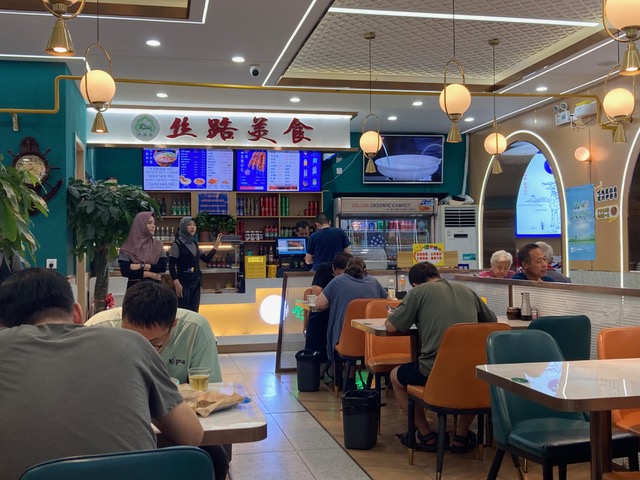
Also not well known outside China is the fact that Beijing has a sizeable Muslim population. At least a quarter of a million people who identify as Muslim reside in the capital, with a Muslim presence in the city dating back to the 8th century. As you may know from following the news, China has some issues in its north-western province of Xinjiang where Turkic-speaking Uyghur Muslims account for 12 million of its inhabitants, along with some ethnic Kazakhs. Less well-known and visible are the Hui Muslims, classified as an ethnic group and religious affiliation, who are found all across China. The Huis have adapted to the dominant Han Chinese culture, while maintaining their beliefs and customs.  

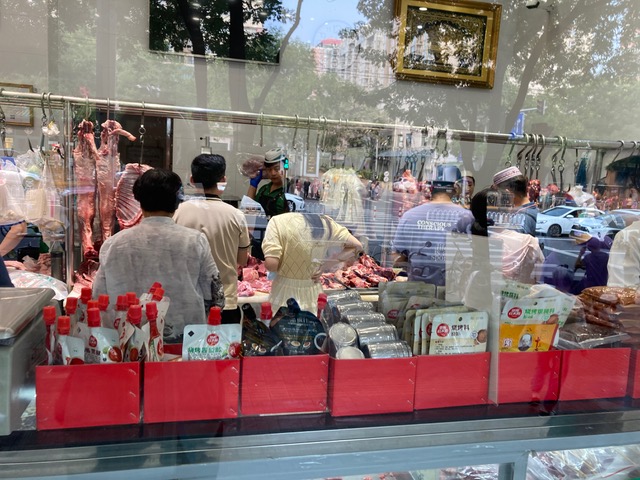
There’s one feature of Muslim life that is at odds with Chinese living, and that’s the eating of pork. Pork is China’s favourite and default meat, accounting for up to 70% of all meat eaten. With Muslims not eating pork, deemed unclean, impure and forbidden, instead the preferred Islamic meat is beef, with lamb/goat also featuring. This food divide meant that Muslims often lived together in neighbourhoods with not only a mosque, but also Muslim food processing and services. Across China, Muslim beef noodle restaurants are ubiquitous, and considered cheap and cheerful as well as clean, a godsend in a land of food hygiene concerns and stomach upsets.

In Beijing Niujie and Madian are the two main Muslim enclaves, though the latter in the north has declined. Niujie, south of the centre, even has its nearby subway station, and while there is still a mosque (with Chinese-style architectural characteristics) the main attraction for most visitors is the distinctly Muslim food available, with snacks and delicacies on offer. 

Of the quarter of a million Muslims who officially reside in Beijing, perhaps half live in the neighbourhood of Niujie. There are halal supermarkets, butchers selling mutton and beef, a Hui hospital and a kindergarten. 

For a block, on both sides of the wide street, are stalls and restaurants, and queues. The smoke from sizzling charcoal grills serving fatty lamb skewer kebabs and the aromatic cumin-scented air probably push Niujie’s air pollution readings beyond acceptable World Health Organisation levels, but no one is complaining. Uyghur vendors, wearing round white hats, call out over the grill to whip up even more business, or shout out to younger men to fetch more of the freshly-baked sesame-studded flatbreads that are stacked high beside tandoor ovens, like round naan, but with a thick edge, like a deep dish Pizza Hut crust.

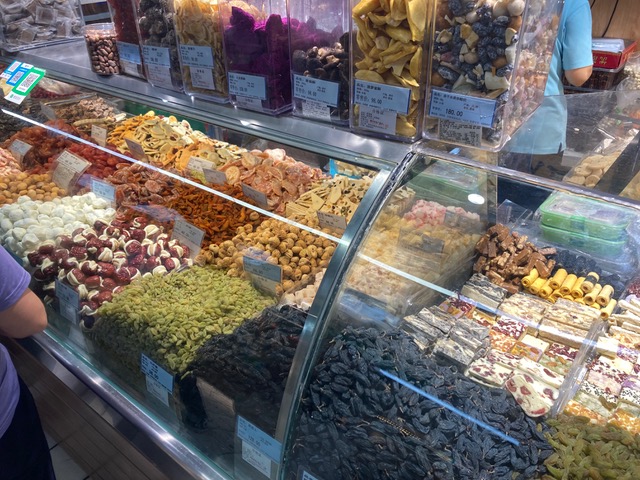
Steam rises from the large bowls of beef noodle soups slurped by families sitting on low stools around a square table, and visitors line up to order from a selection of fruit pastries. The largest amount of tripe you may ever see is cooked in a huge pot, while a rich cake made with dried fruit, nuts, seeds and sugar is sold by weight. 

One of the quests for the self-labelled traveller, as opposed to the unaware tourist, is to be less an outsider and a consumer of tourism products. But underlying all this is the enigma of travel. That we go to experience things that are different from back home. And occasionally we wish to be less visible as an outsider, and more like an insider. 

I think you can do this to a certain degree, depending on where you are and the acceptance of diversity of that place. But for me, as a visitor of European heritage, to the reasonably homogeneous and definitely differentness of China, I stand out. Not just because of my height at 6 feet. Or that my hair isn’t the standard black. 

So what I seek is more of an authentic experience. Which for me often involves shopping local, eating local, random exploration of neighbourhoods rather than ticking off sights, preferring places without tickets or queues. 

It is travel with some risks, not mentioned in the insurance fine print. It is travel which is self-deprecating, acutely aware of my ‘otherness’ and awkwardness, and of how I might connect with others. Some of that is transactional. I buy fruit from an old lady at a local market. I hop on a bus. I go to a place, but it is not the place recommended by the receptionist or concierge.

In Niujie, I am both an outsider and the ‘other’. Yet I have more empathy for and connection with the Muslim street vendors than I do with the Han Chinese who have come that afternoon to eat delicious food that is different to their normal diet. 

After rubbing shoulders with fellow diners at a cramped eatery in Niujie, having finally located the area that doesn’t feature in most Beijing guidebooks, I still had one mission to complete. 

Photo provided by Keith Lyons

So, as you are probably aware, Beijing hosted the Olympics back in 2008, with much fanfare and pomp. It was China showing off to the world just how modern and developed it was. It awed us not just with its impressive pageantry but also its buildings and facilities, many created just for the International sporting event. The Olympics provided the impetus for numerous infrastructure projects, particularly transport networks which were state-of-the-art. 

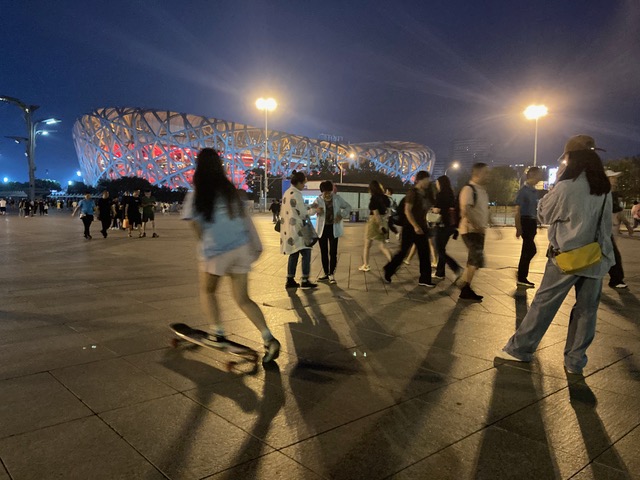
Some facilities remain, and the Bird’s Nest is still an attraction in itself, despite its lack of use following the 16 years. You probably remember the Water Cube, the swimming pool. 

Bird’s Nest: Photo provided by Keith Lyons

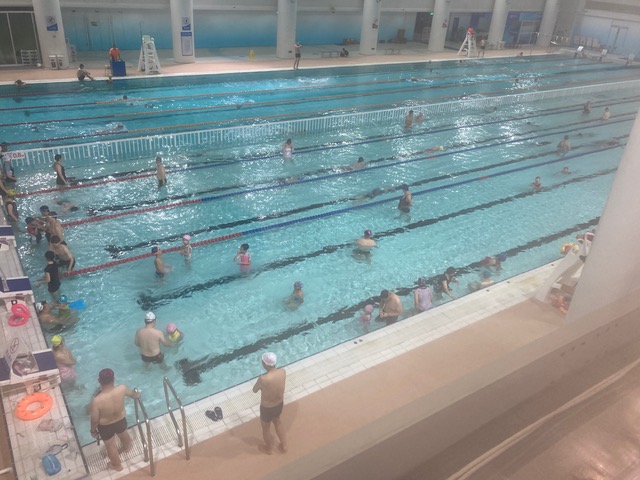
Often when I travel, I check to see if there are swimming pools near my accommodation, or even inside my hotel (if someone else is picking up the tab). So when I found out that Water Cube is open for casual swimming, I set my sights on swimming a lap or two in the famous pool. 

It turns out the pool for public use isn’t the actual one for Olympic races — that’s reserved for competition — but the training pool where swimmers warmed up and down has been open to anyone for more than a decade. But there’s a catch. 

First, you have to know that you can swim there. And there’s another level of safeguard. Because the pool is several metres deep, and there’s the danger of non-swimmers drowning, the pool is partitioned into two halves. The accessible half has a raised floor so it is only around a metre deep. You can stand up in it. Kids can stand up. 

But the other half, where the depth darkens the water to deep blue, is strictly controlled entry. You need a swipe card to access it. And to get that, as an American working in Beijing described to me, involved a medical test as well as completing various swimming feats, which included swimming two lengths without pausing. 

Without the time in the city to complete the rigorous entry requirements, I had to contend myself with the learner’s side, where parents walked alongside their children like chaperons, adults swam on both sides of the lanes, and there were frequent close calls or collisions. 

Inside the Water Cube: Photo provided by Keith Lyons

I’m a reasonably tolerant person, and having lived in China for more than a dozen years had got used to behaviours I initially found, to my mind and upbringing, a little disgusting. But when I swam my first length, only having to stop a couple of times to negotiate around erratic swimmers, the first sound I heard was from a fellow swimmer rising up from his lane to loudly clear his throat and spit onto the floor edge. I made a mental note not to rest my goggles up there.

While I had the passive-aggressive stance towards those spitters, during rests at the end of the lane other swimmers struck up conversations. A middle-aged women confided how she had lessons to swim in her 40s, and now tried to swim at the Water Cube a few days each week, even if she could not go a few metres without gasping for air. “Can you give me any tips to improve my swimming,” she asked as she returned to my end. I replied in Chinese the word my blind masseur used to give me when he hit a sore point on my feet. “Fang song” — relax. It was probably the worst word to say, like shouting ‘keep calm’ out repeatedly when something has gone disastrously wrong. 

I probably should have taken on board my own words, as I swam into a father shepherding his daughter along. He was blocking my way. I saw him do the same to others. Deliberately blocking the way of oncoming swimmers. You are the symbol of modern China, I thought. Selfish, entitled, arrogant. Because I am a man of peace and goodwill to all, when he next blocked my way, I just carried on swimming, exaggerating my kicking to churn up the water and splash his rotund belly and smug grin. 

I switched to another lane, and after a few more lengths, as I waited for a slow swimmer to get a head start, a boy of 12 years decided to strike up a conversation with me. “My mother says I should practice my English, so that’s why I like to come here,” he said, pointing up to the viewing window where a dragon mom waved and then proceeded to turn her phone camera towards us. After exchanging the usual questions about himself and me, he then abruptly turned the conversation around to China and the world. “China is the biggest country in the world. We are the leader.” 

Unable to find the right words to express himself, he asked another swimmer, a man who had just moved to Beijing from the north, to articulate. 

I wanted to ask him if China was such a great country, why did so many of its people want to escape to a better life in the US, Canada, Australia and New Zealand. But conscious that swimming at the Water Cube gives just two hours in the facility I escaped myself and tried to complete a length unimpeded or uninterrupted. 

When I got back, the boy, who was rather overweight, was still there, waiting with another claim about China’s might. 

Maybe I’m being nostalgic, about the good old days, but in the 1990s and 2000s, being a foreigner in China meant automatic adulation and attention from Chinese. Foreigners were feted and admired regardless of their behaviour and personality. 

Now, in the mid-2020s, things have changed. They started changing a decade ago, when China realised that foreigners were not so great after all. When stories from the government claimed that most of the foreigners were economic spies. When Chinese TV had footage of young Americans drunk and predatory on the Shanghai subway. When my friends said how they’d heard that many foreigners teaching in China were losers in their own country. The tide had turned. The golden days were over. China has regained its swagger. The sleeping giant was waking up. The dragon was turning. And I was getting tired. 

Before my number got called and I got requested to leave the pool, I got out, and used my token in the shower, wishing I’d brought my flip-flops to protect my feet from contact with the floor. 

Not just being in the water, but being underground, it always takes a little to adjust to being back above ground and at maximum gravity, weightless. One of the things I like about swimming is that afterwards, some of that fluidity, ease of movement, body perception and gentle feeling remains, like a reminder of how you could be in the world. My senses feel renewed, my mind a little lighter, my awareness more centred. 

Near the Bird’s Nest, they were having a skateboard class, with over 50 participants, many of them young women. And as I strode along the wide boulevard, groups of newly initiated skaters wove in and out of the family groups and sightseers, a sign to the world of new ways of being, new freedoms, and new leisure. Was this a victory for American culture? Or was China taking this recreation and adding Chinese characteristics to it? 

My last swim was both a relaxation exercise at the end of the day, and a future — proofing myself for a long-haul flight home. 

The faint linger of chlorine on the webbing of my hands and fingers. The sensation of lying face down and being held by the water. The realisation that the more I know the less I understand about China. These are the things I took with me as I sat in the aisle seat, stretched out my legs, and reminded myself, that I was 30,000 feet above the earth, going from the ancient capital to one of the youngest nations on earth (New Zealand). Much is lost, falling away, lost in time, the memories not so much fade as slip away imperceptibly. I scroll through the photos on my iPhone. So long Beijing.

*Read the Day two of Keith Lyon’s China trip by clicking here

Read the Day One of Keith Lyon’s China trip by clicking here

Keith Lyons (keithlyons.net) is an award-winning writer and creative writing mentor originally from New Zealand who has spent a quarter of his existence living and working in Asia including southwest China, Myanmar and Bali. His Venn diagram of happiness features the aroma of freshly-roasted coffee, the negative ions of the natural world including moving water, and connecting with others in meaningful ways. A Contributing Editor on Borderless journal’sEditorial Board, his work has appeared in Borderless since its early days, and his writing featured in the anthology Monalisa No Longer Smiles.

.

PLEASE NOTE: ARTICLES CAN ONLY BE REPRODUCED IN OTHER SITES WITH DUE ACKNOWLEDGEMENT TO BORDERLESS JOURNAL. 

Click here to access the Borderless anthology, Monalisa No Longer Smiles

Click here to access Monalisa No Longer Smiles on Kindle Amazon International

Categories
Poetry

Fire Engine

Masud Khan’s poem, Dhamkal (Fire Engine), translated from Bengali by Fakrul Alam

Having fled the madhouse, the lunatic darted up the tree.
Nothing would make him come down, he said,
Except for the pleas of that midget-sized nurse!

The nurse came running, quick as a fire engine,
Waving wildly at him. Her gestures were coded messages,
Inducing the lunatic to climb down from the tree top
Just as a koi fish descends on the dining plate.
Entranced by the smell of steaming curry,
He descended easily and freely
As consecutive numbers do when one counts down.

The lunatic’s thoughts flickered across the nurse’s consciousness.

This day that mad man will return once more to his asylum.
Placing his head on the confessional,
He will soundlessly suffer thirteen electric shocks
Designed to induce thirteen confessions from him
At the directive of the calm and composed health priest!

Masud Khan (b. 1959) is a Bengali poet and writer. He has, authored nine volumes of poetry and three volumes of prose and fiction. His poems and fictions (in translation) have appeared in journals including Asiatic, Contemporary Literary Horizon, Six Seasons Review, Kaurab, 3c World Fiction, Ragazine.cc, Nebo: A literary Journal, Last Bench, Urhalpul, Tower Journal, Muse Poetry, Word Machine, and anthologies including Language for a New Century: Contemporary Poetry from the Middle East, Asia, and Beyond (W.W. Norton & Co., NY/London); Contemporary Literary Horizon Anthology,Bucharest; Intercontinental Anthology of Poetry on Universal Peace (Global Fraternity of Poets); and Padma Meghna Jamuna: Modern Poetry from Bangladesh(Foundation of SAARC Writers and Literature, New Delhi). Two volumes of his poems have been published as translations, Poems of Masud Khan(English), Antivirus Publications, UK, and Carnival Time and Other Poems (English and Spanish), Bibliotheca Universalis, Romania.  Born and brought up in Bangladesh, Masud Khan lives in Canada and teaches at a college in Toronto.

Fakrul Alam is an academic, translator and writer from Bangladesh. He has translated works of Jibonananda Das and Rabindranath Tagore into English and is the recipient of Bangla Academy Literary Award (2012) for translation and SAARC Literary Award (2012).

PLEASE NOTE: ARTICLES CAN ONLY BE REPRODUCED IN OTHER SITES WITH DUE ACKNOWLEDGEMENT TO BORDERLESS JOURNAL

Click here to access the Borderless anthology, Monalisa No Longer Smiles

Click here to access Monalisa No Longer Smiles on Amazon International

Categories
Poetry

Poetry by Ryan Quinn Flanagan

Courtesy: Creative Commons
DANGERMOUSE


There is a metronome in the next room,
knocking against felled coconuts;

The body has parts like a salvage yard
has parts, like the miniseries hacked up
into televised segments that beg you to
watch the exhibitionist whirl his dervish;

hairy and monstrous, father just home
from the bars…

Let the Dangermouse know;
it is wise to be informed –

strafing metal birds and a cradle robber
recruiter to work the malls; expired
coupons never come to collect,
this sourest of science.

Dentistry calls the canines, Marathon
comes a running, the rolling ecstasies,
the raffish unfallowed.

Destiny, the unopened suitcase.
Diving metal birds, the body in parts –

weeping linen closet, little Dangermouse
knows it’s coming:

cover your eyes mouth toes:
a great biting frost returns to these
wailing unmeasured lands.

Ryan Quinn Flanagan is a Canadian-born author residing in Elliot Lake, Ontario, Canada with his wife and many bears that rifle through his garbage.  His work can be found both in print and online in such places as: Evergreen Review, The New York Quarterly, Borderless Journal, GloMag, Red Fez, and Lothlorien Poetry Journal

.

PLEASE NOTE: ARTICLES CAN ONLY BE REPRODUCED IN OTHER SITES WITH DUE ACKNOWLEDGEMENT TO BORDERLESS JOURNAL

Click here to access the Borderless anthology, Monalisa No Longer Smiles

Click here to access Monalisa No Longer Smiles on Kindle Amazon International