Categories
Tribute

Well Done, Shyam! Never say ‘Goodbye’!

By Ratnottama Sengupta
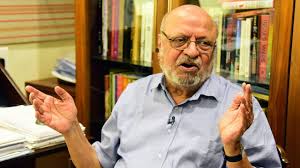

“If I enjoy the film I have made, then I am quite certain viewers will too. And what business do I have to burden viewers with what I myself do not enjoy?”

–Shyam Benegal (in an interaction with Ratnottama Sengupta)

Art is not elitist. Nor is artistic experience one that only the elite can enjoy. The world’s greatest art has been accessible to all mankind. Taj Mahal was erected in memory of Mumtaz Mahal but it is for the world to access and admire. The cave paintings at Ajanta propagated a certain philosophy but thousands of years later too they mesmerise one and all.  And, anyone who goes to Tanjore temple experiences its magnificence. Cinema too is capable of providing such universal experience. What is more, it is possible to provide such an experience without distorting or oversimplifying an idea.

Shyam Benegal (1934-2024) had dinned this belief into me when I interviewed with him for the first time — in Bombay of 1980. Seven years before that he had proved it to the world with his debut film, Ankur (The Seedling, 1974). It had announced itself to cineastes through its nomination for the Golden Bear at the 24th Berlin Film Festival and had gone on to win three National Awards. In the wake of stylised trendsetters like Bhuvan Shome (directed by Mrinal Sen, 1969), Uski Roti (Others’ Bread, directed by Mani Kaul, 1969) and Maya Darpan (Illusory Mirror, directed by Kumar Shahani, 1972), everyone expected Ankur to be another “arty” film. In other words, “pretentious”, “pseudo intellectual”, even “boring”. Far from refusing to peter out of theatres due to lack of footfalls, the Rs 5-lakh budget film went on to garner millions because it engaged audiences of every shade and strata. And it was hailed as marking a new beginning in Indian cinema that had roots in the narrative tradition of earlier masters such as Bimal Roy and Benegal’s own cousin, Guru Dutt.

No, Ankur was not a fluke, Nishant (Night’s End, 1975) had proven. Once again, Benegal had set his film in Telengana, that part of Andhra Pradesh which had seen him grow up with his siblings in the household of his father whose livelihood came from a photo studio. “Alwal was a semi-rural semi-urban area, so I had seen both sides of a feudal society coming to grips with modernity setting in,” Benegal had explained to me.

Ankur had touched upon several ills of the feudal system: class difference, caste inequity, sexual exploitation of women, of the physically challenged, and even alcoholism among the poor. It had a sequence of thrashing, and it closed with the indication of violent protest. Almost all these themes would flower into independent saplings in Benegal’s subsequent films. Because the important thing for him, as he once said to BBC, was that “post-Independence India was changing its feudal character to the kind of society we wanted to create. Industrialisation at one level, creation of the middle class at another level, and disappearance of the regressive values of the feudal life.” 

At that time, when I was yet to step out of my teens, I was deeply impacted by the oppressive ‘liberty’ of the caste person who thought he had a right over the lowborn woman. The empowerment of women was a theme Benegal felt strongly about. “The idea had started during the national movement with Gandhi, who first talked about women having equal responsibility,” pointed out the director of The Making of a Mahatma (1996). “They have to become aware of their strength and empower themselves because 50 percent of your population comprises of women.”

*

From the birth of a new nation to the birth of a nation, Benegal constantly grappled with these themes. With “the whole business of tradition and modernity,” to borrow his words. “In an ancient society like India where so much of tradition is still valued and revered, when will we get rid of the dubious virtues?” he wondered.

Benegal functioned with a sensibility that was native to the length and breadth of the land that was his canvas. “As long as one functions with one’s sensibility, it will resonate with every person of that sensibility,” he maintained. 

To me the most endearing trait of a Benegal film is the simplicity of its narrative. His incidents came out of life, his characters were from his surroundings. And his unfolding, though devoid of gimmick, was not bereft of drama nor of violence. He learnt to steer clear of artifices while making ad films where, “because you have to make your point in one minute, you tend to fall back on gimmick.”

Clarity of purpose and simplicity of narration were the two rails that never let his script go off into a meander of ultra mystical or complex metaphors. Magic realism? Hyper realism? High pitched melodrama? Benegal had need for none of these ploys. “The most complex of ideas have a simple way of projecting themselves,” he’d say. That, and not its reverse, was the most valid mantra of his life.

Why did the Phalke or the Padma Bhushan awards like simple story telling? “Because I like to involve people, and that happens when there is a dramatic juxtaposition of characters.” The use of drama did not in any way dilute the significance of his subject — be it casteism (Samar, Conflict, 1999), women’s empowerment (Bhumika, Role, 1977), portrayal of the principles of national heroes (Making of the Mahatma), or the struggle to wrest power from an oppressor (Junoon, The Obsession, 1978). Be it in feudal Telengana (Nishant), in a Borgadar’s Bengal (Arohan, The Ascent, 1982), an industrial Bombay (Kalyug, The Age of Vice, 1981), in Bose’s Burma (The Forgotten Hero, 2005), or Mujib’s Bangla (Mujib: The Making of a Nation, 2023). 

In the process he dispelled the notion that showing our reality in cinema cannot engross or entertain. In fact, he questioned the very definition of the word ‘Entertainment’. “If a serious talk or a news holds you spellbound, isn’t that also entertainment?” he had asked me.

So, in order to engage the viewers, Benegal plunged into problems and miseries of the marginalised Indian: the milkman (Manthan, The Churning, 1976) and the weaver (Susman, The Essence, 1978), the untouchable (Samar) and the glamorous (Bhumika), the royals (Zubeidaa, 2001) and the entertainer (Sardari Begum, 1996), the middle class households where women are mere birthing machines (Hari Bhari, 2000), or the illiterate voters of Sajjanpur (Welcome to Sajjanpur, 2008).

Through all these voters, men and women, landlords and servants, on the banks of Katha Sagar (A Sea of Stories, 1986, TV series) or in the arid Birbhum or in the Mandi (Market Place, 1983) of flesh, Benegal made spectators of us. “Even a road accident turns us into spectators, some mute, some aggressive, some caring,” he’d pointed out. “What is it we want to experience when we rush to the window when we hear a car screeching to a half?” he’d asked. “Why is an unanticipated death — or murder — part of the entertainment formula? Because the adrenaline rush, the excitement in these exorcises our fears,” he had explained. 

But Benegal’s wasn’t a conventional definition of entertainment. Nor did he decry the use of violence in mainstream cinema. “Indeed, it helps society because viewers find vicarious release from the stress that builds up in the tension filled life in urban societies.” As for his own films rooted in the remote pockets away from the metros? “Sometimes we need to use force because some social problems have got so deeply entrenched,” he was unabashed about violence in his films. “Change in certain situations can come only from the use of violence. But be careful never to lose your moral compass,” he immediately warned me. “Violence cannot be indiscriminately justified nor universalised. And in no circumstance should it be  glamourised.”

So human impulses, and social well-being were his prime concern.  The constant interaction between an individual and his or her milieu; suffering inequities, and standing up against exploitation — we gained insight into these when we sat in darkened auditoriums to watch Arohan, Sardari Begum, Mammo (1994), Well Done Abba…(2010)

Socio-economic. Socio-political. Socio-legal. No label of genre could own Shyam Benegal. Because? “That will restrict my own thinking. How can I keep pace with the galloping changes that come with the ticking of centuries? And when the march of science unleashes computers and cellular phones, Internet and digital filmmaking?”

But what prompted his choice of subject every time he sat down to work on a script — with Shama Zaidi or Girish Karnad, Satyadev Dubey or Khalid Mohamed[1]? “There’s an electic streak in me that will not let me go where I’ve been before or do what I’ve done before,” Benegal was clear. So historical patterns to saw him go from The Making of a Mahatma on Gandhi, the advocate of non-violence, to Bose, The Forgotten Hero who escaped home incarceration and travelled through Himalayan hurdles and joined the Japanese to fight the British colonisers of India. From the Junoon of the Sepoy Rebellion of 1857, to Bharat Ek Khoj (India, a Search, 1988 TV serial) exploring the roots of India. From my Samvidhan (2010, TV mini-series),  the formulation of the Constitution that is the firm foundation of the nation he mapped through his films, to Mujib on the birth of Bangladesh.

This refusal to be contained in a box had seen Benegal go from making promotional ads to documentaries on Steel Authority of India and Artificial Insemination in Animal Husbandry, on Nehru and Satyajit Ray. Benegal’s refusal to be boxed and labelled saw him make

Manthan and Hari Bhari — two prime examples of turning a documentary subject into a feature film. Why, his varied interest saw him making a documentary that mapped the course of a raga which originated with Mallikarjun Mansur hearing a leaking tap in the kitchenette of a friend in Bombay – and went on to capture the spirit of the financial capital!

What explains the prolificity of the man who celebrated his 90th birthday on December 16 and bade goodbye a week later? His indomitable and indefatigable spirit. 

Unusual Concerts: The documentary on Mallikarjun Mansur (1910-1992) and Bombay

[1] Actors on the Hindi screen

.

Ratnottama Sengupta, formerly Arts Editor of  The Times of India, teaches mass communication and film appreciation, curates film festivals and art exhibitions, and translates and write books. She has been a member of CBFC, served on the National Film Awards jury and has herself won a National Award. 

.

PLEASE NOTE: ARTICLES CAN ONLY BE REPRODUCED IN OTHER SITES WITH DUE ACKNOWLEDGEMENT TO BORDERLESS JOURNAL

Click here to access the Borderless anthology, Monalisa No Longer Smiles

Click here to access Monalisa No Longer Smiles on Amazon International

Categories
Editorial

‘Footfalls Echo in the Memory’

Painting by Claud Monet (1840-1926). From Public Domain

Acknowledging our past achievements sends a message of hope and responsibility, encouraging us to make even greater efforts in the future. Given our twentieth-century accomplishments, if people continue to suffer from famine, plague and war, we cannot blame it on nature or on God.

–Homo Deus (2015), Yuval Noah Harari

Another year drumrolls its way to a war-torn end. Yes, we have found a way to deal with Covid by the looks of it, but famine, hunger… have these drawn to a close? In another world, in 2019, Abhijit Banerjee had won a Nobel Prize for “a new approach to obtaining reliable answers about the best ways to fight global poverty”. Even before that in 2015, Yuval Noah Harari had discussed a world beyond conflicts where Homo Sapien would evolve to become Homo Deus, that is man would evolve to deus or god. As Harari contends at the start of Homo Deus, some of the world at least hoped to move towards immortality and eternal happiness. But, given the current events, is that even a remote possibility for the common man?

Harari points out in the sentence quoted above, acknowledging our past achievements gives hope… a hope born of the long journey humankind has made from caves to skyscrapers. If wars destroy those skyscrapers, what happens then? Our December issue highlights not only the world as we knew it but also the world as we know it.

In our essay section, Farouk Gulsara contextualises and discusses William Dalrymple’s latest book, The Golden Road with a focus on past glories while Professor Fakrul Alam dwells on a road in Dhaka , a road rife with history of the past and of toppling the hegemony and pointless atrocities against citizens. Yet, common people continue to weep for the citizens who have lost their homes, happiness and lives in Gaza and Ukraine, innocent victims of political machinations leading to war.

Just as politics divides and destroys, arts build bridges across the world. Ratnottama Sengupta has written of how artists over time have tried their hands at different mediums to bring to us vignettes of common people’s lives, like legendary artist M F Husain went on to make films, with his first black and white film screened in Berlin Film Festival in 1967 winning the coveted Golden Bear, he captured vignettes of Rajasthan and the local people through images and music. And there are many more instances like his…

Mohul Bhowmick browses on the past and the present of Hyderabad in a nostalgic tone capturing images with words. From the distant shores of New Zealand, Keith Lyons takes on a more individualistic note to muse on the year as it affected him. Meredith Stephens has written of her sailing adventure and life in South Australia. Devraj Singh Kalsi describes a writerly journey in a wry tone. Rhys Hughes also takes a tone of dry humour as he continues with his poems musing on photographs of strangely worded signboards. Colours are brought into poetry by Michael R Burch, Farah Sheikh, George Freek, Rajiv Borra, Kelsey Walker, John Grey, Stuart McFarlane, Saranyan BV, Ryan Quinn Falangan and many more. Some lines from this issue’s poetry selection by young Aman Alam really resonated well with the tone defined by the contributors of this issue:

It's always the common people who pay first.
They don’t write the speeches or sign the orders.
But when the dust rises, they’re the ones buried under...

Whose Life? By Aman Alam

Echoing the theme of the state of the common people is a powerful poem by Manish Ghatak translated from Bengali by Indrayudh Sinha, a poem that echoes how some flirt with danger on a daily basis for ‘Fire is their life’. Professor Alam has brought to us a Bengali poem by Jibanananda Das that reflects the issues we are all facing in today’s world, a poem that remains relevant even in the next century, Andhar Dekhecche, Tobu Ache (I have seen the dark and yet there is another). Fazal Baloch has translated contemporary poet Manzur Bismil’s poem from Balochi on the suffering caused by decisions made by those in power. Ihlwha Choi on the other hand has shared his own lines in English from his Korean poem about his journey back from Santiniketan, in which he claims to pack “all my lingering regrets carefully into my backpack”. And yet from the founder of Santiniketan, we have a translated poem that is not only relevant but also disturbing in its description of the current reality: “…Conflicts are born of self-interest./ Wars are fought to satiate greed…”. Tagore’s Shotabdir Surjo (The Century’s Sun, 1901) recounts the horrors of history…The poem brings to mind Edvard Munch’s disturbing painting of “The Scream” (1893).  Does what was true more than hundred years ago, still hold?

Reflecting on eternal human foibles, Naramsetti Umamaheswararao creates a contemporary fable in fiction while Snigdha Agrawal reflects on attitudes towards aging. Paul Mirabile weaves an interesting story around guilt and crime. Sengupta takes us back to her theme of artistes moving away from the genre, when she interviews award winning actress, Divya Dutta, for not her acting but her literary endeavours — two memoirs — Me and Ma and Stars in the Sky. The other interviewee Lara Gelya from Ukraine, also discusses her memoir, Camels from Kyzylkum, a book that traces her journey from the desert of Kyzylkum to USA through various countries. In our book excerpts, we have one that resonates with immigrant lores as writer VS Naipual’s sister, Savi Naipaul Akal, discusses how their family emigrated to Trinidad in The Naipauls of Nepaul Street. The other excerpt from Thomas Bell’s Human Nature: A Walking History of the Himalayan Landscape seeks “to understand the relationship between communities and their environment.” He moves through the landscapes of Nepal to connect readers to people in Himalayan villages.

The reviews in this issue travel through cultures and time with Somdatta Mandal’s discussion of Kusum Khemani’s Lavanyadevi, translated from Hindi by Banibrata Mahanta. Aditi Yadav travels to Japan with Nanako Hanada’s The Bookshop Woman, translated from Japanese by Cat Anderson. Jagari Mukherjee writes on the poems of Kiriti Sengupta in Oneness and Bhaskar Parichha reviews a book steeped in history and the life of a brave and daring woman, a memoir by Noor Jahan Bose, Daughter of The Agunmukha: A Bangla Life, translated from Bengali by Rebecca Whittington.

We have more content than mentioned here. Please do pause by our content’s page to savour our December Issue. We are eternally grateful to you, dear readers, for making our journey worthwhile.

Huge thanks to all our contributors for making this issue come alive with their vibrant work. Huge thanks to the team at Borderless for their unflinching support and to Sohana Manzoor for sharing her iconic paintings that give our journal a distinctive flavour.

With the hope of healing with love and compassion, let us dream of a world in peace.

Best wishes for the start of the next year,

Mitali Chakravarty

borderlessjournal.com

Footfalls echo in the memory
Down the passage which we did not take
Towards the door we never opened
Into the rose-garden.

TS Eliot, ‘Burnt Norton’, Four Quartets (1941)

Click here to access the content’s page for the December 2024 Issue

.

READ THE LATEST UPDATES ON THE FIRST BORDERLESS ANTHOLOGY, MONALISA NO LONGER SMILES, BY CLICKING ON THIS LINK.

Categories
Essay

Still to Moving Images

As a curator, Ratnottama Sengupta writes about the long trajectory of films by artists, beginning with Husain’s Berlinale winner, down to the intrepid band she screened at the just concluded 30th Kolkata International Film Festival

When Maqbool Fida Husain won the Golden Bear in the 17th edition of the Berlin Film Festival, the year was 1967. I, in my pre-teen years, knew little about painting. But growing up in a family of filmmakers I was already conversant with the art of looking through the camera. So I was disoriented that the film critics of the time were baffled by what had impressed the international jury.

Royalty, tigers, ruins, hawks, school children, anklets, on the river bank – all these images moving only to music, not a word uttered. The jury at Berlinale were astounded by the richness of the artist’s idiom that had breathed life into a Rajasthan that is rich in architecture as it is in painting, in costume as in music. 

This dawned on me years later, when I curated the exhibition, 3 Dimensions, forthe All India Fine Arts and Crafts Society in New Delhi. It featured paintings, sculpture and graphic art or drawings by artists from Husain, Satish Gujral, Ghulam Mohammad Sheikh, Jatin Das to Sanjay Bhattacharya, Paresh Maity, Mimi Radhakrishnan, Shadab Hussain, among others. 

A unique feature of this exhibition was that all the participating artists had interest in another expression of art. So every evening of that week had seen a Ram Kumar and Mimi read their short stories; a Narendra Pal Singh and Jatin Das read their poems; a Sanjay Bhattacharya render Tagore songs of and a Shruti Gupta Chandra perform Kathak. Ratnabali Kant had staged a Performance Art in the presence of Prime Minister V P Singh who had inaugurated the week-long exhibition by reading his poems. And, on the closing day, I had screened Through a Painter’s EyesThat’s when it dawned on me: it was the originality of vision captured by the 7-minute short film had won over Berlin as also Melbourne and our very own National Awards too. 

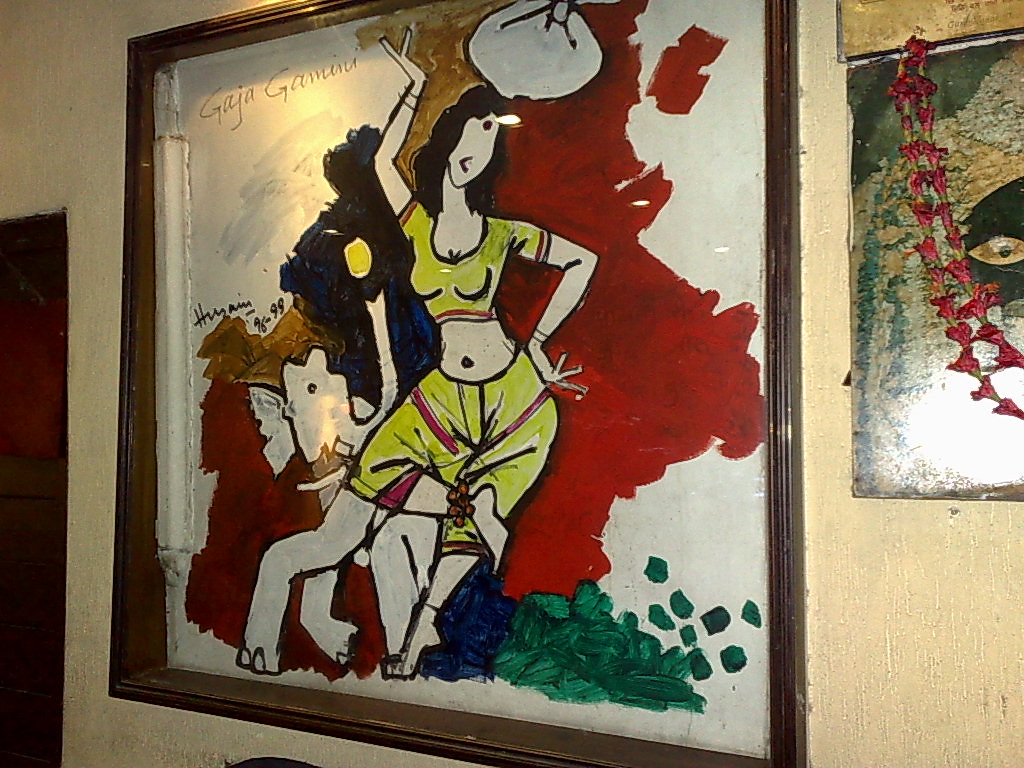
Subsequently Husain, who had started out from the tenements of Bombay by painting oversized hoardings of Hindi films on the sleeping tramlines at the dead of night, had at the ripe age of 84 made Gaja Gamini (2000) with stars such as Madhuri Dixit, and Minaxi — A Tale of Three Cities (2004) with Tabu and Naseeruddin Shah. Ironically these films baffled the critics just as much as the earlier short film had. However the dazzling visuals of vibrant figures and colourful structuring of the (non)-narrative had found acceptance in the Marche du Film section of Cannes 2004.

*

I have since then tried to fathom what drives artists who are skilled at painting with oil or watercolour, or sculpting wood or stone, metal or clay, or creating graphic images on paper or linoleum, to wield the megaphone. Now, instead of holding the camera or editing the celluloid strips with their hands, they use their mind, their mind’s eyes, their creative imagination.

Some other contemporaries of Husain too had, after attaining glory in the plastic arts, turned to experimenting with the new, ever evolving, ever contemporary art form — cinema. In 1970, Tyeb Mehta, who had briefly worked as an editor, made Koodal, meaning  ‘Meeting Ground’ on the Bandra station of Mumbai’s Western Railway. The synthesis of images of humans and animals had won him the Filmfare Critics Award.

Cartoonist Abu — born Attupurathu Mathew Abraham — was a journalist and author who had worked for Punch, Tribune and The Observer in London before returning to work with The Indian Express. He was given a special award by the British Film Institute for the short animation No Ark, clearly a cryptic message deriving from the Biblical tale of Noah’s Ark.

Equally engrossing is the story of Syzygy, also produced by Films Division, and directed by Akbar Padamsee.  This  16-minute short, premiered at a UNESCO screening in Paris 1969, had no narrative, no sound, or even colour. It only had lines evoking shapes typically used to refer to the alignment of celestial bodies. Only one man had stayed back till the end of the screening — and he had said to Padamsee, “Most people could not understand your film — it’s a masterpiece.” 

Reportedly that man had gone on to become the programming director at Cinematheque Francaise – world’s largest film archive. That’s where Indian filmmaker found Ashim Ahluwalia found a copy of Events in a Cloud Chamber, Padamsee’s second film that was sent for screening at the Delhi Art Expo — never to be returned to the artist. The lost-in-transit film has now been professionally reinterpreted by Ahluwalia.

NB: All these films were supported by filmmaking bodies, and though often baffled, cineastes realised theirs was a new way of seeing the visual expression that goes under the arching umbrella of cinema.

*

This desire to understand, adapt, and get under the skin of a modern medium had driven Tagore, a century ago from today, to paint expressionistic forms and also to film Natir Pujo (1931). And today we find a band of artists from Delhi, Mumbai, Kerala and Baroda making films that bridge disciplines from landscape and abstraction to mimetic movement and drama.

What are the notable features of these films that are mostly made on video? They too have little need for dialogue. Instead, their sight is supported by music of natural sound. If the objects they capture through the lens are arresting forms, vacant spaces can be just as inviting. When they have humans as their protagonists, they are keen to capture body language rather than drama. Colourful palette is not a foregone conclusion – monochromes and black and white can be more poignant. Because? Their visuals are but vehicles for commenting on social reality and for communicating philosophic content. 

Legends or veterans, seasoned or sprouting, this intrepid band of adventurers includes Vivan Sundaram, Ranbir Kaleka, Gopi Gajwani, Rameshwar Broota, Bharti Kapadia, Babu Eshwar Prasad, Gigi Scaria, Protul Dash, and Sanjay Roy. They are a continuum of the spirit of experimentation that had driven Husain and Tyeb, Abu Abraham and Akbar Padamsee.

Films by Artists at KIFF*

1 *Disclaimer* 2016/ 9:40 min
By *Gigi Scaria* focuses on the sleight of hands by a magician
2 *On the Road* 2021/ 5:7 min
By *Babu Eshwar Prasad* is a nostalgic look at road movies that are part documentary, part adventure.
3 *Sabash Beta* 3 min
By *Rameshwar Broota* with Vasundhara Tewari applauds the galloping of a fleighty horse.
4 *Leaves Like Hands of Flame* 2010/ 5:34 min
By *Veer Munshi* likens the fallen chinar leaves to the autumn in the lives of uprooted Kashmiris.
5 *L for…* 2019/ 13:14 min
By *Bharti Kapadia* plays with the sight and - surprisingly - the sound of the alphabet.
6 *Fruits Ripen and Rot* 2022/ 4:21 min
By *Sanjay Roy* is a surrealistic look at the divergent responses to food that is central to everyman's existence.
7 *How Far…?* 2023/ 12:37 min
By *Ranveer Kaleka* is an elegy, a dirge, mourning the losses wrought to Planet Earth by human destruction such as war.
8 *Burning Angel* 2024/ 4:37 min
By *Pratul Dash* is an abstract story of the same destruction.
9 *Turning 2008/ 11 min
By Vivan Sundaram is a silent, colourful comment on the waste created by consumerist civilization.
10 *Time* 1974/13 min
By *Gopi Gajwani* is a riveting tale of how relative a minute is to one in mourning, one waiting, and for one in love.


*Kolkata International Film Festival

.

Ratnottama Sengupta, formerly Arts Editor of  The Times of India, teaches mass communication and film appreciation, curates film festivals and art exhibitions, and translates and write books. She has been a member of CBFC, served on the National Film Awards jury and has herself won a National Award. 

.

PLEASE NOTE: ARTICLES CAN ONLY BE REPRODUCED IN OTHER SITES WITH DUE ACKNOWLEDGEMENT TO BORDERLESS JOURNAL

Click here to access the Borderless anthology, Monalisa No Longer Smiles

Click here to access Monalisa No Longer Smiles on Amazon International
Categories
Slices from Life

A Towering Inferno, A Girl-next-door & the Big City

Ratnottama Sengupta time travels fifty years back as famed actress Jaya Bachchan recounts her first day on the sets of Satyajit Ray’s Mahanagar

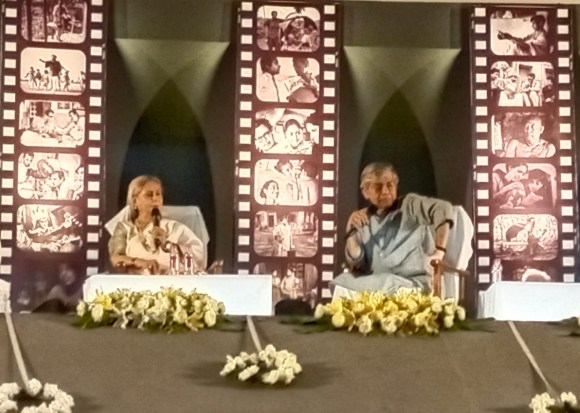
In this event, Jaya Bachchan recounts her days while acting in Satyajit Ray’s award-winning film Mahanagar or The Big City. Photo provided by Ratnottama Sengupta

When Shanti Di, my eldest aunt’s eldest daughter, had got married in 1964, she was already working. So she did not have to face the resistance Arati, the pivotal character of Mahanagar had to face from her in-laws and son. But prejudices and cryptic comments she did face — from her male colleagues. “Women in workplace? They only deprive deserving men of a livelihood,” they would say. “Because, men have to run entire households on their earnings while women work only for the ‘sauce’ — jewellery and saris!”

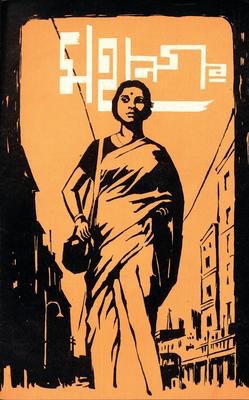
Mahanagar poster designed by Satyajit Ray. Photo provided by Ratnottama Sengupta

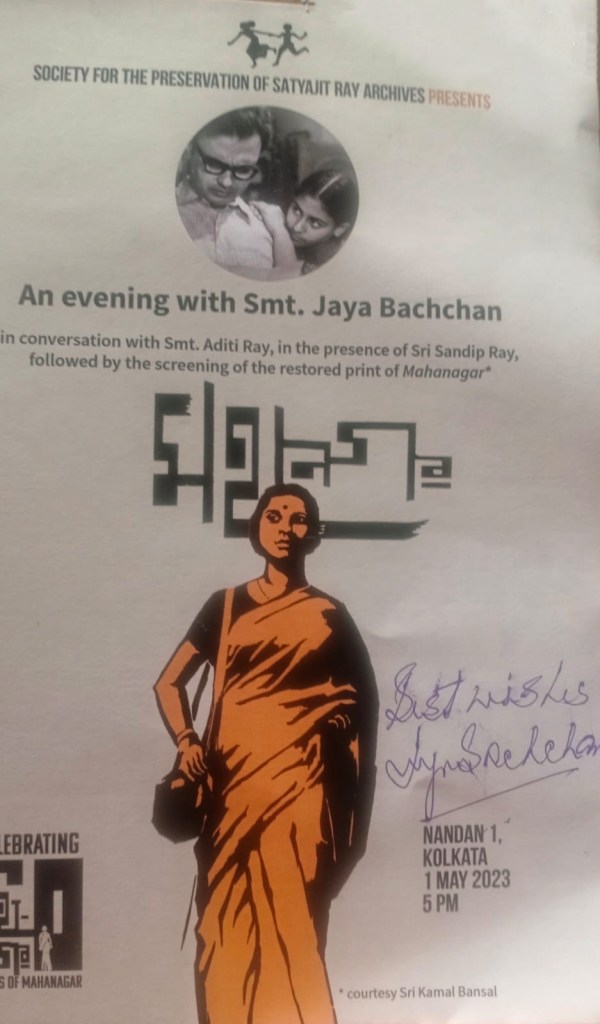
I remembered this at the screening of a restored print of Mahanagar (The Big City, 1963) at Nandan, the West Bengal Film Centre, to mark the 102nd birth anniversary of Satyajit Ray. Based on Narendra Mitra[1]‘s novel, Abataranika (Staircase), the film followed the trials and triumph of Arati, a housewife who steps out of the narrow domestic walls when she finds her husband Subrato bending under the weight of fending for a superannuated father, an aged mother, a school going sister, and their little boy along with themselves. 

But once she starts working, she enjoys her new role of conversing with and convincing women with deep pockets to buy her products — and soon her confidence in her work grows along with her empathy with other women who are yet to be empowered like her sister-in-law, Bani, her mother-in-law, Sarojini, her Anglo Indian colleague, Edith Simmons…  When her husband loses his job, Arati firmly negotiates a raise. And when Edith is fired for absence due to ill health she takes up cudgel for the ‘insult’. 

The remarkable sensitivity and the eye for details with which Satyajit Ray etched the ordinary lives of a middle class family earned him the Golden Bear at the Berlin Film Festival 1964. The director’s son, Sandip Ray, remembers attending the ceremony with his parents. “Why were you not there?”  a voice from the audience asked Jaya Bachchan, who was in conversation with the maestro’s son, now a renowned director in his own right. “Why would they invite me, who was just a ‘cameo artiste’ as someone mentioned this evening?”

Jaya Bachchan and Sandipt Ray conversing at the event on May 1, 2023.

Jaya Di[2] — as I am privileged to address her, much like Sandip ‘Babu’ Ray — was much more than a cameo artiste in Mahanagar. Her ‘Bani’ was a flesh and blood character as she brought to life a marriageable sister who, in my childhood and not just in Bengal, was a part and parcel of any Indian household. Bubbly, sincere, attached to her Boudi as much as to her little nephew whom she mothers when the housewife is earning the family its bread, she is pampered by her brother even as she is being trained by her mother to pick up the haata-khunti…spatula-spoon…in the kitchen!

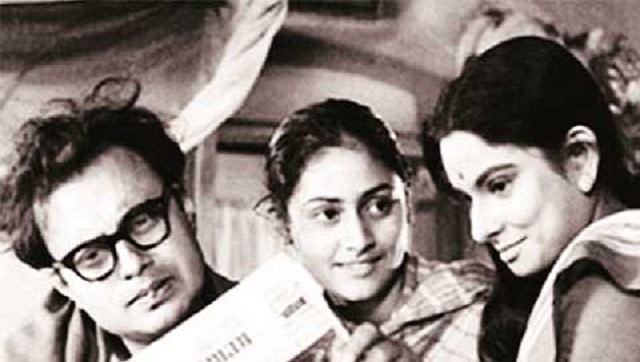
“I distinctly remember the first day of shooting in Indrapuri Studios. It marked my debut in films. Madhabi Di and Anil Kaku were in that shot which is reproduced whenever something is written about Mahanagar. I am at the study table, trying to write something. Those days I used to wear specs when I was reading.  Manik[3] Kaku must have made a mental note of that, he said, ‘Don’t take off your specs, keep them on for the shot.’ I didn’t have any dialogue for the scene. So, although I had not even been on stage before this, I didn’t feel that I was acting. The camera in front of me with Subrata Mitra behind it was not daunting. I was comfortable, just my usual self…”

Little did Jaya Bhaduri know, then, that this ‘girl-next-door’ identity would become her calling card in the years to come, storming even the glamorous boulevards of tinsel town Bollywood.

*

How did Jaya reach the sets of Mahanagar? She didn’t: Ray had sent for the girl in her teens. In all probability, she was recommended by Robi Ghosh and Sharmila Tagore. “They were shooting for Tapan Sinha’s Nirjan Saikatey (1963) when I had gone to Puri with my father, Tarun Bhaduri,” Jaya Di recounts. “We met them and on their return to Kolkata both Robi Kaku[4] and Rinku[5] Di told Manik Kaku that ‘the girl for that role (of sister) has been found at last!'” 

The first time she met Ray he did not ask her anything special. Nor did he ask her to do anything particular on the set. Young Jaya was told to read her lessons aloud, which she did, just as any school going child in Bengal did half a century ago. “I remember that Baba told Jaya Di to continue reading after the camera had moved on because he wanted an audio track of her reading in the background,” Sandip recalled in the course of the conversation. “She continued to read, but suddenly there was a sound of coughing. What happened?? In reply to everyone’s anxious query she coolly replied, ‘Why? Can’t a fly wing its way into my mouth while I’m reading?'”

Jaya Di herself has no recollection of this prank, but she vividly remembers that she would pester people on the set, incessantly asking questions. She especially questioned Subrato Mitra for taking time to light up! “It was as if we were out on a picnic,” she smiles. “The entire unit indulged me like a little girl. I was very comfortable because I had no burden to carry. In the presence of major actors I was required to do very little!”  

*

Jaya Bhaduri was not given any express direction — neither about how to speak her lines nor about action or emotion. She had full freedom to interpret the scene and react to the other characters. “Manik Kaku used to call all the artistes and read out all the dialogues to us. His intonation would give us an idea of what he wanted from us. We interpreted the scene according to our capacity and gave our best shot. He went about canning it, he never had any problem with my delivery.” 

But lessons in acting she did learn on the sets of Mahanagar — by observing how the director groomed the lead actress. “I have seen Manik Kaku directing Madhabi Di to grow into the role of Arati. He literally groomed her in acting. ‘Look this way, through the corner of your eyes. Turn your head like this. Say it like this. Wear the sari in this manner…’ The fact is that Satyajit Ray had a strong visual sense. He envisaged how the character would look and behave at the outset, how she would change, how she would resolve her dilemmas.” 

In other words, his actors were not puppets: he allowed the spontaneity of some, like Jaya; he moulded the emotive action of some, like Madhabi Mukherjee who would soon storm the silver screen as Charulata (1964).

*

Mahanagar was a very modern film, and not just at the time it was made,” Jaya Bachchan observes. Her critique of Ray’s first urban development film gains greater weight from the fact that, in the intervening years, she has ‘grown up’.  From a school girl to a trained actor. From the heartthrob of every Indian family in 1970s to the heartthrob of her ‘Lambuji[6]‘ — Amitabh Bachchan — whose charisma straddles two centuries, three generations, five continents. From a reclusive personal life to a vibrant political presence in the upper house of India’s Parliament. 

Young Jaya Bhaduri (now Jaya Bachchan) in between lead actress Madhabi Mukherjee and Anil Chatterjee. Photo provided by Ratnottama Sengupta

So let me elaborate on her observation, taking off from a scene between her and Subroto, her elder brother in Mahanagar, enacted by Anil Chatterjee.

Subrato has come home from work and his sister asks him for his pen as hers has run out of ink. He enquires when her exams are to commence, then he comments, “What use is this reading and writing? Sei toh henshel thelte hobey, you’ll end up dealing with only pots and pans!” 

Sekhaay toh,” Bani is quick to revert. “They teach us that too – it’s Domestic Science.”

That statement portrayed Ray’s attitude towards housewife. It was and still is a commentary on the identity — role — of a contemporary wife. It is in fact every woman’s attitude in contemporary India, 

Jaya Di has observed: “Today every woman also has to and does work. Not only for economic reasons but for identity, purpose in life. Those who have had higher education, certainly do. Those who have not studied much, who help with housework also have such dignity. I see their confidence in the way they carry themselves. They know their mind and they don’t hesitate to say up front what work they will do and what they won’t; how much time they will apportion to a household and when they will leave. And like urban working women, they too save a little from their earnings, use some of it and keep some for emergencies.”

*

Ray’s masterstroke is seen in the way he sketched the nuances of the bank clerk husband, complete with his angst and jealousy. He is proud of his wife’s charming appearance, he is confident she can steer herself through the career of a salesgirl, he is happy when the second income flows in. Yet — and especially when he loses his job — he suffers from insecurity, jealousy, suspicion. To the extent that the man who wrote her application letters, goads her to write a resignation letter. He is redeemed by the stand he takes at the very end when she gives up her much-needed job to protest a wrong against a colleague.  

Critics have found Ray to be more kind to the protagonist than Narendra Nath Mitra,  the Bengali author who also penned Ras[7] (made into the Hindi film Saudagar (Trader, 1973) which again builds upon how economic realities can make or mar a marriage. About a decade later Jaya Bachchan co-starred with husband Amitabh Bachchan in Abhimaan[8] (1973). In it Hrishikesh Mukherjee takes to an extreme the consequences of a husband’s ego trip when his wife fares better than him, professionally and financially.

*

Earlier Hrishikesh Mukherjee had, in Guddi (1971), given the young sister of Mahanagar a full canvas to come into her own as an actor. The same bubbly girl matures into a woman who can differentiate between love and infatuation. “After Mahanagar I was very selective. I chose to work only with directors who had a ‘Bengali’ sensibility,” Jaya Di says without a hint of hesitation. 

And the rapport she struck with Ray? It lasted a lifetime. When she joined the Film and Television Institute of India (FTII) she asked her Manik Kaku for a letter of commendation to go with her biodata. He wrote back saying that she doesn’t need an institute but join it, “it is the place for you”. 

She went thinking she would not last beyond a few months but with batchmates like Anil Dhawan, her co-star in Piya Ka Ghar (1972), and Danny Denzongpa, she stayed the full course. “And when Manik Kaku came with the print of Goopy Gyne Bagha Byne (1969), I felt so proud! I went to the airport to pick him up!”

That bonding would show every time they were in each other’s vicinity, Sandip Ray reiterates. “Once we were in Bombay and Baba stepped out of the Taj Mahal Hotel to leaf through books in the stall just outside. Suddenly a shrill voice screamed, ‘Manik Kakuuu!’ Jaya Di was passing by in her car and had spotted him!” “And I hugged him!” Jaya Di adds, “I took liberties others would hesitate to.” 

So why was she was not seen in his films again? “There were talks of casting me in Pratidwandi (1970) opposite Dhritiman Chatterjee,” Jaya recalls, “but I was in FTII then. Later I accosted him for not giving me a thought (for the role) – ‘You could have at least called me!’ His reply? ‘It was not necessary.’ That’s all!

“As if to add insult to injury, Manik Kaku got Amitji to do the voice over for Shatranj Ke Khilari (The Chess Players, 1977)  but a role for me? No! I was so angry I went and met him in Rajkamal Studio. His reply? ‘ Ha ha ha…’ Not a word more.”

Amitabh Bachchan doing the voice over for Satyajit Ray in Shatranj Ke Khilari. Picture from Bachchan’s FB, provided by Ratnottama Sengupta.

That did not stop Jaya Bachchan from going to Bishop Lefroy Road every time she happened to be in Kolkata. She had, after all, seen the films the ‘Towering Inferno’ made even before Mahanagar. “Every time I watched a film by Ray I felt this is his best. Until the next one came along…” So, when Charulata came, Mahanagar paled. But wait, to this day Debi (The Goddess, 1960) continues to haunt Jaya Bachchan.

And to think that, when Ray had sent for her, the young girl growing up in Bhopal was beset with doubt and hesitation. “I was studying in a convent school, and I feared that the nuns would disapprove of my acting in a film. But my father said, ‘It’s the opportunity of a lifetime — don’t let go of it.'”

Cut to the convent when she went back after Mahanagar. The same austere nuns came and said, ” ‘You have acted in a Satyajit Ray film?! You are so lucky!!’ That is when I first realised, even before he was crowned in Berlin, what a major director my Manik Kaku was!”

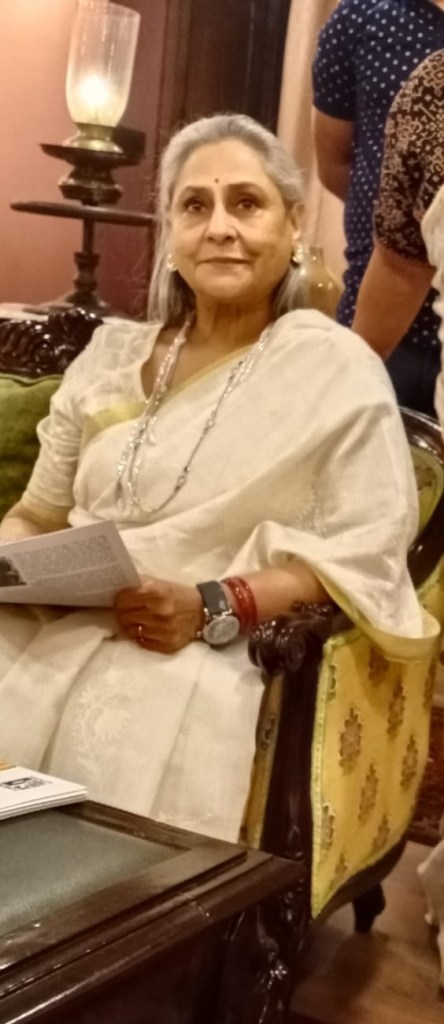
Jaya Bachchan on 1/5/2023. Photo provided by Ratnottama Sengupta

[1] Bengali writer (1916-1975)

[2] An honorific for elder sister

[3] Satyajit Ray was Manik to his friends.

[4] Uncle, father’s younger brother

[5] Sharmila Tagore

[6] Tall man

[7] Juice

[8] Pride

.

Ratnottama Sengupta, formerly Arts Editor of The Times of India, teaches mass communication and film appreciation, curates film festivals and art exhibitions, and translates and write books. She has been a member of CBFC, served on the National Film Awards jury and has herself won a National Award. 

.

PLEASE NOTE: ARTICLES CAN ONLY BE REPRODUCED IN OTHER SITES WITH DUE ACKNOWLEDGEMENT TO BORDERLESS JOURNAL

Click here to access the Borderless anthology, Monalisa No Longer Smiles

Click here to access Monalisa No Longer Smiles on Kindle Amazon International