Categories
Stories

Unspoken

By Spandan Upadhyay

The city hummed in the distance, a restless body of lights and shadows. From the 10th-floor balcony of an aging apartment building, the sound of honking cars, barking dogs, and occasional train whistles formed a chaotic symphony. The night air was thick with the scent of rain-soaked pavement, diesel exhaust, and something else, something old, unspoken, waiting: like the breath of a forgotten tomb.

Flat 10-B faced east. At dawn, sunlight strained through grime-caked windows, pooling weakly on floors that hadn’t seen polish since Madhavi’s husband died. The walls, once eggshell white, had yellowed like ancient newspaper clippings. Cracks branched across the ceiling in fractal patterns, mapping silent histories of monsoons absorbed and endured.

Madhavi Bose had lived in this apartment for twenty-seven years. She had moved in as a young bride, her heart brimming with the quiet satisfaction of middle-class security. Her husband had been a government officer with a voice like a rusted hinge and hands that smelled always of mustard oil and ink. She’d learned to love him through ritual: starching his shirts, packing his tiffin, listening to his stories of petty office politics. Her world contracted to the geometry of his needs, his nap times, his preference for fish on Thursdays, his mother’s backhanded compliments about Madhavi’s rice.

And then, suddenly, he was gone. A heart attack at forty-five, slumped over a stack of tax files. No time for goodbyes, no time for regrets. Just the scent of his hair oil lingering on pillowcases, and the pension that arrived every month like a condolence card.

Left with a sixteen-year-old daughter and a life halved, Madhavi had done what was expected of her. She survived. She woke each morning, brewed tea for one, and scrubbed the balcony tiles until her knuckles bled. She learned to kill cockroaches without flinching. She stopped wearing sindoor.

And then there was Riya.

Riya, now twenty-four, had been a bright, sharp-eyed child, full of questions, full of hunger. At eight, she’d torn maps from schoolbooks to tape above her bed. Patagonia! Istanbul! Marrakech! Places whose names rolled like marbles in her mouth. At fourteen, she wrote stories about women who rode motorcycles through deserts. Too restless for a city like this, too impatient for a life like her mother’s. She devoured novels as if they were contraband, hiding Rushdie under her mattress, scribbling poems in the margins of math notebooks.

University had been a brief reprieve. For three years, she’d rented a hostel bunk near campus, subsisting on muri[1]and the euphoria of all-night literary debates. She fell in love twice, once with a Marxist poet who quoted Faiz, once with a biology student who sketched ferns in her notebooks. Both left for Delhi. Both promised to write. Neither did.

Her first job interview had been at a glossy magazine office where the editor yawned while she spoke. The second, at a publishing house, ended when they asked her to fetch chai for a visiting author. “You’ll start as an intern,” they’d said, though she’d graduated top of her class. Soon, she found herself in a cubicle the colour of wet cement, editing corporate brochures about cement. The future is built on solid foundations. Her colleagues wore polyester saris and discussed baby formulas. At lunch, she hid in stairwells, nibbling canteen samosas gone cold, scrolling through friends’ Instagrams: New York! Berlin! — until her eyes burned.

And so, she returned to Flat 10-B. To her mother. To a house where the only real conversations happened in the spaces between words.

The apartment’s rhythm was metronomic. Madhavi rose at 5:30 AM, the click of her alarm clock splitting the dark like a dry twig. She brewed Assam tea, the pot whistling two precise notes. The newspaper arrived with a thud; she read it front to back, circling typos in red pen. By 6:45, she descended the ten flights (the elevator had died with her husband), her cane tapping each step like a metronome. She walked exactly three laps around the park, nodding at the same widows on the same benches, their saris fading to identical shades of ash.

Riya woke at 8:00 AM to the smell of cumin seeds burning, Madhavi’s eternal attempt at breakfast. She dressed in the dark, avoiding mirrors. The corridor to the front door felt longer every day, lined with family photos fossilized in time: her parents’ wedding portrait, Madhavi’s smile stiff as starched cotton, Riya’s fifth birthday, half the cake uneaten, her father’s garlanded graduation photo gathering dust.

Evenings condensed into separate silences. Madhavi parked herself before the television, absorbing soap operas where women wept over stolen inheritances and switched-at-birth babies. The flickering blue light etched her face into something statue-like, immovable. Riya retreated to her room, headphones blaring punk rock, rereading The Bell Jar [2] for the twelfth time. She’d marked a passage years ago, I saw my life branching out before me like the green fig tree, but now the figs seemed rotted, the tree petrified.

Dinner was a sacrament of avoidance. “There’s dal in the fridge.” “Okay.” They passed each other like shadows, careful not to touch. Once, Madhavi’s fingers brushed Riya’s wrist while handing her a plate. Both recoiled as if scalded.

They never argued. Arguments required collision, and collision required caring enough to crash.

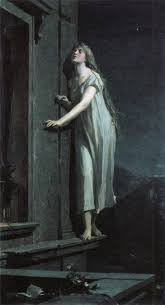
Then the sleepwalking began.

It was Riya who noticed it first. She woke one morning with grit beneath her nails, the taste of soil sharp on her tongue. Her legs ached as if she’d climbed mountains. On a hunch, she checked her shoes, the soles caked with mud.

The next night, she hung her mobile around her neck. The footage, grainy and green-tinged, showed her move out at 2:17 AM. Her movements fluid as that of a marionette. She glided past the cracked full-length mirror, her reflection blurred, as if out of focus, turned the doorknob with eerie precision. Moments later, Madhavi emerged from her room, eyes milky in the dark, nightgown billowing like a sail. Together, they drifted into the hallway, bare feet soundless on cracked tiles.

Riya didn’t speak of it. Words would make it real. Instead, she began stealing glances at her mother, really looking, for the first time in years. Madhavi’s hands fascinated her: long fingers calloused from scrubbing, nails pared to the quick, a silver band still indenting her ring finger. Once, she caught Madhavi humming a Rabindra Sangeet tune while chopping onions, her voice girlish, almost playful. The sound froze Riya mid-step. By the time she exhaled, the humming had stopped.

One rain-heavy evening, Madhavi broke the unspoken rules. “I wanted to be a teacher,” she said abruptly, ladling dal onto Riya’s plate.

Riya’s thumb hovered over her phone screen. “What?”

“At Bethune College, I’d been accepted. History. Your grandfather said educated wives were headaches. So.” She shrugged, a single lift of the shoulder that contained a lifetime of folded dreams. “Your father preferred my fish curry to my opinions anyway.”

The admission hung between them, delicate as a cobweb. Riya thought of her own application to Columbia’s MFA program, buried under a strata of rejection emails. She wanted to ask, Were you angry? Did you ever scream? Instead, she muttered, “The dal’s good.”

Madhavi stared at her, eyes glinting with something that could’ve been pity. Or recognition.

The sleepwalking intensified. Riya began waking in strange tableaus: perched on the fire escape, her toes curled over the edge; kneeling in the building’s puja[3] room, marigold petals stuck to her knees; once, standing in the parking lot, arms outstretched as if awaiting crucifixion. Her phone footage revealed nightly pilgrimages, down ten flights, through the lobby’s broken turnstile, into the skeletal garden behind the building. Always, Madhavi followed.

Then came the monsoon night.

Rain sheeted the balcony grilles, the wind howling through gaps in the window seals. Riya was sleepwalking, mud squelching between her toes, her nightdress plastered to her skin. She stood in the garden’s center, lightning fracturing the sky. To her left, Madhavi hovered, drenched and spectral, her gaze locked on Riya.

A current passed between them, not a spark, but a surge.

Madhavi spoke first, her voice unspooling like smoke. “At last. At last, my enemy.”

Riya’s jaw clenched. The words came out involuntarily. “Hateful woman. Selfish and old. You want my life to be your epilogue.”

“You devoured my youth.” Madhavi’s hands flexed. Her eyes had a glassy look, but they were inanimate. Still. “You, who blames me for her cage.”

“You never fought! You just… folded.”

“And you?” Madhavi’s laugh was a dry leaf crushed underfoot. “You run, but only in circles. You think I don’t see your applications? Your hidden bank account?”

Riya’s breath hitched. The garden seemed to pulse, neem leaves trembling, earth exhaling decades of buried words.

“I could’ve left,” Madhavi whispered. “After he died. Gone back to school. But you-”

“Don’t.”

“– you needed stability. Security.”

“I needed a mother, not a martyr!”

Lightning flashed. For an instant, Madhavi’s face was a mask of cracks. Then, a dog barked, the neighbor’s irritating new resident, and the spell snapped.

Madhavi blinked, rain dripping from her lashes. “Is that you, darling?”

Riya hugged herself, shivering. “Yes, Ma.”

And then, as if nothing had happened, they went back inside. They climbed the stairs in silence, leaving wet footprints that evaporated by dawn.

.

[1] Puffed rice

[2] Novel by Sylvia Plath published in 1963 under the penname of Victoria Lucas

[3] Prayer


Spandan Upadhyay
 is a new writer whose work captures the vibrant nuances of everyday life. With a deep appreciation for the human experience, Spandan’s stories weave together subtle emotions and moments of introspection. Each of his stories invite readers into a world where ordinary occurrences reveal profound truths, leaving a lasting impact.

.

PLEASE NOTE: ARTICLES CAN ONLY BE REPRODUCED IN OTHER SITES WITH DUE ACKNOWLEDGEMENT TO BORDERLESS JOURNAL. 

Click here to access the Borderless anthology, Monalisa No Longer Smiles

Click here to access Monalisa No Longer Smiles on Kindle Amazon International
Categories
Conversation

‘Words, still photos, moving images – they are all storytelling’

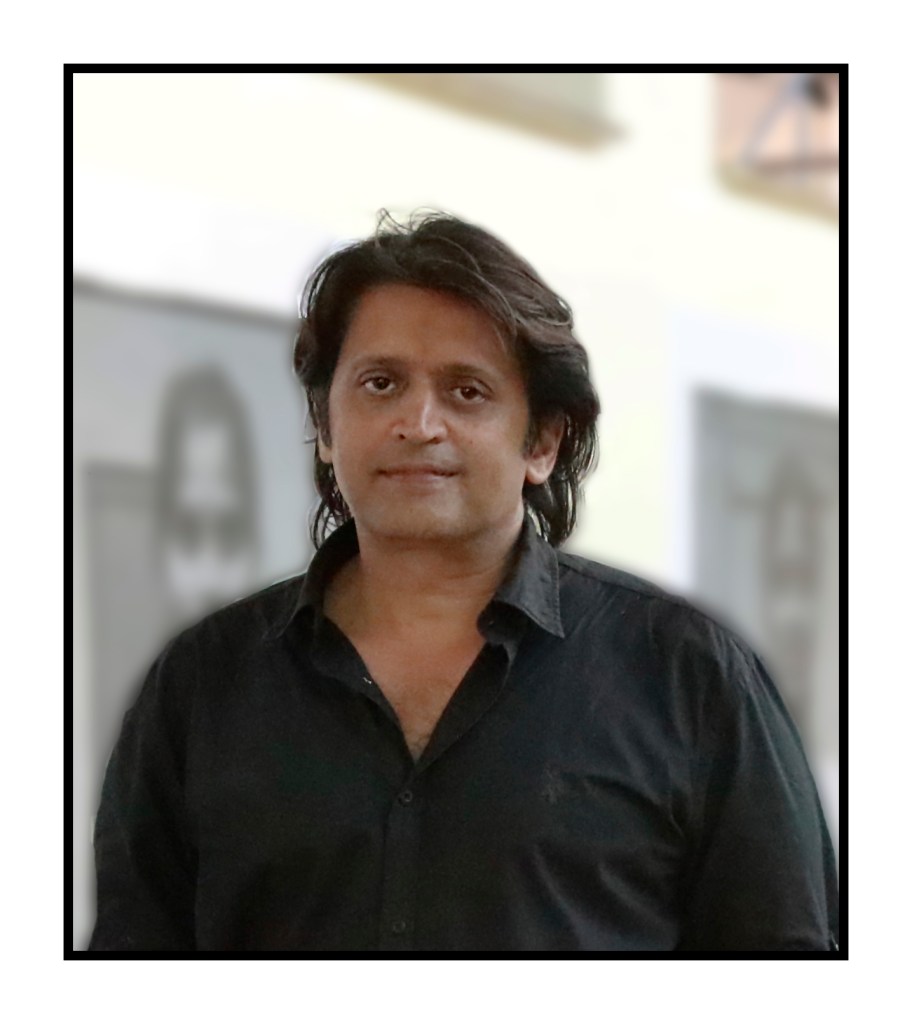
Ratnottama Sengupta introduces and converses with a photographer who works at the intersection of art and social issues, Vijay S Jodha

Vijay S Jodha was yet to become one of India’s leading lens-based artists at the intersection of art and social issues. Back then, in the 1990s, he had no inkling that 30 years later he would be the chairperson of UGC-CEC[1] jury for selecting the best educational films made in India. Or that he would be the national selector and trainer in photography for the National Abilympics Association of India.

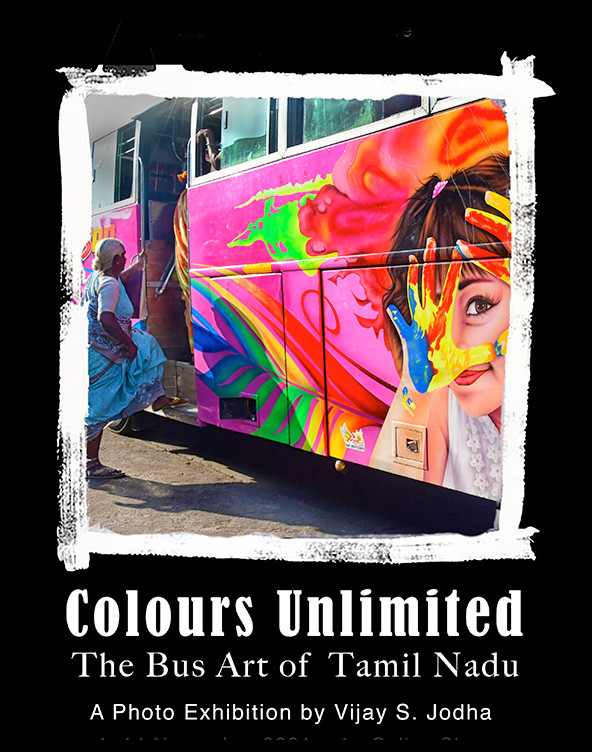
When I first met him, he was mounting a collaborative exhibition of his work with the elderly, their contribution to society and the care they deserve. Little did I know that the entire bent of this journalist-turned documentary filmmaker-turned photo artist would go on to focus on subjects ranging from mob violence, riot victims, farmers’ suicide, 75 years of Indian constitution to Joys of Christmas and the Bus Art of Tamil Nadu. 

Not surprising that the International Confederation of NGOs has honoured Vijay with the Media Citizen Award for using media to drive social change. And it is only one among hundreds of honours he has received in two dozen countries. These include awards and grants, from Swiss Development Agency to Ford Foundation and Bill & Melinda Gates Foundation. Screening of his films on 75 channels worldwide and in 250 festivals in 60 countries.

These seem tedious details? So, interestingly, two public showings of his work have been vandalised. And a false police case against him took eight years to be thrown out by India’s courts!

Conversation

Vijay how did you come into photography? 

I’m a trained filmmaker – I mastered in film production – and have been making films for two decades. My films have shown on 75 stations including Discovery, CNN, BBC. But training in photography I have none. All my photography is non-fiction work. Actually my films are also non-fiction or reality based work. I just find still photography very relaxing because, unlike films where a director is responsible for so many things, here I’m on my own. But there’s no production deadline. No huge budget is needed. I can address any subject that catches my fancy and pursue it over several years, without any worry. Otherwise it’s the same: photos or films, you’re storytelling around substantial issues that interest you, in a manner that does justice to those issues, and — hopefully — engaging to the viewers.

So who was your inspiration?

In photography it is obviously the greats who defined the grammar of the medium itself such as Robert Frank[2] and Cartier Bresson[3]. They’ve inspired us all in some manner. I’m fortunate that, as a part time journalist in New York decades ago, I got to meet and interview top filmmakers and photographers like Gordon Parks and Richard Avedon. 

I once did a course at New York’s School of Visual Arts where they honoured Mary Ellen Mark and she had come across. As a journalist, I covered Sebastião Salgado’s launch of his workers’ project that put him on the map (of photography). I met Raghubir Singh while doing a project on Ayodhya in India, and again in New York where we put up the same exhibition. He also photographed some of us – myself, Siddharth Varadarajan, the editor-publisher of The Wire who was then a student at Columbia University, and other Indian students — were protesting some human rights issue.

I’m also fortunate to have our finest photo-journalists and lens-based artists as friends. I can take across my work to get a feedback or pick their brains. This beats the best photo schools in the world. In fact years ago I did a book which had photos from all of them! This was the biggest photo project on the Tiranga[4] as listed in the Limca Book of Records. They have all done many books on their own but this is the only one where all these masters appear in a single volume, their works united thematically. Apart from Raghu Rai, Ram Rahman, Prashant Panjiar,  Dayanita Singh,  T Narayan, and the late TS Satyan, I’d also interviewed people across India, from the then Prime Minister Vajpayee to those selling flags at traffic lights for a few meagre rupees.

You did not go to any international school to train in the art or the technology aspect. So what prompted your PhD?

Three decades back when I decided to go into mass communication as a career there were few computers, no internet, no private TV channels, or mobile phones. Sorry if that makes me seem Jurassic but it was a world with very few media opportunities. Post college, I had got  admissions into a trainee programme with a newspaper as well as in the MA programme in International Relations at India’s premier Jawaharlal Nehru University. My father felt that a masters and exposure at JNU would be a better investment for journalism – probably the single best advice I’ve got in my entire career — and I followed that. 

Then for some time I worked in print media: I freelanced for newspapers, edited and published a journal for a business house, scripted for a film and worked on a book with one of my journalism heroes – late Kuldip Nayar. But in the pre-internet era newspaper articles had a very short life, so I felt the need to produce something that would last longer such as film. So I decided to get a degree in Film. It also encompassed all my interests, from writing to art to music, travel and photography.

You’ve not been a photo-journalist working for any journal or newspaper. Yet you felt inclined to do projects on environment, elder care, survivors of riots and mob violence, farmer suicide, art that travels. Was it inevitable, given your father’s background?

Actually I’ve done a bit of photo journalism too. During my film school days at NYU I was a writer-photographer for their student-run newspaper, Washington Square News. I’ve also been a stringer for mainstream dailies including The Economic Times where I shot images parallel to my writing. I did stills for Mira Nair’s Monsoon Wedding and of course stills for my own film projects. So I’ve a lot of published images in papers worldwide though my main gig has been films. 

Frankly I don’t see much difference between these mediums. Be it words, stills or moving images; an academic paper, photo books, or films, short or long – all this is story telling. I’m a story teller.

And subjects? I’ve filmed every possible subject except wildlife: I just don’t have the patience for that. Otherwise everything, from artist biopics — on Paritosh Sen and Prokash Karmakar, whose inaugural screening you also attended in Calcutta years ago — to films on environment. My The Weeping Apple Tree (2005) was among the first ones on climate change in India. It won the UK Environment Film Fellowship Award 2005 and had multiple screenings on Discovery, with an introduction by Sir Mark Tully.

At that time, few knew about climate change. So Delhi govt organised a special screening for their MLAs and officers of water, electricity and sanitation departments. It was screened at UNEP headquarters in Nairobi and in various festivals. UNIDO and other grassroots level NGOs used it to create awareness. Some years back an IFS {Indian Forest Service} officer told me that Himachal government uses it to train their forest officers. 

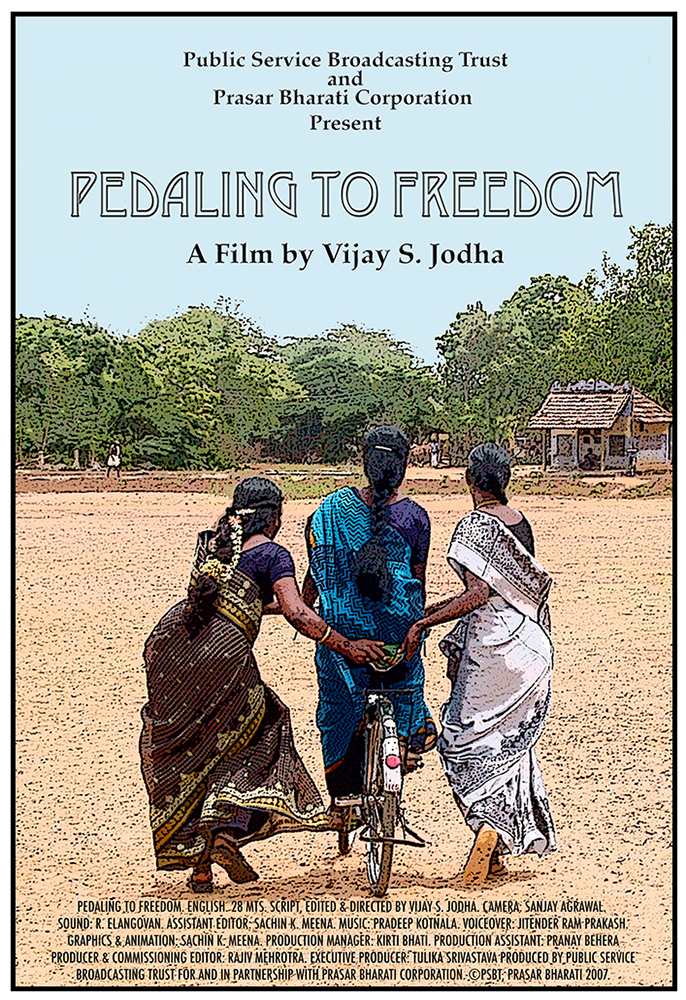
My film on gender, Pedalling to Freedom (2007) revisited an old initiative in one of the poorest parts of the world. It traced the life-changing impact of teaching 100,000 women to ride the bicycle. That film is in the US Library of Congress. It was also chosen for archiving at OSA Budapest, world’s premier repository of materials dealing with human rights. 

Then there are films that get food on the table. Training films. Corporate films. I once did a ‘funeral film’ on a well-known personality whose passing received a lot of press coverage in India but the NRI son could not come for the funeral.

What motivates you Vijay — money, international honour, or the possibility of social change?

Well, all this is livelihood so the money part is important. But doing work that gets recognised far and wide, that is substantial, to hold good for a long time – that’s a huge motivator. 

I have a slightly spiritual take towards this. I feel that regardless of our profession we are all bound by a dharmic or sacred duty. A teacher’s duty is to teach and a doctor’s is to heal. For those in the business of storytelling — including photographers — the sacred duty is to document, bear witness, push things forward. And believe you me, this has little connect with means or accessibility. 

To give you an extreme example: After the Nazis lost the war and Berlin fell, soldiers from the victorious allies army raped virtually every woman in Berlin. Few rapists were taken to task and  to top it, despite all the extensive coverage of the allies victory by forgotten photographers as well as superstars like Margaret Bourke-White  (known to us through her famous Gandhiji with charkha portrait) or Robert Capa (regarded as the greatest war photographer of all time), there was no coverage of this mass outrage in Berlin by anyone be it in photo essays in Life Magazine, or World War photo books. It appears in no Hollywood film or TV series.  

Likewise, fifty years ago, when India came under the draconian Emergency, our courts also endorsed the robbing of our Constitutional rights. Nobody documented, then or since, the forced sterilisation of 6,000,000 who were stripped of their reproductive rights. We, as photographers and filmmakers, failed on this front.

The First Witnesses is my project around farmer suicides. It is not an unheard issue nor something hard to get access. But how many have found it worth their while to document the issue? How many are documenting a disappearing art form or livelihood? Or our urban heritage being torn down? Our movie theatres once represented cinema as an inexpensive and readily accessible mass culture. Now they are being torn down even in smaller towns. Each had a unique character. Is anyone documenting that?

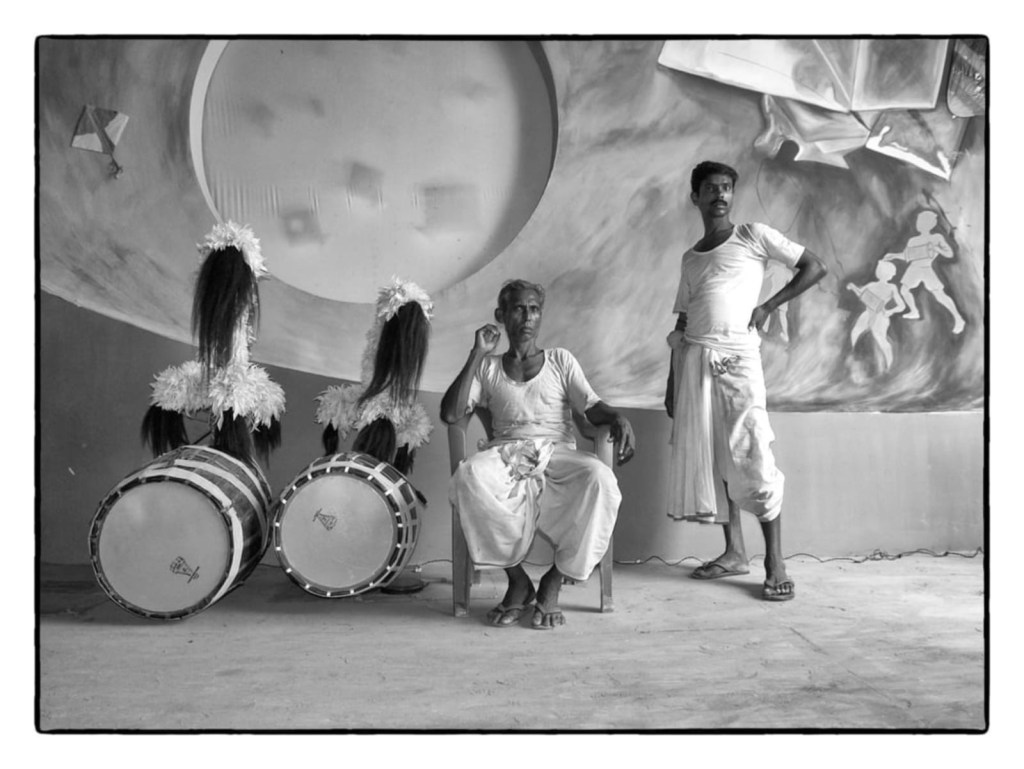
I documented Durga Puja in Kolkata 20 years ago when I was working with painters there. Durga astride a tiger, slaying the demonic Mahisasur emerging out of a buffalo: these elements get interpreted in hundreds of ways across the city each year. Each pandal has a different aesthetic interpretation, inside and outside. The religious aspect is no less important. But  these are also like site-specific installation art works shaped by the imagination of so many talented people but designed for impermanence. How many books of photos exist around this work now recognised by UNESCO as Intangible Cultural Heritage of Humanity?

How successful have you been in achieving this?

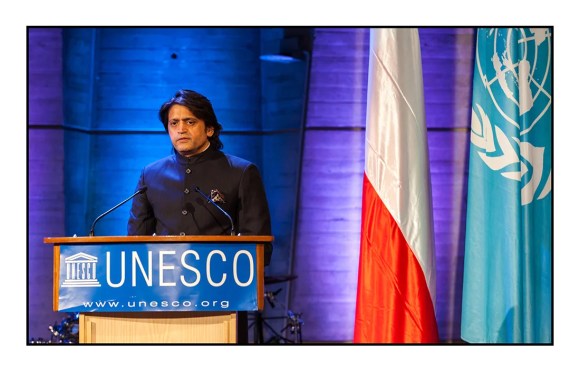
The merit of my work is for others to judge. I’m happy that, though India doesn’t have many foundations or support for non-commercial oriented art, I’ve been able to do at least a few things that are genuinely pathbreaking, substantial and have gone around the world. To be invited to UNESCO headquarters in Paris to screen a film and address delegates from 193 countries, or be honoured by our President for India’s best ever performed at Abilympics — these are certainly my career highlights.

Vijay S Jodha at UNESCO introducing his film. Photo provided by Vijay S Jodha

My work has received over a hundred honours across 24 countries, but what truly motivates me is when people I look up to, my heroes, appreciate what I do. That kind of recognition carries a different weight. For instance, Magsaysay awardee P Sainath, whose ground-breaking reportage has long inspired me, saw my farmers project when it was exhibited alongside his photographic work at the Chennai Photo Biennale 2019. We hadn’t met before, so when he praised my effort, it felt like receiving a medal.

Another moment that has stayed with me was post my time at NYU. My professor, George Stoney, referred to as the father of public access television and mentioned in history books on documentary cinema, mentored Oscar-winning directors like Oliver Stone, Martin Scorsese, Spike Lee, and Ang Lee. When he watched The Weeping Apple Tree, he said, “Vijay, this is better than Al Gore’s An Inconvenient Truth. That was a glorified PowerPoint by comparison.” That one comment meant more to me than most awards ever could.

As a photo artist what is the biggest moment of joy for you — technical hurray or the joy of the subjects?

As I just said, recognition and praise of my heroes gives the maximum joy. There are other honours. Two photo projects listed in Limca Book of Records for being the biggest and path breaking. The first was on ageing that I did over eight years with my brother Samar Jodha – he did the images while I did the concept research, writing and interviews. The other was the aforementioned Tiranga. My film Poop on Poverty (2012) won a Peabody award, the oldest honour for documentary films, and more international honours than any non-fiction film produced out of India. 

After landmark exhibitions in Hong Kong and New York I donated two complete sets of The First Witnesses, my farming crisis project, to two farmer unions including our oldest and biggest All India Kisan Sabha (AIKS). They are using it for awareness raising across villages. That’s a real high as a photographer.

Then there’s high coming from those we pass down our expertise to. Among those I’ve taught or mentored is a highly talented though physically challenged youngster from Vijayawada with missing digits and motoring issues. His family runs a Kirana shop. When he started school, they sent him back saying he cannot even hold a pencil. He won a bronze medal in photography for India at the last Abilympics in France. Another student has himself become a photography teacher in a school for hearing impaired. This is the kind of stuff that gets me very excited. 

Thirty years ago as a volunteer writer and researcher I helped Sanskriti Foundation set up India’s first international artist retreat. That novel venture raised crores in grants and set up three museums. Today it is being scaled back as its founder O P Jain is in his 90s. But that idea caught on and you have scores of artist retreats across India. 

How has digital technology influenced photography as an art form? Has it done more harm? Or widened its spread?

Digital has been a mixed experience. It democratised the process of production and dissemination — be it still images or movies. This is a fantastic thing. But it killed a lot of the processes and livelihoods such as the printing labs, film production and processing facilities. It has also killed an art form like print making. It’s a specialised skill in itself, so a lot of artistry, understanding, appreciation and sustenance of it has got compromised.

The emergence of deep fake images and piracy of work is bad news too. But it has allowed more people to become story tellers. They now bear witness, as filmmakers and photographers, of issues and events that was earlier impossible.

I can cite examples from my work. I’m National Selector and Trainer in photography for National Abilympics Association of India (NAAI) and my students are in different parts of India. Two are hearing impaired, two others have motoring issues and physical challenges. Thanks to digital tools, we’re running long distance classes every week. NAAI provides me sign language interpreter but I can send and receive digital files, use zoom to conduct classes, use google translate to send instructions in Tamil, English and Marathi to my students. Now one student, despite hearing challenge, is running a photo studio. The student who has issues with his leg also works as wedding photographer. Workshops with institutions and festivals, within and outside India, are now easy and inexpensive thanks to these digital tools and communication modes.

Has selfies on mobile camera shortened the life of portraiture?

It has certainly democratised the process while the average person’s patience to study or appreciate any art work — portrait or landscape photo — is shrinking by the minute. Of course, good portraiture requires some skill to make as well as appreciate – that cultural literacy is a challenge everywhere, not just in photo medium. As a seasoned art critic you would have noticed that in the world of painting and sculpture too. Sadly we don’t have that education in our schools. 

You have continued with still images even after doing many documentaries. What is the joy in either case?

I’m doing still photography and movies parallel to each other. Last month I had a book on public policy, as I mentioned. Also launched last month – by our defence minister –was my film on our Armed Forces Medical Corps – it’s one of the oldest divisions in the world, going back 260 years. I’m working on a project on the Indian Constitution and a biopic on Amitabh Sen Gupta, the artist whose retrospective exhibition this year is organised by Artworld Chennai. My still photography project on the farmers crisis is also going on for the past 7-8 years.

All projects are joyous and offer their own challenges. It’s like bringing children into the world. You do the best you can, hope they’ll do well and go far, but you don’t know which one will. Regardless of their line of work you feel happy with each of them and what they achieve. 

What is the future of Arriflex, Mitchell, Kodak Brownie? And that of Yashica, Nikon, Canon, Leica, Olympus…?

Some old camera brands like Konica and Minolta have merged, or evolved into digital Avatars like Arriflex. Others, like Kodak, have faded into history. Interestingly, a small Indian company has licensed their name to market TVs under Kodak brand name now. For those of us from the analogue generation, it’s a bittersweet feeling. When a beloved brand disappears, it feels like saying goodbye to an old friend. But such is the nature of change.

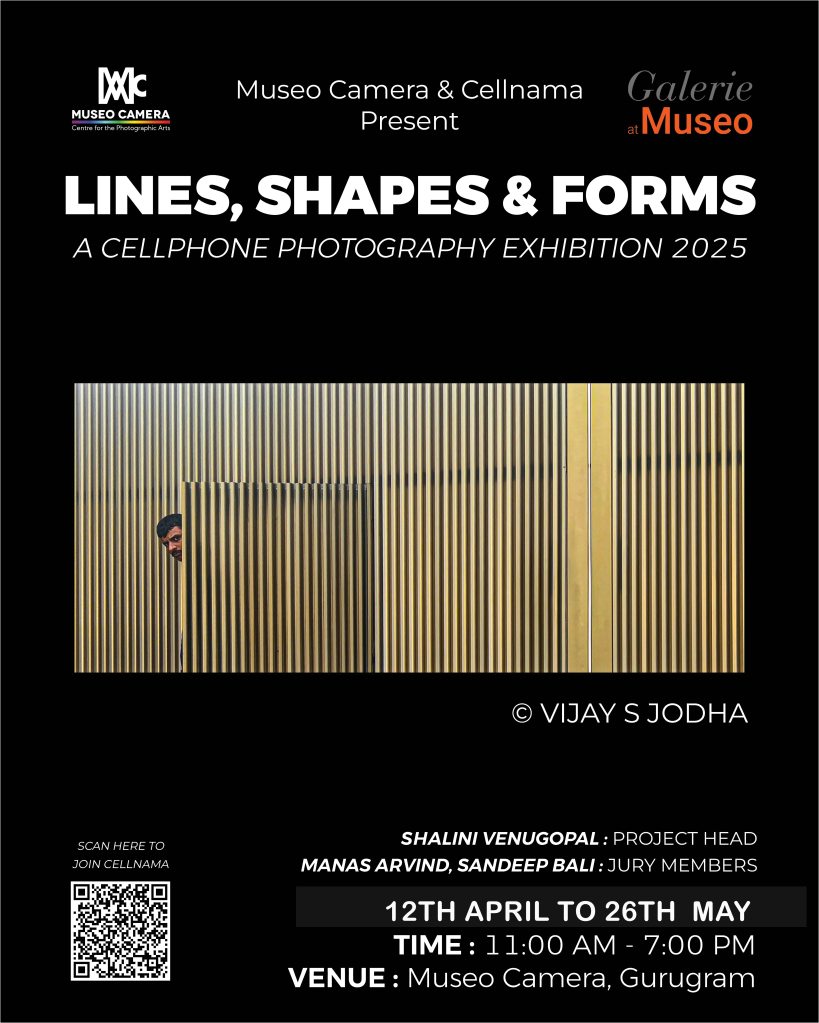
My friend Aditya Arya, one of India’s eminent photographers and a passionate camera collector, has created a remarkable space to preserve this legacy. He established the Museo Camera in Gurgaon, a non-profit centre promoting photographic art, which has become not only a camera museum but also a leading art and culture hub in the Delhi national capital region. If you’re an old time photographer passing through Delhi, it’s a wonderful place to revisit these “old friends.”

(Website of Museo Camera https://www.museocamera.org)

[1]  University Grants Commission-Consortium for Educational Communication

[2] Robert Frank (1924-2019) was a photographer and documentary filmmaker. 

[3] Henri Cartier-Bresson (1908-2004) was a humanist photographer, a master of candid photography, and an early user of 35mm film. One of the founding members of Magnum Photos in 1947, he pioneered the genre of street photography, and viewed photography as capturing a decisive moment.

[4] Three colours, published in 2005

Ratnottama Sengupta, formerly Arts Editor of  The Times of India, teaches mass communication and film appreciation, curates film festivals and art exhibitions, and translates and writes books. She has been a member of CBFC, served on the National Film Awards jury and has herself won a National Award. 

.

PLEASE NOTE: ARTICLES CAN ONLY BE REPRODUCED IN OTHER SITES WITH DUE ACKNOWLEDGEMENT TO BORDERLESS JOURNAL

Click here to access the Borderless anthology, Monalisa No Longer Smiles

Click here to access Monalisa No Longer Smiles on Amazon International

Categories
Essay

Still to Moving Images

As a curator, Ratnottama Sengupta writes about the long trajectory of films by artists, beginning with Husain’s Berlinale winner, down to the intrepid band she screened at the just concluded 30th Kolkata International Film Festival

When Maqbool Fida Husain won the Golden Bear in the 17th edition of the Berlin Film Festival, the year was 1967. I, in my pre-teen years, knew little about painting. But growing up in a family of filmmakers I was already conversant with the art of looking through the camera. So I was disoriented that the film critics of the time were baffled by what had impressed the international jury.

Royalty, tigers, ruins, hawks, school children, anklets, on the river bank – all these images moving only to music, not a word uttered. The jury at Berlinale were astounded by the richness of the artist’s idiom that had breathed life into a Rajasthan that is rich in architecture as it is in painting, in costume as in music. 

This dawned on me years later, when I curated the exhibition, 3 Dimensions, forthe All India Fine Arts and Crafts Society in New Delhi. It featured paintings, sculpture and graphic art or drawings by artists from Husain, Satish Gujral, Ghulam Mohammad Sheikh, Jatin Das to Sanjay Bhattacharya, Paresh Maity, Mimi Radhakrishnan, Shadab Hussain, among others. 

A unique feature of this exhibition was that all the participating artists had interest in another expression of art. So every evening of that week had seen a Ram Kumar and Mimi read their short stories; a Narendra Pal Singh and Jatin Das read their poems; a Sanjay Bhattacharya render Tagore songs of and a Shruti Gupta Chandra perform Kathak. Ratnabali Kant had staged a Performance Art in the presence of Prime Minister V P Singh who had inaugurated the week-long exhibition by reading his poems. And, on the closing day, I had screened Through a Painter’s EyesThat’s when it dawned on me: it was the originality of vision captured by the 7-minute short film had won over Berlin as also Melbourne and our very own National Awards too. 

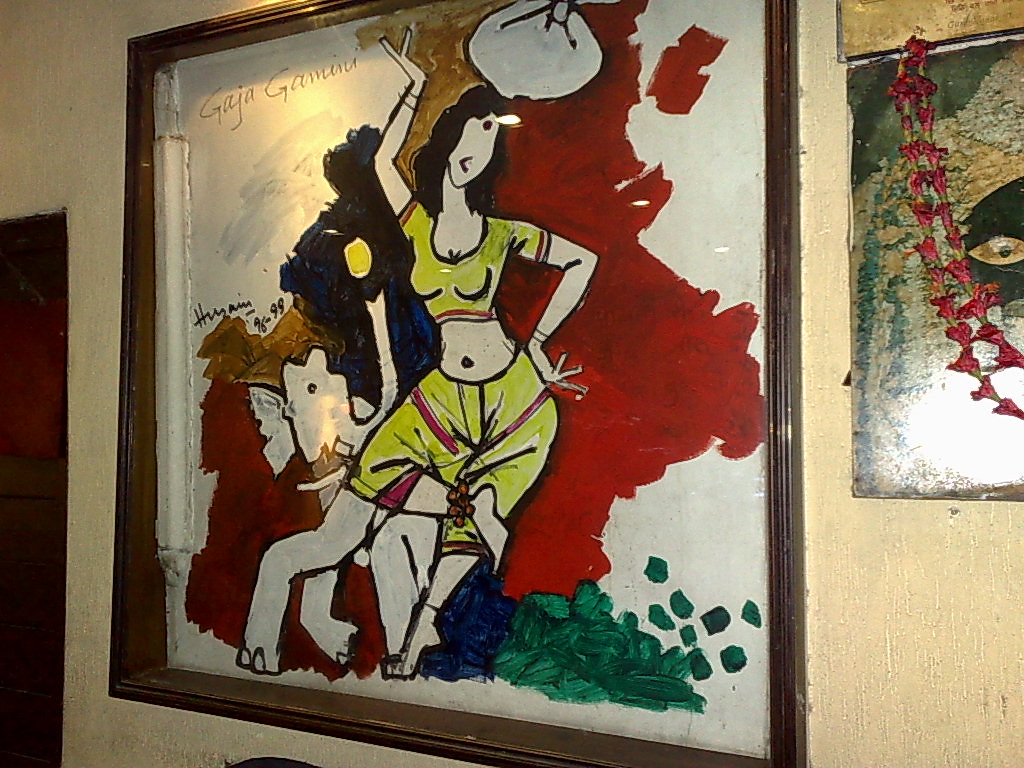
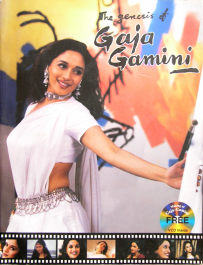
Subsequently Husain, who had started out from the tenements of Bombay by painting oversized hoardings of Hindi films on the sleeping tramlines at the dead of night, had at the ripe age of 84 made Gaja Gamini (2000) with stars such as Madhuri Dixit, and Minaxi — A Tale of Three Cities (2004) with Tabu and Naseeruddin Shah. Ironically these films baffled the critics just as much as the earlier short film had. However the dazzling visuals of vibrant figures and colourful structuring of the (non)-narrative had found acceptance in the Marche du Film section of Cannes 2004.

*

I have since then tried to fathom what drives artists who are skilled at painting with oil or watercolour, or sculpting wood or stone, metal or clay, or creating graphic images on paper or linoleum, to wield the megaphone. Now, instead of holding the camera or editing the celluloid strips with their hands, they use their mind, their mind’s eyes, their creative imagination.

Some other contemporaries of Husain too had, after attaining glory in the plastic arts, turned to experimenting with the new, ever evolving, ever contemporary art form — cinema. In 1970, Tyeb Mehta, who had briefly worked as an editor, made Koodal, meaning  ‘Meeting Ground’ on the Bandra station of Mumbai’s Western Railway. The synthesis of images of humans and animals had won him the Filmfare Critics Award.

Cartoonist Abu — born Attupurathu Mathew Abraham — was a journalist and author who had worked for Punch, Tribune and The Observer in London before returning to work with The Indian Express. He was given a special award by the British Film Institute for the short animation No Ark, clearly a cryptic message deriving from the Biblical tale of Noah’s Ark.

Equally engrossing is the story of Syzygy, also produced by Films Division, and directed by Akbar Padamsee.  This  16-minute short, premiered at a UNESCO screening in Paris 1969, had no narrative, no sound, or even colour. It only had lines evoking shapes typically used to refer to the alignment of celestial bodies. Only one man had stayed back till the end of the screening — and he had said to Padamsee, “Most people could not understand your film — it’s a masterpiece.” 

Reportedly that man had gone on to become the programming director at Cinematheque Francaise – world’s largest film archive. That’s where Indian filmmaker found Ashim Ahluwalia found a copy of Events in a Cloud Chamber, Padamsee’s second film that was sent for screening at the Delhi Art Expo — never to be returned to the artist. The lost-in-transit film has now been professionally reinterpreted by Ahluwalia.

NB: All these films were supported by filmmaking bodies, and though often baffled, cineastes realised theirs was a new way of seeing the visual expression that goes under the arching umbrella of cinema.

*

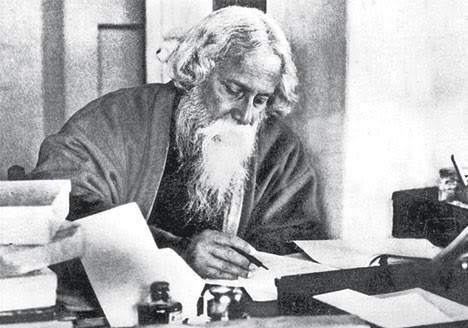
This desire to understand, adapt, and get under the skin of a modern medium had driven Tagore, a century ago from today, to paint expressionistic forms and also to film Natir Pujo (1931). And today we find a band of artists from Delhi, Mumbai, Kerala and Baroda making films that bridge disciplines from landscape and abstraction to mimetic movement and drama.

What are the notable features of these films that are mostly made on video? They too have little need for dialogue. Instead, their sight is supported by music of natural sound. If the objects they capture through the lens are arresting forms, vacant spaces can be just as inviting. When they have humans as their protagonists, they are keen to capture body language rather than drama. Colourful palette is not a foregone conclusion – monochromes and black and white can be more poignant. Because? Their visuals are but vehicles for commenting on social reality and for communicating philosophic content. 

Legends or veterans, seasoned or sprouting, this intrepid band of adventurers includes Vivan Sundaram, Ranbir Kaleka, Gopi Gajwani, Rameshwar Broota, Bharti Kapadia, Babu Eshwar Prasad, Gigi Scaria, Protul Dash, and Sanjay Roy. They are a continuum of the spirit of experimentation that had driven Husain and Tyeb, Abu Abraham and Akbar Padamsee.

Films by Artists at KIFF*

1 *Disclaimer* 2016/ 9:40 min
By *Gigi Scaria* focuses on the sleight of hands by a magician
2 *On the Road* 2021/ 5:7 min
By *Babu Eshwar Prasad* is a nostalgic look at road movies that are part documentary, part adventure.
3 *Sabash Beta* 3 min
By *Rameshwar Broota* with Vasundhara Tewari applauds the galloping of a fleighty horse.
4 *Leaves Like Hands of Flame* 2010/ 5:34 min
By *Veer Munshi* likens the fallen chinar leaves to the autumn in the lives of uprooted Kashmiris.
5 *L for…* 2019/ 13:14 min
By *Bharti Kapadia* plays with the sight and - surprisingly - the sound of the alphabet.
6 *Fruits Ripen and Rot* 2022/ 4:21 min
By *Sanjay Roy* is a surrealistic look at the divergent responses to food that is central to everyman's existence.
7 *How Far…?* 2023/ 12:37 min
By *Ranveer Kaleka* is an elegy, a dirge, mourning the losses wrought to Planet Earth by human destruction such as war.
8 *Burning Angel* 2024/ 4:37 min
By *Pratul Dash* is an abstract story of the same destruction.
9 *Turning 2008/ 11 min
By Vivan Sundaram is a silent, colourful comment on the waste created by consumerist civilization.
10 *Time* 1974/13 min
By *Gopi Gajwani* is a riveting tale of how relative a minute is to one in mourning, one waiting, and for one in love.


*Kolkata International Film Festival

.

Ratnottama Sengupta, formerly Arts Editor of  The Times of India, teaches mass communication and film appreciation, curates film festivals and art exhibitions, and translates and write books. She has been a member of CBFC, served on the National Film Awards jury and has herself won a National Award. 

.

PLEASE NOTE: ARTICLES CAN ONLY BE REPRODUCED IN OTHER SITES WITH DUE ACKNOWLEDGEMENT TO BORDERLESS JOURNAL

Click here to access the Borderless anthology, Monalisa No Longer Smiles

Click here to access Monalisa No Longer Smiles on Amazon International

Categories
Excerpt

Shabnam: A Novel by Syed Mujtaba Ali

Title: Shabnam

Author: Syed Mujtaba Ali

Translated from Bengali by Nazes Afroz

Publisher: Speaking Tiger Books

Badshah Amanullah was surely off his rocker. Or else why would he hold a ball-dance in an ultra-conservative country like Afghanistan? On the occasion of Independence Day, Afghanistan’s first ball-dance would be held.

We, the foreigners, were not that bothered. But there was a buzz of restlessness among the mullahs and their followers—the water carriers, tailors, grocers, and the servants. My servant, Abdur Rahman, while serving the morning tea, muttered, ‘Nothing is left of religious decency.’

I did not pay much heed to Abdur Rahman. I was no messiah like Krishna. The task of saving ‘religious decency’ had not been bestowed upon me.

‘Those hulking men will prance around the dance floor holding on to shameless women.’

I asked, ‘Where? In films?’

After that there was no stopping Abdur Rahman. The ancient Roman wild orgies would have sounded like child’s play compared to the juicy imageries of the upcoming dance event that he described. Finally, he concluded, ‘Then they switch off the lights at midnight. I don’t know what happens after that.’

I said, ‘What’s that to you, you mindless babbler?’

Abdur Rahman went mum. Whenever I called him a blathering prattler, he understood that his master was in a bad mood. I would use the Bengali slang word for it and being a seasoned man, though Abdur Rahman did not know the language, he would be able to read my mood.

I was out in the mild evening. Electric lamps lit up the bushes of Pagman. The tarmacked road was spotlessly clean. I was meandering absentmindedly, thinking it was the month of Bhadra and Sri Krishna’s birthday had been celebrated the previous day. My birthday too, according to Ma. It must be raining heavily in Sylhet, my home. Ma was possibly sitting in the north veranda. Her adoptive daughter Champa was massaging her feet and asking her, ‘When will young brother come home?’

The monsoon season is the most difficult one for me in this foreign land. There is no monsoon in Kabul, Kandahar, Jerusalem or Berlin. Meanwhile in Sylhet, Ma is flustered with the nonstop rain. Her wet sari refuses to dry; she is in a tizzy from the smoke of the wet wood of the oven. Even from here I can see the sudden pouring of rain and the sun that comes out after a while. There are glitters of happiness on the rose plants in the courtyard, the night jasmine at the corner of the kitchen, and on the leaves of the palm tree in the backyard.

There was no such verdant beauty here.

Look at that! I had lost my way. Nine at night. Not a soul on the street. Who could I ask for directions?

A band was playing dance numbers in the big mansion to the right.

Oh! This was the dance-hall as described by Abdur Rahman. The waiters and bearers of the building would surely be able to direct me to my hotel. I needed to go to the service doors at the back of the building.

I approached.

Right at that moment, a young woman marched out.

I first saw her forehead. It was like the three-day-old young moon. The only difference was the moon would be off-white—cream coloured—but her forehead was as white as the snow peaks of the Pagman mountains. You have not seen it? Then I would say it was like undiluted milk. You have not seen that either. Then I can say it was like the petals of the wild jasmine. No adulteration of it is possible as yet.

Her nose was like a tiny flute. How was it possible to have two holes in such a small flute? The tip of the nose was quivering. Her cheeks were as red as the ripe apples of Kabul; yet they were of a shade that made it abundantly clear it was not the work of any rouge. I could not figure out if her eyes were blue or green. She was adorned in a well-tailored gown and was wearing high-heeled shoes.

Like a princess she ordered, ‘Call Sardar Aurangzeb Khan’s motor.’

Attempting to say something, I fumbled.

She, by then, looked properly at me and figured out that I was not a servant of the hotel. She also understood that I was a foreigner. First, she spoke in French, ‘Je veux demand pardon, monsieur—forgive me—’ Then she said it in Farsi.

In my broken Farsi I said, ‘Let me look for the driver.’

She said, ‘Let’s go.’

Smart girl. She would be hardly eighteen or nineteen.

Before reaching the parking lot, she said, ‘No, our car isn’t here.’

‘Let me see if I can arrange another one,’ I said.

Raising her nose an inch or so, in rustic Farsi she said, ‘Everyone is peeping to see what debauchery is taking place inside. Where will you find a driver?’

I involuntarily exclaimed, ‘What debauchery?’

Turning around in a flash, the girl faced me and took my measure from head to toe. Then she said, ‘If you’re not in a hurry, walk me to my house.’

‘Sure, sure,’ I joined her.

The girl was sharp.

Soon she asked, ‘For how long have you been living in this country? Pardon—my French teacher has said one shouldn’t put such questions to a stranger.’

‘Mine too, but I don’t listen.’

Whirling around she faced me again and said, ‘Exactment—rightly said. If anyone asks, say I’m going with you, or say Daddy introduced me to you. And don’t you ask me any question like I’m a nobody. And I will not ask anything as if you have no country or no home. In our land not asking prying questions is akin to the height of rudeness.’

I replied, ‘Same in my land too.’

She quipped, ‘Which country?’

I said, ‘Isn’t it apparent that I’m an Indian?’

‘How come? Indians can’t speak French.’

I said, ‘As if the Kabulis can!’

She burst out laughing. It seemed in the fit of laughter she suddenly twisted her ankle. ‘Can’t walk any longer. I’m not used to walking in such high heels. Let’s go to the tennis court; there are benches there.’

Dense darkness. The electric lamps were glowing far away. We needed to reach the tennis court through a narrow path. I said, ‘Pardon,’ as I touched her arm inadvertently.

Her laughter had no limits. She said, ‘Your French is strange, so is your Farsi.’

My young ego was hurt. ‘Mademoiselle!’

‘My name is Shabnam.’

(Extracted from Shabnam by Syed Mujtaba Ali, translated by Nazes Afroz. Published by Speaking Tiger Books, 2024)

About the Book

Afghanistan in the 1920s. A country on the cusp of change. And somewhere in it, a young man and woman meet and fall in love.

Shabnam is an Afghan woman, as beautiful as she is intelligent. Majnun is an Indian man, working in the country as a teacher. Theirs is an unlikely love story, but it flowers nonetheless. Breaking the barriers of culture and language, the two souls meet. Shabnam is poetry personified—she knows the literary works of Farsi poets of different eras. Majnun is steeped in the language and thoughts of Bengal. Together, they find love in immortal words and in the wisdom of the ages.

As the country hurtles towards yet another cataclysmic change, and the ruling king flees into exile, Shabnam is in danger from those who covet her for her famous beauty. Can she save herself and her Indian lover and husband from them?

Shabnam has been hailed as one of the most beautiful love stories written in Bengali. Lyrical and tragic, this pathbreaking novel appears in English for the first time in an elegant translation by the translator of Syed Mujtaba Ali’s famous travelogue Deshe Bideshe (In a Land Far from Home).

About the Author

Born in 1904, Syed Mujtaba Ali was a prominent literary figure in Bengali literature. A polyglot, a scholar of Islamic studies and a traveller, Mujtaba Ali taught in Baroda and at Visva-Bharati University in Shantiniketan. Deshe Bideshe was his first published book (1948). By the time he died in 1974, he had more than two dozen books—fiction and non-fiction—to his credit.

About the Translator

A journalist for over four decades, Nazes Afroz has worked in both print and broadcasting in Kolkata and in London. He joined the BBC in London in 1998 and spent close to fifteen years with the organization. He has visited Afghanistan, Central Asia and West Asia regularly for over a decade. He currently writes in English and Bengali for various newspapers and magazines and is working on a number of photography projects.

PLEASE NOTE: ARTICLES CAN ONLY BE REPRODUCED IN OTHER SITES WITH DUE ACKNOWLEDGEMENT TO BORDERLESS JOURNAL

Categories
Conversation

Rings on Her Fingers and Bells on Her Toes…

Ratnottama Sengupta in conversation with Sohini Roychowdhury, who uses dancing to build bridges across cultures

“Meet my daughter Sohini,” Uma Di was introducing the dancer who then lived in Madrid. And my first response was, “Why isn’t she in the movies?!”

Sohini Roy Chowdhury. Courtesy: Sohini Roy Chowdhury

Tall, fair, lissome, agile, Sohini Roychowdhury is the stuff beauty queens and show stoppers are made of. That wasn’t surprising: after all, Uma Roychowdhury herself is the picture of perfection in aesthetics.

It didn’t take me long to realise that, much like the well regarded sculptor’s bronzes, her daughter too was made of enduring stuff. One day she was teaching Bharatanatyam to French, Spanish, and Italian enthusiasts. The next day she was lecturing on mythology in New York. One day she was dancing to ‘Jai Ho![1]’ for the director of the Oscar winning Hollywood movie[2]. Another day she was delineating Durga in an Anthropology Museum…

None of these saw her run out of breath. Nor does she, ever, run out of time. When she’s not holding her fingers in a dance mudra, she is holding a metaphoric pen. This month she unveiled her second book, Dance of Goddess Kali. Yes, she has rings on her fingers and bells on her toes — and wherever she goes, there’s dance on the cards!

Here is what she had to say when I spoke to her:

The Dance of Kali follows Dancing with the Gods. How are the two books different?

Dancing With the Gods and The Dance of Kali are two distinct works, each focusing on different aspects of my artistic and spiritual journey. 

Dancing With the Gods is a pictorial, coffee-table book stemming from my journey as a classical Indian dancer with a multinational dance troupe. Its vivid visuals showcase my onstage performances and behind-the-scenes moments. These are highlights of my career as a dancer, both solo and with Sohinimoksha World Dance and Communications[3]

This visually captivating book focuses on imagery and aesthetics. It offers glimpses into my artistic expression through dance, celebrates my journey around the world, and highlights my life-mantra of connecting civilisations through my craft. This tracing of Sohinimoksha’s journey is for a broader audience: Indian dance enthusiasts, art lovers, and individuals interested in my achievements. The aim is to inspire through visually compelling storytelling.

In contrast, The Dance of Kali is a treatise on the ethos of Goddess Kali and Shaktism. It delves into the deeper spiritual and philosophical aspects associated with the goddess, exploring Kali’s symbolism, mythology, and significance within the context of Shaktism, a Hindu tradition of worshiping the divine feminine energy. The tone of this work is contemplative, as it delves into the profound symbolism and the spiritual aspects associated with the Goddess. It incorporates scholarly research, analysis, and interpretations from various perspectives. Hopefully it offers readers a deeper understanding of Kali’s significance in Hindu spirituality.

May I point out here that The Dance of Kali is not a religious book. It is for readers with a specific interest in Hindu mythology, spirituality, or the myths and legends around the resident Goddess of Kolkata. Those seeking a deeper understanding of Kali’s symbolism and philosophical underpinnings within the context of Shaktism, will find this book dispels disrespectful misrepresentations and unfounded Western misconceptions  surrounding the images of Kali as a demonic goddess. 

To sum up: both the books reflect different facets of my artistic and spiritual journey. However, they differ significantly in their subject matter, focus, tone, and intended audience. One celebrates my achievements as a dancer through captivating visuals. The other is an academic tome exploring the profound symbolism and spirituality associated with Goddess Kali.

What prompted you, an international dancer, to pick such a rooted in mythology subject?

I have always had a personal affinity with or inclination towards Goddess Kali. Many artistes draw inspiration from their own beliefs, experiences, and cultural backgrounds when choosing subjects for their work. I am no different. For me the depiction of the Goddess is an opportunity for artistic exploration. Kali, with her complex symbolism and multifaceted persona, offers rich material for creative interpretation through the arts, be it dance, literature or visual arts. 

This book also celebrates India’s rich mythological heritage and the way it connects to other ancient cultures, in Mesopotamia, Egypt, Spain and France. Kali, with her global soul sisters Ishtar or Sara La Kali, holds significant cultural and religious importance, not just in Hinduism, but other cultures as well, particularly within the contexts of worshipping Mother Goddesses. I delve into Kali’s mythology and symbolism to honour this aspect of Indian life, and its universal resonance. 

Yes, Goddess Kali is rooted in Indian mythology. But the themes she embodies — feminine power, transformation, and liberation —transcend cultural boundaries. I hope this book will serve to explore universal themes of empowerment and spirituality. It also aims to provide a deeper understanding of Hindu mythology, and the symbolism associated with the Dark Goddess. Effectively I seek to promote intercultural dialogue and foster greater appreciation for diverse religious traditions. Most significantly, I hope to dispel the uneducated interpretations of Kali as a horrific, savage, demonic goddess. How often she is typecast as a symbol of evil — in popular Western films, books and even as Halloween costumes for disrespectful celebrities like Heidi Klum

I have witnessed your performance as Durga in an anthropology museum in Madrid. I have noted your commitment to meaningful, even profound themes in your endeavours. What has been your grooming in dance?

I started dancing at a young age under  renowned Bharatanatyam Guru, Thankamany Kutty. Later I learnt from Kalamandalam Venkitt in Kolkata. I received rigorous training in Bharatanatyam, the dance  that originated in the temples of Tamil Nadu. My dedication to classical art led me to delve deep into its nuances. I mastered intricate footwork, expressions, and storytelling techniques. Over the years, I refined my technique and expression through consistent practice and performance and came to embody the essence of Bharatanatyam.

Your father was a renowned sitarist living in Germany. Your mother is a reputed sculptor of Kolkata. Why did you, an only child, not take to any of these streams of creative expression?

Indeed I was born into a family of accomplished artists. My father, Pandit Subroto Roychowdhury was a renowned sitarist, and my mother, Uma Roychowdhury, is a reputed sculptor. But I chose a different path for myself. 

As an only child, I was exposed to various forms of creative expression. But my passion for dance was ignited after watching a riveting performance by Yamini Krishnamurthy when I was about four years old. While I deeply respect my family’s artistic legacy, I followed my own calling and embarked on a journey to carve my niche in the world of dance.

What are the values you have imbibed from them individually?

My father’s sitar schools in Germany have produced hundreds of students — including distinguished sitar players. From him I imbibed a profound appreciation for music and rhythm. I learned discipline, dedication, and the importance of perseverance in mastering an art form. From my sculptor mother I inherited a keen love for aesthetics and eye for details. I learned the importance of expressing emotions and stories through visual and performing arts. 

Together these values have steered me towards excellence and innovation in my journey as a dancer and communicator.

Mixed genre performance by Sohini Roychowdhury. Courtesy: Sohini Roy Chowdhury

You have lived in Moscow and Madrid. You are guest professor in far-flung Universities, in America and Columbia. You have danced Bharatanatyam and you have danced to Jai ho! at the premiere of Slumdog Millionaire. What have you gained through your international exposure?

My international exposure has enriched me both personally and professionally. Living in cultural environments as diverse as Moscow and Madrid have broadened my perspectives and deepened my understanding of global arts and communication. 

More than 2000 students have ‘graduated’ through my two dance schools in Spain — Casa Asia and Sohinimoksha Artes de la India. In Moscow, more than 80 Russian students performed with me on stage at the Embassy of India and Nehru Centre at the end of their course. As a guest professor in universities across Europe, USA and Latin America, teaching dance, Natyashastra [theory of dance] and Indology, I have not only shared my expertise — I have learnt from students, artistes and scholars from different backgrounds. 

Through my performances of Bharatanatyam, and collaborations with international artists, have bridged cultural divides. My dancing to Jai Ho! at the European premiere of Slumdog Millionaire showcased the universal appeal of Indian dance and music. It  highlighted its ability to connect with people across borders. Today I can confidently claim to have promoted cross-cultural exchange globally.

Coming from an aristocratic, old Calcutta background, what merit do you see in Bollywood dancing?

Despite coming from an aristocratic background rooted in old Calcutta, I recognise the merit in Bollywood dancing which has become a global phenomenon. Not surprising. For, characterised by vibrant energy, expressive movements, and fusion of multiple dance styles — from Salsa to Tango, Twist to ChaChaCha – Bollywood dancing holds mass appeal. It serves as a platform for artists to showcase their talents to diverse audiences and has contributed to the popularization of Indian culture worldwide. It is rooted in traditional Indian dance forms, yet embraces modern influences. And it reflects the evolving tastes of contemporary audiences. 

Since the 1960s, Bollywood has drawn inspiration from various musical traditions across the world. This imparted its films a rich tapestry of global influences. This fusion of world music and dance enriched the aesthetic of Bollywood — and in turn contributed to its cultural significance and global appeal.

In the 1960s, Indian cinema underwent a transformation with the emergence of filmmakers like Guru Dutt and Raj Kapoor, who infused their films with elements of Western music and dance. The most iconic example of this is seen in the song Mera joota hai Japani [my shoes are Japanese] from Shree 420 (1955): here Raj Kapoor’s character sings about wearing Japanese shoes, English pantaloons, and Russian caps — all of which symbolised the growing influence of the West in post-colonial India. And yet, as the song stresses, at core these films are Hindustani — Indian.

Throughout the ’60s, ’70s and ’80s, the industry witnessed the rise of dance and music directors who played a pivotal role in incorporating world music and dance forms into Hindi cinema. Composers like OP Nayyar, Shankar Jaikishan, SD Burman, C Ramachandran, Kalyanji Anandji, RD Burman, Laxmikant-Pyarelal, and Bappi Lahiri experimented with disparate musical styles. These ranged from rock-n-roll, rumba, flamenco to disco, reggae and jazz. This infused their compositions with international flavours. 

Similarly, choreographers Sohanlal,  PL Raj, Herman Benjamin, Suresh Bhatt, Saroj Khan, Chinni and Rekha Prakash, Shiamak Davar, Farah Khan, Remo D’Souza, Terence Lewis, Vaibhavi Merchant, and Prabhu Deva have blended Indian classical dance with Western styles. This has created the unique dance style that is now identified as Bollywood dancing. It has homogenised movements from hip-hop to salsa and contemporary dance.

Soon stars like Shammi Kapoor, Helen, Asha Parekh, Hema Malini, Rishi Kapoor, Mithun Chakraborty, Jeetendra, Govinda, Hrithik Roshan, Madhuri Dixit, and Sridevi became synonymous with Bollywood’s larger-than-life dance numbers. For, it showcased their versatility and flair for different dance steps. Embracing the twist and turn era of the ’60s to the disco craze of ’70s and the hip-hop-inspired moves of the 2000s, Bollywood stars captivated audiences with their energy and charisma.

Along with Western influences, Bollywood also drew from traditional Indian dances. Its choreography incorporated elements of Bharatanatyam, Kathak, and Odissi. Dance sequences like Dola Re Dola from Devdas (2002) and Pinga from Bajirao Mastani (2015) exemplify the fusion of classical and contemporary dances, blending intricate footwork with dynamic movements and expressions.

In recent years, Bollywood has continued to evolve, reflecting the changing tastes and preferences of global audiences. Directors, like Sanjay Leela Bhansali and Farah Khan, have pushed the boundaries of traditional filmmaking, creating visually stunning spectacles that showcase the diversity of world music and dance. Stars like Priyanka Chopra, Deepika Padukone, and Ranveer Singh have embraced this eclectic mix of styles, bringing their own unique interpretations to the screen.

Spanish, Bulgarian and other European dancers from my own troupe, Sohinimoksha World Dance, have performed specially choreographed fusion dance items set to popular Bollywood tracks. Kristina Veselinova danced to Mere Dholna from Bhool Bhulaiya; Violeta Perez and Lola Martin to Senorita! from Zindagi Na Milegi Dobara and Maria Sanz on Padmavat’s Ghoomer on stages across India and the world. So I readily acknowledge the significance of Bollywood dance in preserving India’s cultural heritage while adapting to changing times.

Would you say our films are taking our dance traditions to votaries abroad? Just as Indian musicians of the 1960s had taken our ragas to the West?

In the 1960s, Ravi Shankar, Ali Akbar Khan and other maestros played a crucial role in initiating the West in the rich notes of Indian classical music — and that had enriched the global cultural landscape. My own father, Pandit Subroto Roychowdhury, spent more than 40 years in Germany and other European countries, spreading and popularising Indian classical music through concerts and classes. Today Indian films, particularly Bollywood, are carrying forward this legacy. They are showcasing the wealth that is Indian dance — often fused with world dance influences. Just as our musicians shared the wealth of ragas with the West, Bollywood films are spreading the infectious exuberance of Indian dance to enthusiasts around the globe. This is fostering cultural exchange on an international scale. Small wonder that Bollywood is now acknowledged as India’s most potent soft power. 

What, in your opinion, is needed to make GenNext learn from our past traditions?

If we want GenNext to learn from our past traditions, we must provide them with comprehensive exposure to our rich cultural heritage. For this, we must integrate our arts and cultural practices into educational curricula. We must foster appreciation through interactive experiences — workshops, performances, cultural events. Additionally we must leverage modern technologies and platforms to disseminate information. Let’s make traditional arts more accessible and engaging for the young. Let’s cultivate mentorship programs and intergenerational exchanges. For, we must bridge the gap between past traditions and contemporary lifestyles, to ensure their relevance and continuity for the generations to come.

Sohini I have seen you at close quarters, as a mother, wife, daughter, and daughter-in-law even as you criss-cross the world for your dance. How do you still find time to write, which is such a demanding, reflective expression?

I am fortunate to be able to balance my roles as a mother, wife, daughter, daughter-in-law, and a performing artiste. My experience as much as my dedication to my craft honed my time-management skills. Despite crisscrossing the world for performances, lecture tours, and other professional commitments, I carve out time to write, for I recognise its significance as a reflective form of expression. 

To effectively manage my time, I set priorities, create schedules, and maximize productivity during the available windows of time. I designate specific periods for writing, be it early mornings, late evenings, or during travel downtime. I try to integrate writing into my daily routine, seizing moments of inspiration and reflection to jot down ideas or draft passages.

My passion for writing is a driving force — it motivates me to make time for it amidst my busy schedule. Writing provides a creative outlet for introspection, and intellectual exploration. It complements my artistic endeavours and enriches my personal and professional growth.

I am grateful for the support I receive from the network of my family, friends, and collaborators. They play a crucial role in facilitating my writing pursuits. My latest book, The Dance of Kali, was co-written with my son Rishi Dasgupta, an Economics MSc from the University of St Andrews, UK. 

However, at the end of the day, that I find time to write amidst my multifaceted life, reflects my passion for engaging in reflective expression. Because? It contributes to my holistic development as an artist and an individual.

[1] A song from the 2008 Bollywood movie, Slumdog Millionaire

[2] Danny Boyle

[3] A dance troop started by Sohini Roychowdhury with presence in Madrid, Berlin and Kolkata

.

Ratnottama Sengupta, formerly Arts Editor of The Times of India, teaches mass communication and film appreciation, curates film festivals and art exhibitions, and translates and write books. She has been a member of CBFC, served on the National Film Awards jury and has herself won a National Award. 

.

PLEASE NOTE: ARTICLES CAN ONLY BE REPRODUCED IN OTHER SITES WITH DUE ACKNOWLEDGEMENT TO BORDERLESS JOURNAL

Click here to access the Borderless anthology, Monalisa No Longer Smiles

Click here to access Monalisa No Longer Smiles on Amazon International

Categories
Poetry

The Grave is Wide…

Poetry by Michael R. Burch

Courtesy: Creative Commons
Epitaph for a Refugee Child
		
I lived as best I could, and then I died.
Be careful where you step: the grave is wide.

Epitaph for a Refugee Mother

Find in her pallid, dread repose,
no hope, alas!, for a human Rose.

who, US?

jesus was born 
a palestinian child
where there’s no Room 
for the meek and the mild

... and in bethlehem still 
to this day, lambs are born
to cries of “no Room!” 
and Puritanical scorn ...

under Herod, Trump, Bibi
their fates are the same— 
the slouching Beast mauls them
and WE have no shame:

“who’s to blame?”

(First published in Setu)


Excerpts from “Travels with Einstein”


I went to Berlin to learn wisdom
from Adolph. The wild spittle flew
as he screamed at me, with great conviction:
“Please despise me! I look like a Jew!”

So I flew off to ’Nam to learn wisdom
from tall Yankees who cursed “yellow” foes.
“If we lose this small square,” they informed me,
earth’s nations will fall, dominoes!”

I then sat at Christ’s feet to learn wisdom,
but his Book, from its genesis to close,
said: “Men can enslave their own brothers!”
(I soon noticed he lacked any clothes.)

So I travelled to bright Tel Aviv
where great scholars with lofty IQs
informed me that (since I’m an Arab)
I’m unfit to lick dirt from their shoes.

At last, done with learning, I stumbled
to a well where the waters seemed sweet:
the mirage of American “justice.”
There I wept a real sea, in defeat.

(First published in Café Dissensus)

Michael R. Burch’s poems have been published by hundreds of literary journals, taught in high schools and colleges, translated into fourteen languages, incorporated into three plays and two operas, and set to music by seventeen composers.

PLEASE NOTE: ARTICLES CAN ONLY BE REPRODUCED IN OTHER SITES WITH DUE ACKNOWLEDGEMENT TO BORDERLESS JOURNAL

Click here to access the Borderless anthology, Monalisa No Longer Smiles

Click here to access Monalisa No Longer Smiles on Kindle Amazon International
Categories
Excerpt

Bhubaneswar@75 – Perspectives

Title: Bhubaneswar@75 – Perspectives

Editors: Bhaskar Parichha/Charudutta Panigrahi

Publisher: Pen In Books

INTRODUCTION

As we look forward to the next 25 years … 

April 13, 1948. It was on this day that the first Prime Minister of India Pandit Jawaharlal Nehru laid the Odisha capital city’s foundation stone. Since then, Bhubaneswar has remained a celebrated model of modern architecture and city planning with its prehistoric past as a temple city. Along with Jamshedpur and Chandigarh, Bhubaneswar is one of modern India’s first planned cities. 

While laying the foundation-stone, Nehru observed: ‘Bhubaneswar would not be a city of high-rise buildings for officers and rich men without relation to the common masses. It would be consistent with the idea of reducing differences between the rich and the poor. The New Capital would embody the beautiful art of Odisha, and it would be a place for beauty…so that life might become an adjunct to beauty.’

Bhubaneswar is a temple town with a series of ancient sandstone temples varying in size from the towering eleventh century Lingaraja Temple. It was a city of temples. Once upon a time, there were more than 7,000 temples in and around Bhubaneswar. Today, there are only a few. 

EXQUISITE ARCHITECTURE

From a religious standpoint, the Lingaraj temple is the most popular. Other temples include the 7th century Vaital temple, the impressive 10th century Mukteshwar temple, and the 11th century Raja Rani temple with its fine carvings. There are many other temples of exquisite architecture. 

Several Grade-I temples of national importance have been protected by the Archaeological Survey of India (ASI) in Old Bhubaneswar, such as Ananta Basudeva, Mukteswara, Persurameswara, and Rajarani Temples, which are just a few examples. Bhubaneswar’s modern capital is shaped by Old Bhubaneswar’s ancient temples.

The state capital city planning began near the old temple town. The Master Plan for the upcoming city of Bhubaneswar was prepared by Dr Otto H Koenigsberger on the concept of neighbourhood unit planning. The original plan envisaged horizontal development rather than vertical growth for a population of 40,000 with administration as the primary function. Koenigsberger designed a linear pattern for the city, with administrative units on the main artery, and neighborhood units attached to them. Neighborhood units offer residents the most sophisticated amenities in a city. They were placed at short distances to give people easy access to schools, hospitals and other facilities.  

CENTRAL VISTA

Six units were developed. Unit-V served as the site for the administrative complex, while other units were planned according to neighborhoods. As part of the town center, there was a market building, a weekly market, a day-to-day market, and a bus station. There was a central vista with views of the Raj Bhawan. There was also a commercial zone along Janpath and Bapuji Nagar up to the railway station. Koenigsberger’s planning zone provided characteristic weather control and a salubrious climate throughout the year. This area — the heart of the city — maintains the lushest green cover in the city with open space and a well-organized transportation system.

A neighborhood unit required that each child live within a quarter of a mile or a third of a mile of their school. Housewives were required to live within a half mile of the civic center to shop there and have access to medical facilities within the town. Distances between a person’s home and place of employment could conveniently be covered by a bicycle or a cycle rickshaw. Koenigsberger suggested 7 different types of roads for 7 different groups of users and 7 different functions. Those are footpaths, parkways, cycle paths, minor housing streets, major housing streets, main roads and main arteries.

Bhubaneswar was planned to be the state capital, but it is primarily a city for government officials. Residential quarters were designed to meet the needs of officials from various income groups. Planning was made to meet the ideal urban family’s requirements. This was done by providing them with single-storey independent houses with a front yard and kitchen and garden space in the back yard. Government bungalows have extensive open spaces around them and abundant space between one house and another. Those with high incomes occupy bungalows near the main employment complex. 

Low income housing consists of mostly one and two bedrooms comprised of more than one unit broken into rows. Early in the planning process, residential quarters in different neighborhoods were mostly standardized. Small scale industries and manufacturing activities were added after 1980. Much of the original plan has changed in twenty years.

HERITAGE ZONE

Bhubaneswar has been declared a special heritage zone as Ekamra Kshetra, which consists of several significant structures. Various socio-cultural and religious heritages of Odisha are represented in the monuments, which represent different periods in Odisha’s history. In recent years, several of these significant elements have steadily lost their significance due to modern construction activities.

An integrated regional development plan has been prepared to meet the growing demand for services in the region. This plan has been declared as the Comprehensive Development Plan (CDP) of the Bhubaneswar Development Plan Area (BDPA). The BDPA comprises Bhubaneswar Municipal Corporation, Khurda Municipality, Jatani Municipality and adjoining 122 Mouzas. The Long Term Perspective Plan for Bhubaneswar-Cuttack Urban Complex (BCUC) provides a vision for the development of the whole region by 2030. Bhubaneswar-Cuttack Urban Complex being the hub of commercial, political, administrative and socio-cultural activities in Odisha, it has rich potential for development. 

A lot of resentment was felt — and it still exists — when Bhubaneswar replaced Cuttack as the capital on 19 August 1949, two years after India gained independence from Britain. In recent times, Bhubaneswar and Cuttack have been called the ‘twin cities of Odisha’ – one with a modern look and another with a millennium-old history. Bhubaneswar and Cuttack have become closer since the Netaji Subhash Chandra Bose Bridge, also known as the Trisulia Bridge, opened on 19 July 2017. 

BIG FIVE

There are a few Tier-2 cities in the country that host the top five IT companies in the country. Bhubaneswar is one of them. These companies include Infosys, Wipro, Tata Consultancy Services, Tech Mahindra, and Mindtree. It is considered one of the three most attractive places in the world to do business, according to the World Bank. Bhubaneswar has been selected as one of the first twenty cities in India to be developed as a smart city. This is part of his flagship ‘Smart Cities Mission’ which seeks to develop 100 smart cities in India. 

Bhubaneswar was added to the World Heritage List (WHL) as part of the application process. The WHL requires that the site be of outstanding value, as well as having at least one of the ten selection criteria met. This is required for inclusion on this list. Bhubaneswar meets four of them. Over 100 cities have been designated World Heritage Sites by UNESCO.

Nations that nominate heritage sites and cities to UNESCO, and submit data, maps, and photographs, are given heritage status by the organization. World Heritage Status is the highest honor and most prestigious title given to heritage monuments, sites, and cities in recognition of their universal value.

Bhubaneswar, one of the two Indian capitals planned after independence, alongside Chandigarh, is today one of the most prominent cities in Odisha. It has a culture as vibrant as the city itself. With a population of one and a half million, Bhubaneswar has become known as one of the most happening cities in Eastern India. India’s evolving urban landscape places the city among its upcoming metropolises.

This book contains twenty-seven essays written by learned scholars on different aspects of Bhubaneswar. From temples to town planning, from becoming India’s sports capital to urban living, from culture to literature, and from business to education, the book says it all. It represents everything that has happened since the foundation stone was laid. It is a throwback to what we have witnessed.

It is hoped that by the time Bhubaneswar celebrates its centennial twenty-five years from now, the city’s signature identity and impeccable heritage will have been preserved and passed on to future generations in a more intact form. 

Bhaskar Parichha

About the Book:

The capital of Odisha and a city that is still in the process of being shaped, Bhubaneswar is many things to many people. The Temple City, as it was once called, was home to thousands of temples at one time.

The foundation stone of ‘modern’ Bhubaneswar was laid in 1948 by Pandit Jawaharlal Nehru. It became the administrative capital of Odisha in the learly 1950s. Bhubaneswar was declared a ‘smart city’ under the urban initiative by the government of India in 2014.

Bhubaneswar, one of the two capitals planned after independence, is today a vibrant city in Odisha with an equally vibrant culture. With a population of one and a half million, Bhubaneswar has become known as one of the most happening cities in Eastern India. India’s evolving urban landscape places the city among its upcoming metropolises.

The book has 25 essays on different aspects of Bhubaneswar written by scholars of standing. From temples to town planning, from becoming India’s sports capital to urban living, from culture to literature, and from business to education, the book says it all. It is a compilation of all that has happened over the past 75 years.

A ‘portrait’ of the city is presented in the book.

About the Editors

Bhaskar Parichha (1957) is a senior journalist and author of five books Unbiased: Writings on India, No Strings Attached: Writings on Odisha, Madhubabau – The Global Indian, and BijuPatnaik – A Biography. He has edited an anthology of essays entitled Naveen @25 -Perspectives. He is a bilingual writer and lives in Bhubaneswar.

Charudutta Panigrahi (1968) is a social advocate and practicing intellectual. He has set upthink tanks in India and abroad. A TED Speaker and an author, he is a polymath whose work takes him everywhere. This is from the last mile in indigenous communities to the high table of global policy making. He lives between Gurgaon, Bhubaneswar, and Panjim with his family. His recent release, The Scent of Odisha, has been received well by readers all over and is acclaimed as an exceptional Odisha chronicle of current times. He is engaged in climate change work and has set up a global platform called Climatists in Berlin.

PLEASE NOTE: ARTICLES CAN ONLY BE REPRODUCED IN OTHER SITES WITH DUE ACKNOWLEDGEMENT TO BORDERLESS JOURNAL

Click here to access the Borderless anthology, Monalisa No Longer Smiles

Click here to access Monalisa No Longer Smiles on Kindle Amazon International
Categories
Excerpt Tagore Translations

Kobi & Rani: Letters from Japan, Europe and America

Rabindranath Tagore’s selected letters to Nirmalkumari Mahalanobis had been published in 1938 under the title Pathe-O-Pather Prante. The sixty letters included in this volume had been personally selected by him from among the five hundred plus letters he had written to her. This volume was translated by Somdatta Mandal and included in the book ‘Kobi’ and ‘Rani’: Memoirs and Correspondences of Nirmalkumari Mahalanobis and Rabindranath Tagore (Bolpur: Birutjatio Sahitya Sammilani, 2020). Selections from some of these letters had been included in borderless journal in its September 2021 issue. A few more letters have been selected here for the benefit of the readers.

Letter 33

Yesterday I reached the Japanese port named Moji. Tomorrow I will reach Kobe. A bird builds its nest with straw and twigs; it does not take long for it to leave that nest and go away. We build our nests mainly with things of the mind, with work, studies and thoughts and an invisible shelter starts growing around us. Just as the seat of the plane moulds itself according to the pressure and shape of the body, the mind while moving along also creates differently shaped holes, and when it sits in that hole it gets stuck there. Later when it has to leave it does not like that at all. Something like that happened to me on this ship. In this cabin there is a writing desk on one side, and a bed on the other. Apart from this, there is a chest of drawers with a mirror, a cupboard to hang clothes and an attached bathroom. After crossing these, there is another cabin where my boxes, trunks etc. are kept. Within this my mind has arranged its own furniture. Because there is little space, my shelter is very intense and every necessary item is within my reach. After getting down from here, I was in Hsu’s house[1] in Shanghai for two days; I did not like it, it made me very tired. The main reason was that the mind did not get the measurements of the body in a new place; it was being hit on all sides and to add to that there was hospitality, welcome and chaos day in and out.

There is newness of thought and imagination everyday but the external newness tries to prevent them. We have imbibed new substances of life in their entirety and have understood that the newness exists within them. I have known for a long time that we do not have to leave them to look for something new. Like other valuable things one has to mediate to seek the new.  This means you have to make it old and then attain it. If you think that you have suddenly found something, then that is not true because within a few days its actual emaciated state is revealed. Nowadays man is engrossed in securing this cheap newness and that is why he wants change at every moment. Science is helping him in this obsession for change, so he does not get the time to sink deep and search for the forever new. This is why a base knowledge from text-books has spread everywhere in the education system. No one has the time to seek the ultimate truth in its real form. This is why obscenities that affect the mind in a strong way are being found in literature. Those who lack the time and have less power find this to be a cheap means of getting quick entertainment. The mind that has grown inert and has had its life strength reduced requires strong stimulation – its roots are starving.

                                                                                    Yours,

                                                                                    9 Chaitra, 1335( B.S.)

You will be surprised to know that when I was writing this letter I was feeling very sleepy. I was warding it off and progressing with my writing. Even now I have not overcome that drowsiness. But it is morning now, it is eleven o’clock – let me go and take my bath.

Letter 34

I have come to Tokyo last night and have put up in a famous hotel. It is not that less famous hotels are cheap or unsuitable for relaxation, but since it is my misfortune that I am also famous, I have to tolerate an equal amount of oppression. It is easy to hide in a small place, but the places to hide in this world are closed for me. Once upon a time I could not even imagine that it would be essential for me to hide from the public for self-defence. Those were the days when I was alone in the boat on the shoals of the Padma. So I haven’t developed the habit of warding off people and anyone can come and keep on pulling me. This morning when I was tired and was sitting down someone came and convinced me with a lot of words. He made me sit in a car and took me to their house inside the lane. In the end I realized that all this excitement was because they wanted to be photographed with me.

In our house we were first born amidst a simple lifestyle and were encircled by love and care from our own people. Then I was a totally private person and there was a very personal thing called a barrier. Gradually with age the relationship with the outside world started to increase. But however much it increased it had a simple measure and there was a balance between the private and the public self. Ultimately through the hands of fate my fame as an exceptional person began to grow and I became more public than I was private. The barrier which I was entitled to became insufficient now. Like an extremely ripe fruit the hard upper shell of my body has split up into seven pieces, and now any kind of bird with any sort of motive can come and peck at me and there is no one to prevent them. There is no harm if they really benefit from it. If they want to satiate their own greed through me, let them do it; but if you think about it, this creates a serious harm not only for me but also for their own selves. My heart is upset by the little demands, and I waste my strength available for doing sufficient work. Moreover, when I realize that I have become the vehicle of other people’s interests, and that those interests are trivial, then I feel reproached. I keep on wishing to return to my traditional and non-famous small house and take shelter among people who are willing to pay a price just for my existence. But at the same time I often meet people who are unknown to me, but who have accepted me within their heart even from a distance. They do not ask anything from me, do not judge me according to my fame, but accept me out of their own happiness. There is nothing more fortunate than this. This time when I was being tortured by my fellow countrymen with a cheap reception in the city of Kobe, then the wife of the English consul here came to meet me. After speaking to her a lot of my sorrow disappeared. I realized that for some people my work has been deeply successful and they do not want anything more than whatever they have received from me without my knowledge.

Today I have three invitations in Tokyo and it will extend from one o’clock in the afternoon till dinner at night. I will then travel to Yokohama by car. After that tomorrow I will have lunch with the Indians who invited me and then leave for Canada at three o’clock. After that I don’t know.

                                                                                                              Yours,

27 March, 1929.

Letter 43

Throughout my life I had to inwardly keep hold of a pursuit. That pursuit is to remove the veil, to keep myself far away from everything. It is the pursuit of releasing me from myself as a person. Stationing myself at one place, I often try to realize that each day this person is troubled with both sad and happy thoughts of work, which is equivalent to letting myself drift within an uncountable flow into another sphere without any fixed destination. This can be seen clearly when it is identified as an independent object, but if we try to associate and become one with it then that knowledge becomes false. I desperately need this realization and that is why I desire it so much. My mind is situated at the crossroads and all its doors are open, so all kinds of winds reach it and all kinds of guests enter the inner chambers. There is a place within man’s life which is that of pain, and all the feelings are located there. That is why only intimacy can enter it. Part of our domestic existence is to spend life with them both in pleasure and pain. Everything has to be tolerated within its limits. But my God, my jeevandebata, decided to make me a poet and that is why has kept my inner chambers unguarded. I don’t have a back door and there are main entrances on all sides. That is why both invited and uninvited people keep coming and going within my inner chambers. Therefore, the chords of the instrument of pain are always tuned to the highest pitch. If the music stops, then my own work would be left undone. I have to know the world through painful experiences; otherwise, what should I express? Unlike scientists and philosophers I do not have vast knowledge and my expression is that of my heart. Though these feelings are the tools of expression for a writer, it is necessary to leave them behind and move away. This is because if we don’t move to a distance, we are unable to perceive the whole at once and reveal it. Being too much engrossed in the world gives rise to blindness and guards the object that is to be seen. Besides this, the small object becomes large and the large one is lost. The great advantage of the domestic world is that it carries its own weight, but the small objects do become a burden. They are the most meaningless things but they create the greatest pressure. The main reason is that their weight rests upon falsehood. When the mind seems to be overwhelmed by bad dreams, it is also an illusion. If we encircle the world with that little ‘me’, then in that small world the small wears the mask of the great and creates anxiety in the mind. If whatever is really great, meaning that its boundaries cross that little ‘me’, is brought in front of the small, then the smaller one’s false intensity is dismissed and shrinks into littleness. Then one feels like laughing at what causes one to cry. That is why removing the big ‘me’ from my life becomes the greatest thing to pursue; and if that is done, the greatest insult to our existence is lost. The humiliation of existence is to live in a small cage that befits birds and animals. In this cage called ‘myself’ we are tied and beaten up, and that becomes a useless burden. That is why it is essential for Rabindranath to seat Rabindranath Tagore at least at a distance: otherwise, he gets to be humiliated by himself at every step. The sorrow of death brings in stoicism, and I have felt the freedom of stoicism several times, but the real stoicism is brought about by accepting the great truth. There is greatness within me and he is the observer; what is small within me is the consumer.  If both of them are combined, then the pleasure of vision is destroyed and the happiness of consummation is spoilt. If you keep pushing your work externally like a pushcart then it moves smoothly, but if you carry that pushcart on your shoulders then you get exhausted. I have taken up a work called Visva-Bharati, and it becomes simpler if I don’t bear the burden and dissociate it from myself. A work is either a success or a failure depending upon the circumstances but if it does not touch ‘myself’ then that work brings in freedom for itself and also for me. Our greatest prayer to the one who is the greatest is asato ma sadgamayo (take me away from whatever is false and lead me towards eternal truth). How will this prayer be successful? If His arrival within me is complete, if I see Him truly within me, then the torture of that ‘me’ can also be pacified.

I don’t know when you will receive this letter. I will be happy if you receive it on your birthday. If you don’t get it there will not be much harm in stretching your birthday by another day. It is not possible always to express all the innermost thoughts but they have to be spoken for the sake of myself.  That is why I wrote this letter on the occasion of your birthday; because freedom is the main mantra of every birth, and it is freedom from darkness to light.

                                                                                                                Yours,

                                           6 Kartick, 1336 (B.S.) 

Letter 48

I am writing this letter to you from Copenhagen, after having fallen into a whirlwind that does not let me pause even for a while. I am moving along garnering knowledge about strangers, but there is no time to store that knowledge. Moreover, I have a forgetful mind, and there is no lock and key in the storehouse of my memory. As soon as something accumulates, instantly something else comes and replaces it. Some just sink in, some get distorted and become hazy. I do not of course consider this to be a complete loss – if you cannot discard then you cannot earn; if you have to store it then you will have to sit firmly without any movement. For a long time, I have constantly ridden the chariot of my mind from one road to another and did not have the time to lock it up in the garage. Instead of fame, I would have found a lot of things if I had gone and sat firmly at the entrance of the museum. Just think of this simple fact: If I had the intelligence to remember everything then at least I would have passed all my examinations and could have left with pride by saluting the world and by gathering accolades. If I want to speak about something, I cannot quote references and so in intellectual gatherings I try to overcome the deficiencies of my education by covering them up naively with my own talk. Since I cannot think of paraphrases and parallel passages in seminars where poetry is being discussed, I try to retain my prestige by composing poems myself. I can clearly visualize that you are reading this and laughing out loudly both physically and also in your mind. You are saying that it is just empty politeness, a bundle of pride. There is no way out. Due to societal norms one can truly praise others but not oneself. So one has to praise oneself in the mind and instead of reduction it leads to more sin. The fact is that once you come abroad from your homeland your self-glorification becomes enhanced a great deal. Someone who doesn’t even have the fortune of having cold water is suddenly given champagne. Then I feel like calling your professors and telling them, ‘O, you masters! Don’t make the sudden mistake of considering me as your student. Don’t mark the papers that I have written in the same way as you mark your examination scripts, because they are demanded by the professors here.’ You know that by nature I am very polite but my tutors at home have beaten me to make me feel proud. This is why I often feel ashamed in my mind. But let me tell you the truth. I have received a lot of fame and respect, but even then my mind always looks across the Indian Ocean. Khuku[2] has written from Santiniketan, “Yesterday there were heavy showers and this morning the sunshine is like liquid gold.” These words were like the sudden touch of a golden wand. My mind became agitated; it said, all right, this is acceptable. I will go to those teachers again. If they make me stand up on the bench, then at least that ray of sunlight like liquid gold will come in through the open window and fall upon my brow and that will be my prize. In the meantime the letters of Bhanusingha[3] have been published once again and I have received them. The letters are full of the monsoon clouds and autumn sunshine of Santiniketan. Reading the letters in such a far off country makes them even clearer. For a brief while I forgot where I was. What a vast difference! The difference between what is good here and what is good there is like the difference between the music here and there. European music is big and strong and varied. It emanates from the victory of men; its sound resonates from all sides and creates a great impact on the heart. We have to congratulate it. But the raga that comes out from the flute of the shepherd in our country, it calls my lone mind to accompany him on the path which is full of shadows from bamboo groves, where the village belle walks with a pitcher full of water at her waist, the doves call from the branches of the mango trees and from a distance the special song of the boatman can be heard. All these excite the mind and blur the vision with a few unnecessary teardrops. They are extremely ordinary and that is why they can easily find a place in our minds. The letter which I wrote on that day seems to be written for today. But there is no way for me to revoke my reply. That day’s post office is closed. So let me end this letter with a deep sigh. I have several engagements and many other things before me.

                                                                                                            Yours,

8 August, 1930.

Letter 49

There is a word prevalent in Bengali called ‘Samoyik Patra’ that means periodicals. But there is no way by which we can hold back time and send them through letters. I do not know when the news of my painting exhibition in Germany reached you and now I got to know from your letter that all of you did not get the news at all. So probably the time for receiving the news is also over. On the other hand, my trip to Germany will be over today and I will go to Geneva tomorrow. Even before you receive this letter you must have already heard the news that my paintings have been received quite well in Germany. The National Gallery in Berlin has taken five of my paintings. I hope you understand the impact of this news. If Lord Indra suddenly sent his horse Ucchaishraba to take me to heaven, then I could compete with my own pictures. But I don’t know why I am not excited about discussing these things. Maybe there is some hidden hostility in my mind, and so there is almost no relation between my country and my paintings. When I write poems then an emotional link is automatically created with the message of Bengal. But when I paint the lines or the colours, they do not come with the identity of any particular state. So they belong to those who like them. Just because I am a Bengali does not automatically turn it into a Bengali thing. This is why I have eagerly donated these pictures to the West. The people of my country probably have come to know that I am not a special category of a human being and so in their mind they have been antagonized towards me. They do not feel any qualms of conscience about saying bad things about me. Let my paintings prove that I am not a hundred percent Bengali but belong equally to Europe as well.

I visited many places which I had known earlier and also delivered lectures there. But unlike my last trip, this time I have entered the inner spirit of Germany. I have come closer to them. Not that they have sufficient love for nationalism in the world, but by being rejected by other races of Europe, they have become strong nationalists in their hearts. Of course I cannot understand why they have a special liking for me. Whatever it might be, they have extraordinary strength, great intelligence and also the capacity to make all things equal. I feel that no other European race has so much strength in all aspects. I understand why France cannot get over the terror of Germany. These people are extremely irascible. After the nudge of poverty their strength has increased many-fold.

The enthusiasm for world nationalism has been brought forward in Geneva. The right tune has not been played in the League of Nations – it may not be played at all – but on its own that city has become the epicentre of the whole world. Those who believe in the unity of the world will automatically come and get united here. In that case I believe that a great power for the welfare of the world has been inaugurated here.

                                                                                                          Yours,

                                                                                           18August, 1930.

Letter 50

After planning to leave for quite some time, the day of my departure has ultimately come near. It has been almost one year. I liked it as long as I was in Europe. After reaching America my mind got suppressed and my health was also affected. The external world in America is too bold, aggressive and restless and so after being continuously shaken up, a sort of stoicism creeps in. I am in that condition now, and for quite some time have become eager to get some shelter within my inner self. After many incidents my mind had become outward-oriented, and the truth of the self was growing rusty without use. It was during this period that I came to America and saw how man has tried to develop his society with unnecessary failures. They have decorated rubbish with the glamour of wealth and spend their days and night behind them, thus creating an indecent burden upon the world. Within all this crass materialism, when the mind becomes restless the eternal longings within man express themselves. Just as cows are herded together to be taken back to their shelter in the evening, in a similar way I am calling my scattered self to return to the deep recesses of the mind. Maybe a shadow of the evening has descended on the late afternoon of my life and the strength of my mind, which had disseminated my endeavours in different kinds of work to the outside world, is also coming to an end. The guard at the entrance of the mansion has already rung the bell signalling that the main door will be closed, and so we cannot do without lighting a lamp in the andarmahal – the inner chambers.

         I haven’t written anything for a long time and I don’t feel the urge to do so. This means that the power of expression has also reached the end; it doesn’t have any extra portion in its coffers and therefore easily stop all dues from the outside world. I am not feeling bad about it. If the fruit starts growing inside, then there is no loss if the petals of the flower fall down.

         I shall begin my journey on the 9th of January in the ship called Narkanda (P&O) and will reach home at the end of the month.

                                                                                                           Yours,

                                                                                 29 December, 1930.


[1] Hsu-Tse Mu, Professor of Literature at the National University, Peking. In 1924 he had accompanied the poet during his China tour as an interpreter. [Mukhopadhyay, Rabindrajiboni, Vol.III, p. 166].

[2] Khuku was the nickname of Amita Sen, a noted Rabindrasangeet singer; Rabindranath adored her. She joined Sangeet Bhavan as a teacher but died very young.

[3] Rabindranath wrote a series of letters to a young girl called Ranu Adhikari. He signed the letters as ‘Robi Dada’ or sometimes as ‘Bhanu Dada’ which was the penname of the poet as Bhanusingha.

About the book:   Pathe O Pather Prante (On the Road and Beyond It) included in ‘Kobi’ and ‘Rani’: Memoirs and Correspondences of Nirmalkumari Mahalanobis and Rabindranath Tagore.

Rabindranath Tagore was a prolific letter writer and Rani Mahalanobis is the only person to whom he wrote more than five hundred letters, the maximum number written to any individual person. In 1938, in the third volume of the series entitled “Patradhara”[5], Rabindranath selected sixty letters written at different periods of time to her. This he titled Pathe O Pather Prante and it was published from Visva-Bharati Publications Department in Kolkata.

Incidentally, we find the first ten letters of this series as a supplement to the narrative where Rani’s memoir Kobir Shonge Europey ends in 1926. Since it was published much later, Rani has also included some of these letters in her memoir. The rest of the letters selected from those written up to 1938 describe various moods of the Poet for a period of twelve years. They include philosophical musings, his observations on the changing of seasons, news about the incidents and functions taking place in Santiniketan during Rani’s absence, and especially his views on his new-found interest in sketching and painting. In other words, unlike those written to Indira Devi and Ranu Adhikari, these letters are interesting because they cover multifarious topics and issues and reveal the Poet’s tone of intimacy with Rani. As per Prashantakumar Pal’s biography,

Rani Mahalanobis used to suffer from a sort of non-infectious tuberculosis, so for her fever was almost a regular affair. Naturally Rabindranath would get worried – he would suggest different medicines – and write innumerable long letters, which according to him would help Rani forget some of her physical ailments. (Rabijibani, vol.IX, p.297. Translation mine)

The sixty letters included in this volume also vary in length. Some are quite short, while others are lengthy. Again some of the letters are dated with the Bengali month and year, whereas others are dated according to the English calendar. A few of the letters do not have any dates at all. Also some of them seem quite sketchy, and do not have the usual beginning, middle or end. The reason for this becomes clear when we get to know that Tagore had drastically edited several sections of these letters, especially places which revealed his innermost self.

About the author:

Rabindranath Tagore (1861 to 1941) was a brilliant poet, writer, musician, artist, educator – a polymath. He was the first Nobel Laureate from Asia. His writing spanned across genres, across global issues and across the world. His works remains relevant to this day.

About the translator:

Somdatta Mandal is Former Professor of English at Visva-Bharati University, Santiniketan, India. A recipient of several prestigious fellowships and awards, her areas of interest are American Literature, contemporary fiction, film and culture studies, Diaspora studies and translation. She has edited three volumes of travel writing —Indian Travel Narratives(2010), Journeys: Indian Travel Writing (2013), and Indian Travel Narratives: New Perspectives (2021) and has translated from Bengali to English different kinds of Indian travelogues, with special focus on men and women in colonial times. Among them are: The Westward Traveller by Durgabati Ghose (2010), Wanderlust: Travels of the Tagore Family (2014), which records vignettes of travel by nineteen members of the Tagore family spanning more than 150 years, A Bengali Lady in England by Krishnabhabini Das, which is the first woman’s travel narrative from Bengal published in 1885(2015), Crossing Many Seas(2018) by Chitrita Devi, Gleanings of the Road (2018) by Rabindranath Tagore, and The Journey of a Bengali Woman to Japan and Other Essays (2019) by Hariprabha Takeda. Two other translated volumes on Rabindranath Tagore have been published recently, ‘Kobi’ and ‘Rani’: Memoirs and Correspondences of Nirmalkumari Mahalanobis and Rabindranath Tagore (2020) and The Last Days of Rabindranath Tagore in Memoirs (2021).