Categories
Stories

Jonathan’s Missing Wife

By Paul Mirabile

Courtesy: Creative Commons

The alarm-clock rang at seven as usual. Jonathan, puffy-eyed, yawned and slammed down the catch violently. He then rolled over towards Heather, his wife, who always needed a firm nudge to get her up in the morning. Alarms had absolutely no effect on her eardrums. Roll he did but the left side of the bed was empty! Odd, Jonathan, a light sleeper, had not heard the creaking of the bed. Besides, he had always been the first to rise in the mornings.

He threw off the blankets, blurry-eyed, and shuffled to the loo. Throwing a bathrobe over his pyjamas, Jonathan glided barefoot into the kitchen. No one! Into the sitting-room. Empty! He opened the door to their son’s now unslept in room and took a peep. Nothing! He shrank back when he saw the large map of Southeast Asia scotched to the wall over his son’s desk, and two books laid out open: André Malraux’s La Voie Royale[1] and Somerset Maugham’s The Gentleman in the Parlour: A record of a journey from Rangoon to Haiphong. He closed the door quietly with a religious deference.

A bit ruffled by this unaccustomed morning void in the house, Jonathan quickly washed, dressed, drank a cup of coffee and decided to investigate the strange absence of his wife. First he telephoned her bridge-club mates, Molly, Susan and Julie. Not one had seen or heard from her since their last get-together last week. Nonplussed, Jonathan dialled Heather’s sister’s number, Hazel at Luton. She had no great love for him but …

Hazel answered the phone, yawning, vague and aloof. No, she hadn’t spoken to Heather since Tuesday. It was Friday. “Maybe she’s out buying a mink stole,” she scoffed with unaffectionate irony. And she slammed the receiver down. Jonathan winced, poising his phone over its hook. He let it drop with a dull thud …

He fell back into a wicker chair chaffed by Hazel’s customary curtness. From the large bay window of his Town Council flat he gazed musingly out at the dwarfed pine trees that separated the pavement from his tiny front garden. The autumn leaves, sad, spiralled up and down against the grey sky, tumbling about the yellowing grass. He rocked back and forth meditatively. Wherever could she be? This was not like her, he repeated over and over again. He suddenly thought of the detective’s report…No, it had nothing to do with that. He was sure of it.

Jonathan shot out of the wicker chair and stepped out the front door. He would make a few rounds of Stevenage before doing anything too hastily. He got into his brand new 1975 Ford Cortina and roared off to their favourite pub, The Duck or Grouse. Why she should ever go there at this time of the morning seemed absurd. But one never knows … Heather worked there in her younger days as a barmaid, perhaps she popped in for a chat before shopping.

The inside of the pub was cloaked by the darkness of early morning emptiness. The owner, Lawrence, a squinty-eyed bloke, was busy juggling bottles of liquor and whistling some ridiculous television series tune. His huge, round, pink, hairless face lit up in surprise at the sight of Jonathan. The pub-owner stopped juggling, staring at him out of his squinty, shabby eyes.

“A bit early for a pint, mate!” he boomed in that portentous fatuous voice of his. “Where’s your better half ?” And he gave Jonathan a conspicuous wink. Jonathan, in no mood for Lawrence’s boring humour, came to the point :

“Heather has gone off, or I think she’s gone off.”

“With who ?” came the other’s equivocal repartee.

“Don’t mess about, Lawrence. Just tell me whether she’s been in or not.” Lawrence rubbed his hairless chin thoughtfully and shook his head. He turned towards the kitchen in the rear and cried out, “Have you seen Heather about, love?” A faint voice between splashes and the clanging of kitchenware answered in the negative. The pub-owner shrugged his burly shoulders. Jonathan pursed his lips, turned his back to him and strode dejectedly to the door. As he reached the low door Lawrence shouted out huskily: “Cheerio old boy ; give my regards to the misses … when you find her … Mind the head, duck or grouse!” Jonathan bit his lip, disregarded the caustic remarks and stalked into the streets.

Back in the car he weighed up the situation, fuming over Lawrence’s uncalled for insinuations. Heather was over sixty ! He frowned. The cheeky sod believed the whole thing to be a joke. Gone off with who?

Perhaps she’s at the pictures. No, at this time of day? What’s on? Oh, that stupid action film. She’d never go in for that.

His eyes lit up — the grocer’s, yes, of course, she went out to the grocer’s shop just across from the Cromwell Hotel. Jonathan headed towards the Cromwell in downtown Stevenage Old Town without a second thought.

The dumpy, red-cheeked Mrs Whitby was all smiles when she caught sight of Jonathan stumbling into her empty shop, although the redness of his face and his bloodshot eyes startled her — that is, piqued her curiosity. 

“All right, Jonathan ? You’re not looking very jaunty this morning,” she began in her hoarse, cocky voice.

“Yes, yes, I’m fine,” he lied. “But listen, has my wife been in this morning?”

“Can’t say that I’ve seen her. Why? Has the misses been playing hide and seek with her mate?” She gave him a sly wink. Jonathan stiffened. He never liked Mrs Whitby and this feeling was manifestly reciprocal. Nor did Heather for that matter. She thought her vulgar. Alas, this was the closest grocery shop to their flat.

“You must take this seriously, Mrs Whitby,” responded Jonathan sharply. “She’s nowhere to be found, and I don’t know what to do.”

“Go to the bobbies,” she suggested tersely. “It’s their job to find missing people, right ? Be quick about it though, she might have been abducted by some romantic stranger stirring about Stevenage.” Mrs Whitby chortled, rolling her crossed eyes in a grotesque manner. Jonathan pulled a dour face.

“Oh don’t talk nonsense. There are no romantic strangers stalking about Stevenage, and if there were, they would never have chatted up a sixty-five year old woman.”

“Well, well, well. How do you know that a woman at sixty-five couldn’t seduce a man?” Mrs Whitby riposted dryly as if she herself, in her sixties, had ensnared a few ‘romantic strangers’. “You should know, sir, that old birds do catch the worm.” Jonathan was shocked by the vulgarity of the metaphor. Then she added lightly, “Go to the police station or call Scotland Yard. You know, Scotland Yard always finds missing people. Mind you, most times they’re dead, but they find a few alive.”

Jonathan stared at the ungainly woman in disbelief; the words stabbed at his chest with poignant thrusts. She noticed Jonathan’s ghastly mien and wanted to retract her statement but it was too late. She quickly said, “But sometimes they find them alive, they do. Don’t worry about Heather; she can take care of herself good and proper.”

He left the grocery shop as if in a drunken stupor, staggering into the cold, wind-swept streets. Melancholic leaves twirled about, descending in crispy clusters to the pavement. Above they dangled precariously from naked boughs, then down they plummeted from the high arching tree-tops, floating like fairy lights, bouncing to the pavement and street listlessly, their silken colours obscured by the mud. Jonathan followed intensely their errant adventure; the spiralling leaves drew him ever closer to their Fate. Suddenly, he drew back from the scene lest he become emotionally devoured by it. The morning events grew more and more estranged to him, like a bad dream or a doctor notifying you that your cancer was incurable. Plucking up courage he took a deep breath, dashed for his car and raced off to the police station in Stevenage New Town.

Jonathan stopped the car abruptly. There, tottering along the pavement was his neighbour Andy. He had no overcoat and sported a stained starched white shirt. His long, wavy hair had visibly not been combed. Andy was certainly drunk! Jonathan pulled up beside him and called out, “Andy! Do you have a minute?”

Andy, indeed drunk, stopped short in his footfalls. When he realised it was Jonathan, he danced over to the Ford flapping his arms like a bird. Andy was in a delightful mood.

“Blimey, Jonathan old fellow, fancy meeting you here.” Andy skipped back and forth, jovially tapping Jonathan’s car window with his tobacco-stained fingers.

“Stop dancing for heaven’s sake,” an exasperated Jonathan yelled out. “Have you seen Heather about ?”

Andy froze in his side-stepping and posed as if to have his photo taken. He turned his beetle-like eyes on his neighbour, “Have I seen Heather ? Well … “ He put a finger to his temple. “Yes, I might have dreamt of her last night or the night before … lambent eyes sparking like wine, teeth, milky white.”

“Stop mucking about and just tell me whether you’ve seen her or not,” the wife-seeker lashed out, beside himself. Andy had always been the ingratiating neighbour, ‘stepping in’ uninvited for tea at four, or more often, for a few shots of Jonathan’s expensive Armagnac at seven!

“I can’t say that I have, Johnny.”

“Stop calling me Johnny! Are you sure? You look absolutely sloshed.”

“Yes I’ve had a few, but I am able to peer through the fumes of Glenfiddich[2] and grasp the dire urgency of the situation. Now let me see,” and he rolled his eyes about in their orbits. “Sorry mate, I haven’t seen your wife since ‘mi own troubles and strife’[3] buggered off with the manager of the Cromwell.”

“What are you insinuating ?” Jonathan eyed him coldly.

“Nothing old boy ; no need to make a row over a flown bird. You know what they say, when the cage is left open birds will fly out.”

“Drunken fool !” Jonathan rolled up the window and sped off to the police station. It soon dawned on him that he had no time to lose. All these ridiculous enquiries led him nowhere. No one took either him or the affair with any seriousness. But was it all that serious? What would the police do? Would they snicker at him, cast amusing glances at one another as he narrated his morning’s ordeals? Would they twitch their moustaches whilst rubbing their clean-shaven chins? Before he had any answers to these questions, he had parked across from the local police station.

Unexpectedly there were no twitching of moustaches or amused glances for the simple reason that behind the desk, congested with sheaves of documents and notes, sat one very clean-shaven police officer, his corrugated, oval face beaming with absolute boredom. As Jonathan staggered forward, the police officer peered at him out of steel, blue eyes. The frosty peering of those eyes examined him from head to toe. Jonathan suddenly felt very self-conscious, like when one forgets to put on underwear on an outing, or trying on shoes at the shop with holes in your socks. In a state of exhausted excitement, he reported everything he had experienced since the alarm-clock woke him up at seven sharp. He even had a photo of Heather in his wallet. The officer obediently jotted down every word in a very professional manner. This show of professionalism put Jonathan somewhat at ease, although he did feel his energy flagging, his verbosity aimless.

The officer held the photo in front of him, studying it carefully. After a few minutes, he turned his attention to Jonathan whom he studied for a minute or two. Those steel, blue eyes bore into his. Jonathan felt terribly awkward.

“I shall have Scotland Yard check all English citizens having left the country on flights to Southeast Asia,” the officer finally stated, beating his brows. These words were spoken as if they brooked no questioning. Jonathan, however, was in no mood to be brow-beaten by a young police officer whose cryptic words left him more in a muddle than when he arrived. This being said, he did express a tinge of anxiety as if the officer were keeping him in the dark by withholding a piece of information that concerned him personally.

“Why Southeast Asia ?” he stuttered.

“Why not Shangri-La for that matter?” The other, amused by Jonathan’s caustic humour, leaned over the desk with an enigmatic smile.

“Are you not Jonathan Richards, father of the teacher who went missing in Thailand some six or seven months ago ?” Jonathan, abashed, fell back.

“Yes I am. But I fail …”

“To see the motive of your wife’s disappearance in connection with your son’s? In that case, allow me, sir, to put you in the picture. Instead of contacting us or Sotland Yard, you went about hiring a private detective whose reputation, as far as our files show is a far cry from Sherlock Holmes’.” He chortled at his own comparison.

Jonathan remained stoic, unamused by such a preposterous assumption. Was this officer making fun of him ?

“My son’s disappearance has nothing to do with my wife’s!” he managed to retort tartly.

“Does it not?” came the other’s terse rejoinder. Jonathan unzipped his vest and unbuttoned his collar. The air had become sultry, laden with danger, unexpectedness.

“I shall not be misled or abused,” he objected without conviction.

“Misled ? Abused ? Dear sir, here you are whimpering about your missing wife after having whimpered about your missing son. What have you done for both ? You sent an incompetent fool to Thailand for an extravagant fee, when in fact, if I am not mistaken, your wife urged you to go contact the police or Scotland Yard.”

Jonathan, aghast, went pale, jarred by the officer’s personal details. He was at the edge of despair, but at the same time was beginning to understand …

“How dare you pry into my family affairs ? Did my wife come to you in secret ? Are you in league with her … hand and glove ?”

“Secret ? Hand and glove ?” he chuckled. “I should think not Mr Richards. It seems that all this is a secret only to you!”

At that blow Jonathan took hold of the officer’s untidy desk. He immediately straightened up, “Am I then responsible for both their disappearances?”

“Now, now, let us not get all rattled over an incident that has been in our files for months. Yes, your wife, Heather, I believe, informed us of your son’s misfortune after Sherlock Holmes had given her his trashy report. You know that the police keep abreast of these foreign matters.”

“That means you urged her to leave then…?” Jonathan shouted, his peevish, bloodshot eyes blurry from anger and insult.

“Not exactly.” The officer replied coolly, twiddling a pen about his thumb. “The police do not urge, as you put it; we merely suggested that since the detective in question happened to be a crank, or charlatan if you wish, other means of locating your son would have to be adopted.”

“Such as?” Jonathan’s voice rose a pitch.

“Such as you yourself going to fetch him, old chap! And since you haven’t made a move for over six months, well, it appears that the misses has taken it upon herself to do what you should have done.”

The accusation addressed so pointedly at him drove him to a frenzy.

“Are you accusing me of parental misguidance ? How dare you …” he shouted, flushing red in the face.

“Let us not get nasty now, Mr Richards. Would you prefer that I send you packing with trite remarks or stencilled phrases like ‘oh, not to worry, it can happen to the best of us. Keep a stiff upper lip’?”

“Rubbish! Anyway, how can you be so sure about all this? Has she left you a note?”

“Police intuition, my good man. Intuition,” snorted the officer all smiles, his cold blue eyes gleaming with rakish roguery.

“Intuition ! What nonsense !” Jonathan exploded.

The officer resumed in a mollifying tone, “Just go home and wait for a letter or a phone call. We, too, shall do our own investigation. No need to put yourself out.” The aloof nonchalance of the police officer’s reaction and comportment infuriated Jonathan even more. He turned on his heels and scuttled out of the station as if having been tutored by some old nanny.

The late morning sun lay hidden behind layers of thick, grey clouds. He felt a sudden chill. A sudden urge to scream at passers-by that eyed him with either indifference or overt suspicion. A scream that would bring back his Heather … his son !

“We can go find him together, Heather … please …,” he lamented to himself. A few drops of rain fell on his feverish forehead. He let the drops drip down into his parched mouth. He needed a drink. The whole sky was engulfing him in a white cloak of despondency. The chills grew longer, succeeded quicker.

“No, impossible ! She couldn’t have gone on her own. She knows nothing of travelling nor of taking care of herself. I’ll call Heathrow to confirm it.”

That officer’s smirk burned his insides. “How dare he tell me more about my wife than …” Jonathan’s train of thought came to an abrupt halt, “A conspiracy! Yes, everyone is ganging up on me; that blasted sister of hers, Andy, Mrs Whitby, Lawrence … even the Stevenage police ! The whole lot of them are in on it. How dare that officer address me as an old chap ! Heather planned this behind my back in connivance with a pack of deceiving scourges …”

In a savage rage he kicked at the water-logged leaves that clung to the pavement. He struck at them violently whilst the pitter-patter of rain fell heavier and heavier. Several leaves rebuffed his vicious assaults, clinging all the more securely to the now drenched pavement. He flew into a tantrum beating the rebellious leaves, “I’ll show you!” he cried aloud, wrenching them out of their refractory state, tearing them to pieces with his boot.

Several women passing by stopped to observe this unusual spectacle. Jonathan, suddenly conscious of their regard, ceased his petulant outburst. There he stood, cutting a gloomy, lonesome figure in the now pouring rain. He felt like a helpless child. He moved swiftly to his car, flung open the door and sped off home, thoroughly disgusted with the police, his neighbours, Stevenage … with Humanity as a whole …

Once at home, wet as a rat, he immediately threw himself down on the sofa in the sitting-room. He wanted to cry but could not. He thought of Heathrow. As he reached for the receiver, his bloodshot eyes fell on a folded piece of paper stuck between the blue china bought in Amsterdam, the artificial wax orchids and two family picture frames on the mantelshelf of the hearth. Why had he not seen that this morning? He stood and looked at it carefully. Heather’s handwriting had scribbled his name on the fold of the paper. With a trembling hand he unfolded it. A sudden sadness overwhelmed him…

Dearest Jonathan,

Off to Southeast Asia to find our Francis. I’m sure you understand my decision given the fact that for six months you have made no move yourself. I had no other choice love, believe me. You’ll be on your own for some time, but you’ll get on just fine without me. I’m sorry I said nothing of this to you, but woman’s intuition told me what you would have been very cross with me if I had. Now that I am gone pray for my safe return with our dear Francis securely at my side.

Love, your Heather.

P.S. I shan’t tell Francis that his poor Patty died. It would break his heart. I’ll let you handle that on our arrival.   

Resignedly Jonathan let the note drop to the carpeted floor. He returned to the sofa and lay back exhausted, brooding over his wife’s leaving … her lack of affection … of honesty towards him. “A conspiracy!” he whimpered, planned by the police and Heather. “And strike me dead if Hazel wasn’t involved in the whole thing ! That brazen hussy probably put her up to it …”

His face dropped into his hands and he began to cry softly. He dried his tears and fixed his attention on the picture of sixteen-year-old Francis on the mantel shelf with his dog Patty, at that time just a puppy. The reality of the situation creeped into the empty house. His whole existence seemed suddenly forfeited. What had prompted his conduct? He had only himself to blame for the whole mess. It was true, they were right. He had done little for his only child. Hiring a detective had been his idea, a way of compensating for his apathy, indifference … even his obtuse disregard of the whole affair as if Francis had been a victim of his own puerile doings, and would just have to find a way out of the mishap himself. Alas, at that time he had no means of weighing the consequences of his indolence in his wife’s eyes. She surely despised him! Jonathan, jaded by these unwelcoming but candid thoughts, stretched out on the sofa and dozed off into a troubled sleep.

A very troubled sleep during which he dreamt that his death had awakened him to life. Little did Jonathan Richards know his wife would never return …

.

[1]          The Royal Road

[2]        A Sottish malt whiskey

[3]        ‘my wife’ in Cockney rhyme

.

Paul Mirabile is a retired professor of philology now living in France. He has published mostly academic works centred on philology, history, pedagogy and religion. He has also published stories of his travels throughout Asia, where he spent thirty years.

.

PLEASE NOTE: ARTICLES CAN ONLY BE REPRODUCED IN OTHER SITES WITH DUE ACKNOWLEDGEMENT TO BORDERLESS JOURNAL

Click here to access the Borderless anthology, Monalisa No Longer Smiles

Click here to access Monalisa No Longer Smiles on Kindle Amazon International

Categories
Poetry

The Writer on the Hill

Kisholoy Roy writes of his encounter with Ruskin Bond

One evening at a city mall,
I met an elderly gentleman
at a café stall.
He seemed jovial and accessible.
His demeanour was 
pleasing and lovable. 
I was killing time 
with nothing to do.
Chatting with someone interesting –
I always love to do.
The gentleman’s persona was magnetic
“You would love conversing with him,”
said my gut feeling and my whim.
Why not introduce myself?
Thought I.
After all there was no harm
in saying Hi!
My introduction was short and formal.
The gentleman seemed impressed, 
and his reaction – cordial. 
“Why don’t you sit?
Then we can have a chat.
You seem interesting, 
and I, hopefully, will not be boring.”
I loved the offer and heartily accepted.
‘A lovely conversation’ – was the least I expected.
The gentleman introduced himself –
“I am Mr Bond – no not James but 
Ruskin…Ruskin Bond.
I am a writer from the hill.
You know Pari Tibba?
That’s where I often chill.”
As we conversed more,
I learnt more and more.
About the hills, about Dehra,
about Landour -- its flora and fauna.
About Mr Bond’s books,
the characters in them
and their looks, 
some incredible encounters,
some well learnt lessons,
some indelible moments,
some wise comments.
An hour passed and then
he got up.
As his driver arrived
for the pickup. 
We wished each other and bade goodbye.
“Take care my friend” said he, 
“until we meet next time.”
Humbled and quenched
That’s how I summarise
Meeting Mr Bond that evening
was surely a pleasant surprise. 

Dr Kisholoy Roy is a PhD in Management with several years of teaching experience at the PG level. He is a published author of several books on management and has also authored fictions and books on cricket and cricketers listed on Amazon and other online bookstores. He has two published poetry collections titled, Thoughts of a Novice Poet and Perspectives.

.

PLEASE NOTE: ARTICLES CAN ONLY BE REPRODUCED IN OTHER SITES WITH DUE ACKNOWLEDGEMENT TO BORDERLESS JOURNAL

Click here to access the Borderless anthology, Monalisa No Longer Smiles

Click here to access Monalisa No Longer Smiles on Kindle Amazon International

Categories
Poetry

Whale Song Across a Darkened Harbour 

By Ryan Quinn Flanagan  

The old man and the sea, painting by Anne Weirich (Public Domain)
Of all things comprised, my unwitting alibis – 
cove familiar shoulders in hunch, a mortuary stillness, 
whale song across a darkened harbour, 
the ghost of old pipe smoke through a ripened air 
and rattily seated upon this chair, this porch, 
a man of great age and weather; 
a bottle of scotch and a single malt glass 
on a nearby table – the roaming vicissitudes; 
no pining gallant plight, no hands of shared warmth,    
just a language so bare and true 
as no man will be incited, 
no love startled back from the breathless  
unmoved depths.

Ryan Quinn Flanagan is a Canadian-born author residing in Elliot Lake, Ontario, Canada with his wife and many bears that rifle through his garbage.  His work can be found both in print and online in such places as: Evergreen Review, The New York Quarterly, Borderless Journal, GloMag, Red Fez, and Lothlorien Poetry Journal

PLEASE NOTE: ARTICLES CAN ONLY BE REPRODUCED IN OTHER SITES WITH DUE ACKNOWLEDGEMENT TO BORDERLESS JOURNAL

Click here to access the Borderless anthology, Monalisa No Longer Smiles

Click here to access Monalisa No Longer Smiles on Kindle Amazon International

Categories
Slices from Life

The Theft of a River

By Koushiki Dasgupta Chaudhuri

I often watch colleagues’ faces fill up with incredulous wonder when I talk about my childhood home. Most of them come from concrete jungles and can never imagine a childhood in the suburbs surrounded by coconut trees, ponds and vast green expanses.

When I mention the pond behind our house and the bamboo forest across it, they envision some sort of a utopian tropical paradise. Only, the pond isn’t much of a pond. It’s more of an algae infested sinkhole that turns into a breeding ground for mosquitoes every rainy season. When I was small, my babysitter had once ventured to swim in it and had rapidly retreated as burning red rashes started spreading all over her body like molten lava. Another time our help had been bitten by a non-poisonous snake while trying    to wash some rags in its murky green depths. It was almost as if the pond had cast the curse of the Erinys[1] upon us for decades of crimes against the natural order.

When I was smaller though, before the pond started to spew out its vitriol in a volcanic rage,     people fished there regularly. Often, I used to wake just before dawn hearing the fishermen call out to each other in the dark. My earliest memories of an alarm clock consist of the splashes they made as they went below the surface. As I would struggle to raise myself from the depths of a carefree child’s slumber, the men would dive into the turbid waters to retrieve the net    they had fastened the day before. The sun would move across the sky to keep shining on my face   till I could no longer pretend to my mother that I was asleep. I would wake up and sit with my books near the window, my attention being taken up by the huge steel drums in which the fishermen would bring in their day’s haul. Some days, our neighbours would offer my mother some fish if it was a good catch. My mother, with her obsessive hygiene and sanitary practices, would always politely refuse. By that time, the entire neighbourhood had started using the pond as the veritable dumping ground for all their leftovers. Waste management? What is that to people living in cramped bamboo houses in alleys too narrow for garbage trucks to enter!

But it wasn’t always like this, or so I have heard. Among other things, me and my mother share the same childhood home. When my mother was small, she used to swim a lot in the pond herself. Only it wasn’t a pond back then. Back then when there were a lot less bamboo houses and a lot more bamboo trees, the pond was a river. My father had once shown me an old newspaper advertisement which talked about the theft of a river. Eight-year-old skeptical me had wondered aloud, ‘How can someone steal a river?’ My father had explained that people had filled the river with sand, earth, rubbish wherever they could to gain a bit more land to live on. I had wandered about the other ponds in the area and slowly understood that it is possible to steal rivers, oceans, earth, even the air   we breathe. I also understood that sometimes theft can be a gradual process. I stole the pond a little  every time I threw my wrapped sanitary napkins into it under the cover of darkness. My neighbour stole it a little more the day he decided to give up fishing and open a cycle repair shop instead. In his defence, the pond had also stolen his livelihood, bit by bit, till one day it simply became unfeasible to sustain a wife and a kid on the meagre fishing yield.

The problem with gradual theft is that you can never tell when it’s over. When did the river turn into a pond? Was it the day the pankouris[2] stopped splashing about in the water? Or will it be the day when the last person forgets that this tiny strip of waterbody was once a mighty being joining the Ganges? It won’t be today, or maybe even fifty years from now, but eventually my descendants will one day look at the grazed land behind my childhood home and struggle to remember what lay there. Maybe the name will come to the tip of their tongues and dissolve – “Shonai Nodi”, a lovable river. In Bengali homes, “Shona / Shonai” is often used as a nickname, an endearing term gifted to children by ailing grandparents. I wonder who had bestowed this name on a river. Were they naïve enough to hope that the name would save it? Ageing parents around the world are thrown away to gather dust in old-age homes everyday. How then would a river survive, even one with a mawkishly sentimental name?

It has been a long time since I used to sit down with my books near the window and watch my beloved “Shonai Nodi”. The bamboo houses are almost all two-storied cement buildings now. I listen to people in the neighbourhood complain of the unbearable heat as they proceed to install their second or third air conditioner. Old women gather at dusk and wonder why living near a pond is not cooling their houses as much as it used to do twenty years back. They dump all their household waste in the water while wondering where all the kingfishers have disappeared. The alleys have become more cramped now with new buildings, each vying with the other to occupy just a bit more space. I see people looking hungrily at the narrow sliver of water left. I am perpetually afraid that one day I will return and see a bustling road there. Perhaps then finally the garbage trucks will be able to enter. And my successors will laugh when I tell them the story about the road that was a pond that used to be a river.

[1] The Erinyes (Furies) were three goddesses of vengeance and retribution who punished men for crimes against the natural order. 

[2] Pankouri – Black cormorant, a fish-eating bird found mainly along the inland waters of the Indian Subcontinent.

Koushiki Dasgupta Chaudhuri is a software developer by profession. In her free time, she likes to read, write, travel and occasionally to try to shatter glass ceilings.

.

PLEASE NOTE: ARTICLES CAN ONLY BE REPRODUCED IN OTHER SITES WITH DUE ACKNOWLEDGEMENT TO BORDERLESS JOURNAL

Click here to access the Borderless anthology, Monalisa No Longer Smiles

Click here to access Monalisa No Longer Smiles on Kindle Amazon International

Categories
Poetry

Moonlight

Balochi poem by Bashir Baidar, translated by Fazal Baloch

O kind and gentle moonlight!
In your embrace, hold me tight.
Like a mother, rock me with love
And chant to me the songs of delight.
 
Like the luminous rainbow
On lofty hills and mountains,
Shower pearls of light
On vast fields and arid plains.
 
Look at the downcast hamlets,
The mute and deserted pathways,
Where like a graveyard life stands
Perpetually silent and dismayed.
 
Fathom the pain of the blue sea,
Listen to the shrieks of the tides.
Night cried again the last night,
Look at the dewdrops far and wide.
 
I wonder at these canyons,
Barren caverns, and pastures --
These made wretched by time.
Will your bright scarf ever flutter?
 
If we do not reap the harvest of heads,
Of corpses, floods will not surge.
After all, how will a rainbow form
On earth, if the sky doesn’t rain blood?
 
How long will the night linger on
To kill all the stars one by one,
Smother the twilight over and over again!
Yet, I am sure, there will be a new dawn. 


Bashir Baidar belongs to the generation of the Balochi poets that emerged on the horizons of Balochi literature in the 1960s. Drawing inspiration from Progressive Writers Movement, Baidar’s poetry is widely cherished for his political undertone. So far, he has published four anthologies of his poetry. This Poem originally featured in poet’s third collection of poetry “Mahikaan” (Moonlight), published by Gaam Publication Gwadar in 2011.

.

Fazal Baloch is a Balochi writer and translator. He has translated many Balochi poems and short stories into English. His translations have been featured in Pakistani Literature published by Pakistan Academy of Letters and in the form of books and anthologies.

PLEASE NOTE: ARTICLES CAN ONLY BE REPRODUCED IN OTHER SITES WITH DUE ACKNOWLEDGEMENT TO BORDERLESS JOURNAL

Click here to access the Borderless anthology, Monalisa No Longer Smiles

Click here to access Monalisa No Longer Smiles on Kindle Amazon International

Categories
Poetry

Tosses of Imagination

Poetry by John Grey

Madonna And Child by Raphael (1483-1520)
CONTRAST

Three in the morning,
and I’m wide awake,
in a room silent
everywhere but in my head.

My thoughts won’t lie down.
My imagination tosses and turns.

Beside me,
my wife is so deep in sleep,
the contrast between us
never more stark.

So it’s not just 
her rom-com movies
versus my horror flicks.

Our nights
could never be more different.

So her “meet cute” 
wakes up refreshed.
My “demon encounter”
still has hell to pay.


VACATION TIME

I wish you wouldn’t stroll
around this particular lake
while I am seated on the porch
of this cabin in New Hampshire
sipping my morning coffee.

Living in the city,
I don’t wake up 
to such a glistening blue
stretch of water
surrounded by lush greenery
with the possibility 
of a loon sighting
somewhere in the quiet ripple.
And I see attractive women
every day.

But my eyes are drawn
to the wind in your long blonde hair,
your shapely figure,
a face a modern-day Raphael
would set aside his Madonna and Child
to paint.

I’m here to get away from it all.
And, thankfully, it’s all here. 

THE METHOD ACTOR

He took acting class at school
and the teacher said, “You are a tree:”
So he stood still
with head high, legs together
and arms spread wide.
When the class was dismissed,
he still didn’t move.
The teacher said, “It’s okay, 
you’re no longer a tree.
You’re a boy again.”
But trees don’t understand
human language.

It’s years later
The new kids in acting class
have to work around him.

John Grey is an Australian poet, US resident, recently published in New World Writing, Santa Fe Literary Review, and Lost Pilots. His latest books, Between Two Fires, Covert and Memory Outside The Head are available through Amazon. He has upcoming poetry in the Seventh Quarry, La Presa and California Quarterly.

.

.

PLEASE NOTE: ARTICLES CAN ONLY BE REPRODUCED IN OTHER SITES WITH DUE ACKNOWLEDGEMENT TO BORDERLESS JOURNAL

Click here to access the Borderless anthology, Monalisa No Longer Smiles

Click here to access Monalisa No Longer Smiles on Kindle Amazon International

Categories
Poetry

Demanding Longevity

Poetry by Quazi Johirul Islam, translated from Bengali by Fakrul Alam

The Creation of Adam by Michelangelo(1475-1564), Sistine Chapel. Courtesy: Creative Commons
One day I too burst into protest like marginal people do
Clamouring for longevity. 

Despite evolving for millions of years
How could us civilised, highly intelligent creatures
 have such short life spans?
This should never have happened!
When a man succeeds to stand tall on his own merit
Comes the call: “Exit from this world….”
How ridiculous! No way one should accept such a summon!
A man with a life span of only 60, 70 or 80?
Maximum 90, or—with an exception or two—a century—
Does this make any sense?

Humans should live as long as they want to.
Like a ruler of any impoverished nation, 
God has seemingly dictated even our retirement age! 
Look at the developed countries of the world, O God,
No retirement age there! One retires when one wants to
And no one is forced into retirement.
Humans should live or die as long as they want to.
I want the freedom to choose death
I called out to all at the top of my voice—
“Let us all die only when we want to!”
To my protests the Compassionate Almighty paid heed
And came down to our protest meet.
Putting a hand on my shoulder, he said,
“How long would you like to live?”
I could have asked Him then to give me
Four or five hundreds, or even a thousand years of life,
But I didn’t, not being the kind of opportunistic leader
Who’ll slow down a movement by accepting bribes!
I had confronted the Almighty face to face
And told him: “Till the time you can ensure the right
To die, only when a human being wants to die,
Our movement for this cause will go on and on!      
A smile on his face, God said: “Haven’t you realised yet
It’s up to every human being to decide his or her fate!
I’ve shark bone hangers holding up millions of fleshy dresses
All kinds of fleshy dresses sway in the breeze,
But what makes you think such dresses equate life?”

“Life, for sure, is strewn across the ways of the world
Marked by the footsteps of your kind
Every day you fidget and frown
And draw images one way or the other
Serve those who are in distress or need help
Embrace trees and burst into tears
Such going-on typify your lives.

“Clothes wear and tear
There comes a day when they have to be thrown away
Do you want eternal life for your attire? 

“You’ll live by the footsteps you etch on earth
Didn’t your predecessors themselves decide on how long they would live?
Didn’t Moses, Christ, Mohammed, Buddha, Socrates, Rabindranath and Einstein
Decide in their own ways how long they would be living?

“Decide on your own how long you want to live
Stop worrying about how long your clothes will last!”  


Quazi Johirul Islam has been writing for over 3 decades. He has published more than 90 books, 39 of them are collections of poetry. His travelogues are very popular. He has been with United Nations, has traveled all over the world, worked in conflict zones, his bag is full of colourful experiences. In 2023, Quazi was awarded Peace Run Torch Bearer Award by Sri Chinmoy Centre, New York. He has also received many awards and honours in Bangladesh, India and abroad.

Fakrul Alam is an academic, translator and writer from Bangladesh. He has translated works of Jibonananda Das and Rabindranath Tagore into English and is the recipient of Bangla Academy Literary Award (2012) for translation and SAARC Literary Award (2012).

PLEASE NOTE: ARTICLES CAN ONLY BE REPRODUCED IN OTHER SITES WITH DUE ACKNOWLEDGEMENT TO BORDERLESS JOURNAL

Click here to access the Borderless anthology, Monalisa No Longer Smiles

Click here to access Monalisa No Longer Smiles on Kindle Amazon International
Categories
Review

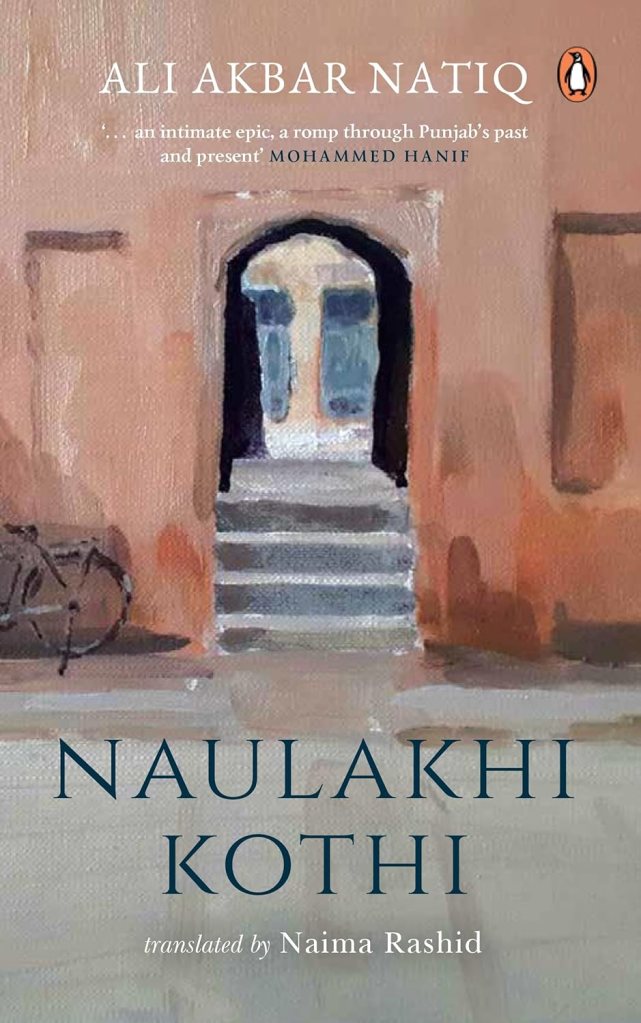
Naulakhi Kothi: A Saga by Ali Akbar Natiq

Book Review by Somdatta Mandal

Title: Naulakhi Kothi

Author: Ali Akbar Natiq (Written originally in Urdu)

Translator: Naima Rashid

Publisher: Penguin Random House India

The recent interest of big publishing houses in India venturing to bring out translated texts from various regional languages and bhasha[1] literatures into English is adding not only richness to the publishing arena but is also spreading the awareness of the existence of so many classic Indian texts which were inaccessible to the layman reader due to their inability to read the language used by the author. This has not only increased pan-Indian readership but spread the richness of Indian literature worldwide.

The novel, Naulakhi Kothi[2], containing 56 chapters and 464 pages, was written originally in Urdu by Ali Akbar Natiq, and has been translated into English by Naima Rashid. It contains a wide historical and meticulous geographical canvas in the micro-level as well as the sweeping narrative of rural Punjab that begins in British India and goes on in the years leading up to the Partition and ends around the nineteen-eighties. It brings us face to face with the lived culture of this place. The days of ordinary people of the entire rural Punjab region going about their business also come alive before us.

The wide canvas of Naulakhi Kothi offers more or less three simultaneous perspectives – that of the feud in the villages of Punjab between the Muslims and the Sikhs and the role of the British administrators who, in trying to maintain law and order in the region, also have their own axe to grind. In the sprawling canvas of characters, in the intricate, multi-layered world that Natiq conjures, with subtext, backstory and arcs, it seems as if we are literally living in the world and conversing daily with its contours.

The first chapter aptly titled “Homecoming” tells us the story of one of the protagonists of the novel, the Britisher, William, who after eight long years in England was returning to Hindustan, the land he had spent his childhood, to work as the newly appointed assistant commissioner of Jalalabad in eastern Punjab. He dreamt of returning ‘home’ to the idyllic Naulakhi Kothi, the titular bungalow built by his grandfather. The manner in which the Britishers had been spoilt silly in Hindustan made many families live like Nawabs and they lived a class apart – often more powerful than the kings who ruled the country. Throughout the novel William is warned by the hardened commissioner Hailey that his behaviour and softness towards the locals does not bode well for any British officer living in Hindustan. His nature was said to display “signs of a certain rebellion and a proclivity towards a poetic bent of mind”.  He was reminded that the British were there to rule these lands and not to romance them. He was asked to maintain a distance between the ruler and the ruled and in dispensing justice, distance himself from the wrongdoer and the wronged.

For the four years he was posted in Jalalabad, William took many radical steps. He toiled so diligently, putting his heart and soul in his work that he managed to change the entire face of the region. The standard of education alone had surpassed that in all other tehsils[3] of Punjab. He also had a new canal and several other small streams built. As a result of these, there was a plentiful supply of water across the tehsil, and an abundant produce of wheat, rice, and maize crops; a general well-being began to show on people’s faces. Because of his connections he could prevent his transfer from the place for some time but could not do so for ever. Through many twists and turns of events, after frequent transfers, and after the war broke out, he realised there was a grand conspiracy in which everyone had teamed up against him – the Hindus, the Muslims and the British. By the end of the novel, we find a decrepit old man who, shorn of his former British glory and power, living a lonely life in Naulakhi Kothi when his wife and children left him and went back to England. But soon he was even thrown out of that place to settle in one of the nehri kothis [4]nearby, and in the end, he died like a pauper with no one to even remember him. So much for his love for Hindustan!

The next sub-plot centres around Maulavi Karamat who for the past thirty years, had been the head imam of the small village mosque. The poor people of the village who could barely make ends meet, could not pay him a salary but instead supplied him with rotis daily which were religiously collected every day by his son Fazal Din. Whatever Maulavi Karamat had learnt from his father, Ahmed Din, and even that which he didn’t fully know, he used to transfer it all to Fazal Din, for the survival of their family rested with him. The fortunes of this man took a good turn when he was appointed by William to become the head munshi in Jalalabad and teach Urdu, Arabic and Persian to young children. This move was basically undertaken to do away with the disparity and poor percentage of Muslim students attending the government schools. From then on, we find Maulavi’s fortunes rising and gradually his son Fazal Din turns into a mature and sensible sarkari babu[5]. After two years of working at the Governor House, Fazal Din had enough to buy his own land and build a house. Post Partition, Fazal Din’s work increased considerably and with adequate means to prepare false property documents, he got enmeshed in corruption and amassed a great amount of wealth. His desire to learn more English and to go to Britain to rise above his class is an example often found among those who worked in the administrative service of the government.

The other most significant strand in the narrative is of course the constant enmity between the Muslims and the Sikhs. We are given the story of Sher Haidar who was the zamindar of a certain area being killed by Sardar Sauda Singh and his men — not in a clandestine way, but in an open, offensive manner. Ghulam Haidar, the son of Sher Haidar was entrusted by his subjects and relatives who pledged their loyalty to the new heir to take revenge of the killing and after a lot of incidents, looting, and fighting that ensues between the two rival religious groups, their fortunes kept fluctuating while the ordinary villagers continue suffering. The Sikh leader who was accused of murder remains free and he showed his prowess by moving around with arms in the open. Detailed descriptions of attack and counterattacks between the warring groups are narrated meticulously and one becomes aware of the looting, arson and treachery that prevailed in the villages of Punjab at that time.

It is difficult do justice to the vast canvas of storyline that Natiq so brilliantly interweaves throughout the novel in this review. The problems the British rulers faced during the world war, the changing equations in the country with the Quit India Movement, Jinnah’s policy for an independent Pakistan, the role of the Muslim League, the silent exodus of the British leaving Hindustan, the idea of Partition that had silently started ripping the population apart,  the resultant flow of refugees after the Partition was officially declared, the exodus – all these find detailed mention in the narrative as well.

Ali Akbar Natiq’s unique narrative style and the equally brilliant translation by Naima Rashid that stays close to the Urdu text preserving the flavour of Urdu sprinkled with regional dialect is to be really appreciated. There are no footnotes or glossaries but the context holds enough clues for flow of the narrative. In the translator’s note at the beginning, Rashid mentions that in the creative choices she has made. She favoured the mood and tone of the original – “If it’s bitingly sarcastic or insulting in the original, I’ve attempted to recreate the same tone and tailored the other choices accordingly.”  Throughout the novel the very detailed descriptions of characters and incidents create a great visual impact upon the reader, and we see the sequences like we do in films. Natiq has managed to cover such a wide canvas of the storyline with dexterity by juxtaposing chapters in such a way that they unfold like a cinematic reel in front of our eyes. Thus, despite its length, this novel with its social, political, religious, historical, and geographical issues covering a wide cross-section of the Punjab region remains a page-turner and is strongly recommended for all classes of reader alike.

.

[1]  Language, referring to different languages of India

[2] Translates to House of nine lakhs(ninety thousand)

[3] Subdistricts

[4] Houses by the river

[5] Government officer

Somdatta Mandal, critic, academic, and translator is a former professor of English at Visva-Bharati, Santiniketan, India.

PLEASE NOTE: ARTICLES CAN ONLY BE REPRODUCED IN OTHER SITES WITH DUE ACKNOWLEDGEMENT TO BORDERLESS JOURNAL

Click here to access the Borderless anthology, Monalisa No Longer Smiles

Click here to access Monalisa No Longer Smiles on Kindle Amazon International

Categories
Poets, Poetry & Rhys Hughes

A Parody of a Non-existing Parody: The Recycled Sea

By Rhys Hughes

I wrote this work on my honeymoon on a remote coffee plantation in the mountains. It is surely obvious which major poem inspired it, namely the famous disjointed epic by T.S. Eliot that I have struggled to understand since I first encountered it. But although The Waste Land baffles me, I can’t dismiss it as nonsense. It has a logic I find obscure, yet I have no doubt it is authentic literature. Therefore, my own effort isn’t a parody. A parody requires a good understanding of the thing that is being parodied, a willingness to oppose it, or at least to disagree in part with it. I am unable to disagree with what I don’t comprehend. And so, my poem isn’t a parody of Eliot’s famous poem, but a parody of the poem I might have written if I had written a parody. It is a parody of a parody that doesn’t exist.

1: The Denial of the Trees

October is kind: the pumpkin
headed men
with toppled isosceles eyes
are satisfied.
The wise befriend the skies: bone
dry the hallowed
undersides
of the sober-minded anthropophagi
still mummified.
They cogitate clearly, those fellows:
one thought alone
ladled from the universal soup
pressed flat and joined
into an eternal loop: October is kind.

The leaves that sweep my face,
tongues of autumn winds
made visible: in the forest the trees
gradually mimic
old bicycles, skeleton finger spokes.
The path wanders away,
slowly deflating.
The puncture is the part
of the dream not worth pursuing
and yet we hasten
to pedal our goods into oblivion.

Alice is making daisy chains.
Daisy is oiling tandem bicycle
wheels again.

This is the realm
where everyone hurries.
The Haste Land.
And the only way out
is to float unafraid
on the stream that rises
in the glade
of snake-tongued Narcissus
and hope it hasn’t been dammed
before it reaches
the mouth
in the shade of understanding.


2: The Backgammon Front

The dice are shook, our nerves rattled
as the trenches fill
with bets: the surly players no longer
smoke cigarettes.
Ifs and buts, whiffs and butts,
they hunker in the nettles
whistling tunes of breakfast longing
they learned from steaming kettles.
Counters, saucers, the forces of good
are evil: the weevils
in the biscuit wait, hibiscus blooms
meditate, always odourless.
One quarter insane already
and it’s getting worse:
the terse verse
is a curse that won’t be lifted soon.
The pips of the dice
are like pumpkin seeds: the scarecrows
aren’t pleased.
But is this really war?


3: Advice About Water

The poor man pours
while the fat cyclist puffs past
and the future
is never an unwrapped present.
The ribbon is the thing
that won’t be untied: both tried
in their own way.
Today the pump has broken,
the water thickens as it trickles out
and the cyclist gives a shout
as he plunges through.
I knew you well in the days
before grinding wheels
when the spray of an accidental puddle
was unremarkable.

Daisy, Daisy,
give me an answer, do.
Mary, Mary, quite contrary,
the question was not
put to you.

The track becomes a path,
the path a road,
and the road slopes down to the eerie
quayside: wide enough
for the ships of petrified wood to knock
against full length.
We lack the strength to marvel at this:
an illicit kiss
between land and sea, fortunately brief.
The hulls were damaged
on some distant reef
and sluggish the overused crews.

On the horizon a whirlpool
of gigantic size
washes the sails of the vessels
it has turned
to splinters: those made of metal
are still intact
but rattling like shirt buttons
in the deep spiral.
Mostly the maelstrom destroys
but sometimes the helix
can fix ancient wrecks,
joining snapped planks back together
and the only question
is whether
anybody truly wants this.

The fat cyclist can’t say.
Out of breath
but never out of pocket
he is still
too far away
to have a worthwhile opinion.


4: The Triangular Raft

Adrift, the shipwrecked sailor
clings to planks
nailed into the shape
of a pumpkin headed man’s eyes.
He is the traumatised
sum of all the internal angles.
Spangles of salt spray
and he glistens like a society woman
who is drowning
in champagne.

Daisy, Daisy,
how does your garden grow?
I’m half crazy.

He had already dried his hair.
It wasn’t fair.
The waves had the last word.
But what was
the first ever uttered? Thirst!
He wouldn’t dare
to sip the brine in which he flowed
like time: the wine
of extinction.

The garden under the sea
will welcome
his bones to their new home
eventually.
The society woman is drinking tea
and politely refusing
to voice her views,
the same way she declines to observe
her worthless words.


5: Lightning on Strike

For higher pay
the atmosphere won’t obey
those dictates
of meteorologists called predictions.
Today the lightning
has a predilection to be absent
in the valley yonder.

I was breaking nuts
with a hammer in the toolshed
and I thought you said:
the thunder still rumbles, the bed
is rotating, our fate
insists that I remain under the weather.
Take my temperature, quick!
Take it far away,
release it into the wild, far beyond
the pumpkin fields.

But I was mistaken.
While breaking shells that boomed
quite unlike bells,
my ears were playing tricks:
you do not exist.

Daisy, Daisy,
or is it Ruth now?
the pumpkins are aglow.
We will always find
at the back of our minds
one simple truth:
other months might be mean,
cannibal chewed, serpentine,
but October is kind.

Rhys Hughes has lived in many countries. He graduated as an engineer but currently works as a tutor of mathematics. Since his first book was published in 1995 he has had fifty other books published and his work has been translated into ten languages.

.

PLEASE NOTE: ARTICLES CAN ONLY BE REPRODUCED IN OTHER SITES WITH DUE ACKNOWLEDGEMENT TO BORDERLESS JOURNAL

Click here to access the Borderless anthology, Monalisa No Longer Smiles

Click here to access Monalisa No Longer Smiles on Kindle Amazon International

Categories
Poetry

And There in This City

By R.S.

Courtesy: Creative Commons
The swallows flew south,
Gathering on telephone wires.
The streets grumbled and huffed,
Weighed down by grey tyres.

The city ripped at the seams,
Worn-out, frowned.
In the sea of apathy,
Voices dwindled and drowned.

Joy shrivelled and wept,
waylaid in a corner—
Itself, the pallbearer 
And the mourner.

The lamp posts blinked and sighed,
In the midst of commotion
And the piers dangled their feet,
In the sleepy blue ocean.

Radhika Soni (R.S.) writes poetry to find harmony in life. She is greatly influenced and inspired by the poetry of Percy Bysshe Shelley, Lord Byron, Edgar Allan Poe, Robert Frost, Pablo Neruda, W.H. Auden and William Butler Yeats to name a few. She loves nature walks and rises early to draw inspiration from the morning star.

.

PLEASE NOTE: ARTICLES CAN ONLY BE REPRODUCED IN OTHER SITES WITH DUE ACKNOWLEDGEMENT TO BORDERLESS JOURNAL

Click here to access the Borderless anthology, Monalisa No Longer Smiles

Click here to access Monalisa No Longer Smiles on Kindle Amazon International