
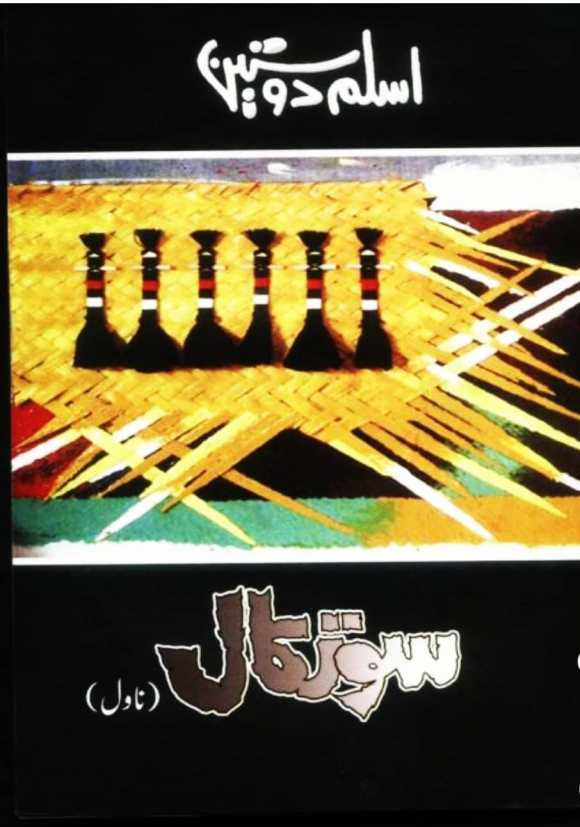
An excerpt from Aslam Dostan’s novel, Sótkál, been translated from Balochi by Fazal Baloch
Whenever Asumi spoke of Noddranzán, his words seemed to brim with longing. He was often found talking about the coast of Noddranzán.
Asumi was my cousin, and we were the same age. In the beginning, he was a shepherd like me, but later he began travelling with camel caravans and took up trading. He spoke so admiringly of the coast simply to tempt me and stir my curiosity.
As far back as I can remember, I had never been beyond Sótkál, except once. I have only a faint memory of it. My grandfather had taken me with him down to the coastal region to offer condolences. After that, my entire world was Sótkál. There was hardly anything in Sótkál that escaped my eyes. I knew where water could be found, where the trees and the shades rustled, where the ravines and gorges lay, and which areas were infested with ferocious wild beasts.
Grandfather used to say: “A shepherd who does not know his flock, its ways, and its temperament can never truly be a shepherd. And here, in rain and storms, to be unfamiliar with the temperament of the river that comes surging from the far reaches of Sótkál is to invite your own destruction.”
Grandfather had another story to tell. Once, a group of the British came here determined to find the source of the Sótkál River. Starting from here, they travelled northward, covering some eighteen manzil[1], but eventually grew exhausted and turned back. They said they had done everything they could, but they could not find its source. That is why only those who live along its banks truly understand the temperament of this river, and that, indeed, is the truth.
For as long as I can remember, my entire universe has been these sheep and goats. Grandfather said only this to me: “Ghulamuk, my son! This flock is yours now. You know what to do with it.”
I had no other work besides this. From dawn until I went to bed at night, I was occupied with the flock. Grandfather had, with great wisdom, kept me busy. It took me many years to understand that there could hardly be a greater calling than this.
Whether it was the scorching sun, the freezing winter rains and storms, or the hot, blistering winds of summer, I could find no rest. I was forever responsible for guarding and tending the flock: making sure that no goat fell into a ravine and broke its bones, that none wandered off and got lost, that no beast of prey carried one away, and that no goat drank all of its own milk.
By virtue of being a shepherd, I came to know every corner of the wilderness. Sometimes I would take the flock to the ravine of Kachól, sometimes to the Basshám Pass. At times I could be seen wandering with them through the desert of Mojén Dém, and at others in Masháni. But there was still one place in Sótkál that I had never taken the flock: Jinnani Jomp—The Mounds of the Jinns.”
Grandfather had strictly forbidden me from going there. “Ghulamuk, my child! You may go wherever you please in every corner of Sótkál, but never, ever turn towards the Mounds of the Jinns.”
We were allowed neither questions nor arguments. Whenever such a thing seemed about to arise, Grandfather would stop us before we could even finish speaking.We were always under his watchful eye.
“Don’t put your hands on your head, boy!”
“Don’t stand on the threshold. It is the time of sunset.”
“Straighten your slippers. They’re lying upside down.”
We always carried within us the fear that whatever we did, Grandfather would see it.
Except for one occasion, he had never actually beaten us. But threats, scolding, and warning us with nothing more than a look were part of his everyday manner.
God knows whether we had a guest that day or what the occasion was, but that day Grandfather slaughtered the hen with black-and-white feathers and had it cooked for lunch. We all sat down together for the meal. Everyone began to eat, but Asumi kept his hands to himself.
“What’s the matter, boy? Why aren’t you eating?” Grandfather asked.
“Grandpa, I don’t eat chicken,” Asumi replied.
“You don’t eat chicken? Why not?”
“I don’t eat chicken because chickens eat lizards.”
A look of disgust passed over everyone’s face, but no one said a word.
“So, chickens have only just started eating lizards, have they? They were eating lizards before you were born, and they’ll go on eating them long after you’re dead. Come on, start eating, and don’t talk such nonsense.”
“No, Grandpa. I don’t eat chickens that…”
Asumi had not even finished the sentence when a slap landed just below his ear. Everyone was startled, but no one dared say anything.
“You think you’re clever enough to make arguments? Eat, and be done with it. Didn’t I tell you never to find fault with the food?”
Without uttering another word, Asumi lowered his head and began to eat.
From that day onward, Asumi stopped finding fault with things. I am certain that no sage, mullah, or learned man could have cured him of that habit so swiftly. Yet one hard slap from Grandfather set him right in a moment.
Grandfather would always say, “Don’t be in a hurry. With time, you will ripen into wisdom.”
No one ever sat us down to advise or teach us the ways of the world. With the passing of time, we learned and gathered our share of experience.
How right Grandfather had been!
***
One scorching day, one of the straps of my sawás[2] snapped. I tried as hard as I could to mend it, but everything I did couldn’t fix it. The earth was burning like an oven, with waves of heat rising from it, while the goats of my flock had scattered in every direction.
Reluctantly, I set out across the scorching ground and gathered the flock. When I finally returned and sat down beneath a tree, I looked at my bare feet and felt tears welling up in my eyes. They were covered in blisters, some as large as lemons.
At dusk, I drove the flock home. By then, I could hardly put my blistered feet to the ground. The moment I reached home, I went straight to Grandfather.
“Look at my feet. Just look at how badly they’re blistered! This broken strap has caused me so much trouble. Please make me a new pair of sawás, whatever it takes.”
When Grandfather saw my blistered feet, he replied with a touch of sarcasm: “All right, son. Go and soak the dwarf-palm leaves in water. After dinner, I’ll make you a new pair”.
I did exactly as Grandfather had told me. After dinner, Grandfather sat talking with the family for a while. Then he lay down and soon drifted off to sleep. I thought to myself that perhaps he would make them for me early the next morning.
The next morning, I saw Grandfather heading towards the fields, a shovel slung over his shoulder.
“Grandpa, what about my sawás?” I called out.
“Oh, damn! I completely forgot,” he said with a laugh. “Never mind. You go on. I’ll ask a man named Nakam to make you a pair.”
I took my flock, tucked the dwarf-palm leaves under my arm, and set off towards the jungle, hoping to find Nakam there.
I waited for him for a long time, but there was no sign of him anywhere. My feet were still covered in the blisters I had got the day before, and I had no strength left to walk under the blazing sun.
There was no sign of Nakam.
“What am I supposed to do now, O God?” I wondered.
To hell with him. Let him come or stay away. Why should he care? It’s my feet that are covered in blisters. With that thought, I set about making the sawás myself. I had watched people make them before, so I knew more or less what to do. They might not have been perfect, but somehow, I managed to make myself a new pair.
I was overjoyed. At last, I thought, my feet would no longer have to suffer the burning ground. When I returned home, Grandfather looked at me and, as usual, asked with a teasing smile: “So, my son, did Nakam ever show up?”
“Grandpa, why did you make me believe that a man named Nakam would come and make me a pair of sawás? I waited for him for ages, but he never came,” I replied, a little irritated.
“My son, the truth is, there is no man named Nakam in the whole hamlet. I told you about him because you are a shepherd, and you must learn to fend for yourself. If I make your sawás for you today, what will you do tomorrow?”
Then he added: “Ghulamok, my son, learn to take care of your own needs. Do not sit around waiting for someone named Nakam, because there is no such man in the entire hamlet.”
[1] Manzil: A Day-long journey equivalent to forty-eight mile
[2] Sawás*: Traditional handcrafted Balochi slippers made of dwarf-palm leaves.

Fazal Baloch is a Balochi writer and translator. He has translated many Balochi poems and short stories into English. His translations have been featured in Pakistani Literature published by Pakistan Academy of Letters and in the form of books and anthologies. He has the translation rights of this novel.
PLEASE NOTE: ARTICLES CAN ONLY BE REPRODUCED IN OTHER SITES WITH DUE ACKNOWLEDGEMENT TO BORDERLESS JOURNAL
Click here to access Wild Winds: The Borderless Anthology of Poems
Click here to access the Borderless anthology, Monalisa No Longer Smiles
