The first thing I realised while walking around London is that not a single one of all the people I had known who had been to England, told me how charming the city is. The buses with open tops, the red telephone booths, Big Ben, the London Bridge and all those pretty buildings simply fascinated us. So, before heading out for Haworth, we walked around in London and took Duck’s tour and saw some really enchanting stuff.
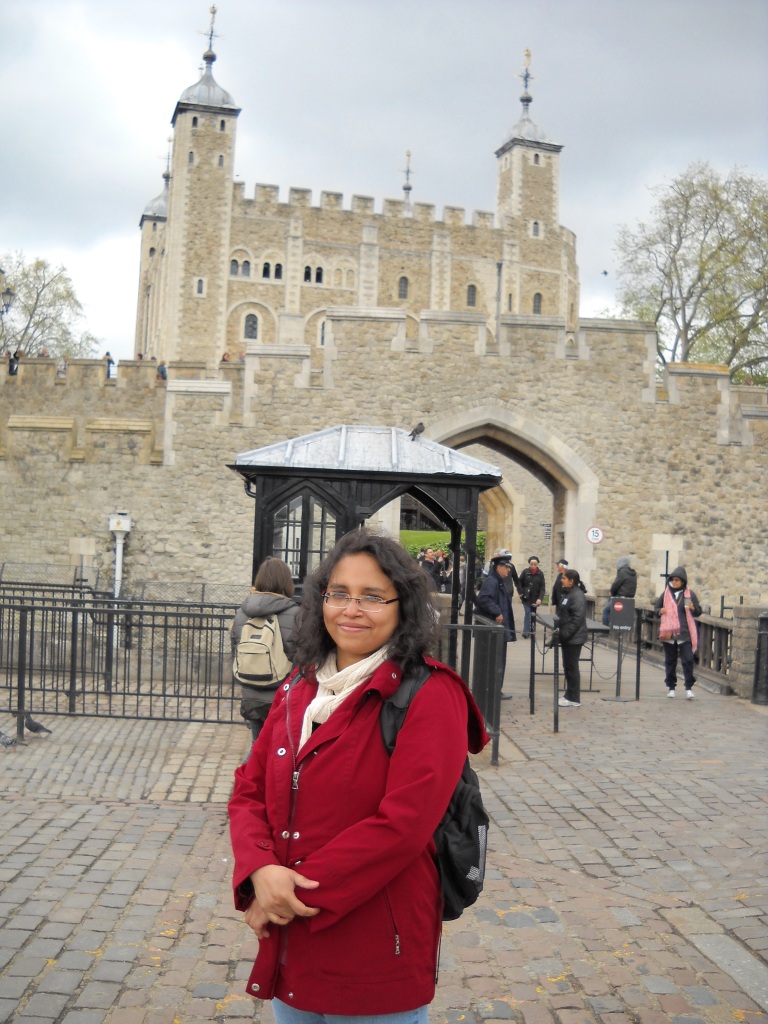
Sohana at the Tower of London
We spent a large part of a day at the famed Tower of London, which is literally a thousand years old, first built by William the Conqueror in the 11th century. Our visit began with a tour by a Beefeater (also known as a Yeoman Warder), who gave us a general overview of the Tower’s history. He had a wicked sense of humor and kept making puns like “Let’s be heading this way.” We saw Tower Hill, the site of public executions on the scaffold, and also Tower Green, where Anne Boleyn and Lady Jane Grey were executed – the spot is now commemorated by a glass sculpture with a pillow on top. The tour ended at the Chapel Royal of St Peter ad Vincula where those executed on Tower Green (including Boleyn and Jane Grey) are buried. Afterwards, we took a picture with the Beefeater outside the chapel.
Next, we went to the building that houses the Crown Jewels. Our eyes were dazzled by the rich display of crowns, scepters, and orbs bejeweled with diamonds, rubies, sapphires, and every kind of precious stone possible in the vault. We also saw the famed Kohinoor diamond, set in the Queen Mother’s crown, as well as the crown worn by the late Queen Elizabeth II. After the crown jewels, there was also a section of gold plates, serving dishes, goblets, wine jugs, etc. that were used for ceremonial occasions by various monarchs. We will probably never again see such a display of wealth, and perhaps there is no other place with so much wealth on display in one place. However, all the gold and perhaps some of the obnoxious histories attached with the splendour on display started to make me feel nauseous, so I was glad to get out into the open air.
We looked around in the White Tower, which stands in the center with a display of military equipment and history. Then we went to the Beauchamp Tower, which is known for the graffiti on the walls left by various prisoners, including some very high-profile ones. At one point, when I saw the graffiti attributed to Robert Dudley, Earl of Leicester, I stood rooted to the spot. It was incredible to think we were standing in the same room where such illustrious prisoners once lived, carving their convictions into the walls.
We walked around the grounds, taking pictures, and then came across some costumed characters, including James Scott, Duke of Monmouth, who posed with me graciously for a picture. The costumed characters put on a dramatic reenactment of James trying to claim the throne. James Scott is the fellow who required several blows of the axe, followed by a butcher knife, during his beheading on Tower Hill by the half-drunk Jack Ketch. The Beefeater told us the story in all its gory detail, though the reenactment, thankfully, included the trial but not the execution.
We took pictures, including one of Nausheen posing with a raven. These birdsare kept and bred on the grounds of the Tower. Apparently, they have kept at least half a dozen ravens since the time of Charles II, who thought the Tower would fall and the empire disintegrate if he did not always keep ravens there. There is even one beefeater whose job it is to feed and take care of the ravens! Finally, we also saw the room where Sir Walter Raleigh was imprisoned for many years, and the place where he used to walk back and forth (now called Raleigh’s Walk), and I got goose bumps.
Our day ended with a brief stop at Tate Modern, which is just across the river from the Tower. I’m not really into modern art, and as I paused in front of a famous painting by Picasso, I had to admit that I understood nothing about its greatness. To me it looked like a misshapen human figure lying on its side. Nausheen kept on dancing around the pieces and went on explaining what she had learnt in conjunction with modern poetry.
The Parliament & Big Ben
Next morning, we passed Big Ben and the Houses of Parliament on our way to Westminster Abbey where kings and queens are still coronated, and where many notable historical, political, and literary figures are buried. It was very crowded, but also a very solemn kind of place – kind of dark and gloomy, with tombs and effigies all around, and Latin epitaphs everywhere. Many of England’s kings and queens are buried here, and we saw the tombs of Henry VII, Elizabeth I, Bloody Mary, and Mary Queen of Scots. The tomb of Queen Elizabeth felt unreal – almost as if it was part of a dream I had nurtured for long.
Eventually, we made our way to the Poets’ Corner, which Nausheen was especially eager to see. She got excited seeing the tomb of Chaucer, who was the first to be buried in the Poets’ Corner. We both patted the tomb in homage to the great man. We also saw tombs of various other poets and writers, such as Austen and Dickens, and memorials to writers who are buried elsewhere, but commemorated here nonetheless, such as Shakespeare and the Brontës. Finally, we stopped at the museum shop to buy some souvenirs.
The afternoon saw us at the Tate Britain. We took a tour with one of the museum guides, who took us through the Turner wing. It was really great that they have an entire wing devoted to Turner, since his work is familiar to me from my dissertation supervisor, Dr. Collins’s course. There were also paintings by Constable and Gainsborough, but of course, Turner’s are the most dramatic and majestic. There was also a smaller wing dedicated to Blake’s prints, paintings, and engravings. However, the ones that are most familiar to us, from Songs of Innocence and Experience, are mostly elsewhere, such as in the British Museum, so there were only a handful of those.
The next day was cold and gloomy and we decided to stay in. We made plans of visiting Hampstead, the home of the young Romantic poet John Keats the day after. I knew days would be bad as I was developing a fever. But I could surely rest for one day.
Sohana Manzoor is an Associate Professor at the Department of English and Humanities at ULAB, a short story writer, a translator, an essayist and an artist. This essay was previously published in The Daily Star in January 2019.
PLEASE NOTE: ARTICLES CAN ONLY BE REPRODUCED IN OTHER SITES WITH DUE ACKNOWLEDGEMENT TO BORDERLESS JOURNAL
I had died seven years earlier,
and she played Chopin's Nocturnes each night,
danced under that great gushing Monet,
so that I was with her and not without,
the pulling Joy behind that sudden knowing smile
bathed in candlelight.
Ryan Quinn Flanagan is a Canadian-born author residing in Elliot Lake, Ontario, Canada with his wife and many bears that rifle through his garbage. His work can be found both in print and online in such places as: Evergreen Review, The New York Quarterly, Borderless Journal, GloMag, Red Fez, and Lothlorien Poetry Journal.
PLEASE NOTE: ARTICLES CAN ONLY BE REPRODUCED IN OTHER SITES WITH DUE ACKNOWLEDGEMENT TO BORDERLESS JOURNAL
The good folk of Black Rock, Montana, USA, were not overly enthusiastic that a small, travelling circus would be coming to their peaceful town to make a one-night performance. They had heard disturbing stories about this circus from people out of state who had seen it or pretended to have seen it. Rip Branco, the mayor of Black Rock, felt a bit reluctant about authorising the performance, but the owners’ arguments won him over, half-heartedly. Besides, the children of Black Rock had never had the pleasure of seeing a circus, nor their parents for that matter.
So, many posters of the coming circus were nailed or pasted on the outer walls of the townhall, the school and at the farmers’ and factory workers’ cooperatives.
Strange tales circulated throughout the region: the performers originated from the Old World speaking alien tongues. Hearsay spread that many of the performers were abnormal individuals, freaks of nature, they said; and that the whole show was a razzle-dazzle of shamelessness, cynicism. What if this hearsay was the truth! The majority of the folks of Black Rock were convinced of its veracity.
In spite of all this hullabaloo the circus rumbled into town. Through the narrow, main avenue of Black Rock, lined with shops, banks, the townhall, the police-station and the Wednesday open-air market, crawled ten or eleven caravans painted in colourful figures of clowns, mountebanks, lions and elephants, and odd looking creatures whose appearances the townspeople, gaped at wide-eyed. They watched this slow-moving spectacle as they stood on each side of the avenue like rows of sentinels or pine-trees. The rear-guard of the caravan was composed of a cage with two dozing lions, behind whom plodded two baby elephants, lethargically swaying their trunks, every now and then emitting a trumpeting cry as if they were announcing the arrival of the courtly cortege …
No one uttered a word as the caravan disappeared into the weedy fields outside the town, designated by the mayor for their one-night performance.
Before the astonished eyes of the townsfolk, many of whom had rushed out to the field leaving their shops unoccupied, men, women and other ‘odd’ individuals scrambled to and thro, pitching, erecting, raising, until the top-tent loomed large and welcoming before them. Admission was a mere two dollars, a comfortable fee for the good people of Black Rock, a fee, too, considered a largesse on the part of the owners given the fact that the performers had no peer on earth … Or so they said.
At eight o’clock sharp the flaps of the big-top were flung open to the mistrustful but curious folks of Black Rock. Mayor Rip Branco, with his wife and two young boys, was the first to be admitted, then the town’s children, all to be seated in the first six or seven rows of the grandstand. Next to shuffle in were the farmers, factory workers, bankers and shopkeepers with or without their wives, conducted to the stalls flanking the grandstand. No animals were permitted. Many of the men grumbled protestations or sardonic remarks, but the ticket seller, a smiling dwarf sporting a torero costume, took no heed.
When the spectators had settled in comfortably the lights went out. A blast of music boomed out of the pitch black. Trombones, trumpets, hand-drums and tambourines filling the big-top with rhythms and melodies very foreign to the ears of the spectators. A huge spotlight fell on five or six colourfully-dressed individuals in the ring masquerading as some sort of rag-time band, blowing or banging their instruments as they danced about in happy-go-lucky abandon. The ring-master stepped out of this motley crew, pushing and shoving them aside, lashing out with his whip towards the more recalcitrant ones, who, in defiance of the snapping whip, blew out scales of disobedience. He bowed to the spectators in the most obsequious manner, doffing his black top hat. One of the musicians handed him a huge megaphone and he bellowed :
“Ladies and gents … and children too, tonight is the night of all nights, one you will never forget. All of you will witness the most rollicking merry-makers that have stalked our good earth; the most incorrigible buffoons who have ever lived. Your eyes will feast upon a jamboree of dancing, jestering and cavorting oddities whose dazzling shenanigans have always made children shriek, women scream, men doubt their senses. But I can assure you every stunt, every act, every gesture, however burlesque, is of the utmost authenticity.” Whether all the spectators were able to decipherthe ring-master’s opening tirade is difficult toassess. In any case, he went on: “ Now, let me present the strongest man on Earth, the nameless giant of Central Asia.” And as he cracked his whip the musicians fled into the darkness behind him. Out of that mysterious dark, the nameless giant charged into the middle of the arena like a raging bull. The master of ceremonies fled as if for his life. Snorting and grunting, the colossus, clad only in a tiger-skin loin-cloth, flexed his biceps, threw out his mighty chest, tightened his thigh muscles. He was indeed a mountain of muscle. Meanwhile popcorn and cotton candy were being distributed to the children, free of charge. Mayor Branco and his family also benefitted from this boon …
The strongman made horrible grimaces at the children who shrank back in their seats, squealing. He stomped about snarling and growling, flaunting his muscle-laden body until out rushed seven little dwarves dressed as toreros, all of them brandishing a bullfighter’s cape. They swarmed about the now enraged strongman, waving their capes and taunting him with obscene gestures and cuss words. The strongman charged into them head down like a bull, snorting and panting, swinging his bull-like neck from left to right, knocking a few dwarves to the sandy soil of the arena. Just as the crowd began to display overt displeasure at this unseemly spectacle with hoots and hollers (except the children who were cheering on both), two dwarves jumped up on to the strongman’s massive shoulders, followed promptly by all the rest, where gradually they formed a little pyramid atop this mountain of a man, who presently much appeased, pranced about in the spotlight with his ‘captured’ dwarves’, singing a song in some alien tongue. The dwarves hectored the dwarf-bearer, chaffing him with the crudest of names, smacking his massive face or slapping the top of his bald head with pudgy hands. With one mighty shake of the head, the strongman shook them all off into the air like so many swarms of flies, they, tumbling and rolling away, far enough from him where they continued to gesture indecorously.
Many spectators began to boo and hoot. Others laughed and cheered, especially the children, who munched happily on their cotton-candy and popcorn. “Shame! Shame!” cried out several women from the stalls. But their rebukes were drowned out by two or three applauding groups of farmers who apparently had been drinking before the performance. In fact many men were drunk, and the majority were taking much delight in this unusual spectacle …
Just then, at the crack of the ring-master’s whip, the dwarves rolled out of the arena and the strongman stomped away, bowing to the crowd. Into the ring now appeared five very weird-looking creatures, and behind them, as if by magic, a long, high tightrope that had been erected, held up by two very high wooden ladders. The spectators were baffled: humans or animals? Three, perhaps women, had faces of lions, whose ‘manes’ grew out of their cheeks, rolling in thick strands down to their feet. It was a horrible sight! But more horrible still were the two-headed and the mule-faced women, dark faces drooping down to their necks. Gasps rose from the crowd. Cries of indignation followed.
“Freaks ! Monsters!” they rasped and raged at the smiling ring-master who introduced his acrobats and trapeze performers, one by one, as the finest in the land whilst they speedily climbed up the ladders, three to the left, two to the right. At the top, they tip-toed out on to the thin wire where in burlesque abandon they danced and pranced and sang, the wire swaying to and fro. One or two juggled little red balls, tossing them over the heads of the others who attempted to catch them. Far below, the master of ceremonies whipped his whip and the merry acrobats danced and pranced all the more ardently, one or two on one foot, as the wire rocked, rolled and pitched like a boat. Terrified shrieks rose from the now standing crowd. Farmers and factory workers showed their fists. Women shouted abuse. As to the children and Mayor Branco, they clapped in rhythm to the singing quintet rocking and rolling on that tightrope.
At that point Mayor Branco turned towards the displeased crowd behind him, confused about what attitude to adopt. There was no doubt that the acrobats and trapeze performers were genuine artists ; their antics on that high wire brooked no belief of beguilement. And however ‘freakish’ they appeared to be, this awful birth-born deformity should welcome a hearty appraisal. Which the good mayor did from the bottom of his heart when the five performers had slid down the ladders, taken their bows in the middle of the ring and disappeared behind the rear flaps of the top-tent.
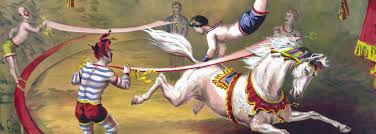
Much of the crowd were on its feet, red-faced (due to their drinking ?), shouting down to the ring-master as he cracked his whip violently: once … twice … thrice, signal which brought out two ferocious, roaring lions[1] shaking their manes. The spotlights followed their proud steps as they neared the front rows of the grandstands. There they sniffed the cotton candy of the now terrified children who recoiled in their seats. Their parents rushed to their rescue, but this was unnecessary, for another crack of the whip — and the accompanying spotlight — brought out a three-legged man and a pin-headed man. They strolled towards the sniffing lions, calling them by their names. One of the lions began lapping the popcorn out of the outstretched hands of several children who squealed in wary delight. Then the lion licked those charitable hands in grunting gratitude.
The pin-headed man whistled. The huge beast turned and trotted to him. He waved to the crowd then opened the lion’s mouth, pushing his pin head into it. As to the three-legged man, he had hopped on to the other lion’s back, two legs at its flanks and one lying over its fluffy mane. With a deafening yelp and roar, they galloped around the ring as if they were at a rodeo show, rushing around the pin-headed man whose whole tiny body had by now completely disappeared in that lion’s open mouth. The crowd held their breaths uncertain of the stance they should take on this stunt. Could a man possibly crawl into a lion’s massive maw ? The drunken farmers laughed grossly. Their wives sneered in contempt. The children sat in excited expectation.
Meanwhile another spotlight had fallen on a beautiful milky-white woman clad in a silken gown, standing upright against a large board placed behind her. Another spotlight swung to the left where a legless man, using his arms like a pair of crutches, had positioned himself ten or fifteen feet from the upright woman, a huge leather belt girding his chest from which hung dozens of kitchen knives. Between this scene and the lion-tamers’ antics, the spectators remained nonplussed, no longer hooting or hectoring.
The legless man swiftly took a knife and threw it at the lovely girl; it drove into the back board a quarter of an inch from the crown of her head. Here the crowd puffed in awe. Many women covered their eyes whilst the children were all eyes! He threw another and another. After each knife thrown, the crowd gasped a huge gasp! The legless man continued his act, each knife working rapidly downwards from the woman’s head, around her exquisite shoulders, along her slim, graceful hips, lengthwise her bare, slender legs until reaching those minute feet of hers. When he had finished his knife-throwing performance, the beaming, long-haired woman stepped out from the contour of the knives, the spotlight proudly exhibiting her ravishing silhouette configured on the board. With a gesture of triumph, she pointed to that silhouette, then glided over to the legless man, took him by the arm and both bowed reverently to the crowd. The men jumped up cheering wildly, either out of respect for the knife-throwing performer or for the ravishing beauty of the woman. As to their wives, they remained seated, smugly looking towards the ring, disregarding their drunken husbands’ sonorous applause. Mayor Branco was on his feet applauding along with his two boys, his wife tugging at his sleeve to sit so as not to make a spectacle of himself.
All of a sudden two spotlights swept over the galloping lion and the one that, it would seem, had all but swallowed the pin-headed man. But no ! Look … there … The lion yawned a wide yawn and out of that yawn the pin-headed man leapt, running about the ring crying out: “I’ve lost me head ! I’ve lost me head!” The crowd, stunned by these uncouth shenanigans, again began yelling insults. As to the galloping lion and its whooping cavalier, they darted to the right, where in front of them a huge hoop had been magically placed; a fiery hoop whose leaping flames hissed and sizzled. Through the hoop they jumped followed by the other lion, tailed by the waddling pin-headed man who dived through the hoop, tumbled over on the other side, got up, dusted himself off, then bowed to the hypnotised spectators. The children at once howled with joy. The adults, hesitant as to the ‘quality’ of this extravagant act, remained stoic, frowning.
The band struck up a local tune, horns and drums ushering in a motley gaggle of clowns rushing about the ring like escaped madmen from an asylum. In their frantic scuffle, two or three of them were tossing about a strange object, flinging it about like a football. A sudden shiver of horror swept through the crowd: those merry-making buffoons were passing a living torso to one another! A man without arms or legs! He had a huge smile on his face as he sailed in the air from one pair of arms to another. Then the clowns broke into a song: “ Zozo the clown and his funny hat, patches on his pants and he’s big and fat, long flappy shoes and a round, red nose, makes people laugh wherever he may go!” These lyrics were repeated without respite as they played football with the torso, who, and it must be stated here, was crying out for joy!
Enough was enough! “ Monsters! Monsters!” cried out groups of red-faced, infuriated men from the back of the stalls, screwing up their eyes. Rotten tomatoes were thrown at the shameless buffoons by the farmers who had brought them along for the occasion. Ladies screamed. The children sat in dazed awe, following each pass of the laughing torso as if they were following a football match. The frolicking clowns, undismayed by the tomatoes, performed cartwheels and somersaults from one end of the ring to the other.
But it was the following scene that left the crowd dumbfounded. As the laughing torso was thrown from clown to clown, spurts of orange flames spouted from his mouth! Long fiery flames that carved out tunnels of blazing light as he arched high in the air. This surreal scene rendered the crowd, momentarily, mute with puzzled, ambiguous emotions. They soon, however, regained their initial, infuriated state.
In the last rows of the stalls, rowdies were making a tremendous row, brawling with the bankers and notaries who had shown, up till then, an impassioned interest in these performances. Fisticuffs broke out. Faces were slapped or punched. Hair and beards were pulled. Clothes torn. Ladies knocked over. Things were indeed getting out of hand. Whistles blew. The local security guards rushed into the upper stalls roughly handling the more pugnacious men, untangling the tangles of rioters one by one, unknotting the knots of brawlers that rocked the stalls.
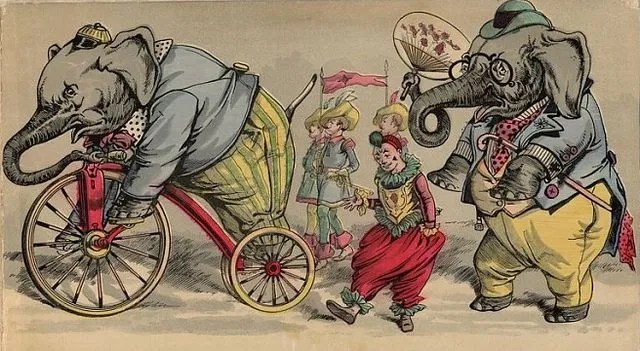
At that stormy moment, trumpets, trombones, drums and cymbals sounded below, silencing the brawlers for a brief moment. Then from out the side flaps two baby elephants charged, trunks held high, trumpeting louder than the fanfare! Atop them, seated in howdahs apparelled in the most royal regalia were yelping mahouts fitted out in cowboy costumes, waving their huge cowboy hats at the now stupefied spectators. The elephants chased the clowns around the ring, grabbing a few with their trunks, rolling them up then flinging them into the air. The elephants had gone amok, lifting their trunks for all to see their huge flabby smiles. The living torso was passed high over the mahouts’ reach, mouthing furious flames galore, landing with a thud in the arms of a receiving clown on the other side. The children in the front rows were on their feet howling with merriment, laughing along with the clowns and elephants as the chase continued on its merry-go-round way. And here the band struck up a favourite tune to which all the clowns sang: “Zozo the clown and his funny hat, patches on his pants and he’s big and fat, long flappy shoes and a round, red nose, makes people laugh wherever he may go.”
This boisterous chorus was joined by children, some of whom had internalised the tune. Their voices rose in unison, rising far above the brawling, bickering and rioting behind them in the upper stalls. To tell the truth, some of the farmers, factory workers and bankers had also joined in the singing. How they enjoyed those yelping ‘cowboys’ whooping it up atop the baby elephants.
Mayor Branco sized up the maddening bedlam, reluctant to decide who were the madder: the performers or the crowds! Yet, deep down, oh how he was enjoying himself that evening. For him, it would be the most memorable night of his life. And I will add here, for most of the other good folk of Black Rock, be they the howling children, the appalled women or the obdurate men …The madness grew even madder when from out of the side flaps the seven little dwarves scrambled, dashing up to the elephants, waving their capes. One or two of these mischievous acrobats had been on stilts and were trying to distract the rampaging mahouts with their capes. The mahout-cowboys riposted by letting fly their lassoes, the nooses catching one or two of the rascally dwarves who were toppled from the stilts and dragged mercilessly in the wake of the plodding elephants. The ring had become a veritable pandemonium of lunacy and delirium …
Suddenly all the spotlights went out. A sudden lull crept over the ring, creeping stealthily up into the stands. A deep lull during which time not one drunken cry from the adults, not one choking laughter from the children, not one trumpet from the elephants nor yelp from either the cowboy-mahouts or clowns or dwarves were heard. The lull must have lasted a minute or two …
The lights suddenly flooded the ring where all the performers and animals had mustered in humble expectancy. Silently they stood (or were held!) searching out the crowd for compassion, understanding, appraisal. The master of ceremonies stepped out from amongst them. He doffed his top hat :
“Ladies, gents and children. The performances that you have experienced tonight will not go unnoted in the chronicles of Black Rock.” (Whether this opening remark meant to be ironic is not for your narrator to say. In any case, it provoked a few snickers from the upper stalls.) “Yes, many of you have exhibited displeasure and resentment. Monsters you cry out? Freaks you bellow in bitter tones! Well, yes, if by monsters you mean these humble unfortunates who have had the courage to show themselves, to exhibit themselves to the public as true artists, and not sulk in self-pity or hide out like criminals or unwanted wretches out of the righteous eye of the public. But why display such ill-feelings towards them, may I ask? Because many of my performers suffer from birth deformities? Because they are physically unlike normal people? No! Their terrible deformities do not, and will never deprive the public the goodness and nobleness of their hearts of gold … their feelings of sincerity when performing for you. But this sincerity must be reciprocal. If not, their disfigurement will be interpreted as a ticket to the streets, a paid fare for lethal medical experiments in clinics, tearful departures for the zoos where they will be put into cages like savage animals … We are a grand and hard-working family whose every member holds equal status. But their livelihood, ladies and gents, depends on your good will, your protection against dangerous individuals whose illicit, murderous intentions would have killed them off long ago or maimed them even more. Here, within the sanctuary of this vast tent, look not at those deplorable disfigurements, but consider fairly and honourably their long, long hours of labour, their unquestionable talent, their dauntless courage and human dignity.”
The fanfare struck up one of rag-time tunes to whose familiar melodies all the children stamped and clapped. Their mothers and fathers also clapped. Farmers, shop-keepers, bankers and factory workers alike imitated the gaiety of the children. Even the security guards joined in the revelry. As to those adamant hooters and rioters, they stalked out of the top-tent, raising their fists, spitting out drunken obscenities … Which were drowned out by the general mirth and merriment.
All the performers bowed. The baby elephants held their trunks high, the lions shook their proud, bushy manes. With the crack of the whip the lights went out.
The good folk of Black Rock Montana filed out of the top-tent singing the Zozo tune. Mayor Rip Branco was the last to leave, a bright, beaming smile on his round face.
And as Shakespeare once had occasion to record: All’s well that ends well.
[1] The story is set in indeterminate times (the author claims around 1970s) before animals were banned from performing in circuses.
Paul Mirabile is a retired professor of philology now living in France. He has published mostly academic works centred on philology, history, pedagogy and religion. He has also published stories of his travels throughout Asia, where he spent thirty years.
.
PLEASE NOTE: ARTICLES CAN ONLY BE REPRODUCED IN OTHER SITES WITH DUE ACKNOWLEDGEMENT TO BORDERLESS JOURNAL
Our aeroplane
vanished one day into the void
without an explanation.
We were flying towards Bermuda
to attend a birthday celebration
but we never arrived.
Your ship disappeared
one afternoon while sailing slowly
north of Puerto Rico.
You were afeared it had sunk
to the bottom of the sea
in some unholy catastrophe
but it hadn’t.
And as for the submarine
cruising east from the Bahamas:
the crew were wearing pyjamas
when it mysteriously
passed out of this world
and entered a realm like a dream.
In a higher dimension
these three vehicles materialised.
Without our consent
they fell in love and began an affair:
an aeroplane snatched from the air
in a relationship
with a sailing ship
and a submarine involved with both.
What a complicated situation!
So many emotions entangled…
I almost feel strangled
by the melodrama
of the Bermuda love triangle.
THE FROTHIEST COFFEE
The frothiest coffee that ever there was
swung from a tether, for certain
because
it was the frothiest coffee
that ever could be
in history
apart from the brew
made frothy by you
for the numberless Counts of Ballyhoo,
all of whom despise tea.
But why did it swing from a tether?
I sigh when I’m asked
that question
and not for the reason
that it’s the
wrong season for asking it. Oh no!
I sigh because
sighs are wise and I’m
a kind of owl
with a reputation to uphold.
What kind of owl exactly?
A coffee loving owl.
I spoon the ground beans into a barrel
with a trowel
and then I add the boiling milk
and I whisk it
vigorously until my soul seems to sink
and cavort among
the bubbles of the wondrous foam
that turns this hovel
into a proper home, as only the frothiest
coffee can.
I hope you understand?
And now I ought
to say something more about
the Counts of Ballyhoo, who as you know
were enemies of tea,
and the youngest scion of that House
was Freddy Fiddledee
and he once decided to embark
on an epic journey in a wooden ark
because ‘motorcycle’
doesn’t rhyme with ‘embark’
at least not at this particular time.
And his mission was
to find out for certain if there really was no
blend of tea he might enjoy,
black or milky or lemony,
in cups or mugs on the decks of tugs despite
his renowned family’s
aversion to that brew: he wondered if there
might be something new
that the world could offer him:
a change from the inevitable coffees he knew
too well, hot as hell,
but there wasn’t.
Too bad! His voyage was a waste.
Let’s not be hasty
and think the poem is at an end.
There are two more lines to go:
this one and
the next one.
Rhys Hughes has lived in many countries. He graduated as an engineer but currently works as a tutor of mathematics. Since his first book was published in 1995 he has had fifty other books published and his work has been translated into ten languages.
.
PLEASE NOTE: ARTICLES CAN ONLY BE REPRODUCED IN OTHER SITES WITH DUE ACKNOWLEDGEMENT TO BORDERLESS JOURNAL
In the public park near my residence, a motley group of kids and teenagers gather after dusk to learn karate from a trainer who does not generate the impression of being an agile practitioner of the art of self-defence. He barely makes a move as he struggles to raise a leg or strike an aggressive pose in his demo lesson. Although his body seems to have lost visible signs of fitness, his body of experience helps him grow his client base. He depends on his stentorian voice to cast a grand impression and throw his weight around as the most experienced trainer in the town.
In the presence of guardians, mostly mothers, the instructor tries his best to sound confident and look smart, ready to provide feedback regarding the progress of young learners who grasp the moves and go home to try it out on their tired fathers unwilling to sponsor a weekend treat or buy them a fancy gift. Cowed down with threats of jabbing their delicate organs with trained fingers during sleep, they cave into submission. This is the most evident sign of triumph cheered by mothers, making one wonder if the ulterior motive to train in this martial art form is to teach stubborn dads a befitting lesson.
The lure of acquiring a black belt does not make kids eager to learn karate but the assurance that they can defend themselves in case of a kidnapping attempt or sexual assault acts as a trigger for them to indulge in the practice sessions. Only a few kids, mainly girls, look genuinely interested in learning the skill whereas the rest of them perform under compulsion, to find inclusion in their peer group and amplify the status of their mothers who post pictures of karate-learning kids on their social media handles. Even though they do not expect them to become famous like Bruce Lee, they need the satisfaction of providing their kids the best opportunity to hone their defence skills. Nobody bothers to ask kids whether they asked for this opportunity. Just because they keep fighting at home, it is not right to infer that they are going to be big fighters.
The trainer appears to be a good conversationalist as he takes small breaks to narrate anecdotes of his martial arts journey over the decades and infuses humour in his tales of dare-devilry to justify the steep fee he charges for his tutelage. Holding open-air classes three days a week, the instructor regales them with heart-warming, humorous tales that bring out the chronicler in him, fetching instant praise from the mixed crowd and free advice to compile them in the form of a book. Story-telling acumen ramps up his popularity as a karate teacher in the locality as he rides a heavy motorbike despite a problematic knee after surviving a life-threatening accident. Sympathy drips for him when he explains how he risked his life to save the life of a stray dog one night.
Many women admirers predict a better future for him as a successful writer without knowing the long, harrowing struggle behind it. He spends more time in the park and allows kids to practice a lot without interference while he engages in discussion with mothers who appear sympathetic to his sacrifices and dedication. When some of his students excel in the district-level championships, the credit goes to him for being an excellent mentor.
Almost a similar scene pans out in the housing society where the builder has constructed an indoor swimming pool as the chief attraction to sell the apartments. Considered a good exercise and a necessity to stay safe from drowning, parents and kids line up to learn to swim every evening. With mothers tagging along, kids in swimwear brace up to master new strokes. Men sit and dangle their legs by the poolside, sometimes taking a half dip as if bathing in a holy river, holding the rod for support. It gives a feeling of consolation that they use their time for exercise and also to showcase their responsibility towards young ones by teaching them swimming.
Talking about popular hobbies, the craze to attend a music school remains all-time high as there are multiple options to take up singing as a career. Kids learn Sa-Re-Ga-Ma[1] along with ABCD these days. When they trudge to the music academy to learn how to sing or dance, it reminds me of what I had been through during my childhood days. The shrill-voiced music teacher was so scary that I could not play the harmonium in her presence. Hitting the right notes always became a challenge. After a few months, she gave her verdict that my voice was good, but my singing was bad. The day I broke the reeds of her favourite harmonium, her patience also broke. She imposed a fine to compensate for the damaged instrument and asked me to leave.
Some years later, I got a chance to sing in front of my class on Teachers’ Day. The few lines I sang were liked but they added it was too fast paced, as if I was in a hurry to complete the song. I couldn’t say I tried to be peppy, but the truth is that in the presence of a teacher, you are reminded of alerts like quick or hurry. The lack of stillness and relaxation was palpable in the voice to suggest the singer was rushing through the singing exercise.
My maiden performance in front of the audience was lauded, and I was encouraged to practice more to get the chance to sing on Parents’ Day. Imagine singing a ghazal by Ghulam Ali or Mehndi Hasan[2] in front of a thousand people, and not being able to do justice to it. I chickened out as the pressure took a toll on my confidence to deliver. Even though some teachers encouraged me to take it up, I stayed out of it as the words of my music teacher kept haunting me. My tryst with singing began and ended with a film song from a Bollywood flick, Saagar[3]. Sometimes the wrong guide derails your interest. You develop a fear of the subject based on expert assessment by a person who is no expert of the subject. A fast paced ghazal performance would have been a hilarious idea as would be a new take on the ghazal format. It would have also become the iconic highlight and a major embarrassment in front of purists who would abhor the idea of a pop ghazal as a deliberate attempt to mar its purity.
There is a new visitor – a guitarist – who comes to the park with his son. He sits on a bench and practices Western numbers while his son goes playing with friends. Park joggers stop in their tracks and listen to his soulful singing. Recently, a senior uncle assured him of an audience during the cultural program in the festive season and he agreed to sing Bengali numbers before a few hundred people without charging a penny. It was a dream come true for an upcoming musician and he thanked the committee members.
The son started dancing right away, feeling happy for his father who was struggling to get a chance all these years. Most of the kids in school perform in front of their parents but it is a surprise when fathers perform on stage in front of their children. The joy parents get by encouraging kids to pursue a hobby is sometimes guided by their residual desire to see their kids learn what they couldn’t during their prime years. When kids see their parents fulfill their dreams, they also feel happy that they are not forced to realise the unfulfilled aspirations of their parents. While it is good to give kids the chance to pursue a hobby, it should be of their choice and not thrust upon them as a compulsion just because some kids in the locality or peer group are doing it. A hobby cannot become a passion if one is not obsessed with it.
Devraj Singh Kalsiworks as a senior copywriter in Kolkata. His short stories and essays have been published in Deccan Herald, Tehelka, Kitaab, Earthen Lamp Journal, Assam Tribune, and The Statesman. Pal Motors is his first novel.
PLEASE NOTE: ARTICLES CAN ONLY BE REPRODUCED IN OTHER SITES WITH DUE ACKNOWLEDGEMENT TO BORDERLESS JOURNAL
I sat in the railway station leaning on a chair.
The evening was pleasant with orange-violet cotton clouds.
The chairs were meant for the passengers waiting for the 5.45 pm shuttle.
The passengers carried veggies and sweetmeats in yellow bags to take home.
Most of the passengers were old and capable of coughing the phlegm of life.
One or two well-to-do walked up the refreshment stall and slurped the hot brew.
I never went to that side because it reeked of sour milk.
Aroma of guavas rented the air where I was seated. It is the season, though late.
The bill advertising the tabloid press said,
‘An engineer from the public works department was found dead in the reservoir.’
I have seen only fishes in those turbid waters, big and small ones snapping their tails.
Sometimes pachyderms appeared from the thick groove on the banks for a drink.
Doubts were raised if the engineer committed suicide, or was it a murder?
A crow wearing a grey collar flew under the roof. It pecked at crumbs fallen off
The potato wafers people bought, ate from polythene bags to kill hunger
While the wait pounded blue vessels and produced dreariness.
The fritters would be swept away before sunset
By the station cleaning staff enveloped in bellow-like overalls.
These particles would soon be part and parcel of the purple carboys in which garbage collects.
The crow has to make a quick dash for its supper. It did not pause to read the bill.
The news of the engineer’s death did worry the crow or anyone. We were not like the crow with the grey collar.
We sat craning our necks and knitting brows, not knowing what to do with what is left.
One of us returned and said the post-mortem is done. The pyre is lit without a trace.
Saranyan BV is poet and short-story writer, now based out of Bangalore. He came into the realm of literature by mistake, but he loves being there. His works have been published in many Indian and Asian journals. He loves the works of Raymond Carver.
.
PLEASE NOTE: ARTICLES CAN ONLY BE REPRODUCED IN OTHER SITES WITH DUE ACKNOWLEDGEMENT TO BORDERLESS JOURNAL
Tahira Naqvi, the Pakistani American writer, has extensively translated the works of Saadat Hasan Manto, Khadija Mastur, Hajra Masroor, and the majority of works by Ismat Chughtai from Urdu into English. As a teacher/professor of Urdu language and literature at New York University, she has regaled us with several short stories that speak of cross-cultural encounters of immigrant Pakistanis in America, especially about how women experience acculturation in the New World. The History Teacher of Lahore is her first novel where she recollects the sights, sounds, and ambience of growing up in Lahore in intimate details. The setting of this novel is the nineteen eighties, which was particularly a time of unrest in Lahore. In this debut political novel, Naqvi eloquently portrays the struggle between a besieged democracy and the rise of Islamic fundamentalism on the one hand, and the thriving cultural traditions of Urdu poetry on the other.
The story begins with the young protagonist Arif Ali who moves from his hometown of Sialkot to Lahore with a dream of being a history teacher and a poet. A ‘tall, slight man in his late twenties,’ we find him relaxing on a bench in Jinnah Park — a place that has become haven for him to spend his time reading, far away from the ferocity of traffic and street crowds. In the days that followed, Arif realised that in the Government Model School for Boys where he taught, he was forced to teach the boys another kind of history for his sake as much as theirs. But that required deep thought, time, and enthusiasm. He befriended Salman Shah, another teacher in his school, and his rapport with him grew stronger by the day. But once again, Arif found the atmosphere in the school was becoming increasingly confining. He would often engage in animated chatter with the high school Islamiyat teacher Samiullah Sheikh, whom he found disagreeable. Not only dressed in Shariyah compliant clothes, but this man was also waiting for his opportunity to teach at a madrassah[1]. This was the period when bans were being imposed on popular music of the kind Nazia Hasan and her brother sang for the younger generation, and even though ‘Disco Deewane’ and ‘Dreamer Deewane’ were sung loud, fear had become an elixir for rebellion. Arif was forced to resign from the school and along with his friend Salman. he ultimately got another position as a history teacher in another private school, Lahore Grammar Institute, where there was more freedom to teach than in the earlier one. The free socializing among the sexes here was new and noteworthy for Arif.
As Arif’s impotent rage towards the increasing religious intolerance grew, he joined his friend’s uncle Kamal and his partner Nadira to secretly help them rescue underprivileged children in clandestine ways. In the meantime, his poetic creations found great impetus when he found a secret admirer in Roohi, Salman’s sister, and started sending her his poems regularly. Though they never met, Roohi would write letters to him every week, and gradually, the more letters Arif received from her, the more his feelings for her grew. The secrecy of their epistolary courtship continued for quite some time till things were disclosed and after a lot of twists and turns in the story, they were finally engaged to get married.
In the meantime, his friend Salman got engaged to a colleague Zehra Raza, and despite the Shia-Sunni clashes that prevailed in society all around, they were unaffected by such ideology. The three of them developed a close camaraderie among themselves, but soon after, the General’s death brought in a lot of political turmoil in the city. The mentality of the public also changed, people went en-masse to watch public flogging, and trouble loomed ahead when Sunni Shia, Ahmadi non-Ahmadi, Punjabi Urdu-speaking, Protestant-Catholic, divisions and sub-divisions, inter-faith, inter-class and inter-religion issues became more and more marked in all spheres of society. The warp and weft of faith produced such tangled intricacies as could only be imagined in nightmares.
As the nation was caught in the vortex of religious extremism, Arif’s position also underwent a great change in the school when he wanted to teach ‘true’ history to his students. He was caught in a dilemma when he found he was forced to teach false historical information in the doctored textbook that Aurangzeb with his hatred of other religions was adored whereas Akbar with more religious tolerance was totally sidelined. He tried to rectify the errors by providing supplementary notes to his students, but that landed him in more trouble. Apart from differences of opinion with the other teachers in school, Arif’s was gripped with a kind of fear and frustration when some unidentified goons threatened him to stay away from issues that did not concern him. Things got worse when a Christian student in his class was falsely accused of blasphemy and Arif decided to save him from being arrested. He embarked on a dangerous mission to resolve this Christian-Muslim conflict that landed him in the middle of sectarian clashes and without giving out all the details, one just mentions that the novel ends at a tragic moment.
In the acknowledgement section Naqvi states that she is grateful to her father for many things but especially for his Urdu poetry which she has used freely in translation. These poems, ghazals and nazms, help to explain the different moods of the protagonist and his mental situation very clearly. One interesting aspect of the novel is that each of the twenty-two chapters is prefaced by a small quote that in a way summarizes the mood and content of that chapter. Most of these quotes are from Jean-Paul Sartre, while others are from Spinoza, Ghalib, Shakespeare’s Sonnet 116, H.W. Longfellow, Jacques Derrida, Tertullian, Thomas Mann, and four entries particularly from The Lahore Observer dated 15 September 1990, December 1990, January 1997, and January 1998 respectively. These wide-ranging quotes not only increase the story-telling impact, but also endorse the erudition of the novelist herself.
To conclude we can say that Bapsi Sidhwa’s The Ice-Candy Man gave us the sights, sounds and details of Lahore during the Partition in 1947, and the same city becomes wonderfully alive again through the pen of another woman writer from Pakistan who had spent her growing years there, and who gives us details about it from the 1980’s onwards when the political situation of the country was once again very murky. The novel wonderfully portrays the radical Islamisation of the country that included murder, mayhem, and public flogging and more that was visible in Lahore, as this process resulted in terrible uncertainty in the lives of the city’s residents from all walks of life. Strongly recommended for all readers, we eagerly wait for more novels by Tahira Naqvi in the future. The insider-outsider’s point of view offered by her is remarkable and this debut novel can be counted as a collector’s item.
“Kaki[1], do not worry. Will you not go to Ajmer Sharif just because you do not have money? No, no. As long as I am to support you, you are going to Khwaja’sDargah[2]. I will give you the money. Lose not this chance. When the Khwaja has summoned you, how can you deny? And, that too, because of money! No, no – never. Tomorrow is the final hearing of a case, and I will get a good sum. Pack up your luggage and be ready. I will arrange for the expenses. Take no stress. You are going to Ajmer Sharif, okay?” Mishraji said to his neighbour, an old Mohammedan widow.
Mishraji was an advocate by profession. His law practice in the district court paid well, but to assume him rich would be an exaggeration. He was not poor either; his wife wore jewellery and he had a 110-cc Honda bike.
The old widow lived alone. Her husband had died two years ago, and her two sons, too, had gone to Saudi Arabia for earning a better livelihood. Such migrations for getting a better pay were not new in the village. One or two from every family had migrated elsewhere to overcome the persecutions of poverty.
The widow, Saliman, had taken a vow that if her sons started to earn there, she would offer a Chadar[3] at the shrine of Khwaja Moinuddin Chishti in Ajmer. Apparently, she needed the money for the pious journey. Her sons had promised to send as soon as they got their first pay, but even after three months, she had not received a dime.
Maybe her sons had squandered the money away, or it might also be that they had not got it themselves yet. The widow subsisted on the rations she got from the PDS (Public Distribution System) and the vegetables in her kitchen garden. As for cash, she had little money she used to get as rent for her fertile land, less than an acre. The rent she got was just enough for the daily expenses, not for the pilgrimage she had taken upon herself.
Now, when the time to go had come closer, she had almost nothing except two hundred rupees she had saved somehow. She knew it would not be sufficient even for the bus fare to the dargah.
Since many of her acquaintances were going, whenever someone asked, “Kaki, have you done your packing for Ajmer Sharif?” She would humbly reply, “Not this time. I will go next year.”
When Ramakant Mishra, the advocate known as Mishraji among the villagers, got this news from his wife, who must have heard this at Kaffu’s confectionery – the one and only one in the village, he offered to help Saliman kaki. In good will, of course.
(2)
The next day was Monday. The court was in session. He pleaded his client’s case. After the closing argument, he was waiting for the decision. The decision was in his favour. The client, who had just been cleared of robbery charges, handed him a bundle of cash amounting to ten thousand rupees. Mishraji’s eyes smiled; the crispy notes had tickled his senses.
To keep his promise, Mishraji left the court early and started on his bike towards the village. He wanted to give the money to kaki in time for her to catch the bus.
Sixteen kilometres separated the town from his village. A dilapidated zigzag road, full of potholes and hairpin bends connected both. It ran between paddy fields, hamlets, shops, temples, and mosques. Had a photographer taken an aerial shot from a minaret, the photo would have looked like a reticulated python coiled between green and grey spots.
Mishraji set out for the village at three in the afternoon. He had to reach kaki before a quarter to four because the bus was scheduled to leave at four. He was in a hurry to get to her in time.
(3)
By quarter past three, Mishraji had covered almost half of the distance; the old peepal tree, taken as the abode of a Brahmarakshasa[4]by the villagers, the brick kiln which provided work to destitute men and women and school dropouts, and the chai tapri[5] – also used as a gambling den by the idlers, all these landmarks were left behind as the bike sped past. Now, Mishraji was passing by a temple, situated near a well on his left side; but right then, a truck overloaded with cement sacks came from the opposite direction. He had to stop to let it pass. It went on rambling and trembling and leaving a cloud of dust thick enough to make him cough. These were the day-to-day realities of his life. He had forgotten that these were the problems to think about, complain about, and raise questions about.
When the truck went away, Mishraji sped off on the bike again. He could see the next hairpin turn in a distance of a few hundred meters and a boy of fourteen or fifteen riding a mule cart loaded with sun-baked bricks. The boy must have been a daily wage labourer from the nearby kiln, Mishraji thought, and he was probably going to deliver the bricks there. The boy and the mule cart were the only objects of his undivided attention then, for the boy’s focus wasn’t on the road but on the mule. He was in a hurry. He was using the whip as an accelerator on the poor mule. As the boy whipped, the mule would start braying and tried to drag the cart with greater force. The mule slobbered and writhed in pain. Mishraji wanted to stop the boy and slap him for this cruelty. But fate had some other plans.
At the turn lay a deep pothole in the middle of the rutted road. No sooner did Mishraji turn his bike than the mule cart arrived close to him, and before he could pass, the right wheel went into that pothole. The mule, already exasperated, came down on its knees. The brick stacks, at rest earlier on the plain surface of the cart, plunged with a fierce thud on the right where Mishraji was. A few bricks fell on his thigh. And a few on the wheel guard, petrol tank, and windscreen, too. The result was an instant damage. The bike skidded off, and Mishraji fell before he could control himself. His left leg rasped against the loose gravel of the road. It tore off his pants, and the abrasion against the gravel made him bleed. He also got scratches on his elbow and knee. However, his head was safe because of the helmet.
The lad, no less responsible than the road and the turn, stood on the other side of the road with a flabbergasted face. Scared to death.
The villagers working in the nearby fields ran for help when they saw the mule cart collapsing. At first, they supported Mishraji, and then, one of them straightened the bike and put it on the stand. Misraji was 46, but he had maintained his body through yoga. He stood up and walked a few steps just to check for any fractures. He was fortunate, there were none.
A searing pain tormented him, but an abrupt rage had halted on his face. He pointed the people towards the mule – still kneeling under the weight of the cart. While they ran to balance it, his eyes looked for the real culprit.
He saw the boy standing on the other side of the road and beckoned him with a wave to come to him. The boy was shivering with fear; he had not imagined that something like this could happen. He started slowly and, with measured steps, came near. When he came close enough, without asking or saying a word, Mishraji held his hand and hit a hard slap on his face. Tadaak! It at once reddened his grimy cheek; a five-fingers-mark emerged on it as if the lightning flash were imprinted on the cloud; then another slap with the same force, and then again, a third one. The boy bellowed and cried for help. Mishraji growled, “Bastard, you almost killed me! Guttersnipes like you have oppressed the whole country.” He went on abusing with the same rage. And the boy kept crying.
Someone in the crowd ran towards him, and said, “Sahib, this boy is unfortunate. Mustaqim, his alcoholic father, beats him and his mother daily; his master, Chobe Singh, at the kiln, beats and abuses him if he arrives late. The master does not tolerate a late delivery. Forgive him, please. Who knows, but maybe God saved you from a greater danger.”
The rage Mishraji felt did not calm. Though he wanted to keep slapping the boy, since he had to reach the village on time, he jerked the hand of the boy and said, “Get last, and never show me your face again. Otherwise, I’ll wring your neck off. Buzz off!”
The boy, sobbing and wiping tears on his dirty sleeve, went to collect the scattered broken bricks. Apart from the recent slapping, he was much more afraid of the upcoming insults and scurrilities from the master waiting at the kiln. He gathered and stacked the bricks and started the cart. The mule limped at first but picked up pace after a slash of the whip.
For a few minutes, Mishraji watched the boy and said nothing. The crowd had already started to disperse. Since he had to reach on time; without giving much thought, he moved towards the bike. The accident had damaged it enough. The indicator, the headlight, and the visor were broken. The wheel guard had a crack; the petrol tank, an ugly scratch; and the front number plate had twisted off in such a way that it was hard to read the numbers from afar. Nonetheless, the bike started on the second attempt and carried the angry and injured advocate to his destination.
(4)
Seeing Mishraji’s condition, Saliman Kaki guessed at once that he must have had a narrow escape from an accident. As he came near, she hugged him and started weeping. Tears rolled down her cheek, and between the sobs, she said, “For me, you had to go through this. Allah, why did You punish this kind-hearted man for my sins? How unfair it is that You always test good men!”
Mishraji tried to console her, but she kept on crying and sobbing. Tears choked her. People on the crossroad, where the driver had parked the bus, watched the emotional scene in amazement. When the driver honked a fourth time, Mishraji realised the urgency of the situation, and taking out five thousand rupees from the bundle, handed them to the widow, saying, “Kaki, do not worry about me. I just got some scratches; they will heal in a day or two. Take care of yourself and eat well. Relax. Relax and call me when you reach Ajmer.”
She was just speechless. She said, in the end, while parting from him and stepping on the bus, “I will offer a Chadar for you, too. I will also pray for you. You are also like my son.”
The bus started, and Kaki stood at the entrance doorway looking at Mishraji until he was out of sight. He stood there, oscillating between joy and joint pains. He felt happy; he had forgotten about the boy.
He came home. His wife was sad and angry and cursed the boy who caused the accident. She also cursed Saliman Kaki. Mishraji bathed, put some bandages on the scratches, and gulped a few painkillers. After dinner, he fell asleep soon.
(5)
The next day, at the breakfast table, he saw the newspaper. He was dumbstruck after reading a short report in the corner of My City page. The headline read, ‘Man Beaten to Death. Accused is Absconding’. The report read thus:
‘Shravasti: A 50-year-old brick-kiln manager was allegedly beaten to death by a teenage daily wage labourer in Angadpur village of Ranipur block on Monday. The police said that the incident took place at four in the evening when the labourer arrived at the brick kiln with his mule cart to deliver the sun-baked bricks. The manager was angry due to the late delivery and tried to hit the alleged teenager by throwing a rosewood baton at him. When the baton missed the aim, the manager ran and caught the labourer and beat him black and blue. When the labourer fell, the manager moved back and went to his shanty chamber. While the manager was busy with his notebook, the labourer came into the chamber with the baton in hand and hit him on the head. He kept hitting until the manager was unconscious. Within an hour, the manager was taken to the District Hospital by people working around, where the doctors declared him dead. The primary cause of the death happened to be the skull fracture and severe brain haemorrhage, as told by the doctors. The accused teenager is absconding. According to the police, he must have crossed the border by now.’
Ravi Prakash has spent thirty years of his life in a small town near the Indo-Nepal border in the district Shravasti. He now lives in Meerut and teaches English in a Government Inter College. Although, he has left the place, it has not left him yet; and possibly, will never leave him. Ravi tries to narrate the stories that haunt him day and night. A few of his stories and poems have been published in several online journals.
.
PLEASE NOTE: ARTICLES CAN ONLY BE REPRODUCED IN OTHER SITES WITH DUE ACKNOWLEDGEMENT TO BORDERLESS JOURNAL
The sparrow I saw under the roof of a border checkpoint

crossing from the USA to Canada,

heading to the Mahatma Gandhi Memorial in New Delhi,

coming out with a bottle of drink from an alleyway

encountered a sparrow in front of a small shop.


Both the sparrows – the one seen at the border checkpoint

and the other in front of the small shop,

belong to the same species as those

that live under the eaves of my hometown houses.

Next to the KBS* New York correspondent’s mike,

the sparrow hopping on the street, nibbling on crumbs,

and the sparrow living in a salt warehouse in Sorae*, Incheon,

are both sparrows from the same species.


Like a quiet Korean restaurant sign by the road on the way to Las Vegas,

or like the little six-year-old Korean-American kid I met

at a small snack bar in an LA alleyway,

lonely yet welcoming fellow countrymen sparrows from afar.


*KBS: Korea Broadcasting System

*Sorae: small creek in Incheon City, Korea
Ihlwha Choi is a South Korean poet. He has published multiple poetry collections, such as Until the Time When Our Love will Flourish, The Color of Time, His Song and The Last Rehearsal.
.
PLEASE NOTE: ARTICLES CAN ONLY BE REPRODUCED IN OTHER SITES WITH DUE ACKNOWLEDGEMENT TO BORDERLESS JOURNAL.
Author: Srijato, translated from the Bengali by Maharghya Chakraborty
Publisher: Penguin Random House
“I believe I would want nothing else if I am allowed to just think. If it were a real job, I would be the first to get it. The only problem then would be that I would have to think on someone else’s command. Now I am free to think whatever I want.”
A quiet tenderness beckons the reader to A House of Rain and Snow. The title suggests everything generous and hospitable. Once inside the cosy house of this novel set in days before the internet revolution, there is, indeed, no disappointment. A translation of Srijato’s[1]Prothom Mudran, Bhalobasha[2]from the original Bengali into English by Maharghya Chakraborty[3], the novel offers, on the face of it, a simple coming-of-age story but such simplicity is only deceptive. Churning within the novel’s agonised romantic spirit are vital interrogations of the relationship between life, living, and livelihood, art and the market, the value and significance of art to life, and the question of integrity in both.
A Künstlerroman[4] that primarily focuses on Pushkar’s journey from an aspiring poet to a published artist, the novel frames more narratives than one. There is the story of Pushkar’s parents – Abanish and Ishita, of his friends, Abhijit and Asmita, and that of his mentor, Gunjan (and Parama), each constituting a mirror of the narrative prism in which Pushkar, the reflected subject, kaleidoscopically understands himself and his journey better. But Pushkar is not alone. Journeying with him in spirit are Nirban and his circle of poet-friends, the girl he is in love with – Saheli, and his most cherished friend and ‘confession box’, the milkwood tree.
Where does art come from? For Srijato, art is not extraneous to life but intrinsic to the very fabric of living. Every character in the world of the novel needs art, in one form or another, to survive. Not everyone, however, can become an artist. This privilege and responsibility is offered to the chosen few — those who can step out of their self-obsessed private worlds to establish a sincere relationship with the wider currents of life. Pushkar, for instance, tells the milkwood tree:
“…solitude is entirely a relative thing, silence too. I cannot understand myself without the immense tumult of this city, that’s where my silence lies. Unless I am standing in this swiftly moving crowd, I cannot find any solitude.”
Art, as the novel seems to assert, cannot be born except within life’s chaotic womb. A house of rain and snow can only be a nursery, a protected locale to nurture vision and aspiration. For the artist to grow, an engagement with the wider world would be mandatory.
But how does one engage with the world? Would the world even be worth engaging with? Is art a means of engagement or retreat, activism or escapism? No clear-cut answers to these questions are possible but A House of Rain and Snow attempts, as all worthy stories do, to shine its own light upon them. The novel’s world is divided into two kinds of people — those who view art as an existential end and those who, like Parama or Sumit Dastidar, view it only as a means or an avenue to something else. Those who see art as an end in itself understand that commitment in art does not necessarily guarantee accomplishment. Neither does accomplishment guarantee material success. As an aspiring artist, one can only bring all of one’s life and living to art without expecting anything in return, the fact of journeying being the artist’s only receipt.
There is very little physical action here. The journeys in A House of Rain and Snow, as the reader will observe, are all psychological. Place and time are important coordinates in this movement. The city of Kolkata emerges evocatively as inspiration and muse, its descriptions exuding a clear eye for detail, a deep sense of cultural nostalgia, a delineation of not just place but of spirit, and a documentation of the city’s multifarious, shapeshifting life — its strength, tenacity, and bustling beauty. Concrete yet shapeless, definite yet blurred, prosaic yet poetic, the city firmly anchors this novel as both stage and ship, contouring its artists’ perspectives on life and art.
The idea of time, in the novel, is as fluid as that of space. There is the constant sense, awareness, and reminder of its passage and yet, in Srijato’s fictional world, time refuses to be linear with the past, present, and future merging frequently through hallucination, dream and memory:
“Today, Gunjan notices the newspaper, he has never seen one in the moonlight. He bends over to pick it up from the mosaic floor gleaming under the light of the moon and, instead of the paper, comes back up with a tiny doll that had fallen on the ground a little while ago. A little more than seven years, to be precise.”
There is a strong visual quality about Srijato’s writing, intricately woven cinematographic effects which, had they been of any significance to the plot, might have amounted to magic realism. But being strictly organisational and descriptive in function, this cinematic quality is instrumental to the novel in other ways — it insulates the narrative from realism, liberates it from answerability to everyday logic, defamiliarises the familiar, and renders the strange intimate. Most importantly, it creates a surrealist impression, reminding us of all that remains constant in our consciousness in the most bizarre of circumstances, and manifests itself in the novel as an artist’s specialised and idiosyncratic way of relating to the world. Examine the windows of rain and snow, for instance:
“No one other than Pushkar knows about this, neither does he wish to tell anyone. There are two windows in his room, side by side, one almost touching the other. Outside one of them it rains the entire day and snows throughout outside the other. On the days this happens, Pushkar finds himself unable to leave the house.”
It is worth noting that it is not Pushkar alone who has such experiences. Other characters like Abanish and Gunjan also experience such strange reconfigurations of time and space — expansion, compression, repetition, alternation, all of which can be interpreted at a symbolic level.
Surcharged with intense lyrical passages, A House of Rain and Snow is quintessentially an exploration of the aching need for art in life. Life, in the pages of the novel, is almost unliveable without the solace of art. Art, in turn, can be born only out of love, the kind of love that Pushkar can extend to the milkwood tree and the world around him:
“He, Pushkar, is in love. A little too much, with everything. …Why, he is not sure. How, he is not sure either. All he knows is that at this very moment, it is love that is becoming his language, his constant recourse. Love. Not just for the people close to him or his writings or his own life. Love for everything. Everything happening around him at this moment, the moving earth, every incident everywhere in the world, the forests, the oceans, the mountains, the plains, the cities, the sky, even the vast outer space beyond earth.”
The translation wonderfully captures the linguistic nuances of Bengali in the English language, its semantic eccentricities, syntactic pace, and its lush images, making the novel a rich and rewarding read. A number of images linger steadily in the reader’s mind long after the book has been read – a tall, wet milkwood tree, an idol-maker shaping a goddess out of clay, and a young boy lifting his exhausted father on his palm.
[1] Srijato, one of the most celebrated Bengali poet-lyricists of our times, is the recipient of Ananda Puroskar in 2004 for his book Udanta Sawb Joker (All Those Flying Jokers).
[2] Literal translation from Bengali: First Gesture of Love
[3] Maharghya Chakraborty is a well-known translator. He teaches at St Xavier’s College in Kolkata.
Basudhara Roy teaches English at Karim City College affiliated to Kolhan University, Chaibasa. Author of three collections of poems, her latest work has been featured in EPW, The Pine Cone Review, Live Wire, Lucy Writers Platform, Setu and The Aleph Review among others.
.
PLEASE NOTE: ARTICLES CAN ONLY BE REPRODUCED IN OTHER SITES WITH DUE ACKNOWLEDGEMENT TO BORDERLESS JOURNAL








 Borderless