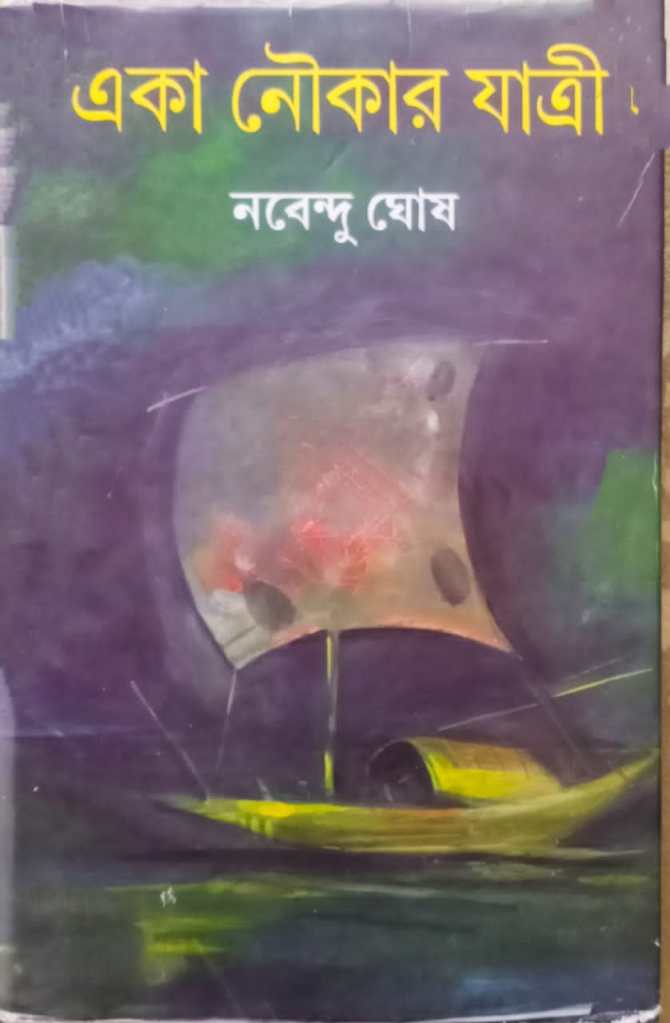
From Nabendu Ghosh’s autobiography, Eka Naukar Jatri / Journey of a Lonesome Boat, translated by Dipankar Ghosh, post scripted by Ratnottama Sengupta
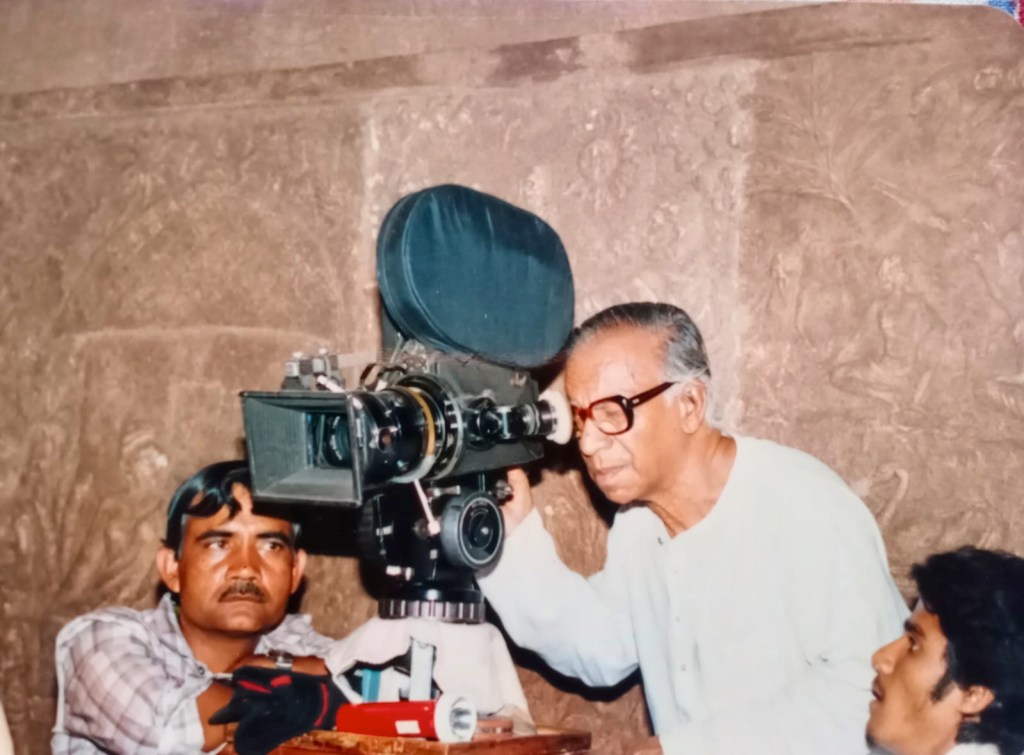
Eka Naukar Jatri or Journey of a Lonesome BoatNabendu Ghosh at work. Photo provided by Ratnottama Sengupta
By now it had become common knowledge in the Bombay film community that Bimal Roy had brought along a “writer” with his group, and apparently he was quite a decent writer. Just as, at one time, Urdu writer Sadat Hasan Manto had come to Bombay Talkies, and Urdu writer Krishan Chander too had come on the scene. There was a feeling that there might be a chance of acquiring a decent storyline from Nabendu Ghosh. Naturally, for a while quite a few producers and film directors contacted me. Story sessions were held at Van Vihar, or at the offices of the producers concerned. but there seemed to be a lack of appreciation from these people to stories that came from the mind of an alumni of the Progressive Writers Association. They were all of the opinion, “The idea is great Ghosh Babu, but it is too idealistic. Dada we want to make movies with Dev Anand and Geeta Bali, accompanied by Johnny Walker and Yakub (comedians of the time). Please tell us stories where we can incorporate them, rather than literary stories.”
Realisation soon dawned on me that the Hindi ‘filmy kahani’ was a different genre of stories. What kind of stories? In short, stories that would be appreciated by 90 percent of viewers from different states, with different tastes, all over India. Hence even a highly educated producer like S Mukherji heard the story of Baap Beti and said: “It’s a nice story but I won’t make it – I’m a businessman”! In other words the businessman had a different slant on dramatic arts: they might well say that “Bicycle Thieves is a great film but an undoable story, I’m a businessman.”
Later, on one occasion I had asked Mr Mukherjee, “You said ‘No’ to Baap Beti, yet you wanted to film the literary story, Mrit Pradip. Why was that?” Mr Mukherjee laughed. “If there is an indication of high literary merit in a story then it might well be conducive to our business, and might turn a ‘hit’ picture into a superhit.” I asked, “Does that mean a ‘hit’ is quantifiable?”
“Of course it is!” he replied. “Just as any tasty dish needs some specific spices to make it tasty.”
“But what about the healthiness of the dish? Isn’t that a consideration?”
“Nabendu Babu, I am not into the medical business.”
“Does it follow that you will cater to the mass’s addiction for entertainment without upholding the essential ideals of life?”
“I do that Nabendu Babu but in very low doses,” said S.Mukherjee. “I follow the principles of dramatic arts as laid down in Natya Shastra but I don’t profess to be a saintly sadhu. I am a very ordinary person in pursuit of happiness.”
He guffawed loudly for a bit. Then he said, “The spices I need for my ‘cinema-dish’ are these. First, the story: usually should be about love. Second: five or six memorable ‘love scenes’ or warm situations, full of fun, lovers tiffs, misunderstanding, separation and reunion. Third: obstacles to love, by a person, family or enemy. That contributes to tension or anxiety. Fourth: four to five moments of suspense: some conspiracy, someone chasing the lovers, trying to kill them. Fifth: comic moments, not mildly humorous but uproariously funny so that people roll around in bouts of laughter. Sixth: moments of tear-jerking sadness. Seventh: Fight scenes, each being individual in itself. Eighth: five to six melodious songs, of which two or three should be such that even persons with no music sense can sing them. Ninth: appropriate selection of actors and actresses. Tenth: a good director and a good music director. Finally: the right planetary configuration for audience’s applause.” Mr Mukherjee laughed out loud.
His words got entrenched in my mind. The successful ‘formula’ for a Hindi film! In other words it was the formula of a Hindi village Nautanki, no different from the Jatra formula of rural Bengal. Of a hundred films made by that formula, even if two managed to enlighten the mind or uplift the spirit, that would be an icing on the golden cake – “sone pe suhaga”. And if there was no icing, the gold that clinked in would be good enough gain, and two and a half hours will pass away in laughter and tears, in suspense and romance, with joyous humming of a few bars of melody as viewers return home to deep slumber, dreaming of the handsome features of a hero or heroine that will tickle their fancy and prove the worth of the newly invented form of art – cinema. In particular, the magic of Hindi movies.
Therefore, I decided to write or adapt stories and ideas to comply with the mandates of the Formula. Whatever good ideas came along, whether in five pages or five hundred, I would fit into two and a half hours, either by extending or shortening in a fast flowing format that would leave the viewer wondering what’s next at every turn. In other words, I would write screenplays of a different kind.
And since I was unable to uphold the higher ideals of literature on the silver screen, I would compensate for it by writing for literature. I would thereby absolve myself of my sense of guilt.
In 1952, when Nabendu Ghosh was narrating his story, Baap Beti, Sashadhar Mukherjee (1909-1990) was a highly successful producer who had set up Filmistan Studios in 1943 along with his brother-in-law, the legendary actor Ashok Kumar; Rai Bahadur Chunilal, father of music director Madan Mohan; and Gyan Mukherjee, director of the superhit Kismet. These personalities had broken away from Bombay Talkies after the death of its founder, Himanshu Rai.
Later in the 1950s, S Mukherjee independently started Filmalaya, noted for films like Dil Deke Dekho (1959), Love in Simla (1960), Ek Musafir Ek Hasina (1962) and Leader (1964). He is also recognised as the patriarch of the distinguished Mukherjee clan of Bollywood that boasts actors like Joy Mukherjee, Deb Mukherjee, Tanuja, Kajol, and Rani Mukherjee.
And Baap Beti? It got made into a film produced by another highly successful producer of the times, S H Munshi. Directed by celluloid master Bimal Roy, it had brought a host of child artistes who went on to become big names of the Hindi screen: Tabassum (1944-2022), who passed away in November; Asha Parekh (2 October 1942), who was bestowed with the Dadasaheb Phalke Award last year, and Naaz (1944-1995), besides Ranjan (1918-1983), the swashbuckling actor from the South.
As he writes in his autobiography, after this conversation Nabendu Ghosh took a conscious decision to write his own realisations as literature, and to adapt stories by other writers for the screen. That is why we find that less than 10 per cent of the films he scripted are from his own stories. But some major directors did draw upon his stories – as Bimal Roy did for Baap Beti; Gyan Mukherjee for Shatranj (1956), Satyen Bose for Jyot Jale (1973), Mohan Sehgal for Raja Jani (1972) and Ajoy Kar for Kayahiner Kahini (1973). Only one classic that used his story but did not credit it to Nabendu Ghosh was Guru Dutt’s Kaagaz Ke Phool (1959).
Nabendu Ghosh with his son, Dipankar Ghosh, & daughter, Ratnottama Sengupta
Nabendu Ghosh’s (1917-2007) oeuvre of work includes thirty novels and fifteen collections of short stories. He was a renowned scriptwriter and director. He penned cinematic classics such as Devdas, Bandini, Sujata, Parineeta, Majhli Didi and Abhimaan. And, as part of a team of iconic film directors and actors, he was instrumental in shaping an entire age of Indian cinema. He was the recipient of numerous literary and film awards, including the Bankim Puraskar, the Bibhuti Bhushan Sahitya Arghya, the Filmfare Best Screenplay Award and the National Film Award for Best First Film of a Director.
Dipankar Ghosh (1944-2020) qualified as a physician from Kolkata in 1969 and worked as a surgical specialist after he emigrated to the UK in 1971. But perhaps being the son of Nabendu Ghosh, he had always nursed his literary side and, post retirement, he took to pursuing his interest in translation.
.
PLEASE NOTE: ARTICLES CAN ONLY BE REPRODUCED IN OTHER SITES WITH DUE ACKNOWLEDGEMENT TO BORDERLESS JOURNAL
I don't want to die, not any more than

anyone else, but in my Sunday
School class are ten-year-old girls who say they
can't wait and would can themselves except that
they'd go to Hell and burn forever, what
they want is to die and live with Jesus
and when they asked me if I do as well
I said Well, maybe, if I won't get bored
and one got angry and said You're going
to fry in Hell for that someday and her friend
added in the oil of your own skin yet
you'll never be consumed completely and
I said Well, I'm not afraid and she said
We're more afraid for you than you are so
I said How about a kiss? That killed me.


No one wants to die--well, I take that back:

My Sunday School teacher’s sure keen on death
and talks about it every class, she knows
that we're all getting older and some day
we'll all die though probably not the same
day and same way but make no mistake, death
is unavoidable so prepare ye
now to be good enough at least to go
to Heaven and dwell there for eterni
-ty instead of Hell (ditto for Eter
-nity) and we never know when God will
snatch us from life back to Heaven to be
judged a saint or sinner and I want to
see you all in Heaven with me someday.
I added If you go. She has good teeth.
Gale Acuff has had hundreds of poems published in a dozen countries and has authored three books of poetry. He has taught tertiary English courses in the US, PR China, and Palestine.
PLEASE NOTE: ARTICLES CAN ONLY BE REPRODUCED IN OTHER SITES WITH DUE ACKNOWLEDGEMENT TO BORDERLESS JOURNAL
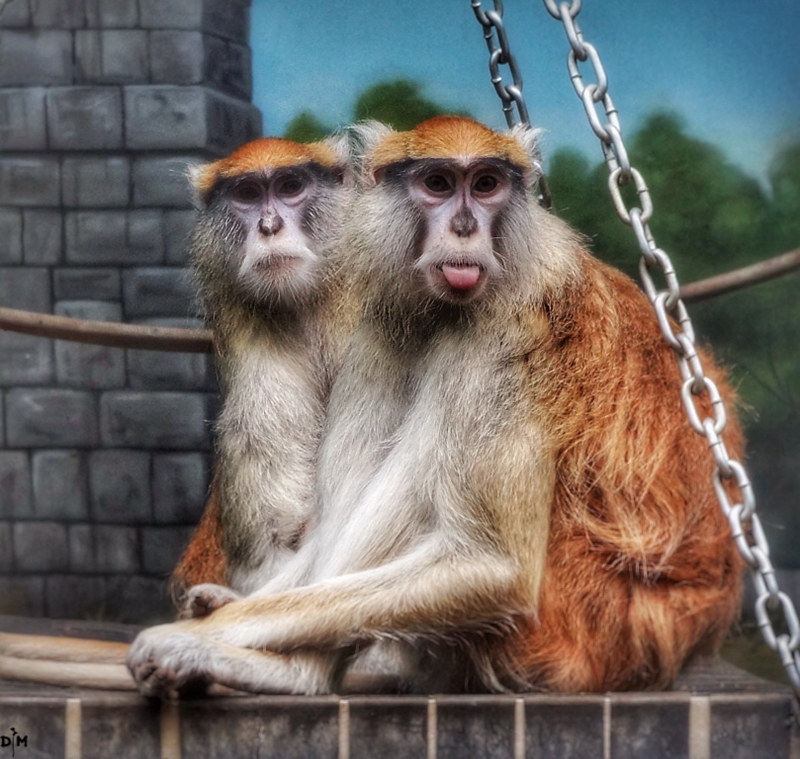
It is often said that monkeys do not like to see their face in the mirror. They tend to screech with explicit dental intimidation if they happen to find themselves in front of one. Whether it is outright abhorrence for narcissistic indulgences that eggs the simians to adopt such a stance or anything else remains unknown, but my litany of encounters with a few specimens illustrate that exceptions also prevail here as everywhere else.
One sunny afternoon, a monkey sneaked in through the door left open by the domestic help who had stepped out to pick up woollens from the clothesline. Sensing positive vibes in the air, he proceeded into the living room and stood on his hind legs in front of a large full-length mirror, striking a confident, self-assured, and dignified pose to assess the overall look. When I lifted the curtain to have a full view of his antics, it was an invasion on his privacy and the facial expression of self-love melted into cheeky defiance. Before I could guess what would happen next, the monkey bared his clenched yellow teeth and raised a palm and gave a resounding slap that made a perfect landing on my face.
As luck would have it, something more interesting caught his attention. The domestic help had just stepped in to discover my strange predicament. She genuflected at the threshold to pay obeisance to the unwanted guest. With such devotion on display, his mood changed from anger to happiness. While the monkey and my help gazed at each other, I quickly disappeared from the scene to arm myself with a stick for self-defence. When I returned, I found the monkey missing while my help was still lying prostrate. I had to bang the stick on the door to alert her and inform her that the monkey had left. She got up and looked around to check if he had gone out and concluded that the peaceful departure meant good luck for the house.
I said she was lucky he did not trample over her while exiting. I had missed his exit. I did not know whether the monkey swished his tail or made a quiet, unceremonious exit. The life-threatening experience was life changing as well. The domestic help kept on showering praise on the auspicious visit that would change my fortune soon. Perhaps the visit was too short – or it was the lack of gastronomic delight for the guest that deprived me of good luck. I should have served lemonade or cookies at least.
We were destined to meet again. On another afternoon, around the same time, I was caught unawares by the presence of another simian walking gracefully out of the open kitchen with a plastic jar of biscuits clutched firmly in one arm. I had just come out after having a bath when this scene exploded in front of my eyes. Though I was fully dressed to keep my assets safe, I was jolted by this free movement inside the house. What I could figure out without my spectacles was that this simian looked more feminine than the previous trespasser. Perhaps this was the companion, and she knew that this house had easy access and was worth visiting and exploring. While moving out, this one also made no rushed effort, as if familiar with the route. Was her memory sharper than mine? Honestly speaking, I often jumble up between exit and entry doors.
As soon as the monkey went out, some other of her flock descended from the roof and flanked her. She was quite skilled at pulling the lid off just like us. In no time, several hands took turns picking up digestive biscuits. Perhaps this good bonding has kept my clothes safe from any direct attack. Even if they are left out to dry, none of them make any mischief by pulling them off from the clothesline whenever they hop around in the compound in gay abandon. Before I could shout at any family member for this negligence, I was reminded there was no one else at home. I had been careless enough to have kept the door open when the courier arrived an hour ago.
They had been to the living room and the dining space – also to the kitchen. The bedroom and the study escaped their notice till then. I was dusting my books. The door had been left ajar. It was the perfect occasion for another visitor to fall in love with reading. While I was busy shuffling and stacking up on the upper shelves, I turned around to see one monkey sitting in front of the computer, fiddling with the mouse and the wire. I was about to jump off the small ladder to save my gadget when the simian tapped on the woofer, identifying the source of soothing music. I descended quickly to pick up some fluffy cushions from the settee to hurl at his face and started to chase him away by making whoosh-whoosh noises. The monkey felt offended, lost interest in the gadgets and rose suddenly, hitting the keyboard with his behind, toppling it along with the music discs kept at the edge of the table. Once he left without creating a ruckus, I was relieved and hoped such an encounter would not occur again though this household was familiar territory for them. However, if surprises are in store, you cannot avoid them.
On another day, when the puja ceremony for the vehicle was about to begin, a monkey came down from the parapet, picked up a coconut from the tray, and broke it into two right in front of our eyes. While he did the honours, the priest stood shell-shocked to witness the simian intervention that was timely, prompt, voluntary and intelligent to deserve a video reel that would go viral within hours. Wondering if he was trained for such impossible acts, he kept quiet. Sadly, not being prepared for this surprise deprived me of the opportunity to shoot a video. I had to convince him that the monkey chose to do so out of his free will. We must appreciate his decision to help us during the auspicious occasion with active participation, to make ordinary mortals realise that they can also perform feats that humanity world thinks is only the human forte.
They still had the instinct to help though we have forgotten to help fellow humans and other creatures of this planet. It was a timely reminder that we need to wake up and start working towards making this world a better place again. On that sombre note, we concluded the brief ceremony and enriched our minds with a broader outlook. The priest would remember this all his life. As expected, the news of a monkey breaking the coconut bought many people to my gate, who came looking for darshan[1] of the trained resident monkey perched somewhere on the roof or a tree top.
Devraj Singh Kalsiworks as a senior copywriter in Kolkata. His short stories and essays have been published in Deccan Herald, Tehelka, Kitaab, Earthen Lamp Journal, Assam Tribune, and The Statesman. Pal Motors is his first novel.
PLEASE NOTE: ARTICLES CAN ONLY BE REPRODUCED IN OTHER SITES WITH DUE ACKNOWLEDGEMENT TO BORDERLESS JOURNAL
ON SITTING TO WRITE A POEM

We are the inferior artists.
Life has its own poetry.
Leaves hang in the wind,
just waiting out the weather,
and sparrows cut
tunnels through the night,
finding cracks in
a stony darkness.
A lioness who slaughtered a deer,
drags the carcass miles
to feed her cubs
and in the distance there are
great mountain peaks
which strain
towards the stars
like stiff unyielding fingers.


NATURE

Nature attacks us relentlessly.
Leaves squirm as they die.
They have no mind
to wonder why.
The stars seem small to me,
but why they’re here
is an unsolvable mystery.
The moon appears
in a threatening disguise,
then reappears
in funereal guise.
A fierce wind suddenly blows,
so I hurry home.
I’ve wasted a hour,
and still know nothing more
than those dead leaves.
George Freek’s poetry has recently appeared in The Ottawa Arts Review, Acumen, The Lake, The Whimsical Poet, Triggerfish and Torrid Literature.
PLEASE NOTE: ARTICLES CAN ONLY BE REPRODUCED IN OTHER SITES WITH DUE ACKNOWLEDGEMENT TO BORDERLESS JOURNAL
A story based on the end of a world war II soldier by Kamaleswar Barua in Assamese, translated by Bikash K. Bhattacharya
Ei Ran Ei Jivan, a collection of wartime narratives penned and published in 1968 by the Assamese writer, Kamaleswar Barua who served as a military engineer in the British Indian Army during the Second World War. Photo: Bikash K. Bhattacharya
Introduction
This is a translation of the narrative “Uehara” from Kamaleswar Barua’s Ei Ran Ei Jivan [1], a collection of narratives published in Assamese in 1968 based on “true events and characters” the author had encountered while serving as a military engineer in the British Indian Army in the Second World War.
Kamaleswar Barua is a relatively lesser-known figure in Assamese literature. Having earned a bachelor’s degree in Civil Engineering from the University of Calcutta in 1932, Barua joined the British Indian Army as an engineer serving in the Naga hills, Manipur and Burma. Attached to engineering field companies, he saw combat in some of the fiercest battles fought in the region in the course of the Second World War. He rose to the rank of major. After the war, Barua earned a master’s degree in City Planning from the University of California, Berkley, in 1951.
Barua was an active member of Assamese literary clubs and reading groups like the Mukul Sangha, a club formed in January 1945 in Shillong, the then capital of Assam. It was in the weekly meetings of Mukul Sangha that Barua shared his personal accounts of the war before turning them into written narratives. Uehara’s story was also first told to a small audience of Assamese litterateurs who encouraged Barua to publish it [2]. However, the project took a backseat for a long time and Barua finally published an anthology of nine narratives, “based on characters he’d encountered during the war”, in 1968. Titled Ei Ran Ei Jivan—which translates as “This War, This Life” or as “Now War, Now Life”—the anthology’s fourth narrative is “Uehara”.
What makes the anthology interesting is the novelty of the genre. The author terms it “a collection of kahini (narratives) about a few wartime characters.” The standard word for short story in Assamese is galpa, while the word kahini doesn’t refer to a specific literary genre. A kahini could be fictional, but it could also be a true historical account. The generic instability notwithstanding, Barua declares in the preface to the anthology, “The names of the characters have been fictionalised unless they’re historically well-known people. I’ve strived to remain true to the characters as best as I could as I’d known and witnessed them.” The preface makes it amply clear that the kahinis Barua tells us are a specific type of wartime memoir narratives rather than autobiographical short stories.
While Barua’s “Uehara” remains a little-known, obscure work, the most prominent literary artefact in Assamese depicting the Japanese in the Second World War in northeast India is Birendra Kumar Bhattacharyya’s short story ‘AgyaatJapani Xainik’ (An Unknown Japanese Soldier) [3]. However, “Uehara” is probably the only work in Assamese that depicts an actual historical encounter between an Assamese native serving the Raj and an Imperial Japanese Army soldier. Barua’s narrative not only portrays an empathetic picture of the mortally wounded Japanese soldier, which is rare in the region’s Second World War literature, but also evokes Pan-Asianism [4].
The original text, by Barua, didn’t contain any notes in it. The endnotes, referenced to academic works for driving home the broader historical context, or for the purposes of clarification, have been added by the translator.
Translation
Uehara
July, 1944. It wouldn’t be an exaggeration to say that Imphal, the capital of the Kingdom of Manipur, was completely encircled by the Imperial Japanese Army. The only way out of Imphal was via air [5]. The city had been maintaining contact with the outside world through Koirengei airport. The plains of Imphal were surrounded on all sides by circular formations of Japanese troops. The city of Imphal and the Allied troops and war equipment it hosted, had been under siege for three months. During this period, there had been several fights between Allied soldiers and Japanese troops just outside the city centre of Imphal. The Japanese suffered huge losses. Many Japanese soldiers were captured and kept as prisoners of war (POW) by the Allied forces. Those who died were buried in temporary graves. The wounded Japanese soldiers were treated in Allied military hospitals and despatched to POW camps in Imphal. Starvation and sleeplessness had taken a toll on their war-weary, scarred bodies. The medical treatment they received was far from satisfactory. Shortage of doctors, nurses as well as medical supplies made it difficult to meet the requirements of the wounded Allied soldiers [6].In such a dire situation, it was only natural that the Allied forces fell short when it came to providing medical care to the wounded enemy soldiers, the Japanese POWs. As a result, the tally of dead soldiers increased by the day.
I had been undergoing treatment at a hospital in the besieged city of Imphal. I was gradually recovering from an intermediate risk surgery. Wounded soldiers from the frontline were arriving at the hospital all the time. By then, I’d been well acquainted with the horrors of war. The scenes were indescribable. It appeared as if lives and limbs of men had little value. I’d become accustomed to the sight of countless wounded soldiers, without limbs or a portion of the face, being brought to the hospital on stretchers. This war was necessary in order to establish peace and freedom, especially individual freedom, they said!
The ward next to the one I was staying at was reserved for the wounded enemy soldiers. Armed sentries guarded the ward all the time. This was where I met Uehara, an Imperial Japanese Army officer who’d sustained severe combat wounds in his chest. The angel of death appeared to be calling him. Uehara expressed his desire to share his last words with a fellow Asian.
Following the order of the commanding officer of the hospital, a British interpreter with knowledge of the Japanese language accompanied me to Uehara’s bed. I sat on a chair close to his bed and the interpreter sat beside me. As Uehara started to speak in Japanese, the interpreter translated his words into English for me.
Uehara was from a small village located on the outskirts of the city of Nagasaki. He was born to a family of farmers. He studied Japanese language, mathematics, geography and Japanese history in the village school. He started assisting his father in farm work since he was sixteen. They had a small plot of land. They cultivated paddy twice a year, and on a separate plot of land, they planted soy bean and vegetables. They had a cow, a few pigs and a flock of roosters and hens. And they had a small but neat wooden house where the four members of the family—Uehara, his parents and his sister—lived. They also had a small garden consisting of a few cherry trees and chrysanthemums. The blossoming of the cherry flowers in the month of May would bring a joy-filled atmosphere to the family. Although their garden was small, they had different colours of chrysanthemums that decorated the courtyard. Uehara’s sister would take care of the garden. The Ueharas would not earn much but they had a stable and happy life sustained by whatever income they would gain from their farm.
But destiny would not tolerate the peaceful life of the Ueharas. Things would take a sharp turn, and dark clouds of misfortune hung in the heavens.
December, 1941. Japan bombed Pearl Harbour, and the President of the United States of America declared war on the Empire of Japan. The young men of Japan either volunteered for, or drafted to, the Imperial Japanese forces. Uehara was one of them. Having undergone training in Tokyo, he was recruited to the Imperial Guards Division of the Japanese Army where he rose to the rank of officer. While serving in Tokyo, he met Yuzuki, a military nurse.
Yuzuki had a round face, a bright pair of eyes and beautiful black hair tied to the back of her head. Uehara was enamoured of her spritely and empathetic behaviour. They fell in love and got married. As the newlywed couple was nurturing dreams about their future, Uehara’s regiment was ordered to Burma [7]. With teary eyes, Uehara and Yuzuki took leave from each other at the Tokyo airport.
Uehara was hopeful. He had unwavering faith in the Mikado [8] and that Japan would emerge victorious in the war. And once the war was over, Uehara would settle down with Yuzuki somewhere in a quiet corner of Nagasaki or Tokyo in a small house with a courtyard and a garden of cherry trees that would offer a nice view of daybreak on the seashore. There they would raise a small family. This youthful determination kept Uehara and Yuzuki going even in separation.
In the jungles of Burma, Uehara’s regiment kept advancing—capturing town after town, Hakha, Falam, Tedim—on their way to Imphal in Manipur. Along with other Japanese troops, his regiment also took part in the siege of Imphal. One day, during the Battle of Imphal, artillery shells hit his chest, severely wounding him. Once he regained consciousness, Uehara found himself in the Allied military hospital. The days that followed were very painful for him. The doctors, despite their efforts, could not stop the bleeding from the wound. Although war essentially entails killing enemy troops, the rules of war also dictate that one is responsible for providing medical care to enemy soldiers wounded in combat. That said, many wounded soldiers are left in the battlefield to die.
When Uehara was narrating his story through the interpreter, I could not understand his language. But I could feel a sense of calm in his voice. I felt that he had a gentle heart that bore no hatred towards anyone. I tried to figure out what could have been the source of his power: Was it in his Japanese culture? Or, was it in his love for Yuzuki?
Uehara politely asked me to take custody of a few articles he’d with him: a blood-stained silk handkerchief in which both Uehara and Yuzuki’s names were inscribed in Japanese characters, a gift from Yuzuki, he said; an incomplete letter to Yuzuki; a flag of Japan with a blazing morning sun on it [9]; and a sword. He requested me as a fellow Asian to keep these items so that I could return them to his wife, Yuzuki if someday I got such an opportunity. He then handed me a note containing Yuzuki’s address in Japan. I took the items from Uehara and came back to my ward with a heavy heart tormented by sombre thoughts. Alas, this is human life! This is how all the dreams and desires come to an end. The next day, I was told, Uehara passed away.
After the end of the war, my peripatetic life once took me to Tokyo. Needless to mention that I took along with me the items Uehara had entrusted in my custody. With the help of the Indian embassy in Tokyo, I informed Yuzuki about my visit and one afternoon I knocked at her door. Yuzuki and her mother greeted me into their small wooden house. The house consisted of only one large room. There were two floor looms on one side of the room while the other side had a raised wooden sitting arrangement. On the wall was a scroll inscribed with Japanese characters. A framed photo of Uehara in military uniform was placed in the middle of the scroll.
The two women slept on the wooden floor. They cooked in the small kitchen in an extended corner of the room. Yuzuki and her mother received me very warmly. Following the Japanese custom, I’d taken off my shoes before entering the house. It was no exaggeration to say that at that time Japan was under the occupation of the United States of America. Items manufactured in Japan at that time were labelled with the phrase ‘made in Occupied Japan’. The Japanese people had learned to speak English. Yuzuki too could speak English. So I didn’t face any difficulty in communicating with her. The two women were happy to receive me. I gave Yuzuki the items Uehara had left with me. She held each of the items close to her bosom and then placed carefully on a cloth spread on a wooden table. Her face radiated with satisfaction. I saw on her face a sense of determination and self-conviction rather than signs of past trauma. The two women then brought tea and bowls of rice and boiled fish. We had dinner together. I felt like an emissary bringing greetings and news from Uehara. I spent several hours in their company. I took leave from them at about nine in the evening. On the way, I noticed the bright and tender moon in the sky. The cherry flowers were shining under the pale moonlight and I could see ripples on the waters of a nearby lake. The ripening apples on the apple trees that I passed by looked astonishingly fresh. The earth is so beautiful! The people are so good!
Translator’s Notes
[1] Kamaleswar Barua, Ei Ran Ei Jivan (Guwahati: Kamaleswar Barua, 1968), p. 23.
[2] Preface to Ei Ran Ei Jivan.
[3] The short story first appeared in the seventh volume of the Assamese literary magazine Jayanti in 1943-44.
[4] Pan-Asianism is an idea, movement, and ideology based on an assumed cultural and ethnic commonality of Asians. It assumes the existence of common political and economic interests and of a shared destiny which necessitate a union of Asian peoples or countries to realize common aims. For more on Pan-Asianism see Sven Saaler and Christopher W. A. Szpilman (Eds.), Pan-Asianism: A Documentary History, 1850-1920, Volume 1 (Maryland: Rowman & Littlefield Publishers, 2011).
[5] Although the author here states that Imphal remained cut off by the Imperial Japanese Army till July, 1944, the British Indian forces succeeded in opening the Imphal-Kohima road on 22 June, 1944, thus ending the three-month long siege of Imphal. See Raghu Karnad, The Farthest Field: An Indian Story of the Second World War (New Delhi: Fourth Estate, HarperCollins, 2015), p.209.
[6] General Sir George J. Giffard’s despatch submitted to the British Secretary of State for War on operations in Burma and Northeast India, 16 November 1943 to 22 June, 1944, mentioned the “decided shortage of medical officers, and a serious shortage of nurses and nursing personnel, though there has been no general shortage of hospital accommodation.” See John Grehan and Martin Mace, The Battle for Burma 1943-1954: From Kohima & Imphal through to Victory, (South Yorkshire: Pen & Sword, 2015), p.115.
[7] Imperial Guards Division of the Japanese Army didn’t take part in the siege of Imphal and they primarily fought in Malaya, Singapore and China. However, it was not impossible that certain officers from Imperial Guards Division were deployed to the Japanese Fifteenth Army that laid siege in Imphal. In fact, during the invasion of Burma, the Fifteenth Army was commanded by General Shojiro Iida, who had previously commanded the Imperial Guards Division in the China Theatre of the war. See Peter S. Crosthwaite A Bowl of Rice Too Far: The Burma Campaign of the Japanese Fifteenth Army (Fort Leavenworth, Kansas: School of Advanced Military Studies, United States Army Command and General Staff College monograph, 2016), p. 27.
[8] Mikado (御門) is a term commonly used in English and other foreign language writings to refer to the Emperor of Japan. However, the term originally meant not only the Sovereign, but also his palace, the court and even the State, and therefore is misleading when applied only for the Emperor. The native Japanese instead use the term Tennō (天皇) for their emperor. See Kanʼichi Asakawa, The Early Institutional Life of Japan: A Study in the Reform of 645 A.D. (Tokyo: Shueisha, 1903).
[9] Perhaps it was a yosegaki hinomaru, a “good luck” flag gifted to Japanese servicemen deployed into battle. For more on yosegaki hinomaru see Michael A. Bortner, Imperial Japanese Good Luck Flags and One-Thousand Stitch Belts (Schiffer Publishing Ltd., 2008).
.
Bikash K. Bhattacharya is a graduate student of anthropology at the University of Texas at Austin from fall 2023. He is a bilingual author writing in English and Assamese. His works have appeared in Journal of Global Indigeneity, The Indian Express and Border Criminologies among others.
PLEASE NOTE: ARTICLES CAN ONLY BE REPRODUCED IN OTHER SITES WITH DUE ACKNOWLEDGEMENT TO BORDERLESS JOURNAL
'You are enough'
I told her
For she has stopped going out.
I don't know what went wrong --
A media catastrophe?
Last Sunday I saw her trying to make herself throw up
Because the little Joe told her she wasn't good enough.
I saw her exercising -- it was barely past 2am --
To get those washboard abs and thigh gaps.
I saw her trying on Fair and Lovely…
Well, I heard they were renamed
For she was called ugly by her 'best friend'.
I saw her cloistered inside the room
as she chose to shut out the sun.
I saw tons of weight-loss apps,
All luring her for premium memberships.
I saw her feed full of fitness gurus --
Once again shaming many like her.
Was it the Big Brother Magazines to blame?
All the Vogue and Marie Clare
Or the Gucci and Dior ?
I saw her throwing out all her barbies
For they represented all she envied.
Disgusted by her flabby arms,
I saw her tossing In the wishing well, her entire worth.
For she was the next day’s scholar and poet.
I saw those airbrushed profile pictures
Burned at stake, wish I could hold many like her
Vaishnavi Saritha is a literature student currently pursuing her Master’s degree from NSS College Pandalam. Her areas of interest are Narratology , Gender Studies and Gothic Fiction.
PLEASE NOTE: ARTICLES CAN ONLY BE REPRODUCED IN OTHER SITES WITH DUE ACKNOWLEDGEMENT TO BORDERLESS JOURNAL
The barman hadn’t warned me that I’d taken the old man’s regular place at the bar. Perhaps that’s why he was so edgy to begin with.
“So. Whur’s thee really frum?”
“The Midlands,” I said.
“Ah wusnae sae fur aff, then.” he observed, nodding slowly.
“I’ve been up here more than fifty years mind you,” I told him.
“Thee’s still an incomer,” he said. “Thee’s allus an incomer.”
I must have frowned or something because he smiled and spoke more softly.
“It’s nae a bad thing tae be.”
“No?”
The smile turned into a grin, and he leaned closer.
“Incomers is good fer’t stock,” he said. “Freshens it up somat. Besides,” he added, there’d be nae names if’n it weren’t fer’t incomers. Fer’t fells an’t becks, tha knows. It’s allus incomers that gies places theer names.”
“I guess so.”
“Sae next lot knaws whut tae call ‘em, he explained. The thing wi’ incomers,” he said, “is ef they gie ‘emselves tae place, or just tek frum it.”
We sat looking at each other after that for maybe a minute or more without saying anything. Then he nodded to my glass.
“Wilt tek another yan?”
“Aye, I thought, why not?”
“So,” he said while the barman was drawing two more pints, “You’ll not have been all that old, when you arrived?”
I noticed the change too. Maybe he’d relaxed a little, forgiven me for taking his place at the end of the bar.
“I was twenty-one,” I said.
“Why here?”
“School trip a few years before. Thought I’d come to heaven.” He nodded at that. “I took to driving up for weekends once I got a car; camped on a local farm. The farmer let me use his standpipe for water. We got to know each other, well, recognise each other. He was older than me. He’d be dead by now, I guess.”
“Aye. It’s a hard life on the fells.”
We sipped our beers.
“And what made you leave? Home.”
That one caught me out. I took a longer pull at the beer.
“Working for my dad for three years.”
“Ah,” he said, and I think he chuckled. “I know that one, lad,” he said.
I’m over seventy, but it’s always nice to be called lad.
“My heart wasn’t in it,” I told him, “The work.”
He gave me a keen look but said nothing.
“You’ll have been tied to the land, I imagine?”
“Tied?’
I wondered what he thought I meant.
“Has it worked, leaving?”
“Yes,” I said. “And staying? Has that?”
He took a long pull at his beer. The barman, who’d been listening intently, waited for his answer.
.
*Animals growing accustomed to and attached to an area of pasture that they seldom stray away from it.
.
Brindley Hallam Dennis lives on the edge of England where he writes occasional plays, poetry, and essays. His writing has been published and performed. He blogs at www.Bhdandme.wordpress.com
.
PLEASE NOTE: ARTICLES CAN ONLY BE REPRODUCED IN OTHER SITES WITH DUE ACKNOWLEDGEMENT TO BORDERLESS JOURNAL
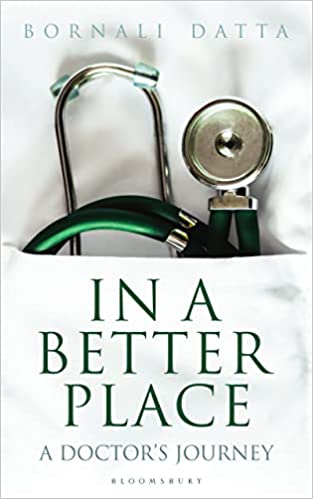
The author of In a Better Place is a highly respected medical practitioner with a long and distinguished career in U.K. and India. Given the vast knowledge and wide-ranging experience that have gone into the writing of this book, it is surprising to note that it is not an academic work. It is a novel, written with effortless ease, that proves to be as informative as it is readable and interesting. Bornali’s language is simple and has a gentle mellowness and her style, though lively, isn’t racy or trendy. It has a leisurely flow but demands close attention. She gives her reason for writing this book in her ‘Author’s Note’:
“While reams of clinical history and medical notes are written arduously every day in every hospital by its diligent doctors and nurses, there is hardly anyone to document the human stories that unfold continuously in the long corridors and lonely wards of hospitals.”
The book, as per her own admission then, is not an account or analysis of medical research and clinical practice. It is a story of human lives caught in the cusp of aspiration and reality. Of sickness and suffering entwined with the pressures and frailties of care givers. It draws from detailed and extensive research into the lives of Indian doctors during the last thirty years of our history. A momentous period which saw globalization and the waking up to a Many countries; One world, concept in a big way.
The writer shows a comprehensive understanding of her subject. Her characters are a group of idealistic young doctors, who are genuinely eager to use their medical education to treat the sick in the best way possible. They inhabit two worlds, India and England, sometimes physically; sometimes in spirit. They are confronted with two choices to begin with. Adherence to convention and traditional ways. Or carrying out their aspirations for what they think will be a better life, in defiance of social and parental pressure. Those who are unhappily trapped in India’s heat and dust, poverty and primitive systems, crowds and chaos yearn for foreign shores. Those who have made it to the West are ill at ease in the strange new life they have embraced. A sense of not fitting in, of somehow being reduced to the other despite all their education and proficiency in English, dogs them. Swamped in nostalgia and exile they are confused and bewildered.
Both sets of lives are seen as fragmented. Places define people and relationships. The book provides a fascinating kaleidoscope of yearning and aspirations in a direct, not always complimentary way. The value of the book lies in its creation of complex emotions, use of empirical data and honest telling.
The chief protagonist of the novel, Sudha, undergoes post graduate training in a government hospital in Delhi before moving to England with her husband, another young doctor called Girish. Their friends, Jai and Sanjay, also make it to their dreamland. All four are overwhelmed, initially, by the difference in the two systems and take a jingoistic delight in having reached where they wanted to be. The dirt and squalor in Indian hospitals, the rusted equipment and callous attitude to suffering by overworked doctors and nurses, is a shameful contrast to what they see in English hospitals. At first the picturesque buildings, manicured lawns, spotless beds and hushed corridors win their total admiration and respect. But, gradually, they get a sense that all is not as it appears on the surface. They, who only wish to do their best, encounter hurdles, injustice and racism and the cold, hard superiority of people who will never forget or let them forget they were once their rulers. An immigrant angst overtakes them. Some make a desperate bid to overcome it and manage to carve a groove for themselves in the land of their exile through unequal, often loveless, marriages with British citizens. Some begin to consider going back to India. But the choice, either way, is equally hard.
Dr. Chatterjee, a senior doctor in the hospital Jai works in, has made two attempts to return to India. Both proved abortive and he was forced to return. His wife and children, having lived too long in the West, could not adjust to India. He has become the proverbial nowhere man, unable to find a comfort zone anywhere. Though an excellent doctor and an intelligent, cultured gentleman, he knows that he will never reach the top of his profession or be accepted socially by his colleagues.
“’The Whites…,’ he tells Jai, ‘don’t want to socialize with you. Take Dr Smith and Dr Weldon. I’ve called both of them for dinner to my house, their entire families, not once but two times. But there is no reciprocation from their side. Not once have they invited me over, although they get together quite often.’”
Aspirations die but hope continues. People suffer but they also find solutions. The author is non-judgmental.
“There is never right or wrong, she says in conclusion to her story. Just what works for one and what works for another. Life goes on regardless, both inside and outside of the hospital, through the trepidation of change, of migration, of loss and adoption of a foreign land.”
But what, in the end, is a better place? Though Bornali doesn’t provide the answer I am tempted to do so. I quote from a poem I used to recite as a child:
Mid pleasures and palaces though we may roam
Be it ever so humble there’s no place like home.
Aruna Chakravarti was the principal of a prestigious women’s college of Delhi University for ten years. She is also a well-known academic, creative writer and translator with a number of published books on record. Her novels, The Inheritors,Jorasanko, Daughters of Jorasanko, have sold widely and received rave reviews. The Mendicant Prince is her last novel and Through a Looking Glass, her latest short story collection. She has also received awards such as the Vaitalik Award, Sahitya Akademi Award and Sarat Puraskar for her translations.
PLEASE NOTE: ARTICLES CAN ONLY BE REPRODUCED IN OTHER SITES WITH DUE ACKNOWLEDGEMENT TO BORDERLESS JOURNAL.
FINDING THE SELF IN ROOTED ROUTES

When I cross any boundary of cartography
New cultures paint my traditional tales.
Why does hybridity then become a cultural conflict
And I the cultural ‘other’?
But with no fixed roots,
Trying to find meaning of the self,
I take different routes.

When cultures assimilate, diversity is born.
When integration takes place,
Identities change grounds.
When identities are in a flux
What becomes of our roots?
Are roots always to be found in a place called ‘home?’
And does home always refer to the ‘homeland'?

What about the ones who try to locate themselves
In rootless geographies,
Where do they belong?
In roots or routes?
For their home lies in ambiguity and diversity,
As it remains hidden in the personal history
Of many diasporic experiences that
History refused to notice.
Isha Sharma is a student of Delhi University. She is passionate about translating emotions into verses. Her writings have been published in Kitaab International, The Indian Periodical, The Indian Express, Indus Women Writing Newsletter, The Feminist Times and The Tribune (Student Edition).
PLEASE NOTE: ARTICLES CAN ONLY BE REPRODUCED IN OTHER SITES WITH DUE ACKNOWLEDGEMENT TO BORDERLESS JOURNAL
Hand of great age – what you find wrapped
around you in shawl-like cover, in humble endowment;
prayer beads, what may come,
this mustiness of basement galleries,
the art of Dutch colonials loading ships
no man can remember sailing
and the bell in the distance is for dinner
and never church; breaks in wrinkled skin, now weeping –
a pensioner’s sudden chill and you are laid up for days!
What is gallant is gone and it is these many long
silences that remain.
Ryan Quinn Flanagan is a Canadian-born author residing in Elliot Lake, Ontario, Canada with his wife and many bears that rifle through his garbage. His work can be found both in print and online in such places as: Evergreen Review, The New York Quarterly, Borderless Journal, GloMag, Red Fez, and Lothlorien Poetry Journal.
.
PLEASE NOTE: ARTICLES CAN ONLY BE REPRODUCED IN OTHER SITES WITH DUE ACKNOWLEDGEMENT TO BORDERLESS JOURNAL.








 Borderless