We are living under fallen skies in dark basements of sorrow a world of broken elevators and stairs too steep for us to climb up from our depth of despair lying curled like a foetus for comfort waiting waiting and waiting for the skies to clear waiting waiting and waiting for the sun to fill the blanks waiting for the sun to shine again
Lynn White lives in north Wales. Her work is influenced by issues of social justice and events, places and people she has known or imagined. She is especially interested in exploring the boundaries of dream, fantasy and reality.
.
PLEASE NOTE: ARTICLES CAN ONLY BE REPRODUCED IN OTHER SITES WITH DUE ACKNOWLEDGEMENT TO BORDERLESS JOURNAL
I have longed to leave and be not afraid Take these wings beyond the listless land Let the sea erase that bight of sand
I have come to soar and sightless to fear Let me hush the clinging shores of here Take these wings and crave this night
I have longed to be lost and be not afraid I have come so far and to be so near These wings will brave the flight of light
THROUGH THE KITCHEN WINDOW
The damp and slump of weathered branches made light with a sudden breeze, and leaves no longer sullen, uplifted to scatter... time to believe in matters of chance?
The souls of spices arise from the pan, my wooden spoon a turmeric moon, and our pandemonium of kids and you chasing leaves. I can see them.
Phil Wood was born in Wales. He enjoys painting and learning German. His writing can be found in: The Fig Tree Coal Mining Anthology, The Shot Glass Journal, London Grip.
PLEASE NOTE: ARTICLES CAN ONLY BE REPRODUCED IN OTHER SITES WITH DUE ACKNOWLEDGEMENT TO BORDERLESS JOURNAL
That is the question Ratnottama Sengupta is asking with so many grey heads since London’s Westminster voted in favour of Assisted Dying
From Public Domain
“She was in so much pain these last four months that we are not mourning her final exit. We are celebrating her liberation.”
Speaking with Bhabhi’s[1] nephew last week forced me to readjust my emotions regarding the final goodbye. Condolences are in order, worldwide, when a dear one departs the mortal world. But of late I have been noticing that people “celebrate the life’ of the departed soul rather than mourn the death. Yes, every departure is a loss, taking an emotional toll of those left behind. And still I am not shocked nor angry that on June 20, a day after Bhabhi breathed her last in Singapore, the British Parliament voted in favour of a bill to legalise Assisted Dying for terminally ill people.
This has paved the way for a long debated social change that has, for as long as I can remember, been held in abeyance. Because? It has always been argued that, since we cannot bring the dead to life, we do not have the right to take away life. Indeed, the UK parliamentarians voted on the subject 10 years after it was first proposed, I learn from the news reports. And even as the Wise Men of London debated the issue, demonstrators outside were crying out, “Kill the Bill, Not the Ill.”
Once the Bill is passed by the House of Lords, the Terminally Ill Adults (End of Life) Law will give “mentally competent, terminally ill adults in England and Wales with six months or less life to live, the right to choose to end their life with medical assistance. Those who would want the procedure would have to gain the compassionate “Aye!” of two doctors and a panel of experts.
While the scrutiny by the Upper House might take months, it is unlikely to be blocked now that it has gone past the Commons and secured a nod from the PM.
*
My first acquaintance with the concept was garbed in the words, ‘Mercy Killing’. I was a school-going teenager when I read a Bengali courtroom drama, Parashuramer Kuthar (1989, Parashuram’s Axe) where the son was in the dock, fighting the charge of murdering his mother with morphine. “Night after night she would cry out of acute pain. Night after night I sat by her bed, watching her inch towards death. The doctor had prescribed the morphine that let her sleep at night. But when that failed, I gave her a repeat dose so she could go to sleep…”
Half a century ago that sounded ominous. Now, having seen — and digested — the ‘Assisted Suicide’ of celluloid icon Jean Luc Godard[2] in the autumn of 2022, I have been weighing my responses to the concept.
Godard, born on July 7, 1930, had lived in France from where he had revolutionised cinema across the globe. At the age of 91, with “multiple disabling pathologies” — to quote his doctors — he went to Switzerland because that was the only country to have legalised euthanasia as long back as 1941. Albeit they have specifications, the overriding one being this: the person assisting the suicide must not have any selfish — read, monetary — motive to provide the seeker the means to exit.
*
“Euthanasia is death with dignity,” my Jyotish Pishamoshai had said three decades ago. At 90 something, the man who went around all his life in trams and buses, to look up his younger cousins, simply hated to be bed bound. Besides, he had seen his youngest brother Dinesh “hang till death” at age 20, without a trace of remorse for having bombed the Writers Building in the Capital of the Raj. So why would the elder brother, his memory intact, want to “be a burden” to even his only son? Mercifully, Sudhir Da did not have to go the way of Parashuram. The almighty in heaven voted for the nonagerian’s exit.
*
My response to the issue peaked when I read this poem, ‘Antim Akanksha’ (The Last Wish) , by Purnendu Ghosh of Jaipur. This IIT-ian from Kanpur, a diehard cinema aficionado, has penned the same thoughts in Bengali and English too. But I had already translated his anguish in Hindi before I spoke with him. “I had written these lines when I was sitting by my mother-in-law, then languishing in the hospital. When I had first seen her, she was 46. Over the next 46 years, I was witness to the transformation age had forced upon her I could only watch, helpless, because the final exit is in the hands of only the Almighty.”
I am still weighing my responses. Yes, I believe in the Existence of a Superior Force. Still, when a person has to lie waiting to bid goodbye to pain, would he or she wait for His mercy, or that of the medics?
Ratnottama Sengupta, formerly Arts Editor of The Times of India, teaches mass communication and film appreciation, curates film festivals and art exhibitions, and translates and writes books. She has been a member of CBFC, served on the National Film Awards jury and has herself won a National Award.
.
PLEASE NOTE: ARTICLES CAN ONLY BE REPRODUCED IN OTHER SITES WITH DUE ACKNOWLEDGEMENT TO BORDERLESS JOURNAL
The nimble promise of half-light finds me, while nested sleep claims you to solitude. I know your curves.
Allegro weaves my waking cloth, a scimitar of nestlessness, I have no rest. You clothe in leaves.
The morning forest stretches songs, not tremulous, no tentative whisper. They scythe a curve of moon.
A wakeful door, a hem of sun, the hum of bees, wakefulness splashes so loud you turn around to me...
Like the curve of the moon, Like the curve of the hills, Like leaves you cling to curves, I stretch to you.
BEACH OBSERVATION
His hands behind his head, no weight, what with the sky shuttered and sea at play along the sleepy bay.
Eyes closed, and yet he knows this weight, the busy spade and bucket pouring time over his feet. He trusts
her even when the worry of sand comes on his heart. A father gives his time no weight. His daughter digs.
Phil Wood was born in Wales. He has worked in statistics, education, shipping, and a biscuit factory. He enjoys painting and learning German. His writing can be found in various places, most recently in: Byways (Arachne Press Anthology), The Lake, Fevers of the Mind (a collaboration with photographer John Winder), and the Borderless Journal.
.
PLEASE NOTE: ARTICLES CAN ONLY BE REPRODUCED IN OTHER SITES WITH DUE ACKNOWLEDGEMENT TO BORDERLESS JOURNAL
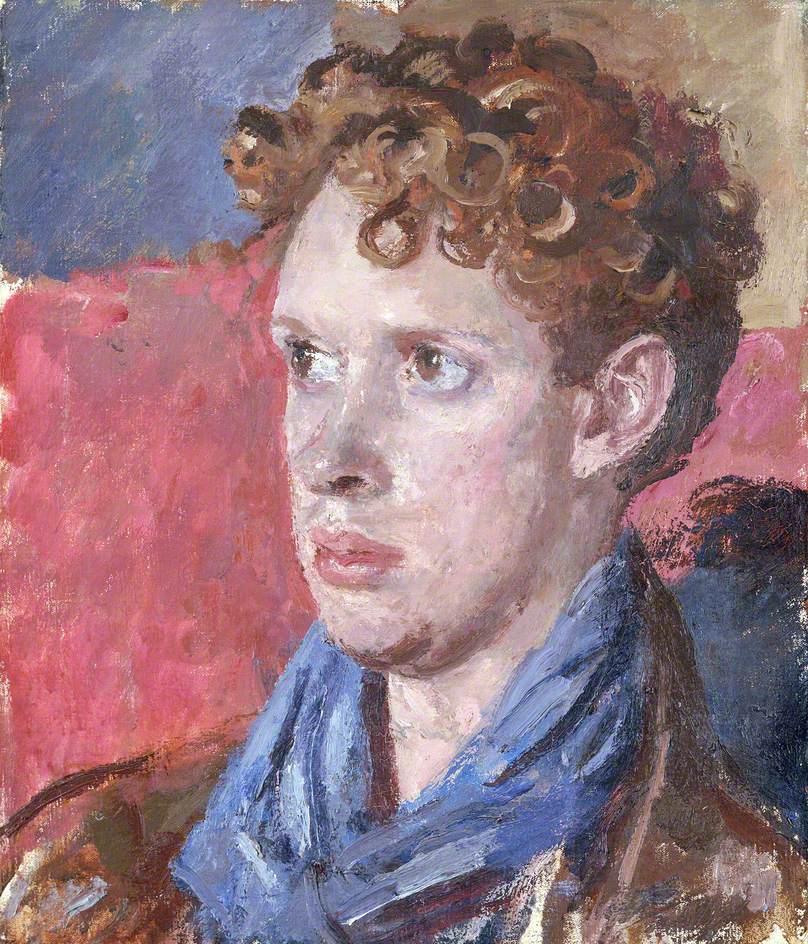
Dylan Thomas (1914-1953);Portrait by Augustus Edwin John (1878–1961) from Amgueddfa Cymru – National Museum Wales
ENCOUNTER

I met the ghost of Dylan Thomas
late at night in Ardmillan Terrace.
His face, as white as alabaster,
he shouted out, 'Hey, you're plastered'!
Well, true, I'd imbibed some alcohol,
but did not take to his tone at all.
I conveyed my protests as best I could
but he just quoted from Under Milk Wood*.
I expressed my liking for his verse.
'The best', he said 'is by far the worst'.
I tried to guess this statement's meaning
yet could derive no glint or gleaning,
nor corpuscle of comprehension,
so I thought I could just as well mention
why he was out late on the street tonight,
in view of his tenuous links to life.
'To find a drink, just like always,
like I used to spend the old days'.
'I've the key to life, you can have the key,
if you can point me to a hostelry'.
'None', did I retort, 'twixt Earth and Heaven,
for they don't serve spirits beyond eleven'.


*Radio drama by Dylan Thomas published in 1954 and read first on stage on May 14th, 1953.
Stuart McFarlane is now semi-retired. He taught English for many years to asylum seekers in London. He has had poems published in a few online journals.
.
PLEASE NOTE: ARTICLES CAN ONLY BE REPRODUCED IN OTHER SITES WITH DUE ACKNOWLEDGEMENT TO BORDERLESS JOURNAL
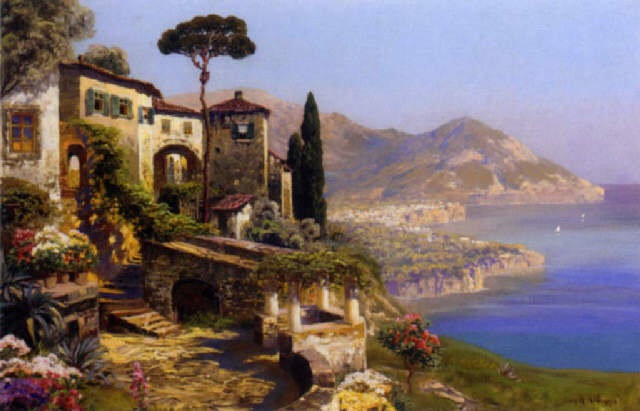
I gaze across the piazza -- you're lounging with our daughters who are sipping limoncello
A wall lizard loiters in dimming light -- distracted by your yellow blouse it ignores the pulse of moths
I pause too, not wanting the intermezzo to end with a Ciao -- I linger under the lemon tree's shade
CWTCH
Our cosy rooms do not become timeless, removing clocks is just a childish gesture.
This sharing space – a spicy spaghetti in bed, a bubbly bath - both knowing pleasure
adds up a cost. But cuddling on the settee, the room unmoors with cartoon repeats.
A wine, no half-life measure: happiness will breathe carefree, no careless cough defeats.
KEATS
reading rooted in mind and tasting ripe berries the oozing winking scent window open writing
Phil Wood was born in Wales. He enjoys chess and learning German. His writing can be found in various places, including : The Seventh Quarry, Borderless, and Arachne Press (Byways Anthology).
.
PLEASE NOTE: ARTICLES CAN ONLY BE REPRODUCED IN OTHER SITES WITH DUE ACKNOWLEDGEMENT TO BORDERLESS JOURNAL
We took to not talking in the easy hours
of walking. Worry days, study days, days
like wasps that never pause, that made life sour
with fret and flit... out of those woods we came

to fallow fields loitered with restless rooks,
then through a brambled kissing gate and found
a bridge, and from the rushing river leapt
a trout with appetite, its nature bound

in blood to hide and seek. We wandered back
along a pockmarked lane, tufted with grass,
hedge-tight. An unmapped night, the sky crow-black,
no moon disclosed. Not talking, just walking.
Phil Wood was born in Wales. He studied English Literature at Aberystwyth University. He has worked in statistics, education, shipping, and a biscuit factory. He enjoys watercolour painting, bird watching, and chess. His writing can be found in various places, including recently : London Grip, Noon Journal of the Short Poem, Borderless and a featured collaboration with photographer John Winder at Abergavenny Small Press.
PLEASE NOTE: ARTICLES CAN ONLY BE REPRODUCED IN OTHER SITES WITH DUE ACKNOWLEDGEMENT TO BORDERLESS JOURNAL
On 26 th January, 1950, India was declared a republic, an independent entity with the complete withdrawal of colonial support of any kind. The country adopted an independent constitution. The Republic Day celebrations conclude on 29th January with ‘Beating the Retreat’,where more than seven decades ago the British withdrew all armed support from India.
In this edition, we will explore how the idea of an independent India has evolved over the decades. We have poetry by Asad Latif that celebrates the Indianess across borders. On the other hand, Beni S Yanthan from Nagaland explores the republic in the shadow of displacement, which makes one wonder if cultural hegemony can help make a country? Ukraine is faced with a war over it.
Tagore’s poem builds empathy around human suffering as does Premchand’s story, translated by C Christine Fair — these are texts written at the start of the turn of the last century. Have we come out of that suffering? Perhaps, the answer can be found in Bhaskar Parichha’s review about a book that spans almost the whole of twentieth century in India. He tells us the author, “MA Sreenivasan (1897-1998) lived through almost the entire 20th century and was among the very few people who witnessed at close quarters the enormous changes that took place in India during this period.” This has been recorded in his book and its review. Rhys Hughes’ humour winds up this edition where he recounts the differences in the cultural ethos of India and a region of the country that despite losing an empire where the sun never set, still retains its sense of humour!
Shantanu Ray Chaudhari converses with writer Gajra Kottary, a well-known writer of Indian TV series, novels and stories. Clickhereto read.
A discussion on Samaresh Bose’s In Search of the Pitcher of Nectar, a book that takes us to the heart of the Kumbh Mela, a festival recognised by the UNESCO as an Intangible Cultural Heritage, with the translator, Nirmal Kanti Bhattacharjee. Clickhere to read.
Translations
Nazrul’s Why Provide Thorns has been translated by Professor Fakrul Alam. Clickhere to read.
Mercy, a story be P. F. Mathews, has been translated from Malayalam by Ram Anantharaman. Clickhere to read.
Songs of Freedom: Vikalangta or Disability is an autobiographical narrative by Kajal, translated from Hindustani by Janees. These narrations highlight the ongoing struggle against debilitating rigid boundaries drawn by societal norms, with the support from organisations like Shaktishalini and Pandies. Clickhere to read.
Paul Mirabile explores James Joyce’s Stephen Dedalus and his passion for words keeping in mind the hundred year old Ulysees & the even older, A Portrait of the Artists as a Young Man. Clickhere to read.
Book Excerpts
An excerpt from Radha Chakravarty’s translation of Tagore’s Farewell Song. Clickhere to read.
An excerpt or two short narratives from Rhys Hughes’ Yule Do Nicley. Clickhere to read.
I am from Wales but now I live in India. I am therefore in a very good position to note any differences between life in the two different countries. The first of these differences concerns food. Indian food is the main kind of food in public eating places in both locations. But the food itself isn’t quite the same. Indian food in India is Indian by default. In Wales no one knows whose fault it is. I fell into a curry in Wales once. I slipped on discarded laddoo peel (we peel laddoos over there because we think they grow on trees) and into the pot I went. It was a good curry and might be considered authentic. After I fell into it, ‘in authentic’ was the correct term for it. I wiped myself clean with a large naan bread. Later I wore the naan bread as a cloak. Waste not, want not.
So much for food. I am writing this short essay at the end of November. India is especially different from Wales at this time of year. Here I am playing badminton in shorts and a t-shirt. Back in Wales it is so cold that the sunbeams have frozen solid and I would be hanging my washing on one of the horizontal rays. In the afternoon, here in India, I will probably read a book of poetry under a banyan tree while drinking mosambi juice and listening to sitar music. But in Wales, I would be snapping off that frozen sunbeam and using it as a long lance while riding my yeti[1] over the misty mountains.
Traffic is another difference. In India the roads are choked with cars, autos, tuk-tuks (yes, I know that autos and tuk-tuks are the same thing but I need more wordage in this essay), trucks, buses, bicycles, wheelbarrows and cows. Wales doesn’t really have roads and the only traffic consists of crows. A crow perched on the back of a cow would make a perfect official emblem for a Welsh-Indian Friendship Association. If there are no roads in Wales, how do we get about? It is a pertinent question. We jump, is the answer. This not only enables us to reach our destinations but keeps us warm in winter.
In India there are monsoons but in Wales they are never soon, they are here already. The only time it stops raining in Wales is when the clouds go on strike for more pay. Lightning also goes on strike. There are puddles everywhere, even on the surfaces of lakes and ponds. Because we jump everywhere, there is a lot of splashing in Wales. This splashing puts most of the moisture back into the air where it forms clouds and perpetuates the cycle. I once perpetuated a cycle. It was a bicycle originally but I sent it away to get an education and it came back as a unicycle. I connected it to a motor powered by a rainfall gauge. Off it went on an endless journey around Wales. I would never attempt something like that in India. So there’s another big difference.
India is actually a very advanced country in terms of technology. Based in Bangalore, I am able to order anything I like with an app on my mobile phone. If I want food or drink or a bicycle, I just have to tap a few keys and a delivery guy will turn up with the ordered stuff. I once ordered a delivery guy using one of these apps and a different delivery guy turned up carrying the first delivery guy over his shoulder. But then I decided I didn’t really need a delivery guy so I sent him back and obtained a full refund.
It’s not like that in Wales. We only acquired mobile phones very recently in history and they are of a decidedly primitive sort. We started with parrots that one keeps in a pocket and speaks the messages to before releasing them to land on the shoulders of the recipients, where they recite the messages. This meant the pockets of our trousers had to be enlarged but we felt it was worth the cost. The parrots didn’t like flying through the endless rain and the messages usually went astray. So we progressed to a more advanced model, which consisted of riders on bicycles holding tin cans connected by string. You can’t order food on our mobile phones or even new trousers.
Wales is behind the times in other ways too, in fact in all ways. Wales is so belated in every respect that when the end of the world finally takes place, the country will continue for a few more years as if nothing has happened. I suspect that very slow processes, such as continental drift, evolved in Wales. I suppose that even evolution evolved in Wales, considering how slow it is and how long it takes a dinosaur to change into a chicken. I can change into a chicken with a great deal more efficiency, but I prefer pretending to be a gorilla or a chimp. It’s a very relaxing thing to do. Why not try?
Also in India you have holy men, but in Wales we only have holy socks. A holy man can open himself to the secrets of the universe. A holy sock is open to the weather, which is generally wet, and not much else. Holy men can levitate if they are sufficiently pure in spirit, or so I have been told. I once saw a flying sock, but it had been lobbed at me by a neighbour and wasn’t pure at all. That’s not the only thing I have seen rushing through the atmosphere in Wales. Parrots with sad expressions, of course, but also gloves. Why this should be so was a mystery for ages but recently the enigma was solved by an enigma machine and the answer is that “glove is in the air, everywhere I look around”. Or perhaps it is just the wind. Yes, I think it’s the wind.
The Enigma machine was used in the early- to mid-20th century, especially in WWII, for commercial, diplomatic, and military communications. Courtesy: Creative Commons
An enigma machine, incidentally, is a device invented in Wales that looks like an abacus, but it has small onions on wires instead of beads. Crows perch on the wires and peck the onions and move them into different positions, which gives the answer to any question. But the answer is cryptic and must be studied by a druid, who will interpret it. Druids are common in Wales. They aren’t holy men, strictly speaking, but are highly respected because they wear intact socks. They also wear cloaks made from naan breads but if you ask them, they insist they are made from wool and cobwebs.
You are probably beginning to ask yourself, is this a serious essay? And at this point you might be harbouring doubts that it is. There are many harbours in Wales, which has a convoluted coastline, but not many in the interior of India. That’s another difference. I have already mentioned laddoos and the fact that we peel them (and I mentioned it in brackets) but we also peel bells. I don’t think bells are ever peeled in India. They are rung instead. The peel of Welsh bells is used to make the tall hats that old women wear, conventionally on their heads, that you might have seen in vintage photographs. Bell peel is more enduring than satin or any other kind of fabric. It means that every old woman always knows what the time is when their hat bongs.
India is full of palaces. Not long ago, I visited Mysore Palace and found it truly impressive. In Wales we have nothing quite like that, but I often mention Mysore Feet after all the jumping I have to do to get anywhere. And now one final difference before I go. In India, the essays that writers write are generally detailed, comprehensive and lengthy. In Wales they often end abruptly in the middle with three dots, as if the writer was eaten by a yeti unexpectedly… but not this one. No yeti. Not yet anyway.
[1] The Welsh yeti, Abominablis Boyo, is only distantly related to the Himalayan species.
.
Rhys Hughes has lived in many countries. He graduated as an engineer but currently works as a tutor of mathematics. Since his first book was published in 1995 he has had fifty other books published and his work has been translated into ten languages.
.
PLEASE NOTE: ARTICLES CAN ONLY BE REPRODUCED IN OTHER SITES WITH DUE ACKNOWLEDGEMENT TO BORDERLESS JOURNAL





 Borderless