Banjara author Ramesh Karthik Nayakdiscusses his new book, Chakmak (flintsone), giving us a glimpse of his world. We also have a brief introduction to his work. Clickhere to read.
Translations
Demanding Longevityby Quazi Johirul Islam has been translated from Bengali by Fakrul Alam. Clickhere to read.
Moonlight, a poem by Bashir Baidar, has been translated from Balochi by Fazal Baloch. Clickhere to read.
Maithili Poetryby Vidyanand Jha has been translated from Maithili by the poet himself. Click hereto read.
Look around you and expand your heart.
Petty sorrows are insignificant.
Fill your vacant life with love for humanity.
The Universe reverberates with celestial ecstasy.
— Anondodhhara Bohichche Bhubone(The Universe reverberates with celestial ecstasy), Tagore, 1894
Some of the most beautiful colours in this universe are blended shades— colours that are born out of unusual combinations. Perhaps that is why we love auroras, sunrises and sunsets. Yet, we espouse clear cut structures for comprehension. As we define constructs created by our kind, we tend to overlook the myriads of colours that hover in the gloaming, the brilliant play of lights and the vibrancy of tints that could bring joy if acknowledged. That ignoring the new-born shades or half-shades and creating absolute structures or constructs lead to wars, hatred, unhappiness and intolerance has been borne true not only historically but also by the current turn of events around the globe. While battles are never fought by the colours or beliefs themselves, they can harm — sometimes annihilate — rigid believers who are victimised for being led to accept their way as the only one and hate another. Perhaps, this has echoes of the battle between the Big Endians and Little Endians over the right way to break eggs in Jonathan Swift’s Gulliver’s Travels (1726). As the book is mere fiction, we can admire, agree and laugh at the content. However, in real life, watching newsreels has become a torture with destruction and violence being the main highlights. These detract from life as we knew it.
Writing or literary inputs seem to have become a luxury. But is it really hedonistic to play with words? Words used effectively over a period of time can impact readers to think peace, acceptance and love and also help people heal from the ensuing violence. That can be a possibility only if we self-reflect. While we look for peace, love and acceptance in others, we could start by being the change-makers and bridge builders ourselves. That is the kind of writing we have managed to gather for our November issue.
Building such bridges across humanity, we have poems on the latest Middle Eastern conflict by Stuart McFarlane and David Mellor, which explore the pain of the victims and not the politics of constructs that encourage wars, destruction of humanity, the flora, the fauna and our home, the Earth. Michael Burch writes against wars. Prithvijeet Sinha and Ahana Bhattacharjee write about refugees and the underprivileged. Reflecting colours of the world are poems from Ryan Quinn Flanagan, Suzayn AH, Radhika Soni, Ron Pickett, George Freek and many more. Rhys Hughes has brought lighter shades into his poetry by trying a new technique while reflecting on yetis and mermaids. His column tries to make a parody of a non-existing parody, using TS Eliot’s century old poem, ‘Wasteland’, with amazing results!
Our translations are all poetry too this time. Professor Fakrul Alam has translated a poem discussing human aspirations by Quazi Johirul Islam from Bengali. Another Balochi poem of hope by Bashir Baidar has been brought to us in English by Fazal Baloch bringing into play the moonlight.
For the first time, we are privileged to carry poetry from a language that has almost till now has eluded majority of Anglophone readers, Maithili. Vidyanand Jha, a Maithili poet, has translated his poetry for all of us as has Korean poet, Ihlwha Choi. Winding up translations are Tagore’s ultimate words for us to introspect and find the flame within ourselves in the darkest of times – echoing perhaps, in an uncanny way, the needs of our times.
Our conversation this month brings to us a poet who comes from a minority group in India, Banjara or gypsies, Ramesh Karthik Nayak. In his attempt to reach out to the larger world, he worries that he will lose his past. But does the past not flow into the future and is it not better for traditions to evolve? Otherwise, we could all well be living in caves… But what Nayak has done — and in a major way — is that he has brought his culture closer to our hearts. His debut poetry book in English, Chakmak (flintstones), brings to us Banjara traditions, lives and culture, which are fast getting eroded and he also visits the judgemental attitude of the majoritarian world. To give you a flavour of his poetry, we bring to you an excerpt from his book, livened beautifully with Banjara art and an essay by Surya Dhananjay that contextualises the poetry for us. Our excerpts also have a focus on poetry for we are privileged to have a few poems from Mamang Dai’s The White Shirts of Summer: New and Selected Poems. Mamang Dai is a well-known name from the North-eastern state of Arunachal Pradesh for both her journalistic and poetic prowess.
We are happy to host Ranu Uniyal’s beautiful review of I am Not the Gardener: Selected Poems by Raj Bisaria. Bisaria among other his distinctions, was named “Father of the modern theatre in North India” by the Press Trust of India. The other reviews are all of prose. Somdatta Mandal has written of Ali Akbar Natiq’s Naulakhi Kothi, a fictional saga of gigantic proportions. Anita Balakrishnan has reviewed Lakshmi Kannan’s short story collection, Guilt Trip. The book that gives hope for a green future, Akshat Rathi’s Climate Capitalism: Winning the Global Race to Zero Emissionshas been reviewed by Bhaskar Parichha. Parichha contends: “Through stories that bring people, policy and technology together, Rathi reveals how the green economy is possible, but profitable. This inspiring blend of business, science, and history provides the framework for ensuring that future generations can live in prosperity.”
The anti-thesis to the theme for a welfarist approach towards Earth can be found in Koushiki Dasgupta Chaudhari’s poignant musing titled, “The Theft of a River”. Meredith Stephen’s travel to California and Sai Abhinay Penna’s narrative about Chikmagalur have overtones of climate friendliness. Ravi Shankar writes further of his travels in Peru and Peruvian coffee. Keith Lyons takes us peeking at Beijing and the Great Wall. Gayatri Devi adds to the variety by introducing us to the starry universe of South Indian cinema while Devraj Singh Kalsi brings in the much-needed humour with his narrative about his “Crush on Bottles“. Suzanne Kamata has also given a tongue-in-cheek narrative about the mystique of addresses and finding homes in Japan. We have fiction from Paul Mirabile located in England and Kalsi’s located in India. Pause by our contents page to view more gems that have not been mentioned here.
Huge thanks to our team at Borderless Journal, especially Sohana Manzoor for her fabulous artwork. This journal would not have been as it is of now without each and every one of them and our wonderful contributors and readers. Thank you all.
Wish you all a wonderful month as we head towards the end of a rather tumultuous year.
Translated by Vidyanand Jha from Maithili to English
Madhubani Painting or Mithila Art
TRANSLATION

My eyes made through swimming
in the waters of the pond full of algae
carry greenery, see greenery everywhere.

My blood made of the juice of Ladubbi mangoes,
flow in my veins continuously, sweet, juicy.

Made from pieces of Rohu fish,
made from Garai Garchunni fish,
my body is shimmering, slick.

The sound of the hooves of Salhesh’s* horses,
the reverberations of the sound of the Chaukitora dance,
the desolation of the consequences of Vidyapati*,
and my voice, my clear language
made from mixing all these —

Gets translated —
speaking an unknown language outside my home,
spending my life in an unknown place, some other place,
losing myself, making myself into someone else
making myself into a customer in a glittering market.

And my Maithil existence
gets translated
into Indian citizenship.

*Salhesh is a folk deity in Mithila(Nepal and Terai region in India)
*Vidyapati (1352-1448) was a Maithili poet


TOGETHERNESS

A filled in disused well reverberates with
the mumbled Sahajiya song of a Vaishanvi*,
mixed with your name whispered softly,
mixed with the sound of a thundering river flowing in full spate.
So many eager songs swirl,
straining to come out of our souls
to touch the heights of the sky.
Sounds are mumbled, words are mumbled
in a filled disused well.

On the banks of a water tank
under a tree with leaves falling,
in a locked old box
are kept for many years so many embraces, kisses so many,
pressed and folded for many years,
the touch of your skin on mine - quivering, exciting,
impulses so many, so many disappointments.
Everything is folded and kept inside.
A box that is rusting slowly is thrown away.
It’s becoming one with the earth slowly.

Routes to many cities utterly unknown,
paths to many villages deserted
wait to be measured
by your feet, by my feet.
Many fabulous scenes, strange scenes many,
sad scenes many, grotesque scenes many
await our eyes,
lost in an unknown corner of this Earth,
in a deathly silent lost village,
Or in an utterly unknown strange city.

Would my being be
yours?
Or maybe on the path of annicca*,
I would be, you would be
separately, alone.
Or is that that I wouldn’t be, you wouldn’t be?

*Sahajiya -- a form of Hindu tantric Vaishnavism; Vaishnavi -- a woman follower of Vishnu
*annicca—Buddhist principle of impermanence
Photo courtesy: Ira Jha
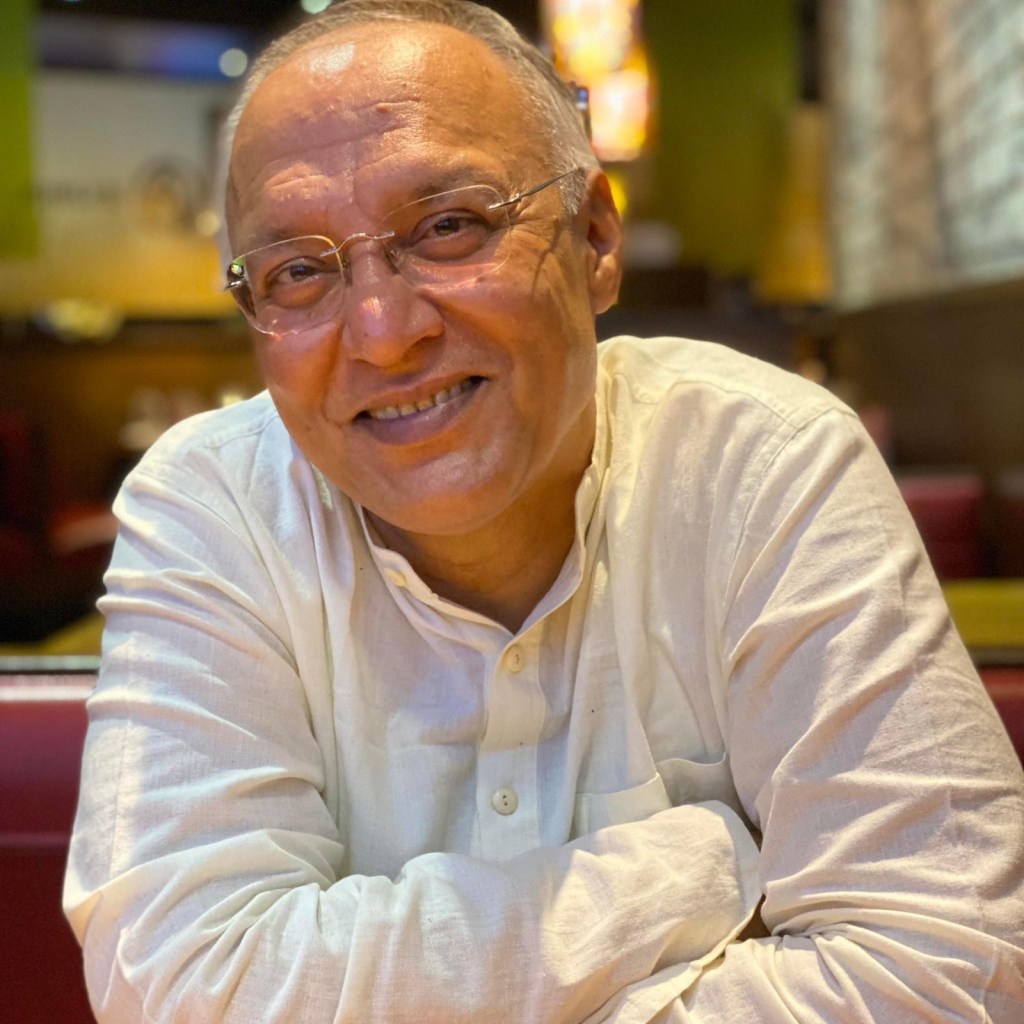
Vidyanand Jha is a poet, short story writer and literary critic in Maithili. He is also a translator translating texts from and into Maithili primarily to and from English. He has been publishing Maithili poems in literary journals since 1980s. He has three poetry collections to his credit: Parati Jakan (Like a Morning Song), published by Sahitya Akademi in 2002, now in its second edition; Bicchadal Kono Pirit Jakan (Like a Lost Love) published by Antika Prakashan in 2019 and Danufak phool Jakan (Like Danuf Flowers) published in 2021. He has received many prestigious awards for his poetry in Maithili. His translations from Maithili have appeared in journals like Indian Literature and Anthologies like The Book of Bihari Literature. He was awarded Katha Translation Award in 1998.
.
PLEASE NOTE: ARTICLES CAN ONLY BE REPRODUCED IN OTHER SITES WITH DUE ACKNOWLEDGEMENT TO BORDERLESS JOURNAL


 Borderless