Categories
Editorial

Imagine… All the People…

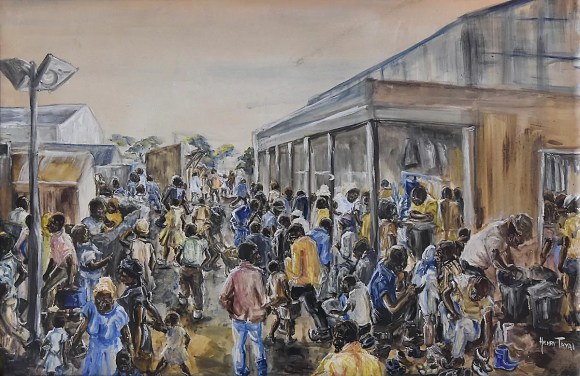
Art by Henry Tayali(1943-1987). From Public Domain

Let us imagine a world where wars have been outlawed and there is only peace. Is that even possible outside of John Lennon’s song? While John Gray, a modern-day thinker, propounds human nature cannot change despite technological advancements, one has to only imagine how a cave dweller would have told his family flying to the moon was an impossibility. And yet, it has been proven a reality and now, we are thinking living in outer space, though currently it is only the forte of a few elitists and astronomers. Maybe, it will become an accessible reality as shown in books by Isaac Asimov, Arthur C Clarke or shows like Star Trek and Star Wars. Perhaps, it’s only dreamers or ideators pursuing unreal hopes and urges who often become the change makers, the people that make humanity move forward. In Borderless, we merely gather your dreams and present them to the world. That is why we love to celebrate writers from across all languages and cultures with translations and writings that turn current norms topsy turvy. We feature a number of such ideators in this issue.

Nazrul in his times, would have been one such ideator, which is why we carry a song by him translated by Professor Fakrul Alam. And yet before him was Tagore — this time we carry a translation of an unusual poem about happiness. From current times, we present to you a poet — perhaps the greatest Malay writer in Singapore — Isa Kamari. He has translated his longing for changes into his poems. His novels and stories express the same longing as he shares in The Lost Mantras, his self-translated poems that explore adapting old to new. We will be bringing these out over a period of time. We also have poems by Hrushikesh Mallick translated from Odia by Snehprava Das and a poignant story by Sharaf Shad translated from Balochi by Fazal Baloch.

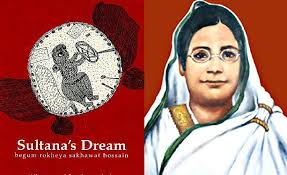
We have an evocative short play by Rhys Hughes, where gender roles are inverted in a most humorous way. It almost brings to mind Begum Rokeya’s Sultana’s Dream. Tongue-in-cheek humour in non-fiction is brought in by Devraj Singh Kalsi and Chetan Dutta Poduri. Farouk Gulsara and Meredith Stephens write in a light-hearted vein about their interactions with animal friends. G. Venkatesh brings in serious strains with his musings on sustainability. Jun A. Alindogan slips into profundities while talking of “progress” in Philippines. Young Randriamamonjisoa Sylvie Valencia gives a heartfelt account of her journey from Madagascar to Japan. Ratnottama Sengupta travels across space and time to recount her experiences in a festival recognised by UNESCO as an Intangible Cultural Heritage of Humanity. Suzanne Kamata brings a light touch again when she writes about robots serving in restaurants in Japan, a change that would be only fiction even in Asimov’s times, less than a hundred years ago!

Pijus Ash — are we to believe or not believe his strange, spooky encounter in Holland? And we definitely don’t have to believe what skeletons do in Hughes’ limericks, even if their antics make us laugh! Poetry brings on more spooks from Saranyan BV and frightening environmental focus on the aftermath of flooding by Snehaprava Das. We have colours of poetry from all over the world with John Valentine, John Swain, Ahmad Al-Khatat, Stephen Druce, Jyotish Chalil Gopinath, Jenny Middleton, Maria Alam, Ron Pickett, Tanjila Ontu, Jim Bellamy, Pramod Rastogi, John Grey, Laila Brahmbhatt, John Zedolik and Joseph K.Wells.

Fiction yields a fable from Naramsetti Umamaheswararao. Devraj Singh Kalsi takes us into the world of advertising and glamour and Paul Mirabile writes of a sleeper who likes to sleep on benches in parks out of choice! We also have an excerpt from Mohammed Khadeer Babu’s stories, That’s A Fire Ant Right There! Tales from Kavali , translated from Telugu by D.V. Subhashri. The other excerpt is from Swati Pal’s poetry collection, Forever Yours. Pal has in an online interview discussed bereavement and healing through poetry for her stunning poems pretty much do that.

Book reviews homes an indepth introduction by Somdatta Mandal to Banu Mushtaq’s Heart Lamp: Selected Stories, translated from Kannada by Deepa Bhasthi. We have a discussion by Meenakshi Malhotra on Contours of Him: Poems, edited and introduced by Malaysian academic, Malachi Edwin Vethamani, in which she concludes, “that if femininity is a construct, so is masculinity.” Overriding human constructs are journeys made by migrants. Rupak Shreshta has introduced us to immigrant Sangita Swechcha’s Rose’s Odyssey: Tales of Love and Loss, translated from Nepali by Jayant Sharma. Bhaskar Parichha winds up this section with his exploration of Kalpana Karunakaran’s A Woman of No Consequence: Memory, Letters and Resistance in Madras. He tells us: “A Woman of No Consequence restores dignity to what is often dismissed as ordinary. It chronicles the spiritual and intellectual evolution of a woman who sought transcendence within the rhythms of domestic life, turning the everyday into a site of resistance and renewal.” Again, by the sound of it a book that redefines the idea that housework is mundane and gives dignity to women and the task at hand.

We wind up the October issue hoping for changes that will lead to a happier existence, helping us all connect with the commonality of emotions, overriding borders that hurt humanity, other species and the Earth.

Huge thanks to our fabulous team, especially Sohana Manzoor for her inimitable artwork. We would all love to congratulate Hughes for his plays that ran houseful in Swansea. And heartfelt thanks to all our wonderful contributors, without who this issue would not have been possible, and to our readers, who make it worth our while, to write and publish.

Have a wonderful month!

Mitali Chakravarty

borderlessjournal.com

CLICK HERE TO ACCESS THE CONTENTS FOR THE OCTOBER 2025 ISSUE

.

READ THE LATEST UPDATES ON THE FIRST BORDERLESS ANTHOLOGY, MONALISA NO LONGER SMILES, BY CLICKING ON THIS LINK.
Categories
Essay

Roquiah Sakhawat Hossein: How Significant Is She Today?

By Niaz Zaman

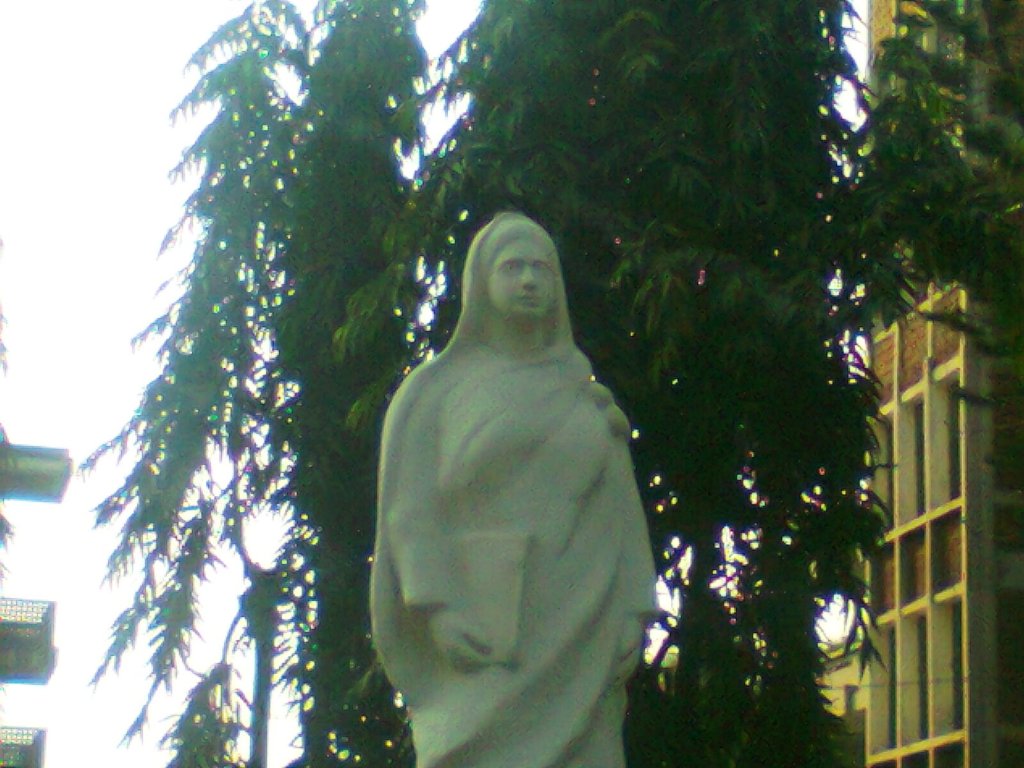
Statue of  Begum Roquiah in the premises of Rokeya Hall, University of Dhaka. From Public Domain.

Recently, near Shamsun Nahar Hall, the second women’s hall of the University of Dhaka, a resident student defaced graffiti depicting Roquiah Sakhawat Hossein – popularly called Begum Rokeya. Black paint was used to smear her eyes and her mouth. Later, the student apologised for her action and promised to restore the image.

I do not know what upset the young woman. The picture is not offensive. The woman has her hair modestly covered. However, the manner of the defacing is troubling. The eyes have been painted over so that the woman cannot see; the mouth has been painted over so that the woman cannot speak. Why was the young woman denying the  rights that Roquiah fought for, that the women of my generation demanded as their fundamental rights, and that the young women of today take for granted?  Why was the young woman who defaced the picture denying the rights that the students against discrimination were claiming?

But, then to my surprise, I learned that this was not the only picture of Roquiah’s that had been defaced after August 5. In this other picture she had been given a beard and the derogatory word “magi[1]” written across it. What had Roquiah done to be dishonoured? What had made her controversial?  Why was a young generation denying the changes that Roquiah had brought in young women’s lives by sheer perseverance and strength of will? On October 1, 1909, only four months after her husband’s death, Roquiah Sakhawat Hossein started a school in his name at Bhagalpur where she had been residing at the time. It was with great difficulty that she was able to persuade two families to send their daughters to her school. Of the five students, four were sisters.

Forced to leave Bhagalpur for personal reasons, she moved to Calcutta. However, she did not give up her dream and, two years later, on March 16, 1911, she re-started Sakhawat Memorial Girls’ School with eight students. At the time of her death on December 9, 1932, there were more than 100 girls studying at the school. Apart from teaching, the school encouraged girls to take part in sports and cultural activities. In recognition of her contribution to women’s education, the first women’s hall of the University of Dhaka was renamed “Ruqayyah Hall” in 1964.

From Public Domain

More than a century has passed since Roquiah’s Sultana’s Dream was published in the Indian Ladies Magazine in 1905. In Bangladesh, in recent years, more than half of SSC graduates have been girls – who have also outperformed the boys. Though the female to male ratio goes down at the university level, women are working in different professions. Nevertheless, the danger to women that led to the institutionalisation of purdah and its extremes – which Roquiah questioned and decried for its often fatal results and which in Sultana’s Dream she reverses to put men in the “murdana” – still persists.

According to the UN, “Violence against women and girls remains one of the most prevalent and pervasive human rights violations in the world.” It is estimated that almost one in three women has been subjected to physical and/or sexual intimate partner violence, non-partner sexual violence, or both, at least once in her life. Numbers of women’s deaths in 2023 reveal that a woman was killed every 10 minutes.

Sadly, many of the killings are within the family, by husbands,  brothers, fathers, mothers-in-law, and mothers – who have internalised the concept of honour and allow their daughters to be killed by those who should protect them. In early November, the murder of five-year-old Muntaha shocked the nation. We learned to our horror that her female tutor has been charged with the murder.

Neither education nor empowerment is proof against violence. What is the answer?  Was Roqiuah wrong?

Had Roquiah been here today she would have been surprised to see so many young women wearing jeans but also hijabs – very different from the all-enveloping burqas of her times. Perhaps she would have been happy to see that the young women in the crowded streets were not afraid of the young men, and that, in August, when the traffic police were absent, they were confidently directing traffic. She would have been happy to see that the burqa had changed – as she had once suggested in an essay on the subject that it should.

However, she would have been shocked to see in recent months  young men beating each other up with sticks – some even fatally. She had believed in education, believed that education was the answer to improving lives. She had striven to educate girls because she believed that it was education that would change their lives for the better. She would have been horrified to know that most of the young men beating each other up were students. She would perhaps have asked, Was I wrong? If education is not the answer, what is?   

It is not enough then to educate women and to empower them. The tutor was educated and empowered. Perhaps what is important then is to realize as Roquiah did that one must have proper values. In “Educational Ideals for the Modern Indian Girl,” she stressed that India[2] must retain what is best about its traditions. Acquiring education did not mean that Indian women should discard their familial roles or forget their cultural values.

Though in this essay Roquiah emphasised traditional roles for women, she also believed that women had roles outside the family. Thus, in a letter to the Mussulman, dated December 6, 1921, she noted that four of the Muslim girls’ schools in Calcutta had headmistresses who had studied at Sakhawat Memorial Girls’ School.

Roquiah has been an icon for the generation of early feminists in East Pakistan/Bangladesh, many of whom like Shamsun Nahar Mahmud and Sufia Kamal were inspired by her and others like Nurunnahar Fyzenessa and Sultana Sarwat Ara who had studied at her school. She was one of the heroines for the generation of women activists of the mid-1970’s who made her call for emancipation their rallying cry. Women for Women, a research and study group, has a poster which quotes lines from Roquiah’s essay, “Subeh Sadek: Buk thukiya bolo ma! Amra poshu noi. Bolo bhogini! Amra Asbab noi…Shokole shomobeshe bolo, amra manush. Proclaim confidently, daughter, we are not animals. Proclaim, sister, we are not inanimate objects… Proclaim it together, we are human beings.

Many people are frightened of the word feminism and believe it means a radicalism that would destroy society. But in reality, feminism is a call for equality and justice. Yes, Roquiah was a feminist, who saw the positive side of Islam and decried the absurdity and injustices of society. Roquiah would not have radically changed gender relationships but in both Sultana’s Dream and her novel Padmarag (1924), she suggests that women can have identities that are not dependent on their relationships to men. Yes, she was bound by her times, but the courage with which she lived her life – refusing to be shattered by personal tragedies and trying to make the world better for others – is still relevant today. As is the rationality that she stressed at all times.

[1] Insulting Bengali slang for woman

[2] India had not been partitioned to multiple entities when Roquiah lived.

Niaz Zaman is a retired academic, writer and translator.

(A version of this essay was published in the Daily Star, Bangladesh on December 9, 2024 under the title “How Significant Is Begum Rokeya Today?”)

.

PLEASE NOTE: ARTICLES CAN ONLY BE REPRODUCED IN OTHER SITES WITH DUE ACKNOWLEDGEMENT TO BORDERLESS JOURNAL. 

Click here to access the Borderless anthology, Monalisa No Longer Smiles

Click here to access Monalisa No Longer Smiles on Kindle Amazon International