Categories
Interview

“Words became my dwelling place”

A conversation with Neeman Sobhan
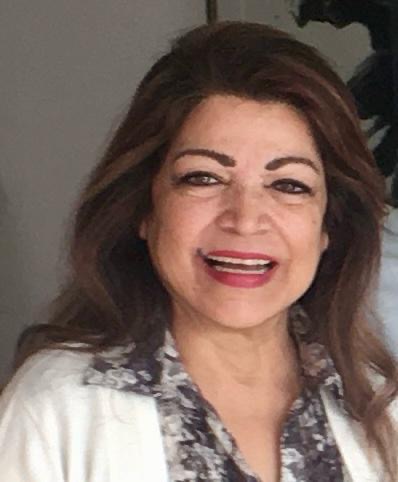
Neeman Sobhan: A Global Nomad?

Neeman Sobhan, born in the West Pakistan of Pre-1971, continues a citizen of both her cultural home, Bangladesh, and her adopted home, Italy. Her journey took her to US for five years but the majority of times she has lived in Italy – from 1978. What does that make her?

She writes of her compatriots by culture – Bangladeshis — but living often in foreign locales. Her non-fiction, An Abiding City, gives us glimpses of Rome. These musings were written for Daily Star and then made into a book in 2002. Her short stories talk often of the conflicting cultures and the commonality of human emotions that stretch across borders. And yet after living in Rome for 47 years – the longest she has lived in any country – her dilemma as she tells us in this interview – is that she doesn’t know where she belongs, though her heart tugs her towards Bangladesh as she grows older. In this candid interview, Neeman Sobhan shares her life, her dreams and her aspirations.

Where were you born? And where did you grow up? 

I was born in Pakistan, rather in the undivided Pakistan of pre-1971: the strange land we had inherited from our grandparents’ and parents’ generation when British colonial India was partitioned in 1947 down the Radcliffe line, creating an entity of two wings positioned a thousand miles apart on either side of India! The eastern wing, or East Pakistan was formerly East Bengal, and my cultural roots are in this part of the region because I come from a Bengali Muslim family. But I was born not there but in West Pakistan, which is culturally and linguistically distinct from Bengal, comprising the regions of Western Punjab, Sindh, Baluchistan and the NWFP (North-West Frontier Provinces, bordering Afghanistan), where the official language is Urdu.

So, my birthplace was the cantonment town of Bannu in the NWFP, (now KPK or Khyber Pakhtunkhwa).

Perhaps my life as the eternal migrant, living outside expected geographical boundaries started right there, at birth. 

My father’s government job meant being posted in both wings of Pakistan. So, I grew up all over West Pakistan, and in Dhaka, whenever he was posted back to East Pakistan. Much of my childhood and girlhood were spent in Karachi (Sindh), Multan and Kharian (Punjab) and Quetta (Balochistan).

How many years did you spend in Pakistan?

The total number of years I spent in undivided Pakistan (West Pakistan, now Pakistan, and East Pakistan, now Bangladesh) is about two decades, or one year short of twenty years. From my birth in 1954, my growing years, till I left the newly independent Bangladesh in 1973 when I got married and came to the US at the age of nineteen.

What are your memories about your childhood in West Pakistan? I have read your piece where you mention your interactions with fruit pickers in Quetta. Tell us some more about your childhood back there. 

I have wonderful memories of growing up in West Pakistan, in Karachi, Multan and Kharian of the late 50’s and early 60’s (despite the era of Martial Law under Field Marshall Ayub Khan, and later his military-controlled civilian government). However, the political environment is invisible and irrelevant to a child’s memories that center around family, school and playmates, till he reaches the teen years and becomes aware of the world of adults. Since, my father’ job entailed us going back and forth between West and East Pakistan, by the time we arrived in Quetta in late 1967, it ended up being my father’s last posting, because by then Ayub Khan’s regime was tottering under protests in both wings of Pakistan; and by the time (I should say in the nick of time) we left for Dhaka, it was already the turbulent year of 1970, which turned Pakistan upside down with General Yahya Khan becoming the new Marshall Law administrator. When we returned to Dhaka, it was the beginning of the end for Pakistan, with preparations for the first democratic general elections, and the blood soaked nine months war of independence for Bangladesh about to be staged.

But as a child, growing up in a Pakistan that was till then my own country, what remains in my treasure trove of memories are only the joys of everyday life, and the friendships (with those whom I never saw again, except one school friend from Quetta with whom I reunited in our middle age in Toronto, Canada!)

Also precious are the road trips with my five siblings and our adventurous mother, as we always accompanied our father on his official tours, across the length and breadth of West Pakistan.

But if I start to recount all my precious memories, I will need to write a thick memoir. And that is exactly what I have been doing over the years: jotting down my recollections of my past in Pakistan, for my book, a novel that is a cross between fact and fiction. The happy parts are all true, but the sad ones relating to the war that my generation underwent in 1971 as teenagers is best dealt with from the distance of fiction.

What I can offer is a kaleidoscopic view of some random memories: the red colonial brick residence of my family in the 60’s in Multan, one of the hottest cities of Punjab, known for its aandhi — dust storms — that would suddenly blow into the courtyard of the inner garden in the middle of the night as my sister and I slept on charpoys laid out in the cool lawn under a starlit sky, and being bundled up in our parents’ arms and rushed indoors; tasting the sweetest plums left to chill in bowls of ice; being cycled to school by the turbaned chowkidar weaving us through colourful bazars to the Parsi run ‘Madam Chahla’s Kindergarten School’ or on horse drawn tanga (carriages); learning to write Urdu calligraphic letters on the wooden takhta (board) with weed Qalam(pens) and a freshly mixed ink from dawaat (ink pots); and to balance this, my mother helping us to write letters in Bengali to grandparents back in East Pakistan on sky-blue letter pads, our tongues lolling as pencils tried to control the Brahmic alphabet-spiders from escaping the page.

In Karachi, returning home on foot from school with friends under a darkening sky that turned out to be swarms of locusts. Learning later that these grain eating insects were harmful only to crops not humans (and Sindhis actually eat them like fried chicken wings) does not take away the thrill of our adventure filled with exaggerated, bloodcurdling shrieks to vie with the screen victims of Hitchcock’s The Birds, viewed later as adults in some US campus. Picnics and camel rides on the seabeaches of Clifton, Sandspit, or Paradise Point. Near our home, standing along Drigh Road (the colonial name later changed to Shahrah-e-Faisal after King Faisal of Arabia, I later heard) waving at the motorcade of Queen Elizabeth II passing by with Ayub Khan beside her in a convertible with its roof down. That was in the 60’s. Later in 1970, embarking with my family on the elegant HMV Shams passenger ship at Karachi port for our memorable week long journey back to Dhaka across the Arabian Sea and the Indian Ocean, with a port of call at Colombo in what was still Ceylon, to disembark at Chittagong port, not knowing then that we were waving goodbye not just to the Karachi of our childhood but a part of our own country that would soon become the ‘enemy’ through its marauding army.

But I reset my memories and bring back the beauty and innocence of childhood with images of my family’s first sight of snowfall in Quetta, the garden silently filling with pristine layers of snowflakes piling into a cloudy kingdom under the freshly tufted pine trees, as we sipped hot sweet ‘kahwa’ tea, and cracked piles of the best chilgoza pine-nuts and dried fruits from Kabul. And since Quetta was our last home in Pakistan, I leave my reminiscences here.
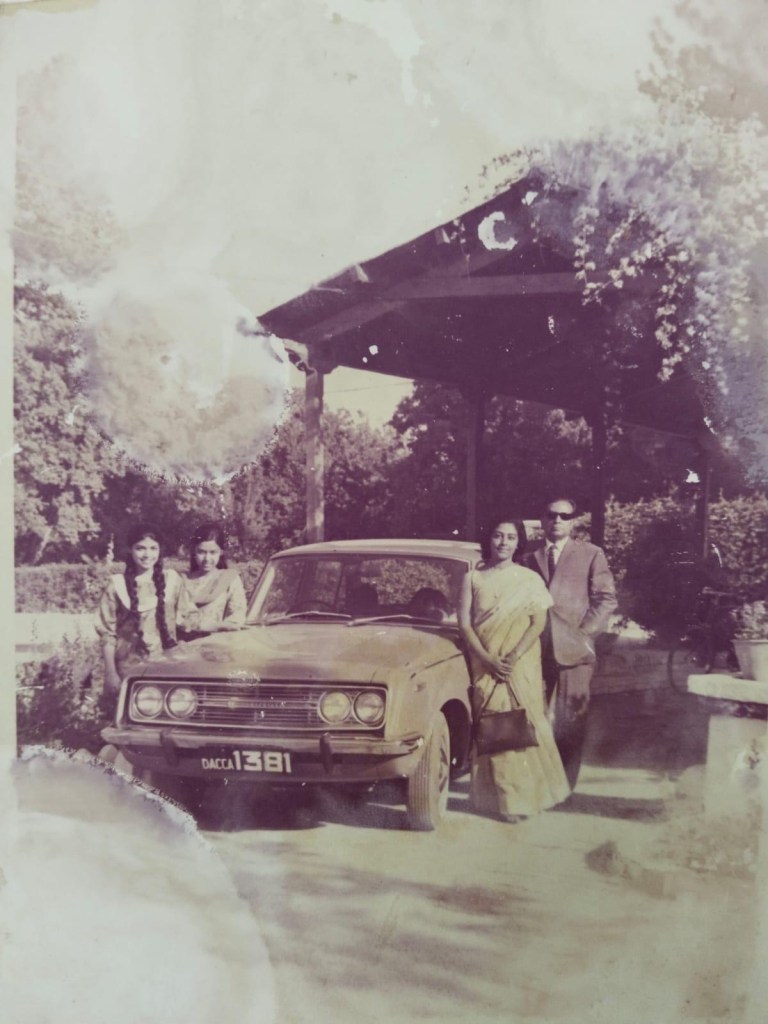
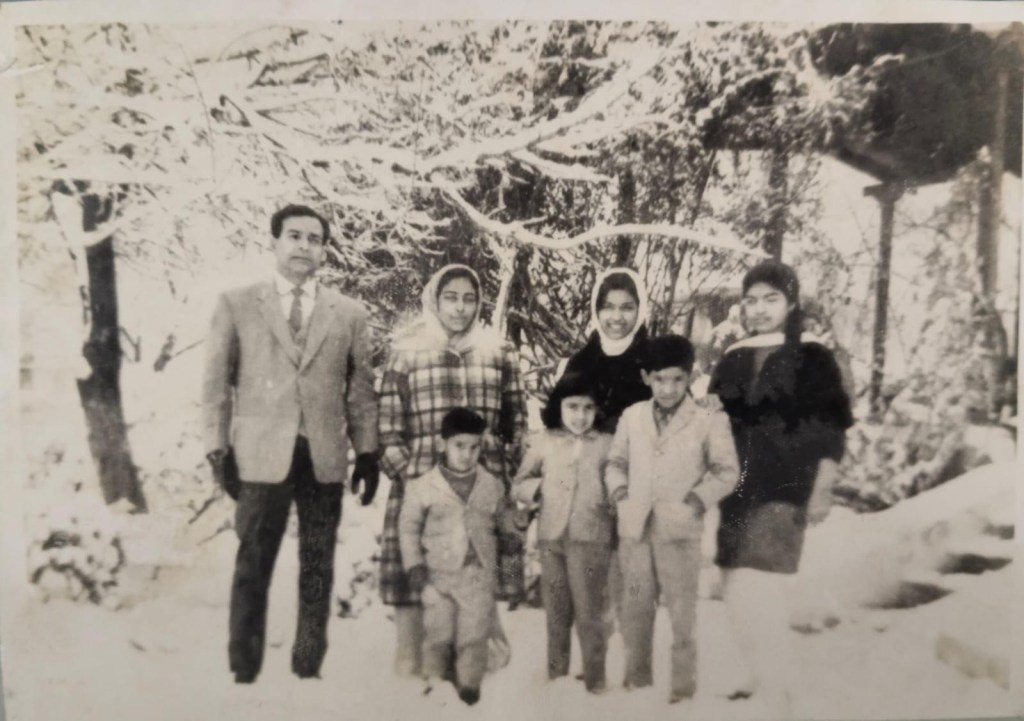
There are so many ways to enter the past. Photographs in albums discolor after a time, but words keep our lived lives protected and intact to be accessible to the next generation. I hope my novel-memoir will provide this.

How many countries have you lived in? Where do you feel you belong — Bangladesh, Pakistan, US or Italy — since you have lived in all four countries? Do you see yourself a migrant to one country or do you see yourself torn between many? 

I have indeed lived in four countries, for varying lengths of time. In the sense of belonging, each country and stage of my life has left its unique impact. But I have still not figured out where I belong.

Although I lived in Pakistan and Bangladesh from birth till I was nineteen, these were the formative years of my life, and I feel they have coloured who I am fundamentally. The culture and languages of the subcontinent is fundamental to me as a human being. Also, having shared my parent’s experience of being almost foreigners and expats in their own country, trying to speak Urdu to create a Bengali lifestyle at home in a culturally diverse world of Punjabis, Sindhis, Baluchis or Pathans, I know it made them (and us as a family), different from our compatriots in East Pakistan who never left their region and had only superficial understanding of the West Pakistanis. My introduction to a migrant’s life and its homesickness started there, observing my parents’ life.

When I moved to the US after my marriage in 1973, it was to follow my husband Iqbal, to the Washington-Maryland area, where he had moved earlier as a PhD student after giving up, in 1971, his position in the Pakistani central government where he was an officer of the CSP (Civil Service of Pakistan) cadre. These were the days of being newly married and setting up our first home, albeit in a tiny student’s apartment, because more than as a home maker, I spent 5 years attending the University of Maryland as an undergraduate and then a graduate student. We thought our future might be here in the US, he working as an economist for a UN agency, and I teaching at a university. A classic version of the upwardly mobile American immigrant life.

But before we settled down, we decided to pursue a short adventure, and Iqbal and I came to Italy in 1978, from the US, on a short-term assignment with FAO, a Rome based agency of the UN. The mutual decision was to move here, temporarily! We would keep our options open for returning to the US if we did not like our life in Italy.

Well, that never happened! And given the fact that since then, we have spent the last 47 years in Italy, the Italian phase of my life is the longest period I have ever spent in any country in the last 71 years!

Meanwhile, we slowly disengaged ourselves from the US and it was clear that if we had to choose between two countries as our final homes, it would be between Bangladesh, our original home country, and Italy our adopted home.

Still, living away from ones’ original land, whether as an expatriate or an immigrant, is never easy. Immigrants from the subcontinent to anglophone countries like the US, UK, Canada, Australia etc, do not face the hurdles that migrants to Italy do in mastering the Italian language. I am still constantly trying to improve my language skills. Plus, there is the daily struggle to create a new identity of cultural fusion within the dominant and pervasive culture of a foreign land

So, in all these years, though I love Italy and my Roman home, I do not feel completely Italian even if my lifestyle incorporates much of the Italian way of life. For example, after a week of eating too much pasta and Mediterranean cuisine my husband and I yearn for and indulge in our Bengali comfort food. Although I enjoy the freedom and casual elegance of Italian clothes, I look forward to occasions to drape a sari, feeling my personality transform subtly, softly.

Yet, I cannot conceive of choosing one lifestyle over the other. The liberty to veer between different ways to live one’s life is the gift of living between two or more worlds.

The only incurable malaise, though, is the chronic nostalgia, especially during festivals and special occasions. For example, when Eid falls on a weekday, and one has to organise the celebration a few days later over a weekend, it takes away the spontaneous joy of connecting with one’s community, forcing one instead to spend the actual day as if it were an ordinary one. I miss breaking my fasts during the month of Ramadan with friends and family over the elaborate Iftar parties with special food back in Dhaka or celebrating Pohela Boishakh (Bengali new year) or Ekushey February (21st February, mother language day) in an Italian world that carries on with its everyday business, unaware of your homesickness for your Bengali world. Over the years, when my sons were in school, I made extra efforts for. But you know you cannot celebrate in authentic ways.

Of course, these are minor matters. And I am aware that by virtue of the fact that I have dual nationality (I’m both an Italian citizen, and a Bangladeshi), I cannot consider myself a true and brave immigrant — someone who leaves his familiar world and migrates  to another land because he has no other options nor the means to return; rather, I feel lucky to be an ex-patriate and a circumstantial migrant — someone who chooses to make a foreign country her home, with the luxury of being able to revisit her original land, and, perhaps, move back one day.

Meanwhile, I feel equally at home in Italy and in Bangladesh because we are lucky to be able to make annual trips to Dhaka in winter.

Whether I am considered by others to be an Italo-Bangladeshi or a Bangladeshi-Italian, I consider myself to be a writer without borders, a global citizen. I feel, I belong everywhere. My home is wherever I am, wherever my husband and my family are. My roots are not in any soil, but in relationships.

I often quote a line by the Mexican poet Octavio Paz. “Words became my dwelling place.” It resonates with me because for me often, it is neither a tract of land, nor even people, but language, literature and my own writings that are my true sanctuary, my homeland. I feel blessed to have the gift of expressing myself in words and shaping my world through language. My home is etched on the written or printed page. My books are my country. It’s a safe world without borders and limits.

Maybe it’s the conceit of a writer and a migrant, nomadic soul, but I think our inner worlds are more substantial than our external ones.                

When I read your writing, I find a world where differences do not seem to exist among people in terms of nationality, economic classes, race or religion. Is it not far removed from the realities of the world we see around us? How do you reconcile the different worlds? 

I believe and trust in our common humanity, not the narrowness of nationality, race or religion. Nationality particularly is limiting, dependent on land, and boundaries that can shift due to physical or political exigencies. Nationality by conferring membership also necessarily excludes on the basis of manmade criteria, while humanity is boundless, all encompassing, and inclusive, based on shared natural, biological, and spiritual traits. 

In my case, I consider the whole world my family. I say this not just as idealistic hyperbole and wishful thinking, but from the fact that I have a multi-cultural, multi-racial family. Only my husband and I are a homogenous unit being Bengali Muslims by origin, but both my sons are married outside our culture, race and religion. One of my daughters in law is Chinese, the other has an English-French father and a Thai mother. So, through my grandchildren, who are a veritable cocktail, yet my flesh and blood, I am related to so many races. How can I bear malice to any people on the globe? The whole world is my tribe, my backyard, where we share festivals and food and rituals and languages. We celebrate unity in diversity.                 

Kindness and caring for others are values I hold dear in myself and others. I believe in sharing my good fortune with others, and in peaceful co-existence with my neighbours, wherever I live. I believe in living with responsibility as a good citizen wherever I find myself. And so far, the world that I see around me, perhaps narrow, is peopled with those who invariably reflect my own sense of fraternity. Maybe I am foolish, but I believe in the essential goodness of humanity, and I have rarely been disappointed. Of course, there are exceptions and negative encounters, but then something else happens that restores ones faith.        

Love is more powerful than hate and generates goodness and cooperation. Change can happen at the micro level if more people spread awareness where needed. Peace can snowball and conquer violence. The human will is a potent spiritual tool. As is the power of the word, of language.       

Literature is about connections, communications, bridges. It can bring the experiences and worlds of others from the margins of silence and unspoken, unexpressed thoughts and emotions into the centre of our attention. It brings people who live in the periphery within our compassionate gaze. Language is one of the most effective tools for healing and building trust. Responsible writers can persuasively break down barriers and make the world a safe home and haven for everyone, every creature.

You have a book of essays on Rome, short stories and poems set in Rome. Yet you call yourself a Bangladeshi writer. You have in my perception written more of Rome than Bangladesh. So which place moves your muse? 

Any place on God’s beautiful earth can move my muse. Still, the perception is not completely accurate that I have written more of Rome than Bangladesh. It is true that many of my columns, short fiction or poems are set in Rome, but they are not necessarily just about Italy and Italians. In fact, my columns and poems were written from the perspective of a global citizen, who celebrates whichever place she finds herself in.

Poetry, in any case, is never just about any place or thing, but a point of departure. It always goes beyond the visual and the immediate and transcends the particular to the philosophical. The sight of a Roman ruin may jumpstart the poem, but what lifts it into the stratosphere of meaningful poetry is the universal, the human. For example, even when my poem speaks of a certain balcony in Verona, the protagonist is not a girl called Juliet but the innocence of first love, in any city, in any era.

My book of short stories, even when located in Rome, actually concern characters that are mostly Bangladeshi. In fact, it is my fiction that makes me a Bangladeshi writer, because my stories are ways for me to preserve my memories of the Bengali world of my past and an ephemeral present. I write to root myself. I often feel that I should write more about the new Italians, the Bangladeshi immigrants generation, rather than the expats of my generation, but my writing stubbornly follows its own compass.

Regarding my book of essays, my original columns for the Daily Star were written about many other cities I travelled to, including Dhaka and places in Bangladesh, and encounters with people in various countries not just Italy. Constrained to select columns from two decades of weekly writing, for a slim volume to be published, I narrowed the field of topics to Italy and Rome. But I had many essays and travel pieces concerning China, Russia, Vietnam, Egypt, Brazil, Spain, Netherlands and many other European cities and Asian capitals. In the end, a handful of columns about Italy became my book An Abiding City: Ruminations from Rome.
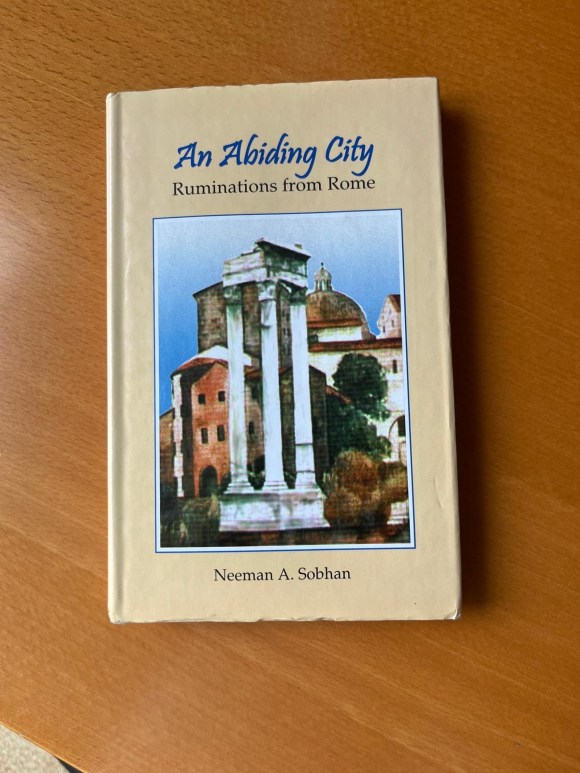
However, in the preface I said: “I must remind that the scope of the book, as suggested in the title, is ‘Ruminations FROM Rome’ not ‘Ruminations ON Rome’ with a tacit emphasis on ‘from’ because the writing relates to matters not just concerning ROME but also encompasses reflections of a more general kind. This is a collection of writings from a columnist who, within her journey through the Eternal City, also attempts to share with her readers her passage through life. I wish my fellow travellers a smooth sojourn into my abiding city, the one WITHIN and WITHOUT.”

I know that had I not lived in Rome but, say, Timbuctoo, I would find something to inspire me to write about. Of course, I am privileged to have lived in Rome and Italy, but nature is beautiful everywhere, in its own way, and there are other civilisations with rich cultures, histories, arts, cuisines, poetry and philosophy that can inspire the sensitive observer and writer.

My elder son lives in Jakarta, my younger son in Bangkok and in all the years of visiting them, I am blown away by the culture and beauty of the Indonesian and Thai worlds, and I have a notebook full of unwritten essays. And there is still so much of the world I have not seen, yet every part of this wondrous earth including my backyard is a chapter in the book of human knowledge. So, had I never left Bangladesh I would still have written. Perhaps “Doodlings from Dhaka!”

What inspires you to write?        

Many things. A face at a window, a whiff of a familiar perfume, an overheard conversation, a memory, a sublime view…. anything can set the creative machine running. Plus, if I’m angry or sad or joyous or confused, I write. It could become a poem, fiction, or a column.

The writer in me is my inner twin that defines my essential self. I am a contented wife of 52 years of marriage, a mother of two sons, and a grandmother of four grandsons (aged 8-7-6-5). These roles give me joy and help me grow as a human being. But my writer-self continues on its solitary journey of self-actualisation. 

Yet, I write not just for myself, I write to communicate with others. I write to transmit the nuances of my Bengali culture and its complex history to my non-Bengali and foreign readers and students, but more importantly to my own sons, born and brought up in Italy, and my grandchildren, whose mothers (my daughters-in-law) are from multi-cultural backgrounds, one a Chinese, and the other a combination of English, French and Thai. I write also for the younger generation of Bengalis, born or raised abroad, who understand and even speak Bangla, but often cannot read the language, yet are curious about their parents’ world and their own cultural heritage.

What started you on your writerly journey? When did you start writing? 

I have always written. As an adolescent, I wrote mostly poetry, and also kept a journal, which I enjoyed reading later. It created out of my own life a story, in which I was a character enacting my every day. It clarified my life for me. Interpreted my emotions, explained my fears and joys, reinforced my hopes and desires. Writing about myself helped me grow. 

My columnist avatar is connected to this kind of self-referral writing, but in real life it emerged by accident when I was invited to write by the editor of the Daily Star. The act of producing a weekly column was a learning experience, teaching me creative discipline and the ability to marshal my life experiences for an audience. I learnt to sift the relevant from the irrelevant and to edit reality. What better training for fiction writing? For almost two decades my experience as a columnist was invaluable to my writer’s identity.

Soon I concentrated on fiction, especially short stories that were published in various anthologies edited by others in Bangladesh, Pakistan and India. I now realised that while column writing was about my life in the present tense and about the daily world around me, my fiction could finally involve the past. The result was my collection of short stories: Piazza Bangladesh.

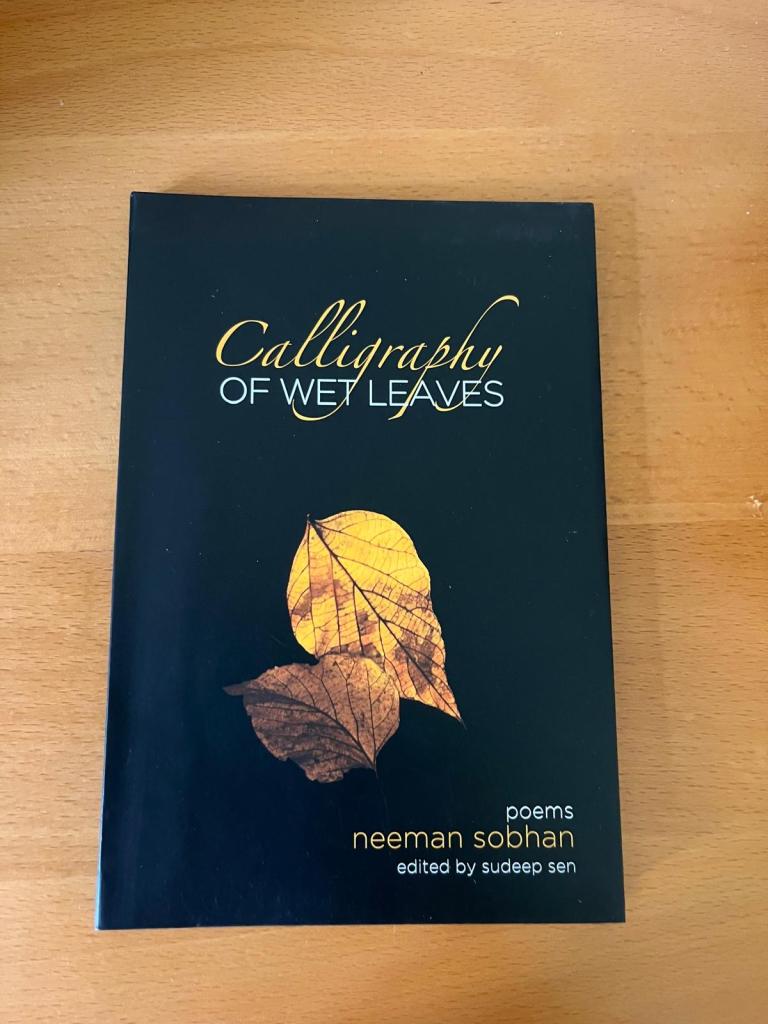
Ironically, it was my book of poems, Calligraphy of Wet Leaves that was the last to be published.

Your short stories were recently translated to Italian. Have you found acceptance in Rome as a writer? Or do you have a stronger reader base in Bangladesh? Please elaborate. 

Without a doubt, as an anglophone writer, my reader base is better not just in Bangladesh, but wherever there is an English readership. However, books today are sold not in bookshops but online, so these days readers live not in particular cities or countries but in cyberspace.      

But living in Italy as a writer of English has not been easy. The problem in Italy is that English is still a foreign and not a global language, so very few people read books in the original English. Every important or best-selling writer is read in translation. This is unlike the Indian subcontinent where most educated people, apart from reading in their mother tongues, read books, magazines and newspapers in English as well.   

This is why I was thrilled to finally have at least one of my books translated into Italian, and published by the well-known publishing house, Armando Curcio, who have made my book available at all the important Italian bookstore chains, like Mondadori or Feltrinelli. Also, through reviews and social media promotion by agents and friends, and exposure through book events and literary festivals in Rome, including a well-known book festival in Lucca, it has gained a fair readership.

That’s all I wish for all my books, for all my writing, that they be read. For me, writing or being published is not about earning money or fame but about reaching readers. In that sense, I am so happy that now finally, most of my Italian friends and colleagues understand this important aspect of my life.

 You were teaching too in Rome? Tell us a bit about your experience. Have you taught elsewhere. Are the cultures similar or different in the academic circles of different countries? 

I taught Bengali and English for almost a decade at the Institute of Oriental Studies of the University of Rome, La Sapienza., till I retired, and it was an enriching experience.

I studied for a year at the University of Dhaka before I got married and came to the US in 1973, where I continued my studies at the University of Maryland, earning my B.A in Comparative Literature and M.A in English Literature. I mention this because these experiences gave me the basis to compare the academic cultures in the Bangladeshi, American and Italian contexts.

I discovered more in common between the Bangladeshi and Italian academic worlds, especially regarding the deferential attitudes of students towards their teachers. In Italy, a teacher is always an object of reverence. In contrast, I recall my shock at the casual relationships in the American context, with students smoking in front of their teachers, or stretching their leg over the desk, shoes facing the professor. Of course, there was positivity in the informality and camaraderie too, between student and teacher. But with our eastern upbringing we cannot disregard our traditional veneration of the Guru and Master by the pupil.

In Italy it was rewarding for me to have received respect as a ‘Professoressa’ while teaching, and even now whenever I meet my old students. However, some of the negative aspects of the academic world in Italy linked to the political policies that affect the way old institutions are run, cause students to take longer to graduate than at universities in the UK or US for example.

Are you planning more books? What’s on the card next? 

I have a novel in the pipeline, a fusion of fiction and memoir, that has been in gestation for more than a decade. Provisionally titled ‘The Hidden Names of Things’, it’s about Bangladesh, an interweaving of personal and national history. It’s almost done, and I hope to be looking for a publisher for it soon. Perhaps, it has taken so long to write it because over the years while the human story did not change much, the political history of the country, which is still evolving through political crises kept shifting its goal posts, impacting the plot.

Most of my writings illustrate, consciously or inadvertently, my belief that as against political history our shared humanity provides the most satisfying themes for literature.

To share my stories with a readership beyond the anglophone one, my collection of stories ‘Piazza Bangladesh’ was translated into Italian and published recently in Italy, as ‘Cuore a Metà’ (A Heart in Half) which underlines the dilemma of modern-day global citizens pulled between two worlds, or multiple homes.

Meanwhile, my short stories, poems and columns will be translated into Bengali to be published in Dhaka, hopefully, in time for the famous book fair in February, Ekushey Boimela. Then my journey as an itinerant Italian-Bangladeshi writer will come full circle and return home.

(This online interview is by Mitali Chakravarty)

Click here to read an excerpt from An Abiding City: Ruminations from Rome

PLEASE NOTE: ARTICLES CAN ONLY BE REPRODUCED IN OTHER SITES WITH DUE ACKNOWLEDGEMENT TO BORDERLESS JOURNAL

Click here to access the Borderless anthology, Monalisa No Longer Smiles

Click here to access Monalisa No Longer Smiles on Kindle Amazon International
Categories
climate change

‘Climate change matters to me, and it should matter to you too’

Zeeshan Nasir writes of a region whose carbon footprint is next to zero, yet it suffers some of the worst climate-related disasters…

The perennial consequence of climate change is affecting the lives of people all over the world, particularly in the remote and underprivileged parts of Balochistan.

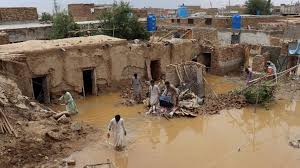
Noora Ali, 14, was oblivious to the temperature shifts because she had grown up in Turbat, a city in the centre of CPEC (China-Pakistan Economic Corridor). They had frequent floods during the monsoon season and blazing heatwaves during summers, with temperatures rising above 51 centigrade. Compared to other cities in Balochistan, Turbat experiences hot summers and typical winters. As a result, the majority of wealthy families in the city travel to Gwadar, Quetta, or Karachi during the sweltering summers and return to Turbat during the winters. The Water and Power Development Authority (WAPDA) moved Noora’s father, who works there, to the neighbouring Gwadar in 2022.

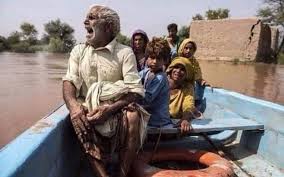
In the February of 2022, the sea seemed calm while boats of the fishermen busily dotted the waters of the Padi Zir (Gwadar’s West Bay). It was a typical Thursday morning when rain started pouring down. The rain was so intense that the sea became wild and uncontrollable. The roads were washed away, bridges collapsed, with streets being inundated with flood water and the port city became completely disconnected with the rest of the country. Back in Turbat, her ancestral hometown was also submerged under flood water.

Noora had also heard from her school fellows that Gwadar and Turbat had never experienced such heavy and intense rainfall before. She knew and felt that the temperature of her native city was rising and that Gwadar beneath flood water didn’t seem normal.  “This is due to climate change.” Her elder brother told her. At the age of 14, typical children in Balochistan have no idea what climate change and global warming are but they are already feeling it impacts.

Like Noora, thousands of children in South Asia, particularly Pakistan, Bangladesh, Nepal, India and Afghanistan are at the risk of climate related disasters, as per the UNICEF 2021 Children’s Climate Risk Index. The report further reiterates that children in these countries have vigorously been exposed to devastating air pollution and aggressive heatwaves, with 6 million children confronting implacable floods that lashed across these countries in the July of 2024.

On the 11th and 22nd November 2024, over 20 youths urged the world leaders to come up with plans to mitigate the impacts of climate change on children at the 2024 United Nations Climate Change Conference (COP 29) held in Baku, Azerbaijan. Among those 20 resolute children was the 14 years old, Zunaira Qayyum Baloch representing the 241.5 million children and women of Pakistan. 

Dressed in her traditional Balochi attire, with a radiant smile in her face and resolute in her commitment, Zunaira Qayyum Baloch, startled everyone. Hailing from the far-flung district of Hub in the Southwest of the Pakistan’s Balochistan, Ms. Baloch went to represent the children of a country whose carbon footprint is next to zero, yet it suffers some of the worst climate-related disasters. Her message to world leaders was clear: step up and combat climate-induced inequalities, particularly those affecting women and children.

She had always remained conscious about the changing climate in her city, observing the floods of 2022 that had wreaked havoc in Hub Chowki, initiating awareness programmes and youth advocacy guide training in her home city to advocate for girls right to education and climate change.

“After my father passed away, my mother became the sole breadwinner. She helped us get an education and met all our requirements.” Zunaira explains. “During the catastrophic rains of 2022, an incident changed my perspective on climate change.  Rainwater had accumulated in the roof of our home and streets were flooded with water. The destruction was so overwhelming that I realised that such events were no longer rare but increasing constantly. “

During the COP29, Ms Baloch expressed her concerns with the experts how Pakistan, particularly Balochistan has been detrimentally affected by climate disasters like frequented floods, heatwaves, hurricanes and droughts. Lamenting that climate change was a child-rights crisis, she told the world how the changes in the climate had jeopardised the lives of millions of women and children throughout the world.

Asking the world leaders to join determined children like her to combat climate change, she addressed them in the COP29: “Climate change matters to me, and it should matter to you too.”

Stark Reality of the Past

Bibi Dureen, 80, is a testimony to how climate is continuously transforming. She hails from the outskirts of the Kech district in a town called Nasirabad.

“The seasons are changing.” She says with her voice laced with sorrow. “The heatwaves have become more aggressive, and floods are common. It all started around 1998 in Turbat. Then in 2007, a devastating flood destroyed our homes, date palm trees, livestock –and worst of all, it took lives.” She pauses, her wrinkled hands trembling.

As she talks to me in front of her thatched cottage, through which sunlight is streaming in, tears well up in her eyes as she recalls a painful childhood memory, “I was young at that time. It was a pitch-black night, and the rain was pouring down mercilessly when a man came shouting that the flood water had reached the fields.” She exclaims with grief. “My mother, desperate to save what little we had, sent her only son, my sixteen-year-old brother, Habib, our family’s only breadwinner, to find the only cow we had in the fields.  Neither the cow nor Habib returned. Later some men found his dead body in the jungle.”

In June 2007, when the Cyclone Yemyin hit the coast of Balochistan, it wrought unprecedented damage to the province, particularly Turbat, Pasni and Ormara and rendered 50,000 homeless within 24 hours, including children. According to reports 800,000 were affected and 24 went missing.

The 2022 floods had a devastating impact across Pakistan, with the province of Balochistan being one of the hardest hit. With 528 children dying nationwide, 336 people died in Balochistan, including children as per the reports of the Provincial Disaster Management Authority (PDMA).

Tragedy struck again in 2024 when torrential rains engulfed 32 districts of Balochistan, particularly, the port city of Gwadar and Kech district. The PDMA put the death toll of children dying due to the flood at 55 out of the total of 170, with 16 others injured.

The Double Crisis Facing Girls

Regions in Balochistan, such as Naseerabad, Jaffarabad, Sohbatpur, Nokundi, Sibi and Turbat have seen severe heatwaves in the past few decades. On May, 2017, the Mercury rose to a record breaking of 53.5 centigrade in Turbat, making the district to be the hottest place of the year after Mitribah, Kuwait. During heatwaves, cases of fainting and health-related illness among residents, particularly children are rarely uncommon. According to a 2023 report by the Pakistan Meteorological Department, Balochistan has seen a 1.8°C rise in average temperature over the past three decades, leading to longer and harsher heatwaves.

Dr Sammi Parvaz, a gynaecologist at the university hospital in Turbat, tells that rising temperatures in the district not only contribute to higher dropout rates among school-girls but their menstrual cycle is also affected.

 “According to the recent research of the National Institute of Health (NIH) , menstruation– a biological process that occurs in females when they reach puberty — is severely affected in countries which are vulnerable to climate change and Pakistan is one them.” She explains. “The menstruation in girl children living in extreme heat, such as, in Turbat and Karachi, becomes very intense, painful and with cramps.”

Dr Sammi further elaborates that this phenomenon is linked to the increased release of cortisol and oestrogen, the hormones which regulate the female reproductive cycle. “Girl children exposed to harsher environments such as severe heat or cold, experience hormonal imbalances leading to irregular periods and severe menstrual cramps. The hospitals in Turbat are frequented by patients suffering from intense cramps or irregular periods.”

Hygiene becomes another pressing issue during floods, especially for young girls. Research published by the International Journal of Environmental Research and Public Health states that floodwater contains lead, polychlorinated biphenyls (PCBs) and other chemicals which are the cause for irregular periods.

During floods thousands of girl children struggle to manage their periods amidst the chaos of the disaster and remain without period products.  For instance, after the 2022 floods, 650,000 pregnant women and girl children in Pakistan were without essential maternal care, with a significant proportion from Balochistan.

Admist all this chaos climate activist like Zunaira Qayyum Baloch raise awareness while women like Maryam Jamali work directly on the ground to ensure that every women has ration in her house and access to menstruation products during catastrophes.

 Madat Balochistan [1]— a non-profit organisation — has supported more than 31,000 people across 34 districts in Sindh and Balochistan. With its major work concentrated in and around Quetta, Dera Bugti, Jaffarabad, Jhal Magsi, Sohbatpur, and Khuzdar, they are a women-led organisation fundamentally prioritising women and young girls in their work because even on the frontlines, they are bearing most of the cost of climate change, according to its co-founder, Maryam Jamali.

 “Our conversations on climate change vulnerability often treat everyone as ‘equal’ in terms of impact, when that is far from the truth. Vulnerability is a multi-dimensional concept and in a country like Pakistan where most of the women and girls are pushed to the margins of society in every way possible — we cannot just overlook their struggles.” Maryam Jamali tells.

“Take the 2022 floods, for example — the most recent catastrophes etched in our memories. Women and girls were responsible for most of the labour when it came to evacuating to safer places. As soon as they did, their needs when it came to menstruation or pregnancy care were completely ignored by aid agencies as they sent out packages or set up medical camps. Most of our work at Madat was compensating for things like this. We worked with midwives to ensure that women, who could not stand in lines for ration, received it regardless or women who did not want to interact with male doctors didn’t have to. In our housing projects, we prioritise women especially those who don’t have a patriarch in the household because that severely limits their access to resources for rehabilitation.”

Floods, heatwaves and other natural calamities are gender neutral. However,  female children are more likely to be affected by them. According to the UN Assistant Secretary-General Asako Okai that when disaster strikes, women and children are 14 times more likely to die than men. In Pakistan, 80% of people displaced by climate disasters are women and children.

 In patriarchal societies in Pakistan, women and female children are the primary caregivers of the family and they are the sole persons to grow crop, do house chores, fetch firewood and water. With little to no potable water nearby, girls have to travel far to help their parents, further exacerbating their vulnerability.

These household responsibilities create an educational gap. Girls are taken out of schools in Balochistan during floods. With Pakistan’s lowest girl literacy rate at just 27 per cent, the International Rescue Committee (IRC) reported that the province of Sindh and Balochistan have seen greater educational disruptions due to heatwaves and floods, with the 2022 flood causing more educational institutions closure than the combined two-year COVID-19 pandemic.

Extreme heatwaves and recurrent flooding in Balochistan have further compounded this gap. For instance, the 2022 flood damaged or destroyed 7,439 schools in the province, affecting the education of over 386,600 students and 17,660 teachers and staff members. Reports also mention that most of the government school were used as flood shelters in the province. In the 2024 floods, 464 schools were again damaged.

The destruction of educational infrastructure has forced many children out of school, contributing to the province’s high out-of-school rate.

Monsoon Brides during Floods

 Though floodwater is no longer accumulating in the Mulla Band Ward of Gwadar district in Balochistan, the damage it has wrought will stay with the people for a long time for many years. For Gul Naz[2],16, the loss has been devastating.She was only 16 years at the time when flood water entered their home in 2022. Her father, being a fisherman, struggled to make ends meet, as the sea was completely closed for fishing, cutting off the family’s only source of income.

“I was in the Jannat Market and when I returned home, I was told by my mother that my marriage has been fixed to a man twice my age in exchange for money.” She discloses that her parents were given Rs.50,000 ($178.50) which is a whooping sum for a poor family, who survive on around one dollar a day.

“I have two kids now and I am a child raising a child.”

The sadness in Gul Naz’s voice is palpable and she isn’t alone in her predicament. During floods and emergency situations, families in Balochistan resort to any desperate means for survival. The first and most obvious way is to give their daughters away in marriage for financial relief — a practice that usually surges during the monsoon season, hence, the name monsoon brides.

In the Sindh province of Pakistan, where this trend is more prevalent, there has been a spike in the number of monsoon brides during the last flash floods of 2022. In the Khan Mohammad Mallah Village, Dadu district, approximately 45 were married off in that year, according to the NGO organisation, Sujag Sansar[3], which works to reduce child marriages in the region.

Pakistan stands at the sixth position in the world when it comes to marrying children below eighteen. While there has been a reduction in child marriages in Pakistan in recent years, UNICEF warns that extreme weather patterns put the girl child at risk.

Madat Balochistan has also been on the forefront in the reduction of child marriages in Balochistan, “It’s not intuitive to think of girls’ education or loan relief or housing provision as measures to build climate change resilience, but in our contexts, these are the very things that drive vulnerability to climate change.” Says the Maryam Jamali. “We have been working on supporting farmers with loan relief so that young girls aren’t married off to compensate for the financial burden of loans after a lost harvest. We are also working on initiatives for sustainable livelihoods for women as well as ensuring that young girls in all the communities we work in have access to education despite geographic or financial limitations.”

Jamali thinks that gender inequality is one of the biggest aspects here which makes it absolutely necessary for a region like Balochistan, where physical vulnerability and socio-economic vulnerability is high, to have young girls at the decision-making table.

“Activists like Zunaira can ensure that when we come up with solutions for climate change, we contextualize them through a gender lens and make sure that this does not become another instance of taking away women’s agency but becomes an opportunity to involve them in climate change policy decision-making.” Jamali contends. “It is rewarding to see the girls we support do great things. One of our girls from Musakhel is studying at Cadet College Quetta, the first in her family to be able to pursue education beyond 8th grade.”

The Way Forward

“Extreme weather can fuel conflict and be a threat multiplier,” says Siraj Gul, a lawyer at the Balochistan High Court, Quetta, citing the recent research published in the journal Alternatives: Global, Local, Political. He stresses that the decades long running insurgency in Balochistan stems from human rights violations, inequality and government negligence. “Climate related catastrophes further destabilise the region’s development. For instance, there was a surge in the number of protests during the 2022 floods in Gwadar, Lasbela and Turbat, reflecting the deep frustration and despair of the people.” According to Mr. Gul if children like Zunaira are given a platform to speak and work for Balochistan, they are not merely advocating for the environment, they are working for a more peaceful and tranquil region.

A climate resilient infrastructure and child-oriented disaster relief have become a must in climate-torn regions like Balochistan.

[1] Help Balochistan

[2]Her name has been changed to retain her privacy

[3] Awake World

Zeeshan Nasir is a Turbat-based writer and currently pursuing his MBBS Degree from the Makran Medical college, Turbat. He tweets on X @zeeshannasir972. He has contributed to Daily Dawn, Countercurrents, Pakistan Today, The Diplomat and others. A different version of this essay has been published earlier in Countercurrents and Pakistan Today.

.

PLEASE NOTE: ARTICLES CAN ONLY BE REPRODUCED IN OTHER SITES WITH DUE ACKNOWLEDGEMENT TO BORDERLESS JOURNAL

Click here to access the Borderless anthology, Monalisa No Longer Smiles

Click here to access Monalisa No Longer Smiles on Amazon International

Categories
Poetry

Bringing along their homeland

Poetry by Abdul Jamil Urfi

Delhi in the 1960’s:
Nostalgia about Lahore was high.
Partition displaced refugees spoke of 
misery, mayhem, murder. Deda Ji regretted 
that, at the time of leaving, a pillowcase of house jewels
was misplaced. Bhabhi Ji had similar regrets--
leaving priceless possessions behind in Lahore
and friends.
 
But what struck us-- newcomers to the grand city
were the names of shops.
So many of them were
named after places in Western Punjab,
or those now in Pakistan. For instance, 
A popular eatery called ‘Lahorian di Hatti’
‘Quetta DAV School’.
Small eateries served dishes called ‘Pindi ke Chholey Bhatoorey’. 
A shop with the name ‘New Lyallpur Cloth House’. 
There were ‘Lahorian Jewellers’, ‘Sindh Wood & Ply’, 
Karachi Sweet Shop, Karachi Stationery Mart, Quetta Store, 
Peshawar Sweet Bhandar, Lahore Watch Co., Sialkot Jewellers 
and also ‘Abbott Drycleaner’s’, whose shop, it turned out, 
had not been named after some monastery’s abbot 
but after ‘Abbottabad’ --a town in Pakistan 
(made famous by the capture of Osama Bin Laden by US Navy Seals)
Thus, many places in erstwhile undivided India, 
but no more in India now.
Lahore, Quetta, Rawalpindi, Lyallpur, Sindh, 
Abbottabad, Karachi, Peshawar, Sialkot 
made their presence felt in a walk in any area of Delhi. 
The Partition displaced people had suffered immense tragedies and losses
And had also brought a little bit of their homeland with them.

Abdul Jamil Urfi published ‘Memoirs of the bygone century, Beeswin Sadi- Growing up in Delhi during the 1960’s and 70’s’, which was extracted and reviewed in The Friday Times (Lahore)FirstpostIndia of the PastCaleidescopeNew Asian WritingScroll.in and The Quint. He works in Delhi as a university teacher. His poems have appeared in ‘Skylark’,  NAW and Vayavya.

.

PLEASE NOTE: ARTICLES CAN ONLY BE REPRODUCED IN OTHER SITES WITH DUE ACKNOWLEDGEMENT TO BORDERLESS JOURNAL

Click here to access the Borderless anthology, Monalisa No Longer Smiles

Click here to access Monalisa No Longer Smiles on Kindle Amazon International
Categories
Tribute

Akbar Barakzai’s Paean to Humanity

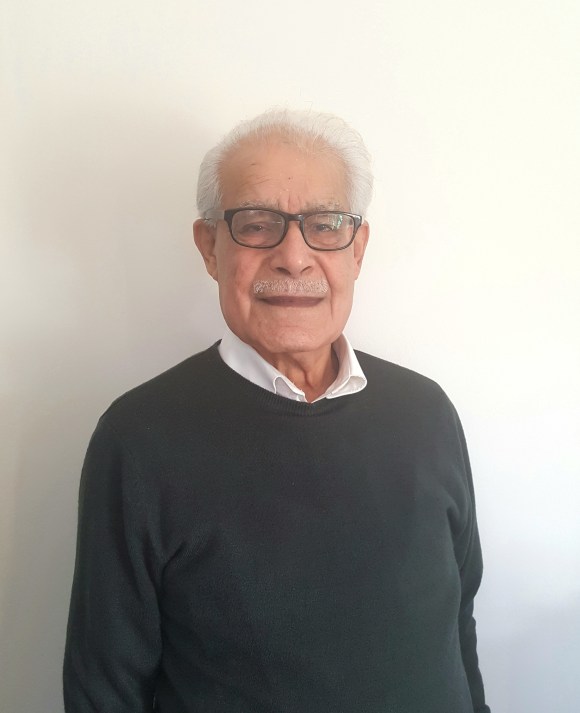
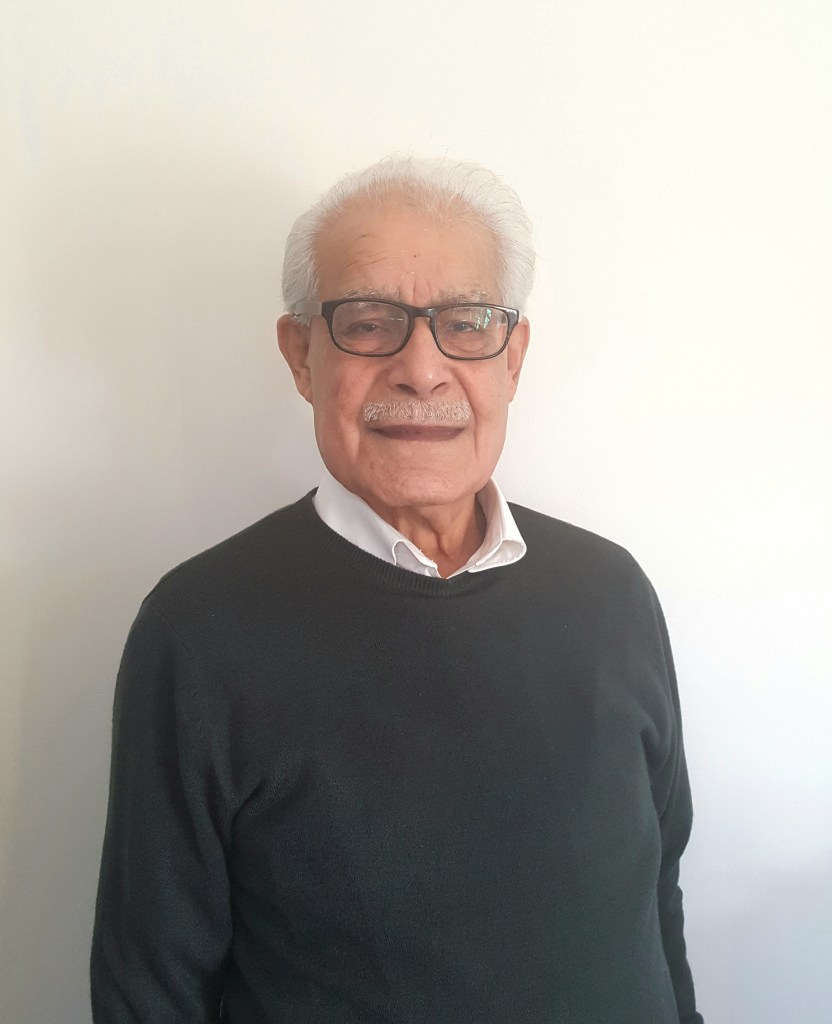
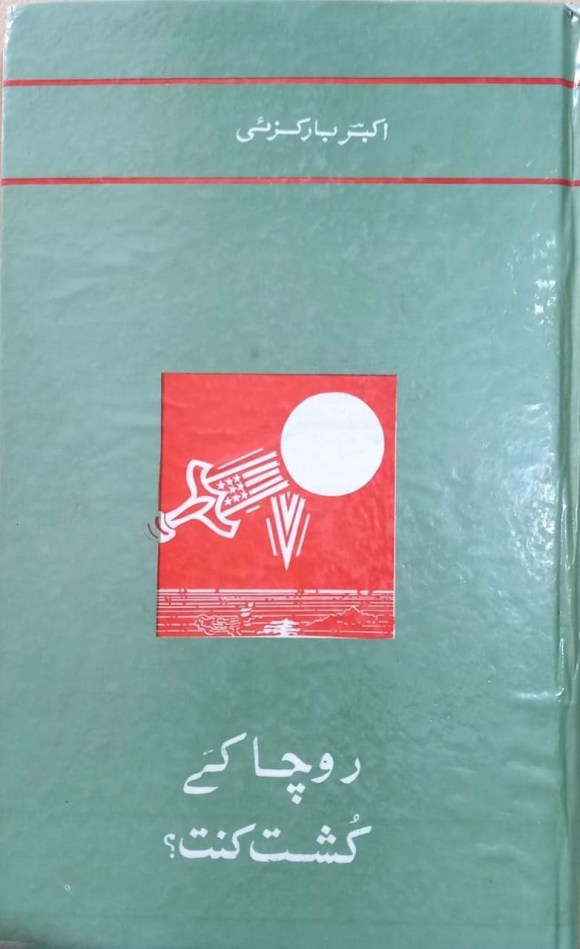
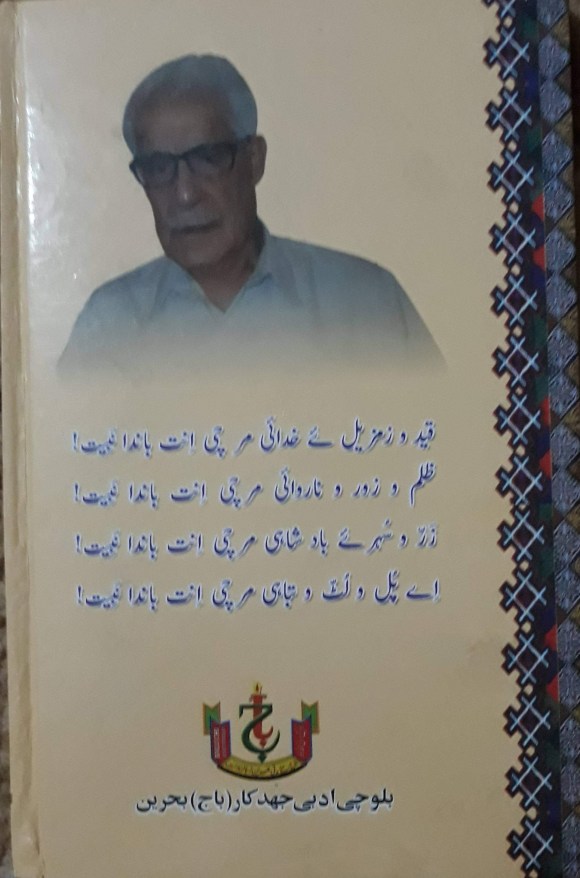
Poem by Akbar Barakzai, translated from Balochi by Fazal Baloch

Akbar Barakzai (1939-2022)
WE ARE ALL HUMAN

Russia, China and India,
Arabs and the New World*,
Africa and Europe,
The land of the Baloch and Kurds --
Indeed, the whole world is ours.
We are all human.
We are all human.

Of blood and brotherhood,
We share common traits and ties.
Love is all we harvest.
On freedom our faith does rest.
Indeed, the whole world is ours.
We are all human.
We are all human.

A life free from strife,
A world blooming with 
Dreams and desires,
Happiness and delight --
This is all we seek.
Indeed, the whole world is ours.
We are all human.
We are all human.


From murderers and tyrants,
Like Genghis,
With our swords and soul,
We protect the beautiful Earth.
Indeed, the whole world is ours.
We are all human.
We are all human.

Together along with the downtrodden, 
The wretched of the Earth,
We shall wage a war 
Against brutes of the world,
And for truth we shall lay our lives.
Indeed, the whole world is ours.
We are all human.
We are all human.

With the stars of our blood,
Like our beloveds, we shall adorn
The night-bitten cities and valleys.
The dark night will vanish forever.
Indeed, the whole world is ours.
We are all human.
We are all human.

The sun will rise from our blood,
the prophet of glory will appear,
The night will pass into dawn --
There will be happiness everywhere.
Indeed, the whole world is ours
We are all human.
We are all human.

*By the New World, the poet means the continents of Americas and Australia.

Akbar Barakzai (1939-2022) was born in Shikarpur, Sindh. He is ranked amongst the proponents of modern Balochi literature. His poetry reflects the objective realities of life. Love for motherland, peace and prosperity and dignity of a man are the recurrent themes of his poetry. His love for human dignity transcends all geographical and cultural frontiers. Barakzai is not a prolific poet. In a literary career which spans over half a century, Barakzai has managed to bring out just two anthologies of his poems, but his poetry has depth and reaches out to human hearts with its profundity. Last year, Barakzai rejected the Pakistan Academy of Letters (PAL) award, quoting  the oppressive policies meted out to his region by the government as the reason.

Fazal Baloch is a Balochi writer and translator. He has translated many Balochi poems and short stories into English. His translations have been featured in Pakistani Literature published by Pakistan Academy of Letters and in the form of books and anthologies. Fazal Baloch has the translation rights to Barakzai’s works and is in the process of bringing them out as a book.

.

PLEASE NOTE: ARTICLES CAN ONLY BE REPRODUCED IN OTHER SITES WITH DUE ACKNOWLEDGEMENT TO BORDERLESS JOURNAL

Categories
Interview

At Home Across Continents

In Conversation with Neeman Sobhan

Neeman Sobhan is an expat who shuttles between Italy and Bangladesh and writes. She has a knack of making herself at home in all cultures and all spheres. Having grown up partly in Pakistan (prior to the Liberation War in 1971), Bangladesh and completed her studies in United States, she has good words about time spent in all places. Her background has been and continues to be one of privilege as are that of many Anglophone writers across Asia. Her stories have been part of collections brought out to celebrate the fiftieth anniversary of Bangladesh.

One of her most memorable stories from her short story collection Piazza Bangladesh, located around the 1971 war takes on an unusual angle, where the personal seems to sweep the reader away from the historic amplitude of the event into the heart-rending cries of women at having lost their loved ones in a way that it transcends all borders of politics, anger and hate. The emotional trajectory finds home in a real-world event in the current war. The fate of innocent youngsters dying while not being entrenched in the hatred and violence wrings hearts as reports of such events do even now. I find parallels in the situation with the young Russian soldier whose mother did not know he was in Ukraine and who was killed while WhatsApping his mother his own distress at being there. And yet her stories stay within certain echelons which, as she tells us in the interview, are the spheres that move her muse.

When and how did you pick up a pen to write?

I have always written. The written word has always held a powerful fascination for me, which has not dimmed at all. From my childhood through my teens, I was a voracious and precociously advanced reader, as well as a passionate writer of poetry, and a keeper of a daily journal. My poetry was regularly published in The Pakistan Observer’s Junior page.  I don’t dare look at them now to even assess whether they were embarrassingly bad or surprisingly good enough to be salvaged and resurrected now! I preserved them as the earliest evidence of my continuing evolution as a writer and a poet today.

During those early days, I also won the first prize in a national essay writing competition sponsored by the newspaper. The Pear’s Encyclopedia I won still holds a precious place on my bookshelf.

English was my favourite subject in school and college, and I knew I would study English literature at university. I started out at Dhaka University in 1972 but by some perverse logic, I actually enrolled in the newly opened International Relations department and not the English Department (in which I had applied and been accepted). The reason, I now recall is because the English department was over-flowing with students, while the International Relations department was something exclusive and admitted a handful of students. However, after a few months I realised I had made a disastrous choice.

Meantime, my marriage was arranged, and I was whisked away to Marlyland, U.S. My husband, Iqbal, an ex-CSP officer (the Civil Service of Pakistan) was a Ph.d student of Economics at the University of Maryland, and in no time I enrolled as an undergraduate student and blissfully went on to study English and Comparative Literature, graduating eventually with a Masters in English Literature.

That I was going to be a writer was for me, even as a teenager, like a pre-ordained and much desired fate. I never wanted to pursue any other vocation.

What gets your muse going? 

Anything, and everything.  A view, a scent, an overheard conversation, a line of poetry, a memory……If I’m angry and seething, I write; if I’m sad or grieving, I write; if I’m joyous or ecstatic, I write; if I feel aa surge of spiritual bliss, I write; if I’m confused, I write. What form that writing takes is unpredictable. It could become a poem, or a paragraph in my notebook, which later could be part of my fiction, or a column. I wrote a regular column for the Daily Star of Bangladesh.

Writing is my food and nourishment, my therapy, my best friend, my passion. The writer-Me is the twin that lives inside me. It’s my muse and guide that defines my essential self. I am a contented wife of almost 50 years of marriage, a mother of two sons, and a grandmother of four grandsons (aged 5-4-3 & 2). These gratifying roles nourish my spirit, give me joy and inspiration, teach me lessons that help me grow as a human being. But my writer-self exists in its own orbit, proceeding on its solitary journey of self-actualisation, following its inner muse.

You have written of Italy, US and Bangladesh. How many countries have you lived in? 

Yes, I have lived in Italy, US and Bangladesh, which makes 3 countries. But, in fact, I have lived in 4 countries.

Remember that I was born not just in the undivided Pakistan of pre-71, when present day Bangladesh was East Pakistan, but I was actually born in West Pakistan, present day Pakistan, in the cantonment town of Bannu, near the borders of the Khyber Pass and Afghanistan, (formerly, the NWFP or NorthWest Frontier Province, presently KPK or Khyber Pakhtun-Khwa). Although my parents were Bengalis from Dhaka, my father’s government job (not in the army but under the Defence department, ‘Military Lands and Cantonments Services’) meant being posted in both wings of the then Pakistan. So, during my childhood and girlhood, I grew up in Karachi (Sindh), Multan and Kharian (Punjab) and Quetta (Balochistan). As a family of five siblings and our adventurous mother, we always accompanied our father on his official tours, by car or train, over the length and breadth of that country.

In the English medium school I was enrolled in, I had to choose Urdu as the vernacular subject, since Bengali was not taught in West Pakistani schools, though the opposite was not true! Anyway, I have no regrets. I am proficient in both Urdu and my mother tongue Bangla/Bengali, which I learnt at home from my mother, who in Quetta actually set up a small Bengali learning school for Bengali Army officers’ children. I am proud of the fact that I carried my mother’s tradition when I taught Bengali to Italians at the University of Rome, many decades later!   

What is it like being an immigrant writer? Which part of the world makes you feel most at home? Why? 

To start with, and to be honest, I do not really consider myself a true immigrant — someone who bravely and definitively leaves his familiar world and migrates  to another land because he has no other options nor the chance or means to return; rather, I feel lucky to be an ex-patriate — someone who chooses to make a foreign country her home, with the luxury of being able to revisit her original land, and, perhaps, move back one day. In fact, I have dual nationality, and am both an Italian citizen, and continue to hold a Bangladeshi passport. I might be considered to be an Italian-Bangladeshi writer. I consider myself a writer without borders.

I feel equally at home in Italy and in Bangladesh. Before the pandemic, my husband and I would make an annual trip to Dhaka for two months from December to February end, since my classes started in early March. Presently, I am back in Dhaka, after two almost apocalyptic years.

Despite the continuing hurdles of mastering the Italian language and trying to improve it constantly, we love our Roman home as much as our Dhaka home. Still, living away from ones’ original land, whether as an expatriate or an immigrant, is never easy, beset by nostalgia for what was left behind and the struggle to create a new identity of cultural fusion within the dominant and pervasive culture of a foreign land. But in this global age, it’s quite usual to live in a mix of cultures and live in a borderless world where ones national or cultural identity is not so clear cut. (I have a daughter-in-law who is Chinese, and another who is half-English, half-Thai! And my grandchildren are the heirs to a cornucopia of cultures and are true global citizens). Nevertheless, in the four and a half decades of my living away from Bangladesh, the eternal quest for that illusory place called home has shaped the sensibility that nourishes my creativity and compels me to write. Often, it’s the pervasive and underlying theme in my columns, stories and poetry. There is a poem of mine, “False Homecoming” which underlines the poignant sense of displacement a person can feel, not in a foreign land but in ones’ own motherland, or the version from the past. After all, many people who live away, exist in a time-warp.So, no matter which part of the world you feel at home in, it’s temporary. For me, as a writer between countries and homes, it is an external and internal odyssey.

It is the endless journey of a writer in constant evolution.

Tell us a bit about your journey. 

I realised early on that our real world being increasingly borderless, it’s not a tract of land that makes me feel at home. It’s my writing. The Mexican poet Octavio Paz once said, “Words became my dwelling place.” This has always resonated deeply with me, because for me, too, language and literature have been my sanctuary and true homeland. I have lived in that comfort zone at the heart of my creativity, imagination and writing: my dwelling place of words.

Of course, there are as many shapes to the sheltering place of language as there are literary forms. My nest of words was also feathered by my particular exigencies, followed a particular route and journey.

Though I speak various languages, my mother tongue is Poetry. For as far back as I can remember I have always written poetry, like writing in a journal, considering it to be the shorthand of my heart, a secret language. I am a reticent person, and there are writers like me who are content to use writing, whether poetry or prose, as a tool for self-exploration, self-knowledge, self-definition, with no thought of being published. At least, not my personal poems.

Yet with poetic irony, despite being a private person, my career as a writer started when I was jettisoned into that most public form of literary expression: the world of weekly column writing. At the urging of a friend, the editor of the Bangladeshi national daily The Daily Star, I turned into a public chronicler of the minutiae of my world, my life and times. Now I discovered my professional language, my father tongue if you will, the language of prose and my journey as a writer started.

When one reads your writing, it is steeped in a number of cultures. Which culture is most comfortable for you while writing and which one for living? 

There’s no place as beautiful and pleasurable to live in as Italy. Except for two or three months of winter, the climate during the rest of the year is perfect; the natural beauty and historical and artistic richness are unsurpassable, the food is delectable whether it’s based on nature’s bounty or the simple elegance of its distinctive cuisine. But for a writer who is also a housewife, the most comfortable country to write in, for me, is Bangladesh. With the culture of household helps abounding, I often get more writing done in two months of living in my Dhaka apartment than a whole year in Rome. My domestic staff are like family to us, and valued parts of our life. They sustain us and we sustain them, helping them educate their children to stand on their own feet. I miss this support network in Italy.

What are your favourite themes and your favourite genre? Expand on that a bit. 

My favourite genre to both read and write is the short story, poetry, humorous essays, travel writing and insightful book reviews. I read fewer novels now, and I have been writing and struggling to finish my first novel for years. I suspect, this is because I am temperamentally more attuned to the short sprint dash of producing a discrete work of imagination than the long-distance run of a lengthy work. But I am determined to conclude this opus before it becomes an unfinished relic.

I never approach fiction-writing through themes. But in non-fiction prose writings, like essays and articles for columns, I love to write about certain topics, or about books, places, and people, from all walks of life. I also love to write about nature, food, history and traditions, about how to improve our world, our lives and our relationships; and the happy, hopeful moments of life. As far as reading goes, I love reading about travel, love and friendship, human compassion, and anything with a happy ending.

You seem to have centred much of your work on people who are affluent. What about the rest — especially the huge population who serve the affluent? Have you written on them? Tell us why or why not.

That is an incomplete picture, and a wrong perception of my writing. To start with, as a writer I am more interested in the richness of the inner lives of human beings, and less so in the outward, economic and class differences. To me, no one is merely affluent or poor, but human and worthy of a compassionate gaze. The diversity and motivations of characters, whichever strata of society they belong to moves my imagination. I do not write to either preach or disseminate ideas of social justice or to right wrongs, but to explore and present the world we live in, in all its complexities and subtleties, the joys and ugliness, the small dreams and grand passions, the disappointments and triumphs of individuals and generations. I like to delve into the psychological or political motivations of human behaviour, especially within the domestic sphere, the family, an ethnic community.

I have many stories about those who serve or are not from privileged classes. My story ‘A Sprig of Jasmine’ is about a sweeper woman at a school in Bangladesh. Then there is the story ‘The Farewell Party’ about a temporary domestic help in a Bangladeshi home in Rome, suspected of stealing. I also have a sequel to that which explores the life of the same Bengali help now working as a nurse-companion to an old Italian woman.  These and many more are awaiting to be published soon in another collection.

But I never consciously choose a subject or set out specifically to tell the story of an under-privileged, oppressed, or marginalised person. It can happen that the story turns out to be about them, but for me a story reveals itself randomly, through an image or scent or a view or an overheard conversation, once I witnessed a slap being delivered, etc, and I follow its trail till it leads me to an interesting bend where it starts to shape into a story. I never know how a story will start or end. It grows in organic but unpredictable way. That is the challenge, and adventure of writing a story.

For example, one of my most newest stories, titled ‘The Untold Story’, (published in a recent anthology for Bangladesh’s 50th anniversary, When the Mango Tree Blossomed, edited by Niaz Zaman), is two parallel tales of two Birangonas (‘war heroines’ or raped victims during the Bangladesh liberation war ), but it came to me more as a way to explore the craft of storytelling, which is something that always engages me: how a story is narrated, as much as what the narrative is about.

By and large, I like to write stories about the world I know, and the people in my own milieu because no one writes about the expat society of Europe. I like to write about my world in all its details and extrapolate from its larger truths about humanity in general.

Jane Austen wrote about the landed gentry and her corner of England, but the stories ultimately reach our hearts not merely as stories of the affluent but of human foibles. John Updike wrote about his American suburban world. Annie Proulx writes about Wyoming. Alice Munro about the middle-class world of her neck of the Canadian world. Henry James focused on American aristocrats. But what is human and vulnerable, or worthy or unworthy, transcends class barriers. People are interesting, subtle, unpredictable, noble or wicked, no matter whether they are affluent or of straitened means. Tagore’s tales of women trapped in their roles in rich households are just as moving as those among the poor and underprivileged.

There are plenty of writers with a sociologist’s background who can chronicle the lives of the downtrodden whom they meet. I applaud them. My younger son works with the Rohingyas; my brother-in-law, a doctor worked for years with children of addicts. They have their stories to tell. I have mine. I’m interested in humanity, wherever I find them.

In the little I have read of your stories, Bangladesh is depicted in a darker light in your narratives — that it is backward in values, in lifestyles etc. Why? 

I don’t know which particular story or stories you have in mind where you felt that this impression was consciously created. Unless the story was indeed about a backward area, like the dingy alleys and neighbourhoods of old Dhaka in the 60’s and 70’s. Or, the murky values resulting from the explosion of wealth and the rise of corruption, undermining civic and ethical values in the rampantly urbanised zones.

In which case, it’s an unavoidable fact and not a depiction.

However, since I write more in a nostalgic light about Dhaka past rather than the reality of the present, I actually have not really written about the darker sides of the country; and which country or society does not have its seamy side. A good question would have been why I have not depicted Bangladesh in a darker light as contemporary writers of Bengali fiction do, dealing courageously with sinister aspects of politics and corrupt moral values at every level of society.

There is much in the Bangladeshi culture that we are proud of, beautiful traditions, and so much beauty in our natural world. I like to weave these into my narrative. So, I’m surprised that you found my stories to be dark.

 What are your future plans?

One of my most urgent projects is to get my novel-in-progress published.

I’m also planning to come out with another collection of stories, and a collection of my columns on travel, and an Italian and Bengali translation of my fiction.

So far, my three published books, and all the stories that have appeared in various anthologies are just a few milestones but do not define my journey as a writer. Daily I grapple with the insecurities of a writer, and daily I learn new things that help me grow towards being the writer I aspire to be. It’s still a long way to a full flowering, but each passing day I dabble in words, I feel the creative petals unfolding, slowly but surely.

Thank you for your time.

(This is an online interview conducted by Mitali Chakravarty.)

PLEASE NOTE: ARTICLES CAN ONLY BE REPRODUCED IN OTHER SITES WITH DUE ACKNOWLEDGEMENT TO BORDERLESS JOURNAL

Categories
Slices from Life

Dhaka Book Fair: A Mansion and a Movement

Ratnottama Sengupta writes of a time when a language freed itself and a palace called Bardhaman House became the centre of a unique tryst against cultural hegemony. The Language Movement of 1952 that started in Dhaka led to the birth of Bangladesh in 1971. In 1999, UNESCO recognised February 21 as the Mother Language Day.

The window at Bardhaman House. Courtesy: Kamrul Mithon

All through the day Kamrul Mithon was standing in front of this window, waiting. He was waiting to be allotted a stall in Ekushey Book Fair 2022. This year the annual book fair in Dhaka is being hosted by the Bangla Academy from February 15 to 28. 

This window is a part of the Bardhaman House. The first boimela or book fair had started under the banyan tree facing this very window. Kamrul Mithon, who earns his bread and butter by the click of his camera, is a book publisher by passion. The freelancer for National Crafts Council of Bangladesh is the Associate Visual Editor at Nymphea Publication who have just published titles like Cannes Diary and When the Mango Tree Blossomed, in the ongoing book fair. The day he spent facing the window was the day the lottery was held – so the best way to while his time was by clicking away, capturing all that captivated his fancy. 

Later it occurred to him that he could post the pictures on Facebook to announce the forthcoming boimela. And when he did so, he captured my attention. “Is this a painting? A poster? A book cover?” My curiosity was piqued. “Neither,” Kamrul replied. He went on to give me a brief history of ‘Burdwan House’ – the architecture from the British Raj when Dhaka, the second biggest city of Bengal Presidency, housed estates of many erstwhile royalties including the Raja of Burdwan.

Maharajadhiraj Bahadur Sir Bijay Chand Mahtab (1881-1941) was the first in the Burdwan family to obtain formal education qualification, tour England and Europe, write his memoirs. Adopted at the age of six, he was bestowed the title of Rajadhiraj at the coronation in the Delhi Durbar. Though only eighteen then, he had the savvy to build a Gothic style gate to welcome Lord Curzon when the Governor General visited Bardhaman. That gate continues to be a historical landmark in the Indian state of West Bengal. 

In 1908, when Bijoy Chand Mahtab risked his life to save that of Sir Andrew Fraser from a Nationalist bullet, Lord Minto elevated him to the title of Maharajadhiraj. He represented the Bengal zamindars in the Bengal Legislative Council and in the Imperial legislative Council for years. President of the British Indian Association, this philanthropist in education and health welfare was part of the committee that recommended replacement of Zamindari by the Ryotdari or tenancy system. After all this, though, he extended hospitality to Gandhi in 1925 and to Subhash Chandra Bose in 1928. Did he sense that the sun was soon to set on the British Empire?

The mansion in Dhaka was one of the many palaces of His Highness of Burdwan: the one in Darjeeling was his Summer Palace. Through the year he resided in the Burdwan House in Kolkata’s Alipore area. That stately home is now rented out for weddings and other occasions. So, I was especially happy to learn that Dhaka has transformed the classical architecture into a centre for research and preservation of Bangla. “Indeed this was where the Bangla Bhasha Andolan spread out from,” Mithon cues me in, “since this was where the instruction went out on the evening of February 21, to fire on the students of Dhaka University.”

Mithon further leads me through the various chapters of the Movement. “In 1952, being the residence of Nurul Amin, the Chief Minister of East Pakistan, Bardhaman House witnessed the escalation in our demand that Bengali be accorded equal status with Urdu as State Language of Pakistan.”

I remember hearing the backstory of the movement from my father, writer Nabendu Ghosh: he was forced to leave Kolkata, the home ground of Bengali literature, theatre, cinema, art – indeed, of Bengali culture – and live in Bombay after the Partition of the Indian subcontinent. Because? The readership of Bangla literature had been halved as had the viewership of Bengali films. Keen to build upon its Islamic genes, the government of the newly formed Pakistan decided that Urdu would be the state language. And to impose that decision even in East Pakistan, its eastern wing separated by 2000 miles of land and rivers, language and culture, it decreed that even Bengali, its lingua franca, must be written in the Arabic script!

Mithon encapsulates the story of rebellion against the firman – the decree — that took the masses unaware. 

“1947, December 5. The working Committee of the Muslim League was meeting in Bardhaman House. The students and teachers of Dhaka University were stunned by the unfair decision that would impact the lives of the 44 million Bangla-speaking citizens who formed roughly 2/3rd of the 69 million population. They took out a procession to demand that Bengali be made the language of education and administration in the state — and at the Centre, it should be accorded the same dignity as Urdu, adopted by the Western wing of the divided India that encompassed large part of Punjab and Sindh, where the lingua franca was Pubjabi and Sindhi.

“1948, January 8. Evening at Bardhaman House. Leaders of the Language Movement met Prime Minister Najimuddin. The purpose? To protest the arrest and torture of the Bhasha Andolan (language revolution) activists — under section 144 — for demanding that they be allowed to freely read write and speak Bangla.

“1948, March 15. On the eve of signing the State Language Agreement, the then Governor Khwaja Najimuddin met the students involved in the Andolan. The next day a procession set out for Bardhaman House to demand the cancelation of the draft agreement. The police were let loose on them, for disobeying the orders under section 144, and the students and teachers were severely wounded. 

“February 21, 1952, was Phalgun 8, 1358 on the Bengali calendar. Governor General Nurul Amin sent out the order that took the lives of Rafiq, Salam, Barkat, Abdul Jabbar, Shafiur Rahman, teenaged Aliullah, 17 other students, teachers, progressive intelligentsia and non-communal individuals, rickshawallahs and labourers… The tower that came up overnight in the University campus was not the only direct fallout of the inhuman firing: The symbol of Power, Bardhaman House became the target of people’s anger. 

“After the heinous bloodbath, the demand to turn it into a Centre for Language Studies gathered momentum. And four years later, in 1954 it gained formal sanction prior to the elections. The 21-point Charter of Demands put forth by the Jukta (United) Front spelled out that the Prime Minister move into a less luxurious residence, leaving the mansion to be used as a Student’s Hostel and, subsequently, to be turned into a Research Centre for the language.

“Eventually the Pakistan government had to bow to the unrest: On May 7, 1954, Bengali was adopted as one of the state languages in the Constituent Assembly of Pakistan. And on December 3, 1954, the Chief Minister of East Pakistan, Abu Hosain, inaugurated the Bangla Academy in the Burdwan House.” 

Quite naturally, along with research and nurturing of the language, Bangla Academy has taken care to perpetuate the memory of the Amar Ekush (eternal 21st) martyrs. The first floor of the Bardhaman House is home to the Bhasha Andolan Museum. Inaugurated on February 1, 2010, it preserves historical photographs, newspapers, memorial documents, cartoon, letters, publicity leaflets, manuscripts, book covers and memorabilia of the language martyrs. And in the ongoing Boimela, Nymphea has brought to the reading public volumes like Ekush: A Photographic History of the Language Movement (1947-1956) and Kaaler Kheya (The Boat of Time) about passing on Bangla from generation to generation. 

The events of February 21, 1952, shed a long shadow that culminated in the emergence of the sovereign nation of Bangladesh which sings, Moder garab moder asha – Aa mori Bangla bhasha (Our pride, our inspiration, O sonorous Bangla!)… The love for its language has seen the nation adopt Tagore’s creation as its national anthem, Aamar Sonar Bangla. And even before that, Renaissance personality Satyajit Ray saluted the language by penning Moder nijer bhasha bhinna aar bhasha jaana nai … O maharaja, we speak no language other than our own, and we celebrate through that very language, Mora sei bhashatei kori gaan

Indeed, the world salutes the struggle and sacrifices of the people of Bangladesh to be able to sing their songs. In November 1999, UNESCO paid tribute to Amar Ekush, the movement for safeguarding Bangla – with all its proverbs and poetry, myths and songs — by declaring February 21 as the International Mother Language Day.

.

Ratnottama Sengupta, formerly Arts Editor of The Times of India, teaches mass communication and film appreciation, curates film festivals and art exhibitions, and translates and write books. She has been a member of CBFC, served on the National Film Awards jury and has herself won a National Award. 

.

PLEASE NOTE: ARTICLES CAN ONLY BE REPRODUCED IN OTHER SITES WITH DUE ACKNOWLEDGEMENT TO BORDERLESS JOURNAL

Categories
Interview

In Conversation with Akbar Barakzai, a ‘Part-time Poet’ in Exile

Who can snuff out the sun? 
Who can suppress the light?
-- Akbar Barakzai, Who Can Snuff Out the Sun

Akbar Barakzai (1939-2022)

His poetry rings with the spaces between mountains. It rushes like the wind of freedom, taking you to the heart of the land and people he writes about.  

Balochistan has a bit of the blood and bones of many cultures and people through the ages – dating back to Harappa and Indus Valley civilisations. Akbar Barakzai, the Baloch poet and activist, writes about transcending the suffering that exudes from hurts inflicted on humankind. He urges the masses to voice out against oppression.

Don’t ever bury the word 
In the depth of your chest 
Rather express the word 
Yes, speak it out. 
The Word brings forth 
Freedom and providence.
--Akbar Barakzai, The Word

He writes for freedom from injustices and lives by his beliefs and principles. Having been forced to move countries to run journals, he is an immigrant in quest of a future that will unite the East and the West. Gently opposing oppressors with his writing, beliefs and ideas, Barakzai made news when he turned down the Pakistan Academy of Literature award last year because he says; “The Pakistan Academy of Literature is sponsored by the Islamabad rulers. I cannot accept an award from an organisation that operates at the beck and call of the tormentors of my people.”  A writer who continues to emote for his people and their rights, he has been translated to English by a lecturer, Fazal Baloch, and published. 

Barakzai calls himself “a part time poet” – but his poetry moves our hearts and minds – it makes us think, imagine a better world. Is he really a part time poet or a major inspiration crying out for mankind to move out of ‘messiahdom’, dogmatism and take charge of their own lives? In this interview, Barakzai not only reveals his life but also his sense of freedom from oppression, his love of human rights which forced him to move countries to conserve the voice of his people.

Since when have you been writing poetry? What set your muse going?

I started writing poetry in 1954 when I was still in school. I was inspired by our people’s long struggle for freedom and justice against the Pakistani and Iranian occupiers.

Your poetry mixes many strands of thoughts and many lores. Can you tell us what influences your writing? Books, music, writers?  

My writing has been influenced by many poets and writers from different languages and cultures. The lasting influence on my art has been that of classical Balochi poetry. However, I must mention some great names from diverse poetic traditions who have had an impact on my poetry, such as the Persian poets Hafiz, Rumi and Nima Yushij; Urdu poets Ghalib and Mir; English poets Shelley and Keats; Russian poets Pushkin and Pasternak and the Chilean poet Pablo Neruda.

Your poem ‘Waiting for Godot’ depicts the theme of the play by Samuel Beckett. It has a beautiful mingling of East and West. What led to it?

Beckett’s Godot is perhaps the most mysterious character in modern (world) literature. My poem is a reminder that the so-called Messiahs never return to this world. Mankind has to find its own solutions. East and West are two different aspects of the same coin. Unlike the infamous poem by Rudyard Kipling, that great apologist of Western imperialism, the East and the West are slowly but steadily inching towards each other. Despite enormous odds “the twain” are destined to “meet” and be united to get rid of the geographical lines created by imperialist powers.

You deal with both the political and the spiritual in your poetry. How do you attune Che Guevara with the God who even if ruthless exists in your poetry?  

I made peace with God quite some time ago. I hope we understand each other better now. I do not believe that God is necessarily ruthless. It may sound strange, but my spirituality is not religious at all, it is based on humanism.  Your interpretation of my poem is different from what I had intended. I am not sure if such a dichotomy exists in the poem. However, it appears that poetic curiosity in the end has succeeded in detecting some kind of duality. With regard to Che, he symbolizes the primordial fighter for justice. He embodies all those millions of people who have fought against the forces of darkness. Hence the allusion to Phoebus Apollo and the ever-conquering brilliance of the sun.

Do you write only in Balochi? You must be fluent in English having lived in England for many years. Why do you not write in English? Or translate your own poems?  

I used to write in Urdu and Persian in my younger years, until I discovered that I could write a lot better in my mother tongue.  As far as writing in English is concerned, I do not feel confident enough to write in it.

Your poetry, the little I have read, takes on elemental truths and uses nature, intermingles those to arrive at larger truths toward the end. Is it all spontaneously expressed? Or do you need to work on it? Tell us a bit about your poetic process.  

My experience of the poetic process tells me that it is spontaneous. Design and architecture of the poem occupy a secondary position. After a poem is formed in my mind my main concern would then be to revise and improve its language. This process may take any length of time. I must confess that I am an obsessive reviser. For example, one of my longer poems took many long years to complete.

As a poet, you continue shrouded in mystery. Tell us about your life.  

My life is and has always been an open book. I don’t think a few random poems are sufficient to reveal the life story of any poet. However, without these fistful of poems, I would have appeared to be a greater mystery. My life, like the billions of ordinary people in this world, is indeed very ordinary. My great grandfather migrated from Western (Iranian) Balochistan as a result of the brutal military operations in the early twentieth century in which thousands of old men, women and children were killed and injured and thousands of others migrated to Sindh. My great grandfather was a small-time farmer. As a result of the Iranian atrocities, he was forced to abandon his land and livestock and move to Eastern (now Pakistani) Balochistan and finally to Sindh. In 1928, Reza Shah of Iran ultimately succeeded in occupying our country. Once they settled in Sindh my great grandfather and grandfather worked as labourers until they saved enough to buy a small shop.      

My father had a basic English education. He had left high school when still in the 4th or 5th grade to support the family with odd jobs. A few years later, he opened his own shop, a ration shop. These shops had mushroomed all over during the war as the English authorities introduced a food rationing system in India. I believe with this background I must have belonged to the lowest rungs of the class system. But my family worked hard to improve their lot.

When I was ten or twelve, my father thought I was strong enough and responsible enough to work in the shop. I would go to school in the morning. As soon as I finished school, I would rush to the shop to help my father. 

A few years before I finished high school, my father got a job in the Directorate of Civil Supplies as the manager of a warehouse. He rented out the shop. With two incomes our lot did improve a little. I was now in high school. I didn’t have to work in the shop anymore. During this period, I became interested in books – any books. These were mainly Urdu, Persian, Sindhi and Balochi books. I read a lot, but my reading wasn’t systematic. I wrote a few nondescript poems during this period and became interested in politics, particularly in Baloch politics. By then I was in college reading literature and related subjects. However, I was more interested in politics than in my studies which meant I wasn’t a good student. Despite this I somehow managed to graduate from Karachi University. My father wanted me to study further and enter the Civil Service. But by then I was completely radicalised. I think I disappointed him then by refusing to continue my studies in order to take competitive exams to join the civil service. However, a few years later as a result of the escalating Pakistani military operations in Balochistan, he told me that although at the time he was not happy with my refusal, he confessed wholeheartedly that my decision was absolutely right. I was so proud of him that he had finally approved of my decision. Although he passed away a long time ago, because of this confession I do love him and miss him more.  

This rather lengthy snapshot of my life should be sufficient to explain why my poetry is expressly concerned with social and political issues.

What led to your move to England?  

This was the busiest period of my political activism. It was the time when General Ayub Khan had imposed Martial Law in Pakistan and was trying to consolidate his rule by hook or by crook. In Balochistan he had re-ordered the military to crush the Baloch resistance once and for all. But the resistance has outlived Ayub Khan, and his military might. It has grown stronger and stronger with the passage of time albeit with huge sacrifices sustained by ordinary people. The rulers treated the Baloch people like dirt and our leaders as traitors who “deserved” to be hanged. By 1965, the military government stepped up its operations in cities and towns, especially in Karachi where the Baloch formed a sizable minority and naturally supported the struggle for freedom. By this time the majority of our leaders were imprisoned in various Pakistani jails. Hundreds of young activists were also put behind bars. I was constantly harassed by the secret police. They raided my house three times and confiscated all my books and papers. These included some precious manuscripts left by a maternal uncle of mine. I was told that they would be returned “in due course”, but I never saw them again. 

In those days, at least in the big cities, the government showed that they believed in the legal system. However, things would soon change. They started arresting people at will, without producing them in a court of law. People would languish in prisons for many years without any charges brought against them. They kept on introducing new forms of brutality, including bombing the population and “disappearing” activists and ordinary people. Under their “kill and dump” policy, they to this day torture and kill activists and then dump their bodies in the periphery of a town or village. So far, they have “disappeared” about 5,000 activists and their family members. Recently they have started abducting young female activists and then dumping their bodies. Almost all of these victims have been assaulted and raped.   

I was picked up twice by the secret police. The second time they brought the great poet Gul Khan Naseer (the Baloch Nazrul) from prison. We were both delighted to see each other. We hugged and exchanged greetings in Balochi. We were told firmly not to speak in Balochi. We protested at this suggestion. Without reacting, they started the interrogation which took about three or four hours. Naseer was taken back to prison. I was told to go home but be prepared for further sessions.

I was advised by our leadership to go underground and eventually leave the country and head for the Gulf region to organise the Baloch migrants working in that part of the world. I did exactly as I was instructed to do. Because of visa problems, I could not stay in the Gulf for long. I therefore moved to Syria, Lebanon and finally to Iraq where in 1973-74, I was joined by some other friends. Together we used to edit a monthly newspaper in Balochi called Tipaakie Raah (Path of Unity). In fact, this used to be the Balochi edition of the paper which was also published in Arabic, Persian, Azari (Azarbaijani) and Kurdish editions. We also managed a daily radio programme in Balochi. Additionally, we published a monthly newspaper in English from London which was called People’s Front. This task was assigned to a senior friend who moved from Baghdad to London for this purpose. Our stay in Iraq would soon be short lived. After Saddam Hussain and the Shah of Iran met in North Africa to end the dispute over Shatt al Arab waterway, the situation in Iraq changed drastically. We were told very politely that the “world situation” had changed. We would still be welcome to live in Iraq, but the publication of the newspaper and the radio broadcasts must stop. It was therefore decided I should move to London. With the help of a doctor friend, I obtained a British visa and moved to London.

Your poetry still cries out for your motherland. Do you want to return? Is a return possible?

Who wouldn’t want to go back to the country they love? But it is not possible. I am only tolerated if I keep silent and remain as far away from Balochistan as possible.

Why did you turn down the Pakistan Academy of Literature award?  

The Pakistan Academy of Literature is sponsored by the Islamabad rulers. I cannot accept an award from an organisation that operates at the beck and call of the tormentors of my people.    

You have published very selectively — do you have more writing which you have not published? If so, do you have plans to publish those?

I have never been a prolific writer or a poet. I keep on telling people that I am a part-time poet.

What message would you like to give to emerging writers?

As a part-time poet I don’t feel I am in a position to advise young writers. I can only say this much to them — be honest to yourselves and your art.   

Thank you very much for giving us your time.

Click here to read translated poetry by Akbar Barakzai.

(This is an online interview conducted by Mitali Chakravarty.)

PLEASE NOTE: ARTICLES CAN ONLY BE REPRODUCED IN OTHER SITES WITH DUE ACKNOWLEDGEMENT TO BORDERLESS JOURNAL

Categories
Author Page

Akbar Barakzai

Akbar Barakzai (1939-2022) was born in Shikarpur, Sindh. He is ranked amongst the proponents of modern Balochi literature. His poetry reflects the objective realities of life. Love for motherland, peace and prosperity and dignity of a man are the recurrent themes of his poetry. His love for human dignity transcends all geographical and cultural frontiers. Barakzai is not a prolific poet. In a literary career which spans over half a century, Barakzai has managed to bring out just two anthologies of his poems, but his poetry has depth and reaches out to human hearts with its profundity. Last year, Barakzai rejected the Pakistan Academy of Letters (PAL) award, quoting  the oppressive policies meted out to his region by the government as the reason.

Interview

In Conversation with Akbar Barakzai, a ‘Part-time Poet’ in Exile

‘The East and the West are slowly but steadily inching towards each other. Despite enormous odds “the twain” are destined to “meet” and be united to get rid of the geographical lines…’

Click here to read.

Poetry

  1. The Word: Click here to read
  2. Waiting for Godot: Click here to read
  3. The Law of Nature: Click here to read
  4. No: Click here to read
  5. Freedom: Click here to read
  6. Who can Snuff out the Sun: Click here to read
  7. For How Long: Click here to read
  8. Be & It All Came Into Being: Click here to read
  9. Mysteries of the Universe: Click here to read.
  10. Shorter Poems of Akbar Barakzai: Click here to read.
  11. We are All Human : Click here to read.

All his poetry has been translated by Fazal Baloch who has the rights to their translation.

Categories
Poetry

Be And It All Came Into Being

Balochi poetry by Akbar Barakzai, translated by Fazal Baloch

Folio from an `Aja’ib al-Makhluqat (Wonders of Creation) of Qazwini (late 16th century).Courtesy: Creative Commons
Be and it All came into Being
(A Poem for Atta Shad*)

The heavens and the earth 
The moon and the sun 
Stars, galaxies and clouds
Space and spacelessness
Indeed the entire creation
God created all in just seven days 
All praise be to God!
 
On the seventh day 
Tired of hard labour 
He thought of heavenly delights
Of fair damsels and houries
Thus hurried to the garden of paradise 
All praise be to God!

’Tis not all His fault 
If unaware He is of worldly woes and worries 
Of the agony of love and longing
Of the harsh nights of hunger and famine
'Tis not his fault if He is unaware
Of the monsters of tyranny and suppression     
Ours is a world too far from Him
Let us not disturb Him in His heavenly abode
He must have other more important things on His mind
May the curse of Allah befall these blasphemous thoughts!
Indeed how would Akbar, a mere minion of God
Know His never ending mysteries!
A mere poet and wordsmith 
He seeks His forgiveness
All praise be to God!

*Atta Shad (1939-1997) is one of the most cherished modern Balochi poets.

Akbar Barakzai was born in Shikarpur, Sindh in 1939. He is ranked amongst the proponents of modern Balochi literature. His poetry reflects the objective realities of life. Love for motherland, peace and prosperity and dignity of a man are the recurrent themes of his poetry. His love for human dignity transcends all geographical and cultural frontiers. Barakzai is not a prolific poet. In a literary career which spans over half a century, Barakzai has brought out just two anthologies of poetry, Who can Kill the Sunand The Lamps of Heads, but his poetry has depth and reaches out to human hearts with its profundity. Last year, Barakzai rejected the Pakistan Academy of Letters (PAL) award, quoting  the oppressive policies meted out to his region by the government as the reason.

Fazal Baloch is a Balochi writer and translator. He has translated many Balochi poems and short stories into English. His translations have been featured in Pakistani Literature published by Pakistan Academy of Letters and in the form of books and anthologies. Fazal Baloch has the translation rights to Barakzai’s works and is in the process of bringing them out as a book.

.

PLEASE NOTE: ARTICLES CAN ONLY BE REPRODUCED IN OTHER SITES WITH DUE ACKNOWLEDGEMENT TO BORDERLESS JOURNAL

Categories
Poetry

The Law of Nature by Akbar Barakzai

Akbar Barakzai was born in Shikarpur, Sindh in 1938. He is ranked amongst the proponents of modern Balochi literature. His poetry reflects the objective realities of life. Love for motherland, peace and prosperity and dignity of a man are the recurrent themes of his poetry. His love for human dignity transcends all geographical and cultural frontiers. Barakzai is not a prolific poet. In a literary career which spans over half a century, Barakzai has brought out just two anthologies of poetry, Who can Kill the Sun and The Lamps of Heads, but his poetry has depth and reaches out to human hearts with its profundity. Last year, Barakzai rejected the Pakistan Academy of Letters (PAL) award, quoting  the oppressive policies meted out to his region by the government as the reason.

The Law of Nature

(First Voice)

Come, you the riff-raff evildoer!
Hearken to what I utter

You are my slave 
I am your Master
You are homeless
At my feet are forts and palaces
You are homeless 
I’m the lord of power and puissance 
You are destitute and famished
I am rich and affluent

I am wise and prudent, you are brainless
I am the man of might, you are weak and frail
I'm the owner of large estates and orchards
Irksome is your existence in this world
I’m the master
You are my subject

Of faith and the divine book
Guidance I always seek
You are a wayward heretic
I am pure, you are filth
I am strong, you are meek

Have you ever pondered?
On the law of nature
Always subdued in the world
Are the weak and vulnerable 
A shark preys on little herrings
The lion hunts the ibex
Birds and locusts are the falcon’s prey

History bears witness
Always favours the fittest
Throne and crown,
Glory and pride. Discern! 
In rebellion
You’ll gather only humiliation
I am powerful, you are powerless
I am the master, you are the subject

(Second Voice)

Granted, you are the master
Proud, rich and affluent
I am miserable and poor, 
Pious jurists and clerics
Your companions and cohorts
I am but a sinner and transgressor

True you are the mighty overlord
I'm just a wretched slave
But listen you to me --
I’m also a man, a descendant of Adam
No matter how much you oppress me
I wouldn't accept your law of nature
A pretext of my subjugation
No matter how mighty you are
No matter how weak and frail I am.

Fazal Baloch is a Balochi writer and translator. He has translated many Balochi poems and short stories into English. His translations have been featured in Pakistani Literature published by Pakistan Academy of Letters and in the form of books and anthologies. Fazal Baloch has the translation rights to Barakzai’s works and is in the process of bringing them out as a book.

.

PLEASE NOTE: ARTICLES CAN ONLY BE REPRODUCED IN OTHER SITES WITH DUE ACKNOWLEDGEMENT TO BORDERLESS JOURNAL