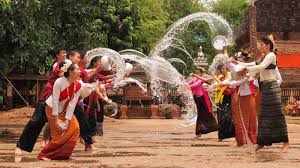
Offerings during Qing Ming Jie, a festival honouring ancestorsSongkran(Thai New Year) CelebrationsFestivals in April: From Public Domain
April is a month full of celebrations around the world. Asia hosts a spray of New Year festivities. Then there are festivals like Qing Ming Jie, Good Friday and Easter. All these are in a way reminders of our past. And yet, we critique things as old fashioned! So, where does tradition end and ‘outdated’ or ‘outmoded’ start? Meanwhile we continue to celebrate these festivals with joy but what happens to those who have lost their home, family and their living due to war or climate disasters? Can they too join in with the joie de vivre? Can we take our celebrations to them to give solace in some way?
In our April issue, we have stories from climate and conflict-ridden parts of the world. From Bangkok, Amy Sawitta Lefevre gives an eyewitness account of the March 28th Earthquake that originated in Myanmar. While in her city, the disaster was managed, she writes: “I’m also thinking of all the children in Myanmar who are sleeping in the open, who lost loved ones, who are feeling scared and alone, with no one to reassure them.” As news reels tell us, in Myanmar there have been thousands of casualties from the earthquake as well as shootings by the army.
From another troubled region, Pakistan, Zeeshan Nasir gives a heartrending narrative about climate change, which also dwells on the human suffering, including increase in underage marriages.
Human suffering can be generated by rituals and customs too. For instance, if festivals dwell on exclusivity, they can hurt those who are left out of the celebrations. Odbayar Dorje muses along those lines on Mongolian traditions and calls for inclusivity and the need to change norms. On the other hand, Devraj Singh Kalsi hums with humour as he reflects on social norms and niceties and hints at the need for change in a light-hearted manner. Farouk Gulsara makes us laugh with the antics of his spoilt pet cat. And Suzanne Kamata dwells on her animal sightings in Kruger National Park with her words and camera while Meredith Stephens takes us sailing on stormy seas… that too at night.
Art is brought into focus by Ratnottama Sengupta who introduces artist Haren Thakur with his adaptation of tribal styles that has been compared to that of Paul Klee (1879-1940). She also converses with filmmaker Leslie Carvalho, known for his film The Outhouse, and his new novel, Smoke on the Backwaters. Both of these have a focus on the Anglo-Indian community in India. Also writing on Indian film trends of the 1970s is Tamara Raza. Bhaskar Parichha pays tribute to the late Ramakanta Rath (1934-2025), whose powerful and touching poetry, translated from Odia by the poet himself, can be found in our translations section.
We have an excerpt from Professor Fakrul Alam’s unpublished translation of Tagore’sRed Oleanders. It’s a long play and truly relevant for our times. Somdatta Mandal shares with us her translation of Tagore’s essay called ‘The Classification in Society’, an essay where the writer dwells on the need for change in mindsets of individuals that make up a community to move forward. A transcreation of a poem by Tagore for his birthday in 1935 reflects the darkness he overcame in his own life. Two poems expressive of longings by Jibananada Das have been translated from Bengali by Professor Alam aswell. From Balochistan, we have an excerpt from the first Balochi novel, Nazuk, written by the late Syad Zahoor Shah Hashmi and rendered into English by Fazal Baloch. Among contemporaries, we have a short story by Bitan Chakraborty translated from Bengali by Kiriti Sengupta, a poignant story that reflects on gaps in our society. And a Korean poem by Ihlwha Choi rendered to English by the poet himself.
This issue has been made possible because of support from all of you. Huge thanks to the team, all our contributors and readers. Thanks to Sohana Manzoor for her fabulous artwork. Do pause by our contents page as all the content could not be covered here.
Perhaps, world events leave a sense of pensiveness in all of us and an aura of insecurity. But, as Scarlett O’ Hara of Gone with the Wind[2] fame says, “After all, tomorrow is another day.”
Looking forward to a new day with hope, let’s dream of happier times filled with sunshine and change.
A conversation with Gajra Kottary, focusing on her new short-story collection, Autumn Blossoms, published by Om Books International.
Gajra Kottary is an eminent screenplay writer on Indian television. She has had many awards and accolades for teleplays that ran into a few thousand episodes, including the very popular Astitva Ek Prem Kahani (Existence: A Love Story, 2002-2006). Trained as a journalist, she turned into a screenplay writer, and now, she opts to go back to writing books.
Her collection of fifty stories in Autumn Blossoms bloom through five hundred pages with an epigraphic verse at the start of each story summing up the intent of the narrative. The focus group of the content is mainly upper middle-class women in India—people who have studied in privileged schools and colleges, though there is a story about a tribal woman who “evolves” to be a leader. The language flows capturing the nuances of her characters, replete with their values, biases, and attitudes. The stories, like her tele series, bring to light not only societal issues but also the interactions between different economic and social strata within the country. They give a glimpse of the world she inhabits.
Forwarded by Anupam Kher, a well-known actor, director and producer, the narratives despite being women-centric are not feminist in intent. There is a story about a girl who while opposing the patriarchy of her married home, runs away to that of her guru only to discover he lives by even more stringent rules and has an extremely gifted wife who practically gave up her life to look after the needs and career of her husband. The turn of events is such that the protagonist returns home, changed in her outlook. The story in a way upends the current norms towards concepts like patriarchy and yet, it dwells on the strength that can be found among common women, women who are housewives and ostensibly live in the shadows of men. The character of the guru’s wife brings to mind Scarlett O Hara’s mother in Margaret Mitchell’s original novel, Gone with the Wind (1936).
The plots of the stories are involved. And each story takes you through a different world. It’s like you have lived the lives of umpteen women within the social constructs of India. You live through murders, weddings, divorces, parties, terrorist kidnappings and even revolutions! In the centre of it all, are the stories of all humanity with their varied moods and flavours, their loves, compassion, happiness, grief, disappointments, and achievements.
In her ‘Afterthought’ — what in common parlance would be afterword — Kottary tells us the name, Autumn Blossoms, is the “generic descriptions of the stories” in the collection. She contends she is “a firm believer in the fact that women, and for that matter men too, bloom and discover strength in the autumn of their lives. As do many protagonists in these stories, where autumn stands as much for the vagaries of age as for what they are experiencing in life which gives them a new perspective.”
There is a story behind the book told in the afterword… how all the stories were curated into this collection. Some of the stories from her earlier collections were redone by the writer to suite her current needs. As there were many stories, she tells us the editor, Shantanu Ray Chaudhuri, “suggested that we categorise them into three sections”. She further elucidates: “The first would be the section about women’s relationships with men. The second section would be women’s relationships with other women. The third would be about women’s relationships with themselves, by far the most complex of them all. Of course, there are bound to be overlaps – these categories have permeable boundaries, so that it is possible for one story in one category to resonate in another. That too provides a sort of unity to the entire collection – apart from the overarching commonality of women being at the centre of each narrative.”
We invite you here to read what the queen of screenplay has to share with us about her journey as a writer and also on her current book, Autumn Blossoms.
Since when have you been writing? Tell us about your writerly journey.
I have been writing ever since I learned to write – quite literally. Ironically as a kid, like many silly things kids do, it was about trying to connect thoughts and make them rhyme in poems. I went to a convent school but more than my English poetry, it was my Hindi writing that got noted. I edited the Hindi section of our school magazine and I always knew I would end up with some sort of career in writing. Then in college, I tried my hand at writing middles and short journalistic pieces for The Times of India, Hindustan Times and some evening papers and women’s magazines. I was emboldened when they got published. So I did the next best thing for those times. I enrolled for a journalism diploma at the Indian Institute of Mass Communications. The course was great, but when I got down to brass tacks, I didn’t enjoy myself at all – reporting and subbing were not my scene at all. I did it for a while, but then took a motherhood break since I had married by then. My break and the quietude it brought helped me to analyse where I was going, helped me find my true calling within writing … which was fiction.
Short stories, published in 2003Novel , published in 2014
Starting with two short-story collections, I soon moved to writing for film and television and it consumed me completely for more than a decade. Until I realised that I also needed to write purely for myself too. I wrote my first novel in 2011 and have written three more after that, simultaneously with my TV work. The former has no deadlines beyond the self-imposed, while TV is all about deadlines so it’s a great mix.
What gets your muse going?
Random thoughts triggered by happenings around … whether it’s in the news or through people’s conversations around. Basically the ‘what ifs’ part of any incident or happening is what triggers the chain of a story in my mind. There is a lovely term in Hindi called ‘udhed-boon’. By now my mind is attuned to churning the thoughts around the ‘what ifs’ to design it into a tale. One has learnt to also decide to design the idea around as a story for a TV show or a short story or a novel. For most of the time, the idea itself speaks in a manner that can be easily identified or slotted. For example, when I read about the phenomena of bride buying in Haryana, I knew I could write a whole TV show around it – so Molkkiwas born. Similarly the concept of age difference in marriages … it’s thematic and therefore lends itself to exploration of its myriad aspects and nuances through a long-format series like Astitva and Na Umr Ki Seema Hodid. Similarly, most of the short stories in Autumn Blossoms are short tales that can’t be stretched very long, or else they would lose their punch.
A soap that focussed on the hunt for a woman’s identity (2002-2006)A TV series centred around exploring Molkki, an Indian tradition that involves marrying off poor girls to a wealthy man in exchange for money (2020-2022)
Tell us briefly what made you opt towards moving back towards books when you are a well-known screenplay writer?
That’s my favourite question to answer. When you write for the screen you train to be collaborative. To cooperate, convince and compromise. Since the ownership of the final product is going to be shared, democracy is the need of the medium.
Published in 2011
But it is important for a writer to be in touch with their solo voice to know what it sounds like, apart from coping with the cacophony of many voices involved in screenwriting. In fact I don’t really understand why more scriptwriters don’t feel this urge to have their individual voices heard and write for print too. It is a most empowering and self-affirming thing to do, but maybe scriptwriting is so tiring that inertia creeps in.
As far as I am concerned, I desperately needed to hear my own voice after more than a decade of collaborative writing, although I started writing short fiction way before scriptwriting. So, I finally wrote my first novel in 2011. I really loved the process though it was an edgy and confusing one all through. Once I had written Broken Melodies and gauged for myself what it added to my skill set, I made a habit of periodically hearing my own voice, along with participating in the chorus of the songs of scriptwriting.
How is writing a book different from writing a screenplay?
I am not a ‘go with the flow’ writer and need to have my goal or destination in sight before I embark on writing a new story. In that sense the process is the same for me in both kinds of writing. But after having done that basic planning for structure, while writing a book, spontaneity takes over. While writing a screenplay one has to be so much more conscious of the craft and style, the judicious part of what ideas to keep and what to discard. In a book one looks at editing much later. Although every good story should have the three-act structure working quietly in the head of the writer, I find that a book or writing for television has most of its texture in the mid portion. The first and third acts are the bookends, the former is a diving board and the latter is a climb to the crescendo. If one can get the middle right, one is sorted. Writing a book is like taking a walk in the park or the open … there’s unpredictability, adventure, mystery, open skies, fresh air to breathe and sights to savour on the way. Scriptwriting is much like walking on a treadmill – you get the required exercise and benefit but it’s not like an entire life experience.
By what I gathered from your ‘Afterthought’, these are stories that have been written over a period of time. How old is the first story and how recent the latest story? What made you think of bringing them out as a collection now?
Yes, these are virtually all the stories in the category of short fiction that I have ever written, including audiobooks. My last published collection of short stories came out in 1996, which is therefore nearly thirty years ago. The audiobooks are fairly recent. Many were written more than a decade ago when I was in between full-time writing for TV. And the last two were written a few weeks before the book went to press, so that we could reach the magical number of 50!
About the reason of bringing them out as a collection. Well it’s every writer’s dream to have a lifetime collection out, I wasn’t actively working towards it.
This book has happened solely because of its editor Shantanu Ray Chaudhuri. He is also a columnist and was writing a piece on my writing journey. As part of his research I shared with him my published, slim volumes of short stories. After he had read them – at record speed at that – he asked if I had written any more that were as yet unpublished. One thing led to another and now we have this door stopper of a volume titled Autumn Blossoms. Both Shantanu and I believe in short fiction, which frankly is challenging to sell. But the challenge is what has driven us both to bring an entire compendium out. Frankly, logically there is no real reason why short fiction shouldn’t be selling even more than novels, in these days of shorter attention span.
Why did you feel the need to have epigraphic verses at the beginning of each story? Are these epigraphs your first attempt at writing poetry … you mention in your ‘Afterthought’ they got you in touch with the ‘closet poet’ in yourself?
The idea to have epigraphic verses at the beginning of the stories was again an innovative suggestion that came from Shantanu after he read some lyrics that I had written in Hindi, and a few in English. They had all been commissioned lyrics, for music albums and the odd theme song for my own shows on TV. Shantanu is quite a poet, having published his poetry too. For me, it was like going back to my early days as a writer who had tried out all genres before I settled for quintessential storytelling. Writing these quatrains was some work and a lot of fun too and discovering the closet poet in myself gave me something to look forward to doing as an option for the coming years. A retirement activity when I perhaps won’t get story ideas anymore. It also gave me a kind of perspective of the essence of each story that I might not have made the effort to analyse otherwise.
Is your writing impacted by any writer, art or music?
My father was a classical musician, though I never pursued music. I love to listen to his music, as well as soulful Hindi film music, and for me the lyrics are as important as the melody. I love Hrishikesh Mukherjee’s films and their music and my regret over the last few years is that I have not been reading as much as I should or would have liked to. I used to love Roald Dahl, Manto, Jane Austen, and most of all Tagore. In recent times I was bowled over by Elif Shafaq’s Forty Rules of Love. I suppose when one admires an art form or artiste, influences do seep in, in terms of both style and content, so all these people’s works have impacted my writing. And also, the aspiration to be as impactful as they have been, since they have been influential across art forms.
You are writing a novel too. Tell us a bit about the novel. Would they too have something to do with these short stories?
Published in 2017
I am almost ready with two novels. Both have male protagonists at the centre which is unusual for me. They are both very different stories from each other. One is a slice-of-life story that is light-hearted in its telling – quite a challenge for me actually – and is tentatively titled Sibling Revelry. The other is a thriller, also a social commentary. It’s tentatively titled Bonds and Bondage. Both the stories, like my earlier novel Girls Don’t Cry have their roots in stories from Autumn Blossoms, that tugged away at me to develop them more, which I eventually did. My forthcoming novels are broader versions of the stories titled ‘Hello, Goodbye’ and ‘Sugar and Spice and All Things…’ respectively.
I don’t know whether this happens with other writers, but this crossover writing does happen with me at times, as I write across media and genre. By now I have come to enjoy the process of finding more and more layers to my own story as I develop some of them from one medium to another.
There are yet some more stories in Autumn Blossoms that I didn’t see as possible novels when I wrote them. But in the process of revisiting them for the collection, I feel they merit a longer format … ‘Friends Indeed’ is a case in point.
What is your favourite genre as a writer?
Honestly, there is no favourite genre. They are all flavours of the season, and I don’t mean that in a disparaging way. Currently it is the short-fiction genre, but I know that it will be my new TV show next and when that hopefully settles, my novels will draw me to them. I guess this makes my imagination more agile, though when there is an unplanned overlap of projects, I get very tired and these days, I get anxious too as energy levels are not as high as they were a few years ago.
What can we expect from you in the near future – more books or serials or both?
God willing, there should be both, but I need to calibrate my involvement in both spheres. I am going to distance myself from the very tiring process of everyday series writing. Though of course, I will still be involved as I am experienced and can bring some wisdom to the table. I dream of writing books at a more leisurely pace; quite literally blossoming in the autumn of my life.
Thank you for the wonderful answers and your writings across the screen and in books
(The online interview has been conducted through emails and the review written by Mitali Chakravarty.)
PLEASE NOTE: ARTICLES CAN ONLY BE REPRODUCED IN OTHER SITES WITH DUE ACKNOWLEDGEMENT TO BORDERLESS JOURNAL.



 Borderless