Uncomfortable with my political views aired unexpectedly inside his salon, the savvy barber, swinging in his fifties, swung into rapid action by making a flower bloom on my head. A cadre of fierce loyalty, he chose to operate without showing a hostile reaction. His hands got together for an act of mischief, with the party symbol taking shape in the back of my head. His fiendish attempt to groom me as a party worker fetched partial success as he fumbled to get his floral designing right. The final shape he managed to accord was such that it was impossible to identify the flower, with several political outfits with floral symbols competing for political aggrandisement in the local town. The remote resemblance still made me think why I couldn’t gauge what he was up to, why I let this happen after surrendering my head in good faith to him while rambling on the rumble and tumble of politics. In hindsight, I should derive consolation from the fact that the rabid supporter, with scissors in hand, could have shown a much worse violent streak and I was lucky to have escaped unhurt.
Earlier, when I roamed around freely, nobody dared to call me a party worker. But now my teashop friends would be keen to excavate details of my allegiance, which party I swore allegiance to. It was better to let confusion prevail or else I would be stereotyped as a political aspirant though the truth remains that nobody in our family or dynasty has ever contested, leave aside won any election for generations.
During my next hop to the salon, I had queries lined up for the barber, but he was busy with his loyal customers. A few people waiting around stared at my face and head with the designed cut. Finally, when I had the chance to ask the barber why he had experimented with a design on my head, he sounded evasive and denied having any such nasty intention. He defended his innocent act by blaming me for being unsteady and shaky. When I tried to make him recall the details and his intent, he started a sudden conversation with another customer to deflect attention, asking him what to do with his goatee. When I sounded hell-bent on seeking an explanation, he cleared it was not a party symbol he intended. He fished out his camera phone, zoomed in, clicked my head and warned me to stay away from his shop or else he would be compelled to post the picture of my head on social media channels tagging local heavyweight politicians, though that was the last thing on his mind.
Becoming an object of ridicule was unacceptable so I chose to disappear from his shop without further discussion. A fanatic supporter could stir any controversy to gain mileage. It was safer to forget the entire episode as the worst nightmare of my life. I had no intention to air political views with a haircut which announced to all kinds of people a political opinion towards which I was indifferent. My best friend also warned me of the ramifications and urged me to go bald right away, to avoid escalation of political conflict. Perhaps it was genuine advice to save me. The next day, I stepped into a branded unisex salon for a neat, nifty job of turning my head into a cleared space. He quoted a hefty price for tonsuring my head, but it was much less than what I would have to cough up in case I was caught in the political crossfire.
Identity matters are crucial both in terms of flaunting and hiding – depending on which community one belongs to. Since both parties were active in the area, I had the fear of being roughed up by the cadre of either party and asked to clarify which party I belonged to. Since I am apolitical by choice — evident from my reluctance to vote for any political dispensation — the safest option would be to cover my head with a cap or hat to avoid any question about why I went for a bald look or what a tonsured head signified in the heat of elections. There would be discomfiting scenes when the neighbours started throwing the odd question. Maybe someone would find the look quirky enough and post it on a social media platform as a classic case of a fence-sitter or a rank opportunist would give it the final shape after seeing who wins, which flower blooms – the turncoat types waiting to lap up the right opportunity. In my case, the housemaid was the first to notice the change and sympathised: “Your bouncy hair is all gone, a terrible experiment that raises concerns.”
The new avatar was the outcome of my quick visit to the reputed hair stylist who egged me to avail of tattoo and beard trimming services though I was well past my prime to sport any of these. Business targets compelled him to pitch these services to all kinds of customers and persuade them. Despite a handlebar moustache as a fearsome icon, I caved into the suggestion, and he then proceeded to snip it. After doodling a small rosebud on the nape right below the collar, he suggested I should remove dark circles from under my eyes using their special serum. I agreed reluctantly to buy a golden facial grooming session to improve the overall look.
The entire package pinched my pocket, but the makeover did give a facelift to my personality and erased the fears of becoming a victim of a political bash-up. I took a selfie and posted it as a profile photo but the response to my glow was unusually slow and the makeover got fewer likes than earlier for some strange reason. The brazen attempt to look younger and dapper, and being fairly successful at having gained the look, was perhaps the reason that stoked jealousy in my peers. The tattoo of a rosebud was a romantic add-on when I should have ideally gone in for something like a lizard or snake as my venomous tongue unleashing spite was notorious all around. Even a cult icon would have suited my age, but not these teeny-bopper love symbols though these were safer than party symbols.
When the elections were over, none of the floral symbols won, but a newly formed party swept the polls. I was relieved I was rendered safe and went to the barber to see how he sulked now. I was surprised to see he had switched loyalty. The new party colours were spread all over the salon with posters. As I was about to take potshots, the barber did admit belatedly he had intended to draw a party symbol on my head the last time but could not do it perfectly well. His new party had a very simple symbol, and it was easy to draw for any novice. The intended threat was enough to make me beat a hasty retreat as my tonsured head had already raised an abundant harvest of salt and pepper hair within a couple of months.
Devraj Singh Kalsiworks as a senior copywriter in Kolkata. His short stories and essays have been published in Deccan Herald, Tehelka, Kitaab, Earthen Lamp Journal, Assam Tribune, and The Statesman. Pal Motors is his first novel.
PLEASE NOTE: ARTICLES CAN ONLY BE REPRODUCED IN OTHER SITES WITH DUE ACKNOWLEDGEMENT TO BORDERLESS JOURNAL
G Venkatesh writes about a book from 1946. What is interesting is no women writers are featured in it despite their being a phrase which he quotes in his essay, ‘a stepdaughter of the Muses’…
Photo graph by G Venkatesh
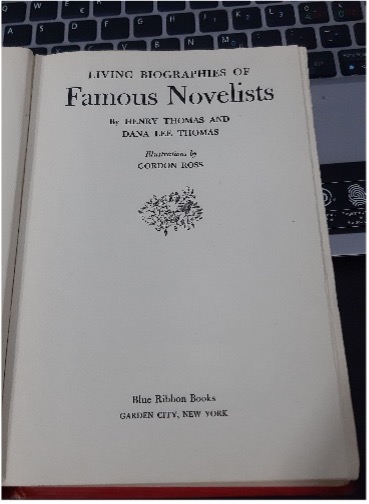
There is this book published in 1946 in New York, that I picked up at a Red Cross charity shop in Karlstad (Sweden) of late. A compilation of micro-biographies (make that ‘nano’ if you will) of 20 novelists (fiction-writers in other words) from Italy, Spain, France, England, Scotland, the USA, Russia and Ireland, who graced the world of literature in flesh between the mid-14th and the mid-20th centuries, and will continue to do so, in spirit, forever.
Pillars of fertile imagination, seeded from the idea-realm Visual by G Venkatesh
I venture in this article to present some gleanings from this little gem of a book, to enlighten, motivate, inspire, educate and rekindle interest in the classics of yore. Ralph Waldo Emerson wrote that all writing happens by the grace of God. We witness that in the lives of the twenty writers profiled in the book. Some had an inborn urge to write, some developed the penchant to do so as if the idea floated in from the idea-realm beyond the astral, and some others were blessed by the Divine to transmute their pain and suffering to the written word that has stood the test of time, and will continue to do so, into the distant future. Condemnation paved the way to commendation for some, while rejections emboldened others to transcend the limits of human judgement and rejoice in the sunshine of hard-earned glory.
At its perigee, the ‘novel’, as observed by Henry and Dana Lee Thomas, is an epitome of philosophy as applied to life. The Thomases ask readers to consider the life of every novelist profiled to be a magnum opus in itself – each adorned with facts stranger than fiction.
Boccaccio, Rabelais, Cervantes
This is an Italian-French-Spanish trio (encompassing the 14th to the early 17th century), and perhaps most of the readers may be familiar only with the third-named. Giovanni Boccaccio was a contemporary of Alighieri Dante (whose biography he wrote). A ‘friendly sinner’, he was a devotee of the here and now, while also being profoundly interested in the hereafter.’ Novelists, well and truly, leave behind accounts of their times, couched in fiction (and that, read alongwith factual history, helps us readers to visualise and understand better how things were in the past). The ‘poets’ in them, simultaneously dwell on and dream about how things can, must and will be in the future. Many of them refrain from including a semi-autobiographical element to their novels, and the Thomases have identified Francois Rabelais as being one such. To the Frenchman, all life was an anecdote with a bitter ending, a truth he based his limited fictional creations on.
Miguel de Cervantes, the Spaniard, is presented as a disappointed, shattered and disgusted man, who was chiefly motivated by his own trials, travails and tribulations to pen the famous Don Quixote. This knight who fought windmills, was perhaps what Cervantes thought himself to be – blessed with the good fortune to live in folly and die in wisdom.
Defoe, Swift, Sterne
From the simple Quixote and the clumsy Sancho Panza to the resourceful Robinson Crusoe and his helpful Man Friday, characters created by Daniel Defoe in a novel eponymous with the protagonist. Defoe was a paradox of moral integrity and material ambition (if you can visualise one such blend), who by virtue of the fact that he donned the mantles of businessman, pedlar, politician, pamphleteer and spy (not necessarily in that order) in his life, could interpret mankind expertly in his fiction. A kind of ‘been-there, seen-that, done-that, can-write-about-all-with-authority’. Jonathan Swift, of Gulliver’s Travels fame, was gifted with a supreme intellect and a spiritual-religious leaning, but encumbered by physical weakness. God gives but also deprives at the same time, a mystery which humankind has not been able to solve. Fatherless when barely half-a-year old, he was verily a titan (like the character Gulliver he created) among pygmies (like the Lilliputians). He abhorred injustice and thought and prayed forever for the felicity of humankind. He lived to be 78, but contended on the basis of his experiences that the gift of a long life is bought at a very high price.
Laurence Sterne, the preacher-poet Yorkshireman, left behind several nuggets of wisdom in his novels and a couple of them can be cited hereunder:
“I laugh till I cry, and I cry till I laugh” (reminding one of the Yin and the Yang which feed into each other)
“Give me all the blessings of wisdom and religion if you will, but above all, let me be a man.”
Scott, Balzac, Dumas
Sir Walter Scott, while being a prodigy like Swift, also had to contend with physical disabilities like him. He tided over them marvellously, prudently, gallantly and tirelessly, en route to a knighthood and immortality in the realm of English literature. Dreamy Honoré de Balzac, obdurate and uncompromising, believed that man’s destiny and purpose in life was to “rise from action through abstraction to sight” – a deed-word-thought ascent in other words. “Life lies within us (spiritual), and not without us (material)”, he averred. He never got the glory he deserved when he was alive, and his soul perhaps got the peace it richly merited when fame showed up posthumously.
Athos, Porthos, Aramis and D’Artagnan – characters from The Three Musketeers, a novel by Alexandre Dumas which presents the facts of 19th century France through the medium of fiction – were known to school-goers in the 1970s and 1980s, like yours sincerely. Dumas, as the Thomases have noted, met praise with a shrug and insults with a smile – stoically in other words. However, he had a penchant for sarcasm and trenchant wit which were unleashed whenever required. “I do not know how I produce my poems. Ask a plum tree how it produces plums,” is verily a testimony to his transatlantic contemporary Ralph Waldo Emerson’s “All writing happens by the grace of God.”
Hugo, Flaubert, Hawthorne
Two Frenchman and a New-Englander American comprise this trio. Viktor Marie Hugo, of Les Misérables fame, was born in the same year as Dumas, and was regarded widely as the ‘Head’ of the 19th century to Abraham Lincoln’s ‘Heart’. His crests of hard-won success coincided with the troughs of ill-deserved sorrow (he had to contend with the deaths of his wife and children). The Divine Will strengthened his mind, soul and fingers to move quill on paper, enabling the much-bereaved Frenchman to cope and conquer. “Sorrow,” he wrote, “is but a prelude to joy.” A stoic would however add, “and vice versa”. Quite like Sterne’s “I laugh till I cry, and I cry till I laugh”. Despite all that he had to endure; Hugo always believed in God and the purposes he lays out for human beings in their lives.
Hugo’s friend Gustave Flaubert considered the written word to be a living entity, with a voice, perfume, personality and soul. A concoction of realism and romanticism, if ever there was one, Flaubert was also a peculiar amalgamation of poet-cynic, artist-scientist and humankind’s comforter-despiser. He ardently believed that though the soul is trapped within a mortal corpus on the terrestrial realm, it (which is the actual identity of a human being) lives in the idea-realm, and finds its rewards therein.
Hawthorne, on the other side of the ocean, was charmed by the sea and surf and sand in his childhood and youth, having spent a lot of time along the New England coast in north-western America. That led him to dwell on the mysteries of the human soul (which continue to be mysteries at the time of writing), while rebelling against the Puritanic influences that had engulfed the region. He was on an eternal quest, an intellectual and moral pathfinder in his own right, and a pioneering rebel with the pen and quill in his arsenal.
Thackeray, Dickens, Dostoyevsky
William Makepeace Thackeray, readers will be interested to know, was born in Calcutta (now, Kolkata). A sentimental cynic who glimpsed the stupidity of life through the fog of sorrow, he believed that foolishness of the past is a pre-requisite to wisdom in the present and the future – in other words, simply put, we learn from our errors as we move on. ‘Gifted with a bright wit and an attractive humour’, in the words of Charlotte Bronte, he contended that literature was more a misfortune and less a profession. His cynicism helped him to grasp reality, and feel empowered in the process –“How very weak the very wise; how very small the truly great are.” Kind and wise humans often lack the power to change things for the better, while the powerful ones lack the conscience, will and goodness to want to do so.
Thackeray rivalled with Charles Dickens for fame and glory. Dickens, similar to Scott and Swift, had to contend with physical discomfort in his childhood and adolescence, in addition to a father who was not responsible with the money he earned. These experiences would later feed into the stories he churned out prolifically; semi-autobiographical some of them, while informing readers at the same time about the times that prevailed – “the best of times and the worst of times” (A Tale of Two Cities). His humble beginnings made him burn the midnight oil later in life, fuelled by the ambition to succeed, which he sustained all along. Quite like it was Hugo across the Channel, the troughs of torment annulled the acmes of accomplishment. Yet, he remained grateful to God and fellow-humans for the life he lived, and bade one and all a ‘respectful and affectionate farewell’, before ascending to the astral realm.
Reclusive Feodor Dostoyevsky, like Hawthorne in America, struggled to shake off a Puritan upbringing and sought fodder for his literature among the common man – the suffering proletariat who visited liquor shops to drown their sorrows in alcohol. Man, he believed, was responsible for his own salvation…and not God. He however did believe at times that God saved those whom men punished. But then, he also contradicted himself or seemed to do so, when he said that man is saved only because the Devil exists. But perhaps that was not a contradiction after all – God saves man from what he has to be saved from! The meaning of life, according to Dostoyevsky, was the brute-to-angel and the sinner-to-saint transformation of man; quite on the lines of Balzac’s action-abstraction-sight prescription.
Novelist
Lifespan
Selected works
Giovanni Boccaccio
1313-1375
Filocolo, Filostrato, Teseide, Fiammetta, Amorosa Visione, Ameto, Decameron, Life of Dante
Francois Rabelais
1495 – 1553
Pantagruel, Gargantua
Miguel de Cervantes
1547 – 1616
Galatea, Don Quixote, Novelas Exemplares, Persiles y Sigismunda
Daniel Defoe
1661-1731
The True-Born Englishman, The Apparition of Mrs Veal, Robinson Crusoe, The Dumb Philosopher, Serious Reflections, Moll Flanders
Jonathan Swift
1667 – 1745
The Battle of the Books, The Tale of a Tub, Gulliver’s Travels Children of the Poor, Directions to Servants, Polite Conversation
Laurence Sterne
1713-1768
A political romance, Tristram Shandy, Sermons by Yorick, The Sentimental Journey
Sir Walter Scott
1771 – 1832
The Lady of the Last Minstrel, Ivanhoe, Kenilworth, The Lady of the Lake, Waverley, The Monastery
Honoré de Balzac
1799 – 1850
The Country Doctor, Eugenie Grandet, Jesus in Flanders, Droll Stories, Louis Lambert, Seraphita, A Daughter of Eve, The Peasants
Alexandre Dumas
1802 – 1870
The Three Musketeers, The Count of Monte Cristo, The Black Tulip, The Prussian Terror, The Forty-Five, Chicot the Jester, The Queen Margot
Victor Hugo
1802 – 1885
Les Misérables, The Toilers of the Sea, The History of a Crime, Legend of the Centuries, The Hunchback of Notre Dame, The Supreme Pity
Gustave Flaubert
1821 – 1880
Madame Bovary, The Sentimental Education, The Temptation of St Anthony, Bouvard and Pécuchet, Salambbô
Nathaniel Hawthorne
1804 – 1864
Twice Told Tales, The Blithedale Romance, The Scarlet Letter, Mosses from an Old Manse, The Marble Faun, Tanglewood Tales, The Snow Image
William Thackeray
1811 – 1863
The Great Hoggarty Diamond, Vanity Fair, The Book of Snobs, Henry Esmond, The Virginian, Lovel the Widower, The Newcomes
Charles Dickens
1812 – 1870
Pickwick Papers, Oliver Twist, Nicholas Nickleby, Barnaby Rudge, David Copperfield, A Tale of Two Cities, Great Expectations
Feodor Dostoyevsky
1821 – 1881
Crime and Punishment, Poor Folk, The Double, The Landlady, The Family Friend, The House of Death, The Gambler, The Idiot,
Leo Tolstoy
1828 – 1910
War and Peace, Anna Karenina, Childhood, The Cossacks, Two Hussars, Three Deaths, A Confession, Master and Man, Resurrection, What is Art
Guy de Maupassant
1850 – 1893
Une Vie, The Ball of Fat, Mademoiselle Fifi, The Necklace, Yvette, Our Heart, Bel-Ami, Pierre and Jean, A Piece of String
Emile Zola
1840 – 1902
Doctor Pascal, Therese Raquin, The Dram Shop, Nana, Germinal, The Earth. The Dream, Rome, Paris, Fertility, Work, Truth, Justice
Mark Twain
1835 – 1910
Huckleberry Finn, The Adventures of Tom Sawyer, Joan of Arc, A Connecticut Yankee, What is Man, The Prince and the Pauper
Thomas Hardy
1840 – 1928
A Pair of Blue Eyes, Under the Greenwood Tree, Far from the Madding Crowd, The Trumpet-Major, The Mayor of Casterbridge, Jude the Obscure, Tess of the D’Urbervilles
Table: The novelists profiled, and a list of their selected works
Tolstoy, Maupassant, Zola
Leo Tolstoy, also a Russian like Dostoyevsky, unlike Dickens, was not guided onward and forward by ambition. He believed in stooping to conquer and was motivated in his life’s journey by compassion. Orphaned when not yet a teenager, haunted by an inferiority complex pertaining to his ‘unprepossessing appearance’, and disgusted with organised religion (the Orthodoxy which prevailed in Russia), he discovered his purpose in Rousseau’s philosophy and in ridding the human heart of evil and helping it to live in peace, in communion with Nature. His dissent, rebellion and dissatisfaction with extravagance (of the nobility), bigotry (of the clergy) and tyranny (of the royalty), were the seeds, water and fertiliser for his contributions to Russian literature. Readers know that Mahatma Gandhi was inspired by the philosopher-prophet-penman Leo Tolstoy to set up the Tolstoy Farm in South Africa. Some nuggets which will serve as parts of vade mecums for readers:
“Death, blessed brother death, you are the final deliverance.”
“There are millions of human beings on earth who are suffering. Why do you think only of me?”
Guy de Maupassant was one of those millions who suffered a lot. Reading about the tragic short life led by him, with constant physical and psychological afflictions which led to autoscopy in his 42nd year, and death in the 43rd, makes one sad. It also makes readers turn to his short stories – of which he is known to be a master – more eagerly. Flaubert and de Maupassant knew each other well, the former being a ‘guru’ guiding the latter on from time to time, along his literary journey.
Another Frenchman – Emile Zola – a contemporary of de Maupassant and Flaubert and a good friend of the painter Paul Cezanne, progressed through pitfalls and serendipitous godsends to profile the poor people of France, and ironically rise to richness thereby. A man who defended justice and spoke up against all forms of unfairness, Zola is known for standing up for the French army captain Alfred Dreyfus, a Jew who was wrongly (and knowingly so) accused of treason in 1894, and playing a key role in clearing the Jew’s name in 1906 (four years after Zola passed away). His last written words –“…to remake through truth a higher and happier humanity.”
Twain and Hardy
The man most readers know as Mark Twain, was born Samuel Clemens in America. Though it would not be right to compare and contrast the travails endured by the novelists profiled by Henry and Dana in this book, it can at least be said that a peep into Twain’s life tugs at your heartstrings and the vibrations linger on for a long time. Indeed, as a natural consequence, respect and admiration well up in the heart, for this novelist. He suffered an awful lot, but also learnt to laugh at his own agony as an ‘onlooker’ – the soul observing the pain of the body and the trauma of the mind it enlivens, from a distance, without being affected in any way. Like Hugo on the other side of the ocean, he endured what can be considered as possibly the greatest sorrow a man can face – burying/cremating his own children, one after another. Twain always supported the underdogs while voicing his disgust at the pompousness of the rich and powerful, in his own unique brand of sarcasm. The following words of his may sound cynical, but they are open to interpretation:
“Nothing exists but you. And you are but a homeless, vagrant, useless thought, wandering forlorn among the empty centuries.”
Without letting these words deter you, link them with the other sufferer Viktor Hugo’s “Nothing is as powerful as an idea whose time has come”, and soldier on.
The last of the twenty, Thomas Hardy, is yours sincerely’s favourite (I happen to read all his important works in my twenties, if I remember right). Hardy like his fellow-Britons Swift and Scott was born with a “frail body, strong mind and compassionate soul”. He was compassionate towards and appreciative of the forces and elements of Mother Nature – winds, clouds, bees, butterflies, squirrels, sheep etc., as pointed out by the Thomases. The manner in which he moulded his protagonists in his novels was catalysed by this compassion. Most of them are compassionate themselves, and evoke compassion in the hearts of readers, quite easily. Hardy wanted to teach his fellow-humans how to “breast the misery they were born to”, by using his fictional protagonists as instruments. His life was an exercise in “subduing the hardest fate” and “persistence through repeated discomfitures”. As it often happens with true geniuses, he was much ahead of his times, and the glory that illumined his soul in heaven posthumously, more than compensated for the disappointments which had to be endured when it was encased in his mortal corpus.
Not the last word by any means
Serendipity, it must have been, which made me stride into the Red Cross charity shop in Karlstad in June, wherefrom I purchased this 280-page treasure. To quote Longfellow (who incidentally was a college-mate of Hawthorne’s),
“Lives of great men all remind us/We can make our lives sublime/And departing leave behind us/Footprints on the sands of time.”
The 20 authors profiled in this book represent a huge family of writers who converted fiction from ‘a stepdaughter of the Muses’ to an ‘epitome of the philosophy of life’, except that there were no ‘daughters or stepdaughters of men’ listed among the novelists in this volume.
.
G Venkatesh (50) is a Chennai-born, Mumbai-bred ‘global citizen’ who currently serves as Associate Professor at Karlstad University in Sweden. He has published 4 volumes of poetry and 4 e-textbooks, inter alia.
.
PLEASE NOTE: ARTICLES CAN ONLY BE REPRODUCED IN OTHER SITES WITH DUE ACKNOWLEDGEMENT TO BORDERLESS JOURNAL
YEARS OF YEARNING


I see the horizon filled with ghosts of pre-owned wives and
Insomnia dripping from rooftops.
Those bodies… bodies with eternal youth
emerge from utter darkness. Soft. Palpable to my carnal breath.

They all are coming out and claiming me.
A desire for a bonfire dance. I see insects
dying like martyrs.
Tomorrow, I will write an elegy in their memory.

Maybe those walls still stand. Those rooms.
Those battlefields and muses. Maybe we all recall our
scars and moonlit longings and the enchantress
who danced with us spitting fire.
She is there tonight, preaching peace and death.
Swarnendu Ghosh is a poet from Kolkata, India, who writes in English and Bengali. His first book, Ferry Ghate Frida, is a collection of Bengali poems published in 2023.
PLEASE NOTE: ARTICLES CAN ONLY BE REPRODUCED IN OTHER SITES WITH DUE ACKNOWLEDGEMENT TO BORDERLESS JOURNAL
I wait
weighing words against memories
memories against poetry
poetry against noise
noise against feeling
feeling against time
only to arrive
at the deepest homecoming of words
-	‘Homecoming’
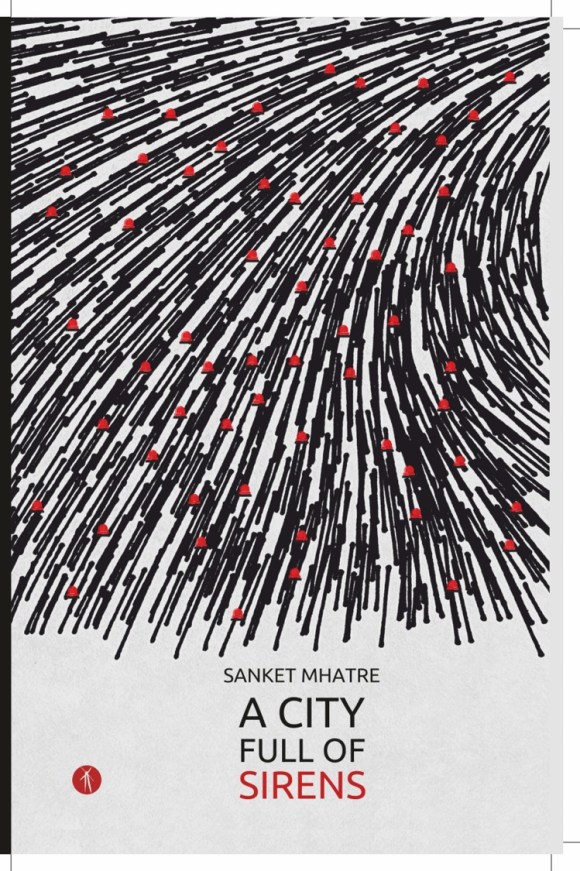
Something irreplaceably urgent yet inconsolably fragile commands the readers’ attention in Sanket Mhatre’s A City Full of Sirens. There is, to begin with, the orderly chaos of the book cover that with its startling depiction of noise and alarm, summons us to a danger that is as neurological as it is existential, as concretely physical as it is metaphysical, and as identifiable as it is, ultimately, anonymous.
Darkness asphyxiates
shifting the axis of your soul
madness froths
bubbles of hurt
shadows of shards
inserting lost files of remembrance
pulse rising –
raising a question at boiling point
Here is an understanding of the city as both protagonist and witness, as conquistador and vanquished, as healer and diseased. Mhatre is mostly talking about Mumbai (“Andheri East doesn’t realize/ that it is sleeping in a belly of void/ It is only a matter of time/ until all the lights go out”) but his city could be “the broken arteries of Kolkata” (‘Mid-flight’) or precisely any cityscape where life routinely unravels amidst disillusionment, betrayal, threat and hope, every poem to it being “a wound or a flower or a piece of sunshine” “written on the threshold of vulnerability and despair” as “a letter trying to find its own footprint on the shifting axis of time and circumstance” (‘Introduction’)
Tortuous and tortured, Mhatre’s city is a site of bereavement, uncertainty, imperilment, disease, derangement and more, its inhabitants choiceless in their compulsion to wear its frayed fabric upon their skin. But this is not all. Lurking within these poems is also the decisive realisation of the city as a human construct, a mirror that reflects rather than distorts or imposes human irresponsibility and disorder. In the title poem of the collection, for instance, the city is a patient incapable of being saved by its nonchalant dwellers:
the city has been suddenly diagnosed with Stage 3C
and all of us who matter to her:
slum dwellers, middle class, uber rich
upper caste, sub-middle-sub-lower, lower,
converts, casteless, outcasts, pimps and city planners
were late by a minimum of ten months in pre-empting this disease
Mhatre’s cities emit steady sirens of disaster – biological, ecological, technological, moral and aesthetic. But redemption, too, is to be found here alone (“Clay hands in a relentless prayer to -/ everything the earth stands for/ and everything that rises upwards from it.” – ‘A Kiss of Cotton’) for only what hurts has the ability to effectively transform – “anything that doesn’t change our body can never change us”. (‘Culture of Transience’) What, chiefly, reconciles the city as wound to the city as mirror, is the imperative of language and its expressive potential for love and poetry. (“A verse could be an open road” – ‘These Years with Her’)
A City Full of Sirens is a dense interrogation of the city, its sirens of overpopulation, congestion, capitalism and climate change, and an exploration of the fullness or plenitude of language that can somehow soften all of this and make it more bearable for life and time. Firmly rooting this collection is a momentous faith in the capacity of words to resist postmodern fragmentation by building bridges across emotions, cultures, and epistemologies. Mhatre’s imagination in poetry is luxuriantly metaphorical. In almost every poem, words defy ordinary appearances to transform into winged images in deep conversation with a reality tangential to the page. In ‘Anuvaad[1]’, as the poet says, all languages are born “from the same birdsong”. In ‘The Concept of Distance’, every stanza offers a new perspective into distance – “The space of pain between two alphabets, now divorced,/ looking on either side of a sentence”. In ‘Morphing into Everything’, the beloved and the city coalesce into one:
my fortresses crumble
dissolve mid-sea
rebirth as an archipelago
sink into her navel
populate her mind
germinate on her dermis
disintegrate into a thousand birds
taking early flight
In each of the fifty-six poems in the collection, is a seamless interweaving of self and space. Most of Mhatre’s sirens are symbolic, conjured through the weight and immediacy of metaphor. In each poem is this sense of something that must be overcome — a lurking claustrophobia, an unnamed distrust, a haunting faithlessness, a constant suggestion of order tipping into anarchy.
An acute precariousness, marked by a vital need to thresh out feeling on the floor of language, is the signature of this collection.
Very significantly, many of these poems are about poetry itself — its genesis, composition, structure, and its relentless shapeshifting ability to weld disparate worlds and subjectivities into a coherent experiential whole. Unravelling within this book’s narrative arc is an empathetic journey of the body and spirit, its goal being to discover “the completeness of existence…Time. Tide. Man. Woman. Humanity. Age. Difference. Distance”. (‘Rain Being’) Passion configures these poems in various ways and not least through the erotic of language. In the best poems here, love, poetry, woman and city become indistinguishable from one another, permeating ontological and aesthetic boundaries and accomplishing a spiritual surrealism that marks the distinctness of this collection.
A City Full of Sirens is, thus, about cities that are both germane and antithetical to poetry, about a “confabulated planet” and mutating geographies “stretching/ through thick mesh of bones and arteries/ pulp synchronized to our heartbeats/ birdsong to a breath/ while ink sprawls/ on a dream of half-slept pages”. (‘Vertical Forests’) It is equally about the inhabitants of the cityscape, the reconciliation of their numerous fragments and roles – “a new you added everyday/ an old you subtracted”. (‘The Queue’), intending “to geolocate/ the fulcrum of our absolute feeling/ outliving erasures”. (‘Synthesis’)
The collection remains remarkable for its obsession with language, its authentic emotional inflections, its charged candour, and its oscillations across a wide thematic range of existence, estrangement, erosion, and redemption. Annihilation, disease and death watermark these poems in undeniable ways but the energy of the book lies in its refusal to be contained within scripts of hopelessness or pain. Summoning optimism to thought and agency to action, A City Full of Sirens makes a palliative of poetry and crafts an entourage of life’s resilience to learn from every setback –
I was never the rain.
Until you cloud-burst me with words.
You gave me the first drop.
It’s my turn to take you in.
--‘Rain Being’
Basudhara Roy teaches English at Karim City College affiliated to Kolhan University, Chaibasa. Author of three collections of poems, her latest work has been featured in EPW, The Pine Cone Review, Live Wire, Lucy Writers Platform, Setu and The Aleph Review among others.
.
PLEASE NOTE: ARTICLES CAN ONLY BE REPRODUCED IN OTHER SITES WITH DUE ACKNOWLEDGEMENT TO BORDERLESS JOURNAL
Shantanu Ray Chaudhuri in conversation with M.S. Viraraghavan and Girija Viraraghavan
M.S. Viraraghavan and Girija Viraraghavan
In their new book Roses in the Fire of Spring: Better Roses for a Warming World and Other Garden Adventures (Running Head, 2023), world-renowned rose hybridisers, M.S. Viraraghavan and Girija Viraraghavan, record their journey of over fifty years, creating more than a hundred new rose varieties, in a range of colours, shapes and types. The authors spoke to Shantanu Ray Chaudhuri on their lifelong passion for the rose.
The passion for roses goes back a long way – can you recall the first moments when you realised that this was a ‘calling’ you had to follow? Any epiphanic moment that leaps to the mind?
From quite a young age, Viraraghavan was fascinated with roses, but the epiphanic moment was really when his family spent summer vacations in Coonoor, staying at the government guesthouse within Sim’s Park, which overlooked a rose garden. Every morning, he would wander about this garden which was a blaze of colour of the new roses created from the golden rose of Persia, R. foetida by Pernet Ducher, a great French rose breeder. The brilliant, never-before-seen colours of these roses amazed him – from bright gold and apricot to dazzling oranges and reds. In particular, one of the golden roses took his breath away – ‘Julien Potin’, aptly named for a jeweller – its vivid colour was quite overwhelming for the boy of thirteen, already thrilled with roses. From this came the intoxicating thought: ‘If Pernet Ducher could do it, why not I?’
There’s a delightful little bit about Viraraghavan sir’s viva-voce for the IAS and how his knowledge of roses played an important part in him getting through that. Would you like to share that with our readers?
A difficult part of the IAS examination is the viva-voce, where a panel of senior administrators question the aspirant about various aspects of his or her life and ambitions. Viraraghavan was in the middle of this interview when the Chairman, by chance a learned rose grower, asked him what his hobbies were. ‘Growing roses,’ was the response. The next question was meant to be a googly to confuse a nervous candidate. ‘What roses can you grow in Madras City?’ But Viraraghavan had read the CompleteGardening in India by K.S. Gopalaswamiengar, well-known horticulturist of Bangalore, many times, so my answer was nearly verbatim from the chapter on various kinds of roses which do well in low-to-medium elevations, i.e., warm climates, so he reeled off the different rose classifications: Teas, Noisettes, Bourbons, Chinas, Hybrid Teas, Hybrid Perpetuals. The interview committee then decided it was prudent to go on to other questions rather than get a lecture from a young and seemingly unflurried candidate! But his capacity to master detailed information on various subjects had been noted, and he came through with flying colours (pun intended).
You mention making your presence on the world stage as late as 2000. Please give us a brief account of your work on roses before and after – a potted highlights package, if one can call it.
From the start, our rose breeding focused on creating better roses for warm climates based on the dictum of India’s pioneer rose breeder, B.S. Bhatcharji of Bengal and Bihar, who had stressed the need for a separate breeding line for warm climates as distinct from the Western focus on creating cold-hardy roses suitable for them. Thus, in the early years, our work was with those roses which, though Western, performed well in hot climates, and we had bred many which did well in Hyderabad where we lived. Then, after perusal of many books on roses, we realised the potential in two Indian rose species Rosa gigantea (from northeast India) and Rosa clinophylla (perhaps the world’s only tropical rose species). After getting them with great effort, we began to work with them. At every annual national rose convention in India we would present updates of our work. In 1999, at what happened to be a World Regional Rose Convention, in Jaipur, Viraraghavan’s talk, as always, focused on the breeding with the two rose species mentioned. After the talk, the World Federation of Rose Societies President, Helga Brichet, and Vice-President (South America), Mercedes Villar, came up to him and said they had never before heard of this kind of rose work or of these rose species and invited him to be a speaker at the next World Rose Convention to be held in May 2000 in Houston, Texas.
That was the start of a further phase of rose breeding with the realisation that other than India, several warm parts of the world were also looking for roses that would do well there. These two rose species had been personally collected by us from their native habitat. At Houston, and in other places, people were fascinated by this aspect, which no earlier breeder had undertaken, that is, personally collecting rose species in the wild, at great risk, growing them and using them in creating new roses; starting from scratch as it were. It made sense to them when Viraraghavan explained the dictum of that great German breeder Wilhelm Kordes I who said –‘The soup ladle will only bring out what is already in the tureen’, meaning that fresh genetic input was required if new and different roses are to be created. The enthusiastic response to his ideas strengthened his determination to go ahead with this new rose breeding line. There is nothing as intoxicating as the realisation that the rose world is watching our work with great interest.
One of the most fascinating sections of the book is the one titled ‘The Ones Who Came Before’. Please provide readers with a short account of these legendary influences.
Karrie’s Rose. Photo courtesy: M.S. Viraraghavan and Girija Viraraghavan
We had noticed that invariably roses were named for famous people with often no connection to the world of roses. This made us think: why not name our roses for the intrepid plant-hunters who had discovered roses in the wild, on mountains and in forests, and botanists who had contributed to the knowledge on plants.
One wild Indian rose is R. gigantea, from our north-east, and Myanmar. Three great plant hunters were responsible for collecting this species in the wild – Sir George Watt, General Sir Henry Collett and Frank Kingdon Ward. We decided to name our rose hybrids for all three. Sir George was a medical doctor with an interest in botany, and worked as a surveyor with the British India government. During the course of his work, in the 1880s, he found Rosa gigantea growing on the slopes of Mt Sirohi, now in Manipur, and collected specimens. Almost simultaneously, so did Sir Henry Collett, except in the Shan Hills in what is now Myanmar. Both specimens were identified as being the same and named by the great Belgian taxonomist of the time, François Crepin. Climbing Mt Sirohi in 1990, we came across and collected plants from perhaps the precise location that Sir George had found Rosa gigantea. We named our first hybrid, a creamy yellow climbing rose, for him. We then felt it should be planted near his ancestral home in Scotland. With the help of the Royal Botanic Garden, Edinburgh, we managed to get this new rose planted in the Logan Botanic Garden, very near Sir George’s birthplace. Some years later we embarked on a sentimental journey, along with his descendants and his associates’ descendants, visiting his grave and the hospital he had worked in after retiring from India, to see the rose blooming in Logan.
We named a second seedling we had bred from R. gigantea for General Sir Henry Collett, a rose with big creamy white blooms that has been planted in suitable areas in Britain as well, and, gratifyingly, being grown by some of his descendants. A third rose, a climber with blooms of yellow-suffused pink, was named for Frank Kingdon Ward, the legendary and intrepid plant hunter who collected innumerable new and wild Himalayan plants despite his surprising acrophobia! We then came across a piece by the then BBC 4 gardening anchor, Matthew Biggs, who had visited Kingdon Ward’s grave in Grantchester near Cambridge. He wrote about the neglected condition of the grave of one of the world’s greatest plant explorers. So we decided to make amends by planting ‘Frank Kingdon Ward’ by the wall nearest his grave in the churchyard in a moving ceremony organised by Matthew Biggs, and attended by a number of well-known British horticulturists, as also the family. An urn with the ashes of Sheila Macklin, Kingdon Ward’s wife, for whom he had named a Himalayan lily, and who had died just the previous year, was interred near his grave, and close to where the rose was planted.
We have also named a rose for Leschenault de la Tour, the great French plant explorer who found a beautiful new rose species, called Rosa leschenaultiana after him, in the Western Ghats in the early 1800s; our rose named for him is a climber with pure white blooms.
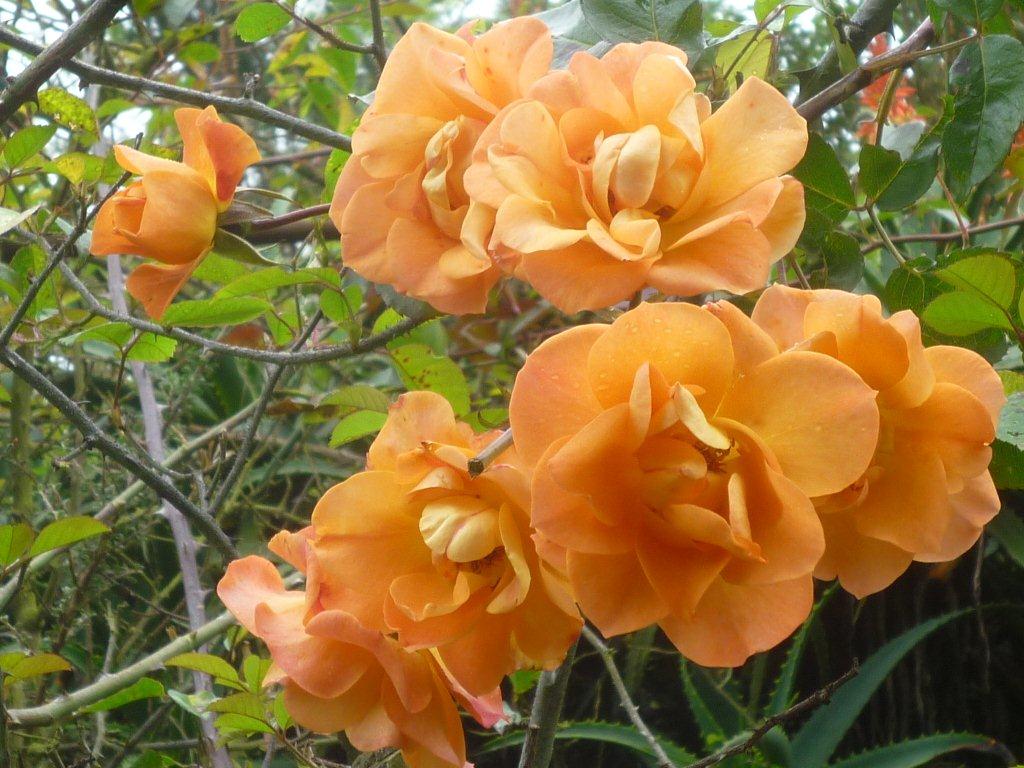
And of course we have a rose to celebrate the remarkable life and career of the great Indian botanist and cytogeneticist, E.K. Janaki Ammal, who co-wrote the Chromosome Atlas of All Cultivated Plants in 1945. She studied botany at Michigan State University in the 1920s on a full scholarship, later receiving a PhD and DSc honoris causa. Back in India, she played a vital role in creating the ‘Noble’ strain of sugarcane – an extraordinary hybrid of sugarcane and bamboo leading to varieties thick as a man’s arm in contrast to the pencil-thin traditional varieties. But credit was stolen by seniors at the research station, and so she went off to Britain. There she worked at famous institutes, including John Innes, Kew and the Royal Horticultural Society. Later, she met the then Prime Minister Jawaharlal Nehru on a plane, and he put her in charge of reforming the Botanical Survey of India in Calcutta. But sadly she was a forgotten figure by the time of her death in 1984. Our rose named for her has the same colour hues as the saris she wore – orange yellow and saffron. A plant of this rose was planted in 2020 at the World Regional Rose Conference Kolkata, at the Botanical Survey of India garden. The rose has also been planted in the John Innes Institute, in Kew and the Royal Horticultural Society’s garden in Wisley in the UK.
If one were to ask you of one moment each – one particular achievement in the journey and one abiding regret – what would these be and why?
There can be no doubt that the moment which was special in our rose breeding career was the moment described above, when Helga Brichet and Mercedes Villar came up to us in Jaipur in 1999, and said they had never heard such a new approach to breeding roses, pioneered by us, of using two Indian rose species to create a new line of warm-climate roses. It was their invitation to speak in Texas launched us on to the world stage of roses.
As for an abiding regret, that’s all too easy to answer. It’s the systematic neglect of Indian-bred roses by the rose-growing public of India, who remain fascinated by roses raised in Europe and the U.S. though they are utterly unsuited for Indian climates. This unreasonable preference for foreign rose varieties is part of the general craze for all things foreign. Fortunately, more recently, there has been a change, and young rose breeders and growers are realising that Indian bred roses do better in the heat and are slowly beginning to grow these.
Give us an insight into the challenges and pitfalls of growing and creating roses in India, as informed by your journey. Interesting story that highlighted these.
The main challenge was getting Indian roses accepted by the Indian rose growing public, as highlighted above. Indeed, now our roses are being grown in India, perhaps because they are being grown around the world! Another thing is one must learn patience. It takes us about eight to nine years to name and release a new rose. It is a long process, of the actual crossing of two roses, waiting for the fruit to ripen, then harvesting the fruit (rose hips), collecting the seeds, stratifying them in the refrigerator (if one lives on the hot plains), sowing the seed, waiting for the seedlings to sprout, growing the plant for a number of years to test its potential, and suitability, and only then finding a name and releasing it, by sending to a rose nursery to make more plants.
Our long career in rose breeding and our connected travels around the world has provided us with many interesting, even hilarious experiences. We were in Japan, at the Sakura Rose Garden. With us was a group of people including our friend, the well-known Japanese plant scientist, Dr Yuki Mikanagi. We were looking at a rose plant, with dark pinkish-red blooms with white on the reverse, bred by us and as yet unnamed. Yuki said she liked this rose very much. We immediately told her that we would name it for her. She said: ‘But this rose is red and white, whereas my name means “snow” in Japanese. Viru’s instant response was, ‘Then we will it name it Blushing Yuki,’ much to the delight of Yuki and everyone.
In his government service days, when we lived in Hyderabad, Viru would tend to his roses, watering and spraying them with fertilizers before leaving for office. There would be a number of telephone calls for him about some official matter. Girija would answer the phone (landline in those days), and when she told the callers he was busy spraying, they would hear it as ‘praying’ and immediately apologise: ‘Please do not disturb him when he is at his prayers’.
Both of us were hands-on gardeners, doing most of the work ourselves and you cannot garden without muddy hands and clothes. Very often visitors would mistake us for the garden help and request us to take them to the master or the mistress of the house. The looks on their faces when they realised who we were would make us laugh.
On one occasion, we were in California to receive the ‘Great Rosarians of the World’ Award. At the ceremony, we both first gave a talk on ‘Roses in India, Past Present and Future’. At the end of the ceremony, an earnest old lady came up to us and asked, in all seriousness, ‘Do roses grow in India?’
For most of us, roses are red and a Valentine’s Day Gift. Appendix 1 of your roses runs to 50 pages! Tell us briefly of some of the interesting ones, in particular the very evocative names you have, for example, Kindly Light, Meghamala/Wine-dark Sea, Twilight Secret. What goes into giving a name to a rose?
Apart from the roses we have named for friends, for other roses we like to give evocative names.
KINDLY LIGHT: we named this lovely white shading to soft pink rose after the hymn ‘Lead, Kindly Light’, a favourite of Mahatma Gandhi’s. We have the practice of giving two names to some of our roses, one better understood in India, if it is a Sanskrit word, and one for the West. This rose is named ‘Swami Vinayananda’ in India, for a monk of the Ramakrishna Mission order. He was great plantsman, his book on dahlias is a definitive work on all aspects of dahlia growing and he was very good rose grower.
MEGHAMALA/WINE-DARK SEA: One more example of two names for a rose. Meghamala translates as ‘garland of clouds’. The name for our rose was inspired by the purple garland-like pattern, reminiscent of clouds, on the petals of this rose, which otherwise are dark orange-red in colour. ‘Meghamala’ is from a line by Devulapalli Krishna Sastri, beloved modern poet of the Telugu language, to whom the rose is a tribute. ‘Wine-Dark Sea’ derives from Homer’s epithet, in both the Iliad and Odyssey, of the purple shadows of approaching night on the orange-red waters reflecting the rays of a setting sun on the Aegean Sea.
ALLEGORY OF SPRING: We named a very special light-pink rose with intriguing pointed petals after the famous Botticelli painting La Primavera, also called ‘Allegory of Spring’.
INCENSE INDIGO: An indigo purple rose with an enticing fragrance was the inspiration for this name.
TWILIGHT SECRET and TWILIGHT TRYST: Two purple-hued roses that remind one of the late evening, shadowy light, romantic secrets and trysts.
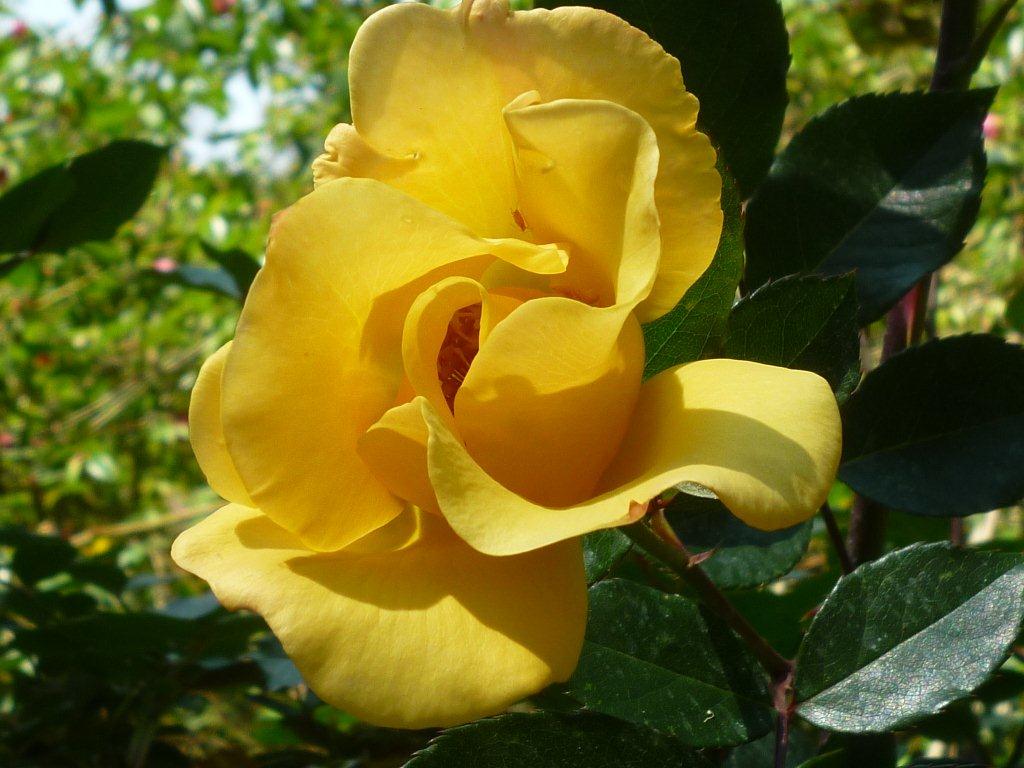
AHIMSA: We gave this name to a golden yellow rose borne on a plant without any thorns (prickles), thinking of the Mahatma’s philosophy of non-violence.
KUSABUE’S GUARDIAN ANGELS: Kusabue is the name of a rose garden in Sakura City, Japan, entirely looked after by volunteers, all very senior citizens. This is our tribute to them.
Golden ThresholdKanyakumariPhoto Courtesy: M.S. Viraraghavan and Girija Viraraghavan
Shantanu Ray Chaudhuriis a film buff, editor, publisher, film critic and writer. Books commissioned and edited by him have won the National Award for Best Book on Cinema twice and the inaugural MAMI (Mumbai Academy of Moving Images) Award for Best Writing on Cinema. In 2017, he was named Editor of the Year by the apex publishing body, Publishing Next. He has contributed to a number of magazines and websites like The Daily Eye, Cinemaazi, Film Companion, The Wire, Outlook, The Taj, and others. He is the author of two books: Whims – A Book of Poems(published by Writers Workshop) and Icons from Bollywood (published by Penguin/Puffin).
.
PLEASE NOTE: ARTICLES CAN ONLY BE REPRODUCED IN OTHER SITES WITH DUE ACKNOWLEDGEMENT TO BORDERLESS JOURNAL
Our population crossed the 8 billion mark in November, 2022. As we move towards trying to hunt for alternative domiciles for our ever-expanding population, even in outer space, we still have to take into account the increased movement of people across the Earth in search of alternative homes driven by external circumstances or by personal needs.
Some have lost their homes and lands to war, some to climate emergencies and some moved out out of choice. Here we have collected narratives of past and present migrations, emphasising the fluidity of borders, despite the lines drawn artificially by manmade constructs. In an earlier interview, Anthony Sattin talks of nomadic migrations and the concept of asabiyya, or brotherhood, which tied humans to ideas and ideals instead of a piece of land mooted in Arabia by Ibn Khaldun in the fourteenth century. Has the time come to revive this concept with conflicts and the climate crises becoming real? As weapons, fire and water affect our habitats, one wonders if reverting to the concept of nomadic existence is not becoming a necessity… This small collection of writings will hopefully highlight the concerns.
In Belacan, Farouk Gulsara shares a narrative based on the life of a migrant in 1950s Malaysia. Clickhereto read.
Ujjal Dosanjh, former Minister from Canada and former Premier of British Columbia, talks of his own journey and learning as he migrated out of India to Canada. Click hereto read.
In Mister, They’re Coming Anyway, Timothy Jay Smith writes on the refugee crisis in Lesbos Island, Greece, in 2016 with photographs by Michael Honegger. Click here to read.
An excerpt from Ramy Al-Asheq’sEver Since I Did Not Die, translated from Arabic by Isis Nusair, edited by Levi Thompson. The author was born in a refugee camp. Click hereto read.
A Question I Caught in the Air

What happens when an ordinary person falls in love
with an extraordinary person?
No, wait!
What happens when an extraordinary person falls in love
with an ordinary person?
Does the absurdity of the situation become reason enough
to make it incompletely complete?
Or completely incomplete?
Ananya Sarkar is a creative writer from Kolkata. Her work has been published in various ezines. She loves to go on long walks, cloud gaze and ponder upon miracles. She can be found on Instagram @just_1ananya and reached at ananya7891@gmail.com
.
PLEASE NOTE: ARTICLES CAN ONLY BE REPRODUCED IN OTHER SITES WITH DUE ACKNOWLEDGEMENT TO BORDERLESS JOURNAL
A schoolmate was fond of creating a big impression of being an avid reader. He knew there were benefits of reading that were largely unknown to genuine book lovers. He fell in love with the idea of reading as he wanted someone to fall in love with him because of this good habit he cultivated. On the way to school, whether inside the bus or train, he always sat with a storybook, trying to cast a furtive glance and observe the bevy of girls noticing him engaged in this pedantic pursuit. He had faith that some girls would become curious and smitten very soon.
With the fond hope of a conversation with them someday, he kept doing the same thing. The book covers kept changing. As he became desperate, he picked up a romantic novel to send the signal. When he did not have a storybook, he fished out a textbook. The compulsion to have some reading material in front of his eyes helped raise a façade of erudition. He wanted to be seen as a reader whenever girls were pottering around.
The impact of reading was severe for him. He was classified and identified as a bookworm. The bespectacled first-rank holder in our class never read so much. Much to his disappointment, girls did not take an interest in him or his reading. It was scary for the fun-loving types. The guys who boarded a moving train at the last minute or disembarked from a speeding bus were heroes to them.
Driven by fatigue for the first time, he was ready to flirt with other options. When he realised books were futile in winning fans or praise, he switched his strategy to something that involved more daring. He went and stood near the entrance door. Ignoring the warning sign ‘DO NOT LEAN OUT’ crafted capitals and in red, he put almost half of his body out of the train compartment, suspending his weight with the support of the hand railing above his head, hoping to be noticed by girls for his bravado.
Before he could realise what had happened, he was hit on the head and rushed to the nearest hospital at the next station halt. He underwent multiple stitches and survived a life-threatening experience. When he regained consciousness, no girls were waiting with bouquets and get-well-soon notes outside his cabin. He found just a few of us with fruit baskets. Such a misadventure, though unintended, did not elicit any wave of sympathy, but he ended up being famous as a silly boy who could not keep himself safe.
Some girls enquired how he was after he rejoined, but it was a formal query devoid of affection. The one he had a soft corner for did not seek any update. The poor fellow failed miserably in reading as well as heroism. Now he was always made to sit inside the coach, never allowed to stand near the door. Some of us cracked jokes, but he often lost his temper after this brain injury. We read it as a change of personality traits. He sat with a bandaged head for some days expecting sensitive queries, but he had stopped being an object of curiosity or pity for the entire class.
Inside the school, during the recess hour, he stopped playing indoor games like chess. He changed his strategy by approaching a lady teacher with suggestions for his reading list during lunch break. He went to the library and got some uncommon books issued, expecting that lady teachers would gauge him better, unlike the carefree girls. Inside the classroom, he raised irrelevant questions and drifted our attention to storybooks, making other students grumble as the lessons were incomplete.
When the copies arrived checked, he performed below average. Soon, the new English teacher understood his ulterior motive. He used difficult words to flaunt his vocabulary and to impress the woman English teacher. Most of us did not know the meaning of the words he used. He derived wicked pleasure as we were shown as ignoramous despite scoring better in English. He loved the idea that he was advanced in reading. He firmly believed someone would appreciate him better and attune themselves to his wavelength. Turning bespectacled before eighteen was a plus point for him as he thought readers looked like that. But the truth was that some vitamin deficiency had led to his poor eyesight.
Most of us saw him spending time in the library scanning books. He would ask us the names of the author on his list. He recalled many names and titles unheard of as his memory appeared sharpened after the head injury. Since we failed to answer, he was pleased to find us ignorant. He mentioned some names to enlighten us. Most of us thought he would become a writer one day since he was discussing what we never bothered to know in such depth. Perhaps the system of education was not doing justice to him.
When we reached high school, a creative writing contest was organised in which the toppers took part. He was asked why he had stayed out of it. He was quiet for a while and then replied the teachers who were judging had not written anything in life, so he would not insult himself by writing for them and submitting to them for assessment. We did not know whether it was his arrogance, or his statement had an iota of truth attached to it.
Years later, it was shocking for him to know I was dabbling in writing. He was still trapped in the world of books, as it appeared from the pictures he sent me of the sprawling library at his residence, and his various poses with books. I asked him what he was doing when Google did not list his name in the top five pages. He said he was doing a regular job for a living that gave him ample time and freedom to read and write. He also said he was the president of the local literary club for youth and a part-time social worker. Although he was eager to know what I wrote, he did not ask me anything as he feared being asked what he wrote all these years, I guess. I told him what I read, and he said he had finished reading those authors a long time ago – pretty advanced, as usual.
He mentioned without radiance that he wrote love poems in his mother tongue using a pen name. It must be for the girl he liked – who qualified as a doctor. Maybe, he still went around her old house on his bicycle to feel her presence though she had moved overseas to another country long ago. His unreciprocated love had many shades, and he kept it alive through poetry.
He forwarded me pictures of reading in the garden, terrace, recliner, et al. In this age of emojis, if you are seen reading, you get hundreds of likes. But in those days, you did not get a single like. These likes – for the book or his reading nook – would have made him confident then. The well-crafted image of being a pretentious reader he remains stuck with – despite no rewards. Possibly, these likes warm the cockles of his sad heart.
I realised I owed him a few likes and pressed the love icon for some of his social media posts as an act of repentance. Being a friend, he deserved likes from me. He messaged me saying one like during those school days would have worked. Even though I praised him today, he understood I was faking like many others. True, I was always a miser when it came to showering praise.
Devraj Singh Kalsiworks as a senior copywriter in Kolkata. His short stories and essays have been published in Deccan Herald, Tehelka, Kitaab, Earthen Lamp Journal, Assam Tribune, and The Statesman. Pal Motors is his first novel.
PLEASE NOTE: ARTICLES CAN ONLY BE REPRODUCED IN OTHER SITES WITH DUE ACKNOWLEDGEMENT TO BORDERLESS JOURNAL
Shesher Kobita(1928-29)Translation of Shesher Kobita by Radha Chakravarty (2011)
Romance and reality inevitably clash. While Tagore is not unconvinced about the existence of conjugal love in some of his stories, conjugality and romance make uneasy bedfellows inFarewell Song. Marriage is rooted in the humdrum, quotidian, everyday but romantic love dwells on another astral plane. It is the realisation of the gap between the two that informs the novel/la, a realisation that never the twain shall truly meet, manifesting itself in the pages of this complex narrative that folds into itself a romantic love story, social satire and literary criticism. The multiple strands are brilliantly woven into the plot of this novel, which could be classified as a prose-poem. Its very title, “Shesher Kobita”, literally meaning last poem and translated by Professor Radha Chakravarty as Farewell Song, is evocative of its lyricality.
Shesher Kobita is primarily a love story between two young people, Amit Raye and Labanyalata, both of whom express their love in the most lyrical vein imaginable. Labanya, like many of Amit’s compatriots in Calcutta, is an avid reader and staunch admirer of Rabindranath Tagore’s writing, and her familiarity with Tagore’s work is evident in much of her conversation and in many of her perceptions. Amit, on the other hand, persists in citing the words of a ‘modern’ poet, Nibaran Chakrabarti, who is a persona created by Amit himself, to express his views about poetry. Readers see through this ruse quickly enough, and the third person narrative , often allows space for narrative commentary. As the translator, Radha Chakravarty points out, “Two schools of Bengali poetry, pro and anti-Tagore, are pitted against each other through the dialectic of the Amit-Labanya encounter.” Tagore cleverly plays out and into the literary /poetic debates of his later decades (1920s onwards) in order to prove his contemporary relevance and above all, the modernity of his work.
Amit, the protagonist, is from an elite and rich family, privileged enough to have gone to Oxford and wealthy enough to be under no compulsion to earn immediately. He’s a dilettante who is interested in the vagaries of style, which is seen as being a notch higher than fashion. Brilliant but restless, mercurial as quicksilver, he cannot commit himself to any one thing or relationship. Yet, getting away from the highly artificial social life of Kolkata, to the relatively pristine and pastoral world of Shillong, he falls deeply, unequivocally in love, with the quiet, studious but unassuming young girl, Labanyalata and establishes a soul-connection, as it were, with her. Yet this deep commitment pales and collapses in the face of the demands of the everyday social world. It is this space–“habitus”– which is occupied by Amit’s sister’s friend, Ketaki (Katy) Mitra. To quote from Radha Chakravarty’s introduction to her translation of the book, “Two forms of love are presented through Amit’s involvements with Katy Mitter and Labanya-one rooted in the material and the social, the other, embedded deep within the soul”
The expression of this soulful love dips into and is expressed through not only Bangla literature and poetry but is steeped in the idioms of English poetry, from Shakespeare to the metaphysical poets. Seeing a book of John Donne’s poems on Labanya’s table, Amit quotes, “for God’s sake, hold your tongue and let me love.” And yet, his intense love seems doomed as an idealistic ephemeral bliss, to be swept away by the ‘real’. Not a keen observer of nature, Amit seems to indulge frequently in “pathetic fallacy”, appropriating aspects of the landscape in order to express his moods and feelings. The landscape is often symbolic with Amit and Labanya meeting for their trysts at the site of a waterfall, always a significant feature of Tagore’s landscapes. Mita (meaning friend) and Banya (of the forest) –the lovers’ names for each other– create a world of their own, full of poetry and lyricality. And yet, inevitably, inexorably, the social, material, everyday world presses upon them and the lovers part. And yet, as the novel draws to a close, we do not experience this parting/ estrangement as a tragedy but almost as much of a resolution and closure that the novel could offer.
For Amit Ray/e is an embodiment of the modern split subject, the divided self. He has made up a world of words, and it is in this world that his heart and mind dwell. It is this inner space-the still centre of the turning world (to quote from another modern poet) that Labanya inhabits. And this is what Labanya, intelligent and perceptive, realises. Labanya, in her own way, is the new woman- independent and emotionally self-reliant, reminding one of Kalyani in ‘Aparichita‘, translated by Aruna Chakravarti as ‘The Stranger‘. They are women who dream of a life beyond domesticity and conjugal felicity. For them marriage would be a slippery slope, not a nesting ground. In these versions of ‘modern’ love, each person, especially the women, are complete and self-assured in themselves. This is particularly true of Kalyani, where we get a sense that she towers over the suitors in her life.
Labanya is able to connect to connect with Amit as a friend. to Amit, the friendship acts as an anchor, a stay against the vacuousness of his urban existence. Such a soulful connection belongs to the realm of dreams and these connects are what dreams are made of. However, dreams often shatter, or worse, fester. When Amit is asked whether in marriage, partnership and companionship cannot combine, his reply is illuminating. Marriage is the finite to the infinity of love and romance. He compares his relationship to the westernised Ketaki/Katy, his girlfriend in England who later becomes his wife, after the interlude with Labanya. “My initial relationship with Katy was indeed based on love but it was like water in a pitcher, to be collected daily, and used up everyday.” In contrast, his love for Labanya “remains a lake, its waters not be carried home but meant for” his “consciousness to swim in”. This realisation creates no inner conflict because he also glimpses that Labanya is someone who lives in his dreams, “in the twilight of gleams and of glimpses” (Tagore’s lines from Gitanjali, a basket of song-offerings). In a serendipitious resolution, Labanya also finds her companion in domesticity, her father’s brilliant student Shobhanlal, who has yearned for her for years, only to be spurned. Thus the story becomes not a tragedy of betrayal, but an extended musing and discussion on love, romance and marriage of the modern subject, in a world where the ground beneath the feet of the characters is constantly shifting.
It is this sense of a world in flux and its nuances that Radha Chakravarty’s translation deftly captures. Translating a novel of discussion requires a constant awareness of key concepts and multiple contexts — literary, social, cultural and philosophical. As a skilled translator and litterateur with an extensive repertoire and many years of experience, the editor-translator has brought her many accomplishments to the task of translation. Translating poetry and its nuances is challenging; here, the translation conveys immense wealth of meaning and richness of detail. The novel, in a sense, is a plea for romantic yearning and aspiration, for reaching out to those “unheard melodies” that are far sweeter than those which are available for the asking.
Unlike Bankim, who had depicted the new woman in an unflattering light a few decades earlier, Rabindranath was essentially sympathetic to women. Women were often among his closest associates and companions, and his friendship with women like the Argentinian Victoria Ocampo not only spurred him into song , but made him rethink the contours of modern cosmopolitan womanhood. Well-read and accomplished, women like Labanya not only challenge traditional ideas of womanhood, but is reflexive and aware enough not to judge Katy Mitra. Torn between the pull of intellectual independence and the desire for surrender, Labanya also represents the emergence of the female subject in modern Bangla literature.
.
Dr Meenakshi Malhotra is Associate Professor of English Literature at Hansraj College, University of Delhi, and has been involved in teaching and curriculum development in several universities. She has edited two books on Women and Lifewriting, Representing the Self and Claiming the I, in addition to numerous published articles on gender, literature and feminist theory.
.
PLEASE NOTE: ARTICLES CAN ONLY BE REPRODUCED IN OTHER SITES WITH DUE ACKNOWLEDGEMENT TO BORDERLESS JOURNAL
They met in an alien city
After thirty years.
At first it seemed unreal --
She hardly had any expectations.
The other girl, now a woman,
Hardly emoted, but was civil,
Something that her corporate and rational
Mind taught her well
Over the years.
They were classmates, friends –
She thought she was more
And also wrote a few letters
Which went unanswered.
Life intervened –
Careers, marriages, children
After years of hearsay that are
Now so regular over social media,
The girl, now woman, called her up.
It was another girl, now her daughter
That needed help with literature.
Shakespeare and the rest,
Poems and the prose,
Who made sense of them all
Beyond the ken of rationality,
Or even of correct exactitude,
Who could ever fathom what
Magic words could do?
She was stunned –
But she was a teacher, and not less
A dealer of words, a reader
Of poetry, a lover of the arts –
It could only be an exercise of pleasure.
She did, the daughter succeeded.
The arrow had hit the target.
But this became a matter of course.
When the other day,
The day of colours,
They met, it was the same correctitude
From the other woman and the daughter,
Merely a recollection of other fellow mates
Never an introspective look or a glance.
She recollected, travelled back
To moments of past warmth
Expectations, and dried up memories.
Of course, there was no hint
Of all this in conversation.
Thirty more years may pass
In the neverland of meeting,
She hardly cared, anymore.
It was important, perhaps,
To say the proper goodbye,
Between wine and the splendour of
Five-star accommodation.










 Borderless