Categories
Contents

Borderless, September 2024

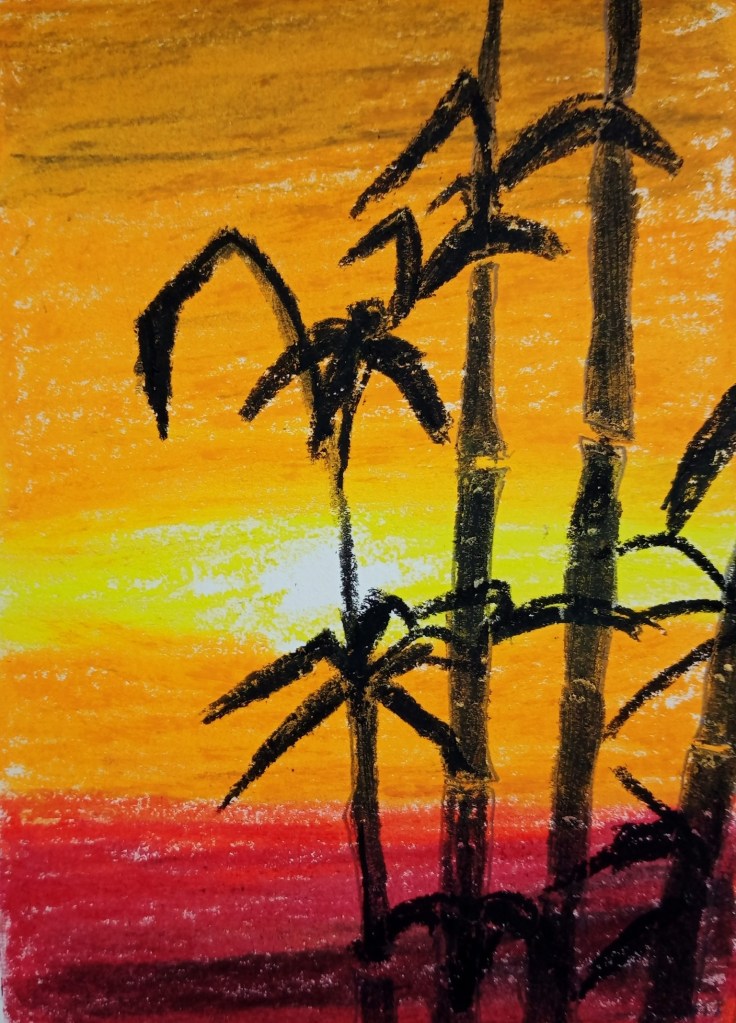
Art by Sohana Manzoor

Editorial

And Wilderness is Paradise Enow… Click here to read.

Translations

Raja O Praja or The King and His Subjects, an essay by Tagore, has been translated from Bengali by Himadri Lahiri. Click here to read.

Nazrul’s Roomu Jhoomu Roomu Jhoomu has been transcreated from Bengali by Professor Fakrul Alam. Click here to read.

The Mirror by Mubarak Qazi has been translated from Balochi by Fazal Baloch. Click here to read.

The Source by Ihlwha Choi has been translated from Korean by the poet himself. Click here to read.

Suprobhat or Good Morning by Tagore has been translated from Bengali by Mitali Chakravarty. Click here to read.

Poetry

Click on the names to read the poems

Rhys Hughes, Cal Freeman, Jackie Kabir, Jennifer McCormack, Pramod Rastogi, Miriam Bassuk, K B Ryan Joshua Mahindapala, Paul Mirabile, Shamik Banerjee, Craig Kirchner, Thomas Emate, Stuart MacFarlane, Supriya Javalgekar, George Freek, Ryan Quinn Flanagan, Luis Cuauhtémoc Berriozábal, Michael Burch

Musings/Slices from Life

Finding the Fulcrum

Farouk Gulsara gives a poignant account of looking after an aged parent. Click here to read.

Watery World

Keith Lyons finds the whole world within a swimming pool. Click here to read.

Days that don’t Smell of Cakes and Candy

Priyanka Panwar muses on days which not much happens… Click here to read.

Rayban-dhan

Uday Deshwal revisits his life with his companion sunglass. Click here to read.

In Favour of a Genre…

Saeed Ibrahim argues in favour of short stories as a genre. Click here to read.

Musings of a Copywriter

In Shades of Grey – Hair and There, Devraj Singh Kalsi writes of adventures with premature greying. Click here to read.

Notes from Japan

In Sneaky Sneakers, Suzanne Kamata grins at life in Japan. Click here to read.

Essays

Ah Nana Bari!

Fakrul Alam writes nostalgically of his visits to Feni in Noakhali, a small town which now suffers from severe flooding due to climate change. Click here to read.

A Manmade Disaster or Climate Change?

Salma A Shafi writes of floods in Bangladesh from ground level. Click here to read.

A Doctor’s Diary: Life in the High Ranges

Ravi Shankar writes of his life in the last century among the less developed highlands of Kerala. Click here to read.

Stories

The Useless Idler

Paul Mirabile writes of a strange encounter with someone who calls himself an ‘idler’. Click here to read.

Imitation

Naramsetti Umamaheswararao explores parenting. Click here to read.

Final Hours

Mahila Iqbal gives a poignant story about aging. Click here to read.

Friends

G Venkatesh writes a story stirring environmental concerns. Click here to read.

Conversation

Ratnottama Sengupta converses with Reba Som, who recently brought out, Hop, Skip and Jump; Peregrinations of a Diplomat’s Wife. Click here to read.

Book Excerpts

An excerpt from Mineke Schipper’s Widows: A Global History. Click here to read.

An excerpt from Anuradha Marwah’s Aunties of Vasant Kunj. Click here to read.

Book Reviews

Somdatta Mandal reviews Karan Mujoo’s This Our Paradise: A Novel. Click here to read.

Rakhi Dalal reviews Swadesh Deepak’s A Bouquet of Dead Flowers translated from Hindi by Jerry Pinto, Pratik Kanjilal, Nirupama Dutt, Sukant Deepak. Click here to read.

Meenakshi Malhotra reviews Anuradha Marwah’s Aunties of Vasant Kunj. Click here to read.

Bhaskar Parichha reviews Ayurveda, Nation and Society: United Provinces, c. 1890–1950 by Saurav Kumar Rai. Click here to read.

.

Click here to access the Borderless anthology, Monalisa No Longer Smiles

Click here to access Monalisa No Longer Smiles on Amazon International
Categories
Editorial

And Wilderness is Paradise Enow…

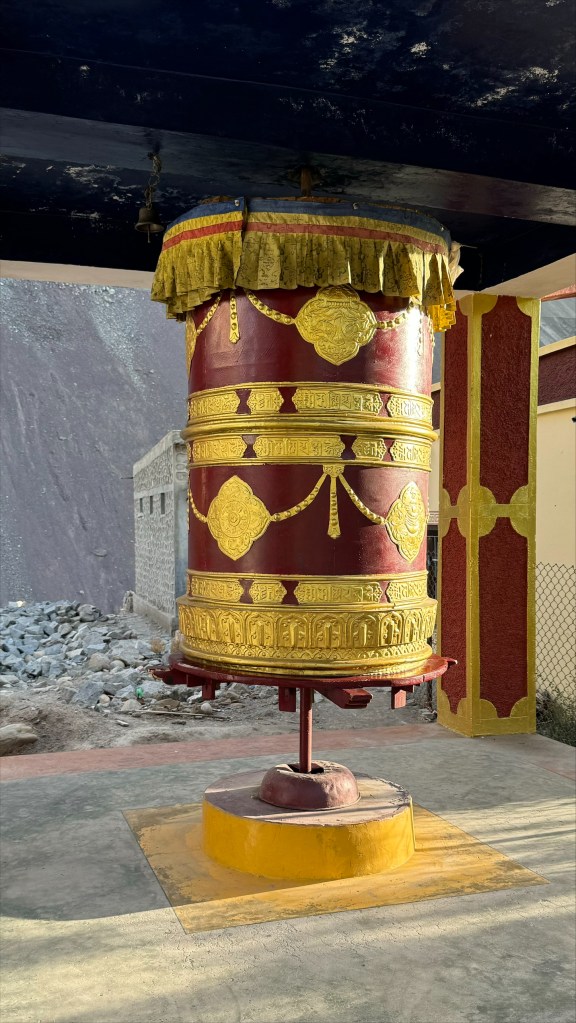
Prayer Wheel at Nurulia, Ladakh. Photo Courtesy: Farouk Gulsara
We lock eyes, find glimmers
of smiles, trust our leaders.
We break bread with strangers
because there aren’t any.

--Imagine by Miriam Bassuk

Imagine the world envisioned by John Lennon. Imagine the world envisioned and partly materialised by Tagore in his pet twin projects of Santiniketan and Sriniketan, training institutes made with the intent of moving towards creating a work force that would dedicate their lives to human weal, to closing social gaps borne of human constructs and to uplifting the less privileged by educating them and giving them the means to earn a livelihood. You might well call these people visionaries and utopian dreamers, but were they? Tagore had hoped to inspire with his model institutions.  In 1939, he wrote in a letter: “My path, as you know, lies in the domain of quiet integral action and thought, my units must be few and small, and I can but face human problems in relation to some basic village or cultural area. So, in the midst of worldwide anguish, and with the problems of over three hundred millions staring us in the face, I stick to my work in Santiniketan and Sriniketan hoping that my efforts will touch the heart of our village neighbours and help them in reasserting themselves in a new social order. If we can give a start to a few villages, they would perhaps be an inspiration to some others—and my life work will have been done.”  But did we really have a new social order or try to emulate him?

If we had acted out of compassion and kindness towards redefining with a new social order, as Miriam Bassuk points out in her poem based on Lennon’s lyrics of Imagine, there would be no strangers. We’d all be friends living in harmony and creating a world with compassion, kindness, love and tolerance. We would not have wars or regional geopolitical tensions which act against human weal. Perhaps, we would not have had the issues of war of climate change take on the proportions that are wrecking our own constructs.

Natural disasters, floods, fires, landslides have affected many of our lives. Bringing us close to such a disaster is an essay by Salma A Shafi at ground level in Noakhali. More than 4.5 million were affected and 71 died in this disaster. Another 23 died in the same spate of floods in Tripura with 65,000 affected. We are looking at a single region here, but such disasters seem to be becoming more frequent. And yet. there had been a time when Noakhali was an idyllic vacation spot as reflected in Professor Fakrul Alam’s nostalgic essay, filled with memories of love, green outdoors and kindnesses. Such emotions reverberate in Ravi Shankar’s account of his medical adventures in the highlands of Kerala, a state that suffered a stupendous landslide last month. While Shafi shows how extreme rainfall can cause disasters, Keith Lyons writes of water, whose waves in oceanic form lap landmasses like bridges. He finds a microcosm of the whole world in a swimming pool as migrants find their way to New Zealand too. Farouk Gulsara muses on kindness and caregiving while Priyanka Panwar ponders about ordinary days. Saeed Ibrahim gives a literary twist to our musings.   Tongue in cheek humour is woven into our nonfiction section by Suzanne Kamata’s notes from Japan, Devraj Singh Kalsi’s piece on premature greying and Uday Deshwal’s paean to his sunglasses!

Humour is wrought into poetry by Rhys Hughes. Supriya Javelkar and Shamik Banerjee have cheeky poems that make you smile. We have poetry on love by Michael Burch and poetry for Dylan Thomas by Ryan Quinn Flanagan. Miriam Bassuk has described a Utopian world… but very much in the spirit of our journal. Variety is brought into our journal with poetry from Jackie Kabir, Jennifer McCormack, Craig Kirchner, Stuart MacFarlane, George Freek, Luis Cuauhtémoc Berriozábal and many more.

In translations, we have Nazrul lyrics transcreated from Bengali by Professor Alam and poetry from Korean by Ihlwha Choi. We pay our respects to an eminent Balochi poet who passed on exactly a year ago, Mubarak Qazi, by carrying a translation by Fazal Baloch. Tagore’s Suprobhat (Good morning) has been rendered in English from Bengali. His descriptions of the morning are layered and amazing — with a hint of the need to reconstruct our world, very relevant even today.  A powerful essay by Tagore called Raja O Praja (The King and His Subjects), has been translated by Himadri Lahiri.

Our fiction hosts two narratives that centre around childhood, one by Naramsetti Umamaheswararao and another by G Venkatesh, though with very different approaches. Mahila Iqbal relates a poignant tale about aging, mental health and neglect, the very antithesis of Gulsara’s musing. Paul Mirabile has given a strange story about a ‘useless idler’.

A short story collection has been reviewed by Rakhi Dalal, Swadesh Deepak’s A Bouquet of Dead Flowers, translated from Hindi by Jerry Pinto, Pratik Kanjilal, Nirupama Dutt, Sukant Deepak. Somdatta Mandal has written about a book by a Kashmiri immigrant which is part based on lived experiences and part fictive, Karan Mujoo’s This Our Paradise: A Novel. Bhaskar Parichha has reviewed Ayurveda, Nation and Society: United Provinces, c. 1890–1950 by Saurav Kumar Rai, a book which shows how healthcare was even a hundred years ago, politicised. Meenakshi Malhotra has reviewed Anuradha Marwah’s novel, Aunties of Vasant Kunj, of which we also have an excerpt. The other excerpt is from Mineke Schipper’s Widows: A Global History. Ratnottama Sengupta converses with Reba Som, author of Hop, Skip and Jump; Peregrinations of a Diplomat’s Wife.

We have more content that adds to the vibrancy of the issue. Do pause by this issue and take a look. This issue would not have been possible without all your writings. Thank you for that. Huge thanks to our readers and our team, without whose support we could not have come this far. I would especially like to thank Sohana Manzoor for her continued supply of her fabulous and distinctive artwork and Gulsara for his fabulous photographs.

Let us look forward to a festive season which awakens each autumn and stretches to winter. May we in this season find love, compassion and kindness in our hearts towards our whole human family.

Have a wonderful month!

Mitali Chakravarty

borderlessjournal.com

Click here to access the content’s page for the September 2024 Issue.

.

READ THE LATEST UPDATES ON THE FIRST BORDERLESS ANTHOLOGY, MONALISA NO LONGER SMILES, BY CLICKING ON THIS LINK.

Categories
Poetry

Secrets of the Evening Sky

By Jackie Kabir

SECRETS OF THE EVENING SKY 

The quiet evening sky
Holds secrets of unnamed people,
Echoes of the screams of some named people.
The colourful evening sky
Keeps memories of unfulfilled dreams.
The vast evening sky
Has many stories to tell
Of those who refused to waver
From their path, knowing it is perilous,
Knowing life is but a fleeting moment.
The evening sky is witness to it all
It has secrets to keep

Jackie Kabir is a writer and translator from Bangladesh. Her collection of short stories Silent Noise was published in 2016. The titular story, ‘Silent Noise’, is being taught in colleges under Manomanium Sundaram University, Tirunelveli, Tamil Nadu.

PLEASE NOTE: ARTICLES CAN ONLY BE REPRODUCED IN OTHER SITES WITH DUE ACKNOWLEDGEMENT TO BORDERLESS JOURNAL

Click here to access the Borderless anthology, Monalisa No Longer Smiles

Click here to access Monalisa No Longer Smiles on Kindle Amazon International

Categories
Stories

Khatme Yunus

By Jackie Kabir

One day Ridima’s husband came home with an injured boy with a bandage on his head. There was a small room just before the main entrance of their house, it was mainly used as a guest room, the boy was laid down there by the people who carried him to the second floor. A scream came out of Ridima’s mouth; her mother-in-law pulled her aside and hushed her and told her to be quiet. She stood at a corner of the family space and watched.

The boy looked very frail, he was around eighteen or nineteen years old. She recognised him now. He was an orphan, who was given shelter by Ridima’s father-in-law. He worked in the shop and had become like their family member. The shops were in a building in Old Dhaka, that housed hundreds of small concerns, the interior was designed in such a way that it had a scaffold with white sheets on it and the stacks of material were arranged on the shelves above the scaffold. Everyone took their shoes off while getting inside. The customers sat on small stools that were arranged all around the scaffold.

The boy stayed in the shop while his food was sent from home in a tiffin carrier. It was a family-owned shop selling materials for clothes. That day one of their regular customers came and took one hundred pieces of material for shirts on credit. He promised he would pay the money as soon as he could. When Ridima’s husband went into the shop and saw that a whole stack of material was gone, he felt very happy. He pulled the cash drawer open. He couldn’t see any money there. He asked the salesman about the cloths. As the boy narrated the incident he lost his  temper and he took the jock from his car which was parked nearby and hit the boy with it, at the back of his head.

The boy fell unconscious and bled profusely. The boy could have died. Sensing the danger, her husband quickly called the compounder from across the street to get him bandaged. People from all around the shops rushed and advised that the boy should be taken to hospital. Pretending that it was a mere accident Ridima’s husband asked some other boys to carry him to the car. The compounder also recommended that the boy should be taken to the hospital immediately. However, Ridima’s husband took him home knowing that there could be a police case if were taken to the hospital. A doctor was called home to treat the boy. When the doctor saw the boy’s condition, he refused to treat him saying that he had be taken to the hospital. Ridima’s husband first threatened him verbally. When that didn’t work, he went inside and got his licensed pistol and asked him to treat the boy. The doctor got scared and wrote down a list of things that he needed and waited patiently till the things were brought. Another boy was given the money and sent to the nearby dispensary.  The doctor gave twenty-one stitches and heavy doses of medicines. He told them to keep the room clean and he told them he needed to change the bandage and do the dressing every day and perhaps, then, the boy would recover, even though his cut was deep.

Immediately Ridima’s mother-in-law sat down on her prayer mat with her long prayer beads. It stayed coiled on her prayer bed at one corner of the long rectangular room. A prayer mat was always spread on the prayer bed. There were about ten thousand beads on the string, she would have to finish it for about twelve and half times in order to do a Khatme Yunus; La illaha illa anta subhanaka inni kuntu minas Zalimeen, which meant, “There is none worthy of worship besides you, glorified are you, surely I am from among the wrongdoers.” It was a one-line prayer which had to be recited one lac and twenty-five thousand times in order to get results. It is said that one of Islam’s earliest prophets was devoured by a whale, he was inside the body of the whale for two and a half days and he recited this prayer and finally the whale gave out everything in form of vomit and Prophet Yunus was saved.  Since then, it was called “Dua e Yunus” and Muslims all over the world used this prayer when faced with a big crisis.

 Since the doctor was paid a huge sum of money and requested by the family to keep it a secret, he came back every day for a week and treated the boy. Ridima was very scared the first few nights. She feared the boy might die, as he had high fever and was delirious most of the night. He slept and they locked the door with a padlock. They opened the door only to give him food, clean the room and when the boy needed to use the toilet. He had to be helped to go to the toilet. Ridima’s mother-in-law asked her to make chicken soup for him every day, he was given soft rice with fish curry, the types known to produce blood in the body.

After a month, the boy could walk properly but Rimida wasn’t sure if his head injury had fully healed. She tried talking to her husband about it, he said, “You keep quiet! Do not try to act smart and meddle into affairs you know nothing about!”                

Ridima’s heart shrank. Her eyes welled with water, and she tried to keep herself from weeping.

 A few later, the boy said he was going to take a stroll downstairs. Ridima was doing some household chores, the boy nodded at her and walked out.

After Magrib Azan, her mother-in-law declared the boy was missing.  Everyone asked Ridima if she was the one who let him go outside. She denied the fact in trepidation though her mother-in-law would not buy it. When her husband came home, her mother-in-law tried to tell him that it was Ridima’s fault that the boy escaped.

Her husband was taking his socks off and said, “Let him go! He was cured and cannot file any case anymore! Good riddance!”

.

Jackie Kabir is a writer from Bangladesh. Her collection of short stories Silent Noise was published in 2016. The titular story is being taught in BA English course in colleges under Manomanium Sundaram University, Tirunelveli. Tamil Nadu.

.

PLEASE NOTE: ARTICLES CAN ONLY BE REPRODUCED IN OTHER SITES WITH DUE ACKNOWLEDGEMENT TO BORDERLESS JOURNAL