Categories
Nazrul Translations

I Sprinkle in the Sky…

Akashe Aaj Choriye Delam Priyo (I sprinkle in the sky) by Nazrul has been translated from Bengali by Professor Fakrul Alam

From Public Domain
Dearest, I sprinkle in the sky my lyrics this day.
I’ve woven on my own a garland of songs
From the flowers produced by my words.
Pick it up if you can, please.
Let my tune’s rainbow be a transient joy,
Orchestrating my sense of loveliness,
And embodying sweetness through the passions of its colours.
What does it matter if you fail to note
The tears moistening my eyelids?
My voice quavers because of my tears!
Spreading across the lotus that is my heart,
Lyrics make the round, buzzing like a bee in flight.
Do taste my mind’s loveliness from that bee if you can!

Listen to the song in Bengali performed by the late Feroza Begum by clicking here.

Born in united Bengal, long before the Partition, Kazi Nazrul Islam (1899-1976) was known as the  Bidrohi Kobi, or “rebel poet”. Nazrul is now regarded as the national poet of Bangladesh though he continues a revered name in the Indian subcontinent. In addition to his prose and poetry, Nazrul wrote about 4000 songs

Fakrul Alam is an academic, translator and writer from Bangladesh. He has translated works of Jibonananda Das and Rabindranath Tagore into English and is the recipient of Bangla Academy Literary Award (2012) for translation and SAARC Literary Award (2012).

PLEASE NOTE: ARTICLES CAN ONLY BE REPRODUCED IN OTHER SITES WITH DUE ACKNOWLEDGEMENT TO BORDERLESS JOURNAL

Click here to access the Borderless anthology, Monalisa No Longer Smiles

Click here to access Monalisa No Longer Smiles on Amazon International

Categories
Memoir

Recycling New Jersey  


By Karen Beatty       

When I was five years old, my father transported our impoverished family from the banks of the Licking River in Eastern Kentucky to Bound Brook, New Jersey, just off a tributary of the Raritan River. My mother had not wanted to leave her beloved Kentucky or depart from her numerous kin there, but she did want to stay married. And my father wanted to find work and get away from anything connected to hollows, moonshine, and that old-time religion. Mother also hoped that she, and especially her four children (with a fifth on the way), would be better off. As it turned out, we children mostly were, while she likely wasn’t.

My father chose Bound Brook, New Jersey, because he planned to work in the trucking business managed by his older brother. In Bound Brook, my father moved us into a place described as “Garden Apartments,” but there weren’t any gardens. It was post WWII housing, mainly for immigrants and working class people who could not afford to buy homes. Since I had been transported from a shack in Appalachia, the two-bedroom apartment in New Jersey, even for parents with five kids, seemed palatial: A bathtub and flush toilet!  Hardwood floors! A gas stove and oven! Sidewalks, and even a nearby building for doing laundry. Stupendous, indeed!

Bound Brook, New Jersey, was a town where most people worked in restaurants, retail, construction, trucking, and schools; plus, there were countless employees at a couple of highly polluting chemical plants located just above the west end of town. (Sometimes strange odors and actual particles released from American Cyanamid drifted into our schoolyards, homes and playing fields.)  I considered townspeople who were low-level bankers and teachers wealthy. Of course we all knew a few kids whose parents were doctors, high-level bankers, or businessmen. Those were the really rich people who did not live in project-style apartments or in low-income housing in the sections of town populated by immigrant Poles, Italians and Irish, with perhaps a random exotic Cuban or Indian family. It was rare to see a Black person or hear Spanish in Bound Brook in the 1950s.

In Kentucky, my mother was a vibrant woman who worked in the County Courthouse. Living in New Jersey, she devolved into a burdened housewife with no local kin and no capacity to access a new community or social life. When the sixth child was on the way, the apartment management informed my parents that they had to move out because they had too many kids. Our family was given two days to leave or pay an extra month’s rent, and regardless, we were being evicted. It happened that there was some new home construction on our west end, near a brook that occasionally overflowed its banks. I knew about the development because we local children frequented the site to steal plywood, tarpaper, and nails to construct lean-tos down the brook. We also nabbed construction cable, which the big kids affixed to tree limbs to make sturdy “Tarzan” swings for sailing from bank to bank across the brook. 

At age eleven, I surreptitiously joined a group tour of the model home in the completed new development, where the available space and the fancy furniture smote me. I raced back to our apartment to tell my mother about the model house, and she sent my father over to take a look. Fortuitously, he ran across a salesperson that informed him that as a veteran of WWII, he qualified for mortgage and down payment assistance. Child number six arrived shortly after we moved into one of the newly constructed homes in the development. Then, deep into the following year, my Mother delivered my youngest brother, child number seven. Our new house afforded a shared bedroom for me and my two younger sisters, and an elongated attic room for the four boys. 

Sadly, as the duration of her stay in New Jersey and the number of kids in our family increased, my Mother’s mental state diminished. She went from intimidation and apprehension about her life in Bound Brook to what could have been clinically diagnosed as agoraphobia and paranoia. In Kentucky she had been a proud and self-confident woman; in New Jersey she was increasingly unkempt, unhinged, and functionally disabled. I remember having to fake her signature on my report card and school permission slips because she was too distracted to sign or even look at paperwork; in fact, she opted out of most any activity not related to basic household management and cooking.

Without filtering her outbursts, my mother jabbered with religious fervor about her afflictions and her rage at our father who had brought her to New Jersey. She lamented that she would not live long enough to see us grow up. She sang sad and sometimes-scary gospel tunes like, “The Old Rugged Cross,” with lyrics about suffering and shame. She also warned us about rich “Republican snakes” that didn’t care about poor people, and dangerous immigrants with funny-sounding names who spoke strange languages (Polish, Italian). She denigrated both poor Black people and neighbouring Jewish people who didn’t love Jesus the way that she did. And she did love Jesus, and the church, even though she thought church people up North dressed too fancy, sang without spirit, and passed the collection plate with too many expectations. She loved us kids unconditionally, while often relying upon us for the basics of daily living. She was unhappy in her marriage and with living in New Jersey, but she was proud of her children, despite her disappointment when most of us went hippie and unchurched and, worse, two voted Republican. 

Sports events and churches consolidated the people in the town of Bound Brook. Officials and functionaries would save your soul if you let them, and, if you were male, tone your body. My brothers were better than good enough at sports, which won them friends, attracted mentors, and enabled them to acquire college scholarships.

I was an excellent gymnast, runner, fielder, and could handle baseballs, basketballs and footballs as well as many boys. And I could maneuver a cable swing and play ping-pong better than most boys. At an inter-school Sports Field Day, I won all six of the proffered blue ribbons. Nonetheless, I didn’t get scholarships, rewards, or accolades. Instead I was mocked as a tomboy for wearing sports attire, and teased as a “skinny-bones” because I didn’t eat or grow much. After leaving rural Kentucky where I was used to drinking raw milk, the New Jersey pasteurised milk did not taste right, and my mother was reduced to serving canned vegetables and mystery meat from a supermarket. I hated the ground meat, hot dogs, and strange overcooked vegetables she served up. So I mostly didn’t eat. At a time when women were expected to be voluptuous and alluring, I was lean and agile. I hated New Jersey.

In fact, I never embraced living in NJ the way I “owned” my early years in Eastern Kentucky and my adult years in New York City. My best friend Janice said whenever she told people she was born in New Jersey, they laughed. She even wrote a song about that. I wasn’t born in New Jersey, but had enough of it imposed upon me to understand the song. Although there were plenty of kids to play with and make “fun trouble” with in the apartments and in our new housing development, I was bullied by big (literally) girls in the neighbourhood, and spurned at school by stylish girls from the better-heeled households. To survive, I became fleet of foot and quick of tongue, able to either run away from dicey situations or talk my way out of them. I fully realised I had to get out of Bound Brook, New Jersey.

In the interest of fairness, I must report that in the late 1950’s and early 1960’s Bound Brook had excellent schools and recreation facilities. Unfortunately, I had not attended any school in Kentucky, so, upon entering elementary school for the first time, I was both shy and academically lost. I also suffered from undiagnosed dyslexia, so I didn’t learn to read until almost 6th grade and never learned to write script, to the chagrin of teachers charged with improving me. Self-conscious about my “hillbilly” accent, I also did not talk at school, a definite deterrent to making friends and getting teacher approval.

I finally caught up by playing and sparring with the kids on the west end, many of whom had worse family situations than me and had the kind of personal and academic issues that were not going to resolve with time. (Being a west end kid certainly informed me that the required “Dick and Jane” school readers did not represent most families.) By the end of fifth grade I could read slowly, print neatly, and participate orally in classes. Best of all, I learned about the local library where I took refuge and read about places and events beyond what I was exposed to at home or in school. I was determined to find a way out of New Jersey.

By high school I was considered one of the smart students who was also a discipline problem. I understood socio-economic differences and realised (without knowing the specified words) that I was from a home with domestic abuse and child neglect. We kids were essentially on our own because our mother had checked out mentally and our father was irritable, sullen and mostly absent. (His absence was a good thing, considering his PTSD rage disorder from WWII.) Never really fitting in either at school or in the neighborhood, I engaged in bravado and resentment to camouflage my fears and vulnerability.

While most of us west end kids were petty thieves and street combatants, my weapon of choice became wit. I assailed bad teachers with derision, mockery, and scorn, refusing to cave to silly authoritarian directives and relentlessly challenging their biased views or misinformation. In short, I was learning about and exposing racism (then called “prejudice”) and political manipulation (still called “patriotism”).

The good and honest teachers admired my audacity and laughed at my antics, but the bad teachers were threatened and became vindictive. I teamed up with Grace, a classmate from the neighbourhood. She came from a single parent household (rare for Bound Brook in the early 1960’s), and lived in one of those so-called garden apartments with her mother. Suffice it to say, Grace and I created a lot of “smart trouble” at school. Soon we were not allowed to be in the same classroom. Worse, despite my qualifying grades, I was barred from the National Honor Society and kicked out of senior English. I had to report to the guidance office where I befriended the guidance counselor, who arranged for me to graduate despite my not completing the English requirement. This all probably happened because English was my best subject, and I was beginning to nurture my lifetime commitment to human rights and civil rights. I held New Jersey in contempt.

I desperately wanted to get out of Bound Brook and away from my home life, but I had no information, experience, or resources to facilitate those yearnings. I had never even traveled to another town by bus or train.

Toward the end of my senior year, I got work at the local recreation center, where I met a woman who was attending Montclair State College. (At the time, Montclair was the best of the New Jersey State colleges.) My older brother was putting himself through Rutgers State University, where female applicants were relegated to their Douglas College campus, close enough to Bound Brook to have required me to live at home and commute. At the last minute, I mailed an application to Montclair State and got a late acceptance with a State Scholarship that covered the $150 annual tuition, without which I could not have attended. Best of all, I was required to find housing near the college, away from home.

I had managed to escape Bound Brook but not New Jersey. I only had enough savings to live off-campus and attend college for one year, so I was prepared to drop out when President Lyndon Johnson saved me by signing the Economic Opportunity Act. Based on family income, I was part of the first wave of acceptances. Yes, to socialism and good government! I was grateful and shocked to receive money for housing, books and general spending.

Moving onto the 7th floor of a new dormitory with a stunning view of the New York City skyline, I rejoiced. Furthermore, because of Montclair State’s proximity to New York City, I was able to partake of a broad liberal education in the arts and sciences. I could actually envision departing New Jersey, so I vowed never to use Bound Brook as my mailing address again. (As it turned out, my instincts were correct: the two of our seven siblings who remained in Bound Brook eventually voted unabashedly for Donald J. Trump.)

Still, my transition out of New Jersey was a long and winding road. I returned to the State (though not to live in Bound Brook) a couple of times for temporary work or educational opportunities, and I never abandoned my New Jersey family or friends. My escape route led me to explore living in Berkeley, California; Bangkok, Thailand; Hiroshima, Japan; Honolulu, Hawaii, and, finally, to settle permanently in Greenwich Village in New York City. My daughter was raised as a proudly triumphant New Yorker.

It was, therefore, not exactly serendipitous that in my early 70s I returned to the place of my former captivity: the state of New Jersey. My choosing a late-life summer residence in the Garden State just kind of happened. My sister and I had been looking in Cape Cod, Massachusetts for places to rent or buy near the ocean, bay or sound. At the time, I was living alone in New York City and Karla lived in Massachusetts. I wanted a get-away place; she was seeking a year-round home. After a couple of thwarted attempts and some financial reality testing, we conceded we could not afford Cape Cod.

Back in New York, we investigated numerous beach towns, with similar financial results. Then, in the New York Times, I read that Asbury Park, on the north coast of the New Jersey shore, was undergoing massively successful development. With more trepidation than excitement, Karla and I hopped on New Jersey Transit to check out the Asbury Park options. We were in the habit of referring to our old home State as “New F*cking Jersey” and reassured each other that “Down the Shore” is not the same thing as NFJ! 

From my youth and during the early days of my marriage, New Jersey towns along the ocean were not unfamiliar to me. In the 1980’s, my husband and I had joined resources with our New York City friends to rent summerhouses in towns close to the ocean. We were emulating our previous summer rentals in the Hamptons, except none of it was like the Hamptons or Amagansett. It was New Jersey.

The Garden State has the shore, not snooty beach towns. You go “down the shore,” not to the beach. The Jersey shore is much cheaper than the Hamptons, but also has far less cache. Thankfully, most of the Jersey Shore is also not like the TV series of that name, at least in the experience of my friends, who were college professors, psychotherapists, artists, or in media-related professions.

In the late 1980’s the shore rentals in New Jersey were affordable, the commute was a dream, and the ocean was fabulous, even if the food and entertainment were not top notch. Of course this was the early days of Bruce Springsteen, so we knew about the Stone Pony, but the town and boardwalk areas of Asbury Park were a wreck. We also knew that next to Asbury Park was an odd little town called Ocean Grove, which was developed and managed by the Methodist Church Camp Meeting Association. The church people did not allow driving on Sunday or the sale of liquor at any time. Entry to the beach was blocked until noon on Sunday mornings. (You were supposed to be in church at that time.) At best, we New Yorkers, many Jewish and all borderline atheists, thought this Ocean Grove place was endearingly bizarre.

We stuck to upscale towns like Spring Lake for our summer rentals. By 1992, when I was 47 years old, we ended our group rentals in New Jersey and eventually most of the friends and their marriages dissipated.

It was not until 2016, when I was 71-years-old, that my sister Karla and I sadly discovered, on a sweltering summer day, that the newly renovated Asbury Park was also not affordable. Dismayed, we crossed an inviting footbridge in Asbury that led to the Ocean Grove side of the Wesley Lake estuary. Meandering around the quiet, spiritually immersed town, we noted the striking contrast to bustling Asbury Park.

Needing a cool down, we spotted an air-conditioned realtor’s office and inquired, without enthusiasm, about properties near the ocean. The prices were considerably cheaper than Asbury and the town was charming, but could we contend with the controlling Methodists? (Certainly our Mother would have approved!) The realtor patiently showed us a couple of listings on the market, but none were very appealing.

As an afterthought, probably because she was kind, it was a slow day, and we were likeable, the agent mentioned that next door to her home was a large Victorian house that had been converted to condos a couple of decades ago. The gaudy blue structure was facing the ocean and included a small 2-bedroom apartment, which had been languishing vacant and unsold for about ten years. We asked to see it, and despite the heat, the realtor agreed to climb over thirty steps in the giant house to show us an unpolished, but fully furnished, top floor unit. A series of convoluted real estate and legal processes that dragged out for a year (plus simple naive luck) enabled us to purchase this condo in the turret (meaning attic) of a magnificent old house, with ocean views throughout. Yes, it was located in Ocean Grove, NEW JERSEY!

Nowadays, I very much enjoy spending my summers down the shore, gazing at the sea from our New Jersey condo and happily catching waves in the buoyant salty water. (Fortunately, my sister lives there year-round to help maintain it.) It is indeed ironic that lacking finances, but having good fortune, delivered me “down the shore” for the summers of my elderhood. Have I come to terms with NFJ?  Recently, I had lunch with a nephew visiting me in New York City. When he nonchalantly asked if I ever considered living year-round down the Jersey shore, I let out a resounding, “NOOO!” 

.

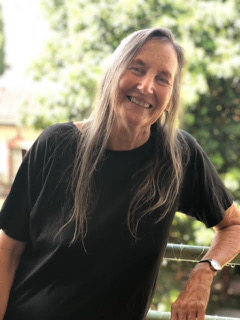
Karen Beatty’s work appears in over 30 publications, including Chicken Soup for the Soul, Books Ireland, Non Binary Review, and Mud Season Review. Her novel, Dodging Prayers and Bullets, was published in 2023.

.

PLEASE NOTE: ARTICLES CAN ONLY BE REPRODUCED IN OTHER SITES WITH DUE ACKNOWLEDGEMENT TO BORDERLESS JOURNAL

Click here to access the Borderless anthology, Monalisa No Longer Smiles

Click here to access Monalisa No Longer Smiles on Kindle Amazon International
Categories
Aeons of Art

Art is Alive

By Ratnottama Sengupta

The Gregorian calendar was still showing 1998.

I was in Oxford on a Charles Wallace fellowship to study John Ruskin’s influence on M K Gandhi and R N Tagore. Like any other student I lived in a hostel, walked up to the Ruskin School of Art and Ashmolean Museum, to the High Street and the flea market, to the Bodleian Library, and – of course – the book stores that continue to make that ancient city of academic excellence such a delight for a person like me who started crawling in the midst of books.

What caught my fancy on the book-lined shelves in the hometown of a ‘legal deposit’ library? The screenplays of Quentin Tarantino. Countless books on Elizabeth 1 – perhaps because Shekhar Kapur’s Elizabeth had just released worldwide. And the volumes on art. The gorgeous reproductions halved the tedium of walking miles of museums and galleries. And the history of art rekindled my love for paintings from our collective past.

But what I didn’t take kindly to was the neglect of – if not bias against — art from my homeland. There were books on Greek, Chinese, Japanese , African, Egyptian, Mayan, Roman art, on Russian Icons and Stained Glass windows, on French Impressionists and German Expressionists, Cubists and Moderns… But Indian art? For crying out loud, where was Ajanta-Ellora? The glass paintings and Miniatures? Pichwai and Patachitra, Nathdwara and Kalighat Pat, Warli and Madhubani, Santiniketan and Baroda?

That’s when I told myself, “Put the journey of Indian paintings between covers.” For, which other country has a continuity that I can boast, of a tradition that has continued unchequered for three thousand years and more?

Once I was back home, my friend Reeta Dutta Gupta approached me to edit an Encyclopedia of Culture for the India Series she was nursing. And Dr Jain of Ratna Sagar entrusted me to author a Notebook that would recount for school-going children the story of Indian art from Bhimbetka to the present millennia. What luck!

*

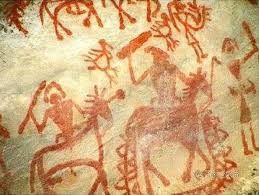
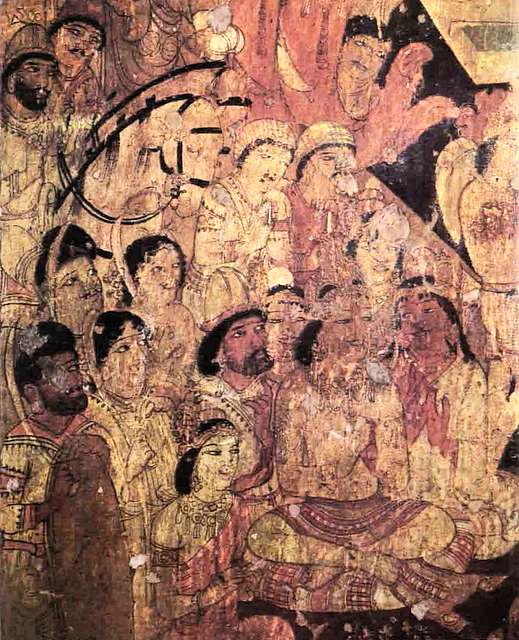
Be it the hunters and the hunted of Bhimbetka, the rock art now on the UNESCO list of World Heritage, or Kolam and Alpana and Rangoli, the decorative designs of Kerala and Bengal and Maharashtra. Be it the Buddha of Ajanta Frescoes or the ploughmen and blacksmith of the Haripura Congress panels painted by the Bengal master Nandalal Bose, be it the illuminations in the Jain manuscripts or the Mughal manners immortalised by the kalams: art in India has grown out of everyday life. These art expressions have been an integral part of the people’s existence, regardless of the style or the period in which they were painted. Yes, down centuries Indian art has withstood change of regiments, religions, philosophy, social content, historical setbacks. And, aesthetic excellence has found an outlet in forms and lines, strokes and colours, whether these were obtained by crushing gems or pounded rice.

This has helped India enjoy a continuity that is rare even in the developed societies. From the sketches of Bhimbetka to those of the tribal artists of Warli, from the murals of ancient India to the art of contemporary masters, from the miniaturised figures to the Tantric patterns – art in India has reinvented itself again and again. And each time it has emerged with renewed vigour and vitality. Because, every age has related to art in an intimate way. By painting on the wall. Decorating the floor. Placing it on the altar. Or simply by keeping an account of the times.

As A Ramachandran – then professor of art at Jamia Millia Islamia in Delhi – had said to me, “Even when our ancient language that was deemed the language of the gods, fell into oblivion, art transcended centuries because it was communicating through a universal language – the visual language of colours and hues.” The lines defined the form, and also created a unitary area for the use of colour, he had further explained. “No matter what the subject, comprehension was never a problem for the Indian – until he was confronted by the art that was imposed by the colonialists.”

The Western overemphasis on realism played havoc, with the native sensibility that allowed for imagination and stylization, Nair Sir had pointed out. That sensibility had no problem accepting a ten-armed goddess, Dasabhuja Durga, or Dasanan, the ten-headed Ravan. “Lifestyle changes too have led to the dilution of Indian aesthetics that once enveloped our workaday lives. The only living art today is the visual art traditions in the villages, but that too might not last as villagers now want to ‘rise’ to the level of the urbans!” he had lamented.

In such a situation, art becomes doubly significant in the life of a child. When she or he is exposed to it, the child can not only access the history and the continuity of a culture but also nurture it with love that can ensure it lives in the days to come… With this in mind, I will write to focus on the high points of Indian art.

Ratnottama Sengupta, formerly Arts Editor of  The Times of India, teaches mass communication and film appreciation, curates film festivals and art exhibitions, and translates and writes books. She has been a member of CBFC, served on the National Film Awards jury and has herself won a National Award. 

.

PLEASE NOTE: ARTICLES CAN ONLY BE REPRODUCED IN OTHER SITES WITH DUE ACKNOWLEDGEMENT TO BORDERLESS JOURNAL

Click here to access the Borderless anthology, Monalisa No Longer Smiles

Click here to access Monalisa No Longer Smiles on Amazon International

Categories
Essay

Anadi: A Continuum in Art

Ratnottma Sengupta revisits an exhibition full 25 years later

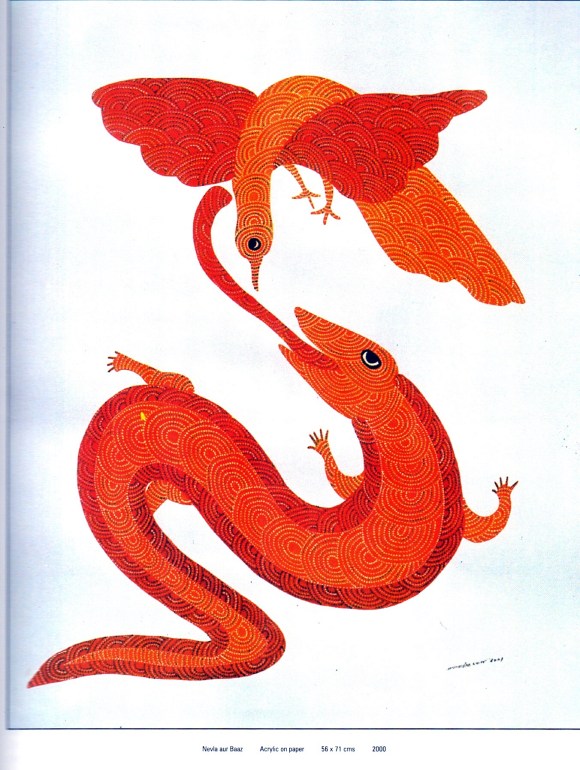
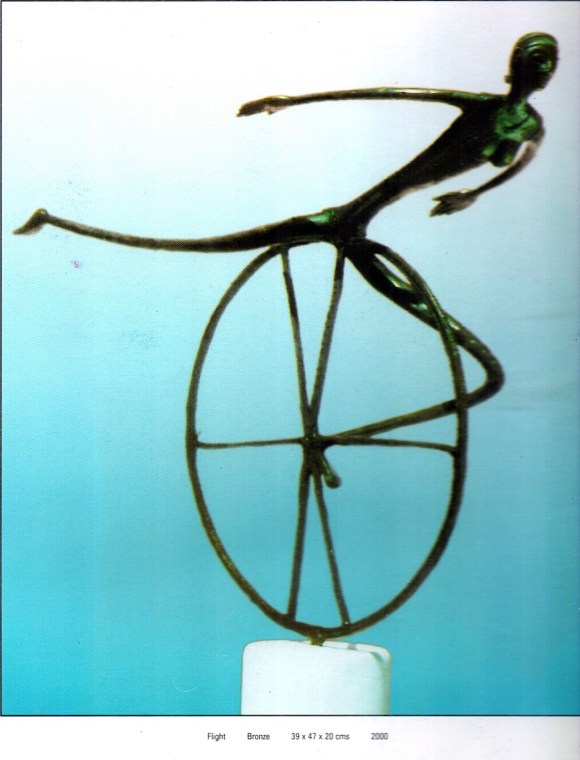
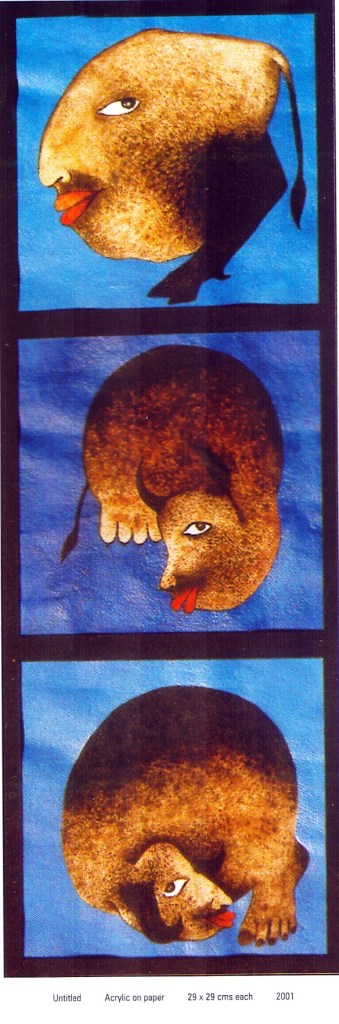
Images from exhibits at Anadi . Provided by Ratnottama Sengupta

On November 1 of 1956 was born a state in Central India called Madhya Pradesh. And 44 years later, on exactly the same day of November 1, in the year 2000 it was remapped. A new state — Chhattisgarh — was carved out of the land that had been home to the oldest Indians: the men and women who had peopled the caves at Bagh and Bhimbetka. 

Standing at the threshold of that new beginning, I had curated an exhibition titled Anadi – that which has no beginning and, therefore, no end. The exhibition card was designed by M F Husain who came on the inaugural day in Delhi. The next day was graced by the presence of Madhavrao Scindia, scion of the royal family that continues to throw up political leaders. I was fortunate to have friends like collectors Anand Agarwal and H K Kejriwal, bureaucrats Bhaskar Ghose and Sarayu Doshi, art lovers like poet Gulzar and artists like Yusuf Arakkal. Happily, then, the exhibition travelled to Birla Academy in Kolkata to Chitrakala Parishath in Bangalore to the National Gallery of Modern Art in Mumbai. And with it travelled a batch of youngsters who were soon to be among the most sought after names in Indian Contemporary Art.

What made that exhibition so special? The card? The multi-venue display? The star viewers? The exhilarating combination of tribal paintings, figurative sculpture, and abstract images? Twenty five years later, I will look back to find an answer.

Images from exhibits at Anadi . Provided by Ratnottama Sengupta

At the intersection of two millennia I was amazed to note there was no rupture in continuity. Anadi offered a fresh look at a continuum that lives on beyond the geopolitical redefinition, because it began at a time when Chhattisgarh was not Madhya Pradesh, nor the Central Province of the Raj. Bhopal, Indore, Raipur, Jagdalpur, Sanchi, Vidisha, Malwa… these cities had no chief minister back then, nor a Prime Minister. Why, there were no Begums nor a Buddha. No Baj Bahadur loved a Roopmati nor did Kalidasa send a Cloud as Messenger. It was a time when the intrepid fingers that harnessed stones and hunted hides also painted rocks to sing of life. In the process – around 10,000 BCE – they crafted the rockbed of Indian Art at Bhimbetka, the UNESCO World Heritage Site mere miles away from Bhopal.

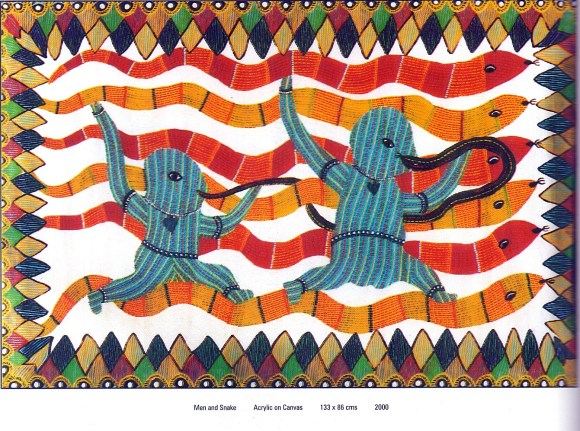
Bare lines that captured with only a twist and a turn the vigor of hunting and the verve of dancing, rock art is that elusive genre which is narrative, figurative and abstract – all at one go. And that is a characteristic common to the tribal stream of art which flourishes in the state from a forgotten past. There is a story in every figure painted by Bhuri Bai or Sukho Korwa. She paints a cart and tells you of the festival day when on its wheels it goes round habitats, collecting all the bimari and driving illness out of the village. He paints a bird that pounces on a snake which devours a rat, recounting the lifecycle that sustains ecological balance. But where is the third dimension? Where’s the likeness to the world of five senses? We see no effort here to evoke either. Instead, there is a stylization which is unique to the region that is home to the Bhil, Gond, Sahariya, Baiga, Saur and other tribes. A stylisation that abstracts the essence of the physical reality they celebrate through colour and line.

Images from exhibits at Anadi . Provided by Ratnottama Sengupta

Dots and crosses, circles and squares all come into play as the vivacious blues and reds, yellows and greens acquire life. A line is not simply a straight line or curve: that would be an unappetising repetition. The quest for variety and individuality finds Kala Bai, Lado, Sumaru break up the lines into an intricate arrangement of countless motifs. When the subject is the same, as too the colour, it’s the dots and crosses, dashes and stars that give the work the imprint of individuality. In the process, these artists who work in a community and send off their creations to markets in distant cities, have worked out a way of ‘patenting’ artistic property. Tradition did not require them to ever sign off a work with their names. In the age of copyright awareness and intellectual property rights, they might put their signatures on the canvas – but the unmistakable imprint of the artists lie in the manner of their assembling the familiar patterns.

That, make no mistake, is the sign of a master, be he in the tribal mould or a modernist. For corroboration, we have only to look at a painting by Maqbool Fida Hussain, N S Bendre or Syed Haider Raza. Madhuri or Mahabharat, Gandhi or Indira, M F Husain constantly painted figures. Eminent and easily recognised ones at that.  And yet, they lived not in the details of their features but in the lines and colours that spelt ‘Husain’ to seasoned viewers. Likewise Bendre’s forms had little concern for photographic realism. In Raza’s case, it is the arrangement of colourful geometrical bindus (circles) and squares alone that speaks of the artist. So, regardless of whether or not there is a ‘McBull’ or ‘Bendre’ inked on the canvas, we readily identify these masters who, incidentally, all came from this same state of Madhya Pradesh.

Images from exhibits at Anadi . Provided by Ratnottama Sengupta

Note one more thing about these names. Each of them had set new watersheds for Indian contemporary art. All of them had opened up new avenues for artists who came after them.  Bendre, the first to head the art education at the Maharaja Sayajirao University of Baroda, gave not just one more centre for mastering the brush. He gave shape to an institution which still assimilates the best of the home and the universe, giving the MSU artists a rare acceptability in India and in the West. Raza, who lived in Paris for years and years, did not sever his umbilical cord with this soil, yet carved a niche for Indianness in the Mecca of contemporary art. And Husain? The life as too the art of this ‘Picasso from Indore’ had become a legend in his own lifetime.  Who else but MF could raise the high water mark at auctions, again at again, at home and abroad? Who but him could open up the markets for Indian artists, including those who preceded him like Jamini Roy?

Images from exhibits at Anadi . Provided by Ratnottama Sengupta

Talking of the masters who opened vistas, especially in the context of Madhya Pradesh, one comes to J Swaminanthan who facilitated a two-way transaction. While holding the reins of Roopankar Museum in Bhopal, he assimilated tribal art to such an extent that he could understand it, explain it, talk about it, write about it and paint after them, using their earth colours, and the bareness of their lines. At the same time, the outsider who became an insider gave, through Bharat Bhavan, all of Madhya Pradesh a new standing in the realm of contemporary art. Artists from all over the country would congregate in Bhopal with their art, exhibit it, discuss it threadbare in seminars, impart it to those keen to learn. Small wonder, the state boasts a host of artists like Akhilesh and Anwar, Seema Ghuraiya and Manish Pushkale, Yogendra and Vivek Tembe, Jaya Vivek and Jangarh Shyam. Artists who steal the attention of the world today.  

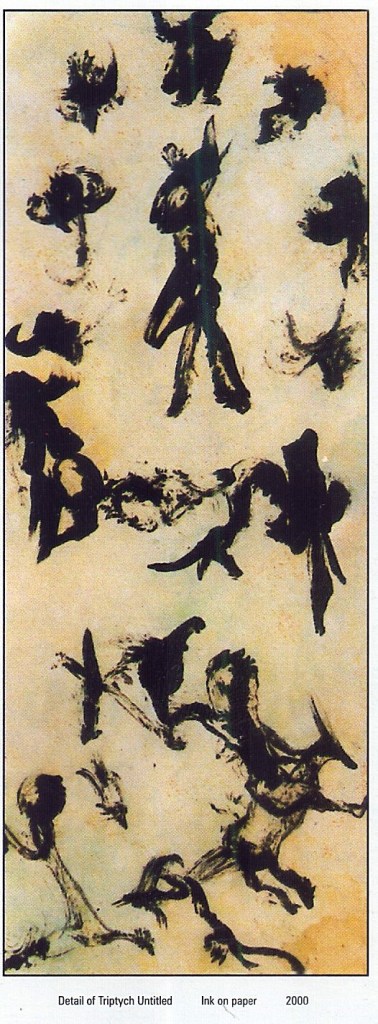
This breed, which was born with the emergence of the state, came of age in artistic terms as the province consolidated its presence on the marquee. And an overwhelming number of them express themselves in just lines and colours. They care not for things like market – which seems to have an insatiable appetite for figurative art. Nor for the narrative tradition of the forefathers who painted on rocks. These neo-masters are all distilling forms, extracting experiences, working out their own equations with abstraction.

But, come to think of it, isn’t this exactly what the original artists of this land – and every other land on earth – set out to do when they picked up the sharpened tool that was millennia away from the paint brush? 

Ratnottama Sengupta, formerly Arts Editor of  The Times of India, teaches mass communication and film appreciation, curates film festivals and art exhibitions, and translates and writes books. She has been a member of CBFC, served on the National Film Awards jury and has herself won a National Award. 

.

PLEASE NOTE: ARTICLES CAN ONLY BE REPRODUCED IN OTHER SITES WITH DUE ACKNOWLEDGEMENT TO BORDERLESS JOURNAL

Click here to access the Borderless anthology, Monalisa No Longer Smiles

Click here to access Monalisa No Longer Smiles on Amazon International

Categories
Poetry

Belonging by Usha Kishore

BELONGING

I don’t belong here, you tell me.
I don’t belong here where the monsoons
drain the sky of all water? This darkness
is not cloud covering the sky in layers
of collyrium dust. This darkness is the
darkness of your heart staining the air.
Can you wipe clean the slate of memory,
my smile etched on fond photographs,
the family fables, the tangle of feuds
and the look in your eyes, when I,
your unwanted daughter, walk in
demanding my dues? I may not belong
here anymore, but I demand the song
of every cuckoo that sang on the thatch,
the footprints of every squirrel that scuttled
across the courtyard, and the cries of every
dark goddess you deified in false myths.
Usha Kishore

Usha Kishore is an Indian-born British poet, editor and translator. The author of three collections of poetry, her work has been widely published.     www.ushakishore.co.uk

.

PLEASE NOTE: ARTICLES CAN ONLY BE REPRODUCED IN OTHER SITES WITH DUE ACKNOWLEDGEMENT TO BORDERLESS JOURNAL

Click here to access the Borderless anthology, Monalisa No Longer Smiles

Click here to access Monalisa No Longer Smiles on Kindle Amazon International
Categories
Musings

When Nectar Turns Poisonous!

By Farouk Gulsara

” No, you cannot refuse this!” my wife said. “This is prasad, the divine offering to the gods.”

A motichoor laddoo… Photo courtesy: Farouk Gulsara

I reluctantly looked at the glazed motichoor ladoo[1]. The memories of my last blood test results started flooding my mind. 

The learned GP looked disapprovingly at my results through his reading glasses, one eye fixed on the result and the other condescendingly on me. Did I hear geckos chapping away in the background, or is the doctor making disgruntled sounds about my glucose levels?

“9.0 fasting sugar is not good! Congratulations, you are a diabetic now!” he declared. I thought I saw a gleam in his eyes as he announced it. 

“Let him have his day,” I told myself. “This is his terrain, let him have his last say.”

Quietly, I was guessing how well the doctor’s fasting sugar would be. Looking at his general appearance, it would not be so great. Proudly carrying around his protuberant apron of a paunch, slouched in his chair all day, the closest he must come to exertion would be leaning forward to examine his patients; he does not scream of a paradigm of health. Yet, this is his turf. Hence, I sheepishly blurted, “Yes, doctor.”

There are some things in life one cannot fight, like who your parents are and the garbage of genetic material one is thrown with. With my very strong family history of diabetes, it was a matter of time before I was garlanded with the same laurel. No amount of time spent at the gym or hours of burning the soles of my running shoes was going to steer me away from his genetic heirloom. I knew that. Still, it is unfair to say, nevertheless. 

So when she offered me the sucrose-dripping divine offerings, I looked at them as my mug of hemlock, as a concoction offered with an intended outcome, no matter how much one can sugarcoat it with divine intervention. Like an accountant who tallies debit and credit transactions, the body does not take into account whether a food is blessed or otherwise. It is quite transactional in its dealings with the trash that is shoved in versus the energy consumed, aided by detoxifying and catalytic agents. 

My mind then wandered upon the practice of emphasising food as one of the highest deeds one can offer to humanity. Every religious function invariably ends with a big feast. Forget prayers; one would get upset if a wedding, a birthday invitation, or even a casual visit to an acquaintance’s home is not accompanied by a meal or at least a snack. What is a birthday party without loads of sugar or unnecessary calories? Feuds have occurred in the past when caterers failed to meet their hosts’ promises. Our community believes that the taste of the wedding meals should be savoured much longer than the newlyweds keep their wedding vows. 

The highest brownie points in most religions must surely be for feeding the masses. No one is denied a meal in most places of worship. Why this fixation on meals and their intermingling with divinity? If any calamity were to befall any part of the world, the Sikh brothers would always be the first to be at Ground Zero to whip out some piping hot vegetarian food for the victims. Where do the homeless in the underprivileged part of town go for a square meal? A langar[2] , the Sikh community kitchen, of course.

I once heard an actress boasting about her polyamorous lifestyle and how she managed to win so many hearts. Her answer stuck in my mind. “Honey, the sure way to a man’s heart is through his stomach. You can either stir a nice meal, or you can compliment him on how slim he looks. You can tell him you can hardly see his stomach!” The actress also said that Belgian chocolates win any girl’s heart. 

Why this fixation on meals and their intermingling with the human psyche and divinity? Food and divinity are closely intertwined, not only because a hungry soul cannot sing praises of the giver, but also because the gratitude and joy showered upon their givers can be intoxicating. It fosters human connection at a primordial level, regulating social orders. After all, hunger remains one of the primitive needs before social conditioning expanded our insatiable wants. 

Famine has been a regular feature in the Indian subcontinent[3]On the other end of society, opulence and wastage were prevalent. The society decided to imbue the act of ‘giving a dog a bone’ with religious fervour, bestowing it with a divine status. We were undernourished then and overnourished now. Either way, we are malnourished[4] , just that in the former, we were fed a wee bit too little, while in the latter, a tad too much. Both leave us much to be desired, metabolically speaking. 

Just as Empress Marie Antoinette could not comprehend why the peasants did not stop their boisterous shouts and just eat the cake[5], my wife cannot understand why I am having second thoughts about indulging in some blessed sweet ladoos.

.

[1] Sweet

[2] A Sikh community kitchen serving free meals to all regardless of religion, caste, gender, economic status, and ethnicity

[3] https://en.wikipedia.org/wiki/Timeline_of_major_famines_in_India_prior_to_1765

[4] . Malnutrition is an imbalance between the nutrients your body needs to function and the nutrients it gets. It can mean undernutrition or overnutrition.

https://my.clevelandclinic.org/health/diseases/22987-malnutrition

[5] “Let them eat cake” is the traditional translation of the French phrase, “qu’ils mangent de la brioche“, said by ‘a great princess’ according to Rosseau. It has been attributed to Marie Antoinette. Brioche is not cake but an enriched bread made with eggs, flour, butter and sugar. (ref:  https://en.wikipedia.org/wiki/Let_them_eat_cake)

Farouk Gulsara is a daytime healer and a writer by night. After developing his left side of his brain almost half his lifetime, this johnny-come-lately decided to stimulate the non-dominant part of his remaining half. An author of two non-fiction books, Inside the twisted mind of Rifle Range Boy and Real Lessons from Reel Life, he writes regularly in his blog, Rifle Range Boy.

PLEASE NOTE: ARTICLES CAN ONLY BE REPRODUCED IN OTHER SITES WITH DUE ACKNOWLEDGEMENT TO BORDERLESS JOURNAL

Click here to access the Borderless anthology, Monalisa No Longer Smiles

Click here to access Monalisa No Longer Smiles on Kindle Amazon International
Categories
Poetry

Alcove and the Theory of Time

By Saranyan BV

At the fourth level, there is an alcove hidden from other human beings. 
(I didn’t know fourth level existed.)
From here a slope moving down in the form of roof,
Looks over another slope, again a roof.
If I can’t see the people, neither can they me!
The pane at this level has a small crack
To allow the air I require to breeze in. Thank you, Lord.
The space in the alcove allows me to stretch,
Allows me the freedom to assume a foetal posture.
The alcove keeps me cold, keeps me warm.
It gives the creepy feeling I might fall off or roll down.
It gives the assurance I am safe.
Here shadows spill light, nights shine darkness.
The whole thing is about the mind.
There is always the whistle, the thoughts about sex,
When it’s not about the sex, it’s about Gods,
About men travelling in trains, men running for cover to hide nakedness.
I am always missing my trains, waiting to find the station’s rest rooms,
Waiting in front of restrooms for the restrooms to be free.
Here people don’t acknowledge truth, the media doesn’t.
The Caxton phenomenon* is dead, all channels whore.
And then there is the sky, the big clear sky like a slice of cake.
The big sky out there where the birds fly, birds make the clouds wait for another day.
How little I feel, how little.
I speak to the feathers to share the alcove.
I speak to feathers because, reasons can’t speak to anyone else in this high alter of solitude.
I impress upon them to share the alcove
Because times are not shareable.

*Caxton phenomenon refers to the impact William Caxton had on English literature and language when he introduced the printing press to England in 1476
From Public Domain

Saranyan BV is poet and short-story writer, now based out of Bangalore. He came into the realm of literature by mistake, but he loves being there. His works have been published in many Indian and Asian journals. He loves the works of Raymond Carver.

.

PLEASE NOTE: ARTICLES CAN ONLY BE REPRODUCED IN OTHER SITES WITH DUE ACKNOWLEDGEMENT TO BORDERLESS JOURNAL. 

Click here to access the Borderless anthology, Monalisa No Longer Smiles

Click here to access Monalisa No Longer Smiles on Kindle Amazon International

Categories
Poetry

Found in Translation: Rohini K.Mukherjee’s Odia Poems

Five poems by Rohini K.Mukherjee have been translated from Odia by Snehaprava Das

Rohini K.Mukherjee
AT THE MYSTICAL SANCHI 

An unknown voice beckons
At the early hours of the morning.
Moved by a new surprise
Buddha relapses into meditation.
A crystal dawn, cold as marble,
Is traced
On his hands and feet
And his eyes and forehead.
Some instant, invisible signal prompts him
To turn on his side and sleep.

After Buddha’s Nirvana,
Calm settles in the valley, slowly.
Thousands of
Branches and branchlets
Radiate blissful divine light.
The trees too, in a lavish growth,
Spread out everywhere --
From the earth below to the sky above --
And meditate!


THE EXECUTIONER

No one could predict
The next scene.
But in the one enacted now
The executioner has
A prominent presence.

The executioner stalks the moon,
His face hidden in the veil of clouds,
Knife in hand, a gleam of smile
On a phony face,
A sharp, keen gaze under the glasses,
Exuding the smell of
An expensive perfume.

The indistinct footfalls may
Prompt one to flick a look back
But there would be no one behind
Only clouds clad in midnight blue
Sailing in the sky.
From somewhere far floats in the music
Of a mountain stream.
Slowly, sorrow dissipates and a
Path opens up for the spring,
A wonderland of fairies.
In his unguarded moments,
The knife in the executioner’s grip
Glitters in the furtive moonlight.
Any moment that poison-coated knife
Could find the moon’s throat,
The moon knows that well.
But it forgives,
Because it also knows well
That the executioner cannot
Hide for long
And will be trapped in
The moonlit garden of tangled clouds.


THE DEATH OF A HAPPY MAN

One day, the eyes lost sleep
And all the locusts flew away,

Not one spectator had guessed
That one day
The man will sprawl out on
On the sea beach sands
Washed away by the waves
From distant lands.

The eyes lost sleep one day.
The flock of locusts flew away.

But no one could guess
The pains, the sobs
That seared that forlorn soul.

Petals drifted in piles
To make him a delicate shroud.
The smell of sandalwood came wafting
In the sea-breeze from the north.
Seagulls flocked around the body,
Unintimidated by the crowd in the beach,
Drowning the voice of
The living men there
With their loud squawks of dissent.
Ooh! What a long wished-for
Happy death
On a cool and blissful sea beach!

After the flock of locusts flew away
Carrying all the dreams back
On their wicked wings,
The eyes lost sleep!


ANKLETS OF THE NIGHT

There is still time for the nightfall.
But the air tinkles with the sound of
The anklets of the night
As if someone is retreating from
An ineffectual, moon-washed garden,
As if someone from the grave
Watching the landscape,
Or someone standing at the riverside
Hums the tune of a departed season,
Or someone hurrying aimlessly away
To escape the approaching dawn.

It is not yet night,
But the night’s anklets ring.
You are probably returning
To your shelter of old times
In search of a new hope.
Just take a look behind to see
The painting of a conflicting wind
Fluttering across the courtyard.

It is not yet night
But its anklets begin to jingle in the air.

How cool you appear in your
Evening chanting of the mantras!
How calm and steady you are
In the pure fragrance of the descending steps
As you set out on the journey
Holding your heart on your palm
Like a burning clay-lamp.
May be when you arrive there
The dawn around you would be sonorous
With the notations of Raga Bhairavi.

There is still time for the nightfall
But the night’s anklets tinkle in the air!


THEY DID NOT COME

I waited for them, but
They did not come,
I waited all this time in vain, and
Knowingly, let myself fall a victim
To the first rays of the sun.
The sun’s whiplash spurred me on
To the jungle.
It forced me to cut wood
And tie them in bundles.
The hunger of the sunset hour
Prodded me back to where
I had started.
The smell of soaked rice, and the aroma of
Onions and oil
Drifted thick in the air of my house.

The sun came in, an intruder,
Sat by me and watched.
Then it devoured all the food,
Leaving nothing,
Not even a single dried-up onion-peel.

Because they did not come,
For me the morning was
Meaningless in its futility.
I knew I was never one
In the list of their ultimate interests
When their tenure of life here ended.

The footfall of the light
Trod easy on my skin.
Days rolled on this way
In sun and light.
The sun was everywhere, all the time.
Whenever the door opened,
The sun stood there.
When the meteor came shooting down,
When words rode over
the waves of sleep to float in the air,
The treacherous sun always appeared.

And for me, there was
No hope of their coming back.

But, one day as I leapt up in a hurry
At the Sun’s summon,
I discovered the Sahara Desert
That I believed had
Remained hidden in my
School Geography book,
Lying face down all these days
Under my own hooves!

Rohini Kanta Mukherjee has authored, edited and co-edited several volumes of poetry and short stories in Odia and English. Many of his poems have been translated and published in various Indian languages , broadcast over several stations of All India Radio and Doordarshan . Some of his poems and translations have appeared in Wasafiri, Indian Literature, The Little Magazine , Purvagraha, Samasa among others. He retired as Associate Professor of English, from B.J.B Autonomous College, Bhubaneswar, Odisha.

Dr.Snehaprava Das, is a noted writer and a translator from Bhubaneswar, Odisha. She has five books of poems, three of stories and thirteen collections of translated texts (from Odia to English), to her credit. 

PLEASE NOTE: ARTICLES CAN ONLY BE REPRODUCED IN OTHER SITES WITH DUE ACKNOWLEDGEMENT TO BORDERLESS JOURNAL

Click here to access the Borderless anthology, Monalisa No Longer Smiles

Click here to access Monalisa No Longer Smiles on Kindle Amazon International
Categories
Nazrul Translations

A Love Song by Nazrul

Jani Jani Priyo, Ea Jebone  (I know my dear one, in this life) by Nazrul has been translated from Bengali by Professor Fakrul Alam

Art by Sohana Manzoor
I know, know very well my dear one,
No desire of mine will ever be fulfilled
In my lifetime. Like a water-lily, I’ll shed
In a watery grave. Moon-like, from above
You’ll shed tears. Between us, my bride,
Forever will blow a wind of parting. Forever,
You’ll be heaving deep sighs. I won’t get to hold
Or grip you close to the heart. And yet,
The moon keeps slandering the lotus. Far away
That you are, how does honey still gush from you?
Stay within my reach, dear night moon of mine,
Though so out of my grip and so untouchable!
My empty heart cries out with desert-thirst.
Everyone says I’m the one you love. And yet,
By your providing balm to that shameful act
My anguish at parting has become sweet tasting!
A rendition of Nazrul’s love song by Feroza Begum (1930-2014) in original Bengali

Born in united Bengal, long before the Partition, Kazi Nazrul Islam (1899-1976) was known as the  Bidrohi Kobi, or “rebel poet”. Nazrul is now regarded as the national poet of Bangladesh though he continues a revered name in the Indian subcontinent. In addition to his prose and poetry, Nazrul wrote about 4000 songs

Fakrul Alam is an academic, translator and writer from Bangladesh. He has translated works of Jibonananda Das and Rabindranath Tagore into English and is the recipient of Bangla Academy Literary Award (2012) for translation and SAARC Literary Award (2012).

PLEASE NOTE: ARTICLES CAN ONLY BE REPRODUCED IN OTHER SITES WITH DUE ACKNOWLEDGEMENT TO BORDERLESS JOURNAL

Click here to access the Borderless anthology, Monalisa No Longer Smiles

Click here to access Monalisa No Longer Smiles on Amazon International

Categories
Review

Heart Lamp by Banu Mushtaq

Book Review by Somdatta Mandal

Title: Heart Lamp: Selected Stories

Author: Banu Mushtaq

Translated from Kannada by Deepa Bhasthi

Publisher: Penguin Random House India

After Geetanjali Shree’s Tomb of Sand, the first novel to receive the International Man Booker Prize in 2022 for a work of fiction written in an Indian language and translated into English, history repeated itself once again when this year in 2025, Banu Mushtaq’s book of selected short stories Heart Lamp, written originally in Kannada and translated into English by Deepa Bhasthi, was recipient of the same coveted prize. It proved that translating from Indian bhasha languages to compete worldwide with other canonical literatures has gained maturity to impress the jury who finally evaluate the prize.

In the twelve stories of Heart Lamp, published originally in Kannada between 1990 and 2023, Banu Mushtaq exquisitely captures the everyday lives of women and girls in Muslim communities in southern India. As a journalist and lawyer, most of the stories are women-centric and in all of them she tirelessly champions women’s rights and protests all forms of caste and religious oppression. As a believer in the highly influential literary movement in Kannada during the 1970s and ‘80s – the Bandaya Sahitya tradition – that started as an act of protest against the hegemony of upper caste and mostly male-led writing that was then being published and celebrated, Banu Mushtaq’s literary career therefore gave importance to dissent, rebellion, protest, resistance to authority, revolution and its adjacent areas at par with the movement that urged women, Dalits and other social and religious minorities to tell stories from their own lived experiences.

The author goes on to highlight several harmful social practices that are still prevalent in the Muslim community and even supported by law, which impede girls including women of all ages, from having freedom to make positive choices, thus hampering them from realizing their full potential. In story after story, the deeply patriarchal structure of Muslim society is depicted in such a manner that it is not only applicable to the Muslims living in villages and town in south India but can be applicable elsewhere too. She shows how child marriage is still in practice and mentions the suffering and trauma women experience because of legally sanctioned polygamy which causes social and financial insecurity and hardship for women and their offspring. The curse of teen talaq[1]and the practice of issuing multiple fatwas[2] which are deliberately aimed at constricting women are urgently in need of being addressed legally.

In the very first story, ‘Stone Slabs for Shaista Mahal’, we find Iftikar’s too much effusive declarations of love for his wife Shaista vanish into thin air immediately after her death and he soon marries a young girl leaving all his children to be looked after by his eldest daughter. The ‘Fire Rain’ has mutawalli[3] Usman Saheb heading the community and making hundreds of decisions for others, but when her sister comes begging he refuses to give her the legitimate share of his ancestral house. Whereas the ‘Black Cobras’ has the mutawalli saheb refuse to help a woman whose husband has deserted her for giving birth to three daughters and provide any support for her youngest sick daughter who dies without any treatment. The story ends with a focus on female revolt when his own wife decides to go and have an operation to stop childbirth. In an interesting story ‘A Decision of the Heart’ the author narrates the plight of a man called Yusuf who is unable to balance the love between his wife and his mother and finally decides to arrange a nikah for his mother Mehaboob Bi.

One story that delves deep into Muslim customs that we generally are not aware of, is entitled ‘Red Lungi’. It tells us about a mass circumcision programme at the mosque for the poor where a young boy Arif undergoes the procedure and is cured in due course. His plight is then contrasted with Samad, the son of a rich man who remains weak and unfit despite the elaborate festivities for his circumcision and the gifts.

The titular story ‘Heart Lamp’ centres around Mehrun who is left to fend for herself as her husband falls for another woman. When she goes to her parents’ house for support, her brothers send her back. Leaving the responsibility of her children upon her eldest daughter Salma, she attempts to burn herself to death. The scene where her daughter begs her to stop and so finally, she aborts her suicide attempt, is extremely moving. The depiction of rural Karnataka comes out very clearly in ‘Soft Whispers’. The story narrates in detail the childhood antics of an eight-year-old girl visting her grandparent’s house in Mabenahalli village. Her young playmate, Abid, who would join her to play tricks, turns into the supervisor of a dargah[4]. When he comes to invite her to join the festival, he keeps his head lowered and does not even meet her eye.

Despite mentioning serious social issues pertaining to the average middle and lower-middle class Muslim families, Mushtaq’s stories are laced with a sense of wry humour and pathos. For instance, in ‘High-Heeled Shoes’, Niaz Khan envies his sister-in-law who comes from Saudi Arabia wearing gorgeous high-heeleded shoes and, in the end, manages to buy a pair for his pregnant wife Arifa which does not fit her at all. The difficulty in walking with those shoes on, and the interaction she has with her unborn child in her womb takes this story to a different level altogether. ‘A Taste of Heaven’ has Bi Dadi, who turns into stone after her ja-namaz [5]is soiled, gaining solace by drinking Pepsi and thinking it to be aab-e-kausar, the nectar from heaven, and starts living in a delusory world of her own in the company of her long-lost husband. In ‘The Arabic Teacher and Gobi Manchuri’, the young Maulvi Hazrat’s penchant for eating “gobi manchuri[6]” is the comic fulcrum on which the story turns. Again, Shazia’s desperate attempts in ‘The Shroud’ to locally procure a kafan[7] and sprinkle it with the holy zamzam water from Mecca after having callously forgotten to bring one for poor Yaseen Bua from her Hajj pilgrimage, makes her grief and being conscience-stricken rather ludicrous.  

In the 2025 International Booker Acceptance Speech Mushtaq said: “This book is my love letter to the idea that no story is ‘local’ – that a tale born under a banyan tree in my village can cast shadows as this stage tonight…. [It] was born from the belief that no story is ever ‘small’ – that in the tapestry of human experience, every thread holds the weight of the whole.”

Her observation power is indeed very strong. Muslim women have been victims of deprivation and discrimination in various matters owing to a dearth in education and awareness. To bring a change in the family, a change in mentality is very crucial. The last story of this collection, ‘Be A Woman Once, Oh Lord!’ is a typical tale of male chauvinism, where deprived a dowry, a man throws out his sick wife and children to get married again.

A woman must construct her own identity besides being someone’s daughter, somebody’s wife or someone’s mother. Only education and self-dependence can establish a woman as a human being beyond her religious and family identities. But as her translator rightly points out, it would be a disservice to reduce Mushtaq’s work to her religious identity, for stories transcend the confines of a faith and its cultural traditions. So, she should not be seen as writing only about a certain kind of woman belonging to a certain community, that women everywhere face similar, if not the exact same problems, and those are the issues that she writes about.

Before concluding, a few words need to be written about the translator and the translation too. In the Translator’s Note, titled ‘Against Italics’, Deepa Bhashti reiterates that the “translation of a text is never merely an act of replacing words in one language with equivalent words in another: every language, with its idioms and speech conventions, brings with it a lot of cultural knowledge that often needs translating too.” She mentions that she was very deliberate in her choice to not use italics for the Kannada, Urdu and Arabic words that remain untranslated in English. She believes that italics serve to not only distract visually, but more importantly, they announce words as imported from another language, exoticizing them and keeping them alien to English. She also mentions that there are no footnotes used at all.  

In her separate International Booker Prize Acceptance Speech, Bhasthi also tells us how through the work they could bring out what would otherwise be unread, uncelebrated texts to a new and very different sets of readers. She stated how the story of the world was really a history of erasures. It was “characterized by the effacement of women’s triumphs and the furtive rubbing away from collective memory of how women and those on the many margins of this world live and love.” Therefore, the stories in this collection are recommended for reading not by reducing Mushtaq’s work to her religious identity, but by transcending the confines of a faith and its cultural traditions.

[1] It’s an Islamic practice in which a Muslim man could divorce his wife by uttering the word “talaq” (divorce) three times.

[2] An Islamic law

[3] Manager of a Muslim charity organization

[4] Tomb or shrine of a Muslim saint

[5] A Muslim prayer mat

[6] Manchurian cauliflower

[7] Shroud

Somdatta Mandal, critic and translator, is a former Professor of English at Visva-Bharati, Santiniketan.

PLEASE NOTE: ARTICLES CAN ONLY BE REPRODUCED IN OTHER SITES WITH DUE ACKNOWLEDGEMENT TO BORDERLESS JOURNAL

Click here to access the Borderless anthology, Monalisa No Longer Smiles

Click here to access Monalisa No Longer Smiles on Amazon International