Our bags stay forever packed
Notwithstanding any setbacks
We are struck with wanderlust.
Travelling is just part of who we are.
Sure, the world may be in chaos
But our knees and minds never dither
When travel is on the cards.

“Too old!” they say.
“Stay home. Be sensible!”
Honestly, such needless wisdom
Falls on deaf ears.
For us, who never tire of seeing new skies,
Stocked with coloured pills of different sizes,
We boldly step outside.

We’ve trekked through Roy's Peak Track,
With sanitiser bottles attached to our backpacks.
On the way down, our knees did protest,
Friendly hands did the rest.
Travel, they say, brings out the best.
Indeed, we have been through such tests.

“There's climate change!” experts declare,
But we still carry the attitude of Columbus
Questing for the unexplored, undiscovered,
Where the adventurous and the young are bound.
One little hiccup in Baku this May?
Did we let that stop us? Not a chance.
We’re off again soon to the seas
This time, to savour Goan Feni.

So let the sceptics scoff and frown,
We are the new age septuagenarians
Those who refuse to slow down.
With maps in hand, excitement in our hearts,
Somewhat dented, broken in body parts,
We continue to travel against all odds.
Snigdha Agrawal (nee Banerjee) has published five books, including Fragments of Time, her deeply personal memoir. A lifelong lover of storytelling, she blends fact and fiction with a keen eye for detail and emotion. Her works span diverse genres, reflecting her rich experiences and insightful observations.
.
PLEASE NOTE: ARTICLES CAN ONLY BE REPRODUCED IN OTHER SITES WITH DUE ACKNOWLEDGEMENT TO BORDERLESS JOURNAL
The very last words my mother had said to me constituted the question, “What is your name?” We were in the VIP lounge of Dhaka airport and she had just been wheeled in from an aircraft with one of my sisters. Another sister and I had gathered there to receive her, perhaps knowing as well as her, that she was close to dying. And yet she had managed a smile as she said to me, “What is your name?”
The words, indeed, amounted to a kind of game she would play with me whenever I would meet her at my sister’s house in Dhaka. It was what we call a rhetorical question since she most certainly did not have to be told what my name was. It was her way of reminding me that while I might be professor of English at the University of Dhaka, I — Dr. Alam, as she would also sometimes teasingly call me — should never forget that I had learned English from her, sometimes literally at her feet as she did housework, and on other occasions, when she had done the day’s work, at the table where all of us siblings would gather to study once we were old enough to do so.
On International Women’s Day, I would like to pay a tribute to my mother, her fierce belief in the importance of education, especially women’s education, and the rights of women to study and work and have parity in every sphere with men.
My mother was an outstanding student. Recorded as well as oral family narratives enable me to reconstruct her brilliant performance as a student as well as her aborted student life and its consequences. From one of my aunts’ contributions to the 100th anniversary commemorative volume of Feni Government Girls School, I am reminded that both in Class Four and Six she had made it to the All Bengal Merit List and had been awarded scholarships for her achievement.
From an uncle’s autobiographical narrative, I have an explanation of why she had to stop studying when she was in Class Eight. The only Muslim girl studying in a very conservative town, she had become an obvious target of their religious concern. “Why must a Muslim girl study after a point?” they would say. My mother would go to school properly veiled, but these men reminded my grandfather, who had once been a progressive Swadeshi[1]but was then embracing a very conservative Islamic position, that there were Hindu male teachers teaching in the school. And, they noted, educated women tended to be immoral. For good measure they added, “Is your daughter going to become a judge/barrister after studying?” What was the point of female education, after all?
Persuaded, my grandfather withdrew my mother from school. The clinching point for him, I learnt from my uncle’s narrative, was his own father telling him with finality, “Your daughter has to stop studying. It’s enough that she can write letters and read them!” My grandfather tried to placate her by saying that she could sit for the matriculation examination as a “private” student.
Both my aunt’s account and my uncle’s narrative l record my mother’s intense grief afterwards. For a while, she tried to concentrate on studying for “private” matriculation. But then the First World War broke out; everything was disrupted in Feni, and she was married off after a couple of years. Not only was she grief-stricken at that time, as my aunt notes in her piece, but she would carry her grief at being cheated out of an education almost to her grave.
However, my mother was nothing if not a fighter. My uncles would tease her and call her a “communist”, and if the word had been fashionable in the late ’50s and ’60s when they would always be visiting us in our Dhaka house, surely they would have also called her a “feminist”, although I am sure she would have detested the sanctimonious and self-serving ways in which the word is at times bandied.
What my mother missed in formal schooling, she made up by reading voraciously, whenever she could spare the time. A lasting memory I have of my mother, both after lunch and dinner, and after all the housework was done and our studies supervised, was of her going to bed, day after day and night after night, with the Bangla newspaper, the current issue of the weekly Begum, and some Bangla novel, usually by Sarat Chandra or some other best-selling Bengali author.
Always feisty, and despite being immensely religious and completely devoted to God and the Prophet, she would never miss the opportunity to berate ‘holier than thou’ Muslim priests and men for the way they treated women. Because she knew the religion well, she would always cite examples of how the place of women was not what it was made to be by patriarchal Muslim men of her generation and how veiling beyond a point was totally unnecessary and the ghomta and orna[2]were good enough, if one knew what was prescribed in the holiest of books.
But the most eloquent way that my mother protested against the deprivation she and her generation of Muslim women suffered because of their fathers and their friends and mullahs at large, was in her single-minded dedication to the cause of women’s education. Not only did she teach us and my four sisters the English and Bangla alphabet, but she also ensured that her four daughters as well as her one son had equal access to education. She insisted that her daughters earned the highest degree possible in the field of their choice and was proud when they became working women. She was saddened when a couple of them did not go beyond an MA degree and when one of them gave up her job. And she did everything for them as long as she could to ensure that they could combine not only higher studies but career goals that would help them realise their dreams. When I told my wife I would be writing a tribute to my mother for International Women’s Day, she reminded me that my mother had told her when we were leaving for Canada, where I would be doing higher studies, that she should not come back without earning a higher degree in some field or the other.
Moreover, my mother’s preoccupation with women’s education went beyond her family. She would help any woman wanting to advance herself, through education and through jobs. Whether it was her sisters or her relatives, or even their friends, she offered our house as a home to them and would become their “local guardian” or counsellor, if not a surrogate mother. She also went way out of her way to help any woman she felt was remotely in distress, or lonely, or deprived in any way, with whatever little she could do to help or comfort them. And she would teach anyone, male or female, she could get hold of, believing that education was above all!
There is a lot more that I could say about my mother but I must end here by saying that I took this occasion not really to give you the feeling that my mother largely made me what I am, but mostly to convey to you how she had pledged herself to parity and worked for the emancipation of women in her own way all her life. In that respect, and in so many ways, she was an exemplary woman and truly ahead of her time and thus worth remembering on this day.
[1] Freedom fighter – active in the struggle for independence of the subcontinent from British rule
[2] Covering the head with the loose end of a saree or an orna (shawl or large scarf)
(First published in Daily Star, Bangladesh, on March 9, 2016)
Fakrul Alam writes nostalgically of his visits to Feni in Noakhali, a small town which now suffers from severe flooding due to climate change. Click here to read.
Rakhi Dalal reviews Swadesh Deepak’s A Bouquet of Dead Flowers translated from Hindi by Jerry Pinto, Pratik Kanjilal, Nirupama Dutt, Sukant Deepak. Click here to read.
Salma A. Shafi writes from ground level at Noakhali
From Public Domain
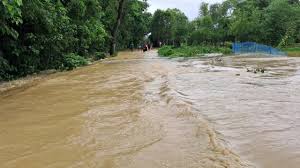
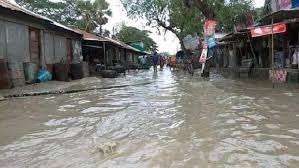
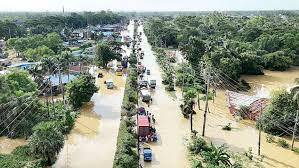
The Greater Noakhali region of Bangladesh is experiencing one of the most severe flood and water-logging crises in recent memory, driven by persistent heavy rainfall since mid-August 2024. The flood affected more than 5 million people, submerging houses, roads, and marketplaces, and leaving large portions of the region inundated. A total of 71 people, including women and children, lost their lives in the flood affected areas. With water levels reaching alarming heights, the disaster has raised significant concerns about vulnerability of the region for future flooding.
Almost every year floods occur in Bangladesh, but the intensity and magnitude vary from year to year. Their nature causes and extent of destruction gives them various definitions such as river flood, rainfall flood, flash flood, tidal flood, storm surge flood. The term manmade flood is a recent phenomenon attributed to encroachment on vital water channels, such as canals and wetlands sometimes for construction of roads and bridges and frequently for fish cultivation, hatcheries and shrimp farming.
Context of recent flood in Bangladesh
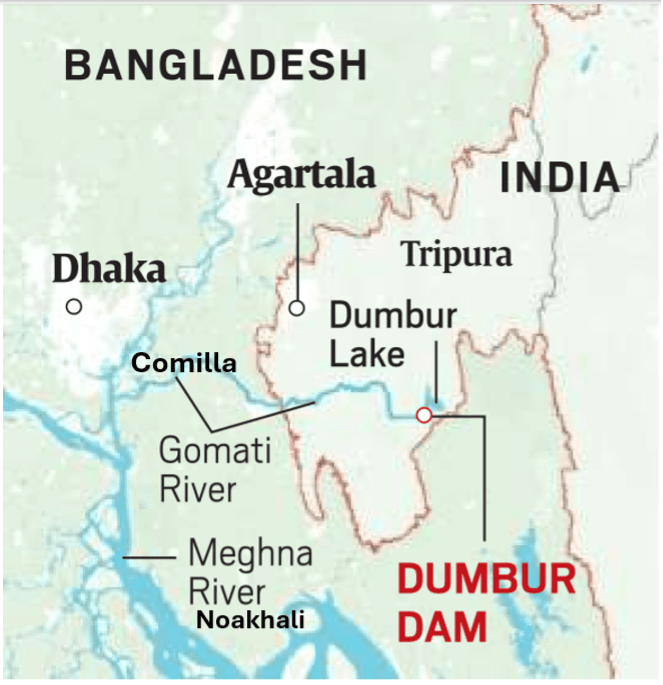
Since August 20, 2024, Bangladesh has been facing severe flooding triggered by continuous heavy rainfall and, according to the Bangladesh Ministry of External Affairs, water releases from Dumbur Dam, upstream in Tripura, India[1], a claim that is denied by the Indian government. Tripura also suffered severe floods and landslides[2] from this August. The flood impacted several districts in Bangladesh, including Feni, Noakhali, Comilla, Lakshmipur, Brahmanbaria, Cox’s Bazar, Khagrachhari, Chattogram, Habiganj, and Moulvibazar. By August 23, 2024, the Ministry of Disaster Management and Relief reported that floods had affected 4.5 million people across 77 upazilas in 11 districts. Nearly 194,000 people, along with over 17,800 livestock sought refuge in 3,170 shelters as the crisis continued.
In addition to widespread displacement, the floods led to tragic fatalities, with deaths reported across multiple districts. Communication with key river stations, such as Muhuri[3] and Halda[4], were completely severed, hampering collection of vital data necessary for relief and rescue operations. The extensive flooding has caused significant damage to property, crops, and infrastructure, displacing thousands of families. The disruption to transportation and agriculture deepened the humanitarian crisis, demanding immediate action to mitigate long-term impacts of disaster on the affected communities.
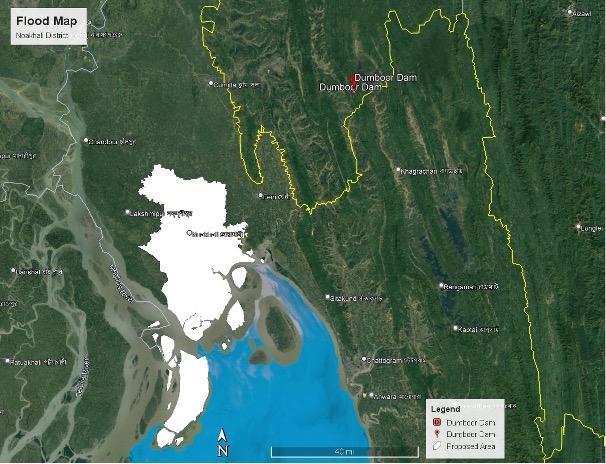
The flood situation in Noakhali District worsened due to continuous heavy rainfall and rising water levels of the Muhuri River. The district Weather Office recorded 71 mm of rainfall within 24 hours, exacerbating the flooding. Approximately 2 million people were stranded as floodwaters submerged roads, agricultural fields, and fish ponds. Seven municipalities in the district went underwater, with widespread waterlogging affecting both rural and urban settlements.
Map provided by Salma A Shafi
On September 1, 2024, the Noakhali Meteorological Office reported a staggering 174 mm of rainfall within a 12-hour period, causing widespread flooding and waterlogging across low-lying areas. The worst-affected upazilas include Noakhali, Senbagh, Sonaimuri, Chatkhil, Begumganj, Kabirhat, Companiganj, and Subarnachar, where over 2.1 million people were stranded. Additionally, more than 264,000 individuals sought refuge in emergency shelters and school buildings. The prolonged water-logging devastated local economy, particularly the agricultural sector, where vast areas of farmland, including Aman rice seedbeds and vegetable fields, were submerged, jeopardizing livelihoods of farmers and disrupting essential food production for a prolonged period.
With 90% of Noakhali district’s population impacted by this flash flood, the region faced critical humanitarian and environmental emergency. An analysis of the causes and consequences of flood and waterlogging in Greater Noakhali reveals an interplay of meteorological, infrastructural, and environmental factors coupled with geographic location of Bangladesh and the geo morphology of the river systems of the region. Bangladesh and India share 54 rivers of which the Teesta, Ganges, Brahmaputra, Meghna forming the GBM basin are the most important. This river basin is one of the largest hydrological regions in the world and stretches across five countries Bangladesh, Bhutan, China, India and Nepal. This basin area is home to 47 percent of the Indian population and 80 percent of the Bangladeshi population. Food security, water supply, energy and environment of both countries are dependent on the water resource of the rivers.
Uncertainty and Challenges in Flood situation
During the monsoon periods development of a low-pressure system over northern Bangladesh can bring very heavy to extremely heavy rainfall in Assam, Meghalaya, and Tripura posing great threat to flood-prone areas in Bangladesh. These overlapping weather patterns and regional dynamics create highly uncertain and dangerous situation, making it difficult to coordinate an effective response and leave millions of people vulnerable to worsening flood conditions.
Map provided by Salma A Shafi
Flooding in Noakhali region resulted from heavy rainfall and floods in western Tripura in August and as per MEA[5] news broadcast that the Dumbur Dam, a hydro power project had been, “auto releasing”, water as a consequence of the rainfall. The Dumbur Dam in Tripura is located far from the border about 120km upstream of Bangladesh. It is a low height dam (30m) that generates power and feeds into a grid from which Bangladesh also draws 40MW power. There are three water level observation sites along the 120km river course. As per news from the monitoring agencies excess water from the Gumti reservoir was automatically released through the spillway once it crossed the 94m mark which is the reservoirs full capacity. It is a known fact there is no comprehensive regional mechanism for transboundary water governance or multilateral forum involving the five Asian nations. The lower riparian nations particularly India and Bangladesh are therefore the worst sufferers.
Key Impact Areas in Bangladesh:
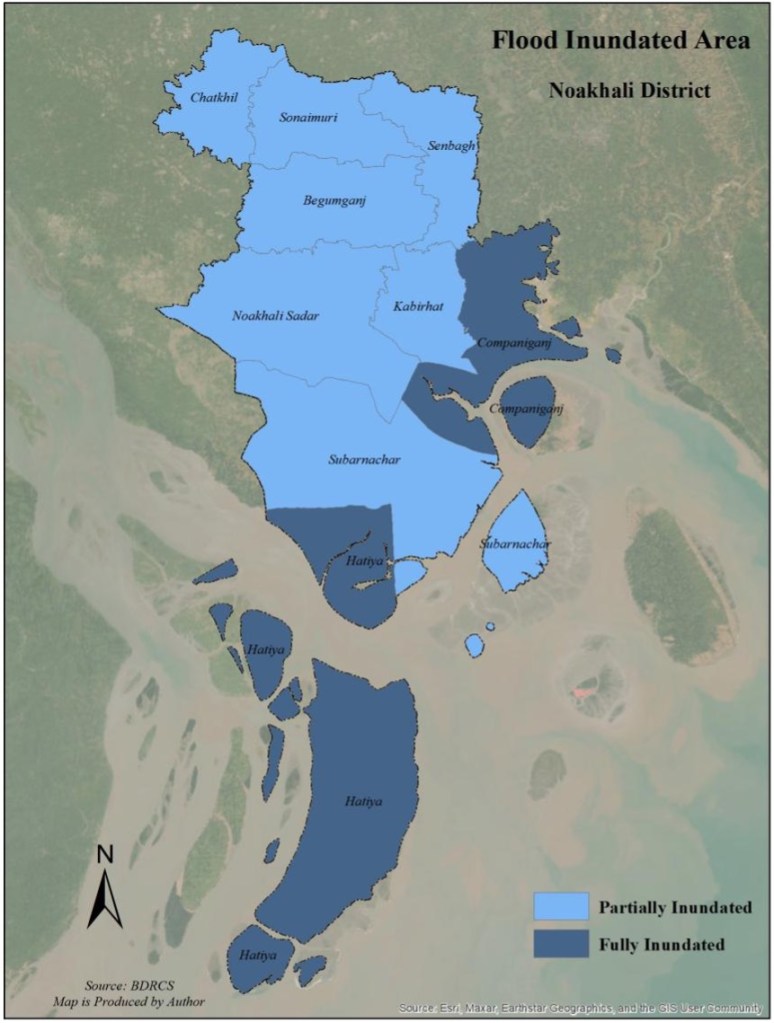
The flood in the Noakhali region was caused by overflow of water from the large catchment areas downstream of the Dumbur Dam. While river channels were not deep enough to accommodate the excess water, unplanned constructions on rivers and canals caused the water to spill into settlement areas causing humanitarian crisis unseen in decades. Kompaniganj and Hatiya upazilas (sub-districts) were completely inundated by floodwaters, while Subarna Char, Sonaimuri, Noakhali Sadar, Kabir Hat, and Senbag upazilas were partially affected. The flooding submerged homes, roads, and marketplaces, with water levels reaching roof levels in the high flood zones, waist-deep in some areas and knee-deep inside most homes. The rising floodwaters devastated farmlands, particularly Aman paddy seedbeds and vegetable fields, swept away, a large number of the cattle, poultry including the sheds which sheltered them.
Current Challenges
The ongoing flood crisis in Bangladesh faces several critical challenges. One of the most immediate issues is the submersion of roads and the disruption of communication networks, which has significantly hindered relief efforts. The situation is fluid, with new districts continuously being affected, complicating the delivery of aid and emergency services to those in need. This has also resulted in delays in evacuations, leaving many communities stranded without access to basic necessities.
Another key challenge is the conflicting information from different meteorological agencies. The Bangladesh Meteorological Department and the Flood Forecasting and Warning Center (FFWC) have issued varying reports regarding upcoming weather conditions. This uncertainty is affecting the preparedness of the affected populations, making it difficult for them to take timely and appropriate measures to protect themselves and their property.
Geo-political Tension in River Management in Bangladesh
Bangladesh, known as one of the most climate-vulnerable nations globally is facing increasing geopolitical challenges due to its strategic location on the Ganges-Brahmaputra Delta. Besides, annual monsoon floods, flash flood, particularly in northeastern districts of Sylhet, Feni and Cumilla, Noakhali are exacerbated by water releases from upstream dams, such as the Dumbur Dam. These actions have intensified tensions between Bangladesh and India, highlighting the complex dynamics of transboundary river management.
Despite legal recognition of rivers as living entities, both nations continue to exploit these water resources through infrastructure projects that disrupt natural river flows. Extensive dam and hydropower projects on shared rivers have caused significant environmental and social injustices downstream, impacting both ecosystems and livelihoods. This situation reflects a broader pattern of unilateral control and inadequate cooperation in water management, which contradicts international agreements and hinders equitable water sharing.
The Bangladesh-India Joint River Commission, established in 1972, is yet to resolve these critical issues. The recent floods have further underscored the need for more effective communication and cooperation between the two nations to prevent future disasters. As calls for water justice grow louder, there is increasing pressure on both countries to remove barriers and ensure the free flow of rivers across borders, upholding the principles of transboundary water governance and protecting the rights of those affected downstream.
Flood Map of Noakhali District, 2024. Map provided by Salma A Shafi
[5] Ministry of External Affairs, in this case Bangladesh.
Salma A. Shafi is an architect and urban planner. She did her MSc. in Urban Planning from AIT, Bangkok, Thailand and has a Bachelor of Architecture (B. Arch.) degree from BUET, Dhaka. Salma Shafi has extensive experience in urban research and consultancy, specialising in urban land use and infrastructure planning, housing and tenure issues. She is a well-known researcher in the field of urbanisation and urban planning. Urban Crime and Violence in Dhaka published by the University Press Limited (2010), Housing Development Program for Dhaka City, Centre for Urban Studies, Dhaka (2008) and Feroza, a biography of her mother published by Journeyman (2021).
.
PLEASE NOTE: ARTICLES CAN ONLY BE REPRODUCED IN OTHER SITES WITH DUE ACKNOWLEDGEMENT TO BORDERLESS JOURNAL
Fakrul Alam writes nostalgically of his visits to Feni in Noakhali, a small town which now suffers from severe flooding due to climate change.
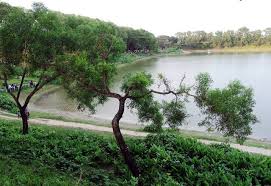
Green Feni, Noakhali Feni flooded due to climate change From Public Domain
Every year, twice a year, during winter and summer vacations, my family would travel to Feni, Noakhali, where we would spend our holidays in our Nana Bari, the home of my Nana, or maternal grandfather.
For days before the journey, our excitement would keep mounting. For one thing, Amma[1] would make frequent trips to Nawabpur, or what was then called Jinnah Avenue, to buy fabrics or wool which she would then sew/darn/weave into clothes or woolens to gift her family members when in Feni. She would also spend more time in the kitchen than usual, cooking as many dishes as she could for my father, the only one of us who would be staying behind since he had his office to attend to; he would join us, if at all, for a few days at the end. For days before she left, Amma would repeat instructions to our household help until, by the time we left, we had memorised what they were supposed to be doing while we were away. Moreover, she would spend the last few days before the journey packing and repacking since she had to ensure that we had everything we needed, not only for the fortnight or so we would spend in Feni, but also for the journey back and forth.
And then, finally, the day of the journey to Feni would arrive! The six of us would board two or three rickshaws in the morning elatedly and head for the railway station in Phulbaria. We would have to thread our way through a platform overflowing with passengers and hangers-on, coolies and vendors, beggars and con-artists, as well as railway police and ticket checkers. Intrepid and inspired, Amma would lead us through the milling and tense crowd. It was as if the whole world was heading for the same interclass compartment; indeed, it seemed that we always managed to reach it just when the train was ready to leave the station.
Eventually, the train would leave Phulbaria and we would relax and feel exhilarated again. Because we did the trip so often, we looked forward to the highlights on the way. Bhairab Bridge, huge and unending, had views of the riverscape that were breathtaking in all seasons and for as long as the train clanged through it we were awestruck. Kasba, the station on the border where Pakistani and Indian troops skirmished frequently throughout the 1960s, was always the place where we tensed up a little. The red hills of Mainamati looked incongruous in the green world of Bangladesh. There were junctions like Brahmanbaria and Laxam, where vendors hawked their wares and cries of “cha gorom[2]” and “deem[3]” filled the air. Although the trip to Feni was supposed to be seven or eight hours long, by the time the train reached Feni station, it would be late in the evening and we would be exhausted, worn out by a journey that seemed to have gone on and on.
Feni in the 1960s was a small mofussil town, and to us Dhakaites, quaintly interesting. Rickshaws were often veiled! The traffic consisted almost entirely of rickshaws and bullock carts; the buildings seemed rickety or run-down, as if someone had forbidden them all to look good or completed or told them not to stand up straight. Although the trip to our Nana Bari from the station was not more than a few minutes by rickshaw, to us, it seemed to take forever; we just couldn’t wait for the journey to end by this time.
But all our fatigue evaporated as soon as our rickshaw took a bend and Nana Bari swung into view, revealing our uncles and aunts waiting eagerly to take us in. Nana, intensely religious at this stage of his life, would often be waiting to greet us with the warmest of smiles before hurrying off to prayer. My Nani[4] would first embrace Amma and the two of them would sniff a little, both overcome by the emotion of the oldest daughter returning home after some months. Then she would hug the five of us turn by turn and dash for the kitchen where she had been supervising the cooking. We would join her there as soon as we had washed and changed so that she could serve us delicious pithas[5] and all sorts of delicacies that Amma could cook in Dhaka only now and then. If it wasn’t too late, Amma’s relatives and friends would drop in, making us feel very important, for everyone wanted to know what we children were doing in school and the details of our Dhaka life. Eventually, we would drop off to sleep in utter exhaustion, but not before our uncles and aunts revealed the plans they had for us for the next few days.
The next few days, in fact, would go in a whirl. If it was summer and the heat was too intense or the rain too heavy, we would play carom or snakes and ladders inside for a while; if there was a cloud cover or only a drizzle outside, we would play hopscotch or football in the courtyard or retreat to the shaded grove in the backyard. Sooner or later, though, we would head for the pond, the centre of our daily rituals. Once we went into the water, we stayed in till Nani and Amma dragged us out for lunch. It was in this pond that we all learned to swim in successive trips; here we floated on banana-trunk rafts for hours and were thrilled at the way my uncles caught fish either with a net or a fishing rod. Sometimes, a tiger-skinned snake would slither past us shushing us instantly until it disappeared. Then we would resume our water games once again. If it was winter, on the other hand, we would stay in bed as long as possible, until the sun was completely up; afterwards, we would head for the courtyard where we would play hopscotch or cricket or go to the farthest reach of our Nana Bari in the plot of land adjacent to the pond, pretending to be picnicking. And then after we had psyched and warmed ourselves adequately we would go to the pond for a quick dip and rush out shivering to dry ourselves and have lunch in the sun.
Some evenings Amma would take us out to visit her relatives. Other evenings, we would go out for strolls. At least one evening we would spend promenading all around the dighi (large tank) around which colonial Feni had grown and where there were dak bungalows and the offices of this sub-divisional town. On one of these evenings, our uncle would take us to the edge of the town to show the old bridge and the massive and ancient banyan tree on the Grand Trunk Road, narrating to us, as we went, the story of how Sher Shah had built it and the bridge hundreds of years ago as part of his plan to administer efficiently the territories he had wrested from the Mughals. On another evening, our uncle would take us to see the ruins of Feni airport, for the town was once one of the key forward bases of the Royal Air Force, even though it would be abandoned at the bend of our history when India was partitioned. At least once during every visit to Feni, we would sneak out to go to see a film, for our now-puritan Nana was known to frown even at the mention of the cinema and would get mad at my uncles and aunts if he came to know where they had taken us.
At night, we would occasionally go to dawats[6]. Once every trip, Nanu would reciprocate by inviting relatives, friends, and even acquaintances she considered important to Nana Bari so that they could also meet us over dinner. On nights when we stayed home all by ourselves, Nana would join us after evening prayers, relaxing and joking with us for at least an hour, and thus remind the other elders of how he had been full of life and a Swadeshi (self-rule) campaigner once, an activist in the cause of one Bengal, but how he had become other-worldly now. Sometimes his stepbrother would visit us, tooting his odd-sounding bicycle horn entirely for our benefit as he came and went, and filling Nana Bari with his booming voice and loud laughter. Nani, too, would join us for a while, finally relaxing after another day of hard work, and would tease us as grandmothers are supposed to do, making us grandchildren feel silly and important at the same time.
Reluctantly, we would go to sleep after dinner; some on beds and some on the mats spread out on the floor. But sleep would take long to come, for we would first review the events of the day or plan for the one that was coming up, exchange secrets in the dark, or whisper stories about the ghosts and robbers that were supposed to be all around Nana Bari.
But we felt totally secure in Nana Bari, wrapped up in the love of my grandparents and uncles and aunts. Every part of the Bari[7] was full of family history. “There,” an aunt would say, “was where you were born!” “Those rooms are where all of us used to live before your Nana decided to extend the house for all you grandchildren,” my Nani would tell us proudly. In time, I began to fill parts of Nana Bari with my own memories too, although I was still a boy. Wasn’t that the room, for instance, where I was painfully initiated into the faith, though the occasion led to a feast in my honour afterwards? Occasionally, we all became part of family history in the making, as an uncle or an aunt got married, or one of us or a cousin had his akika[8] or birthday celebrated, and Nana Bari would then take on a festive air for days.
For the fortnight or so we were in Nana Bari, we were thus completely happy. Little did we know then the financial difficulties my Nana was experiencing due to the religious turn he had taken in old age; the hours he was spending in prayers and meditation meant that other people were taking advantage of him, encroaching on his land and trying to defraud him in business. Little did we know the strain Nani was going through then, running the large family on a reduced budget—Amma had three brothers and seven sisters—for she was always generous with us. Little did we realise that our uncles and aunts had to make do with much less than they had been once used to, for they seemed to be totally indulgent and giving whenever we asked them for anything.
No wonder that when the time to return to Dhaka came we were all quite unhappy. As we departed, Amma (and Nani) cried a lot, this time because mother and daughter knew that they would not be seeing each other for at least another six months, and because every leave-taking now confirmed to them that the first parting was irrevocable. We felt a little sad too. School was something to look forward to, but how could the cramped life we led in the busy city compensate for the freedom and the open spaces and the love swirling all around Nana Bari? The journey back, therefore, would seem uneventful and unending and we would go back to Dhaka a fatigued and melancholy lot.
*
Last year, two of our sisters and I visited Nana Bari for a few hours. My Nana had died in 1970, and my Nani went in 1997; all my uncles and aunts were now in Dhaka or abroad. Nana Bari had shrunk in size, for my uncles had decided to sell parts of it in a strategic move to secure the main house from the machinations of the covetous lot that controls remittance-rich and hooligan-infested Feni. The pond, the shaded groves, and all our favorite haunts were gone and we felt totally depressed at the diminished thing that the Bari had become. Better not to come any more, I told myself, better to keep Nana Bari intact in memory than confront the diminution of the place where more than anywhere else we had once been totally happy. Better to wax nostalgic than be confronted with the ever-increasing intimations of mortality.
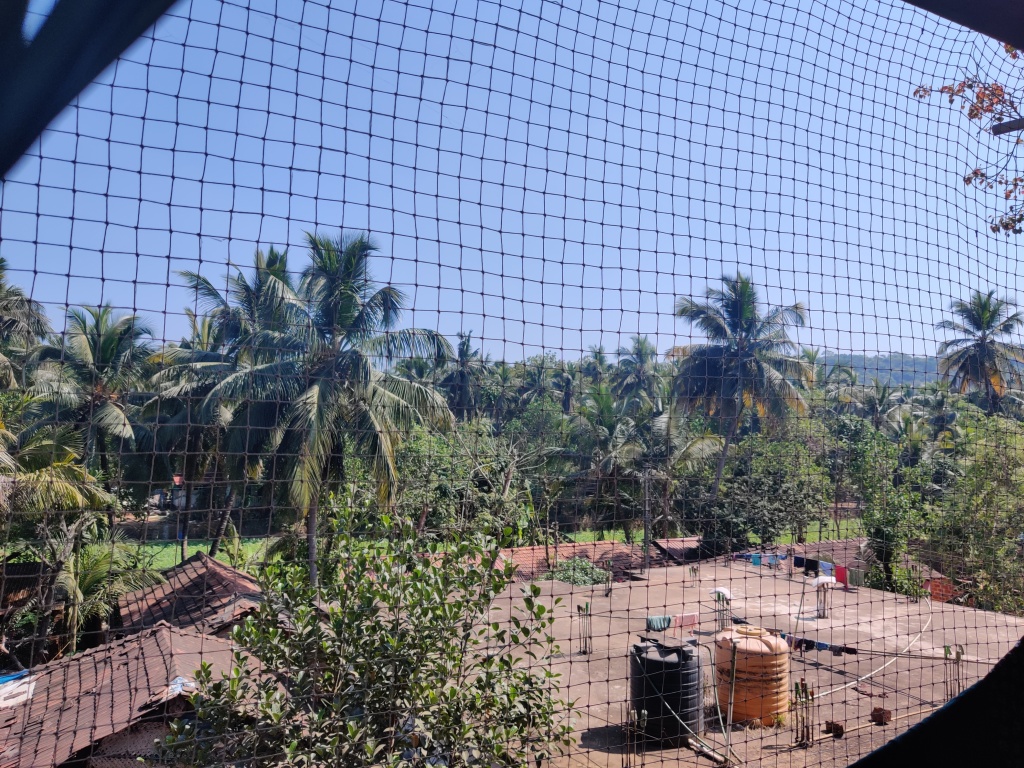
This was her second week in Siolim as a resident, in her aesthetically pleasing, slightly bohemian, rented two bedroom flat. The flat itself gave very tropical vibes with a host of plants – both real and artificial, enhancing the outdoorsy look. Though her building was part of a bigger residential complex, it was miraculously not blocked by views of other buildings. Instead, the windows at both ends of the flat faced east and west, providing stunning views of the morning sky change colour as the sun rose over the dense grove of coconut palms and as if that were not already enough to drive up the rent, a peek of the setting sun, from the opposite end. No less than three spacious balconies with French doors offered an unobstructed view of the quaint sloped roof homes of the ‘locals’, the villagers, bordered by paddy fields beyond.
Except for one house in their midst. From her bedroom balcony that faced east, Anika noticed the one slightly better and bigger home, built with concrete walls and a concrete flat roof, functioning as its terrace. It was not directly opposite but slightly to the right so that she could only see it only from the window or the balcony.
Every morning she would look out in hope of spotting the big fawn dog – the unknown ubiquitous mixed breed — on the terrace. She was always entertained by his movements. He would strut about for a bit, peering over the edge while woofing his alpha dominion over other dogs and cats he spotted. At other times, thinking himself unobserved, he would lie down flat on his back, utterly vulnerable with his legs up in the air, squirming about, tongue lolling, making her laugh.
She had seen the other residents occasionally: two teenage girls who would climb and sit together leaning against the water drum conversing in the evenings as the sky deepened it hues, probably out of the hearing distance of the lady who would sit by herself at the far end staring at the horizon. Anika imagined that this might have been her only place of escape from the endless chores and hubbub of daily life. At other times, a much younger boy of about five followed a slightly older girl, probably his sister (or cousin) of about seven. As she sat to read and do her homework, he would entertain himself skipping about the flat terrace or lolling about on a mattress placed there. After dark, however, the terrace was the domain of the men of the household. Though there were no lights on the roof, the occasional clink told Anika that feni or urak had been smuggled upstairs.
Local families here tended to be ‘joint’ ones with aunts and uncles, siblings and cousins included in the same household. Daily, a slim, capable lady would briskly hang clothes to dry on strings stretched out from stakes. So many clothes every day! The only times Anika didn’t spot too many visitors to the terrace was on extremely sunny days when cotton sheets would be spread out with a brick at each end. They would dry fish on the sheet. She could never identify which of them it was — kokum, shrimp, jambul — from the plethora of spices, fruit and and fish Goans loved to sun dry.
She would have loved procuring some of it straight from them but was still conscious of being the non Goan outsider. She had already experienced all types of opinions. Those who were hypocritical and contradictory – people who welcomed European expats but looked down upon Indians from other states. Those who lamented the growing population due to migration – yet, uncomplainingly, raked in profits from the meteoric growth of the square foot rate. She had also experienced the warmth and hospitality of the majority of the Goans who would go out of their way to help you settle in and make you feel like family.
*
The lady who sat by herself was back today sitting as usual at the very edge. She had the terrace to herself. Something about her intrigued Anika, who realised she had been staring at her instead of being at work on her laptop for the past few minutes. Was it because she was the most frequent visitor? She spent a lot of time staring out over the other end. Or was it because even if others were there, they barely acknowledged her, not even glancing in her direction, or exchanging a friendly word. Likewise, she too ignored them for most part. The only one who paid her any attention was the small boy, too innocent and young to pay heed to family politics, who would wave and go running towards her when he saw her. She seemed to be the family outcast yet was outwardly unperturbed, never getting confrontational, at least on the terrace, from what Anika could observe.
On this day, she was back, presumably ruminating about life. Hailing from a nuclear family herself, Anika mused over the conveniences that a joint family surely had, from shared expenses and chores, to child supervision and upbringing. As she looked at the lady on the terrace, she also thought about the difficulties that living in a large group in a confined space probably entailed, with no privacy, varying opinions and multiple imagined slights.
Today, she seemed restless as she was strolling on the terrace. Anika stepped out onto the balcony to get a closer look. The south-west corner of the terrace with the water drums was the closest point to her balcony. The lady was whiling away time by walking along the perimeter of the terrace. As she wandered closer to the south-west corner, Anika finally got a good look at her.
Her personality was apparent even from this distance, from the way she held her body upright to the confident yet feminine walk. She was neither slim nor thickset but somewhere in between. There was a certain sophistication to her gait. Anika watched as she turned the corner and continued her solitary stroll around the edge of the terrace.
*
The sound of loud arguments in male and female voices interrupted her work the next morning – the family members had reached the downward curve in the sine wave of highs and lows of joint family existence. Adding to the cacophony was a girl’s full-throated wail. Perhaps a fall, burn or injury, with the elders blaming each other for the oversight?
The staircase that the family used to ascend was on the far east side and never visible to Anika. She now saw a small head make an appearance at the flat edge followed by the body of the boy who had climbed up unobserved. His sister as the designated minder was the injured one then. He looked for the assortment of toys that always lay in a heap in one corner of the terrace. Soon he was revving the toy car and following it about as it raced forward a few feet. Anika was a little concerned and stepped out to the balcony. What if the child wandered too close to the edge? The roof edge was unprotected by any railing or boundary wall. She stood undecided and hoped that someone else would arrive soon. That’s when she saw the lady walk towards the boy. Anika sighed in relief. She had probably been sitting, leaning against the other side of the water tanker, that’s why she hadn’t spotted her. The boy would point the car in her direction and she would then send the car revving back to him. The game continued until she heard shouts and the mother climbed halfway up the stairs gesturing at them to come down. The lady and the boy complied. Anika noticed that as usual she didn’t convey her gratitude either by gesture or a word to the lady who had kept a watchful eye over him. She wondered what had caused the breach in their relations and felt the lady deserved at least some acknowledgement. Maybe she sensed her empathy because suddenly she turned and looked directly at Anika. Anika felt a voyeuristic warmth flush her ears and stepped back inside her bedroom.
*
Anika noticed over the next few days that the lady had started sitting closer to the south-west edge, closest to her balcony. She would occasionally glance towards Anika. Her eyes were dark, so dark that you couldn’t distinguish the iris from the pupil. Anika felt a little sorry for her unfortunate circumstances. The only time she noticed her smile was on the rare occasions the boy wandered onto the terrace alone. With nobody to stop him from interacting with her, he would sit beside her presumably listening to stories or they would chase each other.
Anika wondered why she didn’t leave this house – perhaps she had no independent income. Anika had been doing the cleaning herself in her apartment but now she took a decision.
*
Anika stood at the gate of the concrete house. One of the teenage girls came to the gate. Anika did not know Konkani, the local language, but it had similarities to Marathi and with that including a mix of Hindi and basic English, conveyed that she was looking for a daily help to sweep and mop the floors, do the dishes and some light dusting. Would anyone from this household be interested? “Okay! I tell to my mother, give me house number,” she replied. As she wrote down the apartment number behind a schoolbook she had got from inside, Anika tried to find a diplomatic way to say that the sturdy looking lady on the terrace who played with her younger brother would be better for this kind of a job instead of anyone else from the household. However, as the girl looked at her uncomprehendingly, she realised that this was a task beyond her communicative abilities and left.
*
It was not quite dusk when her doorbell rang. The younger, slimmer lady Anika had seen so many times on the terrace, stood at her doorstep. Julie spoke English quite well and understood it even better. Anika took her on a brief tour of the flat stopping at the balcony that overlooked her house. “I really enjoy your dog’s antics early in the morning!” she said, to break the ice. Julie laughed.
Anika noticed that the boy had found his way onto the roof again and was lying on his stomach with his head in his hands, absorbed in the story the lady was no doubt telling him. She sat cross legged in front of him, using gestures and making faces while telling the story, hugely entertaining him. Julie noticed them and her face changed to a scowl.
Anika gestured towards them, “What about her? Doesn’t she need a job? I have seen her on the terrace by herself so many times. She doesn’t seem to be as busy as you are — that’s why I approached your house to look for help.”
“Who? Her? Sheela?” Julie looked thunderous. “Look at her! Wasting time, always sitting on the terrace!”
Anika’s face looked a question. “Well, she seems to look after the boy so well.”
Julie turned towards her – the scowl changing to a confused look. “Her boy? How long have you stayed here?”
“Oh, this is my just my fifth week.” And now, leaping to her defence, Anika continued, “I’ll tell you something you don’t know, that boy has come to the terrace so many times on his own and if it were not for Sheela’s presence, God knows what accident might have happened! Why do you all treat her so badly? Look, even now only she is there with him on the terrace, no one else is supervising him!”
I knew I had probably crossed a line with this as it was none of my business to comment on their affairs.
Julie was struck dumb by my outburst, but her eyes changed. The anger was fading. “Boy?” she repeated. “She lost her five-year-old son three months ago. He drowned in the well behind the house.”
The anger had faded completely from Julie’s eyes to be replaced with fear. “Look at her — she keeps playacting like she’s doing now, as if she is talking to him and can see him, scaring the children — that’s why we argue. She spends all her time sitting on the terrace from where she can watch the well.”
Anika turned back to the terrace. Sheela had noticed them watching her and walked closer. She looked up at Anika with an appeal in her liquid black eyes, almost as if to say, “You can see him too, can’t you?”
.
Rakhi Pande, an experienced education professional, transitioned from a brand management career to become an award-winning teacher and school leader. An avid reader, she tries to write whenever time permits.www.linkedin.com/in/rakhi-pande
.
PLEASE NOTE: ARTICLES CAN ONLY BE REPRODUCED IN OTHER SITES WITH DUE ACKNOWLEDGEMENT TO BORDERLESS JOURNAL.


 Borderless