Categories
Contents

Borderless, May 2025

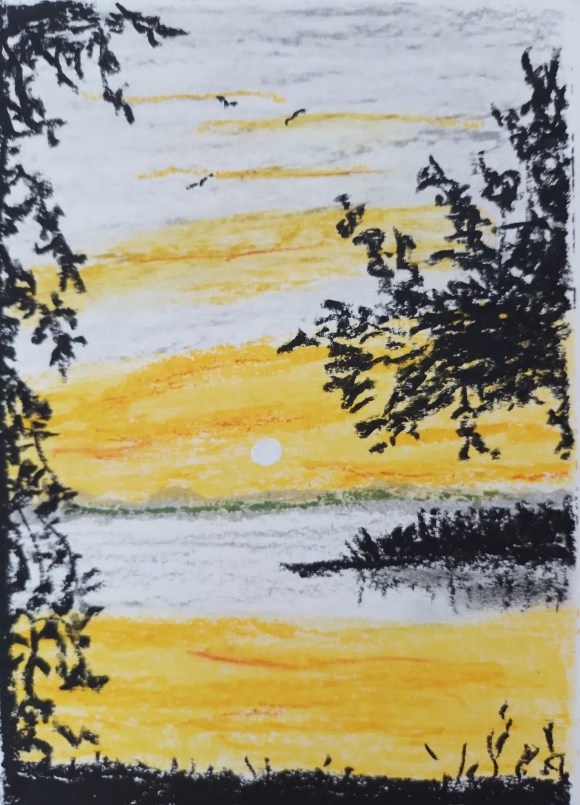
Art by Sohana Manzoor

Editorial

“Imagine all the people/ Living life in peace”… Click here to read.

Translations

The Day of Annihilation, an essay on climate change by Kazi Nazrul Islam, has been translated from Bengali by Radha Chakravarty. Click here to read.

Arise O Woman and Two Flowers on One Leafstalk, lyrics by Nazrul, have been translated from Bengali by Professor Fakrul Alam. Click here to read.

Five poems by Bipin Nayak have been translated from Odia by Snehaprava Das. Click here to read.

Identity by Munir Momin has been translated from Balochi by Fazal Baloch. Click here to read.

Among Strangers, a poem by Ihlwha Choi  has been translated from Korean by the poet himself. Click here to read.

Asha or Hope by Tagore has been translated from Bengali by Mitali Chakravarty. Click here to read.

Poetry

Click on the names to read the poems

Ryan Quinn Flangan, Jim Bellamy, Snehprava Das, George Freek, Niranjan Aditya, Christine Belandres, Ajeeti S, Ron Pickett, Kajoli Krishnan, Stuart McFarlane, Snigdha Agrawal, Arthur Neong, Elizabeth Anne Pereira, Rhys Hughes

Poets, Poetry & Rhys Hughes

In Did He Ever?, Rhys Hughes gives fun-filled verses on Lafcadio Hearn, a bridge between the East and West from more than a hundred years ago. Click here to read.

Musings/ Slices from Life

Will Dire Wolves Stalk Streets?

Farouk Gulsara writes of genetic engineering. Click here to read.

The Boy at the Albany Bus Stop

Meredith Stephens dwells on the commonality of human emotions. Click here to read.

The Word I Could Never Say

Odbayar Dorj muses on her own life in Mongolia and Japan. Click here to read.

Social Media Repetition

Jun A. Alindogan discusses the relevance of social media. Click here to read.

Shanghai in Jakarta

Eshana Sarah Singh takes us to Chinese New Year celebrations in Djakarta. Click here to read.

Musings of a Copywriter

In My Writing Desk, Devraj Singh Kalsi writes of the source of his inspiration. Click here to read.

Notes from Japan

In Feeling Anxious in Happy Village, Suzanne Kamata relates a heartwarming story. Click here to read.

Essays

Reminiscences from a Gallery: The Other Ray

Dolly Narang muses on Satyajit Ray’s world beyond films and shares a note by the maestro and an essay on his art by the eminent artist, Paritosh Sen. Click here to read.

This Garden Calls Out to Me: A Flaneur in Lucknow’s Sikandar Bagh

Prithvijeet Sinha takes us back to a historical landmark, made for love but bloodied by war. Click here to read.

Stories

Going to Meet the Hoppers

Fiona Sinclair writes a layered story on human perspectives. Click here to read.

The Ritual of Change

Parnika Shirwaikar explores the acceptance of change. Click here to read.

The Last Metro

Spandan Upadhyay explores the spirit of the city of Kolkata. Click here to read.

Nico Finds His Dream

Paul Mirabile narrates how young Nico uncovers his own yearnings. Click here to read.

The Bequest

Naramsetti Umamaheswararao gives a story reflecting a child’s lessons from Nature. Click here to read.

Conversation

Ratnottama Sengupta introduces and converses with photographer, Vijay S Jodha. Click here to read.

Book Excerpts

An excerpt from Devabrata Das’s One More Story About Climbing a Hill: Stories from Assam, translated by multiple translators from Assamese. Click here to read.

An excerpt from Ryan Quinn Flangan’s Ghosting My Way into the Afterlife. Click here to read.

Book Reviews

Somdatta Mandal reviews Arundhathi Nath‘s translation, The Phantom’s Howl: Classic Tales of Ghosts and Hauntings from Bengal. Click here to read.

Andreas Giesbert reviews Rhys Hughes’ The Devil’s Halo. Click here to read.

Bhaskar Parichha reviews Aubrey Menen’s A Stranger in Three Worlds: The Memoirs of Aubrey Menen. Click here to read.

.

Click here to access the Borderless anthology, Monalisa No Longer Smiles

Click here to access Monalisa No Longer Smiles on Amazon International

Categories
Editorial

“Imagine all the people/Living life in peace”

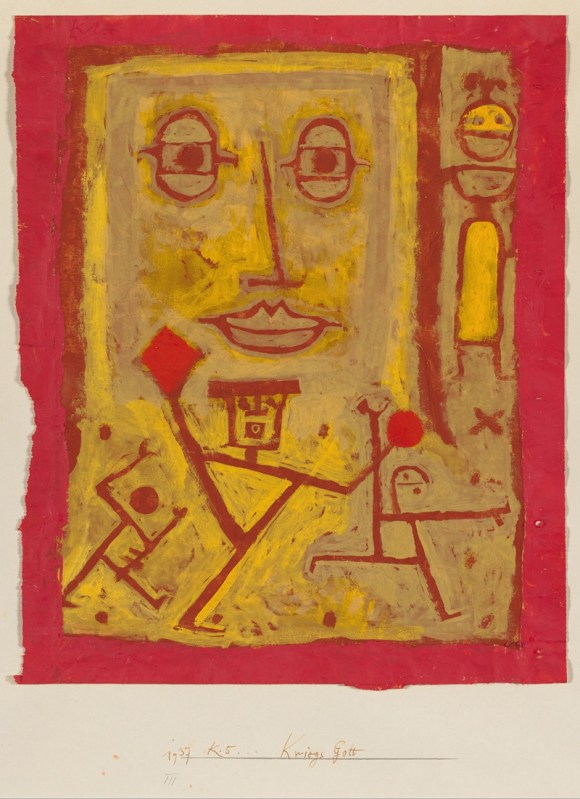
God of War by Paul Klee (1879-1940)
The sky weeps blood, the earth cannot contain
The sorrow of the young ones we've slain.
How now do dead kids laugh while stricken by red rain?

— from Stricken by Red Rain: Poems by Jim Bellamy

When there is war
And peace is gone
Where is their home?
Where do they belong?

— from Poems on Migrants by Kajoli Krishnan

Poetry, prose — all art forms — gather our emotions into concentrates that distil perhaps the finest in human emotions. They touch hearts across borders and gather us all with the commonality of feelings. We no longer care for borders drawn by divisive human constructs but find ourselves connecting despite distances. Strangers or enemies can feel the same emotions. Enemies are mostly created to guard walls made by those who want to keep us in boxes, making it easier to manage the masses. It is from these mass of civilians that soldiers are drawn, and from the same crowds, we can find the victims who die in bomb blasts. And yet, we — the masses — fight. For whom, for what and why? A hundred or more years ago, we had poets writing against wars and violence…they still do. Have we learnt nothing from the past, nothing from history — except to repeat ourselves in cycles? By now, war should have become redundant and deadly weapons out of date artefacts instead of threats that are still used to annihilate cities, humans, homes and ravage the Earth. Our major concerns should have evolved to working on social equity, peace, human welfare and climate change.

One of the people who had expressed deep concern for social equity and peace through his films and writings was Satyajit Ray. This issue has an essay that reflects how he used art to concretise his ideas by Dolly Narang, a gallery owner who brought Ray’s handiworks to limelight. The essay includes the maestro’s note in which he admits he considered himself a filmmaker and a writer but never an artist. But Ray had even invented typefaces! Artist Paritosh Sen’s introduction to Ray’s art has been included to add to the impact of Narang’s essay. Another person who consolidates photography and films to do pathbreaking work and tell stories on compelling issues like climate change and helping the differently-abled is Vijay S Jodha. Ratnottama Sengupta has interviewed this upcoming artiste.

Reflecting the themes of welfare and conflict, Prithvijeet Sinha’s essay takes us to a monument in Lucknow that had been built for love but fell victim to war. Some conflicts are personal like the ones of Odbayar Dorj who finds acceptance not in her hometown in Mongolia but in the city, she calls home now. Jun A. Alindogan from Manila explores social media in action whereas Eshana Sarah Singh takes us to her home in Jakarta to celebrate the Chinese New Year! Farouk Gulsara looks into the likely impact of genetic engineering in a world already ripped by violence and Devraj Singh Kalsi muses on his source of inspiration, his writing desk. Meredith Stephens tells the touching story of a mother’s concern for her child in Australia and Suzanne Kamata exhibits the same concern as she travels to Happy Village in Japan to meet her differently-abled daughter and her friends.

As these real-life narratives weave commonalities of human emotions, so do fictive stories. Some reflect the need for change. Fiona Sinclair writes a layered story set in London on how lived experiences define differences in human perspectives while Parnika Shirwaikar explores the need to learn to accept changes set in her part of the universe. Spandan Upadhyay explores the spirit of the city of Kolkata as a migrant with a focus on social equity. Both Paul Mirabile and Naramsetti Umamaheswararao write stories around childhood, one set in Europe and the other in Asia.

As prose weaves humanity together, so does poetry. We have poems from Jim Bellamy and Kajoli Krishnan both reflecting the impact of war and senseless violence on common humanity. Ryan Quinn Flanagan introduces us to Canadian bears in his poetry while Snigdha Agrawal makes us laugh with her lines about dogs and hatching Easter eggs! We have a wide range of poems from Snehprava Das, George Freek, Niranjan Aditya, Christine Belandres, Ajeeti S, Ron Pickett, Stuart McFarlane, Arthur Neong and Elizabeth Anne Pereira. Rhys Hughes concludes his series of photo poems with the one in this issue — especially showcasing how far a vivid imagination can twist reality with a British postman ‘carrying’ sweets from India! His column, laced with humour too, showcases in verse Lafcadio Hearn, a bridge between the East and West from more than a hundred years ago, a man who was born in Greece, worked in America and moved to Japan to even adopt a Japanese name.

Just as Hearn bridged cultures, translations help us discover how similarly all of us think despite distances in time and space. Radha Chakravarty’s translation of Kazi Nazrul Islam’s concerns about climate change and melting icecaps does just that! Professor Fakrul Alam’s translation of Nazrul’s lyrics from Bengali on women and on the commonality of human faith also make us wonder if ideas froze despite time moving on. Tagore’s poem titled Asha (hope) tends to make us introspect on the very idea of hope – just as we do now. At a more personal level, a contemporary poem reflecting on the concept of identity by Munir Momin has been translated from Balochi by Fazal Baloch. From Korean, Ihlwah Choi translates his own poem about losing the self in a crowd. We start a new column on translated Odia poetry from this month. The first one features the exquisite poetry of Bipin Nayak translated by Snehprava Das. Huge thanks to Bhaskar Parichha for bringing this whole project to fruition.

Parichha has also drawn bridges in reviews by bringing to us the memoirs of a man of mixed heritage, A Stranger in Three Worlds: The Memoirs of Aubrey Menen. Andreas Giesbert from Germany has reviewed Rhys Hughes’ The Devil’s Halo and Somdatta Mandal has discussed Arundhathi Nath’s translation, The Phantom’s Howl: Classic Tales of Ghosts and Hauntings from Bengal. Our book excerpts this time feature Devabrata Das’s One More Story About Climbing a Hill: Stories from Assam, translated by multiple translators from Assamese and Ryan Quinn Flangan’s new book, Ghosting My Way into the Afterlife, definitely poems worth mulling over with a toss of humour.

Do pause by our contents page for this issue and enjoy the reads. We are ever grateful to our ever-growing evergreen readership some of whom have started sharing their fabulous narratives with us. Thanks to all our readers and contributors. Huge thanks to our wonderful team without whose efforts we could not have curated such valuable content and thanks specially to Sohana Manzoor for her art. Thank you all for making a whiff of an idea a reality!

Let’s hope for peace, love and sanity!

Best wishes,

Mitali Chakravarty

borderlessjournal.com

Click here to access the contents page for the May 2025 Issue

READ THE LATEST UPDATES ON THE FIRST BORDERLESS ANTHOLOGY, MONALISA NO LONGER SMILES, BY CLICKING ON THIS LINK.

Categories
Excerpt

One More Story About Climbing a Hill

Title: One More Story About Climbing a Hill: Stories from Assam

Author: Devabrata Das (translated from Assamese by multiple translators)

Publisher: Speaking Tiger Books

1. A Night with Arpita

(‘Arpitar Erati’ translated by Meenaxi Barkotoki)

The side berth was created by lowering the back rests of the two single seats along the aisle of the compartment. Crouching in one corner of that berth, chin in her hands, eyes looking out of the window, could the expression on her face be called disinterest, or was it heartache? On the other hand, she had not the slightest curiosity about what was going on inside the compartment. Drawing the free end of her sari tightly around the upper half of her body, she had withdrawn even her feet into the cavity created by her sari. Her presence in the compartment seemed more like an absence. She seemed completely oblivious and unaware of her surroundings; her look betrayed a sense of resignation. Or perhaps of surrender.

Having positioned myself in the compartment, the sense of resignation that was evident in her demeanour attracted me to her the very first time that I looked at her attentively. I told myself that if I wrote a story someday on the girl, I would name her Arpita (the one who offers herself). Arpita what? Ganguly or Acharya, Roy or Majumdar? Because on hearing the Hindi strewn with Bengali words spoken by the girl’s father, (who had complained animatedly to the waiter about the stale fish served for the meal) I was certain that the girl was not an Assamese disguised in a sari, she was actually Bengali. Regardless of whether she was Assamese or Bengali, she was just a girl, a more or less pretty girl, and she was presently in another world, completely oblivious to her surroundings. Her entire being was concentrated on a point in the darkness of the world outside the compartment, a point that could easily be defined as infinity. Her absentminded beauty aroused my curiosity. Puffing at my Charminar cigarette I kept staring at her from my middle berth in the three-tiered compartment. Just then Kiran returned from the bathroom and broke my reverie. ‘What is this? Why are you already in bed? You don’t mean to go to bed so early, do you?’

This story is actually the story of Arpita and me. I am the protagonist, Arpita the heroine. Apart from the two of us, there is no need for anyone else in this story. The problem, however, is that in order to be able to describe the chain of events, the inclusion of some redundant characters becomes necessary; their presence in the story is not essential but without them it is difficult to narrate what happened. Among those extras, unnecessary characters actually, one is my friend Kiran Debnath. We work in the same office and it is on official work that both of us are travelling by train to another city. We had to travel at very short notice, so we had no reserved train seats; hence the second unnecessary character, Krishna, became necessary. Krishna lives in our neighbourhood. A young man barely out of his teens, he had recently joined the NF Railway as Travelling Ticket Inspector, in short TTI. The moment I saw him at the train station, I was relieved; we wouldn’t have to travel in the crowded, unreserved compartment after all. Since Krishna was there, with his help we would get at least two sitting seats for ourselves. But luckily there was not a huge rush that day and after doing the rounds, Krishna arranged two sleeping berths in a three-tier compartment for us. The sleeper charges for a night are five rupees fifty paise each, so eleven rupees in all. I gave him three five-rupee notes. He forgot to return the change. A little while after the train started, another uniformed ticket checker came and wrote out our reservation slips. The fourth unnecessary character in this story is Arpita’s father, who, after finishing the long and animated argument with the waiter about the stale fish served for dinner, turned his attention to his daughter. She was still staring out of the window. He told her to lie down and go to sleep, and gave her other sundry bits of advice, all of which were met with monosyllabic answers. He then climbed onto the upper berth, above his daughter. In a little while, his snoring proved that he was fast asleep. This is the last time I will mention these unnecessary characters, except for Kiran.

I told Kiran that we had a lot to do the next day. We would have to go through all the documents and records of our branch office in the town we were travelling to. It was not clear whether we would have any free time at all. So instead of sitting up chatting till late in the night, since we had secured two sleeping berths, it might be wiser to go to sleep. Like a good boy, Kiran agreed immediately and went to sleep in the berth below me. To tell the truth, I was not at all sleepy. If I had wanted to or if we were somewhere else, I would have easily chatted with Kiran for an hour or two. But at that moment, in that situation, the single-minded desire to enjoy the distracted attractiveness of a beautiful girl made me give up the wish to chat with Kiran.

Arpita sat immersed in herself on the rattling train, on that otherwise still night, ignoring the silent presence of the many other passengers sleeping in the compartment. No exam results had been declared recently. Then why was Arpita so unwaveringly distracted and sad? Was her pain intensely personal? For instance, had some sly lover cheated her and gone away, after having made a thousand promises of many-hued rainbows and eternal love? Or was there some complication in her recent wedding proposal? Had the partner that her parents chose for her, seen and approved of her but demanded a huge dowry, which made it completely impossible for her to leave her parents’ home? What could it be? What was her real story?

(Extracted from One More Story About Climbing a Hill: Stories from Assam by Devabrata Das, Published by Speaking Tiger Books, 2025.)

About the Book:

 In ‘A Night with Arpita’, a beautiful young girl in a train compartment captures the imagination of the writer—but he is unable to fathom the reason for her melancholy until it is too late. In ‘Ananta with His Seema’, three apparently disconnected incidents take place on a railway platform. Descriptions of the incidents are interspersed with passages from a letter written by Ananta’s friend, that lays bare his helplessness in the face of injustice and the loss of his youthful ideals.

In the eponymous story, life imitates art with a disastrous twist. A young couple treks up a hillside to recreate for themselves the experience of two characters in a love story set in idyllic Shillong. But the beauty of the pine shrouded hills is marred by extremist violence and their climb to the top of the hill has an unforeseen, macabre end.

Each of the eighteen stories, translated by multiple translators, in this collection provides an insight into life in an area of conflict, told with irony and ingenuity. Regarded as a torchbearer of post-modernism in Assamese literature, Das is often a character in his stories, blurring the distinction between writer and narrator and, often, between fiction and reality, leaving readers to construct their own endings. This first English translation of his work is a valuable addition to the pantheon of India’s regional literature.

About the Author

Devabrata Das is considered to be a torchbearer of post-modernism in Assamese literature, following in the footsteps of other great Assamese writers such as Saurav Kumar Chaliha and Bhabendra Nath Saikia. With more than twenty-five bestselling books to his credit in a career spanning more than four decades, his repertoire ranges from fiction to non-fiction, and from screenplays to reviews and critical essays. He received the Sahityarathi Lakshminath Bezbarua Award in 2018, the Sahitya Sanskriti Award of the literary organization Eka Ebong Koekjan in 2010, and the Tagore Literature Award of the Sahitya Akademi in 2011.

About the Translator

Meenaxi Barkotoki is a mathematician turned anthropologist by profession. An avid translator from Assamese into English, her most recent work includes a couple of novels, notably a children’s novel by Arupa Patangia Kalita titled Taniya (Puffin Classics, 2022). Her translations have appeared in newspapers and periodicals as well as in prestigious compilations like The Oxford Anthology of Writings from North-East India (OUP, 2011) and in Asomiya Handpicked Fictions (Katha, 2003). She also writes short stories, travel pieces and current interest articles, and her work has been published in newspapers, journals and magazines. She is a Founding Member of the North East Writers’ Forum.

.

PLEASE NOTE: ARTICLES CAN ONLY BE REPRODUCED IN OTHER SITES WITH DUE ACKNOWLEDGEMENT TO BORDERLESS JOURNAL.