By Farouk Gulsara
I learnt early that life is never fair. They say time and tide wait for no man, moving along their own trajectory.
I heard money solves all problems or at least eases the pain of tough times. There was a time I ventured into saving mode. I started my own piggy bank, dropping in a coin almost daily into a plastic-mould chick figurine. I patted myself on the back as the clink of coins became louder and louder. It was not much, but every jingle reminded me of the value of money and the comfort it would provide me one day. The trouble was that my sisters were equally pleased that my coffers were filling to the brim. They began needling out coin after coin to finance their addiction of buying little treats. I felt frustrated. I knew saving was hard, but I never expected reaching my goal to be so difficult. My sisters’ malfeasance came to light one day when I noticed that the piggy bank had been displaced away from its usual place, tucked behind my nice shirts. That was when I confronted my sisters.
In my eyes, I did nothing wrong. Instead of admonishing my sisters and compensating for my loss, Amma claimed it was my fault. She taught me the harsh truths of life. It was my responsibility to safeguard my property, not anyone else’s. After that realisation, I sought out other ways to save money.
Then, I had a new group of friends. I joined a competitive group of classmates who wanted to excel academically. I thought that would be easy. I devoted all my time to studying and paying attention in class. It seemed easy, but it was a different story when the examination results were released. It was the class jester, for whom everything was a joke, who came out on top. Another valuable lesson I learnt was not just to study hard, but to study smart.
As I grew older and the screaming radio became a constant background to my daily life, I realised that the world was not a peaceful place. On one hand, songs promised a tranquil world of apple trees and honeybees[1]; from the same country, they sent tanks and bombs to annihilate each other. It seemed that the Vietnam War would never end. Peace in the Middle East was merely a pipe dream.
Amidst all that, a hippie song emerged, envisioning a world without boundaries, an airspace free from control, and a peaceful existence [2]. It instilled a sense of hope that life might indeed have something to look forward to after all. The image of two figures dressed entirely in white playing a white grand piano remains permanently etched in my mind as the beacon of hope that one day everything will be all right. And life went on.
After many years of burning the midnight oil and reaping bitter seeds, its sweet fruit finally emerged. Yet, all my classmates who were partying and living life to the full had already gained a head start in their careers. They had ascended the ladders of their professions and were cruising around in flashy cars, while I was starting as an intern with little to show except a few letters behind my name. The competitive streak within me, however, reassured me that academic excellence is superior to the acquisition of wealth.
I continued my healing work, convincing myself that what I was doing would be returned in kind and that I would receive blessings of a different kind. As time passed, I realised that those were merely comforters to soothe a colicky baby. The old adage ‘health is wealth’ was a fallacy. In the real world, wealth buys health, just as one gets justice with all the money one can afford to pay for legal services. The youthful cry of ‘Can’t Buy Me Love’ [3] was another lie. Money buys everything, and it feels better to cry in a BMW than by the footpath of the street.
So, there I was, thinking that if I were to follow the ways prescribed by the elders, I would be all right. “Tell no lies.” They said. “Speak only the truth!” Then there were people who made lying— or they would call it ‘bending the truth’— the pillar of their profession. “Don’t be materialistic, look at humanity!” Tell that to the stockholders who do not take it kindly when the conglomerate shows high praises and blessings but announces no monetary returns in dividends. For one thing, even big countries help each other not for altruistic reasons but for geopolitical and economic interests. There is no such thing as a free lunch. Everything comes with its encumbrances.
I was advised not to fight back but to turn the other cheek. Yet, behind my back, the world has regarded me as a fall guy, and I was merely a useful idiot—someone they could blame for all their wrongdoings because I was naïve enough to admit my mistakes. Now my friends urge me to strike before the other party draws first blood and to never admit to any wrongdoings.
As human beings, we yearn for a world without conflict. We all desire peace of mind—a world where everyone follows a single prescribed path, where everything falls into place, a utopia in which one person sees another not by the colour of their skin or the tunic they wear, but by the strength of their character. Most prayers we offer to a higher being invariably end with ‘Peace on Earth’ or ‘Happiness for All’. Prayers like ‘Sarve Bhavantu Sukhinaha‘ [4] and ‘Om Shanti‘ [5] assume that everyone can have things their way at one given time, creating a win-win situation. Such a situation can only exist in our imagination. Regardless of what everyone else says, life is a zero-sum game. For someone to win, another must lose, somewhere, somehow. For the lion colony to be happy, a goat must be sacrificed. Contentment is achieved when we acknowledge our limitations and accept that sometimes things do not go in our favour. Outcomes may improve if we recognise that we can only do so much.
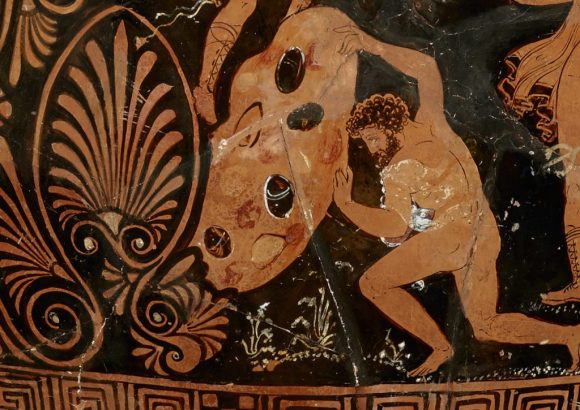
An Earth without conflict is a pipe dream. The natural course of events is entropy interspersed with instances of chaos and order. One can choose to adopt a nihilistic view of our existence and do nothing, or be like Sisyphus [6] — resigned to the fact that we are in a hopeless situation — but strive to find joy in setting small targets and achieving modest successes, filling our hearts with laughter and happiness during the lull before the storm, and endeavour to leave a better future for the next generation.
When everyone found it impossible to carry a big load, the human mind devised the wheel. When the greener pastures across the lake obsessively stirred the curious, it took one brave young man with the imagination to make a raft of fallen tree trunks. Hope springs eternal in the human breast[7]. The change we want the world to embody starts with the man in the mirror. Numerous social experiments have repeatedly shown that doing a kind gesture is contagious. One good turn deserves another. No good deed remains unreturned. We can try.
[1] A verse from The New Seekers’ “’I’d Like To Teach the World to Sing” became a jingle for Coca-Cola later.
[2] John Lennon’s most successful solo single, ‘Imagine’, envisions a world of peace without materialism, without borders separating nations, and without religion.
[3] The Beatles’ 1964 hit ‘Can’t Buy Me Love’ is a McCartney composition that naively preaches that true love cannot be bought. In the later stages of his life, McCartney discovered the hard way that divorce, without a pre-nuptial agreement for someone of his stature, could be financially draining. Money can’t buy love, but falling out of it can be costly.
[4] Sanskrit for ‘May all be happy’
[5] Sanskrit for ‘Peace’
[6] In Greek mythology, Sisyphus was a shrewd king. The gods condemned him to roll a boulder up a hill for eternity, only to see it roll down again after reaching the summit. Albert Camus, in his book ‘The Myth of Sisyphus,’ implies that Sisyphus was happy. He found performing and completing the act itself meaningful. He gave meaning to the meaningless.
[7] “Hope springs eternal in the human breast,” an excerpt from Alexander Pope’s poem “An Essay on Man.”
.
Farouk Gulsara is a daytime healer and a writer by night. After developing his left side of his brain almost half his lifetime, this johnny-come-lately decided to stimulate the non-dominant part of his remaining half. An author of two non-fiction books, Inside the twisted mind of Rifle Range Boy and Real Lessons from Reel Life, he writes regularly in his blog, Rifle Range Boy.
.
PLEASE NOTE: ARTICLES CAN ONLY BE REPRODUCED IN OTHER SITES WITH DUE ACKNOWLEDGEMENT TO BORDERLESS JOURNAL
Click here to access the Borderless anthology, Monalisa No Longer Smiles
Click here to access Monalisa No Longer Smiles on Kindle Amazon International


 Borderless