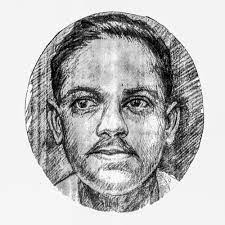
Jibananada Das (1899-1954) was a Bengali writer, who now is named as one of the greats. During his life he wrote beautiful poetry, novels, essays and more. He believed: “Poetry and life are two different outpouring of the same thing; life as we usually conceive it contains what we normally accept as reality, but the spectacle of this incoherent and disorderly life can satisfy neither the poet’s talent nor the reader’s imagination … poetry does not contain a complete reconstruction of what we call reality; we have entered a new world.”
ONE DAY IN THE FOG...(“Akdin Kuashai” from Ruposhi Bangla)
I well know a day will come when you won’t find me in this foggy field
Having ended its walks, the heart will move on to a silent, icy room then
Or perhaps it will be a while before it can be consoled. It may take time
For it to forget this earthly field. In astonishment, I’ll keep looking
At the shaliks of the field from my bed in darkness. Will golden eagles
Still unfurl their wings and waft their way to this fog-filled field from afar?
To this day they head for bare ashwath branches as evening turns golden.
While through the soft rice stalks field mice still keep looking at the stars
As evening descends. Do bees still not build hives in intense dense darkness?
Having their fill of honey, don’t they fly away in the foggy, evening wind?
So far they must fly to, alas…or perhaps hemmed by chalta leaves
Some get trapped under hives. The flies fly away…drop… die in the grass—.
IF LIFE WERE ETERNAL…

Given the boon of eternity, I would walk the ways of the world eternally.
All, all alone -- what if I would see lush green grass in full bloom then?
And what if I beheld the yellowing grass withering away -- And view
The sky full of wan white clouds at dawn? Like a tattered munia bird
Blood reddened breast in the evening -- I would see the stars repeatedly;
I would see an unknown woman’s hair drifting away from a loosened bun;
A woman who would leave -- with a face bereft of the evening sun’s glow.
Jibonanada Das (1899-1954) was a Bengali writer, who now is named as one of the greats. During his life he wrote beautiful poetry, novels, essays and more. He believed: “Poetry and life are two different outpouring of the same thing; life as we usually conceive it contains what we normally accept as reality, but the spectacle of this incoherent and disorderly life can satisfy neither the poet’s talent nor the reader’s imagination … poetry does not contain a complete reconstruction of what we call reality; we have entered a new world.”
Professor Fakrul Alam takes us through the three Partitions of Bengal whichultimately led to the creation of Bangladesh, with focus on the role of Dhaka University. Click hereto read.
Professor Fakrul Alam brings to us Tagore songs in translation and in discussion on the season that follows the scorching heat of summer months. Clickhere to read.
Fakrul Alam writes nostalgically of his visits to Feni in Noakhali, a small town which now suffers from severe flooding due to climate change. Click here to read.
Giraffe’s Dad by Tagore: Giraffer Baba (Giraffe’s Dad), a short humorous poem by Tagore, has been translated from Bengali by Professor Fakrul Alam. Click here to read.
Oikotan(Harmonising) has been translated by Professor Fakrul Alam and published specially to commemorate Tagore’s Birth Anniversary. Click here to read.
Monomor Megher Songi (or The Cloud, My friend) has been translated by Professor Fakrul Alam. Click hereto read.
Jibananada Das (1899-1954) was a Bengali writer, who now is named as one of the greats. In his lifetime, he wrote beautiful poetry, novels, essays and more. He believed: “Poetry and life are two different outpouring of the same thing; life as we usually conceive it contains what we normally accept as reality, but the spectacle of this incoherent and disorderly life can satisfy neither the poet’s talent nor the reader’s imagination … poetry does not contain a complete reconstruction of what we call reality; we have entered a new world.”
I will sleep

Having lived in the world’s pathways for a long, long time
I know many stressful, hidden tales of the heart now.
In forests, branches and leaves sway -- as if
Djinns and fairies conversing! On greying evenings
 I’ve seen on their bodies a drop or two of rain dripping down.
Like parched paddy will. White specks of dust soften in rainwater.
A faint scent suffuses farmlands. From frail bodies of gubur insects
Indistinct, melancholy sounds dip into the dark river water;

I’ve seen them all—have seen the river immerse in the sloping dark;
shapmashis fly away; In asuth tree nests, ravens flutter their wings
Incessantly, someone seems to be standing in the lonely, fog-filled field.
Farther off, one or two straw-roofed houses lie scattered.
Why do the frogs croak on in Nolkhagra forests? Can’t they not stop?
Freshly laid crow eggs slip and slide into the sheora bushes.

(“Ghumiye Poribe Aami” or “I will sleep” from Ruposhi Bangla, first published in Daily Star, Bangladesh)

Aghrayan’s Wintry Wilderness

Saying, "I know you don't look for me anymore in this world these days"--
I ceased speaking. Aswatyha tree leaves lay strewn amidst the grass then--
Withered and disheveled. Wintry agrahyan has arrived in this world's forests.
And yet long, long ago, our minds had been chilled by hemonto's onset!

(Agrahayan and Hemonto are names of Bengali seasons)
“Beauty is truth, truth beauty — that is all
                Ye know on earth, and all ye need to know.”

John Keats (1795-1821), Ode to a Grecian Urn
‘Beauty is Truth’ : The Potato Eaters(1885) by Vincent van Gogh (1853-1890). Courtesy: Creative Commons
What makes for great literature? To me, great literature states the truth — the truth that touches your heart with its poignancy, preciseness, sadness, gentleness, vibrancy, or humour. If Khayyam, Rumi, Keats, Tagore, Frost or Whitman had no truths to state, their poetry would have failed to mesmerise time and woo readers across ages. Their truths – which can be seen as eternal ones — touch all human hearts with empathetic beauty. Lalon Fakir rose from an uneducated illiterate mendicant to a poet because he had the courage to sing the truth about mankind — to put social norms and barriers aside and versify his truth, which was ours and still is. This can be applied to all genres. Short stories by Saki, O’ Henry or plays and essays by Bernard Shaw — what typifies them? The truth they speak with perhaps a sprinkle of humour. Alan Paton spoke the truth about violence and its arbitrariness while writing of South Africa — made the characters so empathetic that Cry, My Beloved Country(1948) is to me one of the best fictions describing divides in the world, and the same divides persist today. The truth is eternal as in George Orwell’s 1984 (1949) or Suskind’s Perfume(1985). We love laughter from Gerald Durrell or PG Wodehouse too because they reflect larger truths that touch mankind as does the sentimentality of Dickens or the poignancy of Hardy or the societal questioning of the Bronte sisters, George Eliot, and Jane Austen. The list of greats in this tradition would be a very long one.
Our focus this time is on a fearless essayist in a similar tradition, one who unveiled truths rising above the mundane, lacing them with humour to make them easily digestible for laymen – a writer and a polyglot who knew fourteen languages by the name of Syed Mujtaba Ali (1904-1974). He was Tagore’s student, a Humboldt scholar who lived across six countries, including Afghanistan and spoke of the things he saw around him. Cherished as a celebrated writer among Bengali readers, he wrote for journals and published more than two dozen books that remained untranslated because his witticisms were so entrenched by cultural traditions that no translator dared pick up their pen. Many decades down the line, while in Afghanistan, a BBC editor for South and Central Asia, Nazes Afroz, translated bits of Mujtaba Ali’s non-fiction for his curious friends till he had completed the whole of the travelogue.
The translation named In a Land Far from Home: A Bengali in Afghanistan was published and nominated for the Crossword Awards. This month, we not only run an excerpt from the translated essays but also have an interview with the former BBC journalist, Afroz, who tells us not only about the book but also of the current situation in ravaged Afghanistan based on his own first-hand experiences. Nazes himself has travelled to forty countries, much like our other interviewee, Sybil Pretious, who has travelled to forty and lived in six. She had been writing for us till she left to complete her memoirs — which would cover much of history from currently non-existent country Rhodesia to apartheid and the first democratic election in South Africa. These would be valuable records shared with the world from a personal account of a pacifist who loves humanity.
We have more on travel — an essay by Tagore describing with wry humour vacations in company of his niece and nephew and letters written by the maestro during his trips, some laced with hilarity and the more serious ones excerpted from Kobi and Rani, all translated by Somdatta Mandal. We have also indulged our taste for Tagore’s poetry by translating a song heralding the start of the Durga Puja season. Durga Puja is an autumnal festival celebrated in India. An essay by Meenakshi Malhotra explains the songs of homecoming during this festival. It is interesting that the songs express the mother’s views as highlighted by Malhotra, but one notices, never that of the Goddess, who, mythology has it, gave up her life when the husband of her own choosing, Shiva, was perceived by her family as ‘uncouth’ and was insulted in her parent’s home.
In spirit of this festival highlighting women power and on the other hand her role in society, we have a review by Somdatta of T. Janakiraman’s Wooden Cow, translated from Tamil by Lakshmi Kannan, where the protagonist upends all traditional values ascribed to women. Another book which is flavourful with food and would be a real fit on every festive occasion is Mohana Kanjilal’s A Taste of Time: A Food History of Calcutta. Bhaskar Parichha tells us in his review, “In the thriving universe of Indian food books, this clearly stands out.”
Aruna Chakravarti’s review of Shazia Omar’s Golden Bangladesh at Fifty also stands out embracing the colours of Bengal. It traces the title back to history and their national anthem — a Tagore song called ‘Amaar Sonar Bangla – My Golden Bengal’. Gracy Samjetsabam’s review of Suzanne Kamata’sThe Baseball Widow, a cross cultural novel with an unusual ending that shuttles between America and Japan, winds up our review section this time.
As Kamata’s book travels across two continents in a pre-covid world, Sunil Sharma in reality moved home from one continent to another crossing multiple national borders during the pandemic. He has written an eye-opening account of his move along with his amazing short story on Gandhi. Another unusual story creating a new legend with wonderful photographs and the narrative woven around them can be relished in Nature’s Musings by Penny Wilkes. This time we have fiction from India, Malaysia, Bangladesh and America. Steve Davidson has given a story based partly on Tibetan lore and has said much in a light-hearted fashion, especially as the Llama resumes his travels at the end of the story. Keeping in step with light humour and travel is Devraj Singh Kalsi’s account of a pony ride up a hill, except it made me laugh more.
The tone of Rhys Hughes cogitations about the identity of two poets across borders in ‘Pessoa and Cavafy: What’s in a Name?’ reminds me of Puck or Narada! Of course, he has given humour in verses with a funny story poem which again — I am not quite sure — has a Welsh king who resisted Roman invasion or is it someone else? Michael Burch has limericks on animals, along with his moving poem on Martin Luther King Junior. We have much poetry crossing borders, including a translation of Akbar Barakzai’s fabulous Balochi poetry by Fazal Baloch and Sahitya Akademi winning Manipuri poet, Thangjam Ibopishak, translated by Robin S Ngangom. A Nazrul song which quests for a spiritual home has been translated from Bengali by no less than Professor Fakrul Alam, a winner of both the SAARC award and Bangla Academy Literary Award.
Former Arts Editor of Times of India, Ratnottama Sengupta, has shared an essay on how kantha (hand embroidered rug) became a tool to pass on information during the struggle against colonial occupation. The piece reminded me of the narrative of passing messages through mooncakes among Chinese. During the fourteenth century, the filling was of messages to organise a rebellion which replaced the Yuan dynasty (1271-1368) with the Ming (1368-1644). Now the filling is delicious lotus paste, chocolates or other edible delicacies. Women were heavily involved in all these movements. Sameer Arshad Khatlani has highlighted how women writers of the early twentieth century writing in Urdu, like Ismat Chughtai, created revolutionary literature and inspired even legendary writers, like Simone de Beauvoir. There is much more in our content — not all of which has been discussed here for again this time we have spilled over to near fifty pieces.
We have another delightful surprise for our readers – a cover photo of a painting by Sohana Manzoor depicting the season titled ‘Ode to Autumn’. Do pause by and take a look at this month’s issue. We thank our writers and readers for their continued support. And I would personally like to give a huge thanks to the team which makes it possible for me to put these delectable offerings before the world. Thank you all.
Tagore wrote on almost all aspects of life. Here are Fakrul Alam’s translations of Tagore’s songs for Ashar, the third month in the Bengali Calendar around the months of June-July. It is the time the monsoons start to set in. The sky, the flora and the fauna are resplendent and fecund with the much-awaited showers. Alam, a renowned scholar and translator from Bangladesh, was kind enough to share these six songs of the season which will soon be a part of his forthcoming publication on translation from the Gitabitan, Tagore’s treasury of more than 2000 songs.
Garland of Lightening Gems(Bajromanik Diye Gantha, written in 1925)
Ashar, how delicate is your garland of jewelled thunderbolts!
Your dark beauty is set off by lightning flashes
Your spells have the power to melt stones and sprout crops--
On your winged feet you bring from sandy wastes flower garlands
On withered leaves you come in torrential and triumphant showers
Your clouds resound like tom-toms in festive abandon
In your deluge of delicious green, parched earth revives
But keep your awful, life-threatening floods away!
In the Thunderous Clouds(Oi Je Jhorer Meghe, written in 1922)
There--in the lap of storm clouds--the rain comes
Its hair loosened, its sari’s borders flying!
Its song beats flutter mango, blackberry, sal and rain-trees
Making their leaves dance and murmur in excitement
My eyes, moving in beat to its music
Wander in falling rain, losing themselves amidst sylvan shades
Whose familiar voice calls out to me in the wet wind endlessly
Stirring a storm of anguish in my soul on this lonely day?
The Tune of New Clouds(Aaj Nobeen Megher Shoor Legeche, written in 1922)
Newly arrived clouds stir a tune in my mind today
And my thoughts become all aflutter causelessly
How these clouds lure me outdoors again and again,
Casting their shade on my eyes every now and then
In the rain pouring from the sky tumultuously
What message of the path to pursue do they bear?
That path will take my mind’s tune into the unknown
And disperse it in the bower of one forever forlorn!
The Sky’s Musings(Aaj Akashe Moner Kotha, written in 1922)
This day I hear the sky’s musings in thundershowers
They’ve reverberated in my heart all day long.
On the dark lake water, clouds thicken
The wind, bearing the pain of centuries,
Has murmured in my heart all day long
By my window and in darkness
I commune with the sky, all alone
Like rustling branches, hidden memories stir
Evoking a tear-soaked tune in my soul
As crickets chirp on—all day long!
Under the Kadmaba Trees(Esho Nipo Bone,written in 1925)
Come and walk in the shade of the Kadamba tree rows
Come bathe in rain water streaming down incessantly
Let down your disheveled thick jet-black tresses
Drape around your bodies your sky-blue saris
With kohl-lined eyes and jasmine garlands
Come and walk in the shade of Kadamba tree rows!
Every now and then, my dear, dear soul mates,
Let smiles light up your lips and eyes wondrously
To the beat of pouring rain, let Raga Mallar tuned songs,
Sung in your sweet voices, sound in forests sonorously
Come and walk in the shade of Kadamba tree rows!
Tear-filled Sorrow(Ashrubhara Bedona, written in 1925)
Tear-filled emotions stir everywhere!
Whose desire sounds in dark in the clouds this day?
They speed across tempestuously,
Whose lament echoes in the rumbling?
Who could be focused on such fruitless worship?



 Borderless