
Categories
Editorial

Seasons in the Sun?

April is a month full of celebrations around the world. Asia hosts a spray of New Year festivities. Then there are festivals like Qing Ming Jie, Good Friday and Easter. All these are in a way reminders of our past. And yet, we critique things as old fashioned! So, where does tradition end and ‘outdated’ or ‘outmoded’ start? Meanwhile we continue to celebrate these festivals with joy but what happens to those who have lost their home, family and their living due to war or climate disasters? Can they too join in with the joie de vivre? Can we take our celebrations to them to give solace in some way?

In our April issue, we have stories from climate and conflict-ridden parts of the world. From Bangkok, Amy Sawitta Lefevre gives an eyewitness account of the March 28th Earthquake that originated in Myanmar. While in her city, the disaster was managed, she writes: “I’m also thinking of all the children in Myanmar who are sleeping in the open, who lost loved ones, who are feeling scared and alone, with no one to reassure them.” As news reels tell us, in Myanmar there have been thousands of casualties from the earthquake as well as shootings by the army.

From another troubled region, Pakistan, Zeeshan Nasir gives a heartrending narrative about climate change, which also dwells on the human suffering, including increase in underage marriages.

Human suffering can be generated by rituals and customs too. For instance, if festivals dwell on exclusivity, they can hurt those who are left out of the celebrations. Odbayar Dorje muses along those lines on Mongolian traditions and calls for inclusivity and the need to change norms. On the other hand, Devraj Singh Kalsi hums with humour as he reflects on social norms and niceties and hints at the need for change in a light-hearted manner. Farouk Gulsara makes us laugh with the antics of his spoilt pet cat. And Suzanne Kamata dwells on her animal sightings in Kruger National Park with her words and camera while Meredith Stephens takes us sailing on stormy seas… that too at night.

Art is brought into focus by Ratnottama Sengupta who introduces artist Haren Thakur with his adaptation of tribal styles that has been compared to that of Paul Klee (1879-1940). She also converses with filmmaker Leslie Carvalho, known for his film The Outhouse, and his new novel, Smoke on the Backwaters. Both of these have a focus on the Anglo-Indian community in India. Also writing on Indian film trends of the 1970s is Tamara Raza. Bhaskar Parichha pays tribute to the late Ramakanta Rath (1934-2025), whose powerful and touching poetry, translated from Odia by the poet himself, can be found in our translations section.

We have an excerpt from Professor Fakrul Alam’s unpublished translation of Tagore’s Red Oleanders. It’s a long play and truly relevant for our times. Somdatta Mandal shares with us her translation of Tagore’s essay called ‘The Classification in Society’, an essay where the writer dwells on the need for change in mindsets of individuals that make up a community to move forward. A transcreation of a poem by Tagore for his birthday in 1935 reflects the darkness he overcame in his own life. Two poems expressive of longings by Jibananada Das have been translated from Bengali by Professor Alam aswell. From Balochistan, we have an excerpt from the first Balochi novel, Nazuk, written by the late Syad Zahoor Shah Hashmi and rendered into English by Fazal Baloch. Among contemporaries, we have a short story by Bitan Chakraborty translated from Bengali by Kiriti Sengupta, a poignant story that reflects on gaps in our society. And a Korean poem by Ihlwha Choi rendered to English by the poet himself.

Our poetry section celebrates nature with poetry by Lizzie Packer. Many of the poems draw from nature like that of George Freek and Luis Cuauhtémoc Berriozábal. Some talk of the relationship between man and nature as does Stuart McFarlane. We have a variety of themes addressed in poems by Thompson Emate, Meetu Mishra, Saranyan BV, Paul Mirabile, Pramod Rastogi, Ryan Quinn Flanagan and many more. Rhys Hughes brings in both humour and social commentary of sorts with his poem. And in his column, Hughes has shared three gothic poems which he claims are horrible but there is that twinge of fable and lightness similar to the ghosts of Ebenezer Scrooge’s world[1]— colourful and symbolic.

Stories sprinkle humour of different shades with Snigdha Agrawal’s narrative about mendicants and AI and Mitra Samal’s strange tale about childhood pranks. Naramsetti Umamaheswararao takes us back to schooldays with his narrative. We have a fun book excerpt from Agrawal’s Fragments of Time (Memoirs), almost in tone with some of her stories and musings.

An extract from Anuradha Kumar’s latest non-fiction making bridges across time and geographies. Called Wanderers, Adventurers, Missionaries: Early Americans in India, the book is an intriguing read. We have a review by Professor Mandal of Sheela Rohekar’s Miss Samuel: A Jewish Indian Saga, translated by Madhu Singh. Highlighting syncretic folk traditions, Gracy Samjetsabam has discussed the late Tony K Stewart’s translation of oral folklore in Needle at the Bottom of the Sea: Classic Bengali Tales from the Sundarbans. Parichha has written about a high-profile book that also hopes to draw bridges across the world, Raisina Chronicles: India’s Global Public Square, by S. Jaishankar and Samir Saran.

This issue has been made possible because of support from all of you. Huge thanks to the team, all our contributors and readers. Thanks to Sohana Manzoor for her fabulous artwork. Do pause by our contents page as all the content could not be covered here.

Perhaps, world events leave a sense of pensiveness in all of us and an aura of insecurity. But, as Scarlett O’ Hara of Gone with the Wind[2] fame says, “After all, tomorrow is another day.” 

Looking forward to a new day with hope, let’s dream of happier times filled with sunshine and change.

Enjoy the reads!

Mitali Chakravarty

borderlessjournal.com

[1] A Christmas Carol by Charles Dickens, 1843

[2] Gone With the Wind, a novel by Margaret Mitchell, published in 1936

Click here to access the contents page for the April 2025 Issue

READ THE LATEST UPDATES ON THE FIRST BORDERLESS ANTHOLOGY, MONALISA NO LONGER SMILES, BY CLICKING ON THIS LINK.
Categories
Editorial

A Sprinkling of Happiness?

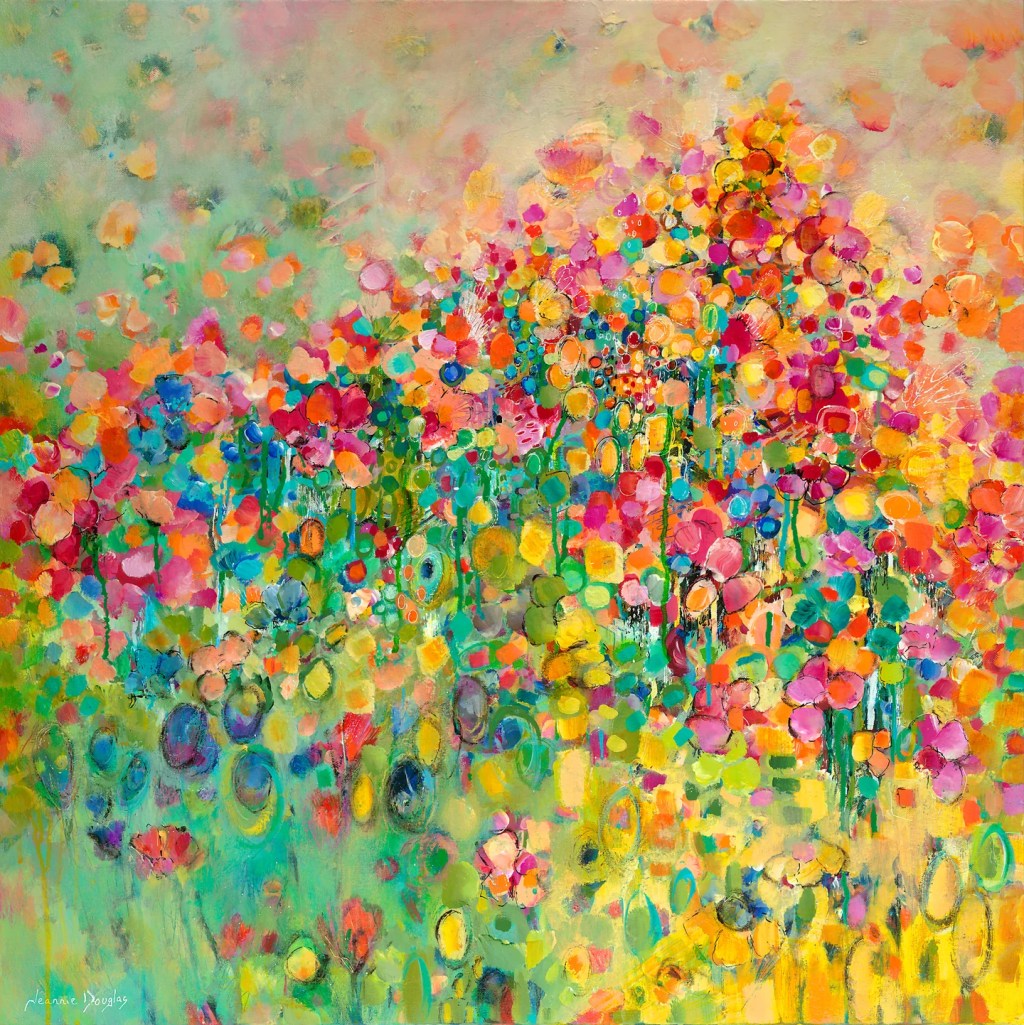
A Pop of Happiness by Jeanie Douglas. From Public Domain

Happiness is a many splendored word. For some it is the first ray of sunshine; for another, it could be a clean bill of health; and yet for another, it would be being with one’s loved ones… there is no clear-cut answer to what makes everyone happy. In Harry Potter and the Half Blood Prince (JK Rowling, 2005), a sunshine yellow elixir induces euphoria with the side effects of excessive singing and nose tweaking. This is of course fantasy but translate it to the real world and you will find that happiness does induce a lightness of being, a luminosity within us that makes it easier to tackle harder situations. Playing around with Rowling’s belief systems, even without the potion, an anticipation of happiness or just plain optimism does generate a sense of hope for better times.  Harry tackles his fears and dangers with goodwill, friends and innate optimism. When times are dark with raging wars or climate events that wreck our existence, can one look for a torch to light a sense of hope with the flame of inborn resilience borne of an inner calm, peace or happiness — call it what you will…?

It is hard to gauge the extreme circumstances with which many of us are faced in our current realities, especially when the events spin out of control. In this issue, along with the darker hues that ravage our lives, we have sprinklings of laughter to try to lighten our spirits. In the same vein, externalising our emotions to the point of absurdity that brings a smile to our lips is Rhys Hughes’ The Sunset Suite, a book that survives on tall tales generated by mugs of coffee. In one of the narratives, there is a man who is thrown into a bubbling hot spring, but he survives singing happily because his attacker has also thrown in packs of tea leaves. This man loves tea so much that he does not scald, drown or die but keeps swimming merrily singing a song. While Hughes’ stories are dark, like our times, there is an innate cheer that rings through the whole book… Dare we call it happiness or resilience? Hughes reveals much as he converses about this book, squonks and stranger facts that stretch beyond realism to a fantastical world that has full bearing on our very existence.

Poetry brings in a sprinkling of good cheer not only with a photo poem by Hughes, but also with more in a lighter vein from Ryan Quinn Flanagan, Michael R Burch, Arshi Mortuza, Jason Ryberg and others. Sanjay C Kuttan has given a poem dipped in nostalgic happiness with colourful games that evolved in Malaysia. Koiko Tsuuda, an Estonian, rethinks happiness. George Freek, Stuart MacFarlane and Saranyan BV address mortality. Nilsa Mariano and G Javaid Rasool have given us powerful migrant poetry while John Grey, Craig Kirchner, Jane Hammons, Nia Joseph, Noopur Vedajna Das and Adeline Lyons refer to climate or changes wrought by climate disasters in their verses.

A powerful essay by Binu Mathew on the climate disaster at Wayanad, a place that earlier had been written of as an idyllic getaway, tells us how the land in that region has become more prone to landslides. The one on July 30th this year washed away a whole village! Farouk Gulsara has given a narrative about his cycling adventure through the state of Kashmir with his Malaysian friends and finding support in the hearts of locals, people who would be the first to be hit by any disaster even if they have had no hand in creating the catastrophes that could wreck their lives, the flora and the fauna around them. In the wake of such destructions or in anticipation of such calamities, many migrate to other areas — like Ranu Bhattacharya’s ancestors did a bit before the 1947 Partition violence set in. A younger migrant, Chinmayi Goyal, muses under peaceful circumstances as she explores her own need to adapt to her surroundings. G Venkatesh from Sweden writes of his happy encounter with local children in the playground. And Snigdha Agrawal has written of partaking lunch with a bovine companion – it can be intimidating having a cow munching at the next table, I guess! Devraj Singh Kalsi has given a tongue-in-cheek musing on how he might find footing as a godman. Suzanne Kamata has given a lovely summery piece on parasols, which never went out of fashion in Japan!

Radha Chakravarty, known for her fabulous translations, has written about the writer she translated recently, Nazrul. Her essay includes a poem by Tagore for Nazrul. Professor Fakrul Alam has translated two of Nazrul’s songs of parting and Sohana Manzoor has rendered his stunning story Shapuray (Snake Charmer) into English. Fazal Baloch has brought to us poetry in English from the Sulaimani dialect of Balochi by Allah Bashk Buzdar, and a Korean poem has been self-translated by the poet, Ihlwha Choi. The translations wind up with a poem by Tagore, Olosh Shomoy Dhara Beye (Time Flows at an Indolent Pace), showcasing how the common man’s daily life is more rooted in permanence than evanescent regimes and empires.

Fiction brings us into the realm of the common man and uncommon situations, or funny ones. A tongue-in-cheek story set in the Midwest by Joseph Pfister makes us laugh. Farhanaz Rabbani has given us a beautiful narrative about a girl’s awakening. Paul Mirabile delves into the past using the epistolary technique highlighting darker vignettes from Christopher Columbus’s life. We have book excerpts from Maaria Sayed’s From Pashas to Pokemon and Nazes Afroz’s translation of Syed Mujtaba Ali’s Shabnam with both the extracts and Rabbani’s narratives reflecting the spunk of women, albeit in different timescapes…

Our book reviews feature Meenakshi Malhotra’s perspectives on Shuchi Kapila’s Learning to Remember: Postmemory and the Partition of India and Bhaskar Parichha’s thought provoking piece on Malvika Rajkotia’s autobiographical Unpartitioned Time: A Daughter’s Story. While both these look into narratives around the 1947 Partition of the Indian subcontinent, Rakhi Dalal’s review captures the whimsical and yet thoughtful nuances of Namita Gokhale’s Never Never Land. Somdatta Mandal has written about Upamanyu Chatterjee’s latest novel, Lorenzo Searches for the Meaning of Life, which is in a way a story about a migrant too.

When migrations are out of choice, with multiple options to explore, they take on happier hues. But when it is out of a compulsion created by manmade disasters — both wars and climate change are that — will the affected people remain unscarred, or like Potter, bear the scar only on their forehead and, with Adlerian calm, find happiness and carpe diem?

Do pause by our current issue which has more content than mentioned here as some of it falls outside the ambit of our discussion. This issue would not have been possible without an all-out effort by each of you… even readers. I would like to thank each and every contributor and our loyal readers. The wonderful team at Borderless deserve much appreciation and gratitude, especially Manzoor for her wonderful artwork. I invite you all to savour this August issue with a drizzle of not monsoon or April showers but laughter.

May we all find our paths towards building a resilient world with a bright future.

Good luck and best wishes!

Mitali Chakravarty

borderlessjournal.com

Click here to access the content’s page for the August 2024 Issue.

.

READ THE LATEST UPDATES ON THE FIRST BORDERLESS ANTHOLOGY, MONALISA NO LONGER SMILES, BY CLICKING ON THIS LINK.