Categories
Excerpt

The Sunset Suite

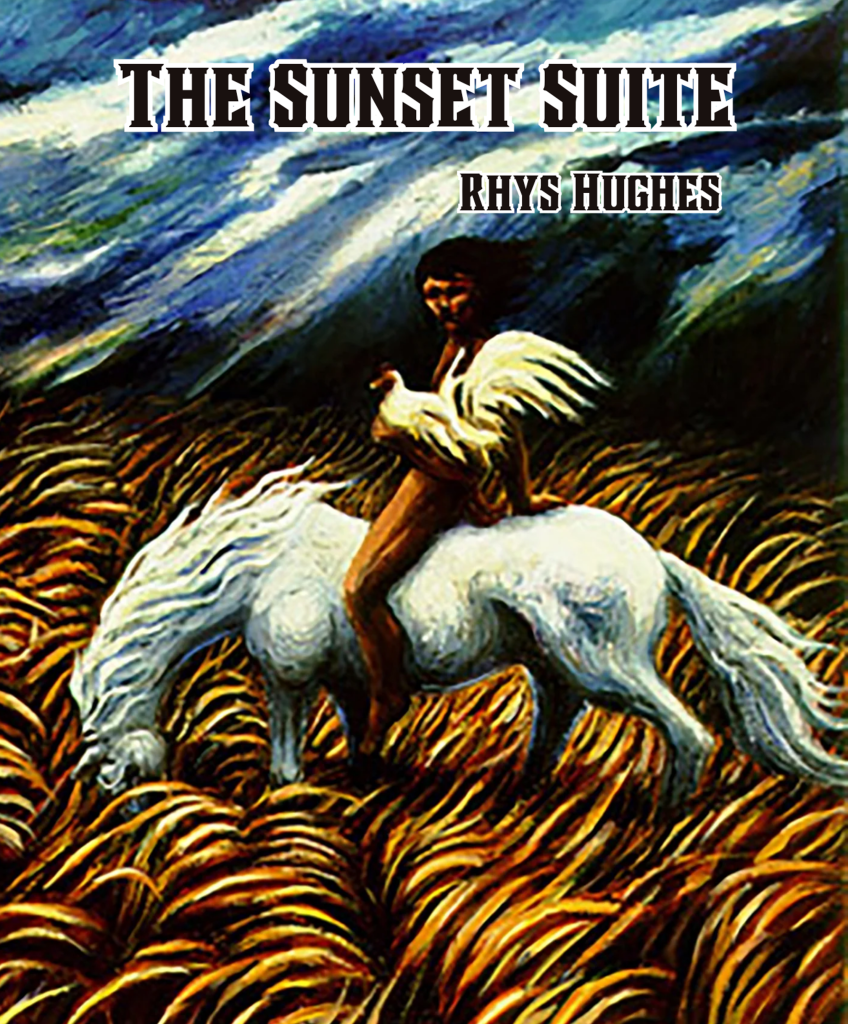
Title: The Sunset Suite (A Weird Western)

Author: Rhys Hughes

Publisher: Gibbon Moon
The two men had made camp beneath a bristlecone pine and they sat with a fire between them. The flames had died down but the embers were glowing and the pot of coffee was resting on the ashes and bubbling. They had tiny cups in their gnarled hands and sipped them as they blinked at each other and the stars over the world burned without twinkling. The first man, who was called Brand, spoke to the second, who was named Thorn, and his words were about the beverage in their cups, and his tone was awestruck.

“You know something, pard? This coffee tastes not just like coffee but also like something else. I think it tastes like a story, a different story with each cup, but a very short story every time because the cups are so small. And that’s not a normal thing for coffee to be like. I won’t say the situation is worrying, no siree, but I might venture the opinion that it’s highly unusual. The cup I drank just now tasted like an anecdote about a mule.”

And Thorn said, “You are right, Brand. What should we do about it? There is a lot of coffee remaining in the pot.”

“I guess we’ll keep drinking it, pard. But maybe we ought to tell it as well as drink it. Get those stories out there. It might be injurious to our health if we swallow them and absorb them all.”

“Agree with you, I do. The cup I just drank tasted like a fable concerning a cactus and a coyote. Should have related it to you, but I didn’t. Maybe I’ll get an attack of indigestion now. Hope not.”

“Listen then, Thorn. Let’s help ourselves to another cup each and I will tell you the story that I’m tasting. You can go second. We’ll take it in turns and keep going until the coffee pot is exhausted.”

“That dented thing looks tired already. But I know what you mean. Alright, I am waiting for you to tell me a tale.”

And the one named Brand opened his mouth.

Into the Sunset

Cowboys are often depicted riding off into the sunset. Jake Bones loved riding off into the sunset more than anything. He refused to ride in any other direction or at any other time. Sunsets don’t really last long, and so Jake rarely rode more than a mile every day. He hung around places until the sun started to turn orange and when it reddened he would mount his horse and canter towards the western horizon until the fiery ball vanished over the edge of the world. Then he would pull on the reins, dismount and look for a place to sleep. In this manner he very slowly crossed the continent. It took years for him to complete his journey and when he started, from a small town on the coast of North Carolina, he hadn’t a plan at all. He just knew he had to follow the sunset. The plan came to him five years later, when he was halfway across the mighty landmass. Jake Bones knew that one day he would finally reach the Pacific Ocean. How would he be able to ride off into the sunset then? His horse would drown if he attempted to make it swim through the rippling light. But there is a solution to every problem and he was riding through a forest of dead trees when inspiration struck. He snapped a branch off, then another, as he went, while the rays of the setting sun slanted at a lower and lower angle and finally were horizontal before they were blocked by the curvature of the Earth. Jake strapped the branches to the sides of his horse with the rope he always carried. In the days, weeks and months that followed, he acquired more branches and other pieces of wood, and the appearance of his horse changed dramatically. Finally, the tang of a salty breeze filled the nostrils of Jake Bones and he knew he had almost reached the ocean. With his knife he cut off the brim of his Stetson and turned the hat into the cap of a sailor. Then he climbed over a rise and found himself gazing down at a seashore lapped by little waves, and the sun was setting into the sea and making a ladder of reddish light towards him. That ladder beckoned and he spurred his horse the short remaining distance into the cool water. His horse was watertight and floated well and he had no anxiety as he slowly paddled towards the west. Why should a lack of land interrupt his progress? Jake Bones had converted his horse into a boat and he had done this on the hoof. He still follows the sunset and has been sighted by the crews of several ships since.

A Model Prisoner

He was guilty of shooting off the ear of a man in a saloon, a man who later died, and that’s why he went to jail. Everyone knew that Shorty Potter was quite an unpleasant individual and that he had tried to place that bullet in the brain of the mad auctioneer, Killy the Bid, but he had been drinking heavily and his aim was amiss and the ear flew off and landed in the middle of an important poker game on a table in the far corner of the saloon.

The bar keeper sent an errand boy to fetch the town sheriff and Shorty was apprehended and locked up and a trial date was set, but Killy the Bid made the incident more complicated than it might have been. The loss of his right ear left him with a ringing in his head, and at first he supposed the ringing was the noise of a train coming through the town, so he tended to stop in his tracks whenever he heard it and wait for the train to pass.

But there never was a train and he soon understood that the ringing was in his mind or maybe some form of tinnitus. He was crossing the railway tracks on a bright morning three weeks after the incident, and when he heard a ringing he just ignored it, and the train struck him and not much of Killy the Bid remained, apart from his left ear, curiously enough.

His demise was deemed wholly, albeit indirectly, a result of Shorty Potter’s discharge of his Colt in that saloon, and the public prosecutor wanted him to be charged with murder, but in the end he was charged with affray and disorder and sentenced to ten years behind bars. Ten years was considered a harsh sentence at a time when men died relatively young and Shorty was appalled at the idea. But he decided to make no trouble henceforth.

He was meek and mild and his reputation as an unpleasant fellow began to erode, at least among the other prisoners and the prison guards. Shorty became, in short, a model prisoner. He volunteered for menial tasks, swept the cells and corridors even when it wasn’t his turn, tended to inmates who fell sick, kept his own cell neat and tidy, was always polite to the guards, no matter how savagely they spoke to him, and in fact they started to soften their tone when telling him something. They eventually trusted him.

The result of all this activity was that he was awarded privileges, nothing a free man might regard as a luxury, but small liberties that any incarcerated felon would certainly appreciate. He was allowed to read books, though the choice he was offered was very limited, but not all of them were religious tracts, and a big volume of Longfellow’s poetry became his favourite. He was also permitted two hours of exercise in the yard instead of one.

Shorty Potter never pushed his luck too far. He scarcely pushed it at all, but one day he approached the most senior guard in the prison and softly asked if he might be allowed some clay. He wanted to construct models for his amusement, a hobby that nobody could surely regard with disapproval, and the guard agreed it was a great idea, an outlet for Shorty’s exuberant creativity that was obviously pent up not only by metallic bars but the rigid routines of prison life. Permission was granted. A bucket of clay was provided.

He moulded it to create little figures of men and women, and as his skills improved he made small houses, churches, even a replica of the prison itself, a model that delighted the senior guard so much he asked for it as a gift. Shorty was happy to give it to him. He produced another, deliberately not as detailed, for himself, and followed this up with ships and saloons, wagons and herds of bison, incredibly lifelike eagles and coyotes. He was especially admired for the hungry bear and a pack of wolves he made.

During this phase of his imprisonment, Shorty Potter often thought about his own surname and wondered if fate was playing a joke, but fate sometimes is kinder than that, and in this case it wanted to help him. Shorty began work on a special piece, the most ambitious of his models. He required more clay than one bucketful and it was given to him after he answered the question, “Why do you need so much?” by saying he was preparing a surprise for the prison guards, an artistic statement that would electrify them.

He worked on this project only at night. The prison guards trusted him now and waited to see what surprise he was preparing for them, and they laid bets on what his masterpiece might turn out to be. A paddlesteamer, said one. A replica of the White House, said another. One guard, pondering the word ‘electrify’ had the unhappy idea that Shorty was making a model of an electric chair, a method of execution introduced the previous year.

One morning, he failed to respond to the wake-up call. A guard rapped on his door with a short iron pole, but there was no answer. The guard peered into the cell and saw Shorty Potter still in bed, and there was something wrong with him. He looked an unhealthy colour. Had he died in his sleep? The guard turned his key in the lock and rushed inside. He shook Shorty and felt the clamminess of his flesh. No, it wasn’t flesh. It was clay!

Shorty had made a model of a man and substituted the model for himself. A decoy! He must have made his escape. But how? There were no holes in the wall and no tunnels under the cell. How had he managed this miracle? With an angry yell, the guard summoned his comrades. They felt betrayed, and it must also be admitted that they felt some respect for Shorty. He really had turned out to be a model prisoner. Then they growled:

“Send out a search party. He can’t have gone far. Shoot on sight! And get that clay model out of here. There will be hell to pay for this. No one has ever escaped from this prison before! Hurry…”

And they hurried. Two of them carried the clay model out of the cell and along the corridors to the main gate and threw it into the dust outside. Then they returned into the prison and slammed the door. One minute later, the clay model stirred, sat up and blinked, then stood. It began hobbling away from the prison until it reached the bushes. It pushed on through the undergrowth, avoiding the paths, until it reached a rapidly flowing river.

It knelt and washed itself in the foamy water and every part of its exposed skin needed a good scrubbing, all apart from the left ear. People would later say that this was a secret message to Killy the Bid about his missing right ear, but in fact the reason was merely that there hadn’t been enough clay to cover it. Shorty Potter cleaned himself and when he looked like a flesh man again, he forded the river with difficulty and reached the far side.

Then he started running for the hills. He reached them too, a sanctuary safe from his pursuers. But on the sixth day of his newly-won freedom, as he walked over a fissured plateau, he slipped down a narrow crevice…

About the Book

Coffee around a camp fire. But every cup tastes like a story. And so the two cowboys, Thorn and Brand, exchange tall tales as they drink. And they will keep telling stories until the pot is empty. They will relate implausible and incredible accounts of outlaws, pioneers, visionaries, musicians, lawmen, warriors, ghosts, mountain men, dreamers and hellfire preachers. They will gradually and inevitably turn into stories themselves as they sit beneath the bristlecone pine tree…

“Rhys Hughes seems almost the sum of our planet’s literature. He toys with convention. He makes the metaphysical political, the personal incredible and the comic hints at subtle pain. Few living fictioneers approach this chef’s sardonic confections, certainly not in English.” — MICHAEL MOORCOCK

“If I said he was a Welsh writer who writes as though he has gone to school with the best writing from all over the world, I wonder if my compliment would just sound provincial. Hughes’ style, with all that means, is among the most beautiful I’ve encountered in several years.” — SAMUEL R. DELANY

About the Author

Rhys Hughes is a writer of Fantastika and Speculative Fiction.

His earliest surviving short story dates from 1989, and since that time he has embarked on an ambitious project of writing a story cycle consisting of exactly 1000 linked tales. Recently, he decided to give this cycle the overall name of PANDORA’S BLUFF. The reference is to the box of troubles in the old myth. Each tale is a trouble, but hope can be found within them all.

His favourite fiction writers are Italo Calvino, Stanislaw Lem, Boris Vian, Flann O’Brien, Alasdair Gray and Donald Barthelme, all of whom have a well-developed sense of irony and a powerful imagination. He particularly enjoys literature that combines humour with seriousness, and that fuses the emotional with the intellectual, the profound with the light-hearted, the spontaneous with the precise.

His first book was published in 1995 and sold slowly but it seemed to strike a chord with some people. His subsequent books sold more strongly as my reputation gradually increased. He is regarded as a “cult author” by some and though pleased with that description, he obviously wants to reach out to a wider audience!

.

PLEASE NOTE: ARTICLES CAN ONLY BE REPRODUCED IN OTHER SITES WITH DUE ACKNOWLEDGEMENT TO BORDERLESS JOURNAL

Click here to access the Borderless anthology, Monalisa No Longer Smiles

Click here to access Monalisa No Longer Smiles on Kindle Amazon International
Categories
Excerpt

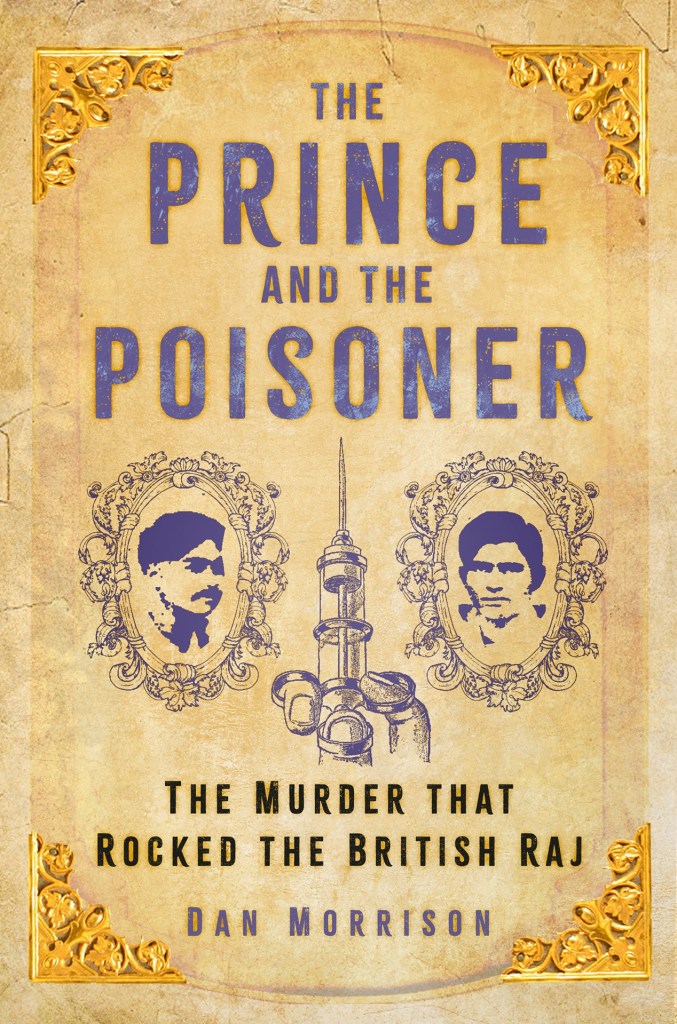
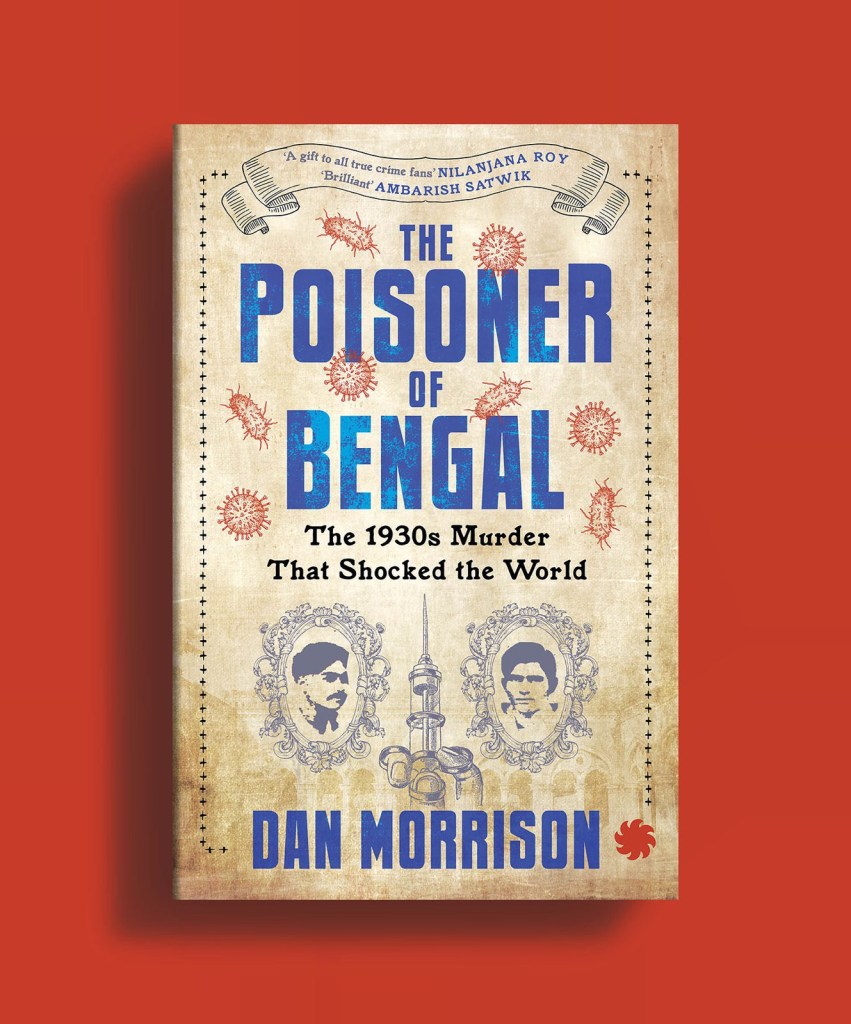
The Murder that Shocked the World


Titles: The Poisoner of Bengal/The Prince and the Poisoner

Author: Dan Morrison

Publishers: Juggernaut (India)/ The History Press (UK)

November 1933: Howrah Station

For most of the year, Calcutta is a city of steam, a purgatory of sweaty shirt-backs, fogged spectacles, and dampened décolletage. A place for melting. In summer the cart horses pull their wagons bent low under the weight of the sun, nostrils brushing hooves, eyes without hope, like survivors of a high desert massacre. The streets are ‘the desolate earth of some volcanic valley’, where stevedores nap on pavements in the shade of merchant houses, deaf to the music of clinking ice and whirring fans behind the shuttered windows above.

The hot season gives way to monsoon and, for a while, Calcuttans take relief in the lightning-charged air, the moody day- time sky, and swaying trees that carpet the street with wet leaves, until the monotony of downpour and confinement drives them to misery. The cars of the rich lie stalled in the downpour, their bonnets enveloped in steam, while city trams scrape along the tracks. Then the heat returns, wetter this time, to torment again.

Each winter there comes an unexpected reprieve from the furious summer and the monsoon’s biblical flooding. For a few fleeting months, the brow remains dry for much of each day, the mind refreshingly clear. It is a season of enjoyment, of shopping for Kashmiri shawls and attending the races. Their memories of the recently passed Puja holidays still fresh, residents begin decking the avenues in red and gold in anticipation of Christmas. With the season’s cool nights and determined merriment, to breathe becomes, at last, a pleasure.

Winter is a gift, providing a forgiving interval in which, sur- rounded by goodwill and a merciful breeze, even the most determined man might pause to reconsider the murderous urges born of a more oppressive season.

Or so you would think.

On 26 November 1933, the mercury in the former capital of the British Raj peaked at a temperate 28°C, with just a spot of rain and seasonally low humidity. On Chowringhee Road, the colonial quarter’s posh main drag, managers at the white- columned Grand Hotel awaited the arrival of the Arab-American bandleader Herbert Flemming and his International Rhythm Aces for an extended engagement of exotic jazz numbers. Such was Flemming’s popularity that the Grand had provided his band with suites overlooking Calcutta’s majestic, lordly, central Maidan with its generous lawns and arcing pathways, as well as a platoon of servants including cooks, bearers, valets, a housekeeper, and a pair of taciturn Gurkha guardsmen armed with their signature curved kukri machetes. Calcuttans, Flemming later recalled, ‘were fond lovers of jazz music’. A mile south of the Grand, just off Park Street, John Abriani’s Six, featuring the dimple-chinned South African Al Bowlly, were midway through a two-year stand entertaining well-heeled and well-connected audiences at the stylish Saturday Club.

The city was full of diversions.

Despite the differences in culture and climate, if an Englishman were to look at the empire’s second city through just the right lens, he might sometimes be reminded of London. The glimmer- ing of the Chowringhee streetlights ‘calls back to many the similar reflection from the Embankment to be witnessed in the Thames’, one chronicler wrote. Calcutta’s cinemas and restaurants were no less stuffed with patrons than those in London or New York, even if police had recently shuttered the nightly cabaret acts that were common in popular European eateries, and even if the Great Depression could now be felt lapping at India’s shores, leaving a worrisome slick of unemployment in its wake.

With a million and a half people, a thriving port, and as the former seat of government for a nation stretching from the plains of Afghanistan to the Burma frontier, Calcutta was a thrumming engine of politics, culture, commerce – and crime. Detectives had just corralled a gang of looters for making off with a small fortune in gold idols and jewellery – worth £500,000 today – from a Hindu temple dedicated to the goddess Kali. In the unpaved, unlit countryside, families lived in fear of an ‘orgy’ of abductions in which young, disaffected wives were manipulated into deserting their husbands, carried away in the dead of night by boat or on horseback, and forced into lives of sexual bondage.

Every day, it seemed, another boy or girl from a ‘good’ middle- class family was arrested with bomb-making materials, counterfeit rupees, or nationalist literature. Each month seemed to bring another assassination attempt targeting high officials of the Raj. The bloodshed, and growing public support for it, was disturbing proof that Britain had lost the Indian middle class – if it had ever had them.

Non-violence was far from a universal creed among Indians yearning to expel the English, but it had mass support thanks to the moral authority of Mohandas Gandhi. Gandhi, the ascetic spiritual leader whose campaigns of civil disobedience had galvanised tens of millions, was then touring central India, and trying to balance the social aspirations of India’s untouchables with the virulent opposition of orthodox Hindus – a tightrope that neither he nor his movement would ever manage to cross.

And from his palatial family seat at Allahabad, the decidedly non-ascetic Jawaharlal Nehru, the energetic general secretary of the Indian National Congress, issued a broadside condemning his country’s Hindu and Muslim hardliners as saboteurs to the cause of a free and secular India. Nehru had already spent more than 1,200 days behind bars for his pro-independence speeches and organising. Soon the son of one of India’s most prominent would again return to the custody of His Majesty’s Government, this time in Calcutta, accused of sedition.

It was in this thriving metropolis, the booming heart of the world’s mightiest empire, that, shortly after two o’clock in the afternoon on that last Sunday in November, well below the radar of world events, a young, slim aristocrat threaded his way through a crowd of turbaned porters, frantic passengers, and sweating ticket collectors at Howrah, British India’s busiest railway station.

He had less than eight days to live.

About the Book:

A crowded train platform. A painful jolt to the arm. A mysterious fever. And a fortune in the balance. Welcome to a Calcutta murder so diabolical in planning and so cold in execution that it made headlines from London to Sydney to New York. 

Amarendra Chandra Pandey, 22, was the scion of a prominent zamindari family, a model son, and heir to half the Pakur Raj estate. Benoyendra Chandra Pandey, 32, was his rebellious, hardpartying halfbrother – and heir to the other half. Their dispute became the germ for a crime that, with its elements of science, sex, and cinema, sent shockwaves across the British Raj. 

Working his way through archives and libraries on three continents, Dan Morrison has dug deep into trial records, police files, witness testimonies, and newspaper clippings to investigate what he calls ‘the oldest of crimes, fratricide, executed with utterly modern tools’. He expertly plots every twist and turn of this repelling yet riveting story –right up to the killer’s cinematic last stand. 

About the Author:

Dan Morrison is a regular contributor to The New York Times, Guardian, BBC News and the San Francisco Chronicle. He is the author of The Black Nile (Viking US, 2010), an account of his voyage from Lake Victoria to Rosetta, through Uganda, Sudan and
Egypt. Having lived in India for five years, he currently splits his time between his native Brooklyn, Ireland and Chennai.

.

PLEASE NOTE: ARTICLES CAN ONLY BE REPRODUCED IN OTHER SITES WITH DUE ACKNOWLEDGEMENT TO BORDERLESS JOURNAL

Categories
Excerpt

Cinnamon Beach

Title: Cinnamon Beach

Author: Suzanne Kamata

Publisher: Wyatt-Mackenzie Publishing

Olivia

Olivia had cruised along I-26 from the capital to the coast of South Carolina more times than she could count, but this time was different. Back in the day, she had ridden shotgun in a girlfriend’s convertible, with a passel of other co-eds in the back, on their way to spring break and beer and boys at the beach. Or, another time, it had been in her yellow VW Beetle, on the way to see the do-gooder surfer guy she thought she couldn’t live without, the one who spent the summer at Myrtle Beach and took her to that place where they tossed their clam shells onto a sawdust-covered floor. Then there was that excursion to Hilton Head Island with Masahiro, before they got married, the one where he freaked out when he saw an alligator sunbathing on the golf course green.

Later, she’d driven to Charleston for an academic conference where she’d presented her paper on Aiken-born writer Gamel Woolsey. And then there had been that trip to promote her own short story collection – her first ever book tour! When their kids were small, they’d met up at the Isle of Palms with her brother Ted and his wife Parisa and their daughter and two sets of grandparents — the good old days. Olivia felt an arrow pierce her heart. This time, it was just Olivia and her two teenagers in a rental car. A minivan. She wasn’t used to driving such a big car. In Japan, she drove what they called a toaster-shaped Kei car, which was small enough to navigate the narrow roads in their neighborhood.

         “Why don’t you drive faster?” Yuto asked from the back seat. He’d been more or less silent for the first hour of the trip, busy filming roadside novelties with his smartphone, which he’d later post on Instagram or Snapchat or TikTok or whatever – she couldn’t keep up.

         “Why?” Oliva asked, irritated. She looked into her rearview mirror, and saw his head, topped by a baseball cap, hovering over his phone. He’d bought a SIM card before leaving Tokushima. For all she knew, he was chatting with his friends back home.

         “Because everybody’s passing you,” he said.

         As if to prove his point, a massive semi whooshed past them, followed by three more cars, all made in Japan. She glanced at the speedometer and confirmed that she was, indeed, driving the speed limit.

Olivia had read somewhere that early in the pandemic, the highways were so tantalizingly devoid of traffic that many drivers could not resist pressing down on the gas pedal. The highway patrol had raked in the bucks from the speeding tickets they’d issued, back when just about every other business was gasping for breath. But Olivia was used to driving slowly. Also, to be honest, she wasn’t in a hurry to get where they were going. To be completely honest, she was struggling with the desire to turn the car around and go back to Columbia.

         She looked in the rearview mirror again to check on Sophie. As expected, she was engrossed in her manga, oblivious to the scraps of blown-out tires and English-language billboards on the side of the road urging her to repent. Her hearing aids were in her lap.

“Anyone need to stop?” she asked. “Looks like there’s a service station up ahead.”

She thought she heard a murmur of agreement, and she wanted to use the restroom anyway, and take a moment before hurtling on into this dreaded not-a-vacation, so she eased onto the next exit ramp.

Once the car was parked, she leaned over the back seat and tapped Sophie’s knee. She signed “bathroom?” – one hand making a “W. C’ like an OK sign with an open O. Olivia was sure that it was an obscene gesture in some European country – Italy, maybe – just as the Japanese sign for “older brother” meant “fuck you” in America.

Sophie nodded and pushed the thick manga off of her lap. They went in together, Olivia waiting outside the bathroom while her daughter went in first. When she came out, Olivia handed her a couple of crumpled dollar bills. “Buy a snack or a drink,” she signed.

Inside the bathroom, she stood in front of the mirror, far enough back to take in at least half of herself. Her shalwar kameez with the Parisa! label stitched in back was not as wrinkled as she’d expected. This one, in a Palmetto print with a nod to the South Carolina state tree, had a touch of polyester. She was wearing it as kind of conciliatory gesture toward her sister-in-law, the eponymous Parisa!

A few years back, Parisa had come up with the idea of marketing the traditional tunic and pants combo of Southeast Asian women to ladies who lunch in the South. Instead of stitching them up into the usual jewel-toned silks and cottons of her parents’ India, she chose Liberty of London florals, playful prints, and alternative materials, such as paper. The “pajama pant suits” had taken off locally, and then nationally, after a few significant influencers had posted photos of themselves dressed in Parisa! on their social media. The outfits were classic, flattering to just about every body type, and they were super comfortable. Now, Parisa’s fan base included female politicians, writers, and talk show hosts. Parisa! had become a household name.

Olivia smoothed down the front of her tunic with the palms of her hands, then swiped at the smudges of mascara under her eyes with a pinky. There was a dent between her eyebrows. If only she had been injected with Botox! If only she were ten years younger! She sighed, turned away from the mirror, finished her business and went back to the car.

Yuto and Sophie were already in the back seat, buckled up and ready to go. Sophie had popped open a can of Diet Coke.

“What’d you get?” Olivia asked.

Yuto held up a bag of fried pork rinds. “Want some?”

“Uh, no thanks.” Sure, Olivia had lived in the South, but she’d never become quite that Southern.

Parisa

Parisa had just finished making the last bed when she heard the crunch of tires on gravel. She spent a few extra seconds smoothing the coverlet, stalling, before moving to look out the window.

         Normally, when the family gathered at the beach house, they would go to the linen closet themselves, get the sheets, and make their own beds. They had their favorites. The kids liked the ones with faded cartoon characters, which reminded them of being innocent and carefree, of those days before the anxiety of zits and dating and final exams. Olivia went for the sheets with the highest thread count, which were probably nicer than the ones on her bed in Japan. Parisa didn’t think they could afford such sheets, even if her husband was a professional golfer. It had been a while since he had won any tournaments, and she seemed to remember that he’d lost one of his endorsements. And in Japan, didn’t they sleep on mats or something? Parisa had seen Olivia petting the bed after she’d finished making it, as if she enjoyed the silky smoothness. But this time, Parisa made the beds for them. It wasn’t a normal time. Parisa wondered if life would ever feel normal again.

         As if sensing her mood, Chester padded into the room and nudged her with his snout. The golden retriever shed something awful in the warmer months, and he left a patch of fur on her maroon USC T-shirt. She plucked at the dog hair, her fingers grazing the Gamecocks emblem. She’d worn the shirt on purpose to remind her of how they had all met, she and Ted and Olivia.

         They’d all been students at the University of South Carolina in Columbia. She and Olivia had been in the same class, but they had not met until Ted introduced them. Ted had been a year ahead. They had worked together at a swanky restaurant, one where the staff had been trained in table settings and wine pairings. In between bussing tables, Ted had told Parisa about the bistro that he planned to open himself someday, and she’d told him about her dream of becoming a fashion designer. Once they’d started to get serious, she’d brought him home to meet her parents, who had immigrated from New Delhi back in the 1960s – and her older brothers, who’d been born in Greer, South Carolina, just as she had, but who had been raised to be good Indian boys.

         She remembered how her parents had met them at the door, and how, after stepping inside, Ted had gotten down on his hands and knees and touched their feet in greeting. Apparently, he had seen someone do this in a movie or something. Parisa had been both embarrassed for him, and deeply moved by his effort. She had remained standing, twisting her hands together. Her mother, who had dressed in a peacock-blue sari for the occasion, had taken it all in stride, as her due. Her father had chuckled and ordered him to his feet.

         They’d led him into the living room where her brothers, Arun and Anil, sat waiting in armchairs. The Indian-style swing, which hung from the ceiling, and which Arun usually preferred, was empty. When they got up to shake his hand, Parisa was momentarily worried that Ted would try out a “namaste” on them, but he didn’t. He shook their hands, as he would those of any American, and when invited, sat down on the sofa. And then they’d all grilled him mercilessly. Where was he born? What did his parents do? What was he studying? What did he aspire to do in the future? Where did he want to live after graduation? And so on.

         The Hispanic housekeeper had brought out a silver tray of chai and Indian sweets – laddoos and barfi – which Ted had dutifully consumed. He had raved about them, not realizing that Parisa’s mother had bought them at the Asian market. She spent as little time in the kitchen as possible.

         Once they were back in the car, about to drive back to campus, Ted took a deep breath and slowly exhaled. “Wow,” he said. “That was grueling.”

         She’d worried that it had all been too much for him, but a week or so later, he’d taken her to meet his parents, who’d moved down to South Carolina from Michigan. They had been kind and welcoming, a bit more subdued than her own parents. Ted’s mother had served meatloaf with mashed potatoes, and peach pie for dessert. Although they had asked one or two questions about her parents’ backgrounds and jobs, they hadn’t pried.

It had taken a bit longer for Ted to introduce her to his sister.

      “She’s kind of…different,” he’d said, more than once. “I worry about her sometimes.” A cloud seemed to form over him every time her name came up. He’d frown and lower his voice as he itemized his concerns: She didn’t have any sort of career plan for after graduation. She liked to write poetry, and she sometimes consulted tarot cards. Also, her taste in men left a lot to be desired. She tended to go out with guys who had earrings and wore eyeliner. Often, they played in bands. One had been arrested for drug possession. Luckily, these romances never lasted long.

         “When am I going to meet your her?” Parisa had asked more than once, even as she harbored her own reservations. What if Olivia didn’t like her? What if she didn’t like Olivia? What would that mean for their future together?

         “Yeah, soon,” Ted always said, but the occasion never seemed to arrive.

         One Friday evening, when they were both off of work, he invited her over to his apartment for dinner for the first time. He was planning a feast, he told her. She wondered if this was it, if he would propose.

         Parisa dressed up in a black linen sundress. Her shapely legs were a toasty brown, so she didn’t bother with hose. She showed up on Ted’s doorstep with a bottle of wine. He was wearing an apron over his blue button-down Oxford shirt and khakis, which was cute. He leaned in and kissed her, and she caught a whiff of Polo. With one hand, he took the wine, murmuring appreciatively, and with the other at her back, ushered her into the living room/dining area.

         The apartment, which he shared with two other guys, was neat and tidy, so unlike a typical college guy’s domain. Healthy green plants flourished in the corners of the room, and an aquarium gurgled pleasantly. The guppies and black mollies always swam in clear water, so it was obvious that someone – Ted – regularly changed it. There were no stray socks or empty beer cans or empty pizza boxes anywhere in sight. No old newspapers, no cockroaches scuttling about. The air was redolent with sizzling steaks and butter-fried garlic. A colorful salad in a teak bowl already sat at the center of the table, which was covered in damask. Candles stood sentinel on either side of the bowl, ready to be lit. Cloth napkins tucked into pewter rings were settled beside each earthenware plate.

         “Are you hungry?” he asked, a hopeful lilt in his voice.

         “Famished.” Seeing how much effort he had put into the evening, she’d already decided that she would praise the food no matter what. She would eat every morsel. But she could already tell that it would be delicious.

         He uncorked and poured the wine. She sat down at the table and spread her napkin over her lap. He brought out the perfectly seared steaks, the stuffed mushrooms, and steamed broccoli. Once everything was just so, he took his place across from her. They toasted and clinked their wine glasses together, took sips.

         “Yum!” she said, lifting her fork. She had just taken her first bite when the phone rang.

         A flicker of annoyance passed over Ted’s face. He ignored the call at first, but then the answering machine beeped, and they heard a tremulous voice. “Ted? Are you there? I need your help.”

         He sighed gustily, and pushed back from the table. “Sorry, it’s my sister. Better see what she wants.”

         Parisa continued eating, chewing quietly so that she could listen to Ted’s half of the conversation.

         “What? How did that happen? No, never mind, don’t tell me. Where are you? Okay, sit tight. Stay in the store, where there are people around. I’ll be there soon.”

         He hung up the phone, squared his shoulders, and turned back to the table. “I’m so sorry. My sister ran out of gas in a bad part of town. I have to go help her.”

         Parisa surveyed the table. She knew that Ted had spent a lot of money and time on this dinner, and if they left the table now, it would be wasted. That’s when she understood how much Ted truly cared about his sister, what a good, kind brother he was. What a good, kind, caring man.

         “Do you mind if I go with you?” She could finally meet the mysterious Olivia.

         He hesitated for a moment, then shrugged. “Not at all.”

         Ted grabbed a jerry can which he just happened to have on hand. She remembered that he had been a boy scout, and that their mantra was “be prepared.” They drove out to the edge of town, where Parisa had once gone with a sorority sister to deliver Meals-on-Wheels. Parisa wondered briefly if Olivia had gone out there to buy drugs, then quickly quashed the thought. There were many reasons why she might have ventured into the area. Maybe she had gotten lost.

         Ted’s jaw was tensed on the mostly silent ride. Finally, they pulled into a convenience store parking lot. The windows were covered with grills. Almost as soon as Ted had killed the engine, the door opened and a waifish young woman with black hair, done in a bob, pale skin, and fire engine red lips came rushing out. In the harsh light, Parisa could see that her eyes were surrounded in kohl. She looked like a goth Snow White. She was wearing a black leather jacket over a tight leopard print dress, and her legs were covered in fishnet hose. With her black Doc Martens, she seemed as different from Parisa’s sorority sisters, with their curling-ironed blonde hair and Lily Pulitzer pants, as a girl could get.

         The rear car door opened, and Olivia slid in, dragging the back of her hand under her nose. Parisa then saw that it was not kohl surrounding her eyes, but smeared mascara. Clearly, she had been crying.

         “Are you okay?” Ted asked. “Did someone hurt you?”

         “Only my heart,” she said with a sniffle.

         Ted looked over at Parisa and rolled his eyes. “Boyfriend,” he mouthed.

         “Hi,” Parisa said, leaning over the seat. “I’m Parisa.”

         “Ted’s girlfriend,” Olivia said. “Yeah, I’ve heard a lot about you. Good things. Nice to finally meet you.” She smiled, and Parisa smiled back. She knew right away that they would be friends.

About the Book:

Cinnamon Beach is a multicultural tragicomedy, told from three female perspectives, in which an American writer living in Japan returns to South Carolina to scatter the ashes of her brother while trying to maintain the “perfect-family” facade she created from afar and support her Indian American sister-in-law who wants a future which might upset everyone. Sparks fly at an impromptu book-signing when the author reconnects with her college friend, now a famous African American country music star, and her daughter who is deaf finds ways to communicate with a secret first-love. The book will be published worldwide by Wyatt-Mackenzie Publishing on August 6, 2024. It is now available for preorder.

About the Author:

Suzanne Kamata was born and raised in Grand Haven, Michigan, and later moved to South Carolina where she graduated from the University of South Carolina. She is the author of the award-winning short story collection, The Beautiful One Has Come and four previous novels – Losing Kei (Leapfrog Press, 2008), which has been translated into Russian; Gadget Girl: The Art of Being Invisible (GemmaMedia, 2013) winner of multiple awards including the APALA Honor Award and the Paris Book Festival Grand Prize; Screaming Divas(Simon & Schuster, 2014) which was named to the ALA Rainbow List; and The Baseball Widow (Wyatt-MacKenzie,2021), IPPY Gold Winner and 2022 NYC Big Book Award Winner. She has also received awards from the Sustainable Arts Foundation, the Independent Publisher’s Association, SCBWI, and Half the World Global Literati Awards. Additionally, she has edited three well-received anthologies, and her essays have appeared in Real Simple, Brain, Child, literarymama.com and many others. She has an MFA from the University of British Columbia, and teaches English at Naruto University of Education in Japan. She lives in Tokushima Prefecture with her husband and cats.

Categories
Excerpt

These Many Cold Winters of the Heart by Ryan Quinn Flanagan

Cover art by Shona Flanagan

Title: These Many Cold Winters of the Heart

Author: Ryan Quinn Flanagan

Book Publisher: Roadside Press

50 Little Angels  

She died last week and the family convened
to box up all her things:
a few jewelry box keepsakes,
the new-fangled salad spinner from eight birthdays ago
that she could never work and refused to use,
that blazon of 50 little angels on the mantle,
hands clasped and eyes ascended in silent
porcelain deference; a small army thrown into boxes,
taped up and sent to storage, so the landlord
could list the place in the papers the following Tuesday,
champion an eat-in kitchen and proximity
to public transit.

(First appeared in Rusty Truck)

A Giant Bear Jumps Up the Rockface Outside Sudbury, Ontario

You never realize how helpless you would actually be
if the cards came calling.

A giant bear jumps up the rockface outside Sudbury, Ontario.
A single leap up over twenty feet after sprinting
in front of my truck.

Across three lanes of traffic.
Those powerful hind legs digging claws
deep into billions of years of solid Canadian Shield.

Power windows don’t seem so great after that.
We have a long way to go.

It was just a moment,
but it was everything to me.

Why anyone would count carbs after that
seemed completely farcical to me.

I was in control of nothing.
And all the power steering in the world
could not help me with that.


(First appeared in Setu)

Foreclosure Town


What the level of hand soap was at
when your brother died.

I would never forget that.
How many rings were failing the shower curtain.

How many tubes of toothpaste were left in the pantry,
were all the labels facing out?

That is the difference.
I remember everything.

How the air felt against the side of my nose
as the wind picked up.

Peeling railings on my fingers.

Those careless brown flecks with the orange underside.
How nothing seems to get everywhere.


(First appeared in Rusty Truck)

About the Book:

Ryan Quinn Flanagan’s These Many Cold Winters of the Heart begins with an epigraph from Emily Dickinson “I am out with lanterns looking for myself,” a perfect depiction of this collection. You will be riveted from the opening poem, “I Grew Up in a Brewery Town,” where the Molson plant closes down but “people survived, they usually do” although “everyone had to pay for their beer now/and they were drinking more than ever” to the powerful “wonderful bloody magic” in “The Butterfly Hunter” near the end. Flanagan has no shortage of acute observations on everything from a humorous pair of crows and the homelessness of tents in winter, to Bob Dylan and Lawrence of Arabia. A plentiful array of humorous, everyday usually irreverent pieces, also stunning moments of awe, and sometimes addressing tough subjects without flinching, from unexpected violence and death, to family mental illness, the loss of a brother, and the suicide of a childhood friend and an uncle and its after-effects. These latter poems will sneak up on you and take your breath away….I highly recommend These Many Cold Winters of the Heart and look forward to having the book in hand. Susan Ward Mickelberry, author of And Blackberries Grew Wild.” (From Susan Ward Mickelberry Reviews).

“Ryan Quinn Flanagan walks us through daily life in These Many Cold Winters of the Heart. ‘This is no simple dirty ditty[.]’ The moments he captures come running off the page like a giant bear ‘A single leap up over twenty feet after sprinting/in front of my truck.’ He explores death, work, and all the minutiae of life somehow knowing how all the pieces fit together…” Karen Cline-Tardiff, Gnashing Teeth Publishing.

About the Author:

Ryan Quinn Flanagan is a Canadian-born author who lives in Elliot Lake, Ontario, Canada with his wife and many bears that rifle through his garbage.  His work has been published both in print and online in such places as: The New York Quarterly, Rusty Truck, Borderless Journal, Evergreen Review, Red Fez, Horror Sleaze Trash and The Blue Collar Review.  He enjoys listening to the blues and cruising down the TransCanada in his big blacked out truck.

PLEASE NOTE: ARTICLES CAN ONLY BE REPRODUCED IN OTHER SITES WITH DUE ACKNOWLEDGEMENT TO BORDERLESS JOURNAL

Click here to access the Borderless anthology, Monalisa No Longer Smiles

Click here to access Monalisa No Longer Smiles on Amazon International

Categories
Excerpt

Deposition of a Political Prisoner: A Speech by Nazrul

Title: Kazi Nazrul Islam: Selected Essays 

Author: Kazi Nazrul Islam

Translator: Radha Chakravarty

Publisher: Penguin Random House

Deposition of a Political Prisoner (1923)

[In 1922, Kazi Nazrul Islam, the famous ‘Rebel Poet of Bengal’, aroused the wrath of the British administration for the revolutionary anti-imperialist writings published in his magazine Dhumketu (Comet), published in Kolkata. The Dhumketu office was raided by the police, Nazrul’s anthology Jugabani was banned, and on 23 November 1922, Nazrul was arrested and imprisoned in Presidency Jail. On 16 January 1923, Nazrul delivered his famous speech “Rajbandir Jabandandi” (Deposition of a Political Prisoner), at his trial. Sentenced to a year’s rigorous imprisonment, Nazrul was confined first in Alipore Jail and subsequently in Hooghly Jail. In February, Tagore dedicated his play Basanta to Nazrul, and later sent him a telegram urging him to call off his hunger strike. Nazrul never received the telegram, and was released from jail in November 1923.]

I am accused of treason. Hence, I am a prisoner of the state, as indicted by the state.

On one side stands the royal crown, and on the other, the flame of the comet. One represents the king, holding the sceptre; the other stands for the truth, holding the rod of justice. On the side of the king are the salaried employees of the state. On my side is the King of kings, Judge of all judges, true from the beginning to the end of time—the living divinity.

Nobody has appointed my judge. In the eyes of this Supreme Judge, all are equal—ruler and subject, rich and poor, the happy and the unhappy. At His throne, the ruler’s crown and the beggar’s musical instrument, the ektara, are placed at par. His laws are the laws of nyaya or justice, and dharma. That law has not been created by any victor for any conquered race, but from the true insights of global humanity. It is the law of universal truth, of omnipresent, all-pervading divinity. On the side of the king is a fragment of creation, minute as an atom; and on my side, the Creator Himself, whole and indivisible without beginning and end.

Behind the king are the insignificant, and behind me, stands the divine force of Lord Shiva himself. The one who backs the king has selfish goals; the one who supports me aims for the truth, to gain perfect bliss.

The king’s words are mere bubbles; my words, the boundless ocean. I am a poet, inspired by the Lord to reveal the hidden truth, to give form to formless Creation. Through the voice of the poet, the Lord makes himself heard. My utterance is the medium that publicly announces the truth, the utterance of the Lord. That utterance can appear as treason in the judgement of the state, but in the judgement of nyaya, that utterance is neither a rebellion against nyaya, nor against the truth. That utterance may be punishable in the king’s court, but in the light of dharma, at the court of nyaya, it is guiltless, untainted, unblemished, clear, inextinguishable, like truth itself.

The truth is self-revealing. It cannot be stopped by an angry, red-eyed royal sceptre. I am the veena, the instrument of that unceasing self-revelation, the veena that resonated as the voice of eternal truth. I am the veena in the hands of the Lord. It may break if it must, but who can break the Lord? It is an eternal truth that the truth exists, and so does the Lord—since the beginning of time, and forever. The one who obstructs the voice of truth today, who wishes to silence that voice, is also one of the minutest atoms of the Lord’s creation. It is by Lord’s signs, signals and wishes that such a person exists today, or may not exist tomorrow. There is no end to the hubris of the foolish mortal: he wants to imprison and punish his own Creator! But one day, this hubris is bound to drown in tears!

As I was saying, I am  an instrument for the revelation of truth. There may be heartless powers that imprison that instrument, or destroy it; but the One who plays that instrument, who expresses His fiery message through that veena – what power on earth can confine Him? What power on earth can destroy the vidhata, the supreme arbiter of our destinies? I am mortal, yes, but my vidhata is immortal. I will die, so will the king, for many traitors like me are dying, and so are many kings who summon up such accusations against them, but through the ages, at no point in time, and for no reason, has the manifestation of truth been suppressed – the voice of truth has never perished. Today, too, in the same way, it continues to express itself, and will continue to do so forever. This utterance of mine, stifled by authority, will be heard again, in the voice of another.  If you snatch away my flute you do not kill my music, for I can take up another flute, or create a new one, and bring the music back to life. The music does not belong to the flute, you see, it exists in my soul, and in the art of my fashioning of the flute. Hence the fault lies not with the flute, nor with the tune; the fault lies in me, the player of the flute. Likewise, for the utterance that emerges through my voice, I am not responsible. The fault lies not in me, or in my veena. It lies with the One who plays his veena through my voice. Hence, I am not the traitor against the state; the ultimate traitor is that same Lord, the player of the veena.  There exists no royal authority or second divinity who has the power to punish Him. No police force or prison has yet been created, that has the power to imprison the Lord.

The royal translator deployed by the king is simply translating the language of that utterance, not its soul. His translation projects that utterance as treason, for his aim is to satisfy the king. But my writing expresses the truth, radiance and the very spirit of life, for my aim is to offer my devotion to the Lord. For the tormented, anguished dwellers on this earth, I appear as a shower of truth, the tears that rain from the Lord’s eyes. I have not revolted against the king, but against injustice. …

[From Kazi Nazrul Islam: Selected Essays, translated by Radha Chakravarty. New Delhi: Penguin Random House, 2024.]

About the Book:
Selected Essays reveals to us the extraordinary versatility of Nazrul as an essayist. Addressing subjects as diverse as social reform, politics, communal harmony, environmental concerns, education, aesthetics, ethics, and philosophy, this rich collection showcases Nazrul’s dynamic vision and unique use of language as an instrument of change. The essays chart his evolving consciousness as a thinker, writer and activist, offering vivid glimpses of the ethos of his times, his relationships with leading figures such as Tagore and Gandhi, and his active engagement with social, political and cultural processes. These new translations bring Nazrul’s powerful voice to life, all its vibrant immediacy.

About the Author:

Kazi Nazrul Islam (1899-1976) is widely remembered as the fiery iconoclast who fought against the structures of oppression and orthodoxy. The iconic ‘rebel poet’ of Bengal and the national poet of Bangladesh, Nazrul continues to be loved for his songs and poetry. But he was also a writer of powerful short stories, novels, essays,  journalistic editorials and articles. In his literary career, which lasted from 1919 to 1942, Nazrul achieved both fame and notoriety, for his fiery, forthright, unorthodox approach to life and art.

About the Translator:

Radha Chakravarty is a writer, critic, and translator. She has published 23 books, including poetry, translations of major Bengali writers, anthologies of South Asian literature, and critical writings on Tagore, translation and contemporary women’s writing. She was nominated for the Crossword Translation Award 2004 and the Pushcart Prize 2020. 

CLICK HERE TO READ THE REVIEW

.

PLEASE NOTE: ARTICLES CAN ONLY BE REPRODUCED IN OTHER SITES WITH DUE ACKNOWLEDGEMENT TO BORDERLESS JOURNAL

Categories
Excerpt

The Naming of Rabindranth

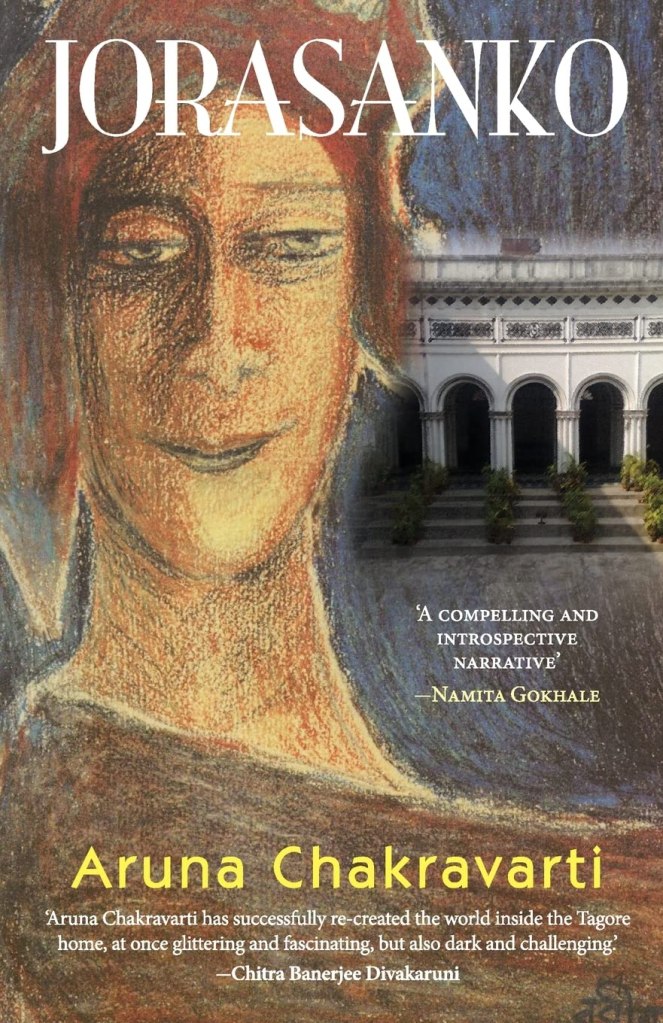
Title: Jorasanko

Author: Aruna Chakravarti

Publisher: HarperCollins India

Genu stood where she was as though rooted to the ground. Her eyes were fixed on the masses of gold and gems that hung from Sarada’s neck and trailed down her vast bosom. Her ears were filled with the jingling from the rows of bangles that encased her mother-in law’s fat arms as she put the finishing touches to her daughter’s toilette. Then the girl turned and walked away.

As soon as she reached the door she started running. Stuffing the end of her sari into her mouth, willing the lump to stay stuck in her throat, she ran like a wild thing down the gallery towards her room. Suddenly, she heard a cry and her feet stopped. She stood nonplussed for a moment. Where had the cry come from? From within her? Had the pain she had tried so hard to suppress burst out of her chest in a wail so bitter? So piteous? Then she pulled herself together. Of course not. It was her mother-in-law’s newborn baby crying. A boy two months and twenty days old…

Following the direction of the sound, she came to a tiny room adjoining the birthing chamber. The room was dark and the child lay, all alone, on a narrow bed. There was no sign of the wet nurse or of anyone else. Everyone was busy enjoying the wedding. Lifting the baby in her arms, she felt something flow out of him, something that warmed and comforted her. They were of a kind, she thought. Both alone. Both unloved. She remembered what Subhankari had told her some days after the child was born. Though she had given birth to a boy, Sarada, she had said, was rather disappointed.

‘He’s ugly.’ Sarada had muttered, looking askance at her newborn.

‘He’s not ugly at all’ Subhankari had retaliated indignantly. ‘You’re too fussy, Saro.’

‘Well he’s certainly darker than my other children. And look at his cars. How big they are! And how they stick out!’ Instructing the midwife to bathe him in milk, she had turned over on her side and gone to sleep.

But what neither Subhankari nor Genu knew was that Debendranath had sent for Anandachandra Vidyabagish soon after the birth and asked him to prepare the little one’s horoscope as he had done for all the other children. And, a few days later, Anandachandra had burst into the baar mahal, his mouth stretched in an exultant grin. ‘An outstanding conjunction of planets! he had cried. ‘A birth like this happens once in hundreds of years. This child’s sun is so strong – he will dazzle the world with the light of his genius.’

Debendra had smiled. ‘A good thing,’ he had said. ‘One of my tasks has been simplified. I’ve been racking my brains to find a suitable name for the boy. Since he was born on a Monday, it could have been Somendranath but that, as you know, has already been taken. Now that you say his sun is so strong, I shall name him Rabindranath. But your calculations had better be correct, Ananda. I don’t want you coming to me with a long face, confessing you bungled them.’

(Excerpted from Jorasanko by Aruna Chakravarti, published by HarperCollins India)

About the Book:

In a sprawling novel that spans a unique phase in the history of Bengal and India, Aruna Chakravarti provides a fascinating account of how the Tagore women influenced and were in turn influenced by their illustrious male counterparts, the times they lived in and the family they belonged to. Jorasanko mirrors the hopes and fears, triumphs and defeats that the women of the Tagore household experienced in their intricate interpersonal relationships, as well as the adjustments they were continually called upon to make as daughters and daughters in law of one of the most eminent families of the land. ‘In her meticulously researched novel, Aruna Chakravarti has successfully re-created for the reader the world inside the Tagore home, at once glittering and fascinating, but also dark and challenging. The women of the Tagore family who are at the heart of this novel are complex beings who will raise many questions in the modern reader regarding the role of women in today’s society’, Chitra Banerjee Divakaruni, author of Palace of Illusions and One Amazing Thing.

About the author:

Aruna Chakravarti  had been the Principal of a prestigious women’s college of Delhi University for ten years. She is also a well-known academic, creative writer and translator with seventeen published books on record. They comprise five novels, two books of short stories, two academic works and eight volumes of translation. Her first novel The Inheritors (published by Penguin Random House) was shortlisted for the Commonwealth Writers’ Prize and her second, Jorasanko (published by HarperCollins India)received critical acclaim and also became a best seller. Daughters of Jorasanko, a sequel to Jorasanko, (HarperCollins India) has sold widely and received rave reviews.Her novel Suralakshmi Villa, published by Pan Macmillan Ltd under the Picador imprint, has been adjudged “Novel of the year (India 2020)” by Indian Bibliography published in The Journal of Commonwealth Literature U.K. Her latest work, The Mendicant Prince, a semi-fictional account of the Bhawal legal case, was released by Pan Macmillan Ltd, in July this year to widespread media coverage and acclaim. Her second book of short stories Through a Looking Glass: Stories has just been released by Om International Ltd.

Her translated works include an anthology of songs from Rabindranath Tagore’s Gitabitaan, Sarat Chandra Chattopadhyay’s Srikanta and Sunil Gangopadhyay’s Those Days, First Light and Primal Woman: Stories. Among the various awards she has received are Vaitalik Award, Sahitya Akademi Award and Sarat Puraskar.

She is also a script writer and producer of seven multi- media presentations based on her novels. Comprising dramatised readings interspersed with songs and accompanied by a visual presentation by professional artists and singers, these programmes have been widely acclaimed and performed in many parts of India and abroad.

.

PLEASE NOTE: ARTICLES CAN ONLY BE REPRODUCED IN OTHER SITES WITH DUE ACKNOWLEDGEMENT TO BORDERLESS JOURNAL

Click here to access the Borderless anthology, Monalisa No Longer Smiles

Click here to access Monalisa No Longer Smiles on Kindle Amazon International
Categories
Excerpt

Biju Patnaik: Architect of Modern Odisha

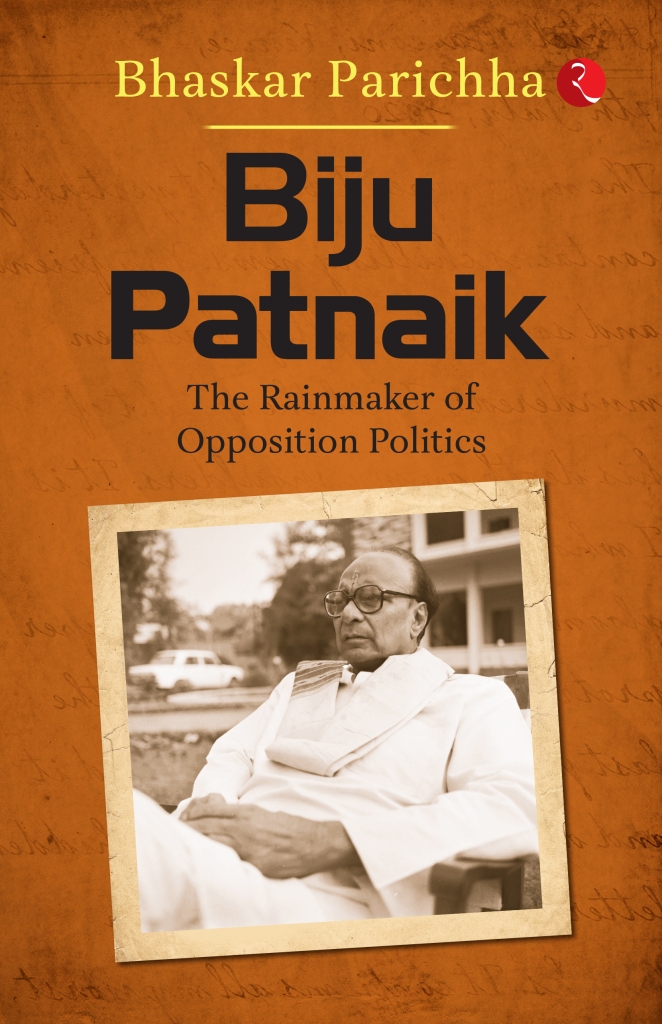
Title: Biju Patnaik: The Rainmaker of Opposition Politics 

Author: Bhaskar Parichha

Publisher: Rupa Publications India

Architect of Modern Odisha

Biju had a strong sense of zeal for dreaming big. At that time, no one had even dreamt that there could be a private sector industry, much less one that was successful. He dreamt and succeeded. Throughout his life, Biju stood out as a person with courage, and that by itself chronicled a remarkable saga of industrial adventure in Odisha half a century ago.

In 1945, when he had attempted to establish an industrial empire in Odisha, he had several other responsibilities. He could have remained committed to politics and wielded political power, as he was exposed to it during the height of the freedom struggle. However, he had a unique vision of industrialization of Odisha. As mentioned earlier, Biju was greatly influenced by Manubhai Shah. In the same way that Mahtab taught him the basics of realpolitik, Manubhai taught him the first few lessons of setting up an industry.

In the years following Biju’s release from jail, he developed an unshakable faith in himself and a commitment to utilize his full potential. There were no great merchants or wealthy individuals in his circle, nor was he in possession of vast resources. The only thing he had was a lofty vision. Despite British strongholds throughout the country, he had flipped through quite a few pages on how to struggle and achieve success. However, the actual struggle had not yet begun.

Owing to his aviation background, several years before he became a big industrialist, he had set up his own airline Kalinga Airlines. At one time, it is believed that Biju had seven aircraft registered in his name, a rare possession. This demonstrated the importance of Biju as a pilot—industrialist. Apart from aviation, it was Choudwar’s textile mill that ushered in a new era of industrial expansion in Odisha. With the establishment of the Odisha Textile Mill in Choudwar, he launched the first chapter of his industrial empire. Slowly but surely, the Kalinga Empire was taking shape. Two years later, it swept through the area, adding a few more plants, both large and small. It would be a reiteration of the obvious to dwell on the ingenuity of this stalwart who painted a large industrial landscape on a blank canvas.

In setting his vision of an industrialized Odisha, Biju was clearly aiming to change the fate of Odias; to transform an agriculture-dominated, feudalist economy and society into something more industrial. This was the inevitable course of action that he took.

ODISHA TEXTILE MILL

From 1946 to 1950, Mahtab served as the Chief Minister of Odisha.

There was a great deal of activity during his tenure as

CM Mahtab,  like    Biju,     was   also   concerned    with    the industrialization of Odisha. He was seeking a dynamic youth to this end, which he found in Biju. Mahtab was also instrumental in establishing Biju as a leading industrialist in the country. It took just a short period of time for Biju to become one.

In 1944, the interim Indian government decentralized the textile industry. As a result, Odisha received four textile units. As textiles appeared to have great potential, Biju was particularly interested in them. Odisha Textile Mills was established at that time. A company named B. Patnaik & Co. was established. A half stake in the company was owned by Biju. Lala Pratap Singh, a descendant of industrialists Lala Sriram and Bhubanananda Das, held the other half. In Odisha, it was the first private company to begin operations. Through this flagship company, Biju’s enterprise   was growing rapidly. Several small- and medium-sized industries emerged, including cotton and ferromanganese. Biju Patnaik & Co. was an industry through and through. It was the birth of a brand. A common thread running through Biju’s corporate credo was the concept of industrialization and diversification.

It was in the late 1940s that Biju joined the Kalinga industrial empire. The primary objective of his career was to establish himself as an upcoming industrialist and develop a company that had the highest annual growth rate. Biju took a shot and Odisha’s industrialization was catapulted into a remarkable era. However, this glory did not last long. Out of his own free will, Btu was renouncing that industrial prowess. The two contrasting factors that contributed to his disdain for the position must have been his well-publicized commitment to do something for the slothful people of Odisha and his dislike of the responsibilities that came with being a manager.

After a brief blossoming, his entrepreneurial spirit soon faded. Biju was the only one apart from Prafulla Chandra Roy[1] in West Bengal, who was able to build industries from scratch. It has been decades since Sir Prafulla Chandra Roy pioneered the West Bengal industry before it withered away.

In 1963, Biju gave away his Ironworks plant in Barbil to the state when it was earning 10-15 per cent profit annually. Biju then gave other plants to his employees. The Kalinga Group saw a gradual decline once he made everything available to the state. All of this had the potential to make him the richest man in the state. This reluctance to engage in business, which Biju demonstrated later as well, was accompanied by a lack of expectation of compensation. All he wanted was a progressive Odisha, which could have never become a reality if he had no political power.

[1]Physicist, educator, historian, industrialist and philanthropist, Roy was an eminent figure in Indian science. Known as the father of chemical science in India, he established the first modern Indian research school in chemistry. While being the founder of Bengal Chemical & Pharmaceuticals, he also served as its chairman.

About the Book

Transitioning from pilot to freedom fighter, businessman to politician, Biju Patnaik(1916-1997) was a multifaceted leader and towering regional icon who has left behind an impactful legacy. Step into the riveting saga of Biju Patnaik, the icon of resurgent opposition politics, through this compelling biography, Biju Patnaik: The Rainmaker of Opposition Politics. His journey, from leaving office in 1963 to reclaiming it in 1990, epitomized resilience and rebirth in politics. Whether as chief minister or Opposition leader, Patnaik’s unwavering connection with the people of Odisha defied conventional politics. Navigating triumphs and trials, Patnaik wielded immense influence, shaping the state’s destiny. His adept manoeuvring from the state secretariat to the corridors of power in Delhi showcased unparalleled strategic prowess, strengthening Opposition alliances and advocating for a credible alternative to the dominant Congress. Biju had tremendous faith in Opposition unity, considering it vital for the survival of democracy in the country. A visionary and unifier, Biju Patnaik’s legacy as a stalwart of Opposition unity echoes through the captivating pages of this stirring account.

About the Author

Bhaskar Parichha is a renowned name in Odisha journalism. Throughout his four-decade long career in the media industry, he has been affiliated with various newspapers in the state. He is the writer of Unbiased: Writings on India, No Strings Attached: Writings on Odisha, and Madhubabu – The Global Indian. Recently, he has also edited a collection titled Naveen@25 – Perspectives. Residing in Bhubaneswar, he is known for his bilingual writing.

.

PLEASE NOTE: ARTICLES CAN ONLY BE REPRODUCED IN OTHER SITES WITH DUE ACKNOWLEDGEMENT TO BORDERLESS JOURNAL

Click here to access the Borderless anthology, Monalisa No Longer Smiles

Click here to access Monalisa No Longer Smiles on Amazon International

Categories
Excerpt

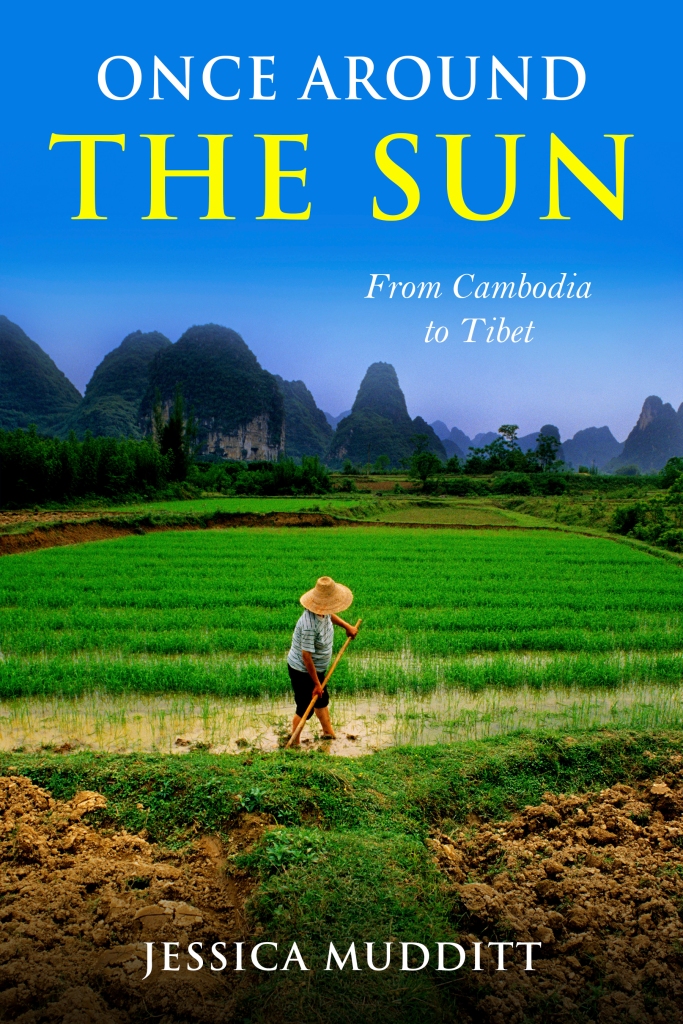
Once Around the Sun: From Cambodia to Tibet

Title: Once Around the Sun: From Cambodia to Tibet

Author: Jessica Mudditt

Chapter 20 – In or out?

As I walked the streets of downtown Hohhot in search of a travel agency, I felt further than five hundred kilometres from Beijing. I was still in East Asia, but the capital city of Inner Mongolia had Central Asian influences too, such as the cumin seed flatbread I bought from a hawker with ruddy cheeks and a fur hat. I passed a Muslim restaurant with Arabic lettering on the front of its yellow-and-green facade, and many street signs and shops featured Mongolian script as well as Mandarin. With its loops, twirls and thick flourishes, Mongolian looked more similar to Arabic than Chinese. In actual fact, the top-down script is an adaptation of classical Uyghur, which is spoken in an area not far to the west.

The winds that blew in from the Russian border to the northeast were icy cold, so I was glad to soon be inside a travel agency. It was crammed with boxes of brochures and a thick film of dust covered the windowpanes. Hohhot is the main jumping-off point for tours of the grasslands, so I was able to get a ticket for a two-day tour that began the following morning.

I wasn’t enthusiastic about going on a tour because I preferred to move at my own pace, however there was no other way to access the grasslands. The upside was that I was guaranteed to sleep inside a ger, which is a circular tent insulated with felts. The Russian term of ‘yurt’ is better known. I had read that Inner Mongolia was a bit of a tourist trap for mainland Chinese tourists, but I was nonetheless excited to get a glimpse of the Land of the Weeping Camel.

I walked into a noodle shop and a customer almost dropped her chopsticks when she saw me. The girls at the cash register were giggling and covering their faces as I pointed at a flat noodle soup on a laminated menu affixed to the counter.

Foreign tourists must be thin on the ground in Hohhot, I thought as I carried my bowl over to a little table by the window.

Inner Mongolia was one of the few places that Lonely Planet almost discouraged people from visiting: ‘Just how much you can see of the Mongolian way of life in China is dubious.’ But I was still keen to see what I could.

I ate slowly, enjoying each fatty morsel of mutton. I was pretty good with chopsticks by that point – I’d never be a natural, but I didn’t drop any bits of mutton into the soup with a splash, as I used to in Vietnam.

Hohhot seemed a scruffy, rather bleak sort of city – or at least in the area where I was staying close to the train station. Street vendors stood cheek by jowl on one side of the road, calling out the prices of their wares. The opposite side was under construction and the one still in use was unpaved, which meant that two lanes of traffic had to navigate a narrow area of bumpy stones while avoiding massive potholes and piles of dirt. I saw a motorbike and a three-wheel truck almost collide.

I spent the next few hours wandering around the Inner Mongolia Museum, which has a staggering collection of 44,000 items. Some of the best fossils in the world have been discovered in Inner Mongolia because its frozen tundra preserves them so effectively. The standout exhibit for me was the mammoth. It had been discovered in a coal mine in 1984 and most of its skeleton was the original bones rather than replicas. I gazed up at the enormous creature and tried to imagine it roaming the earth over a million years ago. Mind-boggling.

I admired the black-and-white portraits of Mongolian tribesmen, and then took photos of a big bronze statue of Genghis Khan astride his galloping mount. The founding leader of the Mongol Empire was the arch-nemesis of China, and parts of the Great Wall had been built with the express purpose of keeping out his marauding armies. Genghis Khan must have rolled in his grave when China seized control of a large swathe of his territory in 1947.

What was once Mongolia proper became a Chinese province known as ‘Inner Mongolia Autonomous Region’. This long-winded name is an example of Orwellian double-speak. So-called ‘Inner Mongolia’ is part of China, whereas the independent country to the north is by inference ‘Outer Mongolia’. Nor is the Chinese region autonomous. The Chinese state has forced Mongolians to assimilate. Their nomadic lifestyle and Buddhist beliefs had been pretty much eradicated, and although speaking Mongolian wasn’t outlawed, learning the state language of Mandarin was non-negotiable.

On top of this, the government provided tax breaks and other financial incentives to China’s majority ethnic group, the Han Chinese, if they relocated to Inner Mongolia. Mongolians now account for just one in five people among a total population of 24 million. The same policies of ethnic ‘dilution’ exist in China’s four other ‘autonomous regions’, which include Tibet and Xinjiang, the home of the Uyghurs.

Shortly before I left the museum, I came to a plaque that described the official version of history, which was at odds with everything I’d read in my Lonely Planet.

‘Since the founding of Inner Mongolia Autonomous Region fifty years ago, a great change has happened on the grasslands, which is both a great victory of the minority policy and the result of the splendid leadership of the Communist Party of China. The people of all nationalities on the grassland will never forget the kind-hearted concerns of the revolutionary leaders of both the old and new generations.’

I rolled my eyes, snapped a photo of the plaque for posterity, and continued walking.

* * *

I didn’t venture far from my hotel for dinner because I planned on having an early night. I chose a bustling restaurant with lots of families inside and was waiting for a waiter to come and start trying to guess my order when a group of men at the next table caught my eye. They seemed to be waving me over.

Me? I asked by pointing at myself.

Yes, they were nodding. Shi de.

I happily joined the group and introduced myself by saying that I was from ‘Aodàlìyǎ’. I think they were Han Chinese, as they didn’t look Mongolian. I whipped out my phrasebook and tried to say I had come from Beijing, but I was fairly certain they didn’t understand me.

Anyhow, no matter. Ten shot glasses were filled from a huge bottle of baijiu, and I was soon laughing as if I was with old friends. One of the slightly older guys used a set of tongs to place wafer-thin slices of fatty pork into the bubbling hotpot on the table, followed by shiitake mushrooms and leafy greens. As the impromptu guest of honour, my bowl was filled first once it was cooked – by which time I’d already had three shots.

The hotpot was fantastic, and I had to remind myself not to finish everything in my bowl. Bethan had told me that Chinese etiquette requires a small amount of food not to be eaten at each meal. This indicates that it was so satisfying that it wasn’t necessary to eat every last bite. As a kid, it was ingrained in me to finish everything on my plate. I loved food and was generally in the habit of licking my bowl clean, so I had to exercise a certain amount of restraint.

I had just rested my chopsticks across the top of my bowl to signal I was finished when I was invited to go sit on the wives’ table, which was across from the men’s. The women were very sweet and a couple of them seemed to be around my age. I once again tried to communicate using my phrasebook, but I was hopelessly drunk by then. I could hardly string a sentence together in English, let alone Mandarin. I was also beginning to feel queasy from the baijiu, so I gratefully accepted a cup of green tea from the porcelain teapot that came my way on the lazy Susan. After taking some photos together, I bid the two groups ‘zaijian’ (goodnight). I tried to contribute some yuan for the meal, but they wouldn’t hear of it. I curtsied as a stupid sort of thank-you, and then I was on my way.

* * *

More hard liquor awaited me the following day. A striking woman in a red brocade gown with long sleeves handed me a small glass of baijiu as I stepped off the minibus a bit before noon.

‘It’s a tradition,’ she said with a smile, while holding a tray full of shots.

I downed the baijiu with my backpack on and grinned as the backpacker behind me did the same. There were four foreign tourists on the tour, and about eight domestic ones. The liquor gave me an instant buzz, which I needed. I hadn’t slept well and woke up feeling lousy, so I’d kept to myself during the two-hour journey. Even though I should have been excited, I got grumpier and grumpier as the reality of being on a tour began to sink in. Plus, the landscape was not the verdant green steppes I’d been expecting. At this time of year, it was bone dry and dusty. It hadn’t occurred to me to check whether my visit coincided with the low season.

I began chatting to the other tourists. The guy who had the baijiu after me was Lars from Holland. There was also a couple from Germany. I could immediately tell they were pretty straitlaced. Their clothes looked very clean and functional, and the girl refused the baijiu.

The woman in red introduced herself as Li, our tour guide. Then she led us along a path lined with spinifex to a dozen gers. They faced each other in a circle, and off to the right was a much larger ger with the evil eye painted on its roof and Tibetan prayer flags fluttering in the fierce winds. There were no other buildings in sight and no trees.

Li told us to meet inside the big ger in fifteen minutes after we’d put our stuff in the smaller gers she proceeded to assign us. Lars and I would be spending the night in a ger with ‘82’ painted on its rusted red door. There certainly weren’t eighty gers, so the logic behind the numbering system wasn’t clear – but no matter. The German couple took the ger to the right of ours.

These were not portable tents for nomads. Each ger was mounted on a concrete base and I think the actual structure was made of concrete too, and merely wrapped in grey tarpaulins. The door was made of metal and at the top was a sort of chimney structure – perhaps for ventilation. Like igloos, the only opening was the door, and it was pitch-black inside. I located a dangling light switch as I entered.

‘Ah – I love it!’ I exclaimed.

It was a simple set-up, with single beds lining the perimeter and a low table in the middle of the room. Patterned sheets were draped from the concave ceiling. I chose the bed with a framed portrait of Genghis Khan above it. Lars put his backpack next to a bed on the other side. I was happy enough to share a ger with him. He gave off zero sleazy vibes.

‘I might just take a couple of those extra blankets,’ I said to Lars as I piled on a few extra floral quilts from another bed. The wind had an extra iciness to it out on the steppes and I shuddered to think what the temperature would drop to overnight. We zipped our jackets back up and headed out.

I wandered over to the toilet block, which was quite a distance from the gers. I made a mental note to drink as little as possible before getting into bed to avoid having to go in the night. Once I got closer to the toilets, I was glad they were so far away. The stench was unbelievable.

In the female section were two concrete stalls without doors. In the middle of the floor in each was a rectangular gap. I almost gagged. Just a few centimetres away from the concrete was an enormous pile of shit. I could make out bits of used toilet paper and sanitary pads and there were loads of flies buzzing around. Without running water or pipes, the excrement just sat there, day after day, building up. I would have turned and walked straight back out but I was busting for a wee. I held my breath so I wasn’t inhaling the smells. I wanted to close my eyes too, but I was terrified of falling in, so I had to look at what I was doing. I couldn’t get out of there fast enough.

‘Oh my god, Lars – the drop toilets are totally disgusting,’ I said after I met up with him in the big ger. ‘It’s just a pit of shit without running water.’

‘I know an American girl who fell into a drop toilet in China last year,’ he said.

‘No way,’ I said with a shudder.

‘Yeah. She said it was terrible. She was in a really poor village somewhere in central China and she went to the toilet at night. She couldn’t see that some of the wooden planks had gaps in them – and then one of them broke and she fell in. She was up to her neck in shit. She was screaming for people to come help her. Apparently, it took them half an hour to fish her out, and all the while she could feel creatures writhing around her body. She cut her trip short and had to get counselling when she got home.’

‘I bet she did,’ I said. ‘That’s the most disgusting thing I’ve ever heard in my life. The poor girl.’

Just then Li appeared and said we were heading outside to watch horse racing and traditional wrestling after some sweet biscuits and tea. We assembled around a fenced area where there were about thirty ponies tethered to poles. Some were lying down while still saddled.

‘Horses usually sleep while standing up, so these ponies must be knackered – pardon the pun,’ I joked to Lars.

Notwithstanding, they looked to be in reasonably good condition, with shiny coats and no protruding ribs. There were chestnuts, bays and dapple greys.

I heard the sound of hoofbeats and looked behind me. A group of men on horseback came thundering across the steppes. It was a magnificent sight, and any lingering resentment I had about being on a tour melted away.

One of the men rode ahead of the rest. He was wearing a cobalt-blue brocaded tunic and his wavy black hair came down past his ears. He was really good-looking. He approached Li with a smile, said something to her and dismounted with the ease of someone who had probably started riding horses before he learned to walk. Li and the man exchanged a few words – I definitely saw her blush – and then he got back on.

‘Gah!’ he yelled as he dug his heels into his horse’s sides.

The other horsemen followed after him with whoops, leaving a trail of dust in their wake. These Mongolian ponies were only about twelve or thirteen hands, but they sure were fast and could turn on a dime. I loved watching them carve up the dry earth.

Next a group of men on motorcycles appeared along the track. There were quite a lot of them – at least twenty. We formed a big circle, and the traditional wrestling began. I wasn’t sure what the rules were, but it was fairly self-explanatory: one man got another in a headlock and thumped him to the ground. The next man came along and fought the winner, and so on and so forth. The spectators egged on the fighters with what I assumed were good natured cat calls. Everyone was grinning. By the time the wrestling matches were over, the fighters were absolutely covered in dust and the sun was beginning to set. I’m sure it was all staged for our benefit, but it was good fun.

With the seamless orchestration of a tour that has been done a thousand times before, we gravitated to the big ger. Dinner was bubbling away in a large clay pot and it smelled pretty good. There was also a big vat of noodles with black sauce and the ubiquitous Chinese vegetables of thinly sliced carrot, bok choy, baby corn and onion. There was a bottle of baijiu on each table.

We were serenaded with traditional music while we ate. One of the instruments reminded me of the didgeridoo and there was also a violin. I had read that strands of horse mane are used to make violin strings. The male singer had a deep voice that was almost a warble, and it was hauntingly beautiful.

Five men and women emerged from behind a red curtain and began to dance. They wore long-sleeved, billowing satin tunics that were cinched at the waist with embroidered belts. One of the women had a tall hat made of white beads that dangled down to her waist. It must have been heavy. It was a high-energy display of kicks and splits and parts of it were reminiscent of Irish dancing. They twirled their billowing skirts like sufis. The Chinese tourists started clapping in time with the music and then we all joined in. Sure, it was a bit cheesy, but I was really enjoying myself. At the end of the concert, we had photos with the performers as they were still trying to catch their breath.

We were given torches to light our way back to our gers. It was absolutely freezing, so I wore all my clothes to bed. I snuggled into my blankets and pulled them right up to my chin, feeling grateful for the warmth of Bethan’s jumper.

Mercifully, I slept right through until morning and avoided a late-night visit to the shit pit.

When I wandered out of the ger the next morning, breakfast was being prepared nearby. The carcass of a freshly slaughtered sheep was hanging from the back of a trailer. A man was skinning it while the blood drained out of its neck into a big metal bowl. Its head was in a second bowl, while squares of wool were laid out flat to dry on a tarp. A toddler in a puffy orange jacket was playing in the dust while his mother worked away at skinning parts of the wool. What distressed me more than butchery up close was the live sheep that was watching on from the back of the trailer. He presumably knew he was next.

After a breakfast of ‘sheep stomach stew with assorted tendons’ (as Li described it) we headed out for a ride on the steppes. I couldn’t wait to ride a horse again. I’d spent most of my childhood obsessed with horses, and I was lucky enough to have one for a few years, until I got older and became more interested in hockey and parties.

I rode a stocky bay with a trimmed mane that bobbed up and down as it trotted along the path. I looked over its perky little ears. The saddle had an uncomfortable pommel that kept jabbing me in the stomach, but I loved being under the wide open sky. It was a pale blue with just a few wispy clouds. Sheep grazed and crows rested on clumps of rocky outcrops.

I winced at the Chinese guy ahead of me, who was bouncing out of time to the rhythm of his horse’s gait and landing with a heavy bump in the saddle; his oversized suit flapping in the wind and his feet poking out straight in the stirrups. Much easier on the eye was the guide two horses ahead of him. He was every inch the Mongolian cowboy. Dressed from head to toe in black, he wore a leather jacket, cowboy hat and scuffed black cowboy boots. He never took off his wraparound sunglasses and he spoke little. He smouldered like the heartthrob actor, Patrick Swayze.

We’d travelled several kilometres when we came to a building block that was the same greyish brown as the earth. Inside it had a cottage feel. We sat around a table covered with a frilly tablecloth and drank yak milk. As we did, Lars told me about his day trip to North Korea. While in South Korea for a couple of weeks, he had visited the demilitarised zone (better known as the ‘DMZ’), where a ceasefire was negotiated between the two Koreas in 1953. In a military building is what is known as the ‘demarcation line’ – and Lars had one foot in North Korea and another in South Korea. I hung on his every word.

Our conversation got me thinking about how cool it would be to go to North Korea. I was actually quite close to the border. When I got back to the ger, I retrieved my Lonely Planet out of my bag and thumbed to the section titled ‘Getting there and away’, which had instructions for every country that borders China.

‘Visas are difficult to arrange to North Korea and at the time of writing, it was virtually impossible for US and South Korean citizens. Those interested in travelling to North Korea from Beijing should get in touch with Koryo Tours, who can get you there (and back).’

I was pretty sure the cost would be prohibitive for my budget and decided to stick with my existing plan of cutting south-west towards Tibet. Maybe one day I’d get the chance to visit North Korea, but it wouldn’t be on this trip.

Once back in Hohhot, I boarded a train bound for Pingyao. As I watched the apartment blocks pass by in a blur, I thought with satisfaction about the past twenty-four hours. Any visit to Inner Mongolia is problematic, but I couldn’t fault the Chinese tour company. They had made every effort to keep us entertained. Mongolian culture was so new to me that I couldn’t even tell whether something was authentic or staged, but I had seen and done all the things I hoped to during my visit. And, sure, my time there was really brief. But I’d be forever grateful to have seen a part of the world I thought I’d only ever get to see in a documentary.

Photo Courtesy: Jessica Muddit

About the Book: While nursing a broken heart at the age of 25, Jessica Mudditt sets off from Melbourne for a year of solo backpacking through Asia. Her willingness to try almost anything quickly lands her in a scrape in Cambodia. With the nation’s tragic history continuing to play out in the form of widespread poverty, Jessica looks for ways to make a positive impact. She crosses overland into a remote part of Laos, where friendships form fast and jungle adventures await.

Vietnam is an intoxicating sensory overload, and the hedonism of the backpacking scene reaches new heights. Jessica is awed by the scale and beauty of China, but she has underestimated the language barrier and begins her time there feeling lost and lonely. In circumstances that take her by surprise, Jessica finds herself hiking to Mount Everest base camp in Tibet.

From a monks’ dormitory in Laos to the steppes of Inner Mongolia, join Jessica as she travels thousands of kilometres across some of the most beautiful and fascinating parts of the planet.

About the Author: Jessica Mudditt was born in Melbourne, Australia, and currently lives in Sydney. She spent ten years working as a journalist in London, Bangladesh and Myanmar, before returning home in 2016. Her articles have been published by Forbes, BBC, GQ and Marie Claire, among others. Once Around the Sun: From Cambodia to Tibet is a prequel to her earlier book, Our Home in Myanmar.

.

PLEASE NOTE: ARTICLES CAN ONLY BE REPRODUCED IN OTHER SITES WITH DUE ACKNOWLEDGEMENT TO BORDERLESS JOURNAL

Click here to access the Borderless anthology, Monalisa No Longer Smiles

Click here to access Monalisa No Longer Smiles on Kindle Amazon International

Categories
Excerpt

Out of Sri Lanka

Title: Out of Sri Lanka: Tamil, Sinhala and English Poetry from Sri Lanka and its Diasporas 

Editors: Vidyan Ravinthiran, Seni Seneviratne and Shash Trevett. 

Publisher: Penguin India (Vintage)

AAZHIYAAL
(b. 1968)

Aazhiyaal (the pen name of Mathubashini Ragupathy) was born in Trincomalee in Eastern Sri Lanka. She taught English at the Vavuniya Campus, Jaffna University, before moving to Australia in 1997 where she worked for two decades in the IT sector and commercial management in Canberra. Aazhiyaal has published four collections of poetry in Tamil: Uraththup Pesa (2000), Thuvitham (2006), Karunaavu (2013) and Nedumarangalaai Vazhthal (2020), the last honoured by Canada’s Tamil Literary Garden. Her poems have appeared in anthologies and have been translated into several languages. She in turn has translated Australian Aboriginal poetry into Tamil (Poovulagaik Kattralum Kettalum, 2017). Aazhiyaal writes about women’s place within patriarchy and uses her work to make sense of the war in Sri Lanka: ‘I believe that poetry is the antidote to the present rat-race. It is needed, it is necessary.’


Unheeded Sights

After the rains
the tiled roofs shone
sparklingly clean.
The sky was not yet minded
to become a deeper blue.
The tar roads reminded me
intermittently of rainbows.
From the entire surface of the earth
a fine smoke arose
like the smoke of frankincense, or akil wood,
the earth’s scent stroking the nostrils,
fragrant as a melody.

As the army truck coming towards me
drives away,
a little girl transfers her candy-floss
from one hand to the other
raises her right hand up high
and waves her tiny fingers.

And like the sweet surprise
of an answering air-letter
all the soldiers standing in the truck
wave their hands, exactly like her.

The blood that froze in my veins
for an instant, in amazement,
flows again rapidly, asking aloud,
‘War? In this land?
Who told you?’

[tr. from Tamil by Lakshmi Holmström]


BASHANA ABEYWARDANE
(b. 1972)

Rohitha Bāshana Abeywardane was a member of the founding editorial board and later editor in chief of the Sinhala alternative weekly newspaper Hiru. In 2003, he was one of the activists who organised the Sinhala-Tamil Art Festival. His journalistic commitments brought on threats to his life, and he had to leave Sri Lanka. He continues to publish and coordinates Journalists for Democracy in Sri Lanka, an organisation founded by journalists in exile. Following a stay in the Heinrich Böll House, Langenbroich, Abeywardane took part in the PEN Writers in Exile Program from September 2007 to August 2010. Today, he lives in Germany with his wife.


The Window of the Present

Nightmares, long dead,
peer through the shattered panes
of the window of the present.

The dead of the south, killed on the streets,
with bullet-riddled skulls,
walk once again, through an endless night,

and those of the north drowned in deluges of fire
when rains of steel drench their unforgiving earth,
gaze through the shards of glass empty eyed;

as slaughtering armies, prowl under starless skies,
upholding sovereignty
with blood-soaked hands.

PACKIYANATHAN AHILAN
(b. 1970)

Born in Jaffna in the north of Sri Lanka, Packiyanathan Ahilan has lived through the thirty-year civil war. An academic as well as a poet, he has published three collections of poetry and is Senior Lecturer in Art History at the University of Jaffna. As well as writing about the visual arts, poetry, theatre and heritage, he curates art exhibitions and is co-editor of Reading Sri Lankan Society and Culture (Volumes 1 & 2). Ahilan’s poetry is sparse and staccato, like a heartbeat: he is one of the most influential poets writing in Tamil in Sri Lanka today.


Days in the Bunker III

Good Friday.
The day they nailed you
to the cross.

A scorching wind
blew across the land and the sea.
One or two seagulls
sailed in an immaculate sky.
The wind
howling in the palm trees
spoke of unfathomable terror.
That was the last day of our village.

We fishermen came ashore,
only the waves
returned to the sea.
When the sun fell into the ocean,
we too fell
on our knees
and wept.

And our lament
turned slowly into night.

In the distance
our village was burning
like a body being cremated.

Good Friday.
The day they nailed you
to the cross.

[tr. from Tamil by Sascha Ebeling]


A Poem about Your Village and My Village

1
I do not know.
I do not know if your village
is near the ocean with its wailing waves
or near a forest.
I do not know your roads
made from red earth and
lined with tall jute palms.
I do not know
the birds of your village
that come and sing in springtime.
I do not know
the tiny flowers along the roadsides
that open their eyelids when the rains pour down.
I do not know the stories
you tell during long nights
to the sound of drumbeats
or the ponds in your village
where the moon goes to sleep.

2
Tonight,
when even the wind is full of grief,
you and I know one thing:
Our villages have become
small
or perhaps large
cemeteries.
The sea with its dancing waves
is covered with blood.
All forests with their
trees reaching up to the sky
are filled with scattered flesh
and with the voices of lost souls.
During nights of war
dogs howl, left to themselves,
and all roads and the thousands
of footprints our ancestors left behind
are grown over with grass.
We know all this,
you and I.
We now know about
the flowers that died,
the abandoned lines of poetry,
the moments no one wants to remember.


3
But
do you know
if the burnt grass
still has roots,
or if the abandoned poems
can still be rooted in words?
If, like them, you do not know
whether our ancient flames
are still silently smouldering
deep down in that ocean
covered with blood,
know this today:
They say that
after he had lain in hiding
for a thousand years
one day
the sun rose again.

[tr. from Tamil by Sascha Ebeling]

ABOUT THE BOOK:

Out of Sri Lanka shines light upon a long-neglected national literature by bringing together, for the first time, Sri Lankan and diasporic poetry written in and after Independence.  Featuring over a hundred poets writing in English, or translated from Tamil and Sinhala reshapes our understanding of migrational poetics and the poetics of atrocity. Poets long out of print appear beside exciting new talents; works written in the country converse with poetry from the UK, the US, Canada and Australia. Poems in traditional and in open forms, concrete poems, spoken word poems, and experimental post-lyric hybrids of poetry and prose, appear with an introduction explaining Sri Lanka’s history.

There are poems here about love, art, nature – and others exploring critical events: the Marxist JVP insurrections of the 1970s and 80s, the 2004 tsunami and its aftermath, recent bombings linked with the demonisation of Muslim communities. The civil war between the government and the separatist Tamil Tigers is a haunting and continual presence. A poetry of witness challenges those who would erase, rather than enquire into, the country’s troubled past. This anthology affirms the imperative to remember, whether this relates to folk practices suppressed by colonisers, or more recent events erased from the record by Sinhalese nationalists.

 ABOUT THE EDITORS:

Vidyan Ravinthiran was born in Leeds, to Sri Lankan Tamils. His first book of poems, Grun-tu-molani (Bloodaxe, 2014), was shortlisted for the Forward Prize for Best First Collection, the Seamus Heaney Centre Poetry Prize and the Michael Murphy Memorial Prize. His second, The Million-petalled Flower of Being Here (Bloodaxe, 2019) was shortlisted for the Forward Prize for Best Collection, the T.S. Eliot Prize and Ledbury Munthe Poetry Prize for Second Collections. After posts at Cambridge, Durham and Birmingham, he now teaches at Harvard.

Seni Seneviratne, a writer of English and Sri Lankan heritage published by Peepal Tree Press, with books including Wild Cinnamon and Winter Skin (2007)The Heart of It (2012), and Unknown Soldier (2019), which was a Poetry Book Society Recommendation, a National Poetry Day Choice and highly commended in the Forward Poetry Prizes 2020.

She is currently working on an LGBTQ project with Sheffield Museums entitled Queering the Archive and her latest collection, The Go-Away Bird, was released in October 2023. She lives in Derbyshire.

Shash Trevett is a Tamil from Sri Lanka who came to the UK to escape the civil war. She is a poet and a translator of Tamil poetry into English. Her pamphlet From a Borrowed Land was published in 2021 by Smith|Doorstop.

Shash has been on judging panels for the PEN Translates awards and the London Book Fair, and was a Visible Communities Translator in Residence at the National Centre for Writing. Shash is a Ledbury Critic, reviewing for PN Review and the Poetry Book Society and is a Board Member of Modern Poetry in Translation. She lives in York.

Categories
Excerpt

Spellcasters

Title: Spellcasters: A Novel 

Author: Rajat Chaudhuri

Publisher: Niyogi Books

Imprint: Olive Turtle

It was dark outside but for a faint yellow glow hanging like a cobweb around the gate lamp. She saw two figures moving stealthily, sneaking up the verandah. They were coming in her direction. As they approached the façade of the house they scanned the wall, and then the pillars.

The two men came right up to where she was hidden behind the window, and one was pointing above their heads at the exterior wall. He was well-built, about six feet, and wore a long raincoat speckled with rain and a cap with a chinstrap. He had something in his hand which looked like a crowbar for jimmying locks. The other man, much shorter, had a thickset brutish face, and he had such a cruel look in his eyes that Sujata gasped when she saw him standing so close. He was carrying a jerrycan. This guy had a vermilion streak on his forehead, and his bucktooth was shining in the faint light.

Will they try to break in? She could call out for help with the hope that someone would hear. But the nearest house belonged to a private school, and there would be no one there except for the caretaker who would be dead drunk. The hotel further down the road was still waterlogged, and the labourers—even if they heard her—won’t be able to make it here in time. Too late to call the police, and then there would be many questions.

The shorter of the two opened the jerrycan and began to splash some liquid on the walls and on the chairs kept outside. Petrol! His partner pulled a tool from his pocket and reached up to the wall. The electricity metres were just above his head. What! They were trying to short circuit the electric wires and start a fire! That’s what she thought they were upto. And when she rushed out, they would shoot her and dump her body into the flames.

She went stiff for a second but was alert right the next moment. With a swift movement she swept away the curtains, pushed the shutter and stood straight in front of the window.

The thuggish-looking character with the jerrycan took a step back at the sound and then he saw her. He gave out a low whistle to warn his companion while trying at the same moment to draw his gun. But whatever happened after that was too fast for him, or anyone for that matter.

It is impossible to provide an exact record. If someone was watching, they would have seen her cross her hands after she swept away the curtains to face the hired hitmen. She joined her hands, crossing her arms in that millennia-old swastika mudra—which they say can even stop the devil in his tracks.

It could have ended there but didn’t. As she made the hand gesture, buck-tooth whistled but he couldn’t draw his gun. An ice shower from another world froze his muscles. He turned to stone, buried as if under an avalanche of ice.

Through that daze he saw the curls of her hair writhe and twist, having come to life, animated and growing longer. Sinuous dark ribbons hissing their way out through the window, hoods raised, fangs exposed. Till there was no one on this side, only these swarthy hissing messengers of death slithering into the verandah.

The taller of the two hearing the other whistle, cursed under his breath, ‘Damn! What is it yaar?’

He glanced to his left but it was all too late. All that Sujata heard as she stepped back was a blood-curdling cry of agony as a blue tongue of fire leapt out from the metre box lashing at the two, flinging them back. Both were knocked out cold. It was only left for the fire to do the rest.

A hot train of sparks charged ferociously through the wires and licked the petrol doused wall. Within seconds the lawn lit up with this eerie blue light. Blue changed to white. Flames shivered like teasing tongues. Now they leapt through walls and doorways, and were streaking across the ceiling of her room in angry crimson arrows.

She threw on her jacket and rushed towards the passage for the kitchen exit. Amitav Ghosh’s book about climate change still lay open on the couch where Chanchal had left it. She stopped, scooped it up and stuffed it into her knapsack. A book is always a good weapon, hardbacks are even better. Below the book was a half-eaten bar of Atman dark chocolate; she had given it to him.

She took a bite and jammed it into her pocket. The curtains in the passage had caught fire from the radiated heat coming from the next room. She made a dash for the kitchen. If it got hot beyond a point, the gas tank would explode. Not another moment to lose!

But the kitchen door leading out to the backyard was jammed. She struggled with the oil and grime-caked bolt, losing precious minutes. Is this how she will go then?

ABOUT THE BOOK

Chanchal Mitra wakes up in a far-off desert town, sharing a dingy hotel room with the flamboyant Mr. Kapoor, who is planning to abduct a billionaire. Kapoor insists that the billionaire tycoon is an impostor. Chanchal is unwittingly drawn into the plot. Soon they are joined by the mystery woman Sujata, her eyes dark like murder; and then a crutch-clutching ex-sailor, who is quick with a gun.

In the smog-swathed capital city of Aukatabad, an organic chemist engaged by the tycoon to design a mind-altering drug, is found dead from an overdose. Elsewhere, the billionaire industrialist’s chocolate factory is contaminated by salmonella while Sujata fights a fiery death at the hands of hired killers. As weird weather overtakes the land and Kapoor sets out with his accomplices to kidnap the businessman, the flimsy lines between friend, foe and lover begin to quickly disappear.

ABOUT THE AUTHOR

Rajat Chaudhuri’s works include novels, story collections, edited anthologies and translations. He curated The Best Asian Speculative Fiction and co-edited the Multispecies Cities: Solarpunk Urban Futures (Asia-Pacific) anthology.

His most recent novel, The Butterfly Effect was twice listed by Book Riot (US) as one of the ‘Fifty must read eco-disasters in fiction’ and among ‘Ten works of environmental literature from around the world’. Acclaimed for its exploration of a ‘Ballardian near-future’, this novel is now taught in Indian, American and European universities. His short fiction has also appeared in the internationally acclaimed climate fiction video game, Survive the Century. Chaudhuri has received writing fellowships from Charles Wallace (UK), Hawthornden Castle (Scotland) and Livonics (India) and residency awards from Arts Council Korea-InKo (South Korea) and Sangam House (India).

ABOUT THE PUBLISHER

An internationally acclaimed publishing house, Niyogi Books, established in 2004, has more than 650 titles today. They not only specialize in textual context but also strive to give equal importance to visuals. They purvey a wide range of content on art, architecture, history, culture, spirituality, memoirs, and every aspect, which connects with our rich heritage. Under their umbrella, they have fiction and non-fiction that cover books on social science, cookery, and self-help as well as English Translations of modern classics from different Indian languages. Niyogi Books has recently launched four new Imprints: Olive Turtle (English fiction), Thornbird (English Translation), and Paper Missile (English non-fiction) and Bahuvachan (Hindi Translation: Fiction & Non-Fiction). Also, they have co-published a number of critically acclaimed books with reputed institutions like the British Library, Rietberg Museum Zurich, IGNCA, National Gallery of Modern Art, Ministry of Culture (Govt. of India), National Manuscript Mission, Sahitya Akademi, among many others.

.

PLEASE NOTE: ARTICLES CAN ONLY BE REPRODUCED IN OTHER SITES WITH DUE ACKNOWLEDGEMENT TO BORDERLESS JOURNAL