Categories
Stories

Belacan

Migrant stories of yore from Malaysia by Farouk Gulsara

“There she goes again,” thought Saraswati as she cut vegetables she had never seen in her native country. “Here goes Ah Soh cooking her stinky dish again.”

Ah Soh with Nand Lal, Sarawswati’s son.(Photo taken circa the early 2000s).Courtesy: Farouk Gulsara

Saraswati, Ah Soh and the rest of the pack are people commonly called fresh off the boat. They hail from various parts of China and India. 

The loud beating of a metal ladle against a frying pan, accompanied by the shrilling Chinese opera over the radio and her shrieking at her children, need no guessing whose kitchen ‘aroma’ is coming from. Everyone knows Ah Soh is frying belacan, a fermented Malay shrimp paste. 

A house in the New Village (Photo taken circa the early 2000s). Courtesy: Farouk Gulsara

Ah Soh is Saraswati’s immediate neighbour in a New Village in Ipoh. Ah Soh, by default, is the self-appointed leader of the pack. Since she is one of the oldest occupants of New Village, she leads the group of housewives, all living along the same row of single-story wooden houses. These houses were the brainchild of the British when they wanted to keep the communist at bay in the 1950s. More than ten years into its inception, the houses are still strong and are a catch for many newcomers to Malaya.

Ah Soh and her husband, Ah Leong, hail from Canton, China. Escaping poverty and famine, Ah Leong scrapped the bottom of the barrel to buy himself a one-way ticket to Singapore in the early 1950s, then an up-and-coming international port, to try his luck. 

After trying a few odd jobs here and there, Ah Leong heard of an opening in newly opened tin mines in Ipoh. He made a dash for it and found Ipoh and the work he liked. Soon, he saved enough cash and paid an agent to bring over the newly married wife that he left behind in China. Ah Leong, Ah Soh and later, their two young daughters develop roots in the New Village. 

Life was no bed of roses for Saraswati either. Losing most of her family members to famine, a 13-year-old Saraswati was bundled off to a distant relative’s house in Bihar. Saraswati is pretty sure she was sold off to work as a maid, as she scrubbed and cleaned from dawn to dusk.

Lady Luck manifested most peculiarly. Saraswati was labelled bad luck when many mishaps hit her new family soon after joining them. One of the kids died of diarrhoea, and a big branch of a peepal tree growing in the compound fell on the house, destroying the roof. So, when the family heard of an elderly widower looking for a suitable bride, Saraswati was bundled off yet again. 

Hence, Saraswati’s next phase of life started with her boarding a ship, S Rajula, from Calcutta to Penang, Malaya. She spent an entire month suffering from motion sickness, not only from the ship’s motion but by the various smells of people and their cooking. Starting life as a complete vegetarian, by the time she arrived in Malaya, after overexposure to a plethora of aromas and sights, she had garnered enough courage to taste various types of meat. 

So, Ah Soh’s pungent belacan was tolerable to Saraswati’s smell buds, even though she hails from the Hindi heartland where, by design, everybody in her community was vegetarian.

Saraswati’s husband, Lal, had his own tale of melancholy. After losing his family to famine, he became an orphan and a guardian to his 12-year-old sister. With much difficulty, he somehow, doing odd jobs, managed to sustain his little family to adulthood. He was in the marriage market after getting his little sister happily married off. Unfortunately, three months into his marriage, the young bride succumbed to tuberculosis, then a deadly death sentence to anyone. Even the President of Pakistan had died of TB.

Nursing a heartbreak, he heard the news that some people he knew were going to try their luck in Malaya. The talk around town was that Malaya, the land of milk and honey, was the darling was the Empire and had great job opportunities. So that is how he landed in Malaya. 

Again, after doing whatever work that came by, he landed in a more secure job washing the British Army’s dirty laundry in a camp in Ipoh. Cleaning, starching and ironing kept him busy, but he was happy for the first time. With money in his pocket and regular meals to look for, he ventured out for humble accommodation. That is how this New Village house came about.

He returned to his hometown in Bihar, India and got a bride for himself. So, here he is, with his second wife, Saraswati, and two young boys. 

The New Village is a melting potpourri of people escaping from famine and depravity. If in the 1950s, this place protected the country from communist threat, in the 1960s, it was a pillar of hope for displaced people to start life anew.

Ah Soh had her kind, who hailed from China, and Saraswati had hers hail from various parts of India. It is incredible that despite the skirmishes between the two countries, they were bosom buddies here. These economic immigrants soldiered on, straddled in unfamiliar circumstances, struggling towards an uncertain future with zest in their chests and youth in their limbs. They go on to build their camaraderie, work, mingle, and live in harmony. Graduating from convenient sign language, they have now mastered the art of communication. Like how a cat would communicate with a dog in an adverse situation, such as absconding from the animal catcher, they cling to each other desperately as they go on with life. 

Saraswati’s new home gave them, the newcomers, a simple language that contained many Chinese and Indian words to use. Language or no language, they were still able to communicate and fulfil each other’s needs. If one person from one part of China or India could not connect with a fellow compatriot, here they had a motley crew of economic migrants from these countries speaking, eating and looking out for each other. 

Lal’s contract workers took him to various towns and kept him away from the family for months. An illiterate Saraswati with only street smartness skills would go on to manage the children and household on her own. With the convoy of housewives from New Village, Saraswati would do her marketing and grocery. Pointing and making gesticulating would constitute making an order, and hawkers were honest enough to return correct change. Slowly, she began to develop a liking for Chinese food. 

Monthly grocery was by credit, and things were obtained from Ah Meng’s sundry shop, packed to the brim with everything under the sun. Lal would pay the bills at the end of the month as he returned from numerous contract jobs. 

Besides her Chinese neighbours, Saraswati had neighbours from Punjab, Tamil Nadu and Andhra Pradesh. Ajit Singh had a few dairy cows at the back compound of his house. From Ajit, Saraswati and her children had an uninterrupted supply of fresh milk. 

R-L: Shobha(Saraswati‘s daughter) , Ah Soh(by then in her early 70s), Meela (Sarawati’s daughter), Saraswati and Kamala. (Photo taken circa the early 2000s). Courtesy: Farouk Gulsara

Two doors away from Saraswati’s house was Kamala’s. It was always a hive of activities from day to night. Kamala had so many children that Saraswati had lost count. People came and went as if it were the marketplace, and their main door was always open. There were always people singing, dancing or simply yakking there. 

Ah Soh’s house was next to Devi’s house. Her household was loud, too, at the end of the month, but for a different reason. Devi has five children to show for her seven years of marriage. Her husband, a postman, also had something to offer, a mistress. Somewhere along the way, he picked up drinking, and his frequenting at the local liquor shop introduced him to a dancer. It was a routine that at the end of the month, as everyone received their pay, the neighbourhood would be filled with much noise; the clanging of kitchen utensils from Devi’s, music from Kamala’a and shuffling of mahjong tiles from Ah Soh’s front porch. Devi’s family quarrel noise over money got buried over the rest.

Saraswati has been feeling easily lethargic these days. She realises that her monthlies have been delayed. Her husband’s monthly visit has been productive. She now has to get used to the idea that there will be an addition to the family. 

Maybe it is the pregnancy; she is getting a little pensive these days. She sometimes reminisces about the life that she had. Uprooted from her family by the forces of nature, she started a life as a child labour. Because of superstition, she was packed off again into marriage. Driven by economic hardship, she and her husband crossed the dreaded Black Waters to try their luck in a new land. 

From an illiterate teenager, now she has morphed into a woman who could command leadership in her circle of friends and care for her family. From a meek non-adventurous vegetarian, she has savoured all meats and dishes, some of which her ancestors would have never dreamt of tasting. 

She wonders what the future holds for her, her husband and the three kids she will raise to adulthood in this independent young country called Malaya as it crawls into the mid-1960s.

The foreground: Rohan, Saraswati’s grandson. In the background, Kamala’s son, Raja, in deep conversation with Nanda Lal and Shobha (Saraswati’ kids). The same house they all grew up in, albeit the extensions and refurbishments. (Picture taken circa the early 2000s) Courtesy: Farouk Gulsara

.

Farouk Gulsara is a daytime healer and a writer by night. After developing his left side of his brain almost half his lifetime, this johnny-come-lately decided to stimulate the non-dominant part of his remaining half. An author of two non-fiction books, ‘Inside the twisted mind of Rifle Range Boy’ and ‘Real Lessons from Reel Life’, he writes regularly in his blog ‘Rifle Range Boy’.

.

PLEASE NOTE: ARTICLES CAN ONLY BE REPRODUCED IN OTHER SITES WITH DUE ACKNOWLEDGEMENT TO BORDERLESS JOURNAL

Click here to access the Borderless anthology, Monalisa No Longer Smiles

Click here to access Monalisa No Longer Smiles on Kindle Amazon International

Categories
Poetry

Migrant Poems

By Malachi Edwin Vethamani

Courtesy: Creative Commons
A HABITATION OF ONE’S OWN 

(i)

His journey began
with a seed of hope,
an unwavering resolute
to seek new opportunities.

                Tossed on a sea
caught between two land masses,
a small soul
lurching towards a dark land.

Greeted on land by few, familiar faces 
his hungry belly needed feeding
and work to provide a roof,
shelter from sun and rain. 

                     *
Daytime sweat saving dollars
to return home one day
to buy land
build a house, raise a family.

The journey home,
constantly deferred,
soon blurs
familiar family faces.

News from home
arrives with newcomers
few and far between.
Scant and sketchy.

Life takes a new turn
and begins to take root
in the once harsh 
friendless, orphaned land.

               *
The years pass on,
the world encroaches
upon little lives with
deaths and disappearances.

A sudden change of masters
abandoned by the white man 
terrorised by Japanese swords, 
heads on stakes.

Survived to hear shouts of “Merdeka”! 
gave little cause for rejoicing 
received a red identity card,
labelling him a foreigner.

(ii)

His labour,
faith in his God,
hope for his children
remain resolute and unyielding.

The change of masters
has meant little for his lot,
still second-class citizens
meted out meagre morsels. 

The land that had drawn
the father now pushes
his children away, 
to seek new shores.

They now depart
to distant lands,
leaving father and mother
like their father once had.

(iii)

Tirunelveli
Madras
Penang
Kuala Lumpur
Malaya
Malaysia

All the places
my father passed through,
then resolutely remained
refusing to return.

Now he lies in Cheras, 
at final rest, all labours done
in Malaysian soil
with a blue identity card.

(First published in  ‘Life Happens’, Petaling Jaya, Maya Press, 2018)

NEW ARRIVALS 

You now arrive 
on wings of hope
small bands of brothers
leaving behind kinfolk.
Budding youth
soon to be savaged
in this land.

Like you,
my father and uncles
once made that journey.
Different routes, 
not similar conditions.
Same hopes, not of wealth
but to mete out 
a life for themselves.

Decisions made to leave
home and village
on a single-way passage
unclear destinations.

Their long journey
many decades ago
tossed and turned
on unkindly seas.

The sight of land
through sea-sick eyes
gave little comfort,
knowing that another journey
was set to begin
with no preparation
on touching land -
the promised Malaya.

Now, you arrive
over land and by air,
fatigued and clueless.
A piece of paper
in your hand
holding hope and despair
Like so many before you. 


(First published in  ‘Life Happens’, Petaling Jaya, Maya Press, 2018)

THE OTHER CHILD

As the candles on his thirteenth 
birthday cake were blown out,
so ended a dear dream. 

Unlike his freshly minted teenage friends 
he is labelled different. 
Losing the camaraderie of childhood friends,
set aside as a refugee. 
A word he would hear more and more.  

He too was born in this land.
Sang Negaraku* every school week,
the last six years. 
Now those doors he yearned for
are closed to him. 

His parents are silent. 
They have no answers.
They say: Be patient. 
God will answer our prayers. 

I have not changed overnight. 
But they see me different now.
My sun-filled school days now grey.
I now wait for my father 
with news of a new school,
among others sharing a similar fate
born in this land 
but still a refugee. 


*Malaysian national anthem

(First published in Rambutan Kisses, 2022)

Malachi Edwin Vethamani is a poet, writer, editor, critic, bibliographer and Emeritus Professor at University of Nottingham. His publications include: Rambutan Kisses (2022), The Seven O’clock Tree (2022) and Love and Loss (2022), Coitus Interruptus and Other Stories (2018), Life Happens (2017) and Complicated Lives (2016). His individual poems have appeared in several literary journals and anthologies. His edited four volumes of Malaysian poetry in English. The Malaysian Publishers Association awarded Malchin Testament: Malaysian Poems the National Book Award 2020 for the English Language category. His collection of poems Complicated Lives and his edited volume of poems Malaysian Millennial Voices were finalists for the National Book Award 2022 for the English Language category.

PLEASE NOTE: ARTICLES CAN ONLY BE REPRODUCED IN OTHER SITES WITH DUE ACKNOWLEDGEMENT TO BORDERLESS JOURNAL. 

Click here to access the Borderless anthology, Monalisa No Longer Smiles

Click here to access Monalisa No Longer Smiles on Kindle Amazon International

Categories
Review

Anthem of Hope

Review by Basudhara Roy

Title: Greening the Earth: A Global Anthology of Poetry

Editors: K. Satchidanandan and Nishi Chawla

Publisher: Penguin Random House

At a time when apocalyptic unease about the precarity of our home on this planet grips us as a civilisation and is concomitantly coupled with the irremediable apathy that governs our everyday mundanity, a collection of poems on the subject by some of the finest poets from around the world writing in our times, is both an existential alarm of urgency and a spiritual balm that soothes our despondency enough to spur us to action. Greening the Earth: A Global Anthology of Poetry edited by K. Satchidanandan and Nishi Chawla, and recently brought out by Penguin Random House is, as its editors point out, an act of “responsible activism”.

A tonal sequel to Singing in the Dark, their first co-edited anthology of poems around the pandemic which had already foregrounded nature’s clear vengeance against human greed, this collection attempts to grapple with the more sinister and nemetic darkness of environmental crises by establishing a dialogic space for the affirmation of ecological citizenry through poetry and “the articulation of a new aesthetic of survival”.

Poetry has, always and undeniably, been at the forefront of every revolution and the reasons for this are not hard to seek. Out of the circuit of formal epistemology, poetry has mostly been free to encode and perform alternative knowledges. The language of poetry, being generically unanswerable to established patterns of syntax and semantics, has been, historically, at liberty to pursue and present its own ensemble of meaning. Again, just as poetry, dispensing with literacy and formal training, has offered little resistance or discouragement to potential creators, it has also always been widely accessible to the general public owing to its capacity for oral dissemination and circulation in minor media such as notes, letters, greeting cards, placards and advertisements.

But poetry’s chief merit, most significantly, lies in its ability to accomplish a multifaceted and compound expression encompassing reality and possibility, facticity and vision, statistics and emotions. To declare in editorial essays or news reports that the world is coming to an end is one thing, to express its consequences in poetry is something else. Ecological poetry or ecopoetry has been on the scene for a considerable period of time now. An extension or intensification of the genre of nature poetry, ecological poetry evinces a keen political and activist consciousness geared to fight back the environmental crisis through determined human effort. Integrating perspective, observation, information, emotion, vision and testimony, ecopoetry attempts to establish a deeply personal relationship between man and nature underlining, thereby, their indispensability to each other’s survival.

Greening the Earth with its staggering set of around a hundred and eighty-five poets and poems from across the world, offers us an essentially global anthem of hope. The planet cannot be greened by afforestation alone. Greening the planet requires a systemic reconstruction of our relationship with it that envisages love, responsibility and sustainability. It is a recognition of  nature’s intrinsic worth beyond her instrumental value and the fierce acknowledgement of the inextricability of the two.

A walk through the anthology is an immensely moving and personal tour through innumerable poetic moods and ecotopes, our teeming biodiversity, and our shared vulnerability as inhabitants of the cosmos. At the heart of each of these astonishingly diverse and beautiful poems is a sense of kinship to a wider and infinitely unknown world, an awareness of the mutability of life-forms within the unmapped continuity of time, a strong condemnation of human selfishness and myopia, and a more-than strong suspicion of the imminent end of humanity.

At the same time, here is also the urgent and extraordinary tenderness that arrives only with the knowledge of transience and the prophecy of loss. If life and the world are to be lost to us as a species, there will never be time enough to dwell on all that we love. Each of these poems is, therefore, also about love – love not merely for the natural world but for every little thing that holds up our lives and which we have been taught to discount as inessential or marginal in our daily drive to build a living.

Greening the Earth, thus, advocates a different ontological ethics – one that calls for wide inclusiveness, greater mindfulness, minute attention, and an adjustment to the flow of time around us instead of attempting to govern this flow. It embodies an intense desire to reverse the cycle of alienated technological growth and to revert to an era of deep feeling and conscious interconnectedness. Here is joy, agony, grief, fear, beauty, despair, isolation, and community but most significantly, here is the possibility of building both ourselves and the world anew through searching self-analysis.

In ‘Signs and Wonders’, Paul Hoover sketches a barren civilization which can be revived only when “a child will write them back into existence,/one branch at a time”. Toi Derricotte’s ‘Unburying the Bird’, similarly, is a deeply moving poem about bird deaths “because of too much/ something” and yet, the poem’s onus is on resurrection rather than on accusation:

Feed her from the tip of your finger.
Teach her the cup of your hand.
You breathe on her.
One day,
you open up your hand
and show her sky.

The recognition of the human as one insignificant dot within the immensity of the universe marks many of these poems. Sarah Key’s ‘Ode to the Scarce Yellow Sally Stonefly’ is one among several poems where humans are treated as textual equals with other species. The poem pays tribute to a critically endangered variety of the stonefly that was rediscovered in the United Kingdom after a period of twenty-two years owing to the efforts of conservation biologists like John Davy-Bowker. After eight stanzas of describing the stonefly, its disappearance, and its rediscovery, the poem in its final stanza, deftly but unassumingly, turns to the larger and logical picture – the extinction of homo sapiens from the planet:

Tell me, flighty friends, will there be
A Mr. Davy-Bowker for me?
Will some AI god come along, algorithm my scent,
go where my species has gone?

Rochelle Potkar’s ‘Confluence’ raises concern regarding the legal personhood and rights of our natural environment. Embodying the spirit of the ‘Rights of Nature’ movement that believes in the right of every ecosystem to flourish without victimisation by humans, the poem makes a strong case for the rights of water bodies which are relentlessly drained, contaminated, and exploited by human activities, its opening line being highly potent in its irony:

Waters when they evaporate, meet…
at a global conference, to speak of fish dropouts,
obscura of clouds, near-deaths, hydrological dynamics,
monocultures, and metals:
nickel, lead, chromium, at their beds.

The constant awareness of despair and inertia runs in a large number of poems as in Michael Cope’s ‘We Watch the Signs’ where the awareness of danger leads to numbness rather than action, the first and third lines of this first stanza being a constant refrain throughout the poem:

We watch the signs in numbness and regret.
Midwinter summer, chaos in the year,
And still our money’s on the outside bet.

David Ebenbach’s ‘Viaduct Greene’ eloquently traces the possibilities of companionship in a posthuman world – a date through “this expanse of soda bottles and human waste” when “a subway dies and you make it a garden.” In Meg Eden’s ‘Scene of a Dismantled Village outside Pripyat’, “The forest has become/ a radioactive living room.” Humans are absent from this scene altogether, their “heirloom china,/ covering the forest floor!” Animals have taken over:

Inside one cup, a chipmunk
makes its home. Inside another,
a spider breeds. Soon, her eggs
will hatch and from where
there was one body, there will be
thousands. Think about that –
something still lives after all of this. 

‘Lakeside Walks’ by Arvind Krishna Mehrotra is, entirely, an exercise in mindful perception, the poetic consciousness establishing itself as intimately one with its immediate environment. Here rain, squirrel, friend, four-lane highway, letter, piebald cow, pinwheel flower, poem, face mask, mynah and park bench are all emotive equals drawing the poet’s attention “aimlessly, which is the same as purposefully”, articulating thereby an intense ecopoetic vision of connection and harmony. 

What makes the book a trifle inconvenient to handle is the absence of a table of contents so that attempting to look up a specific poem in this anthology becomes entirely a matter of labour, memory, and chance. Its Preface, however, constitutes a comprehensive and well-researched essay on ecological consciousness in literature and will be an appreciable resource for readers in general and those with special interest in ecocriticism. What is also valuable about this anthology is its inclusion of poems in translation from a wide variety of global languages.

With a memorable green cover showcasing an opulent spread of maple leaves, here is a body of poems intended to woo us to an earth-centric view of life and the world, and as Rainer Maria Gassen writes here in his poem ‘To Nature – Three Sonnets’, “should this poem fail to win you over/ there’ll be hundreds if not thousands more of them.”

Basudhara Roy teaches English at Karim City College affiliated to Kolhan University, Chaibasa. Author of three collections of poems, her latest work has been featured in EPW, The Pine Cone Review, Live Wire, Lucy Writers Platform, Setu and The Aleph Review among others. 

.

PLEASE NOTE: ARTICLES CAN ONLY BE REPRODUCED IN OTHER SITES WITH DUE ACKNOWLEDGEMENT TO BORDERLESS JOURNAL

Click here to access the Borderless anthology, Monalisa No Longer Smiles

Click here to access Monalisa No Longer Smiles on Kindle Amazon International

Categories
Musings

Islands that Belong to the Seas

By Paul Mirabile

Islands belong to oceans and seas and lakes. They are born within the deepest depths of the marine underworld like infants in the depths of their mothers’ wombs. Born often from surging volcanic eruptions, the molten lava hardens into rock. The rock is smoothed by ocean-swept sands that turn fecund over time. They are gradually populated by migrating birds who rest their weary wings and deposit seeds from which sprout rich and luxuriant vegetation. To these shingled or sandy shores, little by little, pirates, buccaneers, conquistadors, renegades, the exiled or self-exiled, slaves, missionaries and migrant workers come to explore and eventually settle.

They all come flocking to this primordial land floating in the waters of the world, birds and humans, animals too follow. Bees buzz their contentment, donkeys hee-haw, goats baa and mosquitoes whine. And yet the islands do not belong to any one of these creatures. They belong to the oceans and seas and lakes — their creators and benefactors.

Ah! The birth of an island! The centre of which rises high above those shingled or sandy shores, the dense jungles or arid scrub, where Vulcan in rampant rage had spat out smouldering rock and tongues of lava. There they now waft as if levitating from their aqueous-bed, home to a new Humanity …

Since my childhood, whenever I poured over maps my eyes would invariably fall on the islands that dotted the oceans or seas or lakes of our world. They held a more significant, a more imaginative, a stronger attraction for me, ones with which I could empathise. For Sicily was my genealogical point of attachment on those maps, a legacy of thirteen civilisations or so which had landed, settled or departed, leaving their immemorial traces both on the land, in the architecture, in our very mixed genes. Sicily is a perfect ‘officina[1] which I translate as the ‘melding of Humanity’ !

I day-dreamed while pouring over those frazzled maps and islands, whilst reading Jules Vernes’ Mysterious Island and Daniel Defoe’s Robinson Crusoe. Actually, I don’t believe that I love islands because of those novels (or any other), but they did arouse in me a sense of friendship, affection and human compassion towards islands because of the extraordinary diversity of their errant or settled communities, their many languages and customs, their manifold landscapes. Languages that have forged the hybrid compositions of Creole, forged inter-marriages, forged populations whose quotidian merges into the hybrid species of fauna and flora.

I read and read again and again the fabulous tale of Hayy Ibn Yaqzān[2] who lived on his uninhabited island amongst the plants, trees and animals, all alone in wondrous solitude, learning from them: his human qualities, his religion, his love of humanity and sympathy for every quintessential being or object that came into contact with him — be it mineral, vegetal, animal or eventually human …

Islands are bursting with nature and nature is a friend of humanity, thus islands are bursting with friendship — bursting with hybrid species … like their ethnicities and their languages. Even when Nature can become an enemy, this enmity offers islanders the possibility of strength and force through trial and error. When storms arise, they build sturdier homes. When dangerous interlopers reach their shores, they offer hospitality and eventual integration. Perilous sea creatures and beating waves against boulders demand of islanders to muster their ingenuity and imagination. To cultivate friendship, virtue ; to draw closer to one another ; to be able to live only in a way that conforms to Nature … to an island’s generous and bountiful treasures ; to befriend Nature and Humanity, for they are equal in diversity and disinterestedness.

I suddenly stopped dreaming of islands as they pinched with patriotism, narrow nationalism, circumscribed communitarianism. I stopped dreaming of islands and with my fingers touched Sicily, Cuba, Cyprus, Malta, Madeira, and the Princess Islands stringing out in the Marmara Sea. I slid them upon the island of Olkhon on Lake Baikal in Russia, the oldest and deepest in the world; an island where Shamanism, the oldest religion of the world, and Orthodox Christianity vie in relative peacefulness. There my fingers brushed against layers of civilisation, of ethnic blending, of howling winds and raging white-crested waves off boulders and high cliffs and laughing seagulls on the wing. There I heard a myriad of languages spoken by the communities of Humanity both in the public and the private domains: Greek, Turkish, Sicilian, Spanish, Italian, Maltese, Russian, Arabic, Jewish-Spanish, Norman, Armenian and so on. There swelled dark secrets of mythical creatures, of legendary figures whose wild wisdom infused a shroud of enigma that piqued my curiosity towards the universal sympathy that exudes from those aforesaid islands: the fragrance of bougainvillaea, wisteria, honeysuckle and jasmine, of ossified forests laden with the ice of deep winter, of the briny sea spray of stoic rocks, of cries of fishermen at the docks and those of traders at the markets. When I lift my finger that sacred moment, that spell which has been cast upon me vanishes from my waking state …

To Sicily, Cuba, Malta, Madeira Cyprus, Olkhon and to the Princess Islands I weighed anchor and set sail on various shaped vessels — ships that cleaved the high seas or navigated the coasts. At dawn upon disembarking, the colours of the skies drip from violet to orange to red to blue. The fishermen at the harbours or docks always asked me: “How do you like it ?”

“What, the island ?”

“Yes.”

“There is no point on Earth that rivals an island,” I would always repeat in sympathetic earnest.

On shore, wherever that shore be, we would drink coffee or tea in one of the wooden cooperatives for fishermen, traders and sailors. Chickens cackled, dogs barked, seagulls laughed whilst glasses and conversation chimed out the tunes of the islanders’ community spirit: tunes chanted in many tongues, gesticulated in many forms. I broke bread and filled my glass, observing the leathern faces of these hard-working tradesmen mending their nets, fitting their poles, scraping or painting their sea vessels … accomplishing their livelihood together as a whole.

“The wind is blowing from the southeast,” a rough-looking chap declared for all to ponder upon.

“That’s rain !” shouted another with a slight nod of his head.

And then I fell asleep in my bungalow and dreamt of dancing boats and throngs of fishermen talking about their fortunes or misfortunes. Villagers living near the rising waves filled my sleep with their colourful robes or coiffeurs, their daily gestures of sympathy to both nature and humanity.

Pouring over maps filled my childhood. Fingering the points that we call islands submerged me in oceanic rhapsody. Entire archipelagos coiling from North to South and West to East pervaded my soul with the rhythmic cadence of their tides. And as the tides beat out cosmological tunes, my dreams ended. I woke and embarked on many an island adventure in Sicily, Madeira, Cuba, Cyprus, Olkhon, Malta and on the Princess Islands. Points on the map became the unchartered lands of my great middle age sympathetic adventure. I had returned to the lands of my ancestors ! Ships had bore me to those points of human sympathy, exploring fantastic landscapes, communicating in innumerable tongues. There I breathed the air of island sovereignty, simplicity, silence and solitude.

I lived happily on all those islands. And in spite of certain prejudices and intolerances, I rejoiced living with the islanders who are good, heroic, honest and fair in their daily commerce. Who earn their daily living by the sweat of their brow and by the devotion to one another, whoever be that one or other. Inside the cafés faces furrowed by wind and sun concentrated on their drink or their cards or dominoes, whilst outside, hands hardened by generations of toil and moil, mended nets, built boats, cut fish, rowed boats. I rejoiced at all those acts of universal friendship.

I lived happily, intermingling with the melded species of plants, birds and humanity — not only as a spectator, but as an actor: the spectator who observes himself acting, and the actor who perceives his observations. Like in a dream … day and night !

It seemed to me like paradise. Paradise, a word derived from the Old Persian ‘pairidaëza‘ which meant ‘enclosure, a place walled in’: walled in or enclosed by its creator — the water ! But its meaning shifted when read by the Hebrews and became ‘pardēs‘ ‘a garden’. The Garden of Eden ? Yes, a garden so pristine and divine, yet possessing that infamous apple tree of the forbidden fruit. All paradises can descend into the bowels of Hell if tempted by a slithering, sly, snaky and insidious interloper … As we shall soon see !

At present the tides of time have consumed my youth, so I have decided to write a humble meditation about my mingling amongst the islanders of so many islands, of so many archipelagoes. I see them all from the porch of my bungalow, stretching out like a necklace of pearls. A pearly necklace cast in its oceanic casket. So I write and wander upon the silent, deserted roads of the many islands that I have treaded; that I have seen, touched, smelt and tasted. The time has hence come to render homage to those islands, to the nature of those islands, to the nature of those populations.

At this point, I expect readers will retort and point out that not all islands should benefit from such a distinguished homage: How about Cyprus, and the Turkish-Greek conflict ? And Sri Lanka and the terrible war that raged between 1983 and 2010 ? Japan and England, too, big islands indeed but islands, nevertheless. Was the subjugation of Welsh, Scot and Irish not enough? No, those English islanders set out on the high seas to subjugate other ethnic communities … other islands! The first being Ireland, invaded in the XIVth century and conquered uninterruptedly by Henry the Eighth and Oliver Cromwell. The ‘de-Irelandising’ of the island, or more appropriately formulated, the genocidal ‘civilising mission’ produced exile, persecution, misery and death until the founding of the Irish Free State in 1921 and finally the Republic of Ireland in 1949![3]

Were the Japanese not content to eliminate any foreign intrusion on their precious island ? No, they set out to decimate and enslave the ethnic communities that thrived on the islands of the Pacific: Guam, Wake Island, the Philippines, the Solomon Islands, the Aleutian Islands, etc. Japan’s violent and bloody imperialism during WW II, and England’s century’s long brutal colonisation have marked all our History books and memories of their so called ‘civilising missions’. Be it the imperialistic brutality in the lands of the rising sun or that of the setting, as the French say: c’est bonnet blanc et blanc bonnet ![4]

Yes, these counter examples are, alas, historically documented. Are they then accidents of history or sorrowful exceptions? I will answer that in the case of Cyprus, the Cypriots, a fine blend of Greek and Turkish ethnic commingling since the Middle Ages, with a sprinkling of English since King Richard the Lion Heart (1191), became the unfortunate victim of Britain’s ‘civilising mission’. One needs only to read Lawrence Durrell’s Bitter Lemons of Cyprus[5]to understand the sad and tragic events that erupted in the 1950s and their never-ending aftermath and continuity. Cyprus belongs neither to Greece nor to Turkey (and certainly not to Great Britain), but to the Cypriot Greek and Turk, who in turn know perfectly well that their grand island for centuries has always belonged and will always belong to the brilliant whiteness of the Mediterranean Sea! The tragedy that befell this island sprang from the combined effort of British cynicism, Greek nationalism and Turkish overweening military reaction.

As to Sri Lanka, Sinhalese and Tamils had been living together since the twelfth century, assuredly not under the most perfect idyllic neighbourly conduct, yet the intermingling populations, be they Hindu, Christian or Budddhist, carried out their daily lives without too many eruptive disturbances. It was only with the full British conquest in 1815, and their fancied game of pitting one community against another, there, favouring the Tamil populations of the island, that a slow but steady bitterness, rancour and animosity grew within the Sinhalese population. The pent-up enmity exploded as soon as the British abandoned their ‘mission’, leaving both communities in a sort of political vacuum: Who was to govern? Who was to replace the ‘civilisers’ once they decamped without preparing Sinhalese and Tamil for self-rule, as the British had always done in the benignity and magnanimity of their decolonisation? The vacant legacy they left behind was rapidly filled with ethnic rivalry, exposed to Sinhalese vindictiveness and Tamil claims to share power and land in spite of their minority status. Each community claimed their rights as the deprived community at the expense of one another, a situation so similar to the void left behind by the British in Cyprus. The dramatic events that followed became the final act in the history of Britain’s ‘civilising mission’ performance …

In these two cases, the two communities, forsaken victims of the British colonial mindset, instead of achieving ethnic unity, wallowed in the abysmal chasm of oblivion. Islands that could be paradises plunged into the throes of Hell !

To conclude, an island belongs to the vast waters that enshrine it, as its etymology translates: a ‘land’ in ‘water’. Islands do not belong to imperialists or colonialist powers ; they belong to the oceans or seas or lakes that give birth to them, to the nature that stretches its silken carpet over them, to the ethnic groups or communities that gradually settle upon them, intermingling, trading, marrying, creating together a hybrid or Creole culture worthy of any ‘continental’ civilisation. For this very reason, there should not be any dominate power on an island, or official boundaries which sever communities from one another save the natural one that has nurtured and provided for its very existence: the surging billows and silent tides of their eternal creator …  

.

[1]‘Factory’ or ‘workshop’ of production. It is of Latin origin

[2] An allegory written by Alī Ibn Sinā or Avicenna (950-1037) Hayy Iby Yazqān, the Bird Salāmān and Absāl interpreted and adapted by Ibn Tufayl with the same title, born in Muslim Spain in the XIIth century. See Lenn Evan Goodman, Ibn Tufayl’s Hayy Ibn Yaqzān, gee tee bee, Los Angelos, CA, 2003.

[3]The slaughter of all Irish aristocrats, the prohibition of inter-marriage between Anglo-Normand and Irish and the prohibition of the Gaelic written language in 1592 were part of the English ‘civilising mission’ in Ireland.

[4]‘It all amounts to the same thing’ or ‘It’s six of one and half a dozen of the other’.

[5] Lawrence Durrell, Bitter Lemons of Cyprus, 1957.

Paul Mirabile is a retired professor of philology now living in France. He has published mostly academic works centred on philology, history, pedagogy and religion. He has also published stories of his travels throughout Asia, where he spent thirty years.

.

PLEASE NOTE: ARTICLES CAN ONLY BE REPRODUCED IN OTHER SITES WITH DUE ACKNOWLEDGEMENT TO BORDERLESS JOURNAL

Click here to access the Borderless anthology, Monalisa No Longer Smiles

Click here to access Monalisa No Longer Smiles on Kindle Amazon International

Categories
Poetry

‘Seeds Fall to the Ground’ 

By Ryan Quinn Flanagan

Courtesy: Creative Commons
‘Seeds fall to the ground, something grows’ 

Nestled so close to harpied shore, 
seeds fall to the ground, something grows – 
what has been replaced, never in true replica, 
it is but for these small changes that that I find myself 
ambered in thought, wrenched mandibled and Langoliered 
as if the thick black ledger has gone to town and left a deep flush  
pulsing to be felt by personal agitators; if I seem pensive, 
know that the millwright has never been the machine, 
these oats of a ponderous farling… 
And see how the diving gulls parry, 
the many deboning stations along fisherman’s wharf 
lost to scaler’s ardour; 
a heaviness overcomes me that is no simple sleep, 
never suffocating, so much as revelatory: 
imposter fish, locksmith, birth mother…  
Everyone is in the service of someone. 
Even if that service is  
of the Self. 	

Ryan Quinn Flanagan is a Canadian-born author residing in Elliot Lake, Ontario, Canada with his wife and many bears that rifle through his garbage.  His work can be found both in print and online in such places as: Evergreen Review, The New York Quarterly, Borderless Journal, GloMag, Red Fez, and Lothlorien Poetry Journal

PLEASE NOTE: ARTICLES CAN ONLY BE REPRODUCED IN OTHER SITES WITH DUE ACKNOWLEDGEMENT TO BORDERLESS JOURNAL

Click here to access the Borderless anthology, Monalisa No Longer Smiles

Click here to access Monalisa No Longer Smiles on Kindle Amazon International

Categories
Poets, Poetry & Rhys Hughes

An Experiment with Automatic Poetic Translation

Courtesy: Creative Commons

I am intrigued by the whole process of translation, a most remarkable alchemy of words and meanings, and when it comes to the translation of poetry, I find the operation especially bewildering and beguiling. But this is not the place for me to discuss my views on the mechanics of the subject, for in fact I have no such views. I am not a translator. I merely wish to explain that the following poem is the result of a minor experiment I have been planning for a long time, a variant of the ‘Chinese Whispers’ game, performed using an automatic translation program. A poem is written, a poem using fairly obvious imagery, and then the translation game begins. The poem is translated from English into another language, in this case Albanian, then from Albanian into another language, Arabic in fact, and from Arabic into Basque, and so on. Eventually the poem exists in Zulu, and from there it is translated back into English.

Possibly it will no longer sound like a real poem at this stage. But it can be easily adjusted, turned into something resembling a new poem, and presented as a continuation of the original poem. The final poetic work will consist of the original stanza followed by the manipulated stanza. If they enhance each other, so much the better, but if not, nothing much has been lost.

The Transformation

The transformation is lengthy
but painless,
it does not drain us. The way
ahead is clear
as far as the glowing horizon
where the moon
has promised to rise. The eyes
of the night
stare intensely in preparation
for blinking
thanks to the white eyelid of
a belated moon
and we grow wise when at last
it arrives, saying
that the stars belong in sleep
and so they do and so
do we and finally
the change
occurs
rest
ful
ly.

This poem was automatically translated between all the following languages:

English – Albanian – Arabic – Basque – Bengali – Czech – Dutch – French – German – Greek – Hindi -Indonesian – Korean – Latin – Macedonian – Maltese – Nepali – Persian – Portuguese – Romanian – Sanskrit – Slovak – Swahili – Thai – Turkish – Urdu – Vietnamese – Welsh – Zulu – English

And the result, after a very small manual adjustment, is:

After a long time
I’m still crying,
a street name outside of us.
This is obvious at first:
bright horizon.
Where is the moon?
And so ends the contract.
Dinner?
I can’t wait to get ready.
This is not a rumour
of white hair
or months.
Finally we bring you a sage.
They started talking,
you are sleeping,
and so
I continue to do so.
Be careful,
what’s up is silence,
targeted
from where?

Rhys Hughes has lived in many countries. He graduated as an engineer but currently works as a tutor of mathematics. Since his first book was published in 1995 he has had fifty other books published and his work has been translated into ten languages.

.

PLEASE NOTE: ARTICLES CAN ONLY BE REPRODUCED IN OTHER SITES WITH DUE ACKNOWLEDGEMENT TO BORDERLESS JOURNAL

Click here to access the Borderless anthology, Monalisa No Longer Smiles

Click here to access Monalisa No Longer Smiles on Kindle Amazon International

Categories
Poetry

Birds in Flight

By A Jessie Michael

BIRDS IN FLIGHT   

Birds in flight
Wings spread wide and tight
Lift off
In perfect formation
Inbuilt navigation
Flying to food and shelter
Unperturbed by storming weather

Men in flight
Crammed in rickety open boats
Set off
Flotsam of a nation
Escaping damnation
No leader, no navigator
No telling their fate in water

They look up to the sky
See birds in flight
Gliding high
In perfect formation
Inbuilt navigation
Out in front a leader
Heading to food and shelter

HAVE WE?  HAVE WE?

Have we learnt another language
to challenge our little brains?
Have we walked in others’ shoes 
and learnt of their pain?
Have we shared with them a cup of joy
and freely drunk of theirs too?
Have we sat at their table and
broken bread with them?
Have we stood beside the others 
and thought them just the same?
Have we risen above ancient anger,
forgiven our fellow men,
thought them worthy of our compassion
and stretched out our hands?
Have we emptied the bitter cup
that diminishes all men?

Our colours are but geography,
our religions but pathways 
to the same universal One.
So who is to say who is better?
It is always our own buried fear,
that we pray at the alter,
then curse the man on the street
just because he looks different 
and is from another land;
just because we will not say
he is really homo deus.


A. Jessie Michael is a retired Associate Professor of English from Malaysia. She has written short stories for online journals, local magazines and newspapers. She has published an anthology of short stories Snapshots, with two other writers and most recently her own anthology The Madman and Other Stories (2016).

PLEASE NOTE: ARTICLES CAN ONLY BE REPRODUCED IN OTHER SITES WITH DUE ACKNOWLEDGEMENT TO BORDERLESS JOURNAL

Click here to access the Borderless anthology, Monalisa No Longer Smiles

Click here to access Monalisa No Longer Smiles on Kindle Amazon International
Categories
pandies' corner

Songs of Freedom: An Ordinary Tale

Story by Nandani, translated from Hindustani by Janees

Songs of Freedom bring stories from women — certainly not victims, not even survivors but fighters against the patriarchal status quo with support from the organisation Shaktishalini[1]

–Sanjay Kumar, founder, pandies


Nandani is an 18 year-old from Delhi, currently studying in the 10th grade. In her free time, she loves to read biographies, hang out with her friends, dancing and singing. She calls books as good friends of hers and looks forward to travelling across the world once in her lifetime. 

An Ordinary Tale

A story set in the year 2002. An ordinary story I must tell.

When a girl child is born in a Panditfamily, the mother welcomes Goddess Lakshmi. But the mother-in-law is unable to fathom bahu’s [2] joy over the girl baby. Call it outdated, archaic, outmoded. For the saas[3], a son would have proven to be a boon, a blessing straight from the heavens, a support to the family’s genes. She, like many others, was of the belief that a girl born is nothing but a burden who must be ‘disposed’ off to another family at the earliest. What are women but estranged wealth?! The world is run by men, their divine masculinities, their valour, by their being. Women are absolute subordinates to men. She failed to understand that being born a ‘male’ is simply a matter of – birth.

But bahu was not ready to give up. She would put in efforts to make her family think otherwise. She named her daughter Avantika. When Avantikahad grown up a bit, the saas one day cunningly said, “Bahu! See I like to put forward things as they are, no sugar-coating. I want you to focus on giving birth to my grandson now. I hope I will not be disappointed this time.”

The poor bahu was busy attending household chores. She tended to ignore the otherwise outrageous demands the mother-in-law burdened her with. Meanwhile the saas thought to herself, “Now that I have explicitly expressed my wish to bahu, maybe it’s better to let my raja beta[4] know of my justified desire.” So, she made sure she had her wish conveyed to her son. “My dear son, I have expressed my wish to Bahu – for a grandson, with whom I can enjoy the joys of grandmotherhood.” For the son, the mother’s wish was as good as a divine decree.

The bahu, who has overheard their conversation, felt betrayed and outraged. “How could you say yes on my behalf? What about my consent? I am not ready for another child. You don’t have a job. You don’t let me go out and work. You are living off your mother’s expenses… drinking, beating me to death every night! I don’t want to traumatise another child the way Avantikahas been traumatised.”

Her husband retorted, “How dare you? Who are you to stop me from taking decisions?” Basically, what he meant was that she was his slave and had no authority in deciding how many kids she wanted, when to have and so on and so forth.

The saas interfered in the matter and somehow convinced, or rather forcibly convinced the bahu to bear a child. We will not go into the details of this.

2005

Another girl child was born! The saas, was not just disappointed this time. She experesses her intolerance of this development. “All I ever wanted was one grandson! Not five or eight. Bahu is deliberately depriving me of this privilege. It was wrong of me to trust her.” Again, she simply failed to comprehend how sex and science works!

With the birth of Nira, the bahu’s life became hell … rather was made hell by her mother-in-law and husband. Violence grew. “Ever since this girl has taken birth, a curse has taken over the joys and prosperity of our home. I refuse to accept her.  Her arrival is a time of tribulation for us.”

The contempt and disgust if the saas towards the bahu and her daughters were echoed by the husband and father, who had turned more violent than before, and why not ? He had all the more reason to inflict pain on his wife. Backed by his mother, he started beating his wife every day, cursed her all day. When Niraturned one-and-a-half, the hostility worsened. The bahu turned numb. A wish as simple as wanting a decent life was out of her reach. “Because of you I live a miserable life despite being a man. You are the reason my brothers and mother don’t respect me. You and your daughters have ruined my relations with them….”

One day something changed. She mustered the courage to say ‘no’ despite the routine beatings. She was not willing to take it anymore and so, with her two little daughters, she decided to leave the house.

“I have not sinned. I have given birth to daughters and that is no sin. There is not a single defect in me or my daughters. It is you, your intentions, and your mentality that is defective…I reject living a life like this.”

She sought refuge at her paternal home and soon began working to support her daughters. Now, she had a life that promised, to all intents and purposes, a relief from the darkness of the past. A few months later, she fell in love with a colleague at work. Nobody knew what occurred to her, but leaving her two daughters behind, the mother eloped with the lover to start a new life. She turned blind to the plight of her own daughters who were just starting out with the promise of a fresh start.

Avantika and Nira, unaware that another calamity had befallen them, adapted to the new life under the shadow of their maternal grandmother, their nani. Unable to look after the girls with growing time, nani took a difficult call due to her ailing health. “Can you look after the girls when I die? Can you take care of them?” she asked her other daughter (the girls’ aunt). “I wish I could…but in today’s time managing two more children… It’s beyond my capacity…I understand what they mean to you…so for you maybe I can look after Avantika, the elder one…however, something must be done about Nira

A few weeks later, the nani sent for their aunt and said, “I am here today, but who knows about tomorrow? We must take final decisions with regards to Avantika and Nira. All they have is me. I am glad you took charge of one of them. But something must be thought about the other as well. I am sure God will send help.”

“Mother, I have an acquaintance who is associated with a shelter home. Sending Nirato a girls’ hostel should take care of our worries. Let me get in touch with her.”

Little Nirawas sent to a girls shelter home. She cried a lot on separation from sister and nani. A year later the news of nani’s death upended the girls’ lives. Trying to cope with the grief, they adapted to their new lives – one day at a time, one goal at a time.

2023

Both Avantika and Nira are growing up at their own pace – finding new goals to focus on. They are not together, nor are they in touch. But they are fighters and survivors. And this is how this story has end for the time being. However, certain questions continue to haunt me…

Do you discriminate between a son and a daughter? What would Avantika and Nira’s mother do if her parents did not offer to support her? Can women discriminate against other women? Why is it that a woman often finds it difficult to find solidarities from fellow women?

It is quite difficult to single out the oppressor and the oppressed in this story, however, that does not spare us from rejecting to inflict this age-old atrocity on our women. This has to stop with our generation.

.

[1] “Establishing itself as a premier women’s organisation in India from 1987, Shaktishalini has spread out and deals with all kinds of gender based violence. A shelter home, a helpline and more than that a stunning activist passion are the hallmarks of this organisation. 

pandies and Shaktishalini – different in terms of the work they do but firmly aligned in terms of ideological beliefs and where they stand and  speak from. It goes back to 1996 when members of the theatre group went to the Shaktishalini office to research on (Dayan Hatya) witch burning for a production and got the chance to learn from the iconic leaders of Shaktishalini, Apa Shahjahan and Satya Rani Chadha. And collaborative theatre and theatre therapy goes back there. It is a mutual learning space that has survived over 25 years. Collaborative and interactive, this space creates anti-patriarchal and anti-communal street and proscenium performances and provides engaging workshop theatre with survivors of domestic and societal patriarchal violence. Many times we have sat together till late night, in small or large groups debating what constitutes violence? Or what would be gender equality in practical, real terms? These and many such questions will be raised in the stories that follow.” — Sanjay Kumar

[2] Daughter-in-law

[3] Mother-in-law

[4] Beta is son and raja is king

Janees is an independent researcher and theatre-practitioner who has been associated with Pandies for the past six years.

PLEASE NOTE: ARTICLES CAN ONLY BE REPRODUCED IN OTHER SITES WITH DUE ACKNOWLEDGEMENT TO BORDERLESS JOURNAL

Click here to access the Borderless anthology, Monalisa No Longer Smiles

Click here to access Monalisa No Longer Smiles on Kindle Amazon International

Categories
Poetry

In Another Galaxy

Poetry by Masud Khan, translated from Bengali by Fakrul Alam

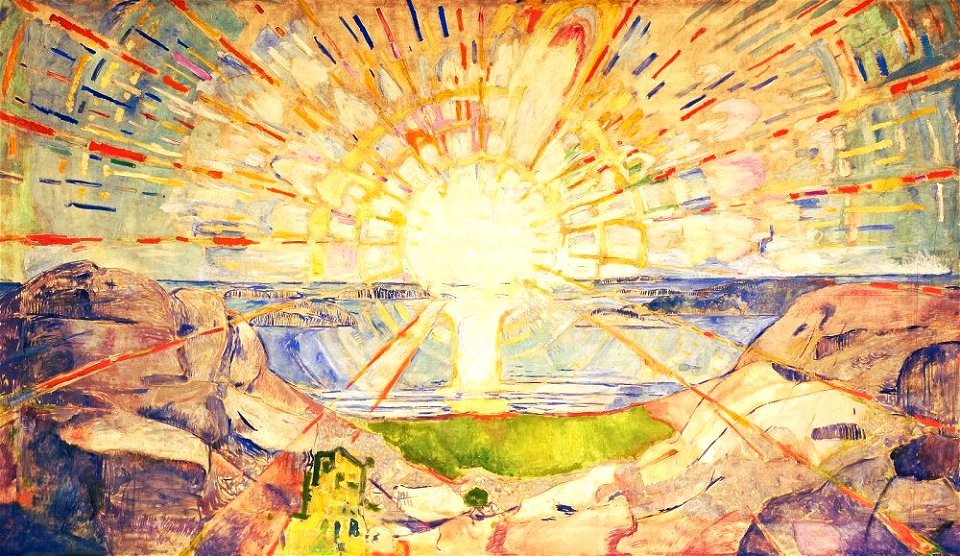
Sun by Edvard Munch  (1863–1944) Courtesy: Creative Commons
The Sun’s old. Deadly rays leak out of its decrepit body,   
Lashing planets, satellites and asteroids. 
Fleeing for dear life, humans and animals run helter-skelter.
 
Unable to endure the sun’s excruciating heat, 
Men and women prepare to move with the Earth forever—
Moving with the planet they love more than any other,  
They will seek sanctuary in some distant young galaxy,
Just as bewildered people, uprooted by some raging riot somewhere,
Flee far away to some distant land, lives in their hands,
Forsaking their country, destined to be refugees forever. 
 
One morning, at sunrise,
Planets, satellites and asteroids will stare in astonishment.
At a nine-planet orbital village, a stellar union council of nine wards, 
Looking immense, elliptical, though everything else will be the same! 
Other planets will be in their orbits as always!
Only cunning, conniving and naughty earth will elude their gaze!
 
The Sun, that incarnate ball of fire, will be so fiery and indignant then 
That it will dart out its mile-after-mile long murky tongue
Spewing furious fumes of loud hitherto unheard curses, 
Gurgling lava spilling out from some swollen uvula forever...
It will pursue Earth as long as it can, chastising it all the time
It will flicker its fiery, thundering, curses-spewing tongue incessantly! 
 
As it flees, casting furtive backward glances, 
Will Earth ponder for even a moment and exclaim:
“Alas, what’s going to happen to those ill-fated planets—
To Mercury, Venus and Mars?”   

Masud Khan (b. 1959) is a Bengali poet and writer. He has, authored nine volumes of poetry and three volumes of prose and fiction. His poems and fictions (in translation) have appeared in journals including Asiatic, Contemporary Literary Horizon, Six Seasons Review, Kaurab, 3c World Fiction, Ragazine.cc, Nebo: A literary Journal, Last Bench, Urhalpul, Tower Journal, Muse Poetry, Word Machine, and anthologies including Language for a New Century: Contemporary Poetry from the Middle East, Asia, and Beyond (W.W. Norton & Co., NY/London); Contemporary Literary Horizon Anthology,Bucharest; Intercontinental Anthology of Poetry on Universal Peace (Global Fraternity of Poets); and Padma Meghna Jamuna: Modern Poetry from Bangladesh (Foundation of SAARC Writers and Literature, New Delhi). Two volumes of his poems have been published as translations, Poems of Masud Khan(English), Antivirus Publications, UK, and Carnival Time and Other Poems (English and Spanish), Bibliotheca Universalis, Romania.  Born and brought up in Bangladesh, Masud Khan lives in Canada and teaches at a college in Toronto.

Fakrul Alam is an academic, translator and writer from Bangladesh. He has translated works of Jibonananda Das and Rabindranath Tagore into English and is the recipient of Bangla Academy Literary Award (2012) for translation and SAARC Literary Award (2012).

PLEASE NOTE: ARTICLES CAN ONLY BE REPRODUCED IN OTHER SITES WITH DUE ACKNOWLEDGEMENT TO BORDERLESS JOURNAL

Click here to access the Borderless anthology, Monalisa No Longer Smiles

Click here to access Monalisa No Longer Smiles on Kindle Amazon International

Categories
Stories

The Coin

By Khayma Balakrishnan

Courtesy: Creative Commons

“What if you ran away?” Shyam suggested when she heard my story and saw the bruises on my hands. I looked at her between my tears. “Where?” I sniffled. Shyam stared at me blankly. She did not have an answer to that question.  I won’t lie. I had thought about running away many times. But I was seventeen and SPM[1] was just a few months away. If I did run away, what would happen to my future? Sometimes I wished that I wasn’t a person who thought so much. Why can’t I be like one of those girls who couldn’t care less? Why couldn’t I take risks? I tucked my hair behind my ears, a nervous habit of mine and looked down at my book, attempting to solve a complicated Additional Mathematics problem. It seemed to be as complicated as my life. I closed my eyes and looked out of the classroom. I wished to be anywhere at all, except home.

After school, I walked home, dreading each step, hoping time would slow down. I walked by the big red mansion, wondering if it really was haunted? As I turned into the junction, I wondered if the aunty and uncle in the corner lot were really abandoned by their sons? Why were all the swings broken in the playground? How many cars were there exactly in the Chinese house? Where did the vegetable seller live? As I came closer to home, my heartbeat quickened. I tucked my hair behind my ears with shaky fingers. Why was the walk home so short?

It was another day of beatings, curses, and a night of sleepless slumber. My mother screamed at me that she wished I had never been born. My aunt slapped me across the face for daring to answer her back. My grandfather spat his tobacco on my face while calling me worthless. As I helped shower my grandmother and changed her clothes, she scratched me, adding on to the existing bruises. After five years, I had gotten used to it. I couldn’t wait to be back at school the next day so I could at least fit in a nap.

As I sat staring at my homework that night, I wondered if things could have been different. What if I had not run away with my mother from my father’s home. He was a drunk who hit us, but back then, my mother loved me. She would hug me and kiss the pain away. I agreed to leave that hell, not knowing my mother would then become the demon. She kept telling me that I ruined her life, that she was stuck in a horrible marriage because of me. Often, I was confused. Was it really my fault? I never asked her to stay. Why was I constantly blamed for her choices?

As I strolled to school the next day, I wondered if Shyam would be willing to listen about what happened the previous day at home. Afterall, it must sound the same to her.  But before I could tell her, she came running to my table at the back of the class. “Don’t go to the canteen during recess, come to the Upper Six classroom, Steph has something to show you.” Before I could ask her more, Puan Vijaya entered the class. Shyam walked back to her table. I glanced at her, and she winked at me.

Selamat Pagi, cikgu,[2]we droned. History was fun. Normally, I would be interested. Now, I was curious. What could Steph have? Was it a new book? She had many of those naughty romances that were forbidden reads for us. Or was it a new picture she had drawn? She often drew pictures of men and women doing… that thing. I couldn’t focus as Puan Vijaya read about Malayan Union from the history textbook. Steph, Shyam and I met in Form Three. They have been listening to my stories ever since, offering a shoulder, often being angry on my behalf and asking me to run away from my home. But I was too much of a coward to do that.

The next two periods were biology and Bahasa Melayu[3], which crawled with an unbearable slowness. It was as if time was truly testing me. I kept drawing pictures all over my biology notebook as I barely registered what my teacher was saying. Science never interested me, but I took it to be close to Shyam and Steph. Finally, the much-awaited bell that indicated it was break rang. Girls poured out of classrooms and chatter filled the corridors of the whole school. Shyam looked at me meaningfully from the front of the class. My stomach felt like it might drop from the excitement. We walked together towards the stairs in silence.

On the way to the third floor, a patrolling prefect stopped us. “Masa rehat, tak boleh naik atas. Pergi kantin,[4]” she ordered. My shoulders slumped in defeat, but Shyam perked up. “Terlupa barang dalam kelas tambahan semalam. Sekejap je.[5] Please” I wondered what extra classes she meant but kept mum. The prefect looked at us both, and after a moment, let us pass. I was surprised. Shyam pulled my hand, and we climbed up the remaining stairs. Finally, we were outside the Upper Six classroom. It was a long classroom that had almost thirty tables. The classroom was usually empty as the girls in the Upper Six class were often in the library. Their classes were always conducted there.

Steph had closed the windows and pulled the curtains. I was excited. The moment was here. After we stepped in, we made sure to close the door and lock it. Steph took out a board that had numbers and alphabets. It looked like she had made the board herself. “This board will tell us our future,” she whispered. I eyed it sceptically. “How?” I asked out loud. My voice echoed in the silent room, making us jump.

“Shhhh,” she gestured. “Do you have a coin?” Shyam and I reached into our pockets. I produced a 20cents coin. She took it gleefully. “This is called Spirit of the Coin,” and my eye widened. I had heard of the game. Although I had never played it before, I knew many girls in my school played it, convening with the unseen and unheard. My stomach dropped further. “I’m scared,” I whispered. “Don’t you want to know when you can escape? When will she die?”

Her question piqued my interest. I nodded. Indeed, I did want to know. I just didn’t know if I was brave enough. I tucked my hair back and looked down at the board, studying it. It was a small board, had all of the Latin alphabets and numbers, ranging from zero to ten.

“It’s okay. Shyam and I will play first. You watch us. Then if you want, it’ll be your turn, okay,” I nodded again.

“First, the rules. You cannot summon a spirit that is dead for less than 30 days, or else the spirit will follow you home. You can only ask three questions. You cannot ask the spirit to do any favours for you. You must use the phrase — go home — when you want the spirit to leave, understand?” Shyam and I nodded again, as if in a trance.

I blinked and looked at her and asked, “Wait, what if you ask it to do a favour for you?”

Steph looked at me, surprised. Maybe she hadn’t expected me to ask a question. “From what I heard, the spirit will do it, but you will be indebted to the spirit for the rest of your life,” and I nodded.

“Who taught you how to play this? Did it work,” I pressed on further. I could see Steph was losing her patience.

“I watched my cousins play it yesterday. I remember it,” she said, her voice high from the annoyance she must be feeling towards me. I nodded silently. I had more questions but decided to be quiet. I didn’t want to make her too angry. 

“I’ll go first, you girls watch,” Steph sat on the ground, with the board in front of her. She placed the coin in the middle and muttered something. We felt a blast of wind, which was weird as all the windows were closed and the air was still.

“It’s here,” Steph whispered.

What was, I wondered? But I tucked my hair behind and decided to stay silent. “Will I pass my SPM?” was her first question. The coin started to move, as if on its own. It was fascinating yet frightening for me. Sweat poured out of my forehead as I watched the coin go to the words Y then E and lastly to S. I saw Steph’s eyes grow big. “When will I get married?” was her next question, and again I watched the coin move to numbers 2, then 0, then to 2 and finally to 5. 2025! Steph didn’t look too happy with the answer though. “Go Home!” Steph said out loud. There was a blast of wind, and the air became still.  She looked at Shyam. “Do you want to try?” Shyam nodded.

I looked at the clock in the classroom. We had five more minutes before breaktime was over. When Shyam’s finger touched the coin, we felt another blast of wind. I wonder who she summoned?  “Will I pass my SPM?” was also her first question. The coin answered Y-E-S. But before Shyam could ask her second question, we heard a bell ring shrilly. It indicated that break time was over. We had to hurry. “GO HOME” Shyam commanded. We felt a blast of wind and it was quiet again. Steph folded her board. Shyam held the coin, not knowing what to do with it. Steph took it from her and shoved it in my hand. It felt warm, almost hot.  I was stunned. I did not want the coin. “Keep it, you might need it,” she winked and opened the classroom door.

“Come, let’s go!” Shyam pulled my hand. I stuffed the coin into my pocket.

During the remaining classes, I kept stroking the coin in my pocket. I wanted to play the game, but what would I ask? About SPM? About my future? Or about my aunt? When would she die? When would the torment end? I had so many questions. But the most important question would be which spirit would I call? Appatchi[6]? Tata[7]? Or papa? As Mrs. Lee ended our class, we thanked her. The final bell rang, and as much as I did not want to, I had to start walking home. I wondered what awaited me at home today.

Once home, I quickly changed into my house clothes, and I kept the coin in the pocket of my shorts. I hoped it would give me strength to get through the day. I went through the routine like a clockwork. I bathed ammama[8], while she screeched and scratched me, blended her food and fed her. All while she spat it back on my face. At one point, I got so angry I wanted to scream at her, but I couldn’t. Because they were watching. And waiting for the opportunity to strike me. After feeding ammama, I did the dishes. She had laid out my food. Rice which was swimming in cold rasam[9]. Looking at it, I lost my appetite. I tucked my hair, made sure nobody was watching and threw the food away. I washed the clothes, took in the dry clothes, and folded them. I was used to doing six people’s laundry on my own. I swept and mopped the house. It was already six in the evening.

She had gone out to the pasar malam[10]. I sought permission from appaiya[11] to shower. He nodded and I ran to the washroom. As I was putting on my clothes after the shower, I heard her car honk. “No, no, no…” I muttered as I quickly pulled a t-shirt over and ran to the front of the house. I did not dry my hair and it was dripping, making my t-shirt wet.  She had gotten out of the car and was opening the gate.

“Where were you?” she screamed. The neighbours looked over, and then continued to mind their own business. This was normal to them.

“So..sorry cinamah[12], I was bathing” I answered.

“Why did you take so long to shower? Because of your hair? Do you think you are so pretty that you need to wash your hair? I’ll put an end to this today!” and I knew the worst part of the day was upon me. She dragged me by my hair to the kitchen.

“Kneel!” she commanded. I cried and begged her for mercy. She hit my head with a metal spoon and forced me to kneel. She rummaged the kitchen drawers and took a pair of scissors. She started cutting my hair while I cried. She kept cutting it until the entire floor was filled with hair. My head felt bare and my tears wouldn’t stop. She kicked my back and I fell on the floor. “Sweep up the kitchen. I don’t want to see your hair anywhere,” and she walked away.

Appaiya and amma[13] were watching and had done nothing to stop her. “You deserve it,” I heard amma behind me. I got up and stared at the floor.

My hair was everywhere. I walked towards the broom and swept it all up. I threw it all away and went into the room. I looked at myself in the mirror. I looked terrible. There were patches of hair in some parts while some parts were so bare you could see the skin on my head. My tears refused to stop at the sight. How was I going to go to school? The girls would laugh. The teachers would stare. More tears spilled out. At the same time, anger bubbled in me. I wanted revenge. Maybe it was time for me to actually do something instead of crying. I closed my eyes and touched the coin. It felt warm to my touch.

The night went by without any other incidents. Cinamah had a satisfied look on her face, while amma laughed every time she saw me. I stayed in the kitchen as much as possible, until it was time to feed ammama her dinner and put her to bed. I did the rest of my chores quietly, but a plan was growing in my head. By the time they had all gone to bed, it was eleven thirty at night. I was ready to end this torture as well.

I started working on my homework and waited till the clock struck twelve. Then I tip-toed outside each room and waited till I heard their snores. Once I was satisfied, I walked back to the dining table where my books were and took out a piece of paper. I remembered how Steph’s board had looked. I drew the alphabets and the numbers. I reached into my pocket to take out my coin. It still felt warm on my skin. I was ready. I closed my eyes.

“Can you kill my whole family?” The coin remained rooted on its spot. I felt a blast of wind as I caught the coin move slowly.

.

[1] Sijil Pelajaran Malaysia (SPM), or the Malaysian Certificate of Education equivalent to a GCSE exam

[2] Selamat Pagi : Good Morning: Cikgu: Teacher

[3] Malay language

[4] Break time, can’t go upstairs. Go to the canteen

[5] I forgot something in an extra class yesterday. Please let me go for a short while.

[6] Grandmother (The mother of one’s dad)

[7] Grandfather (The father of one’s dad)

[8] Ammama: Grandmother (The mother of one’s mom)

[9] A thin and spicy South Indian soup

[10] Night market

[11] Grandfather (The father of one’s mum)

[12] Aunt (Mother’s sister)

[13] Mother

Khayma Balakrishnan enjoys writing stories and poems. Her work in English contains flavours of her native tongue, Tamil, as well as her national language, Bahasa Malaysia. Her works have been published both in print and online from 2017 till 2023.

.

PLEASE NOTE: ARTICLES CAN ONLY BE REPRODUCED IN OTHER SITES WITH DUE ACKNOWLEDGEMENT TO BORDERLESS JOURNAL. 

Click here to access the Borderless anthology, Monalisa No Longer Smiles

Click here to access Monalisa No Longer Smiles on Kindle Amazon International