ANAMNESIS

Elysium is a town on the edge of remembrance.
A dawnfly quivers on a Mandarin tree.
In the untamed sky, the ospreys dance.
Elysium is a town on the edge of remembrance,
each crevasse in the Mekai a lesson in forbearance
the cryptic Dihing flows free --
Elysium is a town on the edge of remembrance,
A dawnfly quivers on a Mandarin tree.


Glossary:
Mekai: A tree found in Dehing Patkai
Dihing: A tributary of the Brahmaputra
Jahnavi Gogoi’s poetry has been published in The Usawa Literary Review, Inssaei International journal, Academy of the Heart And Mind, Spillwords, Indian Periodical, Synchronized Chaos , Soul Connection, Reflections and others.
PLEASE NOTE: ARTICLES CAN ONLY BE REPRODUCED IN OTHER SITES WITH DUE ACKNOWLEDGEMENT TO BORDERLESS JOURNAL
The palms sway as if they are reminded of a time long ago when they did not know that tectonic shifts would eventually edge them closer to the peninsular sequestration of mainland India. I bristle with the unimpeded curiosity of a man who knows that there is little to be seen apart from the reality of the here and the now. Corbyn’s Cove remains deliciously impaired by the downhill stretch of road that sees at least a hundred motor mishaps a year; I cannot help but grimace as the palms continue their little dance in immaculate rhythm with the late evening breeze.
Corbyn’s Cove seems to be a delightful aperitif before the hinging actuality imposed upon us by that of the most symbolic images of the island: the Cellular Jail. The garden near the gate of Cellular Jail boasts of petunias imported from England; I give them as much of a passing glance as the after-effects of the audio-visual show permit me.
Savarkar, hailed as a hero by the modern dispensation of our country, was perhaps the most well-known inmate of this gaol. As a reward for the valour he displayed while submitting at least three mercy petitions to the British for clemency after being sentenced here, the airport in Port Blair was named after him. On being granted that, Savarkar virtually stopped all criticism of the British Raj, as a result of which he enjoys a considerable legacy in present-day India as a freedom fighter. The museum here offers no facts about the said freedom or fighting. A young schoolboy asks questions to which his parents have no answer.
*
The convoy through which our car moves in giddying fashion on the Andaman Trunk Road leads us, after a fleeting glimpse of the indigenous people of the island — the Jarawas, to Baratang, where limestone caves await. An old, almost run-down ferry transports us to the mangrove creeks over the Middle Strait and heaves with painful aggravation before vomiting us out of its hull. The mud volcanoes watch with distaste and emit a sigh of antipathy. While the limestone caves remain apathetic to our incursions, I pay no heed to their unvoiced contempt.
Wading through the mangrove forests of Baratang Island
But unlike many of my forays in the past, I have felt less at home in Andaman than I have anywhere else. On leaving Port Blair, it seems as if I am circumnavigating an alternate planet, where the corruption that greed unfailingly encourages is let down by the unbridled probity of the officialdom, many of whom hail from the mainland. There is little of culture to speak of, save that which is showcased by settlers from the mainland. As is usually the case when emigres outnumber natives by their sheer magnitude, the indigenous peoples of Andaman have been forced to the margins of a history that they could not claim to have created.
Repeated written requests to visit the island of Nicobar get turned down. Resigned to an expedition that matches the itinerary of other visitors from the mainland, it is not hard to find solace in Aberdeen Bazaar in downtown Port Blair when the sun goes down. The limestone caves of Baratang had been exceptionally kind during the day, decrypting my confusion between stalagmites and stalactites with ease. Listening to my questions with the uninhibited sagacity of a sixty-year-old, the caves showcased how indifference does not necessarily have to portray weakness.
*
Havelock is perhaps the best-known illustration of a one-horse or one-road-town. The ferry from Haddo twists and tumbles in the unfamiliar Bay of Bengal, infamous for its stomach-churning capabilities; it is not before the reassuring Naseeruddin Shah makes an appearance on the in-house television that I finally close my eyes. I wake to the turquoise-clear waters of the same tormentor (the Bay, not Shah) before descending into the waiting taxi, grateful for another chance at life.
The sun sets without leaving a trace of itself at Radhanagar, and the Bengali migrants who serve up a delightful Mughlai parantha[1] talk endlessly of the overflow of tourists. Their Tamil neighbours, who sell seashells and illegal necklaces made from corals, seem happy enough to welcome the said disturbance, without whom their livelihoods would have been at stake.
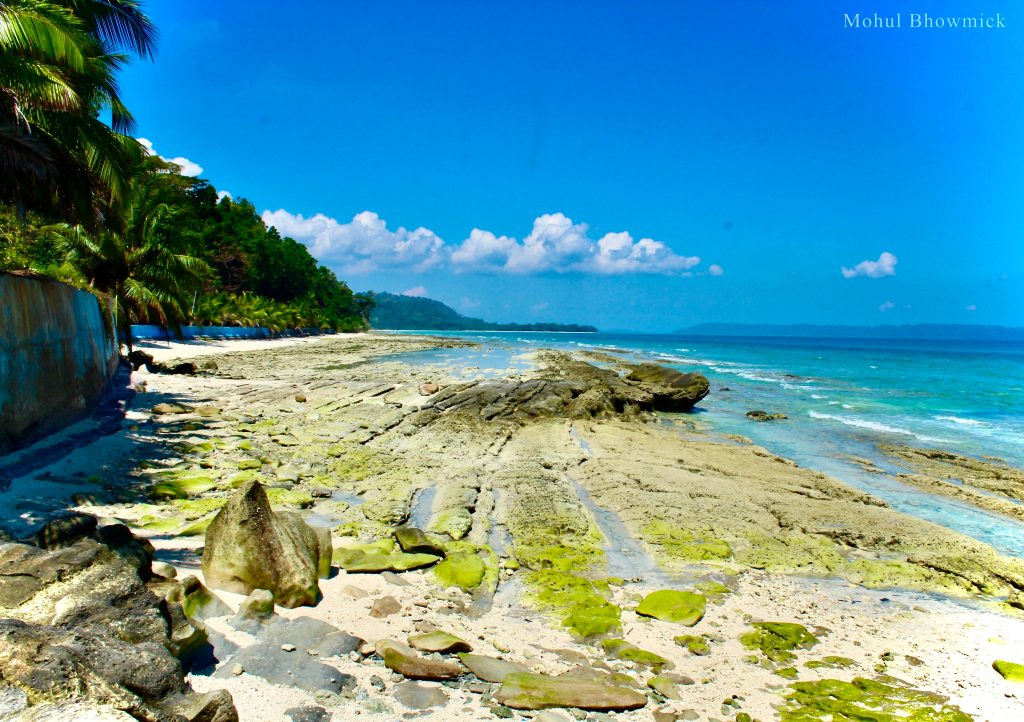
The next day, the Kala Patthar beach seems astral at high noon as the sun beats gently down on the golden sand. I sit sipping on tender coconut juice and remind myself that it is too easy to seek the idea of Shangri-la in such locales, and not in the grim reality that the here and the now present. The harsh sun that burns my bare forearms to embers brings with it the missive that utopia, after all, is a state of mind.
The bright sun parches you on the Kala Patthar beach, Havelock Island.
“All the way to heaven is heaven,” Saint Catherine had decreed in the fourteenth century. I found little to argue with the apostle when heading into Neil Island, recently renamed Shaheed Dweep by the central government. Bharatpur merits no mention at all, or about as much as a slap the genteel administrator at the tourist information centre would deserve for including it in one’s itinerary. Laxmanpur 1 and 2, strangely enough, overwhelm me enough to want as little to do with them as possible; it is often the untested and untried that draw a weary traveller’s mind.
Going against the tide? Almost sunset at the Laxmanpur -2 beach on Neil Island.
*
Return to Port Blair. The droll afternoon spent at Ross takes one back a century or two, but the cacophony that the resultant evening provides is worthy enough of a Tarantino chef-d’oeuvre. At dinner, two raucous Punjabi gentlemen argue over the viscosity of the dal makhni on offer; I take second helpings of the rabri[2] keeping an ear out for the chatter. They involve the floor staff as well, who are helpless, and have no option but to get a new batch of dal tadka served. The gentlemen say that they remember having asked for dal fry… I wonder what Rasheed, our driver during the sojourn, feels when he drops his guests at the airport for their flights back home to the mainland. He has never stepped out of Port Blair and continues to seem distant from the release (or is it escape?) that the terminal offers. I imagine him looking towards me misty-eyed, hopeful for a future in which his reality mirrors that which Andaman often proffers to travellers. But he turns the car around and rushes past the incoming traffic even before we have entered the concours
[1] Mughlai Parantha is flatbread stuffed with minced meat and coated with eggs
Mohul Bhowmick is a national-level cricketer, poet, sports journalist, essayist and travel writer from Hyderabad, India. He has published four collections of poems and one travelogue so far. More of his work can be discovered on his website: www.mohulbhowmick.com.
PLEASE NOTE: ARTICLES CAN ONLY BE REPRODUCED IN OTHER SITES WITH DUE ACKNOWLEDGEMENT TO BORDERLESS JOURNAL.
Saranyan BV is poet and short-story writer, now based out of Bangalore. He came into the realm of literature by mistake, but he loves being there. His works have been published in many Indian and Asian journals. He loves the works of Raymond Carver.
.
PLEASE NOTE: ARTICLES CAN ONLY BE REPRODUCED IN OTHER SITES WITH DUE ACKNOWLEDGEMENT TO BORDERLESS JOURNAL
Conceived in the twilight dreams of poets, philosophers, and political activists, you blazed in the dulled and drugged minds of millions caged and enslaved in the divided and ruled subcontinent. Inspired by the Divine word, Iqbal sought your freedom in his poetry and prose, and likened you to the Shaheen— the king of birds– and exhorted you to soar to freedom. He died nine years before your birth, but his figurative verses, by design or fate, fashioned you into the shape of the sublime and magnificent eagle.
Today, perched on the peak of the Arabian Ocean, you struggle to soar. Designed to defend and fortify your power, your predatory hand claws fetter and numb your mind and movement. You stretch your neck towards the east and tilt your hooked head. Your forward-pointing eyes boasting of binocular vision are fixed towards the rising sun for a glorious future, but you are blinded by fear and greed. Your blood vessels pulses with power and rhythm but you hunch, clench your long spiked wings, unable to spread them, stroke the wind, and take your place in the skies. Immobile and unable to nurture, you attack your own — the most vulnerable and the weakest.
Agreed that your birth, doctored by a misguided and designated cartographer, was both cruel and chaotic[1] The impatient foreigner, recklessly ignoring centuries of daily human connection, the age-old water ways, and land markings, fleshed you out from outdated maps and census reports. Fearing a dangerous rebellion that brewed in the burning summer and desperate to flee the threatening chaos, the imported white-man culled and cut the eight hundred thousand square kilometres of you in thirty-six days. You burst on the world map in the muggy, sweat-drenched August of 1947, soaked in blood and roughly clumped in the likeness of Iqbal’s eagle.
But with creation, there is demise – and your birth slit a wound that festered a carnage. Within days, unprecedented violence tore neighbourhoods and communities apart. Friends-turned-foes, looted, plundered, burnt down villages and raped and hacked thousands of innocent women and children to death. Lit by the hope to reach their new homeland, fifteen million Hindus, Muslims, and Sikhs, fled across the jagged border, but two million succumbed to death. Traumatised by your birth, you continue to kill and slaughter. Seventy-six years later, you deceive and double cross your ‘wajood ki wajah,’ your reason for existence, and with it, the spirit of your independence, idealism, and self-actualization.
Trapped in mnemophobia of suppression, you deny and desecrate the creed that your founder, Mohammad Ali Jinnah gifted you, i.e., the land and its freedom. “You are free to go to your temples, you are free to go to your mosques or any other place of worship in this State of Pakistan. You may belong to any religion or caste or creed, that has nothing to do with the business of State.”[2] Did Jinnah fight for your independence to lose you to your fanatical oppression of others? Did God gift you the cradle of fertile plains, the vast web of waterways, fortress-like mountains, havens of harbours, and mines of minerals so you could abuse your own?
In the wild, your namesake, the king of birds, knows better than to turn on its young. Driven by an intrinsic parental instinct, it patches a nest high in the branches and cliffs, secure from the sight of predators. Both parents, in turn, incubate the eggs until they hatch, nest their eaglets, spread their wings to protect them from cold and heat, and tear off the hunted meat to hold it close to the beaks of their young. In face of approaching danger, the male and female defend their young aggressively. They nurture their eaglets for weeks, teaching them to hunt and survive until the little ones can fly off to seek their food and future.
A parent to over ninety-five million children, how do you compare? Millions of your young ones live and work on the streets every day. They feed off garbage dumps and stray barefoot and in rags, unprotected from the onslaught of the harsh climate and the criminals, while you guard your pastures of livestock, fields of crops, and fruit-filled orchards. Yet, you choose not to feed your children – and only a chilling low of 3.6 per cent, aged six to twenty-three months, consume a minimum acceptable diet[3].
Abused and violated every day, the children are forced into selling drugs, prostitution, and trafficking, and many succumb to accidents or fatal diseases. More than half a million of your children are raped, assaulted and killed in one year – not by anyone else, but by you[4]. Over half of the little ones do not have access to health, hygiene, clean water, food, and more than forty million minds wither out of school[5]. When they turn into criminals you blame them for their condition. You hoard your wealth inside mansions, factories, banks and vaults outside the country and shackle millions of your children to hard, gruelling and unpaid labour. There are no laws enforced to protect the children, and according to leading experts an “eighty-eight per cent are subjected to violence and physical abuse within their homes regularly”[6]. After the catastrophic floods that ravaged your lands last year, more than four million of your children continue to drink the contaminated and stagnant waters[7].
You make laws to break them, sign treaties, pacts, and MOUs to betray them, print signs, banners, and pamphlets to tear them, and host meetings, dialogues and conferences to applaud your resounding lies while a frightening number of your children perish every day[8]. Is your independence a construct of borders and boundaries to keep others out, while you molest your own? Is your independence a construct to suppress, violate, and annihilate the weakest? Is your independence a construct to kill your children? If independence profits and feeds off the flesh of others, it is only a fool’s fabrication. Like a chain, a nation is only as strong as its weakest link. When you celebrate your independence, remember that you are only as strong as your weakest – the malnourished and uneducated — forty-five percent of you. Thousands of your children will sleep shivering and starving tonight and some will not open their eyes tomorrow. One day you might not too.
Aysha Baqir is an author and activist on a mission. She founded a pioneering not for profit economic development organization, Kaarvan Crafts Foundation, in 2004 to alleviate poverty. Her novel Beyond the Fields was published in January 2019 in Singapore and 2022 in Pakistan and shortlisted for best-Debut English at the 9th UBL Literary Awards. She is an Ashoka Fellow and recipient of Vice Chancellor’s Alumni Achievement Award from LUMS. She is working on her second project.
ENTERING THE EXIT

Let’s not waste our time
anymore.
We are not going anywhere
in this life.
I am entering the exit soon.
There are green doors
that lead me to the sun.

There are lights that blind me,
like a candle magnified
and a fire that dances in my retinas,
like a flashlight and
flashing signals
slinging lightning bolts.
It is O.K. to say goodbye.
After all
you know nothing lasts.
The lightning bolts
are no rainbow.

Being alone is not so bad.
There is always music.
Soon we will be gone.


SMILE MORE

He was just a little hungry.
This is what he told me.
Gary said he was a little lonely.
He seemed happy when he talked.

I listened to him as he asked
for a dollar. I handed him two
which is all I had in my pocket.
He told me to smile more and

he was speaking the truth.
I do need to smile a little more.
I prefer to live in silence most days.
Gary had a kind but anxious voice.

We will speak again soon he said.
It has been year since I’ve seen him.


THE SMOOTH LIFE

One time only
was my life smooth.
If my memory
was not so fickle,
the smooth life would
return and make
things easy. Sleeping
here, under the bed,
with the cats and
the shades blocking
the light away from us,
there is a certain intimacy
born in this room.
Our sonorous hearts
race with urgency.
Life is not clear or smooth.
The light frightens me.
Life is bizarre
like an escaped madman.
His filthy mind would
make anyone blush.
I remain hidden
like a secret.
The poor cats are
here with me. They
scratch my face.
My selfishness is
far from lovely.
The day goes on.
Light fades away.
This makes me smile.
Our sonorous hearts
are bound to break.
Oblivion sets in.
Eternity awaits.
The moon shines on
like the glittering stars.
I lack the confidence
my heart requires.
Born in Mexico, Luis Cuauhtémoc Berriozábal lives in California and works in the mental health field in Los Angeles, CA.His poetry has been published by Blue Collar Review, Borderless Journal, Escape Into Life, Kendra Steiner Editions, Mad Swirl, SETU, and Unlikely Stories.
PLEASE NOTE: ARTICLES CAN ONLY BE REPRODUCED IN OTHER SITES WITH DUE ACKNOWLEDGEMENT TO BORDERLESS JOURNAL
Title: The Greatest Indian Stories Ever Told: Fifty Masterpieces from the Nineteenth Century to the Present
Editor: Arunava Sinha
Publisher: Aleph Book Company
The Indian subcontinent has had a long tradition of storytelling that is referred to as ‘contes’ or tales, by the French. ‘Kathasaritsagar‘ by Somdev in Sanskrit compiled in the 11th century CE is a great example of this. Flavourful folk tales can also be found in renditions after the 11th Century CE — like the ‘Singhasan Battisi’[1].
Various Indian languages soon adopted this genre, gaining popularity throughout the country. Over the past 150 years, hundreds of memorable and popular stories have been written in more than 20 different languages. There are many ways in which they have become cultural cornerstones. Even those who do not read books often quote from a Premchand story or refer to a Tagore character in conversation. There are more people who know about our recent history as a result of Manto’s stories than any other history book published.
The Greatest Indian Stories Ever Told: Fifty Masterpieces from the Nineteenth Century to the Present edited by Arunava Sinha, is a welcome addition to the genre.As an English translator, Sinha specialises in translating Bengali fiction and non-fiction from Bangladesh and India into English, including classic, contemporary, and modern works. More than seventy of his translations have been published so far in India, UK, and USA. He has twice won India’s top translation prize, the Crossword Award for translated books. He teaches at Ashoka University, where he is also the co-director of the Ashoka Centre for Translation.
This anthology contains stories that draw inspiration from a wide range of Indian regional dialects, languages, literature, and cultures, and includes early masters of the form, contemporary stars, and brilliant writers who came of age during the twenty-first century.
Among these authors are some of the most revered in Indian literature and have, between them, won almost every major literary award, including the Nobel Prize for Literature, the Jnanpith Award, the Sahitya Akademi Award as well as numerous other honours at the state, national, and international level.
There is a plethora of literary delights in this collection, from Tagore’s evocative prose to Amrita Pritam’s emotional depth, from Ruskin Bond’s enchanting stories to Mahasweta Devi’s thought-provoking stories. It is a treasure trove of narratives translated to or written in English. If all these weaving the colours of the diversities in India are to be savoured across all the Indian states with diverse languages, they need to be in English. Collections of some of the best literary short fiction written by Indian writers began to emerge in the country at the end of the nineteenth century. And now in the twenty first century, the trend has been retained by this collection.
A must-have for any Indian literature enthusiast, The Greatest Indian Stories Ever Told provides a literary journey that explores space and time, which makes it a precious collector’s item that will become a valuable over time. Anyone who is interested in India’s rich cultural heritage as well as the rich tapestry of Indian storytelling should definitely read this anthology in order to gain some insight into the country’s rich cultural heritage. It promises to be an exciting and enticing literary feast, leaving readers awe-struck and enriched by the depth and beauty of Indian storytelling whether you are familiar with these eminent authors or are new to them, regardless of whether you know their work or not.
.
[1] Collection of ancient Indian folk tales; Literally, 32 tales of the throne, compiled after the 11th century CE
.
PLEASE NOTE: ARTICLES CAN ONLY BE REPRODUCED IN OTHER SITES WITH DUE ACKNOWLEDGEMENT TO BORDERLESS JOURNAL
UNCERTAINTY

Night clings to the branches
as if it were a sodden blanket.
The moon is a dead eye,
staring from its distant grave,
as stars enact mysterious ceremonies
like bats in a cave.
My heart is as cold as a stone.
With nowhere to go,
a crow hurries away.
He seeks he knows not what,
but he doesn’t want to stay.


BREVITY

The sky looks down at me
with unseeing eyes.
Dead leaves fall into the river,
and flow with the stream,
I don’t know where.
I’ll never go there.
The moon’s rays are blades,
slicing the clouds in tatters.
Tonight, I drink to dead friends,
and forget my wasted life,
but I think it’s too late
to make amends.
George Freek’s poetry has recently appeared in The Ottawa Arts Review, Acumen, The Lake, The Whimsical Poet, Triggerfish and Torrid Literature.
PLEASE NOTE: ARTICLES CAN ONLY BE REPRODUCED IN OTHER SITES WITH DUE ACKNOWLEDGEMENT TO BORDERLESS JOURNAL
The air was getting colder. There was an early morning chill. I wrapped my cotton blanket more tightly around me. January is one of the colder months of the year in Thrissur, Kerala, India. During winter and summer, I had taken to sleeping on the terrace of the men’s hostel. More peaceful and soothing. You can watch the twinkling stars and the clouds. A few other kindred souls did the same. Though it did rain on occasions and then we had to beat a hasty retreat with our bed rolls. The terrace also attracted students who studied using their table lamps till the small hours of the morning.
I stayed at the same hostel room throughout my undergraduate medical (MBBS) course and the first month of my internship. I still remember my entry into the men’s hostel. I had a big suitcase, a bedding roll, a table lamp, a plastic bucket, a mug, and a few daily necessities. We were allotted the first floor of the C Block called the C’ block. We were the sixth batch of the institution and the last one to enjoy the privilege of being allotted rooms together in a single block. Of the twelve rooms in C’ all except three were allotted to our batch.
Ragging was still going strong though strong anti-ragging efforts were also ongoing. We had security guards posted at the entrance to our block and our seniors screaming abuse at us. Gradually after the first few weeks, things quietened down. Reminiscing about those days, I am struck by the simplicity of our lives. Each room had two windows, a ceiling fan, three wooden tables with three wooden chairs, three wooden cots, three metallic cloth hangers, and concrete wall shelves. There was also a ventilator opening into the corridor. Each room was shared by three students. The older medical college hostels had high roofs and did not always have a ceiling fan.
The men’s hostel was located at the edge of the vast campus of the Medical College, Thrissur. There were three blocks (A, B and C) with each block spread over two floors. There was a big portico in front with a phone room and a phone boy. There were bigger rooms (with attached baths) for the tutors and a TV room on the first floor. We had an improvised gym on the ground floor. A room for indoor games was on the first floor next to the TV room and the hostel mess was on the ground floor. In those days there were no cell phones and subscriber trunk dialling (STD) was not yet available. Trunk calls had to be booked manually. The newspaper and magazines room were right at the hostel entrance.
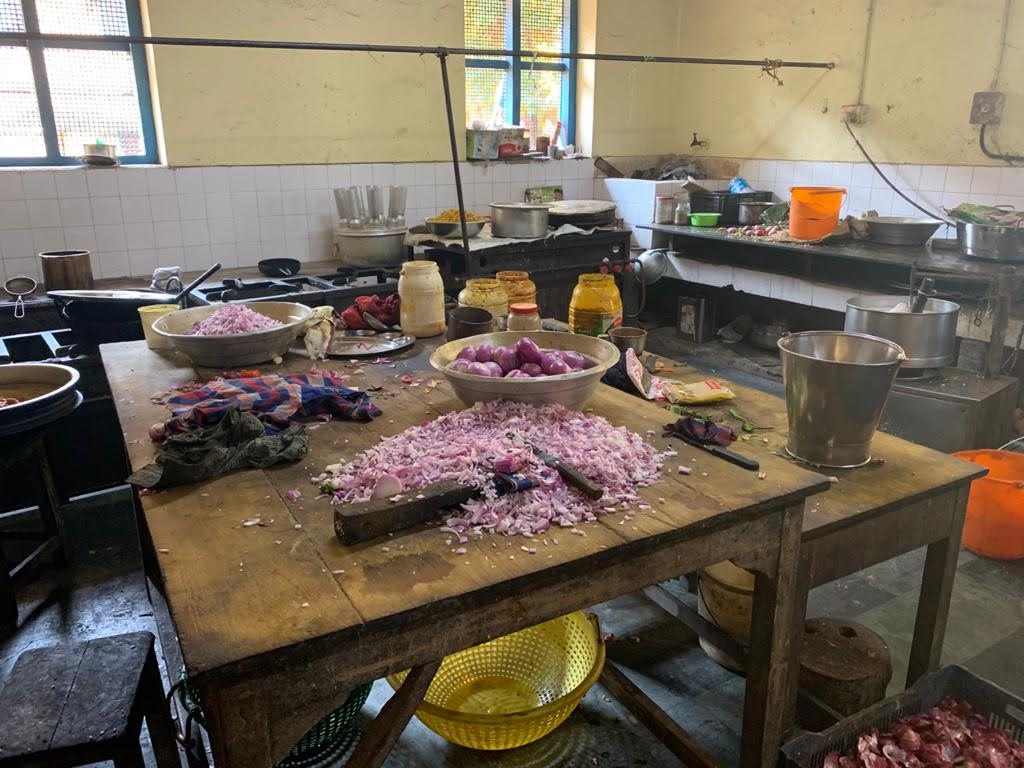
The mess was a simple affair with eight wooden tables and wooden stools and chairs. The chairs had to be strong enough to withstand frequent abuse from the students. There was a serving window, and the main kitchen was inside. Mornings were busy as the clinical students had to board the college buses to reach the hospitals in the town. We had a varied menu for breakfast. This could be masala dosa (a flat bread of rice and lentil flours stuffed with vegetables) puttu (steamed cylinders of ground rice, layered with coconut shavings and fillings), idli (a savoury rice cake), upma (a thick porridge made from rice flour or semolina), noolputtu (called string hoppers in Sri Lanka), bread with jam and butter and something that we called the fractional test meal (FTM). FTM consisted of a glass of warm milk, two boiled plantains and two hard boiled eggs. Quite nutritious and filling. Lunch was usually a hurried affair except on Sundays. Afternoon tea or coffee was one of my favourite repasts. Kerala has a rich and varied selection ranging from different types of vadas (savoury fried snacks), adas (fresh coconut and jaggery wrapped in a dough made of rice) steamed in banana leaf, cutlets, pazhampori (fried banana fritters) and something we called the grenade. The grenade was shaped like one, was mildly sweet and required some effort eating. Neither the mess tea nor coffee were remarkable.
Hostel mess. Photo courtesy: Ravi Shankar
The quality of dinner varied greatly. On the menu could be chappati (unleavened flat bread), Kerala parotta (layered bread), biryani, plain rice among others. People from the central parts of the state were fond of kanji (a rice gruel). Each month we selected three mess secretaries to oversee the mess. Later we started having a dinner feast toward the end of the month with a grand menu. I still fondly remember the biryani and the lime juice. Lime juice is a specialty of the area with a beautiful blend of sourness and sweetness. We had the Indian Coffee House (ICH) run the college canteen off and on. They closed and reopened a number of times. The crowd we had was not enough for their operation? They served masala dosas with a stuffing of beetroot and potatoes, cutlets, and strong rich coffee. Economics restricted this outing to may be once a week. I survived on a monthly money order from my family.
We also had a local tea shop run by an old people a five-minute walk from the hostel. We used to drop in there during the evening for tea, coffee, and snacks. They also occasionally served lunch. The lunch was served on banana leaves and consisted of papadam, injipulli (dark brown sweet-sour and spicy curry made of ginger, tamarind, green chillies and jaggery), vegetables, sambar (a lentil-based vegetable stew), rasam (a spicy South Indian soup-like dish) and fish curry and fish fry as an extra. The fish was mackerel coated in a spicy rich coconut coating and deep fried in coconut oil. During the early days the mess had frequent financial difficulties resulting in closure and we had to hunt for food outside. Luckily there were a few local tea shops around the campus though this often required a long walk. This was challenging especially at night. Eventually the situation stabilized, and closures, luckily became rare. We also had water problems before we were connected to the main water supply. We were dependent on a small pond, which used to dry up during the summer. The mess had a huge water storage container placed near the wash basins in case the taps run dry.
The medical college campus was the old TB sanatorium. The sanatorium was established several decades ago far away from human habitations. The campus was vast, and the soil rocky. There were a lot of cashew trees on the sprawling campus. Soon campus roads were constructed, and we could walk move about more easily amidst nature. The basketball and the badminton courts were closed to the hostel and were packed during the evenings. Summers were hot though the temperature was usually below 40 Celsius. Now summer temperatures are routinely over 40 degrees throughout much of Kerala. The state is facing the full brunt of global warming.
We organised a hostel day only once during the time I was at the college. That was a grand affair with music and dancing and several courses of food. The ground in front of the hostel was converted into a fairyland with twinkling lights and decorations. We had a system of ‘late mess’ where dinner was stored for us till 10 pm. We often used this service when we went to watch movies in Thrissur town. The bus fare then was below two rupees and now it is around twenty rupees.
We used to enjoy long walks in the sprawling campus and through the by lanes of surrounding villages. Life was very stressful with assignments, submissions, and frequent examinations. We had to find creative means to relax and recharge. I still remember my last week at the hostel. I was doing my posting in the hospital at Thrissur town and decided to shift to a lodge at the town outskirts. I had accumulated several medical textbooks during my study years, and these were heavy and had to be transported safely. Carrying these around required brute physical effort. You had to be physically strong to be a doctor. I developed close links with my room mates and my floor mates during my stay at the Men’s Hostel (MH). These are nurtured and maintained through our batch WhatsApp group. At my alma mater each batch is named after a famous personality in medicine. As I read more about Osler and his stellar contributions to medicine I felt justly proud that our batch carry his illustrious name. MH, Medical College, Trichur you have left an indelible mark on me and my fellow hostelers. MH tujhe salam[1]!
Dr. P Ravi Shankar is a faculty member at the IMU Centre for Education (ICE), International Medical University, Kuala Lumpur, Malaysia. He enjoys traveling and is a creative writer and photographer.
.
PLEASE NOTE: ARTICLES CAN ONLY BE REPRODUCED IN OTHER SITES WITH DUE ACKNOWLEDGEMENT TO BORDERLESS JOURNAL
  Prologue.
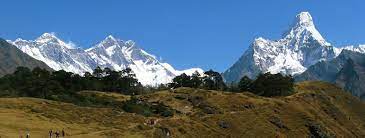
There are fourteen mountains
on the surface of the Earth
higher than eight-thousand metres
and recently it was found
by observers on the ground
they have all been sending postcards
to the Royal Geographical Society
but no one knows why…
     Mount Everest.
You say I am the tallest but that’s not
quite true: I am just
more obviously tall than you
and everyone else you know.
There is a mountain under the sea,
Mauna Kea by name
who is rather taller than me, 10,200
metres high as a matter
of fact: it’s just a question of tact that
she doesn’t loudly dispute
my claim to fame (and yes,
she’s a lady). And on the planet Mars
stands Olympus Mons,
highest mountain in our solar-system.
     K2.
I am not quite as lofty
as my brother
Mount Everest (see above)
but he’s a softy
when compared to me in terms
of difficulty of climb.
Mountaineers drop from fright
on my slopes as well
as from physical exhaustion.
This is a warning, just a friendly
caution. Don’t sleigh
on my white suede snows. You
can do anything but
sleigh off my white suede snows.
     Kangchenjunga.
I invoke hunger in the bellies
of those who try
to get to my summit. A fellow
named Crowley tried it
back in 1905 and he survived
while others of his team
were avalanched into oblivion.
He was snacking
at the time in his tent on mints
and thus was born
his insistence that life is sweet.
    Lhotse.
I am the least prominent
of the eight-thousanders
despite the awfully vertiginous
vertical relief of my
South and Northeast Faces.
I wouldn’t really mind
swapping places with one of my
sheerer fellows but I’m
reluctant to make the offer.
Should I stoop so low?
    Makalu.
I look like a pyramid, they say,
but the comparison
offends me most painfully.
I am millions of years old,
the pyramids, a few thousand.
It should be the other way
around, visitors to Egypt ought to gasp
and cry: the pyramids look rather
like Makalu. Now that’s
the analogy that ought to apply.
     Cho Oyu.
My name in Tibetan means
Turquoise Goddess
and although I am modest
I am pleased with the appellation.
It seems I am the easiest
of the eight-thousanders to climb
but I don’t regard that
as a disadvantage. Why be macho
in the clouds? If you love
Cho Oyu, she will be kind to you.
Climb me and you’ll return
like a human boomerang
for I have the lowest death-summit
ratio among the gang.
    Dhaulagiri.
I dazzle the eyes with my gleaming
backside, and startle
the minds of those who slide down
my beauteous slopes.
I hope and pray for a climber today
to do something silly
such as roll down Dhaulagiri all the
way to the bottom
after the snapping of his ropes: yes,
to my shining base.
It’s not a race, as such, because there
can never be a winner,
just a mess like a yeti’s dog’s dinner.
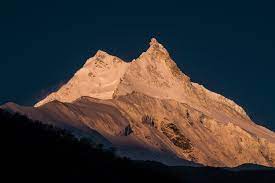
     Manaslu.
A serrated wall of ice hanging
on the horizon like a bandsaw
nailed to a door.
That is how I am described by
those who wish
to ride my teeth: climb up one
side and perch
on my summit and you’ll find
my mind is pure
enough for gentler metaphors.
I am not a tool, rarely the fool
who tries to fix
my own position in the scheme
of things. In the
valley below me snow leopards
prowl and growl
and so do you, softly, dreaming.
     Nanga Parbat.
When rats desert a sinking ship
they expect it to really
sink, not merely plunge its prow
for a quick drink
and then right itself again. That
hurts, a betrayal
of the laws of disaster. And the
mice called climbers
who scurried
on my broad flanks when I sank
into the spray
of my own blown snows, crying
avalanche! surely
thought I had drowned for good
in that illusory sea.
But as you can see: I’m still here.
     Annapurna.
Now we come to the real test.
I was the first eight-thousander
to be climbed.
Does that make me the easiest?
Well, no. In fact
I am the most dangerous of the
fourteen. My fatality
rate is twenty-five times as high
as that of Miss Cho Oyu
and my slopes are littered with
those who have
found their literal ever rest here.
Get it? My propensity for
making puns wasn’t mentioned
in Maurice Herzog’s
classic book about the first ascent
of me. I wonder why?
I took all his toes and most of his
fingers with the aid
of frostbite: a remarkable feat for
him, paid for with
both of his own astonishing feet.
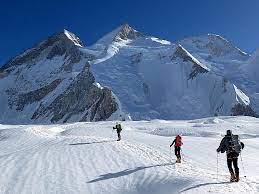
     Gasherbrum I.
I have a brother who you will meet
below, but in the meantime
you ought to know
that my eternal
snows glow
brightly
across the region that is my home,
and this is why
I am mystified as to
the origin of my nickname:
the Hidden Peak. It’s inaccurate
to my mind. Am I really
so hard to find?
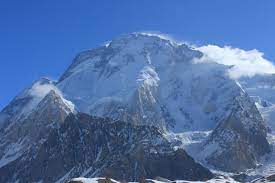
     Broad Peak.
My name is a physical descriptor
but my views
are broad too: I don’t care who or
what climbs me.
I welcome diversity.
On July 23rd, 2016, a Frenchman
by the name of
Antoine Girard piloted a paraglider
over my head.
That’s a type of lightweight plane,
but I didn’t complain.
I never lodge objections with God.
     Gasherbrum II.
You have already met my brother a short
distance above.
He is above in height
as well as in his location in this poem. I
look up to him in
everything, true, but he isn’t what I want
to talk about today.
No, I wish to briefly mention the Duke of
the Abruzzi and
also a certain Vittorio Sella,
the former a brave aristocrat and intrepid
mountain explorer,
the latter the greatest photographer of high
peaks who ever held
a camera. Climbers wear trousers but their
breath comes in pants:
this pair arrived to reconnoitre me in 1909
and I was flattered,
at least to the greatest extent that any giant
is flattered by ants.
     Shishapangma.
I was the last of the eight-thousanders
to be scaled, not because
I’m any harder to climb than I am to rhyme
but thanks to logistical
and political considerations. Less of that!
I wish to share with you
a little snippet that I find pleasant to think
about. When Tintin
was in Tibet, he travelled
with Captain Haddock towards me, looking
for a crashed plane. I
don’t recall either of them,
but I have been told their journey was true,
although they knew me
back then by my Sanskrit name, Gosainthan.

     Epilogue.
Mountains rise and fall
like empires or supposedly solid walls.
Postcards are more
ephemeral than either,
especially when written in verse.
That’s the curse of time.
But the Royal Geographical Society
is never averse
to receiving them from
any interesting global feature that cares
to write a few lines.
Rhys Hughes has lived in many countries. He graduated as an engineer but currently works as a tutor of mathematics. Since his first book was published in 1995 he has had fifty other books published and his work has been translated into ten languages.
.
PLEASE NOTE: ARTICLES CAN ONLY BE REPRODUCED IN OTHER SITES WITH DUE ACKNOWLEDGEMENT TO BORDERLESS JOURNAL
I am never too confident about those who label themselves ace professionals. Such grandiose claims, often based on degrees or years of experience, deliver substandard outcomes. A professional photographer near my residence ranks high in the list of pseudo-professionals I have known all these years. As the sole proprietor of SN Studio1, his roster of clients comprises the dead, the alive and the half-dead types like me. He offers a long list of services – as evident from the signage emblazoned with his debonair picture for better brand recall.
The dead queued for the last click are, perhaps, the coolest customers for him, offering the rare luxury of stillness he seeks from those he photographs. Only the dead can satisfy his need for immobility and dollops of patience. The restlessness of those alive and kicking and seeking to expedite the clicking process annoys him. He often behaves like an artist, as if he is engaged in creating a classic portrait instead of taking a photograph, and the conspiratorial world is just not ready to allow his artistic blooms to create many splendored exhibits. Several customers decline the inventive touch he wants to add, admonishing him for being too tardy to freeze the fleeting moment.
His focus is pretty sharp on capturing the nostrils stuffed with cotton balls from a fresh angle, adding to the frame a member of the family touching the feet. No one notices or appreciates the special touch to bring the picture to life. Urged by those carrying the bier to make haste, he hurriedly clicks. The bier bearers set out for their last journey with the dead before the weather gods turn hostile, leaving our photographer friend with instructions to take only the good prints even though he spends the entire roll to immortalise the departed soul. It is reaffirmed beyond a strain of doubt that he shares an amazing chemistry with the dead. It is true the dead emerge the easiest to click, and he is at his best in the presence of the dead. Although the dead cannot get up to thank him for a great job, their survivors often do so by placing further orders for portraits.
He always clicks close-up pictures of the face and those weeping inconsolably and embracing the corpse while including strong, irreverent relatives wearing bright shades on sad occasions to suggest their undying spirit to live. Clicking their sons and daughters reflecting grief is what to him is a prize-winning candid shot that unfortunately escapes attention and admiration. He includes one such picture in his portfolio to remind himself of his professional acumen that remains untapped.
Some people who started patronising him for passport-size photographs – much before the digital era arrived – often fail to obey his instructions. The make-up he applies makes them look strange. The talcum powder on his dressing unit is of the popular Dreamflower brand, and the brushes and puffs bring him closer to a moody make-up stylist. Under the harsh lights of the camera, beads of sweat appear on the forehead as the inexorable wait makes even the most saintly folks restless. By the time he takes a snap after tilting the head or lifting the chin for the perfect pose, I feel sapped. Like a film photographer with characteristic disdain, he makes bombastic pronouncements but falls short of meeting the expectation pitched high. Most of the passport-size pictures were meant for the dossiers such as identity card, library card, passport, or any other form-filling exercise where affixing a passport-size photo was mandatory.
Many of those who got clicked for matrimonial purposes remained unmarried for a long time. The reason behind the lacklustre response is understood quite late – more than a year. He frames what he considers to be beautiful shots and showcases them on the display board behind his counter. Applying for jobs with such pictures creates a bad impression on recruiters. Once upon a time, getting a chance to be auditioned for a TV serial excited me. I asked him to prepare two classy pictures to be sent for the competition. He made me wear goggles and then applied gel to my hair. I thought it was an audition for a hero’s role but my look impressed the selectors to shortlist me for a villain’s role. When he asked me whether I was chosen for the role a month later, I had nothing much to say. Before I could frame a reply, he sounded confident that the pictures were fabulous for the role of an anti-hero. I said I did not accept the role offered as the terms and conditions were exploitative. I said I was ready to wait for the right opportunity, for a bigger gig though it was not convincing enough as a newcomer is normally desperate to grab whatever comes his way.
I said I would be getting my portfolio made by a leading photographer. But I knew within myself, I would never again venture along this path. Some weeks later, I went to his studio and noticed my pictures pinned on the board. Sensing that I was about to object to this public display, he pacified me by saying some girls took an interest and sought my contact details. Hoping that this news would create a flurry of excitement in my heart, he offered to arrange a meeting with them at the studio. Smelling something fishy, I chose not to show any interest and stayed out of the trap. His offer of help to get me hitched was ditched and he was perhaps pricked beyond imagination that his selfless moves were scuttled in this dry, thankless manner.
During those days he was scouting for a chance to film a Punjabi wedding for his portfolio. I did what he was expecting from me. I invited him to photograph my wedding. He was roped in with a clear clause mentioning that his photography during the Ladies Sangeet and the Mehndi ceremonies would decide whether he would qualify to cover the marriage and reception. During the Ladies Sangeet function, I sneaked in along with him. He was busy enjoying the performance so much that he forgot to click for half-an-hour. He got poor, dark, hazy, long shots, without any close-ups as he did not have the temerity to go nearer and click. He stayed away from the inner circle for fear of being snubbed. When asked why he did so, he explained timidly that the opportunity to create memories took centre stage and his mind was busy soaking in the gyrations forever. It seemed to be more of his desire to be present during an ostentatious Punjabi wedding for his entertainment than anything else.
The resultant effect was I declared that I would never patronise him for any occasion or event. As his client list thinned with the digital wave setting in, he did try to stage a comeback in a new avatar, by converting the studio into a photographer’s institute where he conducted highly affordable short-term courses and taught amateurs all about professional photography in various categories.
Devraj Singh Kalsiworks as a senior copywriter in Kolkata. His short stories and essays have been published in Deccan Herald, Tehelka, Kitaab, Earthen Lamp Journal, Assam Tribune, and The Statesman. Pal Motors is his first novel.
PLEASE NOTE: ARTICLES CAN ONLY BE REPRODUCED IN OTHER SITES WITH DUE ACKNOWLEDGEMENT TO BORDERLESS JOURNAL














 Borderless