Categories
Slices from Life

The Matriarch of Hirronk

By Ali Jan Maqsood

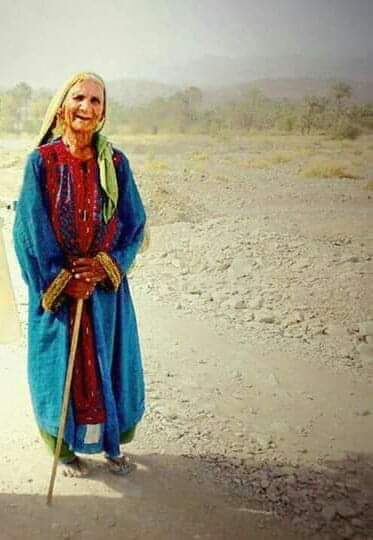
A smiling Ganji Baloch. Photo provided from Facebook by Ali Jan Maqsood.

In a village of around five thousand people, one was Ganji Baloch. She was the only person left of her family in the village. Her husband had died. Their daughters were married and left to live with their spouses in other places. Their sons had left the village saying that they would permanently settle in cities to educate their children. They asked Ganji to join – some sixty kilometres away from the village – but she refused saying that she could not leave her ancestral land, her gardens and her people, and settle down in a distant town. And then, it was Ganji alone with her home, her garden, her people and her loneliness.

Ganji’s home was in the middle of the village. I remember when I was a child, we often used to pass through her compound to go to my uncle’s home. We always found her alone, sometimes inside the home, sometimes lying on her charpoy outside, under the open skies. As we visited the village on vacations only, I met Ganji when I was visiting my uncle’s new home.  I had asked my cousin why she was alone. He narrated the whole story. At the end, he said that Ganji had deep love for her land. I laughed and said she sounded crazed. “What exists here in this barren land? Who is here besides her own self? She is only looking for pity and nothing else.” I thought it would be better for her to move to the city and enjoy the rest of her life in ease and comfort.

We moved.

Today, after several years, I again saw Ganji’s smiling face – on Facebook. Someone had put it there. I was reminded of the past. I had moved out of my homeland too. And then I realised Ganji was not crazed but it was us — those who thought happiness can be found by pursuing dreams of comfort and ease. The comfort and ease to be had when you were on your own land and among your own people continued unbeatable. That day I realised Ganji was an ardent lover of her land, her gardens, her stones and her people. She had no greed for riches but a need for inner happiness and strong bonds with her people. Ganji was an honourable woman who spent all her life in her village. Even if she was the sole person left in her home, she still preferred being amidst her own land and people. Her smile had eventually become her recognition. She used to visit everyone in her village and was on good terms with everyone. She was an independent woman who fended for herself.

Akram Baloch, a lecturer and resident of the same village, said that Ganji had plenty of land which she could sell at high costs. She received many offers, but she refused saying that they were hers. “How can a person sell her lands? At least, I cannot.” she often echoed.

It heard Ganji had made a potable water spring at the end of her garden and provided water to any thirsty passer-by. She took charge of maintaining that watering system for anyone who needed it. I wonder if Hirronk, her village, would ever bear another Ganji Baloch in the years to come. Is she crazed or is she one for whom her land, her people, her stones, her gardens and her village meant more than the rest of the world?

.

Ali Jan Maqsood studies Law at University Law College Quetta. He can be reached at alijanmaqsood17@gmail.com and tweets at @Alijanmaqsood12

.

PLEASE NOTE: ARTICLES CAN ONLY BE REPRODUCED IN OTHER SITES WITH DUE ACKNOWLEDGEMENT TO BORDERLESS JOURNAL

Categories
Poetry

Love Poetry by Gayatri Majumdar

Courtesy: Creative Commons
I'M YOURS

If you must,
	consume me in totality 
		leave no trace – 
no fragrance, no rain,
not even whisperings
	among seeds bursting to ground
and shed-music of falling meteors – 
find me that obeisance rest of your red honeysuckle
	agreeing with the sweet daft.
Slay me, if you must,
	for I am yours,
but spare me the brutalities 
of certain birthing, happy endings.


LOVE

As I fall into your arms,
I can hear the distinct click of the jail door 
in a rusty corner of the galaxy.

You, my lover, were impatient for this precise moment
dispersing me to light
the night’s jazz fused with cosmic dust and saxophone. 

You steady your gaze, 
your belief in me unwavering
even as I
howling to moon and street lights,
grapple with my weakening knees
– tremble, unable to pin the ‘pain’.

You, my lover, were certain this would be the precise moment 
when I’d return your gaze – 
broken, wanting all the love your petalled heart can hold
– demanding, dissolving 
into the light-substance of your presence,
this night’s other delights 
twigging, drumming to my heartbeats.

I marvel at the precision of your timing,
just when I thought all that is not there, seems lost;
You appear, materialise
Stuck as you are, in me,
in this garden
of crooked pathways, wayward roots whispering – 
sleep hours of creatures and last sips of tea.

This time I’m certain,
your departure is imminent – you take with you the night’s last melody – 
the seasons will change
as the ethers of your blues ache,
return those lost hours to me . . .

You begin to perfect the tribhanga*,
your flute wafting the stones and trickery. 

*Krishna’s tribhanga (“three parts break”) pose.

Gayatri Majumdar, the founder of The Brown Critique (1995–2015), has authored six books. She co-founded ‘Pondicherry Poets’ and curates numerous poetry/music events. Gayatri is associated with Sri Aurobindo Society in Pondicherry

.

PLEASE NOTE: ARTICLES CAN ONLY BE REPRODUCED IN OTHER SITES WITH DUE ACKNOWLEDGEMENT TO BORDERLESS JOURNAL

Categories
The Literary Fictionist

Deathless are the Words

By Sunil Sharma

Courtesy: Creative Commons

It was decided.

The Madman was to be neutralised before he became a popular prophet.

“Take him down!” the chief secretary gave the oral order. “Leave no trace!”

“How?” the deputy asked.

“Cops in the civil dress. Mid-night arrest. Unmarked cars.”

The deputy replied, “Consider it done, boss!”

The senior bureaucrat breathed easy.

His mind went back to the afternoon summons to the offices of the dreaded MOT (Ministry of Objective Truth).

The Minister was furious: “Why does the Madman roam free in our dear republic?”

“Sir, we are working in that direction. Trying to find incriminating evidence. Except few diaries and books, nothing on him. He is an ineffective nut, dreaming of equal system of governance. Talks of ideal worlds! Harmless!”
“I know, I know all that. Those ideals are impossible in our old democracy! But our beloved King feels the man is a threat,” the minister grunted. “He is inciting the public. You know the consequences of turning people against our beloved King of the republic.”

“Yes, sir.”

“Remember our motto as determined by our beloved King?”

“Yes, Sir.”
“What is that?” the Minister asked.

“Words are the real danger.”
“Yes.”

The chief secretary smiled.
“Look at this video carefully,” the Minister said. “Subversion, open and loud! Challenging us!!”

The video showed a bearded man in old clothes shouting to a small crowd:

“Change-change!”
“Change-change!” the crowd chanted lustily.

The Madman looked up and shouted: “The days change. Evenings change. Why not they and you?
“Yes. Change-change! Bring them on. Change-change, change them all,” the public shouted spiritedly, as the nut paced up and down an area circled with a red chalk; stopping, walking, talking to invisible beings within that marked spot.

The crowd listened eagerly to the dishevelled figure, increasing in size.

The Madman paused for long and then resumed in a hoarse voice: “Fools! All! Listen! to the drum beats, the roll of thunder and crashing seas! Roll on thunder! Cleave the sky and forest, bring in the new! Fools! All!”
“Fools! All!” the crowd repeated faithfully. “Change! All! Don’t fight shy!”

It was a spontaneous chorus provided by the onlookers, mostly idlers and the young unemployed.

Vaudeville staged freely in the public garden.

“This will come to a pass. This, too, will change fast. Despair not! Come forward!” The Madman continued.
Pause.

Then the principal actor yelled dramatically: “Things change. This will change. Un-fix. Re-fix. Fix. Fix.”

The audience clapped and echoed the lines: “Fix, re-fix, fix, fix!”

“Iron gates get rusted and fall away in the gales…stone walls crumble. Hark! The shattered visage of Ozymandias rots in the vastness of the desert, mocking others of his tribe. Fix, re-fix. The march is on! Come on. Come on!”

The people laughed and repeated the last words of the Madman.

“My God! He is a like poison.” The secretary confirmed. “It is sedition, pure and unalloyed! More lethal than the missiles stored in our secret facility!”

“Shh! Shh!” cautioned the minister. “The Foreign agencies have eyes everywhere! There are no nuclear warheads in our dear and peace-loving republic!”

The chief secretary immediately corrected: “Oh! there are no missiles. The King loves peace!”

The Minister continued: “This man here in the video! He pretends to be mad. He is a dissident and needs to be punished for his outrageous comments against dear leader, our king.” The Minister’s eyes darted upward towards the ceiling.

Bugs!

“Yes Sir. He will be fixed tonight! He is a threat! A spy of the enemies of the republic, our beloved king.”

As directed, the cops arrested the man sitting on the pavement, staring into the sky, a street dog at his feet.

“Again?” He asked the cops. “Mad? Troubling a homeless man who has not committed any crime? Better go after the robbers in suits sitting in the palace.”

“We are here to take you home, real home, dear sir,” the inspector said. “Away from this world. Be the guest of our great republic. A tiny dark cell is now your new home.”

“All the world is my home, fools!” the man laughed. “You can imprison my body, not mind. You can jail the writer by declaring him mad, a threat but cannot imprison his words in the stone walls! Words tend to escape and fly even the maximum-security jails.”

The inspector smiled: “We will see this time.”

The Madman picked up his tattered bag and said goodbye to the dog that tamely followed the speeding vans.

The new prisoner was lodged in an isolated cell.

A team monitored his behaviour.

In the dungeon, he talked to the walls or slept on the hard floor.

Once he was heard talking to the air: “Because things are the way they are, things will not stay the way they are. Brecht was right. These fools will never understand! Status quo! It will unravel. Brecht, the Great!”

The inspector reported to the chief secretary: “Eureka! He talks about another collaborator Brecht. Who can be this dark conspirator?”

The chief secretary had never heard the name but did not show. He asked the go-to person, the famed MK (Memory Keeper) — the sole custodian of names, dates and archives– the top-secret vaults of the state secret. All significant names from history and arts, philosophy and political science were erased carefully– names of critical thinkers; revolutionaries and radical writers and artists by the king via this super secretive body but archived for future references by the king and his core council only.

These archives were guarded by the MK and his team of young and dedicated sleuths who pored over texts and documents and eliminated anything remotely radical, out-of-box thinking or quotes or essays or books from the records in a methodical way.  

Only the name of the King was allowed to be inscribed in records, new histories, books, syllabi and other state data, all created diligently by the scribes. king as a seer! His edicts were cast in stone.

Only thing allowed: Daily chants of his name and party by the people—social media and public spaces, supervised by the MOT and the IT (Information Technology) Cells.

The King is the Truth! The Truth is the King!

That was the official motto.

The Memory Keeper smiled. “Brecht! Forget him. No threat in a de-radicalised democracy. Mere vintage! Already forgotten globally by the youth and middle class!”

They all heaved a sigh of relief: One man less to locate and interrogate!

Somehow, the news of Madman’s disappearance spread.

The Madman Arrested and Tortured! The global media screamed religiously for days.

 The news mobilised the intellectuals and influencers. Wildfire-like, it further spread. People were enraged and protested against the arbitrary nature of power.

#Free the Voice of People# Free the Madman.

The movement spread.

Amnesty Association, Union of Countries  – all joined the movements across world capitals.

People took out candle marches, held rallies, organised sit-ins.

Media covered each such meeting at the public squares.

The King finally intervened.

He asked his Council to release the Madman.

And told the Plan to silence this gadfly.

The Madman was back to his bench and the famous Circles of Chalk.

People rushed to welcome him in the streets.

The Madman again prophesied: “Beware of the seasons! Spring coming! Winter is over!”

The public again followed him and listened to his predictions: “Today autumn; tomorrow spring! You cannot imprison the gales and winds! Down, down, the bridge and the old castle. Here comes the Spring!”

The crowds shouted this as the latest mantra.

His popularity surged.

Dubbed as The Mad Philosopher for the Mad Age, his fan following grew in millions, over the months.

The Plan was activated: Declare him heretic. Against God. Against nation. Against heritage.

A systematic campaign was created on social media.

The Madman hates his country!

The Madman hates God.

The Madman hates his country, its language and culture.

He is the Enemy of the State.

Must be killed!

Doctored videos circulated.

He was shown laughing at the old gods of the land, ridiculing the language, culture and religious texts of the country, eating things that were not sanctioned or, wearing wrong clothes or, mixing with “Other”.

It inflamed the passions of the young and the disaffected.

The impression was carefully crafted: The Madman is not a Patriot! Anti-order. Messenger of chaos!

The IT cells of the MOT went into overdrive.

“Hatred and misinformation, once sown, do their destruction,” MOT was told by its zealous minister.

“People can be easily divided,” he briefed the team, “by the notions of skin colour, accent, ethnicity, food, clothing, gods, regions, sex. The Controllers should know how to play the game and create disaffection among the public.”

The Controllers understood. The most crucial office: Controllers of Thoughts, they decided to release what constituted as the sole and objective Truth.

Or, falsehood.

The Minister was specific: “Lies are truths in post-modern democracies. Sow the discord! Fictions are facts.”

They did.

A hysteria was manufactured.

Madman, the Devil!

Army of hate mongers helped.

Soon, blinded by anger and hatred, a young man, radicalised by the constant rhetoric, attacked the Madman in the public garden with a sharp knife. The man lay bleeding on the road.

People took pictures.

His dying words, “Fools! You can kill me, not my words! I will return in a changed form. My spilled blood will become words. Words take wings. You will never be able to trace and kill the winged words! I will outlive killers.”

The authorities deployed old strategies of annihilating fatal words by organising complete bans, issuing edicts; via censors, book burnings, cancelations of commemorative events; even through the sponsored murders of key followers and sympathisers of the nut becoming a prophet and rallying centre for the large populations of the world; by systematic stamping out references to the Madman, a total erasure.

“Like cutting the heads of the hydra!” the chief secretary complained.

More the mandarins tried, more they failed.

His image and words appeared in some other form or place.

Even an underground flourished in his name.

The King ordered them not to stop in their sole and most important enterprise of removing the Madman from memory and history of the national consciousness.

He was officially declared as mad subversive who misled the gullible public and any mention of him invited the penalty of death.

The “gullible” public called him the Sane Saint!

To the collective horror of the King and core council, multiple sightings of the dead Madman in many cities and regions were reported by the ordinary citizens!

The pandemic is now a borderless phenomenon.

Each affected citizen claims, “I am the Madman! I have become sane!”

The war cries are loud and clear.

Getting amplified by the minute.

The State and King are trying to figure out ways of dealing with this perplexing paradox, this strange social development, before it spills into a storm.

.

Sunil Sharma is an academic and writer with 23 books published—some solo and joint. Edits the online monthly journal Setu. 

.

PLEASE NOTE: ARTICLES CAN ONLY BE REPRODUCED IN OTHER SITES WITH DUE ACKNOWLEDGEMENT TO BORDERLESS JOURNAL.
Categories
Poetry

Poetry from Italy

Poems by Rosy Gallace, translated by Irma Kurti

Rosy Gallace

THE EXPIRED TIME

It wasn’t the highway kilometres

that made us feel distant.

It wasn’t the labour

or the cost of the tolls.

.

It wasn’t even

a round trip on an easy jet.

It was our thoughts

so distant… and… different.

.

Our time has traveled

between parallel lives

chasing each other, never meeting.

.

Our thoughts intertwined

with the days filled with loneliness;

now, they’re here in their nakedness.

.

Our time has expired.

.

For once, without finding any holds,

let’s look at each other through sincere

eyes and beyond words, let us listen

to the rhythms of heart, let’s shake

hands, be real, let’s just be ourselves.

.

IF YOU WERE HERE

I would not feel the unbridgeable void

in these long summer days.

I’d forgive even the chirping of cicadas

that took away the sleep from your nights.

.

I would run to you to find

the answers to my silences.

I would ask you how to live:

get up, get dressed, wash, eat,

keep that pain a secret,

the pain that takes the breath away.

.

I would fly to you on dark days;

I don’t know where else to go.

I’d find relief among those walls

that smelled so much

of lavender and talcum powder.

.

If you were here

I wouldn’t be so lost tonight,

confused and cold. I’d have a smile

and a warm hand, that word you

whispered in a low voice and how

magically everything turned as before.

.

This time I’d take you by the hand,

proudly I’d lead you along the course,

even on that chair you hated so much

despite that, you would be happy with me.

.

I would touch a kiss on the folds

of the forehead while you travel in

your memories in a smile shielded

from the grimace of pain.

.

Rosy Gallace was born in Guardavalle in the province of Catanzaro in Calabria and lives in Rescaldina, Milan. She has published several books of poems which have been translated into English, Romanian and Albanian. She is the creator, organiser, and president of several literary contests and also acts as part of the jury for various literary competitions in Italy.

Irma Kurti is an Albanian poetess, writer, lyricist, journalist, and translator. She is a naturalised Italian. She has won numerous literary prizes and awards in Italy and Italian Switzerland. Irma Kurti has published 26 books in Albanian, 17 in Italian, 8 in English and two in French. She is also the translator of 11 books of different authors and of all her books in Italian and English.  

.

PLEASE NOTE: ARTICLES CAN ONLY BE REPRODUCED IN OTHER SITES WITH DUE ACKNOWLEDGEMENT TO BORDERLESS JOURNAL

Categories
Interview Review

The Fearful Trill of Freedom & Equality

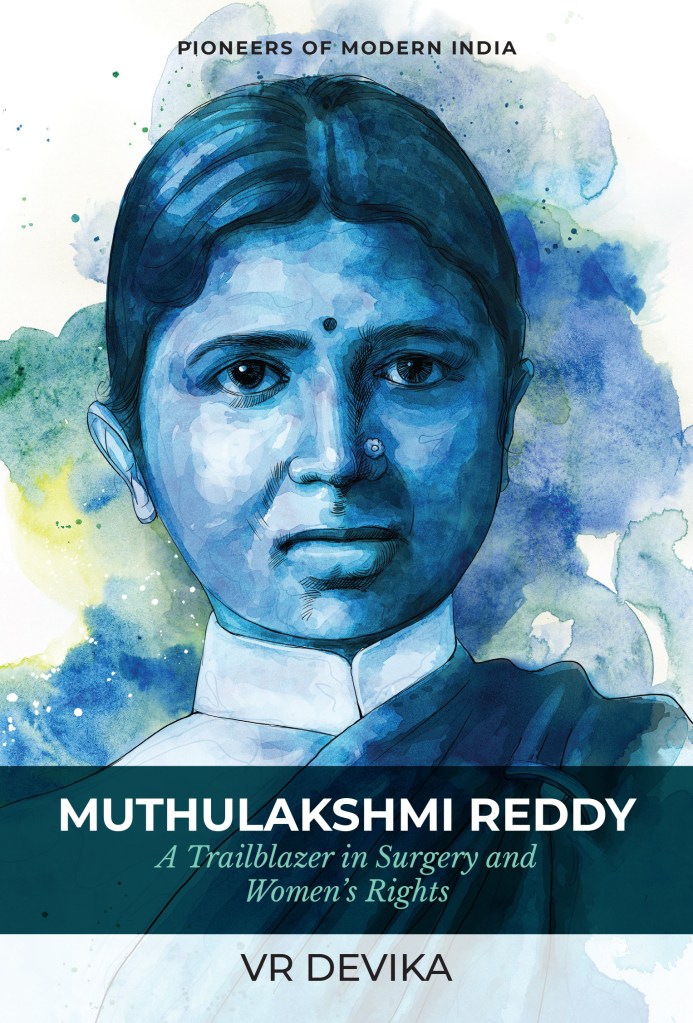
A conversation with VR Devika, author of Muthulakshmi Reddy: A Trailblazer in Surgery and Women’s Rights, Niyogi Books.

“Education, Freedom and Responsibility bring out the best from the individual and race. This will apply to all men and women irrespective of caste, creed or colour.”

—Dr Muthulakshmi Reddy, Muthulakshmi Reddy: A Trailblazer in Surgery and Women’s Rights

 Muthulakshmi Reddy: A Trailblazer in Surgery and Women’s Rights by VR Devika is a biography of a woman who shouted out to demand reforms among devdasis ( women who had been ‘married’ to lifelong service of a deity or a temple) and prostitutes in the nineteenth-twentieth century. The biographer, V R Devika, is a storyteller, educationist and Gandhi scholar.

Muthulakshmi Reddy (1886-1968) was born to a devdasi mother and transcended the system that had deteriorated from when a devadasi was considered ‘auspicious’ as she would never be widowed or married, and she could maintain her status quo, the book informs, adding a historic perspective to this ‘norm’. By Reddy’s times, these women had been reduced to become mistresses to rich men. In ancient times, before malpractices set in, a princess is said to have opted to become a devdasi. The decline started in the sixteenth century when devdasis were transferred from temple to temple.

The narrative is simple and straightforward but what stands out is the value of the content, the strength of the woman who could speak up boldly and demand reforms — even have some of them instituted. She spoke out for reforms with searing words. The author quotes from many of her speeches.

“Muthulakshmi used strong language to explain her position on the Devadasi question. ‘Of all the laws, rules and regulations which down the centuries have helped to place women in a position of inferiority, none has been so very powerful in creating in the minds of men and people a sentiment of scorn and contempt for women as the degrading idea of the double standard of morals.’

“She thundered, ‘From this double standard that has sprung that worst attack on women’s dignity, that safety valve theory that a certain number of women should exist, should sacrifice their self-respect, their honour, their comforts, their health and happiness to satisfy the lust of the other sex. At the present day, the continuance of such a doctrine and of the laws which are founded on it, is a shameful anachronism unworthy of our civilisation. Both in the past and in the present, women have disproved their inferiority, and how then can we at the present day tolerate or connive at a system which transforms a woman of whichever caste or class she may be, into a mere chattel, a piece of tainted merchandise? The inequity of the system is too deep for me to give expression, and further under that inhuman and unjust system the innocent children of a certain caste or community are trained to become proficient in all the arts of solicitation that they become captives to vice.’”

That men and women perpetrate social norms to justify the existence of the so-called ‘world’s oldest profession’ is well brought out in the book. That women forced into the sex trade are not doing this out of choice is conveyed with conviction. Names of Reddy’s associates include Sarojini Naidu (1879-1949) and the well-known singer whose mother was a devdasi too, MS Subbulakshmi (1930-1997).

Reddy was one of the first female medical graduates[1] in India, the first woman[2] to enter an Indian Legislature and the first woman in the world to preside over a Legislative Assembly. A recipient of the Padmabhushan and more accolades, she, as a doctor founded the Addyar Cancer Institute in 1952 after her sister was caught with cancer, and, as a humanitarian, started the Avvai Home in 1931 for those rescued from brothels and streets. Her spirit is well captured by the author when she writes:

“In 1942, during the World War II, soldiers of the British Royal Airforce camping in tents on the banks of Adyar river had made some derogatory remarks about the girls and harassed them. Muthulakshmi stood vigil all night with a stick in her hand and dared any soldier to come near the Home. She even went up the ranks to the commander’s house near Fort St. George to complain to him about the conduct of the soldiers and curb their behaviour.”

VR Devika has extensively shown that Reddy was a force to be reckoned with but she has not given way completely to adulation. She has objectively shown how Reddy over ruled her son’s choices for the well-being of her own institutions. It brought to mind Gandhi’s attitude towards his own family. An established cultural activist, VR Devika has been associated with the inception of Chennai’s Dakshinachitra Heritage Museum and Tamil Nadu INTACH[3], has been visiting the Avvai Home and in this exclusive she tells us the story of how the book came about and why she visited this home and its impact on her.

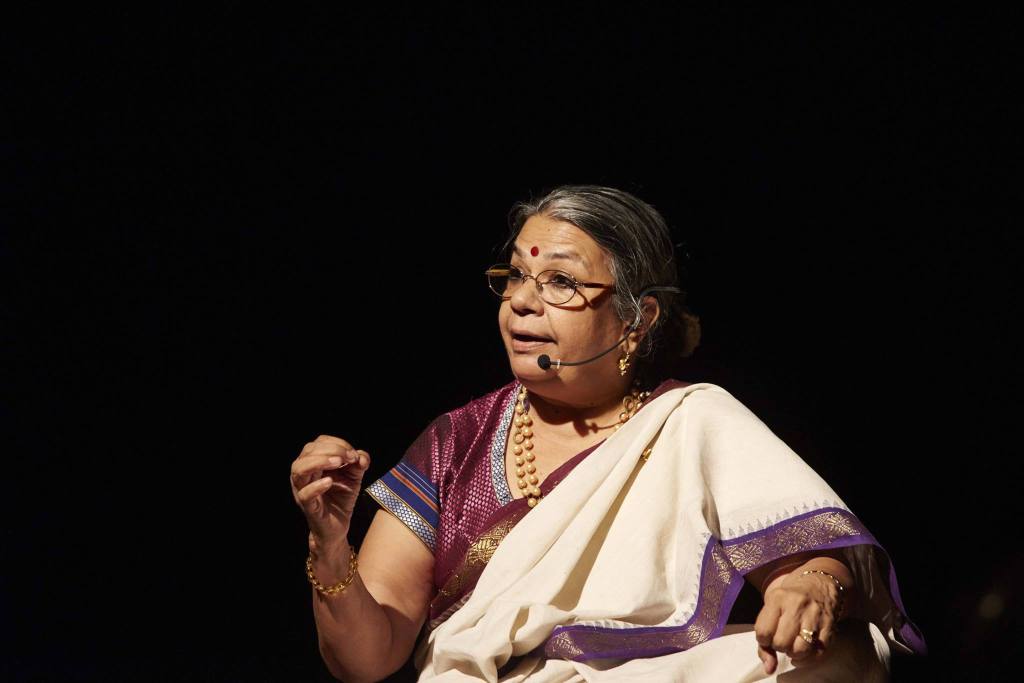
VR Devika. Photo provided by Niyogi Books

Tell us why you felt that Muthulakshmi Reddy’s story needed to be told. What was the readership you had in mind when you wrote the biography?

The dance scholarship [donors] consisting of mainly outsiders who had a hypothesis, got a good grant, employed interpreters and cherry picked to denigrate her in a fashion that took dance academic world by storm after the 1980s. I had also bought into them when I began to learn Bharathanatyam. But when I joined INTACH Tamilnadu and Madras Craft Foundation in 1985 after having been a schoolteacher since 1974, I began a project of English language as a skilling programme and theatre as empowerment for Avvai Home. That is when I began to get the other side of the story that was really fascinating. I kept thinking I must reach this story out. Dr.V.Shanta, chairman of Cancer institute, said I must write her [Muthulakshmi Reddy’s] biography and I decided to work on it after she passed away. I had young people who were studying English but had no access to English other than their textbooks as the target audience but I am a story teller and I just began to tell the story in simple way as I always do.

You tell us in the authorial note that you went on ‘work’ to the Avvai home. Tell us about the home. Why were you there?

Geetha Dharmarajan and I lived near Avvai Home. I had no idea about the history of the home etc. But I knew very poor girls studied there. Geetha had spoken to them and I went along but Geetha relocated to New Delhi and started Katha[4] and I stayed on helping Avvai Home in many different ways. I have written a full story of Avvai Home in the book. It was volunteer work. Rajalakshmi of Avvai Home requested me to help them on a production on Dr.Muthulakshmi Reddy. I interviewed Sarojini Varadappan, Dr.Shanta, and several others to write the script for the production. I am now on their school advisory committee.

For me, the most interesting aspect was how Muthulakshmi Reddy made the transition from being born a devadasi to empowering herself enough to outlaw the custom. Did her parents ever marry?

No there was no way they could marry as a girl born in the system was barred from ritualistic marriage according to Hindu custom. She was his companion.

Your narrative is direct and eulogistic of great names and associations of/ developed by Muthulakshmi Reddy and the lady herself. The personal is largely left out, except to emphasise her achievements. Why?

I cannot [describe that] as I never met her. I had to sketch a portrait from her writings, her achievements and her son’s writing.

Would you regard the devdasi system as a social ill that has been erased or is it an ongoing battle?

There is no social evil that has been erased completely. Nostalgists for devdasi system denigrate her [Reddy]. But there is the social evil of discrimination against Dalits still, but should Ambedkar be blamed for giving a legal handle for those who wanted to come out and achieve something of their own despite the caste hierarchy? Those who benefited from the abolition of dedication are in thousands while those who bemoan the loss of culture in the way they want it are in hundreds.

The devdasi system is a generic system in a number of states in India. Did Reddy’s reforms benefit all the states? Was the Avvai Home open to all devdasis or only from her state?

Avvai Home never claimed to be only for devdasis but for girls who needed protection and access to education. No reform benefits everyone. Her law was for the Madras Presidency of the time which consisted of parts of Andhra, Orissa and Karnataka too as part of it.

Muthulakshmi Reddy started a number of things, including the second oldest cancer hospital in India. But all these were reactions borne of personal experiences. Do you think if she had been born into a regular family, and her sister would not have had cancer, would she have striven for these institutions too?

I can’t answer a hypothetical question. How do we know what she would have done?

What was the driving force behind the reforms instituted by Muthulakshmi Reddy?

Her own indomitable will and the stubborn streak that sought to get it done and get others who would help her come in whole heartedly.

Would you justify the “emotional blackmail” on her son to fulfil her own dream by giving up his own? Do you think that it is right of a parent to impose their will in this way?

I am not justifying it. It happened that way. Just telling the story. She did not force her elder son who went into Electrical Engineering. Her second son never resented the “emotional blackmail” He went along whole heartedly.

What for you was the most endearing quality of Dr Reddy?

I have many who worked with her telling me she was very kind, but she was also a tyrant and would not bend. Her own indomitable will and the stubborn streak that sought to get it done and get others who would help her come in whole heartedly. She was a mother (Amma) was the unanimous opinion.

Thank you for giving us your time.


[1] Anandi Gopal Joshi(1865-1867) and Kadambini Bose Ganguly (1861 –1923) graduated and practiced as doctors in other parts of India.

[2]  Muthulakshmi Reddy joined the Madras Legislative assembly in 1930.

[3] Indian National Trust for Art and Cultural Heritage 

[4] Katha is a non-profit and non-governmental organisation that has established itself in the field of community development, child welfare, education and literature.

(This review and interview is by Mitali Chakravarty.)

.

PLEASE NOTE: ARTICLES CAN ONLY BE REPRODUCED IN OTHER SITES WITH DUE ACKNOWLEDGEMENT TO BORDERLESS JOURNAL

Categories
A Special Tribute

Can Gandhi-ism Survive?

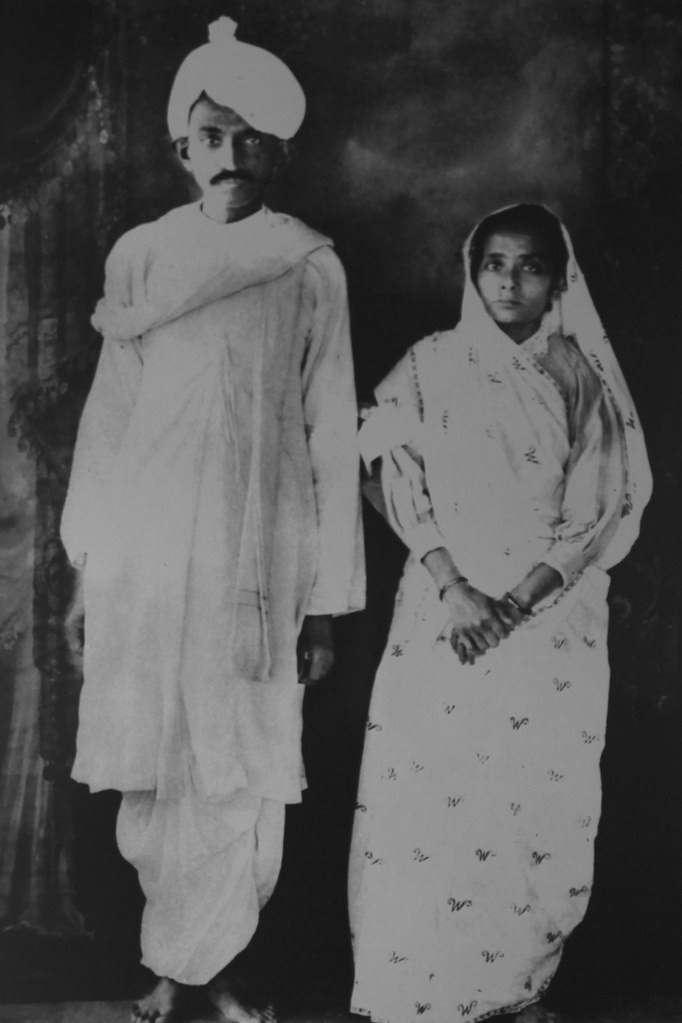
Mohandas Karamchand Gandhi (1869-1948) was an ordinary man who became extraordinary in quest of a just world. With his strong belief in non-violence and truth, Gandhi set out to find freedom, dignity and respect for his compatriots with peaceful weapons he evolved reading greats like Tolstoy, Thoreau and many more. He named these; Ahimsa or non-violence, Satyagraha or the way of truth and civil disobedience or peaceful protest by disobeying an unjust law.

To use these wisely, we needed a certain amount of education and preparation — not in terms of degrees from universities but in terms of spiritual growth. In his An Autobiography or My Experiments with Truth, Gandhi wrote: “A Satyagrahi obeys the laws of society intelligently and off his own free will, because he considers it to be his second duty to do so. It is only when a person has thus obeyed the laws of society scrupulously that he is in a position to judge as to which particular rules are good and just which are unjust and iniquitous. Only then does the right accrue to him to the civil disobedience of certain laws in well-defined circumstances. My error lay in my failure to observe this necessary limitation. I had called on the people to launch upon civil disobedience before they had  qualified themselves for it, and this mistake seem to me of Himalayan magnitude.” Have we done anything to rectify his self-professed oversight?

Now as we commemorate his 153rd birth anniversary, in the midst of war, violence, hatred, intolerance, where do we stand in terms of Gandhi’s ideology? For a man lives on only if his ideals survive.

Exploring this issue is an essay by Debraj Mookerjee, who wonders if the man and his values will face complete erasure? Reinforcing this thought is a Manipuri poem by Thangjam Ibopishak, translated by Robin S Ngangom, and a review of a book by Bhaskar Parichha on the conspiracy that led to the assassination of Gandhi. On the other hand is Keith Lyon’s essay on Gandhi’s ‘enduring vision‘ and winding up the prose is Rakhi Dalal’s essay urging us to pursue Gandhi’s vision, titled after the words of a man who did live by Gandhi’s ideals, Martin Luther King, while Aminath Neena gives us an inspirational poem along those lines.

In Quest of Gandhi-ism

Just a Face on Currency Notes? by Debraj Mookerjee explores Gandhi’s relevance and evolution. Click here to read.

Gandhi & the Robot, a poem relooking at Gandhi’s ideology in the present context, written in Manipuri by Thangjam Ibopishak and translated by Robin S Ngangom. Click here to read.

Bhaskar Parichha reviews Why They Killed Gandhi; Unmasking the Ideology and the Conspiracy by Ashok Kumar Pandey. Click here to read.

Re-inforcing Ideals

In the spirit of Gandhi-ism, we have poetry from Aminath Neena, Light a Candle. Click here to read.

In Gandhi — an enduring vision — and those spectacles, Keith Lyons applauds the Mahatma from New Zealand. Click here to read.

‘If humanity is to progress, Gandhi is inescapable’, Rakhi Dalal says it all through this quotation of Martin Luther King Jr. Click here to read.

Categories
Essay

Just a Face on Currency Notes?

By Debraj Mookerjee

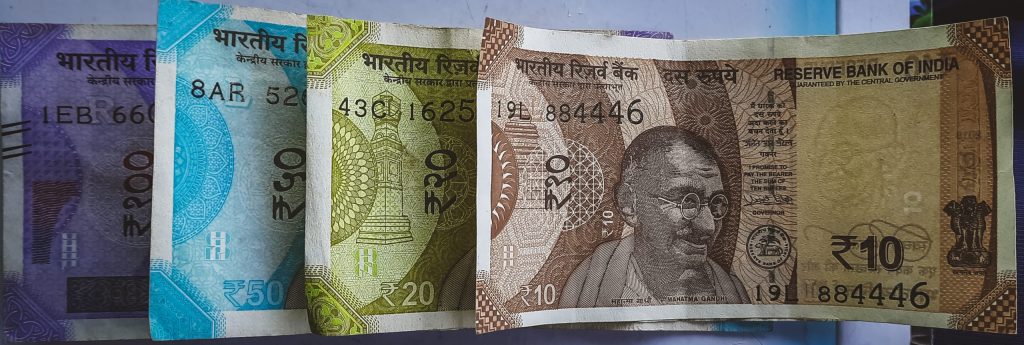
Gandhi on currency notes: Courtesy: Creative Commons

Twentieth century India could arguably be said to belong to Mohandas Karamchand Gandhi, or simply Mahatma (Great Soul), or even Bapu (father). In its political and moral imagination, India was enveloped by the enduring legacy of both the man himself, and his philosophy. So many things written into the Constitution were scripted by Gandhian belief, even quirks, for that matter. Cow Protection (“The central fact of Hinduism is cow protection”) was accommodated in the Constitution because Gandhi wanted it in. Nehruvian liberalism ensured its relegation to the Directive Principles of State Policy, which are not enforceable, but more recommendatory in nature, but Gandhian sentiment could not be unaccommodated.

The twentieth century was left behind not very long ago, but India seems to have leapt into another era in these two decades, shaken from the moral moorings anchored by Gandhi. The starkest recognition of this change has been the veiled attacks on Gandhi himself (though the valorised resurrection of his assassin, Nathuram Godse). The more direct attacks have been on the very nature of the Constitution. The key words in the Indian Constitution bear the mark of Gandhian beliefs, wedded top the standards of a modern Constitutional democracy.  These are Encoded in the preamble. In the 1950 version the words the words ‘Sovereign’, ‘Democratic’, ‘Republic’ are headlined (Secular and Socialist were added later via the 42nd Amendment). Below them are listed words like ‘Justice’, ‘Liberty’, ‘Equality’ and ‘Fraternity’. These hallowed principles are under threat in every day public life. Justice is colour blind, liberty not protected by justice, inequality threatened by unequal notions regarding liberty, and the sense of fraternity shredded by unchecked sectarianism.

The safeguarding of the idea of India is not merely an ideological battle; it is the fight for the soul of India. The soul that Gandhi’s deeper moral philosophy gave shape to. This soul was moulded through ideas both ancient (that once sprang in this land) and modern (drawn from the best philosophies from across the world). This endeavor was not easy. It was difficult in both conception and adoption. It was rendered possible because of Gandhi’s great moral force, and adopted because of the Freedom Movement’s largely liberal and inclusive character.

After Ashoka the Great and possibly Prophet Mohammad (PBUH[1]), Gandhi is singular in the modern era as someone who viewed politics and the engagement between political entities though the prism of morality. Before and after him politics has always been the ‘art of the possible’. Gandhi wished to go deeper, to find the idea of the nation, indeed the very idea of an independent India beyond merely the definition of nationhood. He wanted his India to have a soul, to emerge from its bondage purified by intent and moral leadership. This is what Gilbert Murray, the redoubtable classical scholar and public intellectual, once wrote about Gandhi: “When I met him in England in 1914, he ate, I believe, only rice, and drank only water, and slept on the floor; and his wife, who seemed to be his companion in everything, lived in the same way. His conversation was that of a cultivated and well-read man with a certain indefinable suggestion if saintliness. His patriotism, which is combined with an enthusiastic support of England against Germany, is interwoven with his religion, and aims at the moral regeneration of India on the lines of Indian thought, with no barriers between one Indian and another, and to the exclusion as far as possible of the influence of the West, money-worship, and its wars.”

Gandhi was never against the West; what he was against was what Western politics and society had become (recall his famous quip about ‘Western civilisation’ and that ‘it would be a good idea’). Gandhi was deeply impressed by Tolstoy’s ‘Letter to a Hindoo’ wherein he exhorted the Indian revolutionary, Taraknath Das, to adopt the path of non-violence. Tolstoy quotes widely from ancient texts. He was impressed by the fact that Tolstoy was quoting the ancient Tamil saint-philosopher while speaking of non-violence. The crucial wisdom that struck Gandhi deep (because it became his credo later) was this: “The punishment of evil doers consists in making them feel ashamed of themselves by doing them a great kindness.” This ancient wisdom reached the west via an eighteenth-century Latin translation. The journey of the idea of nonviolence and its acceptance by someone as revered by Tolstoy took Gandhi deeper into its exploration, since he was morally drawn to its spiritual embeddedness and its synergy with his own worldview. The concept of Ahimsa emerged from this distillation.

On the other side Gandhi was drawn to Henry David Thoreau’s ideas of civil disobedience and nonviolent resistance against an unjust government. In his 1942 ‘Appeal to American Friends’, Gandhi says,“ [Y]ou have given me a teacher in Thoreau, who furnished me through his essay on the ‘Duty of Civil Disobedience’ scientific confirmation of what I was doing in South Africa’. This scientific confirmation was drawn by Thoreau and his guru Emerson from ancient Asian philosophy, both Buddhist and Hindu. They believed the path of righteousness can be charted by the individual, outside of prescribed religions. Transcendentalism, a dominating cultural and philosophical movement in nineteenth century America, emerged from the distillation of older moral philosophies of the East, and, the path to righteousness, embedded in civil disobedience against any entity that is not moral, howsoever powerful it might be, emerged from such thoughts with stark clarity in Gandhi’s chosen mode for resistance – Satyagraha.

Gandhi dissolved so many ideas in his thoughts that it is sometimes difficult to discern the origins of many of his ideas. This is also because his was a syncretic mind, blending, assessing, conjoining and ultimately putting all ideas to the test of a simple morality, expressed best in one of his last notes (1948) in words that are talismanic: “Whenever you are in doubt, or when the self becomes too much with you, apply the following test. Recall the face of the poorest and the weakest man [woman] whom you may have seen, and ask yourself, if the step you contemplate is going to be of any use to him [her]. Will he [she] gain anything by it? Will it restore him [her] to a control over his [her] own life and destiny? In other words, will it lead to swaraj [freedom] for the hungry and spiritually starving millions? Then you will find your doubts and yourself melt away.”

The great beauty of Gandhi is that he is simple and complex at the same time. In the words of UR Anantha Murthy (author of Samskara, and a great literary voice), Gandhi was a ‘critical insider’, a phenomenon that India was lucky to experience, but a rare phenomenon. He was an insider in the sense that he identified with the lowest common denominator of what it meant to be an Indian, leading an abstemious life of frugal simplicity. But he was also critical of that which needed reform and transformation. He had the moral energy to envision a modern India, not based on modern technology, but based on a philosophy the world had abandoned. He envisioned a world of justice, where the downtrodden would determine the priorities of governance, where righteousness would set the terms for nations engaging with other nations, and where politics would not cast aside morality and ethics to foster its goals. In his lifetime he carried the moral force of a juggernaut, recognised by the world as one set apart. 

Today’s India is choosing to not only not heed the path offered by him, a path that held us together though times good and bad, but to actively discard acceptance, to choose violence over consensus, and to enforce the will of the majority over those who exist on the margins. Gandhi is fading away from the India’s conscience. Once his moral force has completely dissipated, he will remain only on the face of currency notes (a materiality he himself eschewed). And then, one day, when we are another nation, he’ll perhaps drop off even those currency notes.


[1] Peace Be Upon Him

Debraj Mookerjee has taught literature at the University of Delhi for close to thirty years. He claims he never gets bored. Ever. And that is his highest skill in life. No moment for him is not worth the while. He embraces life and allows life to embrace him.

.

PLEASE NOTE: ARTICLES CAN ONLY BE REPRODUCED IN OTHER SITES WITH DUE ACKNOWLEDGEMENT TO BORDERLESS JOURNAL. 

Categories
A Wonderful World

Where “Divides of Class, Religion & Ethnicities Collapse”

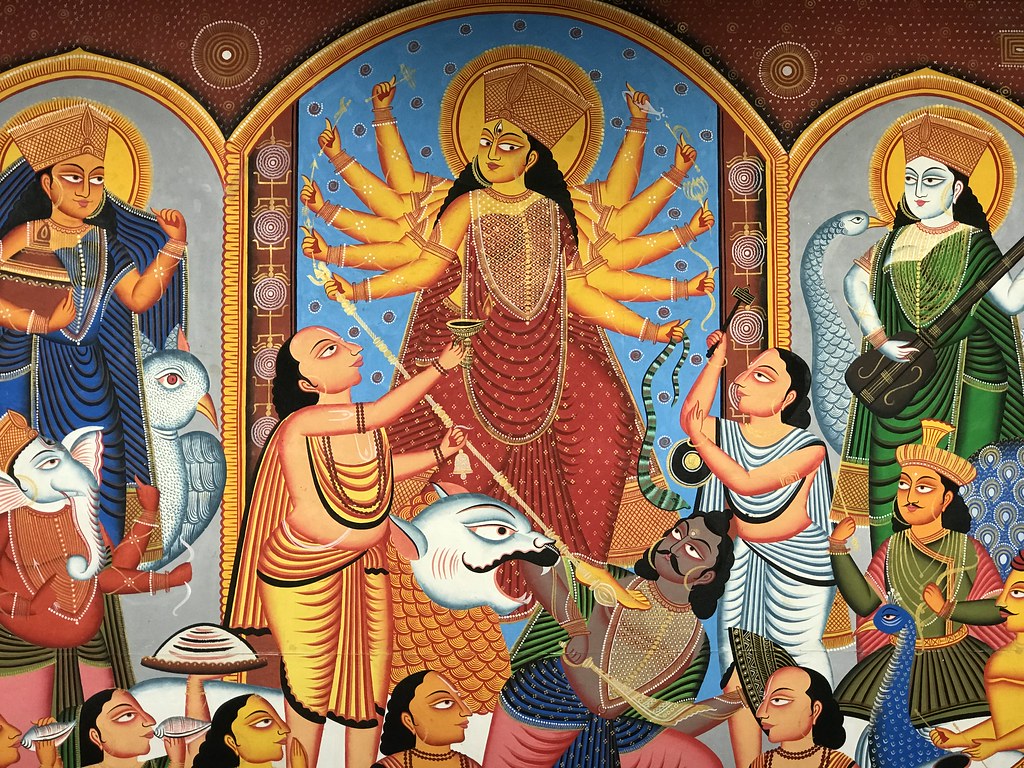
Painting of Durga Puja. Courtesy: Creative Commons
Wherever I look, a golden light 
Suffuses a vision of holidays,
The festive sun rises in the woods
Of puja* blossoms drenched in gold rays. 
             -- Tagore, Eshechhe Sarat

This has been a favourite poem of many who grew up reading Tagore, lines that capture the joy and abandon of the spirit that embodies the celebration of Durga Puja, a festival that many Bengalis deem as important as Christmas, Chinese New Year, Diwali or Eid. It is a major celebration in Bengal and large parts of the sub-continent, though not in all parts.

The reason that reviving the lore associated with this fiesta has become very important is that it centres around women. Given the situation in Iran, where the battle over how to wear headscarves has turned bloody, murderous and violent, celebrating an empowered woman, even if mythical, takes precedence over all else. Mythology has it that Durga was empowered by weapons given to her by various deities, all of who were men, and then, she did what all the male Gods failed to do — destroyed a demon called Mahisasur. Rama too prayed to Durga for victory around this time. And on Bijoya Doushami, the last day of the Durga Puja, some celebrate Rama’s victory over Ravana and call it Dusshera or Dashain.

Taking up this theme of the narratives around Durga Puja and how it has been made into an “Intangible Cultural Heritage of Humanity” by UNESCO is Meenakshi Malhotra’s essay on the festival. Part of the citation reads: “During the event [Durga Puja], the divides of class, religion and ethnicities collapse….” 

To bring to you a flavour of the Puja, we have translations of poetry by Tagore describing the season and of a poet who was writing before Rabindranath, Michael Madhusdan Dutt, by Ratnottama Sengupta, verses exploring the grief of parting Durga’s mother expresses as her daughter returns to her husband’s home. This is also a festival of homecoming for, like Durga, those living far from their homes return to the heart of their families. Rituparna Mukherjee has woven a story specially around this aspect of the festival. Journals in Bengal, traditionally, brought out special editions with writings of eminent persons, like Satyajit Ray. We have an interview with a writer who wrote a book on Satyajit Ray, an actor called Barun Chanda, to bring a flavour of that tradition along with the translation of a celebrated contemporary Bengali writer, Prafulla Roy, by Aruna Chakravarti. We hope you enjoy savouring our Durga Puja Special.

Poetry

Eshechhe Sarat (Autumn) , describing the season of Durga Puja, by Tagore has been translated from Bengali by Mitali Chakravarty. Click here to read. 

Bijoya Doushumi, a poem on the last day of Durga Puja, by the famous poet, Michael Madhusudan Dutt, has been translated from Bengali by Ratnottama Sengupta. Click here to read.

Prose

A Mother, a Daughter & a Demon Slayer?, an essay by Meenakshi Malhotra, checks out the festival of Durga Puja against the concept of women empowerment. Click here to read.

Homecoming by Rituparna Mukherjee is a poignant story about homecoming during Durga Puja. Click here to read.

Nagmati by Prafulla Roy has been translated from Bengali as Snake Maiden by Aruna Chakravarti. Click here to read. 

Interview

Meet Barun Chanda, an actor who started his career as the lead protagonist of a Satyajit Ray film and now is a bi-lingual writer of fiction and more recently, a non-fiction published by Om Books International, Satyajit Ray:The Man Who Knew Too Much in conversation Click here to read.

Categories
Essay

A Mother, a Daughter & a Demon Slayer?

By Meenakshi Malhotra

Durga Puja is an annual festival that marks a time of joyous celebration among the Bengali community worldwide. The UNESCO declared this festival as an ‘Intangible Cultural Heritage of Humanity’. A festival that has become the most looked forward to cultural event in the year, among the communities celebrating them, it is the biggest event in the festive calendar of Bengalis. Durga Puja in certain ways has transcended its religious context to assume mammoth proportions as can be seen in the UNESCO citation: “Durga Puja is seen as the best instance of the public performance of religion and art, and as a thriving ground for collaborative artists and designers. The festival is characterized by large-scale installations and pavilions in urban areas, as well as by traditional Bengali drumming and veneration of the Goddess. During the event, the divides of class, religion and ethnicities collapse as crowds of spectators walk around to admire the installations.” 

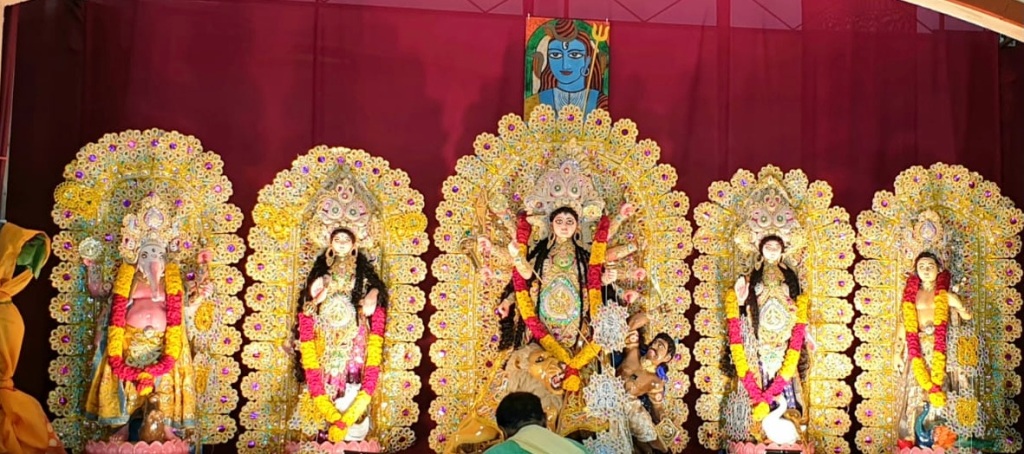
The idol of Durga, drowned at the end of the festival, is made by local craftsmen and is at the fulcrum of all the festivities as people come to worship her and celebrate her homecoming.The goddess is said to have descended from her husband’s home to visit her parents. According to art historians, the UNESCO tag will give a boost to the crafts around the festival — from the idol-making at Kumartuli to the designing and making of elaborate sets to house the idol. What is worth noting, moreover, is that no effort is spared when it comes to embellishing or decorating the goddess, in spite of its transient and impermanent nature. For, on the last day of the festival, the idol is immersed in the river, signifying the evanescence and temporality that marks human life and all its endeavours.         

Her descent on earth with her four children (Lakshmi, goddess of prosperity; Saraswati, goddess of learning; Ganesh, god of wisdom, and Kartik, god of war) for the five days of the festival, is also perceived as the advent of a daughter to the house of the mother, a moment which overflows with affection and emotions. The event happens at a certain time in the Hindu calendar and participates in linear time, as well as part of a larger ongoing  cycle of temporality. In the Hindu pantheon, Durga or Parvati is a prominent mother goddess, the consort of Shiva. Her names refer to split roles of the feminine imaginary. As Durga she is the fiery slayer of demons, as Kali she has to be appeased through blood and slaughter. Interestingly, in the cultural imaginary and imagery of the Durga Puja, she is also mother as well as the daughter, whose visit to the paternal home is brief and fleeting and therefore, provides the occasion for a joyous celebration.

Significantly, the Shaktik or the empowered feminine goddess, Durga, signifies the triumph of good over evil. The divine is represented both in terms of mythic abstractions and the material every day, as power and poetry, as divine and human, as mother and daughter. Thus she is the resplendent and refulgent goddess but also the all-powerful who eliminates all suffering and is thus referred to as “durgati-nashini”(destroyer of troubles). The goddess is shown as ten-armed, mounted on a lion, the king of the animals, ready to go into battle against the demonic strength of the demon king, Mahisasura. She is fully geared to destroy the demon king as her ten hands hold weapons.

The weapons tell a tale, which is intricately linked to the narrative and symbolism of Durga. They were given to her by male Gods who had failed to defeat Mahisasur to empower her to kill the evil demon. The trident was said to be given by her spouse, Shiva, and its three sharp points symbolised the three qualities (called ‘gunas’) of ‘sattva’(signifying wisdom and purity), ‘rajas’(signifying activity and material gain  ) and ‘tamas’(signifying darkness and destruction). The snake, a part of the iconography of Shiva who is depicted with a snake wound around his neck, was also gifted by him. The conch signifying the primordial sound called “aum”, the seed word for all creation, was gifted by Varuna, the god of water bodies. The sword was given by Yama, the god of death and Justice. The lotus, which represents the emergence of spiritual consciousness even under trying circumstances, was gifted by the creator of the universe, Brahma. The discus-also known as the “Sudarshan chakra” was given by the preserver of the universe, Vishnu, and spins on Durga’s index figure to symbolise how the energy provided by the goddess sets the universe in motion. The chakra represents the cosmic cycle of life and death in continuum, emphasising that though time destroys everything, inner awakening can help transcend the transience of time.

The thunderbolt or ‘vajra’ given by the king of gods, Indra, symbolises firmness of character, determination, and supreme power. The divinity empowers her devotee with unshaken confidence and implacable will. The bow and infinite arrows, gifted by Vayu, the air god, is a weapon whose combination of potential and kinetic powers symbolises energy.  The spear is a  gift from Agni or the fire god; it represents pure, fiery power. It also represents the power to judge and act with fairness and wisdom, differentiating the right from the wrong. The club or axe, gifted by Vishwakarma (a deity mentioned in the Rig veda and considered the architect or the engineer of the universe)  represents the power to defeat evil and embodies fearlessness while fighting against the wicked. Solar radiance is gifted to her by Surya, the sun god, to banish darkness and evil around her.

Finally, the goddess  is depicted  as mounted on a lion, the king of all animals and the most powerful.  Her mount signifies the need to keep strength and power within one’s control and use it only when required. The weapons of Durga are depictive of qualities we need to possess to empower ourselves to achieve our dreams.

Her fight with  Mahisasur was not just to eradicate evil from the universe at a particular  conjuncture, but also to set an example for generations to come. Yet the iconography and the narrative symbolism of the Goddess begs a question: Does she become more than a site or ground where masculine power is on display? Does her iconography also  highlight the gap between the sexes and the fact that the source of her power lies in the weapons she is given by the male gods and is, therefore, ultimately controlled by them?  Or can it be seen as a joint effort of the male and the female to find a world free of hatred, violence and evil?

.

Dr Meenakshi Malhotra is Associate Professor of English Literature at Hansraj College, University of Delhi, and has been involved in teaching and curriculum development in several universities. She has edited two books on Women and Lifewriting, Representing the Self and Claiming the I, in addition  to numerous published articles on gender, literature and feminist theory.       

.

PLEASE NOTE: ARTICLES CAN ONLY BE REPRODUCED IN OTHER SITES WITH DUE ACKNOWLEDGEMENT TO BORDERLESS JOURNAL

Categories
Stories

Homecoming

By Rituparna Mukherjee

Sulakshana looked outside her window. It was still dark outside. The 25th day of September, it was Mahalaya[1]. She had set her alarm for 4 a.m. and had woken up much before that. Her mind was a sea of thoughts that day, not anxious, she had a sense of excitement that she hadn’t felt in months. Somehow the night leading up to Mahalaya, and the sound of Birendra Krishna Bhadra[2] from her ear plugs filled her with a potent nostalgia.

She was hungry. She looked at the plums on her dining table. They embodied autumn to her and autumn, in Edinburgh, was truly one of a kind. She had loved the changing colours of the trees when she had first arrived in the quaint city to pursue her masters in biochemistry seven years ago. She had escaped the city she had grown up in. Not because she didn’t love it. She did. Dearly. But she felt constricted there. A deep introvert, she felt her voice stifled amidst the din of family and over-achieving friends. She had not considered it an escape of course. She believed she was fulfilling a very middle-class dream, that of being the foreign-educated daughter.

She had always felt somewhat burdened by her name. Her name to her carried the expectations of her parents and family, which restricted her already timid movements. In the early days in Edinburgh, her friends and professors would respectfully ask the appropriate pronunciation of her name. She would shyly oblige and after a few trials and errors she became Sue. She didn’t mind. She somehow found it liberating, as if her limbs were cut loose of the excess baggage. She enjoyed the anonymity, the distant politeness, the cleanliness of the place, the beauty of the countryside and the gorgeous cafes. But in the utter silence of the night, Kolkata whispered to her in her dreams like a capricious child. She would often see herself walking its streets on the way back home from school, especially in the month leading up to the Durga Puja celebrations — where the city itself like a beautiful maiden would prepare for the days to come, each day bringing in a new adornment, a banner in one corner, bamboo stands of the pandals[3], skeletal at first would be brimful of the local artistry. She would wake up suddenly to the smell of shiuli and kadam flowers in autumn and be a little dismayed to find herself in a cold and windy city with barely any known faces.

Mostly, she missed her grandmother and mother. They were mirror images of each other. Sometimes she liked to think of herself as their reflection, but she didn’t want to be as quiet. She had just submitted her doctoral thesis and was suddenly at a crossroad again. She would have to extend her visa to stay in this country and until that was resolved. She could not leave. She had been promising her mother that she would come home for a short while since pre-COVID times. Her mother had stopped asking after a few months. She never broached the topic herself. It lay fermenting like old rice. Sulakshana was both ashamed and afraid to touch it.

She was getting good job offers in multi-national conglomerates that would have made her life easier. But her heart lay in research. Her situation was peculiarly prickly. She had managed to save some money during her tenure, but she knew she was in for large expenses. She wasn’t sure if she had enough not to be billed an economic migrant. She could not stand the ignominy. She could only work for 20 hours per week that had largely limited her income. She had earlier applied for a U.S visa only to be refused for not having a CV[4] on her. Her stellar academic record had not mattered. She recalled her father’s worried face while adding up the numbers during her Master’s application. She had to show all the money upfront, the tiniest mistake would mean instant denial. She knew she was in for another round of the same sore process. It was a dead weight tied to her limbs. She longed to be free.

Meanwhile Birendra Krishna Bhadra was chanting- “Kuber dilen ratna haar”- the God Kuber gave the Goddess Durga a necklace of gemstones. She smiled.  She would listen to the Mahalaya’s Mahisasur Mardini, the slokas or chants invoking the descent of Durga to Earth, from her childhood. The entire family would wake up at the crack of dawn and listen to the radio with rounds of tea and biscuit. She would sit huddled close to her grandmother, a part of her saree put protectively on her to prevent her from catching cold in the transitioning weather. Her grandmother would often ask her questions such as- “Accha[5], let me see if you have heard it well. What did the God Biswakarma give the Goddess?” Or, “Do you remember how many names the Goddess has?” She would never tire of these questions, or of making garlands out of shiuli flowers, her grandmother’s favourite. The other day when she spotted dhuna [6]in the incense department of the store in Edinburgh, her eyes watered with a pain she thought she would never know.

The Goddess had killed Mahishasur and was coming to her family. She knew she would have to decide soon. She could see the faint light of dawn spreading in the sky outside her window. That was the same everywhere. The story of the homecomingof Durga would always end with dawn, symbolic to her in so many ways. She felt a lump in her throat. Perhaps it was time to return home after all.      


[1] The start of the descent of the Goddess Durga from her heavenly home to Earth, her paternal home.

[2] Birendra Krishna Bhadra (1905-1991), a writer, playwright and radio broadcaster whose rendition of evoking Durga on her journey to Earth is one of the best-known and best-loved by Bengalis across the world.

[3] Marquee

[4] Curriculum Vitae

[5] Okay

[6] incense

Rituparna Mukherjee is a faculty of English and Communication Studies at Jogamaya Devi College, under the University of Calcutta. She is a published poet and short fiction writer. She works as a freelance translator for Bengali and Hindi fiction and poetry and is an editor at the Antonym Magazine.  She is also an ELT consultant and ESL author outside of her work and research schedule.

.

PLEASE NOTE: ARTICLES CAN ONLY BE REPRODUCED IN OTHER SITES WITH DUE ACKNOWLEDGEMENT TO BORDERLESS JOURNAL