Categories
Editorial

“We are the World”

In 1985, famous artistes, many of whom are no longer with us, collaborated on the song, We are the World, to raise funds to feed children during the Ethiopian famine (1983-85). The song was performed together by Michael Jackson, Willie Nelson, Bob Dylan, Ray Charles, Diana Ross, Stevie Wonder, Smokey Robinson, Paul Simon, Tina Turner, Dionne Warwick, Lionel Richie, Billy Joel and Bruce Springsteen.  The producer, Julia Nottingham, said: “It’s a celebration of the power of creativity and the power of collective humanity.” The famine was attributed to ‘war and drought’.

Over the last few years, we have multiple wars creating hunger and drought caused by disruptions. Yet, the world watches and the atrocities continue to hurt common people, the majority who just want to live and let live, accept and act believing in the stories created by centuries of civilisation. As Yuval Noah Harari points out in a book written long before the current maladies set in, Homo Deus (2015), “…the stories are just tools. They should not become our goals or our yardsticks. When we forget that they are mere fiction, we lose touch with reality. Then we begin entire wars ‘to make a lot of money for the corporation’ or ‘to protect the national interest’. Corporations, money and nations exist only in our imagination. We invented them to serve us; why do we find ourselves sacrificing our lives in their service?”

What Harari says had been said almost ninety years ago by a voice from another region, by a man who suffered but wrote beautiful poetry, Jibanananda Das… and here are his verses —

“The stories stored in my soul will eventually fade. New ones—
New festivals—will replace the old — in life’s honey-tinged slight.”

Jibananda Das, from ‘Ghumiye Poribe Aami’ (I’ll fall asleep), 1934, translated from Bengali by Professor Fakrul Alam

We carry the poem in this issue translated by Professor Fakrul Alam, lines that makes one dream of a better future. These ideas resonate in modern Balochi poet Ali Jan Dad’s ‘Roll Up Not the Mat’ brought to us in English by Fazal Baloch. Korean poet Ihlwha Choi’s translation takes us to longing filled with nostalgic hope while Tagore’s ‘Probhat’ (Dawn) gives a glimpse of a younger multi-faceted visionary dwell on the wonders of a perfect morning imbibing a sense of harmony with nature.

“I feel blessed for this sky, so luminous. 
I feel blessed to be in love with the world.”

--‘Probhat’ (Dawn) by Tagore, 1897, translated from Bengali by Mitali Chakravarty

Starting a new year on notes of hope, of finding new dreams seems to be a way forward for humanity does need to evolve out of self-imposed boundaries and darknesses and move towards a new future with narratives and stories that should outlive the present, outlive the devastating impact of climate change and wars by swapping our old narratives for ones that will help us harmonise with the wonders we see around us… wonders created by non-human hands or nature.

We start this year with questions raised on the current world by many of our contributors. Professor Alam in his essay makes us wonder about the present as he cogitates during his morning walks. Niaz Zaman writes to us about a change maker who questioned and altered her part of the world almost a century ago, Begum Roquiah. Can we still make such changes in mindsets as did Roquiah? And yet again, Ratnottama Sengupta pays homage to a great artiste, filmmaker Shyam Benegal, who left us in December 2024 just after he touched 90. Other non-fictions include musings by Nusrat Jan Esa on human nature contextualising it with Milton’s Paradise Lost (1667); Farouk Gulsara’s account of a fire in Sri Lanka where he was visiting and Suzanne Kamata’s column from Japan on the latest Japanese Literary Festival in the Fukushimaya prefecture, the place where there was a nuclear blast in 2011. What is amazing is the way they have restored the prefecture in such a short time. Their capacity to bounce back is exemplary! Devraj Singh Kalsi shares a tongue-in-cheek musing about the compatibility of banks and writers.

Rhys Hughes’ poem based on the photograph of a sign is tongue-in- cheek too. But this time we also have an unusual exploration of horror with wry humour in his column. Michael Burch shares a lovely poem about a hill that was planted by his grandfather and is now claimed as state property… Afsar Mohammad explores hunger in his fasting poems and Aman Alam gives heart rending verses on joblessness. Poems by Kirpal Singh contextualise Shakespearian lore to modern suffering. We have more poems by Kiriti Sengupta, Michelle Hillman, Jenny Middleton, G Javaid Rasool, Stephen Druce, John Grey, George Freek and many others — all exploring multiple facets of life. We also have a conversation with Kiriti Sengupta on how he turned to poetry from dentistry!

Exploring more of life around us are stories by Sohana Manzoor set in an expat gathering; by Priyatham Swamy about a migrant woman from Nepal and by Naramsetti Umamaheswararao set against rural Andhra Pradesh. While Ahmad Rayees gives a poignant, touching story set in a Kashmiri orphanage, Paul Mirabile reflects on the resilience of a child in a distant Greek island. Mirabile’s stories are often a throwback to earlier times.

In this issue, our book excerpts explore a writer of yore too, one that lived almost a hundred years ago, S. Eardley-Wilmot (1852-1929), a conservationist and one who captures the majesty of nature, the awe and the wonder like Tagore or Jibanananda with his book, The Life of an Elephant. The other book takes us to contemporary Urdu writers but in Kolkata —Contemporary Urdu Stories from Kolkata, translated by Shams Afif Siddiqi and edited by Shams Afif Siddiqi and Fuzail Asar Siddiqi. A set of translated stories of the well-known Bengali writer, Bibhutibhushan Bandopadhyay by Hiranmoy Lahiri, brought out in a book called Kaleidoscope of Life: Select Short Stories has been reviewed by Somdatta Mandal. Malashri Lal has discussed Basudhara Roy’s A Blur of a Woman. Roy herself has explored Afsar Mohammad’s Fasting Hymns. Bhaskar Parichha has taken us to Sri Lanka with a discussion on a book on Sri Lanka, Return to Sri Lanka: Travels in a Paradoxical Island by an academic located in Singapore, Razeen Sally.

Bringing together varied voices from across the world and ages, one notices recurring themes raising concerns for human welfare and for the need to conserve our planet. To gain agency, it is necessary to have many voices rise in a paean to humanity and the natural world as they have in this start of the year issue.  

I would like to thank all those who made this issue possible, our team and the contributors. Thank you all from the bottom of my heart. I cannot stop feeling grateful to Sohana Manzoor for her fabulous artwork too, art that blends in hope into the pages of Borderless Journal. As all our content has not been mentioned here, I invite you to pause by our content’s page to explore more of our exciting fare. Huge thanks to all readers for you make our journey worthwhile.

I would hope we can look forward to this year as being one that will have changes for the better for all humanity and the Earth… so that we still have our home a hundred years from now, even if it looks different.

Wish you a year filled with new dreams.

Mitali Chakravarty

borderlessjournal.com

Click here to access the content’s page for the January 2025 issue

.

READ THE LATEST UPDATES ON THE FIRST BORDERLESS ANTHOLOGY, MONALISA NO LONGER SMILES, BY CLICKING ON THIS LINK.
Categories
Essay

Are Some of Us More ‘Human’ than Others?

By Meenakshi Malhotra

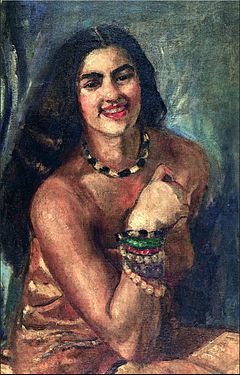
Self-portrait by Amrita Shergil. Courtesy: Creative Commons

Post-humanism and the Anthropocene epoch have undermined the notion of human exceptionalism, the feeling that as a group or a species, human beings are superior to other species. It is time to interrogate the hierarchy of human/animal where we understand the category of the human as undoubtedly superior. One view is to see the human as a posthumous category, not just post-human. Most civilisations and philosophies across the world have privileged one set of values/qualities at the cost of another-thus categories like human-animal, man-woman, reason-passion, good-bad have become binaries where one term is considered better than the other. 

It is in this context that I turn to Catherine MacKinnon’s work, Are Women Human? (2006). In her book, she poses the question of women’s relationship to the category of the human. 

After almost a century from the Universal Declaration of Human Rights, which defined what a human being is and is entitled to, Catharine A MacKinnon asks: ‘Are women human yet?’ If women were regarded as human, would they be subjected to the privations and oppressive practices perpetrated in cultures? Would they, for instance, be sold into slavery and sexual slavery worldwide; would they be “veiled, silenced, and imprisoned in homes; bred, and worked as menials for little or no pay; stoned for sex outside marriage or burned within it; mutilated genitally, impoverished economically, and mired in illiteracy–all as a matter of course and without effective recourse?”

In the wake of recent events which have once again highlighted the scant regard in which women are held across nations and in societies, it is instructive to revisit the fundamental questions posed by Mc Kinnon. The Nirbhaya, Asifa, Unnao, Priyanka Reddy, Hathras  cases in India, events that unfolded recently in Afghanistan and innumerable instances the world over, are traumatic and traumatising as they are instances where violence has been unleashed, consciously and deliberately, on women, children and whole communities. These significant  events can be called ‘critical’ since they raise some crucial questions on the category and definition of the notion of the ‘human’ itself.

The category of the ‘human’, as Yuval Noah Harari and many before him discussed, became associated, in terms of evolutionary biology, with a large brain, an upright gait and other specific characteristics. Whatever its genealogies in scientific or anthropological parlance, the word acquired a specific set or cluster of meanings. The notion of ‘human’ gets associated with a set of inalienable rights(as in human rights), a set or cluster of affect/s such as kindness, compassion and sympathy/empathy. And yet, this is a term we revisit time and again, at important historical conjunctures. Sadly it is a term which emerges more in the breach than the observance. Further, it is one that seems to be taxonomically problematic and perplexing and  shores up the category in a peculiarly  exclusionary way. To substantiate and cite an instance, inter alia, were the Jews admitted in the category of the human by the Germans, the Dalits by upper castes and women by men? The problem here is not just of ‘othering’ but the fact that the persistence of asymmetric power relationships robs one group of a sense of agency and the power to name themselves and their experience. The other group, which calls the shots on how humanity is to be defined, becomes blind to its own oppressive behaviour, perpetuates atrocities and is condemned by posterity. It becomes a case where, in a manner of speaking, all of us are human but some are obviously more human than others. Thus the  suspicion that peppers our mind when we come across liberal terms like ‘equality’ and ‘freedom’ also extends to the ‘human.’   

Working with issues that are sited on the cusp of law and culture and that are a vital aspect of transnational feminism affecting the  status of women, McKinnon in her essays  takes her gendered critique of the state to the international plane. Her book/essays is/are a trenchant critique of the inequalities of international politics, which turns a blind eye to the consequences and significance of the systematic maltreatment of women and its condoning by a skewed system. Her sharp critique points toward fresh ways—social, legal, and political—of  “targeting its toxic orthodoxies”.

McKinnon takes us inside the workings of nation-states, where the oppression of women is the common factor that defines community life and distributes power in society and government. She takes us to Bosnia-Herzogovina for a harrowing look at how the wholesale rape and murder of women and girls there was an act of genocide, not a side effect of war. She takes us into the heart of the international law of conflict to ask—and reveal—why the international community can rally against terrorists’ violence, but not against violence done to women. A critique of the transnational status quo that also envisions the transforming possibilities of human rights, this  book makes us look as never before at an ongoing war too long undeclared, unspoken and relegated to silence..  

It is important to recover voices like that of McKinnon since the self-appointed  custodians of the ‘human’ are more often than not dyed-in-the-wool liberals, paternalists, self-appointed purveyors of law and morality. Most of them are so entitled that they are entirely blind to their own privilege as they declare themselves to be the champions of human rights, having practised and perpetuated the wrongs that need to be set right.

As we ‘celebrate’ the month of the Woman in March, we need to revisit these questions which have gained a new urgency in our time. Only then can we perhaps understand the full implications of the human and work towards making it a truly inclusive category.

.

  Dr Meenakshi Malhotra is Associate Professor of English Literature at Hansraj College, University of Delhi, and has been involved in teaching and curriculum development in several universities. She has edited two books on Women and Lifewriting, Representing the Self and Claiming the I, in addition  to numerous published articles on gender, literature and feminist theory.       

.

PLEASE NOTE: ARTICLES CAN ONLY BE REPRODUCED IN OTHER SITES WITH DUE ACKNOWLEDGEMENT TO BORDERLESS JOURNAL

Categories
Editorial

In Search of Human Excellence

Good morning world! 

Borderless Journal today completes three full months of its virtual existence and will take a plunge towards a refreshed image. We hope to be a monthly from now on to serve you better, to do more justice to our submissions which continue to be overwhelming in numbers.

Meanwhile, in our pages, we have tried to connect mankind with ideas and thoughts that move away from borders drawn to divide humans — we want a world that transcends race, colour, creed or nationality. The only thing we look for is connectivity and coherence. We want to see the best in humans, what makes us strong and what carries us forward into a world that is not fragmented by fears, anger, hatred and marginalised thoughts.

Marginalisation also creates borders because there are humans within the border who for some reason are seen as different from humans without the border. I am not thinking of equality but of equity, where we can all feel we have been treated with justice. 

These few months we had writing not just on COVID 19, lockdowns, quarantines and opening of lockdowns, but also stories of major natural calamities like the Amphan, race riots like that of Floyd’s and more. Perhaps, the latest riots in America, will make us all realise that in every country, every culture, we have our own Floyds. And to acknowledge that we are of the same flesh and blood as the marginalised or underprivileged masses is a mammoth task for all mankind. We need to rise above things that divide and fill the world with love, kindness and tolerance.

Mark Twain in A Connecticut Yankee in King Arthur’s Court (1889) has the protagonist who travels back in time to Camelot observe prisoners from the underprivileged masses waiting to be sentenced and he thinks:” …they are white Indians.” Indians, meaning the Red Indians who had their housing and way of life shrunk into reserves in the same year in Minnesota the book was published — 1889. In 1887, their land had been taken away by the Dawes Act signed by the US President Cleveland. Was it just — taking away the land in which they had lived for centuries? Was it just to hate someone for having a different culture or a different way of life anywhere in the world at any point in history? Was it just to have slaves? Was it just to kill Floyd? Was it just to kill in the name of creed, or on the basis of what people eat? Was it just to give people no work, no food and no transport and have them walk till they dropped dead?

To me, all these are Floyds of the modern-day world, people killed in mob violence or for following different food habits, lifestyles, cultures or beliefs. History speaks only the truth. It is heartless and as Churchill said, “History is written by the victors.” And the victors to perpetrate their hegemony, create margins for those they dominate — the ruled become the marginalised and non-marginalised as that makes it easy for power brokers to fan differences to maintain their own strength. In the colonial period, they called it divide and rule.

Toni Morrison, another lady with a great deal of wisdom, said in an interview, “Race is a construct, a social construct.” History, Yuval Noah Harari, and more have shown this assertion by Morrison to be a fact. All of these are man-made constructs. 

I have a very basic question: if we can accept the different colours in nature, why can we not find it in our hearts to accept differences not only of skin colour but of beliefs, of creeds and of food habits?  These are questions that Borderless seeks to explore, to find the weaves that connect mankind to help move towards a richer tapestry of humanity. This is just the start of the journey and we can all make it together.

Sara’s Selections in the loving nurture of Bookosmia hopes to integrate these larger values into the younger generation. 

Let us all lead by example with exemplary writing, with exemplary choice of subjects and with exemplary writing skills. We are open to comments and feedback by readers who are as necessary to the existence of writers and journals as air to breathe and live.

Welcome to an exploration of a world beyond borders! 

Mitali Chakravarty

Founding Editor,

Borderless Journal

Categories
Musings

The Dawning of a New Era

By Mitali Chakravarty

More than a century ago Tagore wrote a song:

Kothao amar hariye java nei mana, mone, mone

Translated it stands, I can get lost anywhere within the infinite of my mind (imagination).

Time has come that we put his suggestion to test.

Though we are all torn by the isolation that battling COVID-19 demands, we still have a huge thing which we did not in the past, a thing that helps us all connect — the internet. While the educated stay connected, using social media and email, there will be many under isolation who will not have the skill sets to reach out, either due to lack of internet or due to the inability to write. There are countries like Singapore, where this is not an issue — but there is still a large population out there who cannot connect, who will be told by their community leaders that they need to remain isolated. Will that be a possibility? What about the homeless? What about those who do not have a clean potable water supply? What happens to them?

One thing that the tiny virus, which we cannot see with our naked eyes, has taught us is that mankind in its suffering cannot be bordered by economic, religious, cultural or political boundaries. As we all stand, in isolation, willing or unwilling to take up cudgels against a virus that has forced us to disturb, break and destroy the tenor of our lives, perhaps the time has come to assess our blessings.

Today, the fact that you are reading this means you are connecting with the internet and can read. You are connecting with my ideas, with my thoughts. We belong to the privileged few who can soar with internet and our imaginations. We have a home and hearth. We are educated and have enough to eat. We can afford to be kind and merciful to others.

The factory smoke has largely got silenced — even if temporarily. That means the air is getting cleaner. I can see more birds fly in the sky, bluer skies and hear bird calls. Perhaps, the Earth will stretch out in languor and awake from COVID19, a healthier and greener planet.

As I see the visa exempt, borderless virus roam the world, I am reminded of  Sir Arthur Conan Doyle’s novel, The Poison Belt (1913), where the whole of mankind loses a day as our planet passes through Ether, and then wakes up as the Earth emerges out of the sleep inducing belt of the ‘poisonous’ gas. Will such a thing happen? Will we wake up and see the corona disappear one day?

Probably not, given that we have already diagnosed the virus. But, when you think of it, mankind has been through so many pandemics and has continued to thrive.

Perhaps, the tiny virus has taken on more than it can digest. Each time, mankind emerged a winner, they had a better life. After the Great Plague that wracked Europe from 1348-1350, came a jubilant Renaissance with Leonardo Da Vinci, Botticelli, Michelangelo, Christopher Columbus and Galileo Galilei celebrating the wealth of human development.

Then there was small pox, which was introduced among Native Indians and Mexicans in the fifteenth century by Conquistadors, and was completely eradicated after two centuries; cholera, which continues to assail some countries and many more such diseases. Mankind battled these and emerged victor into a better equipped world.  

This time, the pandemic is more widespread because we are living in a more connected planet. Is that such a bad thing? We do not really want to live like the hermaphrodite humans in Isaac Asimov’s Solaria, where mankind is served by robots alone on a solitary planet and they never meet other humans. But a temporary and intelligent isolation can teach the little virus that for all its virulence, it cannot destroy mankind. This is just a temporary measure, a temporary gesture to help mankind move into a better world. We will have to reorganise our way of life, our tenor of existence. Given the climate, economic and political issues our planet faces, this may not be such a bad thing!

After all, twentieth century guru, Yuval Noah Harari in his recent article in Financial Times, concludes: “Humanity needs to make a choice. Will we travel down the route of disunity, or will we adopt the path of global solidarity? If we choose disunity, this will not only prolong the crisis, but will probably result in even worse catastrophes in the future. If we choose global solidarity, it will be a victory not only against the coronavirus, but against all future epidemics and crises that might assail humankind in the 21st century.”

And I would like to agree with Harari as he says with conviction: “Yes, the storm will pass, humankind will survive, most of us will still be alive — but we will inhabit a different world.”

Let us look forward to the dawning of that new world.

Mitali Chakravarty is a writer and the founding editor of borderlessjournal.com.