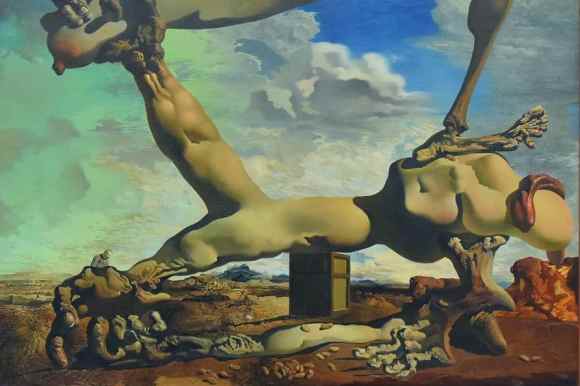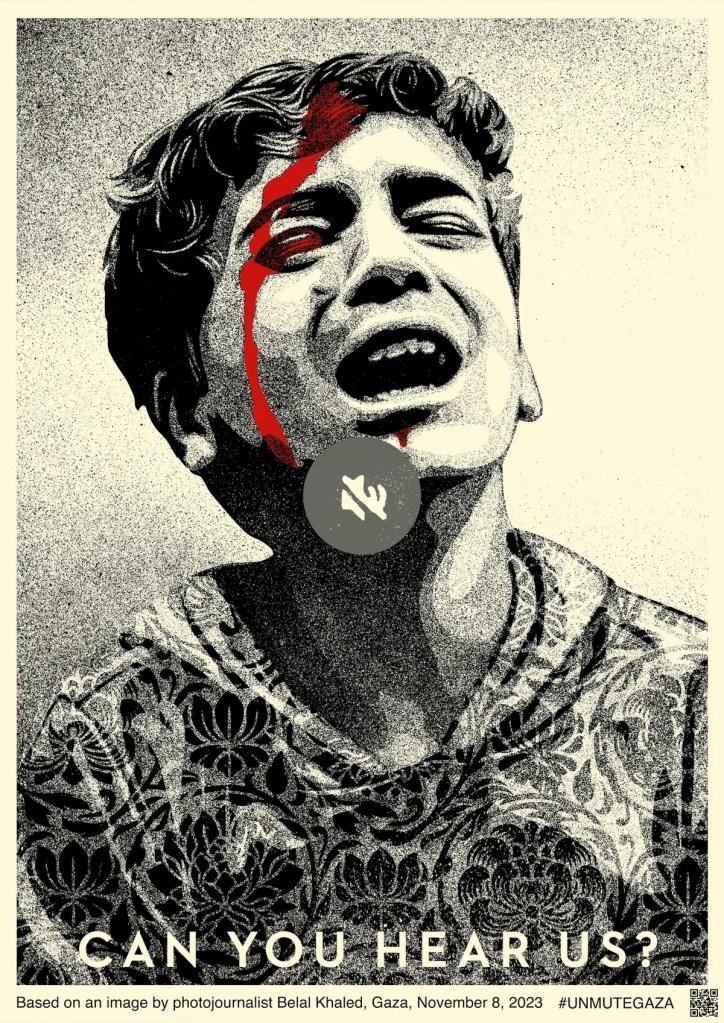
Art by Salvador Dali(1904-1989) From Public Domain
BEHIND BARS
I write about what I see…
If you don’t want me to see it Close the TV channels down
I write about what I see…
If you don’t want me to scroll up and down Close the internet down
I write about what I hear…
If you don’t want me to listen Put all the people behind bars
Though I fear, the truth May slip through the cracks
COME BACK THE COUNTRY I LOVE
Come back the country I love Come back and put Food on my table
Come back and bring me Peace and Love
No one is excluded and I belong here again
Not trembling over words Or the bang at the door
It is you who don’t belong here anymore
Come back Come back the country I love
THIS IS HAPPENING
This is not happening This you can’t see The prison cells are filling Whilst you digest the lies on TV
This is not happening This you can’t see
You play deaf dumb and blind Until you see
This is happening This you can see Your brother your mother your father Taken away Live on TV
CHEERING YOUR GENOCIDE
Every time I let the tap run, I feel guilty Every time I fill my belly, I turn away from the screen Every time the key clicks to my door, I can open and walk around But you and yours are raised to the ground, No guilt from those who cheer on your genocide.
DEAD SOUL
There is no limit Because babies are still born And each by being alive is dead
The last straw a family of nine wiped off this earth
But there are fields and fields of such dead souls.
SOMEONE IS KILLED
Everyday someone is Killed on your street. . . No one says or does anything to help . . .
It’s not your street. . . But everyday someone is killed on a Gaza Street A human being just like you and me.
David R Mellor is from Liverpool, England. He spent his late teens homeless on Merseyside. He is currently writing and performing in Turkey. His work has been featured by the BBC and the Tate, and his published collections of poetry are What a Catch (2012, Some Body (2014), Express Nothing (2019) and So This Is It (2020). His collection of stories An Englishman in Turkey (Turkiye’De Bir Ingililiz) has recently been published .
.
PLEASE NOTE: ARTICLES CAN ONLY BE REPRODUCED IN OTHER SITES WITH DUE ACKNOWLEDGEMENT TO BORDERLESS JOURNAL
Nico hurried off the steamer at Burgaz Island, oblivious of the swarming passengers disembarking and embarking. How long had it been since he had stepped foot on the island of his grandfather’s birth: twelve … thirteen years ? He made a bee-line for the central plaza. There he still stood, Saït Faïk, ever so thoughtful, leaning against that eternal tree. Nico approached the Turkish poet –Grandpa would have been so delighted to be here with us again. I’m sure he would have asked you about the talking seaweed and weeping mussels, Nico mused.
Vasiliki had passed away six years ago, a natural death, probably in his sleep. The old fisherman had asked Nico to have him buried between his wife, Nefeli, and daughter, Myrto, which he dutifully accomplished. Since the adolescent was the sole inheritor, he sold his grandfather’s little house for a good price, which permitted him to live comfortably in Athens while completing his university studies. Indeed, because he was parentless, and because his grades in grammar school were excellent, Nico had qualified for a scholarship. The ambitious student, thus, enjoyed financial ease to continue studying several more years for his doctorate. He excelled in Greek language and literature, French and English philology, in European History. At nights he read and spoke Turkish with several Turkish friends, for the vision of returning to Burgaz stole upon him like those perfumed nights on Burgaz with his grandfather as they contemplated the star-studded sky. That seemed so long ago …
Once his doctoral thesis defended, Nico left Greece and set off for Burgaz, off on an adventure. Poetry had been a major part of his thesis, and he had written quite a few poems, contributing to the university Literary Club’s weekly journal. Some of his poems and short stories caught the eye of an editor in Athens who had them published in a widespread monthly magazine. Soon he was invited to poetry readings and story-telling jousts, and because of these eventful evenings his circle of readers widened like concentric ripples in a pool of water after a rock had been thrown in …
The young poet left Athens not knowing exactly what Destiny held for him … nor what drove him so powerfully to return to the island. Was it because of his love for his grandfather ? His fascination for Saït Faïk? Or both? Saïk’s provided him with inexhaustible inspiration. Perhaps, too, it was the mystery of Burgaz of which his grandfather had so oftentimes spoke. Yes. It might have been that.
The horse-drawn carriage pulled up in front of the long flight of stairs to Zorba’s ‘humble’ home. Nico paid and began to ascend the worn-out mossy steps. Nothing had changed as the fretted gable slowly loomed in front of him. The perfumed scent of azaleas, roses, honeysuckles and pomegranate stirred distant memories. He had written to Zorba about his project to spend some time on Burgaz, and the good merchant, although away for several months in the United States on business, insisted that the young poet stay as long as he wished in his ‘humble’ home. He would be greeted and well-fed by his trusty maid, Zelda.
On hearing carriage bells Zelda rushed out, waiting for the ascending Nico arms akimbo. He dropped his knapsack, shoulder-bag and hugged the good woman. Speaking Greek had been her wont when Nico accompanied his grandfather years ago, but now, since the young man had decided to sojourn in Burgaz, she spoke to him in Turkish. Zelda was pleasantly surprised to hear him reply quite readily in Turkish. In fact, Zelda would prove an excellent tutor for Nico. Her grammar was excellent and her accent easy to understand.
So, after a solid diner, exhausted after a long day of travelling, Nico once again trudged up the steps of the floating stairway, the tinkling sound of the fountain below tickling his ears, opened the door to the room he knew so well with its frescoed ceiling of Greek heroes and large bay window looking out upon the darkened forests and the Marmara Sea. He washed and before drifting off to sleep, read a few chapters from Homer’s Odeyssus, which he always carried with him when ‘on the road’, and several paragraphs from Saït Faïk’s Son Kuşlar (Last Birds), underlining the words he couldn’t understand.
Up early the next morning, Zelda had prepared a breakfast of black olives, goat’s cheese, hard-boiled eggs, bread, butter, rose jam and black tea. She had gone to the local market (it was Tuesday) and would not be back before eleven.
Dressed lightly — the weather was very warm, Nico sauntered down the same long and winding path through the wooded slope that led to the stony beach, hoping Abi Din Bey would still be serving grilled-cheese sandwiches, and spouting poetry for his customers. How the brisk island breeze of the sea swept away the cobs of lingering doubt in Nico’s mind as he descended — doubts that had tortured him because his grandfather would no longer be at his side, physically. Yet, when he stepped upon the beach these doubts evaporated. Vasiliki was there and would always be there. He spotted several fishing boats out at sea. Had Nico built a new boat with the help of his grandfather? Indeed he had. It was the biggest and most beautiful of all his boats! Much bigger than the Nefeli which was still in route towards China. But this wonderful boat would not be launched into the leaden seas: it lay housed in a small museum in Hydra where it can be admired by both the young and the old. In fact, Nico even won an award for that marvellous construction. He had named her Myrto in memory of his grandfather’s daughter. The tombstone engraver, on Nico’s behest, carved the silhouette of his boat on Vasiliki’s gravestone.
Abi Din Bey’s welcoming gate had been sealed! The homely front gardens lay desolate, the trees devoid of fruit, clusters of weed and couch grass grew wild. The poet’s house, albeit perfectly intact, exhaled an odour of negligence. Nico stared at this bleak scene, his heart growing heavy. It had never occurred to him that Abi Din Bey would not come rushing out to greet him. That this solitary man was mortal like all other human beings … like his grandfather. He felt like a child who believes his or her parents immortal out of love for them.
From behind a middle-aged man walked up to him: “Abi Din died about ten or eleven years ago,” he began in a soft voice in broken Turkish. “He has no inheritors, so his house stands derelict and abandoned.”
Nico, snapped out of his despondency, eyed the stranger with mixed emotions. “What of his poetry?”
“Abi Din’s life of a poet held absolutely no interest for most who prefer to live in a cloud of unknowing. Abi Din Bey wrote some excellent poems, but alas no one had ears to listen to them.”
“We listened to them,” remonstrated Nico, though rather lamely.
“I know you did, you and your grandfather, Vasiliki.”
Nico reeled back as if struck by a blow. “How do you know … Who are you?”
“Oh, who I am makes no difference to anyone. But if you insist. I am the pilgrim of the heart, I voyage throughout the world admiring its marvels, an idler preaching the blessings of uselessness. Abi Din was one of those marvels, one of those brilliantly elevated idlers.” With those words, the stranger turned to leave.
Nico caught him by an arm: “Sir, where is the old man who piled up stones on the beach ? I haven’t seen him.”
“Nor will you ever see him again. Gone too, and some say that he recited several passages from Saït Faïk’s Son Kuşlar on his dying breath. Have you read Saït Faïk?”
Overcome by all these converging threads of some hidden or latent fabric beyond his grasp or comprehension, Nico could only stutter: “Well … yes … in fact…”
The other interrupted: “Listen, if you want to pay respects towards Abi Din and Saït, you should buy his house. It’s not very expensive.”
“But you …” The unnamed pilgrim put up a hand.
“I have no possessions. That is my first life principle. I idle my way through countries, people and books like a phantom. You buy it, my friend. Buy it before either Time brings about its ruin or the Burgaz municipality its demolition. For now, there are no plans to do either. It’s a mystery why that quaint house has not caught the eye of some eager artist.” And he gave Nico a wink.
“Mystery?” A sudden bout of remorse paralysed Nico. Had his grandfather not spoken of a mystery on Burgaz?
“Yes, mystery! Isn’t that why you’ve returned?” With that last question left unanswered by a flummoxed Nico, the pilgrim strolled away along the beach, chanting some sea-faring tune.
When Nico came to his senses he literally jumped for joy. he would buy Abi Din’s house, settle on Burgaz and pursue his artistic life simply, wholeheartedly. He could become a resident of Turkey merely by depositing enough money in the Osmanlı Bankası[1]. The anonymous figure of the pilgrim had since vanished into a haze of blue. Nico ran up the winding path to Zorba’s home, where Zelda had been preparing lunch. Excitedly he explained his project. She thought it a smashing idea, and promised to help him with the paper work. They ate, had their coffee, and at two o’clock walked to the crossroads, hailed a carriage and rode to the Town Hall, a majestic, white-washed villa near the centre of town.
On the way, Nico asked Zelda whether or not she knew of a middle-aged man who walked about the island, idling his way here and there. Zelda giggled: “Oh yes, him. The Turks call him Mister başı boş[2]and the Greeks tempelis[3].”
“But he’s far from empty-headed,” remonstrated Nico.
“I’m sure he isn’t, that’s why I call him ‘aylak‘.”
“I don’t know the word.”
“Someone who idles about without any definite destination.” Nico nodded, puzzled none the less at these attributes of a person who seemed quite ‘full-headed’ to him …
The irksome formalities to purchase Abi Din’s house would fill a book. Suffice it to report that in two weeks the house belonged to Nico, once he had deposited enough money in the bank, and of course, bought the house in cash …
Although Nico now spent most of his time in his acquired house, he always ate lunch with Zelda at Zorba’s house, and sometimes dinner. It must be recorded here that Nico was better versed in writing stories than in culinary skills.
Every morning after breakfasting, Nico would roam the hilltops of Burgaz sauntering cheerfully along the dirt paths, jotting down in his little notebook details that caught his eye or thoughts that scudded across his mind. The island air intoxicated him as he conjured up characters and events for future stories or poems.
On Sundays, Nico would attend services at St John’s Greek cathedral, there mingling with the small community members who had taken a liking to this young man, calling him their ‘island writer’! He became a novelty for the islanders, who invited him dine or to read his creations. Meanwhile, several of Nico’s short stories and poems were being published in Athens by his editor and were read by the Greek community in Burgaz. Nico even attempted to write poems and stories in Turkish which Zelda not only corrected, but suggested a more fitting word or subtle syntax structure.
Once a month, Nico took the steamer to Heybeliada, or in Greek, Chalki[4], the third of the four Princess Islands where he was fortunate enough to consult the books at the library of the massive Greek Theological Centre, opened in 1844 for seminarists but closed by the Turkish authorities in 1971. Although prohibited, Nico’s reputation, which had spread to all the islands, allowed him to study at the library, the second largest religious library in the western world, several million tomes behind the Vatican’s. The young artist even managed to work two days a week there. How he managed that remains a mystery.
Once or twice a month, accompanied by Zelda, Nico would go to Büyükada (Big Island) called ‘Prinkipo’ in Greek because it is the largest island of the four, and stroll along a tarred road to contemplate the largest wooden building in Europe, a former Greek orphanage, built by the French in 1898. The Greeks bought it and children who had lost their parents were lodged here until its forced closing in 1964. This eerie-looking structure remained intact. Surrounded by high barb-wire fencing and guarded by savage dogs, no one could enter it. Every time Nico stood before this ominous edifice, he thought of his grandfather who had salvaged him from such a parentless fate. Perhaps, the children here were well taken care of…
One day as Nico sauntered along one of the myriad paths in the wooded hills of Burgaz he came face to face with the idling pilgrim. So delighted was Nico to meet this eccentric character that he began to pour out all the good news that had occurred to him since their last encounter many months ago. The other smiled kindly: “No need to repeat what many have already told me,” he stated indifferently. “Nothing on Burgaz goes unnoticed, especially novelties such as yourself. I wouldn’t want to puff up your pride, but some have considered you as a new Saït Faïk.”
Nico stared at the pilgrim disconcertedly. “I can assure you, my dear friend, that you have made quite a reputation for yourself on Burgaz. And who knows, you may be able to solve the mystery of which your grandfather so often spoke.” Baffled, Nico remained speechless. The other took his arm and they strolled together downwards into the sinking sun.
Nico could not contain his surprise: “How could you know about …”
“About Vasiliki’s mystery? Ah, that would entail hours of explanation, Nico. For now let us discuss your writings, for the intention behind those writings may have given you the key to unlock the mystery.”
The pilgrim paused sniffing the pine- and spruce-scented air. “You know, many writers have lost touch with reality, or have been completely overwhelmed by it. They seem incapable of telling a story, transmitting the joys and sorrows of their characters whose traits lie deep in their own hearts, imprisoned like birds in a cage, fluttering frantically, unable to express the Truth of what lies beneath the masks and costumes. Saït Faïk, Edgar Poe, Dino Buzzati[5], Guy de Maupassant[6], Somerset Maugham, Katherine Mansfield all drew their inspiration from fragments of a separate reality, the glints of a deflected flood of light, the shards of a broken vase to disclose the experiences of their characters, to bestow upon their readers the amalgamated emotions that flew freely from their hearts. Their stories and poems are not talk-of-the-day productions. They were derived from the unlocking of the cage, the flight outwards into the battlefield between joy and sorrow. You would think that their eyes were turned both inwards and outwards at the same time. There is something powerful, even sacred, if I may use that word, in their narrated experiences, which does not necessarily entail the use of I, nor does it insinuate a ‘message’ to be harnassed or brought into line by the opinionated or bigoted. The syntax rhythms and word combinations expose the élan or the coming and going between the inward and the outward regard … I discern in your regard that inward and outward alternating vision, the aura that enhaloes your stories and poems. But mind you, this is only an idler’s perception.”
“What do you mean by aura?” Nico, crimsoning under the weight of so many complex compliments, managed to ask, almost out of breath.
“The halo of tradition that all sincere writing bears,” came the succinct reply. “A poem or a short-story, as in your case, bears an aura familiar to the reader, yet whose tale and expression of this tale transports him or her to strange, unfamiliar places. This is especially noticeable in your Turkish writings, an uncanny concoction of familiarity and eeriness. Perhaps it’s due to Zelda’s mixed origins.”
Nico stopped in his tracks, a blank look on his face. “Yes, Zelda, who, when we cross paths, addresses me as the ‘aylak‘. Her father was a remarkable writer and professor of philosophy in Greece and in Turkey. She inherited much of his wisdom as well as her mother’s strong character.” Nico stood stunned by this revelation.
“Zelda is only …”
“Only what, my friend ? Zorba’s maid or servant ? Ah ! I see you haven’t delved deep enough into the hearts of those who are very close to you. I’ve noted, too, that you have never written one line or verse about your deceased grandfather.”
Nico, stung to the quick by the very truth of that remark, bowed his head. He felt a surging wave of shame, and on this billowing wave rode an undulating image of a squealing seal that he and his grandfather had admired on their fishing adventure — an image gradually over-shadowed by another, more fuzzy, the stiffening body of a seagull on a pebbly shore near the mouth of a cavern.
The mild voice of his companion brought back these troubling scenes: “When all is said and done you will surely open wider the cage and let fly the encaged birds towards brighter poetic heights. Heights that perhaps you have yet to imagine.” With those comforting but enigmatic words the pilgrim turned to leave. He halted and asked: “Tell me, have you been to Granada?”
“Granada, Spain? No I haven’t, why?”
“You look like someone I met there.” The idler disappeared downwards into the crimson glint of sunset.
Nico ran back to Zorba’s house, undecided whether to speak to Zelda about her family. He never dreamed of broaching the subject to her as she herself had never bought up.
When the young writer had lumbered up those mossy steps he found Zelda seated on an armchair in the corner of the dining room, a shadow of gloom etched on her face. Her eyes were red. Wordlessly, she handed him a letter. It was written in faulty Greek, addressed to Zelda from an associate of Zorba’s in New York. A moment later Nico looked at Zelda with deep compassion. Zorba had died of a heart attack. His body would be sent to Burgaz for burial, accompanied by several of his associates who intended to buy his house.
“What will happen to me?” were Zelda’s first strained words. “I refuse to live in the same house with strangers even if they are Zorba’s associates.”
“Have you any family, Zelda? Anywhere to go? Anyone to help you financially?” She nodded in the negative to all these questions.
Nico sat down beside her: “Listen Zelda, come live with me, it’s a bit cramped, but at least you will have a roof over your head, food on the table, and a good friend who will always be at your side.”
Zelda dried her eyes and stared at Nico in embarrassment.
“I’m old enough to be your mother,” she said faintly.
“Exactly!” responded Nico excitedly. “You shall be the mother I hardly ever knew, in the same way that the presence of Abi Din in his house has been the father I hardly ever knew. How my grandfather would rejoice at that family reunion, however surreal, if I may say so.” Zelda smiled.
And with that acquiescing smile the two orphaned destinies appeared to converge into one …
[1] The biggest bank of Turkey at the time of Nico’s arrival specializing in international transactions. (Ottoman Bank).
Paul Mirabile is a retired professor of philology now living in France. He has published mostly academic works centred on philology, history, pedagogy and religion. He has also published stories of his travels throughout Asia, where he spent thirty years.
.
PLEASE NOTE: ARTICLES CAN ONLY BE REPRODUCED IN OTHER SITES WITH DUE ACKNOWLEDGEMENT TO BORDERLESS JOURNAL
Vasiliki and Nico boarded the passenger steamer for Burgaz Island at Sirkeçi pier at Istanbul. As the steamer moved out slowly from the crowded port, Nico gazed at the dreamy silhouette of this storiedcity where for four days they had woven in and out of lanes and alleys, gardens and markets, prayed in the Greek churches.
They had left Hydra six days ago by boat and bus, arriving in Istanbul after a night spent in Thessaloniki. Now they were off to Vasiliki’s island of birth. He had never been back since his departure at the age of twelve, and the thought of returning excited him. “Look grandpa at the setting sun over Topkapı Palace,” shouted an elated Nico. And indeed Nico’s elation was not feigned.
The cypress trees and domes of the mosques and minarets were outlined against a sky alive with streaks of reddish flames whose reflections could be discerned in the unruffled waters of the Marmara Sea. The crenelated walls of Topkapı Palace undulated eerily in the ruddy, pastel twilight as did the silhouettes of the many domed mosques that embossed the mighty palace with a pinkish tinge. Nico stood hypnotized at the stern imagining himself as part of one of the yarns of A Thousand and One Nights. A sensation of estrangement, of magical transport had arrested his movements. Suddenly a flock of seagulls descended screaming into the wake of the steamer, snatched as many fish as possible and flew off towards Galata Tower, which they circled and circled until vanishing in the evening shadows beyond the hilly banks of the Bosphorus Strait, the yalıs[1], Dolmabahçe[2] and Berlerbeyi Palace.
“A fairytale city, Nico.” Vasiliki said, interrupting his grandson’s spellbound state.
“Yes, grandpa. It looks like one of the coloured pages of my A Thousand and One Nights.”
Vasiliki chuckled. “Perhaps it is, my boy.” And they both contemplated that marvellous city until it, too, disappeared under the orb of the sea …
They disembarked two hours later …
“Burgaz ,” sighed Vasiliki, stepping foot on to the soil of his birth. He took Nico’s hand and hurried him from the throngs of the port into the quiet of the main plaza where the statue of Saït Faïk greeted them. “There he is, Nico, one of the finest poets and short-story writers of the Turkish language.” Nico moved closer :
“He looks very thoughtful, grandpa. What do you think he’s thinking about?”
“That’s a good question. But for now we have to get a horse-drawn carriage to Zorba’s home before nightfall.”
For some unknown reason Nico’s thoughts roamed back to his Nefteli. “Do you think the Nefteli lay anchor at this island on her voyage to China, grandpa?” Vasiliki knitted his brows.
“I’m not so sure. She would have taken a more westerly route.” Nico nodded, unable, however, to imagine his beautiful Nefteli never having moored at this beautiful island with such a famous poet standing so thoughtful in the middle of the plaza. Whilst the boy ruminated these thoughts, Vasiliki hailed a horse-drawn carriage, and in broken Turkish directed the driver to take them to Soknar Sokak [3]located on the western side of the island.
“You speak good Turkish, grandpa,” Nico commented.
“My parents spoke it at home, but when we left Burgaz to settle in Greece, they chose to speak more Greek than Turkish. The Greeks never took a liking to us Greeks who lived in Turkey.”
“Why?”
“Oh, that’s a long and sad story. I’m too happy to be here on Burgaz to tell you now.” So Nico was left unsatisfied. “My brother’s friend’s name is Zorba,” Vasiliki continued. “He’s in the textile business in Istanbul. He comes to Greece often. His wife died two years ago and now lives alone in a big villa on a hillside overlooking the sea. He’s very wealthy and in his spare time writes poetry.”
“Like Saït Faïk?” Vasiliki puckered his lips.
“No one can write poetry like someone else, Nico. If that happens, it’s like imitating a poet’s poems and you shouldn’t do that. Anyway, you’ll soon meet him. And you’ll also meet my father’s friend Abi Din Bey, a Turkish Alevite who lives down on the beach. He knew Saït very well. He writes poetry, too. I remember one of his verses: ‘I wished to smell a rose./It feigned reluctance./No, it said, bring my scent …’ Oh, I forgot the rest.”
“But why did the rose not want to be smelt?” asked Nico curiously.
“I have no idea, my boy. It’s only poetry. Besides, I’m a fisherman, I haven’t had much instruction on those things.” And on that unscented note, Nico espied a flock of seagulls chasing the early evening cloudlets galloping far off towards the East.
They arrived. Vasiliki paid the driver and up they climbed a long flight of wooden stairs through a well-kept garden of intoxicating scents. Above them loomed a massive sun-bleached white, wooden pillared portico, above which rose three-balconed stories, surmounted by two towering turrets in the middle of which spiralled even higher a fretted gable. Nico stood awestruck as if he had come upon one of Zeus’s palaces. A minute later a huge, flabby-faced, moustachioed man burst through the front portico door to greet them in broken Greek.
“Welcome! Welcome! Come into my humble home, please,” Zorba gesticulated theatrically, dragging both guests into his home, which in the eyes of his two guests was far from humble …
Dragged I say through the lofty portico whose colonnade must have counted over twenty Doric-like pillars, then into a vestibule at the end of which a floating double staircase wound breezily above a bubbling marble fountain then on to a cambered, U-shaped landing bedecked with azaleas, wisteria and dwarfish palm plants. Hanging on the walls of the vestibule and the cambered landing were landscape paintings and several stately portraits. Zorba immediately escorted them into a brightly lit drawing-room whose frescoed ceiling teemed with Greek heroes and from which a shone a gigantic chandelier. Deep velvet-red draperies afforded a nineteenth century posh atmosphere, an atmosphere of opulent repose. They were seated on a plush, baize-covered ottoman. Refreshments were hurried into the room by a maid, set delicately on a superb pearl-inlaid coffee-table.
“Welcome to Burgaz, Vasiliki and Nico,” Zorba beamed, delicately seeping a large glass of mango juice. “Where will be your first visit if I may ask?” Vasiliki set his mango juice down, licking his lips.
“To Abi Din Bey’s beach home,” replied Vasiliki.
Zorba frowned. “Rather a shabby place his cabin on the beach,” he retorted gruffly.
“Perhaps, but I must see him. You know, he was a very good friend to my father.”
“Yes … yes, of course,” grumbled Zorba, ostensibly displeased at the mention of the beach comber. “Whatever ! You are my guests here and may stay as long as you please.” He looked at Nico affectionately: “What a wonderful adventure for your grandson. To relive his grandfather’s and father’s past …”
“And who knows, Zorba … perhaps his future …”
Zorba, a bit puzzled by that remark, smiled a gold-toothed smile, nevertheless. The smile seemed to set his well-fed, pasty face aquiver.
“Excellent, Vasiliki. But now we must dine.” Zorba ushered his guests into the tapestry-hung adjoining dining room where a long table had been set with all the delicacies that Burgaz Island could offer : sumptuous mezes[4]: stuffed vine leaves, eggplant caviar, marinated red peppers, homus[5], followed by lentil soup, fish and köfte[6]. This gargantuan meal terminated with strawberry sorbet and künefe[7].Two hours laterVasiliki and Nico sat back in their red upholstered chairs utterly exhausted.
Refusing any liquor, Zorba showed his guests their enormous room on the first floor whose bay-window overlooked a dark stretch of forest which gradually merged with the slow-moving lights of the steamers and cargoes on the Marmara Sea. Vasiliki and Nico, after unpacking, fell asleep as soon as their heads touched the pillows.
They awoke at nine o’clock, washed and rushed down the elegant, floating staircase for a quick breakfast. They ate alone, Zorba having breakfasted very early in order to meet customers in Istanbul, so said the maid. They set out for Abi Din Bey’s beach home, a half-hour’s walk down a winding path through the wooded hillside.
The sound and smell of the sea below, the laughing seagulls above thrilled Nico with an unequivocal joy. He felt drawn into an adventure. Once on the beach, they veered to the right and in two or three minutes stood at the Alevite’s welcoming gate, open to all and sundry. Charging out of the front door of a flat-roofed, one-storey little house, a handsome, stalwart, balding man greeted them with so many handshakes and kisses on the cheeks. He led them inside his three-room home, built under an arching rock shelf, overhung with a thick network of running vines and bougainvillaea which dangled over the front walls of the house.
Nico was astonished at all the books strewn on the rug-covered floor or lying open on the arms of a worn-out sofa. A low, wooden table, where a tea-pot and glasses had been set, comprised the rest of Abi Din’s ‘drawing-room’ furniture. The walls lay bare of pictures and the two front pane less windows bore no curtains. One naked lightbulb hung limply from a rafter. Nico, seated on the sofa, stared at the bareness of Abi Din’s abode. He could not decide whether the poet lived in poverty or simplicity.
As if reading his thoughts, Abi Din Bey, who had since served them black tea, said in his deep, authoritative voice: “Simplicity remains the poet’s true companion. All he needs is the whistling of the wind, the lapping of the waves, the rustling of the leaves. The true poet touches reality with his or her ears more than the eyes before voicing that reality, poetically. But I will acknowledge that the poet opens his or her senses to the moon at night and to the horizon-filled fishermen tossing their nets at the edge of the briny sea in the day.”
“You have been afflicted with Saït Faïk’s poetic madness,” laughed Vasiliki, translating his friend’s words for Nico.
“Anyone who came into contact with Saït became a poet … good or bad I am not to judge ! Who else listened to the talking seaweed or the weeping mussels?” Vasiliki agreed with a nod then translated for his grandson.
“Grandpa, how can seaweed talk and mussels weep?”
“Well, poets can hear things that we cannot, Nico.”
After tea, Abi Din Bey led them out to his front garden where the fragrances of oleander and honeysuckle muddled Nico’s imagination, already running amok due to all this talk of weeping mussels and talking seaweed. Out beyond the wooden fence the glint of Marmara glowed turquoise.
Vasiliki and Abi Din Bey spoke of Vasiliki’s father and grandfather, of a time when Burgaz bathed in a mellow light of unruffled peace and perfumed tranquillity. “And now look — Istanbul’s ‘hippies’ camp on weekends in the forests and on the beaches littering, smoking and drinking. Tourists swarm the island as if it were la Côte d’Azure. If Saïk or your father were alive … “ Abi Din Bey would repeat … but would never finish …
Towards late afternoon after a pleasant nap in their host’s hammocks, Vasiliki and Nico left Abi Din Bey to his domestic chores to stroll along the beach, avoiding the vast wracks of seaweed. “Let’s walk up to the Monastery of the Transfiguration on Bayrak Tepe,” Vasiliki suggested. “It’s the highest spot on the island. The monastery was built in the XIXth century and has never changed, so my father told me. We can talk to the Pope and his wife, they’re Greek … well, Turkish Greek.”
“You said there’s a difference, grandpa.”
“You see, the Greeks who came from Turkey to settle in Greece were never really liked by the Greeks because of their way of speaking Greek and their Turkish customs.”
“Why?” the boy insisted. But at that moment they halted in their tracks. A shirtless and shoeless man was busy erecting little pyramidal piles of stones here and there on the beach. Before Nico could enquire about this curious occupation the man turned towards the sea, opened his muscular arms wide, and in an eerie, sing-song voice chanted:
“Women light the lamps of spirit with a blue light as they warm up coffee.
During the nights, in the darkness, on the peak of a mountain
a miller, his eyes closed,
sleeps, face down.
Villagers would come
To sell their copperware at the market,
To sell yogurt.
A naked child, begging in the street, was knee-deep in snow.
The man turned his back to the sea and resumed his Sisyphean labour …
“What did the man chant, grandpa?”
“A poem by Saït, I think. A sad poem. You know, the life of a fisherman is not easy, but the life of a poet is not to be romanticised. Outwardly life may seem merry and bright. But deep inside, Nico, a poet’s lot is not to be envied. Saït’s short stories and poetry are filled with solemnity. Zorba thinks he understands this solemnity. Abi Din Bey is less pretentious; he leads a simple, lonely life and reads Saït for comfort. This solemnity has offered him a gratifying livelihood. He liked Saït so much and sought his companionship. But Saïk chose alcohol for a companion. Abi Din is a religious man, he doesn’t drink alcohol. Alcohol should never be a poet’s companion.”
Nico said nothing as they trudged up Bayrak Tepe to the Greek monastery, where after tea and honey cakes with the pope and his wife, they hurriedly trekked down the opposite side of the island, keeping the sea to the right. Two hours later they reached Zorba’s hillside home before nightfall. The sky blazed a crimson red as the sun set under the waveless Marmara.
Dinner having finished, Zorba and Vasiliki were served wine in the drawing-room and Nico a glass of lemonade. Zorba, exceptionally cheerful after a fruitful day in Istanbul, stood, poured himself another glass of wine and recited a few verses of his poetry :
“Honey is certainly a special nourishment;
Is truly medicinal.
He who eats honey thinks soundly;
He who does not, thinks ignorantly.”
Zorba sat down absorbed in the silence of his guests. “How I try to imitate Saïk,” he sighed at length.
Zorba placed a pudgy hand to his heart: “Poets live to write and not write to live.”
Vasiliki agreed, heard the grandfather clock strike midnight, yawned and sleepily suggested that they be off to bed. Zorba acquiesced, promising a few more strophes the following night. A weary Vasiliki smiled perfunctorily …
Waking up with the larks, Vasiliki and Nico were served breakfast. Zorba had again left for Istanbul very early. The two tourists walked to the centre of town to visit Saint John the Baptist’s[9] church, then Saïk Faïk’s house-musuem and gardens. Saït’s former two-storey, balconeyed home rose into the blue island sky, the gable rising even higher than the palm trees that served as sentinels. The gardens were similar to Zorba’s — exceptionally well-kept. Inside, Nico was taken aback by the refined taste of the poet’s family: the exquisite, velvet cushioned chairs and sofas, the poet’s private library where many bookshelves contained poetry magazines, dictionaries and novels in Turkish, French and Greek. Nico surmised that the poet was a studious man.
“A very well-educated man,” whispered Vasiliki. “He translated too. His knowledge of languages inspired his short story and poetry writing.”
“Do you speak French, grandpa?”
“I’m afraid I don’t, my boy. You know, I’ve had little instruction. But you, Nico, look at those leather-bound volumes ; you may become a boat-building poet someday if you work hard at school.”
Nico’s little round eyes glowed a brilliant glow. How he loved to read, to touch the crispy pages of a book, to smell the print and paper. Spellbound by all this literature, he suddenly heard a fey voice :
The mysterious voice trailed off. Nico searched the room frantically for his grandfather. There he stood in front of a hanging portrait of Saït Faïk.
“Grandpa.”
“Yes, my boy.”
“I would like to be a poet.,” Nico asserted.
“A boat-building poet?”
“Yes, write poems and short stories like that man hanging on the wall. He has such a handsome face … a kind, smiling face. He must have been a gentleman.”
Vasiliki nodded. “I’ve no doubt he was. Those eyes speak the tremors of his soul, a soul filled with the love of life, all life : mineral, animal, vegetable, human.”
Nico screwed up his eyes which met those of Saït’s, a deep blue like the sea. Laughing eyes, like the seagulls’ … Five minutes later they stepped into the blazing Burgaz sun, white white …
The rest of the morning and afternoon was spent in Abi Din’s front garden, drinking tea, chatting about Burgaz fishermen. They ate grilled-cheese sandwiches and sardines for lunch.
The loquacious Abe Din turned to Nico: “A poet’s life has its highs and lows. It’s best to keep to the middle, no jealous rivals to spread scandal, no avaricious publishers to milk you like a cow. Thieves, all of them ! Just write poems, Nico. Don’t waste your energy on market reception, critic’s reviews or what publishers expect from you. Your poems speak for themselves. And do you know why ?”
Nico did not know why for two reasons: he couldn’t understand Turkish and he never wrote a poem. The animated man continued, nevertheless: “Because you organise the movement of the poem with your own voice, a poem is an activity not a product. Poems make poetry; poetry does not make poems. A poet has no regards for schools of poetry, for modes of poetry, for signs-of-the-time poetry. Writers of poetry express the signs of their times; writers of poems suggest images of untimely inspiration. Writers of poetry idolize poetic forms ; writers of poems organise their poems subjectively, free from poetic occult pedantry and cryptic complexity. Listen ! Listen to those outer and inner inspirations.”
Vasiliki translated his friend’s fiery tirade as best he could and when Nico had understood the ‘Listen! Listen!’ The obedient boy listened even harder. Abi Din Bey’s voice rose higher: “A poem is first heard in the heart then expressed by word of mouth or on paper. Open your ears wide, Nico, open them wide!” When those last words of wisdom were translated, Nico attempted to open his ears as wide as he could. It was not an easy task, much harder than opening his eyes wide …
When the sun began to set Vasiliki and Nico bid farewell to the poet, promising to return the following year. Little did they know that the solitary poet would pass from this world in the near future …
They spent four more nights as Zorba’s guests eating like kings, listening to their host’s business conquests and after-dinner poetry over a glass of wine or lemonade. They left Zorba on the long flight of steps, he waving good-bye with a pudgy hand as the horse-drawn carriage bounced his guests up and down towards Burgaz pier.
“Grandpa, I’m going to work hard at school and read Saït Faïk’s short-stories and poems.”
“We’ll find translations of them, Nico. I told you that Burgaz Island plays strange things on people who come here. Her soil inspires us. Her energy rises from the core of the earth into our hearts and spirits. Burgaz possesses a mystery that no one has ever solved.”
“Not even Saït Faïk, grandpa?” Vasiliki scratched his white beard.
“I have no answer to that one, my boy. Maybe he did solve it. Poems and stories were his livelihood, like my fishing, a daily labour of love and effort. Perhaps someday you’ll solve the mystery of Burgaz.”
“By boat-building and writing poems?” Vasiliki gazed up at the circling seagulls.
Nico was not sure. Meanwhile, ahead lay the pier and the steamer now steaming into port, smoke bellowing from her stack. Ropes had been thrown down to moor her as passengers straggled off and on. Grandfather and grandson rushed into the vortex of that rolling movement and disappeared within the bustling throngs …
[1] Wooden mansions or villas along the Bosphoros Strait.
[7] A sweet dessert made of angel hair, (kadaif), cheese, butter and topped off with honey sirop and crushed pistachios.
[8] Losely translated from ‘Bir Zamanlar’ ‘One Time’.
[9] Iohannas Prodromos in Greek. It was built in 1899.
[10] From Sait Faik’s poem ‘Masa’ ‘Table’, partially translated.
Paul Mirabile is a retired professor of philology now living in France. He has published mostly academic works centred on philology, history, pedagogy and religion. He has also published stories of his travels throughout Asia, where he spent thirty years.
.
PLEASE NOTE: ARTICLES CAN ONLY BE REPRODUCED IN OTHER SITES WITH DUE ACKNOWLEDGEMENT TO BORDERLESS JOURNAL
Going back to when I played here, running up the path mama mama kissing your sweet forehead
now motionless and cold
Dreaming of leaving
Not wishing to go But there is no one here, just the buzz Of the drone overhead And night falling in my soul
Leaving leaving Dreaming dreaming of leaving leaving leaving leaving…
David Mellor has been published and performed widely from the BBC, The Tate, galleries and pubs and everything in between. Now, resident in Turkey he has continued his literary career with his work appearing in journals including a weekly column in Canakkale Gündem about his observations of Turkish life. His poems and writings are autobiographical, others topical and several his take on life.
.
PLEASE NOTE: ARTICLES CAN ONLY BE REPRODUCED IN OTHER SITES WITH DUE ACKNOWLEDGEMENT TO BORDERLESS JOURNAL.
THERE
I’m not there
And neither are you
But we have all danced at festivals
Walked down the streets
Cooked food in our homes
I’m not there
And neither are they now…
LOVED
Death is
R
O
P
P
I
N
G
From the skies
L lies lifeless
O on
E V ery
Str E et
Death is
R
O
P
P
I
N
G
From the sky
Bodies mount up
1.500 here…
1.500 there…
L
O
V
E
Lies in ruins…
No one utters her name
JUST SOME BODY
(a child refugee)
I heard the shots, I did
And my siblings being dragged screaming
Out the door
My father ran, carrying me like a football
Up into the hills and miles away
Terror in his eyes, “Which way now?”
Into the truck, freezing at night
Dumped on the shore
There was no need to ask
“Are they coming too?”
As I knew…
They were no more
The boat with a hundred frightened faces came ashore,
We were taken to the airport and told…
“Get back home!”
My father desperately pleaded, but to no avail
We landed in Kabul
He was tortured and murdered
And I followed suit
David Mellor has been published and performed widely from the BBC, The Tate, galleries and pubs and everything in between. Now, resident in Turkey he has continued his literary career with his work appearing in journals including a weekly column in Canakkale Gündem about his observations of Turkish life. His poems and writings are autobiographical, others topical and several his take on life.
.
PLEASE NOTE: ARTICLES CAN ONLY BE REPRODUCED IN OTHER SITES WITH DUE ACKNOWLEDGEMENT TO BORDERLESS JOURNAL.
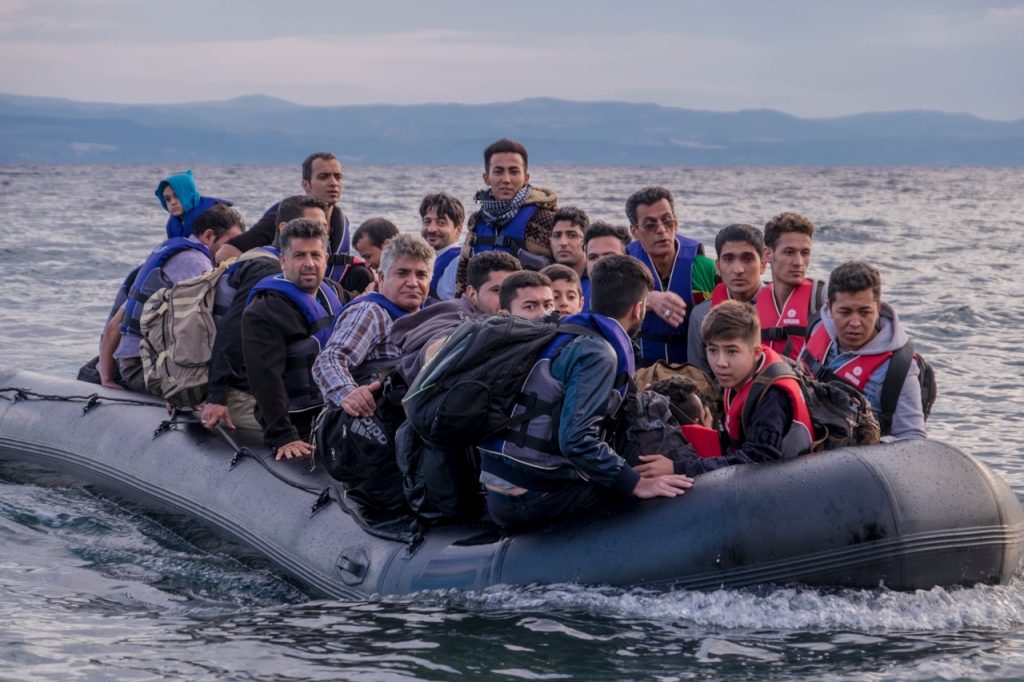
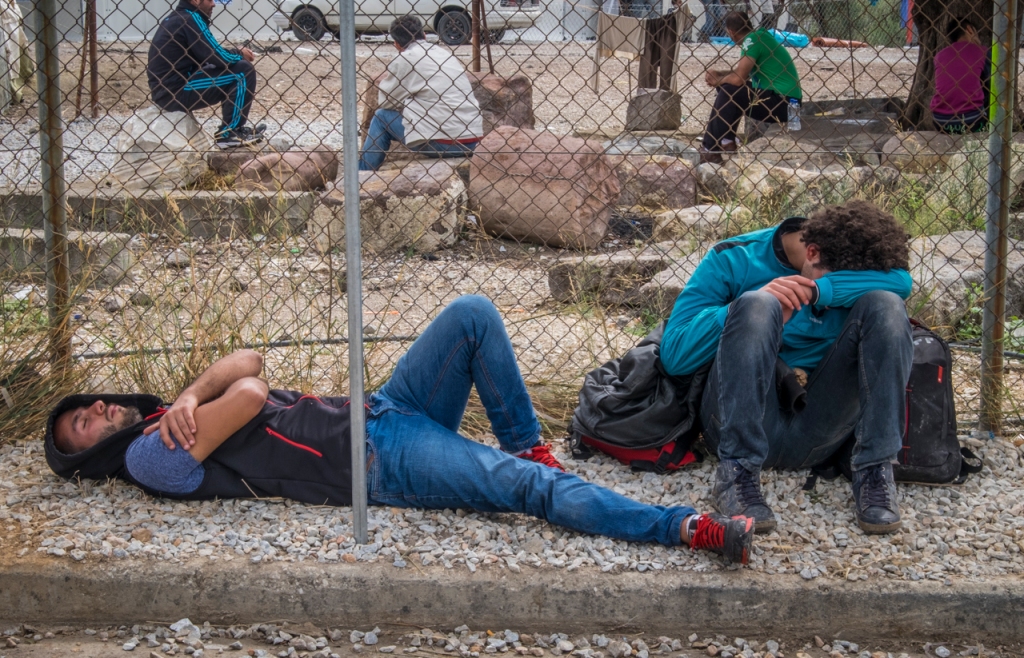
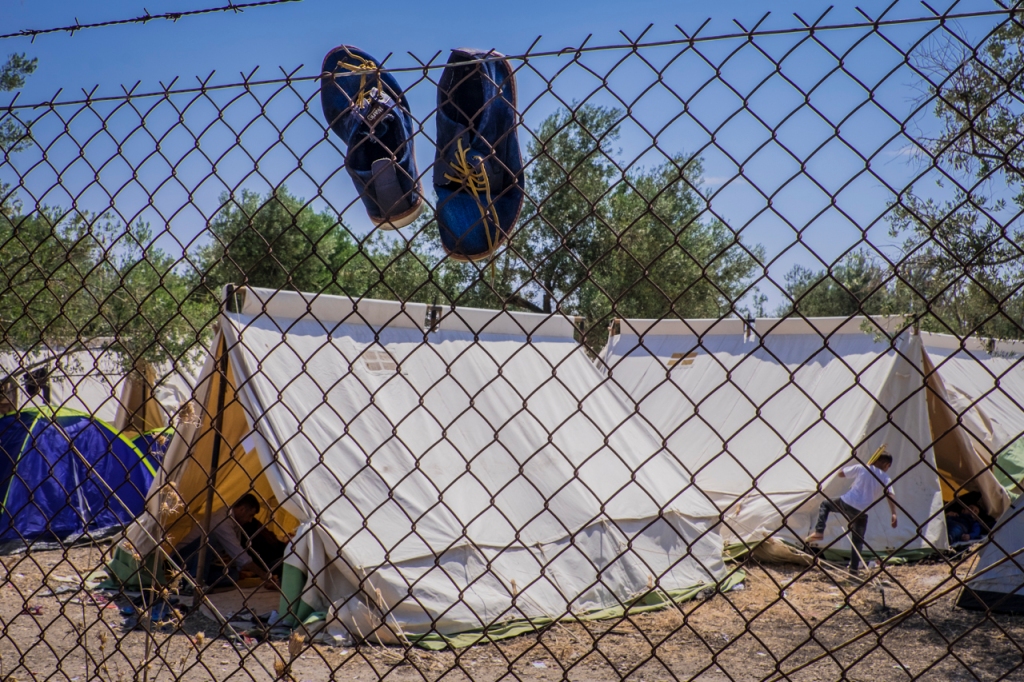
Refugees landing at Lesbos. Photographs by Michael Honegger
Memories of Lesbos, 2016.
Sunrise over the Mediterranean. The island’s hills brighten as the chug of boat engines can be heard over the lapping waves. These aren’t your typical Greek fishing boats returning from a night at sea, but a flotilla of black rafts, nine total carrying some 400 refugees to land on the north coast of Lesbos Island. Under five miles off the Turkish coast, Lesbos has become a beachhead for a flood of refugees that has come as unannounced as a tsunami, and for which local communities are even less prepared.
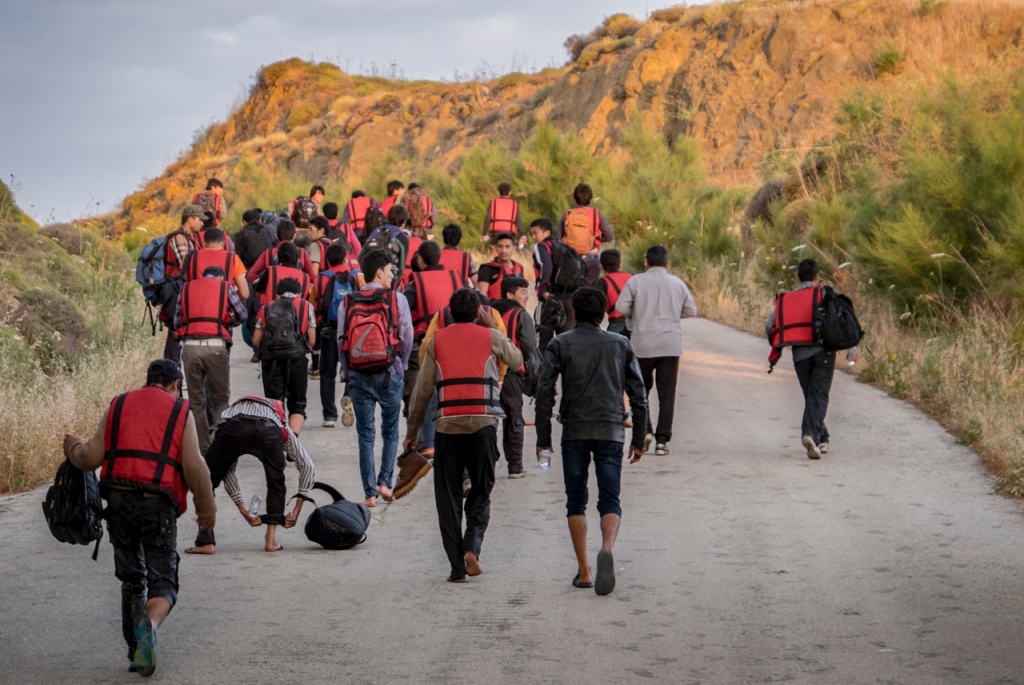
There has always been a trickle of refugees across the narrow channel. In the ten years that I have been coming here, every week I would find one or two rafts abandoned on the beach with ten or so life jackets or paddles. Until recently, most had been young men from Afghanistan and Iraq, escaping wars they didn’t want to fight, who would later be spotted on a road walking the forty miles or so to the island’s capital, Mytilini, to be processed and transferred to a camp in Athens. In the whole country, the number of such migrants has increased five-fold over the same period last year; but for the islands offshore Turkey, the numbers have risen far more dramatically. On Lesbos, the count has gone from a few dozen a month to over two thousand in one three-day period alone.
A surge in Taliban-led violence in Afghanistan, the rapid spread of the barbaric Islamic state in Iraq, and Syria’s devastating civil war have sent millions fleeing for their lives. Over half of the Syrian population has been displaced, and now accounts for half or more of the new arrivals. Often members of the middle class—teachers, IT specialists and engineers—more often Syrians come as families, forced to leave when their children’s school was bombed; or if from Aleppo, when their neighbourhood was razed. On the whole, Syrians have more money than others, but that doesn’t mean much when they have nothing else but the clothes they are wearing.
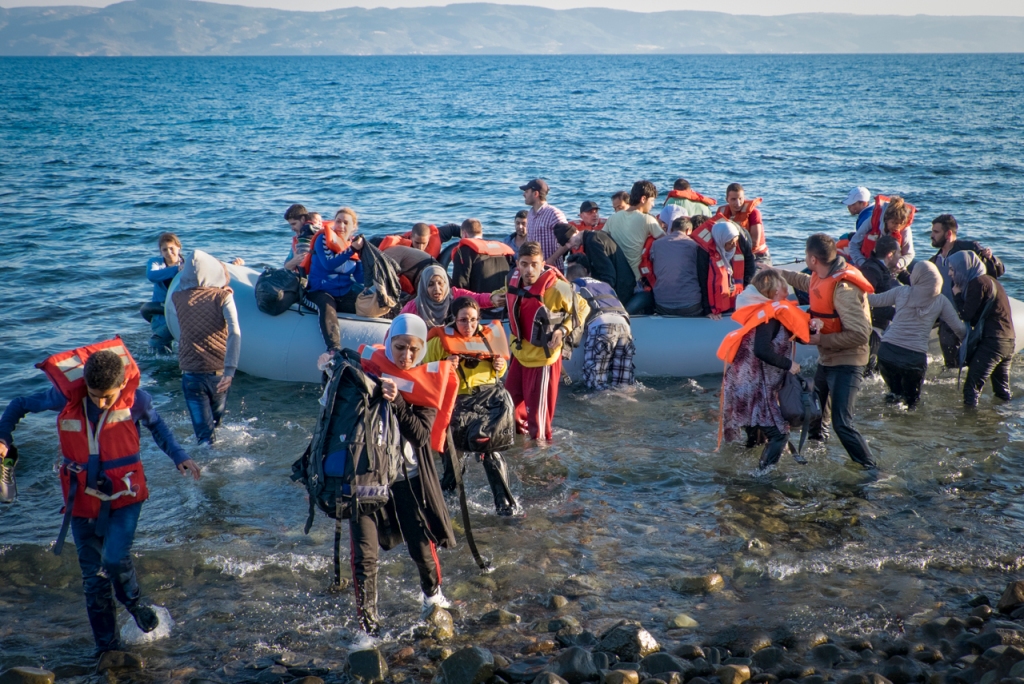
Refugees in Lesbos. Photographs by Michael Honegger
Some Afghani refugees have walked from as far as Kabul, taking weeks to hike over Iran’s mountains and cross the length of Turkey to its west coast. The odd Syrian has flown to Istanbul, and taken buses to where, even if he or she has money, still has to hide in forests, waiting for days until his turn for the ‘trafficker’ to bundle him aboard a rubber raft. With the craft’s captain (usually one of the refugees) given an hour of training, they are launched for Greece with nothing more precise nautically than a pointed finger.
It’s a harrowing journey for everyone, not the least because of the real risk of capsizing their overloaded rafts even in light seas—sometimes purposefully. The traffickers instruct them to slash their pontoons if the Greek Coast Guard approaches to keep from being turned back to Turkey, which inevitably tosses forty-some non-swimmers into the sea with a crew of only four frantically trying to save them. Ironically, the Coast Guard’s mission is not to turn them back, but to ensure their safe arrival.
Ahead of them, the journey will still be hard. They don’t know it yet. Their dream—their safety—is their first footstep in Europe. It’s only one step in a perilous journey that will take them to processing centers, overcrowded camps, and force them into the hands of other traffickers, more malevolent than anyone else they have met on their way, who, for extortionist prices, promise to get them to Germany or Austria—the current popular destinations.
That emotional first step on European soil can’t be overestimated. As their rafts slide ashore, it’s a celebration. The journey has ended and they have arrived safely. Regardless of their wariness of what’s next, they scramble ashore, some feeling the need to run a short distance from the water; but others, overcome with their first sense of security in years, weep, embrace each other, believing—rightfully—that they have made it to a better place. Certainly a safer one.
It’s different, too, from what they imagined. There is little officialdom at this northern point of the island. No police to register them, no information other than the latest rumours that their rescuers—sometimes the Coast Guard, sometimes local volunteers—can pass on. Frequently they don’t know where they landed, only that they need to register with the police to get in the long line to be processed.
Where are the police?
Seventy kilometers away.
Will there be a bus?
Maybe.
Maybe?
Probably not. But maybe. It changes daily.
What do we do?
Walk.
Walk? My wife is pregnant. My boy is three years old.
I’m sorry. Walk.
The rules, and the probability of a bus, change daily. It’s not because of some great inefficiency by Lesbos’ government, though the elimination a few years ago of village mayors to create a central authority in Mytilini has complicated providing services as essential as portable johns at the bus park where people are often stranded for several days. Earlier this week, that meant thirty persons crowded into a bus shelter on a chilly and rainy night; among them, eight children and five women—two of them pregnant.
While it was foreseeable that the Syrians would mass in camps just over the border in Turkey, it was far less predictable that they would become such a massive wave of refugees headed for the West. If someone saw it coming, that message never got to frontline Lesbos. It might not have mattered if it did. The country is bankrupt. Local officials can hardly provide basic services, let alone cope with an explosion of refugees. International NGOs haven’t caught up with the crisis either.
Local volunteers are making extraordinary efforts to meet the rafts on arrival, and ensure that they have food, water, clothing, shoes, and even Pampers because there are so many infants. Of course, not everyone agrees on what assistance, if any, should be provided.
Most refugees don’t plan to stay in Greece. Some will, of course, but the locals, seeing first-hand the dimension of what is happening, are starting to ask the bigger picture questions: What does it mean for Europe? Who are these people, coming from war-torn countries, possibly armed because in war zones people have weapons? How many refugees can be absorbed before fundamentally changing the culture of Europe itself?
Closer to home, the concerns take on an economic aspect. What if tourists stop coming because they don’t want to be confronted with the plight of refugees, as some reports suggest has started to happen on other islands? No one denies they need water and food, but what beyond that might actually encourage the next groups to make Molyvos their destination? Tents? Toilets? The worry is that if the refugees, using their cell phones, report back to those following in their footsteps that they are being helped, even more people will come here.
The refugees expect to be met and confronted in some way. The lack of even one policeman in my village, or the absence of a bus to take them to Mytilini, puzzles them. A couple of days ago, a few staged a sit-in, blocking traffic on the road in the village, demanding to be arrested and taken to Mytilini. It lasted only as long as it took to convince them that there really was no one in authority who could arrest them.
One of the young men asked me why not a policeman? Why not a bus? I told him that Greece was a poor country, but he didn’t buy it. His was poorer.
I tried the argument: There are too many of you. The village can’t cope. You are sending messages back that here you get water, food, and until a few days ago, we had a small camp where you could sleep. Now too many people are coming.
He shook his head sadly at my obtuseness.
Mister, they’re coming anyway.
Photograph by Michael Honegger
Timothy Jay Smith, writer, wanderer and philanthropist, has traveled around the world many times collecting stories for his novels, screenplays and stage plays.
.
PLEASE NOTE: ARTICLES CAN ONLY BE REPRODUCED IN OTHER SITES WITH DUE ACKNOWLEDGEMENT TO BORDERLESS JOURNAL
“Indeed, so fierce was this sense of resistance to change, and so universal were the powers ascribed to it, that in reading the Orientalists one understands that the apocalypse to be feared was not the destruction of Western civilisation but rather the destruction of the barriers that kept East and West from each other.”
This unreferenced passage was found upon the mangled body of a certain Mister Wilkens after he had thrown himself from a speeding night express from Paris to Madrid. I, riding on that train, and possessing a peculiar nature for the bizarre, decided to investigate rhe reasons for such a gruesome suicide. Fortunately, upon arriving in Madrid, I ran into the Englishman who had shared the compartment in which Mister Wilkens had been travelling on that memorable night. I had seen him on the railway tracks whilst the train officials searched the surrounding embankments for the body of the poor man. Apparently, it had been Mister Wilkens’ travelling companion who had alerted the officials. He knew why Mister Wilkens had killed himself but seemed rather parsimonious with the details when questioned by the police or the press, feigning that he was about to fall asleep when the tragic event occurred, and was only awakened by a terrible laugh or scream. (Which we shall soon learn was a blatant lie!)
When I met him in Madrid by some extraordinary chance and bought him a drink at the famous beer saloon at the Plaza Santa Anna, made famous by its association with Ernest Hemingway who drank and got rowdy there, I offered the man money to divulge the reason for the suicide to me. He bluntly refused. I explained my idiosyncrasies towards the bizarre and he, smiling a wicked smile, promised to tell me only if I would not submit the story for publication or spread its contents orally to the press, friends or family until he authorised me to do so. As to my offer of payment, he suggested two hundred quid would do! I agreed all agog, albeit the amount of money seemed to be rather steep. In any case, I assured him that I had neither friends nor family, and that I had no great love for journalists. His story, thus, would be perfectly safe with me.
This was how I came to be the first to put into writing the nature of Mister Wilkens and the reasons for his suicide. Now if readers ask themselves how I’ve managed to publish the testimony without breaking my solemn oath, I would then have to elaborate on the unforeseeable and tragic end of my informer (whose name, by the way, I never learned). But that is yet another story. Permit me to recount this one first.
*
“We were the only two in the compartment.” My English informant began smugly in a slightly high nasal tone while the air smelt somewhat of that Cambridge midnight lamp oil. “I can genuinely recollect at the train station in Paris that his personality was of a sullen, meek sort, one of a man who had fallen hard, got up, but only to fall again. He wore a tragic, tormented face, and if I recall correctly, every two or three minutes suffered an unsightly twitch under his left eye that made the other eye seem exorbitant. Anyway, once we had left Paris far behind, he engaged in the most singular gambit as regards the way in which he sought to enlist my attention : ‘Have you ever travelled to the Orient ?’ The gambit put so bluntly shook me out of my dreamy thoughts. I noted that his left eye began to twitch as if it sought to put me out even before I ventured an answer.
“‘No I haven’t, although I’ve read many travel writers and adventurers’ tales of the Orient.’
“‘Oh really !’ he snorted in overt contempt. ‘For example ?’
“ ‘Well … there’s Marco Polo.’
“He guffawed : ‘He never left his dingy cell in Venice, the seedy bugger !’ I shrugged my shoulders.
“He lifted an appraising eyebrow : ‘Yes, a remarkable polyglot and reader of the Oriental heart ; an ethnologist and anthropologist avant la lettre. He was, nevertheless, a man fraught with prejudices and terribly dogmatic. Alas, a man of his times. Yet, his writings do hold much insight, and so humorous at that. Did he not say that England was just a tiny island ? He secretly despised it for he breathed more spacious air in Asia, Africa and Continental Europe.’ He adjusted his badly knotted tie. ‘Go on …’
“ ‘I’ve read all of Alexandra David-Néel’s novels[2]?’ I pursued with an amused air of a child.
“ ‘Ah ! Now there’s an outstanding, pugnacious explorer ! She outstrips them all — except Burton of course — in intrepidity, intelligence, will-power and writing style. Her sarcasm and irony suit my humour, whilst her practice and research into Buddhism bear the seriousness of any so called specialist or expert.’ He smiled a self-congratulatory smile as if he had brought up the name himself. I must admit that I too was pleased at his overt approval; indeed, to have outsmarted the Brits and the Tibetans through cunning and acumen in order to reach Lhasa on foot safe and sound was a fantastic feat.
“My travelling companion lifted his chin for me to continue my enumeration : ‘Pierre Loti[3] ?’
“He snorted : ‘Please be serious, sir.’ And he yawned.
“He threw up his hands : ‘His novels are wonderful, but his Orient is as imaginary as his imaginary museums.’
“‘Pearl Buck[5] ?’ I countered with excessive decorum as if all this were just a parlour game.
“ ‘Hum … yes, she is the only Westerner who really knew China, more so than the American journalists Louis Strong and Edgar Snow. Read her Nobel Prize speech, it’s an incredible lesson in Chinese literature. Yes, Pearl Buck had a genuine love for the East. Her books plunge us into the remotest depths of twentieth century rural China. The Mother is a sparkling piece of penmanship …’
“ ‘I shall not name all the modern travel-writers to the East whom I have read on my train rides, many of whose narratives are quite dull and stereotyped.’ I rejoined, hoping to put an end to this ridiculous ‘parlour game’.
“ ‘So right you are, sir,’ he beamed. He sat back in his seat fidgeting with the buttons on his vest, some of which were missing. ‘I noted, too ….’
“Our compartment door slid open violently. The conductor practically jumped in demanding our tickets. My heart almost jumped with his jump ! Anyway, we dutifully showed them to him. When he had jumped out, so to speak, Mister Wilkens, although unperturbed by all this jumping about, seemed, none the less, beset by something, his eyes staring blankly at the table aside the window where he had placed a shoulder-bag, perhaps because he had lost the thread of our conversation. He looked up and blurted out: ‘You know sir, I spent over forty years living in the East : Turkey, Syria, Armenia, India, China, Laos, Mongolia, not as a conquering dolt, a cosmopolitan snob or a professional prig, but as a pilgrim in quest of my humane origins.’
“My travelling companion was in a state of unusual excitement. ‘Humane origins ?’ I repeated with a soupçon of irony.
“ ‘Yes, humane origins. I see that you fail to grasp the essence of that formula. Humane is another word for Humanism, my dear fellow. Humane defines our human heritage, the fount of our soul and spirit.’
“Just at that moment several French customs officials slid our door open and asked for our passports. When they were examined and returned, a few minutes later the Spanish police entered and inspected them in the same taciturn manner. As soon as these formalities had been completed we leaned back in our seats.
“I sat politely, absorbed in Mister Wilkens’ rather dark comments, exposed with such bursts of emotion. I swallowed every word he said, albeit the digestion caused me great discomfort. Be that as it may, sceptical at first, I grew somewhat more interested as he rambled on, amused at the man’s gyrating gesticulations, wondering, however, if he had gleaned his monologue from a book or from his own experiences as he so pompously pretended. This being said, I did feel a certain fraternal respect for him, although I will confess that he annoyed me with that composed self-sufficient poise. A poise I had stupidly preened in my old university days at Cambridge; you know, the eloquence of words, however boastful and bombastic, hollowing out dismal logic and stale equations. But I was dead sure that if I hadn’t been to Cambridge, this man would have never even addressed a single word to me. He sniffed out his ‘own kind’ ! But of this ‘kind’ I was particularly sceptical and mistrustful, especially of pedants like him. A sentiment of distrust one encounters in people who throw themselves upon you, spilling out their watered down philosophies or immature phantasies during long hours in trains. To be fair though, I did not detect this incorrigible comportment in Mister Wilkens’ hurried, but measured spurts. His words were solid, linked together like the shiny mail-coats of those fine mediaeval smithies.
“ ‘Are you then not content with your many years spent amongst the populations of Asia ?’ It was a mundane question but…
“ ‘Disorientation …’
“ ‘What ? Disorientation ?’
“ ‘Yes, disorientation, sir. Look at the word closely : ‘dis-‘ apart from and ‘orient’ … I am separated from the Orient … my Orient ; like dis-order, out of order, or dis-jointed, out of joint. Or how does disease appeal to you : out of or separated from ‘ease’, or disaster, out of the harmonious movements of the ‘astres‘ or stars ? The Eastern stars of course. Have I made myself understood ?’ He sneezed.
“I nodded without conviction. That pedantic tone, plus his semantic shenanigans unnerved me as well as that left eye of his which had been twitching with each jerky gesture of head and hands. He then began wringing those hands of his like some sort of maniac, gazing at the top berth above me, starry-eyed.
“ ‘Were you there on mission ?’ I ventured, hoping to regain his attention.
“ ‘Mission ? Yes, my mission ; not there, but here in Europe. I must relocate my orientation here in the West, if that is at all possible, given the fact that I am completely disorientated.’ He scratched that twitching eye peevishly. ‘So many languages and cultures studied and taught all gone up in smoke. A tragic fire has set aflame my life since returning to Europe; it has turned all my dreams to ashes. All my written and spoken words wrapped in the flame of a setting sun! And I can assure you sir, no phoenix will ever arise from them. Once disorientated, always disorientated as they say.’ He reached for his shoulder-bag, pulled out a soft-covered book, opening it at random with a look of disdain.
“I must admit that I found it painstaking to follow Mister Wilkens’ histrionic tirade with any seriousness. There he sat, lofty and smile-less, his head swaying listlessly from one side to the other like a puppet. His twitching eye had become intolerable to look at; I turned my head away and peered out of the window. Darkness had mantled the low-lying countryside in a softness that diverted my attention momentarily from those inflamed words. During this dream-like state, the darkness absorbing me within her lush, humid vortex, it seemed to me — though I am hardly a psychologist — that my travelling companion had experienced a traumatic relationship crisis with peoples of very alien values to his own European ones, a crisis that exhausted and put to trial his intellectual and emotional limits, exhausting him of any margin of repartee, driving him to self-accusation, even to self-maceration. His ‘Oriental’ experiences hardly broadened his vision of the world; on the contrary, they left him in an utter state of culpability. I felt that all his monologuing, if I may use that ugly word, was a confession pronounced before the hour of death. This may be an exaggeration, but I did sense that Mister Wilkens had been touched by some unknown madness, perhaps a loss of identification or an explosion of a multitude of identifications with which he could not cope … nor wished to cope! He made weird grimaces, sighed, fidgeted about in his seat, ignoring me completely until the train pulled into a station. Three minutes later we pulled out. Mister Wilkens had not once raised his eyes from that book, which I am sure he was not reading at all.
“If I remember correctly it was a very cold night, the sky, a crisp, obsidian black, the stars, frozen, and the moon, full and bright. I dare say our compartment was so cold that we were forced to bundle up in our overcoats. Mister Wilkens looked up at me several times from his pretended book-reading, though he displayed no desire for conversation. I broke in on him once, rather bombastically, lauding the French railway system. He nodded apathetically, then plunged his pug nose back into those pages. A few moments later the conductor poked his head in to apologise about the heating that, he promised, should be coming on shortly. I sighed in relief for I was freezing.
“Mister Wilkens cast me a cursory glance: ‘Have you studied things seriously, sir ? I mean the things in life, yourself, for example ?’
“I found the question impertinent, but answered, none the less: ‘Yes I have as a matter of fact … including myself,’ I retorted, holding my head haughtily high. ‘I too have travelled widely.’ He snorted. I remember at that point I had taken off my overcoat, for the heating was slowly coming back on. Mister Wilkens, however, kept his on in spite of the beads of sweat rising to the surface of his high, furrowed forehead. He offered no repartee, thumbing nervously through that book of his.
“I thought to retaliate, judging him an unmannerly upstart: ‘So you consider yourself an Orientalist ?’
“He looked up from his ‘perusing’ and stared at me as if I had insulted him with the grossest of four-lettered words. ‘That is an ugly word,’ he sneered. ‘All your years at Cambridge have taught you nothing. Anyway, to answer your question: no, I am not an Orientalist. Alas, as I have just finished explaining, everything has gone up into smoke: to have learned all those languages for nothing… to have undertaken all those voyages for nothing; to have taught and written for nothing ! Do you understand, sir … For nothing …’
“ ‘But …’
“ ‘But what ? Please, don’t pretend to console or pamper me, I abhor puerile commiseration. For nothing, sir. Do you realise that besides this train from Paris to Madrid back and forth, back and forth …’ A woman threw open our compartment door to step in, but when she saw Mister Wilkens’ twisted face and his twitching eye, she gasped and slammed it shut. He scoffed, fell mute and turned to the window.
“Large snowflakes fell. They formed little rims of melting sleet on the window. The wind whipped them about, giving an impression of so many odd geometric configurations. During that uneasy interlude I searched frantically for something to say. I couldn’t bear that slice of silence arching over us, that biting irony of contempt.
“Before I was able to say what I had finally conjured up to say, he burst brusquely into my crowded thoughts: ‘I must tell you a little story about Sandy, a mate of ours at Cambridge with whom we would go out on Saturday nights to “drink up the town” as the Americans say! There we were, a bit tipsy, carousing with the crowd, having a jolly good time, and Sandy, making a perfect bore of himself. So, to enliven the ambience I mustered everyone’s attention to inform them that I had stuck up for Sandy a week ago. Hearing his name suddenly mentioned, he raised his fat face out of the beer mug and looked blankly at me. I turned to Sandy and said : ”Sandy, how ungrateful you are, just think, I stuck up for you the other day, someone said that Sandy wasn’t fit to live with the pigs and I said that he certainly was !” All of us roared with laughter whilst poor Sandy buried his pasty face in the froth of his beer. In fact the whole pub was howling with laughter. It was truly a smashing night out.’
“Mister Wilkens was choking with laughter. He appeared so pathetic to me. He wore such a cretinous smirk on his twitching face. That revolting anecdote of his was cheap and full of childish contempt. Was he doing this purposely to disgust me, to urge me to get up and leave the compartment? He calmed down and eyed me with a sort of conspiratorial smile: ‘Have you ever thought of taking the Leap, sir ?’ He pushed his tortured face forward waiting for an answer. His hysterical tone had shaken me up a bit. I wished only now to be left alone.
“ ‘The leap ?’ I asked, examining him rather warily. It was an odd word which he emphasised with an accompanying gesture of his hand raised high overhead. He noted the tint of circumspection in my voice. He sneered and threw open our compartment window. Stretching his hand out, he caught the flakes of snow that shone in the half-lit wintry night. I made no move. Cold air rushed into the warmth of the compartment. I nodded towards the window. He feigned to ignore me and his sneer erupted into a series of ugly snickers. I snuggled up in a corner and for an instant thought it best to leave him to his madness. It was becoming frightfully cold, and furthermore, his attitude frightened me, his gestures were nervous, erratic. His face, morose, spiteful. He kept tapping his feet and hands, playing nervously with the frayed ends of the cuffs of his shirt. Was it because of the cold or some inner anxiety? I sensed that he was displeased with the tone of my voice and most probably even disgusted with my company, and was undoubtedly endeavouring to communicate it to me. I sprang to my feet to take leave of him. He grasped my shoulder. His fingers were wiry, hard as steel.
“ ‘Yes, the leap, my good fellow. Leaps are like twilights and rainbows, terribly brief. Do you understand who all those peanuts in a jar are ? No, you have understood absolutely nothing of what I have been saying.’ I stood gaping at him, frozen in terror. He released his grip and in one violent movement pushed me aside against the compartment door. ‘You may plead in my favour that I’ve had my day in the sun; I shan’t disapprove of that banality. But tell me, sir, you, so well cultivated, was it all then just fairy dust ? A forty-year timeless fairy tale existence before … before the plunge into this nightmare, waking up into a dank, grim prison of biological and material utility ? Are we all forbidden to accomplish our dreams ? Must we live out our lives in a stifling cocoon of time- and energy-consuming survival of the fittest ? Well sir, yes, I’ve had my day in the bold, rising sun, but it has since sunk …’ Mister Wilkens threw back his head in the most theatrical fashion, grabbed his book, leapt up on to the table aside the window then rolled out of it without uttering the slightest sound. Confounded, I made no effort to stop him. At length, coming to myself, I ran for the conductor. The rest of the story you know.”
When he had finished his account and his fifth beer (which I had been paying for) I again promised him that I would neither write nor mention this unusual event to anyone. I enquired, however, about the book he had been reading or pretended to be reading in the train. My informer said that he had tumbled out of the window with it cradled in his arms, but no one, apparently, made any effort to find it. I paid him, and without another word, he stood and left the beer-hall.
At this point the reader is undoubtedly eager to know why I have broken my vow and have divulged the tragic end of Mister Wilkens. Well, let me record without going into details that a similar tragedy befell my English informer some months ago on the December 9, 1976, on a night train between Paris and Madrid, so reported El Pais[6]. A large photo of him reminded me that I had never asked him his name, and it was only by the photo that I knew it was my informer. Perhaps he, like Mister Wilkens, had also made the leap, although I doubt whether he dabbled in the field of Orientalism. This being said, I hope these suicides are not contagious, and that because of poor Mister Wilken’s embryonic virus, I too have been contaminated by his travelling companion! To look at it from another point of view, however, I have often wondered about that book; that is, Mister Wilkens’ book which he had held in his arms when he leapt out of the speeding train. My guess is that it may be the key in understanding the reason for killing himself, that and the citation found on him, which I have put into quotation as an epigraph to my narrative, and unfortunately –I must confess– whose author I have never been able to discover. I’m sure the key to the mystery lies in that name of the book.
[1] (1821-1890) British military officer, explorer, erudite, writer and polyglot.
[2] (1868-1969) French explorer, intellectual and writer.
[3] (1850-1923) French military officer, traveller and writer.
[4] (1901-1976) French writer, traveller and Minister of Culture under President General De Gaulle.
[5] (1892-1973) American writer, winner of the Nobe Prize for Literature in 1938, born in China.
Paul Mirabile is a retired professor of philology now living in France. He has published mostly academic works centred on philology, history, pedagogy and religion. He has also published stories of his travels throughout Asia, where he spent thirty years.
.
PLEASE NOTE: ARTICLES CAN ONLY BE REPRODUCED IN OTHER SITES WITH DUE ACKNOWLEDGEMENT TO BORDERLESS JOURNAL
Adamov led an introverted life. Perhaps because everyone, both friends and foes, thought he was ugly. In fact, he himself, when looking in the mirror that hung lopsided on his peeling wallpaper drew the same conclusion. An ugliness that drove him deeper into his own world, and which would lead him to become the foremost collector of books in the Kalmak region of the Caucasian mountains, and even beyond … This intense activity, which began at a very early age until his violent, and I may add, mysterious death in a dingy New York City hotel room, took him to the four corners of the earth, buying, bartering, stealing manuscripts, first published books, political pamphlets, rare essays. He even possessed, heaven knows how, an incunabulum[1]: a Lutheran Bible! Adamov also acquired, as a picturesque pastime, miniatures of Mughal, Kangra and Rajput stamps, Tibetan thankas, Buddhist prayer masks, mediaeval Chinese scroll paintings. It was said that he amassed more than 25,000 books at the humble two-storey lodging of his home village in the mountains of Daghestan ! But this, I will not confirm …
In short, books became his very existence, his raison d’être. His trusty companions and faithful, consoling friends in his many moments of maniac depression. His book-hunting transformed Amadov into a detective, snooping out the scent of an affair, flaring the odour of yellowing pages, crispy to the touch, invigorating to the smell, pleasing to the eye.
For Adamov, it was not just a question of tracking down a book like a hunter hunting his prey, but of locating the author’s place of residence, his or her favourite haunts. He would spend weeks, months in cities and towns, even after having procured his book, following the daily footfalls of those illustrious or obscure writers. If the writer happened to be alive, he would trail him or her from his or her home to a restaurant, a hotel, a library or book-shop, but never like a sleuth. If caught red-handed, this might have caused him some embarrassment. Adamov was afraid of direct confrontation, especially if it involved the law. To tell the truth, Adamov had no real intention of meeting an author, however famous. He reckoned that authors never measure up to their books, so why waste time actually meeting them? What would they talk about anyway: the birds and the bees? The weather?
It was during those moments of utter dolefulness on the road that Adamov recalled his childhood with a faint smile: He recollected rummaging through the dilapidated homes of his village in search of maps, pamphlets, books, picture cards or any scribblings that caught his eye, classing them in files either by theme or by date of their finding. For example, in 1960 he found 345 miscellaneous documents; in 1961, only 127. He had such a wonderful childhood, in spite of the periodic bombings from above, parental scoldings or beatings, visits from the neighbouring village militia that demanded money, food or young blood for the ’cause’ … A ’cause’ which he never adhered to, nor was ever recruited for, given his frail body and nervous disposition …
Finally he left his home village in search of bigger game, although he promised his parents that he would always keep in contact with them by his book trade; that is, every book purchased, after having read it, would be sent to their two-storey home … A home which became legally his after their deaths in the 1970s …
In 1974 we find our book-hunter in Amsterdam, lodged at the Van Acker Hotel, Jan Willem Brouuersstaat 14, just opposite the Concertgebouw, the famous concert hall, where he had been listening to Beethovan’s symphonies during that delightful month of May. It was in that hotel, in his room, that he arranged an appointment with a Dutch book dealer, a pasty-faced, unscrupulous dwarf, who negotiated hard for his wares. He clutched in his chubby, wrinkled arms an XVIIIth century first edition of Dom Bedos’ L’Art du Facteur d’Orgue[2], that Adamov had been tracking down for years. And finally, there it lay in the hands of that despicable dwarf who wanted more than 7,000 guilders for it! Adamov knew this was an illegal purchase, being classed as patrimonial property, probably having been stolen from the National Library by this slimy sod, but he had to possess it ! They haggled over the price for hours and hours well into the night. Following a rather violent squabble, the dwarf suddenly clutched at his chest, gurgled a few irrelevant syllables, and fell stone dead at Adamov’s shoeless feet. He wretched the priceless treasure from the still clutching arms of the dwarf, slipped on his shoes, checked the street from his window, then the corridor from the door, noiselessly. Adamov quickly packed his meagre belongings (he always travelled light), locked the door behind him and silently crept out into the soothing blackness of the street. In his flight, he threw the hotel door key in a rubbish bin, then made a bee-line for the bus station, where at six o’clock in the morning he was already headed for Berlin, and without wasting a moment, on a train for Istanbul where he was expected by an Armenian seller (or reseller ?) who possessed several Armenian illuminated manuscripts of mediaeval stamp, costly indeed, but since he paid nothing for Dom Bedos’ invaluable treasure, after an hour or two of desperate haggling, bought two manuscripts. The Armenian threw in two or three miniatures from Herat and Tabriz in the hope that his client would return for the other four illuminated manuscripts … Adamov never did: He was murdered sixteen years later …
Now the incident in Amsterdam caused our book-hunter much discomfiture; not any pangs of conscience mind you; Adamov felt no grief over the sudden death of that dwarf. He feared rather police enquiries about the death, and the overt fact that he fled from his hotel without assistance to him, and without paying the bill to boot! The police might accuse him of the dwarf’s death … As to the manuscript, that posed no particular problem since the dwarf had undoubtedly had it stolen or had stolen it himself. Wherever he went now, the hunter would have to look over his shoulder, staying at the grottiest hotels imaginable to avoid the police or their hired henchmen, travelling on night-buses or trains or on cargo ships when crossing oceans or seas.
The Amsterdam incident happened three years ago. Since, Adamov had eluded local police and Interpol not by any Arsène Lupin[3] tactics or strategies, but perhaps by some lucky star or a guardian angel, if the readers are inclined to believe in these wardens of the wanton. But still our book-hunter remained on the qui-vive[4]! Since that unfortunate (or fortunate?) incident, Adamov had been seen in Georgia, Armenia, Iran and Uzbekestan, where he spent over a year, illegally (his visa having expired after three months!), in Bukhara haggling over a XIVth century publication of Hoca Ahmet Yesevi’s Hikmets (Strophes of Wisdom)in the original Chagatai language, a language that he learned to read in three months.
How he slipped out of Uzbekistan is anyone’s guess. He probably bribed the custom officials. In any case, we find traces of him in the Yunnan, at Lijiang, southern China, bargaining hard for three colourful Naxi pictographic manuscripts from a Dongba priest, manuscripts which the Chinese government absolutely forbade to be taken out of the country, but whose exorbitant estimated price on the black market, a cheery sum of 25,000 yuan, persuaded the wily priests to take the risk. Besides, the priest could always imitate the three XVIth century manuscripts : it was all a question of time and patience … And he had both! Who would ever know? Adamov sensed the abysmal greed of his vender, and promised him 10,000 yuan more if he would relinquish two more of the forbidden scriptures, but payable in two days since he would have to wire back to Daghestan for the money. The plucky priest, all agog, smiling a wicked smile, handed the two booklets over to him without hesitation. Adamov never returned. He disappeared, travelling quickly through Nepal to the Himalayas via Sikkim, Ladakh and Zanskar, where, at last, at the Phuktal monastery he sojourned for five months, reading a first edition of James Hilton’s LostHorizons whilst ploughing through the Hungarian philologist and Tibetologist, Alexander Csoma’s Tibetan-English Dictionary. Before he bid farewell to his kind and generous hosts, he had filched six illuminated prayer books in Tibetan, two festival masks and a thangka[5]. By the time the good monks noticed the theft, the incorrigible thief had trekked to Kaylong, bussed it to Manali, finally arriving in Karachi, where he boarded a cargo ship for Japan, then on to Oakland, California.
Aboard the cargo the thief had time to mediate upon his book-hunting existence. He admitted it wasn’t particularly glamorous — abandoned parents, a dead dwarf, stolen patrimonial property, false passports and bribery of officials. Nevertheless, these unsavoury moments of his hunting never dampened his enthusiasm. His lust for sweet-smelling tomes, his craving to possess, at any cost, more and more of them. To tell the truth, Adamov had become completely obsessed by his collection. Oddly enough, the more he accumulated the uglier he became ! In fact, he not only became uglier, he became fatter … Adamov had no qualms about this ponderous load; indeed, it enveloped him with a sort of pompous aura, whose fleshy freight he swaggered about the decks of the ship like some august, stately sultan. It added to the mystery of his past, present … and future. A future that had little cheer and much disquiet. He was running out of money, for he refused to sell what he bought. Even the many stolen books he dreaded to forswear. How many times had he asked himself why he hoarded such a vast treasure without really capitalising on his assets, without developing a trading-network throughout Asia, without, at least, rereading his precious volumes two or three times, sniffing their illuminated contents, inhaling the strange forms of their letters and signs, touching ever so lightly, again and again, the brittle paper of their pages or the calfskin vellum of their covers … To these questions he had no clear answer. He felt trapped in a conundrum, out of whose meshes Adamov, the hunter, gradually fancied himself the hunted!
But by who? The few passengers aboard hardly looked at him, much less spoke to him. He ate his meals with two or three burly fellows, perhaps Koreans, who beyond a good morning, afternoon or night, never pronounced a word to him, nor amongst themselves for that matter.
So he churned these thoughts over and over in his head as the days went by on the never-ending Pacific Ocean. What he needed was a project. Yes, a project that would offer him a meaning to his collecting … to his cherished collection. He resolved to go to New York City once disembarking at Oakland. Why New York City? Because Adamov had read about a Jewish New Yorker, named Louis Wolfson, who spoke many languages and wrote in French because he hated his mother speaking English to him. An odd chap indeed, but this is what he read. The idea fascinated him. The fact that Wolfson was still alive, in spite of the many sojourns in psychiatric wards and clinics. It was his book : Le Schizo et la Langue[6]that he would find and read. This posed no real problem, having been edited and re-edited since 1970. Yes, this book would put him on the trail of something enormous … Something worthwhile. Adamov looking out to sea gazed complacently into his future. A piercing crimson glow hollowed out a widening hole amidst the thick, grey clouds … He spun on his heels. The hunter sensed a pair of eyes bearing down on him. Yet, when he searched out the deck and the bridge high above him there was not a soul in sight. He sighed, padded his paunch, and casually shuffled off to his cabin as the swells lifted the ship high into the crests of the grey sky, only to drop with tremendous speed into the black, oceanic valleys below …
Six months later, Adamov had reached New York City on a greyhound bus from Atlanta, Georgia. He took up his lodgings at a sleezy hotel on the Lower East Side, Water Street, number 9. It wasn’t long before Adamov, weaving in and out of the 8 million New Yorkers day after day, night after night, had purchased a cheap 1970 edition of the aforesaid book by Louis Wolfson, with a preface by Gilles Deleuze, a French philosopher of some renown in Europe. He pored over this odd book as if he himself had written it. His fascination over such a contemporary edition unnerved him. This Wolfson grew on him like a drug-addiction — not for his writing, which indeed proved rather drab, but to the singularity of his method to achieve a written work through strenuous exercises of self-neglect and utter detachment from maternal infringement. The schizophrenic maniac had managed to create his own sphere of reality through the myriad experiences of listening to such diverse languages as Yiddish, French, Russian and German on his make-shift Walkman whilst strutting through the streets, sitting in parks, at the table when eating with his obnoxious mother, ensconced in the public library as he read or wrote in all the languages he knew … except English, that accursed language that his mother tortured him with like a sadist would when ripping out fingernails! That language which he hated as much as he hated his mother …
Adamov bought a Walkman and had recorded Persian, Arabic and Mongolian on it, which he listened to as he strolled about the same streets that Wolfson had strolled. Or, he sat in the same New York Public Library where Wolfson had sat for hours and hours until closing time. He couldn’t give a biscuit where Wolfson was now living, probably locked up in some clinic for the alienated in a straitjacket. He had nothing personal against English. However, these dippings into ‘alien tongues’ hour after hour, day after day, lifted him out of the ‘New World’ into one of his own making … his own created polyphonic world. His excitement grew as he shifted from Wolfson’s book to the many languages that he repeated over and over again …
It was more or less at this time that I penetrated Adamov’s world. I, too, had my grotty lodgings at the same hotel, a room right next to his. At night I heard his wild, inflamed exclamations about things I hardly deciphered. However, one day we met in the low-lit, begrimed corridor as he dawdled to his room. He had shaved his head and let grow a beard down to his chest. He wore a skullcap of pure white. Adamov’s black, beady eyed bore into mine with some suspicion at first, but my soft spoken, causal demeanour put him immediately at ease. I introduced myself, and he invited me into his room for an evening chat …
It was the first and last discussion I had with this odd fellow, and it lasted well into the night. The oddness lay not so much in the subjects that we touched upon, but the dream-like atmosphere that Adamov somehow created. There he sat enthroned behind his reading and writing table near the unclean window like Genghis Khan himself, stroking his beard, turning the pages of Wolfson’s book that lay before him, his pudgy fingers smearing coffee grinds on page 40, heavily marked with pencilled notes ! He would address me in English, then after several minutes switch to Spanish and Italian with the utmost ease, an ease that I echoed since I was well versed in those languages. My host appeared to be pleased by this hollow echo in the night. After a drink or two of some cheap red wine, Adamov would burst into a soliloquy in Turkish, afterwards slipping into Russian, German, Dutch and French, attempting to throw me off the chase, to deviate my beating. And in this, I must confess, he thoroughly succeeded. Oftentimes the sly polyglot began a sentence in Russian and finished it in Chinese or Tamil, a feature that linguists call ‘code-switching’. I was flabbergasted …
But what really stupefied me was this strange man’s ability to alter his speech patterns and accents. Now he would impersonate, linguistically, an American from the deep South, now one from New York City. Now a Frenchman from Paris, now from Marseilles! When he fell into speaking Spanish, he conversed ever so casually with a Mexican ‘gaucho’[7] accent, only to follow up with a ‘caballero’[8] one from Barcelona or Madrid … All these inflections and modulations left me swooning, to say the least. At length, at four in the morning, I rose and retired to my room, having learnt absolutely nothing of importance about this amazing creature. In short, I felt more ignorant of this man than before I ever laid eyes on him …
Everyday Adamov spent over ten hours at the public library. It was there that his great project suddenly took form, looming larger and larger in his excited mind. Why not write stories myself ? Why not write stories in many languages and not just read or listen to them ? Yes, different stories written in different languages, signed by invented names! Twelve stories – fiction, each bearing a style of its own, a flavour and texture of its own, yet signed by twelve different writers. Adamov grew more and more agitated, fidgeting in his chair much to the annoyance of two elderly readers opposite him, poring over a William F. Buckley essay and Eric Lux’s 1991 edition: WoodyAllen: A Biography.
But what languages could he choose? French, Spanish, English, Turkish, Italian and German … Any. How about Russian and Chinese? That would make eight. “I can get on all right with Tamil and Persian … and Armenian?” Adamov paused, collecting his thoughts. What would be the twelfth language ? His own ? Never. It was his mother’s tongue, and besides who would ever read it? But was being read all that important, vital to his existence? No. This project was beyond a reading public … beyond mankind’s expectations of what writing and literature meant to him.
By this time, Adamov’s eyes seemed to pop out of their sockets. The two elderly readers rose from their chairs and left with many a smirk and sneer. What did he care? Still, he needed one last language: “I got it, I’ll invent a language from all the languages I know! That will be my twelfth story; a story to end all stories …”
He mapped out his plan of action mentally. Our future short-story writer shot out of his chair and made a bee-line for his hotel. He would put his plan into action that very night … He set to work at his reading and writing table, having decided to begin the Twelve with English, the language that Wolfson loathed! He cringed under that delicious stroke of inspiration. Let the bugger loathe all he might! Adamov could love his book, but he harboured no devotion towards its writer. Besides, he was residing in an English-speaking country and there he wanted to write in English. He would write French in France or Belgium, Spanish in Spain or in Latin America, Turkish in Turkey, and so on.
Hours went by as Adamov pressed on and on, burning oil of the midnight lamps, filling sheets of cheap notebook paper as quickly as his imagination spiralled out. Coffee after coffee kept pace with his hand, à la Balzac, amidst the screaming police sirens, the bickering of pimps and their whores below his window, rubbish bin cans crashing on pavements as stray cats or vagrants rummaged through their contents. Through the thin walls of his room he heard coughing, sneezing, cursing, snoring and sleep-talking.
As the sun broke through the thick, colourless skies of a New York City morning, Adamov, thoroughly exhausted, threw down his mighty writing tool. He had finished the first of the Twelve: The Gardenof Enchantment, signed Hilarius Eremita …
Just at that triumphant moment a sudden hammering at his door rocked him out of his reverie. He rose sluggishly and shuffled to the unlocked door. As he grasped the knob the door burst open in one forceful thrust. Two hooded men seized Adamov by the throat, pinned him against the wall and strangled him with their bare hands. The ponderous writer slid limply to the floor, mouth ajar, eyes open in tragic astoundment. The hooded men fled, vanishing into thin air, as the expression goes …
Hearing hurried footsteps, I waited until they had died down, then tip-toed to his room. For some unknown reason his premeditated murder, for premeditated murder it undeniably was, did not surprise nor move me. I swiftly, however, rushed to the writing table : Nothing had been touched ! I gathered all his papers then returned briskly to my room …
And this was how I was able to salvage from the malevolent hands of Adamov, or Hilarius Eremita, the story called, The Garden of Enchantment …
When I think back on this whole affair there is no shadow of a doubt that the hunter had become the hunted for reasons that we shall never really know. In light of that, I departed from New York City the day after the murder on a flight to Buenos Aires, then on to Madrid …
.
[1] A book printed on a Gutenburg Press before 1500.
[3] Famous French ‘gentleman’ robber who steals from the rich to give to the poor, and in doing so, always outsmarts the police, but without ever shedding any blood. Arsène’s adventures were written by Maurice Leblanc (1864-1941).
Paul Mirabile is a retired professor of philology now living in France. He has published mostly academic works centred on philology, history, pedagogy and religion. He has also published stories of his travels throughout Asia, where he spent thirty years.
.
PLEASE NOTE: ARTICLES CAN ONLY BE REPRODUCED IN OTHER SITES WITH DUE ACKNOWLEDGEMENT TO BORDERLESS JOURNAL
Tulip of Istanbul was originally written in Turkish in 2009, is a historical novel by Iskender Pala. The translation to English by Ruth Whitehouse and its publication by Niyogi Books in December 2021 has put it within the reach of the larger community of Anglophone readers.
Iskender Pala is a professor of Turkish (Ottoman) Divan Literature, an author, and a columnist. He is a recipient of the Turkish Writer’s Association Prize (1989), The Turkish Language Foundation (1990), The Turkish Writer’s Association Essay Prize (1996), and was honoured with The Presidential Culture and Arts Grand Award in literature in 2013. He has been conferred the title of “The People’s Poet” by popular vote in Usak, Turkey. Ruth Whitehouse is a scholar of Modern Turkish Literature and translator with multiple translations from Turkish.
Tulip of Istanbul , a fictionalised historical romance, is a murder mystery that is woven to highlight the period that followed the Treaty of Passarowitz in 1718. The story spans 1729 to 1730. Also known as the Tulip Age, this was a time when the glory of the peaceful period since the 1718 treaty was interrupted by an outbreak of a public revolt that showed resentment to over-indulgence and wastage, leading to social and economic downfall. The book has 66 brief chapters that seek to answer a question that is set as the title of each chapter. In the ‘Preface’, the author claims he wrote the book under the influence of a handwritten anthology of Turkish poetry by an anonymous compiler from an “Auction of Stamp Collections and Old Books” outside Istanbul’s Marmara Hotel. Impressed by the book, he wanted to showcase part of the Ottoman history as a storyteller. Thus was born the One Murder, Sixty-six Questions in Turkish translated as the Tulip of Istanbul.
The ‘Prologue’ reveals that “truth must not remain concealed” and so, the story is told two weeks after the October Revolution that deposed Sultan Ahmet III and slayed his son-in-law Grand Vizier Ibrahim Pasha of Nevsehir. The book opens with the question, “Is There No Limit to Self-Sacrifice?” The mysterious murder of Naksigul, the bride with heavenly beauty on the first night of the wedding, left the husband, Falco, distraught and deranged. The death of his wife had him thrown to prison as the prime suspect. Naksigul was holding a rare and beautiful purple twin bud tulip when she died. Two lovers were brought together by fate when Falco escaped the jailors. They jointly set out to solve the mystery.
In the story, Pala beautifully alludes to the rich culture and history of Istanbul. He manages to introduce the readers to the ninth-century music therapy called “Farabi”; historical figures who visited the empire of the time, the poet Nedim, the painter Van Mour and dignitary Lady Wortley Montagu; and to the Empire’s culture of maintaining insane asylums, prisons, lodges, and coffee houses. The narrative is interestingly infused with plots that are a story-within-a-story about the social life of the Ottoman Empire, the accounts behind the architectural beauties of the walled city of Istanbul, the picturesque sunsets of the Turkish straits be it by the Bosporus or sea of Marmara, the magnificent domed mosques, and palaces with fashionable gardens.
The action peaks to an important juncture at the house and garden of the most coveted tulip cultivator Hafiz Celebi. In the story, Pala includes mesmerising tales on the nomenclature, symbols, and meanings of the “Tulip” flower, which metaphorically and literally relate to the flourishing business, architectural beauty, and exchange of politics, art, and aesthetics of the Empire with the countries like Iran, Austria, Holland or Crimea. Through the story, Pala aptly accommodates how the Horticulturist community indirectly played a role in the policies and well-being of the state. Tulips are strewn through the story binding it into a poetic whole. Pala mentions the upgrade in information sharing with the coming of the first printing press in Turkey and succeeds in connecting it to the ongoing social unrest and the gruesome revolt that ensued in the Tulip Era. The mystery livens up till the end of the story where love guides and transforms, its own meaning and the seeker.
The language used by the translator in the story aids in understanding the appreciation for elegance and perfection in the art and aesthetics of the Ottoman Empire. Tulip of Istanbul is a potent read with a capacity to broaden the perspective about a culture one knows less about, a perfect springtime read. Changing seasons and social change serve as the backdrop to the dreamlike story filled with intrigues of royal secrets and suspense wreaths with those that pursued power alongside those that pursued love.
.
Gracy Samjetsabam teaches English Literature and Communication Skills at Manipal Institute of Technology, MAHE, Manipal. She is also a freelance writer and copy editor. Her interest is in Indian English Writings, Comparative Literature, Gender Studies, Culture Studies, and World Literature.
.
PLEASE NOTE: ARTICLES CAN ONLY BE REPRODUCED IN OTHER SITES WITH DUE ACKNOWLEDGEMENT TO BORDERLESS JOURNAL
Featuring poetry by Lesya Bakun, Rhys Hughes, Ron Pickett, Michael R Burch, Kirpal Singh, Suzanne Kamata, Mini Babu, Malachi Edwin Vethamani, Sybil Pretious and Mitali Chakravarty
These fragments I have shored against my ruins
…
Datta. Dayadhvam. Damyata.
Shantih shantih shantih
-- Wasteland (1922) by TS Eliot
These lines from a hundred year old poem by TS Eliot continue to cry out to be part of our civilisation’s ethos as do the lyrics of Bob Dylan’s pacifist song, ‘Blowin’ in the Wind‘ which wonders : “Yes, and how many times must the cannonballs fly/Before they’re forever banned?” The world continues to war destroying nature, lives and a common human’s need to exist in peace and go about his daily tasks, secure that the family will meet in their home for dinner and a good night’s rest. Cries of humanity in crisis from the battle grounds of Ukraine take precedence as Ukrainian Lesya Bakun writes about the plight of the people within the country stalked by violence and death.
REFUGEE IN MY OWN COUNTRY/ I AM UKRAINEBy Lesya Bakun (07.03.2022, Ukraine)
I am Kharkiv.
I am Volnovakha.
I am Kyiv.
I am the blocked Mariupol on the verge of humanitarian catastrophe.
I am the completely destroyed
City of Shchastia --
That is literally translated as "happiness" --
Where people have to sit in the bomb shelters,
Because nothing else is preserved.
The Russian troops are not letting them out.
I am Ukraine.
I am a fighter.
I am a refugee
In my own country.
What's in the minds of Russians?
Nine years ago, I was in Strasbourg, France.
Seven years ago, I was in Dublin, Ireland.
Two years ago, I was in Istanbul, Turkey.
Today, I am
In an internally displaced people’s centre --
In a city that I cannot even publicly disclose
For the security of too many families
Who are fleeing to remain safe.
"The Ukrainian IT company N has left the markets of Russia and Belarus forever".
We should have done it eight years ago.
We should have done it thirty-one years ago.
A lot of my friends are switching from Russian to Ukrainian.
We should have done that thirty-one years ago
So that no one comes to "protect us".
I am the gasoline
that NATO sent us
Instead of closing the sky --
Apparently so that we can burn
The Budapest Memorandum
We have seen the real face of Russians
Again
They negotiated green corridors
And started shelling from the heavy weaponry.
Evacuation is cancelled.
"I wish you survival,
Health
And the closed sky above you."
As the battle rages and razes, some react to what we have gleaned from media reports, some of which move hearts with stories of bravery and the spirit of the people battling the invaders who kill and destroy what they cannot possess… But can freedom of thought and resilience ever be destroyed?
THEY SHALL NOT PASSBy Rhys Hughes
They shall not pass
we cried as we held the pass
against the enemy.
And our sleepy student
days in sunlight
suddenly seemed long gone
and very far away
though it was only
a few weeks since war began.
Would such times
ever return? We had no idea.
Now the conflict is over
and the years pass
with increasing velocity
and right here
in the rebuilt city I am young
no longer. I am
the teacher: it is my turn.
And as I watch my students
dozing in sunlight
instead of revising for exams
an old refrain fills
my head: They shall not pass.
ADVANTAGE INTRUDERBy Ron Pickett
The sun edges over the cluttered horizon.
The cell towers, eucalyptus and large water tank are comforting.
The sun slowly fills the dark.
Life is safe and warm and good – for now.
The sun slides below the western horizon in Kyiv and darkness returns.
The dark brings its special unseen terrors.
The rumble and rattle of distant rockets and bombs.
The roar of jets and the throb of helicopters.
Flashes of light fill the night sky but there are no storms in the distance.
The earth trembles: the people quiver.
Daylight is ten long hours away, we who have been there remember, and shudder.
There are patches of dirty snow on the ground.
On trees and shrubs and the Peoples Friendship Arch.
And under the rubble of bombed buildings.
The snow is marked by the black stains of explosions and the red stains.
The snow will melt with the coming of spring, but the stains will remain.
The stains are physical and psychological and deep.
Dark is the province of the predator.
Dark is a comforting cover for the aggressor.
Dark is the source of fear and anguish for the weak.
This predator is man who can see in the dark.
To see at night is a huge advantage.
Advantage intruder.
FRAIL ENVELOPE OF FLESHBy Michael R Burch
for the mothers and children of Ukraine
Frail envelope of flesh,
lying cold on the surgeon’s table
with anguished eyes
like your mother’s eyes
and a heartbeat weak, unstable ...
Frail crucible of dust,
brief flower come to this—
your tiny hand
in your mother’s hand
for a last bewildered kiss ...
Brief mayfly of a child,
to live two artless years!
Now your mother’s lips
seal up your lips
from the Deluge of her tears ...
FOR A UKRANIAN CHILD WITH BUTTERFLIESBy Michael R Burch
Where does the butterfly go ...
when lightning rails ...
when thunder howls ...
when hailstones scream ...
when winter scowls ...
when nights compound dark frosts with snow ...
where does the butterfly go?
Where does the rose hide its bloom
when night descends oblique and chill,
beyond the capacity of moonlight to fill?
When the only relief’s a banked fire’s glow,
where does the butterfly go?
And where shall the spirit flee
when life is harsh, too harsh to face,
and hope is lost without a trace?
Oh, when the light of life runs low,
where does the butterfly go?
THE TIMES, THE MORALSBy Kirpal Singh
(After Ee Tiang Hong)
Testy times
Tempers flake, bruise
Blood swells veins
As memories burn.
Times were
When reason prevailed
And men talked --
Eyes glittering.
Now it’s tit for tat
No relenting
Frayed nerves
Know no restraint.
We pray n plead
For sanity’s return
As pall bearers
Carry another dead.
When will all this horror, violence and sorrow end? Will there be peace anytime soon… many voices across the globe join in quest of harmony.
Mt Fuji: Photo Courtesy: Suzanne Kamata
A VIEW OF MT. FUJI (March 3, 2022)
By Suzanne Kamata
On the third day
of the third month
of the fourth year of
Beautiful Harmony (Reiwa)
which followed the era of
Heiwa (Peaceful Harmony)
my husband, son, and I traveled to Gotemba.
We checked into our mostly vacant hotel
wandered the grounds amongst
oaks and bamboo and volcanic rocks
gazed upon the majestic mountain
symbol of Japan.
Mt. Fuji stood
calm and dormant and frilled by cloud
spotlit by late afternoon sun.
As we stared in wonder and awe
BOOM!
an explosion resounded.
A black helicopter
like the ones over Kyiv
flew into view.
I recalled the military vehicles
we’d passed on the highway
those young men driving to
practice for self-defence.
When will there be peace in Ukraine?
When will there be peace in the world?
RUSSIA AND UKRAINE
By Mini Babu
After the war,
the repose of the dead,
settles over the nations.
The leaders will smile,
shake hands and
interchange the bodies
of the dead, maimed,
captives and,
each will dust
that which belongs to
the other, wash
their hands and
walk away.
Children hold on
expecting their fathers,
unknowing that
fathers never come back
after war.
And I, the ordinary,
instruct my children
how historic these names
are for examination.
Putin and Zelensky.
PEACE TALKS IN THE FOREST
By Sybil Pretious
I breathe
I sit on the hard cushion of root, foundation of growth
Peace talks to me in the forest
Leaning against the rough trunk bark, feeling of strength
Peace talks to me in the forest
Above the leaves, cover me with a protective shade
Peace talks to me in the forest
Flowers flutter giving a splash of colour
Peace talks to me in the forest
Seeds heralding new life hang, dispersed on the wind
Peace talks to me in the forest
And I wonder
Why do warring nations not meet in forests
For peace talks
where peace talks.
PRICE OF PEACE
By Malachi Edwin Vethamani
(I)
Peace is
a gentle brook,
natural and real.
Peace is
not things to come,
not imagined.
We arrive as beings of peace.
One with all around us,
same flesh, same blood.
Then labels are thrust upon us.
baptised into communities,
branded as nations.
Essentialist labels
bind us and blind us.
We shed our individual beings,
stitched into communities.
If you are not with us
You are against us, they say.
Taking a stand
comes with a price.
The price is often peace.
(II)
This is yet another call to stop a war.
A new plea for peace.
A shout out for prayers.
The callers change
with each new
war cry.
This too will pass.
How much will remain?
How much decimated?
Then these cries will be repeated.
What is lost?
Is anything ever gained?
We will smell
the stink of death
and see the rubble of destruction.
All the display of human unkindness
we inflict on our fellow beings.
(III)
What new enterprise,
what profiteering,
has brought on this new war?
Surely, no noble cause
can condone this waste of lives.
Whose monuments will we pull down now?
What new statues will we raise for self-proclaimed heroes?
What of the spouses who lost their partners?
What of the parents who lost their children?
Children and citizenry
casualties all.
Crushed and broken.
WASTELAND REVISITED AFTER A CENTURY By Mitali Chakravarty
The river flowed with debris, with bodies
of the dead. When the waters reddened
with corpses crossing borders on a train,
nightmares haunted myriads of lives.
The undead cried till infecting more, the
anger, the hatred spread. That was more than
seven decades ago. History repeats itself.
Will it ever stop? This hatred? This war?
Does killing, destroying ever help? Does
it dissolve the buried hate, the anger, the
deaths? Swigging blood like vodka, the madmen
brew war with oil, weapons, the threat of nukes
to annihilate all lives — make barren the Earth.
Cosmic clouds gather to thunder,
‘Da, datta, dayadham, damyata’ till peace
comes with love songs that echo through the
Universe. A Brahmic vision of kalpas like waves
ebb and flow, calming the cries of tortured souls.
Oh God! Help us learn Mercy. When will the
white horse ride to our rescue? Or was that all
a myth? Kalki? Does the white horse ride out of each
soul to form a lightening that dispels mushroom clouds?
Peace be unto you.
Om Shantih, Shantih, Shantih!
PLEASE NOTE: ARTICLES CAN ONLY BE REPRODUCED IN OTHER SITES WITH DUE ACKNOWLEDGEMENT TO BORDERLESS JOURNAL