Categories
Contents

Borderless, February 2024

Art by Sohana Manzoor

Editorial

Finding Godot?… Click here to read.

Conversations

Ratnottama Sengupta talks to Ruchira Gupta, activist for global fight against human trafficking, about her work and introduces her novel, I Kick and I Fly. Click here to read.

A conversation with Ratna Magotra, a doctor who took cardiac care to the underprivileged and an introduction to her autobiography, Whispers of the Heart: Not Just a Surgeon. Click here to read.

Translations

Two poems by Nazrul have been translated from Bengali by Niaz Zaman. Click here to read.

Masud Khan’s poetry has been translated by Fakrul Alam. Click here to read.

The White Lady by Atta Shad has been translated from Balochi by Fazal Baloch. Click here to read.

Sparrows by Ihlwha Choi has been translated from Korean by the poet himself. Click here to read.

Tagore’s Dhoola Mandir or Temple of Dust has been translated from Bengali by Mitali Chakravarty. Click here to read.

Pandies Corner

Songs of Freedom: What are the Options? is an autobiographical narrative by Jyoti Kaur, translated from Hindustani by Lourdes M Supriya. These narrations highlight the ongoing struggle against debilitating rigid boundaries drawn by societal norms, with the support from organisations like Shaktishalini and pandies’. Click here to read.

Poetry

Click on the names to read the poems

Rhys Hughes, Maithreyi Karnoor, Luis Cuauhtémoc Berriozábal, Sivakami Velliangiri, Wendy Jean MacLean, Pramod Rastogi, Stuart McFarlean, Afrida Lubaba Khan, George Freek, Saranyan BV, Ryan Quinn Flanagan, Sanjay C Kuttan, Peter Magliocco, Sushant Thapa, Michael R Burch

Poets, Poetry & Rhys Hughes

In City Life: Samples, Rhys Hughes takes on the voice of cities. Click here to read.

Musings/Slices from Life

Ratnottama Sengupta Reminisces on Filmmaker Mrinal Sen

Ratnottama Sengupta travels back to her childhood wonderland where she witnessed what we regard as Indian film history being created. Click here to read.

Suga Didi

Snigdha Agrawal gives us a slice of nostalgia. Click here to read.

Healing Intellectual Disabilities

Meenakshi Pawha browses on a book that deals with lived experiences of dealing with intellectual disabilities. Click here to read.

Musings of a Copywriter

In Hobbies of Choice, Devraj Singh Kalsi explores a variety of extra curriculums. Click here to read.

Notes from Japan

In Becoming a Swiftie in my Fifties, Suzanne Kamata takes us to a Taylor Swift concert in Tokyo. Click here to read.

Essays

Walking about London Town

Sohana Manzoor takes us around the historic town. Click here to read.

How Do You Live?

Aditi Yadav explores the universal appeal of the translation of a 1937 Japanese novel that recently came to limelight as it’s rendition on the screen won the Golden Globe Best Animated Feature Film award (2024). Click here to read.

The Magic Dragon: Cycling for Peace

Keith Lyons writes of a man who cycled for peace in a conflict ridden world. Click here to read.

Stories

A Night at the Circus

Paul Mirabile tells a strange tale set in Montana. Click here to read.

Echoes in the Digital Expanse

Apurba Biswas explores a futuristic scenario. Click here to read.

Two Countries

Ravi Shankar gives a story about immigrants. Click here to read.

Chadar

Ravi Prakash writes about life in an Indo-Nepal border village. Click here to read.

Just Another Day

Neeman Sobhan gives a story exploring the impact of the politics of national language on common people. Click here to read.

Book Excerpts

An excerpt from Nabendu Ghosh’s Journey of a Lonesome Boat( Eka Naukar Jatri), translated from Bengali by Ratnottama Sengupta. Click here to read.

An excerpt from Upamanyu Chatterjee’s Lorenzo Searches for the Meaning of Life. Click here to read.

Book Reviews

Somdatta Mandal reviews The History Teacher of Lahore: A Novel by Tahira Naqvi. Click here to review.

Basudhara Roy reviews Srijato’s A House of Rain and Snow, translated from Bengali by Maharghya Chakraborty. Click here to read.

Bhaskar Parichha reviews Toby Walsh’s Faking It : Artificial Intelligence In a Human World. Click here to read.

.

Click here to access the Borderless anthology, Monalisa No Longer Smiles

Click here to access Monalisa No Longer Smiles on Amazon International

Categories
Editorial

Finding Godot?

Discard all prayers,
Meditation, hymns and rituals.
Why do you hide behind
Closed doors of temples?
....
There is no God in this house.

He has gone to visit the
Farmers who plough the hard ground,
The workers who break rocks ...


— Tagore, Dhoola Mandir or Temple of Dust (1910)

Love is a many splendoured thing and takes many forms — that stretches beyond bodily chemistry to a need to love all humankind. There is the love for one’s parents, family, practices one believes in and most of all nurtured among those who write, a love for words. For some, like Tagore, words became akin to breathing. He wrote from a young age. Eventually, an urge to bridge social gaps led him to write poetry that bleeds from the heart for the wellbeing of all humanity.  Tagore told a group of writers, musicians, and artists, who were visiting Sriniketan in 1936: “The picture of the helpless village which I saw each day as I sailed past on the river has remained with me and so I have come to make the great initiation here. It is not the work for one, it must involve all. I have invited you today not to discuss my literature nor listen to my poetry. I want you to see for yourself where our society’s real work lies. That is the reason why I am pointing to it over and over again. My reward will be if you can feel for yourself the value of this work.”

And it was perhaps to express this great love of humanity that he had written earlier in his life a poem called Dhoola Mandir that urges us to rise beyond our differences of faith and find love in serving humankind. In this month, which celebrates love with Valentine’s Day, we have a translation of this poem that is born of his love for all people, Dhoola Mandir.  Another poet who writes of his love for humanity and questions religion is Nazrul, two of whose poems have been translated by Niaz Zaman. Exploring love between a parent and children is poetry by Masood Khan translated from Bengali by Fakrul Alam. From the distant frontiers of Balochistan, we have a poem by Atta Shad, translated from Balochi by Fazal Baloch, for a fair lady — this time it is admiration. Ihlwha Choi translates poetry from Korean to express his love for a borderless world through the flight of sparrows.

Love has been taken up in poetry by Michael Burch. Borne of love is a concern for the world around us. We have powerful poetry by Maithreyi Karnoor that expresses her concern for humanity with a dash of irony or is it sarcasm? Luis Cuauhtémoc Berriozábal expresses his admiration for the poetry of Italian Poet Antonia Pozzi (1912-1938) in poetry. We have poems by Stuart McFarlane, Pramod Rastogi, Afrida Lubaba Khan, George Freek, Saranyan BV, Ryan Quinn Flanagan and many more. Rhys Hughes brings humour into poetry and voices out in his column taking on the persona of two cities he had lived in recently. There is truth and poignancy in the voices of the cities.

Suzanne Kamata writes a light-hearted yet meaningful column on the recent Taylor Swift concert in Tokyo.  Aditi Yadav takes up the Japanese book on which was based a movie that won the 2024 Golden Globe Best Animated Feature Film Award. Sohana Manzoor journeys to London as Devraj Singh Kalsi with tongue in cheek humour comments on extracurriculars that have so become a necessity for youngsters to get to the right schools. Snigdha Agrawal gives us a slice of nostalgia while recounting the story of a Santhali lady and Keith Lyons expresses his love for peace as he writes in memory of a man who cycled for peace.

Ratnottama Sengupta also travels down the memory lane to recall her encounters with film maker Mrinal Sen as he interacted with her father, Nabendu Ghosh. She has translated an excerpt from his autobiography to highlight his interactions with Ghosh. The other excerpt is from Upamanyu Chatterjee’s latest novel, Lorenzo Searches for the Meaning of Life.

In reviews, Somdatta Mandal has explored Tahira Naqvi’s The History Teacher of Lahore: A Novel. Srijato’s A House of Rain and Snow, translated from Bengali by Maharghya Chakraborty, has been discussed by Basudhara Roy and Bhaskar Parichha has reviewed Toby Walsh’s Faking It: Artificial Intelligence in a Human World. News and Documentary Emmy Award winner (1996) Ruchira Gupta’s daring novel born of her work among human traffickers, I Kick and I Fly, has been brought to our notice by Sengupta and she converses about the book and beyond with this socially conscious activist, filmmaker and writer. Another humanist, a doctor who served by bridging gaps between patients from underprivileged backgrounds, Dr Ratna Magotra, also conversed about her autobiography, Whispers of the HeartNot Just a Surgeon: An Autobiography , where she charts her journey which led her to find solutions to take cardiac care to those who did not have the money to afford it,

We have fiction this time from Neeman Sobhan reflecting on how far people will go for the love of their mother tongue to highlight the movement that started on 21st February in 1952 and created Bangladesh in 1971. Our stories are from around the world — Paul Mirabile from France, Ravi Shankar from Malaysia, Sobhan from Bangladesh and Ravi Prakash and Apurba Biswas from India — weaving local flavours and immigrant narratives. Most poignant of all the stories is a real-life narrative under the ‘Songs of Freedom’ series by a young girl, Jyoti Kaur, translated from Hindustani by Lourdes M Supriya. These stories are brought to us in coordination with pandies’ and Shaktishalini, a women’s organisation to enable the abused. Sanjay Kumar, the founder of pandies’ and the author of a most poignant book about healing suffering of children through theatre, Performing, Teaching and Writing Theatre: Exploring Play, writes, “‘Songs of Freedom’ bring stories from women — certainly not victims, not even survivors but fighters against the patriarchal status quo with support from the organisation Shaktishalini.”

While looking forward in hope of finding a world coloured with love and kindness under the blue dome, I would like to thank our fabulous team who always support Borderless Journal with their wonderful work. A huge thanks to all of you from the bottom of my heart. I thank all the writers who make our issues come alive with their creations and readers who savour it to make it worth our while to bring out more issues. I would urge our readers to visit our contents’ page as we have more than mentioned here.

Enjoy our February fare.

Mitali Chakravarty

borderlessjournal.com

Click here to access the content’s page for the February 2024 Issue.

.

READ THE LATEST UPDATES ON THE FIRST BORDERLESS ANTHOLOGY, MONALISA NO LONGER SMILES, BY CLICKING ON THIS LINK.

Categories
Notes from Japan

Becoming a Swiftie in my Fifties

Narrative and Photographs by Suzanne Kamata

I was already living in Japan when Taylor Swift was born, so she was never part of my American cultural experience. I didn’t hear her songs on the radio, didn’t see her face on the cover of magazines, and because I never clicked on links about her, she never entered my online bubble.

I had a vague awareness that she was a Country and Western singer, but I’d always been more inclined to listen to “alternative” music (Kate Bush, Siouxsie Sioux, Sinead O’Connor, Bjork, and so on).

At some point, my students at a small teacher’s college in Western Japan began to mention her as their favourite singer in their self-introductions. When they asked me what musicians I liked, I struggled to come up with someone they had heard of. Finding a favorite Taylor Swift song seemed like a good way to connect.

I learned a little bit more about her: she enjoys baking and knitting; she loves cats. Every time she visits a city, its economy improves. She gives generous bonuses to the people who work for her and supports LGBTQI rights. She has inspired girls all over the world. She seems like a genuinely nice person.

My son listened to her music, and after he shared one of his playlists with me, I had “We Are Never Ever Getting Back Together” on my phone. I liked it. It was catchy and relatable, easy to sing along to. But I didn’t really become a fan until she released Folklore during the pandemic. A friend whose musical taste I trusted raved about it on Facebook, so I downloaded the album. I listened to it as I drove to my office where I sat alone at my desk all day, uploading material for virtual classes. I became enamored with her storytelling, evident in songs such as “Betty,” about a teenage love triangle, and “The Last Great American Dynasty,” which exudes Great Gatsby vibes.

Last July, I learned that Taylor Swift would be performing four shows in Tokyo. A lottery would determine who would get tickets. I had never been to a big concert in an arena—well, not since I saw the Bee Gees in Detroit, when I was in junior high school, and that was before artists began incorporating mapping and other bells and whistles. I thought it would be fun. An extravaganza. I asked my husband if he wanted to go to a Taylor Swift concert with me.

“There’s no way you’ll be able to get tickets,” he said.

I entered the lottery anyway. Lo and behold, I “won” two tickets for Thursday, February 8, the second of four shows. As the date was months away, I didn’t count on anything. A lot could happen. And it did!

A week before the concert, I got an emergency text from my sister-in-law telling me that my elderly mother had fallen down and broken her hip. She was in the hospital, about to have surgery. The last time something like that had happened (to my father), I had rushed back to America. But my dad told me that everything was under control, and my mother made it through surgery without any complications, so I decided to put off my return home.

Then, three days before the start of the concerts, a rare snowstorm hit Tokyo, shutting down transportation. Since my husband and I live in distant Shikoku, we were planning to take a plane on the day of the show, arriving just a few hours in advance. If the snow continued, we wouldn’t make it.

“It’ll melt,” my husband assured me.

He was right. By Thursday, most of the snow was gone.

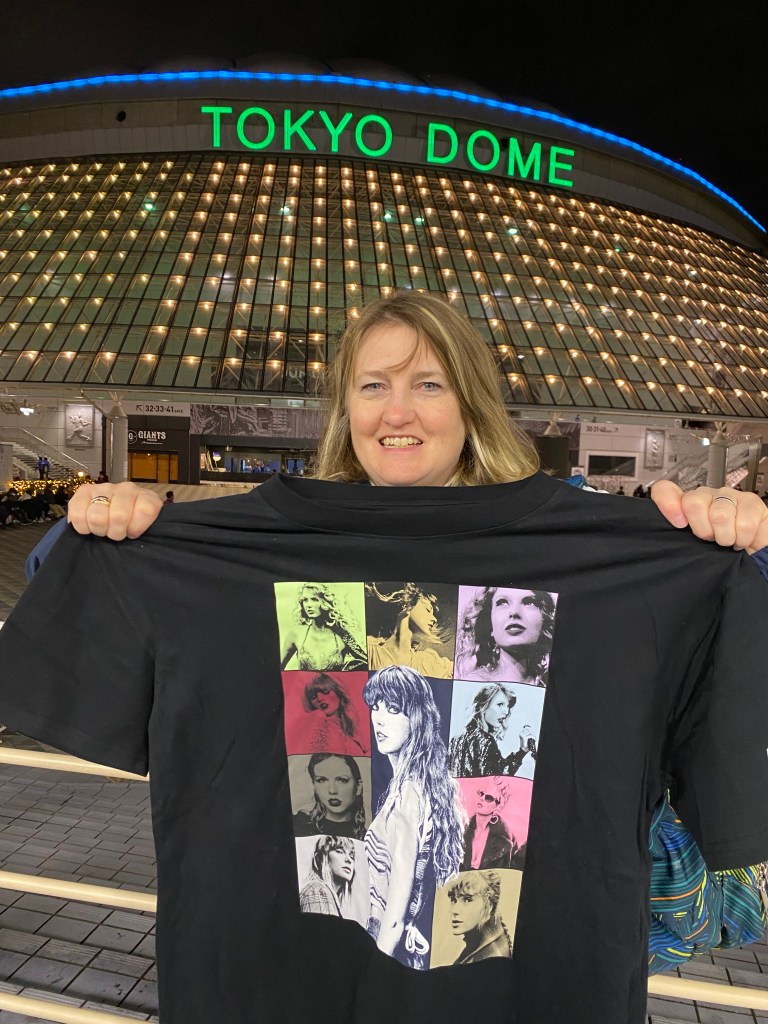
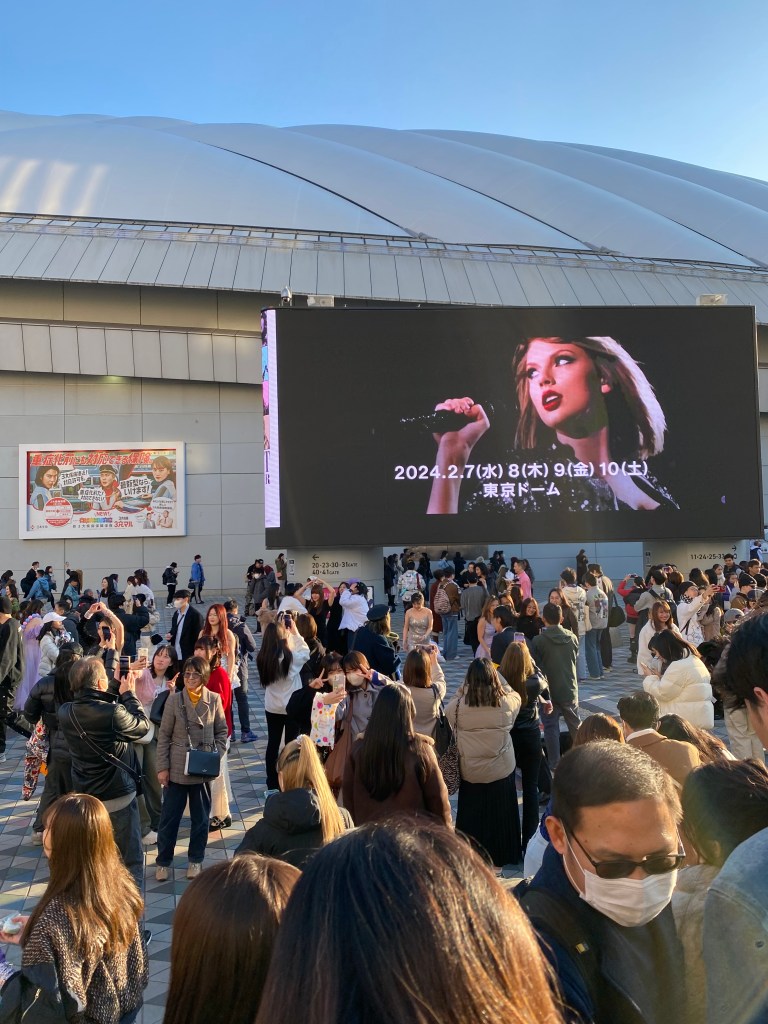
We made it to Haneda Airport, checked into our hotel in Ueno, had some sushi, and took the train to Tokyo Dome. Two hours before start time, a crowd had already gathered. Young women in spangled dresses, tiaras, and cowgirl hats, speaking various languages, posed for photos and exchanged friendship bracelets. Hundreds of people were queued up to buy merchandise related to the Eras Tour. Although my husband and I waited in line for almost an hour, when it became clear that we risked missing the beginning of the performance, we left and went to find our seats, which were high up in the rafters.

Slowly, the seats began to fill. By the time the lights dimmed, the place was packed. The music began, and dancers came onto the stage holding what looked like Japanese fans. Cheers surged. To my left, an earnest young woman, who was apparently attending alone, recorded nearly the entire show on her phone. A white-haired Japanese man, also on his own, sat just in front of me. Several young women in short dresses stood behind us, singing and dancing along to the songs that they knew. Whenever Taylor disappeared for a set or costume change, they would squeal in delight at her reappearance on stage: “Yabai, yabai, yabai[1]!”

For three hours and twenty minutes, as Taylor went through her set of 47 songs, ranging across her career, the arena was filled with joy.

Occasionally, my husband would lean over and ask, “Do you know this one?”

I confess that I didn’t know all of the songs—especially those from her early albums. I danced along anyway.

After the concert, my social media feeds were abuzz with reactions from other friends who had been there, or who’d attended the performance the night before. It felt as we had been part of something huge—and happy.

Meanwhile, back in the United States, rumors were circulating that Taylor Swift was part of some Deep State government plot to re-elect President Joe Biden in November. NFL fans were complaining that she got too much onscreen attention when she attended her boyfriend’s games (to cheer him on). Others slut-shamed her for having had too many boyfriends or attacked her for polluting with her private plane.

I was glad that none of that vitriol had reached Japan.

My husband and I went back to Tokyo Dome the next evening, during the concert, to buy T-shirts. At that time, the line for merchandise was blessedly short. We saw people sitting on benches outside the arena, or with their ears pressed to the walls, taking in as much as they could. It was strangely moving.

When I got back home, I downloaded two more of her albums. I’ve been listening to them non-stop ever since.

.

[1] Great, great, great!

Suzanne Kamata was born and raised in Grand Haven, Michigan. She now lives in Japan with her husband and two children. Her short stories, essays, articles and book reviews have appeared in over 100 publications. Her work has been nominated for the Pushcart Prize five times, and received a Special Mention in 2006. She is also a two-time winner of the All Nippon Airways/Wingspan Fiction Contest, winner of the Paris Book Festival, and winner of a SCBWI Magazine Merit Award.

PLEASE NOTE: ARTICLES CAN ONLY BE REPRODUCED IN OTHER SITES WITH DUE ACKNOWLEDGEMENT TO BORDERLESS JOURNAL

Click here to access the Borderless anthology, Monalisa No Longer Smiles

Click here to access Monalisa No Longer Smiles on Amazon International
Categories
Excerpt

The Ocean is Her Title

Book Title: The Ocean is Her Title

Author: Manjima Misra

Publisher: Book Street Publications

The world ball dance was held on 25th December. It was the last time that Jay and Poulomi had agreed to meet each other with the tag of being lovers. The ballroom was majestic with a long winding staircase – the magnificent staircase was adorned with Christmas Mistletoe plants. Jay could not help but stare at Poulomi in her maroon ballroom dress and with her maroon lipstick making her lips seem more protruded than ever.

The song ‘Maroon’ by Taylor Swift was playing in the background.

The ballroom ceiling was full of sparkling chandeliers which glimmered with golden light. The golden rays of the daytime sunshine lit up the ballroom with a soft glow, as they passed through the crystal clear huge glass windows. Each of the windows had maroon curtains which were shifted to the side to let the daylight in.

As the day approached late evening, the curtains were closed and the ballroom still had the soft golden glow – this time it was because of candlelight lamps.

In this glorious ballroom, Agatha was playing the instrumental version of the song ‘Maroon’ on piano with the grandeur of royalty, for the piano was gifted by the Princess of England, Agatha could not feel more proud of her musical skills.

For a while, Agatha kept looking at Poulomi and Jay now and then. Poulomi’s maroon dress had golden belt and golden buttons, and Poulomi was wearing a necklace studded with golden star shaped diamond-like stones. She was carrying a golden purse with her and as she walked down the staircase, she seemed like the very Queen of England.

In the middle of the dance with Jay, Poulomi excused herself and went to Agatha. She exchanged a few words with Agatha and when she returned to the dance floor, Jay was nowhere to be found. Jay had disappeared.

Agatha came running and said, “Poulomi, you must confront Jay. This act of disappearance is no way justified”.

“Agatha, is Jay a real person? Or is he a hallucination of mine?” asked Poulomi, being well aware of her own mental health condition. And Poulomi ran towards the veranda and gazed at the maroon night sky glittering with silver stars.

Agatha followed her and said, “Well, at least, the sky and the stars are for real.”

About the Book:

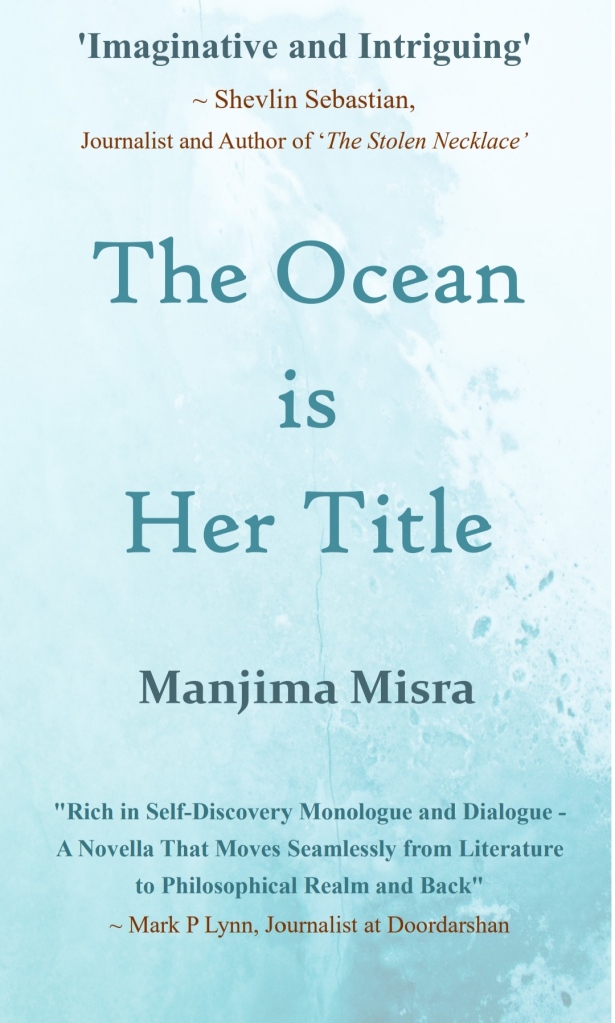
The novella, titled The Ocean is Her Title, is an exploration of a fractured existence of the central character Poulomi “struggling through a welter of feelings, incapacities, and anxieties to shore up her beleaguered existential coherence”. In the words of Mark P Lynn, noted journalist at Doordarshan, “the novella is rich in self discovery monologue and dialogue and moves from literature to the philosophical realm and back. The internal monologue takes the form of a conversation with real characters who are fictionalized from the author’s love for Harry Potter, Taylor Swift, Wonder Woman, and the heartfelt support structure provided by a father who tends to a child with bipolar disorder.” In the words of renowned journalist and author Jitendra Dixit, “The Ocean Is Her Title, the readers are invited to embark on an emotionally charged novella that weaves together the dreams and struggles of a young Delhi girl, Poulomi, whose life takes an unexpected turn when she is abducted and transported to a place she could never have imagined – the Ocean Hospital. This novella, authored by Manjima Misra, is a poignant exploration of identity, resilience, and the complexities of modern womanhood.”

About the Author:

Manjima Misra is a writer based in Delhi. She has written three published books previously which are titled Indian Feminine Fury, Unapologetically Mad, and The Ocean is Her Title. Her opinion articles have been published in The Indian Express, The Quint, Outlook India, Deccan Herald, Newslaundry, and Firstpost. She has previously worked as a writer with the Education Desk at The Indian Express and as an educator with Teach For India.

 She has a Master’s degree in English literature from the University of Delhi and a Postgraduate Certificate in Teaching English to Speakers of Other Languages (TESOL) from the University of St Andrews, Scotland.

PLEASE NOTE: ARTICLES CAN ONLY BE REPRODUCED IN OTHER SITES WITH DUE ACKNOWLEDGEMENT TO BORDERLESS JOURNAL

Click here to access the Borderless anthology, Monalisa No Longer Smiles

Click here to access Monalisa No Longer Smiles on Amazon International