Categories
Interview Review

Mandalas, Malashri Lal & the Pilkhan Tree…

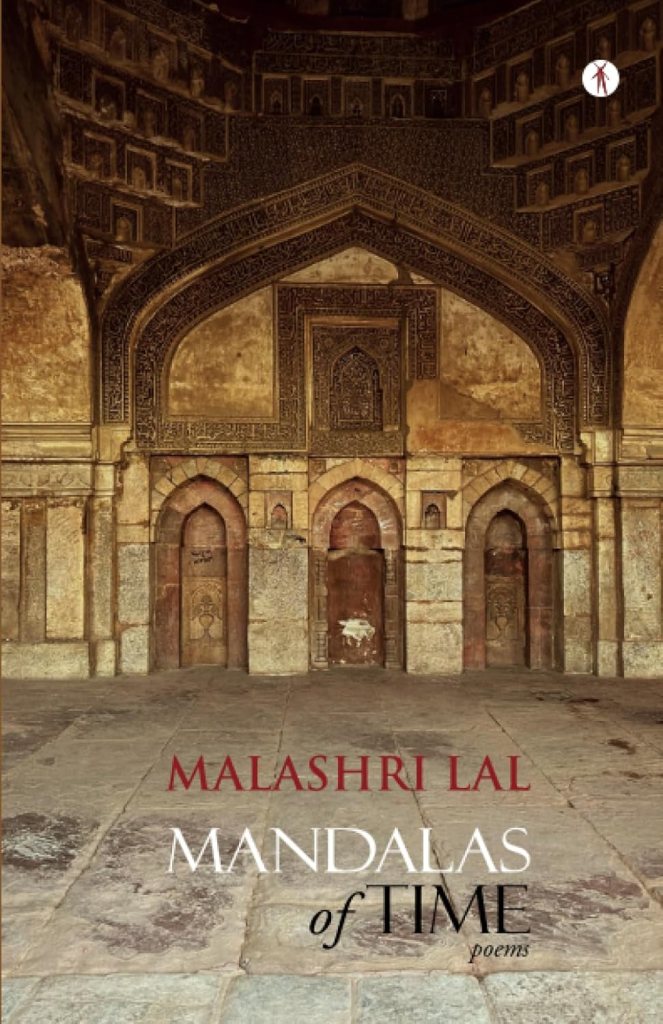
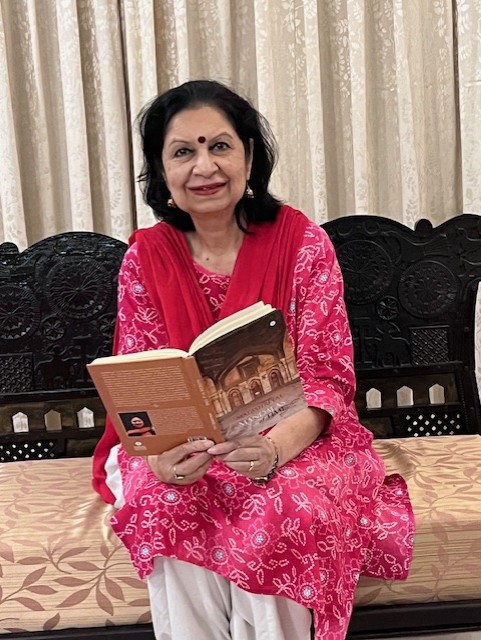
In Conversation with Malashri Lal, about her debut poetry collection, Mandalas of Time, Hawakal Publishers
Time present and time past
Are both perhaps present in time future,
And time future contained in time past.
If all time is eternally present
All time is unredeemable.

-- TS Eliot, Burnt Norton, Four Quartets(1941)

Mandalas’ means circle in Sanskrit, the root, or at last the influencer, of most of the Indian languages in the subcontinent. Sanskrit belongs to the Indo-Germanic family, which homes Latin and Greek among other languages. Malashri Lal, a former professor in Delhi University, has called her poetry collection Mandalas of Time

Her poetry reiterates the cyclical nature of the title, loaning from the past to blend the ideas with the present and stretching to assimilate the varied colours of cultures around the world.

Embracing an array of subjects from her heritage to her family — with beautiful touching poems for her grandchild — to migrants and subtle ones on climate change too, the words journey through a plethora of ideas. Nature plays an important role in concretising and conveying her thoughts. In one of the poems there is a fleeting reference to wars — entwined with the Pilkhan (fig) tree:

The Pilkhan tree thinks of its many years
Of shedding leaves, bearing inedible fruit, of losing limbs
But smiles at his troubles being far less
Than of unfortunate humans
Who kill each other in word and deed
But gather around the tree each Christmas
With fulsome gifts and vacant smiles
To bring in another New Year.

--Another New Year

Amaltas (Indian Laburnum) or Bougainvillea bind her love for nature to real world issues:

Only the Amaltas roots, meshed underground 
Thrust their tendrils into the earth’s sinews below.
Sucking moisture from the granular sand, desperately.
The golden flowers pendent in the sun, mock the traveller
Plump, succulent, beacon-like, they tease with
The promise of water
Where there is none.

--Amaltas in Summer

And…

The Bougainvillea is a migrant tree, blossom and thorn
That took root in our land
And spread its deception
Of beauty.

--Bougainvillea

Her most impactful poems are women centric.

Words crushed into silence
Lips sealed against utterance
Eyes hooded guardedly
Body cringing into wrinkled tightness
Is this what elders called
‘Maidenly virtue?’

--Crushed

There is one about a homeless woman giving birth at Ratlam station during the pandemic chaos, based on a real-life incident:

Leave the slum or pay the rent 
Who cares if she is pregnant,
Get out — go anywhere.

Ratlam station; steady hands lead her to the platform.
Screened by women surrounding her
A kind lady doctor takes control.
Pooja sees a puckered face squinting into the first light.
"This is home," she mutters wanly,
"Among strangers who cut the cord and feed my newborn,”

-- Ladies Special

In another, she writes of Shakuntala — a real-world migrant who gave birth during the covid exodus. She birthed a child and within the hour was on her way to her home again — walking. It reminds one of Pearl S Buck’s description of the peasant woman in Good Earth (1931) who pauses to give birth and then continues to labour in the field.

Most interesting is her use of mythology — especially Radha and Sita — two iconic characters out of Indian lore. In one poem, she finds a parallel to “Sita’s exile” in Italy, at Belisama’s shrine. In another, she finds the divine beloved Radha, who was older to Krishna and married to another, pining after the divinity when he leaves to pursue his life as an adult. And yet, she questions modern stances through poems on more historical women who self-immolated themselves when their husbands lost in battle!

Malashri Lal has turned her faculties post-retirement to literary pursuits. One of her co- authored books around the life of the poet Michael Madhusudan Dutt, received the Kalinga award for fiction. She currently serves on the English advisory board of Sahitya Akademi. In this conversation, Lal discusses her poetry, her journey and unique perceptions of two iconic mythological women who figure in her poetry.

When did you start writing poetry? 

Possibly my earliest poetry was written when I was about twelve, struggling with the confusing emotions of an adolescent. I would send off my writing to The Illustrated Weekly which used to have pages for young people, and occasionally I got published. After that, I didn’t write poetry till I was almost in my middle age when the personal crisis of losing my parents together in a road accident brought me to the outpourings and healing that poetry allows.

What gets your muse going? 

Emotional turmoil, either my own or what I observe within the paradigms of social change. With my interest in women’s issues, my attention is arrested immediately when I hear or read about injustice, violence, exploitation or negligence of women or girl children. It doesn’t have to be a dramatic or extreme event but even the simple occurrences of decision making by a husband without consulting his wife has me concerned about the dignity and agency of a woman. Some poems like “Escape”, hint at such inequality that society takes for granted. On the other hand, my poems about migrant women giving birth on the long march to a hypothetical  village “home”  during the pandemic, are vivid transferences from newspaper stories. “Ladies Special” is about Pooja Devi giving birth at Ratlam station; “The Woman Migrant Worker” is based on a  report about  Shakuntala who stopped by the roadside to give birth to a baby and a few hours later, joined the walking crowd again. 

Why did you name your poetry book Mandalas of Time? 

To me ‘Mandalas’ denote centres of energy. Each node, though distinct in itself, coheres with the others that are contiguous, thus resulting in a corporeal body of interrelatedness. My poems are short bursts of such energy, concentrated on a subject. They are indicative of a situation but not prescriptive in offering solutions. Hence the spiritual energy of ‘Mandalas’, a term used in many traditions, seemed best suited to my offering of poems written during periods  of heightened consciousness and introspection. The poems are also multilayered, hence in constant flux, to be interpreted through the reader’s response. Many of them end in questions, as I do not have answers.  The reader is implicitly invited to peruse  the subject some more . It’s not about closure but openness. See for instance: “Crushed”, or “Shyamoli”. 

Today, I rebel and tug at a
Divided loyalty —
The feudal heritage of my childhood
Fights off the reformist Bengali lineage,
My troubled feminism struggling
Between Poshak and Purdah
White Thaan and patriotism
Can one push these ghosts aside?

--Shyamoli
*Poshak: Rajasthani dress
*Thaan: White saree worn by the Bengali widow

You have written briefly of your mixed heritage, also reflected in your poem dedicated to Tagore, in whose verses it seems you find resolution. Can you tell us of this internal clash of cultures? What exactly evolved out of it? 

My bloodline is purely Bengali but my parents nor I ever lived in Bengal. My father was in the IAS in the Rajasthan cadre and my mother, raised in Dehradun, did a lot of social work. In the 1950s and 1960s, Rajasthan was economically and socially confined to a feudal heritage and a strictly hierarchical structure. Rama Mehta’s novel Inside the Haveli (1979), describes this social construction with great sensitivity. Elite homes had separate areas for men and women, and, within that, a layout of rooms and courtyards that were defined for specific use by specified individuals according to their seniority or significance. Such hierarchies existed in Bengal too — the ‘antarmahal[1]’ references bear this out —  but the multiple layers in Rajasthan seemed more restrictive.   

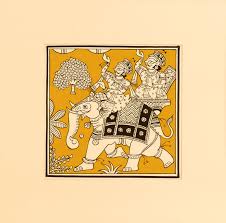
In my “mixed heritage” of being born of Bengali parents but raised in Rajasthan, I started noting the contrasts as well as  the similarities. I recall that when my father went on tours by jeep into the interior villages along rutted roads, I would simply clamber on. At one time I lived in a tent, with my parents, during the entire camel fair at Pushkar. I would listen to the Bhopa singers of the Phad painting tradition late into the evening.  So my understanding and experience of Rajasthan is deep into its roots.
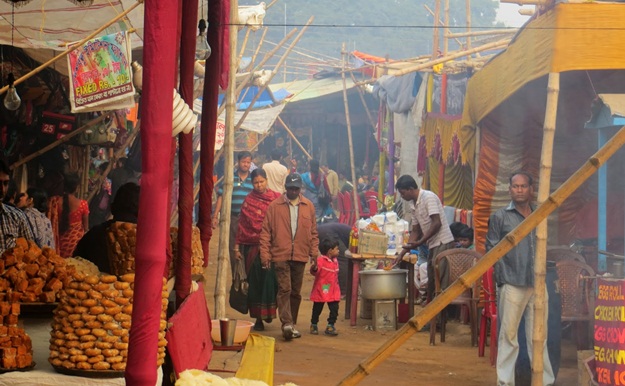
Bengal– that is only Calcutta and Santiniketan–I know through my visits to grandparents, aunts and uncles. My cousins and I continue to be very close.  I saw a fairly elite side of Calcutta—the Clubs, the Race Course, the restaurants on Park Street, the shopping at New Market, and sarees displays at Rashbehari Avenue. Santiniketan though was different.  I was drawn to the stories of the Santhal communities, visited their villages, attended the Poush Mela[2] regularly and knew several people in the university. After Delhi, the wide-open spaces, the ranga maati (red soil), the Mayurakhi River, and the tribal stories were fascinating. I am fluent in Bengali and because of my relatives in Calcutta as well as Santiniketan, I never felt an outsider. My father’s side of the family has  been at Viswa Bharati since the time of  Rabindranath Tagore. So, I felt comfortable in that environment. And through an NGO called Women’s Interlink Foundation, established by Mrs Aloka Mitra, I had easy access to Santhal villages such as Bonerpukur Danga.
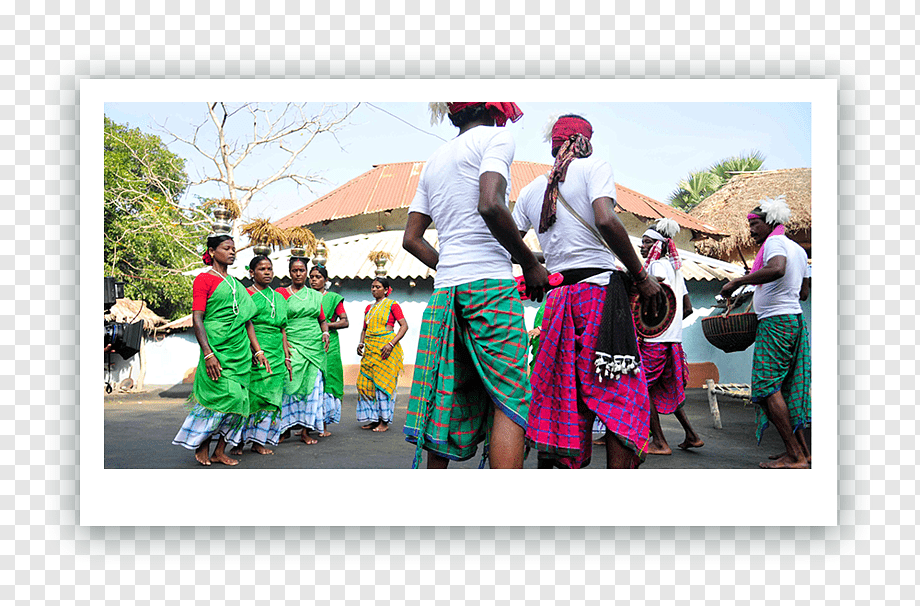
However, in summary, though I lived with both the strains of Bengal and Rajasthan, the daily interaction in Jaipur where I received all my education till PhD, was more deeply my world. The fragmented identity that some poems convey is a genuine expression of figuring out a cultural belonging. Poems such as “To Rabindranath Tagore” helped me to understand that one can have multiple exposures and affiliations and be enriched by it.

Do you feel — as I felt in your poetry — that there is a difference in the cultural heritage of Bengal and Rajasthan that leads you to be more perceptive of the treatment of women in the latter state? Please elaborate. 

Indeed, you are right. Bengal has a reformist history, and my family are Brahmo Samaj followers. Education for women, choice in marriage partner, ability to take up a career were thought to be possible. My paternal grandmother, Jyotirmoyi Mukerji, was one of the early graduates from Calcutta University; she worked as an Inspectress of Schools, often travelling by bullock carts, and she married a school teacher who was a little younger than her. They together chose to live in Rangoon in undivided India, heading a school there. These were radical steps for women in the late 19th century.  My father grew up in Rangoon and came to Rajasthan as a refugee during the Second World War. My grandmother, who lived with us, was a tremendous influence denoting women’s empowerment. But what we saw around us in Jaipur was the feudal system and purdah for women in Rajasthan.

Fortunately, Maharani Gayatri Devi had set up a school in 1943 in Jaipur to bring modern thinking in the women, and I was fortunate to study there till I went to university. Let’s recall that Maharani Gayatri Devi was from Coochbehar (Bengal) and had studied at Santiniketan. She brought Bengal’s progressive ideas to the privileged classes of Rajasthan. My classmates were mostly princesses. I visited their homes and families and delved deeply into their history of feudalism. Without being judgmental, I must say that Rajasthan’s heritage is very complex and one must understand the reasons behind many practices and not condemn them.

You have brought in very popular mythological characters in your poems — Sita and Radha — both seen from a perspective that is unusual. Can you explain the similarity between Sita’s exile and Belisama’s shrine (in Italy)? Also why did you choose to deal with Radha in a post-Krishna world? 

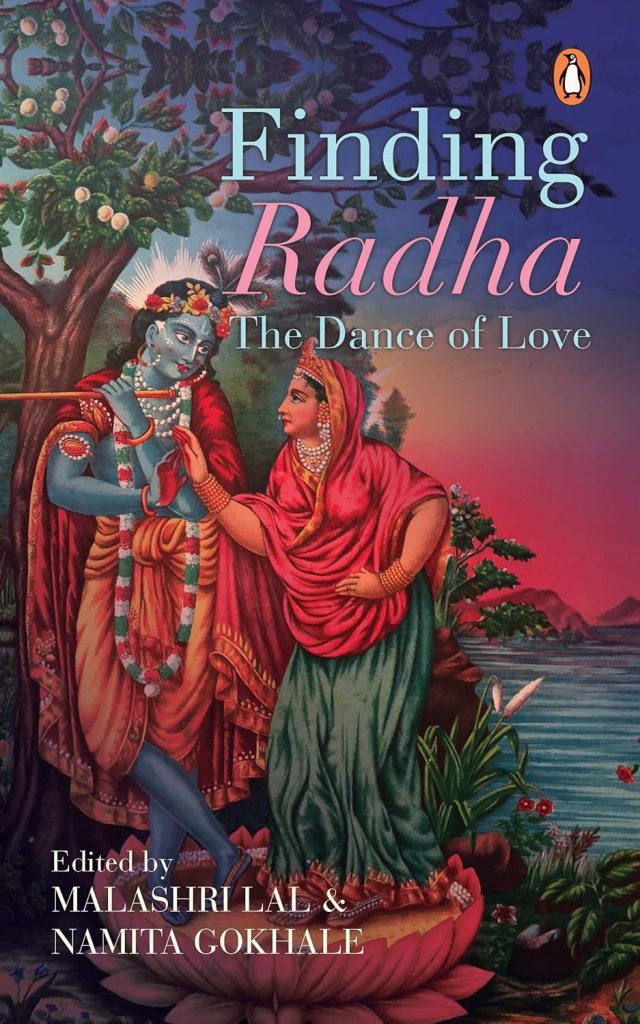
Namita Gokhale and I have completed what is popularly known as the “Goddess Trilogy”. After In Search of Sita and Finding Radha,  the latest book, Treasures of Lakshmi: The Goddess Who Gives, was launched in February 2024 at the Jaipur Literature Festival, and the Delhi launch was on 8th October 2024 to invoke the festive season. 
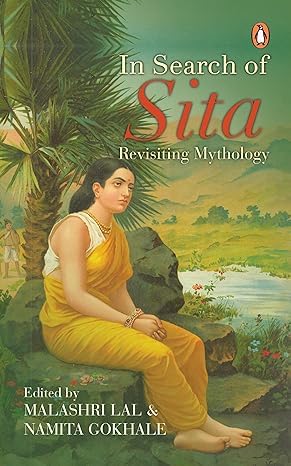
In answering your question let me say that myth is storytelling, an indirect way of contending with issues that are beyond ordinary logic or understanding. Sita and Belisama coming together is an illustration of what I mean. The backstory is that Namita Gokhale and I had a joint residency at Villa Serbelloni in Bellagio (Italy) and we were revising the final manuscript of our book In Search of Sita. The thrust of that book is to recall the strength of Sita in decision making, in being supportive of other women, in emerging as an independent minded person. Our research had unearthed a lot of new material including oral history and folklore. In Bellagio, we started enquiring about local mythical stories and chanced upon Belisama,[3] a Celtic goddess known for her radiant fire and light, and in the village we chanced upon an old grotto like structure.  Unlike in India, where we have a living mythology of commonly told and retold tales, in Italy the ancient legends were not remembered. The poem “Bellagio, Italy” took shape in  my imagination bringing Sita and Belisama, two extraordinary women, together.

As to my poems on Radha, I cannot think of a “post-Krishna” world since Vrindavan and Mathura keep alive the practices that are ancient and continuous. Radha is the symbol of a seeker  and Krishna is the elusive but ever watchful divine. They are body and soul, inseparable. The stories about “Radha’s Flute” or “Radha’s Dilemma” in poems by those names have an oral quality about them. The craft of writing is important, and for me, the theme decides the form.   

Interesting, as both the poems you mention made me think of Radha after Krishna left her for Rukmini, for his role in an adult world. You have a poem on Padmini. Again, your stance is unusual. Can you explain what exactly you mean — can self-immolation be justified in any way? 

This is a poem embedded in the larger query about comparative cultural studies. Rani Padmini’s story was written by Jayasi[4] in 1540, and it described  a ‘heroic’ decision by Padmini that she and her handmaidens should commit Jauhar (mass self-immolation)  rather than be taken prisoners and face humiliation and violent abuse by the men captors. You will note that my poem ends on a question mark: “I ask you if you can rewrite /values the past held strong?” Self-immolation has to be seen in the context of social practices at the time of Padmini (13-14th queen in Mewar, Rajasthan).  The jauhar performed by Rani Padmini of Chittor is narrated  even now through ballads and tales extolling the act if one goes into oral culture. But there is counter thinking too,  as was evident  in the controversy over Sanjay Leela Bhansali’s film Padmavat (2018) which stirred discussions on historicity, customary practice and oral traditions. Sati and Jauhar are now punishable offences under Indian law, but in recording oral history can one change the storyline?  It’s not just self-immolation that comes under such a category of questioning the past — polygamy, polyandry, child marriage, prohibitions on widows and many other practices are to be critiqued  in modern discourse,  but one cannot rewrite what has already been inscribed in an old  literary text. 

This is a question that draws from what I felt your poems led to, especially, the one on Padmini. Do you think by changing text in books, history can be changed? 

“History” is a matter of perspective combined with the factual record of events and episodes. Who writes the “history” and in what circumstances is necessary to ask. The narration or interpretation of history can be changed, and sometimes ought to be. To take an obvious case why is the “Sepoy Mutiny” of 1857 now referred to as the “First War of Independence”? In current discussions on Rana Pratap[5] in Rajasthan’s history, there are documents in local languages that reinterpret the Haldighati battle of 1576 not as the Rana’s defeat but his retreat into the forests and setting up his new kingdom in Chavand where he died in 1597. The colonial writers of history—at least in Rajasthan– were dependent on local informers and had little understanding of  the vast oral repertoire of the state. Even Col. James Tod’s Annals and Antiquities of Rajasthan (1829) about  the history, culture, and geography of some areas in Rajasthan, is often reproducing what he has heard from the bards and balladeers which are colourful and hyperbolic renderings as was the custom then. In Bengal, the impact of Tod is seen in Abanindranath Tagore’s[6] Rajkahini (1946), which is storytelling rather than verified facts. I feel history cannot be objective, it is author dependent.    

Nature, especially certain trees and plants seem to evoke poetry in you. It was interesting to see you pick a fig tree for commenting on conflicts. Why a Pilkhan tree? 

The Pilkhan is an enormous, bearded old fig tree that lives in our garden and is a witness to our periodic poetic gatherings. Mandalas of Time is dedicated to “The Poets under the Pilkhan Tree” because my book emerged from the camaraderie and the encouragement of this group. I see the tree as an observer and thinker about social change—it notes intergenerational conflict in “Another New Year”, it offers consolation against the terrors of the pandemic in the poem “Krishna’s Flute”.  It’s my green oasis in an urban, concrete-dominated Delhi. In the evening the birds chirp so loudly that we cannot hear ourselves speak. Squirrels have built nests into the Pilkhan’s  wide girth. It’s not a glamorous tree but ordinary and ample—just as life is. By now, my poet friends recognise the joy of sharing their work sitting in the shadow of this ancient giant. There are no hierarchies of age or reputation here. We are the chirping birds—equal and loquacious! 

You have successfully dabbled in both poetry and fiction, what genre do you prefer and why? 

Mandalas of Time is my first book of poems and it comprises of material written unselfconsciously over decades. During the pandemic years, I decided to put the manuscript together, urged by friends. Meanwhile my poems started appearing in several journals.

As to fiction, I’ve published a few short stories and I tend to write ghostly tales set in the mountains of Shimla. Its possibly the old and the new that collides there that holds my attention. I’ve been urged to write a few more and publish a book—but that may take a while.

Should we be expecting something new from your pen? 

Mandalas of Time has met with an amazing response in terms of reviews, interviews, speaking assignments, and online presentations.  The translation in Hindi by 13 well known poets is going into print very soon. Permission has been sought for a Punjabi translation. I’m overwhelmed by this wide empathy and it is making me consider putting together another book of poems.

Thank you for giving us your time.

Malashri Lal’s poetry can be accessed by Clicking at this link.

[1] Inner rooms for women mainly

[2] A fair held in December, where local vendors mingle with others to exhibit their wares and culture. It was started by the Tagore family in 1894

[3] Belisama was identified with the Roman virgin goddess of wisdom, justice and learning, Minerva, by interpretatio romana.

[4] An Indian Sufi poet who lived from 1477-1542

[5] Known as Maharana Pratap (1540-1597) too, he ruled over Mewar, which can be located in current day Rajasthan. 

[6] Abanindranath( 1871-1951) was the nephew of Rabindranath Tagore, known for his art and the impact he had on it.

(The online interview has been conducted through emails by Mitali Chakravarty.)

PLEASE NOTE: ARTICLES CAN ONLY BE REPRODUCED IN OTHER SITES WITH DUE ACKNOWLEDGEMENT TO BORDERLESS JOURNAL. 

Click here to access the Borderless anthology, Monalisa No Longer Smiles

Click here to access Monalisa No Longer Smiles on Kindle Amazon International

Categories
Review

Mapping the Mind

Book Review by Navleen Multani

Title: Mapping the Mind, Minding the Map

Editors: Basudhara Roy and Jaydeep Sarangi

Publisher: Sahitya Akademi

Mapping the Mind, Minding the Map edited by Basudhara Roy and Jaydeep Sarangi anthologises twenty contemporary poets. This book unveils a large canvas of poems penned by poets hailing from diverse locations and cultures, evoking thoughts on existential dilemmas of the contemporary world. The 391 pages of the anthology comprise poems by multiple poets: Adil Jussawalla, Arundhati Subramaniam, Ashwani Kumar, Bashabi Fraser, Bibhu Padhi, Jayant Mahapatra, K. Satchidanandan, K.Srilata, Keki N.Daruwalla, Lakshmi Kannan, Mamang Dai, Nabina Das, Robin S. Ngangom, Sanjukta Dasgupta, Tabish Khair, Usha Akella, Yogesh Patel and more

Every poem entails evocative images, visual and syntactic cues that put forth poetics of everyday life. Traversing maps and minds, this engaging collection of two hundred poems unravels different places and persons. The anthology is a poetic narrative and holistic exploration of locating oneself through language. As the book brings together experiences and knowledge of space, it pushes readers to rethink how landscape shape identity.

Memories encompassing reflections on landscapes, ancient history, myth, family, home, towns, cities, countries, music, seasons, elements of nature, disasters, wants, love and wounds of Homo Sapiens, women, mother as well as immigrants abounds the creation of every poet. Memories of special days, seasons, cities and cultures culminate in the compositions of Mamang Dai. Nabina Das’ creations talk about death and else. Sanjukta Dasgupta juxtaposes past and present to celebrate free spirit of Kali, Alakshmi and Millenial Sita.

This compilation, published by Sahitya Akademi, is an itinerary for dreamers and travellers alike. Ten poems by each poet weave a tapestry of emotions, experiences, moments and memories that define persons, places, practices and cultures. Every word, image and syntactical turn in these poems moves readers to discover poet’s emotional state. Events and myriad experiences, memorable and unpleasant, form an intricate reflection on life. The poems are also revelations about the contemporary world. The mosaic of memories present a ceaseless stream of significant moments that mould the minds and the maps. The compositions heighten consciousness, enrich the understanding of readers and deepen their humanity. The poems make the readers encounter hardships, moments of despair, compassion, empathy and resilience to extract invaluable insights. Reflections on difficult and dark times infuse renewed strength to deal with adversity.

Every poet uses different linguistic register to delve into solitude, decay, death and a new force that nurtures mind as well as takes to greater understanding about existence. “When Landscape Becomes Woman” by Arundhati Subramaniam reveals “That a chink in a wall is all you need to tumble into a parallel universe”. Whether it is Bashabi Fraser’s “Mothers All” claiming, “They are the bravest soldiers-marching on”, or Adil Jussawalla’s “Refuge” telling “Mother tells her rosary from six to seven, her one hour refuge,” each poet, irrespective of gender, envisions an independent and autonomous identity. “What’s wrong with us Kali women?”, “Maryada[1] and modern Draupadi”, “Woman in a Landscape” by Adil Jussawalla, “History”, “Draupadi”, “Partition Ghazal”, “The Tribal Goddess” and “Patna to Nalanda-1979” by Keki N.Daruwalla transport readers from past to present and illuminate multi-facets of life. “Somewhere like a shadow in the night like a black mineral in the earth, /Somewhere in a mirror where you can see your dreams a poem awaits deftly angled light,” writes Keki Daruwalla. Ashwani Kumar’s poems dwell on Alzheimer’s, lies emerging from deception, town vanished in the reservoir of waters and the strange ways of the world.

The deftly crafted poems blend imagery, thoughts and experiences. Many of the poems are centred on home, landscape and seasons. Titles of a few poems like “Mitti[2]’, “Bhakti[3]”, “Haldi[4]”, “Mahaprajapati[5]”, “O Boisakh[6]” and “Lopamudra[7]” have not been provided with a translation. Supplementing these titles are poems like “Earthrise”, “Missives of Music”, “The Same Moon from Edinburgh to Calcutta: A Refracted Lens”, “Sunrise at Puri-on-Sea”, “The River” and “Earth Day”.

The poems ranging from prose to typographic and linguistic variations, Mapping the Mind, Minding the Map speaks to larger issues of urban Indian identity, acceptance, adaptation and cultural estrangement. These map the poetics of womanhood, the body, institution, family and love. By doing so, the anthology erases traditional boundaries to develop a new poetic form. The poems are ensembles of words that unite to present verbal, vocal and visual sphere of communication.

This three-dimensional language becomes carrier of aesthetic message of the poet. The reduction of language to a word or fragments in many of the poems is similar to the reduction of landscape to map elements selectively and generally. This gives a distinct charm to the anthology. The poems explode with bird-names, names of cities and countries making these compositions a dialectical map. Very aptly the poems, as Howard McCord contends, can be comprehended as “a map on which articulation of consciousness can be charted, and the serial flow we associate with prose can be gathered into clusters and islands of words which reveal the individual’s voice and vision, even his philosophical stance, more accurately than a line broken by a general rule imposed.” Poems in Mapping the Mind, Minding the Map are maps that offer ways to know simplified, generalised and selective views on the world and human existence.

[1] Dignity

[2] Mud

[3] Devotion

[4] Turmeric

[5] The woman who raised Buddha

[6] The second month in the Bengali calendar which coincides with April-May

[7] A philosopher who lived in the Rigvedic age

Dr Navleen Multani is Associate Professor, Head, School of Languages, and Director, Public Relations at Jagat Guru Nanak Dev Punjab State Open University, Patiala (India). She is Area Editor with Oxford Online Bibliographies: Literary and Critical Theory.

.

PLEASE NOTE: ARTICLES CAN ONLY BE REPRODUCED IN OTHER SITES WITH DUE ACKNOWLEDGEMENT TO BORDERLESS JOURNAL

Click here to access the Borderless anthology, Monalisa No Longer Smiles

Click here to access Monalisa No Longer Smiles on Kindle Amazon International

Categories
Review

Thus Flow the Verses…

Book Review by Malashri Lal

Title: Nadistuti: Poems

Author: Lakshmi Kannan

Publisher: Author Press

The title plunges us into the sacrality of resonant words, the Nadistuti sukta being a hymn in the Rigveda in praise of rivers. Poet, novelist and translator Lakshmi-Kaaveri equates the flow of the waters with ‘the flow of poetry’, the quiet mingling of streams of remembrance and phrases that shape into lines of verse. Her book is dedicated to Jayanta Mahapatra ‘who lives on’ and an exordium titled ‘Naman’ offers gentle tribute to H.K. Kaul, who was among the founders of the Poetry Society of India and passed away during the recent pandemic. Nadistuti is a brilliant and thought-provoking collection of poems that charts the timeless continuums while being aware of the fragility of human existence.

The book begins with a prayer to the River Narmada (meaning ‘the giver of pleasure’), which divides the north from the south of India. Yet the rippling waters have no boundary—a philosophical observation that I find marks much of this remarkable volume. Remembering Ganga, Yamuna, Godavari, Saraswati, Narmada, Sindhu, Kaaveri, devotees recite the shloka[1] at their morning bath seeking the blessings of the rivers. Though such rituals are mostly forgotten in modern times, the climate crisis should remind us of the consequences of such amnesia. The invisible Saraswati is possibly a metaphor for such “forgetting” simply because of her partial invisibility. Lakshmi Kannan’s vibrant lines recall the disappearance of the river as also of Saraswati’s appearance in another form as a revered Goddess invoked by “students, writers, musicians, dancers, painters”. From the Nadistuti I learned the word— ‘potomologist’—the study of rivers, but the book is far greater than an academic enquiry—it’s a recognition of the civilisational bloodline that is linked to the ancient rivers which  were the earliest cradles of humankind.

Some extraordinary and innovative aspects Lakshmi’s book deserve special mention. First, the remarkable prose- poem called ‘Ponni Looks Back’ which stretches the boundaries of imagination in a charming manner.   Ponni is the name of the river Kaaveri in classical Tamil Literature.  It flows through Tamil Nadu and Karnataka and is always perceived as a woman. Lakshmi tracks Ponni’s autobiography as though writing a Bildungsroman, the education and growing up of an innocent girl and her experiences along the way. Therefore, Ponni is born as a small unobtrusive stream on the Mysore-Coorg border. Then she becomes prominent and significant, and a vital witness to history—the Hoysala kingdom, the classical arts of Belur, Halibid, Somnathpur, then carrying on further to wrap around the islands of Srirangapatnam and Srirangam and so on. I enjoyed the autobiographical voice of Ponni reveling in her centuries of testimony to all the changes she has observed and imbibed—till we come to the new politics that is destroying rivers and society today. Ponni says, “One day I heard different voices floating over my waters…they sit around tables, shout at each other and refer to me dryly as the Kaaveri dispute, wrenching my waters apart”. Like yet another goddess, Sita, she chooses to end her journey. Ponni merges with her mother, the Bay of Bengal —her love and amity having completed what tasks she could undertake towards humanitarian goals. The world of manmade disasters is a chapter River Kaaveri would rather not participate in.

My question here is: “Do poetry and politics merge?…  Can poets continue to be as Shelley called them ‘the unacknowledged legislators of the world’?”  This brings me to another significant aspect of Nadistuti: Lakshmi’s brand of subtle feminism. Predictably, I am drawn to the poems that argue against son-preference, challenge gender stereotypes, and poke gentle barbs at unenlightened men.

Second, I cite a longish poem called “Snake Woman” from the section titled Chamundi, because it combines rituals, dream imagery, gender prejudice and the paradox of son preference. The ritual is called Nagapuja and has strict rules of abstinence from certain foods like snake gourd, and it entails hours of prayer—the chant being:

Please grant me a male child
Oh, King of Cobras
I will name him Nagaraja
In your honour.

Something strange started happening that the pregnant woman could never dare reveal to the world. She dreamt every night of a female baby cobra wearing jhumkies (long earrings) and a jeweled girdle and sporting a red dot on her forehead. Well, the baby born was female—and the happy mother, though a little fearful, called her Nagalakshmi. The mother-in-law showed acute displeasure: “She can have any name.  Who cares!”

Another pregnancy, again the rituals of Nagapuja—more stringent than before. No dreams this time. And an eagerly welcomed boy-child is born, enthusiastically named Nagaraja. And guess what? As he grows up, he ‘hissed at is mother’, ‘bared his fangs at his father’ and ‘spewed venom on his sister’.  These are poet Lakshmi Kannan’s vivid vocabulary for the revered son! And the snake woman sister, what happened to her? She sloughed off her skin seasonally, grew strong, capable and emerged as a “lustrous one”.

I selected this poem for more than just Lakshmi’s clever reversal of gender prejudice. Snakes have a central place in the folktales and folklore of India. The word used, “theriomorphic”,  denotes  situations, where animals and human beings interchange  bodies and identities. Snakes are not evil—they are often the progenitors of good deeds and the shapeshifting happens for many commendable reasons.  The figuration of the snake as exclusively evil does not derive from Indian mythology. Lakshmi’s poem, this one and several others, tread this beautiful territory of humans and non-humans sharing a common abode, the Earth, and there is an implied lament that we have ignored this vital connectivity.  

And finally, I am delving into the emotive, personal poems that end the collection. Called  ‘Fireside’, it invites   memories of WB Yeats’ classic lines:

When you are old and grey and full of sleep,
And nodding by the fire, take down this book…

Lakshmi addresses many members of her family; they are named, thanked and remembered for their acts of love and compassion. Because Lakshmi believes in history and continuities, as we have seen in ‘Ponni Looks Back’, and the Nagalakshmi reference, these too are poems about lineage, heritage, respect and love—the attributes that make life worthwhile. Lakshmi’s mother (addressed in the poems as Amma) was Sharada Devi, an acclaimed painter in Mysore and Bangalore whom the daughter remembers with her easel-mounted canvas gently acquiring colours, the landscapes emerging from the contours of her imagination. Today, Lakshmi Kannan, the poet of Nadistuti, looks at a blank sheet of paper and compares that to her Amma’s canvas—the words will surely incarnate. Another poem has a redolent title ‘In Search of Father’s Gardens’, upturning African American writer Alice Walker’s book In Search Of Our Mothers’ Gardens, but for me it’s a tale reminiscent of Lakshmi’s early novel Going Home that I had reviewed decades ago. It was a book about ancestral homes and families breaking up. In the reconfigurations over time, Nadistuti’s final section presents poems to members of Lakshmi’s immediate family, named, but not too personalised, making this an exemplary template for those who hesitate to present the private in public poetry.  With beauty, grace, gratitude, humour, irony—each person emerges as a tributary in the flow of the poet and writer we know and love as Lakshmi- Kaaveri. The last poem ‘If You Want to Visit’ is deeply poignant.  It’s not a farewell poem—instead it’s an invitation to an eternal companionship:

Come
Visit me now
I’ll not have a word of complaint
I’ll gather all of these and leave with you.

Here is the confluence of all that Nadistuti says: the day’s prayer in the morning, the Ponni River encapsulating history, the rituals that pass through many generations, and the legacy of a poet’s words embedded in the annals of time. An exquisite and meaningful collection of poems, Lakshmi has introduced concepts of poetic writing that are evocative of the ancient Rigveda and equally provide the guiding lamps for modern choices.

[1] Holy chants

Malashri Lal, Former Professor in the English Department, University of Delhi, has published   twenty one  books of which Mandalas of Time: Poems, and Treasures of Lakshmi: The Goddess Who Gives   are the most recent. Lal has received several research and writing fellowships.  She is currently Convener, English Advisory Board of the Sahitya Akademi.

.

PLEASE NOTE: ARTICLES CAN ONLY BE REPRODUCED IN OTHER SITES WITH DUE ACKNOWLEDGEMENT TO BORDERLESS JOURNAL

Click here to access the Borderless anthology, Monalisa No Longer Smiles

Click here to access Monalisa No Longer Smiles on Amazon International

Categories
Essay

Bengaliness and Recent Trends in Indian English Poetry: Some Random Thoughts

By Somdatta Mandal

It is clear that English is employed here not as a language on loan, but as the rich, spluttering resource of the marrow and the bloodstream.-- Arundhathi Subramaniam.

At the outset, let me make a candid statement. I am a very prosaic person, someone who in her long teaching career and academic writing as well as translation, has never ventured to write poetry myself. I might seem like the odd woman out, but somehow, I have been closely following the recent trends in which Indian Poetry in English has been rapidly spreading its wings and with new volumes being published every other day, it is now a force to be reckoned with.

Tomb of Henry Louis Vivian Derozio at the South Park Street Cemetery, Kolkata.

Recapitulating literary history briefly, it is well known that Indian English Poetry (or often called Anglophone poetry in India) is the oldest form of Indian English literature. Beginning roughly from 1850 to 1900, it went through the ‘imitative’ phase when Indian poets were primarily ‘romantic’ and tried to imitate the British masters. Beginning with Derozio[1], many poets of the time — namely Rabindranath Tagore, Sri Aurobindo, Sarojini Naidu, Michael Madhusudan Dutt, Toru Dutt — were also Bengalis by birth. The poetry written between 1900 to 1947 belonged to the ‘assimilative’ period and often questions were asked why the poets didn’t write in their ‘own’ languages. Post-independence poetry was primarily experimental, and when we come to contemporary Indian English poetry, we find it becoming wholly urban and middle-class. The poets are realistic and intellectually critical in the expression of their individualised experience. They go in for precision at all levels and do not stick to one genre but experiment with multiple poetic forms.

Interestingly, I realised that a whole host of Indian English poets writing at present (some have several volumes of poetry published already, whereas others have just given birth to one or two), but coincidentally many of them happen to be Bengalis — Bashabi Fraser, Sudeep Sen, Kiriti Sengupta, Sanjukta Dasgupta, Mitali Chakravarty, Angshuman Kar, Shyamasri Maji, Basudhara Roy, Radha Chakravarty, and others. It is not a complete list at all, and what makes this study more interesting is that except for a couple of them, all these poets come from an English literature background. It is also not a coincidence that most of them teach English as their profession. So, whether it be personal lyrics, free verse, memories, experiences, observations, or even translation, the English muse therefore gives them the impetus to experiment with all forms, and at the same time helps them to move away from themes like nationalism, nature, Indian culture, love etc. that dominated Indian English Poetry in earlier times.

Bashabi Fraser receiving her CBE (2021 The Queen’s New Year Honours) from Prince Charles, now King Charles III.

Bashabi Fraser is an Indian-born Bengali and a Scottish academic, editor, translator, and writer. She is a Professor Emerita of English and Creative Writing at Edinburgh Napier University. Fraser’s work traverse continents in bridge-building literary projects. She was appointed a Commander of the Order of the British Empire (CBE) in the 2021 New Year  Honours for services to education, culture and cultural integration in Scotland, in particular for her projects linking Scotland and India. Among her several volumes of poetry the Bengal and Bengali connection comes out in volumes like From the Ganga to the Tay: a poetic conversation between the Ganges and the Tay (2009), Letters to My Mother and Other Mothers (2015), My Mum’s Sari (2019), and Lakshmi’s Footprints and Paisely Patterns: Perspectives on Scoto-Indian Literary and Cultural Interrelations (2023). Fraser has worked extensively on a project about the Bengal Partition and the angst resulting from this divide expresses itself in the following poem.

This Border
Can shadow lines on the earth’s surface divide language and literature, rituals and customs, rivers…and memories?

There was a time when you and I
Chased the same butterfly
Climbed the same stolid trees
With the fearless expertise
That children take for granted
Before their faith is daunted
Do you remember how we balanced a wheel
Down dusty paths with childish zeal
Do you remember the ripples that shivered
As we ducked and dived in our river
Do you remember what we shared
Of love and meals, and all we dared
Together – without fears
Because we were one
In all those years
Before we knew that butterflies
Were free to share our separate skies
That they could cross with graceful ease
To alight on stationary trees
On either side of this strange line
That separates yours from mine
For whose existence we rely
Entirely on our inward eye
This border by whose callous side
Our inert wheel lies stultified
This border that cuts like a knife
Through the waters of our life
Slicing fluid rivers with
The absurdity of a new myth
That denies centuries
Of friendships and families
This border that now decrees
One shared past with two histories
This border that now decides
The sky between us as two skies
This border born of blood spilt free
Makes you my friend, my enemy.

Another well-established poet is Sudeep Sen who studied in New Delhi and in the United States and is a global citizen, so to say. Sudeep’s literary output is enormous and some of the titles of his volumes of poetry have subtle references to Indianness and Bengaliness embedded in them as well. Mention may be made of volumes like Leaning Against the Lamp-Post (1983), The Man in the Hut (1986), Kali in Ottava Rima (1992), Postmarked India: New & Selected Poems (1997), and several others. Though he might not do it consciously, his Bengaliness remains embedded in his psyche.

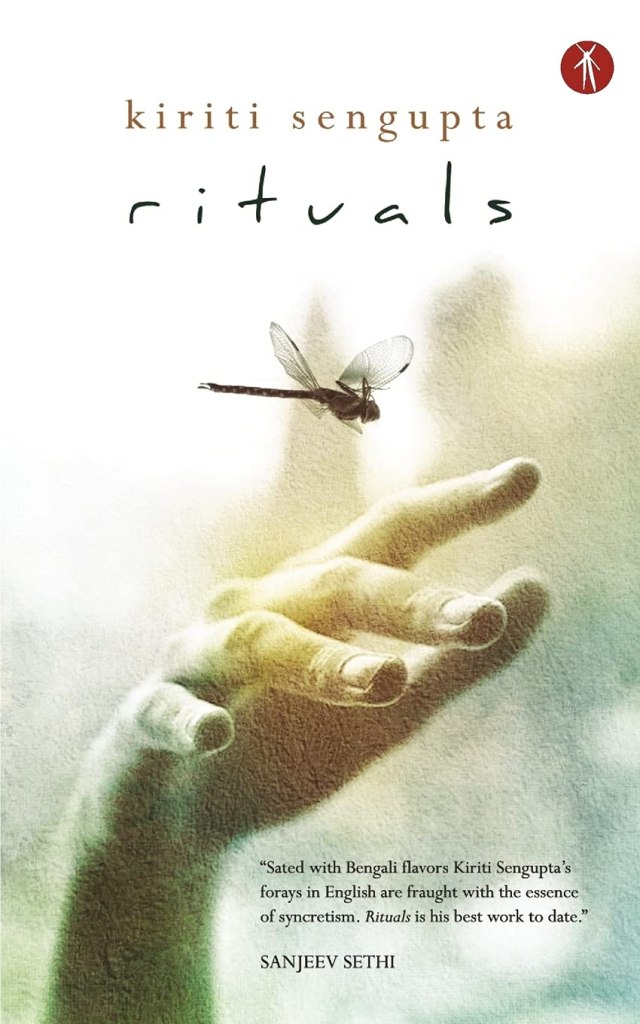
Kiriti Sengupta who has been awarded the Rabindranath Tagore Literary Prize (2018) for his contribution to literature, is a poet, editor, translator, and publisher. What is more significant is that along with Bitan Chakraborty, he mans the publishing house Hawakal, which has already carved a niche for itself as the largest publisher of Indian Poetry in English. Several poets mentioned in this essay have seen their creations see the light of the day through Hawakal Publishers and they have done yeomen service in this regard. As an established poet, Sengupta has several volumes of poetry to his credit. His collection from 2019, called Rituals, is very different from the work readers usually read in that there is a narrative thread in many poems that is not there simply to tell a story but to ultimately present a meditation on an aspect of life and the modern world that they haven’t considered before. “Fleeing the house and leaving the doors ajar. Is it perversion or fallacy?”

In an earlier volume entitled Solitary Stillness (2018), Sengupta does not give away the traits that have pervaded his poetry, he has not forgotten his Bengali roots, and has once again drawn his poetry on the canvas of the time that has been rooted in Calcutta. As he elaborates upon this point in his professional website, here, he makes a reference to Lapierre, and indeed, the ‘city of joy’ tag sounds fake just as we read that particular poem, which is so natural, that it almost appears to have been spoken by a resident of a city, one who is not a poet. According to him, that person who complains about water logging or that person for whom any tag of romanticism about the city is bourgeois, it is nothing but a label that’s needed to promote consumerism.

Mitali Chakravarty, the indefatigable editor of Borderless Journal, wrote to me saying that she is happy I feel she belongs to Bengal, “I call myself a Bengali and a human”. Though a non-resident Bengali, her perception of her own work and Bengali cultural identity is clearly revealed in a poem published in The Daily Star (Bangladesh)[2].

Confused

I am mixed up – cannot help
English and Bengali under my belt

I can read a bit of Hindi
Cannot understand much of French
A little Chinese …low class, they said…
I am mixed up – cannot help
English and Bengali under my belt

I grew up thinking I will find a way
But now pidgin is all that I can say
I write in English – the language borrowed from the West
The language that taught us or brought us unrest
The language that through The Raj spread
Importing Nationalism in its tread
I am mixed-up – cannot help
English and Bengali under my belt

But my life is that of the non-English
A probashi Bengali at best

People say I am not typical, not quite the right type
A mixed-up Bengali – I said
Culture is something I dread at every tread
Because what Culture I have is mine
- Not of a Race, a Country or Religion –
Human Being is the only race to which I belong

Help protect my home, the Earth – its every drop, its every stone

In a world of 7.7 billion, can I be alone?
I am mixed up – cannot help
English and Bengali under my belt

Though she has been writing poetry for a long time, Mitali’s first poetry collection, Flight of the Angsana Oriole: Poems was published by Hawakal only in October 2023. In the ‘Introduction’ to this volume, she states that her random collection of poems “are sometimes of the past” as she knew it and “sometimes of the present. And sometimes in quest of a future or a dream that she hopes will go to create a more hopeful future than the world presents to us currently.” The poems in this volume are personal; some talk of her journey through life, the world as she sees it, some even influenced by her travels across the world. She further states: “Inherent in each line is not just the influence of my experiences in many countries but the nurturing I had in India, where I was born, educated and spent the first two decades of my earthly existence.” So, poems like ‘Death of Lalon’, ‘Shivratri’, ‘Kali Rise’, ‘Shraddha‘ [last respects] and a few others do convey the subconscious Bengaliness embedded in her psyche, irrespective of where she physically resides now.

Radha Chakravarty, a prolific writer and translator, Former Professor of Comparative Literature and Translation Studies at Ambedkar University, Delhi, has recently joined the bandwagon of Indian Poetry in English with her debut collection of poems Subliminal published by Hawakal Publishers in 2023. In a detailed interview given to Mitali Chakravarty for the March issue of Borderless Journal[3], she tells us about her aims and ambitions as a poet and how most of the poems in Subliminal are independent compositions, not planned for pre-conceived anthology.

My poetry actually delves beneath surfaces to tease out the hidden stories and submerged realities that drive our lives. And very often, those concealed
truths are startlingly different from outward appearances. I think much of my poetry derives its energy from the tensions between our illusory outer lives and the realities that lurk within.

Many of Radha Chakravarty’s poems express the feeling of Bengaliness in different perspectives. We read about the typically soft quilt called kantha in Bengali in the poem ‘Designs in Kantha‘ thus:

Sewn into soft, worn layers,
forgotten fabric of grandmother tales –
patterns of the past,
secret memories, hidden designs,
intriguing patterns in silk strands
dyed in delicate dreamy shades—
embroidered storylines
in exquisite, dainty kantha-stitch.

When Mitali Chakravarty asks her why she writes in English though it isn’t her mother tongue, she answers:

Having grown up outside Bengal, I have no formal training in Bengali. I was taught advanced Bengali at home by my grandfather and acquired my deep love for the language through my wide exposure to books, music, and performances in Bengali, from a very early age. I was educated in an English medium school. At University too, I studied English Literature. Hence, like many others who have grown up in Indian cities, I am habituated to writing in English. I translate from Bengali, but write and publish in English, the language of my education and professional experience. Bengali belongs more to my personal, more intimate domain, less to my field of public interactions….
Both Bengali and English are integral to my consciousness, and I guess this bilingual sensibility often surfaces in my poetry. In many poems, such as ‘The Casket of Secret Stories,’ ‘The Homecoming’ or ‘In Search of Shantiniketan’, Bengali words come in naturally because of the cultural matrix in which such poems are embedded.

 Of course, the poet also mentions that all her poetry is not steeped in Bengali. In fact, in most of her poems, Bengali expressions don’t feature at all, because the subjects have a much wider range of reference. As a globe trotter, Radha has written about different places and journeys between places.

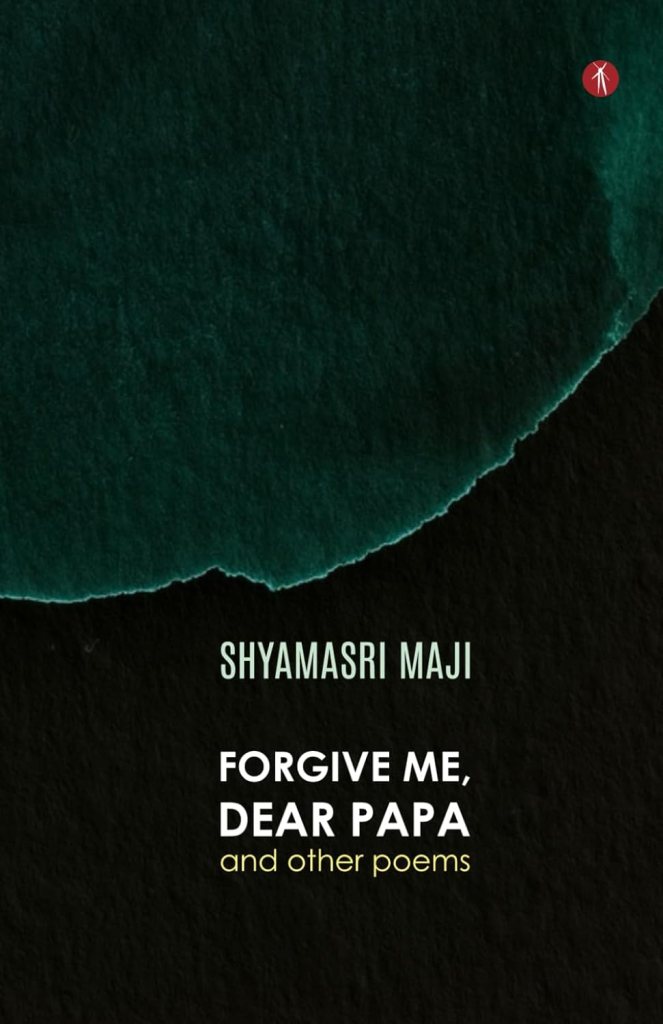
Another debut book of poems that Hawakal Publishers brought to light in December 2023 entitled Forgive Me, Dear Papa and other poems is written by Shyamasri Maji, an Assistant Professor of English teaching at Durgapur Women’s College, West Bengal. Dedicating this collection of poems to her “incurably romantic self,” Maji feels that “being ‘romantic’ in this context is being imaginative, reflective, puerile, rebellious and emotional.” The poems are a mixed bag, belonging to different thematic issues. Some focus on a woman’s radical views on the gender hierarchies in our society, in some nature plays the role of mediator between the narrator and the world, the idea of loss of love, which is closely linked with thoughts of death, while a few poems also represent an interpersonal dialogue between the self and the other. Some of Maji’s poems focus on the role of memory whereas some are experimental in the sense that they portray a woman’s comprehension of a man’s thoughts. Stressing upon the fluidity of identities, she shows how love, pain, pandemic, separation and grief affect all human beings irrespective of an individual’s gender and sexual orientation.

Six books of published poems and twenty-five years of creative journey has been a consistent exploration by the poet Sanjukta Dasgupta as she tries to find the path of freedom from among the misleading mesmeric mazes that threaten and stifle both sense and sensibility. As a woman poet with a strong feminist stance, Dasgupta admits in an online interview given to Basudhara Roy[4]:

Though I read Bangla poetry since my schooldays, I wrote my poems in English. It was an unconscious choice. Much later I learnt that I should have been embarrassed about writing in English rather than in my home language, my mother tongue Bangla. The poems written in English kept on being born on the page with embarrassing regularity.

She further states in the same interview[5]:

Writing poetry is an irrepressible urge for me. It is, in a way, far more intense than the biological labour pain. This labour pain of creativity leaves me restless till the words are born on the page. But the creative process allows endless revisions; a biological production is largely about acceptance, neither revision nor deletion are considered ethical practices. In the case of poetry, it is not about choice, it is a compulsion which is intense and gratifying and multiple revisions often lead to the emergence of the perfect product.

The title of Dasgupta’s poetry book Lakshmi Unbound (Chitrangi, 2017) is very significant. Lakshmi being an intrinsic part of the fabric of Bengali culture, the radicality and dissidence of the idea of ‘Alakshmi[6]’ will require no explanation to a Bengali reader.

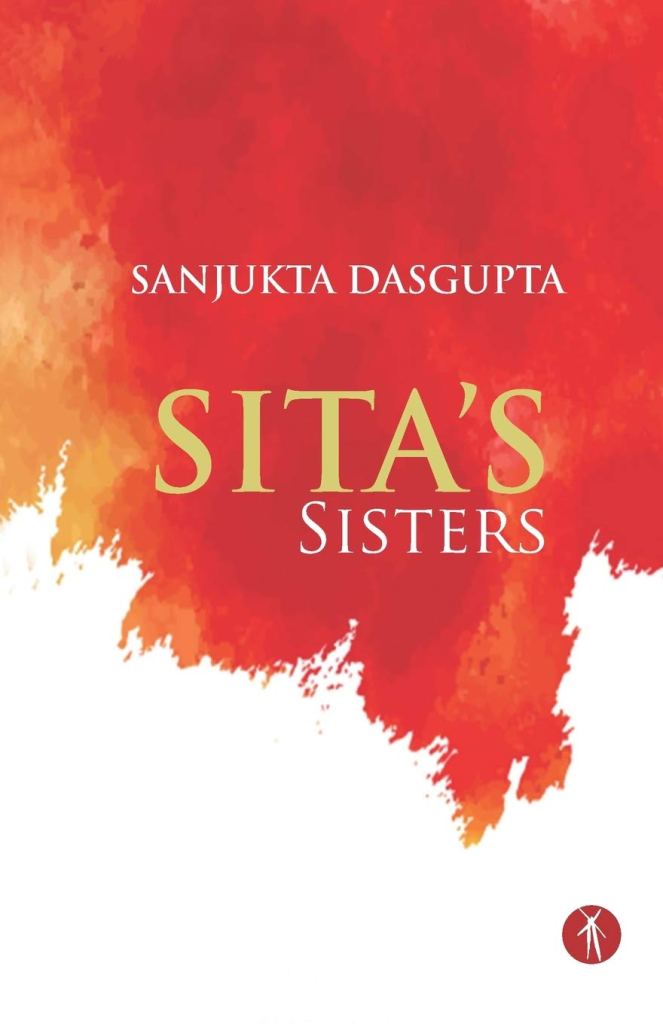
She thinks the core agenda in Lakshmi Unbound is a defiant, determined search for freedom.  So, it is not just deconstruction, it is an endeavour to call attention to the need to destabilize the deep-rooted stereotypes that have controlled the minds and mobility of women. In Sita’s Sisters (Hawakal, 2019), she crafts a revisionist feminist mythology by taking up familiar figures like Sita, Lakshmi, Kali, Mira and attempts to free these mythic figures from their claustrophobic space so that they can be re-invented in sync with the contemporary times. 

Residing in Jamshedpur, in the state of Jharkhand, Basudhara Roy is an established poet and has several books and publications to her credit. In her own website, is stated: “Committed to an undying affair with words, Basudhara finds in poetry an epistemological and existential skylight. She writes because she feels she must test words on her tongue, pulse, moods, agitation, abstraction and satire. She is convinced that words can change the world and hence, she works at them in her own culinary way – washing, peeling, grating, pounding, baking, sautéing, kneading, roasting, often flaming them for what they might yield.”

The following poem from Stitching a Home (Red River, 2021) considers the eternal problem of a woman that plagues women writers a lot.

The Right Kind of Woman

The right kind of woman will
inspire affection, regard, trust.
Not promiscuity, never lust.

Bred by a mother equally right,
she knows to avert her eyes to
innuendoes, telling smiles.

In crowded buses, shops, streets,
she knows to shut tight, bud-like,
relinquish space, circumscribe limbs.

Above all, she knows the prudence
of holding her tongue, of choosing
silence’s worth over wordy rebellion.

Schooled to surrender in dark
rooms, she knows, unasked, to
feign desire, moan, stifle, sigh on cue.

On her forehead, she had a
third eye to emit fire, take sides,
rake storms. Last night, its lid rusted

with disuse fell out, and the right kind
of woman laughed herself to death
over all she had left undone, unsaid.

“Writing poetry is an isolation exercise” says Angshuman Kar, an established Bengali poet who by profession is also an English Professor at a university in West Bengal. His book of poems Wound is the Shelter (Hawakal, June 2023) is unique and different from the other volumes discussed here because the poems are all translated by the poet himself from his original Bengali poems. In the ‘Introduction’, Kar tells us that authors who translate themselves often seem to be unhappy about the task of translating their own works. The Marathi poet Arun Kolkatkar likens it to incest, — “like making love to your own daughters.” Critics of translation studies have both supported and criticised self-translation. Those who support it argue that the author knows their work the best and hence s/he is the best translator of their own work. Those who oppose self-translation argue that the author-translator takes too much liberty while translating his/her own work; thus, the translation hardly remains faithful to the original. In such a situation Kar says, “Without being critical, I must say that I love self-translation. I enjoy translating my own work, I love committing incest. It makes me a better poet…. As a self-translator, I find incest healthy. It makes me a better poet – il miglior fabbro.

Coming to the individual poems in Wound is the Shelter, it need not be reiterated that most of them portray universal feelings but at the same time are seeped in Bengali culture as well. In “My Poems” Kar talks about Jungle Mahal, the three districts of West Bengal that are full of jungles; in “World,” he writes about blooms of a sal tree and shiuli flowers; in “Memory Card” he talks about a bus ride to reach his maternal uncle’s house in Bankura from where he went to the studio to take a family photograph — “Grandma in the middle/On either side we – three brothers, two sisters and a cousin”. In “Father” he mentions how his father’s bereavement fades with time and how his portrait adorns the wooden throne in which gods and goddesses are kept and he stands with Kali, Shiva and Durga. In “Neelkantha” he refers to Shiva; in “Park” he states how man forgets grief when he comes to a park, “That is why in a city as sad and lonely as Kolkata the number of parks is always high.” The five-part poem “Tiger” is also very powerful, “there is a tiger inside every human being” he states. Kar also mentions about the mask of a demon of Chhou dance of Purulia, the aal path in paddy fields, the Chandi mandap[7] of a small village, the man called Bhagaban Das who labours in a factory, and the man called Shubhasis Babu who rents him cars, whose voice he hears but has not seen him. Thus, even in his transcreated poems, Kar’s Bengaliness expresses itself overtly.

It is not possible to analyse the poems of each of the Bengali poets that I have mentioned above within the purview of this single essay, and so I have just selected a few of them (especially the poets who have one or two volumes to their credit at present). As mentioned earlier, though Bengali by birth, all the poets rendering their emotions in English, do often consciously or unconsciously express multicultural elements, Bengali cultural nuances, and idiomatic force in their poems. As the trend for providing glossary is passe now, much is left to the readers’ imagination, but still certain occasional Bengali words and phrases make their poems even more appealing.

After sharing my random thoughts about Indian Poetry in English in general and selectively mentioning a few Indian English poets who also happen to be Bengali and often unconsciously exude a sort of Bengaliness in some of their poems, without attempting to sound rather parochial, I wholeheartedly wish to see more volumes of their poetry being published in future. I conclude by quoting a very salient observation made by Arundhathi Subramaniam who is not wholly optimistic about the situation, but believes that despite hurdles in publishing, the voices of Indian poets writing in English would be heard [8]:

Despite the clunky discourse that continues to hover around it, however, Indian poetry in English endures, even flourishes, seventy years after Independence. Publishers may be few and far between, the royalties meagre, the critical climate thick with indifference or theoretical bluster, and the poets themselves bewildered by disputes over their identity, even their existence. But poetry, in its mysteriously resilient fashion, continues to be written, shared and discussed (if sometimes with more passion than discernment). … I am not ecstatic about the state of Indian poetry in English. (But then I am not ecstatic about poetry; only, at times, about poems.) What I do know is that Indian poetry in English is alive. And like all things alive, it engages, it annoys, it provokes, it excites. On several occasions, it has given me the jolt of wonder for which I turn to poetry in the first place.

Considering the slightly mellow tone in Subramaniam’s observation, I personally feel Indian English Poetry has become a significant force in the literary arena at present and will grow stronger with time. Seasoned poets who have several volumes of poetry published already, as well as the fresher ones whose debut volumes promise a lot more to come in future, can all look forward to seeing their ‘spontaneous overflow of powerful emotions’ in print and carry on the legacy of Indian Poetry in English to newer heights. And sure enough, the sub-genre of Bengali Indian English poetry can be researched in greater details in future.

.

[1] Henry Louis Vivian Derozio (1809–1831), poet and assistant headmaster of Hindu College, Calcutta, a radical thinker and started the Young Bengal Movement.

[2] Published in November, 2019. See http://www.thedailystar.net

[3] https://borderlessjournal.com/2024/03/14/the-subliminal-world-of-radha-chakravartys-poetry/

[4] https://lucywritersplatform.com/2022/05/12/sanjukta-dasgupta-in-conversation-with-basudhara-roy/

[5] Ibid.

[6] Alakshmi is one who is opposite of Lakshmi, a goddess who embodies prosperity and well being.

[7] Chandi Temple

[8] Subramaniam, Arundhathi. “Beyond the Hashtag: Exploring Contemporary Indian Poetry in English.” Indian Writing In English Online, 6 May 2022, https://indianwritinginenglish.uohyd.ac.in/beyond-the-hashtag-exploring-contemporary-indian-poetry-in-english-by-arundhathi-subramaniam/.

Somdatta Mandal, critic and translator, is a former Professor of English from Visva-Bharati University, Santiniketan, India.

.

PLEASE NOTE: ARTICLES CAN ONLY BE REPRODUCED IN OTHER SITES WITH DUE ACKNOWLEDGEMENT TO BORDERLESS JOURNAL

Click here to access the Borderless anthology, Monalisa No Longer Smiles

Click here to access Monalisa No Longer Smiles on Kindle Amazon International

Categories
Interview Review

The Subliminal World of Radha Chakravarty’s Poetry

In conversation with Radha Chakravarty about her debut poetry collection, Subliminal, published by Hawakal Publishers

Radha Chakravarty

Words cross porous walls
In the house of translation—
Leaf cells breathe new air.

We all know of her as a translator par excellence. But did you know that Radha Chakravarty has another aspect to her creative self? She writes poetry. Chakravarty’s poetry delves into the minute, the small objects of life and integrates them into a larger whole for she writes introspectively. She writes of the kantha — a coverlet made for a baby out of soft old sarees, of her grandmother’s saree, a box to store betel leaves… Her poetry translates the culture with which she grew up to weave in the smaller things into the larger framework of life:

Fleet fingers, fashioning
silent fables, designed to swaddle
innocent infant dreams, shielding
silk-soft folds of newborn skin
from reality’s needle-pricks,
abrasive touch of life in the raw.

--'Designs in Kantha’

She has poignant poems about what she observes her in daily life:

At the traffic light she appears 
holding jasmine garlands
selling at your car window for the price
of bare survival, the promise
of a love she never had, her eyes
emptied of the fragrance
of a spring that, for her, never came.

--‘Flower Seller’

Some of her strongest poems focus on women from Indian mythology. She invokes the persona of Sita and Ahalya — and even the ancient legendary Bengali woman astrologer and poet, Khona. It is a collection which while exploring the poet’s own inner being, the subliminal mind, takes us into a traditional Bengali household to create a feeling of Bengaliness in English. At no point should one assume this Bengaliness is provincial — it is the same flavour that explores Bosphorus and Mount Everest from a universal perspective and comments independently on the riots that reft Delhi in 2020… where she concludes on the aftermath— “after love left us    and hate filled the air.”

The poems talk to each other to create a loose structure that gives a glimpse into the mind of the poetic persona — all the thoughts that populate the unseen crevices of her being.

In Subliminal, her debut poetry book, Radha Chakravarty has brought to us glimpses of her times and travels from her own perspective where the deep set tones of heritage weave a nostalgic beam of poetic cadences. Chakravarty’s poems also appear in numerous journals and anthologies. She has published over 20 books, including translations of major Bengali writers such as Rabindranath Tagore, Bankim Chandra Chatterjee, Mahasweta Devi and Kazi Nazrul Islam, anthologies of South Asian writing, and several critical monographs. She has co-edited The Essential Tagore (Harvard and Visva-Bharati), named ‘Book of the Year’ 2011 by Martha Nussbaum.

In this conversation, Radha Chakravarty delves deeper into her poetry and her debut poetry book, Subliminal.

Your titular poem ‘Subliminal’ is around advertisements on TV. Tell us why you opted to name your collection after this poem.

Most of the poems in Subliminal are independent compositions, not planned for a pre-conceived anthology. But when I drew them together for this book, the title of the poem about TV advertisements appeared just right for the whole collection, because my poetry actually delves beneath surfaces to tease out the hidden stories and submerged realities that drive our lives. And very often, those concealed truths are startlingly different from outward appearances. I think much of my poetry derives its energy from the tensions between our illusory outer lives and the realities that lurk within. In ‘Memories of Loss’, for example, I speak of beautiful things that conceal painful stories:

In a seashell held to the ear
the murmur of a distant ocean

In the veins of a fallen leaf
the hint of a lost green spring

In the hiss of logs in the fire,
the sighing of wind in vanished trees

In the butterfly’s bold, bright wings,
The trace of silken cocoon dreams

So, when and why did you start writing poetry?

I can’t remember when I started. I think I was always scribbling lines and fragments of verse, without taking them seriously. Poetry for me was the mode for saying the unsayable, expressing what one was not officially expected to put down in words. In a way, I was talking to myself, or to an invisible audience. Years later, going public with my poems demanded an act of courage. The confidence to actually publish my poems came at the urging of friends who were poets. Somehow, they assumed, or seemed to know from reading my published work in other forms, that I wrote poetry too.

Did being a translator of great writers have an impact on your poetry? How?

Yes, definitely. In particular, translating Tagore’s Shesher Kabita (as Farewell Song), his verses for children, the lush, lyrical prose of Bankimchandra Chatterjee (Kapalkundala) and the stylistic experiments of contemporary Bengali writers from India and Bangladesh (in my books Crossings: Stories from India and Bangladesh, Writing Feminism: South Asian Voices, Writing Freedom: South Asian Voices and Vermillion Clouds) sensitised me to the way poetic language works, and how the idiom, rhythm and resonances change when you translate from one language to another. Translating poetry has its challenges, but it also refined my own work as a poet. Let me share a few lines of poetry from Farewell Song, my translation of Tagore’s novel Shesher Kabita:

Sometime, when you are at ease, 
When from the shores of the past,
The night-wind sighs, in the spring breeze,
The sky steeped in tears of fallen bakul flowers,
Seek me then, in the corners of your heart,
For traces left behind. In the twilight of forgetting,
Perhaps a glimmer of light will be seen,
The nameless image of a dream.
And yet it is no dream,
For my love, to me, is the truest thing …

What writers, artists or musicians have impacted your poetry?

For me, writing is closely associated with the love for reading. Intimacy with beloved texts, and interactions with poets from diverse cultures during my extensive travels, has proved inspirational.

Poetry is also about the art of listening. As a child I loved the sound, rhythm and vivacity of Bengali children’s rhymes in the voice of my great-grandmother Renuka Chakrabarti. She has always been a figure of inspiration for me, a literary foremother who dared to aspire to the world of words at a time when women of her circle were not allowed to read and write. A child bride married into a family of erudite men, and consumed by curiosity about the forbidden act of reading, she took to hiding under her father-in-law’s four-poster bed and trying to decipher the alphabet from newspapers. One day he caught her in the act. Terrified, she crept out from her hiding place, and confessed to the ‘crime’ of trying to read. Things could have gone badly for her, but her father-in-law was an enlightened individual. He understood her craving to learn, and promised that he would teach her to read and write. Under his tutelage, and through her own passion for learning, she became an erudite woman, equally proficient in English and Bengali, an accomplished but unpublished poet whose legacy I feel I have inherited. Subliminal is dedicated to her.

As a child I absorbed both Bengali and English poetry through my pores because in our home, poetry, and music were all around me. I was inspired by Tagore and Nazrul, but also by modern Bengali poets such as Jibanananda Das, Sankho Ghosh and Shamsur Rahman. In my college days, as a student of English Literature, I loved the poetry of Shakespeare, Donne, Yeats, T. S. Eliot and the Romantics.

Later, I discovered the power of women’s poetry: Emily Dickinson, Sylvia Plath and Adrienne Rich, to name a few. I am fascinated by the figure of Chandrabati, the medieval Bengali woman poet who composed her own powerful version of the Ramayana. Art and music provide a wellspring of inspiration too, for poetry can have strong visual and aural dimensions.

You translate from Bengali into English. How is the process of writing poetry different from the process of translation, especially as some of your poetry is steeped in Bengaliness, almost as if you are translating your experiences for all of us?

Translation involves interpreting and communicating another author’s words for readers in another language. Writing poetry is about communicating my own thoughts, emotions and intuitions in my own words. Translation requires adherence to a pre-existing source text. When writing poetry, there is no prior text to respond to, only the text that emerges from one’s own act of imagination. That brings greater freedom, but also a different kind of challenge. Both literary translation and the composition of poetry are creative processes, though. Mere linguistic proficiency is not enough to bring a literary work or a translated text to life.

English is not our mother tongue. And yet you write in it. Can you explain why?

Having grown up outside Bengal, I have no formal training in Bengali. I was taught advanced Bengali at home by my grandfather and acquired my deep love for the language through my wide exposure to books, music, and performances in Bengali, from a very early age. I was educated in an English medium school. At University too, I studied English Literature. Hence, like many others who have grown up in Indian cities, I am habituated to writing in English. I translate from Bengali, but write and publish in English, the language of my education and professional experience. Bengali belongs more to my personal, more intimate domain, less to my field of public interactions.

Both Bengali and English are integral to my consciousness, and I guess this bilingual sensibility often surfaces in my poetry. In many poems, such as ‘The Casket of Secret Stories,’ ‘The Homecoming’ or ‘In Search of Shantiniketan’, Bengali words come in naturally because of the cultural matrix in which such poems are embedded. ‘The Casket of Secret Stories’ is inspired by vivid childhood memories of my great-grandmother’s  daily ritual of rolling paan, betel leaves stuffed with fragrant spices, and arranging them in the metal box, her paaner bata[1]. When she took her afternoon nap, my cousins and I would steal and eat the forbidden paan from the box, and pretend innocence when she woke up and found all her paan gone. Of course, from our red-stained teeth and lips, she understood very well who the culprits were. But she never let on that she knew. It was only later, after I grew up, that I realised what the paan ritual signified for the housebound women of her time:

In the delicious telling,
bright red juice trickling
from the mouth, staining
tongue and teeth, savouring
the covert knowledge
of what life felt like in dark corners
of the home’s secluded inner quarters,
what the world on the outside looked like
from behind veils, screens,
barred windows and closed courtyards
where women’s days began and ended,
leaving for posterity
this precious closed kaansha* casket,
redolent with the aroma of lost stories

*Bronze

But I don’t agree that all my poetry is steeped in Bengali. In fact, in most of my poems, Bengali expressions don’t feature at all, because the subjects have a much wider range of reference. As a globe trotter, I have written about different places and journeys between places.

Take ‘Still’, which is about Mount Everest seen from Nagarkot in Nepal. Or ‘Continental Drift’, about the Bosphorus ferry that connects Asia with Europe. Such poems reflect a global sensibility. My poems on the Pandemic are not coloured by specific Bengali experiences. They have a universal resonance. I contributed to Pandemic: A Worldwide Community Poem (Muse Pie Press, USA), a collaborative effort to which poets from many different countries contributed their lines. It was a unique composition that connected my personal experience of the Pandemic with the diverse experiences of poets from other parts of the world. The poem was nominated for the Pushcart Prize. I guess my poems explore the tensions between rootedness and a global consciousness.

What are the themes and issues that move you?

I tend to write about things that carry a strong personal charge, but also connect with general human experience. My poems are driven by basic human emotions, memory, desire, associations, relationships, and also by social themes and issues. Specific events, private or public, often trigger poems that widen out to ask bigger questions arising from the immediate situation.

Sometimes, poetry can also become for me what T. S. Eliot calls an “escape from personality,” where one adopts a voice that is not one’s own and assume a different identity. ‘The Wishing Tree’ and the sequence titled ‘Seductions’ work as “mask” poems, using voices other than my own. This offers immense creative potential, similar to creating imaginary characters in works of fiction.

There are a lot of women-centred poems in Subliminal. Consider, for example, ‘Designs in Kantha’, ‘Alien’, ‘River/Woman’, ‘That Girl’, ‘The Severed Tongue’ and ‘Walking Through the Flames’. These poems deal with questions of voice and freedom, the body and desire, and the legacy of our foremothers. Some of them are drawn from myth and legend, highlighting the way women tend to be represented in patriarchal discourses.

The natural world and our endangered planet form another thematic strand. I am fascinated by the hidden layers of the psyche, and the unexpected things we discover when we probe beneath the surface veneer of our exterior selves. My poems are also driven by a longing for greater connectivity across the borders that separate us, distress at the growing hatred and violence in our world, and an awareness of the powerful role that words can play in the way we relate to the universe. ‘Peace Process’, ‘After the Riot’ and ‘Borderlines’ express this angst.

How do you use the craft of poetry to address these themes?

Poetry is the art of compression, of saying a lot in very few words. Central to poetry is the image. A single image can carry a welter of associations and resonances, creating layers of meaning that would require many words of explanation in prose. Poems are not about elaborations and explanations. They compel the reader to participate actively in the process of constructing meaning. Reading poetry can become a creative activity too. Poems are also about sound, rhythm and form. I often write “in form” because the challenge of working within the contours of a poetic genre or form actually stretches one’s creative resources. In Subliminal, I have experimented with some difficult short forms, such as the Fibonacci poem, the Skinny, and the sonnet. Take, for instance, the Skinny poem called ‘Jasmine’:

Remember the scent of jasmine in the breeze?
Awakening
tender
memories
bittersweet,
awakening
buried
dormant
desires,
awakening,
in the breeze, the forgotten promise of first love. Remember?

The last two lines of the poem use the same words as the beginning, but to tell a different story. The form demands great economy.

I pay attention to the sound, and even when writing free verse, I care about the rhythm.  Endings are important. Many of my poems carry a twist in the final lines. I mix languages. Bengali words keep cropping up in my English poems.

Are your poems spontaneous or pre-meditated?

The first attempt is usually spontaneous, but then comes the process of rewriting and polishing, which can be very demanding. Some poems come fully formed and require no revision, but generally, I tend to let the first draft hibernate for some time, before looking at it afresh with a critical eye. Often, the final product is unrecognisable.

Which is your favourite poem in this collection and why? Tell us the story around it.

It is hard to choose just one poem. But let us consider ‘Designs in Kantha’, one of my favourites. Maybe the poem is important to me because of the old, old associations of the embroidered kantha with childhood memories of the affection of all the motherly women who enveloped us with their loving care and tenderness. Then came the gradual realisation, as I grew into a woman, of all the intense emotions, the hidden lives that lay concealed between those seemingly innocent layers of fabric. The kantha is a traditional cultural object, but it can also be considered a fabrication, a product of the creative imagination, a story that hides the real, untold story of women’s lives in those times. Behind the dainty stitches lie the secret tales of these women from a bygone era. My poem tries to bring those buried emotions to life.

As a critic, how would you rate your own work?

I think I must be my own harshest critic. Given my academic training, it is very hard to silence that little voice in your head that is constantly analysing your creative work even as you write. To publish one’s poetry is an act of courage. For once your words enter the public domain, they are out of your hands. The final verdict rests with the readers.

Are you planning to bring out more books of poems/ translations? What can we expect from you next?

More poems, I guess. And more translations. Perhaps some poems in translation. My journey has taken so many unpredictable twists and turns, I can never be quite sure of what lies ahead. That is the fascinating thing about writing.

Thank you for giving us your time.

[1] Container for holding Betel leaves or paan

(The online interview has been conducted through emails and the review written by Mitali Chakravarty.)

Click here to read poems from Subliminal.

PLEASE NOTE: ARTICLES CAN ONLY BE REPRODUCED IN OTHER SITES WITH DUE ACKNOWLEDGEMENT TO BORDERLESS JOURNAL. 

Click here to access the Borderless anthology, Monalisa No Longer Smiles

Click here to access Monalisa No Longer Smiles on Kindle Amazon International

Categories
Greetings

Festival of Lights

After welcoming the dark half of the year with Halloween, we light lamps to observe yet one more homecoming festival — that of the legendary Rama. Though Diwali or Deepavali is interpreted variously in different parts of India, in the North, Rama’s homecoming after fourteen years of exile and victory over various demons is celebrated with the lighting of lamps and fireworks. Simultaneously, in Eastern India, they celebrate the victory of good over evil with the worship of Goddess Kali. In the Southern part, the victory of Krishna over a demon or asura known as Narakasura is jubilated. This festival is observed as a national holiday across a dozen countries now. There are a dozen different rituals, Gods and Goddesses correlated with the festivities. But victory of good over evil is a concurrent narrative along with prayers for prosperity and well being of the world. Both of these themes are a felt need in the present times.

In keeping with the theme of light, at Borderless, we celebrate this season with stories and poems connected with lights or lamps along with narratives around the festivals themselves… all from within our treasury.

Poetry

Light a Candle by Ameenath Neena. Click here to read.

One Star by Ihlwha Choi. Click here to read.

The Candle by Matthew James Friday. Click here to read.

The Starry Night by Sunil Sharma. Click here to read.

Prose

What Ramayan taught me about my parents: Smitha R gives a humorous recap of how the legendary epic brought the family together. Click here to read.

How a dark Goddess lights up a Fallen World: Meenakshi Malhotra talks of Kali and the narrative of the festival that lights up during this festive season. Click here to read.

The Dark House: A Balochi folk tale translated by Fazal Baloch that reflects on the crucial role of light in a young girl’s life. Click here to read.

Categories
Tagore Translations

The Golden Deer By Tagore

Written in 1910,  Amar Sonar Horin Chai ( I want the Golden Deer) is a popular Rabindra Sangeet that is often performed on stage. Seemingly simple, it explores the poet’s yearning for the intangible and ends with the sense of euphoria generated by his quest for the impalpable.

Sohana Manzoor’s interpretation in pastel & ink of ‘Amar Sonar Horin Chai’
The Golden Deer

Regardless of what you say,I want the golden deer.
Enchanting,nimble footed,I want that golden deer. 
He runs startled,eludes our gaze,and cannot be tied. 
If he comes within our reach,he escapes puzzling our vision. 
Chasing the elusive one who continues to evade capture 
Through fields and forests,I lose myself. 
Things that you can buy in bazaars are stored in homes.
Why do I look for that which cannot be bought?
I lost what I had while yearning for the intangible.
Do you think I am grieving for my lost treasures?  
I am content to live with a smile devoid of sorrow, 
Disappearing in my mind amidst meadows and woods. 

There is a reference to Sita’s yearning for the golden deer during her exile in the poem, an episode which led to her kidnapping by Ravana in Ramayana.

This poem has been translated by Mitali Chakravarty and edited by Sohana Manzoor on behalf of Borderless.