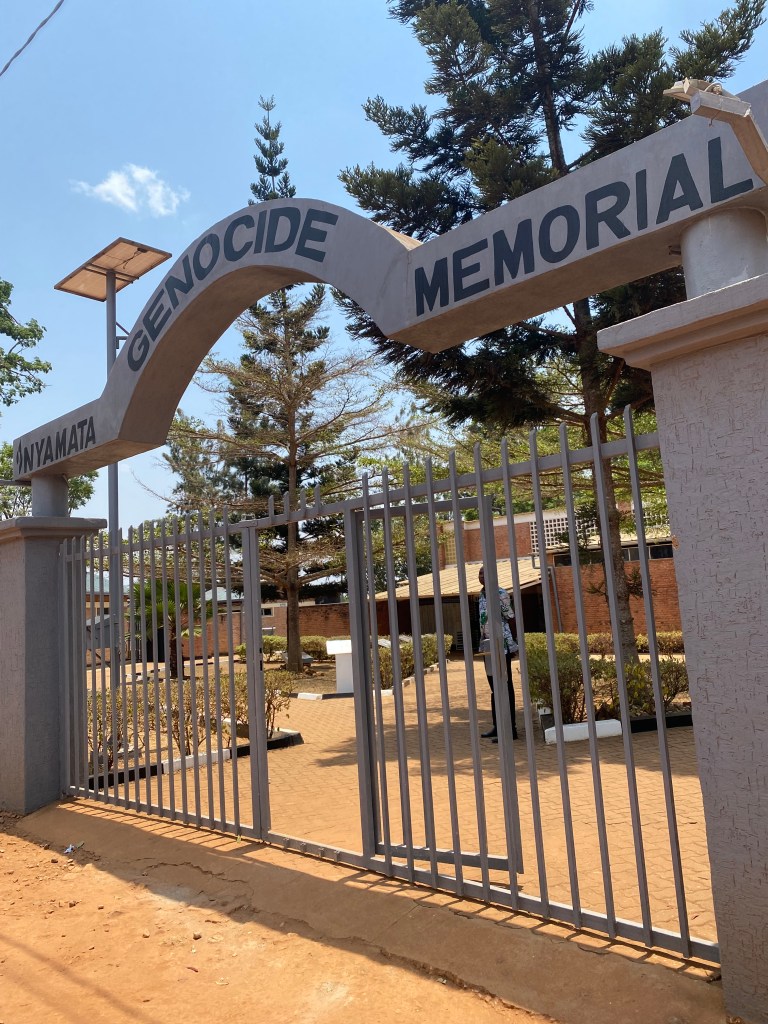
In late September, I visited Rwanda with a professor of Naruto University of Education in Japan and two Japanese graduate students. We traveled from Kigali, the capital city, to the Kayonza District, a rural area, to learn about the 1994 Genocide against Tutsi which necessitated peace education in Rwanda. In one month, around a million Tutsis and their sympathisers were systematically and viciously slaughtered by members of the Hutu ethnic group following government directives. This “final solution” was enacted via machetes and spears, often by classmates, co-workers, and neighbors. Just about everyone in Rwanda was affected by the horror in some way. Our driver told us that his father, sister, and brother were murdered at that time. Our interpreter, Claude Mugabe, was also a genocide survivor. He had been eight years old at the time, and he said that he remembered everything.
The animosity between two ethnic groups may be traced to the colonial period, when Belgians favoured the Tutsi, who typically had tall, slender bodies, high foreheads, and narrow features, for prestigious positions and privileges. Periodic violence against the Tutsis began in the 1950s and continues to this day, but Rwandans have made great efforts to ensure that the events of 1994 never occur again. We learned that Rwandan citizens are no longer required to carry identity cards indicating their ethnicity.
We visited a center which is a part of the Peace Education Initiative Rwanda. The three pillars of their program are peacebuilding and reconciliation, youth empowerment, and social economic development. We first gathered in tent where some photos of the massacre were displayed. Some community members, including those who had been alive at the time of the genocide and high school students, were gathered to share their thoughts and experiences with us.
Photograph by Suzanne Kamata
As birds sang and chickens squawked in the background, Mugabe explained some ways in which the people of his community have sought reconciliation, including sharing goats, building together, and working alongside one another. He emphasised that it’s important that everyone have their basic needs met. To this end, the community members fight against malnutrition, which can lead to diseases, through gardening vegetables and rearing animals such as goats and chickens, which provide milk and eggs.
Another important part of reconciliation, as we learned, is forgiveness. We heard moving –and often shocking – testimonies from both a victim and a perpetrator. We first heard from a woman who was a victim. She told us how she was harassed by her teachers after they learned that she was a Tutsi, and ultimately forced to drop out of school. She said that she spent some days and nights hiding in the bush. Her house was burned, and nothing remained. On April 9, she left her hiding place and sought refuge in the Catholic church. It was full, however, so she went to the cinema. On April 14, the Hutus attacked the church. Although the woman lost her sight, she said that she later received health insurance, and “Today we’re living in peace and harmony.”
Next, we heard from a man who was 30 years old, with a wife and two children, at the time of the genocide. He admitted that he had critical thinking ability, but he participated in the attack on the church, anyway, along with other civilians and members of the military. They were armed with machetes, guns, and grenades, and given thirty minutes to exterminate everyone in the church. They surrounded the church and opened fire, but they “succeeded” in killing only thirteen people the first day. He did not return the second day because his wife was sick. Later, he fled to Tanzania, but after being repatriated to Rwanda, he, like many others, was arrested and sent to prison. “I internalized what I did,” he said through the interpreter. He was filled with remorse. When he was released, he bought a cow for the victims, and asked for forgiveness. In the beginning, only 12 people were involved, but now almost 3,000 participate in peace education in the village.
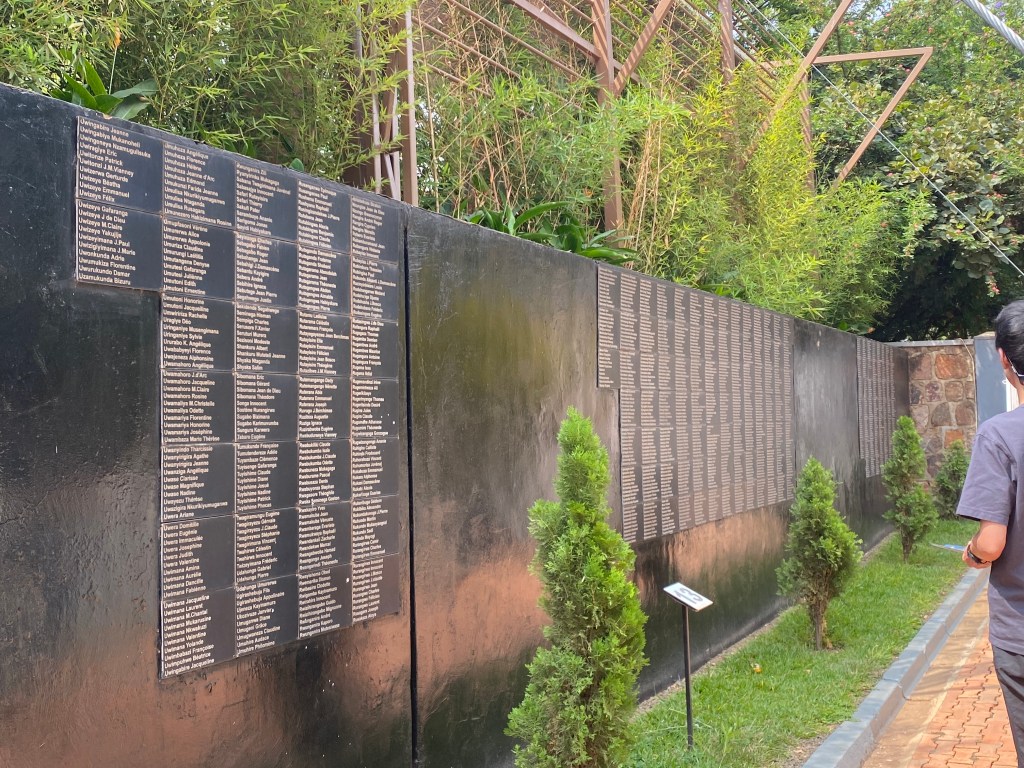
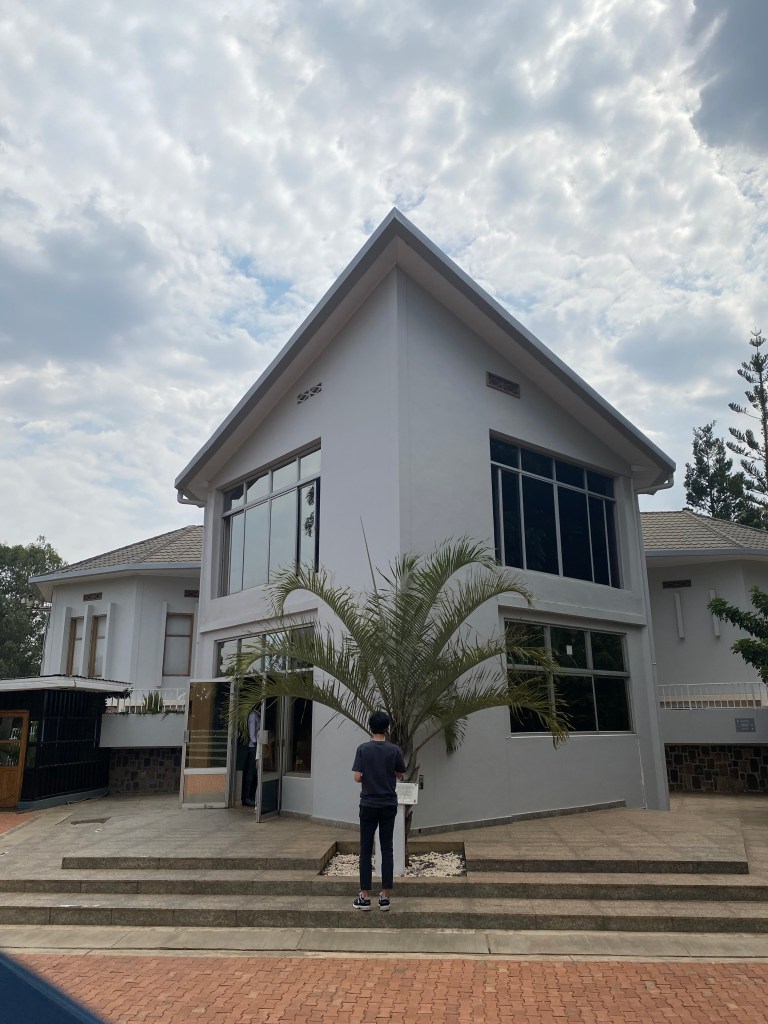
In addition to these community activities, peace education is an important part of the school curriculum in Rwanda. As in Japan, where students go on field trips to Hiroshima and Nagasaki to learn about the atomic bombing of those cities, Rwandan students visit sites related to the genocide, such as churches which now serve as memorials to those who died. We visited two such memorials. In one, the blood-stained clothing of the murdered was stacked on the church pews, while their photos were displayed on the wall. There were glass cases full of skulls, some with bullet holes, or larger gashes caused by clubs or machetes, as well as coffins full of bones. Though graphic and disturbing, these exhibits gave us an understanding of this particular tragic event and of the horrors of war in general.
As I thought about the divisions among people in my own country, the United States, all of the hate-filled rhetoric spewing from the mouths of politicians, and the move to silence voices from outside the mainstream, I couldn’t help thinking that some of these measures might be applied there, as well. What if we truly acknowledged that past? What if we shared our bounty? What if we asked for forgiveness? For now, I will remember what I learned in Rwanda. I will cling fast to hope.
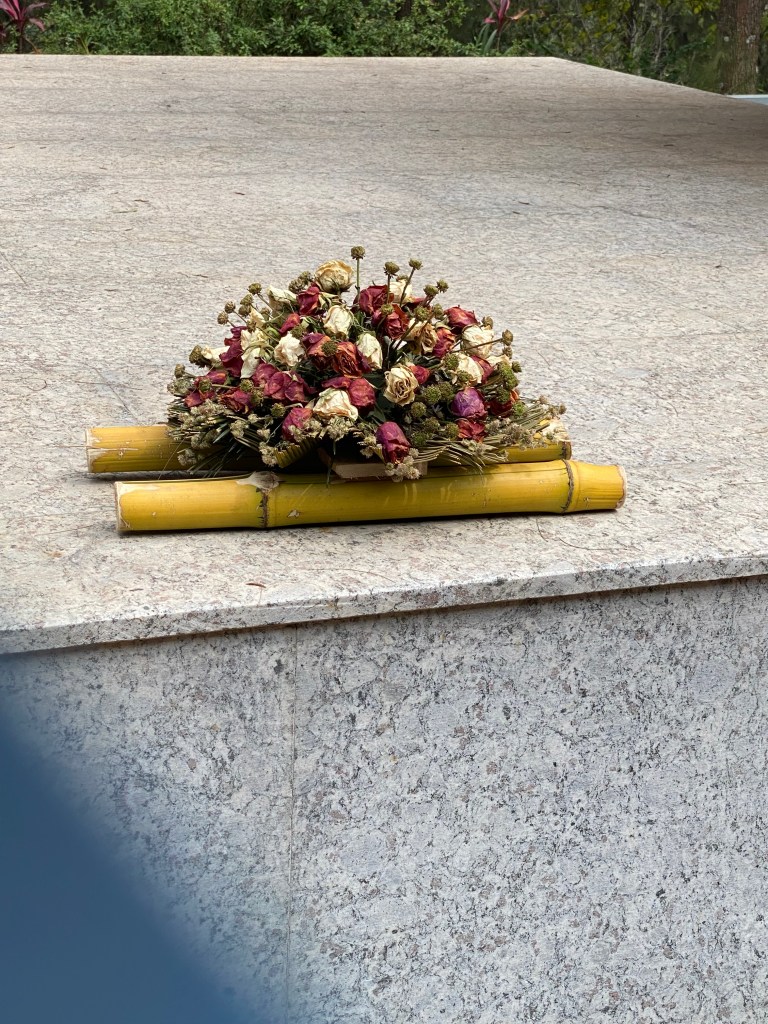
Photographs by Suzanne Kamata
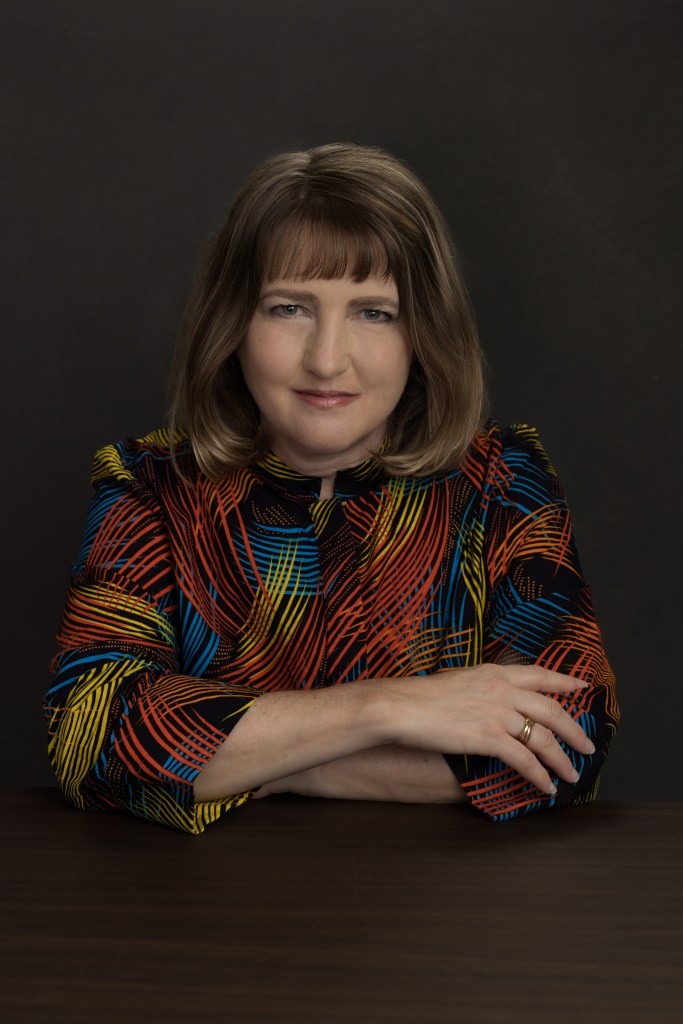
Suzanne Kamatawas born and raised in Grand Haven, Michigan. She now lives in Japan with her husband and two children. Her short stories, essays, articles and book reviews have appeared in over 100 publications. Her work has been nominated for the Pushcart Prize five times, and received a Special Mention in 2006. She is also a two-time winner of the All Nippon Airways/Wingspan Fiction Contest, winner of the Paris Book Festival, and winner of a SCBWI Magazine Merit Award.
PLEASE NOTE: ARTICLES CAN ONLY BE REPRODUCED IN OTHER SITES WITH DUE ACKNOWLEDGEMENT TO BORDERLESS JOURNAL
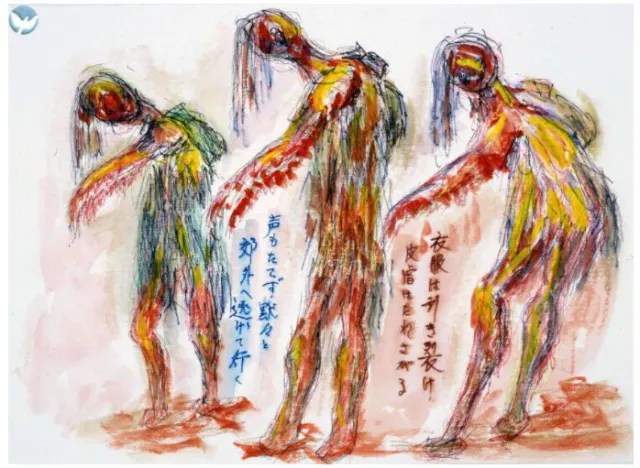
This painting/drawing is from artist Kichisuke Yoshimura, who said of it, “Their clothes ripped to shreds, their skin hanging down. On the riverbank I saw figures that seemed to be from another world. Ghost-like, their hair falling over their faces, their clothes ripped to shreds, their skin hanging. A cluster of these injured persons was moving wordlessly toward the outskirts.” Courtesy: Public domain
Almost eight decades after the Atomic Holocaust in Hiroshima and in Nagasaki, we still are looking for peace. These blasts destroyed humanity and the tenor of human lives. While nuclear treatise are still holding up, many parts of the world are warring over different issues… for borders we ourselves have drawn, for ideologies and pedagogies we ourselves have created. It has become difficult now to keep track of the terrors and horrors unleashed on unsuspecting citizens and innocents. There was a point of time, where kings settles their conflicts by fighting outside the cities with rules of war. But despite all the treatise and the deals, children are still dying in bomb blasts. Innocents are still being killed by missiles. One would have thought, humanity would have learnt from the past… But have we?
Showcasing the need for peace, we bring to you, recent poetry about the ensuing conflicts and some poems on the blast that killed innocents and maimed generations to come. We have an essay on an age-long conflict which does not seem to get resolved and the interview of a second generation Hibakusha who still suffers from the impact of the blast that had destroyed her mother’s world and left its imprints on the later generations.
Ratnottama Sengupta,comments on the current situation in Ukraine while dwelling on her memorable meeting with folk legend Pete Seeger, a pacifist, who wrote ‘Where have all the Flowers gone’, based on a folk song from Ukraine. Click here to read.
In Conversation with Suzanne Kamata about Cinnamon Beach, published by Wyatt Mackenzie Publishing, and a brief introduction to her new novel.
Suzanne Kamata
Cinnamon beach by Suzanne Kamata seems to be ostensibly a normal romantic novel but there is an aspect that makes it unique. It glues all colours of humanity together. Almost all the families in her narrative are of mixed heritage or multiracial. She has stepped beyond the veneer of race and nationality to highlight that all humanity has the same needs— for love, acceptance and kindness, irrespective of colour and creed, a gentle reminder in a world that is moving towards polarisation in terms of constructs made by human laws.
Set against the backdrop of the Cinnamon Beach, the narrative shuttles through two countries that she has called home — Japan and USA. There are autobiographical elements woven into the narrative but perhaps, they halt in becoming lived experiences. The protagonist, upcoming writer, Olivia Hamada, an American married to a Japanese, has lost both her job and finds her marriage in doldrums when she visits her sister-in-law, Parisa. Parisa is a renowned fashion designer, daughter of an immigrant Indian and has lost her husband, Ted, Olivia’s elder brother. It is a poignant story with Olivia and her deaf daughter, Sophie, falling in love with a star, Devon, and his son, Dante respectively — both persons of colour. Devon’s ancestors were brought in from Africa. So how mixed are the races – Sophie is half Japanese-half American and Dante is part African-part American!
The narrative start simply and gains nuances as it progresses. There are comments and conversations that introduce twists and turns to explore attitudes and prejudices.
At a point Kamata tells us: “She’d heard, several years ago, of a revolt at a liberal college cafeteria in protest of its serving sushi. And there was that dust-up over a reality TV star using the name ‘kimono’ for her new line of shapewear. Perhaps she had been wrong to ever go to Japan in the first place. But she had done it and she had gone and written a collection of short stories heavily inspired by events in her real life, and now, here she was.” The bias against Japan that led to the destruction of Hiroshima and Nagasaki are hinted at conversationally – world events that conspired more than eighty years ago. Why do such biases still exist today when we have moved forward so much technologically?
When Olivia asks Devon why he never liked to talk race or indulge in activism, he tells her, “It’s just that I would rather build bridges than burn them.”
And he explains further, “Sometimes taking a stand on issues creates more division.”
Religious observances seem to be unboxed too with Buddhist, Hindu and Christian customs intermingled. All festivals become a celebration of love and acceptance. Her world is idyllic when it comes to interactions between the lead characters. Living in a city like Singapore, that does not seem an impossibility as many are of mixed origins.
One would hope that the whole world will eventually learn that all these differences are only the colours of the rainbow, as shown in Kamata’s novel. The novel ends on a note of hope — hope for a new beginning and for love and for a multiracial relationship.
Kamata’s style is fluid. The situations and events are so much a part of the lived reality that you can almost feel and see the characters come to life. Anyone can enjoy the novel, whether as a light read or to find the nuances that explore the need for the redefinition of societal norms. With her smooth and untroubled storytelling, Kamata leaves it to the reader to decide what they want to find in her storytelling. Nothing is coerced or made incomprehensible.
With a number of novels, short stories and poetry collections under her belt, as an award-winning storyteller, Kamata guides us through her world skilfully leaving us with a feeling of having made new friends and gained deeper insight into myriad colours of humanity. In this interview, she talks about her writing, her novel and beyond.
Tell us when you started writing? And how?
I have been writing since I was a child. I loved reading, so perhaps it was natural that I would start to make up my own stories. I got a lot of encouragement from my teachers and parents, which inspired me to continue.
How many novels have you written in all? And which has been your favourite?
I have written seven, including young adult novels and one for middle grade readers. At the moment, Cinnamon Beach is my favourite, maybe because it’s shiny and new.
You do stories for children too and poetry. Tell us a bit about those.
I subscribed to a magazine called Ladybug for my children when they were young. I decided to try writing a story and submitting it to the magazine, and it was accepted. Other stories, inspired by my children, followed. For example, my son requested a baseball story. My middle grade novel, Pop Flies, Robo-pets and Other Disasters is the result of that.
What is your favourite genre to read and to write?
I prefer to read and write realistic fiction. The age level doesn’t really matter. I personally read everything from picture books to middle grade novels to adult novels.
How did Cinnamon Beach come about? How long did it take you to write the novel?
This was my pandemic book. I wrote most of it within a year, which is unusual for me. It usually takes me about four years to finish something. But I had a lot of free time during the pandemic, when I was alone in my office, and I wrote. I was kind of obsessed with what was happening in the United States, where things were much, much worse than where I live in Japan. I actually made a visit to the US at the height of COVID-19 because my father broke his hip. So, my thoughts were turned toward South Carolina, where my parents and sister-in-law live. Also, I had been thinking about writing a multicultural beach novel for some time. I enjoy reading novels set at the beach, but they usually feature only white people. My family is very diverse, so when we go to the beach together there is a very interesting mix of cultures. I wanted the book to reflect that.
What kind of research went into it?
As I mention above, I did visit South Carolina during the pandemic. I also talked about it with my sister-in-law, who is Indian American. She gave me some ideas and commented on the final draft. Other than that, I went for a lot of walks on a nearby beach here in Japan.
In Cinnamon Beach, you have woven in autobiographical elements. Tell us how much of it is from your lived experiences.
A lot of it starts with something true and then leaps into “what if”? I did lose my brother, but not during the pandemic. He died in 2019, and I attended his funeral, but what if he had died a year later, when travel restrictions were in place? Also, I did have a work experience similar to Olivia’s. I brought my story to a newspaper, but I found a new job before the story was published, and I asked that it not appear in print after all. But what if I had allowed it to be published? My daughter is deaf and she uses an app to communicate with non-Japanese users. As far as I know, she doesn’t have a secret boyfriend, but what if she did?
You have written of nepotism in a Japanese University. Is that based on your experiences, facts or is it fiction?
Olivia’s experiences at a Japanese university are based on mine. People often get jobs through connections in Japan.
Having been married to a Japanese for a number of decades, what are the cultural differences? How do you bridge them? Is that woven into your narrative?
There are so many! There are a lot of little ones, such as my husband’s expectation for homemade soup with every meal (which I find troublesome to prepare), and my expectation for some sort of celebration on my birthday (which is rarely met). And there are many greater differences. For example, I feel that people don’t take gender harassment as seriously in Japan as they do in my native country, or that they are unaware of what it means. Also, Americans are very forthcoming about mental health issues, whereas it seems more secret and shameful to talk about them in Japan. I don’t know that my husband and I have necessarily bridged our cultural differences, but I have accepted that we think differently about many things. Olivia is divorced, so she and her Japanese husband did not bridge them very well.
Are mixed marriages more common in Japan or America? Please elaborate.
Mixed marriages are much more common in the United States than in Japan. Marriages between Japanese men and Western women are quite rare. According to Diane Nagatomo’s Identity, Gender, and Teaching English in Japan, in 2013, less than 2 percent of the 21,488 marriages registered in Japan between a Japanese and foreign national were between Japanese men and American women. I doubt that those numbers have changed much.
Do such families — with Western, Japanese, Indian and black, exist outside your fiction? Please elaborate.
Certainly. The ethnic mix of the family in Cinnamon Beach is based on that of my own family. As another example, Nikki Haley, the former governor of South Carolina, is an Indian American married to a white man. Their daughter married a black man. Many children of my Western friends who are married to Japanese have partners who are of other cultures (neither Japanese, nor Western). I think Third Culture Kids tend to be very open to people from other cultures.
What books, stories, music impact your writing and how?
In the case of Cinnamon Beach, having read beach novels by authors such as Elin Hilderbrand, Dorothea Benton Frank, Mary Alice Monroe, Patti Callahan Henry, Kristy Woodson Harvey and Sunny Hostin made me want to write my own beach novel. I don’t know that music influences my writing, because I write in silence, but it was fun to come up with a playlist of songs that related to the book.
Having said that, I love music and I have known people in bands. The music world is fascinating to me, and I have created musician or music-adjacent characters in other books as well. The character Devon was inspired by the Black American Country and Western singer Darius Rucker. I knew him a bit in college, because he and his then-band sometimes practiced in the house next to mine.
What are your future plans? What other books can we look forward to from you soon?
Next up in a short story collection, River of Dolls and Other Stories, which will be published in November by Penguin Random House SEA. And I also have an essay collection (mostly travel narratives) in the works. Will keep you posted!
Thank you for giving us a lovely novel and your time.
(The online interview has been conducted through emails and the review written by Mitali Chakravarty.)
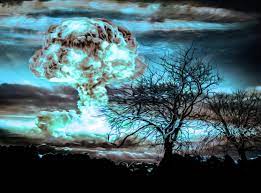
Atom Nuclear Bomb Explosion- Illustration “Atomic Landscape” Nagasaki, Japan 1946 Art by Robert Graham Courtesy: Creative Commons
When in 1945, the Allied forces dropped atom bombs on August 6th in Hiroshima and on August 9th in Nagasaki, the Second World War drew Japanese aggression to a halt. But what was the impact on the lives of those innocents whose home, family and future changed forever? Their lives were wrecked — within a few seconds for no fault of their own. The impact clearly continues to ravage the second generation, as can be seen from the narrative of a hibakusha’s daughter who shares her travails while expressing her candid views on the recent movie, Oppenheimer, and the sale of ‘Boppenheimer’ products. She writes: “I live with it1 now having a chronic progressive nerve pain disease. My damaged immune system is attributed to my mother’s exposure to radiation from the atomic bombing.”
Are we forgetting that past, where two whole towns were decimated by atomic bombings with uncountable numbers of deaths and suffering handed down generations? Will we repeat the horrific story again to resolve issues as conflicts continue to ravage the planet with weapons, without considering their impact on the already felt climate crises? Will there be a replay of the bombing of 1945 to annihilate a people, their way of life and create suffering among all humanity? We may not be around to comment on the outcome!
Way back in 2017, climate experts contended that in case of another such bomb blast, “The effect would be similar to that of the giant meteor believed to be responsible for the extinction of the dinosaurs. This time, we would be the dinosaurs.”
With that in mind, we hope for a world without wars. In this special edition, writings look for peace by creating awareness and suggesting alternatives. Kathleen Burkinshaw writes about the 1945 bombings and her perspectives on media packaging of mushroom clouds. We have a story from a soldier’s perspective during the First World War by the eminent Bengali poet, Nazrul, who fought in it as a soldier for the British army. Current conflicts show up in the writing of Ramy-Al-Asheq, who was born in a refugee camp in the Middle East. They move to Ukraine with voices of Lesya Bakun, a refugee on the run, and Ron Pickett, a US army veteran. Poetry on Myanmar in the past by Sister Lou Ella Hickman and a story of the Rohingya’s plight by Shaheen Akhtar brings the focus into civil wars within Asia. More poems by Don Webb and Michael Burch urge for peace through poetry. Awareness about conflicts that nonetheless impact an interconnected world are brought in with interviews with journalists who were in Afghanistan (Andrew Quilty) and Myanmar (Jessica Muddit) when the takeovers by the current regimes started. We conclude with a discussion for alternatives towards a better future with Anthony Sattin.
Non-Fiction
Mushroom Clouds and Movies: Response from a Hibakusha’s Daughter:Kathleen Burkinshaw, a second generation victim who suffers nerve disorders from the atom bomb dropped on Hiroshima, where her mother watched her own father perish, responds to the recent media packaging of the event. Click here to read.
The Refugee and the Other, an excerpt from Ever Since I Did Not Die by Ramy Al-Asheq, translated by Isis Nusair. Click here to read.
Poetry
I am Ukraine by Lesya Bakun, a refugee from Ukraine. Click here to read.
Wars and Rumours of War, a response on the war in Ukraine by Ron Picket, a a retired naval aviator with over 250 combat missions and 500 carrier landings. Click here to read.
My Visit to Myanmar in 1997, a poem about peace in the land where Buddha flourished by Sister Lou Ella Hickman. Click here to read.
Henais a short story by Nazrul from the perspective of a soldier during the first world war, translated from Bengali by Sohana Manzoor. Click here to read.
The Magic Staff is a poignant short story about a Rohingya child seeking refuge by Shaheen Akhtar, translated from Bengali by Arifa Ghani Rahman. Click here to read.
Interviews
A discussion about Afghanistan, with journalist Quilty who went back to Kabul as Taliban entered the city. Click here to read.
Keith Lyons talks to Jessica Mudditt, who watched from within the country as the Myanmar Junta took over. Click here to read.
Could there be a way out of this world wide unrest? A discussion with Anthony Sattinas he explores concept of brotherhood unique to earlier times, when borders were not this well defined. Click here to read.
*
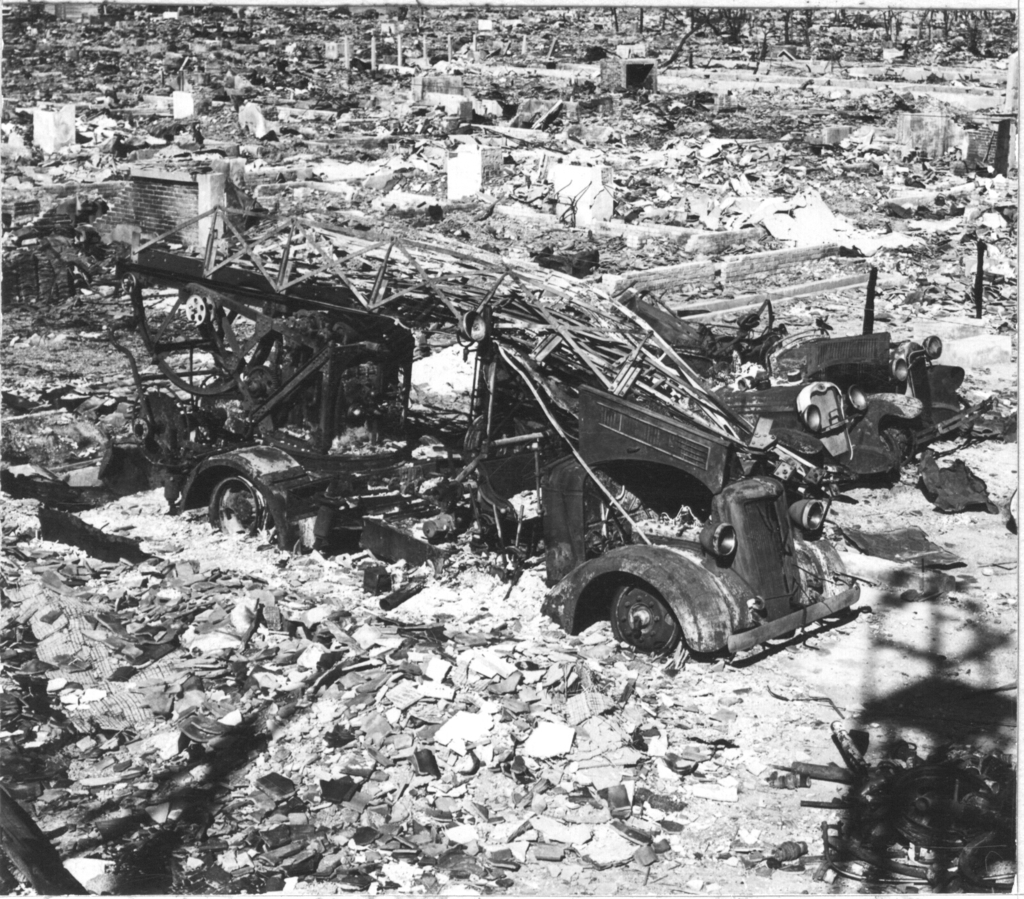
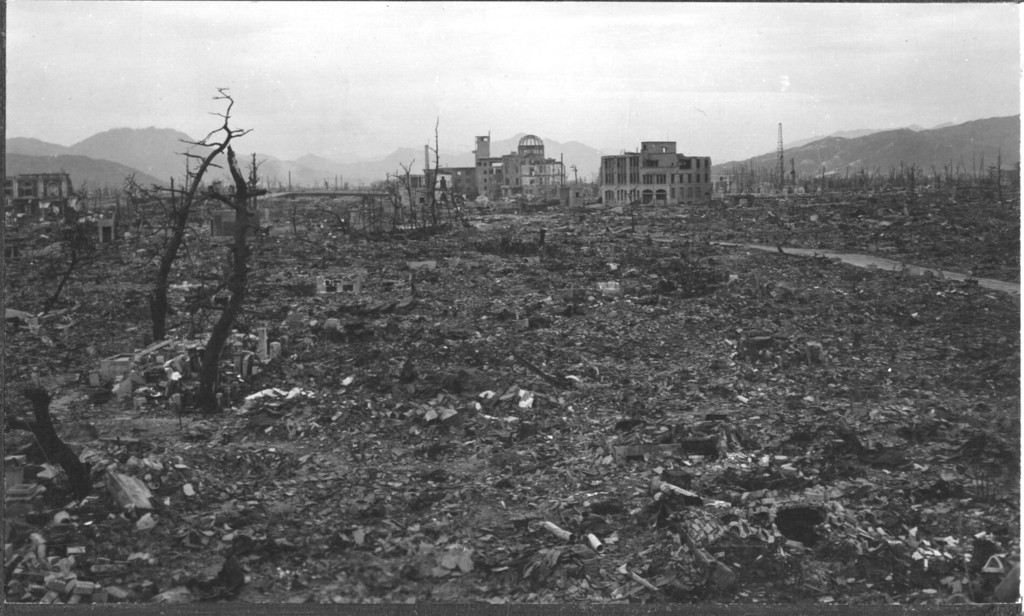
Hiroshima after August 6th, 1945Hiroshima after bombingCourtesy: Creative Commons
Will I see the Oppenheimer film? My answer – NO! I have no issues with the director, Christopher Nolan, as a person, nor toward the talented actors.
Do I hope people who haven’t considered nuclear weapons a current threat before, will now make nuclear disarmament part of their conversations (along with the demons plaguing a brilliant physicist during/after he developed the atomic bomb for our country’s war effort)? Yes!
That said, I don’t need to see Oppenheimer because I know how the story ends-even if they weren’t brave enough to show that in the movie itself.
I’ve needed some time to process my emotions after reading reviews, interviews, and social media posts. I discovered that Oppenheimer, even with 3 hours screen time, dismissed the rest of the story.
Spoiler alert — the bomb killed members of my family. My mother was 12 years old on August 6, 1945, in Hiroshima. She watched her beloved Papa die, lost her friends, and her home. 145,000 people died within the first 5 years of the bomb being dropped. And, not always mentioned — thousands survived only to carry the emotional/physical scars their entire life, unintentionally passing it on to their next generations-as my mother did to me.
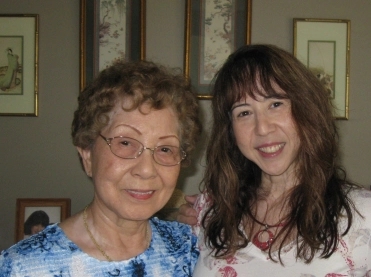
The novel tells her mother’s saga as a survivor of the Hiroshima blastKathleen Burkinshaw and her mother(left)Photos provided by Kathleen Burkinshaw
So, I find it appalling that neither the death, injuries, nor damage from the Hiroshima and Nagasaki atomic bombs were depicted. Not to mention the omission of victims who suffered/continue to suffer from the Trinity test, despite filming the explosion for Oppenheimer in New Mexico!
Oppenheimer is not the first film about Hiroshima or Nagasaki atomic bombing that I’ve avoided. I can’t even listen to the specific chapters depicting the bombing in the audiobook for my own novel, The Last Cherry Blossom (TLCB) — it’s no fault to the lovely, talented narrator. But researching and writing those chapters devastated me. I’ve read a short section of the bombing to students for more than 11 years, and I cry every time. I still hear the agony in my mother’s voice, her sobs each time she shared the horror of that day. I can still hear her screams as she relived them in her nightmares — nightmares that lasted her entire life. Just as she couldn’t unsee it, I can’t unhear the pain in her voice.
Greg Mitchell’s headline for his Mother Jones article,‘Oppenheimer’ is a Good Film that Bolsters a Problematic Narrative, also touched on another issue for me. Mitchell described the lone narrative used in the movie about dropping the atomic bombs, “… an officer who insists the Japanese won’t surrender otherwise, … a host of American soldiers will then have to die storming the country’s beaches…reminded of how savagely the Japanese have fought to the last man in other circumstances.”
Why is this problematic? It’s false. There were many complicated reasons involved in the decision to use the atomic bomb. To me, the American/Allied soldiers who fought, gave their lives especially in the last two pivotal Pacific battles, won the war. The atomic bombs were just science experiments and a warning to other countries.
This issue has been argued by many scholars*. Yet rather than debating the ‘why’, what matters now, in 2023 is showing the Hell that the atomic bombs (along with the mining/testing of nuclear weapons) unleashed 78 years ago.
I realise that Oppenheimer depicts a “singular dramatic moment in history…” a phrase referenced to Nolan on motionpictures.org post.
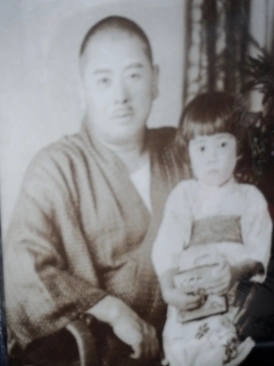
Kathleen Burkinshaw’s Grandfather & Mother. Photos provided by Kathleen Burkinshaw
But what about that same singular dramatic moment in the lives of Hibakushas (atomic bomb victims)? Because of that moment, I witnessed the frightening effects of my mother’s PTSD throughout my childhood — such as her hours in a darkened room holding the few pictures she had left of her loved ones.
I live with it now having a chronic progressive nerve pain disease. My damaged immune system is attributed to my mother’s exposure to radiation from the atomic bombing.
Before my last thought, I must mention that I began my mission to educate students about the atomic bombing of Hiroshima (and why my mother finally let me tell her story to students) 14 years ago, because my daughter (then in 7th grade) was so upset when she heard students discuss that “cool” #mushroom cloud picture.
She asked me to speak with her class about the PEOPLE under that famous mushroom cloud, like her Grandma. My mom finally gave me permission to discuss it. She realized these students are future voters and should know why nuclear weapons should never be used again.
I wrote TLCB not just to honor my mom, my family, and all the atomic bomb victims. I also wrote it so that readers could connect with the people in Hiroshima during the last year of WWII – to show that the children in Japan loved their families, worried what would happen, cried over lost loved ones, and wished for peace-Allied children were feeling and wishing the very same things. We must connect with the humanity under the famous mushroom clouds, so not to repeat the same horrific mistake. Students in my daughter’s class weren’t being cruel, they needed a connection.
And I must say, I’ve had the privilege of making this connection with thousands of students around the world. It’s these future voters/leaders’ compassion and empathy that gives me hope that peace and nuclear disarmament could be achieved.
Photos provieded by Kathleen Burkinshaw
You might understand then, why I’m furious about the “Boppenheimer” /”Barbenheimer” memes. Believe me, the irony of two movies so polar opposites premiering the same day hadn’t escaped me.
However, I’ve seen pictures of Barbie and Ken dolls in the cute pink convertible with the mushroom cloud behind them, swimsuit Barbie with sunglasses standing in front of a PINK mushroom cloud, and the worst – the mushroom cloud wall art. Yes, it exists,and it is NOT “…beautiful within the chaos…”
Under that mushroom cloud are 80,000 people that died immediately or within hours that day-like my grandfather. Many people evaporated from the extreme heat of that blast-with only their shadows left to prove their existence. No family should ever have to experience that ever again.
One final thought, followed by a final question. The atomic bomb dropped on Hiroshima had the strength of 15,000 tons of TNT. Even so-called low yield nuclear weapons (which is an oxymoron) have a strength higher than that. So, the next time a nuke is used it could be 800,000 people dead in a large US city, in one day. Tell me, would you want someone selling mushroom cloud art after your family members are killed under that same cloud, now that you know the rest of the story?
Kathleen Burkinshaw, the daughter of a hibakusha, is the writer of The Last Cherry Blossom, a book that has been adopted by the UNODA as Education Resource for students and teachers to sensitise the world about the suffering involved in the atomic bomb blast. She first wrote and published this article in her own blog.
PLEASE NOTE: ARTICLES CAN ONLY BE REPRODUCED IN OTHER SITES WITH DUE ACKNOWLEDGEMENT TO BORDERLESS JOURNAL
A story based on the end of a world war II soldier by Kamaleswar Barua in Assamese, translated by Bikash K. Bhattacharya
Ei Ran Ei Jivan, a collection of wartime narratives penned and published in 1968 by the Assamese writer, Kamaleswar Barua who served as a military engineer in the British Indian Army during the Second World War. Photo: Bikash K. Bhattacharya
Introduction
This is a translation of the narrative “Uehara” from Kamaleswar Barua’s Ei Ran Ei Jivan [1], a collection of narratives published in Assamese in 1968 based on “true events and characters” the author had encountered while serving as a military engineer in the British Indian Army in the Second World War.
Kamaleswar Barua is a relatively lesser-known figure in Assamese literature. Having earned a bachelor’s degree in Civil Engineering from the University of Calcutta in 1932, Barua joined the British Indian Army as an engineer serving in the Naga hills, Manipur and Burma. Attached to engineering field companies, he saw combat in some of the fiercest battles fought in the region in the course of the Second World War. He rose to the rank of major. After the war, Barua earned a master’s degree in City Planning from the University of California, Berkley, in 1951.
Barua was an active member of Assamese literary clubs and reading groups like the Mukul Sangha, a club formed in January 1945 in Shillong, the then capital of Assam. It was in the weekly meetings of Mukul Sangha that Barua shared his personal accounts of the war before turning them into written narratives. Uehara’s story was also first told to a small audience of Assamese litterateurs who encouraged Barua to publish it [2]. However, the project took a backseat for a long time and Barua finally published an anthology of nine narratives, “based on characters he’d encountered during the war”, in 1968. Titled Ei Ran Ei Jivan—which translates as “This War, This Life” or as “Now War, Now Life”—the anthology’s fourth narrative is “Uehara”.
What makes the anthology interesting is the novelty of the genre. The author terms it “a collection of kahini (narratives) about a few wartime characters.” The standard word for short story in Assamese is galpa, while the word kahini doesn’t refer to a specific literary genre. A kahini could be fictional, but it could also be a true historical account. The generic instability notwithstanding, Barua declares in the preface to the anthology, “The names of the characters have been fictionalised unless they’re historically well-known people. I’ve strived to remain true to the characters as best as I could as I’d known and witnessed them.” The preface makes it amply clear that the kahinis Barua tells us are a specific type of wartime memoir narratives rather than autobiographical short stories.
While Barua’s “Uehara” remains a little-known, obscure work, the most prominent literary artefact in Assamese depicting the Japanese in the Second World War in northeast India is Birendra Kumar Bhattacharyya’s short story ‘AgyaatJapani Xainik’ (An Unknown Japanese Soldier) [3]. However, “Uehara” is probably the only work in Assamese that depicts an actual historical encounter between an Assamese native serving the Raj and an Imperial Japanese Army soldier. Barua’s narrative not only portrays an empathetic picture of the mortally wounded Japanese soldier, which is rare in the region’s Second World War literature, but also evokes Pan-Asianism [4].
The original text, by Barua, didn’t contain any notes in it. The endnotes, referenced to academic works for driving home the broader historical context, or for the purposes of clarification, have been added by the translator.
Translation
Uehara
July, 1944. It wouldn’t be an exaggeration to say that Imphal, the capital of the Kingdom of Manipur, was completely encircled by the Imperial Japanese Army. The only way out of Imphal was via air [5]. The city had been maintaining contact with the outside world through Koirengei airport. The plains of Imphal were surrounded on all sides by circular formations of Japanese troops. The city of Imphal and the Allied troops and war equipment it hosted, had been under siege for three months. During this period, there had been several fights between Allied soldiers and Japanese troops just outside the city centre of Imphal. The Japanese suffered huge losses. Many Japanese soldiers were captured and kept as prisoners of war (POW) by the Allied forces. Those who died were buried in temporary graves. The wounded Japanese soldiers were treated in Allied military hospitals and despatched to POW camps in Imphal. Starvation and sleeplessness had taken a toll on their war-weary, scarred bodies. The medical treatment they received was far from satisfactory. Shortage of doctors, nurses as well as medical supplies made it difficult to meet the requirements of the wounded Allied soldiers [6].In such a dire situation, it was only natural that the Allied forces fell short when it came to providing medical care to the wounded enemy soldiers, the Japanese POWs. As a result, the tally of dead soldiers increased by the day.
I had been undergoing treatment at a hospital in the besieged city of Imphal. I was gradually recovering from an intermediate risk surgery. Wounded soldiers from the frontline were arriving at the hospital all the time. By then, I’d been well acquainted with the horrors of war. The scenes were indescribable. It appeared as if lives and limbs of men had little value. I’d become accustomed to the sight of countless wounded soldiers, without limbs or a portion of the face, being brought to the hospital on stretchers. This war was necessary in order to establish peace and freedom, especially individual freedom, they said!
The ward next to the one I was staying at was reserved for the wounded enemy soldiers. Armed sentries guarded the ward all the time. This was where I met Uehara, an Imperial Japanese Army officer who’d sustained severe combat wounds in his chest. The angel of death appeared to be calling him. Uehara expressed his desire to share his last words with a fellow Asian.
Following the order of the commanding officer of the hospital, a British interpreter with knowledge of the Japanese language accompanied me to Uehara’s bed. I sat on a chair close to his bed and the interpreter sat beside me. As Uehara started to speak in Japanese, the interpreter translated his words into English for me.
Uehara was from a small village located on the outskirts of the city of Nagasaki. He was born to a family of farmers. He studied Japanese language, mathematics, geography and Japanese history in the village school. He started assisting his father in farm work since he was sixteen. They had a small plot of land. They cultivated paddy twice a year, and on a separate plot of land, they planted soy bean and vegetables. They had a cow, a few pigs and a flock of roosters and hens. And they had a small but neat wooden house where the four members of the family—Uehara, his parents and his sister—lived. They also had a small garden consisting of a few cherry trees and chrysanthemums. The blossoming of the cherry flowers in the month of May would bring a joy-filled atmosphere to the family. Although their garden was small, they had different colours of chrysanthemums that decorated the courtyard. Uehara’s sister would take care of the garden. The Ueharas would not earn much but they had a stable and happy life sustained by whatever income they would gain from their farm.
But destiny would not tolerate the peaceful life of the Ueharas. Things would take a sharp turn, and dark clouds of misfortune hung in the heavens.
December, 1941. Japan bombed Pearl Harbour, and the President of the United States of America declared war on the Empire of Japan. The young men of Japan either volunteered for, or drafted to, the Imperial Japanese forces. Uehara was one of them. Having undergone training in Tokyo, he was recruited to the Imperial Guards Division of the Japanese Army where he rose to the rank of officer. While serving in Tokyo, he met Yuzuki, a military nurse.
Yuzuki had a round face, a bright pair of eyes and beautiful black hair tied to the back of her head. Uehara was enamoured of her spritely and empathetic behaviour. They fell in love and got married. As the newlywed couple was nurturing dreams about their future, Uehara’s regiment was ordered to Burma [7]. With teary eyes, Uehara and Yuzuki took leave from each other at the Tokyo airport.
Uehara was hopeful. He had unwavering faith in the Mikado [8] and that Japan would emerge victorious in the war. And once the war was over, Uehara would settle down with Yuzuki somewhere in a quiet corner of Nagasaki or Tokyo in a small house with a courtyard and a garden of cherry trees that would offer a nice view of daybreak on the seashore. There they would raise a small family. This youthful determination kept Uehara and Yuzuki going even in separation.
In the jungles of Burma, Uehara’s regiment kept advancing—capturing town after town, Hakha, Falam, Tedim—on their way to Imphal in Manipur. Along with other Japanese troops, his regiment also took part in the siege of Imphal. One day, during the Battle of Imphal, artillery shells hit his chest, severely wounding him. Once he regained consciousness, Uehara found himself in the Allied military hospital. The days that followed were very painful for him. The doctors, despite their efforts, could not stop the bleeding from the wound. Although war essentially entails killing enemy troops, the rules of war also dictate that one is responsible for providing medical care to enemy soldiers wounded in combat. That said, many wounded soldiers are left in the battlefield to die.
When Uehara was narrating his story through the interpreter, I could not understand his language. But I could feel a sense of calm in his voice. I felt that he had a gentle heart that bore no hatred towards anyone. I tried to figure out what could have been the source of his power: Was it in his Japanese culture? Or, was it in his love for Yuzuki?
Uehara politely asked me to take custody of a few articles he’d with him: a blood-stained silk handkerchief in which both Uehara and Yuzuki’s names were inscribed in Japanese characters, a gift from Yuzuki, he said; an incomplete letter to Yuzuki; a flag of Japan with a blazing morning sun on it [9]; and a sword. He requested me as a fellow Asian to keep these items so that I could return them to his wife, Yuzuki if someday I got such an opportunity. He then handed me a note containing Yuzuki’s address in Japan. I took the items from Uehara and came back to my ward with a heavy heart tormented by sombre thoughts. Alas, this is human life! This is how all the dreams and desires come to an end. The next day, I was told, Uehara passed away.
After the end of the war, my peripatetic life once took me to Tokyo. Needless to mention that I took along with me the items Uehara had entrusted in my custody. With the help of the Indian embassy in Tokyo, I informed Yuzuki about my visit and one afternoon I knocked at her door. Yuzuki and her mother greeted me into their small wooden house. The house consisted of only one large room. There were two floor looms on one side of the room while the other side had a raised wooden sitting arrangement. On the wall was a scroll inscribed with Japanese characters. A framed photo of Uehara in military uniform was placed in the middle of the scroll.
The two women slept on the wooden floor. They cooked in the small kitchen in an extended corner of the room. Yuzuki and her mother received me very warmly. Following the Japanese custom, I’d taken off my shoes before entering the house. It was no exaggeration to say that at that time Japan was under the occupation of the United States of America. Items manufactured in Japan at that time were labelled with the phrase ‘made in Occupied Japan’. The Japanese people had learned to speak English. Yuzuki too could speak English. So I didn’t face any difficulty in communicating with her. The two women were happy to receive me. I gave Yuzuki the items Uehara had left with me. She held each of the items close to her bosom and then placed carefully on a cloth spread on a wooden table. Her face radiated with satisfaction. I saw on her face a sense of determination and self-conviction rather than signs of past trauma. The two women then brought tea and bowls of rice and boiled fish. We had dinner together. I felt like an emissary bringing greetings and news from Uehara. I spent several hours in their company. I took leave from them at about nine in the evening. On the way, I noticed the bright and tender moon in the sky. The cherry flowers were shining under the pale moonlight and I could see ripples on the waters of a nearby lake. The ripening apples on the apple trees that I passed by looked astonishingly fresh. The earth is so beautiful! The people are so good!
Translator’s Notes
[1] Kamaleswar Barua, Ei Ran Ei Jivan (Guwahati: Kamaleswar Barua, 1968), p. 23.
[2] Preface to Ei Ran Ei Jivan.
[3] The short story first appeared in the seventh volume of the Assamese literary magazine Jayanti in 1943-44.
[4] Pan-Asianism is an idea, movement, and ideology based on an assumed cultural and ethnic commonality of Asians. It assumes the existence of common political and economic interests and of a shared destiny which necessitate a union of Asian peoples or countries to realize common aims. For more on Pan-Asianism see Sven Saaler and Christopher W. A. Szpilman (Eds.), Pan-Asianism: A Documentary History, 1850-1920, Volume 1 (Maryland: Rowman & Littlefield Publishers, 2011).
[5] Although the author here states that Imphal remained cut off by the Imperial Japanese Army till July, 1944, the British Indian forces succeeded in opening the Imphal-Kohima road on 22 June, 1944, thus ending the three-month long siege of Imphal. See Raghu Karnad, The Farthest Field: An Indian Story of the Second World War (New Delhi: Fourth Estate, HarperCollins, 2015), p.209.
[6] General Sir George J. Giffard’s despatch submitted to the British Secretary of State for War on operations in Burma and Northeast India, 16 November 1943 to 22 June, 1944, mentioned the “decided shortage of medical officers, and a serious shortage of nurses and nursing personnel, though there has been no general shortage of hospital accommodation.” See John Grehan and Martin Mace, The Battle for Burma 1943-1954: From Kohima & Imphal through to Victory, (South Yorkshire: Pen & Sword, 2015), p.115.
[7] Imperial Guards Division of the Japanese Army didn’t take part in the siege of Imphal and they primarily fought in Malaya, Singapore and China. However, it was not impossible that certain officers from Imperial Guards Division were deployed to the Japanese Fifteenth Army that laid siege in Imphal. In fact, during the invasion of Burma, the Fifteenth Army was commanded by General Shojiro Iida, who had previously commanded the Imperial Guards Division in the China Theatre of the war. See Peter S. Crosthwaite A Bowl of Rice Too Far: The Burma Campaign of the Japanese Fifteenth Army (Fort Leavenworth, Kansas: School of Advanced Military Studies, United States Army Command and General Staff College monograph, 2016), p. 27.
[8] Mikado (御門) is a term commonly used in English and other foreign language writings to refer to the Emperor of Japan. However, the term originally meant not only the Sovereign, but also his palace, the court and even the State, and therefore is misleading when applied only for the Emperor. The native Japanese instead use the term Tennō (天皇) for their emperor. See Kanʼichi Asakawa, The Early Institutional Life of Japan: A Study in the Reform of 645 A.D. (Tokyo: Shueisha, 1903).
[9] Perhaps it was a yosegaki hinomaru, a “good luck” flag gifted to Japanese servicemen deployed into battle. For more on yosegaki hinomaru see Michael A. Bortner, Imperial Japanese Good Luck Flags and One-Thousand Stitch Belts (Schiffer Publishing Ltd., 2008).
.
Bikash K. Bhattacharya is a graduate student of anthropology at the University of Texas at Austin from fall 2023. He is a bilingual author writing in English and Assamese. His works have appeared in Journal of Global Indigeneity, The Indian Express and Border Criminologies among others.
PLEASE NOTE: ARTICLES CAN ONLY BE REPRODUCED IN OTHER SITES WITH DUE ACKNOWLEDGEMENT TO BORDERLESS JOURNAL
“I was three years old at the time of the bombing. I don’t remember much, but I do recall that my surroundings turned blindingly white, like a million camera flashes going off at once.

Then, pitch darkness.

I was buried alive under the house, I’ve been told. When my uncle finally found me and pulled my tiny three year old body out from under the debris, I was unconscious. My face was misshapen. He was certain that I was dead..."

-- YASUJIRO TANAKA/ LOCATION: NAGASAKI/DISTANCE FROM HYPOCENTER: 3.4 KM, AFTER THE BOMB, https://time.com/after-the-bomb/
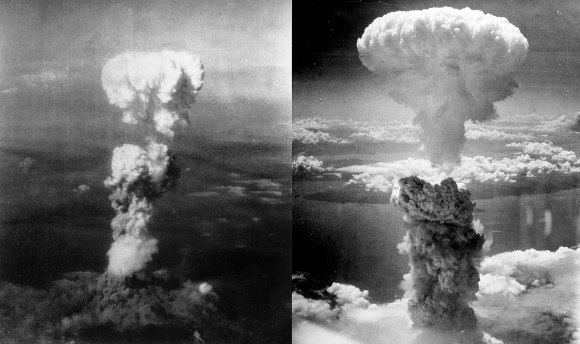
The two atom bombs that ended the Second World War. (1939-1945) Courtesy: Creative Commons
Recalling the incidents of 1945 — when two bombs were dropped in the name of peace destroying towns, populations and a way of life of innocents who had nothing to do with the aggressive invasion of the power-hungry, instilling suffering for generations to come, and justifying the whole incident in the name of peace — should have taught humankind lessons that we would never forget. When I read about the incidents, the horror of these make me shudder. Even the sky changed colours. The Earth grew barren as life on it writhed to an untimely halt, some wounded towards a painful end and some dead. Some of our species suffered in the most horrific ways. For some death lingered with pain. For others, life lingered with pain — both emotional and physical. Has that all been forgotten or erased from our minds?
Given the current global atmosphere, we perhaps most need to pray for peace: peace, to alleviate hunger; peace to be with loved ones; peace to have access to resources at a reasonable price so that all of us can afford to live in comfort. And yet the wars rage…
As we move ahead this year, poetry around war has proliferated in our pages, showing why we need peace. Today, in this issue we bring to you writing that looks for peace as well as our older pieces describing the horrors of the atom bomb in Hiroshima.
An interview with nuclear war survivor’s daughter, authorKathleen Burkinshaw, who continues to suffer the aftermath of the Hiroshima blast that only her mother had faced and has written a book, The Last Cherry Blossom, describing the horrors of the war, life before it and after. Clickhereto read.
Can Peace come Dropping by... An essay by Candice Louisa Daquin, contextualising the current global issues and exploring peace. Click hereto read.
The mother of a soldier once told me she did not agree that winning a war was a solution to peaceful living. She said, “If our army kill the enemy, some other mothers lose their sons; some other wives are widowed; some other children lose their fathers…”
Her summation of the war seems like an accurate description of the current day scenario. While politically the bombs that killed 140,000 in Hiroshima and 74000 in Nagasaki on 6th and 9th August respectively(1945), destroyed two cities, ended the Second World War (1939-1945) which claimed a total of 70-85 million lives over six years and led to the celebration of VE Day (Victory Europe Day), can we afford such horrors of violence and annihilation again? This is a question that remains in the grey zone as nuclear non-proliferation looks like agreeing to peace because the terror of war frightens. Will we ever have a world where peace is loved for the sake of what it brings and not for the fear of annihilation?
Writers in this special commemorate the horrors of the atom bomb and write their plea for peace. While American-Japanese writer, Suzanne Kamata, and Manjul Miteri of Nepal explore victimhood, Michael Burch talks of the Enola Gay, the legendary bomber that dropped “Little Boy” and annihilated a whole city. He reflects on the testing that continued on Bikini Island and further to ‘maintain peace’. We also have the words of Kathleen Burkinshaw who continues impacted by this terror — though it was her mother who was the hibakusha or survivor of the bomb blast. We round up this section with Candice Louisa Daquin’s reflections on peace and the reality as it is.
Oh Orimen! A poem in Nepalese about a victim of the blast written by a sculptor, Manjul Miteri, who while working on the largest Asian statue of the Buddha in Japan visited the museum dedicated to the impact of the blast. The poem has been translated to English by Hem Bishwakarma. Click hereto read.
Kathleen Burkinshaw is the daughter of a woman who survived the Hiroshima blast. Burkinshaw suffers neural damage herself from the impact of the bomb that her parent faced. She has written a book called The Last Cherry Blossomrecounting her mother’s first hand experiences. Her novel has been taken up by the United Nations as a part of its peacekeeping effort. She has been actively participating in efforts to ban nuclear weapons, including presenting with Nobel Laureates. Click here to read the interview.
“Nothing can be unconditional: consequently, nothing can be free.”


“Liberty means responsibility. That is why most men dread it.”

-- George Bernard Shaw,  Maxims for Revolutionists, Man & Superman (1903)
George Bernard Shaw (1856-1950), a great writer and playwright, used these epigrammatic lines to bring focus on what people thought was liberty or freedom from oppression, from regimes that were dictatorial. While discussing concepts of freedom, one does wonder if political freedom solves all humane issues, occasions we celebrate with great aplomb, like the birth of a nation.
This month started with the observance of July 4th, the date of the American Revolution in 1776 and the publication date of Whitman’s Leaves of Grass in 1855. In between these two years, in 1789, ten days down the line, on July 14th, another significant occurrence has been handed down by history to be celebrated as the Bastille Day— the day prisoners were freed from Bastille, a major event that led to the overthrow of the insensitive monarchy in France, a symbolic resurgence of the common, exploited man that has often been seen as an inspiration for later uprisings to reinforce the concept of democracy or liberté, égalité, fraternité.
As we move forward in time, towards August, one wonders if liberty attained by these means was good for all fellow humans? France was part of the Allied Forces that with America taking the lead dropped not one but two atom bombs on Hiroshima and Nagasaki on August 6th and 9th, 1945, to end the Second World War. Did the ends justify the means? Reflecting the cry and suffering of these victims, we have poetry from Suzanne Kamata, a well-known writer from Japan. Michael Burch on the other hand has shared poetry with us which shows how the nuclear programme continued unrepentant despite the devastation it caused. One must give kudos to the descendants of the victims of the nuclear blast that they have forgiven the perpetrators, admitted their own hand in the Second World War and moved ahead. In that spirit, we have an essay on peace by Candice Louisa Daquin, who joins the Borderless team as a writer-in-residence.
We have much happening in poetry this time with an interview of American poet Jared Carter, a recipient of number of awards and fellowships, including the Walt Whitman Award and the Guggenheim fellowship. He walks us through how he created the poem ‘Yeti’ (first published in the May edition of Borderless) and talks of the impact of artifacts from China and India on his own thought processes, the impact of Du Fu (712-770) and much more. We have a poem in Du Fu’s style this time by George Freek and an interesting poem with a Chinese title by Carter, a title that can have multiple connotations and yet each seems to fit the poem perfectly.
Rhys Hughes has brought humour into our pages with both his poetry and essay on William Mcgonagall, who bore the sobriquet of the worst writer in the world through his life and had things thrown at him when he read his poetry in Dundee. Yet, his work survived the beatings, and he lives on known as the ‘Scottish Homer’.
More poetry by Singaporean poet Marc Nair gives us a glimpse of the little island as viewed by someone who has grown up on it. Poetry is always multi-hued, and we have Lorraine Caputo transport us to a Garífuna village in Honduras. Penny Wilkes takes us ‘Down the Path of Nostalgia’ with a mix of old and new photography, prose and poetry on how almost a decade after the end of the Second World War, she started her love affair with photography and nature. It hovers between poetry and musings, and this time we have a rare musing by Jared Carter too. Devraj Singh Kalsi continues cogitating with wry humour while arranging bookshelves. We also have the backpacking granny visitingIndonesia. Post sharing this trip, our granny — Sybil Pretious — plans a little break from publishing to complete her memoirs.
A riveting flash fiction by Kaiyi Tan celebrates the spirit of conquest in these dark times, weaving into the pandemic lore the quest for personal freedom. Stories this time carry a real life one by Jean Kortum on adoption — her own struggle. But then, stories can be real or unreal – draw a bit from both to reflect bigger truths or create alternates that sink into the human mind as a perceived reality and leave an imprint deep inside the heart, like that of Niles Reddick. My conviction is that some lived experiences of writers seep into each story, whether it is from Bangladesh or India or by our literary fictionist, Sunil Sharma. His narrative continues infused by suspense.
We have a complete translated story of Tagore by Radha Chakravarty as our book excerpt this time. ‘The Parrot’s Tale’, ostensibly part of a children’s collection, reflects Tagore’s response to conventional schooling — a reason for him to start Shanti Niketan perhaps. She has also shared two of her translations of Rabindranath’s songs from Bhanusingher Padabali (1884, Bhanusingh’s verses). Chakravarty generously consented to an interview and has given us a glimpse of her journey as a translator and critic. We also have translated a long poem by Tagore on our pages, a poem that inspires hope, though it was named Dushomoy (1897, Bad Times) finally. The original name had been Swarga Patthe (On the Path to Heaven) as can be seen from a page in his diary. We have been fortunate in finding a recording of his voice reciting the poem in Bengali and the print of a sample page of the manuscript bearing his signature.
We continue with Akbar Barakzai’s poetry translated by Fazal Baloch from Balochi – this time addressed to his daughter reminding for some reason of Nehru’s Letters from a Father to his Daughter — a book I read as a child. In addition, we have translations from Korea and Bosnia & Herzegovina, from where the young poet, Maid Corbic, has taken up the concept of freedom of the self and of the nation, both together.
Keith Lyons from New Zealand in his very brief essay has quoted American novelist William Faulkner, “We must be free not because we claim freedom, but because we practice it.” And perhaps we need to remember this if for no other reason, then, just to maintain our own sanity in these strange, almost unreal times as we attempt to unite as humankind to free ourselves from an unknown and unfathomable virus.
In a more sombre note, last week, untroubled by the virus, a victim of cancer, Bollywood legend Dileep Kumar, aged 98, breathed his last. Ratnottama Sengupta adds an unusual colour to the Borderless Journal with her tribute to this hugely acclaimed actor. In the process, she unfolds for us a brief history of the Indian cinema, and a glimpse of a world that transcends all man made constructs in quest of perfection.
We have an interesting set of reviews this July. Rakhi Dalal has reviewed Anuradha Kumar’s riveting short story collection, A Sense of Time. A murder mystery for young readers, Murder at Daisy Apartments by Shabnam Minwalla, has been reviewed by Gracy Samjetsabam. The Third Eye of Governance–Rise of Populism, Decline in Social Research by Dr N Bhaskara Rao, reviewed by Bhaskar Parichha, seems to be a non-fiction that looks forward to bridging gaps between academia and the real world, a truly felt need. Parichha has also given us an essay on a man who inspired Ian Fleming, the creator of James Bond, to make him a part of his lore, a journalist who moved around all of Asia with equal aplomb and a sense of humour – a truly global citizen called Richard Hughes.
I want to thank all our wonderful contributors for making this edition a reality. And readers, we leave you to explore the unknown… like that place we call outer space. A huge thank you again to not only all our wonderful contributors, our faithful readers but also to the fabulous Borderless team scattered across the world.
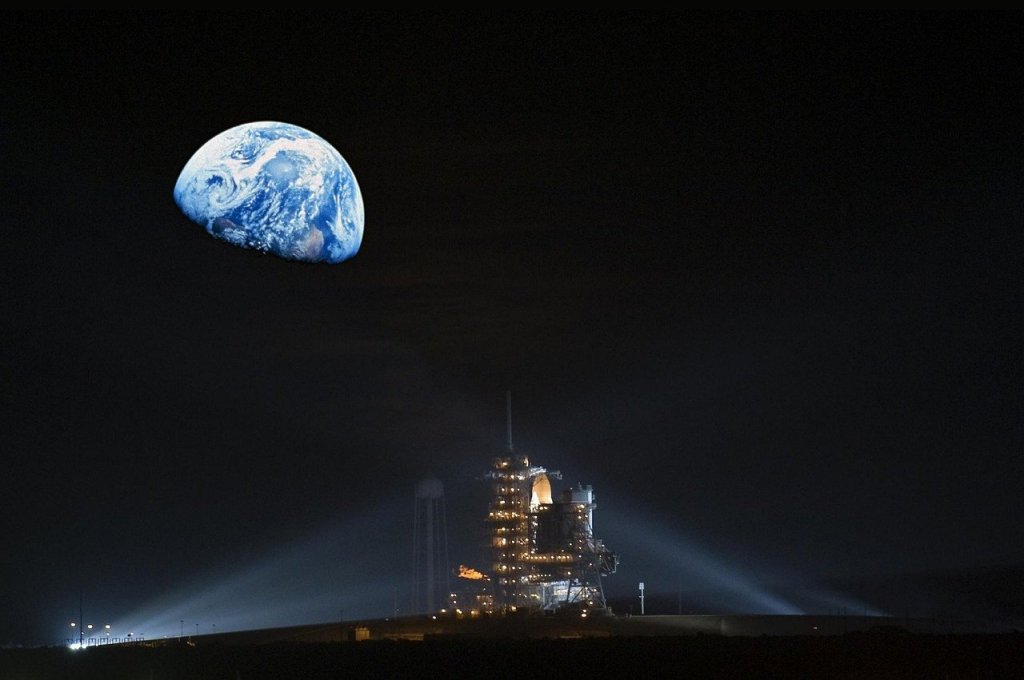
Before I wind up, a little bird trills a song of hope in my ear. Business tycoons have started stepping into the mysterious void of space to eventually – let us hope — create affordable travel for common man, though it has started off as an expensive proposition. Will this be an industry that will generate more jobs on and off Earth and find new places for man to inhabit? After all, when George Bernard Shaw wrote his plays and essays, we had yet to cross the frontiers beyond Earth, had never even thought of flying across the world in budget airlines or mining moons!
Will we have a new world, a new outlook and a new set of hopes and aspirations as we stretch the frontiers of our home planet?
Wish you all a wonderful month of reading and thinking.
Three moving poems on the nuclear blasts that ended the Second World War and the lives of many innocents in Hiroshima & Nagasaki on August 6th and 9th, 1945, respectively.
Hiroshima School for GirlsAugust 6, 1945
The day began like any other:
all of us lined up for morning
drills beneath a clear sky,
mock wooden rifles propped against
our shoulders. Suddenly there was a sharp
blue light like a camera flash.
Teacher cried
“Down!”
We tossed our
guns aside, dropped to
the ground, thumbs in
ears, fingers over
eyes to protect
them from damage
just as we’d practiced.
(Published first in Skipping Stones)
At that Moment
I was in the schoolyard
singing the Student Brigade song
when a B-29 flew overhead.
A verse appeared in my mind:
Madness reigned
on the the bloody
battleground of Saipan.
After the flash
silence
the city, destroyed
transformed into ruins.
Next thing I knew
I was sitting in a field
barefoot
gazing at clouds of dust
houses without roofs.
Rain began to fall
drops drumming on
the ground, my body
staining my uniform
with brown spots.
Everything around me was
painted gray.
Burnt people lay along
the riverbanks. A woman
stared from swollen sockets
her hair charred
only a wisp of clothing on
her shoulders. From her
twisted mouth:
My child! My child.
My Daughter
Etsuko left home wearing
baggy pants and a straw hat,
school bag on her back.
At 8:15
flash
explosion
inferno
Men and women
burnt, drooping
drifting from Hiroshima
like sleepwalkers.
We waited.
Etsuko didn’t return.
Clinging to hope we searched
through smoldering rubble
heaps of corpses, among
ravaged victims pleading
for water, begging for help
naked women stooping at
bridge girders.
At 6 p.m.
we headed home.
Someone said, “Etsuko’s here!”
But she was scorched, every
limb swollen, her eyes blinded.
“I was with a friend,”
Etsuko said. “We went
west with the wind
crawled across the train
bridge, came back to Koi.”
I brought her to the
emergency clinic where scores
were treated, died anyway.
The next day, Etsuko
opened her eyes. A miracle:
“I can see!” she said.
”Good. We’ll be going
home soon.”
Etusko gazed at me
and departed this world at
10:15.
(“At that Moment” and “My Daughter” were first published in When Women Waken)
Suzanne Kamatawas born and raised in Grand Haven, Michigan. She now lives in Japan with her husband and two children. Her short stories, essays, articles and book reviews have appeared in over 100 publications. Her work has been nominated for the Pushcart Prize five times, and received a Special Mention in 2006. She is also a two-time winner of the All Nippon Airways/Wingspan Fiction Contest, winner of the Paris Book Festival, and winner of a SCBWI Magazine Merit Award.
.
PLEASE NOTE: ARTICLES CAN ONLY BE REPRODUCED IN OTHER SITES WITH DUE ACKNOWLEDGEMENT TO BORDERLESS JOURNAL





 Borderless