Categories
Excerpt

Cinnamon Beach

Title: Cinnamon Beach

Author: Suzanne Kamata

Publisher: Wyatt-Mackenzie Publishing

Olivia

Olivia had cruised along I-26 from the capital to the coast of South Carolina more times than she could count, but this time was different. Back in the day, she had ridden shotgun in a girlfriend’s convertible, with a passel of other co-eds in the back, on their way to spring break and beer and boys at the beach. Or, another time, it had been in her yellow VW Beetle, on the way to see the do-gooder surfer guy she thought she couldn’t live without, the one who spent the summer at Myrtle Beach and took her to that place where they tossed their clam shells onto a sawdust-covered floor. Then there was that excursion to Hilton Head Island with Masahiro, before they got married, the one where he freaked out when he saw an alligator sunbathing on the golf course green.

Later, she’d driven to Charleston for an academic conference where she’d presented her paper on Aiken-born writer Gamel Woolsey. And then there had been that trip to promote her own short story collection – her first ever book tour! When their kids were small, they’d met up at the Isle of Palms with her brother Ted and his wife Parisa and their daughter and two sets of grandparents — the good old days. Olivia felt an arrow pierce her heart. This time, it was just Olivia and her two teenagers in a rental car. A minivan. She wasn’t used to driving such a big car. In Japan, she drove what they called a toaster-shaped Kei car, which was small enough to navigate the narrow roads in their neighborhood.

         “Why don’t you drive faster?” Yuto asked from the back seat. He’d been more or less silent for the first hour of the trip, busy filming roadside novelties with his smartphone, which he’d later post on Instagram or Snapchat or TikTok or whatever – she couldn’t keep up.

         “Why?” Oliva asked, irritated. She looked into her rearview mirror, and saw his head, topped by a baseball cap, hovering over his phone. He’d bought a SIM card before leaving Tokushima. For all she knew, he was chatting with his friends back home.

         “Because everybody’s passing you,” he said.

         As if to prove his point, a massive semi whooshed past them, followed by three more cars, all made in Japan. She glanced at the speedometer and confirmed that she was, indeed, driving the speed limit.

Olivia had read somewhere that early in the pandemic, the highways were so tantalizingly devoid of traffic that many drivers could not resist pressing down on the gas pedal. The highway patrol had raked in the bucks from the speeding tickets they’d issued, back when just about every other business was gasping for breath. But Olivia was used to driving slowly. Also, to be honest, she wasn’t in a hurry to get where they were going. To be completely honest, she was struggling with the desire to turn the car around and go back to Columbia.

         She looked in the rearview mirror again to check on Sophie. As expected, she was engrossed in her manga, oblivious to the scraps of blown-out tires and English-language billboards on the side of the road urging her to repent. Her hearing aids were in her lap.

“Anyone need to stop?” she asked. “Looks like there’s a service station up ahead.”

She thought she heard a murmur of agreement, and she wanted to use the restroom anyway, and take a moment before hurtling on into this dreaded not-a-vacation, so she eased onto the next exit ramp.

Once the car was parked, she leaned over the back seat and tapped Sophie’s knee. She signed “bathroom?” – one hand making a “W. C’ like an OK sign with an open O. Olivia was sure that it was an obscene gesture in some European country – Italy, maybe – just as the Japanese sign for “older brother” meant “fuck you” in America.

Sophie nodded and pushed the thick manga off of her lap. They went in together, Olivia waiting outside the bathroom while her daughter went in first. When she came out, Olivia handed her a couple of crumpled dollar bills. “Buy a snack or a drink,” she signed.

Inside the bathroom, she stood in front of the mirror, far enough back to take in at least half of herself. Her shalwar kameez with the Parisa! label stitched in back was not as wrinkled as she’d expected. This one, in a Palmetto print with a nod to the South Carolina state tree, had a touch of polyester. She was wearing it as kind of conciliatory gesture toward her sister-in-law, the eponymous Parisa!

A few years back, Parisa had come up with the idea of marketing the traditional tunic and pants combo of Southeast Asian women to ladies who lunch in the South. Instead of stitching them up into the usual jewel-toned silks and cottons of her parents’ India, she chose Liberty of London florals, playful prints, and alternative materials, such as paper. The “pajama pant suits” had taken off locally, and then nationally, after a few significant influencers had posted photos of themselves dressed in Parisa! on their social media. The outfits were classic, flattering to just about every body type, and they were super comfortable. Now, Parisa’s fan base included female politicians, writers, and talk show hosts. Parisa! had become a household name.

Olivia smoothed down the front of her tunic with the palms of her hands, then swiped at the smudges of mascara under her eyes with a pinky. There was a dent between her eyebrows. If only she had been injected with Botox! If only she were ten years younger! She sighed, turned away from the mirror, finished her business and went back to the car.

Yuto and Sophie were already in the back seat, buckled up and ready to go. Sophie had popped open a can of Diet Coke.

“What’d you get?” Olivia asked.

Yuto held up a bag of fried pork rinds. “Want some?”

“Uh, no thanks.” Sure, Olivia had lived in the South, but she’d never become quite that Southern.

Parisa

Parisa had just finished making the last bed when she heard the crunch of tires on gravel. She spent a few extra seconds smoothing the coverlet, stalling, before moving to look out the window.

         Normally, when the family gathered at the beach house, they would go to the linen closet themselves, get the sheets, and make their own beds. They had their favorites. The kids liked the ones with faded cartoon characters, which reminded them of being innocent and carefree, of those days before the anxiety of zits and dating and final exams. Olivia went for the sheets with the highest thread count, which were probably nicer than the ones on her bed in Japan. Parisa didn’t think they could afford such sheets, even if her husband was a professional golfer. It had been a while since he had won any tournaments, and she seemed to remember that he’d lost one of his endorsements. And in Japan, didn’t they sleep on mats or something? Parisa had seen Olivia petting the bed after she’d finished making it, as if she enjoyed the silky smoothness. But this time, Parisa made the beds for them. It wasn’t a normal time. Parisa wondered if life would ever feel normal again.

         As if sensing her mood, Chester padded into the room and nudged her with his snout. The golden retriever shed something awful in the warmer months, and he left a patch of fur on her maroon USC T-shirt. She plucked at the dog hair, her fingers grazing the Gamecocks emblem. She’d worn the shirt on purpose to remind her of how they had all met, she and Ted and Olivia.

         They’d all been students at the University of South Carolina in Columbia. She and Olivia had been in the same class, but they had not met until Ted introduced them. Ted had been a year ahead. They had worked together at a swanky restaurant, one where the staff had been trained in table settings and wine pairings. In between bussing tables, Ted had told Parisa about the bistro that he planned to open himself someday, and she’d told him about her dream of becoming a fashion designer. Once they’d started to get serious, she’d brought him home to meet her parents, who had immigrated from New Delhi back in the 1960s – and her older brothers, who’d been born in Greer, South Carolina, just as she had, but who had been raised to be good Indian boys.

         She remembered how her parents had met them at the door, and how, after stepping inside, Ted had gotten down on his hands and knees and touched their feet in greeting. Apparently, he had seen someone do this in a movie or something. Parisa had been both embarrassed for him, and deeply moved by his effort. She had remained standing, twisting her hands together. Her mother, who had dressed in a peacock-blue sari for the occasion, had taken it all in stride, as her due. Her father had chuckled and ordered him to his feet.

         They’d led him into the living room where her brothers, Arun and Anil, sat waiting in armchairs. The Indian-style swing, which hung from the ceiling, and which Arun usually preferred, was empty. When they got up to shake his hand, Parisa was momentarily worried that Ted would try out a “namaste” on them, but he didn’t. He shook their hands, as he would those of any American, and when invited, sat down on the sofa. And then they’d all grilled him mercilessly. Where was he born? What did his parents do? What was he studying? What did he aspire to do in the future? Where did he want to live after graduation? And so on.

         The Hispanic housekeeper had brought out a silver tray of chai and Indian sweets – laddoos and barfi – which Ted had dutifully consumed. He had raved about them, not realizing that Parisa’s mother had bought them at the Asian market. She spent as little time in the kitchen as possible.

         Once they were back in the car, about to drive back to campus, Ted took a deep breath and slowly exhaled. “Wow,” he said. “That was grueling.”

         She’d worried that it had all been too much for him, but a week or so later, he’d taken her to meet his parents, who’d moved down to South Carolina from Michigan. They had been kind and welcoming, a bit more subdued than her own parents. Ted’s mother had served meatloaf with mashed potatoes, and peach pie for dessert. Although they had asked one or two questions about her parents’ backgrounds and jobs, they hadn’t pried.

It had taken a bit longer for Ted to introduce her to his sister.

      “She’s kind of…different,” he’d said, more than once. “I worry about her sometimes.” A cloud seemed to form over him every time her name came up. He’d frown and lower his voice as he itemized his concerns: She didn’t have any sort of career plan for after graduation. She liked to write poetry, and she sometimes consulted tarot cards. Also, her taste in men left a lot to be desired. She tended to go out with guys who had earrings and wore eyeliner. Often, they played in bands. One had been arrested for drug possession. Luckily, these romances never lasted long.

         “When am I going to meet your her?” Parisa had asked more than once, even as she harbored her own reservations. What if Olivia didn’t like her? What if she didn’t like Olivia? What would that mean for their future together?

         “Yeah, soon,” Ted always said, but the occasion never seemed to arrive.

         One Friday evening, when they were both off of work, he invited her over to his apartment for dinner for the first time. He was planning a feast, he told her. She wondered if this was it, if he would propose.

         Parisa dressed up in a black linen sundress. Her shapely legs were a toasty brown, so she didn’t bother with hose. She showed up on Ted’s doorstep with a bottle of wine. He was wearing an apron over his blue button-down Oxford shirt and khakis, which was cute. He leaned in and kissed her, and she caught a whiff of Polo. With one hand, he took the wine, murmuring appreciatively, and with the other at her back, ushered her into the living room/dining area.

         The apartment, which he shared with two other guys, was neat and tidy, so unlike a typical college guy’s domain. Healthy green plants flourished in the corners of the room, and an aquarium gurgled pleasantly. The guppies and black mollies always swam in clear water, so it was obvious that someone – Ted – regularly changed it. There were no stray socks or empty beer cans or empty pizza boxes anywhere in sight. No old newspapers, no cockroaches scuttling about. The air was redolent with sizzling steaks and butter-fried garlic. A colorful salad in a teak bowl already sat at the center of the table, which was covered in damask. Candles stood sentinel on either side of the bowl, ready to be lit. Cloth napkins tucked into pewter rings were settled beside each earthenware plate.

         “Are you hungry?” he asked, a hopeful lilt in his voice.

         “Famished.” Seeing how much effort he had put into the evening, she’d already decided that she would praise the food no matter what. She would eat every morsel. But she could already tell that it would be delicious.

         He uncorked and poured the wine. She sat down at the table and spread her napkin over her lap. He brought out the perfectly seared steaks, the stuffed mushrooms, and steamed broccoli. Once everything was just so, he took his place across from her. They toasted and clinked their wine glasses together, took sips.

         “Yum!” she said, lifting her fork. She had just taken her first bite when the phone rang.

         A flicker of annoyance passed over Ted’s face. He ignored the call at first, but then the answering machine beeped, and they heard a tremulous voice. “Ted? Are you there? I need your help.”

         He sighed gustily, and pushed back from the table. “Sorry, it’s my sister. Better see what she wants.”

         Parisa continued eating, chewing quietly so that she could listen to Ted’s half of the conversation.

         “What? How did that happen? No, never mind, don’t tell me. Where are you? Okay, sit tight. Stay in the store, where there are people around. I’ll be there soon.”

         He hung up the phone, squared his shoulders, and turned back to the table. “I’m so sorry. My sister ran out of gas in a bad part of town. I have to go help her.”

         Parisa surveyed the table. She knew that Ted had spent a lot of money and time on this dinner, and if they left the table now, it would be wasted. That’s when she understood how much Ted truly cared about his sister, what a good, kind brother he was. What a good, kind, caring man.

         “Do you mind if I go with you?” She could finally meet the mysterious Olivia.

         He hesitated for a moment, then shrugged. “Not at all.”

         Ted grabbed a jerry can which he just happened to have on hand. She remembered that he had been a boy scout, and that their mantra was “be prepared.” They drove out to the edge of town, where Parisa had once gone with a sorority sister to deliver Meals-on-Wheels. Parisa wondered briefly if Olivia had gone out there to buy drugs, then quickly quashed the thought. There were many reasons why she might have ventured into the area. Maybe she had gotten lost.

         Ted’s jaw was tensed on the mostly silent ride. Finally, they pulled into a convenience store parking lot. The windows were covered with grills. Almost as soon as Ted had killed the engine, the door opened and a waifish young woman with black hair, done in a bob, pale skin, and fire engine red lips came rushing out. In the harsh light, Parisa could see that her eyes were surrounded in kohl. She looked like a goth Snow White. She was wearing a black leather jacket over a tight leopard print dress, and her legs were covered in fishnet hose. With her black Doc Martens, she seemed as different from Parisa’s sorority sisters, with their curling-ironed blonde hair and Lily Pulitzer pants, as a girl could get.

         The rear car door opened, and Olivia slid in, dragging the back of her hand under her nose. Parisa then saw that it was not kohl surrounding her eyes, but smeared mascara. Clearly, she had been crying.

         “Are you okay?” Ted asked. “Did someone hurt you?”

         “Only my heart,” she said with a sniffle.

         Ted looked over at Parisa and rolled his eyes. “Boyfriend,” he mouthed.

         “Hi,” Parisa said, leaning over the seat. “I’m Parisa.”

         “Ted’s girlfriend,” Olivia said. “Yeah, I’ve heard a lot about you. Good things. Nice to finally meet you.” She smiled, and Parisa smiled back. She knew right away that they would be friends.

About the Book:

Cinnamon Beach is a multicultural tragicomedy, told from three female perspectives, in which an American writer living in Japan returns to South Carolina to scatter the ashes of her brother while trying to maintain the “perfect-family” facade she created from afar and support her Indian American sister-in-law who wants a future which might upset everyone. Sparks fly at an impromptu book-signing when the author reconnects with her college friend, now a famous African American country music star, and her daughter who is deaf finds ways to communicate with a secret first-love. The book will be published worldwide by Wyatt-Mackenzie Publishing on August 6, 2024. It is now available for preorder.

About the Author:

Suzanne Kamata was born and raised in Grand Haven, Michigan, and later moved to South Carolina where she graduated from the University of South Carolina. She is the author of the award-winning short story collection, The Beautiful One Has Come and four previous novels – Losing Kei (Leapfrog Press, 2008), which has been translated into Russian; Gadget Girl: The Art of Being Invisible (GemmaMedia, 2013) winner of multiple awards including the APALA Honor Award and the Paris Book Festival Grand Prize; Screaming Divas(Simon & Schuster, 2014) which was named to the ALA Rainbow List; and The Baseball Widow (Wyatt-MacKenzie,2021), IPPY Gold Winner and 2022 NYC Big Book Award Winner. She has also received awards from the Sustainable Arts Foundation, the Independent Publisher’s Association, SCBWI, and Half the World Global Literati Awards. Additionally, she has edited three well-received anthologies, and her essays have appeared in Real Simple, Brain, Child, literarymama.com and many others. She has an MFA from the University of British Columbia, and teaches English at Naruto University of Education in Japan. She lives in Tokushima Prefecture with her husband and cats.

Categories
Essay

From Place to Place

By Renee Melchert Thorpe

Formative years can imply simply a growing body or the development of a complex outlook on life.   My mother, born Mary Ann Hostetler in Pontiac, Illinois, lived her formative years in colonial India.   Here is what I know about two formative migrations that made her who she was.  She was a quick study, a keen photographer, and resourceful traveler, but she also had an uncanny sensitivity to the need of people to feel welcome anyplace.

She had a deeply fond memory of arriving with her family in West Bengal when she was a mere 2 years old.  On the dock of Calcutta, waiting to greet the Hostetlers, was another Mennonite missionary, a man who would escort the family to the mission compound.  Dispatched aloft by her mother, little Mary Ann absolutely “sailed into his arms”, feeling sincere love and comfort from this steady and attentive new man.  He would sometimes take her for walks in the farms and villages, letting her reach out safely.  There was nothing to fear in this new place, and she was allowed to build her confidence.

Crates and luggage would have been handled by porters, a first lesson in India’s system of echelons, privileges and defenses, which even Anabaptists would adopt. India would embrace Mary Ann with her cacophony and vibrancy.  There was always the conservative life at home and in the classroom, but she could escape into the chowrasta[1], eat street food, and read the discarded letters such food was wrapped in.

From the age of 5, she boarded at a dreary school in the extraordinary altitude of Darjeeling, wintered in the rural outskirts of Calcutta, spoke street dialect like an urchin, and learned to draw from memory a Mercator map of the world showing the borders of all the British colonies.  During school break back in her parents’ mission compound, she and her brother might pass time picking fat ticks from the tender hide of a little bullock her parents kept, but her favourite activity in those warm days was to climb an old mango tree which stood just out of range of her mother’s call and read a book.  Any book.  She was never without one.

She and her family made two returns to the US, the first in 1936 for a Mission Board furlough, and again in 1944, when she had graduated from high school and the war, closing in first on the Straits Settlements, and soon after striking the Calcutta docks, was too close for comfort. 

For that 1936 furlough, the family stayed a few days in Calcutta’s Salvation Army hotel while her mother shopped for items to bring back with them to the States.  Her list would have included a tablecloth and sheeting, cotton yardage, British wool, perhaps a few sandalwood items. These things would not have been exotic souvenirs but rather, practical items for their year ahead enduring America’s Great Depression.  They were, after all, the family of a pastor, disinclined to appear exceptional or proud.

Through their Salvation Army hotel window, my mother gazed down at the Fairlawn Hotel next door, where well-heeled families relaxed with tea service on white rattan furniture, children scattered gleefully on the vast greensward, late afternoon birdsong above, and a distant Victrola warbling from inside the forbidden edifice.  She longed to experience such pleasures, and decades later, she did finally stay a few nights at the Fairlawn in 1992, with me, as I had chosen the hotel without knowing its gnawing maneuvers deep in my mother’s soul.

Checking in, we met the flamboyant and zaftig British redhead in charge of the place, my mother’s very age, daughter of the owner from those last days of the Raj.  That woman could scream gutter Bengali at the top of her lungs, and the next moment turn to my mother and politely ask about some little thing important only to little girls from a faraway garden city.  I watched as these two disparate women embraced and laughed together.    

The day she and her own mother arrived in the Los Angeles port of San Pedro, she was astonished to disembark and hear sweaty stevedores yelling and chattering in English.  This told her more about America and what was purportedly its classless society, than any adult’s own description could have.  She thrilled at this discovery.  She was unconcerned about fitting in with new school mates, got along well with them, even though they whispered amongst themselves about “her brogue.”

She never told me anything about her trip back to India, a year later.  But she would have sailed again, stuffed into Second Class.  I imagine her trying to lose her parents, availing herself of the ship’s library.  But I don’t know.

She graduated from Mount Hermon School as the “Best Girl,” although if you visit there, you can discover that the clueless new headmaster from her graduation year neglected to have the big silver trophy emblazoned with her name for the class of 1944.  Her brother’s is there with the year 1943 on the school’s “Best Boy” cup.  But he simply forgot to put in the engraving order when it was Mary Ann Hostetler’s honor.  My mother harbored few resentments, but this was a sore point, as she had worked very hard at academics.

I have never seen Bombay Harbour, where she finally left India as a young woman, but this is what she has told me.  It was wartime, 1944, but she was full of hope and thrilled to be out of that grim and cold school in the clouds.   

Mary Ann and her family boarded a passenger liner repurposed to carry a large number of troops.  A little sister had been born in India, making the family five, now billeted in what was once a First Class cabin, as were other American families leaving India.  Of course, no monogrammed towels or French milled soaps awaited them, but she relished the luxury of portholes and her own bunk.

The ship left Victoria Dock in April of 1944, mere days before the catastrophic accident of the munitions-laden SS Fort Stikine accidental fire and explosion, which destroyed every vessel in the harbor.  Wartime secrecy held successfully for decades, and my mother never learned of the near miss until many years after the war was over. 

All kinds of security measures were taken, even though the atmosphere on the crowded ship was convivial and relaxed. No flags flew.  And they sailed a zigzag course as a precaution against torpedoes.  They were in a convoy with two other soldier and civilian transports, but never saw the other ships except when in harbour.  One of those harbours was Melbourne, where boarded dozens of Australian war brides, and every last one of those young women, my mother said, had a screaming infant.  Those women shared second class cabins.  Two mother/baby pairs had bunks and one pair slept on their cabin floor.

Everyone aboard seemed to be flirting with the soldiers and welcoming distraction.  My mother and her new girlfriends, and even a few of the young Australian mothers, were nurturing chaste romances and enjoying their youth.  It was so much fun, and so stress-free, that my mother looked down at her wrist one day, where there had flourished for many months a large filiform wart, resembling some sort of fleshy agave plant; it had vanished. 

They went through the Panama Canal, a surprise for everyone aboard as well as for their stateside families.  All had been told by the war department that the convoy would land in San Francisco.  Instead, they went to Boston.  Plans were upset, lives were disrupted, and thousands of families who had made their way to California were now faced with crossing the wide country to meet their loved ones.  Typical instance, my mother said, of the war and the US government inflicting the population with whimsy, wasted efforts, or red tape in the name of national security.

To glimpse at last the American flag flying in Boston harbour gave my mother an indescribable feeling of safety and delight.  Worries carefully buried were truly gone.  The war would end in a little over a year’s time.  She had the rest of her life ahead of her.  

The USA was a safe harbour for a few years of university before she was off again, this time to Japan.  Decades later, with an empty nest, she and my father chose Italy.   Migrations were just part of living, and wherever she went, if she met another person displaced by whatever reason, she had a new best friend.  I knew them, too.  The Finnish dry cleaner, the Salvadorian woman who answered the phone at the Honda repair shop, or the Japanese lady who ran an art supply store: these people came from away, and so had she.

.

[1] An intersection of four roads.

Renee Melchert Thorpe has fiction and nonfiction work has appeared in several Asian journals and magazines.

.

PLEASE NOTE: ARTICLES CAN ONLY BE REPRODUCED IN OTHER SITES WITH DUE ACKNOWLEDGEMENT TO BORDERLESS JOURNAL

Click here to access the Borderless anthology, Monalisa No Longer Smiles

Click here to access Monalisa No Longer Smiles on Kindle Amazon International
Categories
Stories

Pier Paolo’s Idyll

By Paul Mirabile

In order to build a new low-cost residential complex twenty kilometres to the West of Rome, hundreds of hectares of low-lying hills, orchards, several depopulated hamlets and unplanted vineyards had been cleared by an army of bulldozers, cranes and cheap labour with picks and shovels. In the 1960s, housing construction in Italy had mushroomed out in an erratic, rampaging spectacle beyond any public or private circumspection.

Pier Paolo and his middle-aged mother benefitted from one of these new, but hastily built residential flats on the tenth floor of a fifteen-storey tower. His father had abandoned the family four or five years ago, forcing the boy’s mother to work as a seamstress for the hundreds of residents of their tower. He himself had dropped out of school to work at a nearby wine factory in the industrial zone. Their meagre incomes paid the rent, permitted them to eat two or three meals a day and dress decently.

Everyday, Pier Paolo shuffled lazily to the factory at eight o’clock. To reach the small factory, he crossed an immense horizonless, treeless esplanade paved in the most banal ugly grey paving stones. What caught his attention, however, was a low rising stretch of grassy dirt mounds which ran for a lengthy distance along a high, barbed wire metal barrier which separated the dirt mounds from a rocky embankment leading downwards to a newly build avenue. These low dirt knolls, according to the season, blushed a poppy spring red, a leafy, autumnal brown, a wintry white then a lush, verdant green in the summer. On his off days, he would walk through the low hillocks from one point to the other. They covered an area of about twenty-five metres by ten metres. His constant crossings in this forgotten pile of dirt had traced footpaths in and around the knolls, the low bushes and over broken roots.

Pier Paolo enjoyed these pleasant promenades. Below, on one side, buzzed speeding vehicles. On the other, lay the empty, treeless esplanade where hardly a soul appeared, save a few workers, housewives pushing carts of food, flowers or trinkets to be sold in the neighbourhood market, one or two old school comrades and stray dogs. It was at that particular movement of contemplation that Pier Paolo experienced a tinge of excitement, a mounting commotion that would endorse and embolden his existence, would prompt his escape from the boring walls of a suffocating flat, the ugly concrete and metal of their block residence …

Returning from the factory one afternoon at the beginning of June, Pier Paolo walked briskly over the range of shaggy mounds of piled up dirt for an hour or so before finally deciding  upon a spot that would suit his adventure nicely. Hidden from the eyes of those who crossed the esplanade, a small concavity in the rim of a grassy hillock would afford him a place to sleep. He only needed to erect a make-shift lean-to, not to protect him from the rain — during the spring and summer months it never rained — but from the scorching heat. Yes, Pier Paolo resolved to live with nature on this diminutive tract of earth that had miraculously survived the building contractors’ bulldozers and cranes.

He hastened home to his mother who was busy sowing a marriage dress for her second storey neighbour. Pier Paolo excitedly explained his adventure. It would last through not only for the summer months, but also through autumn before the heavy rains set in. She listened passively, her mouth agape. Had her son gone completely daft? No, he appeared quite normal, even serious. He would rise with the rising sun, have his breakfast at the café near the factory, lunch at the factory canteen, and as to diner he would buy deli meats, olives, cheese and bread at the grocer’s.

“Why not eat diner here with me?” his mother suggested in her soft, meek voice.

“Of course I’ll eat with you mummy, but only on weekends. I must live permanently in my new environment. I’m eighteen year’s old, and it will be an adventure to sleep out in such primitive and natural surroundings without neighbours’ screaming and shouting, loud parties until four in the morning, lifts breaking down all the time. I want to breathe fresh air, if that is all possible in this godforsaken dump.”

His mother flushed at these last words, but held her tongue, astonished at her son’s resolution. “You see mummy, I want to look up at the stars and not at the cracks in the ceiling of my room.” His mother nodded her head, thimble on her thumb, needle and thread between her index and middle finger. He was right, there were many cracks and fissures in the ceilings and walls of their ‘new’ flat ! Well, he did show ingenuity and imagination. He wouldn’t take no for an answer, and besides, he wouldn’t be far from home …

So Pier Paolo packed a few belongings in his back-pack, rolled up his sleeping bag, kissed his mother on her wrinkled forehead and strolled to his ‘earthy paradise’ as he facetiously called his up-coming ‘residence’.

The first two weeks Pier Paolo did eat with his mother on Sundays and also gave her his clothes to be washed, cleaned and dried, made ready for work on the morrow. However, the following weekends he did his own washing at the launderette for a few lira, and ate sandwiches at his hilly home instead of with his mother. It certainly was not out of anything against her. He loved her very much. But Pier Paolo wished to be on his very own, especially on his off days and at night, lying on his sleeping bag outside the lean-to, observing the stars and the moon as they moved slowly across the universe. Up till then, no one had disturbed him. A stray dog did sniff about his installation on several occasions, but the animal seemed friendly, and Pier Paolo threw it some slices of salami and pepperoni. The only other ‘visitors’ to his comfortable solitude were the sparrows who gayly pecked at the crumbs of bread that he scattered for them just below his shelter.

Oh how after a hard day’s work at the factory he relished those calm, starry evenings, the light whir of vehicles below beyond the barbed-wire barrier, the absolute silence of the esplanade behind him! He really felt quite at home amongst the natural elements; the ants building their ant-hills, the bees doing their dance amidst the honeysuckles, the birds chirping in and out of the bushes. The poppies and daisies were in bloom, too. Alas, many of the grassy knolls and thorny footways had been littered with coke bottles and caps, beer cans or liquor bottles, yellowed magazine and newspaper pages, cigarette studs, all thrown there by returning workers from the industrial area or gangs of drunken adolescents. Pier Paolo, struggling through the prickly weeds, would clean the mess the best he could, but invariably the same lot or other litter-louts would fling whatever trash they had into his ‘paradise’ as if it were a huge rubbish bin. Did these individuals know that Pier Paolo had taken up residence in those piles of grassy mounds? Even if they did, nothing would have prevented them from tossing whatever they had into it, accompanied by drunken guffaws and mindless giggles.

The sea must not have been far off, or so he imagined. For at times he heard the whir of a winged seagull. He stood to catch sight of it, but only the blurry orange glow of the high rising tower lights far off at the end of the esplanade marked the sky. The towers resembled so many indistinct parapets of flickering light-bulbs which loomed ominously at the end of the soundless esplanade. That vastness of ugly emptiness had always frightened him, and at those times he would turn his back to this sinister, featureless urban landscape and dwell upon the images of faraway scenes that crossed his imagination. No, those electric lights would not chase away his stars …

One star-filled night, he envisaged pink and amber sands of a horizonless desert whose barkans[1] and chots[2] left him breathless; the heat of the sands made him sweat under the blazing hot sun in an azure sky of pure, unpolluted, untainted opal. In another vision, he pictured himself deep in a chain of snow-clad crested mountains, trekking with difficulty over ribbed glaciers and ice-laden passes, the blues of the mountains inviting him to penetrate ever deeper so as to discover the arcane entrance to the subterranean kingdom of the King of the World.

Pier Paolo’s imagination soared to new heights night after night following a hard day’s work. It were as if he had mounted a magic carpet which floated under rainbows, over wide forests and turquoise seas. These fantastic images slid him slowly into a deep, healthy sleep. He awoke refreshed and vigorous, ready for a hearty breakfast at the café and work. In fact, he had never worked as hard as he did now, loading the train cars with heavy cartons of wine, working rapidly at the conveyor belt packaging wine bottles.

Many of the workers admired the young Pier Paolo for his renewed energy, his replenished stamina and spirit. At the sound of the whistle, he showered, bought some prosciutto, pepperoni, provolone, olives, pistachios and bread from the grocer’s, then returned merrily to his shaggy-mounded home. His muscles ached, but gradually relaxed when the stars began to pop out forming clusters of scintillating comfort …

He saw himself on the Niger River somewhere in Mali, drifting in a canoe on the slow moving current, wild geese cackling on the wing, hippopotami bellowing and rumbling in the deep waters, camels grunting from the arid sand-filled shores. He drifted and drifted as the heat bore heavily upon him, lying upon sacks of corn, munching on dates, tomatoes and boiled fish …

A sudden barking! It was the stray dog. Pier Paolo shook himself out of his dreamy stupor, threw the poor scraggy creature a slice of pepperoni, then closed his weary eyes and slept soundly. Darkness crept over the hilly mounds, mantling their denizen in another tranquil night of peaceful repose.

Oddly enough, after having devoured the slice of pepperoni, the dog never returned to visit our grassy-mounded denizen. He had other visitors, however — a motley lot of out-of-schoolers who seemingly scented the presence of someone living amidst the abandoned lot, and who endeavoured to confirm it. It was a Saturday afternoon. Pier Paolo was busy reading an interesting detective story when suddenly he found himself encircled by three ragamuffin boys and two very buxom girls! They all sized him up, noses in the air as if sniffing the warm breeze of a July day.

“Who are you mate?” a skinny boy questioned with overt contempt. He appeared to be the ‘chief’ of the pack. Pier Paolo stood up. He was much taller than any of them and more broad-shouldered. The others held their ground, but one or two scraped the dirt with their worn-out shoes, biting their lips.

“I’m the king of these mounds. What of it?”

“The king?” guffawed the skinny chap out of the corner of his distorted mouth.

“Yea, the king,” repeated Pier Paolo, heightening his voice with an added tinge of condescension.

“Very well, king. Then what if we were to dethrone you and turn your monarchy into a democratic state?” The others sniggered at this show of rhetoric, albeit hesitantly.

“Go ahead, Mister Democrat!” responded the monarch, tightening his fists, smiling through clenched teeth. No one moved. The warm breeze made the democrats sway in their fixed positions like a herd of paper tigers.

“Ah, let it go,” interrupted one of the girls. “Let him rule over his trash-filled kingdom.” And she turned to leave, followed shortly by the other girl then the three boys, who exchanged menacing glances with Pier Paolo. The ‘chief’ bowed in affected reverence to the ‘king’ and mumbled something unintelligible. When they had reached the esplanade, Pier Paolo scoffed at this unexpected intrusion, crawled under his lean-to and went back to his afternoon reading …

The August heat dried all the perfumed poppies and dainty daisies that Pier Paolo had planted around his lean-to. The heat had become unbearable, driving through the palm-leaf roof of his make-shift shelter. It was holiday for most of the workers at the wine factory, but Pier Paolo volunteered to work the whole month, not only for higher wages, but for showering and the afternoon hot meals. He did visit his mom every now and then, but was living mostly on deli meats, olives, cheese, fruit and bread. Because of the heat, he showered every day and took his clothes to the launderette every two days. It’s true that this kind of a diet began to bore him, however, his solitary refuge had really become his royal paradise!

Every Saturday and Sunday, he roamed through his ‘kingdom’ searching the nooks and crannies for unusual objects: a broken tombstone dating from the seventeenth century judging from the Latin inscription, a yellow-paged book of verses by a poet unknown to him, several of which he managed to read but hardly understood. He discovered a rusted compass and magnifying-glass, half-buried in one of the weedy mounds. In a riot of dead roots he rummaged out a photo of a young girl dressed as if to go to church, all in white with a huge black crêpe de chine hat. He collected these treasures and put them in a box for safe-keeping. They represented objects reminiscent of some by-gone era.

One day he stumbled upon a huge footprint, much bigger than any print he had ever seen.

“A dinosaur?” he thought excitedly.

He scoured the knolls for any dinosaur bones but found none. Where did that enormous footprint come from? Pier Paolo grew somewhat apprehensive. His kingdom indeed enclosed a myriad mysteries. And this one drew him further before the advent of humankind …or so he thought.

One fine sunny morning, the black dog he had fed, suddenly appeared with a huge bone in its mouth. Pier Paolo threw it a few slices of salami he had been munching on but the dog shook its shaggy head and plodded off behind a knoll. He raised a quizzical eyebrow. Did the dog not like salami? Perhaps that bone was a dinosaur bone. He shrugged his shoulders sniffing the hot air.

During the month of August he hardly visited his mother. He hardly spoke to his colleagues at the factory. They eyed him nervously. The boy seemed so estranged, aloof with a distant look in his eyes. He would look straight through you and beyond, somewhere far, far away. His gait too had slackened. This being said, he carried out his tasks as usual.

He let his hair grow long, dishevelled. He grew a wispy beard, uncombed. His clothes, although clean, hung on him like a bag, and a bit bedraggled to boot as if he had slept in them. Which he always did, needless to say. All he yearned for was to return to his solitary retreat in the evening, lie down and stare at the emerging stars. They drew him upwards and outwards. The sun having set, the heat ceased to vex him. The crickets discontinued their August chorus. Other sounds, alien, rose to a high pitch in his head…the tinkling of camel bells across the sandy wavelets of the Gobi or the Sahara deserts. There he was again, riding atop a camel, a white, gleaming, silken turban wound about his head, his body protected by a satin djellaba. He had sailed the high seas for many moons before disembarking in this ocean of ergs[3] whose vibrant colours made his eyes squint. The cleanliness of such an expanse delighted him, such a contrast to the concrete ugliness and filth of all those horrid towers! As the ship disappeared over the rim of the watery horizon, he stood between the vastness of the desert and the sea, the first in front of him, the second behind, ready to penetrate unknown territories. Above, a translucent blue sky. The camels plodded onwards; a sudden crispy sound alerted him to a change in the landscape, the camels’ hooves now trudged over stetches of slaty black sands that the dried lava of a volcano eruption had deposited thousands and thousands of years ago. The camels trudged and trudged ; the crusty slaty sands crunched and crunched until Pier Paolo fell asleep …

Pier Paolo, after five weeks of not visiting his mother, spent a Sunday with her. So happy was she to see her son that the cheerful woman cooked him his favourite dish: eggplant parmigiana. She bought him the best provolone and caciocavallocheeses that she could afford, and served him a vintage Chianti wine. As a special treat for dessert, she fried him Sicilian sfince[4]. How he wolfed those delicious delicacies down! Pier Paolo hadn’t eaten such sweets for over three months. He had become so thin, his long hair and beard framed an emaciated face, whose bulging eyes bore a wild look. Yet he remained very polite, mild-mannered, even tender towards his loving mother throughout the afternoon. When he closed the door behind him, she held back her tears. Would she hold them back when his final hour came?

It was a warm September afternoon, 1975. Next to his lean-to, Pier Paolo sat reading a novel by Alberto Moravia, ‘Gli Indifferenti’[5], the 1929 edition. He sniffed the cool autumn air, admired the pleasant scents of the poppies and honeysuckles around which the bees were busily buzzing. From behind the mounds, he heard a few vehicles screech to a halt, followed by many coarse voices. The boy stood, walked over the mounds and noticed five or six men in ties and two policemen staring up at him. A big fat man, probably a building contractor by the look of his clothes, waved to him to come down. With overt disdain, he turned and returned to his novel. Shortly after, though, he found himself surrounded by these intruders to his privacy. He stood, miffed to the marrow!

“You’re trespassing, sirs. And encroaching on my afternoon reading.” This was stated with calm but obvious scorn. All the men laughed so loud that it brought a series of yowls from the stray dog, who had been observing the scene from atop the knoll where Pier Paolo had built his lean-to. It was showing its teeth, yet uttered not a growl.

“Clear out boy, you’ve had your fun for the summer. The neighbours are complaining about you. Anyway the city is about to level all this and pave it clean.” The fat man certainly gave himself airs, puffing out his chest.

Pier Paolo, with a thin smile, replied wearily: “What neighbours? No neighbour has ever said anything about my being here. They don’t even know I’m here.”

“Listen, don’t muck about with us. I’m telling you to push off or we’ll be forced to drag you off,” the other said in a offensive tone, his face turning a beet-red.

Pier Paolo clenched his fists: “This is my kingdom, fatty. I and only I decide when to leave!”

The dog yowled again. The fat contractor kicked down the lean-to in a spate of anger. Pier Paolo, taken aback by this display of uncalled for violence, lashed out at him with two or three well-placed blows to the face. ‘Fatty’ fell backwards to the ground, spitting out a tooth and much blood.

One of the policemen grasped Pier Paolo by the shoulder ; the young boy showing unusual strength knocked his arm away and struck the policeman’s jaw with his elbow, then continued to strike him in the ribs with a volley of punches. Just then from above, the dog leapt into the crowd barking hysterically. It fell onto one of the men biting into the neck. The dog had gone mad. The other policeman took out his pistol and shot it dead.

Pier Paolo, stunned by the gunshot and the dog lying limp next to his broken lean-to, flew into a rage and attacked the policeman, seething like an animal, gnashing his teeth. He struck blow after blow, uncontrollably. Now the rest of the men pounced on the boy beating him mercilessly to the ground, kicking him in the head. The policeman broke up the beating, handcuffed the half-unconscious Pier Paolo and dragged him off to the police car …

The badly beaten boy was taken to hospital. Upon his release, he was immediately arrested and charged for assault and battery on the two policemen and on two municipal civil servants. At the trial the accused, who had no defence, was sentenced to two years imprisonment and a 50.000 lira fine, which he refused to pay on the grounds that neither he nor his mother could afford such a sum. The judge slapped on another year of imprisonment.

Confined to stare at four concrete walls many hours a day, Pier Paolo gradually slipped out of the reality of his circumstances. He took no food nor spoke to anyone. He merely lay prostrate on his little cell bed like one awaiting death. No more wonderful images of deserts, mountains and seas crossed his benumbed mind.

Death stole upon Pier Paolo in violent spasms on the evening of the second of November, 1975. Apparently, he had starved himself to death.

His lonely mother sewed and sewed, no longer able to retain her tears. No neighbour came to comfort her; no religious authority to commiserate with her grief.

As to Pier Paolo’s kingdom or paradise, on one dreary November day, several bulldozers levelled the shaggy mounds. The area that had been his home now became an extension of the paved esplanade up to the barrier of the embankment.

[1] Crescent-shaped sand dunes.

[2] Large lake-like salt deposits.

[3] Large wavy dunes.

[4] Made of ricotta, unbleached flour and unsalted butter, rolled into balls and fried. When cooled, sugar powder is sprinkled on them. They are generally eaten on Saint Joseph’s day in Sicily.

[5] Translated in English as ‘The Indifferent Ones’ or ‘The Time of Indifference’ by Alberto Moravia(1907-1990)

.

Paul Mirabile is a retired professor of philology now living in France. He has published mostly academic works centred on philology, history, pedagogy and religion. He has also published stories of his travels throughout Asia, where he spent thirty years.

.

PLEASE NOTE: ARTICLES CAN ONLY BE REPRODUCED IN OTHER SITES WITH DUE ACKNOWLEDGEMENT TO BORDERLESS JOURNAL

Click here to access the Borderless anthology, Monalisa No Longer Smiles

Click here to access Monalisa No Longer Smiles on Kindle Amazon International

Categories
Review

Bhang Journeys: Stories, Histories, Trips and Travels

Book Review by Bhaskar Parichha

Title: Bhang Journeys: Stories, Histories, Trips and Travels

Author: Akshaya Bahibala

Publisher: Speaking Tiger Books

Akshaya Bahibala is a poet, bookseller, publisher, and library advocate. He is the co-founder of Walking Book Fairs, an independent bookstore and publishing company, as well as one of the most beloved bookmobiles in India, having journeyed over 35,000 kilometres through 20 states to promote a love of literature. Bahibala has authored four books in Odia. This book marks his debut in English. This captivating book is full of unexpected twists and turns, offering a unique blend of memories, adventures, and intriguing facts about a well-known substance. It serves both as an exploration and a cautionary tale.

Bhang Journeys: Stories, Histories, Trips and Travels by Akshaya Bahibala is an eye-witness account of the cannabis in one part of India – Odisha. Quite a bit of research and ideation seems to have gone into the book. This book is truly captivating due to its exploration of a controversial subject — bhang or cannabis..

Reads the blurb: “For ten years, from 1998 to 2008, Akshaya Bahibala was in the grip of bhang, of ganja—drinking it, smoking it, experiencing the highs and lows of an addict on Puri’s beaches with hippies, backpackers and drop-outs from France and Japan, Italy and Norway. Then he drew back from the edge and tried to make a life, working as a waiter, a salesman, a bookseller. He starts this journal-cum-travel book with startling, fragmented memories of his lost decade. From these, he moves to stories about people across Odisha whose lives revolve around ganja-bhang-opium.”

Bahibala commences the book by recounting his experiences of indulging in bhang and ganja on the shores of Puri. He also spends time with a considerable number of foreigners — Caucasian men and women who appear to visit Puri for the purpose of getting high. The author mingles with Japanese, German, French, Italian, and Israeli tourists, sharing meals, borrowing money, exchanging bhang-infused biscuits, occasionally engaging in fights, all while listening to Bob Marley’s soulful rendition of “No Woman, No Cry” in a state of intoxication.

The book has some interesting details like how the owner of a government-approved bhang shop prides himself on selling the purest bhang available, claiming it can make people as forgiving and non-violent as Jesus. Another story is about how an opium cutter, learnt how to massage a lump of opium with mustard oil and carve it into tablets as a boy. There is a heart wrenching narrative of a girl who survived cholera by licking opium and became a lifelong addict. Yet another, is about the yearnings of a goldsmith with an opium de-addiction card for 20 grams a month, but he longs for more — atleast 25 grams. There is also the story of the ganja farmer who flies to Puri from Punjab in a helicopter.

The hallucinations induced by the drug are reflected in the case study of a young man, suffering from ganja-and-bhang-fuelled paranoia, convinced that Indian and American spies are after him makes for an interesting yet concerning read. Descriptions are given of angry villagers indulging in violence against excise department officials who try to destroy ganja plantations.

Alongside these narratives, are official data on opium production, seizures, and destruction; UN reports on the medicinal benefits of cannabis and a veteran’s recipes for bhang laddoos and sherbets. The author delves into the process of creating bhang, highlighting its complete legality in India (unlike charas and ganja, which are prohibited under the country’s 1985 Narcotic Drugs and Psychotropic Substances Act). Additionally, there is a subtly humorous account of a Brahmin bhang shop owner who offers intriguing insights into the procurement and sale of bhang. Bahibala also discusses opium (referred to as afeem locally) cutters and government-operated facilities where opium is manufactured. He sheds light on opium addicts, for whom the government provides a de-addiction program.

The author concludes the book on a rather melancholic tone, discussing the current state of affairs in Puri and the significant changes that have occurred over the past two decades. The absence of foreign tourists on Beach Road, the police cracking down on public marijuana use, the proliferation of hotels and restaurants, and the eagerness of owners to expand and construct more establishments are all highlighted. Additionally, the author reflects on the individuals he once knew during his youth, noting that some have relocated to other countries while others remain in the area.

This book offers a comprehensive perspective on the bhang/charas/ganja culture in India, covering aspects such as production, sale, purchase, and consumption under peer pressure. The author’s personal experiences and lessons learnt add depth to the narrative, making it a captivating read. It is a liberating and unfiltered account, unconcerned with conforming to political correctness and yet, there is his own story, where he feels he ‘lost’ a decade of his life to addiction.

Bhaskar Parichha is a journalist and author of UnbiasedNo Strings Attached: Writings on Odisha and Biju Patnaik – A Political Biography. He lives in Bhubaneswar and writes bilingually. Besides writing for newspapers, he also reviews books on various media platforms.

.

PLEASE NOTE: ARTICLES CAN ONLY BE REPRODUCED IN OTHER SITES WITH DUE ACKNOWLEDGEMENT TO BORDERLESS JOURNAL

Click here to access the Borderless anthology, Monalisa No Longer Smiles

Click here to access Monalisa No Longer Smiles on Amazon International

Categories
Poetry

Poetry by Phil Wood


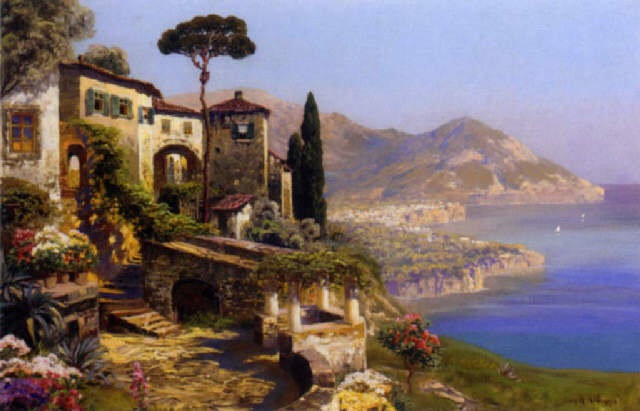
Sorrento (italy) by Alois Arnegger (1879–1967)
SORRENTO 

I gaze across the piazza --
you're lounging with our daughters
who are sipping limoncello

A wall lizard loiters in dimming light --
distracted by your yellow blouse
it ignores the pulse of moths

I pause too, not wanting the intermezzo
to end with a Ciao --
I linger under the lemon tree's shade

CWTCH

Our cosy rooms do not become timeless,
removing clocks is just a childish gesture.

This sharing space – a spicy spaghetti
in bed, a bubbly bath - both knowing pleasure

adds up a cost. But cuddling on the settee,
the room unmoors with cartoon repeats.

A wine, no half-life measure: happiness
will breathe carefree, no careless cough defeats.

KEATS

reading
rooted in mind
and tasting ripe berries
the oozing winking scent
window open
writing

Phil Wood was born in Wales. He enjoys chess and learning German. His writing can be found in various places, including : The Seventh Quarry, Borderless, and Arachne Press (Byways Anthology).

.

PLEASE NOTE: ARTICLES CAN ONLY BE REPRODUCED IN OTHER SITES WITH DUE ACKNOWLEDGEMENT TO BORDERLESS JOURNAL

Click here to access the Borderless anthology, Monalisa No Longer Smiles

Click here to access Monalisa No Longer Smiles on Kindle Amazon International
Categories
Excerpt

New Novel by Upamanyu Chatterjee

Title: Lorenzo Searches for the Meaning of Life

Author: Upamanyu Chatterjee

Publisher: Speaking Tiger Books

It is the 20th of December 1980, a Saturday, and at dinner, Lorenzo Senesi, who will turn twenty-two in a little over a month, tells his mother, ‘Mamma, I think I just might go down to Padua with Roberto and Francesca for Christmas and the New Year. Should be back by the 3rd or 4th of January.’

Elda glances at her son but says nothing. Amedeo the father grunts once to acknowledge that the information has reached his ears. Paola, Lorenzo’s sister, older by fourteen months, asks in a tone that suggests that it wouldn’t matter if he doesn’t respond, ‘With those two? But I thought you were bored to death of them.’

The next morning, Lorenzo packs some essential things, including his copy of Carlo Carretto’s The Desert in the City, in an overnight bag, places the bag on the rear seat of his Renault 5, goes to the kennel in the corner of the garden to hug and nuzzle Vega the dog (a handsome golden-brown beast, half German Shepherd, a quarter Retriever, and in her reflective moments, there is something about her eyes that recalls the young Sylvester Stallone) and is off. Francesca and Roberto are nowhere to be seen. From Aquilinia, the dot on the outskirts of Trieste where they stay (a workers’ village, really, an adjunct to the Aquila oil refinery is how it was conceived and inaugurated in 1938, with habitual pomp, by Mussolini), he takes La Strada Costiera, the scenic coast road, down to the plains.

It is late in the morning, and bright and sunny. On his right lie the hummocks, ridges and undulations of karst, their eroded limestone continually sneaking a peek between the trees of lime and pine at the brilliant blue, on his left, of the bay of Trieste. The landscape tumbles down in leaps and bounds to the radiant sea that stretches like blue polythene till the haze of the horizon. On some curves, he can spot the white sails of boats, as still as life, on the aquamarine lapping at the feet of Miramare Castle.

The Renault, three years old, is an acquisition that dates from his road accident and the insurance money that he reaped as one of its consequences. It moves well; he makes good time to Sistiana and thence to Monfalcone where, having left the Adriatic and reached the bland plains, he takes the A 4 west-south-west towards Milan. He is undecided—but only for a moment—between the radio and the cassette player. Radio Punto Zero on FM wins; with his arms fully stretched to grip the steering wheel, he leans back in the seat to enjoy Adriano Celentano crooning ‘Il Tempo Se Ne Va.

A hundred and fifty kilometres, more or less, to Padua, an uncluttered highway through the ploughed cornfields and plantations of poplar of the region of Gorizia; Celentano on the radio is succeeded by Franco Battiato, Giuni Russo, Antonello Venditti and Claudio Baglioni. Friuli-Venezia-Giulia gives way to the Veneto a while before Lorenzo switches off the radio to enjoy, in peace, the noon silence. At Padua, though, it not being his final destination, he still has a further fifteen kilometres to go to reach Praglia at the foot of the Euganean Hills.

He parks the Renault as far as he can from a bus disgorging a contingent of British tourists alongside the church wall of the Chiesa Abbaziale di Santa Maria Assunta and carrying his overnight bag, walks across to the arched recess in which is inset an iron door. It is the principal entrance to Praglia Abbey of which the church forms an integral part. He rings the bell and waits.

He glances back at his car. Behind the wall, the church rises solid and grey, monolithic like a fortress, almost forbidding. Hearing the clang and whine of the iron door being opened, he turns back.

The monk whom he sees, Father Anselmo, sombre in his black robe, is tiny. He smiles and nods at Lorenzo and ushers him in. ‘Oh, have you come by car? Then I’ll open the main gates for you so that you can park inside.’ Without ceasing to nod and smile, he ushers him out.

Father Anselmo, being the porter of the abbey, is a statutory requirement of the institution. Let there be stationed at the monastery gate, says Chapter 66 of the Rule of Saint Benedict, a wise and elderly monk who knows how to receive an answer and to give one and whose ripeness of years does not suffer him to wander about. This porter ought to have his cell close to the gate so that those who come may always find someone there from whom they can get an answer. So when the Father does not reply, it may be presumed that the question was not worth a response. For they do not speak much, the Benedictines.

The Renault having found its parking berth in a spacious, paved, open corridor that runs right around a large, rectangular garden, Lorenzo returns to the reception room where Father Anselmo, at his place behind a plain, unadorned desk, waits for him.

‘Good afternoon,’ he starts again formally. ‘I would like to meet the maestro dei novizi. I have an appointment. My name is Lorenzo Bonifacio.’

A cue, as it were, for Father Anselmo to nod and smile again, and without getting up, lean sideways in his chair and press, six times in a measured, definite code, a red plastic button affixed to the wall. One push of the bell, a long pause, two pushes, a short pause, two more pushes, a long pause, one last push. Immediately, from the great bell tower of the church, clearly audible in each nook and cranny of the abbey, begins to ring, in the same code and with the same pauses, one of the lesser bells. Father Anselmo then gestures to Lorenzo to sit down in one of the chairs ranged along the wall. No conversation ensues.

(Extracted from Lorenzo Searches for the Meaning of Life by Upamanyu Chatterjee. Published by Speaking Tiger Books, 2024)

About the Book

One summer morning in 1977, nineteen-year-old Lorenzo Senesi of Aquilina, Italy, drives his Vespa motor-scooter into a speeding Fiat and breaks his forearm. It keeps him in bed for a month, and his boggled mind thinks of unfamiliar things: Where has he come from? Where is he going? And how to find out more about where he ought to go?
When he recovers, he enrols for a course in physiotherapy. He also joins a prayer group, and visits Praglia Abbey, a Benedictine monastery in the foothills outside Padua.

The monastery will become his home for ten years, its isolation and discipline the anchors of his life, and then send him to a Benedictine ashram in faraway Bangladesh—a village in Khulna district, where monsoon clouds as black as night descend right down to river and earth. He will spend many years here. He will pray seven times a day, learn to speak Bengali and wash his clothes in the river, paint a small chapel, start a physiotherapy clinic to ease bodies out of pain, and fall, unexpectedly, in love. And he will find that a life of service to God is enough, but that it is also not enough.

A study of the extraordinary experiences of an ordinary man, a study of both the majesty and the banality of the spiritual path, Upamanyu Chatterjee’s new novel is a quiet triumph. It marks a new phase in the literary journey of one of India’s finest and most consistently original writers.

About the Author

Upamanyu Chatterjee is the author of English August: An Indian Story (1988), The Last Burden (1993), The Mammaries of the Welfare State (2000), Weight Loss (2006), Way to Go (2011), Fairy Tales at Fifty (2014), and Villainy (2022)—all novels; The Revenge of the Non-vegetarian (2018), a novella; and The Assassination of Indira Gandhi (2019), a collection of long stories. 

In 2000, he won the Sahitya Akademi Award, and in 2008, he was awarded the Order of Officier des Arts et des Lettres by the French Government for his contribution to literature.

.

PLEASE NOTE: ARTICLES CAN ONLY BE REPRODUCED IN OTHER SITES WITH DUE ACKNOWLEDGEMENT TO BORDERLESS JOURNAL

Categories
Conversation

Roads Less Travelled

If he had stayed in his first job as a bank clerk, perhaps Tomaž Serafi would never have discovered new worlds beyond the borders of the small central European country he grew up in. But he ventured out to find both ancient wisdom and inner truths. He talks to an old friend Keith Lyons.

In Mahayana Buddhism, there is a term ‘Bodhisattva’ for those who reach the threshold of enlightenment, but choose instead to remain behind delaying personal liberation, to dedicate themselves to the benefit of others. To me, Tomaž Serafi is like a compassionate Bodhisattva, gently opening doors for others, and encouraging them to go through. 

But then, what do I know? I first met Tomaž more than 20 years ago, connected by a woman we loved. But when I recently scanned a map of Europe, one of the first things that came to mind was that in a modest apartment overlooking the Ljubljanica River near the heart of Slovenia’s capital, Tomaž was doing his thing, living his life to the fullest, letting his light shine. 

He doesn’t just feature in my own personal geography or spiritual map of the world. Over the last two decades when travelling in Asia or Australasia I’ve come across people from Ljubljana, and on too many occasions, it turns out they also know Tomaž. 

What can you tell us about where you live, in Ljubljana?

Ljubljana is located in the heart of Europe, nestled between Italy, Austria, Hungary, Croatia, and the Adriatic Sea. Slovenia’s capital city is neither large nor small, with a population of 300,000. It’s a delightful place to reside, featuring a vibrant community of young people, and hosting numerous cultural events.

Ljubljana. Courtesy: Creative Commons

I live in the city centre, right alongside the picturesque green river known as the Ljubljanica. From my window, I enjoy a spectacular view of Ljubljana’s castle perched atop a hill and the flowing river. If I wish to take a stroll in nature, there’s a forest just a 3-minute walk from my house in one direction and 15 minutes in the other. Even in the city centre, there are plenty of trees and green spaces.

Ljubljana is a hidden gem in Europe, and not many people know about its story. What can you say about the country and its people?

When I was born in 1962 Slovenia was a part of Yugoslavia, which was a non-aligned country, not affiliated with either the capitalist Western bloc or the communist Eastern bloc. Yugoslavia was a socialist country, somewhere between communism and capitalism. It was wealthier than communist countries but not as affluent as capitalist ones. Back then, we didn’t have much, but there were no truly impoverished people. Nobody was starving, and nobody was wealthy. 

Today, we have a significant number of very wealthy individuals alongside many who are extremely poor, struggling with hunger and homelessness. Presently, life in Slovenia is not significantly different from that in other European countries.

What was it like for you growing up in the 1960s and 1970s in Slovenia?

Back then, we didn’t have cell phones and computers, so we spent most of our time outdoors playing with friends. We played games like hide and seek and competed to see who could run the fastest, jump the highest, climb the highest tree, and so on. When I was a child, I either played outside with friends or read books. 

Where did reading books take you?

Books became my passion from the moment I learned how to read. Through books, I learned about other places on Earth and different cultures. I especially adored books about Native Americans. I read all of Karl May’s  books [1]– Apache chief Winnetou was my number one hero.

So your interest in the whole wide world came from books?

Yes, my love of books furthered my fascination with other cultures. I’ve always been an avid reader. When I recognised that our own culture was not faring well, that it was troubled and leading us toward a precipice, I became curious about other cultures, especially indigenous ones. I began to delve into literature about Native American, Aboriginal, Celtic, and other cultures, exploring their spirituality and beliefs.

What put you on a path of exploring spirituality?

When I was 15, I fell off a rock wall in a canyon while I was climbing, plummeting 15 meters to the ground. I lay there, unable to move, and had to be rescued and taken to the hospital. Fortunately, it turned out that nothing was broken, but that incident profoundly changed my life. I began to contemplate the concepts of life and death. Death came close, examined me, and decided to spare me for a while longer. 

Since that moment, I haven’t been afraid of death anymore. I also started pondering the meaning of life, which became the most significant question for me: What is the meaning of life? That question guided me towards spirituality and spiritual growth. Ever since, spirituality has been the most vital aspect of my life, (alongside, of course, the elements of sex, drugs, and rock and roll).

How were your first experiences venturing overseas?

My first journey took place when I was 15 years old, and I hitchhiked through Europe. I passed through Italy, and in Genoa, I attempted to buy marijuana. I gave money to a guy who entered a house but never returned. It was only then that I realised he had exited through another entrance at the back of the house.

Later in the Côte d’Azur, I purchased LSD, only to discover that I had received plain candy instead. In Nice, I was robbed by a group of 14-year-old Algerians. While hitchhiking on the highway outside of Paris, a large truck deliberately ran over my backpack, scattering all my belongings on the road. Moments later, the police arrived and informed me that hitchhiking on the highway was prohibited. When I showed them what had happened to my backpack, they simply shrugged and drove away.

In Brittany, a kind couple invited me to sleep in their house because it was raining, and I had intended to sleep outside in my sleeping bag. In Paris, a young man around 20-years-old invited me to stay in his apartment, but as we shared the same bed, he tried to put his hand into my underwear. 

From these experiences, I learned that I couldn’t trust everyone and that I needed to be cautious. I also discovered that some people are incredibly generous and trustworthy. Most importantly, I learned that I am the master of my life, and it’s best to rely on myself. I also realized that the world is vast, and not every place is the same as my small Slovenia. I encountered people of various nationalities and skin colours, broadening my horizons. I understood that a person’s nationality doesn’t matter; fundamentally, we are all the same. In every country, there are both good and not-so-nice people. But regardless of where they are, everyone shares the same desire: to find happiness.

Has your style of travel changed over time from those first adventures in Europe?

When I was younger, I was restless and eager to explore as many places as possible, often staying in one place for no more than a day or two. However, as time went on, I came to realise that the longer I remain in one location, the more fulfilling it becomes. I grow more peaceful and content, and it’s only then that I can truly savour and fully immerse myself in the experiences.

I also came to understand that the slower I travel, the more profoundly I connect with the landscapes I traverse. When I travel by car, it feels like I’m merely watching the scenery on a television screen. Travelling by bicycle is a much richer experience. Walking on foot is even better, as I absorb every step of the journey. Travelling by public transport has its own appeal. On a bus, I can keenly observe the locals, their personalities, and their customs, which offers a splendid perspective on the places I visit.

What has been a really memorable travel experience for you?

One of the most memorable places that I visited in Ghana was a village called Sonyon. I was travelling by bicycle, and wherever I went, I would tell the people that I wasn’t a tourist but a pilgrim who had come to bestow blessings upon them. You can only reach this village on foot or by bicycle. Later, I learned that it’s a spiritual village where people from all over come to heal or achieve specific goals. They perform offerings, and then conduct certain ceremonies, and they say it has a powerful effect. 

The houses in this village are single-story, made of mud, and have flat roofs. They are built close together, so in the evening, the villagers go up to the roofs, where it’s cooler due to a gentle breeze, and they walk around the village from house to house, like on a promenade. They even sleep there sometimes. I lay on the roof, and children came up and started touching me because they were curious about my white skin. I lay on my stomach, patted my back, and said, “You can touch me here,” and they began to stroke and massage me. It was a fantastic feeling, like being caressed and massaged by five or six children! 

And how about when travelling in my home country, New Zealand?

One of the most memorable experiences during my first trip to New Zealand’s North Island was while stopping for a short break near a magnificent coastline while hitchhiking. I wanted to stay there for a while. So, I headed towards the coast, found a suitable spot, and set up camp. I spent quite a few days there. I was truly enjoying myself. I remained naked throughout the experience, frequently leaping into the water, singing loudly, dancing, and engaging in meditation, among other activities. 

Then I was walking for a long time and eventually, I ran out of water and food. With my last bit of strength, I managed to reach the top of a hill. According to the information in my book, I should have soon come across the first settlement along the way. However, the path had disappeared. Tall grass had grown all around me. I climbed onto a rock and saw a belt of forest nearby, with a path beyond it. I headed towards the forest. Wild boars ran past me. The forest was so overgrown that it took me an hour to reach a path about a hundred meters away. I was dirty and scratched, my clothes were torn, and I was hungry and thirsty. It was Christmas Eve.

Soon, I heard human voices and saw a holiday trailer. People were having a picnic. I asked them if I was heading in the right direction towards the main road. They confirmed it and said, “Wait a minute. Are you thirsty, or hungry? Have a beer. It’s Christmas Eve.” I stayed with them. Soon, Māori friends joined them. We sat around the fire, ate and drank, talked, an elderly Māori woman shared stories of their spirituality and sang their songs, and I sang some of ours. I couldn’t have asked for a better Christmas gift.

Let’s go back to your earlier existence. What happened for you to give up a career working in a bank?

It all began with Illusions (1989) by Richard Bach. I was still employed at a bank when I came across this book – and it had a profound impact on me. It meant so much to me that I made a personal commitment to translate it, despite having no prior experience in translation. And so, I translated it. Subsequently, I submitted my translation to all the publishers in Slovenia, but unfortunately, none of them were interested (back then, the book didn’t align with the socialist Yugoslavia prevailing system). Undeterred, I took matters into my own hands. I photocopied 200 copies of my translation and sold them independently. With the proceeds from those sales, I was able to print an additional 500 copies. To my surprise, I found that I was earning more from these efforts than I would have if a publishing house had purchased my translation.

This realization led me to make a life-altering decision—I left my job at the bank and embarked on a journey of translating and publishing other books that I believed had the power to touch people’s hearts and were of great importance. Authors such as Kahlil Gibran, J.R.R. Tolkien, the Dalai Lama, Louise Hay, William Bloom, Paul Solomon, Dan Millman, and Lobsang Rampa were just a few of the writers whose works I translated and shared with the Slovenian audience.

What do you think is the purpose of your life?

When I was going through a very difficult period in my life and couldn’t sleep one night, I went to the balcony and suddenly heard a voice loudly asking me, “Tomaž, why are you here, why did you come to this world?” Suddenly, it dawned on me, and I replied, “I came here to be happy!” The voice replied, “That’s right, Tomaž. Now, take a look at yourself. Are you happy?”

That’s when I decided to be happy. Once I made that decision, I stuck to it, and I truly was happy.

Later, many years later, I realised that I didn’t just come to be happy. I discovered that I’m even happier and more fulfilled when I make someone else happy. Gradually, I realised that my mission is to help others. I help them in various ways. At one point, I helped by translating and publishing books that benefited them. Later, I assisted them with counselling at the New Age Information Centre, which I founded. Now, I help them with therapeutic massages, with conscious and loving touch.

So what’s your superpower?

My superpower is undoubtedly my touch. However, this transforms into true power only when I am fully aware of it and fill it with love. In fact, my superpower is the awareness that everything is one, that all that exists, the entire universe, and all the things and beings that fill it, both material and immaterial, are actually one vast super being or God.

What things do you do most days to keep you balanced?

For a long time now, I’ve had a morning routine that fulfils me and makes mornings the most beautiful part of my day. When I wake up, I first express gratitude for the night and greet the new day that lies ahead, even before I open my eyes. Then I engage in exercise. I limber up all my joints, perform tantric exercises, breathing exercises, practice yoga, tai chi, and chi gong. 

Afterwards, I sit down to meditate and spend some time in silence. Only then am I prepared for the day’s responsibilities. Similarly, in the evening, when I close my eyes, I give thanks for the day I’ve lived and bid goodnight to the night that approaches. 

How do you think you’ve made an impact on the lives of others?

When I was publishing books, I received a lot of feedback from my customers which made my heart sing. Some were praising my translations, and some were thankful that I decided to publish such beautiful and meaningful books. 

I receive even more grateful feedback from the people I massage. One client commented “I was led to the place where everything just is and exists.” And, Frida, gave me this wonderful endorsement, “For a moment you caught me in timelessness that lasted and lasted. My body was dancing under your loving hands and melted with your grace. Thank you for this magical experience. Your love for the work you are doing and for the people can be felt and it is healing.”

Recently I received this feedback, with the person saying “This was not an ordinary massage. Tomaž’s gentle presence made me feel safe, so I entrusted him with my process.” Another wrote “Tomaž, your creation is truly something special. You’ve given the world a wonderful gift, and I thank you for it.” I’m grateful to people like Medeja who thank me by saying “As if a flock of angels, completely devoted and determined angels, guided me through all possible processes — fears, pains, freedom, love, and beauty — and brought me to their home, where it is so beautiful and pleasant that there are no words to replace this feeling.”

What are the most important things you’ve learned?

I’ve learned that the most important thing for me is to live my soul.

I’ve also learned that no one is more important than another, that there is no good or bad, and that life isnot serious; rather, everything is like dust in the wind of the Universe, or as I like to say, “chickenshit.”

The most fulfilling action one can take is to help others because it brings genuine joy. As socialbeings, our connections with others are the most crucial aspects of life, far surpassing thesignificance of material possessions.

If you have a message or advice for others, what would it be?

Don’t worry; life is not so serious. Follow your heart and live your soul. Be yourself; you don’t have to be somebody else, you don’t have to pretend to be somebody else. Everything is changing; nothing is permanent; everything will end or transform. Live fully, live, and be aware of every moment of your life. That’s why we are here: to live our life fully, to experience everything from joy to sadness, from anger to love, from despair to fulfilment. And to be aware of all of this.

website: singingheart.weebly.com
Email: tomaz.serafi@gmail.com

[1] Karl May( 1842-1912) German author. Winnetou was a novel by him.

Keith Lyons (keithlyons.net) is an award-winning writer and creative writing mentor originally from New Zealand who has spent a quarter of his existence living and working in Asia including southwest China, Myanmar and Bali. His Venn diagram of happiness features the aroma of freshly-roasted coffee, the negative ions of the natural world including moving water, and connecting with others in meaningful ways. A Contributing Editor on Borderless journal’s Editorial Board, his work has appeared in Borderless since its early days, and his writing featured in the anthology Monalisa No Longer Smiles.

PLEASE NOTE: ARTICLES CAN ONLY BE REPRODUCED IN OTHER SITES WITH DUE ACKNOWLEDGEMENT TO BORDERLESS JOURNAL. 

Click here to access the Borderless anthology, Monalisa No Longer Smiles

Click here to access Monalisa No Longer Smiles on Kindle Amazon International

Categories
Poetry

In 1947

By Masha Hassan

Art by Amrita Sher-Gil (1913-1941)
It is the beginning of a saffron day.
She tinges her white salwar with colour.
The walls are thin and we listen,
Offered prayers to Sikh Saints,
Inside a room of crippled faith.
We wait,
We wait for the devotion to finish,
For her to step out,
To tsk at our negligence,
To sigh at us heretics…
Chiffon is what covers her head,
Falls over so elegantly onto her shoulders,
Only to be quickly put back to its position.
She bends over in much pain.
‘Nanak’ she says is the medicine --
Handing out the sacred sweet.
We roll our eyes but stretch our hands,
Whilst scuffling her salwar,
Remembering the sun of 1947
She’d narrate,
 
In silent murmurs and naked
Soles,
 
She had covered miles to feel
Uninhabited,
 
She remembered intervals
On makeshift mornings,
 
Toppling over bodies with
No sound,
 
On footpaths familiar she remembered
Runnels painted with blood,
 
Leaving behind dupattas* and flags,
Flying spirits in the sky,
 
She was certain she’d return,
To unlocked doors,
 
To obscure meanderings
 
To Bitter-sweet memories
Of abandoned and burnt
Homes,
 
Rest assured,
She never did
 
She found refuge in language. 

*Veils or Scarves that are almost the size of stoles
This poem is about the journey made by the late Kuldeep Kaur (seated on the left). She was originally from Rawalpindi (now in Pakistan). As a child, she had to travel on foot, stepping over heaps of dead bodies from Rawalpindi to an army base camp and finally settled in New Delhi, Patel Nagar. This photograph was taken in 1993. She is seated next to her daughter, both of who also witnessed the 1984 Sikh-Hindu riots, another face of fundamentalism. Photo provided by Masha Hassan.

Masha Hassan is a PhD student at the University of Bologna, Italy. Her research entails identity constructions at the margins, the ‘liminal identities’, focusing on the South Asian diaspora.  You would occasionally find her wandering in Kebab shops in Italy talking in Urdu, Hindi or Punjabi with the shop owners, listening to their journeys. Her articles have been published in The Speaking Tree, Times of India, Jamhoor Magazine, and online Italian magazines such as OgZero and connessioneprecarie. Her first poem, ‘Main, Junaid’, (dedicated to Hafiz Junaid who was lynched on a moving train on the suspicion of carrying beef) was published on the cover of a local Marathi magazine called Purogrami Jangarjana, Mumbai, India in June 2017.

PLEASE NOTE: ARTICLES CAN ONLY BE REPRODUCED IN OTHER SITES WITH DUE ACKNOWLEDGEMENT TO BORDERLESS JOURNAL. 

Click here to access the Borderless anthology, Monalisa No Longer Smiles

Click here to access Monalisa No Longer Smiles on Kindle Amazon International
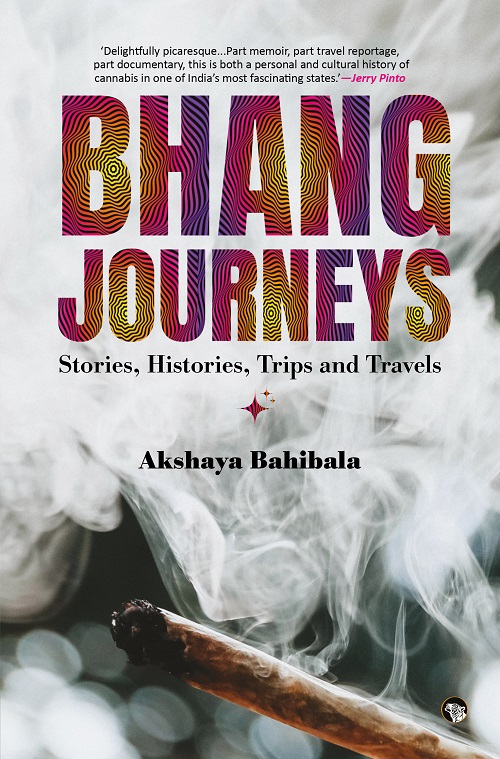
Categories
Interview Review

Born Free to Follow your Heart

Anthony Sattin, an award winning journalist and travel writer in conversation about Nomads: The Wanderers Who Shaped our World, his recent book published by Hachette, India.

A breath-taking narrative that travels with the freedom of nomads, drawing from folklore, history and modern movements to give voice to an idea that might help move towards a more progressive and hopeful future — Anthony Sattin has achieved all this in a single book called Nomads: The Wanderers Who Shaped our World, a non-fiction that touches the heart with the concept of unifying humanity beyond the borders of ‘isms’ drawn over time. It explores the history of people who often have not been chronicled in conventional texts.

We are living in times where floods, forest fires, wars and divides are ravaging humanity as it wakes up from the coils of a pandemic that had almost stilled all normal interactions and economic activities for more than two years. The unrests and the changes attributed to “climate change” call for “continued solidarity” and a united front from all humanity as indicated by UN Secretary-General Antonio Gueterres and global guru Harari. In times such as these, an attempt to revive the concept of asabiyya, or bonds based on felt interests, is laudable and a necessity for the world to move forward. And that is exactly what Sattin has done in his recent book.

He has travelled with nomads; folklores, starting with Cain and Abel, Gilgamesh and Enkidu; history, Gobelki Tepe or Potbelly Hill, the place where he locates what might have been Eden, Achaemenid kings, Persian nomads, Mongols, Mughals to global nomads — spanning 12, 000 years of history.

In his book, Sattin tells us: “We are living at a time when the world — our world — shaped by the age of Reason and Enlightenment, powered by industrial and technological revolutions is faltering.  Social contracts are fraying and communications are breaking down. The raw materials and natural resources are becoming scarce, and the consequence of our actions … are written large across landscapes, the climate, the fabric of our lives…Change is needed.”

Sattin “traces the shifting relationships between people who move and those who were settled” to find the concept of asabiyya or the sense of bonding popularised by an Arab philosopher called Ibn Khaldun (1332-1406). Perhaps, this is an ideal that could benefit humankind if we were all to see ourselves as one tribe. He has mentioned modern attempts at asabiyya, like the call given by ‘Black Lives Matter’, to contextualise the concept for us and to show how a movement born from within the hearts of people could touch and change attitudes.

The book is divided into three parts after an initial introduction from Mount Zagros, where Sattin was rescued from a bout of sunstroke by nomads: the first part is called ‘The Balancing Act’, where he explores ancient folklore and history, Huns, Hyksos, Scythians, Xiongnu and more: the second part is called ‘The Imperial Act’, from  ‘The rise of the Arabs to the Fall of Mongols’ where kingdoms and world history is brought into play and the importance of asabiyya is introduced with historic instances and the last part is called ‘The Act of Recovery’, where changes towards redefining the world in terms of ideals aligned with asabiyya are explored.

The scope of the non-fiction is clarified at the start of the book from Mount Zagros. He starts the first section interestingly in a locale, termed by him as “Paradise” in 10,000 BC with a global population of ‘Perhaps 5 million’, of which he lists the nomad population as ‘Most of the number’. As he unfolds the history of mankind, from the past we find echoes of what could be called mobile or nomadic bonds that embrace to expand and heal civilisations. Sattin has been exploring such bonds for the last forty years.

Described as “a cross between Indiana Jones and a John Buchan hero” and “one of the key influences on travel writing today”, Sattin started his interactions with bedouins at age nineteen and found them nurturing. He elucidates: “After I left school, I went travelling in the Middle East. In the Sinai Peninsula, at that time, there were no hotels or other facilities outside of Sharm el Sheikh. So, I and the friend I was travelling with relied on the Bedouins for many things — they brought us fish and other food, they told us stories about the magical places in the desert mountains and although we had been told that they would rob us, they looked after us.”

Anthony Sattin. Photo Courtesy. John Murray/Hachette India. 

Sattin has several non-fictions under his belt and is an award-winning journalist, who writes in a number of well-known journals, like the Sunday Times, the Conde Nast Traveller and the Financial Times. An editorial advisor to the Geographical magazine, he is also a fellow of the Royal Geographical Society and a founder-member of Travel Intelligence and ASTENE (the Association for the Study of Travel in Egypt and the Near East). He was the director of the Principal Film Company, has written, advised and presented on television and radio productions, including the BBC.

In this exclusive conversation, Sattin discusses Nomads, and tells us how the book came to be.

What made you think of writing a book on nomads, who — you have stated in your book — now constitute only 40 million in a world of 7.8 billion humans?

Every book has its moment, and this is the right time for Nomads. It came out of a lifelong interest in people who live on the move and on the problems of settled society, especially with cities – some of the first thoughts in Nomads occurred decades back when I read Lewis Mumford’s The City in History[1]. But I also have many ideas for books in my head at any one time and they don’t all get written! And some of them sit around for ages and then it seems to me to be the right moment to write. The way our world has changed in the past decade helped shape my sense that this is the moment to write about open borders and freedom of movement. I also wanted to write something that would stretch me more than anything else I had written. Twelve thousand years of history seemed like a big enough challenge…

How long did it take you to research and write the book? What kind of research did you do?

I began shaping the idea nine years ago, after I finished my previous book, Young Lawrence[2], about how the second son of an anonymous, middle class Oxford family became Lawrence of Arabia. The proposal took more than a year to get right – as my editor at WW Norton in New York pointed out, a subject this big can be about everything and nothing. Then there were years of research, particularly in the Bodleian Library at Oxford and the London Library, which is a wonderful place, the largest private library in the world and which serves as my home from home. I had many conversations over the years with scholars, people in publishing, fellow writers, travellers and nomads. And then there was the travelling with nomads, the writing and rewriting.

You travelled and lived among nomads for some time? How many years? Were your travels affected by the pandemic? If so, how did you bypass that?

I have been meeting nomads for more than forty years, particularly in North Africa and the Middle East, where I have travelled extensively. When I was 19, I was looked after by Bedouin in the Sinai Desert. In 2010, I was back there on a camel trek with a guide who impressed me because he knew every mountain, every watering place and every cave, including one which he pointed out as the place where he was born.

In Mali, I spent time with Touareg nomads, who came together each year at a place in the desert beyond Timbuktu – these tribes used to be at war with central government (and are again), but a treaty had been brokered and one of the terms was that tribal and government leaders would meet once a year to sort out grievances. They also played music, danced, raced camels… How could one not be swept away?

Specifically for Nomads, I went to Iran to spend some time with the Bakhtiari, a large nomad tribe who I had chosen in part because they claim lineage that goes back millennia, because they had played a part in the making of modern Iran but also because in the 1920s, a movie[3] was made of their annual migration into the Zagros Mountains, amazingly by the director and producer[4] whose next movie was the original King Kong! The Bakhtiari taught me much about the challenges facing nomads today.

Can you tell us of a few interesting experiences while moving with nomads which are not part of the book?

When I first went into the Zagros Mountains to meet the Bakhtiari, I was taken by a guide (being British, I had to have a guide for my entire stay in Iran) and he could not understand why I would waste my money and my time going into the mountains. He was from the city and exhibited age-old prejudices against people who lived on the move, whom he called ‘primitives”. But I am not a nomad and although I don’t find them primitive, I do find some aspects of their lives very challenging: years ago, on a camel trek in the Thar Desert, I caught what I now assume was sunstroke and thought I was going to pass out. My guide – there were just the two of us travelling – got me out of the desert. At the first village we reached, he had someone bring a bed out of a house and placed in the shade of a tree. I lay down and remember no more until about four hours later when I woke to find myself surrounded by the whole village. They had been angry with the guide for bringing me to them – think of all the trouble they would face if I died! When I woke, in the middle of this scene, the whole crowd burst into cheers like a scene out of a Bollywood movie.

You have spoken of ‘asabiyya’ taught by Ibn Khaldun. Can you explain the concept briefly and tell us if this can be of relevance in the current global situation?

Asabiyya is a sense of group feeling, something that binds people together. Ibn Khaldun thought it had shaped the world and found that it was most powerful among nomads and people who lived in the desert, in part because they must rely absolutely on each other. When this group feeling is channelled by a leader – the Prophet Muhammed, for instance – it can lead the group towards extraordinary achievements, as when the first Arabs overcame the might of the better-trained and armed Byzantine and Persian armies. It might all sound like something from long ago but I think there is a sense, in our own time, of someone like Greta Thurnberg having channelled that same feeling to force our leaders to pay attention to the climate emergency.

At a point you tell us that “…cities posed existentialist risks, and their temptations could overwhelm the asabiyya and nomads would lose their identity.” Why was maintaining their identity for the nomads so essential? Do you think this is something that needs revival in the present?

The existential risks I mention are the ones that rob nomads of their asabiyya and therefore of their power. Ibn Khaldun had seen this first hand: in North Africa, several small reformist movements had come out of the harsh desert or mountains to the south and overwhelmed the courts and kingdoms along the north coast. But each of those movements had fallen apart within a few generations as the pure people of the desert found themselves corrupted by living in cities. As for identity, it is important for all of us to know who we are and where we have come from — that was one reason to write the book, because very little is taught about nomads in western schools.

Your book touches upon number of issues — including faith. Given the fact that the great Khan had a Nestorian church, a mosque and a Buddhist temple in his capital city despite following the Shamanistic faith, would you say that an openness or tolerance in beliefs and faiths led to a more strongly tethered kingdom, as they did not really seem to have concepts of permanent national boundaries then? Is this not a dichotomy that you create a strongly tethered kingdom and yet are open to move on, leaving the old capital behind? And is it not wasteful?

I think there are two things going on here. On the one hand, a belief in freedom of conscience, the right to follow any or no religion. This was certainly something the great Mongol khans believed in. They were mostly animists, believing in the Sky Father and reliant on signs and omens, but they were not adverse to being prayed for and blessed by an imam or priest. Even the Ottomans, who came out of a nomadic tradition and were clearly Muslims, thought it important to allow freedom of conscience in their empire. What mattered was not who you prayed to, but whether you were prepared to acknowledge the sovereignty of the khan or the sultan. Some of the most successful periods in human history have flourished because of this idea.

A strongly tethered kingdom is another issue. For nomads, cities and capitals were not as important as lands, particularly hunting and grazing lands. The Mongol khans, like ancient Persian emperors and many other nomad leaders, recognised the need for a pivotal meeting place, a capital, but they were mostly more interested in spending time elsewhere and on the move. A leader such as Attila, the Hun ruler, had no interest in the cities he conquered.

You mention British author, Bruce Chatwin(1940-1989), as having said “we are born to move, that we must move or die.” Can you explain what that would mean? In the current context, people talk of roots and homeland. If they keep moving what happens to their firm conviction in homeland?

It depends what sort of ‘moving’ we are talking about. On a mundane and personal level, research now tells us that we are less likely to get ill and more likely to live longer if we walk 10,000 steps a day. On a national and global scale, we need interaction, we need to live lighter, we need to be nimble on our feet and in our thoughts.  

You have divided the world into two groups — nomads and settlers — and said we need a bit of both. Can you tell us how and why?

Humans began to settle and cultivate some 12,000 years ago and since then, like Cain and Abel, humans have broadly been divided into those who stay in one place, usually either cultivating the land or living in towns/cities, and those who live on the move. For most of history they have lived in a state of mutual dependence and often even in harmony. A world without nomads, with everyone fixed in one place – which seems to be where we are heading – is a smaller, less rich, less fertile world.

In a post-pandemic world, would the nomadic lifestyle you have written of be feasible, especially with all the governmental issues creeping in? 

The word nomad comes from a very old Indo-European word meaning pasture or a fixed area, which suggest the right to graze. But if you take a broad view of what it means to be a nomad in the 21st century, you might also include digital nomads and others who move to work or just because that is how they want to or have to live. That might not have been possible during the pandemic, when we were all locked down, but the number of people on the move now in many parts of the world is right back up and that can only be a good thing – we need to mix and meet, to exchange experiences and opinions.

If we opt for a mobile lifestyle, would we need to redefine borders as of old? Would that take us back to a pre-nationalistic era? Do you think we should be redefining our mindsets and our isms? Do you suggest we all go back to an intermittent nomadic lifestyle?

We should always be questioning mindsets and isms! Happily, we are living through a golden age of revisionist history shaped by a number of forces, decolonialism, Black Lives Matter and #MeToo among them. We also live in an age of misinformation on a massive scale. Nomads has come out of a need I had to shine some light on a way of life that is either entirely missing, or misrepresented in our histories.

Are you planning to write more on this issue or move on to something else? Would you share with us your next project?

There is much more to be written about this issue, but after spending most of the past eight years working on Nomads, it is time for me to look elsewhere. I hope I have stimulated a debate about nomads that will encourage others to look further. Meanwhile my thoughts are turning to Egypt — and to Italy, from where I am writing today.

Thanks for giving us your time during your travels.


[1] First published in 1961

[2] First published in 2014

[3] Grass (1925)

[4] Merian C. Cooper (1893-1973)

(This review and online interview is by Mitali Chakravarty)

.

PLEASE NOTE: ARTICLES CAN ONLY BE REPRODUCED IN OTHER SITES WITH DUE ACKNOWLEDGEMENT TO BORDERLESS JOURNAL

Categories
Poetry

Poetry from Italy

Poems by Rosy Gallace, translated by Irma Kurti

Rosy Gallace

THE EXPIRED TIME

It wasn’t the highway kilometres

that made us feel distant.

It wasn’t the labour

or the cost of the tolls.

.

It wasn’t even

a round trip on an easy jet.

It was our thoughts

so distant… and… different.

.

Our time has traveled

between parallel lives

chasing each other, never meeting.

.

Our thoughts intertwined

with the days filled with loneliness;

now, they’re here in their nakedness.

.

Our time has expired.

.

For once, without finding any holds,

let’s look at each other through sincere

eyes and beyond words, let us listen

to the rhythms of heart, let’s shake

hands, be real, let’s just be ourselves.

.

IF YOU WERE HERE

I would not feel the unbridgeable void

in these long summer days.

I’d forgive even the chirping of cicadas

that took away the sleep from your nights.

.

I would run to you to find

the answers to my silences.

I would ask you how to live:

get up, get dressed, wash, eat,

keep that pain a secret,

the pain that takes the breath away.

.

I would fly to you on dark days;

I don’t know where else to go.

I’d find relief among those walls

that smelled so much

of lavender and talcum powder.

.

If you were here

I wouldn’t be so lost tonight,

confused and cold. I’d have a smile

and a warm hand, that word you

whispered in a low voice and how

magically everything turned as before.

.

This time I’d take you by the hand,

proudly I’d lead you along the course,

even on that chair you hated so much

despite that, you would be happy with me.

.

I would touch a kiss on the folds

of the forehead while you travel in

your memories in a smile shielded

from the grimace of pain.

.

Rosy Gallace was born in Guardavalle in the province of Catanzaro in Calabria and lives in Rescaldina, Milan. She has published several books of poems which have been translated into English, Romanian and Albanian. She is the creator, organiser, and president of several literary contests and also acts as part of the jury for various literary competitions in Italy.

Irma Kurti is an Albanian poetess, writer, lyricist, journalist, and translator. She is a naturalised Italian. She has won numerous literary prizes and awards in Italy and Italian Switzerland. Irma Kurti has published 26 books in Albanian, 17 in Italian, 8 in English and two in French. She is also the translator of 11 books of different authors and of all her books in Italian and English.  

.

PLEASE NOTE: ARTICLES CAN ONLY BE REPRODUCED IN OTHER SITES WITH DUE ACKNOWLEDGEMENT TO BORDERLESS JOURNAL