Nazrul’s Musafir, Mochh re Aankhi Jol(O wayfarer, wipe your tears) has been translated from Bengali by Professor Fakrul Alam.
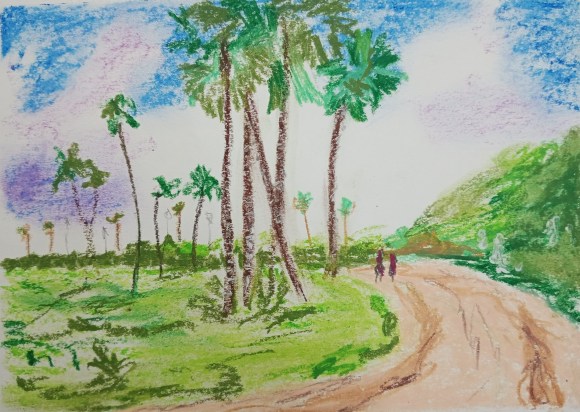
Art by Sohana Manzoor
O wayfarer! Wipe your tears, Return only with yourself. The flower blooming on its own Shed all by itself. O foolish one! So hapless is your state, Will you now build your nest in water? Thirsts are not quenched here For this is no lake to allay thirsts. Will the bokul that didn’t bloom in monsoon Blossom when it’s winter? On this path forever, errors shed Covering the grove of frustration. Oh poet! You’ve illuminated many lamps With your own light But your own revered Krishna hasn’t come To light up the darkness pervading your world.
A rendition of the lyrics by Feroza Begum (1930-2014) in original Bengali
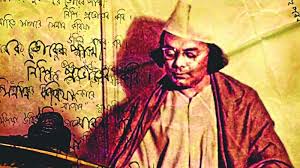
Born in united Bengal, long before the Partition, Kazi Nazrul Islam(1899-1976) was known as the Bidrohi Kobi, or “rebel poet”. Nazrul is now regarded as the national poet of Bangladesh though he continues a revered name in the Indian subcontinent. In addition to his prose and poetry, Nazrul wrote about 4000 songs.
Nazrul’s Jonomo, Jonomo Gelo(Generations passed) has been translated from Bengali by Professor Fakrul Alam. Click here to read and listen to a rendition by the famed Feroza Begum.
Ajit Cour‘s short story, Nandu, has been translated from Punjabi by C Christine Fair. Click here to read.
The Scarecrowby Anwar Sahib Khan has been translated from Balochi by Fazal Baloch. Click here to read.
Naramsetti Umamaheswararao moulds children’s perspectives. Click here to read.
Notes from Japan
In American Wife,Suzanne Kamata gives a short story set set in the Obon festival in Japan. Click here to read.
Conversation
Neeman Sobhan, author of Abiding City: Ruminations from Rome, discusses shuttling between multiple cultures and finding her identity in words. Click here to road.
Nazrul’s Lyrics translated from Bengali by Professor Fakrul Alam
Born in united Bengal, long before the Partition, Kazi Nazrul Islam(1899-1976) was known as the Bidrohi Kobi, or “rebel poet”. Nazrul is now regarded as the national poet of Bangladesh though he continues a revered name in the Indian subcontinent. In addition to his prose and poetry, Nazrul wrote about 4000 songs. Pictures from Public Domain
Generations after generations I’ve trod the path of hope. Yet, O desert wayfarer, there seems to be no border in sight. Year after year have come and gone for someone like me. When I tried quenching my thirst even as my eyes watered Lighting up hope’s lamp futilely, mirages crowded my vision. Hundreds of songs seemed to sing out of desert groves Which once upon a time must have been part of the ocean. Desert wayfarer that I am, I see its watery expanse in dreams And think of the ocean’s bottom, where my craft had sunk— A craft I was in with my mate whom I keep looking for now!
A Bengali rendition of the song by Feroza Begum (1930-2014)
Tumi Kon Kanoner Phul ( From whose garden could you be) by Tagore was published in the collection called Kori O Komal (Sharp and Flat) in 1886.
From whose garden could you be And in which sky were you a star? Where could I have seen you before And in what dream did you last appear? When was it that you had last sung, And when did you last look at my eyes? I’ve forgotten it all! All that I can remember now Is that you were my eyes’ star! Hush—don’t say anything now— Just take a look and go your way In this moonlight just smile and melt away! Overcome with sleep, I look at the moon With an enraptured heart Like your eyes, let the twin stars in the sky Keep streaming their rays.
Renderred by well-known contemporary singer, Srikanto Acharya
Anjali Loho Mor (Take my Offerings) was written and composed by Nazrul (1899-1976)
Take my offerings melodically, musically Like a flaming lamp, my soul flickers Captivated by you, O lovely one; What feeling of bliss is this, making the body sway And dance before you melodically, musically? In ecstasy unfolds love’s petals, Full of beauty, fragrance and love Looking at your face, I’d like to say to you: “Fall down like petals of flower will do And colour your feet’s soles, melodically, musically”
Renderred by the legendary Feroza Begum (1930-2014)
Nazrul’s Shukno Patar Nupur Paye(with ankle bells of dried leaves) has been translated from Bengali by Professor Fakrul Alam
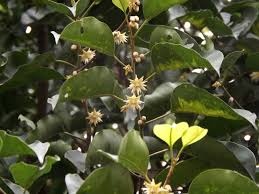
Bokul or MedlarChapa or Champaka flowersFrom Public Domain
With ankle bells of dried leaves The wild wind dances away. Making waves sparkle and sway, The wild wind goes on its way. At the pond’s heart, lotus flowers collect. Bokul and Chapa buds lie strewn. Restless waterfalls stream and sparkle. As she darts across the field, Taking off her wildflower ornaments And unfurling her unruly hair at the sky The crazy dust-covered woman keeps dancing. Like an Iranian child in a frontier world Treading desert spaces, she enthrals all Fair-complexioned, sand-coloured ornaments Draping her body, she comes darting!
Nazrul’s song performed in Bengali by legendary singer, Feroza Begum (1930-2014)
Nur Jahan, Nur Jahan, Floating down a river you came To a land full of clouds A land of gardens—Iran! You had your plate filled With Nargis flowers, poppies and roses And had brought them all along. You brought as well legends Of Shirin and Farhad and Shiraz. With your graceful and slim self came Bulbuli, Dilruba and Rabab’s songs. Your love healed even Emperor Salim’s lunacy! You daubed sandalwood paste on yourself And bore the stigma in front of everyone -- A stigma the moon bears in the blue sky Smilingly. It’s what is written in lovers’ tales. I’ll ensure that it ambles along pathways Forever, questing for love’s pleasures, Despite any infamy linked to the affair.
Jahangir(Prince Salim) and his beloved empress, Nur Jahan
Nazrul’s Nur Jahan sun by the legendary Feroza Begum
Born in united Bengal, long before the Partition, Kazi Nazrul Islam(1899-1976) was known as the Bidrohi Kobi, or “rebel poet”. Nazrul is now regarded as the national poet of Bangladesh though he continues a revered name in the Indian subcontinent. In addition to his prose and poetry, Nazrul wrote about 4000 songs.