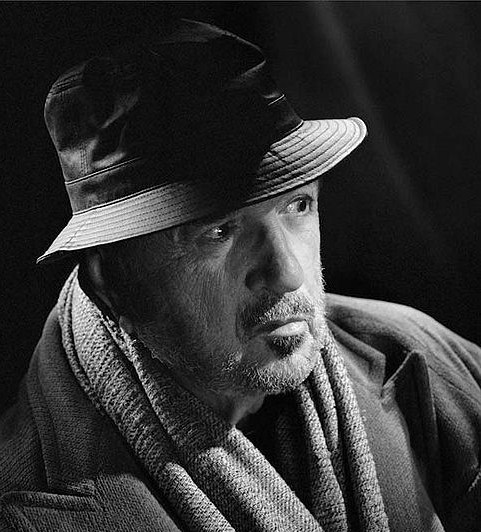
Five poems by Rohini K.Mukherjeehave been translated from Odia by Snehaprava Das
Rohini K.Mukherjee
AT THE MYSTICAL SANCHI
An unknown voice beckons At the early hours of the morning. Moved by a new surprise Buddha relapses into meditation. A crystal dawn, cold as marble, Is traced On his hands and feet And his eyes and forehead. Some instant, invisible signal prompts him To turn on his side and sleep.
After Buddha’s Nirvana, Calm settles in the valley, slowly. Thousands of Branches and branchlets Radiate blissful divine light. The trees too, in a lavish growth, Spread out everywhere -- From the earth below to the sky above -- And meditate!
THE EXECUTIONER
No one could predict The next scene. But in the one enacted now The executioner has A prominent presence.
The executioner stalks the moon, His face hidden in the veil of clouds, Knife in hand, a gleam of smile On a phony face, A sharp, keen gaze under the glasses, Exuding the smell of An expensive perfume.
The indistinct footfalls may Prompt one to flick a look back But there would be no one behind Only clouds clad in midnight blue Sailing in the sky. From somewhere far floats in the music Of a mountain stream. Slowly, sorrow dissipates and a Path opens up for the spring, A wonderland of fairies. In his unguarded moments, The knife in the executioner’s grip Glitters in the furtive moonlight. Any moment that poison-coated knife Could find the moon’s throat, The moon knows that well. But it forgives, Because it also knows well That the executioner cannot Hide for long And will be trapped in The moonlit garden of tangled clouds.
THE DEATH OF A HAPPY MAN
One day, the eyes lost sleep And all the locusts flew away,
Not one spectator had guessed That one day The man will sprawl out on On the sea beach sands Washed away by the waves From distant lands.
The eyes lost sleep one day. The flock of locusts flew away.
But no one could guess The pains, the sobs That seared that forlorn soul.
Petals drifted in piles To make him a delicate shroud. The smell of sandalwood came wafting In the sea-breeze from the north. Seagulls flocked around the body, Unintimidated by the crowd in the beach, Drowning the voice of The living men there With their loud squawks of dissent. Ooh! What a long wished-for Happy death On a cool and blissful sea beach!
After the flock of locusts flew away Carrying all the dreams back On their wicked wings, The eyes lost sleep!
ANKLETS OF THE NIGHT
There is still time for the nightfall. But the air tinkles with the sound of The anklets of the night As if someone is retreating from An ineffectual, moon-washed garden, As if someone from the grave Watching the landscape, Or someone standing at the riverside Hums the tune of a departed season, Or someone hurrying aimlessly away To escape the approaching dawn.
It is not yet night, But the night’s anklets ring. You are probably returning To your shelter of old times In search of a new hope. Just take a look behind to see The painting of a conflicting wind Fluttering across the courtyard.
It is not yet night But its anklets begin to jingle in the air.
How cool you appear in your Evening chanting of the mantras! How calm and steady you are In the pure fragrance of the descending steps As you set out on the journey Holding your heart on your palm Like a burning clay-lamp. May be when you arrive there The dawn around you would be sonorous With the notations of Raga Bhairavi.
There is still time for the nightfall But the night’s anklets tinkle in the air!
THEY DID NOT COME
I waited for them, but They did not come, I waited all this time in vain, and Knowingly, let myself fall a victim To the first rays of the sun. The sun’s whiplash spurred me on To the jungle. It forced me to cut wood And tie them in bundles. The hunger of the sunset hour Prodded me back to where I had started. The smell of soaked rice, and the aroma of Onions and oil Drifted thick in the air of my house.
The sun came in, an intruder, Sat by me and watched. Then it devoured all the food, Leaving nothing, Not even a single dried-up onion-peel.
Because they did not come, For me the morning was Meaningless in its futility. I knew I was never one In the list of their ultimate interests When their tenure of life here ended.
The footfall of the light Trod easy on my skin. Days rolled on this way In sun and light. The sun was everywhere, all the time. Whenever the door opened, The sun stood there. When the meteor came shooting down, When words rode over the waves of sleep to float in the air, The treacherous sun always appeared.
And for me, there was No hope of their coming back.
But, one day as I leapt up in a hurry At the Sun’s summon, I discovered the Sahara Desert That I believed had Remained hidden in my School Geography book, Lying face down all these days Under my own hooves!
Rohini Kanta Mukherjee has authored, edited and co-edited several volumes of poetry and short stories in Odia and English. Many of his poems have been translated and published in various Indian languages , broadcast over several stations of All India Radio and Doordarshan . Some of his poems and translations have appeared in Wasafiri, Indian Literature, The Little Magazine , Purvagraha, Samasa among others. He retired as Associate Professor of English, from B.J.B Autonomous College, Bhubaneswar, Odisha.
Dr.Snehaprava Das, is a noted writer and a translator from Bhubaneswar, Odisha. She has five books of poems, three of stories and thirteen collections of translated texts (from Odia to English), to her credit.
PLEASE NOTE: ARTICLES CAN ONLY BE REPRODUCED IN OTHER SITES WITH DUE ACKNOWLEDGEMENT TO BORDERLESS JOURNAL
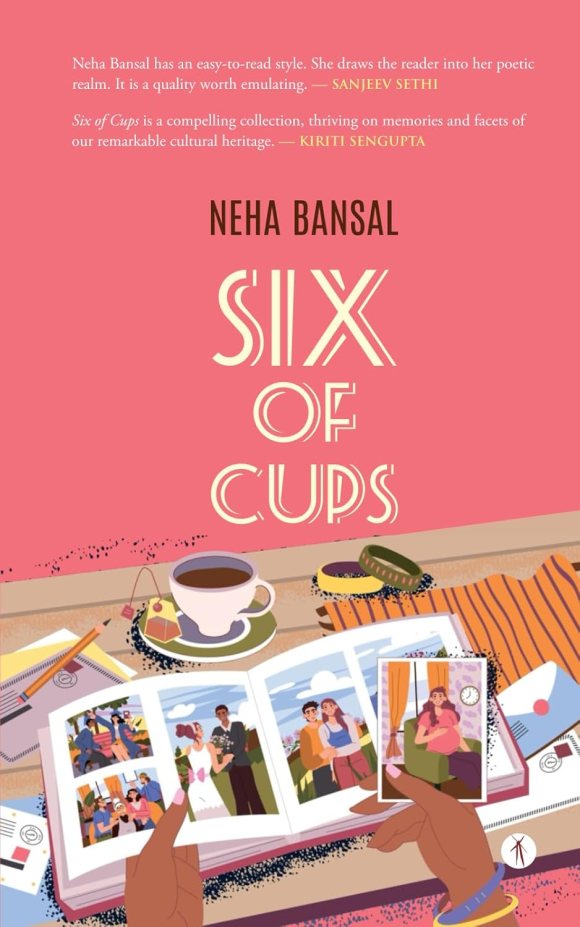
Some books speak in metaphors. Some shout their brilliance. Some want to be dissected, reviewed, analysed like puzzles. But Six of Cups isn’t that kind of book. It doesn’t ask you to do much. It just wants you to sit with it.
Neha Bansal’s poems don’t pretend. They don’t try to be clever. They don’t need you to clap. What they ask for is something quieter — your stillness, maybe. Your memory. They speak softly. Almost like they’re afraid of waking something in you. And maybe that’s exactly what they do.
This is a collection of fifty poems. Simple on the surface. But like most simple things, they carry weight. Not the kind that crushes. The kind you forgot you were holding until you’re reminded.
Reading Six of Cups is like finding an old sweater at the back of your closet. You didn’t even know you were missing it. But the moment you hold it, you’re somewhere else. In another time. Another house. Another life.
The title itself comes from the tarot — a card about childhood, nostalgia, kindness, innocence. The poems live in that space. They revisit things that aren’t just personal, but also collective such as homemade meals, festivals, sibling fights, old TV serials, chalk-smeared hands, and monsoon evenings. There’s a familiarity here that doesn’t feel manufactured. You don’t get the sense that Neha Bansal is trying to be nostalgic. She just is.
There’s a poem about Doordarshan[1]. It doesn’t try to explain the significance. It just takes you there — back to the old wooden cabinet TV, the warm static before the signal settled, the family crowding around the screen. It doesn’t say much and yet it says everything.
‘Sibling Squabbles’ is a small miracle. It captures that strange love we carry for the ones who shared our roof, our food, our secrets. The kind of love that includes shouting, pushing, sulking. But also defending each other, silently. Even now.
‘Paper Boat’ and ‘Mint Chutney’ — two more standouts don’t indulge in poetic imagery. Instead, they lean into the senses. The tartness of raw mango on your tongue. The wet smell of monsoon earth. The steam of evening tea. You read them and you’re not just reading. You’re smelling things. Tasting them. Hearing the old kitchen door creak open.
Neha Bansal is an Indian Administrative Services officer. It’s an unexpected background for a poet, maybe. Bureaucracy is about order. Poetry, one imagines, is about chaos. But in these poems, there’s order in the chaos. There’s discipline, but not rigidity. Every word is chosen carefully. Nothing feels excessive. Nothing is wasted. She writes like someone who listens closely to the world, to people, to memory. Maybe that’s what makes her poetry so honest. Her poems for people who’ve lived. People who remember the smell of their mother’s shawl. People who know the comfort of routine — boiling milk, folding bedsheets, watching Ramlila in the open field. They’re for the ones who’ve carried small hurts for years and never said a word.
There’s a kind of sacred quiet in this collection. That might be its most remarkable trait. In a time when poetry is often loud, performative, and built for clicks, these poems resist the noise. They’re not dramatic. They don’t climax. They settle in. They let silence speak.
In one of the most moving pieces, Neha Bansal writes about an old family tradition — Janmashtami, the celebration of Lord Krishna’s birth. But it’s not about religion. It’s about her grandmother drawing tiny footprints with rice flour. The quiet anticipation of the festival. The waiting. The softness of belief, not its spectacle. It’s in those tiny footprints that the poem finds its magic. You can almost see them fading slowly on the tiled floor.
These poems understand that memory is not a highlighted reel. It’s a soft murmur. A drawer that squeaks when you open it. A spoon stirring something warm. A phrase you haven’t heard in years but still know by heart. Neha Bansal knows that nostalgia isn’t about grandeur. It’s about the details we almost miss.
Her form is mostly free verse. But that doesn’t mean it’s careless. She knows how to pause — where to breathe. The white space around her lines isn’t empty. It holds meaning. A kind of emotional residue. You finish a poem, and it doesn’t end. It lingers. Like the scent of someone who just left the room.
There’s no poetic ambition here and that’s its strength. These poems don’t ask to be poetry. They just are. And that’s why they work. You trust them. You feel at home in them.
I thought of my own home while reading these pages. Kashmir. The long winters. My grandmother in her worn pheran, roasting cornflakes and walnuts on an old iron tawa, her hands, cracked and slow. The hush of mornings. No urgency. Just living.
That’s what Six of Cups reminded me of — the art of simply being. And how much that art is vanishing now.
Some poems mention festivals like Lohri, Janmashtami, Diwali. They present them as they are — domestic, lived-in, full of ordinary magic. For those unfamiliar, there’s a glossary at the end. But the real understanding happens not through translation, but emotion. Neha Bansal doesn’t lean on metaphor much. And when she does, it’s light. A passing breeze, not a storm. She doesn’t build complex imagery. But she does ask you to notice. In a world of scrolling, skimming, glancing — she’s saying, “Stop. Look. Listen.”
Even the titles of her poems have that simplicity: ‘Old Shawls’, ‘Grandmother’s Halwa’, and ‘First Rain’. They sound like diary entries. And in a way, they are. Only they’re not just her diary — they become ours too.
The brilliance of Six of Cups is that it democratises poetry. It makes it accessible again. You don’t need a theory. You need memory. You need feeling. That’s it. If you’ve ever missed someone or some place or even some version of yourself — you’ll get this.
And maybe that’s the beauty of it. It doesn’t want to be studied. It wants to be remembered. Like an old friend. Like a childhood street. Like a scent you can’t name but know in your bones.
The last poem in the collection doesn’t try to wrap everything up. There’s no neat ending. It just… fades out. The way light fades at dusk. Slowly. Gently. Without warning.
You close the book and feel something that isn’t quite sadness. It’s quieter than that. Maybe it’s the feeling of being seen. Or the feeling of remembering something small that meant something big. You sit with it for a while. You let it settle.
Six of Cups is not a loud voice. It’s a warm room. A soft light. A hand reaching back, not to pull you into the past, but to remind you it’s still with you. That you are made of it.
And maybe that’s what poetry should be sometimes — not a performance but a presence.
Gowher Bhat is a published author, columnist, freelance journalist, and educator from Kashmir. He writes about memory, place, and the quiet weight of things we carry. His work often explores themes of longing and belonging, silence and expression. He believes the smallest moments hold the deepest truths.
PLEASE NOTE: ARTICLES CAN ONLY BE REPRODUCED IN OTHER SITES WITH DUE ACKNOWLEDGEMENT TO BORDERLESS JOURNAL
The world ball dance was held on 25th December. It was the last time that Jay and Poulomi had agreed to meet each other with the tag of being lovers. The ballroom was majestic with a long winding staircase – the magnificent staircase was adorned with Christmas Mistletoe plants. Jay could not help but stare at Poulomi in her maroon ballroom dress and with her maroon lipstick making her lips seem more protruded than ever.
The song ‘Maroon’ by Taylor Swift was playing in the background.
The ballroom ceiling was full of sparkling chandeliers which glimmered with golden light. The golden rays of the daytime sunshine lit up the ballroom with a soft glow, as they passed through the crystal clear huge glass windows. Each of the windows had maroon curtains which were shifted to the side to let the daylight in.
As the day approached late evening, the curtains were closed and the ballroom still had the soft golden glow – this time it was because of candlelight lamps.
In this glorious ballroom, Agatha was playing the instrumental version of the song ‘Maroon’ on piano with the grandeur of royalty, for the piano was gifted by the Princess of England, Agatha could not feel more proud of her musical skills.
For a while, Agatha kept looking at Poulomi and Jay now and then. Poulomi’s maroon dress had golden belt and golden buttons, and Poulomi was wearing a necklace studded with golden star shaped diamond-like stones. She was carrying a golden purse with her and as she walked down the staircase, she seemed like the very Queen of England.
In the middle of the dance with Jay, Poulomi excused herself and went to Agatha. She exchanged a few words with Agatha and when she returned to the dance floor, Jay was nowhere to be found. Jay had disappeared.
Agatha came running and said, “Poulomi, you must confront Jay. This act of disappearance is no way justified”.
“Agatha, is Jay a real person? Or is he a hallucination of mine?” asked Poulomi, being well aware of her own mental health condition. And Poulomi ran towards the veranda and gazed at the maroon night sky glittering with silver stars.
Agatha followed her and said, “Well, at least, the sky and the stars are for real.”
About the Book:
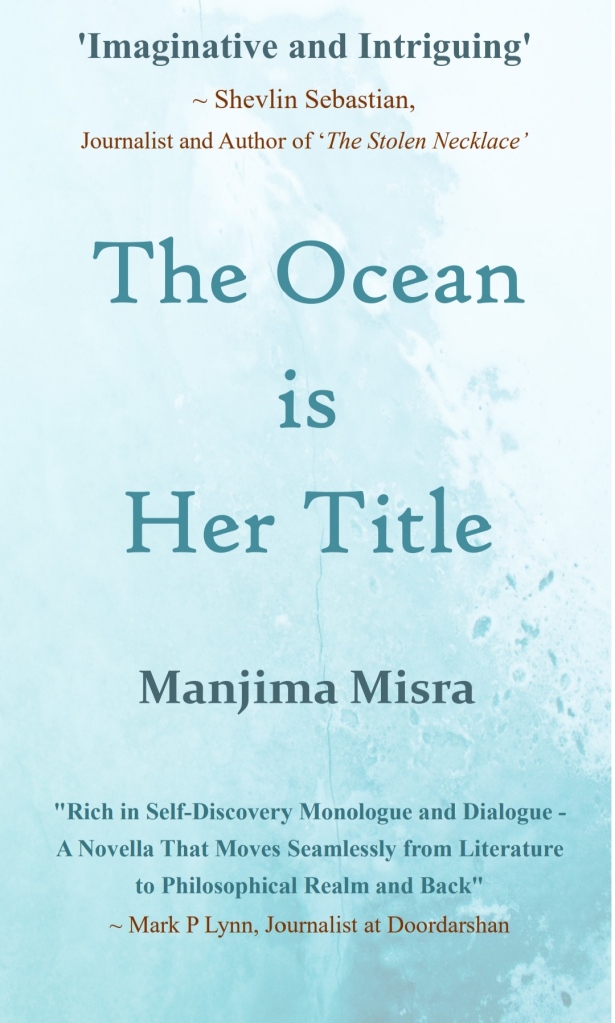
The novella, titled The Ocean is Her Title, is an exploration of a fractured existence of the central character Poulomi “struggling through a welter of feelings, incapacities, and anxieties to shore up her beleaguered existential coherence”. In the words of Mark P Lynn, noted journalist at Doordarshan, “the novella is rich in self discovery monologue and dialogue and moves from literature to the philosophical realm and back. The internal monologue takes the form of a conversation with real characters who are fictionalized from the author’s love for Harry Potter, Taylor Swift, Wonder Woman, and the heartfelt support structure provided by a father who tends to a child with bipolar disorder.” In the words of renowned journalist and author Jitendra Dixit, “The Ocean Is Her Title, the readers are invited to embark on an emotionally charged novella that weaves together the dreams and struggles of a young Delhi girl, Poulomi, whose life takes an unexpected turn when she is abducted and transported to a place she could never have imagined – the Ocean Hospital. This novella, authored by Manjima Misra, is a poignant exploration of identity, resilience, and the complexities of modern womanhood.”
About the Author:
Manjima Misra is a writer based in Delhi. She has written three published books previously which are titled Indian Feminine Fury, Unapologetically Mad, and The Ocean is Her Title. Her opinion articles have been published in The Indian Express, The Quint, Outlook India, Deccan Herald, Newslaundry, and Firstpost. She has previously worked as a writer with the Education Desk at The Indian Express and as an educator with Teach For India.
She has a Master’s degree in English literature from the University of Delhi and a Postgraduate Certificate in Teaching English to Speakers of Other Languages (TESOL) from the University of St Andrews, Scotland.
PLEASE NOTE: ARTICLES CAN ONLY BE REPRODUCED IN OTHER SITES WITH DUE ACKNOWLEDGEMENT TO BORDERLESS JOURNAL
In Conversation with Ramesh Karthik Nayak, author of Chakmak, with an afterword on Banjaras bySurya Dhananjay and art by Ramavath Sreenivas Nayak, published by Red River.
They always wish they wander
into black clouds like Banjara Tribes:
the people with no address on the earth,
gypsies in the tales of time.
Here are stories of a people who have never voiced their lores in English. The Banjaras had oral folk lore as old as the hills. They relocated to various places in the world. One group wandered down to the South, where some learnt to write their spoken language — Gor Boli — in Telugu. To this group belongs young Ramesh Karthik Nayak who has given us a wonderful book of poems describing the life of Banjaras as well as concern that in the process of integration, they seem to be losing parts of their heritage. Called Chakmak[1], the book leaves a lingering aftertaste not just with words but also with the vibrant artwork by Ramavath Sreenivas Nayak and an informative essay on Banjaras by Surya Dhananjay.
Banjara art in Chakmak by Ramavath Sreenivas Nayak
You travel with the book to a place of wonder and yet it’s not all smooth sailing as the poems introduce notes of accord and discord into the conversation. Reality and discontent creep in.The poetry is layered with images, simple and yet of a definitive flavour. There is poignancy in the poet’s lines when he says:
The ippa flowers grieve
releasing inebriety
listening to the story of our tanda*.
*tanda: settlement
And:
No ghunghtos* were left in the tanda,
all have disappeared
along with the people
who were born
and grew
within the ghunghtos.
*ghungtos: veils
And yet the culture seems to have had an innate wisdom as the tribe harmonised with nature:
The thunders devour our huts and us.
So, to threaten thunder, we howled.
We should raise our voices whenever we need to.
Or else we die.
In the titular poem ‘Chakmak’, Nayak tells us about his life as a Banjara and then reflects:
The world is trying to heap the chakmak together,
ransack our tribe for stones
and change the tanda into a haat*
of banjara tribes.
The chakmak in the haat were ready to burst
with chronicles untold.
You gather the people.
The flute disappears.
I try fabricating the remaining tale.
*haat: market at a fair
Nayak for all his flavour and wisdom experiences a severe disconnect and finds himself in almost perhaps, an immigrant’s world, where it is hard to adjust to the reality of the ethos that connects him to the larger world and he feels an outsider in the world that he was born into. Torn between these two, the young writer is fascinated by death. He tells us –
Since my childhood
I saw death as an untouchable
In this candid conversation, Ramesh Karthik Nayakn– a young lecturer, presenter on Doordarshan[2] and an upcoming voice for a people who have remained voiceless over centuries following oral traditions — talks of this strange position he finds himself in. He tells us more about his people, his perceptions and his poetry.
Ramesh Karthik Nayak
Congratulations on being the first Banjara writer to have done a full book in English. Reading your book, one gets a whiff of Banjara life as it was in the past. Can you tell us about their life and beliefs? The creation myth seems unique… maybe you can tell us a bit about the colours you have reflected in your poetry?
Thank you. There is a vacuum in indigenous literature. Not enough indigenous literature has been produced till now. This vacuum won’t be filled until we the insiders turn outsiders. After some time, when we question our identity, we start seeking our own history and go back into the past. In this process, we practise a few things (writing, singing, painting, dancing or sculpting) which slowly turn us into an insider.
Each and every colour has a significance in our lives. All colours will be seen in our attire. If there are any colours missing, they will be reflected in the mirrors embroidered into our garments while we travel.
There are many beliefs and occupations seen among us.
If, the calf’s ceremony (Bhessi Puchre). When a buffalo gives birth to a calf, based on the calf’s gender, after 5 or 7 days, we conduct a ceremony with seven triangle-shaped stones (Shaathi Bhavani[3] :Manthrali, Kankali, Hinglaj, Mariamma, Thulja, Sheetla, and Dhavalagar) by offering lapsi (rice boiled in milk and cooked in jaggery). The Saathi Bhavani look after their children (who share their arts and crafts with nature for free) and their cattle safely and provide them with natural resources abundantly. Only after this ceremony, the milk from the lactating cow can be shared with others. Until then, no single drop could be shared outside the home. If the milk was shared with others before the ceremony, the calf’s life would be in danger. Thus, we respect animal needs too.
Another very distinctive ritual is a death ritual of a young married person. Friends or family members of the deceased pierce pins under the dead person’s feet so that the corpse is hindered from walking back without pain. They believe that the young person will have a yearning for their hamlet and children. So, the ghost might want to haunt their homes. Also, while taking the body to its final destination, the deceased’s friends throw mustard seeds along the way. While coming back home, they pluck off the pins off the feet and pick up each grain. They keep picking the grains the whole day. The cycle keeps repeating.
Did Banjaras — who at the end you call gypsies — ever grow roots and become farmers? You have a poem about a farmer. Did your ancestors give up their nomadic lifestyle to opt for farming?
Our ancestors used to sell salt by wandering from place to place. They used to thatch roofs and transport stuff from place to place. They sang songs handed down orally and embossed traditional tattoos. They would stitch clothes with infinite designs, etc. Now everything has turned upside down. Now, we are growing up eating many types of leafy and root vegetables, rice, corn and sorghum instead of our traditional foods.
In Telangana, wherever you travel by the highway, you will see Banjaras on both sides of the roads selling fruits and vegetables. Other common occupations among us are farming, driving auto rickshaws, selling crafts, making bricks in kilns, etc.
Your dialect/ language Gor Boli had no written script and I read in the afterword that the traditions were oral. So, did you learn about your culture purely from oral traditions? Are your two books written in Gor Boli written in Telugu or in just plain Telugu? Which language are you most comfortable in? Which language did you grow up speaking?
I have learnt many things by seeing and listening. Whenever I ask my parents about something they simply smiled instead of giving an answer. They did not want to share any cultural things about our community. They always asked me to concentrate on my studies. That might be one of the reasons that I always keep thinking of my people and their history.
I grew up with the Telugu language. In 1999/ 2000, I was sent to a private school for my education. From then onwards, I thought I was a Telugu. Later, I realised I’m a Gor (Banjara/ Lambadi). Now I am a hybrid Gor. I want to localise myself from hybridity. I have published two books in Telugu. One is in English. These three books are just an introduction to an existing community. To write down the sensibilities and other things, I think this life won’t be enough. There is only one book which I haven’t been able to publish yet, written in Gor Boli with Telugu script. I’m comfortable with Telugu. People tell me that I stammer when I speak Gor Boli. They also say my way of speaking is like that of a child. Nowadays, I believe I’m comfortable with Telugu, Banjara (Gor Boli) and English.
In your poem, ‘Who am I?’, you mention eviction. Did you or your tribe face displacement? Tell us your story.
Yes, it happened with my grandparents. Before that, they used to stay in abandoned lands. They would stay in one area for two to five years and then migrate to a different place to get enough grass for the cattle or herd they had. Earlier, my grandparents were settled near a hilly place, where there was a pond. Then, in 1970s, the then-state government relocated my grandparents to Jakranpally Thanda, also called VV Nagar Tanda, near to the highway road NH44 and a village Jakranpally (now known as Mandal) near to our tanda.
Still, in our state, some nomadic communities face eviction.
TheBanjaras depicted in the art in your book seem to be a musical lot. Does music impact your poetry?
Yes indeed. Women are trained to sing their plights in a song, which we call Dhavlo. This was the name of my short story collections in Telugu. The event could be happy or sad, but everything would be sung in a song. Some of the lyrics can be so heartrending that listeners could start to cry. Our people cannot survive without singing. Some people also misunderstand our Dhavlo as Rudali’s[4]song. Each and every moment is made into a song for self or for children or just to survive. I hope the flow of my blood has music, then automatically my words would atleast carry a little bit of music with it. So that could turn into a poem that you read.
You seem to be steeped in lores from the past, and yet you bring it all to us in English. How did you develop your fascination for words? Tell us how from a tanda you moved into school textbooks?
It started when I was admitted into private school. I stopped talking to others. I would stare at our school ground, where there were some other nomadic families sheltered in the tarpaulin tents. I felt like going to them. They were not Banjaras, but they had donkeys and horses. I still remember the scene. In the summer, near our school, a canal was being dug. Accidentally, a boy fell under a heavy vehicle and died. His mother picked him and kept him in her lap and wept.
I was fascinated. I thought of killing myself. And in this way, death always put herself first in my words.
Later, as I changed many schools, I grew lonelier and started drawing landscapes. I started writing to create captions for my drawings. Thus, my drawing drove me into writing. Writing turned into a habit; later it became a compulsion. When I came across Toni Morrison’s quote, “If you find a book you really want to read but it hasn’t been written yet, then you must write it”, I could connect and also to the stories of Mahasweta Devi. Because of my writing, I have developed my skill in Telugu and English — at least I can express the way I feel. Later, after getting published, with the help of my friends, Aparna Thota and Chaitanya Pingali, the Balder Bandi (Bullock Cart) attracted readers and an autonomous college prescribed a poem in the under-graduate curriculum and the book was prescribed in the post-graduate curriculum.
Why did you name your book Chakmak, a flintstone. Is the poem named as such at the centre of the story you want to share with the readers?
In our community, we bow down to the earth in front of a rock or stone to offer ourselves. We also use the rocks for other things like I have mentioned in the poem. So, in our community, things which are regarded as sacred should also be useful in other ways. They should not sit idle or be untouchable. In our daily lives, we do see many stone and pebbles, but we don’t even take a look at them, instead we kick them off. I wanted to highlight that even rocks have history.
Also, many rock were getting blasted in our areas. We are just losing our natural resources. We are losing the peacock and fox cries that echo from the top of rocks.
I sensed a sense of regret in your poems for the loss of a way of life. Do you feel that it is better to stay indigenously and not integrate with the mainstream? Do you think it helps integrate with the mainstream?
I’m afraid for my people. They are losing their sensibilities. Their fascination for modern lifestyle is making them disregard their identity as Banjaras. Sometimes, I even feel like I should go to each and every one and explain to them why we should choose ourselves as we have been. Being segregated from the mainstream is also part of our identity. So, I hope for now there will not be any integration with the mainstream population. Of course, you may be wondering that Ramesh Karthik Nayak is now living with mainstream society and telling this. Yes, I’m living with this society, where I feel suffocated with the artificial lifestyle. I know I will be just a guest to my land, where I keep cheating my people, writing their lives on paper. Mainstream society once had pity on indigenous communities, but now it has turned envious, because our people are getting benefits like reservation from the government.
In ‘A Day in the Rainy Season’, you have spoken of a rain ritual where people howl: in ‘Roseland’ you have written of how roses is not what Banjaras grow and in ‘On the Forest’, you reaffirm that the Banjaras are in harmony with the green. Given the need for a greener world, would you say that Banjaras lived in harmony with nature? If so, how?
Nomadic or Adivasi people always believed in nature. And they still insist that they are an extension of the greenery, which is a quarter part of this cosmos. And the harmony that the reader experiences in my poems cannot be explained except as part of our traditions. But I want to make a point. In tribal communities, love and hatred are two different things that resonate at different wavelengths. Their way of living reflects love always to the outsiders. Without beliefs and rituals offered to the trivial things, you cannot even imagine a single day in the life of tribals. It will be incomplete.
You have mentioned untouchability. Have you or yours ever faced it in the present day or is it something from the past? In ‘Death’, you equate death with untouchability.
I have had my education in distance mode. So, I don’t know about the discrimination that happens in schools and colleges. But I heard many things related to discrimination from friends. Now, I regularly hear that these nomads (Banjaras) migrated from somewhere and they even have reservations now. They don’t belong to this land, they say.
To support my studies, I used to distribute leaflets in bus stops. I used to work in a photocopy shop operating machines, sold books at events, did catering, and helped as an air-conditioning mechanic. While working, few people did not want me to work for them because I was a Banjara.
In the past, our people were herders. They were not allowed to touch the water that the owners’ animals drank. And they were always accused of stealing. They were always treated as thieves and murderers (Criminal Tribes Act, 1871) in some areas. In some areas of course, Banjaras were treated with due respect because of their hard work. However, there have been times when they would not be allowed to get into the bus to sit with others, especially when they were in Banjara attire.
In 2016, I visited a tanda near Medchal. On my third visit, a group of women told me their plight about selling fruits and vegetables, how people bargained with them because of their indigenous identity or because of their broken Telugu, how some people took credit and never paid. Later, an older woman, Kokhli, talked about the well. Whenever these Banjaras want to fetch water from the well, which belonged to a landlord near their tanda, the farm workers used to excrete into the water so that the Banjaras could not quench their thirst. But unfortunately, they had no other choice. So, they had to draw from the same well for drinking. The same thing also happened recently in Tamil Nadu. I’m trying to record all these in my stories and poems.
Since my childhood, I have had a great love towards death. I even dreamed of dying many times. That’s how death came and repeated more in my poems.
What are your future plans? Any other book in the offing?
In our Telugu states, we have 35 tribal communities, which includes Girijanas — nomads dwell near to the hills or abandoned lands, and Adivasis — people dwell within the forest (Gond, Koya, Nayak Pod, Gutthi Koya, Pardhan, Banjara, Matura Lambadi, etc). I want to write more about all the tribes in Telugu and in English languages. It might be in any genre. Sometimes a single topic can be expressed in multiple formats like in a poem, short story or essay.
Presently, I am co-editing (with Prof Surya Dhananjya) a compilation of Telangana Banjara stories in Telugu. I am also working on my second short story collection Banjara Hills in Telugu along with English poems (which I am rewriting from Telugu).
Thanks for giving us your time and for a brush with your people through the book.
Ratnottama Sengupta travels down the path of nostalgia with her ancestors, her parents, eminent writer, Nabendu Ghosh and his wife, Kanaklata
Nabendu with his children. From right to left: Ratnottama Sengupta, Nabendu Ghosh & Shubhankar Ghosh. Photo provided by Ratnottama Sengupta
Nabadwip Chandra Ghosh of Dhaka was an advocate who had mastered in both, Sanskrit and History. And he was a kirtan[1] singer par excellence. Both these traits have familial roots: His father was a court clerk, his cousin a doctor of those times. And all the males in the Vaishnav family — devotees of Prabhu Jagadbandhu Sundar of Faridpur — were good singers, a talent that was to continue with his sons and grandsons.
It was for his kirtans in particular that P R Das, brother of freedom fighter Chittaranjan Das (1870-1925), asked Nabadwip Chandra to join him as his junior in Patna High Court. The year was 1920. Bihar which was a part of the Bengal Presidency, was steeped in casteism. The Ahirs — Yadavs who tended cattle and sold milk — were exploited by the Bhoomihars, who were Brahmins, and if they retaliated, they were arrested and put in jails. By 1920s, the freedom movement too had gained steam but the political prisoners were also clubbed with the ‘hooligan’ Yadavs. Nabadwip Chandra fought courtroom battles to win this deprived section their political right, and came to be highly respected – a father figure for a large section of people in Bihar.
In fighting those battles Nabadwip realised one thing: the acute need for education among the so called Backward Classes. “Unless a person has education, he or she is not respected and remains vulnerable to exploitation, economic or otherwise,” he maintained. And education is best spread through mothers. Consequently he sought marriage alliances for his sons with daughters of teachers, sisters of lawyers and doctors, and — later — with undergraduates and graduates.
His elder son was married to Kalyani, the daughter of a school teacher. His third son’s wife, IA passed Sundara, was the daughter of a BA-BL – a lawyer in Bhagalpur. His fourth son’s wife, Namita was again the daughter of a teacher from Ranchi — and she was a graduate who was already teaching before she married, and did her MA after her wedding. So had Nabadwip Chandra’s daughter Rani who, after her tying the knot with Mahesh Chandra of Jorhat, completed her schooling and mastered in Economics. Further she taught in JB College, Jorhat and went on to become the vice principal whose students included Tarun Gogoi who rose to hold the high office of the Chief Minister of Assam.
In fact, Nabadwip Chandra’s own wife, Suniti Bala, was the daughter of a minister in the minor royalty of Jessore — a man who won a gold medal as one of the first matriculates of British India. His entire family was keen on education — and Suniti was not only literate, she received formal education at home before she was married at the age of 15 — which was pretty advanced for the first decade of 1900s. All her life, after child bearing, rearing kids, attending to household chores in the kitchen, she would spend her ration of leisure hours reading books and in her later years, telling stories to her grandchildren.
*
Nabadwip and Suniti’s second son Nabendu inherited his parents’ love for letters. And he took it to a much higher level as a writer who carved a place for himself in the history of Bengali literature and of Hindi Cinema. He started writing early, when still in middle school, as he wrote for and co-edited a handwritten magazine. Even as a teenager he would attend Sahitya Sammelans and while in College he got published in sought-after literary magazines.
But Nabendu did not stop with words alone. Along with singing kirtans, a talent he inherited from his father, he trained himself to dance in the mould of Uday Shankar. He would regularly dance and act on stage, in Patna and elsewhere in the state, and subsequently played memorable cameos in Bombay films too. Before he passed away at the full age of 91, he had penned 16 novels, 28 collections of stories, and nearly a hundred screenplays for Bollywood classics.
On January 31, 1944 he married Kanaklata. Sister of advocate Bhupendranath Ghosh from Malda. She turned out to be an architect of human lives. Kanak was born to Chandrakanta Ghosh, a landed gentry who was forward looking enough to will large tracts of agricultural land to his daughters at a time when all they were entitled to was Streedhan — jewellery given at the time of marriage. Still, his wife Dakshayani, who was ‘Karta’ — head of the Hindu joint family — after his death, decided to live a part of her sunset years in Vrindavan, the holy land of Vaishnavs.
Kanaklata had not completed her school years when she was married to Nabendu. But being a doughty soul, the 16-year-old not only read Nayak O Lekhak — Nabendu’s first published novel; she got it critiqued by an academic cousin (who later became a professor) before she consented to the marriage with a man older to her by ten years.
Kanaklata’s own education had to be shelved as she became a mother twice over; lost her first born; faced an uncertain future as Nabendu lost two successive government jobs because of his ‘seditious’ – anti-imperialist — writings; and then Partition uprooted the family that had to leave Bengal and seek livelihood in Bombay’s tinsel town. But, despite her young years, it was she who instilled in her husband the spirit to soldier on with his pen and not succumb to any compromise in his literary efforts.
Kanaklata: Photo Courtesy: Monobina Roy
She herself did not surrender her appetite for formal education to circumstances. Years after her sons and daughter had graduated from universities and she had become a grandmother thrice over, she enrolled in Open Classrooms and got her Master’s certificate in Bengali language.
In the intervening years? Her home provided a platform to umpteen writers, country cousins, sisters, nephews, nieces, even to nobodies. She was there at 2 Pushpa Colony when they wanted to pursue higher education in Bombay, or make a career in the country’s financial capital, or shine in the tinsel town. She helped to negotiate marriage proposals, and she supported in every way she could, those who sought medical intervention by specialists. Simultaneously she secured the financial future of her nuclear family by judiciously building houses and investing in government bonds.
Most of all, Kanaklata was the architect of the lives of her three offspring. Her eldest son Dipankar who, as a child, was legendary in family gatherings for his mischiefs and pranks, was groomed in Shivaji Military Preparatory School. Thereafter she ensured that he trained in Medicine at the Nil Ratan Sarkar Medical College in Kolkata. Once he became a doctor he served with Oxfam during the Bangladesh Liberation War.
This education stood him in good stead when he went to UK and joined the Royal Army Medical Corp that swung into action during skirmishes in Belize, the Carribian country in Central American land, in 1986, and again in Desert Storm, the first Gulf War of 1991. When the Berlin Wall fell in 1990, he was serving in Belsen, where the Nazis had set up a concentration camp sometime in 1943. He went to the minefields of Bosnia, which Princess Diana visited in 1997. In mid-1990s he was stationed in Brunei, where the British Military protects the Sultan; at the turn of the millennium, he was in Cyprus, which the British forces use as base for both military and humanitarian operations in the region that often saw dissonance. What a rich life of experiences in helping the injured and ailing!
At her insistence, Kanaklata’s second son Subhankar was trained in direction at the Film and Television Institute of India. He came out to be Associate Director of Damul (1984). He rose to partner his father in the making of the classic, Trishagni (1989), to direct the National award winning Woh Chhokri (1993). With teleserials like Yugantar, Nishkriti and Dances of India showing on Doordarshan he was a name to reckon with on the National network in its heyday. Then he went on to teach filmmaking in Mumbai’s Whistling Woods and to set up the wing of Filmmaking Studies in the National University of distant Fiji.
*
And Kanaklata raised the youngest of her brood, their only daughter Ratnottama, to cultivate the inheritance from her father, in literature, cinema and the arts. Even before the word global environment gained currency, by demonstrating how not to chuck everything in the bin, she drove home to her daughter the concepts of ‘re-use and re-cycle’. Blessed with green fingers, she shared with neighbours and friends the fruits of her ‘farming’ in the patch of green surrounding their Goan-style bungalow in the Mumbai suburb of Malad – and inculcated in her children the importance of green environs. Cooking, she taught me, was as significant in our everyday life as banking or management of money. And she drilled into me when I was still in school, that “you must earn, even if it’s only a hundred rupees every month. Else, even your own children will not respect you.”
I am always delighted to give this one example of her practical thinking. Soon as her daughter joined college, the home-maker booked a Life Insurance policy for her and directed her to pay the annual premiums. And how could she do it without compromising on her studies? “Simple. Clean the house, sell the waste to the raddiwala; put the ‘income’ in the bank.” At the end of the year, she had the money for the insurance premium and also the experience of banking. This, at a time, when majority of account holders in the bank were men.
Through all this, long before the world started celebrating International Women’s Day, Kanaklata had taught her daughter to be “no less than a son.” For, she ingrained in her, “there is nothing you cannot do if it spells well-being for people in your care…”
Nabendu and his wife, Kanaklata. Photo provided by Ratnottama Sengupta
Ratnottama Sengupta, formerly Arts Editor of The Times of India, teaches mass communication and film appreciation, curates film festivals and art exhibitions, and translates and write books. She has been a member of CBFC, served on the National Film Awards jury and has herself won a National Award.
.
PLEASE NOTE: ARTICLES CAN ONLY BE REPRODUCED IN OTHER SITES WITH DUE ACKNOWLEDGEMENT TO BORDERLESS JOURNAL
In a medium that is known for its regressive content, Gajra Kottary, novelist and short-story writer, has time and again gone against the tide and broken taboos. Shantanu Ray Chaudhuri looks at five shows she has written that went against the grain and emerged triumphant…
Growing up in the 1980s, one of the many pleasures of a less cluttered and leisurely time was the birth of the TV series. Many people I know would swear by the fact that the first of these represented the best of Indian television. Even close to forty years later, I can still rattle off the days on which each was telecast: Karamchand on Mondays; Hum Log[1]and then Buniyaad[2] on Tuesdays and Saturdays; Khandan[3] on Wednesdays; Ados Pados[4]on Thursdays; Yeh Jo Hain Zindagi[5]on Fridays. You had stalwarts like Satyajit Ray, Mrinal Sen, Shyam Benegal and Basu Chatterjee make fine works for the television.
Sometime by the end of the decade kitsch entered in the shape of Ramayan and Mahabharat. I moved on and lost touch. A resurgence of sorts happened with the coming of cable television, and we had path-breaking shows like Shanti and Tara. And then it became increasingly difficult to keep track of TV shows. The shows changed beyond recognition. Led by the likes of Kyunki Saas Bhi Kabhi Bahu Thi,[6] they became more and more ridiculous in the worlds they represented. One word came to be bandied about regularly with respect to soap operas: regressive.
However, like all generalised judgements, a blanket application of the word is unfair to a number of serials that tried to, and often succeeded in breaking taboos, while operating within the limitations dictated by the medium and the grammar of its narrative. And the one writer who has time and again bucked the trend, gone against the tide, is Gajra Kottary, the creator of historic shows like Astitva: Ek Prem Kahani[7]and Balika Vadhu.[8]
Gajra Kottary with Shantanu Ray Chaudhuri. Photo provided by Shantanu Ray Chaudhuri
Journalism and Fiction Writing
One of the reasons Gajra manages to break new ground in her television narratives might have something to do with her training as a journalist. “IIMC [Indian Institute of Mass Communication] was a tough course to get into and we had a few fresh graduates like me, and a whole lot of older and established professional journalists from other non-aligned countries studying with us, a great mix,” she says. It provided her with a grounding in fact-based narratives while polishing her skills as a writer, of which she had provided glimpses in college, when two stories she wrote got published in Eve’s Weekly, along with two fiction-style middles in TheTimes of India. “The IIMC stint helped because as I have observed over the years, I have more respect for the sanctity of facts even while taking my flights of fancy than others in the business. I take fewer creative liberties than others. I have done more realistic shows on television which helped forge a distinct identity for my writing.” But it also left her confused since political and economic writing held no interest for her and Delhi offered avenues only for those.
Destiny intervened in the form of Cupid. Falling in love with Sailesh Kottary, a “hotshot and hardcore journalist”, she moved to Bombay. It was here, as a “stay-at-home mom”, that she gave wings to her imagination and honed her writing skills. Watching serials like Saans[9] and The Bold and the Beautiful might also have helped imbibe certain aspects of writing for a visual medium. Her first work of fiction, Fragile Victories, a collection of stories, led to her first assignment in television. She had sent a copy of the book to Mahesh Bhatt, who passed it on to Soni Razdan. Impressed by the collection, the latter signed Gajra up for the story and screenplay of her first TV production, Hamare Tumhare[10](2000), which marked her TV debut, before Astitva made everyone sit up and take notice.
If IIMC shaped her in some ways, another skill-set that has held her in good stead probably came from her experiments in writing fiction. Fragile Victories was followed by another collection of stories, The Last Laugh, and the novels Broken Melodies, Once Upon a Star, Girls Don’t Cry and Not Woman Enough. These helped her to keep to a discipline that could go missing in the never-ending juggernaut that is the TV soap opera. They also are testimony to her willingness to push the envelope when it comes to narratives and characters. Not many know that much before Indian writers, particularly women, began addressing issues of sexual identity and same-sex relationships, Gajra had written about these in her fiction. As she puts it, these themes “continued to ‘consume’ me”. Not Woman Enough may have been published as an e-book only recently, but it evolved from a story that she had published way back in 2003. “I felt that I hadn’t done justice to the theme in the short format, so I wrote a full-length novel titled Not Woman Enough and felt finally relieved of my obsession.” Another story, ‘Two Gold Guineas’, evolved to her third novel Girls Don’t Cry, a pun on the expression ‘boys don’t cry’ and “an ode to the bravery of women and the friendship between a grandmother, mother and daughter”.
What is startling about these works of fiction is her ability to address taboos. Not Woman Enough not only deals with a same-sex relationship, but Gajra has the audacity to set it in rural Rajasthan as opposed to an urban setting, where it would have probably been just another story. She has the perspicacity to understand that the stakes are so much higher for first-generation characters experiencing the forces of social liberation while battling age-old customs. It is the same acuity that she brings to bear upon her iconic TV shows, which have time and again shown what is possible in a medium that allows little leeway for out-of-the-box thinking.
Astitva: Ek Prem Kahani (2002-2006, Zee TV)
Running 668 episodes, over a period of three-and-a-half years, this is the series that launched Gajra into the big league. Today, twenty years after the first episode was aired, an older woman-younger man relationship might appear staid. But back then it was bold, and Indian television had not seen anything like it. It made an icon of its lead, Niki Taneja, who plays a doctor who falls in love with a man ten years younger. What stood out is the maturity with which the series unfolds, largely devoid of the excesses that came to mark television in later years. “The first TV show maker I decided to call upon was Ajai Sinha, who had directed shows like Hasratein[11]and Justajoo[12]. He had been planning a show called Astitva with a bold theme and my timing was bang-on. It spoilt me enough to believe that television too was conducive to the kind of work I felt happy doing.” That this show managed to hold its own against a raging Kyonki[13], speaks volumes of the writer.
Balika Vadhu (2008-2016, Colors TV)
2167 episodes! Yes, you read that right. One of the longest-running shows on Indian television, this cemented Gajra’s reputation as a writer. Here again, Gajra was going out on a limb addressing a much-abused tradition prevalent in large parts of India. And sure enough, the press wasn’t flattering. It is one show that divided opinion like few others. “Yes, we received some negative press, because Anandi was this irrepressible kid, a happy child who kept bouncing back despite dealing with the dark consequences of child marriages of the past playing out in the present. It was a calculated approach as child marriage is a dark and gloomy issue. It was a conscious decision here as we needed to keep the cheer, but critics felt that we were glorifying child marriage. I think they were missing the woods for the trees.”
One possibly needs to understand the medium and its viewership to get a sense of what Gajra means. Unless the packaging is glossy enough – colourful clothes and jewellery – audiences might have been put off entirely by what is a repulsive subject. “And that would mean we would not be able to get across the underlying message of the show. These tactics are important due to the challenge of the medium of television, and the terror of the remote control. It was a classic case of the sugarcoated pill doing its work.”
Apart from the writing, the series was also recognised for its iconic performances and comments on several social issues that ail Indian society, which were woven in organically without being preachy. It also had an authentically rustic feel thanks to Purnendu Shekhar, whose concept it was. Those decrying the glossy packaging forget that the issues the series addressed included girl child education; peer, sibling and parental pressure to do the best; child labour; the begging racket; forced prostitution behind a legal façade; quacks and medical malpractices; date rape; adoption; alcoholism; divorcee and widow remarriage; trafficking in women; surrogacy; juvenile delinquency and teenage crimes, among others. From the comfort of our air-conditioned condos and offices, far removed from these realities, it was easy for the elitist press to criticise the series.
One standout episode dealt with the protagonist’s first experience of menstruation. This is a subject still, despite Padman and the increased conversation around it, spoken of in hushed tones. It is fascinating to hear Gajra’s take on this: “I remember how we involved Avika’s [the child actor who played Anandi] mother to explain to the child privately about menstruation before we shot the scene showing a young girl’s trauma when it happens to her as a bahu in a conservative household. Lots of people wrote to us about delaying the marriages of their girl children after watching Balika Vadhu. There was a girl who was emboldened enough to annul her marriage that had happened as a child when she turned eighteen. We received mails even from parents of city girls who were now reversing their decisions to get their girls married by the time they were sixteen.”
There was of course the flipside of popularity, when the writer received a death threat on Twitter if she dared to kill off the character of Shiv (played by Siddharth Shukla). “Those were the early days of social media, so real people started to write in with their reactions which were usually very intense and sometimes downright ridiculous.”
This series, spanning 55 one-hour episodes, was a huge challenge, involving as it did a historical figure, and one of the most important religious figures of the world. But trust Gajra to approach the subject from a refreshing point a view: as she points out, in school textbooks we go straight from the story of Gautama leaving home to being under the Bodhi tree and achieving enlightenment. But his experiments to arrive at the truth had many stages to it. As she says, “What it did was to dispel my own myths about the Buddha’s life. I had always felt disturbed about his abandonment of his wife and child for his own spiritual search.”
It helped that the show came to her at a point in life when the strong opinions and idealism of youth, both professionally and personally, had given way to the realisation that nothing is or can be ‘perfect’. By the time the show was done she too had evolved to accept that the Buddha had to be true to his heart’s calling. “I understood the ‘larger purpose’ of his life. I came to terms with the ‘abandonment’, though my heart still bleeds for Yashodhara and Rahul. What also helped was learning about Yashodhara’s evolution, albeit painfully, to want to join his sangha voluntarily, and him helping her find her ‘larger purpose’.” The series focuses on aspects of his life after the Enlightenment that many are not aware of. It is this larger view that shapes the series, making it a departure from the dime-a-dozen ‘mythological/religious’ shows with ‘special effects’ that blight our senses.
Extramarital affairs are the oxygen to the beast that is the TV serial. Offhand, I can think of not one serial that does not have a million and more permutations and combinations of the theme. So, it takes a really perceptive writer to give this tired trope a new perspective, and Gajra manages that in Silsila, upending the traditional way that extramarital affairs are portrayed. “Is the ‘other’ woman necessarily a femme fatale, a super-cool career woman, and the wife a boring domestic goddess or could it be the other way round also?” she asks.
The series provides further proof of her ability to give a new spin to a theme that’s been done to death. As she says, “I am emotional about this show as it was inspired by what happened with some close friends and associates. I needed a relief from all the social stuff in Balika Vadhu. Also, I believe that an author’s voice in terms of standing for the right thing can and should reflect in any kind of story, even if it’s not apparently one on a social issue. The classic extramarital affair with the eternal conundrum is a fascinating aspect of human relationship … does a third person enter the picture because a marriage is already collapsing or does the entry of a third person lead to the collapse of a marriage. Is it the cause or effect?”
Molkki (2020-2022, Colors TV)
After Silsila, it was back to a classic social issue for Gajra. At the heart of this show is the tradition of bride-buying in Haryana, which in turn has its roots in the scarcity of brides due to female feticide/infanticide. As Gajra says, “Molkki was a Covid baby, my second project with Ekta Kapoor and it was made keeping in mind all commercial considerations.”
Female infanticide is a recurrent theme in several of her stories. She writes about it in her novel, Girls Don’t Cry, while Not Woman Enough, published as an e-book by Juggernaut, has this as a strong strand, being part of the protagonist’s backstory impacting her psyche. Again, what needs to be noted here is the writer’s willingness to explore issues that contemporary television is not known for, even if the execution falters given the demands of the medium.
Addressing the Regressive Nature of Television
But Gajra does agree that on the whole, television is regressive. Though it is described as a writer’s medium, there’s only so much that writers can do in terms of trying to infuse new ideas and nuanced storytelling in the face of TRPs[16] and other market considerations and entrenched beliefs that ‘bas yahi chalta hai’[17]. So, writers take the easy way out, churning out what the studio executives want. “For the handful of people prepared to take the risk and at least try to do things differently, there are scores of others who would like to use every gimmick in their book and keep regurgitating bad content.”
In terms of audience profiling too, what’s happening with television is that most of the intelligentsia has shifted to web shows. The television viewership class has gone lower down in the social scale. So when content is being made and consumed by a non-thinking class, it also starts reflecting in the TRP studies. The classic chicken-and-egg syndrome.
Looking Ahead
Gajra is currently basking in the success of her latest show, Na Umr Ki Seema Ho,[18] which recently celebrated its hundredth episode. The show is being hailed as ‘different’ by many. As she says, “The most heartening comment that I often get to hear is that ‘it’s the first TV show I have started watching after many years’, from people who had switched full time to watching web shows.”
Shantanu and Gajra with the lead actors of Na Umr Ki Seema Ho. Photo provided by Shantanu Ray Chaudhuri
Any grand obsession, a show she would like to write? “As far as TV goes, I have always dreamed of doing a version of one of my all-time favourite films, Abhimaan[19], with or without the music background. The subject becomes more and more relevant every decade. Frankly, no channel wants to touch it. Though the people one speaks to share my admiration for the story, the ‘system’, they say, is not conducive to making it. I also want to adapt my first novel, Broken Melodies, as a web show or film. It’s the story of a girl growing up in the seventies, torn between the values and stifling world that her classical musician father [an autobiographical element given that Gajra is the daughter of the classical maestro Pandit Amarnath] represents and the liberation that the English education sponsored by her mother affords her.”
One can only say, more power to writers like her, and the breaking of glass ceilings and taboos.
(Originally published in The Telegraph, Kolkata)
Addendum
Shantanu: You grew up in Delhi in the 1980s. That was the birth of the TV era with Hum Log, Buniyad, and all those glorious serials. Did any of these influence you?
Gajra: You’re so right, Shantanu, they hugely did, except that there was no plan that I had then, to actually use that impact to write something similar. I loved both these shows purely as a viewer. HumLog did tackle social issues, for example, dowry, but why I liked it was that it showed the clash of values within a family with different generations, and through that, it entertained and made one feel and think – the sensitization process as its termed. Later, I learned that Hum Log was inspired by the Sabido method (originating in Mexico) where TV is used as a medium to bring about positive social change by making viewers ‘feel and think’ rather than preaching to them.
I loved Buniyaad for a purely sentimental reason. My parents were from Lahore and Multan respectively and had come as refugees to Delhi, so we had grown up hearing stories of Partition and here was a show that brought that era alive for me in an extremely moving and entertaining way. So maybe subconsciously both these shows did impact my psyche – as in it was possible to talk emotions that were universal, even while having a responsible author’s voice.
Shantanu: What do you attribute the change in the style and content in TV soaps, first with Tara and Shanti, and then Kyunki Saas Bhi…
Gajra: Tara and Shanti were the first movers, coming in like a breath of fresh air after the DD days which were associated with somewhat stodgy storytelling, Buniyaad etc., being the shining exceptions. Tara and Shanti were great in terms of revolving around thinking and evolved women, but perhaps were ahead of their times…they still are, given where TV storytelling has gone.
By the time Kyunki Saas came to TV screens, middle- and lower-middle-class homes could afford a TV set, so there was a genuine need for TV to go more middle class in its appeal. So, we had a plethora of shows with joint families and generations under one roof, which truly was the reality of such homes, and which therefore connected with the masses easily. Ekta Kapoor also upped the drama quotient hugely, so there was no way it wasn’t going to work with the masses.
Unfortunately, however, everyone went about copying the formula and there was the overdose factor. So, TV honchos were afraid of trying different subjects and worlds and that for a very long time became the bane of TV writers.
Shantanu: On Buddha: ‘dispel your own myths, you say …’ What apart from his abandonment of his wife and child haunted you. Do you reconcile with the abandonment once you had done the writing for this? Did it make sense now?
Gajra:Buddha, the show, came to me at a point in life when the strong opinions and idealism of youth – both in professional and family life – had given way to some acceptance and the realisation that actually nothing is or can be ‘perfect’. And certainly not any decisions of life that we might make. So, we might as well make the decision, and accept and live with the consequences as positively as one can. I know that that’s so ‘anti’ the way today’s youngsters think!
So yes, from his wife and family’s point of view his decision seemed ‘selfish’ but he had to be true to his heart’s calling and that so-called ‘selfishness’ of his is what made him give so much to the world to make it a better one. I understood the ‘larger purpose’ part of the Buddha’s life after I started researching more and more while writing the story for the show. I came to terms with the ‘abandonment’, though my heart still bleeds for Yashodhara and Rahul, when I think about them. What also helped was me learning the historical truths about how Yashodhara evolved, albeit painfully, to want to join his sangha voluntarily at some point, and him helping her find her ‘larger purpose’.
Also, what I realised is that in school textbooks we go straight from the story of Buddha leaving home to being under the Bodhi tree and achieving enlightenment and uplifting the world. This had been my myth too. But, in reality, the Buddha’s many experiments to arrive at the truth had many stages to it. He went through extreme deprivation, abnegation, self-loathing and much else, before he arrived at the eight-fold path – the most practical and fair way to lead life in any time and space.
And he certainly did not advocate renunciation for all or even the perception of Buddhism as a religion. His was the ultimate live-and-let- live approach to life – just that his methods helped his followers lead a life of peace and equanimity within their chosen path. Through writing the show I realised that there could be no other way of life that was so compatible with the modern way of thinking and doing. So I am not a ‘Buddhist’ but I still try to recall the eight-fold path at various difficult points in my life and it really helps me.
Shantanu Ray Chaudhuriis a film buff, editor, publisher, film critic and writer. Books commissioned and edited by him have won the National Award for Best Book on Cinema twice and the inaugural MAMI (Mumbai Academy of Moving Images) Award for Best Writing on Cinema. In 2017, he was named Editor of the Year by the apex publishing body, Publishing Next. He has contributed to a number of magazines and websites like The Daily Eye, Cinemaazi, Film Companion, The Wire, Outlook, The Taj, and others. He is the author of two books: Whims – A Book of Poems(published by Writers Workshop) and Icons from Bollywood (published by Penguin/Puffin).
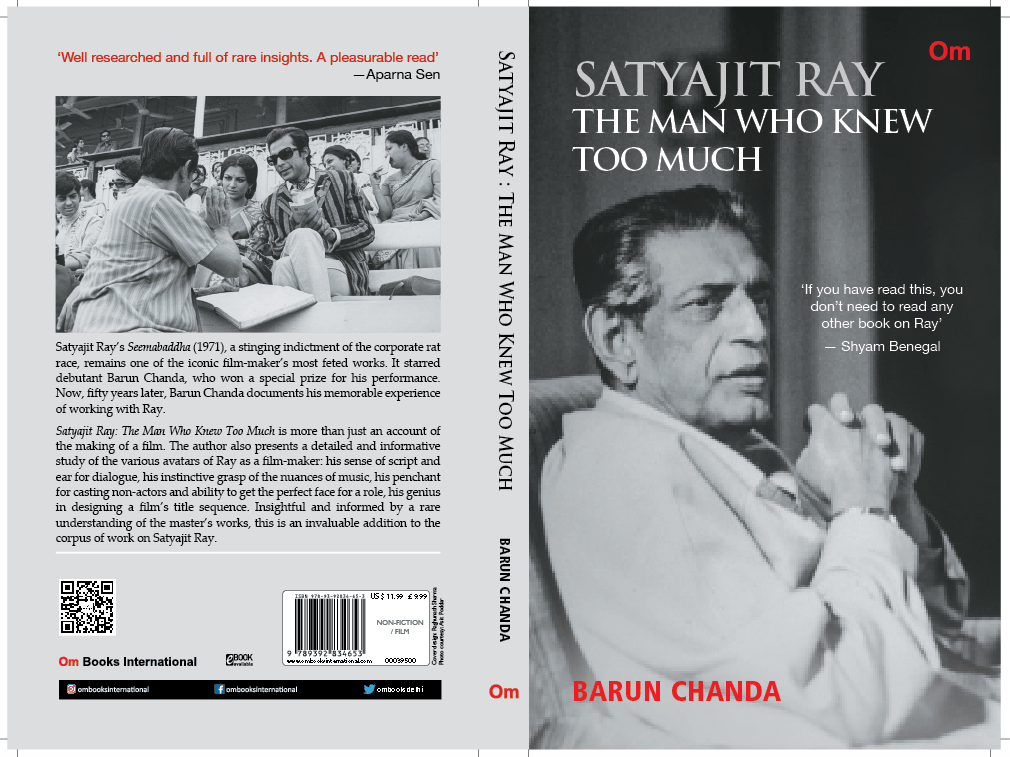
In conversation with Barun Chanda, an actor who started his career as the protagonist of a Satyajit Ray film and now is a bi-lingual writer of fiction and more recently, a non-fiction published by Om Books International, Satyajit Ray:The Man Who Knew Too Much
“[O]ne would like to remember Ray as one of the last truly great renaissance men of Bengal, moulded much in the tradition of Tagore, in the sense that his genius manifested itself in manifold directions: film-making, photography, writing, composing poetry, limericks, music, designing, drawing, developing new typefaces, you name it.
“For a long time, he was also our most distinguished cultural ambassador to the world.”
This perhaps is the one of the most apt descriptions of a man whose films were legendary in our lifetime and a part of the concluding chapter in The Man Who Knew Too Much by Barun Chanda. The book is an exhaustive account of Ray and his major films, how he made the films, what were the influences he had, how he directed the films and how versatile he was. Chanda is clearly impacted by this giant of Bengal renaissance, which started with Raja Ram Mohan Roy in the eighteenth century and encompassed Tagore.
The book is as much a memoir by Chanda about Satyajit Ray as it is a narrative about his films. Structured unusually, this non-fiction has an introduction sandwiched between two sections, the first being Chanda’s own interaction with Ray as a hero of his award-winning film, Seemabadha[1](1971), and the making of the movie; the second being the narrative that covers the titular content (borrowed from Alfred Hitchcock’s famous 1956 thriller), The Man Who Knew Too Much, about the genius of Ray as a filmmaker. Chanda shows us how Ray was truly unique and very gifted. He would remember all the dialogues and be intent on being involved with every part of film making, from costumes to camera, lighting and makeup — which is probably why his films had a unique touch so much so that he has to date been the only Indian filmmaker to win an honorary Oscar which Hollywood actress Audrey Hepburn, collected for him as he lay sick in bed (1992) breathing his last, saying: “Dear Satyajit Ray, I am proud and privileged to have been allowed to represent our industry in paying tribute to you as an artist and as a man. For everything you represent I send you my gratitude and love.”
And this note has been quoted by Chanda to bring out the uniqueness of a man who counted luminaries like Arthur C Clarke, Jean Renoir, de Sica, Kurusawa, Cartier-Bresson among his friends. He has unveiled the unique persona further. “As Ray was wont to say, everything that he had done earlier in his career, helped prepare him to be a complete filmmaker. His sense of framing stemmed from his knowledge of still photography. His deep love of Western and Indian classical music helped shape him as a music director. His sense of art direction came from his earlier stint at D.J. Keymer. His power of illustration helped him design the sets of Hirak Rajar Deshe[2]and Shatranj ke Khilari[3], both marvellous instances of art direction. And a combination of these two factors facilitated his making of some of the most original and impressive cinema posters ever.”
Chanda goes on to describe the full genius of Ray’s film making which even stretched to scripts, songs — both the lyrics and music often, and of course his ability to visualise the whole movie beforehand. Ray is quoted as having said: “I have the whole thing in my head at all times. The whole sweep of the film.”
Interspersed with anecdotes about the films, the text highlights the eternal relevance of some of the dialogues and lyrics that Ray wrote himself. For example, listening carefully to the lyrics of ‘Ore Baba Dekho Cheye[4]’ (Goopy Gyne Bagha Byne, 1969), one could see it as a comment from a current pacifist in today’s war-torn world. This book actually seems like an eye opener not only to understand Ray’s films, but also to find out what the world needs from the media, an important comment in times of false news and sensationalism.
However, the book is not all adulation. It is also a critique of the persona of a visionary who could risk all for realising his vision. Chanda tells us how to attain perfection, Ray could risk necks: “There was an element in Ray bordering on ruthlessness. To get a certain effect on the screen he wasn’t averse to taking risks, at times to dangerous levels.”
New perspectives are brought in from unpublished interviews: “In an unpublished Bengali interview of Ray which is in the possession of Abhijit Dasgupta, one-time chief of Doordarshan, Kolkata, when asked about his film Sadgati[5], the maestro is quoted to have said: ‘One needed to make a film on this story immediately. As a Marxist, Mrinal Sen would have probably made it differently, more angry … Had this film been angrier I’m not sure it would have served the purpose any better. I don’t think display of anger alone can lead to much of an achievement. To my mind a truly politically angry film hasn’t been made so far. Until now what has been done is to shoot at safe targets. It hasn’t made any difference to establishments in any way. If one were to achieve this kind of a thing, I would sooner be a political worker than a filmmaker.’”
While looking at the maestro through an objective lens, Chanda finds it hard not to express his affection for the giant who impacted not just him but a whole generation of movie goers, film personnel and the world. His last sentence says it all:
“As far as I’m concerned, he [Ray] is always present. Not past. Not even past perfect.”
Chanda, a man who started his life working in the same advertising agency as Ray and dreaming of being an actor, with four books and multiple films under his belt, himself mesmerised audiences as a protagonist in Ray’s award-winning film and then suddenly withdrew from the industry for two decades. Why would he do that? Let us find out more about him and Ray in this interview.
Barun Chanda
First of all, let me tell you I am very honoured to be interviewing a Ray hero from a film I have watched multiple times. So, tell me, why did you act only in one Ray film, have a hiatus of twenty years and then go back to acting with Hirer Angti[6] in 1992, the year Ray died. Did it have anything to do with Satyajit Ray’s presence or influence?
No. I’ll tell you what – after Seemabadha, I got a cluster of film offers, nine-ten offers and I did not accept anyone of them because they did not seem to be significant enough. I wasn’t interested in making money out of films or becoming a film star. I was interested in acting in good films. If they came my way, I would do. If they didn’t come my way, I wouldn’t. I would go back to my profession which is advertising. I was very happy there.
So, these offers that came didn’t quite satisfy me. And Manikda[7] did not call me back again for whatever reasons. The other significant filmmakers like Tapan Sinha, Mrinal Sen and Ritwick Ghatak – they did not call me. I suppose I was branded as a capitalist actor. Or Imperialistic actor! I suppose it became ingrained in their mind I was an executive and nothing else. They felt they could not bend me into the roles in their film. A pity!
Is this your first non- fiction? What led you to think of writing a book on Satyajit Ray?
Yes, it is my first non-fiction. I had harboured this thought for a long-long time but there is a natural reluctance about writing anything. I am, by and large, a lazy person and there were a whole lot of things that were pretty personal, and I thought, you know, let it be stored in my mind. Maybe, I could narrate to my close friends’ circle certain stories and certain things that happened between me and him. But not for everyone. Even in this book, I have not mentioned a whole lot of things that are too personal, which he confided to me in good understanding that I will not tell another. I won’t speak about it.
Then the centenary year came, and many asked me why I did not write my out my memories. Shantanu Ray Chaudhuri was one of them. He said the time is right and you have such wonderful anecdotes and experience, put it down for posterity. When I did the first part, I realised it could not just be my experiences but also something larger – in the sense what kind of a man was he in real life.
I was also dissatisfied with the books I have been reading about Ray and his works — starting with Marie Seton[8], who was supposed to be a gospel on Ray. I found it was a narration of his films in chronological order and what she thought of them. It was film-based assessment, not of the man himself or his qualities separated from the films. So, I decided to explore his persona. This book is quite different from any written on him. I have sections on music, editing with a whole lot of films but not in a chronological order. That is passé. The second part started with what has not been done. As I progressed, newer sections dawned on me – a whole lot of sections I have not used. I wanted a chapter on “The Rise and Fall of the Ray Empire” – but then thought I’d rather not finally. It would have been terrific, but I did not, perhaps want to spoil the public feeling about Ray. I did not want to criticise. I did do a chapter though — “Director or dictator”.
Absolutely. Your book is dispassionate but has no scandals or any unfair criticism. In fact, it seems to be based on not just your memories but also many interviews and lot of research. Can you tell us what went into the making of this book in this context? What kind of research and who all did you interview? How much time went into the making of the book?
I used Ray’s experiences with actors who are no longer alive – like Chabbi Biswas or Tulsi Chakraborty. I have used Aloknanda Roy who happened to work with Chabbi Babu in Kanchenjunga[9]. I used the living actors. I did not interview Soumitra Chatterjee – I know his feelings on Ray. So, I did not interview him separately. But there is a lot in the book about how Soumitra da perceived Ray or his equation with Ray.
The book worked well for me – I would have gone to a madhouse but for this book. You have to believe me. For it helped my sanity, writing this book during the Covid period[10]. The eighteen months—closer to two years. I could really concentrate on something as I am an outgoing person – not that I am a club person – but I would like to meet my friends, lead an active life. Suddenly, I felt imprisoned – it was like house imprisonment. So, I turned my attention to writing this book and whatever I could get out of YouTube, whole lot of other’s books, Ray’s interviews. One gentleman, Abhijit Dasgupta, who was the head of Kolkata Doordarshan, had conducted an interview. He gave me part of it which I found very intimate. You could do a book on Ray and Mrinal Sen dispassionately –Mrinal’s films would be of historical importance but not of relevance otherwise whereas Manikda’s films can be watched again and again because it touches your heart.
That is so true. Your book is structurally unusual with an introduction in the middle of two parts. Why did you follow such an unconventional format? Do you feel it helped your presentation in any way?
Yes. Because I was writing a different book. No one has written a biography in two parts. In a way it is not a biography, but it is trying to understand and appreciate Ray as a filmmaker. That’s what the book is.
I was in an advantageous position to write on Ray. Actually, Dhritiman Chatterjee could have done the same. I admire Dhriti for his thinking, but I guess there is an innate laziness. He did interview Manikda but I do not know where the tapes are.
I felt the way I did it was the right way. The book came naturally to me. For somethings, I went out of my way — like the titling.
To this date, no Indian director has made a film where the title is relevant to the film. The film follows from the title. The thought is not there. But it is there in the West. That is why you have people like Saul Bass. Ray wanted to do things himself – that might have been why he did the titling too. He would draw and present to the art director who would work further on it. I should have had a whole lot of drawings in this book, but it was not readily available.
I continue to feel I could embellish certain chapters, especially on music. Debojyoti Mishra, a film music director, has written a book in Bengali which actually traces from where Ray has borrowed what piece of Western Classical music. It is not unlike Tagore – there are analogies in the use of music between the two.
Ray spent a few years in Santiniketan when he was young, I think around 1940. Was he impacted by Tagore? Can you tell us about it? Did he meet Tagore or have any conversation with him as it was a year before Rabindranath passed on?
He did not actively seek out Rabi Thakur. He was a very shy person. There is no mention anywhere in his writings about seeking out Tagore, knowing very well Tagore held his father and grandfather in great esteem. His mom knew Tagore well. But he never sought him out. It is rather difficult to understand why he did not utilise the time speaking with Tagore. Maybe, Tagore was inaccessible. I could have asked him, but I never did. I do not know why I never asked.
Why would you borrow from Alfred Hitchcock to name probably one of the last of the Bengal renaissance men? Can you please elaborate?
I thought that the title was absolutely apt. As a director he knew more than any director did. It described him to perfection. He would draw, give music and work with his basic idea with the rest of the team.
What would you say is Ray’s most major contribution to the world?
The brilliance of Ray’s portrayal of the village was outstanding. You watch the film and think you cannot improve on it. And Ray knew it and has said it.
Does Ray continue to impact current trends in cinema?
Ray was a classicist. The film making style has moved away from that. He would not move the camera unless it became imperative to his film. But now, cameras are handheld, and they have fast shooting. Film making has transformed with the emergence of the web series. Shooting has become so much easier and quick, though they work very hard. There is something more raw about web series. The feature film is more stately, more crafted. Films have enough time. You cannot get a good film if the actors are not brilliant. You cannot shoot a good film in ten or twelve days as they do for web series. That is not physically possible. In the West, they take eighty to ninety days to shoot a film.
Ray wrote many novels on Feluda and Professor Sonkhu. Yet made few films on them. He made films of others’ books rather than his own. Can you tell us why?
Maybe, the writing part started late in his life. It was propelled by his need to feed Sandesh[11] and he had to supply stories to Desh[12] — one per year, for the puja[13]special. His writing came as an offshoot – it was an accident. But the preparation was there – if you read his scripts or lyrics, they are fantastic. The scripts he wrote were brilliant. There is much to admire and respect about him. He was a writer too.
You are known to be a writer too. Are your books impacted by your association with Ray?
What I learnt from him was how to write dialogues. The publisher of my Bengali books, Tridib Chatterjee, said he found my dialogues “smart”. Ray’s writing was very tight. I tighten my descriptions. I do not expect the readers to read a book like Tom Jones[14].
Can you tell us about your other books? Coke (2011) interestingly, is available in both Bengali and English. So, which came first — the Bengali book or the English? Are they both your handiwork? Tell us a bit about your novels?
I wrote it in Bengali first and then wrote it in English later. Actually, it was not a direct translation. I write in both the languages. Another one which is in English is Murder in the Monastery. The second edition is being brought out by Rupa, should be available on Amazon soon hopefully. Post-Covid, people have gone into hibernation. So, many have complained they cannot get it.
I have two books in English, Coke and Murder in the Monastery. The others are in Bengali.
Which genre is preferable to you — murder, mystery thrillers or non-fiction like this one?
I get my high writing fiction, especially crime.
Are you giving us any new books in the near future?
Yes, a collection of short stories in Bengali, probably after the pujas. I have created a character called Avinash Roy. He is learned and intelligent but not overtly brilliant like Sherlock Holmes. My favourite character [fictional] among detectives is that of Inspector Morse – I have seen the TV series but not read the books. He was very human. Absolutely brilliant. But coming back to my current book, it is also facing delays, but I am hoping it will be out this October.
Thank you for giving us your time and answering our questions
Ratnottama Sengupta pays a homage during the 27th Kolkata Film Festival to Jean Claude Carriere, the legendary screenwriter of Peter Brook’s Mahabharata, first performed on stage in 1985 and then released as a film
A Lifetime Achievement Award from the Academy of Motion Picture Arts and Sciences for someone decorated with a Padmashri? One easily understands the Oscar when you spell out that the awardee had written the screenplay of a hundred and more films for the Who’s Who of World Cinema – starting with Luis Bunuel, and going on to Volker Schloendorff, Milos Forman, Pierre Etaix, Jacques Tati, Andrzej Wajda, Nagisa Oshima, Louis Malle, Abbas Kiarostami, Philip Kaufman, Jean Paul Rappaneu, Jacques Deray… not necessarily in that order. The Padmashri also falls in place the minute you hear it was for the writer of Peter Brook’s Mahabharata. Indeed, how many names have bridged the inner core of two extreme cultures of the East and the West, so smoothly as Jean Claude Carriere?
This French writer-actor’s equation with the land of Kauravas and Pandavas was way beyond that of any tourist who may’ve visited India twenty-five times. For, this was the man theatre legend Peter Brook had zeroed in on to play his Ganesha. Meaning, act in the play? No, he was to write the nine-hour magnum opus that would ensue after sunset and end at sunrise at the theatre annual that identifies Avignon in France. Who could’ve imagined his interpretation that the five sons sired by different deities — Yama, Vayu, Indra, the Ashvins — could be cast as men from different races, leading to Yudhistira being blonde and Bhima an African? This, remember, was three years before Doordarshan started airing the B R Chopra epic that continues to enthral.
A scene from Peter Brook’s Mahabharata. Courtesy: Creative Commons
But why am I comparing Carriere – whom I had the good fortune to meet on one of his visits to Delhi – to Ganesha? Simple: Siddhi Vinayak, the God of Fulfilment, was the ‘scribe’ Vyasa approached to pen down his magnum opus – and he laid the condition that Vyasa should not pause in his narration of the events even once. Vyasa agreed on the condition that Ganesha would not pen down the words without comprehending their depth, their emotion, their implication… Carriere had done just that for Peter Brook. And the mythology had stayed within the writer. Hence, three decades later, he wrote a lyrical text for Sujata Bajaj when the Paris-based Indian artist from Kolkata exhibited her iridescent body of work titled Ganapati.
At least eight years of reading and researching had gone into Mahabharata, 1974 onwards, before Carriere’s forays to India started in 1982. And four years later, it mesmerised viewers in the desolate quarry outside Avignon. For the two following years, the play was performed in French and English, it toured the world for four years, it was adapted for television as a six-hour series, it was shortened to a three-half hour film screened in India, Carriere wrote Battlefield based on it, and published a book sketching his India tours… The 25 actors seen in Avignon 1987 came from 16 countries – and the only Indian was Mallika Sarabhai who played Draupadi!
“I compare India to Draupadi in the dice game – she keeps unfolding,” Carriere famously said later. Elsewhere he said he felt that India was a mansion where one room leads to another, that to yet another, and that to some more rooms… In India, Carriere observed a unique continuity since the antiquity now lost in time — one he did not find in either Greece or Egypt. That is distilled in the book, In Search of the Mahabharata that chronicles the three initial years of his journeys in diary-like jottings and numerous sketches. “They have more immediacy, more intimacy, greater feeling than camera,” he told the book’s Delhi-based translator, Aruna Vasudev.
Carriere of course was a seasoned hand at adaptation. Long before the curtain fell on his 91 years, he had adapted the German novelist Gunter Grass (The Tin Drum, 1979) and French Marcel Proust (Swann in Love, 1984) for Volker Shloendorf; the Russian Dostoevsky for the Polish Andrzej Wajda (The Possessed, 1988), the French journalist Joseph Kessel (Belle de Jour, 1967) and French poet Pierre Louys (That Obscure Object of Desire, 1977) for the Spanish Bunuel, French dramatist Edmond Rostand (Cyrano de Bergerac, 1990) for Jean-Paul Rappaneu, Czech Milan Kundera (The Unbearable Lightness of Being, 1988) for the American Philip Kaufman… And what was the key to this success? It lay in Carriere’s belief that “a scenario is created when you and the director establish a near telepathic communication. This requires on both sides a receptiveness and a trust which can never be taken for granted. The writer must submerge his ego since, ultimately, it is the director’s film and you are there only to facilitate him.”
My first experience of this ‘facilitating’ was Happy Anniversary (1962) that won director Pierre Etaix – who co-produced it with writer Carriere – the Oscar for Best Short. Half-a-century after its viewing the 15-minute short remains vividly etched in memory. A woman is preparing a romantic dinner to celebrate their wedding anniversary while the husband is running around and making stops to pick up gifts for his wife. But the Paris traffic is against him, and by the time he reaches home the flowers for his wife have wilted, and his drunken wife has finished dinner and fallen asleep. What a captivating comment on urban realities!
Carriere’s most abiding partnership — his 20-year-tie with Buñuel – had started in 1963 when the Spanish director was looking for a French co-writer to adapt The Diary of a Chambermaid by Octave Mirbeau. The maid who exposes the sexual, religious and social repressions of the middle class provincial French families set the keynote – social satire – that Buñuel would repeat in Belle de Jour. Its erotic narrative with subversive wit exposed bourgeoise hypocrisy through a respectable doctor’s wife who enjoys her afternoons as an inmate of a high-class brothel. Buñuel’s absurdist humour not only alerts viewers to the failings of the French bourgeoisie, but it also sets the tone for his constant anti-establishment ire. In The Milky Way (1968), two tramps set off from Paris to make a pilgrimage to a Spanish shrine and on the way meet characters who expound on the six central ‘mysteries’ of Catholic dogma. Another amusing anti-clergy film, it reveals Buñuel’s target shifts from the church to the military, to the state — that is, only within the different faces of establishment. This influenced Carriere to later state, “In art a certain anti-conformism is necessary.”
Jean Claude Carriere was a remarkable storyteller, it is clear, just as it is that he had no dogma. Effortlessly he could move from one world to another. One of ideals and spirituality, to that of warfare and political spoils. As one reviewer noted, “he had the knack of entering the dream world not on the wings of some abstract imagination but on the legs of reality – with absolute groundedness.”
Carrier knew what he wrote was not for publishing, it was written not to be read but to be transformed into a film. He is known to have said: “If you want fame, and a beautiful statue made of yourself, don’t be a screenwriter. The writer disappears. He works in the shade.” It was absolutely essential to be forgotten. His art exemplified this, though not the writer who also acted in some films. He knew, if not forgotten, very often screenwriters are ignored. That is why, in his Honorary Oscar acceptance speech in 2014, he expressed his happiness that such an award was given to a screenwriter. For, “they are like shadows passing through the history of cinema. Their names do not appear in reviews, but still they are filmmakers,” he asserted sharing his Oscar with screen writers around the world.
Ratnottama Sengupta, formerly Arts Editor of The Times of India, teaches mass communication and film appreciation, curates film festivals and art exhibitions, and translates and write books. She has been a member of CBFC, served on the National Film Awards jury and has herself won a National Award. Ratnottama Sengupta has the rights to translate her father, Nabendu Ghosh.
.
PLEASE NOTE: ARTICLES CAN ONLY BE REPRODUCED IN OTHER SITES WITH DUE ACKNOWLEDGEMENT TO BORDERLESS JOURNAL
Now people began to hear of Badshah Salamat’s close links with the region of Braj. His visit was described in a dhrupad —
Shah Chhatrapati Akbar visits the Braj region,
Kings of the seven islands, nine regions and ten directions tremble.
Cavalry, infantry, elephants, and brave warriors,
With bows, arrows, swords and spears.
Not one blot on the clothes of Humayun’s son,
How formidable was the army of Jalaluddin Muhammad.
The region of Braj was not far from Fatehpur Sikri. It is said that Badshah Salamat, having listened to the poetry of Surdas, asked when he met him, ‘Surdas ji, God has made me powerful and all the talented people sing my praise. Why don’t you sing my praise too?’
Surdas sang the following words in reply: ‘No space in my heart.’
Badshah Salamat thought, ‘Why would he sing my praise? He would sing if he had the greed to seek something from me. He is a man of God.’
Finally, Surdas sang: ‘Seeing God is like nectar for the thirst that the eyes have.’
Badshah Salamat asked him, ‘Surdas ji, you can’t see. How do you know what this thirst is that the eyes have? How come this metaphor?’
When Surdas kept quiet, Badshah Salamat said, ‘His eyes are with God. He sees there and describes what they see.’
Badshah Salamat then thought, ‘He should be given something but he has been initiated into Vaishnavism. He has no desire.’
People say that when Badshah Salamat heard that the Vaishnav poet Govindswami sang very well, he went out to listen to him in disguise.
Badshah Salamat was fond of travelling incognito among people. In the sixth regnal year, corresponding to about 1560–61 ce, a large group from Agra had camped outside the city on the way to the shrine of Salar Masud Ghazi in Bahraich. Badshah Salamat went to their gathering incognito but some petty criminal recognized him and the word began to spread. To convince people otherwise,
Badshah Salamat rolled his eyes upwards. When people saw this they said, ‘Such eyes and expressions can’t be that of an emperor.’
As Govindswami sang the Raga Bhairav, Badshah Salamat was sure he would not be recognized. But suddenly, as he sat listening, these words escaped his lips, ‘Wah, wah!’
Recognizing him, Govindswami said, ‘This raga has lost its value.’
At this Jalaluddin Muhammad Akbar said, ‘I am the Emperor.’
Govindswami replied, ‘If you are the Emperor, keep to it. But this raga has lost its value because you listened to it.’
Badshah Salamat then thought, ‘I am the ruler of one country. For him, the grandeur of three worlds is meaningless. Why would he obey my command?’
It is said that Badshah Salamat heard an artiste sing the poetry of the Vaishnav poet Kumbhandas and said, ‘Would there be anyone like him who sees God in this manner?’
The artiste replied, ‘Saheb, he lives even now!’
An excited Badshah Salamat asked for Kumbhandas’s whereabouts. The artiste replied, ‘There is a village near Shrigovardhan called Jamunawat. He lives there.’
When Badshah Salamat’s men reached the residence of Kumbhandas he was in Parasoli. Reaching Parasoli, these men said, ‘Badshah Salamat has asked for you.’
Kumbhandas said to them, ‘I am no servant to the Emperor. What do I have to do with him?’
Badshah Salamat’s men said, ‘How do we know what you have been called for? We are under orders from the Emperor to get Kumbhandas ji. Here is a palanquin and a horse. Please mount and come with us. We have to take you.’
Kumbhandas had no option. Wearing his shoes, he said, ‘Brother! I have never mounted a conveyance. I will go on my own.’ When Kumbhandas reached Sikri on foot, Badshah Salamat
said, ‘Kumbhandas ji, come. Please be seated.’
Badshah Salamat’s elegant tent had precious stones and frills. Even so Kumbhandas felt his home Braj was far better because Shrigovardhannath ji played there.
Badshah Salamat said, ‘Kumbhandas ji, you have written much poetry in praise of Vishnu. That is why we have called you here. Sing for me some poetry in praise of Vishnu.’
Kumbhandas thought, ‘The real patron of my voice is Shrigovardhandhar. But now that I cannot avoid it, I better sing something to ensure he does not ever ask for me. Let me say harsh words. If he minds, so be it.’
Kumbhandas remembered, ‘One who has been adopted by Lord Krishna is always safe. He would come to no harm even if the whole world turns against him.’
Then he recited —
Devotees have no need of Sikri.
One walks one’s shoes threadbare, God’s name forgotten,
And salutes those whose face brings no joy.
O Kumbhandas, without Lord Krishna, these are false destinations.
They say Badshah Salamat felt unhappy when he heard this but said to himself, ‘If he had any greed he would sing my praise. He is a true devotee of his Lord.’
Irritated with Badshah Salamat, Mullah Abdul Qadir Badayuni said, ‘… Hindu infidels, who are indispensable, and of whom half the army, and country, will soon consist and as whom there is not among the Mughals or Hindustani Muslims a tribe so powerful, he could not have enough. But to other people, whatever they might ask for, he gives nothing but kicks and blows…’
When it began to be murmured in Fatehpur Sikri that Badshah Salamat had turned Hindu, Sheikh Abul Fazl was forced to respond,
‘This rumour is spread because His Majesty, being of an open mind, would meet Hindu holy men, raise the rank of Hindus and be kind to them in the interests of the welfare of the country… There were three reasons these rumours spread by evil men gained currency. First, people following different religions gathered in the darbar, and because there was something good in every faith, everybody got some bit of praise. Secondly, because of sulh-i-kul, people of various kinds got spiritual and worldy success. Third, the crooked ways of evil people of the age.’
(Excerpted from Akbar: A Novel of History by Shazi Zaman. Published by Speaking Tiger Books, 2021)
About the book
Conventional historical accounts tend to paper over seemingly minor events related to Akbar’s life, to the detriment of a comprehensive appreciation of one of the most important figures of Indian history. Shazi Zaman fills the gap with this remarkable novel rooted in history.
Akbar’s writ ran from the Hindukush in the west to the Bay of Bengal in the east, an empire his father Humayun and grandfather Babur had only dreamed of. And his religious policy, boldly unorthodox, was as fierce a contest with the clergy, particularly Islamic, as were his military campaigns with his political opponents. Most histories give us Akbar the commander who never lost on the battlefield, and the fearlessly iconoclastic ruler. But we rarely come across the restless, questing soul who wished to reconcile a sensitive and compassionate heart to the sometimes ruthless obligations of statecraft; and the man who, in his struggle for sulh-i-kul, peace with all, could dare to treat as equal not only all faiths—Hinduism, Islam, Christianity, Jainism, Zoroastrianism and others—but all life as well—human or animal.
With a scholar’s rigour and a storyteller’s insight, Shazi Zaman, in this transcreation of his acclaimed Hindi novel, sifts through fact and many an anecdote to paint a complex yet enchanting portrait of one of the world’s great monarchs. There isn’t another book, as vast in scope and as layered, to help us fully understand the phenomenon that was Akbar: the unsparing pragmatist and benevolent ruler; the austere leader and indulgent friend; the unlettered prince and philosopher-mystic.
About the Author
Shazi Zaman started his three-decade-long career in broadcast journalism at Doordarshan and has since then worked with several media organizations. He has had a long association with the ABP News Network as a senior executive producer and as their Group Editor. He has been on the governing bodies of the Film and Television Institute of India, Pune, and the Indian Institute of Mass Communication, Delhi. Akbar is his third novel. His earlier Hindi novels are Prem Gali Ati Sankri and Jism Jism ke Log.
.
PLEASE NOTE: ARTICLES CAN ONLY BE REPRODUCED IN OTHER SITES WITH DUE ACKNOWLEDGEMENT TO BORDERLESS JOURNAL
Gita Viswanath and Nikhila H explore how the world of moviegoers has changed with time and with COVID19
During the pandemic, people all over the world watched a lot more films due to the lockdown than they normally do. The use of social media also increased exponentially. The proliferation of OTT (Over the Top) platforms has given immeasurable access to cinema and other modes of entertainment to those who have the means and technology (such as internet connection and steady bandwidth, viewing devices, etc). While some term this phenomenon as a democratisation of film-viewing practices in a given society, others feel that the nature of cinema is bound to change in the absence of a collective social experience of film viewing.
The history of the motion pictures has seen a shift from 35 mm to 70 mm; the decline of the latter, and then its resurgence in the 1980s. During these times, going to the cinema was an event in itself. It necessitated the rituals of planning, the booking of tickets in advance, dressing up and stepping out of the homes. The singular mark, if we identify one, of this era of film spectatorship, would be its collective nature. It was not uncommon to witness several members of the audience cry, laugh, or cheer together. While there are several films that show their characters watching a film withing their plot, Abbas Kiarostami’s entire film Shirin (2008),focuses on women audience’s responses to watching a film on the legendary lovers, Shirin and Khusrow. The story of the lovers reaches us exclusively through the soundtrack. The creation of the star was also a consequence of collective viewing. The euphoria surrounding the star, at times translating to audience performances in the form of whistling, hooting, flinging coins at the screen, and performing aarti (a Hindu prayer ritual)when the star appeared, could not have happened in the isolation of the home.
By the mid-1970s, almost all major cities in India had television broadcasts. The growing popularity of the television, even with its diminished screen size, as a means of watching films challenged the primacy of the cinema hall as a site of exhibition. The spatial shift from the public cinema hall to the private homes as viewing spaces is also a consequence of the arrival of television. However, the total individualisation of the viewing experience was yet to happen. Families, at times, even neighbours, would gather in front of the television, where the Doordarshan telecast around 6 pm and ended by 10 pm. Programmes were made specifically to appeal to groups of people across age, occupation, and class. While Tania Modelski’s Loving with a Vengeance: Women’s Narrative Pleasures (1982) argues how television, particularly soap operas play upon women’s fantasies and feed their longing for an alternative to their isolation within the nuclear family, it is also possible to argue that watching films on television meant being subjected to informal censors within the family and domestic situation.
Scholars have talked about how cinema-going created a new kind of sociality and public sphere around cinema. In the Indian context, a short story by a Kannada feminist writer Vaidehi titled “Gulabi Talkies mattu sanna alegalu” (Gulabi Talkies and small waves) for instance, gives us a glimpse of how through cinema-going the public sphere became accessible to women, otherwise sequestered within their homes. Girish Kasaravalli’s film Gulabi Talkies (2008) ostensibly drawing from the short story, gives us an insight into the fantasy worlds opened up by cinema for women, as well as delineates the destruction of that social imaginary and their proclivity for fantasy, when women got pushed back into the private sphere with the coming of television.
Soon after, the advent of the Video Cassette Recorder (VCR) and Video Cassette Player (VCP), became hugely popular ways of watching movies with the added advantage of recording them for repeat viewings. Lending libraries mushroomed and entire families were able to watch a movie for the price of, or perhaps, less than that of a single movie theatre ticket. In India, this led to a complete change in leisure practices to the extent that cinema hall owners ran into huge losses and most theatres that had seen their glory days had to either shut down and get converted into shopping complexes or lay in a state of neglect.
The 1990s heralded the era of the multiplex that once again drew audiences to theatres, at least in the urban areas. With admission rates way higher than single screen theatre tickets, the multiplex became a site of the upper middle-classes flush with funds in a newly globalised, consumer-driven economy. This even gave rise to an entire new genre of films called the multiplex film. Young filmmakers with exposure to world cinema cashed in on this change and made films that may not have been feasible in the era of single screen theatres whose audiences comprised people from different classes. The more homogenised audience of the multiplex enabled filmmakers to produce films that catered to the taste of a particular segment of the market.
And then came mobile telephony in the new century. The miniaturised screen size transformed film viewing, which was essentially a public and later family/group activity, into a highly individualised one. Today, it is not unusual to see different members of a family watching different films on their phone screens in the same house or even same room – the use of headphones or earbuds making it even more convenient.
We are all familiar with the phenomenon of the intermission/interval; peculiar to film screenings in India. This device, as Lalitha Gopalan has noted in Cinema of Interruptions: Action Genres in Contemporary Indian Cinema (2002), even became an important consideration while scripting the film wherein the interval would be located at a turning point in the narrative. The interval in cinema halls also provided the scope for sale of snacks, which in the era of multiplexes turned into a focal point with the aim of providing a wholesome and complete form of entertainment for the audiences.
Turning our attention back to viewing films on the laptops or phones, we may say that the act of determining the interval is also controlled by the viewer. We could stop watching to eat, to visit the washroom, to turn off the stove, to get the door, or when the plot slackens and our interest wanes, to doze off. With the alarming speed with which attention spans are decreasing, filmmakers are turning their attention to short films.
The abundance of OTT platforms for distribution of films has led to easy access to world cinema. Until some years ago, it was difficult to view international films unless one frequented film festivals. Now, it is a different story. Platforms such as Mubi, Netflix, Prime Video, among several others, provide us with opportunities to watch films from all over the world. Just as in the case of the rise of multiplexes, similarly, OTT platforms also have proved to be a boon to filmmakers. Professional organisational set-ups, constant demand for fresh scripts, and scope for experimentation have made OTTs viable for young filmmakers.
At a time, when socialising in the real world became highly restricted, a flurry of activity was visible in the virtual world. One such popular enterprise was the formation of online film clubs to watch and discuss films, which the authors of this article also engaged in. What is interesting about such groups is that the film viewing experience is not collective. We do not watch the film to be discussed together; rather, we watch them at our convenience after deciding upon the film and only get together virtually to discuss our individual responses in the process of a personalised experience of viewing.
Let us think about the nature of spectatorship that online groups engender. The sense of the collective does not stem from the act of seeing, which, in any case, happens in the privacy of our homes. Rather, it stems from the sense of a joint endeavour and the need to contribute meaningfully to it. While most theories of affect talk about the process of experiencing cinema, it may be equally important to look at the communicative aspect of affect; hence articulating what we feel about a film is a way of affirming and making available for ourselves (and others) how we feel about a film. Lakshmi Srinivas (2013) talks of how film viewing is framed by the social aesthetic, that is, film is a pretext, which provides a context for the social experience of film going. The audience response in any Indian theatre, she argues, provides a frame for the filmic experience; similarly, in our isolated film viewing case, the Saturday meeting becomes the ‘social’ within which our filmic experience may be framed.
With COVID-enforced isolation and restriction to stay in the house, films and social media platforms became a way of escape and reaching out, though not in the same way as the more conventional ways of watching cinema. The need to have social interactions beyond the family may have motivated some of us to embrace the world of online interaction. The form of discussing films (and virtually all of the films we discussed spoke to and of the contemporary times) on our Facebook group, Talking Films Online, for instance, became a way of thinking beyond and outside the oppressive present. It helped most of us gain a perspective by contextualising the present itself, while we seemed to be in danger of being cut off from the known and the familiar past. Thus, the activities of watching films and logging in for discussions on Saturdays became a way of regaining a hold on our lives, when we all felt adrift.
The lockdown gave many spectators who were part of online film groups, the experience of seeing and hearing and being seen and heard on screen. While initially thrust upon as an inevitable fall-out of the situation, people soon learned to equip themselves with better devices (where possible), requisite apps, necessary accessories to be better seen and heard. Being part of the discussions on the films, recording them and sharing them make participants content generators in their own right, leading at times, to the creation of independent YouTube channels for uploading the recordings of the discussions and for live broadcasts.
Thus, the shift in patterns of spectatorship over time goes beyond a mere change in ways of viewing films. Rather, the ways of generating content to accommodate these changes have themselves transformed. The resultant transformation in modes of sociality is just about beginning to become apparent.
Gita Viswanath is the author of a novel, Twice it Happened, a non-fiction book, The ‘Nation’ in War: A Study of Military Literature and Hindi War Cinema, as well as a children’s book, Chidiya. Her poems and short stories have been published online. Two of her short films, “Family Across the Atlantic” and “Safezonerz” are available on YouTube.
Nikhila H. teaches in the Department of Film Studies, English and Foreign Languages University, Hyderabad. Her areas of research interest are Filmic Translations and Gender Studies. Her recent publications have been on remakes and multimodal translations. Her current projects include a commissioned essay for a volume on Shyam Benegal for Edinburgh University Press, and for a collaborative volume on New Cinemas of India.
.
PLEASE NOTE: ARTICLES CAN ONLY BE REPRODUCED IN OTHER SITES WITH DUE ACKNOWLEDGEMENT TO BORDERLESS JOURNAL.