Gower Bhat discusses the advent of coaching schools in Kashmir for competitive exams for University exams, which seem to be replacing real schools. Clickhere to read.
In winters, birds migrate. They face no barriers. The sun also shines across fences without any hindrance. Long ago, the late Nirendranath Chakraborty (1924-2018) wrote about a boy, Amalkanti, who wanted to be sunshine. The real world held him back and he became a worker in a dark printing press. Dreams sometimes can come to nought for humanity has enough walls to keep out those who they feel do not ‘belong’ to their way of life or thought. Some even war, kill and violate to secure an exclusive existence. Despite the perpetuation of these fences, people are now forced to emigrate not only to find shelter from the violences of wars but also to find a refuge from climate disasters. These people — the refuge seekers— are referred to as refugees[1]. And yet, there are a few who find it in themselves to waft to new worlds, create with their ideas and redefine norms… for no reason except that they feel a sense of belonging to a culture to which they were not born. These people are often referred to as migrants.
At the close of this year, Keith Lyons brings us one such persona who has found a firm footing in New Zealand. Setting new trends and inspiring others is a writer called Harry Ricketts[2]. He has even shared a poem from his latest collection, Bonfires on the Ice. Ricketts’ poem moves from the personal to the universal as does the poetry of another migrant, Luis Cuauhtémoc Berriozábal, aspiring to a new, more accepting world. While Tulip Chowdhury — who also moved across oceans — prays for peace in a war torn, weather-worn world:
I plant new seeds of dreams for a peaceful world of tomorrow.
Fiction in this issue reverberates across the world with Marc Rosenberg bringing us a poignant telling centred around childhood, innocence and abuse. Sayan Sarkar gives a witty, captivating, climate-friendly narrative centred around trees. Naramsetti Umamaheswararao weaves a fable set in Southern India.
A story by Nasir Rahim Sohrabi from the dusty landscapes of Balochistan has found its way into our translations too with Fazal Baloch rendering it into English from Balochi. Isa Kamari translates his own Malay poems which echo themes of his powerful novels, A Song of the Wind (2007) and Tweet(2017), both centred around the making of Singapore. Snehaprava Das introduces Odia poems by Satrughna Pandab in English. While Professor Fakrul Alam renders one of Nazrul’s best-loved songs from Bengali to English, Tagore’s translated poem Jatri (Passenger) welcomes prospectives onboard a boat —almost an anti-thesis of his earlier poem ‘Sonar Tori’ (The Golden Boat) where the ferry woman rows off robbing her client.
We have plenty of non-fiction this time starting with a tribute to Jane Austen (1775-1817) by Meenakshi Malhotra. Austen turns 250 this year and continues relevant with remakes in not only films but also reimagined with books around her novels — especially Pride and Prejudice (which has even a zombie version). Bhaskar Parichha pays a tribute to writer Bibhuti Patnaik. Ravi Varmman K Kanniappan explores ancient Sangam Literature from Tamil Nadu and Ratnottama Sengupta revisits an art exhibition that draws bridges across time… an exploration she herself curated.
Farouk Gulsara — with his dry humour — critiques the growing dependence on artificial intelligence (or the lack of it). Devraj Singh Kalsi again shares a spooky adventure in a funny vein.
We have a spray of colours from across almost all the continents in our pages this time. A bumper issue again — for which all of the contributors have our heartfelt thanks. Huge thanks to our fabulous team who pitch in to make a vibrant issue for all of us. A special thanks to Sohana Manzoor for the fabulous artwork. And as our readers continue to grow in numbers by leap and bounds, I would want to thank you all for visiting our content! Introduce your friends too if you like what you find and do remember to pause by this issue’s contents page.
Wish all of you happy reading through the holiday season!
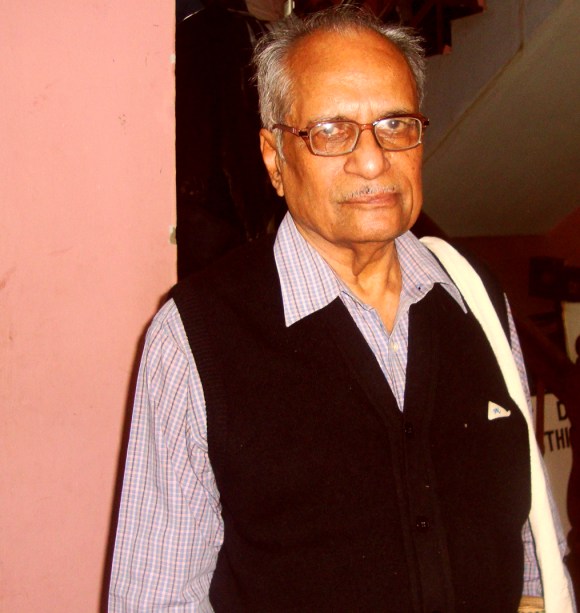
Bibhuti Patnaik (born: 1937). Photo provided by Bhaskar Parichha
Bibhuti Patnaik’s literary career unfolds like a long river—steady, persistent, and quietly transformative—running through the landscape of Odia literature for more than six decades. From the late 1950s onward, he wrote with a rare combination of emotional honesty and narrative discipline, giving voice to the evolving inner lives of middle-class Odias.
His writing emerged at a time when Odia literature was searching for a new expression after Independence, trying to reconcile classical traditions with modern psychological sensibilities. Into this space stepped a young writer who was not concerned with ideology or grand social systems, but with the stirrings of the human heart.
A defining feature of Pattanaik’s oeuvre is his meticulous representation of the Odia middle class. His novels, whether Aswamedhara Ghoda (Horse of Aswamedha), Sesha Basanta (Last Spring), or Prathama Sakala (First Dawn), foreground the ethical tensions, emotional fragilities, and moral negotiations embedded in quotidian life.
What distinguished Patnaik from many of his contemporaries was his unwavering commitment to emotional realism—a faith that the complexities of human relationships, especially love and desire, could carry as much literary weight as any political or social theme.
In his earliest works, Patnaik revealed a sensitivity to the fragile moral dilemmas that shape everyday life. His characters were not heroic figures or tragic archetypes; they were ordinary men and women negotiating expectations, impulses, and the confines of middle-class respectability. His prose, clean and unadorned, immediately established a new relationship with the reader—intimate, direct, and unpretentious.
For Odia readers of the 1960s, accustomed to more stylized narrative forms, this was refreshing. Young readers in particular embraced his novels, drawn to a writer who articulated emotional experiences with clarity and sincerity. Even at this early stage, Patnaik showed a remarkable ability to create female characters with depth and interiority, granting them agency in a literary culture that often placed women on symbolic pedestals rather than treating them as independent subjects.
As Patnaik moved into the 1970s and 1980s, his literary world expanded. The emotional tensions that shaped his early novels did not disappear, but they began to encounter new social realities. Odisha was changing—economically, culturally, and morally—and Patnaik’s novels became sensitive mirrors to these shifts. Urbanisation, job insecurity, the erosion of joint families, and the anxieties of modern aspiration found their way into his fiction.
He continued to write about intimate relationships, but these relationships were now embedded in broader pressures: generational conflict, economic burdens, and shifting gender dynamics. His characters struggled not only with their feelings but also with the demands of a changing society. Through this evolution, Patnaik maintained a narrative clarity that made his writing accessible to a wide audience, allowing him to be both widely read and critically noticed.
The 1990s marked a turning point in his career. While he continued to produce fiction, Patnaik increasingly turned his attention toward literary criticism and self-reflection. His essays—fearlessly honest, sometimes provocative—revealed a writer deeply engaged with the ethical health of the literary world. He wrote about the politics of awards, the failures of institutions, the erosion of literary standards, and the compromises that authors often make.
These writings unsettled the comfortable spaces of Odia literary culture but also enriched the discourse by demanding accountability and sincerity. At a time when many writers preferred diplomatic silence, Patnaik chose frankness. This choice, while controversial, made him an indispensable voice in understanding the dynamics of Odia letters in the late twentieth century.
His memoirs and autobiographical writings in the 2000s and 2010s further broadened his contribution. They are not mere recollections of a long literary life but important historical documents that offer insight into the personalities, politics, and conflicts of Odisha’s literary circles. The candour with which he narrates his experiences—sometimes tender, sometimes critical—makes these works stand apart in Odia autobiographical literature.
They reveal a writer who, despite being celebrated, never hesitated to critique himself or the milieu in which he worked. The tone of these later writings is marked by a late-style simplicity: calm, distilled, and enriched by decades of observation. Unlike many of his generation who grew stylistically heavier with age, Patnaik’s prose became lighter, clearer, and emotionally more resonant.
One of the most enduring features of his work is his representation of women. Throughout his career, Patnaik returned again and again to the complexities of female experience—women torn between personal desire and social expectation, women who resist, women who compromise, and women who assert themselves. His empathy for his female characters is evident not in idealisation but in the dignity he grants to their doubts, choices, and vulnerabilities. In a literary tradition long dominated by male narratives, this alignment with women’s emotional truth marked a significant departure and set a model for subsequent writers.
What ties Patnaik’s diverse phases together—novels, essays, memoirs—is an ethical thread. At the heart of his writing lies an insistence on sincerity: sincerity in feeling, sincerity in storytelling, sincerity in literary practice. His criticism emerges from the same commitment that shaped his fiction—the belief that literature must remain close to life, uncorrupted by pretension or institutional manipulation. Even when he critiques, he does so with the conviction that honesty is necessary for a healthy literary culture.
Today, looking back at his multi-decade journey, it becomes clear that Bibhuti Patnaik’s importance extends far beyond his widespread readership. He shaped the emotional vocabulary of several generations of Odia readers. He penned some of the most psychologically astute portrayals of love and moral conflict in Odia fiction.
He exposed the fissures in literary institutions through his bold essays. And he preserved the history of Odia literary life through his memoirs. His evolution—from a young chronicler of quiet emotions to a mature critic of cultural politics—mirrors the transformations of post-Independence Odisha itself.
Bibhuti Patnaik’s legacy is defined by this continuity of purpose. Whether writing a tender love story or a sharp critical essay, he remained committed to the integrity of human experience. His work endures because it speaks, with remarkable clarity, to the fears, hopes, and contradictions that shape ordinary lives.
In doing so, he carved a place for himself as one of the most authentic voices in modern Odia literature—unshakeable in sincerity, unafraid of truth, and unforgettable in the emotional clarity of his storytelling.
.
Bhaskar Parichha is a journalist and author of Cyclones in Odisha: Landfall, Wreckage and Resilience, Unbiased, No Strings Attached: Writings on Odisha and Biju Patnaik – A Political Biography. He lives in Bhubaneswar and writes bilingually. Besides writing for newspapers, he also reviews books on various media platforms.
PLEASE NOTE: ARTICLES CAN ONLY BE REPRODUCED IN OTHER SITES WITH DUE ACKNOWLEDGEMENT TO BORDERLESS JOURNAL


 Borderless