Life has got more than one scope.
A moonlight full of hope
reminds, do not lose inspiration.

The moon clads the grass and trees.
The meadow seems to release a laughter like a beautiful child in mild light.


Fireflies, at a side, in a cluster, emit random bursts of luster– making a joyous spread.


This joy is caught with leaps
by those who hide – the crickets who notify of the night,
chirping while being out of sight.


It ripples, in rows, the grassy mass, and flows across the blades of grass – A comfortable and pleasant breeze,
which fills the air and the heart with ease.
Ayesha Binte Islam writes as a hobby, and is currently pursuing a Bachelor of Science in Computer Science and Engineering.
.
PLEASE NOTE: ARTICLES CAN ONLY BE REPRODUCED IN OTHER SITES WITH DUE ACKNOWLEDGEMENT TO BORDERLESS JOURNAL
The message
that came through back channels
was clear.

There will be a girl with a yellow tulip,
pretending to listen to music.

A single yellow tulip,
no other number or colour.

You will sit down,
share some light banter
before passing along
the information.

Then you will walk three blocks East
to a basement bookshop
in the village.

Ask the proprietor
if he has any Victor Hugo
on loan.

Before heading back home
and returning to your life.

Watering the plants in the window.
Fighting with the chain on the back
of the toilet
until one or both of you
have been pacified.
Ryan Quinn Flanagan is a Canadian-born author residing in Elliot Lake, Ontario, Canada with his wife and many bears that rifle through his garbage. His work can be found both in print and online in such places as: Evergreen Review, The New York Quarterly, Borderless Journal, GloMag, Red Fez, and Lothlorien Poetry Journal.
.
PLEASE NOTE: ARTICLES CAN ONLY BE REPRODUCED IN OTHER SITES WITH DUE ACKNOWLEDGEMENT TO BORDERLESS JOURNAL
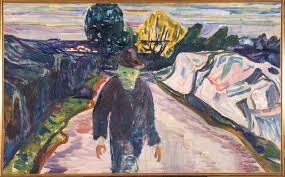
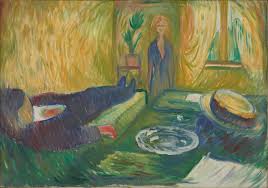
The Murderer by Edvard MunchThe Murder by Edvard Munch Paintings by Edvard Munch(1863-1944). From the Public Domain
The murder had been carried out with frightening rapidity and meticulousness. Roger preened before the mirror with unconcealed content at his exploit, however gruesome. At last, those evil eyes would never again stare stonily into his. Those lascivious lips curl into a sardonic snarl and snicker. And those hairy nostrils, never again to open in surly disdain. Two years of planning, two years of mounting tension … of burning desire — now that the vile individual was dead and buried, buried deep where no one, not even the sniffing police hounds could sense his other worldly lot, Roger breathed in relief and slept soundly, without apprehension or fear: his revenge had been just.
His hands, however, still trembled after the strangulation, still ached after hours of digging, his mind still aflame with abominable delight. Roger hence decided to take to the road to lead a life of a vagrant, of a wandering non-entity whose secret would lie hidden deep in a heart cleansed of ardent expectancy. He needed no one, desired nothing, only to guard that titillating secret entombed securely within that cleansed heart. Why did he leave now since his victim would no longer polluted his existence ? Because of his vile but indispensable act ? No. Because Roger had never befriended one person since his arrival at that town, never sought to marry and have children, never wished to climb the social rungs of power and prosperity at his mediocre profession. He was a person not without qualities, mind you, but whose indifference to those qualities confined him to the life of a unimaginative loner.
This being said, Roger always felt an instinctive drive for adventure, to strike out on his own so to speak, a picturesque wanderer, but at the same time terribly frightened of it. An adventurer fearful of adventure, however paradoxical that may sound! After the salutary slaying, he now experienced an élan that would send him forth into the wide horizons of the world as a mendicant, living from day to day with a knapsack for companionship, few thoughts of the future and certainly none of the past … Or so he wished …
So the fearless adventurer took to the road to experience a loneliness which he had voluntarily chosen, and this, regardless of the loathsome deed. Roger envisioned his departure merely as a reader who begins another chapter of a long novel.
Winter, spring, summer, autumn … How many seasons had come and gone ? He walked or hitch-hiked, sleeping under the stars or in abandoned, gutted homesteads, dreaming of vigilante squads at his heels, he hiding behind thick bushes or red tinted rocks, eyes scanning the horizon but never settling on his. Would the heavy rains drive the slain body upwards from its underworld plot for all eyes to see? To see and feast on the merciless truth? He dreamed these disturbing dreams, yet they never disrupted his slow but steady gait … never prompted misgivings. At times, the wanderer’s heart, albeit cleansed, longed for the silence of his act to break out of its soundless vault. Roger soon realised that his act was causing him an inexplicable sorrow, a sorrow that accentuated the mystery of his wanderings. Because in spite of his errantry he suffered the deed in lonesome insufferable suffering, the only person in the world to bear the secret of such an odious act. Had Roger fooled himself ? Had he been duped by his own vanity and puffy aplomb ?
He strode ever onwards, none the less, picking wild berries and figs during the day, laying his head on his knapsack or on lumps of grass on balmy nights. The brisk silvery air would, at times, revive his sunken spirits. His gait then would become more springy, more cheerful. There, in the violet blue above, a flock of kingfishers glided so majestically. He had an urge to join them on their migrating route. He arched his neck backwards; “Is the road not better than the tavern?” he wondered looking at the vanishing flock. As the last bird disappeared behind a cloudlet.
One warm spring evening as he shuffled along a dusty country road in an unknown shire, he was overtaken by a motley gaggle of beggars. They were singing bawdy songs of better days; days upon the bland or furious surface of the seas, of chopping wood in the mountainous forests, of pounding fists on the tables of taverns where beer and hydromel poured out of heady kegs. Roger bit his lower lip; these lewd ballads reminded him of an individual whom he had long despised and had disposed of. Yes, there was no doubt that he carried out what was absolutely essential to his well-being.
As soon as these songs died out, the beggars began arguing about something or someone, gesticulating wildly in their tattered garments, stomping their shredded boots. They stopped, hailing to Roger. One bent, glassy-eyed old fellow stepped forward and pulled at his sleeve, pressing him to bear witness on a vital issue: “Hey governor, you’ve heard the news about a murdered bloke rising up from his grave?” Roger suddenly stopped in his tracks.
The question baffled him. He shrugged his shoulders. “You see mates, he don’t know nothing about it!” the beggar cried out through rotting teeth, turning to his companions.
“Blimey, if he ain’t a halfwit,” coughed another. “Halfwit or just wanting to keep it all for himself.”
“The whole thing is rot, I say,” grumbled another, patting Roger on the shoulder. “Don’t worry governor, they don’t know what they’re on about.”
“The rains brought it up, I’m saying,” rejoined the first beggar, wheezing through his nose. “Strangled, dragged and buried he was by a pair of strong hands.” And the beggar took a covert glance at Roger’s strong hands. “The poor sod dragged like a sack of potatoes then thrown into a deep pit,” he stuttered, glancing harder at Roger’s hard hands.
“They’ll get the blighter for sure now,” added the still coughing beggar whose hair lay sticky on his broad shoulders. “They’ll hang him high. All the evidence is there.”
“What evidence?” Roger managed to ask, a bit distraught at all these insinuations, desperately trying to conceal his mounting fear.
“What evidence? What evidence?” he asks. They all howled in concert like a pack of wolves. “It’s written all over the corpse. Written in the stars, too. Just look up and read the evidence for yourself, mate.”
Roger involuntarily lifted his eyes to the darkening heavens where the stars were emerging in twinkling clusters. Was he able to decipher their twinkling? Were the beggars able to? When he lowered his eyes the whole pack had vanished round the bend of the road … Or so he thought. He wondered: “Was it a dream? An hallucination?” Roger sighed and moved on, glancing up every now and then up at the crowding stars.
Four weeks later as a harvest moon rose over some low-lying mountains, he trudged up to a cottage whose roof of browning straw and unsmoking chimney bespoke poverty. About to knock, his hand remained motionless mid-air: a woman’s voice reached his ears, a voice coarse but melodious, each syllable articulated in a maternal tone. The voice was reciting lullabies or children’s bedtime rhymes. A veil of sadness moistened his eyes. His mother, too, sang or recited nursery rimes and poems whenever her spirits had been dampened by grave or sombre events. And Roger mused: “Was the deed all that needful?” He knocked, his spirit traversed by qualms of uncertainty. A huge fat woman dressed in a thick woollen robe opened the door slowly. She stuck her red puffy face out: “Well, what do you want, tramp?”
“I’m down to the bone, good woman. Just a bit of bread and some water will do me. I’ve been on the road for so long.”
“Hungry hey! Had a good taste of the frost? And I suppose without a halfpence to your name. Well, come in and sit yourself at the table. I’ll give you some soup and bread … then off you be. I’m not particularly fond of vagrants.” The creaking of the door disturbed Roger who obsequiously side-stepped the fat, straightforward woman and sat down at a very long, knotty, oaken, wooden table. The ashes in the hearth lay cold like the atmosphere of the cottage … like the cold, dry voice of his host. Everything, cold as a grave …
She served him cold soup and rancid black bread. Roger ate with trembling hands, but without any real appetite. His head spun round; he felt estranged from his surroundings and from himself for reasons he couldn’t quite grasp. The woman wiped her huge, knotty hands on a greasy apron observing her ‘guest’ suspiciously: “Had enough? Want some more? You eat like a prisoner eats before execution.”
Roger gave her a strange look, but remained speechless. She scrutinised the speechless tramp: “Did you hear the news, they finally caught that lunatic who killed the real estate agent? I hope he gets what he deserves,” she rasped.
Roger shot her a terrified look: “Impossible!” he screeched, his mouth full of black bread.
“Why impossible? The bloody sod wasn’t very clever; he left so many fingerprints. He even left his calling card on the body. A real estate agent, they say he was. Probably a settling of scores.” Roger’s face went a deathly white.
“Did you see his photo in the papers?” Roger squeaked.
“I don’t read the dailies. It was the neighbours over the hill who told me. You act as if you know all about it. Did you know the victim?” Roger said nothing. “What’s up, cat got your tongue?” The fat woman eyed him leerily out of her beady eyes. “Your eyes tell me you have something heavy on your heart, something to hide,” she probed, a bit intrigued by the paleness of the tramp’s face, paling whiter and whiter. “Your lips move and move but no sound comes out, and you squirm in your seat like a worm on a fish-hook.”
The woman read Roger all too well; he, indeed, had fallen into a sudden whirlpool of words, repeating events of his childhood under his breath, vainglorious events and despicable lies. His voice then rose to a pitch that shocked his host. She suspected him of evil doing.
“You know mate, if they hadn’t caught that killer, I would say that you had strangled and buried the real estate agent.” She moved towards him, arms akimbo, beetling her brows.
“Strangled? Buried?” Roger pushed back his chair, he suddenly felt very tired. His thoughts whirled about in his head, chaotically. He stood, arms limp at his sides.
“I have to sleep,” he managed to stutter.
“Words are sharper than swords, hey! And you’ve said too much already. Your thoughts are impure, weighed down by some great burden. I don’t want anything to do with you. Go out and sleep in the haystack. But I want you off my property by morning, right?”
Roger thanked the fat, beady-eyed woman and stumbled out of her cold cottage into the colder air. The harvest moon had risen high, orangey-brown and round. He had taken a half loaf of bread with him. “How could they have caught the killer?” he murmured. “I’m the killer! I’m the killer!” He checked himself, listening to the wind.
“I forgot to fill my gourd.” Roger turned back but the cottage had disappeared. The haystack, too, was nowhere to be seen. He sat down, his back against an oak tree. “Must have lost my way,” he whispered to the oak tree.
The cold wind bit through his cotton vest. The silence of the forest frightened him, penetrated the uneasy thoughts of his confused mind. Would his victim’s grave become the mirror of his ever-lasting reflection? No! He was not to be intimidated. His act was a righteous one; how long had that individual plagued his dreams … poisoned his waking existence? An act of faith! Yes, that’s it, it was an act of faith. Roger rubbed his blood-shot eyes.
The eyes of the forest were upon him, the eyes of the animals, the trees and other night creatures ; large, owlish eyes that crouched behind thick bushes and gnarled trees. Relentlessly they followed his every move. He contemplated the moon’s valediction behind the dark, wooded hills then finally fell asleep…a very restless sleep …
The morning dew dripped off his long, unwashed hair, beard and foul-smelling clothes. His muscles ached. Roger felt wretched. He nibbled on some black bread, then set out to find a path that would lead him to a village or town. Hours passed. The sun, like his lies and vainglory, lay heavy on his bowed shoulders … on his furrowing brow, dripping with perspiration and weighed down his worn-out footfalls. Roger stopped abruptly.
He heard the tinkling of goat or sheep bells to his left. The tinkling was music to his ears; it brought an unexpected joy to his fatigued mental and physical state. The tinkling was then accompanied by snatches of a young chanting voice; pastoral verses intermingled with the tinkling which created a sort of contrapuntal rhythm. Roger experienced an estranged longing to relive his childhood, so comforting, so filled with maternal attention and love. Had he really undertaken that horrible deed? Had his hands stirred up the dust of such an unforgiving reality? At that moment, to his right he espied a large grassy pasture dotted with bleating sheep and goats. And there was a shepherd boy, no older than thirteen. “Perhaps he has some cheese and milk,” he thought excitedly.
Roger limped over the thick grass towards the hobbling boy who now approached, tapping his staff in rhythm to Roger’s hastening stride. Roger put up a trembling hand: “Good day shepherd. I’m down to the bone. Might you have a bit of cheese and bread for a poor mendicant?”
The shepherd boy, squint-eyed and long-haired, stroked one of his goats without answering. The boy was barefoot. He sized up the medicant and pronounced in a reproachful tone: “You don’t look like a sponger, sir.” Roger, taken aback by the boy’s bluntness, smiled sheepishly, avoiding his cross, roving eyes.
“How so?”
“Your face and hands tell me you’re not a sponger, that’s all. I’d say you’re a townsman.” Roger stood dumbfounded; he couldn’t quite fathom what the lad was on to.
“So you won’t give me some cheese and bread?”
“Of course I will, but stop playing the sponger. You need not beg, just ask.” And the boy handed Roger a large slab of goat’s cheese and bread.
He watched Roger eat the food with voracious grunts and groans, then asked him warily: “Did you hear about the killer … they freed him … the bloke who murdered the real estate agent?” Roger stopped munching.
“Freed ? Well, I’m glad to hear it. Then it wasn’t him after all who had killed that poor man.”
“No, it wasn’t him at all, sir. Do you know why?” Roger certainly did, but gestured indifferently that he hadn’t the faintest idea.
The shepherd lowered his squint eyes then chanted in a strange, fey voice: “The eyes, sir, the eyes are the windows of the soul. Through them all has been engraved, every word and deed all written bold. They are read like the stars by whose glitter stories are told. So put an end to your roaming days and come in from the cold.” The boy pointed his staff at Roger: “You are the murderer, sir ; the double-tongued wanderer who has senselessly misplaced the guardian of his heart and the shepherd of his thoughts.” The boy fell silent and began to caress his goat.
Roger felt faint; he wavered back and forth like a leaf clinging limply to its life-giving branch.
“I don’t understand you shepherd: guardian of the soul, shepherd of thoughts? Am I too ignorant to understand or are you having me on?”
The shepherd stared at Roger without compassion: “Like the shepherd who guards his herd, you are the guardian of your heart. Keep it simple, innocent of blood-letting, base defilement and scathing lies. Innocent like a child’s.”
“But if it has been contaminated?” Roger interrupted in a hushed voice.
The shepherd dropped his eyes, still caressing his goat. He replied : “Thoughts are like sheep; you must caress them and not let them wander into the clutches of wolves.”
“Wolves? What wolves?” All these enigmas troubled Roger dearly. The boy tapped his staff to the rhythm of the wind that had been steadily picking up, tinkling the bells of the herd animals.
“Those who wander in packs and feast upon the lone and parasitic sponger,” came the boy’s blunt reply.
“I only seek freedom, laddie. Freedom!” Roger said in a strident voice at a loss to grasp the shepherd’s intentions.
“Freedom from what, sir? Society? Your murderous hands? A bad conscious? Or free to be doomed? Doomed is true freedom.”
“That is a play on words,” the wanderer snapped scornfully.
“Is it ?”
A soft, silky evening veil mantled the wind-swept pastureland. The shepherd boy turned away, chanting a tune alien to Roger’s ears, but whose solemn undertone caused him to shudder. He suddenly turned round and shouted through the wind: “Stop bleating about the countryside like a lost sheep. You should know all this yourself. The murder that you have committed is like wind ripping through the weeping willows, a storm over the desert sands, a tempest upon the open seas. Right?”
Roger, mouth agape, could not reply to those metaphorical images as the shepherd hobbled away with his goats over the brow of a grassy hill.
Four more seasons passed in cheerless roaming …
Then one summer day, as lightning flashed and thunder boomed across the heavens, heavy rains pounded the parched earth. Roger was forced to find shelter in the dens of animals, cowering in the corners, petrified by the sudden lightnings, booms and downpours. He had never witnessed such a mystifying spectacle! Compunction pricked his heart with twinges of joy and grief, anger and jubilation, pleasure and remorse. Had the rains really lifted the corpse from its pit? Had the eyes that followed his every step penetrated the mask of apathy, the layers of indifference, the veils of contemptible aloofness? Perhaps he had never killed that real estate agent after all. Then the occult twinges and tugging made him doubtful while the lightning lit the heavens and the thunder resounded over the downs and through the dells. Was he really guilty of what he believed he had whole-heartedly accomplished, or simply pitied his empty, hapless existence?
One star-filled night when the storms had abated, Roger returned and slept in the same grassy pastureland where the shepherd boy had tended his gentle herd. Alas, the boy was nowhere to be seen. Roger felt terribly alone. And yet, he slept so soundly that night in the shepherd’s pasture; dreams of staring eyes, rising bodies, and he crouching in terror behind bushes or boulders had not plagued his slumber. A dreamless night the wanderer spent. A night without colours, without sounds, without memories … A dark night, the darkest of all nights …
So, waking refreshed, he left that green bed, glowing, strong and free like the morning sun rising from behind the dark surrounding hills …
*
The Dunghill Daily News obituaries announced that real estate agent Roger Snider died of a heart attack at his home at the age of forty-five most probably in his sleep. On the following page, the usual, daily bulletin urged the good residents of Dunghill to provide any information about another real estate agent, Ralph Richardson, who had disappeared four years ago without leaving a word either with his family or with his friends. If anyone had any information about his disappearance they were asked to contact the local police.
.
Paul Mirabile is a retired professor of philology now living in France. He has published mostly academic works centred on philology, history, pedagogy and religion. He has also published stories of his travels throughout Asia, where he spent thirty years.
.
PLEASE NOTE: ARTICLES CAN ONLY BE REPRODUCED IN OTHER SITES WITH DUE ACKNOWLEDGEMENT TO BORDERLESS JOURNAL
Oh! You would not believe For a while I thought Professor Livingstone fooled me. He taught us botany, that tamarind is a leguminous species With small little leaves and a central nerve.
Oh! You wouldn’t… For a while I believed when I read somewhere all leguminous are like spinach*, Good protein, sound for body and health, No small leaves, no central nerve.
Oh! You wouldn’t… When I referred back to my old text That the Professor used for Botany, the book had holes, Smelt ancient, a silver fish or two crawled to shy away from light.
Oh! You wouldn’t… The silver fishes ate the portions of the book Which spoke about the species Tamarindus Indica And the family to which it belonged.
Oh! You wouldn’t believe my dear Professor, The tamarind trees belong to the leguminous after all. I tried to hide my head in a borehole Dug by silver fishes in the pages containing work on Phytomorphology*.
Saranyan BV is poet and short-story writer, now based out of Bangalore. He came into the realm of literature by mistake, but he loves being there. His works have been published in many Indian and Asian journals. He loves the works of Raymond Carver.
.
PLEASE NOTE: ARTICLES CAN ONLY BE REPRODUCED IN OTHER SITES WITH DUE ACKNOWLEDGEMENT TO BORDERLESS JOURNAL
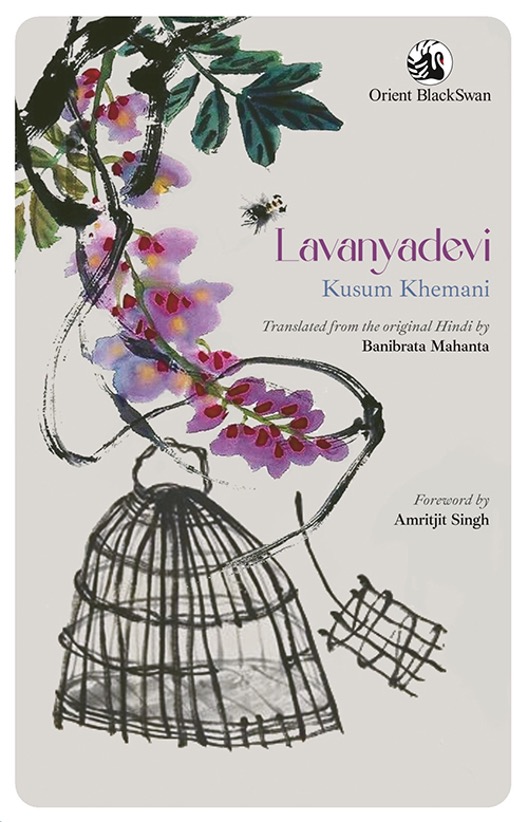
Author: Kusum Khemani (Translated from Hindi by Banibrata Mahanta)
Publisher: Orient BlackSwan Private Limited
Lavanyadevi is an award-winning 2013 novel by Kusum Khemani written in Hindi that chronicles five generations of a traditional aristocratic Bengali zamindar family as it transitions into modernity from British India to the present with the eponymous protagonist as its principal focus. Lavanyadevi—a compelling woman of perfection, extraordinary vision, qualities, and grace—remains real and credible because she is self-aware, self-critical, open to others, and to change. As a Marwari (people originally belonging to Marwar in Rajasthan) living in Kolkata, in Khemani’s fiction the schisms between ‘Bengali’ and ‘Marwari’ blur to reveal a delightfully plural, composite, and distinctively Indian ethos. Lavanyadevi is a story about women and their search for self, about shared laughter and friendships that endure across generations, beliefs and cultures—between mother and daughter, grandmother and granddaughter, and Marwari and Bengali women. Khemani’s women protagonists are strong, clear-sighted, both worldly and sublime, embodying a larger-than-life idealism while being grounded firmly in the everyday.
In his introduction to his novel Kanthapura (1938), Raja Rao had defined it as a sthala-purana[1], which he defined as a “legendary history” in which the old lady narrator in the village took recourse to the traditional Indian narrative technique, digressed at will to bring forth her point. Somehow the way Kusum Khemani takes recourse to multiple narrative techniques in Lavanyadevi and binds the different digressive stories and incidents into one contiguous whole when she tells us about the history of five generations of the Bengali zamindar family, reminds one of Raja Rao’s theory. She uses diverse narrative strategies like flashbacks, diaries, letters and emails, history, memory and the third person narrator to enrich its telling, lending it depth and range. A large part of the narrative revolves around telling us about past history when Lavanyadevi manages to lay her hands on her mother Jyotirmoyidevi’s diaries and finds great pleasure and thrill of reading one’s own family history. Not only do they offer a wonderful eye-witness account of the private and public sphere of Kolkata of those times, but they also make her easy transition into reading about her mother’s youth, her elaborate description of her magnificent wedding and the rituals that spread over almost a month.
The diary as metanarrative and the protagonist as reader/narrator are particularly effective, offering a telescopic perspective. Though at times it rambles a bit, the polyphonic structure of the novel engages Lavanyadevi the granddaughter, the daughter, the wife, the mother and the grandmother in conversations with her preceding and her succeeding generations. One must sometimes go back to the family tree and chart provided at the beginning of the novel to place people in proper perspective.
From the very beginning of the novel, Khemani portrays the character of Lavanyadevi in superlatives and this continues in different phases of her life till the end when she decides to remain incognito in the mountain ashram and yet control the lives of her descendants, well-wishers and others. From a child who always stood first in school and remained wholly ignorant of the real world, to her unusual marriage to a gentleman who moved over to Rangoon and then to London where she acquired many more degrees, till she came back to Kolkata, to rear her three children successfully, she seemed to excel in everything. This is how she is described at one place:
“Lavanyadevi was indefatigable. She administered the work of several institutions, her college and her home efficiently and with ease. She was never seen to panic. She was like Goddess Durga with her many hands – untiring in her zeal, handling all her duties unfailingly, responsibly and meticulously. No one could ever complain of being ignored by her. She loved all and treated everyone with the same degree of love and warmth. Scrupulous and hardworking, always upholding truth, Lavanyadevi was the unmatched standard of excellence in all aspects of life, her words worth their weight in gold.”
After judiciously assigning different welfare projects in the city as well as in far-flung places like Dhaka and the hills in Uttarkashi from the immense money she inherited from the family, and after her husband’s demise, Lavanyadevi decided it was time for her to leave the family premises and go and live in an ashram in the hills. There she did not stay in hibernation but her travels for work grew even more frenetic.
From the very beginning her rootedness and belief in the philosophical framework of Hinduism formed the core of her being. They propelled her to seek answers to questions of satya (truth) and mukti (liberation) that confronted her in the latter half of her life. She decided to transcend immediate personal concerns and address larger universal issues. Her transition from grihastha (householder) to sanyasa (renunciate) harkens back to the Hindu ideal of human life divided into four phases. However, contrary to the conception of life in isolation, Lavanyadevi, free of any kind of worldly considerations in this final phase of life, marshaled material and human resources to create a strong network of seva (social service) across the country and even beyond its borders. The list of her welfare schemes is too long to mention in the purview of this review, but ranged from renovating brothels in Kolkata’s red-light areas, creating self-help centres for rural women in Dhaka, de-addiction centres, eco-friendly schools in the hills, organic farming in South India, etc.
In the latter half of the novel, we find Lavanyadevi successfully transmitting her values and ideals to her children and grandchildren who are called the “Saptarshi Mandal friends” and who carry her legacy forward and emphasise that progress does not always mean breaking from the past. Here the novelist becomes too idealistic and brings in too many issues that seem a bit far-fetched. Issues of inter-caste and inter-religious relationships apart, the list of social welfare missions seems endless. Her “soul-children” unobtrusively usher in change and create space for diversity in relationships and ways of living. Harmonious cohabitation with nature became the foundational principle of all the education centres she built in the hills but the way she invisibly controls the activities of all her soldiers through emails and emphasises the middle path of life makes the advocacy of humanitarian concerns a bit overemphasised. She becomes larger than life for ideas and wish-fulfilment.
A Hindi novel about a Bengali family by a Marwari woman from Kolkata became significant when it was commissioned for translation into English. Winner of the PEN/Heim Translation Grant 2021, the jury called Lavanyadevi an ‘ambitious, far-reaching’ novel, lauding Khemani’s ‘energetic prose, deadpan sense of humor, and exquisite control’, and Banibrata Mahanta’s translation that ‘stretches and manipulates language to produce a vivid text’ and a must-read for lovers of Indian literature. Here one needs to mention the seriousness with which Mahanta gives us the ‘Translator’s Introduction’ at the beginning of the text and again ‘Translator’s Note’ at the end. This reviewer feels that both these could have been combined into one general essay highlighting the significance of the evolution of the Marwaris in Bengal, how Khemani’s novel is a hybrid artefact born out of multiple linguistic and cultural encounters, how the characters in the novel speak in languages other than Hindi produces dialogues in Bangla, Marwari, Haryanvi or Punjabi; and how between a breezy translation and a linguistically nuanced one, wherever possible the translator has eschewed the former and gone for the latter. As he rightly admits, translating this complex narrative into global or even a pan-Indian English is always risky, but Mahanta should be given due credit for overcoming all obstacles and bringing this immensely readable novel to a wide readership.
A translation of Jibananada Das’s Andhar Dekhecche, Tobu Ache (I have seen the dark and yet there is another) from Bengali by Professor Fakrul Alam
Art by Sohana Manzoor
I have seen the dark and yet there is another, greater dark
I have known death and yet there is another death awaiting
Behind is a whole history existing, but not accessible yet
Is that grand narrative—one to whom the plot has another meaning;
And to whom the sea sings another tune, and there is a different stirring
Of the heart and of issues—and where the mind is illumined uniquely.

Fire, wind, water—primeval gods burst out laughing
Spent—once spent—does one end up as pork?
Ha! Ha! I burst out laughing—
It was as if amidst the loud laughter,
The carcass of a huge whale had suddenly surfaced in a dark ocean
Making the entire earth become as overpowering as a whale carcass’s stench.

 I had thought humans would progress steadily in history’s lap;
Instead of playing with machines they had mastered
They would mature from accumulated successes.
And yet it is the machine that has become a power to reckon with
It is Love that has been punctured and power that has prospered
With the nuclear bomb—was the increase in knowledge
Supposed to result in such a split?

The wisdom that we had gathered over time in life
Just isn’t there—what we have is stasis—senility;
Surrounded by all sorts of fears, we only have
Fatigue and depression. We’ve become self-centered
And have enclosed ourselves in shells. We’re too scared
To break them and avoid unclean sexual exchanges
Carried out in the dark. Oceanic, airy, sunlight soaked,
Blood-drenched, death-touched words come and dance
Like frightening witches—we are frightened---hide in caves—
We would rather disappear—dissolve—disappear in Brahma’s
Word. Our two thousand years of learning is thus much!


We keep ourselves busy with commissions—build bases—love the city
                                         and the port’s bustle
The grass below our boots we consider only grass—nothing else alas—
we’ve made the motorcar our prized possession
Why do wagtails dance then—fingas and bulbulis flit from forest to forest?
Jibananada Das (1899-1954) was a Bengali writer, who now is named as one of the greats. In his lifetime, he wrote beautiful poetry, novels, essays and more. He believed: “Poetry and life are two different outpouring of the same thing; life as we usually conceive it contains what we normally accept as reality, but the spectacle of this incoherent and disorderly life can satisfy neither the poet’s talent nor the reader’s imagination … poetry does not contain a complete reconstruction of what we call reality; we have entered a new world.”
As a curator, Ratnottama Sengupta writes about the long trajectory of films by artists, beginning with Husain’s Berlinale winner, down to the intrepid band she screened at the just concluded 30th Kolkata International Film Festival
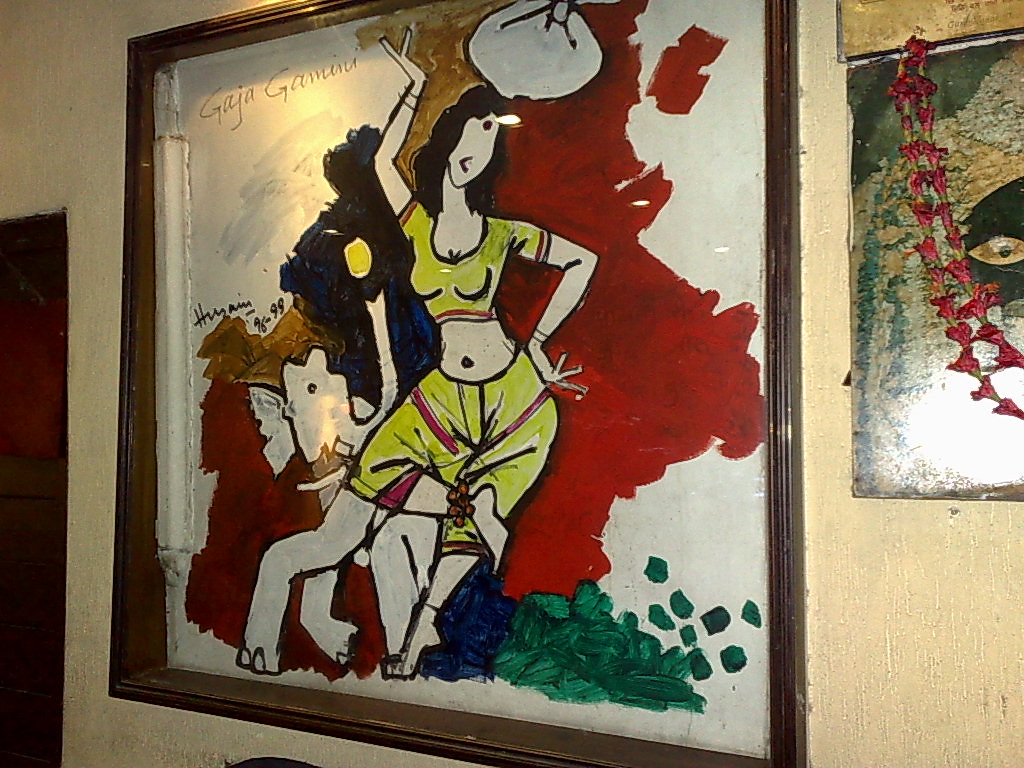
Gaja Gamini: Painting by MF Hussain Gaja Gamini (An elephant’s walk) Movie by MF Hussain
When Maqbool Fida Husain won the Golden Bear in the 17th edition of the Berlin Film Festival, the year was 1967. I, in my pre-teen years, knew little about painting. But growing up in a family of filmmakers I was already conversant with the art of looking through the camera. So I was disoriented that the film critics of the time were baffled by what had impressed the international jury.
Royalty, tigers, ruins, hawks, school children, anklets, on the river bank – all these images moving only to music, not a word uttered. The jury at Berlinale were astounded by the richness of the artist’s idiom that had breathed life into a Rajasthan that is rich in architecture as it is in painting, in costume as in music.
This dawned on me years later, when I curated the exhibition, 3 Dimensions, forthe All India Fine Arts and Crafts Society in New Delhi. It featured paintings, sculpture and graphic art or drawings by artists from Husain, Satish Gujral, Ghulam Mohammad Sheikh, Jatin Das to Sanjay Bhattacharya, Paresh Maity, Mimi Radhakrishnan, Shadab Hussain, among others.
A unique feature of this exhibition was that all the participating artists had interest in another expression of art. So every evening of that week had seen a Ram Kumar and Mimi read their short stories; a Narendra Pal Singh and Jatin Das read their poems; a Sanjay Bhattacharya render Tagore songs of and a Shruti Gupta Chandra perform Kathak. Ratnabali Kant had staged a Performance Art in the presence of Prime Minister V P Singh who had inaugurated the week-long exhibition by reading his poems. And, on the closing day, I had screened Through a Painter’s Eyes. That’s when it dawned on me: it was the originality of vision captured by the 7-minute short film had won over Berlin as also Melbourne and our very own National Awards too.
Subsequently Husain, who had started out from the tenements of Bombay by painting oversized hoardings of Hindi films on the sleeping tramlines at the dead of night, had at the ripe age of 84 made Gaja Gamini (2000) with stars such as Madhuri Dixit, and Minaxi — A Tale of Three Cities (2004) with Tabu and Naseeruddin Shah. Ironically these films baffled the critics just as much as the earlier short film had. However the dazzling visuals of vibrant figures and colourful structuring of the (non)-narrative had found acceptance in the Marche du Film section of Cannes 2004.
*
I have since then tried to fathom what drives artists who are skilled at painting with oil or watercolour, or sculpting wood or stone, metal or clay, or creating graphic images on paper or linoleum, to wield the megaphone. Now, instead of holding the camera or editing the celluloid strips with their hands, they use their mind, their mind’s eyes, their creative imagination.
Some other contemporaries of Husain too had, after attaining glory in the plastic arts, turned to experimenting with the new, ever evolving, ever contemporary art form — cinema. In 1970, Tyeb Mehta, who had briefly worked as an editor, made Koodal, meaning ‘Meeting Ground’ on the Bandra station of Mumbai’s Western Railway. The synthesis of images of humans and animals had won him the Filmfare Critics Award.
Cartoonist Abu — born Attupurathu Mathew Abraham — was a journalist and author who had worked for Punch, Tribune and The Observer in London before returning to work with The Indian Express. He was given a special award by the British Film Institute for the short animation No Ark, clearly a cryptic message deriving from the Biblical tale of Noah’s Ark.
Equally engrossing is the story of Syzygy, also produced by Films Division, and directed by Akbar Padamsee. This 16-minute short, premiered at a UNESCO screening in Paris 1969, had no narrative, no sound, or even colour. It only had lines evoking shapes typically used to refer to the alignment of celestial bodies. Only one man had stayed back till the end of the screening — and he had said to Padamsee, “Most people could not understand your film — it’s a masterpiece.”
Reportedly that man had gone on to become the programming director at Cinematheque Francaise – world’s largest film archive. That’s where Indian filmmaker found Ashim Ahluwalia found a copy of Events in a Cloud Chamber, Padamsee’s second film that was sent for screening at the Delhi Art Expo — never to be returned to the artist. The lost-in-transit film has now been professionally reinterpreted by Ahluwalia.
NB: All these films were supported by filmmaking bodies, and though often baffled, cineastes realised theirs was a new way of seeing the visual expression that goes under the arching umbrella of cinema.
*
This desire to understand, adapt, and get under the skin of a modern medium had driven Tagore, a century ago from today, to paint expressionistic forms and also to film Natir Pujo (1931). And today we find a band of artists from Delhi, Mumbai, Kerala and Baroda making films that bridge disciplines from landscape and abstraction to mimetic movement and drama.
What are the notable features of these films that are mostly made on video? They too have little need for dialogue. Instead, their sight is supported by music of natural sound. If the objects they capture through the lens are arresting forms, vacant spaces can be just as inviting. When they have humans as their protagonists, they are keen to capture body language rather than drama. Colourful palette is not a foregone conclusion – monochromes and black and white can be more poignant. Because? Their visuals are but vehicles for commenting on social reality and for communicating philosophic content.
Legends or veterans, seasoned or sprouting, this intrepid band of adventurers includes Vivan Sundaram, Ranbir Kaleka, Gopi Gajwani, Rameshwar Broota, Bharti Kapadia, Babu Eshwar Prasad, Gigi Scaria, Protul Dash, and Sanjay Roy. They are a continuum of the spirit of experimentation that had driven Husain and Tyeb, Abu Abraham and Akbar Padamsee.
Films by Artists at KIFF*

1 *Disclaimer* 2016/ 9:40 min
By *Gigi Scaria* focuses on the sleight of hands by a magician
2 *On the Road* 2021/ 5:7 min
By *Babu Eshwar Prasad* is a nostalgic look at road movies that are part documentary, part adventure.
3 *Sabash Beta* 3 min
By *Rameshwar Broota* with Vasundhara Tewari applauds the galloping of a fleighty horse.
4 *Leaves Like Hands of Flame* 2010/ 5:34 min
By *Veer Munshi* likens the fallen chinar leaves to the autumn in the lives of uprooted Kashmiris.
5 *L for…* 2019/ 13:14 min
By *Bharti Kapadia* plays with the sight and - surprisingly - the sound of the alphabet.
6 *Fruits Ripen and Rot* 2022/ 4:21 min
By *Sanjay Roy* is a surrealistic look at the divergent responses to food that is central to everyman's existence.
7 *How Far…?* 2023/ 12:37 min
By *Ranveer Kaleka* is an elegy, a dirge, mourning the losses wrought to Planet Earth by human destruction such as war.
8 *Burning Angel* 2024/ 4:37 min
By *Pratul Dash*  is an abstract story of the same destruction.
9 *Turning 2008/ 11 min
By Vivan Sundaram is a silent, colourful comment on the waste created by consumerist civilization.
10 *Time* 1974/13 min
By *Gopi Gajwani* is a riveting tale of how relative a minute is to one in mourning, one waiting, and for one in love.


*Kolkata International Film Festival
.
Ratnottama Sengupta, formerly Arts Editor of The Times of India, teaches mass communication and film appreciation, curates film festivals and art exhibitions, and translates and write books. She has been a member of CBFC, served on the National Film Awards jury and has herself won a National Award.
.
PLEASE NOTE: ARTICLES CAN ONLY BE REPRODUCED IN OTHER SITES WITH DUE ACKNOWLEDGEMENT TO BORDERLESS JOURNAL
I’ve remembered you with your fallen walls, shelled mirrors, bloodless faces, children with stones and guns;
—with things we did to you for nothing.
I’ve loved you with your broken, faithless hearts, with your dreams of the sun, and with my dreams of snow.
I’ve seen you in fear.
I’ve seen you strong.
I’ve seen you wrong, and rebellious—
and I’ve loved you.
When you sit in a Shikara* upon the Dal, all by yourself, all at once, in a silence known only to you— and embraced only by you,
I’ve loved you then.
*Shikaras are light boats and can be found on Dal Lake in Kashmir.
Jayant Kashyap is an Indian poet. His third pamphlet, Notes on Burials, won the New Poets Prize in 2024 (smith|doorstop, 2025). He’s also published a zine, Water (Skear Zines, 2021).
PLEASE NOTE: ARTICLES CAN ONLY BE REPRODUCED IN OTHER SITES WITH DUE ACKNOWLEDGEMENT TO BORDERLESS JOURNAL
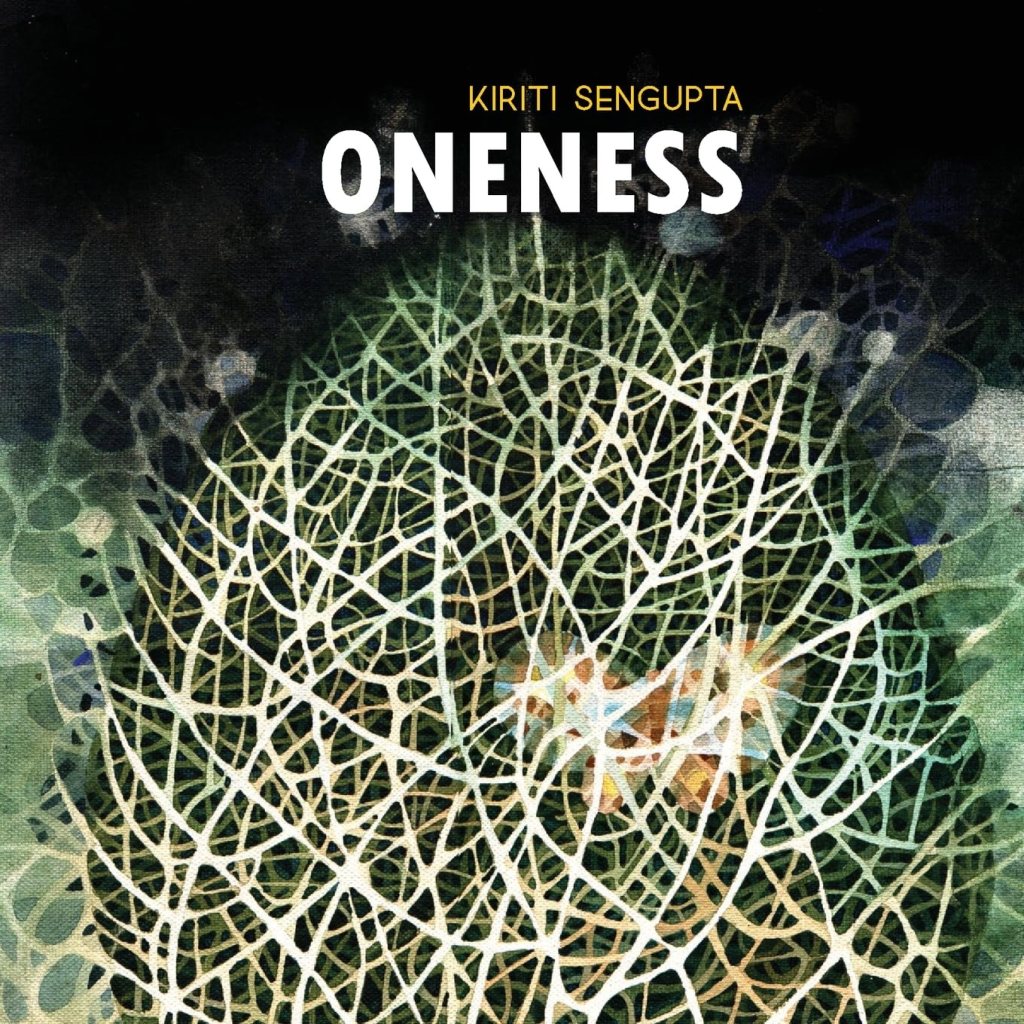
Oneness by Kiriti Sengupta, an established writer and publisher, is the paean of a poet in love with life. This thin volume has the gorgeousness of a Rajasthani miniature: The poems are accompanied by colourful paintings by Pintu Biswas and Samir Mondal. The artwork adds to the magic of the experience that is Oneness. Exploring the pieces, the reader, too, is drawn by the poet into embracing life like an affectionate lover who accepts the highs and lows of our existence or a relationship. The bright tapestry (literal and metaphorical) presented in the little tableau of a book entrances us to appreciate the romance of oneness in the midst of our teeming variety of happenings over time.
The title “Oneness” recalls to mind John Donne’s[1] immortal sermon, delivered after he healed from a prolonged bout of illness, titled ‘No Man is an Island’. Donne’s illness was so severe that he was considered to be on his deathbed, but defying all odds, he survived. And, then, he wrote:
No man is an island,
Entire of itself;
Every man is a piece of the continent,
A part of the main.
Oneness is a celebration of life as much as the start of ‘No Man is an Island’. It expresses an all-encompassing love for other human beings, the realisation that the hues of blood, joys and griefs are same for everyone, that death and sorrow are common to all. Oneness is an eternal feeling captured well in this collection.
Oneness homes haikus, short verses and prose poems. The haikus reflect profoundness with the brevity of words, typical of Sengupta’s style. For instance:
full moon
across the landscape
fireflies.
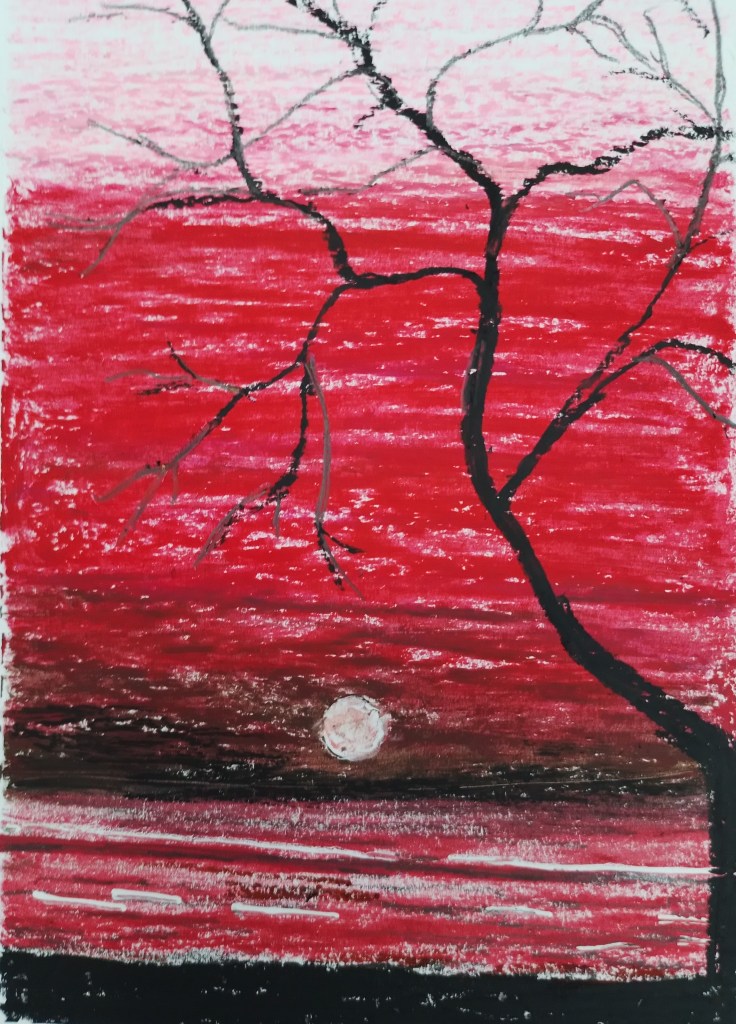
One would imagine a dark night sky and a full, flowery golden moon, illuminating the black landscape and the pinpricks of lights from the insects. Instead, the accompanying artwork surprises with a canvas awash in swirling cobalt blues a large blazing red moon, and fireflies like bright flames. It forms an interesting contrast.
Some haikus are beautiful and poignant with subtle decadent sadness:
the post box
recedes to rust
the lost art
A post box is part of the past in the twenty-first century with the advent of online communication. The painting shows a cherry-red post box, with two crows frequenting the scene. The crows, presumably, communicate with each other at the site of the letterbox. The visual and the art bring to mind Donne’s lines, “Any man’s death diminishes me / Because I am involved in mankind”. Perhaps there is a need to mourn the metaphorical death of letter writing, a form of genuine, soulful exchange which would wean away from loneliness and the impersonality of online interactions.
Taking other poems into consideration, it is difficult to choose favourites. In ‘Primordial Leaning’, Sengupta begins with an assertive statement, compelling the reader to accept that they define women as Durga or Kali. The rest of the poem intersperses questions and one more statement. The poet questions the attitude adopted by ‘pop feminists’ to ask whether it is ‘kind’ to compare women to these warrior goddesses, and should men, in turn, behave like Shiva, who is the Destroyer in the Hindu Trinity. It is an interesting take that would be of great value to scholars of Gender and Masculinity Studies. There are no easy answers to this interrogative, but Sengupta packs in a punch in his fiery inimitable style.
You define women as Durga
or Kali. Are you a believer? Are you
being kind? You could have convinced
them to fight the evil.
Instead, when you imply the goddess,
do you illustrate
sisterhood with many limbs? Would you
like men to act as Shiva—the destroyer?
The poem ‘Tenure: Early Years’ asserts that one never outgrows one’s early life when he or she is around a parent. Even when the child becomes an adult, a guardian keeps the memories of their wards’ childhood alive through stories and reminiscences. Thus, for a parent, juvenescence lasts forever.
What role do guardians play
when their wards grow up?
They feed lived experiences,
keep childhood alive.
Juvenescence spans the length
of the parent’s life.
In ‘Separation’, man and nature experience alienation, a state prevalent in postmodern times. However, in the artwork facing the poem, the “worn-out tree” is the reflection of the narrator. Perhaps it is a case of pathetic fallacy where nature echoes the loneliness faced by twenty-first century man. Yet, one can always ask: are trees and men, thus, not united in their separation from the rest of the kaleidoscope?
Only a little needs to be invested
in sketching the worn-out tree.
A charcoal or two, canvas, and span.
I place myself amid the landscape
to explain the prevailing isolation.
John Donne’s sermon ends with the idea of the inevitability of Death: “And therefore never send to know for whom the bell tolls;/ It tolls for thee.” The poems in Oneness, on the other hand, create an eternal algorithm of the unity and universality of human existence. Each written piece, with its companion artwork, form an unforgettable vignette; each is a resplendent unveiling of the beauty and truth of life.
.
[1] John Donne (1572-1631), major poet of metaphysical school
.
Jagari Mukherjee is the Editor-in-chief of Narrow Road Literary Journal and the Chief Executive Editor of EKL Review. Jagari has three full-length poetry collections and two chapbooks and a bestselling ebook to her credit.
PLEASE NOTE: ARTICLES CAN ONLY BE REPRODUCED IN OTHER SITES WITH DUE ACKNOWLEDGEMENT TO BORDERLESS JOURNAL







 Borderless