Categories
Stories

Felipe Jimenez’s Quest of the Unheard

By Paul Mirabile

Ever since his boyish days at the Seminary in Zamora, Spain, Felipe Jimenez acquired an unsual passion for mediaeval Visigothic architecture. A passion rarely shown in the mid 1800s. Another passion, too, swelled Felip’s heart and pride, one seemingly incongruous to the first: his fascination for the Quinta del Sordo, or the Villa of the Deaf; the villa or country-house where Francisco de Goya[1], a famed painter, alone and dwelling in his soundless world, drove out the fears and torments that haunted his sleepless nights by depicting a series of the most incredible frescoes that any painter up till then had painted. Frescoes that came to be called ‘pinturas negras[2]. Why Felipe Jimenez had associated these two passions into one maniacal life project is the drama of his heart and of this tale …

In the mid 1800s the only means of exploring the Spanish countryside with any speed was on horseback. Felipe prided himself as an excellent horseman. He loved horses, especially his own, whom he named with endearing irony, Rocinante[3]. As he roamed Northern Spain in search of the three extant Visigothic churches, he himself questioned his love of mediaeval art: Was it his voracious readings of mediaeval castles and knights? The glorious battles between Visigoth Christians and Muslim Arabs? The silent stones of ruined churches, castles and hamlets to whose voices no one wished to lend an ear?

And Goya’s frescoes? The deaf Master’s tortured figures and thickly layered pigments impressed on the solitary walls might have reflected the bleak, lonely landscape that Felipe was now traversing speedily. Reflected the bleakness, too, of his soul for a reason that he could not understand. He thought, spurring his steed faster, that the oddity of his passions might have been kindled, unknowingly, by the unexpected encounter of two very apparently contradictory visions, yet out of which Felipe had been magically touched or enlightened because of their estranged association, because of their incompatible commonalities.

With a genuine thirst to sate these emotions, our rider rode on and on until he came upon the seventh century Visigothic church of San Pedro de la Nave in his own region of Zamora. A pure joy to lit up his eyes when he saw the sculptured capitals[4] of twittering birds and intoxicating flowers, of the beloved Daniel in the Lion’s den, soothing the roaring beasts with his melodious chanting, of Saint Philip’s outstretched hands conducting his chant to Creation. These tickled Felipe’s ears as he listened to their concerted canticle. He had never before experienced such fineness of hewn stone and arched forms.

From his shoulder-bag he procured a sketchbook and began drawing the animated capitals, one after the other, carefully noting each cry of the bird, each chant of Daniel and of Philip. When this task had been meticulously completed, he stepped outside into the blackness of night, breathed in the thick air, then retrieved his bed-roll, rolled it out and slept peacefully against the outer wall of the church, whose stones, still hot from the scorching afternoon sun, afforded him warmth against the chills of the early autumnal night. He awoke refreshed, bathed in the swathes of a pure, reddish, morning glow.

Now if these treasures aroused enthusiasm in Felipe’s heart, greater would be the treasure trove that awaited him to the south of the great city of Burgos, when some weeks later, he discovered the seventh century chapel of Quintanilla de las Viñas, perfectly intact. Dismounting from his trusty but fatigued steed, in awe he admired the outer friezes[5] of exquisitely sculptured partridges and peacocks,  feasted his dust-filled eyes upon festoons of interweaving vines and clusters of hanging grapes. They were almost real to the touch those plump clusters! He listened in a sort of dazed ecstasy to the imagined screams of the partridges and peacocks as they paraded their plumage and fanned their tails inside the frieze. The sweetness of the grapes dripped off each pregnant cluster. How Felipe longed to quench his thirst by picking each one out of its stony bezel.

Unable to enter the chapel, the door being barred, Felipe brought out his sketchbook and reproduced those screams and sweet drippings as best as his artistic talents enabled him. He was an excellent artist. As he closed his sketchbook, a sudden thrill shot up his spine — a thrill that he had never experienced before. Felipe rode off filled with wonder, the early autumnal sun setting red and round over the arid plains of northern Spain. Had it all been an intimate communion with those birds and grapes? Had others bore witness to those storied stones? Felipe patted Rocinante’s jowls affectionately: all these questions remained enshrouded in the mystery of Spain … his own story within Spain’s … 

Over the scorching plains Felipe galloped wildly in search of the last Visigothic church, San Juan de Baños, locatedin the region of Palencia. He arrived after five or six days of riding under the blazing sun, sleeping under the gelid stars.

This jewel outshone the other two: the basilica-plan church’s naves[6] were supported by the most perfectly intact groined vaults[7]: they left him breathless. He began sketching them in feverish excitement. But what really astounded the drawer was the triumphal arch that welcomed the church-goer within. An arch that he had never laid eyes on before.

Just then Rocinante began pawing the hard soil with the hoof of her foot. She  snorted and pawed with steady blows in an unusual way. Felipe ran over to her. He noted that her horse-shoe had been displaced. As he bent to reshoe his horse, it occurred to him that Rocinante’s iron shoe bore an exact resemblance to the welcoming entry arch of the church. When he had finished the shoeing, he resumed his drawing, marking every detail of this incredible arch: It can’t be compared to the Moorish arch or to the Roman one- he mused. He then decided to coin this novelty the arco de herradura[8]; that is, the horse-shoe arch, for indeed unlike all the arches found in Spain, the opening at the bottom of this one was much narrower than its full span. But what attracted him most about this original work of art were the two abutting ends of the arches supported by the tops of the columns which gave the impression that they sought to join together to form a circle. Of course this impression was one of an artist’s …

Overjoyed by his coined expression, thanks to his trusty dark-maned Rocinante whose shoe had been properly shod, Felipe spent the rest of the day studying the church inside and out. When twilight set in he pulled out his bed-roll, lay down at the apse[9] of San Juan de Baños, imagining in his head his next and last halt, Recaredopolis, the only Visigothic town to be founded by the migrating Northern-Germanic peoples, built by King Leovigilda’s excellent craftsmen in 578 and finished by his son, King Recaredo, the first Catholic Visigothic king of Spain, baptised in 586. According to his map, Recaredopolis was located eighty kilometres from Madrid in a hamlet called Zorita de las Canes. According to several learned acquaintances, he had been informed that the hamlet lay in stoic silence, ignored by archeologists, unvisited by the curious. He liked that. He would ride to it at the red of dawn …

Five days later, the dark-maned Rocinante carried her exhausted rider, face-blistered and throat-swollen into Zorita de las Canas, then straight to Recaredopolis. Here the silence of the still standing stones welcomed the quester. Trotting through the remaining edifices he pulled up his steed before a horse-shoe arch, more or less identical to the one that he had admired and sketched at San Juan de Baños. The domed roofs of the churches and chapels had fallen into decay, but the untouched stones rang of a superior, magnanimous craftsmanship. This sixth century town had withstood the upheavels of History, the turbulence of Time, although the two-storey palace had lost its second storey entirely and the granary had been reduced to two walls and piles of heaped up stone.  
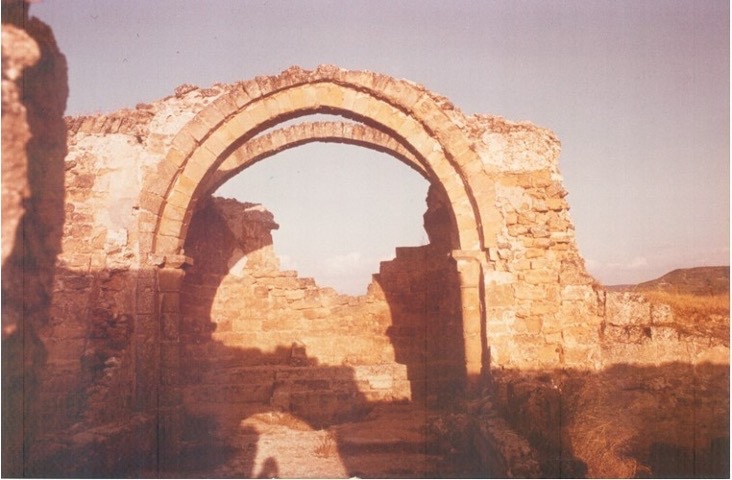
The horseshoe arch at Recaredopolis. Photo Courtesy: Paul Mirabile

Felipe let his horse roam about looking for a good feed whilst he meandered in and out of the moss-clad walls of the dilapadated palace, granary and sanctuary, filling his sketchbook with copy after copy of this fabulous mediaeval architectural trove. It seemed to him that no one, besides the villagers, had stepped foot in these ruins. Felipe felt estranged from himself, staggering about in a queer trance-like state from wall to wall, all so silent, yet deafening to his ears, so lyrical, so ecstatic that they strove to enter into communion with him. He sketched until the advent of night …
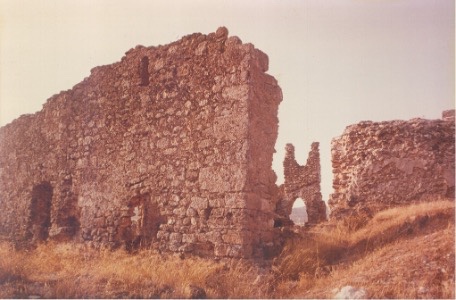
The ever-standing mediaeval sanctuary walls. Photo Courtesy: Paul Mirabile

Felipe built a fire and cooked a few potatoes and green peppers over it on a make-shift spittle. Lying on his bed-roll as he had done for so many star-studded nights, hands behind his head, he scrutinized the Autumn moon’s face mottled with huge black spots, listening to the deep, warm silence that surrounded him. He suddenly sat up: Had he not heard a runeful moaning skipping over the dry, empty plains? He bit his lower lip. The night air began to chill him. He continued to listen, attentively, his heart pounding painfully. Nothing. No one. Something frightened him: The horrors of war. Of famine and poverty ? Of old age creeping up upon him ? Or the ugliness of human depravity ? But why are these thoughts plaguing him at this very uninvited moment, as he lay so peaceful in this lieu of broken stones and tales ? 
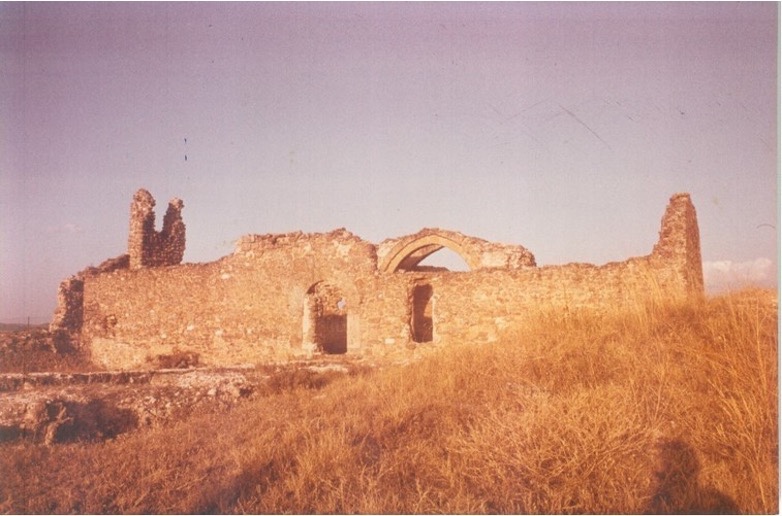
The sanctuary rising over the dry, grass-swept plain. Photo Courtesy: Paul Mirabile

He counted the stars, mentally tracing the curved contours of the waxing alabaster moon. Nothing stirred. No breath of wind, no call or cry from animal or bird. Felipe felt a surge of loneliness here as if the slow decay and negligence of the ruins resembled his own, physically and mentally … He was well over fifty, and the hardships of aging were slowly creeping up on him. His hand trembled when he drew. His back hurt from riding. His mind thought thoughtless thoughts, adrift between the past and the present in some sort of dark chaos. 

Felipe ignored the fact that no thought arises by thinking. Thoughts burst upon you at the most unsuspecting moments. They dance and whirl about then penetrate as quickly as that! The thinker must welcome them no matter how abrupt, unforeseen, painful. Yet, Felipe was keen on welcoming them, eager to decipher their subtle choreography.

He awoke in a dull trance. The sun rose lethargically over the voiceless ruins, the curling, misty plains. He watched its entrance into the world whilst the dancing thoughts that had spun him about during the night, and at present were jarring him out of sleep, grew brighter and brighter into figures of acts to be enacted. He threw dirt over the embers of the fire, rolled up his rug, saddled the munching Rocinante, and with a last glimpse of Visigoth Spain, galloped at full speed towards Madrid.

However, not to the big city. What had he to do with big cities ? No, Felipe Jimenez spurred desperately to Manzanares, twenty kilometres outside of Madrid, where there, the enigma of his quest would be resolved, or so he hoped! For a wild, dancing thought had overwhelmed him last night. A thought so feral that it would surely unlock the door to the mystery of an overt sense of hopelessness. Felipe imagined that hidden recess, heard its muffled invocations. To Manzanares he thus rode hard. To the Quinta del Sordo (Villa of the Deaf) where those welled up voices would overflow and spill forth the truth of centuries and centuries of silent exuberance, ecstasy and crime … To him and him alone ? That sacred communion remained to be seen …

Francisco de Goya’s voice, one that the great painter no longer heard since his deafness had severed him from the rest of the world, lay dorment in that villa; or so it was said. The great Master heard only faint murmurs of the Other World, murmurs that conducted his hand, steered his strokes, governed his unbridled imagination.

To those strange frescoes Felipe flew, thrilled that the hidden recesses of somber existence would be laid bare at that villa, illumined by the fourteen pinturas negras (black paintings), those black, ochre and brown pigments telling a tale that no historian, no archaeologist, no artist has ever told. Muteness, deafness, voicelessness — beacons of existential raison d’être

Three days later, Felipe Jimenez and Rocinante arrived at the villa as wreaths of fog were lifting off the slow, rolling wavelets of the River Manzanares. He dismounted, tied his horse to a tree and stood for several minutes in front of a quaint, two-storey country house behind which rose a range of shaggy hillocks hardly visible in the morning haze. Between the wisps of mist he noted that the front walls were in a deplorable state, suffering no doubt from the humidity and heavy rains. The alabaster sheen of the roughcast had crumbled off in large, mossy patches into a front garden overgrown with yellowing quitch grass, spiky thistles and thorny nettles. Flower beds had become weedy, rank.

He walked up to the front door and knocked: once … twice … thrice: No one.

Felipe laughed and thought: “Of course, he can’t hear. He’s deaf !” Mustering a bit of courage, he pushed open the heavy door; it had been left unbarred. He peeked inside, then slipped in quietly. Once inside, the silence frightened him. All the shutters had been shut in the dining room. There was hardly any furniture. A foul odour of dissolution made him dizzy.

“Señor …  Señor Goya?” Felipe called in a feeble voice unlike his own, the echo filling the room and his ears with unfamiliarity. “Are you out ? Yes, you must be out!” he assured himself, after which he rapidly threw open the shutters allowing streams of greyish, morning, misty light into the Master painter’s dining room. He gasped in disbelief. Painted on the dirty, unpapered walls were six frescoes that glowered at him in irate mockery. Yes, they eyed this intruder, this interloper’s every gesture with incensed scorn: there, the toothless guffawing of two old men hunched over their bowls slurping soup, fleshless faces sneering in gnarled lechery. Whether it was the dull light or the artistic acuteness of Goya’s brush work, their faces gave the impression of being embossed with warts or malignant tumours. Their clothes drooped on them like tattered rags (Dos viejos comiendo sopa)[10] !

Then Felipe approached a most peculiar scene: the mythological god of Time, Saturn, its eyes popping out of its sockets, was chewing one of his sons alive in bloody gluttony, the ruthless, long-haired creature believing that if he devoured his sons, one by one, he would never be dethroned by them, thus interrupting the course of Time (Saturno devorando uno de sus hijos)[11]. To his left, the most frightening of all frescoes: El Aquelarre[12]. Felipe drew closer. Yes, this was the Master’s most horrid depiction of his mindset: a black mass! It was a huge depiction of a motley crew, attired in tatters, gloating, mottled faces tormented, distorted by unhealthy beliefs, listening in starry-eyed reverence to a goat-like creature, yes, Satan himself, robed in black, horns held high in haughty hallowedness. Upon these dank, lonely walls Goya expunged from his tortured mind the two pillars of his psyche: the ecstatic and the grotesque  …

In a state of feverish agitation Felipe took out his sketchbook and traced the six frescoes one after the other like a madman attempting to capture each frightful feature, every desperate detail, each and every harrowing stroke of the Master’s demoniacal brush.

Sketching as best he could, given the dusky dimness of the late morning light and the dark pigments of the paintings, Felipe, after having drawn the downstairs frescoes now rushed head-long upstairs to Goya’s study. He shrank back in a dazed shock overwhelmed by the sight of the other eight masterpieces. All of them depicted the dark recesses of a man’s deranged mind, a mind enmeshed in  darkened  recesses, questioning and questioning and questioning. Felipe went from one to the other gaping at the cheerless existence of an artist, whilst the artist’s cheerless figures gaped at him, at this unwelcomed stranger. With much difficulty he discerned two warty, bizarre figures suspended dreamily in mid-air as if set free from Earth’s weightiness, sailing over a battlefield where they observed the drama below in ecstatic grotesqueness. In the background upon a hill an embattled castle lent a glum foreboding to the outcome of the scene (Visión fantástica)[13]. And there, on the back wall, two men, buried up to their knees, battling to the death with cudgels, a delightful technique that only the Spaniards could have invented. (Duelo a garrotazos)[14].

“Hobgoblins, all of them!” Felipe cried out involuntarily in crazed delirium. He had lost control of himself, sketching and sketching the figures that glowered at him, talking aloud in an effort to expurgate the evil that gradually filled his soul. The horrors of war, death, violence.

The most phantasmagorical visions had been assembled here in this dreadful villa during the restless nights of a his heart, painted by the Master of painters who had shunned all contact with the outside world. A solitary, mute communion had occurred within these demented walls, whose commerce wallowed in the mire of old age decrepitude, of sickening lust for glorious butcheries and triumphant slaughtering. Did Francisco de Goya love the smell of blood?

Felipe hardly understood the obsession that had nettled him for so many years whilst he sketched until his wrist ached. The mute stones … the deaf ears … the pounding silence that had entombed the landscape with courtly crimes, pogroms and despot debaucheries, all of which had crumbled into speechless stone, into hollow, unspoken edifices.  Indeed, all had fallen into decay, a slow decay, like the colourless figures painted on these waning walls ; like Goya’s mind ! “And mine ? Yes, mine too ! Ecstasy and grotesqueness : the mindset of our national character …” he acknowledged ingloriously.

Felipe, utterly exhausted, completed his sketching just before nightfall. He tip-toed down the stairway to the front door that he had left ajar. A last glimpse behind him saddened his heart; he had not met the Master. Yet, at the same time, a faint voice told him it would have been a fruitless meeting: the deaf have no one but themselves to converse with.

Furthermore, perhaps that meeting would have divulged the dreadful truth of Goya’s painted visions, and more importantly, the truth of those stones whose own untold story might have spoken a truth that only Felipe would have comprehended, enwrapping him thus in many veils of a strange, naïve self-satisfied truth. A truth that went beyond human reasoning, struggling in a twilight zone of Felipe’s own story within the quagmire.

It stands to reason that Felipe Jimenez had experienced what some call the ‘sense of the past’. A troubling experience that may occur at any instant of time or by incessant galloping between the past and the present. Nevertheless, it must be recorded that Felipe never really believed that he would fully join or unite the stony vestiges of a lost kingdom to the ‘black paintings’ by Francisco de Goya. Perhaps this sentiment or fantasy can be compared to the horse-shoe arch whose two bottom abutting stones sought to conjoin in a circle … in vain …

Be that as it may, our heroic Felipe died without friends or family. Only three of his sketches have been preserved. Oddly enough, they were discovered on the inside cover of a 1780 Royal Spanish Academy edition of El Ingenioso Hidalgo Don Quijote de la Mancha written by Miguel de Cervantes[15], edited by Joaquin Ibarra. In this same edition were also found several scattered notes in the margins presumedly jotted down by Felipe.

Felipe Jimenez’s tomb has never been located. Does this obliterate his existence ? I for one believe he did exist. However, many historians contend that he never existed at all …

.

[1]          Francisco de Goya (1746 – 1828) born in Fuentedetodos, Spain died in Bordeaux, France.

[2]        ‘The Black Paintings’.

[3] Don Quixote’s mangy horse was named as such. Miguesl Cervantes’ Don Quixote was published in 1605.

[4]        Head or top of a column or pillar.

[5]        A horizontal band of sculpture usually filled with animal or vegetal motifs.

[6]        The central aisle of a church.

[7]        Arches supporting intersecting vaults or arched roofs.

[8]        ‘Herradura’ means ‘horse-shoe’. It comes from the Spanish ‘hierro’ ‘iron’.

[9]        A large domed recess at the end of a chapel or church.

[10]      ‘Two old Men eating Soup’ (1819-1823). All the frescoes were painted during that time period.

[11]      ‘Saturn devouring one of his Sons’.

[12]      ‘Witches’ Sabbath’.

[13]      ‘Fantastic Vision’.

[14]      ‘Duel with cudgels’.

[15]      The Ingenous Gentleman, Don Quixote of La Mancha by Miguel de Cervantes Saavedra (1547-1616)

.

Paul Mirabile is a retired professor of philology now living in France. He has published mostly academic works centred on philology, history, pedagogy and religion. He has also published stories of his travels throughout Asia, where he spent thirty years.

.

PLEASE NOTE: ARTICLES CAN ONLY BE REPRODUCED IN OTHER SITES WITH DUE ACKNOWLEDGEMENT TO BORDERLESS JOURNAL

Click here to access the Borderless anthology, Monalisa No Longer Smiles

Click here to access Monalisa No Longer Smiles on Kindle Amazon International

Categories
Excerpt

Out of Sri Lanka

Title: Out of Sri Lanka: Tamil, Sinhala and English Poetry from Sri Lanka and its Diasporas 

Editors: Vidyan Ravinthiran, Seni Seneviratne and Shash Trevett. 

Publisher: Penguin India (Vintage)

AAZHIYAAL
(b. 1968)

Aazhiyaal (the pen name of Mathubashini Ragupathy) was born in Trincomalee in Eastern Sri Lanka. She taught English at the Vavuniya Campus, Jaffna University, before moving to Australia in 1997 where she worked for two decades in the IT sector and commercial management in Canberra. Aazhiyaal has published four collections of poetry in Tamil: Uraththup Pesa (2000), Thuvitham (2006), Karunaavu (2013) and Nedumarangalaai Vazhthal (2020), the last honoured by Canada’s Tamil Literary Garden. Her poems have appeared in anthologies and have been translated into several languages. She in turn has translated Australian Aboriginal poetry into Tamil (Poovulagaik Kattralum Kettalum, 2017). Aazhiyaal writes about women’s place within patriarchy and uses her work to make sense of the war in Sri Lanka: ‘I believe that poetry is the antidote to the present rat-race. It is needed, it is necessary.’


Unheeded Sights

After the rains
the tiled roofs shone
sparklingly clean.
The sky was not yet minded
to become a deeper blue.
The tar roads reminded me
intermittently of rainbows.
From the entire surface of the earth
a fine smoke arose
like the smoke of frankincense, or akil wood,
the earth’s scent stroking the nostrils,
fragrant as a melody.

As the army truck coming towards me
drives away,
a little girl transfers her candy-floss
from one hand to the other
raises her right hand up high
and waves her tiny fingers.

And like the sweet surprise
of an answering air-letter
all the soldiers standing in the truck
wave their hands, exactly like her.

The blood that froze in my veins
for an instant, in amazement,
flows again rapidly, asking aloud,
‘War? In this land?
Who told you?’

[tr. from Tamil by Lakshmi Holmström]


BASHANA ABEYWARDANE
(b. 1972)

Rohitha Bāshana Abeywardane was a member of the founding editorial board and later editor in chief of the Sinhala alternative weekly newspaper Hiru. In 2003, he was one of the activists who organised the Sinhala-Tamil Art Festival. His journalistic commitments brought on threats to his life, and he had to leave Sri Lanka. He continues to publish and coordinates Journalists for Democracy in Sri Lanka, an organisation founded by journalists in exile. Following a stay in the Heinrich Böll House, Langenbroich, Abeywardane took part in the PEN Writers in Exile Program from September 2007 to August 2010. Today, he lives in Germany with his wife.


The Window of the Present

Nightmares, long dead,
peer through the shattered panes
of the window of the present.

The dead of the south, killed on the streets,
with bullet-riddled skulls,
walk once again, through an endless night,

and those of the north drowned in deluges of fire
when rains of steel drench their unforgiving earth,
gaze through the shards of glass empty eyed;

as slaughtering armies, prowl under starless skies,
upholding sovereignty
with blood-soaked hands.

PACKIYANATHAN AHILAN
(b. 1970)

Born in Jaffna in the north of Sri Lanka, Packiyanathan Ahilan has lived through the thirty-year civil war. An academic as well as a poet, he has published three collections of poetry and is Senior Lecturer in Art History at the University of Jaffna. As well as writing about the visual arts, poetry, theatre and heritage, he curates art exhibitions and is co-editor of Reading Sri Lankan Society and Culture (Volumes 1 & 2). Ahilan’s poetry is sparse and staccato, like a heartbeat: he is one of the most influential poets writing in Tamil in Sri Lanka today.


Days in the Bunker III

Good Friday.
The day they nailed you
to the cross.

A scorching wind
blew across the land and the sea.
One or two seagulls
sailed in an immaculate sky.
The wind
howling in the palm trees
spoke of unfathomable terror.
That was the last day of our village.

We fishermen came ashore,
only the waves
returned to the sea.
When the sun fell into the ocean,
we too fell
on our knees
and wept.

And our lament
turned slowly into night.

In the distance
our village was burning
like a body being cremated.

Good Friday.
The day they nailed you
to the cross.

[tr. from Tamil by Sascha Ebeling]


A Poem about Your Village and My Village

1
I do not know.
I do not know if your village
is near the ocean with its wailing waves
or near a forest.
I do not know your roads
made from red earth and
lined with tall jute palms.
I do not know
the birds of your village
that come and sing in springtime.
I do not know
the tiny flowers along the roadsides
that open their eyelids when the rains pour down.
I do not know the stories
you tell during long nights
to the sound of drumbeats
or the ponds in your village
where the moon goes to sleep.

2
Tonight,
when even the wind is full of grief,
you and I know one thing:
Our villages have become
small
or perhaps large
cemeteries.
The sea with its dancing waves
is covered with blood.
All forests with their
trees reaching up to the sky
are filled with scattered flesh
and with the voices of lost souls.
During nights of war
dogs howl, left to themselves,
and all roads and the thousands
of footprints our ancestors left behind
are grown over with grass.
We know all this,
you and I.
We now know about
the flowers that died,
the abandoned lines of poetry,
the moments no one wants to remember.


3
But
do you know
if the burnt grass
still has roots,
or if the abandoned poems
can still be rooted in words?
If, like them, you do not know
whether our ancient flames
are still silently smouldering
deep down in that ocean
covered with blood,
know this today:
They say that
after he had lain in hiding
for a thousand years
one day
the sun rose again.

[tr. from Tamil by Sascha Ebeling]

ABOUT THE BOOK:

Out of Sri Lanka shines light upon a long-neglected national literature by bringing together, for the first time, Sri Lankan and diasporic poetry written in and after Independence.  Featuring over a hundred poets writing in English, or translated from Tamil and Sinhala reshapes our understanding of migrational poetics and the poetics of atrocity. Poets long out of print appear beside exciting new talents; works written in the country converse with poetry from the UK, the US, Canada and Australia. Poems in traditional and in open forms, concrete poems, spoken word poems, and experimental post-lyric hybrids of poetry and prose, appear with an introduction explaining Sri Lanka’s history.

There are poems here about love, art, nature – and others exploring critical events: the Marxist JVP insurrections of the 1970s and 80s, the 2004 tsunami and its aftermath, recent bombings linked with the demonisation of Muslim communities. The civil war between the government and the separatist Tamil Tigers is a haunting and continual presence. A poetry of witness challenges those who would erase, rather than enquire into, the country’s troubled past. This anthology affirms the imperative to remember, whether this relates to folk practices suppressed by colonisers, or more recent events erased from the record by Sinhalese nationalists.

 ABOUT THE EDITORS:

Vidyan Ravinthiran was born in Leeds, to Sri Lankan Tamils. His first book of poems, Grun-tu-molani (Bloodaxe, 2014), was shortlisted for the Forward Prize for Best First Collection, the Seamus Heaney Centre Poetry Prize and the Michael Murphy Memorial Prize. His second, The Million-petalled Flower of Being Here (Bloodaxe, 2019) was shortlisted for the Forward Prize for Best Collection, the T.S. Eliot Prize and Ledbury Munthe Poetry Prize for Second Collections. After posts at Cambridge, Durham and Birmingham, he now teaches at Harvard.

Seni Seneviratne, a writer of English and Sri Lankan heritage published by Peepal Tree Press, with books including Wild Cinnamon and Winter Skin (2007)The Heart of It (2012), and Unknown Soldier (2019), which was a Poetry Book Society Recommendation, a National Poetry Day Choice and highly commended in the Forward Poetry Prizes 2020.

She is currently working on an LGBTQ project with Sheffield Museums entitled Queering the Archive and her latest collection, The Go-Away Bird, was released in October 2023. She lives in Derbyshire.

Shash Trevett is a Tamil from Sri Lanka who came to the UK to escape the civil war. She is a poet and a translator of Tamil poetry into English. Her pamphlet From a Borrowed Land was published in 2021 by Smith|Doorstop.

Shash has been on judging panels for the PEN Translates awards and the London Book Fair, and was a Visible Communities Translator in Residence at the National Centre for Writing. Shash is a Ledbury Critic, reviewing for PN Review and the Poetry Book Society and is a Board Member of Modern Poetry in Translation. She lives in York.

Categories
Slices from Life

Serenading Sri Lanka

Photographs and Narrative by Mohul Bhowmick

Sri Lanka can be savoured best via its street food stalls; the aroma of the spices that emanates from the flurry of dishes left drying in the hot sun is supposed to hold the flavour of the country in its entirety.

Quite appropriately, I step out of the airport in Colombo just as dark clouds assemble overhead for an impromptu November gathering. The path to the bus terminal is waylaid in the melee, and the eventual taxi that comes around is met with immense gratitude for the warmth it emanates from within.

Meanwhile, the clouds have picked up pace and lambasted in full strength upon my flimsy raincoat. As the taxi — a Tata Nano — pulls out of the airport, I read a sign that tells me, rather ominously, ‘Welcome to Sri Lanka!’

.

But have I arrived? The drizzle accompanies me all day even as I try to venture out northwest from my dorm near the Galle Face Green towards Independence Square and Viharamahadevi Park. The park has a tinge of tenderness that makes me long for home barely six hours after I have left.

The soldier who has been entrusted to protect the monument of Gautama in the centre of the park slights me at first by asking me to put my camera away, but something about my nationality sparks enough curiousity and reverence in him to apologise and show me around its premises.

Named after the mother of the great Sri Lankan king Dutugemunu [161-137 BCE], who united the island under his banner after generations of oppression from Indian invaders, the park is tranquil in a manner that only the moneyed can afford to be. To be welcomed here by a member of the Lankan military seems ironic to me. Quite intrinsically, I discover that the affluent neighbourhood of Cinnamon Gardens is merely a stone’s throw away.

.

The sunset at Galle Face Green is where I lay my eyes upon the Indian Ocean for the first time; the gentle disappearance of the disk of fire in its graceful attire with lakhs of denizens of the city in attendance is not an event to be forgotten in a hurry.

It strikes me in the bouts of consciousness I still have with me on the start-stop train to Anuradhapura the next morning, which miraculously manages to reach the ancient capital of the island only moments after its scheduled time of arrival despite having spent about fifteen stoppages in the rough-hewn greenery of north-central Lanka.


The Isurumuni Royal Temple, Anuradhapura.

The Vanni, which separates the north from Anuradhapura, begins here, and I do not think I have gathered enough courage to bypass it just yet.

The Maha Sri Jaya Bodhi — a sapling of the Bodhi Tree under which the ascetic Sakyamuni had sat all night in meditation in the fifth century BCE and attained Enlightenment in Gaya — transposes much of the tranquillity one must have felt had Gautama himself been around; instead, hundreds of his lay followers deify his idol and consecrate his ideals with flowers and oaths of incorruptibility.

The compound where the Maha Bodhi stands allows one the permission to whisk the mind away from its constant whirl of thought and towards action based on feeling; its way, as Gautama’s, holds that offering the grant of ‘self-realisation’ to one’s fellow man is far more sumptuous a gift than an endowment of land or capital can ever accomplish.


Novice monks at the Ruwanwella Dagoba in Anuradhapura.

The Ruwanwella Dagoba, which the great Dutugemunu had painstakingly built, offers the refuge that the Maha Bodhi implores one to seek by going inwards. Two quarts of the Buddha’s relics are enshrined here, and the inflow of visitors ensures that the joyful policemen on duty are hard put to shred their visages of quietude, which one would have moments ago thought to be beyond them.

The next morning, with a German fellow traveller — whom I met at dinner while watching India decimate New Zealand on television in the semifinal of the cricket World Cup — I excavate whatever innards of peace and serenity I could from the Isurumuni Royal Temple.

My new friend from Germany tells me of of his experiences while travelling in Japan. He explains how he had made good use of the public parks (greens) at night as the locals did not use them after dark. He did not have money to sleep in hostels/ hotels and used benches in the public parks instead!

I offer him freshly plucked oranges from the gardens abutting the temple, where princes and princesses of an earlier age used to amble while seeking matches.

I get so drawn into the ethics that Gautama’s teachings must have instilled among the laypeople of the island that I almost forget to notice when my landlord — from whom I had also borrowed a bicycle — casually doubles the rate of his homestay when I check out. I learn — only much later — that he is no believer in the path Sakyamuni trod and speaks Tamil.


The Sigiriya rock fortress from afar.

Sigiriya seems much hotter than Anuradhapura1 was, and I write this even as the sun goes down and I climb up to a hidden rock far from the one which gives the town its name. The sun sets farther still from the Sigiriya Galla, and along with a bunch of British fellow travellers, I enjoy the last beads of light seeping past the horizon.

My evening is considerably brightened when our guide Vasu points me towards a green-looking hillock supposed to be the one Hanuman brought from the Himalayas as he sought for the life restoring ‘sanjeevani’ herb. While descending, a girl from Cornwall shrieks in considerable awe of the girth of the trunk of the first elephant she has ever seen.

The hike up Kasyapa’s fortress2 takes little effort, and the sparse crowd makes it feel worthwhile all the more. My newfound British friends — devoid of the SAARC3 protection of a reduced entry ticket to the top — climb the eastward facing Pidurangala instead. They tell me much later that they found the visage of Sigiriya quite appealing from the top of the latter; in a picture they show me, I cannot help but speculate that the black spot on the top of the rock was my shadow.

A dip in a hidden lake authorised by the owner of the backpacker’s hostel we are in is sprinkled liberally with views of the fortress in the backdrop; even the arrival of a slimy water snake that nibbles at my friend Jackson Price — a former telecommunications manager from Bristol — is not enough to shatter our sense of innate wellbeing.

.

There is just about enough time to catch the temple near the centre of Dambulla town unawares before Rapahel Nuding — a mechanical engineer from Stuttgart — and I take the bus south to Kandy. The carvings on the rocks inspire us both differently; me to poetry and him to decode how it could possibly have been done without the help of modern-age machinery.

Kandy is damp and misty when we arrive; the flecks of raindrops prance around nicely as neither of us wants to close the window shades of the rusty old bus we are travelling in. The lake can be sensed before we can see it; within an hour, we are back in the area to witness the ceremony at the Temple of the Tooth Relic where the dante dhatu, or the tooth relic, is displayed to laypeople.

Temple of the Tooth Relic

I help Raphael tuck into his — and my first this trip — masala dosa in the hordes of Tamil restaurants near the temple; I wonder if he asks for a second helping of the mango lassi to cool his inflamed tongue down or merely because he has liked the sensation the frozen — and possibly preserved — fruit. He stays back for a day, but I sling my bag to get on the morning train to Nuwara Eliya, having had enough of the cultural capital of Lanka already.

.

The bitter cold that greets me in Nuwara Eliya is only slightly lessened by the endless cups of tea that keep rolling through the night at the Laughing Leopards backpackers’ hostel. I struggle to explain to Helen Brinkmann, a post-graduate student from Dortmund, why I shall go to bed in tears having watched Australia demolish India in the final of the World Cup; the memories keep plaguing me a few days later in Ella when I sit down to get a grip upon myself and form an understanding of the ill-fated event.

Of the twin haunts of Nuwara Eliya and Ella, it is the journey that fascinates me the most; the rickety old contraption that passes off as a train is as old as I am in spirit and wanders only slightly off the gorgeous trails that have to perforce be left behind. Quite like the train, I am too enamoured by the countryside to trade it for the capital a week later.


The hills of Uva, as seen from Ella.

The hills that rise from the extensive green wildernesses filled with shrubs of undefinable assortment catch my eye in Ella, and it is some time before I can catch a grip of my sentiments and force myself to sit down. The bats and monkeys that gather in numbers at the Ravana Ella — or Ravana’s cave — scare me out of my wits before I can even put my foot into the mouth of the opening. Outside, the sun shines generously on a creek drifting past the hills in a muted whirr that only the sapient can perceive.

.

It speaks highly of the natural largesse that Sri Lanka possesses. Within hours of leaving the cool climes and peaks of Ella, I arrive at sea level, and the Indian Ocean peeks in patches to the left when the bus turns right from Matara, the southernmost tip of the isle. Indeed, I have breakfast in the hills and lunch on the coast.


Sunset at the beach in Mirissa

Mirissa, where I am headed next, brags of pristine beaches uninjured by the droves of tourists that fill it during the season. On arrival that evening, I find a rock to the west that garnishes a panorama that is stunning. My first encounter with kottu roti is astride a charitable helping of coconut sambal which my tongue finds excitable, and I tell myself that I am finally in the south.

.

Excursions are made to the beaches that litter the southern Lankan coast without rhyme or reason, or even distinction to one’s name or creed. Weligama, Midigama, Ahangama, the air force base at Koggala, Habaraduwa and Unawatuna all become names interchangeable with rapture perpetuated by the lack of inaccessibility. From another country, people struggle to reach me on my cell, and their needs stay blissfully away from my purview.

The sun shines on the coast much like it had done when I was in the west; the north and central parts of the country are barraged by untimely rains and I am glad to have left them behind.


The harbour as seen from Galle Fort.

Galle, where I am to stay for a night before heading back to Colombo, charms me out of my wits and looks askance as I walk away evincing a wry smile from the preposterous shindig that one might as well call a fort. The cricket ground stirs a longing for a home I have no rush to return to; on account of the goodwill and record I enjoy, I am allowed into the members’ stand for a gracious helping of a local under-19 match.

The entrapments that the Portuguese, the Dutch and the British had all in turn instituted — that now passes off as a spectacle of great pleasure — protect the town of Galle from outsiders, and also, it seems to me, from itself. Inward-looking to a fault, the Sinhalese of Galle have been known to open their hearts and hearths to all but those who have boasted of a skin tone less plentiful than white.

Upon being given to understand the intricacies of such delights and lodging in a palatial mansion owned by a Lankan Muslim family, I exult in the first serious gelato I have had in my life; an egg roti earlier in the day had barely served the purpose it was intended for.

.

Return to Colombo. I see the capital with eyes that I had not been endowed with when I first landed on these shores; it seems to be a lifetime ago now. The polished highway outside the President’s House, which abut the Chinese-funded port and end up at the imperial inheritance of the Galle Face Green purport me to a world I thought I had left behind in the countryside.

I put it down to my lack of vision but the night creeps up on me unannounced even as I try to trudge out of the humongous man-eating machine they call the One Galle Face shopping mall. It is not without some discomfort that I take flight, aware that it may not be for the last time.

.

  1. Kingdom of Dutugemunu ↩︎
  2. Built during the reign of King Kasyapa [477-495 CE] ↩︎
  3. South Asian Association for Regional Cooperation ↩︎

Mohul Bhowmick is a national-level cricketer, poet, sports journalist, essayist and travel writer from Hyderabad, India. He has published four collections of poems and one travelogue so far. More of his work can be discovered on his website: www.mohulbhowmick.com.

PLEASE NOTE: ARTICLES CAN ONLY BE REPRODUCED IN OTHER SITES WITH DUE ACKNOWLEDGEMENT TO BORDERLESS JOURNAL. 

Click here to access the Borderless anthology, Monalisa No Longer Smiles

Click here to access Monalisa No Longer Smiles on Kindle Amazon International

Categories
Poetry

Spectacles of Life

By Kumar Ghimire


Perceptions paint the world,
Each with their own
Lens of preconceptions.
Only an infant remains unpainted,
Blind to the art of presupposition.

The white clouds in the blue sky,
Perceived as dark,
When viewed through darkened lenses
In the garden, bloom to unravel secrets;
A revelation for the inquisitive,
Putting on the glasses of inquiry.

If you mask with restricted sight,
And the boundless sky shrinks to confinement,
Life mirrors the chosen spectacles,
Determining the hues of the lens
Through which you peer into the eye called life.

Kumar Ghimire is a poet from Nepal. He writes poems in Nepali and English language. His poems have been published in International Times, Ink Pantry, Synchronized Chaos, Grey Thoughts etc.

PLEASE NOTE: ARTICLES CAN ONLY BE REPRODUCED IN OTHER SITES WITH DUE ACKNOWLEDGEMENT TO BORDERLESS JOURNAL

Click here to access the Borderless anthology, Monalisa No Longer Smiles

Click here to access Monalisa No Longer Smiles on Kindle Amazon International

Categories
Excerpt

Spellcasters

Title: Spellcasters: A Novel 

Author: Rajat Chaudhuri

Publisher: Niyogi Books

Imprint: Olive Turtle

It was dark outside but for a faint yellow glow hanging like a cobweb around the gate lamp. She saw two figures moving stealthily, sneaking up the verandah. They were coming in her direction. As they approached the façade of the house they scanned the wall, and then the pillars.

The two men came right up to where she was hidden behind the window, and one was pointing above their heads at the exterior wall. He was well-built, about six feet, and wore a long raincoat speckled with rain and a cap with a chinstrap. He had something in his hand which looked like a crowbar for jimmying locks. The other man, much shorter, had a thickset brutish face, and he had such a cruel look in his eyes that Sujata gasped when she saw him standing so close. He was carrying a jerrycan. This guy had a vermilion streak on his forehead, and his bucktooth was shining in the faint light.

Will they try to break in? She could call out for help with the hope that someone would hear. But the nearest house belonged to a private school, and there would be no one there except for the caretaker who would be dead drunk. The hotel further down the road was still waterlogged, and the labourers—even if they heard her—won’t be able to make it here in time. Too late to call the police, and then there would be many questions.

The shorter of the two opened the jerrycan and began to splash some liquid on the walls and on the chairs kept outside. Petrol! His partner pulled a tool from his pocket and reached up to the wall. The electricity metres were just above his head. What! They were trying to short circuit the electric wires and start a fire! That’s what she thought they were upto. And when she rushed out, they would shoot her and dump her body into the flames.

She went stiff for a second but was alert right the next moment. With a swift movement she swept away the curtains, pushed the shutter and stood straight in front of the window.

The thuggish-looking character with the jerrycan took a step back at the sound and then he saw her. He gave out a low whistle to warn his companion while trying at the same moment to draw his gun. But whatever happened after that was too fast for him, or anyone for that matter.

It is impossible to provide an exact record. If someone was watching, they would have seen her cross her hands after she swept away the curtains to face the hired hitmen. She joined her hands, crossing her arms in that millennia-old swastika mudra—which they say can even stop the devil in his tracks.

It could have ended there but didn’t. As she made the hand gesture, buck-tooth whistled but he couldn’t draw his gun. An ice shower from another world froze his muscles. He turned to stone, buried as if under an avalanche of ice.

Through that daze he saw the curls of her hair writhe and twist, having come to life, animated and growing longer. Sinuous dark ribbons hissing their way out through the window, hoods raised, fangs exposed. Till there was no one on this side, only these swarthy hissing messengers of death slithering into the verandah.

The taller of the two hearing the other whistle, cursed under his breath, ‘Damn! What is it yaar?’

He glanced to his left but it was all too late. All that Sujata heard as she stepped back was a blood-curdling cry of agony as a blue tongue of fire leapt out from the metre box lashing at the two, flinging them back. Both were knocked out cold. It was only left for the fire to do the rest.

A hot train of sparks charged ferociously through the wires and licked the petrol doused wall. Within seconds the lawn lit up with this eerie blue light. Blue changed to white. Flames shivered like teasing tongues. Now they leapt through walls and doorways, and were streaking across the ceiling of her room in angry crimson arrows.

She threw on her jacket and rushed towards the passage for the kitchen exit. Amitav Ghosh’s book about climate change still lay open on the couch where Chanchal had left it. She stopped, scooped it up and stuffed it into her knapsack. A book is always a good weapon, hardbacks are even better. Below the book was a half-eaten bar of Atman dark chocolate; she had given it to him.

She took a bite and jammed it into her pocket. The curtains in the passage had caught fire from the radiated heat coming from the next room. She made a dash for the kitchen. If it got hot beyond a point, the gas tank would explode. Not another moment to lose!

But the kitchen door leading out to the backyard was jammed. She struggled with the oil and grime-caked bolt, losing precious minutes. Is this how she will go then?

ABOUT THE BOOK

Chanchal Mitra wakes up in a far-off desert town, sharing a dingy hotel room with the flamboyant Mr. Kapoor, who is planning to abduct a billionaire. Kapoor insists that the billionaire tycoon is an impostor. Chanchal is unwittingly drawn into the plot. Soon they are joined by the mystery woman Sujata, her eyes dark like murder; and then a crutch-clutching ex-sailor, who is quick with a gun.

In the smog-swathed capital city of Aukatabad, an organic chemist engaged by the tycoon to design a mind-altering drug, is found dead from an overdose. Elsewhere, the billionaire industrialist’s chocolate factory is contaminated by salmonella while Sujata fights a fiery death at the hands of hired killers. As weird weather overtakes the land and Kapoor sets out with his accomplices to kidnap the businessman, the flimsy lines between friend, foe and lover begin to quickly disappear.

ABOUT THE AUTHOR

Rajat Chaudhuri’s works include novels, story collections, edited anthologies and translations. He curated The Best Asian Speculative Fiction and co-edited the Multispecies Cities: Solarpunk Urban Futures (Asia-Pacific) anthology.

His most recent novel, The Butterfly Effect was twice listed by Book Riot (US) as one of the ‘Fifty must read eco-disasters in fiction’ and among ‘Ten works of environmental literature from around the world’. Acclaimed for its exploration of a ‘Ballardian near-future’, this novel is now taught in Indian, American and European universities. His short fiction has also appeared in the internationally acclaimed climate fiction video game, Survive the Century. Chaudhuri has received writing fellowships from Charles Wallace (UK), Hawthornden Castle (Scotland) and Livonics (India) and residency awards from Arts Council Korea-InKo (South Korea) and Sangam House (India).

ABOUT THE PUBLISHER

An internationally acclaimed publishing house, Niyogi Books, established in 2004, has more than 650 titles today. They not only specialize in textual context but also strive to give equal importance to visuals. They purvey a wide range of content on art, architecture, history, culture, spirituality, memoirs, and every aspect, which connects with our rich heritage. Under their umbrella, they have fiction and non-fiction that cover books on social science, cookery, and self-help as well as English Translations of modern classics from different Indian languages. Niyogi Books has recently launched four new Imprints: Olive Turtle (English fiction), Thornbird (English Translation), and Paper Missile (English non-fiction) and Bahuvachan (Hindi Translation: Fiction & Non-Fiction). Also, they have co-published a number of critically acclaimed books with reputed institutions like the British Library, Rietberg Museum Zurich, IGNCA, National Gallery of Modern Art, Ministry of Culture (Govt. of India), National Manuscript Mission, Sahitya Akademi, among many others.

.

PLEASE NOTE: ARTICLES CAN ONLY BE REPRODUCED IN OTHER SITES WITH DUE ACKNOWLEDGEMENT TO BORDERLESS JOURNAL

Categories
Poetry

Kuala Lumpur by Rex Tan

i.
Locked jaws on the kerb
A kick at the low cranium
Incisors, breakfast

ii.
Bright sky, lonely soul
The filial son wishes for
Longer road to home

iii.
Bracing wind, sun, rain
Kapchai* weaves through the city
For sesuap nasi*

iv.
Car tyres screech, yelling
A child runs to rescue his
Flying scarlet crane

v.
Wafting smell of food
Red fu* posters, peach blossoms
Your absence, rings loud


*Kapchai: (local slang) Underbone motorbikes
*Sesuap nasi: (Malay) A spoonful of rice
*Fu: (Mandarin 福)Prosperity

Rex Tan is a journalist by trade and a poet at heart. As a Malaysian, he is fluent in English, Mandarin, and Malay, yet he calls none his first language.

PLEASE NOTE: ARTICLES CAN ONLY BE REPRODUCED IN OTHER SITES WITH DUE ACKNOWLEDGEMENT TO BORDERLESS JOURNAL

Click here to access the Borderless anthology, Monalisa No Longer Smiles

Click here to access Monalisa No Longer Smiles on Kindle Amazon International

Categories
Poetry

Go, Green Hornet, Go

By Peter Magliocco

Go as the ghost without shadow
Into realms of Iron Man and Achilles
To steal their superpowers tonight.
What good is just being human anymore?
Pluck the force of ages
From the secretive cabbala
Of Wall Street mystics in hiding;
Fill your bounty with their crypto-coins
And rule the stock market of dreams.
The Gen-Z losers will cringe at your doorstep,
Bring you cold elixirs for forgetting foibles
Of their obsolete flesh in a time capsule.
With gusto swirl your cape into faces
Of once doubting infidels
Who’ll never know what it’s like coming-out
To scrape clouds of silver linings,
The taste of greening ambrosia on your lips
In the sunlight’s caress arcing
Past rainbow arches –

While Gotham mortals dress up for Halloween
Waiting for their monstrous selves
To replace dead superheroes

Peter Magliocco writes from Las Vegas, Nevada, where he’s been active as writer, poet, editor, and artist. He has recent poetry in A Too Powerful Word, Trouvaille Review, Lothlorien Poetry Journal, Flashes of Brilliance, dyst, Dreich, and elsewhere. His latest poetry books are The Underground Movie Poems (Horror Sleaze Trash), Night Pictures from the Climate Change (Cyberwit.net), and Particle Acceleration on Judgement Day (Impspired press).    

.

PLEASE NOTE: ARTICLES CAN ONLY BE REPRODUCED IN OTHER SITES WITH DUE ACKNOWLEDGEMENT TO BORDERLESS JOURNAL

Click here to access the Borderless anthology, Monalisa No Longer Smiles

Click here to access Monalisa No Longer Smiles on Kindle Amazon International

Categories
Stories

The Temple-going Snake

By Devraj Singh Kalsi

Every morning, around 9 a.m., the brown snake emerged from its cosy pit, slithered across the lush green grass, and found its way out of the bungalow through the lower rungs of the iron-grille door. Every evening, before sunset, around 6 p.m., the snake took the same path to return to its pit.

Adarsh followed the same routine without knowing that the resident snake was a keen follower of his schedule. One day, while taking the car out of the garage, he noticed the snake as it was moving out of the gate. He took his car out of the gate and looked around to trace the snake. But it was impossible to locate where it had gone. 

While driving his car, Adarsh was worried that the snake would bite several people, regretting that he should have made some more efforts to find out where it had vanished. When he reached his office and took the elevator, he shed his skin and transformed into a toxic agency head smitten by the urge to lord over the subordinates. Despite the heavy workload, he could not clear his mind as the snake kept his slithering into his thoughts. He decided to find out whether it was just a one-off incident or whether the presence of the snake in his compound signified the growth of enemies and unrecognised threats. 

Being curious to know more about the snake, he was ready to leave the house around the same time. The snake was also punctual and gave Adarsh had another encounter. This time, he was ready with the motorbike as he was prepared to follow the snake more closely and avoid getting stuck in a traffic jam. 

As the snake slipped out of the premises and took the main road, Adarsh geared up his bike and tracked the snake moving at its leisurely pace. When he came close to the canal bridge, he saw the snake crossing it along with pedestrians, keeping to the concrete edge. So many people were walking but they were unaware of the snake taking the same route.

When he crossed the bridge, he looked around for a while, unable to see where it had slipped. Then he stood near the milk booth and asked the shopkeeper whether he had seen a snake. Before he could get any response, Adarsh spotted the snake moving up the stairs of the temple across the road. His curiosity doubled up now and he parked his bike right in front of the milk booth and rushed to the temple. 

It had been several years since he had entered a temple. The pursuit of a snake had brought him close to the divine abode. He was eager to know why the snake frequented the temple – almost taking it up as an assignment to get to the bottom of the mystery. He hastened up the stairs to ensure he did not lose sight of the snake. For a few minutes, he pondered whether it was right for him to enter the temple atall as he was a man who, he felt, due to his profession had become poisonous, negative, and toxic. He wondered whether it was befitting for an evil guy to enter the pure, sublime space. Drawing solace from the fact that if a snake could enter the temple despite carrying venom in its body, he could also do the same without harbouring any guilt as the sac of poison resided in his mind.

Instead of folding his hands for prayer, he rang the bell and looked around for the snake. Considering it prudent to alert the priest, he said, “Pandit ji, I saw one long snake entering the temple so I came inside to inform you of the danger.”

“Oh! A snake has brought you here, Shriman[1],” the priest sprinkled holy water on his bald head and offered him flowers. He cupped those flowers in his palms, went ahead to bow down before the deity and offered the floral obeisance. Although he felt awkward doing this exercise, he did not know that this would bring him closer to the snake relaxing inside the sanctum area. Scared to find himself so close to the snake for the first time in his entire life, he gave a loud cry and made a quick attempt to rush out of its reach.

The priest was observing his nervous reaction. When he came out and stood in front of him, he was able to gather his composure. 

“So, you finally met the snake you came looking for after a long search?” the priest poked him.

Adarsh did not know how to respond to this question. This question raised many other questions. But he touched the feet of the priest and sought his blessings. This act of surrender made the priest answer the most probable questions in his mind. 

 “You wanted to know what the poisonous snake was here for. Before I answer that for you, can you answer what you do the whole day? Hiss, sting, bite, bare fangs, to get work done or worse perhaps…” 

Adarsh was silent for a while. His silence confirmed that the guess was correct. His job profile listed such toxic activities daily and there was nothing noble to mention with a glint of pride. It appeared that the priest was reading his dark mind and focusing on what had died within him over the years. He felt like running away to escape this examination. It would be equivalent to running away from the truth. His curiosity made him look for the snake, but the priest said it was the wish of the Lord that he came after a snake because the Lord wanted him to reform. Such a hard-hitting interpretation of a simple act of curiosity was as unacceptable to Adarsh as the will of God. 

The priest continued despite Adarsh showing no interest, hoping that this information would make him rethink. “You wanted to save people from a poisonous snake and you wanted to know where it goes. You are not a bad human being at all, only driven by circumstances and environment to commit sins. Look at this truth now. The snake sits inside the whole day and when the temple doors close, it goes to the place where it comes from, without disturbing a single person along the way, without biting a single person despite carrying so much poison. Take it as an inspiring lesson that though there is poison in the mind, one can still keep it under control and ensure no harm is caused to fellow human beings. Perhaps the snake is in good company and has reformed its nature. Read it from this angle. You should also come to the temple every day and spend time here. The Lord will be happy to see you. He gives more blessings to those who are most unlikely to come.” 

Without answering the priest, without promising anything to the priest, Adarsh turned around with folded hands and retraced his steps. While coming down the stairs, he remembered his recent misdeeds. He went home and dwelled on the priest’s words in his mind. The next evening, he left his office early and visited the temple. He met the priest, and the snake. There were many devotees singing bhajans and taking prasad. He sat alone in a corner for some time. The ambience seemed to have a transformative impact on him. For an hour, he discovered a new self – shed his old skin and found himself in a happy frame. 

Inside the office, Adarsh was a reformed person as he became polite and respectful. His juniors and peers were surprised to find a new boss in just a week. Adarsh continued with his daily trips to the temple and he was close to achieving a month of decent behaviour at the workplace. He followed the path shown by the snake and felt lighter inside. However, he did not know whether he could retain this new avatar without divine intervention daily, fearing he would return to his previous self if he stopped visiting the temple. He imitated the habit of the temple-going snake. 

After a few months, he asked the priest some hard-hitting questions during one such visit: “I did nothing wrong since I started coming here. But how long does it take to change one’s nature? I am a practical-minded person, and today, despite coming to the temple, I ended up sacking an employee I did not like to work with, on a very flimsy ground. I knew I was doing it wrong, but I could not stop myself from doing it. The evil had returned to me. I don’t want to nurture guilt, but I think I have failed the test I don’t know why the stupid snake keeps coming here. It should go and bite people, enjoy its toxic life, and keep sending people to hell instead of trying to change its basic character. I’m sure we all are not here to do good. Being good is so boring.”

Without waiting for the priest to answer, he stepped out of the temple premises. As he was coming down the stairs, he received a phone call from his office, and he was shocked to hear the urgent message. He slipped and fell, rolled down the stairs, landing in the hospital bed where he was declared to have suffered a severe spinal injury. Being wheelchair-bound, he sat in the blooming garden and observed the snake slithering out of the lush green cover to visit the temple, envying its luck every day. A poisonous life had turned pious whereas a life supposed to be pious had turned poisonous. The steps of the temple Adarsh was eager to climb down now became the steps he was eager to climb up once he got back on his feet again.  

[1] Mister

Devraj Singh Kalsi works as a senior copywriter in Kolkata. His short stories and essays have been published in Deccan Herald, Tehelka, Kitaab, Earthen Lamp Journal, Assam Tribune, and The Statesman. Pal Motors is his first novel.  


PLEASE NOTE: ARTICLES CAN ONLY BE REPRODUCED IN OTHER SITES WITH DUE ACKNOWLEDGEMENT TO BORDERLESS JOURNAL

Click here to access the Borderless anthology, Monalisa No Longer Smiles

Click here to access Monalisa No Longer Smiles on Kindle Amazon International

Categories
Stories

The Yellow Flower

By Haneef Sharif, translated from Balochi by Fazal Baloch

He had only two dreams in his life: first, to plant a yellow flower in the courtyard, and second, to die before the flower could bloom.

He wandered aimlessly through the streets. Just as he was about to turn the corner near the supermarket, he spotted a short-statured man with a bald head, wearing mismatched shoes, and carrying a briefcase. Memories of Mr. Hunchback flooded his mind, and he was nearly hit by a bus as he stood in the road absentmindedly. The driver slammed on the brakes abruptly, jolting all the passengers from their seats. Thus, he was saved. For weeks, he avoided going back, overwhelmed by fear. He dreaded the thought of venturing to the corner of the supermarket, fearing that he might meet with an accident and eventually die, unable to fulfill his desire of planting a yellow flower in the courtyard.

One day, however, he found himself wandering through those streets again. Whether it was a stroke of fate or a design of God, he spotted the same short-statured man who resembled Mr. Hunchback. The man was carrying the same briefcase he would take to the classroom. All the curious children wished that someone would open the briefcase so they could see its contents, but the fear of Mr. Hunchback kept them from getting close to him. Thus, nobody could ever discovered the secret hidden within the briefcase.

Out of the blue, he was startled by a loud honking horn. He faltered and almost fell down. A bus had stopped just before him. It seemed like divine intervention that he wasn’t run over. The driver looked at him with what appeared to be pity. He wondered why he wanted to die; what made him attempt suicide because the moment the bus took a turn he leapt in its path. If it was not for the bend in the road, causing the bus to slow down, he would have not narrowly escaped a second brush with death.

He moved away from the path of the bus, concealing his fear of death, holding his heartbeat, and resumed walking. As he distanced himself, his gaze fell upon a young girl standing on the balcony of her apartment. Her head was bowed, engrossed in something on her mobile screen. She wore blue jeans and a grey shirt, standing with one foot gracefully placed over the other.

He stood there for a while, captivated by the sight of the girl, who remained oblivious to his presence. Moments later, a young man of her age came in and wrapped his arm around her waist, startling her for a moment. Soon after, she leaned her head on his shoulder and their lips met for a fleeting moment him before they disappeared into the apartment.

He lingered there, waiting for someone to appear, but no one did. He remained fixated on the balcony, indifferent to the passing buses and pedestrians carrying briefcases. His attention was drawn to a vase on the balcony with a yellow flower. Yellow was a colour he associated with death. Whenever he spotted the colour, he would pressume someone must have died or was about to die somewhere. He avoided yellow taxis or buses and refrained from downloading anything of that hue. He was puzzled by those who chose to paint their houses yellow.

On that particular day, the balcony he had been observing was painted entirely in yellow, including the door and the entire building. He couldn’t explain why he hadn’t noticed this before, even the girl had worn yellow earrings. Despite regularly visiting the street after his initial encounter with the girl, she never appeared on the balcony again. He began to suspect that the girl had died, but he couldn’t fathom how it had happened. Then, that day, as he gazed at the balcony, contemplating death, the door suddenly swung open, revealing the very girl he had been musing about for several days. She stood there, surveying the street below.

“Did she see me or not?” He wondered without any reason.

As she glanced downward, a bus sped by, stirring in him a disdain for buses. He quickly redirected his attention to the girl, who then approached the yellow flower, gazing at it with sorrowful eyes. As she began to caress its petals, her eyes welled up with tears. And as she sobbed, her tears fell onto the yellow petals. In that moment, he thought someday, he would plant a yellow flower and before the flower could bloom, he would commit suicide.

(An Excerpt from Hanif Sharif’s recent novel “Afsanah” brought out be Adab Publisher in Balochi, translated by Fazal Baloch)

Dr. Haneef Shareef, a trained medical professional, is one of the most cherished contemporary Balochi fiction writers and film directors. So far, he has published two collections of short stories and one novel. His peculiar mode of narration has rendered him a distinguished place among the Balochi fiction writers. He has also directed four Balochi movies.

Fazal Baloch is a Balochi writer and translator. He has translated many Balochi poems and short stories into English. His translations have been featured in Pakistani Literature published by Pakistan Academy of Letters and in the form of books and anthologies. He has the translation rights to Haneef Shareef’s works. 

.

PLEASE NOTE: ARTICLES CAN ONLY BE REPRODUCED IN OTHER SITES WITH DUE ACKNOWLEDGEMENT TO BORDERLESS JOURNAL

Click here to access the Borderless anthology, Monalisa No Longer Smiles

Click here to access Monalisa No Longer Smiles on Amazon International

Categories
Poetry

Meeting  Poets Outside their Poems

By Alpana

Meeting poets outside their poems is like catching hold of a dandelion
always fleeting and flying.
fanning our desires to be light and liberated.

I met a poet in the wee hours of spring yesterday,
wrapped in thoughts,
inhaling more matter,
processing many ideas,
looked much like her poems,
blooming and how!

I met a poet in the early hours of baisakh*,
smelling like toil,
sprinkled with joy
of harvesting goodness,
just like his poems,
emanating courage and thick-skinned demeanour.

I met a poet walking briskly early morning,
panting and perspiring
due to swift movement
but also, gasping to let the poetry ooze out.
Her poetry is quick
Because the pace of her steps mirrors the pace of the gazillion words
plodding in her mind.

I met a poet chewing a gummy one day,
lost in her own reverie
absolutely chill,
rummaging her bag for more such gummyfying trysts,
sitting in a bean sofa with pen and paper
scribbling and doodling away her worries
just like that!

I met a poet engrossed in thrift shopping the other day
clad in comfort, spotting the comfort
not to discomfort his hard-earned moolah
but the words in his poems are priceless.
Because they reveal what being a parent is like.
The experience is valuable and so is his poetry,
causing ripples here and there,
echoing babbles now and then.

So, now you know where to spot poets.
When not absorbed in writing,
spot the happy souls or the dejected ones
in spring,
in the by-lanes of your colony,
or a high-end bar busy chewing a gummy.
Poets are fascinating.
Poets are otherworldly.
But how do you match the poets with their poetry?
How to remove the veil?
The make-believe.
The façade.
The art.
Please, tell me.
Because poets outside their poems
might be catching butterflies
or responding to a cooing baby.
But exactly how do you match the poets with their poetry?


*April-May

Alpana teaches in a government college of Gurugram, Haryana. If not responding to her babbling toddler and her curious gestures, she finds herself occupied with reading haikus and listening to Jagjit Singh ghazals.

.

PLEASE NOTE: ARTICLES CAN ONLY BE REPRODUCED IN OTHER SITES WITH DUE ACKNOWLEDGEMENT TO BORDERLESS JOURNAL

Click here to access the Borderless anthology, Monalisa No Longer Smiles

Click here to access Monalisa No Longer Smiles on Amazon International